

ISO/FDIS 21256-2
(Main)Fine bubble technology — Cleaning applications — Part 2: Test method for cleaning machine oil stains from the surfaces of machined metal parts
- Abstract
This document specifies a test method for removal of machine oil stain from a noncorrosive metal surface using fine bubble water. A test is provided to show the comparative cleaning advantage of adding fine bubbles to the water.
- Status
- Not Published
- Technical Committee
- ISO/TC 281 - Fine bubble technology
- Drafting Committee
- ISO/TC 281/WG 3 - Applications of fine bubble technology
- Current Stage
- 5020 - Proof sent to secretariat or FDIS ballot initiated: 8 weeks - 50 Approval
- Start Date
- 30-Oct-2026
- Due Date
- 30-Oct-2026
- Completion Date
- 30-Oct-2026
Buy Documents
ISO/FDIS 21256-2 - Fine bubble technology — Cleaning applications — Part 2: Test method for cleaning machine oil stains from the surfaces of machined metal parts
REDLINE ISO/FDIS 21256-2 - Fine bubble technology — Cleaning applications — Part 2: Test method for cleaning machine oil stains from the surfaces of machined metal parts
ISO/FDIS 21256-2, published by ISO, is a test standard for fine bubble technology in cleaning applications. It specifies how to assess removal of machine oil stains from noncorrosive machined metal surfaces using fine bubble water. The method is written for users who need a repeatable way to compare cleaning performance with and without fine bubbles.
What does ISO/FDIS 21256-2 specify?
ISO/FDIS 21256-2 specifies a laboratory test method for removing machine oil stains from a noncorrosive metal surface using fine bubble water. It is set up to show the comparative cleaning advantage of adding fine bubbles to the water, so the result is a side-by-side performance comparison rather than a general cleaning claim.
The document is organized into clauses for scope, references, terms, principle, reagents and materials, apparatus, specimen preparation, procedure, calculation, and test reporting. It also includes three informative annexes that give examples and one alternative evaluation method.
| Annex | What it covers |
|---|---|
| Annex A | Example method for depositing an oil stain on the test pieces, including a worked cleaning test example |
| Annex B | Example infrared spectrum of the test oil used for oil content meter calibration |
| Annex C | Alternative evaluation method by gravimetric measurement |
What are the key requirements of ISO/FDIS 21256-2?
ISO/FDIS 21256-2 sets out a controlled comparison between cleaning with plain water and cleaning with fine bubble water. In practice, the value of the method depends on keeping the test oil, specimen preparation, cleaning conditions, and residual-oil measurement consistent.
Materials and test pieces
Clause 5 requires treated water that conforms to ISO 3696, a specified test oil, and a defined extraction solvent. The test oil is triolein or another oil agreed by the parties concerned, such as an anti-rust oil or press release agent. This matters because the oil must represent the cleaning challenge being studied.
Clause 7 requires test pieces of a fixed size, made from stainless steel grade 4301-304-00-I in accordance with ISO 15510, with a lapped surface and controlled roughness. The surface must be free of dents and scratches. In practice, the metal surface condition affects how the oil film behaves and how easily it is removed.
Depositing the oil stain
Clause 7.2 gives the preparation route for the stained test pieces. The test pieces are first cleaned, dried, then coated with the test oil on the front surface and heated to fix the stain. The coating must have a controlled surface density and uniformity, so each specimen starts from a comparable contamination level.
Annex A gives one example of how the oil stain can be deposited in practice, including spray application and calibration of spraying time. That example helps laboratories set up a repeatable staining method when they need a practical starting point.
Apparatus and cleaning conditions
Clause 6 describes the test equipment, including the cleaning tank, the outlet geometry, the position of the test piece, and the requirement for a fine bubble generating system that can be switched on and off. The tank and flow arrangement are fixed so the cleaning stream hits the specimen in a defined way. That makes the comparison between plain water and fine bubble water meaningful.
Clause 8 sets the cleaning conditions. The water temperature, flow rate, cleaning duration, and water volume are controlled, and the tank is emptied and cleaned between tests. A continuous flow is circulated during cleaning. In practice, the operator must keep the cleaning environment stable, because changes in temperature or flow can change the amount of oil removed.
Measurement and calculation
Clause 4 states the principle: compare residual oil after cleaning and measure it with an oil content meter based on infrared spectroscopy. Clause 8.3 describes extraction of the remaining oil from the test piece and measurement of the extracted solution. This is important because the method does not judge cleaning by appearance; it quantifies remaining oil.
Clause 9 defines the oil cleaning index calculations for the plain-water test and the fine-bubble-water test. The index is based on the change between the initial oil load and the residual oil after cleaning. In practice, the same calculation allows direct comparison of the two cleaning conditions.
Test reporting
Clause 10 requires the test report to identify the sample, the standard used, the method used, the results and calculation clause, any deviations, unusual features, and the test date. This matters for traceability, internal comparison, and external review.
What terms does ISO/FDIS 21256-2 define?
ISO/FDIS 21256-2 formally defines oil cleaning index and uses several operational terms throughout the method.
- Oil cleaning index - the number representing the residual oil removed from the test surface after cleaning.
- Fine bubble water - the cleaning water used with fine bubbles for the comparative test against plain water.
- Test piece - the prepared machined metal specimen that carries the oil stain and is used in the cleaning test.
- Test oil - the oil applied to the front surface of the test piece before cleaning, usually triolein or an agreed oil.
- Residual oil - the oil remaining on the test piece after the cleaning step and extraction measurement.
- Oil content meter - the infrared spectroscopy-based instrument used to measure the extracted oil.
- Surface concentration - the amount of oil normalized to the area of the test piece, used in the calculation of the oil cleaning index.
Who uses ISO/FDIS 21256-2?
ISO/FDIS 21256-2 is used by laboratories, manufacturers, and technical teams working with fine bubble cleaning systems. It is relevant in industries where industrial products carry mineral oil from cutting, lubrication, or cooling operations.
Typical users include:
- fine bubble technology developers
- cleaning equipment manufacturers
- testing laboratories
- quality assurance teams
- process engineers in metalworking and machining
- buyers or evaluators comparing cleaning performance claims
In practice, these users apply the standard when they need to document cleaning performance, compare different cleaning methods, or check the effect of fine bubble generation under controlled conditions.
What changed in ISO/FDIS 21256-2 from the previous edition?
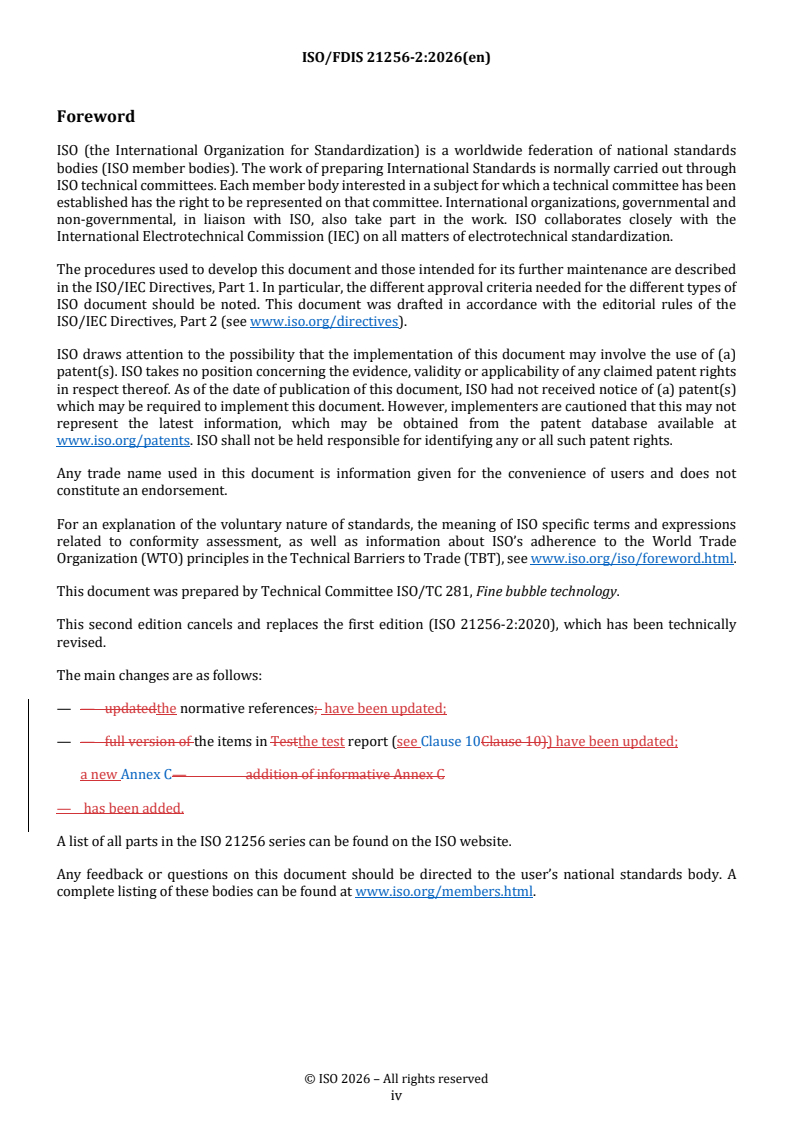
ISO/FDIS 21256-2 is the second edition and cancels and replaces ISO 21256-2:2020. The foreword states three changes:
- the normative references were updated
- the items in the Clause 10 test report were updated
- informative Annex C was added
These changes indicate a technical revision, with the reporting format and supporting material brought up to date.
Which standards are used with ISO/FDIS 21256-2?
ISO/FDIS 21256-2 refers to several standards that support the test method:
- ISO 3696 - provides the water quality specification used for the test water
- ISO 6353-3 - specifies reagents, including propanol-2-ol and other chemicals used in specimen cleaning and preparation
- ISO 15510 - identifies the stainless steel material grade used for the test pieces
- ISO 20480-1 - supplies terminology for fine bubble technology
- ISO 20480-2 - supplies categorization of fine bubble attributes
- JIS K 0117 - is cited for infrared spectrophotometric analysis used with the oil content meter
- ASTM D 7066-04 - is cited for infrared determination related to oil and grease measurement
These references support the specimen material, chemical handling, terminology, and the analytical measurement used in the method.
What does the ISO/FDIS 21256-2 document contain?
ISO/FDIS 21256-2 contains the test principle, specimen preparation, apparatus requirements, cleaning procedure, calculation formulas, and reporting items needed to run the method. It also includes a detailed equipment figure in Clause 6, an example oil-deposition method in Annex A, an example infrared spectrum and calibration information in Annex B, and an alternative gravimetric evaluation method in Annex C.
The document also includes worked examples. Table A.1 shows example results, Table A.2 shows an example test report, and Annex A links the practical steps to the calculation of the oil cleaning index. Annex C explains how gravimetric weighing can be used for rough screening, while the main body keeps infrared spectroscopic analysis as the reference approach.
Relations
- Effective Date
- 22-Nov-2025
Buy Documents
ISO/FDIS 21256-2 - Fine bubble technology — Cleaning applications — Part 2: Test method for cleaning machine oil stains from the surfaces of machined metal parts
REDLINE ISO/FDIS 21256-2 - Fine bubble technology — Cleaning applications — Part 2: Test method for cleaning machine oil stains from the surfaces of machined metal parts
Frequently Asked Questions
ISO/FDIS 21256-2 is a draft published by the International Organization for Standardization (ISO). Its full title is "Fine bubble technology — Cleaning applications — Part 2: Test method for cleaning machine oil stains from the surfaces of machined metal parts". This standard covers: This document specifies a test method for removal of machine oil stain from a noncorrosive metal surface using fine bubble water. A test is provided to show the comparative cleaning advantage of adding fine bubbles to the water.
This document specifies a test method for removal of machine oil stain from a noncorrosive metal surface using fine bubble water. A test is provided to show the comparative cleaning advantage of adding fine bubbles to the water.
ISO/FDIS 21256-2 is classified under the following ICS (International Classification for Standards) categories: 07.030 - Physics. Chemistry. The ICS classification helps identify the subject area and facilitates finding related standards.
ISO/FDIS 21256-2 has the following relationships with other standards: It is inter standard links to ISO 21256-2:2020. Understanding these relationships helps ensure you are using the most current and applicable version of the standard.
ISO/FDIS 21256-2 is available in PDF format for immediate download after purchase. The document can be added to your cart and obtained through the secure checkout process. Digital delivery ensures instant access to the complete standard document.
Standards Content (Sample)
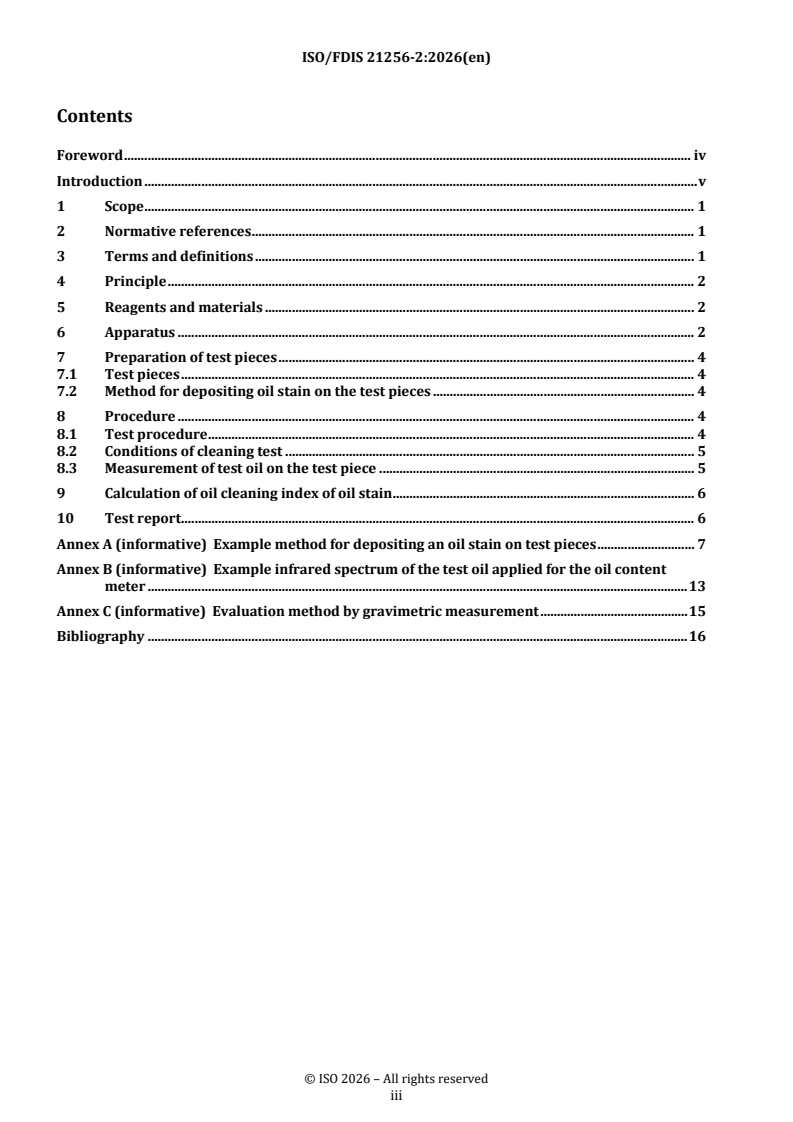
Contents
- Introduction
- 1 Scope
- 2 Normative references
- 3 Terms and definitions
- 3.1 oil cleaning index
- 4 Principle
- 5 Reagents and materials
- 6 Apparatus
- 7 Preparation of test pieces
- 7.1 Test pieces
- 7.2 Method for depositing oil stain on the test pieces
- 8 Procedure
- 8.1 Test procedure
- 8.2 Conditions of cleaning test
- 8.3 Measurement of test oil on the test piece
- 9 Calculation of oil cleaning index of oil stain
- 10 Test report
- Annex A
- Annex B
- Annex C
- Bibliography
Introduction
Mineral oil is used in manufacturing processes of industrial products, for applications such as cutting, lubrication and cooling. Oil remaining on the surface of products is cleaned during operation and at the end of the process. The main cleaning solvent fluids used in these industries are solvent based (e.g. hydrocarbon detergent liquids, bromine-containing detergents, alkali detergents), despite it being well known that such detergents can cause environmental pollution such as ozone layer depletion, water pollution, etc. As an ecological alternative, fine bubble technology, which does not use detergents, is becoming popular. Use of fine bubble technology improves resource sustainability, energy saving and safety, as it uses less water and no chemical substances.
This document is intended to provide a procedure that can help demonstrating the cleaning performance of such technology, so that different methodologies can be compared.
FINAL DRAFT International Standard ISO/FDIS 21256-2:2026(en) Fine bubble technology — Cleaning applications — Part 2:
Test method for cleaning machine oil stains from the surfaces of machined metal parts
1 Scope
This document specifies a test method for the removal of machine oil stains from noncorrosive metal surfaces using fine bubble water. A test is provided to show the comparative cleaning advantage of adding fine bubbles to the water.
2 Normative references
The following documents are referred to in the text in such a way that some or all of their content constitutes requirements of this document. For dated references, only the edition cited applies. For undated references, the latest edition of the referenced document (including any amendments) applies. ISO 3696, Water for analytical laboratory use — Specification and test methods ISO 6353-3, Reagents for chemical analysis — Part 3: Specifications — Second series ISO 15510, Stainless steels — Chemical composition ISO 20480-1, Fine bubble technology — General principles for usage and measurement of fine bubbles — Part 1:
Terminology ISO 20480-2, Fine bubble technology — General principles for usage and measurement of fine bubbles — Part 2:
Categorization of the attributes of fine bubbles
3 Terms and definitions
For the purposes of this document, the terms and definitions given in ISO 20480-1, ISO 20480-2 and the following apply.
ISO and IEC maintain terminology databases for use in standardization at the following addresses:
- ISO Online browsing platform: available at https:// www .iso .org/ obp
- IEC Electropedia: available at https:// www .electropedia .org/
3.1 oil cleaning index
number representing the residual oil removed from the test surface after cleaning
4 Principle
Evaluate the performance of oil removal from stained surfaces. The test compares cleaning performance based on measuring the amount of residual oil after cleaning surfaces with or without the bubble water. The residual oil is measured using an oil content meter based on infrared spectroscopy.
ISO/FDIS 21256-2:2026(en)
5 Reagents and materials
5.1 Water, which usually has been treated and conforms to grades of water in accordance with ISO 3696. 5.2 Test oil.
The test oil used to coat the test surface shall be triolein or an oil agreed between the parties concerned (e.g. among anti-rust oil or press release agent). An example of infrared spectrum of the test oil applied for an oil content meter is given in Annex B.
5.3 Extraction solvent, containing 65 % to 75 % (mass fraction) of extracted chlorotrifluoroethylene dimer (CF CFCl) or C F Cl and 25 % to 35 % (mass fraction) of extracted chlorotrifluoroethylene trimer 2 2 4 6 2 [1] (CF CFCl) or C F Cl and chlorotrifluoroethylene tetramer (CF CFCl) or C F Cl . See JIS K 0117 . 2 3 3 9 3 2 4 4 12 4
6 Apparatus
6.1 Test equipment.
Figure 1 shows a typical example of equipment, where the differences in results between operation with the fine bubble generating system on and off can be compared. The dimensions of the cleaning tank shall be as given in Figure 1.
The following applies:
a) The inside dimension of the cleaning tank shall be (280 ± 10) mm × (230 ± 10) mm × (340 ± 10) mm. b) The inside diameter of the cleaning stream outlet shall be (13 ± 0,1) mm. c) The centre of the test piece shall be placed at (100 ± 10) mm distance from the cleaning stream outlet, and (115 ± 5) mm distance from the side wall of the tank.
d) The centre of the test piece shall be placed on the axis of the outlet. e) The position of the test piece shall be such that the cleaning stream hits normal to its surface. f) The streamline at the outlet shall be parallel to the axis of the outlet. g) The material of the tank shall be a transparent heat-resistance resin. h) Test equipment and accessories shall be cleaned off residual oil after test for each test piece. Fresh water shall be used for testing the subsequent test piece.
ISO/FDIS 21256-2:2026(en) Dimension in millimetres Key 1 fine bubble supply system 2 pump 3 filter 4 fine bubble generating system ON/OFF 5 flow rate of suction air 6 cleaning tank 7 cleaning stream outlet 8 test piece 9 cleaning water 10 flow rate of water a The fine bubble generator shall be able to turn ON/OFF.
b The position of the test piece shall be such that the cleaning stream hits normal to its surface.
The quantity of water shall be 15 l.
Figure 1 — Test equipment 6.2 Oil content meter, measuring instrument based on infrared spectroscopy, which is commercially available. Refer to the manufacturer instructions for the sampling procedure, sample preparation and [1] [2] detection limit (see JIS K 0117 and ASTM D 7066-04 ).
The oil content meter should be calibrated.
An example of infrared spectrum of the test oil applied for oil content meter calibration is given in Annex B. NOTE As an alternative method for evaluating the cleaning performance, an example of a gravimetric approach is shown in Annex C.
ISO/FDIS 21256-2:2026(en)
7 Preparation of test pieces
7.1 Test pieces
The dimensions of test pieces shall be length of (75 ± 1) mm and width of (20 ± 1) mm with thickness of (1,5 ± 0,5) mm for easy treatment. Material of the test pieces shall be 4301-304-00-I in accordance with ISO 15510, and lapped surface with roughness Ra 50 nm to 100 nm. The test sample surface shall be free of surface dents and scratches.
7.2 Method for depositing oil stain on the test pieces
The method for depositing test oil on the test pieces shall be as follows:
a) Clean all surfaces of the test pieces using a waste cloth with propanol-2-ol in accordance with ISO 6353-3. b) Then, clean all surfaces of the test pieces using clean waste cloth with extraction solvent (5.3). c) Dry the surface of the test pieces with a dryer or leave it at room temperature for a sufficient time (e.g. 10 min or more) and ensure to completely dry it.
...
Contents
- Introduction
- 1 Scope
- 2 Normative references
- 3 Terms and definitions
- 3.1 oil cleaning index
- 4 Principle
- 5 Reagents and materials
- 6 Apparatus
- 6.2 Oil content meter
- 7 Preparation of test pieces
- 7.1 Test pieces
- 7.2 Method for depositing oil stain on the test pieces
- 8 Procedure
- 8.1 Test procedure
- 8.2 Conditions of cleaning test
- 8.3 Measurement of test oil on the test piece
- 9 Calculation of oil cleaning index of oil stain
- 10 Test report
- Annex A
- Annex B
- Annex C
- Bibliography
Introduction
Mineral oil is used in manufacturing processes of industrial products, for applications such as cutting, lubrication and cooling. Oil remaining on the surface of products is cleaned during operation and at the end of the process. The main cleaning solvent fluids used in these industries are solvent based (e.g. hydrocarbon detergent liquids, bromine-containing detergents, and alkali detergents), despite it being well known that such detergents can cause environmental pollution such as ozone layer depletion, water pollution, etc. As an ecological alternative, fine bubble technology, which does not use detergents, is becoming popular. Use of fine bubble technology improves resource sustainability, energy saving and safety, as it uses less water and no chemical substances.
This document is intended to provide a procedure that can help demonstrating the cleaning performance of such technology, so that different methodologies can be compared.
Fine bubble technology — Cleaning applications — Part 2:
Test method for cleaning machine oil stains from the surfaces of machined metal parts
1 Scope
This document specifies a test method for the removal of machine oil stainstains from a noncorrosive metal surfacesurfaces using fine bubble water. A test is provided to show the comparative cleaning advantage of adding fine bubbles to the water.
2 Normative references
The following documents are referred to in the text in such a way that some or all of their content constitutes requirements of this document. For dated references, only the edition cited applies. For undated references, the latest edition of the referenced document (including any amendments) applies. ISO 3696, Water for analytical laboratory use — Specification and test methods ISO 6353-3, Reagents for chemical analysis — Part 3: Specifications — Second series ISO 15510, Stainless steels — Chemical composition ISO 20480-1, Fine bubble technology — General principles for usage and measurement of fine bubbles — Part 1:
Terminology ISO 20480-2, Fine bubble technology — General principles for usage and measurement of fine bubbles — Part 2:
Categorization of the attributes of fine bubbles ISO 15510, Stainless steels — Chemical composition ISO 6353-3, Reagents for chemical analysis — Part 3: Specifications — Second series
3 Terms and definitions
For the purposes of this document, the terms and definitions given in ISO 20480-1, ISO 20480-2 and the following apply.
ISO and IEC maintain terminology databases for use in standardization at the following addresses:
- ISO Online browsing platform: available at https://www.iso.org/obp
- IEC Electropedia: available at https://www.electropedia.org/
3.1 oil cleaning index
number representing the residual oil removed from the test surface after cleaning
ISO/FDIS 21256-2:2026(en)
4 Principle
Evaluate the performance of oil removal from stained surfaces. The test compares cleaning performance based on measuring the amount of residual oil after cleaning surfaces with or without the bubble water. The residual oil is measured using an oil content meter based on infrared spectroscopy.
5 Reagents and materials
5.1 Water, which usually has been treated and conforms to grades of water given in accordance with ISO 3696.
5.2 Test oil.
The test oil used to coat the test surface shall be triolein or an oil agreed between the parties concerned, (e.g.,. among anti-rust oil or press release agent.). An example of infrared spectrum of the test oil applied for an oil content meter is given in Annex B.
5.3 Extraction solvent, containing 65 % to 75 % (mass fraction) of extracted chlorotrifluoroethylene dimer (CF CFCl) or C F Cl and 25 % to 35 % (mass fraction) of extracted chlorotrifluoroethylene trimer (CF CFCl) 2 2 4 6 2 2 3 [1] or C F Cl and chlorotrifluoroethylene tetramer (CF CFCl) or C F Cl . See JIS K 0117 Reference [1].. 3 9 3 2 4 4 12 4
6 Apparatus
6.1 Test equipment.
Figure 1 shows a typical example of equipment, where the differencedifferences in resultresults between the operation with the fine bubble generating system on and off can be compared. The dimensions of the cleaning tank shall be as given in Figure 1.
The following applies:
a) The inside dimension of the cleaning tank shall be (280 ± 10) mm × (230 ± 10) mm × (340 ± 10) mm. b) The inside diameter of the cleaning stream outlet shall be (13 ± 0,1) mm. c) The centre of the test piece shall be placed at (100 ± 10) mm distance from the cleaning stream outlet, and (115 ± 5) mm distance from the side wall of the tank.
d) The centre of the test piece shall be placed on the axis of the outlet. e) The position of the test piece shall be such that the cleaning stream hits normal to its surface. f) The streamline at the outlet shall be parallel to the axis of the outlet. g) The material of the tank shall be a transparent heat-resistance resin. h) Test equipment and accessories shall be cleaned off residual oil after test for each test piece. Fresh water shall be used for testing the subsequent test piece.
ISO/FDIS 21256-2:2026(en) Dimension in millimetres
Key 1 fine bubble supply system 2 pump 3 filter 4 fine bubble generating system ON/OFF 5 flow rate of suction air 6 cleaning tank 7 cleaning stream outlet 8 test piece 9 cleaning water 10 flow rate of water a The fine bubble generator shall be able to turn ON/OFF.
b The position of the test piece shall be such that the cleaning stream hits normal to its surface.
QuantityThe quantity of water shall be 15 l.
Figure 1 — Test equipment
6.2 Oil content meter
6.36.2 Measuring, measuring instrument based on infrared spectroscopy, which is commercially available. Refer to the manufacturer instructions for the sampling procedure, sample preparation and detection limit [1] [2][1][2] (see JIS K 0117 and ASTM D 7066-04 .).
The oil content meter should be calibrated.
An example of infrared spectrum of the test oil applied for oil content meter calibration is given in Annex B.
ISO/FDIS 21256-2:2026(en) NOTE As an alternative method for evaluating the cleaning performance, an informative example of a gravimetric approach is shown in Annex C.
7 Preparation of test pieces
7.1 Test pieces
The dimensions of test pieces shall be length of (75 ± 1) mm and width of (20 ± 1) mm with thickness of (1,5 ± 0,5) mm for easy treatment. Material of the test pieces shall be 4301-304-00-I in accordance with ISO 15510, and lapped surface with roughness Ra 50 nm to 100 nm. TestThe test sample surface shall be free of surface dents and scratches.
7.2 Method for depositing oil stain on the test pieces
The method for depositing test oil on the test pieces shall be as follows.:
a) Clean all surfaces of the test pieces using a waste cloth with propanol-2-ol stipulated by in accordance [5] with ISO 6353-3 ..
b) Then, clean all surfaces of the test pieces using clean waste cloth with extraction solvent (5.3). c) Dry the surface of the test pieces with a dryer or leave it at room temperature for a sufficient time (e.g.,. 10 minutesmin or more) and ensure to completely dry it.
...