


ISO 23150:2021
(Main)Road vehicles — Data communication between sensors and data fusion unit for automated driving functions — Logical interface
Road vehicles — Data communication between sensors and data fusion unit for automated driving functions — Logical interface
This document is applicable to road vehicles with automated driving functions. The document specifies the logical interface between in-vehicle environmental perception sensors (for example, radar, lidar, camera, ultrasonic) and the fusion unit which generates a surround model and interprets the scene around the vehicle based on the sensor data. The interface is described in a modular and semantic representation and provides information on object level (for example, potentially moving objects, road objects, static objects) as well as information on feature and detection levels based on sensor technology specific information. Further supportive information is available. This document does not provide electrical and mechanical interface specifications. Raw data interfaces are also excluded.
Véhicules routiers — Communication de données entre capteurs et unité de fusion de données pour les fonctions de conduite automatisée — Interface logique
General Information
- Status
- Withdrawn
- Publication Date
- 25-May-2021
- Technical Committee
- ISO/TC 22/SC 31 - Data communication
- Current Stage
- 9599 - Withdrawal of International Standard
- Start Date
- 31-May-2023
- Completion Date
- 12-Feb-2026
Relations
- Effective Date
- 06-Jun-2022

Get Certified
Connect with accredited certification bodies for this standard

TÜV Rheinland
TÜV Rheinland is a leading international provider of technical services.

TÜV SÜD
TÜV SÜD is a trusted partner of choice for safety, security and sustainability solutions.

AIAG (Automotive Industry Action Group)
American automotive industry standards and training.
Sponsored listings
Frequently Asked Questions
ISO 23150:2021 is a standard published by the International Organization for Standardization (ISO). Its full title is "Road vehicles — Data communication between sensors and data fusion unit for automated driving functions — Logical interface". This standard covers: This document is applicable to road vehicles with automated driving functions. The document specifies the logical interface between in-vehicle environmental perception sensors (for example, radar, lidar, camera, ultrasonic) and the fusion unit which generates a surround model and interprets the scene around the vehicle based on the sensor data. The interface is described in a modular and semantic representation and provides information on object level (for example, potentially moving objects, road objects, static objects) as well as information on feature and detection levels based on sensor technology specific information. Further supportive information is available. This document does not provide electrical and mechanical interface specifications. Raw data interfaces are also excluded.
This document is applicable to road vehicles with automated driving functions. The document specifies the logical interface between in-vehicle environmental perception sensors (for example, radar, lidar, camera, ultrasonic) and the fusion unit which generates a surround model and interprets the scene around the vehicle based on the sensor data. The interface is described in a modular and semantic representation and provides information on object level (for example, potentially moving objects, road objects, static objects) as well as information on feature and detection levels based on sensor technology specific information. Further supportive information is available. This document does not provide electrical and mechanical interface specifications. Raw data interfaces are also excluded.
ISO 23150:2021 is classified under the following ICS (International Classification for Standards) categories: 43.040.15 - Car informatics. On board computer systems. The ICS classification helps identify the subject area and facilitates finding related standards.
ISO 23150:2021 has the following relationships with other standards: It is inter standard links to ISO 23150:2023. Understanding these relationships helps ensure you are using the most current and applicable version of the standard.
ISO 23150:2021 is available in PDF format for immediate download after purchase. The document can be added to your cart and obtained through the secure checkout process. Digital delivery ensures instant access to the complete standard document.
Standards Content (Sample)
INTERNATIONAL ISO
STANDARD 23150
First edition
2021-05
Road vehicles — Data communication
between sensors and data fusion unit
for automated driving functions —
Logical interface
Véhicules routiers — Communication de données entre capteurs et
unité de fusion de données pour les fonctions de conduite automatisée
— Interface logique
Reference number
©
ISO 2021
© ISO 2021
All rights reserved. Unless otherwise specified, or required in the context of its implementation, no part of this publication may
be reproduced or utilized otherwise in any form or by any means, electronic or mechanical, including photocopying, or posting
on the internet or an intranet, without prior written permission. Permission can be requested from either ISO at the address
below or ISO’s member body in the country of the requester.
ISO copyright office
CP 401 • Ch. de Blandonnet 8
CH-1214 Vernier, Geneva
Phone: +41 22 749 01 11
Email: copyright@iso.org
Website: www.iso.org
Published in Switzerland
ii © ISO 2021 – All rights reserved
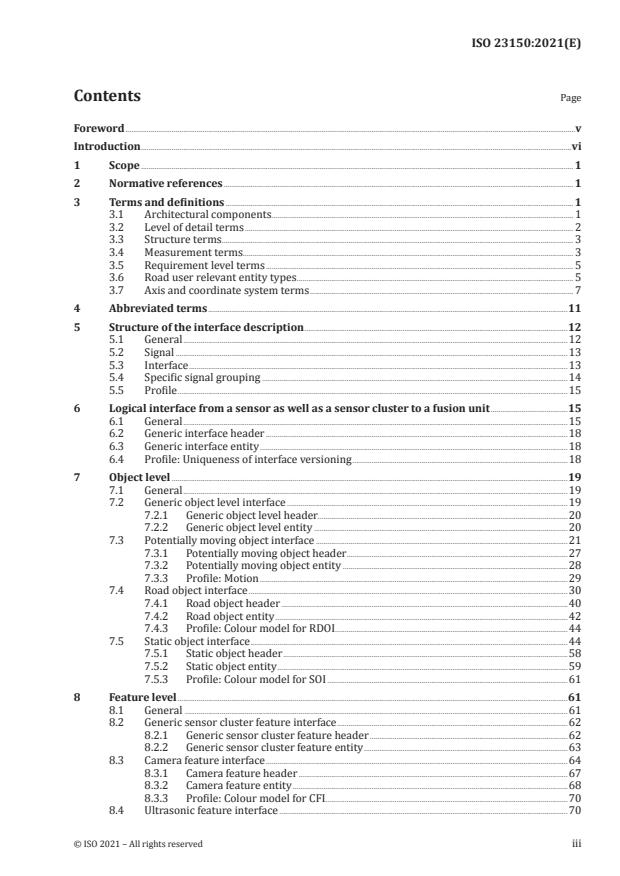
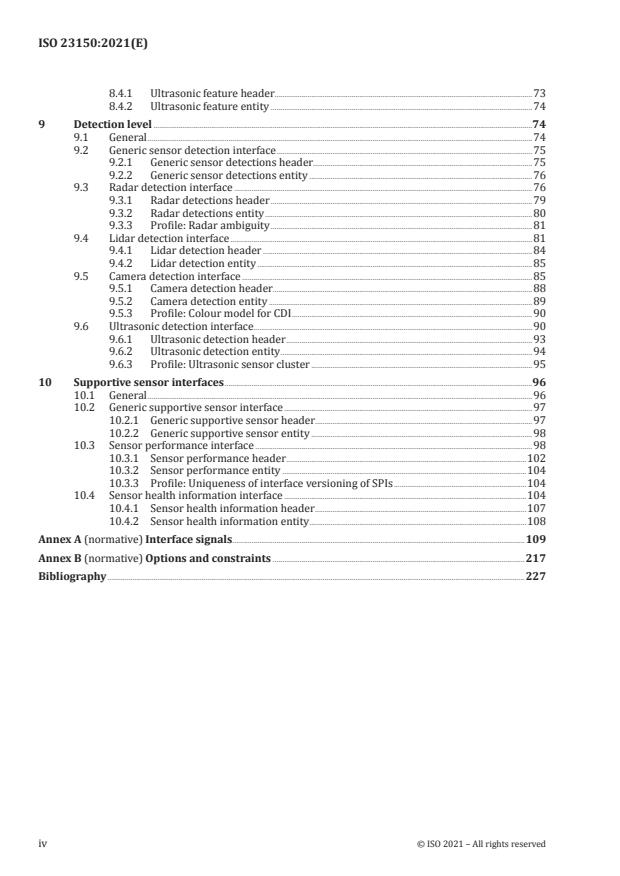
Contents Page
Foreword .v
Introduction .vi
1 Scope . 1
2 Normative references . 1
3 Terms and definitions . 1
3.1 Architectural components . 1
3.2 Level of detail terms . 2
3.3 Structure terms . 3
3.4 Measurement terms. 3
3.5 Requirement level terms . 5
3.6 Road user relevant entity types . 5
3.7 Axis and coordinate system terms . 7
4 Abbreviated terms .11
5 Structure of the interface description .12
5.1 General .12
5.2 Signal .13
5.3 Interface .13
5.4 Specific signal grouping .14
5.5 Profile .15
6 Logical interface from a sensor as well as a sensor cluster to a fusion unit .15
6.1 General .15
6.2 Generic interface header .18
6.3 Generic interface entity .18
6.4 Profile: Uniqueness of interface versioning .18
7 Object level .19
7.1 General .19
7.2 Generic object level interface .19
7.2.1 Generic object level header.20
7.2.2 Generic object level entity .20
7.3 Potentially moving object interface .21
7.3.1 Potentially moving object header .27
7.3.2 Potentially moving object entity .28
7.3.3 Profile: Motion .29
7.4 Road object interface .30
7.4.1 Road object header .40
7.4.2 Road object entity .42
7.4.3 Profile: Colour model for RDOI .44
7.5 Static object interface .44
7.5.1 Static object header .58
7.5.2 Static object entity .59
7.5.3 Profile: Colour model for SOI .61
8 Feature level .61
8.1 General .61
8.2 Generic sensor cluster feature interface .62
8.2.1 Generic sensor cluster feature header .62
8.2.2 Generic sensor cluster feature entity .63
8.3 Camera feature interface .64
8.3.1 Camera feature header .67
8.3.2 Camera feature entity .68
8.3.3 Profile: Colour model for CFI .70
8.4 Ultrasonic feature interface .70
8.4.1 Ultrasonic feature header.73
8.4.2 Ultrasonic feature entity .74
9 Detection level .74
9.1 General .74
9.2 Generic sensor detection interface .75
9.2.1 Generic sensor detections header.75
9.2.2 Generic sensor detections entity .76
9.3 Radar detection interface .76
9.3.1 Radar detections header .79
9.3.2 Radar detections entity .80
9.3.3 Profile: Radar ambiguity .81
9.4 Lidar detection interface .81
9.4.1 Lidar detection header .84
9.4.2 Lidar detection entity .85
9.5 Camera detection interface .85
9.5.1 Camera detection header.88
9.5.2 Camera detection entity .89
9.5.3 Profile: Colour model for CDI .90
9.6 Ultrasonic detection interface .90
9.6.1 Ultrasonic detection header .93
9.6.2 Ultrasonic detection entity .94
9.6.3 Profile: Ultrasonic sensor cluster .95
10 Supportive sensor interfaces .96
10.1 General .96
10.2 Generic supportive sensor interface .97
10.2.1 Generic supportive sensor header.97
10.2.2 Generic supportive sensor entity .98
10.3 Sensor performance interface .98
10.3.1 Sensor performance header .102
10.3.2 Sensor performance entity .104
10.3.3 Profile: Uniqueness of interface versioning of SPIs .104
10.4 Sensor health information interface .104
10.4.1 Sensor health information header .107
10.4.2 Sensor health information entity.108
Annex A (normative) Interface signals .109
Annex B (normative) Options and constraints .217
Bibliography .227
iv © ISO 2021 – All rights reserved
Foreword
ISO (the International Organization for Standardization) is a worldwide federation of national standards
bodies (ISO member bodies). The work of preparing International Standards is normally carried out
through ISO technical committees. Each member body interested in a subject for which a technical
committee has been established has the right to be represented on that committee. International
organizations, governmental and non-governmental, in liaison with ISO, also take part in the work.
ISO collaborates closely with the International Electrotechnical Commission (IEC) on all matters of
electrotechnical standardization.
The procedures used to develop this document and those intended for its further maintenance are
described in the ISO/IEC Directives, Part 1. In particular, the different approval criteria needed for the
different types of ISO documents should be noted. This document was drafted in accordance with the
editorial rules of the ISO/IEC Directives, Part 2 (see www .iso .org/ directives).
Attention is drawn to the possibility that some of the elements of this document may be the subject of
patent rights. ISO shall not be held responsible for identifying any or all such patent rights. Details of
any patent rights identified during the development of the document will be in the Introduction and/or
on the ISO list of patent declarations received (see www .iso .org/ patents).
Any trade name used in this document is information given for the convenience of users and does not
constitute an endorsement.
For an explanation of the voluntary nature of standards, the meaning of ISO specific terms and
expressions related to conformity assessment, as well as information about ISO's adherence to the
World Trade Organization (WTO) principles in the Technical Barriers to Trade (TBT), see www .iso .org/
iso/ foreword .html.
This document was prepared by Technical Committee ISO/TC 22, Road vehicles, Subcommittee SC 31,
Data communication.
Any feedback or questions on this document should be directed to the user’s national standards body. A
complete listing of these bodies can be found at www .iso .org/ members .html.
Introduction
Highly-automated driving (AD) functions for road vehicles require a situation awareness of the
surroundings of the vehicle and a, preferably, comprehensive scene understanding. For the fast and
reliable recognition of real-world objects, a sensor suite is necessary to provide information for the
fusion unit. Utilisation of different sensor technologies like radar, lidar, camera and ultrasonic with
different detection capabilities is indispensable to ensure both complementary and redundant
information. The fusion unit analyses and evaluates the different sensor signals and finally generates a
dynamic surround model with sufficient scene understanding.
While current partly-automated functions utilise only particular objects (for example, vehicles,
pedestrians, road markings) to generate a simple surround model, it is necessary for future highly-
automated driving functions to merge not only the recognised objects but also to include other sensor-
specific properties and characteristics of these objects for the generation of a coherent model of the
surroundings. To minimise the development efforts for the sensors and the fusion unit and to maximise
the reusability of development and validation efforts for the different functions on the sensor and
fusion unit side, a standardised logical interface layer between the sensor suite and the fusion unit is
worthwhile and beneficial for both the sensor and the system supplier.
Key
1 logical interface layer between the fusion unit and automated driving functions
2 logical interface layer between a single sensor as well as a single sensor cluster and the fusion unit
3 interface layer on raw data level of a sensor’s sensing element
Figure 1 — Architecture: sensors/sensor clusters – fusion unit – automated driving functions
The logical interface layer between a single sensor as well as a single sensor cluster and the fusion unit
[see key 2 in Figure 1] addresses the encapsulation of technical complexity as well as objects, features
and detections to enable object-level, feature-level and detection-level fusion. Additional supportive
information of the sensor as well as the sensor cluster will supplement the data for the fusion unit.
vi © ISO 2021 – All rights reserved
INTERNATIONAL STANDARD ISO 23150:2021(E)
Road vehicles — Data communication between sensors
and data fusion unit for automated driving functions —
Logical interface
1 Scope
This document is applicable to road vehicles with automated driving functions. The document specifies
the logical interface between in-vehicle environmental perception sensors (for example, radar, lidar,
camera, ultrasonic) and the fusion unit which generates a surround model and interprets the scene
around the vehicle based on the sensor data. The interface is described in a modular and semantic
representation and provides information on object level (for example, potentially moving objects, road
objects, static objects) as well as information on feature and detection levels based on sensor technology
specific information. Further supportive information is available.
This document does not provide electrical and mechanical interface specifications. Raw data interfaces
are also excluded.
2 Normative references
There are no normative references in this document.
3 Terms and definitions
For the purposes of this document, the following terms and definitions apply.
ISO and IEC maintain terminological databases for use in standardization at the following addresses:
— ISO Online browsing platform: available at https:// www .iso .org/ obp
— IEC Electropedia: available at http:// www .electropedia .org/
3.1 Architectural components
3.1.1
fusion
act of uniting signals (3.3.1) from two or more sensors (3.1.5) as well as sensor clusters (3.1.6) to create a
surround model (3.1.7)
3.1.2
fusion unit
computing unit where the fusion (3.1.1) of sensor (3.1.5) data as well as a sensor cluster (3.1.6) data is
performed
3.1.3
interface
shared boundary between two functional units, defined by various characteristics pertaining to the
functions, physical interconnections, signal (3.3.1) exchanges and other characteristics of the units, as
appropriate
[SOURCE: ISO/IEC 2382:2015, 2124351, modified — Notes to entry have been removed.]
3.1.4
logical interface
interface (3.1.3) between a sensor (3.1.5) as well as a sensor cluster (3.1.6) and the fusion unit (3.1.2),
defined by logical characteristics
Note 1 to entry: Logical means a semantic description of the interface.
Note 2 to entry: Mechanical and electrical interfaces are excluded.
Note 3 to entry: This document uses the term interface as a shortcut for the term logical interfaces.
3.1.5
sensor
in-vehicle unit which detects entities external of the vehicle with preprocessing capabilities serving at
least one logical interface (3.1.4)
Note 1 to entry: A sensor may use one or more sensing elements.
3.1.6
sensor cluster
group of sensors (3.1.5) of the same technology serving a common logical interface (3.1.4)
Note 1 to entry: A sensor cluster can exceptionally consist of only one sensor.
EXAMPLE A stereo camera, a surround-view camera, an ultrasonic sensor array, a corner radar system.
3.1.7
surround model
representation of the real world adjacent to the ego-vehicle
3.2 Level of detail terms
3.2.1
detection
sensor technology specific entity represented in the sensor coordinate system (3.7.18) based on a single
measurement (3.4.1) of a sensor (3.1.5)
Note 1 to entry: A small amount of history can be used for some detection signals (3.3.1), for example, model-free
filtering may be used in track-before-detect algorithms.
3.2.2
detection level
set of logical interfaces (3.1.4) that provides detections (3.2.1)
3.2.3
feature
sensor technology specific entity represented in the vehicle coordinate system (3.7.16) based on multiple
measurements (3.4.1)
Note 1 to entry: Multiple measurements can originate from a sensor cluster (3.1.6).
Note 2 to entry: Multiple measurements can originate from multiple measurement cycles (3.4.2).
Note 3 to entry: The term feature is used in this document not as function or group of functions as specified in
1)
ISO/SAE PAS 22736 .
3.2.4
feature level
set of logical interfaces (3.1.4) that provides features (3.2.3)
1) Under preparation. Stage at the time of publication: ISO/SAE DPAS 22736:2021.
2 © ISO 2021 – All rights reserved
3.2.5
object
representation of a real-world entity with defined boundaries and characteristics in the vehicle
coordinate system (3.7.16)
Note 1 to entry: The geometric description of the object is in the vehicle coordinate system.
Note 2 to entry: Object signals (3.3.1) are basically sensor technology independent. Sensor technology specific
signals may extend the object signals.
EXAMPLE A potentially moving object (3.6.1), a road object (3.6.2), a static object (3.6.3).
3.2.6
object level
set of logical interfaces (3.1.4) that provides objects (3.2.5)
3.3 Structure terms
3.3.1
signal
entity consisting of one or more values and which is part of a logical interface (3.1.4)
3.3.2
logical signal group
grouping of signals (3.3.1) that has a logical relationship and a name for the grouping
3.3.3
classification
attribute-based differentiation
Note 1 to entry: An attribute is defined by a list of enumerators.
3.4 Measurement terms
3.4.1
measurement
measuring and processing result of a measurement cycle (3.4.2)
3.4.2
measurement cycle
time period from the start of a data acquisition event to the start of the next data acquisition event
Note 1 to entry: A measurement cycle of one sensor (3.1.5) is a consistent view of an observed scene and not
overlapping in time.
3.4.3
accuracy
closeness of agreement between a measured quantity value and a true quantity value
Note 1 to entry: The concept accuracy is not a quantity and is not given a numerical quantity value. A measurement
(3.4.1) is said to be more accurate when it offers a smaller error (3.4.6).
Note 2 to entry: The term accuracy should not be used for trueness (3.4.4) and the term precision (3.4.5) should
not be used for accuracy, which, however, is related to both these concepts.
Note 3 to entry: Accuracy is sometimes understood as closeness of agreement between measured quantity values
that are being attributed to the measurand.
[SOURCE: ISO/IEC Guide 99:2007, 2.13, modified — The terms "measurement accuracy" and "accuracy
of measurement" were deleted and the Notes to entry have been adapted.]
3.4.4
trueness
closeness of agreement between the average of an infinite number of replicated measured quantity
values and a reference quantity value
Note 1 to entry: Trueness is not a quantity and thus cannot be expressed numerically, but measures for closeness
of agreement are given in the ISO 5725 series.
Note 2 to entry: Trueness is inversely related to systematic error, but is not related to random error.
Note 3 to entry: The term accuracy (3.4.3) should not be used for trueness.
[SOURCE: ISO/IEC Guide 99:2007, 2.14, modified — The terms "measurement trueness" and "trueness
of measurement" were deleted and the Notes to entry have been adapted.]
3.4.5
precision
closeness of agreement between indications or measured quantity values obtained by replicate
measurements (3.4.1) on the same or similar measurands under specified conditions
Note 1 to entry: Precision is usually expressed numerically by measures of imprecision, such as standard
deviation, variance, or coefficient of variation under the specified conditions of measurement.
Note 2 to entry: The specified conditions can be, for example, repeatability conditions of measurement,
intermediate precision conditions of measurement, or reproducibility conditions of measurement (see
ISO 5725-1:1994).
Note 3 to entry: Precision is used to define measurement repeatability, intermediate measurement precision and
measurement reproducibility.
Note 4 to entry: Sometimes precision is erroneously used to mean accuracy (3.4.3).
Note 5 to entry: Precision is inversely related to random error, but is not related to systematic error.
[SOURCE: ISO/IEC Guide 99:2007, 2.15, modified — The term "measurement precision" was deleted,
the word “objects” was replaced by “measurands”, the Notes to entry have been adapted and Note 5 to
entry has been added.]
3.4.6
error
measured quantity value minus a reference quantity value
Note 1 to entry: The concept of error can be used both:
Note 2 to entry: a) when there is a single reference quantity value to refer to, which occurs if a calibration is
made by means of a measurement standard with a measured quantity value having a negligible measurement
uncertainty or if a conventional quantity value is given, in which case the error is known, and
Note 3 to entry: b) if a measurand is supposed to be represented by a unique true quantity value or a set of true
quantity values of negligible range, in which case the error is not known.
Note 4 to entry: Error should not be confused with production error or mistake.
[SOURCE: ISO/IEC Guide 99:2007, 2.16, modified — The terms "measurement error" and "error of
measurement" were deleted and the Notes to entry have been adapted.]
4 © ISO 2021 – All rights reserved
3.5 Requirement level terms
3.5.1
conditional
required under certain specified conditions
Note 1 to entry: One of three obligation statuses applied to a requirement level (3.5.4) of a logical interface (3.1.4)
specification, indicating the conditions under which the signal (3.3.1) or logical signal group (3.3.2) is required. In
other cases, the signal or logical signal group is optional. See also mandatory (3.5.2) and optional (3.5.3).
[SOURCE: ISO/IEC 11179-3:2013, 3.2.22, modified — Notes to entry have been adapted.]
3.5.2
mandatory
always required
Note 1 to entry: One of three obligation statuses applied to a requirement level (3.5.4) of a logical interface (3.1.4)
specification, indicating the conditions under which the signal (3.3.1) or logical signal group (3.3.2) is required.
See also conditional (3.5.1) and optional (3.5.3).
[SOURCE: ISO/IEC 11179-3:2013, 3.2.71, modified — Notes to entry have been adapted.]
3.5.3
optional
permitted but not required
Note 1 to entry: One of three obligation statuses applied to a requirement level (3.5.4) of a logical interface (3.1.4)
specification, indicating the conditions under which the signal (3.3.1) or logical signal group (3.3.2) is required.
See also conditional (3.5.1) and mandatory (3.5.2).
[SOURCE: ISO/IEC 11179-3:2013, 3.2.89, modified — Notes to entry have been adapted.]
3.5.4
requirement level
definition of the obligation status of a logical interface's (3.1.4) logical signal group (3.3.2), signal (3.3.1)
as well as a signal's identifier or signal's enumerator
Note 1 to entry: Each requirement level entry has one of three possible obligation statuses applied: conditional
(3.5.1), mandatory (3.5.2) or optional (3.5.3).
3.6 Road user relevant entity types
3.6.1
potentially moving object
real-world entity which potentially can move and is relevant for driving situations
Note 1 to entry: A representation of a potentially moving object is part of object level (3.2.6) logical interfaces
(3.1.4).
EXAMPLE A vehicle, a bicycle, a pedestrian, an obstacle.
3.6.2
road object
marking or structure of a road which is relevant for driving situations
Note 1 to entry: A representation of a road object is part of object level (3.2.6) logical interfaces (3.1.4).
EXAMPLE A road marking (3.6.2.1), a road boundary (3.6.2.2), the road surface (3.6.2.3).
3.6.2.1
road marking
line, symbol or other mark on the surface of a road or a structure intended to limit, regulate, warn,
guide or inform road users
Note 1 to entry: Other marks could be text, numbers, arrows or combinations.
EXAMPLE A lane marking, Botts' dots.
[SOURCE: ISO 6707-1:2020, 3.3.5.80, modified — "user" was modified to "road users", “a road surface”
was modified to “the surface of a road” and the Note 1 to entry and example have been added.]
3.6.2.2
road boundary
structure that limits the road
EXAMPLE A curb stone, a guard rail, the end of the surface of the road.
3.6.2.3
road surface
surface supporting the tyre and providing friction necessary to generate shear forces in the road plane
(3.7.6)
Note 1 to entry: The surface may be flat, curved, undulated or of other shape.
[SOURCE: ISO 8855:2011, 2.6]
3.6.3
static object
real-world stationary entity which can be used for information and/or localisation
Note 1 to entry: A representation of a static object is part of object level (3.2.6) logical interfaces (3.1.4).
EXAMPLE A general landmark (3.6.3.1), a traffic sign (3.6.3.2), a traffic light (3.6.3.3).
3.6.3.1
general landmark
real-world stationary entity which can be used for localisation
Note 1 to entry: A stationary traffic sign (3.6.3.2) or traffic light (3.6.3.3) is also regarded as a general landmark.
EXAMPLE A building, a tunnel, a bridge, a sign gantry structure, a tree.
3.6.3.2
traffic sign
traffic relevant, authorised sign that limits, regulates, warns, guides or informs road users
Note 1 to entry: One traffic sign usually consists of one main sign (3.6.3.2.1) and none, one or several supplementary
signs (3.6.3.2.2).
EXAMPLE A speed limit which is restricted for trucks.
3.6.3.2.1
main sign
traffic sign (3.6.3.2) which gives a general message, obtained by a combination of colour and geometric
shape and which, by the addition of a graphical symbol or text, gives a particular message for road users
[SOURCE: ISO 3864-1:2011, 3.12, modified — The original term was "safety sign", "sign" has been
replaced by "traffic sign" and the phrases "or text" and "for road users" have been added to the
definition.]
6 © ISO 2021 – All rights reserved
3.6.3.2.2
supplementary sign
traffic sign (3.6.3.2) that is supportive of a main sign (3.6.3.2.1) and the main purpose of which is to
provide additional clarification
[SOURCE: ISO 3864-1:2011, 3.14, modified — "traffic sign" now replaces "sign" and "main sign" replaces
"traffic sign".]
3.6.3.3
traffic light
traffic relevant, official lights
Note 1 to entry: One traffic light consists of one or several light spots with different light colours and shapes.
EXAMPLE A pedestrian traffic light.
3.7 Axis and coordinate system terms
3.7.1
reference frame
geometric environment in which all points remain fixed with respect to each other at all times
[SOURCE: ISO 8855:2011, 2.1]
3.7.2
axis system
set of three orthogonal directions associated with X, Y and Z axes
Note 1 to entry: A right-handed axis system is assumed throughout this document, where: ZX=×Y .
[SOURCE: ISO 8855:2011, 2.3, modified — Notes to entry have been adapted.]
3.7.3
coordinate system
numbering convention used to assign a unique ordered trio of values to each point in a reference frame
(3.7.1) and which consists of an axis system (3.7.2) plus an origin point
[SOURCE: ISO 8855:2011, 2.4, modified — "(x, y, z)" has been removed from the definition.]
3.7.4
cartesian coordinate system
set of numerical coordinates (x, y, z), which are the signed distances to the YZ-, ZX- and XY-planes
3.7.5
spherical coordinate system
set of two angles and a distance vector associated with radial distance, azimuth and elevation
Note 1 to entry: The azimuth angle is the angle in XY-plane of the axis system (3.7.2) counted from the X-axis. The
elevation angle is the angle from the azimuth direction in the XY-plane of the axis system towards the direction
of the distance vector, that is XY-plane has an elevation angle = 0 rad.
Note 2 to entry: The angles of the spherical coordinate system have increasing values in counter-clockwise
direction.
3.7.6
road plane
plane representing the road surface (3.6.2.3) within the front tyre contact patches and the vehicle road-
level reference point (3.7.13)
Note 1 to entry: See Figure 2.
Note 2 to entry: For tyre contact patches, see ISO 8855:2011, 4.1.5.
Key
1 vehicle front
2 vehicle’s front tyre contact patches
3 vehicle road-level reference point (3.7.13)
4 vehicle road plane (3.7.6)
Figure 2 — Road plane
[SOURCE: ISO 8855:2011, 2.7, modified — The phrase "and the vehicle road-level reference point" and
the figure have been added, and the Notes to entry have been modified.]
3.7.7
road level
point related to a road plane (3.7.6)
3.7.8
vehicle unsprung mass
unsprung mass
mass that is not carried by the suspension, but is supported directly by the tyres
[SOURCE: ISO 8855:2011, 4.11, modified — The term "vehicle unsprung mass" has been added.]
3.7.9
vehicle sprung mass
sprung mass
mass that is supported by the suspension, that is the total vehicle mass less the vehicle unsprung mass
(3.7.8)
[SOURCE: ISO 8855:2011, 4.12, modified — The term vehicle sprung mass has been added and Note 1 to
entry has been removed.]
3.7.10
vehicle rear-axle reference point
point fixed in the vehicle sprung mass (3.7.9) and located at the centre of the rear-axle
3.7.11
vehicle sprung mass axis system
axis system (3.7.2) fixed in the reference frame (3.7.1) of the vehicle sprung mass (3.7.9), so that the
X-axis is substantially horizontal and forwards (with the vehicle at rest), and is parallel to the vehicle's
longitudinal plane of symmetry, and the Y-axis is perpendicular to the vehicle's longitudinal plane of
symmetry and points to the left with the Z-axis pointing upward
8 © ISO 2021 – All rights reserved
3.7.12
vehicle rear-axle coordinate system
coordinate system (3.7.3) based on the vehicle sprung mass axis system (3.7.11) with the origin located at
the vehicle rear-axle reference point (3.7.10)
Note 1 to entry: The vehicle rear-axle coordinate system is a vehicle coordinate system (3.7.16).
Note 2 to entry: See Figure 3.
Key
1 vehicle front
2 vehicle rear-axle reference point (3.7.10)
Figure 3 — Vehicle rear-axle coordinate system
3.7.13
vehicle road-level reference point
point at road level (3.7.7) located in the middle of the rear tyre contact patches
Note 1 to entry: For tyre contact patches, see ISO 8855:2011, 4.1.5.
3.7.14
vehicle road-level axis system
axis system (3.7.2) fixed in the reference frame (3.7.1) of the vehicle unsprung mass (3.7.8), so that the
X-axis is parallel to the vehicle's longitudinal plane of symmetry and points into forward moving
direction and the Y-axis is perpendicular to the vehicle's longitudinal plane of symmetry and points to
the left with the Z-axis pointing upward
Note 1 to entry: Vehicle road-level axis system’s XY-plane is parallel to the ego-vehicle’s road plane (3.7.6).
3.7.15
vehicle road-level coordinate system
coordinate system (3.7.3) based on the vehicle road-level axis system (3.7.14) with the origin located at
the vehicle road-level reference point (3.7.13) at the vehicle road level (3.7.7)
Note 1 to entry: The vehicle road-level coordinate system is a vehicle coordinate system (3.7.16).
Note 2 to entry: See Figure 4.
Key
1 vehicle front
2 vehicle road-level reference point (3.7.13)
3 vehicle road plane (3.7.6)
Figure 4 — Vehicle road-level coordinate system
3.7.16
vehicle coordinate system
cartesian coordinate system (3.7.4) which is either the vehicle rear-axle coordinate system (3.7.12) or the
vehicle road-level coordinate system (3.7.15)
Note 1 to entry: See Figure 5.
Key
1 vehicle rear-axle reference point (3.7.10)
2 vehicle road-level reference point (3.7.13)
Figure 5 — Vehicle coordinate systems
3.7.17
sensor axis system
axis system (3.7.2) fixed in the reference frame (3.7.1) of the sensor (3.1.5)
Note 1 to entry: The X-axis is in viewing direction of the sensor and the Z-axis pointing upward.
10 © ISO 2021 – All rights reserved
3.7.18
sensor coordinate system
spherical coordinate system (3.7.5) based on the sensor axis system (3.7.17) at a defined origin point of
the sensor (3.1.5)
Note 1 to entry: The origin point of the sensor coordinate system has to be selected in a way that detections (3.2.1)
could easily be specified in a spherical coordinate system. For example, the origin point of a camera sensor is the
virtual projection centre of the camera’s optics.
Note 2 to entry: See Figure 6.
Key
1 origin point of the sensor (3.1.5)
2 detection (3.2.1)
d radial distance
α azimuth
β elevation
Figure 6 — Sensor coordinate system
4 Abbreviated terms
AD automated driving
C conditional
CDI camera detection interface
CFI camera feature interface
D dimensional
DLI detection level interface
ECU electronic control unit
FFT fast Fourier transform
FLI feature level interface
FOV field-of-view
FWHM full width at half maximum
HW hardware
ID identifier
IQR interquartile range
IRI international roughness index
LDI lidar detection interface
LSG logical signal group
M mandatory
O optional
OLI object level interface
PMOI potentially moving object interface
RCS radar cross section
RDI radar detection interface
RDOI road object interface
RL requirement level
SHII sensor health information interface
SNR signal to noise ratio
SOI static object interface
SPI sensor performance interface
SSI supportive sensor interface
UDI ultrasonic detection interface
UFI ultrasonic feature interface
5 Structure of the interface description
5.1 General
The scope of the document are logical interfaces. Therefore, the following parts of the document use the
term interface as a shortcut for the defined term “logical interface” (3.1.4). The interface descriptions
have the following structure:
— a description of each interface by logical signal group (LSGs), signal names and requirement levels
(RLs) (including conditional requirements) and additional options;
12 © ISO 2021 – All rights reserved
— the requirement level attribute “conditional” shall be an element used in this document;
— the logical interlink as well as complex dependencies between signals of an interface shall be defined
in an interface’s subclause as a profile subclause of the i
...
Questions, Comments and Discussion
Ask us and Technical Secretary will try to provide an answer. You can facilitate discussion about the standard in here.
Loading comments...