


ISO 2382-15:1985
(Main)Data processing — Vocabulary — Part 15: Programming languages
Data processing — Vocabulary — Part 15: Programming languages
Traitement de l'information — Vocabulaire — Partie 15: Langages de programmation
General Information
- Status
- Withdrawn
- Publication Date
- 30-Oct-1985
- Withdrawal Date
- 30-Oct-1985
- Technical Committee
- ISO/IEC JTC 1 - Information technology
- Drafting Committee
- ISO/IEC JTC 1 - Information technology
- Current Stage
- 9599 - Withdrawal of International Standard
- Start Date
- 17-Jun-1999
- Completion Date
- 12-Feb-2026
Relations
- Effective Date
- 15-Apr-2008
Get Certified
Connect with accredited certification bodies for this standard

BSI Group
BSI (British Standards Institution) is the business standards company that helps organizations make excellence a habit.

NYCE
Mexican standards and certification body.
Sponsored listings
Frequently Asked Questions
ISO 2382-15:1985 is a standard published by the International Organization for Standardization (ISO). Its full title is "Data processing — Vocabulary — Part 15: Programming languages". This standard covers: Data processing — Vocabulary — Part 15: Programming languages
Data processing — Vocabulary — Part 15: Programming languages
ISO 2382-15:1985 is classified under the following ICS (International Classification for Standards) categories: 01.040.35 - Information technology (Vocabularies); 35.060 - Languages used in information technology. The ICS classification helps identify the subject area and facilitates finding related standards.
ISO 2382-15:1985 has the following relationships with other standards: It is inter standard links to ISO/IEC 2382-15:1999. Understanding these relationships helps ensure you are using the most current and applicable version of the standard.
ISO 2382-15:1985 is available in PDF format for immediate download after purchase. The document can be added to your cart and obtained through the secure checkout process. Digital delivery ensures instant access to the complete standard document.
Standards Content (Sample)
International Standard
Norme internationale
lNTERNATlONAL ORGANIZATION FOR STANDARDIZATlON.MEX(AYHAPOAHAR OPTAHM3ALWlR l-IO CTAHAAPTbl3A~WWORGANlSATlON INTERNATIONALE DE NORMALISATION
Data processing - Vocabulary -
Part 15: Programming languages
First edition - 1985-11-01
Traitement de I’information - Vocabulaire -
Partie 15: Langages de programmation
Premihe Edition - 1985-11-01
Ref. NoJR6f. no : IS0 2382/15-1985 (E/F)
UDWCDU 681.3 : 004.4
: traitement de I’information, langages de programmation,
Descriptors : data processing, programming languages, vocabulary. / Descripteurs
vocabulaire.
Price based on 17 pages/Prix bash sur 17 pages
Fo reword
IS0 (the International Organization for Standardization) is a worldwide federation of
national standards bodies (IS0 member bodies). The work of preparing International
Standards is normally carried out through IS0 technical committees. Each member
body interested in a subject for which a technical committee has been established has
the right to be represented on that committee. International organizations, govern-
mental and non-governmental, in liaison with ISO, also take part in the work.
Draft International Standards adopted by the technical committees are circulated to
the member bodies for approval before their acceptance as International Standards by
the IS0 Council. They are approved in accordance with IS0 procedures requiring at
least 75 % approval by the member bodies voting.
International Standard IS0 2382/ 15 was prepared by Technical Committee ISO/TC 97,
lnforma tion processing s ys terns.
Users should note that all International Standards undergo revision from time to time
and that any reference made herein to any other International Standard implies its
latest edition, unless otherwise stated.
0 International Organization for Standardization, 1985
Printed in Switzerland
Avant-propos
L’ISO (Organisation internationale de normalisation) est une federation mondiale
d’organismes nationaux de normalisation (comites membres de I’ISO). L’elaboration
des Normes internationales est confide aux comites techniques de I’ISO. Chaque
comite membre interesse par une etude a le droit de faire pat-tie du comite technique
cr66 a cet effet. Les organisations internatjonales, gouvernementales et non gouverne-
mentales, en liaison avec I’ISO participent egalement aux travaux.
.,
Les projets de Normes internationales adopt& par les comites techniques sont soumis
aux comites membres pour approbation, avant leur acceptation comme Normes inter-
nationales par le Conseil de I’ISO. Les Normes internationales sont approuvees confor-
mement aux procedures de I’ISO qui requierent I’approbation de 75 % au moins des
comites membres votants.
La Norme internationale IS0 2382/K a et6 elaboree par le comite technique ISO/TC 97,
S yst&mes de traitemen t de l’in forma tion.
L’attention des utilisateurs est attiree sur le fait que toutes les Normes internationales
sont de temps en temps soumises 8 revision et que toute reference faite a une autre
Norme internationale dans le present document implique qu’il s’agit, sauf indication
contraire, de la derniere edition.
Organisation internationale de normalisation, 1985
Imprim en Suisse
ii
Page
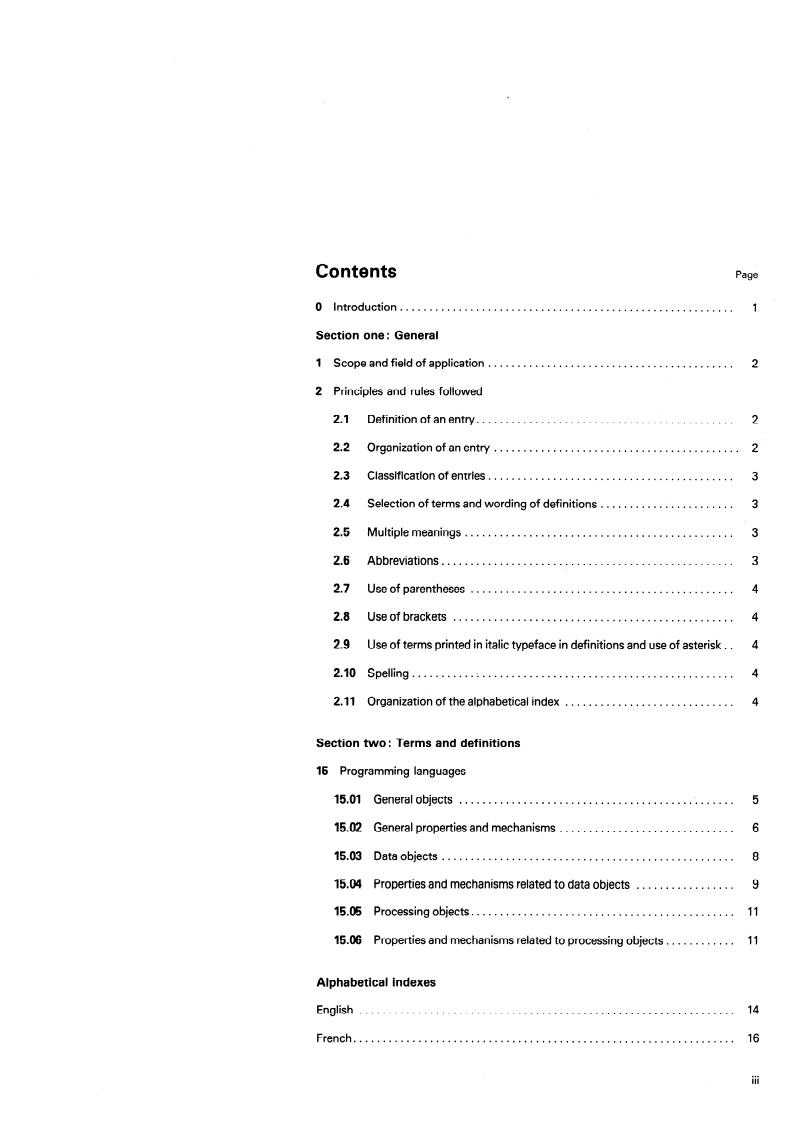
Contents
0 Introduction. . . . . . . . . . . . . . . . . . . . . . . . . . . . . . . . . . . . . . . . . . . . . . . . . . . . . . . .
Section one : General
1 Scope and field of application . . . . . . . . . . . . . . . . . . . . . . . . . . . . . . . . . . . . . . . . . . 2
2 Principles and rules followed
2.1 Definition of an entry. .
2.2 Organization of an entry .
2.3 Classification of entries .
....................... 3
2.4 Selection of terms and wording of definitions
2.5 Multiple meanings . 3
2.6 Abbreviations .
2.7 Use of parentheses .
................................................ 4
2.8 Useofbrackets
2.9 Use of terms printed in italic typeface in definitions and use of asterisk . .
2.10 Spelling. . . . . . . . . . -. . . . . . . . . . . . . . . . . . . . . . . . . . . . . . . . . . . . . . . . . . . .
2.11 Organization of the alphabetical index . . . . . . . . . . . . . . . . . . . . . . . . . . . . .
Section two: Terms and definitions
15 Programming languages
15.01 General objects . . . . . . . . . . . . . . . . . . . . . . . . . . . . . . . . . . . . . . . :. . . . . . .
15.02 General properties and mechanisms .
15.03 Data objects .
15.04 Properties and mechanisms related to data objects .
15.05 Processing objects .
15.05 Properties and mechanisms related to processing objects .
Alphabetical indexes
English . . . . . . . . . . . . . . . . . . . . . . . . . . . . . . . . . . . . . . . . . . . . . . . . . . . . . . . . . . . . . . . .
French. 16
___
III
Page
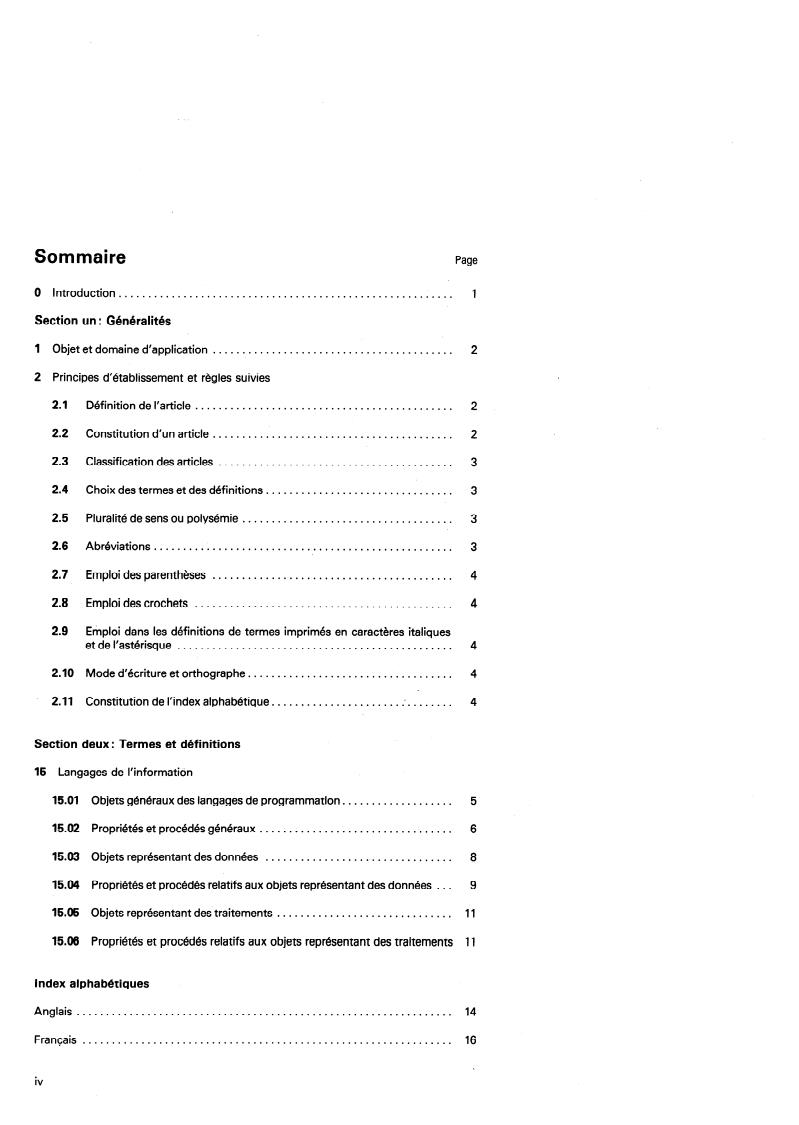
Sommaire
0 Introduction. . . . . . . . . . . . . . . . . . . . . . . . . . . . . . . . . . . . . . . . . . . . . . . . . . . . . . . . .
Section un : Gbn&alit6s
Objet et domaine d’application . . . . . . . . . . . . . . . . . . . . . . . . . . . . . . . . . . . . . . . . .
2 Principes d’etablissement et regles suivies
Definition de l’article . . . . . . . . . . . . . . . . . . . . . . . . . . . . . . . . . . . . . . . . . . . . 2
2.1
2.2 Constitution d’un article . . . . . . . . . . . . . . . . . . . . . . . . . . . . . . . . . . . . . . . . .
2.3 Classification des articles . . . . . . . . . . . . . . . . . . . . . . . . . . . . . . . . . . . . . . . .
Choix des termes et des definitions . . . . . . . . . . . . . . . . . . . . . . . . . . . . . . . .
2.4
2.5 Pluralite de sens ou polysemie . . . . . . . . . . . . . . . . . . . . . . . . . . . . . . . . . . . .
2.6 Abreviations . . . . . . . . . . . . . . . . . . . . . . . . . . . . . . . . . . . . . . . . . . . . . . . . . . .
2.7 Emploi des parentheses . . . . . . . . . . . . . . . . . . . . . . . . . . . . . . . . . . . . . . . . .
2.8 Emploi des crochets . . . . . . . . . . . . . . . . . . . . . . . . . . . . . . . . . . . . . . . . . . . .
2.9 Emploi dans les definitions de termes imprimes en caracteres italiques
et de I’asterisque . . . . . . . . . . . . . . . . . . . . . . . . . . . . . . . . . . . . . . . . . . . . . . .
2.10 Mode d’ecriture et orthographe . . . . . . . . . . . . . . . . . . . . . . . . . . . . . . . . . . .
2.11 Constitution de I’index alphabetique . . . . . . . . . . . . . . . . . . . . . . ;. . . . . . . .
Section deux: Termes et definitions
15 Langages de I’information
15.01 Objets generaux des langages de programmation . . . . . . . . . . . . . . . . . . .
15.02 Proprietes et procedes generaux . . . . . . . . . . . . . . . . . . . . . . . . . . . . . . . . .
15.93 Objets representant des don&es . . . . . . . . . . . . . . . . . . . . . . . . . . . . . . . .
15.04 Proprietes et procedes relatifs aux objets representant des don&es . . .
15.05 Objets representant des traitements . . . . . . . . . . . . . . . . . . . . . . . . . . . . . .
15.06 Proprietes et procedes relatifs aux objets representant des traitements 11
Index alphabetiques
Anglais. 14
Francais . . . . . . . . . . . . . . . . . . . . . . . . . . . . . . . . . . . . . . . . . . . . . . . . . . . . . . . . . . . . . . .
,
\
iv
INTERNATIONAL STANDARD
IS0 2382/15-1985 (E/F)
NORME INTERNATIONALE
Traitement des donn6es -
Data processing
Vocabulaire -
Vocabulary -
Partie 15 I Langages
Part 15 I Programming
de programmation
languages
0 Introduction
0 Introduction
Le traitement des donnees est a I’origine de multiples echanges
Data processing gives rise to numerous international
intellectuels et materiels sur le plan international. Ceux-ci souf-
exchanges of both intellectual and material nature. These ex-
frent souvent des difficult& provoquees par la diversite des ter-
changes often become difficult, either because of the great
mes utilises pour exprimer la meme notion dans des langues ou
variety of terms used in various fields or languages to express
dans des domaines differents, ou encore de l’absence ou de
the same concept, or because of the absence or imprecision of
I’imprecision des definitions pour les notions les plus utiles.
the definitions of useful concepts.
To avoid misunderstandings and to facilitate such exchanges, it Pour eviter des malentendus et faciliter de tels echanges, il
is essential to clarify the concepts, to select terms to be used in parait essentiel de preciser les notions, de choisir les termes a
various languages or in various countries to express the same employer dans les differentes langues et dans les divers pays
concept and to establish definitions providing satisfactory pour exprimer la meme notion, et d’etablir pour ces termes des
definitions equivalentes dans chaque langue.
equivalents for the various terms in different languages.
IS0 2382 was initially based mainly on the usage to be found in
L’ISO 2382 a et6 basee a I’origine principalement sur I’usage tel
the Vocabulary of Information ‘Processing, established and
qu’il a et6 releve d’une part dans le Vocabulary of information
published by the International Federation for Information
Proces+ing etabli et publie par I’lnternational Federation for
Processing and the International Computation Centre, and in Information Processing et le Centre International de Calcul et
the USA Standard Vocabulary for Information Processing and
d’autre part dans le USA Standard Vocabulary for Information
its revised edition, established and published by the American
Processing dans son edition r&i&e etablie et publiee par
National Standards Institute (formerly known as the American
I’American National Standards Institute (connu auparavant
Standards Association). Published and draft International
sous I’appellation d’American Standards Association). Les
Standards relating to data processing and documentation from
Normes internationales publiees ou au stade de projets concer-
other international organizations (such as the International
nant le traitement de I’information et la documentation ema-
Telecommunication Union and the International Electro-
nant d’autres organisations internationales (telles que I’Union
technical Commission) together with published and draft
internationale des telecommunications et la Commission elec-
national standards have been considered.
trotechnique internationale).
The purpose of IS0 2382 is to provide definitions that are
Le but de I’ISO 2382 est de procurer des definitions rigou-
rigorous, uncomplicated and which can be understood by all
reuses, simples et comprehensibles par tous les interesses. La
concerned. The scope of each concept defined has been
portee de chaque notion a et6 choisie de facon que sa definition
chosen to provide a definition that is suitable for general
puisse avoir la valeur la plus generale. Toutefois il est parfois
application. In those circumstances where a restricted applica-
necessaire de restreindre une notion a un domaine plus etroit,
tion is concerned, the definition may need to be more specific.
et de lui donner alors une definition plus specifique.
However, while it is possible to maintain the self-consistency of
D’autre part, si I’on peut assurer la coherence interne de cha-
individual parts, the reader is warned that the dynamics of
que pat-tie prise individuellement, la coherence des diverses par-
language and the problems associated with the standardization
ties entre elles est plus difficile a atteindre. Le lecteur ne doit
and maintenance of vocabularies may introduce duplications
pas s’en etonner : la dynamique des langues et les problemes de
and inconsistencies between parts.
I’etablissement et de la revision des normes de vocabulaires
peuvent etre 9 I’origine de quelques repetitions ou contradic-
tions entre des parties qui ne sont pas toutes preparees et
publiees simultanement.
IS0 2382/15-1982 (E/F)
Section un : G6n6ralitb
Section one : General
1 Objet et d.omaine d’application
1 Scope and field of application
L’ISO 2382 a pour objet de faciliter les &changes internationaux
IS0 2382 is intended to facilitate international communication
dans cette technique et ses applications. A cet effet, elle
in data processing. It presents, in two languages, terms and
presente un ensemble bilingue de termes et de definitions ayant
definitions of selected concepts relevant to the field of data
trait a des notions choisies dans ce domaine, et definit les rela-
processing and identifies relationships between the entries.
tions pouvant exister entre les differentes notions.
In order to facilitate their translation into other languages, the
Les definitions ont et6 etablies de maniere a eviter les particula-
definitions are drafted so as to avoid, as far as possible, any
rismes propres a une langue don&e, en vue de faciliter leur
peculiarity attached to a language.
transposition dans les langues autres que celles ayant servi 8 la
redaction initiale.
IS0 2382 deals withthe main areas of data processing, in-
. .*.
eluding the principal processes and types of equipment used,
L’ISO 2382 traite des principaux domaines du traitement des
the organization and the representation of data, the program-
don&es, des principaux procedes et types de machines
ming and operation of computers, peripheral equipment and
employ&, de I’organisation et de la representation des
data communication as well as particular applications.
don&es, de la programmation et de I’exploitation des ordi-
nateurs, des dispositifs peripheriques et du transfert des don-
This part of IS0 2382 (which will comprise some twenty-five
&es, ainsi que de certaines applications particulieres.
parts) deals with programming language concepts that are
most commonly used in the data processing community.
La presente partie de I’ISO 2382, qui en comprendra environ
vingt-cinq, definit les termes des langages de programmation
qui sont le plus couramment utilises parmi les informaticiens.
2 Principles and rules followed 2 Principes d’&ablissement et regles suivies
2.1 Dhfinition de I’article
2.1 Definition of an entry
La section deux est composee d’un certain nombre d’articles.
Section two comprises a number of entries. Each entry consists
Chaque article est compose d’un ensemble d’elements essen-
of a set of essential elements that includes an index number,
one term or several synonymous terms, and a phrase defining tiels comprenant le numero de reference, le terme ou plusieurs
termes synonymes et la definition d’une notion couverte par
one concept. In addition, an entry may include examples, notes
or illustrations to facilitate understanding of the concept. ces termes. Cet ensemble peut etre complete par des exemples,
des notes, des schemas ou des tableaux destines a faciliter la
comprehension de la notion.
Occasionally, the same term may be defined in different entries,
or two or more concepts may be covered by one entry, as
Parfois, le meme terme peut etre defini dans des articles diffe-
described in 2.5 and 2.8 respectively.
rents, ou bien deux notions ou davantage peuvent etre
Other terms such as vocabulary, concept, term and defini- couvertes par un seul article: voir respectivement en 2.5 et 2.8.
tion, are used in this International Standard with the meaning
defined in ISO/R 1087, Vocabulary of terminology. D’autres termes tels que vocabulairel notion, terme, dhfini-
tion sont employ& dans la presente Norme internationale avec
le sens qui leur est donne dans I’ISO/R 1087, Vocabulaire de la
terminologie.
2.2 Constitution d’un article
22 . Organization of an entry
Chaque article contient les elements essentiels definis en 2.1 et,
Each entry contains the essential elements defined in 2.1 and, if
si necessaire, des elements supplementaires. L’article peut
necessary, additional elements. The entry may contain the
done comprendre .dans I’ordre les elements suivants:
following elements in the following order:
a) un numero de reference (le meme, quelle que soit la lan-
an index number (common for all Ian in which
a) wages
gue de publication de la presente Norme internationale);
this International Standard is published
1;
IS0 2382/15-1985 (E/F)
b) le terme ou le terme prefer6 en general dans la langue.
L’absence dans une langue, de terme consacre ou 3 con-
b) the term or the generally preferred term in the
seiller pour exprimer une notion est indiquee par un symbole
language. The absence of a generally accepted term for the
consistant en cinq points de suspension (. . . . .), les points de
concept in the language is indicated by a symbol consisting
suspension peuvent etre employ& pour designer dans un
of five points ( . . . . . 1; a row of dots may be used to indicate,
terme, un mot a choisir dans chaque cas particulier;
in a term, a word to be chosen in each particular case;
c) le terme prefer6 dans un certain pays (identifie selon les
regles de I’lSO/R 639, lndicatifs de langue, de pays et
d’autorite’);
d) I’abreviation pouvant etre employee a la place du terme;
d) the abbreviation for the term;
e) le termes ou les termes admis comme synonymes;
e) permitted synonymous term(s);
f) the text of the definition (see 2.4); f) le texte de la definition (voir 2.4);
g) un ou plusieu rs exemples, precedes du titre
g) one or more examples with the heading “Example(s)“;
(( Exemple(s) n;
h) one or more notes specifying particular cases in the
h) une ou plusieurs notes precisant le domaine d’applica-
field of application of the concepts, with the heading
“NOTE(S)“; tion de la notion, precedees du titre ((NOTE(S)));
j) un schema ou un tableau, pouvant etre communs zl plu-
j> a picture, a diagram, or a table.
sieu rs articles.
2.3 Classification des articles
2.3 Classification of entries
Chaque partie de la presente Norme internationale recoit un
A two-digit serial number is assigned to each part of this Inter-
numero d’ordre a deux chiffres, en commencant par 01 hour le
national Standard beginning with 01 for “fundamental
chapitre ((Termes fondamentaux)).
terms”.
Les articles sont repartis en groupes qui recoivent chacun un
The entries are classified in groups to each of which is assigned
a four-digit serial number. The first two digits are those of the numero d’ordre B quatre chiffres, les de& premiers chiffres
etant ceux du numero de par-tie de la presente Norme interna-
part of this International Standard.
tionale.
Each entry is assigned a six-digit index number. The first four
Chaque article est rep&e par un numero de reference a six chif-
digits are those of the part of this International Standard and
the group. fres, les quatre premiers chiffres etant ceux du numero de par-
tie de la presente Norme internationale et de groupe.
In order that versions of this International Standard in various
Les numeros des parties, des groupes et des articles sont les
languages may be related, the numbers assigned to parts,
memes pour toutes les langues, afin de mettre en evidence les cor-
groups and entries are the same for all languages.
respondances des versions de la presente Norme internationale.
2.4 Selection of terms and wording of definitions 2.4 Choix des termes et des dbfinitions
The selection of terms and the wording of definitions have, as Les choix qui ont et6 faits pour les termes et leurs definitions
far as possible, followed established usage. When there were sont, dans toute la mesure du possible, compatibles avec les
contradictions, solutions agreeable to the majority have been usages etablis. Lorsque certains usages apparaissent contradic-
sought. toires, des solutions de compromis ont et6 retenues.
2.5 Multiple meanings 2.5 Bluralit~ de sens ou polysemie
Lorsque, dans I’une des langues de travail, un meme terme
When, in one of the working languages, a given term has
several meanings, each meaning is given a separate entry in peut prendre plusieurs sens, ces sens sont definis dans des ar-
ticles differents pour faciliter I’adaptation du vocabulaire dans
order to facilitate translation into other languages.
d’autres langues.
2.6 Abbreviations 2.6 Abr&iations
As indicated in 2.2, abbreviations in current use are given for Comme indique en 2.2, des abreviations litterales d’usage cou-
rant, au moins en anglais, sont indiquees pour certains termes.
some terms. Such abbreviations are not used in the texts of the
definitions, examples or notes. De telles abreviations ne sont pas employees dans le corps des
definitions, exemples ou notes.
IS0 2382/15-1985 (E/F)
2.7 Emploi des parentheses
2.7 Use of parentheses
Dans certains termes, un ou plusieurs mots imprimes en carac-
In some terms, a word or words printed in bold typeface are
t&es gras sont places entre parentheses. Ces mots font partie
placed between parentheses. These words are part of the com-
integrante du terme complet, mais peuvent etre omis lorsque le
plete term, but they may be omitted when use of the abridged
terme ainsi abrege peut etre employ6 dans un contexte techni-
term in a technical context does not introduce ambiguity. In the
que determine sans que cette omission introduise d’ambigu’ite.
text of another definition, example, or note in this International
Un tel terme n’est employ6 dans le texte d’une autre definition,
Standard, such a term is used only in its complete form. d’un exemple ou d’une note, dans la presente Norme interna-
tionale, que sous sa forme complete.
In some entries, the terms are followed by words in paren-
Dans certains articles, les termes definis sont suivis par des ex-
theses in normal typeface. These words are not a part of the
pressions imprimees en caracteres normaux et placees entre
term but indicate directives for the use of the term, its particular
parentheses. Ces expressions ne font pas pat-tie du terme mais
field of application, or its grammatical form.
indiquent des prescriptions d’emploi, precisent un domaine
d’application particulier ou indiquent une forme grammaticale.
2.8 Emploi des crochets
2.8 Use of brackets
Lorsque plusieurs termes etroitement apparent& peuvent etre
When several closely related terms can be defined by texts that
definis par des textes presque- identiques, a quelques mots
differ only in a few words, the terms and their definitions are
pres, les termes et leurs definitions ont et6 group& en un seul
grouped in a single entry. The words to be substituted in order
article. Les mots a substituer a ceux qui les precedent pour
to obtain the different meanings are placed in brackets, i.e.
obtenir les differents sens sont places entre crochets (c’est-a-
I, in the same order in the term and in the definition. In
[
dire [ I) dans le meme ordre dans le terme et dans la defi-
order to avoid uncertainty regarding the words to be
nition. En vue d’eviter toute incertitude sur les mots a rempla-
substituted, the last word that according to the above rule
cer, le dernier mot qui, suivant la regle ci-dessus pourrait etre
could be placed in front of the opening bracket, is wherever
place devant le crochet d’ouverture, est place, si possible, a
possible, placed inside the bracket and repeated for each alter-
I’interieur des crochets et rep&e 5 chaque occasion,
native.
2.9 Emploi dans les definitions de termes
2.9 Use of terms printed in italic typeface in
imprimes en caracteres italiques et de I’asterisque
definitions and use of asterisk
Dans le texte d’une definition, d’un exemple ou d’une note,
A term printed in italic typeface in a definition, an example, or a
tout terme imprime en caracteres italiques a le sens defini dans
note is defined in another entry in this International Standard,
un autre article de la presente Norme internationale, qui peut se
which may be in another part. However, the term is printed in
trouver dans une autre partie. Cependant le terme est imprime
italic typeface only the first time it occurs in each entry.
en caracteres italiques uniquement la premiere fois qu’il ap-
Italic used for other grammatical forms of a para dans chaque article.
typeface is also
term, for example, plu rals of nouns and participles of verbs.
Les caracteres italiques sont egalement utilises pour les autres
formes grammaticales du terme, par exemple, les noms au
The basic forms of all terms printed in italic typeface are listed
pluriel et les verbes au participe.
in the index at the end of the part (see 2.11).
La liste des formes de base de tous les
termes imprimes en carac-
An asterisk is used to separate terms printed in italic typeface
t&es italiques est fournie dans l’index a
la fin de la par-tie (voir 2.11).
when two such terms are defined in separate entries and direct-
ly follow each other (or are separated only by a punctuation
L’asterisque sert a &parer les termes imprimes en caracteres
sign).
italiques quand deux termes se rapportent a des articles separes
et se suivent directement (ou bien sont &pares simplement par
Words or terms that are printed in normal typeface are to be
un signe de ponctuation).
understood as defined in current dictionaries or authoritative
Les mots ou termes ecrits en caracteres normaux doivent etre
technical vocabularies.
compris dans le sens qui leur est don& dans les dictionnaires
courants ou vocabulaires techniques faisant autorite.
2.10 Spelling 2.10 Mode d’ecriture et orthographe
Dans la version anglaise de la presente Norme internationale,
In the English version of this International Standard, terms,
les termes, definitions, exemples et notes sont ecrits suivant
definitions, examples and notes are given in the spelling prefer-
I’orthographe prevalant aux Stats-Unis. D’autres orthographes
red in the USA. Other correct spellings may be used without
correctes peuvent etre utilisees sans violer la presente Norme
violating this International Standard.
internationale.
Organization of the alphabetica. index
2.11 2.11 Constitution de I’index alphabetique
Pour chaque langue de travail, un index alphabetique est fourni
For each language used, an alphabetical index is provided at
8 la fin de chaque partie. L’index comprend tous les termes
the end of each part. The index includes all terms defined in the
definis dans la pat-tie. Les termes composes de plusieurs mots
part. Multiple-word terms appear in alphabetical order under
sont repertories alphabetiquement suivant chacun des mots
each of their key words.
constituants caracteristiques ((( mots cl&) )).
IS0 2382/15-1985 (E/F)
Section two: Terms and definitions Section deux: Termes et definitions
15 Langages de programmation
15 Programming languages
Objets gh6raux des langages de
15.01 General objects 15.01
programmation
15.01 .Ol 15.01 .Ol
lexical unit
unite lexicale
(lexical) token entite lexicale
A language construct that, by convention, represents an l%ment de langage representant, par convention, une unit6
elemental unit of meaning. signifiante elementaire.
Examples: A literalsuch as “2G5”, a keyword such as PRINT, a Exemples: Un libel@ tel que ((2G5)); un mot-c& tel que PRINT;
un separateur tel que le point-virgule.
separator such as a semicolon.
15.01.02 15.01.02
identifier
identificateur
A lexical unit that names a language object. Unit6 lexicale servant a designer un objet de langage.
Examples: The names of arrays, records, pro- Exemples: Les noms de variables, de tableaux, d’articles, d% ti-
cedures etc.
quettes, de proc6dures, etc.
of a letter optionally followed by - Un identificateur est frequemment constitue par une lettre
NOTE - An identifier usually consists NOTE
letters digits or other characters. suivie, facultativement, par des lettres, des chiffres ou d’autres
caracteres.
15.01.03
15.01.03
keyword
mot-cl6
A lexical unit that, in certain contexts, characterizes some
Unit4 lexicale qu i, dans certains contextes, caracterise un
language construction.
element de langage.
Example: In some contexts, IF characterizes an if-statement. Exemple : Dans certains contextes, le mot-cle ((IF))
caracterise
une instruction conditionnelle.
NOTE - A keyword normally has the form of an identifier.
NOTE - Un mot-cl6 est generalement form6 comme un identificateur.
15.01.04 15.01.04
reserved word mot rherv6
A keyword that may not be used as an identifier. Mot-& qui ne peut etre employ6 comme identificateur.
NOTE - In Ada keywords are reserved FORTRAN has no NOTE - En Ada 1 ), tous les mots-cl& sont des mots reserves; en
FORTRAN, il n’y a pas de mot reserve.
reserved words.
15.01.05
15.01.05
literal
Ii bell6
A lexical unit that directly represents a value.
litteral
Unite’ lexicale qui represente explicitement une valeur.
Examples: 14 represents the integer fourteen, “APRIL”
represents the string of characters APRIL, 3.0005E2 represents
Exemples : 14 representant I’entier quatorze, ((AVRI L))
the number 300.05. representant la cha7ne de caracteres AVRIL, 3.0005E2 repre-
sentant le nombre 300’05.
15.01.06
15.01.06
instruction
statement
6nonc6
A language construct that represents a step in a sequence of
element de langage representant un pas d’une sequence d’ac-
actions or a set of declarations.
tions ou un ensemble de dklarations.
rk of the US Department of 1) Ada est une marque deposee du Departement US de la defense,
Ada is a registered tradema
1)
Ada Joint Program Office.
Ada Joint Program Office.
IS0 2382/15-1985 (E/F)
instruction compost+e
Instruction constituee d’ suite d’instructions.
NOTE - Most often the statements are grouped together some NOTE - Le plus souvent, les limites de cette suite d’instru ctions sont
bv
syntactic device. par la syntaxe.
determinees
15.01.08 15.01.08
block (in programming languages) bloc (en langages de programmation)
A compound statement that coincides with the scope of at Instruction composee dont les limites coi’ncident avec celles de
least one of the declarations contained within it. la port&e d’au moins une declaration qui y est contenue.
pro-
NOTE - A block may also specify storage allocation or segment NOTE - U n bloc peut accessoirement determiner I’attribution de
m&moire ou segmenter des programmes 3 d’autres fins.
grams for other purposes.
.
15.01.09
15.01.09
module
module de programme
program unit unit4 de programme
clement de langage, compose be procedures ou de declara-
A language construct that consists of procedures or data*
declarations and that can interact with other such construc- tions de don&es, pouvant se combiner avec d’autres elements
de meme nature.
tions.
Exemples: Le ((package)) en Ada, I’((unite de programme)) en
Examples: In Ada, a package; in FORTRAN, a program unit; in
PL/I, an external procedure. FORTRAN, la ((procedure externe)) en PL/I.
15.01 .I0
15.01 .lO
encapsulated type type encapsul6
A module representing an abstract data type. Module representant un type de don&e abstrait.
of its values Exemple: Module de traitement de pi/e.
NOTE - An encapsulated type hides the representation
but permits operations on the values by other modules.
NOTE - Un type encapsule cache la representation de ses valeu rs
Example: A stack processing module. mais permet B d’autres modules d’operer sur elles.
15.Ol.ll 15.01.11
program (in programming languages) programme (en langages de programmation)
Module de programme, ou ensemble de modules de pro-
A logical assembly of one or more interrelated modules.
gramme relies entre eux.
15.01.12
15.01.12
comment
commentaire
A language construct for the inclusion of text in a program and
Element de langage, permettant d’inserer dans un programme
having no impact on the execution of the program.
des textes quelconques, sans incidence sur I’execution du pro-
gramme.
NOTE - Comments are used to explain certain aspects of the pro-
gram.
NOTE - Les commentaires servent expliquer certains aspects d’un
programme.
15.01 .I3 15.01.13
environment description description d’environnement
A language construct for the description of features that are t%ment de langage servant a decrire des caracteristiques qui ne
not part of a program but are relevant to its execution. font pas pat-tie du programme mais concernent son execution.
properties of files,
Examples : Machine characteristics, special Exemples : Caracteristiq ues de la machine, proprietes
particulieres des fichiers, rela tions avec d’autres programmes.
interfaces with other programs.
15.02 PropriBt6s et pro&d& gQn6raux
15.02 General properties and mechanisms
15.02.01
15.0201
declaration declaration
The mechanism for establishing a language object.
Procede permettant de creer un objet de langage.
normally involves attaching an identifier, and NOTE - Une declaration implique normalement I’affectation d’un
NOTE - A declaration
iden tifica teur et d’attributs 3 I’objet de langage concern&
allocating attributes, to the language object concerned.
IS0 2382/15-1985 (E/F)
15.02.02
default (adjective) par d6faut (qualitatif)
Pertaining to an attribute, value, or option that is assumed implicite
when none is explicitly specified. Qualifie un attribut, une valeur ou une option sous-entendus,
en I’absence d’autres precisions.
15.02.03 15.02.03
declaration implicite
implicit declaration
A declaration, caused by the occurrence of an identifier and in Dhclaration provoquee par I’apparition d’un identificateur et
which the attributes are determined by default. dans laquelle les attributs sont fournis par de’faut.
15.02.04 15.02.04
built-in
incorporQ
predefined intrinshque
Pertaining to a language object that is declared by the definition
Qualifie un objet de langage dont la declaration figure dans la
of the programming language. definition du langage de programmation.
Examples: The built-in function SIN in PL/I, the predefined Exemples: La fonction incorporee SIN en PL/I; le type de
data type INTEGER in FORTRAN. donnhes incorpore INTEGER en FORTRAN.
15.02.05
15.02.05
scope (of a declaration)
portee (d’une declaration)
That portion of a program within which the declaration applies.
champ d’application (d’une declaration)
Par-tie du programme a laquelle s’applique la dtklaration.
NOTES
NOTES
for “the
1 “The scope of an identifier” IS often used as a synonym
scope of its declaration”.
1 L’expression ((Ia portee d’un identificateuw est souvent employee
pour designer le champ d’application de la declaration de cet iden-
2 A language object may not be referable throughout its scope since
tifica teur.
it may be hidden by the declaration of the same identifier in an inner
block.
2 La rhfhrence Sr un objet de langage n’est pas forcement possible sur
toute sa portee car une declaration du meme identificateur dans un
bloc interne peut cacher cet objet.
15.02.06 15.02.06
,
local local (adjectif)
Pertaining to the relationship between a language object and a Par rapport a un bloc, qualifie un objet de langage dont la
block such that the language object has a scope contained in portee est toute entiere sit&e a I’interieur de ce bloc.
that block.
15.02.07 15.02.07
global global
Pertaining to the relationship between a language object and a Par rapport a un bloc, qualifie un objet de langage dont la
block such that the language object has a scope extending port&e s’etend au-de& de ce bloc mais reste comprise a I’in-
beyond that block but contained within an encompassing terieur d’un bloc plus vaste.
block.
15.02.08
15.02.08
external externe
Pertaining to a language object that has a scope that extends Qualifie un objet de langage dont le champ d’application
s’etend au-dela d’un module de programme.
beyond one module.
Exemple : Les
Example: The entry names of a module are external. noms des points d’entrhe d’un module de pro-
gramme sont des noms externes.
15.02.09 15.02.09
static statique (adjectif)
Pertaining to properties that can be established before the Qualifie des particularites qui peuvent etre determinees avant
execution of a program. I’ex&cution d’un programme.
Exemple: La longueur d’une variable de longueur fixe est stati-
Example: The length of a fixed-length variable is static.
que.
IS0 2382/15-1985 (E/F)
15.02.10
15.02.10
dynamic dynamique (qualificatif)
Pertaining to properties that can only be established during the Qualifie des particularites qui ne peuvent etre determinees que
execution of a program. durant I’execution d’un programme.
Example: The length of a varying length data object is dynamic. Exemple : La longueur d’un objet de Iongueur variable
dynamique.
15.02.11 15.02.11
lifetime
dur6e de vie
Of a language object, that portion of the execution time during Par-tie du temps d’execution durant laquelle un objet de langage
which the object exists. consider6 existe.
.
*. .-
15.02.12
15.02.12
reference reference
A language construct designating a declared language object. Element de langage designant un objet de langage declare.
Exemple : U 11 iden tifica teur.
Example : An Identifier.
15.02.13
15.02.13
(name) qualification qualification par nom
A mechanism for referencing a component of a language object Procede permettant de designer un constituant d’un objet, au
by means of a reference to the object and an identifier* moyen de la reference a I’objet et d’un identificateur attribue a
declared for the component. ce constituant.
Examples: Used for referencing record components (B OF A in Exemples: La facon de designer un composant d’un article (B
OF A en COBOL), un element d’une bibliotheque, un objet de
COBOL), members of a library, language objects in a module.
langage dans un module de programme.
15.02.14
15.02.14
uniform referencing refhrence uniforme
A property of a programming language such that two or more Propriete d’un langage de programmation telle que plusieurs
elements de ce langage servant a referencer soient de meme
language constructs for referencing are of the same form.
forme.
Examples : Language constructs for name qualification and
indirect references; language constructs for subscripting and Exemples: Un langage utilisant les memes elements pour la
actual parameters. quafifkation par nom et la reference indirecte, ou encore pour
les indices et les parametres effectifs est dit a reference
uniforme.
15.03 Data objects 15.03 Objets relatifs aux don&es
15.03.01 15.03.01
variable variable
A language object that may take different values, one at a time. Objet de langage susceptible de prendre des valeurs
differentes, mais une seule a la fois.
NOTE - The values of a variable are usually restricted to a certain data
NOTE - Les valeurs que peut prendre une variable se limitent
type.
g&&alement 3 celles d’un seul type de don&es.
15.03.02
15.03.02
constant constante
A language object that takes only one specific value. Objet de langage qui ne prend qu’une seule valeur specifiee.
15.03.03 15.03.03
agregat
aggregate
Ensemble structure d’objets relatifs aux don&es defini comme
A structured collection of data objects, forming a data type.
un seul type de donnees.
IS0 2382/15-1985 (E/F)
15.03.04
15.03.04
array (in programming languages)
tableau (en langages de programmation)
An aggregate that consists of data objects, with identical Agregat dont chaque constituant possede des attributs identi-
attributes, each of which may be uniquely referenced by ques, et peut etre design6 sans ambiguite par indicage.
subscripting.
15.03.05 15.03.05
record (in programming languages)
article (en langages de programmation)
An aggregate that consists of data objects, with possibly differ- Agregat dont les constituants peuvent avoir des attributs
ent attributes, which usually have identifiers attached to them.
differents et comporter un identificateur.
NOTE - In some programming languages, records are called struc- NOTE - Dans certains langages de programmation les articles sont
tures. appek structures.
15.03.06
15.03.06
variant part (of a record)
partie variable (d’un article)
A part of a record the data objects of which are defined in alter-
Partie d’un article, dont les objets sont definis de plusieurs
native ways. faCons.
NOTE - Both the number and composition of data objects can vary. NOTE - Le nombre et la composition des objets peuvent diffker.
15.03.07
15.03.07
area (in programming languages) zone (en langages de programmation)
Espace auquel est associe une rltgle permettant d’y introduire
A space together with a mechanism for inserting data objects
into it, and for accessing and for deleting data objects from it. des don&es, d’avoir acces a celles-ci et de les supprimer.
15.03.08 15.03.08
(formal) parameter
param&tre formel
dummy argument parametre fictif
A language object, the identifier of which appears in an entry of
Objet de langage dont l’identificateur apparait dans le point
a procedure, that is associated with the corresponding actual d’entree d’une procedure et qui, lors de chaque execution de
parameter specified by the procedure calf for use in the execu-
celle-ci, est associe au parametre reel correspondant fourni par
tion of the procedure. I’appel de procedure.
15.03.09
15.03.09
actual parameter
paramhre r6el
(actual) argument
parametre effectif
A language object that appears in a procedure call and that is
Objet de langage present dans un appel deprocedure, et qui est
associated with the corresponding formal parameter for use in
associe au parametre formel correspondant pour I’execution de
the execution of the procedure. la procedure.
15.04 Properties and mechanisms related to data 15.04 PropriMs et pro&d& relatifs aux objets
relatifs aux donn6es
objects
15.04.01 , 15.04.01
(data) type type de donnees
A set of values together with a set of permitted operations. Ensemble de valeurs associe a I’ensemble des operations per-
mises sur ces valeurs.
15.04.02 15.04.02
picture (in programming languages) image (en langages de programmation)
A language construct that describes a data type by means of a Element de langage decrivant un type de don&es au moyen
model character string * literal. d’un libel/e modele compose d’une chal”ne de caracteres.
15.04.03
15.04.03
format
(description de) format
A language construct that specifies the representation, in
l%ment de langage specifiant la representation, sous forme de
character form, of data objects in a fife. caracteres, des objets designant les don&es dans un fichier.
IS0 2382/15-1985
(E/F
15.04.04
15.04.04
subscripting indiGage
A mechanism for referencing an array element by means of an
Pro&de permettant d’obtenir la reference d’un element d’un
array reference and one or more expressions that, when tableau au moyen de la reference du tableau et d’expressions
evaluated, denote the position of the element. dont I’evaluation fournit la position de cet element dans le
tableau.
NOTE - This term also applies to the use of the mechanism.
NOTE - Ce terme designe egalement I’utilisation de ce pro&de.
15.04.05 15.0405
indirect referencing reference indirecte
A mechanism for referencing via a data object the value of
Pro&de permettant de designer un objet de langage au moyen
which points to the referenced language object. de la valeur d’une don&e.
NOTES NOTES
This term also applies to the use of the mechanism. 1 Ce terme designe egalement I’utilisation de ce procede.
2 The referencing may be done along a chain of data objects in which 2 La reference peut &re obtenue’ au moyen d’une chaine d’obj
...
Questions, Comments and Discussion
Ask us and Technical Secretary will try to provide an answer. You can facilitate discussion about the standard in here.
Loading comments...