

ISO 24166-3:2022
(Main)Snap-on bottles for metering pumps — Part 3: Plastic
General Information
- Abstract
This document specifies the shape, dimensions, fill capacities and performance requirements of plastic bottles for metering pumps. It also specifies the material for the manufacturing of such containers as well as the secondary packaging. The document provides requirements for packaging of the plastic bottles and addresses nonsterile, ready to sterilize or sterile as three possible options. This document is applicable to colourless or coloured containers moulded from plastic and intended to be used in the packaging, storage or transportation of products intended for medicinal use.
- Status
- Published
- Publication Date
- 07-Aug-2022
- Current Stage
- 6060 - International Standard published
- Start Date
- 08-Aug-2022
- Due Date
- 17-May-2022
- Completion Date
- 08-Aug-2022
Buy Documents

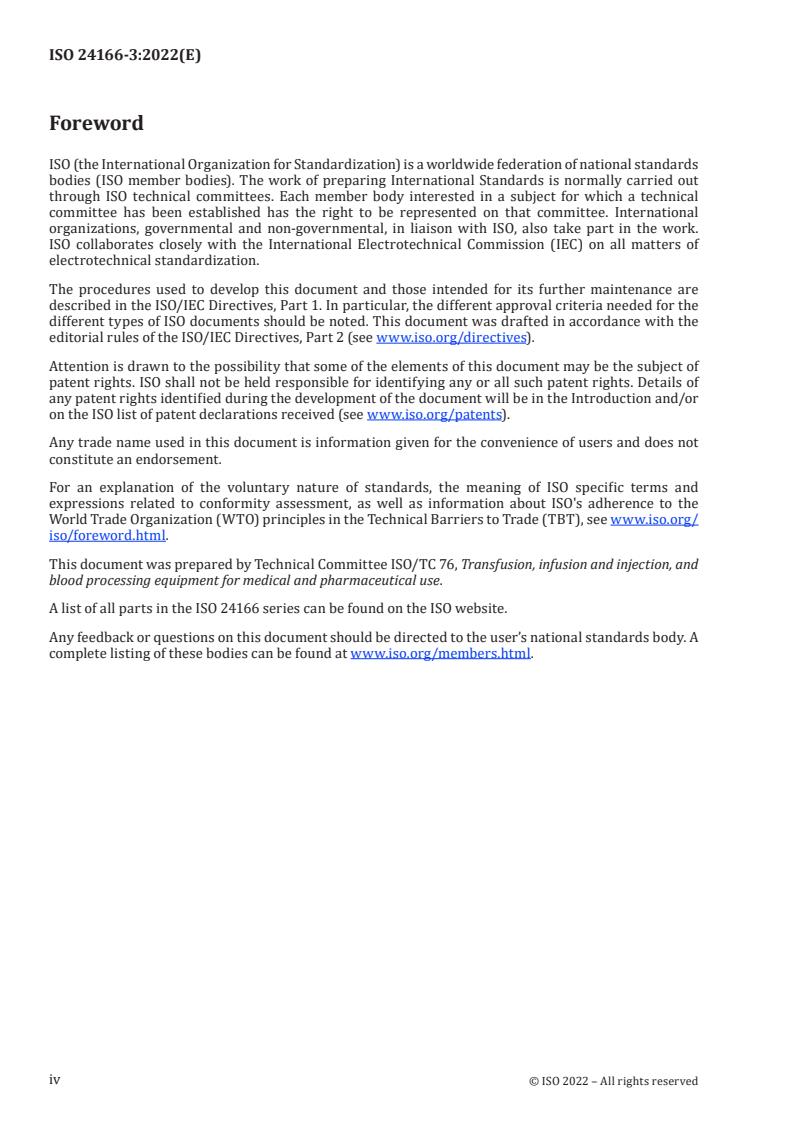
ISO 24166-3:2022 - Snap-on bottles for metering pumps — Part 3: Plastic Released:8. 08. 2022
ISO 24166-3:2022 - Flacons avec jonc d’encliquetage pour pompes doseuses — Partie 3: Plastique/20/2023
Overview - ISO 24166-3:2022 (Snap‑on bottles for metering pumps - Part 3: Plastic)
ISO 24166-3:2022 defines the shape, dimensions, fill capacities and performance requirements for plastic snap‑on bottles intended for use with metering pumps in medicinal applications. The standard covers material selection, neck finishes (with or without a sealing ring), brimful capacities for standard sizes (e.g., 5P–100P), manufacturing tolerances, packaging options (nonsterile, ready‑to‑sterilize, sterile) and relevant test methods. It is part of the ISO 24166 series and references packaging validation requirements such as ISO 11607‑1/2.
Key topics and technical requirements
- Neck finish and snap‑on geometry: precise neck dimensions and tolerances to ensure a reliable press‑fit between bottle and metering pump; separate specifications for bottles with and without a sealing ring.
- Brimful capacity and dimensions: standardized capacities and dimensional tables (typical sizes 5P, 10P, 15P, 20P, 30P, 50P, 100P) with defined tolerances to support interoperable filling and pump assemblies.
- Materials: selection criteria covering oxygen and water vapour permeability, sterilization compatibility, drug/container interactions, and suitability for Injection Blow Molding (IBM) or Injection Stretch Blow Molding (ISBM).
- Mechanical and physical performance: wall‑thickness requirements and tests such as vertical force resistance and tightness tests (annexes provide measurement methods).
- Packaging and sterilization options: requirements for protective packaging, sterile barrier systems (SBS), foil bags, shipper boxes, and configurations for nonsterile, ready‑to‑sterilize or sterile deliveries.
- Testing and annexes: informative annexes detail snap‑on considerations, tightness tests, inner depth measurement and vertical force measurement technical methods.
Practical applications and who uses this standard
ISO 24166‑3:2022 is intended for organizations involved in the design, manufacture and distribution of primary packaging for liquid medicinal products:
- Plastic bottle manufacturers and mold designers (IBM/ISBM)
- Metering pump and closure system suppliers seeking interoperable interfaces
- Pharmaceutical fill‑finish and packaging engineers standardizing production lines
- Quality, regulatory and sterilization teams ensuring cGMP compliance and sterile barrier validation
- Supply chain and procurement teams specifying packaging for storage and transport
Adoption of this standard helps ensure compatibility between bottles and metering pumps, reduces redesign risk, and supports regulatory expectations for primary packaging used in medicinal products.
Related standards
- ISO 11607‑1 / ISO 11607‑2 - packaging and validation for terminally sterilized medical devices
- ISO 15378 - primary packaging materials for medicinal products (cGMP considerations)
- Other parts of the ISO 24166 series (glass and alternate materials)
Keywords: ISO 24166-3:2022, snap-on bottles, metering pumps, plastic bottles, medical packaging, sterile barrier system, brimful capacity, neck finish, vertical force, IBM, ISBM, cGMP.
Buy Documents
ISO 24166-3:2022 - Snap-on bottles for metering pumps — Part 3: Plastic Released:8. 08. 2022
ISO 24166-3:2022 - Flacons avec jonc d’encliquetage pour pompes doseuses — Partie 3: Plastique/20/2023
Get Certified
Connect with accredited certification bodies for this standard

BSI Group
BSI (British Standards Institution) is the business standards company that helps organizations make excellence a habit.

TÜV Rheinland
TÜV Rheinland is a leading international provider of technical services.

TÜV SÜD
TÜV SÜD is a trusted partner of choice for safety, security and sustainability solutions.
Sponsored listings
Frequently Asked Questions
ISO 24166-3:2022 is a standard published by the International Organization for Standardization (ISO). Its full title is "Snap-on bottles for metering pumps — Part 3: Plastic". This standard covers: This document specifies the shape, dimensions, fill capacities and performance requirements of plastic bottles for metering pumps. It also specifies the material for the manufacturing of such containers as well as the secondary packaging. The document provides requirements for packaging of the plastic bottles and addresses nonsterile, ready to sterilize or sterile as three possible options. This document is applicable to colourless or coloured containers moulded from plastic and intended to be used in the packaging, storage or transportation of products intended for medicinal use.
This document specifies the shape, dimensions, fill capacities and performance requirements of plastic bottles for metering pumps. It also specifies the material for the manufacturing of such containers as well as the secondary packaging. The document provides requirements for packaging of the plastic bottles and addresses nonsterile, ready to sterilize or sterile as three possible options. This document is applicable to colourless or coloured containers moulded from plastic and intended to be used in the packaging, storage or transportation of products intended for medicinal use.
ISO 24166-3:2022 is classified under the following ICS (International Classification for Standards) categories: 11.120.99 - Other standards related to pharmaceutics. The ICS classification helps identify the subject area and facilitates finding related standards.
ISO 24166-3:2022 is available in PDF format for immediate download after purchase. The document can be added to your cart and obtained through the secure checkout process. Digital delivery ensures instant access to the complete standard document.
Standards Content (Sample)
INTERNATIONAL ISO
STANDARD 24166-3
First edition
2022-08
Snap-on bottles for metering pumps —
Part 3:
Plastic
Flacons encliquetables pour pompes doseuses —
Partie 3: Plastique
Reference number
© ISO 2022
All rights reserved. Unless otherwise specified, or required in the context of its implementation, no part of this publication may
be reproduced or utilized otherwise in any form or by any means, electronic or mechanical, including photocopying, or posting on
the internet or an intranet, without prior written permission. Permission can be requested from either ISO at the address below
or ISO’s member body in the country of the requester.
ISO copyright office
CP 401 • Ch. de Blandonnet 8
CH-1214 Vernier, Geneva
Phone: +41 22 749 01 11
Email: copyright@iso.org
Website: www.iso.org
Published in Switzerland
ii
Contents Page
Foreword .iv
Introduction .v
1 Scope . 1
2 Normative references . 1
3 Terms and definitions . 1
4 Symbols . 3
5 Dimensions .4
5.1 General . 4
5.2 Bottles without sealing ring . 4
5.3 Bottles with sealing ring . 5
6 Materials . 7
7 Requirements . 7
7.1 General requirements . 7
7.2 Physical requirements . 8
7.2.1 Vertical Force . . . 8
7.2.2 Particulate contaminations . 8
7.3 Chemical requirements . . 8
7.4 Sterilization . 8
8 Marking of the bottle .8
9 Packaging options . 8
9.1 General packaging requirements . 8
9.2 Packaging for nonsterile plastic bottles . 9
9.3 Ready to sterilize or sterile plastic bottles . 9
Annex A (informative) Snap-on considerations .10
Annex B (informative) Tightness test .12
Annex C (informative) Inner depth measuring .13
Annex D (informative) Vertical force measurement technical method .14
Annex E (informative) Example of a packaging configuration .17
Bibliography .18
iii
Foreword
ISO (the International Organization for Standardization) is a worldwide federation of national standards
bodies (ISO member bodies). The work of preparing International Standards is normally carried out
through ISO technical committees. Each member body interested in a subject for which a technical
committee has been established has the right to be represented on that committee. International
organizations, governmental and non-governmental, in liaison with ISO, also take part in the work.
ISO collaborates closely with the International Electrotechnical Commission (IEC) on all matters of
electrotechnical standardization.
The procedures used to develop this document and those intended for its further maintenance are
described in the ISO/IEC Directives, Part 1. In particular, the different approval criteria needed for the
different types of ISO documents should be noted. This document was drafted in accordance with the
editorial rules of the ISO/IEC Directives, Part 2 (see www.iso.org/directives).
Attention is drawn to the possibility that some of the elements of this document may be the subject of
patent rights. ISO shall not be held responsible for identifying any or all such patent rights. Details of
any patent rights identified during the development of the document will be in the Introduction and/or
on the ISO list of patent declarations received (see www.iso.org/patents).
Any trade name used in this document is information given for the convenience of users and does not
constitute an endorsement.
For an explanation of the voluntary nature of standards, the meaning of ISO specific terms and
expressions related to conformity assessment, as well as information about ISO's adherence to the
World Trade Organization (WTO) principles in the Technical Barriers to Trade (TBT), see www.iso.org/
iso/foreword.html.
This document was prepared by Technical Committee ISO/TC 76, Transfusion, infusion and injection, and
blood processing equipment for medical and pharmaceutical use.
A list of all parts in the ISO 24166 series can be found on the ISO website.
Any feedback or questions on this document should be directed to the user’s national standards body. A
complete listing of these bodies can be found at www.iso.org/members.html.
iv
Introduction
This document is part of a series of International Standards for containers made from different
materials used in combination with metering pumps for medicinal applications.
Glass containers are mainly used for that purpose. Plastic containers can be used as an alternative.
This document can be used for the development of standardized filling and assembling equipment.
Based on the dimensions of the containers, appropriate components, such as metering pumps and other
closure systems can be developed and standardized. As such this document provides important inputs
for developing entire packaging systems for medicinal applications.
Primary packaging materials are an integral part of medicinal products. Thus, depending on the
jurisdiction, the principles of the current Good Manufacturing Practices (cGMP) can apply to the
manufacturing of these components (e.g. ISO 15378).
v
INTERNATIONAL STANDARD ISO 24166-3:2022(E)
Snap-on bottles for metering pumps —
Part 3:
Plastic
1 Scope
This document specifies the shape, dimensions, fill capacities and performance requirements of plastic
bottles for metering pumps. It also specifies the material for the manufacturing of such containers as
well as the secondary packaging.
The document provides requirements for packaging of the plastic bottles and addresses nonsterile,
ready to sterilize or sterile as three possible options.
This document is applicable to colourless or coloured containers moulded from plastic and intended to
be used in the packaging, storage or transportation of products intended for medicinal use.
2 Normative references
The following documents are referred to in the text in such a way that some or all of their content
constitutes requirements of this document. For dated references, only the edition cited applies. For
undated references, the latest edition of the referenced document (including any amendments) applies.
ISO 11607-1, Packaging for terminally sterilized medical devices — Part 1: Requirements for materials,
sterile barrier systems and packaging systems
ISO 11607-2, Packaging for terminally sterilized medical devices — Part 2: Validation requirements for
forming, sealing and assembly processes
3 Terms and definitions
For the purposes of this document, the following terms and definitions apply.
ISO and IEC maintain terminology databases for use in standardization at the following addresses:
— ISO Online browsing platform: available at https:// www .iso .org/ obp
— IEC Electropedia: available at https:// www .electropedia .org/
3.1
base foil
packaging component for protection of the pallet load from contamination
3.2
bottle
vial
container made of a suitable material, which is intended for packaging, storage and application of liquid
medicinal products
EXAMPLE Tubular glass, moulded glass or plastic.
3.3
brimful capacity
volume of water required to fill a container, placed on a flat, horizontal surface
[SOURCE: ISO 4802-1:2016, 3.3]
3.4
chemical indicator
test system that reveals change in one or more pre-defined process variables based on a chemical
change resulting from exposure to a process
[SOURCE: ISO 11139: 2018, 3.43, modified — "pre-specified" was replaced with "pre-defined", "or
physical" was deleted.]
3.5
customer
business entity that purchases bottles for metering pumps and conducts further processing or filling as
appropriate
[SOURCE: ISO 21882:2019, 3.1 modified — “sterilized ready for filling vials” was replaced with “bottles
for metering pumps”.]
3.6
dip-tube
conduit, part of the metering pump, which delivers the product from the bottle to the metering
mechanism
3.7
foil bag
gas permeable or non-permeable bag
Note 1 to entry: Foil bags can be used as sterile barrier system (3.17) or as protective packaging (3.13), depending
on final usage.
3.8
label
written, printed or graphic information appearing on the item itself, on the packaging of each item or
on the packaging of multiple items
[SOURCE: IMDRF/GRRP WG/N52: 2019, 3.17, modified – replaced "unit" and "devices" with "item"]
3.9
manufacturer
business entity that manufactures or is otherwise responsible for the manufacturing of the bottles
ready to be filled by the customer (3.4)
[SOURCE: ISO 21882:2019, 3.14 modified – “performs” was replaced with “manufactures”, “vials” was
replaced with “bottles”.]
3.10
metering pump
device actuated by the user to deliver a specific dose of liquid
3.11
packaging system
combination of a sterile barrier system and protective packaging
[SOURCE: ISO 11139:2018, 3.192]
3.12
pallet
construction for transportation and storage of goods
3.13
protective packaging
configuration of materials designed to prevent damage to the sterile barrier system and its contents
from the time of their assembly until the point of use
[SOURCE: ISO 11139:2018, 3.219]
3.14
sealing ring
bottle feature on top of the flange to support tightness
3.15
shipper box
protective packaging for the foil bags
3.16
snap-on bottle
container with press-fit for metering pumps
3.17
sterile barrier system
SBS
minimum package that minimizes the risk of ingress of microorganisms and allows aseptic presentation
of the sterile contents at the point of use
[SOURCE: ISO 11139:2018, 3.272]
3.18
transport cover
outside packaging layer protecting against environmental hazards and keeping the shipper boxes (3.15)
in place
4 Symbols
t bottom concavity
d outer diameter body
h total length
h length cylindrical part of the body
h inner depth
r shoulder radius
r bottom radius
s wall thickness body
s wall thickness bottom
P plastic
...
NORME ISO
INTERNATIONALE 24166-3
Première édition
2022-08
Flacons avec jonc d’encliquetage pour
pompes doseuses —
Partie 3:
Plastique
Snap-on bottles for metering pumps —
Part 3: Plastic
Numéro de référence
DOCUMENT PROTÉGÉ PAR COPYRIGHT
© ISO 2022
Tous droits réservés. Sauf prescription différente ou nécessité dans le contexte de sa mise en œuvre, aucune partie de cette
publication ne peut être reproduite ni utilisée sous quelque forme que ce soit et par aucun procédé, électronique ou mécanique,
y compris la photocopie, ou la diffusion sur l’internet ou sur un intranet, sans autorisation écrite préalable. Une autorisation peut
être demandée à l’ISO à l’adresse ci-après ou au comité membre de l’ISO dans le pays du demandeur.
ISO copyright office
Case postale 401 • Ch. de Blandonnet 8
CH-1214 Vernier, Genève
Tél.: +41 22 749 01 11
E-mail: copyright@iso.org
Web: www.iso.org
Publié en Suisse
ii
Sommaire Page
Avant-propos .iv
Introduction .v
1 Domaine d'application .1
2 Références normatives .1
3 Termes et définitions . 1
4 Symboles . 3
5 Dimensions .4
5.1 Généralités . 4
5.2 Flacons sans jonc d'étanchéité . 4
5.3 Flacons avec jonc d'étanchéité . 5
6 Matériaux . 7
7 Exigences . 7
7.1 Exigences générales . 7
7.2 Exigences physiques . 8
7.2.1 Force verticale . 8
7.2.2 Contaminations particulaires . 8
7.3 Exigences chimiques . 8
7.4 Stérilisation . 8
8 Marquage du flacon .8
9 Options d'emballage .8
9.1 Exigences générales relatives à l'emballage . 8
9.2 Emballage des flacons en plastique non stériles . 9
9.3 Flacons prêts à stériliser ou stériles . 9
Annexe A (informative) Considérations relatives à l'encliquetage .10
Annexe B (informative) Essai d'étanchéité .12
Annexe C (informative) Mesure de la profondeur intérieure .13
Annexe D (informative) Méthode technique de mesure de la force verticale .14
Annexe E (informative) Exemple de configuration d'emballage .17
Bibliographie .18
iii
Avant-propos
L'ISO (Organisation internationale de normalisation) est une fédération mondiale d'organismes
nationaux de normalisation (comités membres de l'ISO). L'élaboration des Normes internationales est
en général confiée aux comités techniques de l'ISO. Chaque comité membre intéressé par une étude
a le droit de faire partie du comité technique créé à cet effet. Les organisations internationales,
gouvernementales et non gouvernementales, en liaison avec l'ISO participent également aux travaux.
L'ISO collabore étroitement avec la Commission électrotechnique internationale (IEC) en ce qui
concerne la normalisation électrotechnique.
Les procédures utilisées pour élaborer le présent document et celles destinées à sa mise à jour sont
décrites dans les Directives ISO/IEC, Partie 1. Il convient, en particulier, de prendre note des différents
critères d'approbation requis pour les différents types de documents ISO. Le présent document a
été rédigé conformément aux règles de rédaction données dans les Directives ISO/IEC, Partie 2 (voir
www.iso.org/directives).
L'attention est attirée sur le fait que certains des éléments du présent document peuvent faire l'objet de
droits de propriété intellectuelle ou de droits analogues. L'ISO ne saurait être tenue pour responsable
de ne pas avoir identifié de tels droits de propriété et averti de leur existence. Les détails concernant
les références aux droits de propriété intellectuelle ou autres droits analogues identifiés lors de
l'élaboration du document sont indiqués dans l'Introduction et/ou dans la liste des déclarations de
brevets reçues par l'ISO (voir www.iso.org/brevets).
Les appellations commerciales éventuellement mentionnées dans le présent document sont données
pour information, par souci de commodité, à l’intention des utilisateurs et ne sauraient constituer un
engagement.
Pour une explication de la nature volontaire des normes, la signification des termes et expressions
spécifiques de l'ISO liés à l'évaluation de la conformité, ou pour toute information au sujet de l'adhésion
de l'ISO aux principes de l’Organisation mondiale du commerce (OMC) concernant les obstacles
techniques au commerce (OTC), voir www.iso.org/avant-propos.
Le présent document a été élaboré par le comité technique ISO/TC 76, Appareils de transfusion, de
perfusion et d'injection et appareils destinés au traitement du sang à usage médical et pharmaceutique.
Une liste de toutes les parties de la série ISO 24166 se trouve sur le site web de l'ISO.
Il convient que l’utilisateur adresse tout retour d’information ou toute question concernant le présent
document à l’organisme national de normalisation de son pays. Une liste exhaustive desdits organismes
se trouve à l’adresse www.iso.org/fr/members.html.
iv
Introduction
Le présent document fait partie d'une série de Normes internationales relatives aux récipients fabriqués
à partir de différents matériaux utilisés conjointement avec des pompes doseuses pour les applications
médicales.
Les récipients en verre sont principalement utilisés à cette fin. Les récipients en plastique peuvent être
utilisés comme alternative.
Le présent document peut être utilisé pour la conception d'équipements de remplissage et d'assemblage
normalisés.
Sur la base des dimensions des récipients, il est possible de concevoir et de normaliser des composants
appropriés, tels que des pompes doseuses et d'autres systèmes de fermeture. À ce titre, le présent
document fournit des éléments importants pour la conception de systèmes d'emballage complets pour
les applications médicales.
Les matériaux d’emballage primaire font partie intégrante des produits médicinaux. Par conséquent,
selon la juridiction, les principes des Bonnes pratiques de fabrication (BPF) actuelles peuvent s'appliquer
à la fabrication de ces composants (par exemple l'ISO 15378).
v
NORME INTERNATIONALE ISO 24166-3:2022(F)
Flacons avec jonc d’encliquetage pour pompes doseuses —
Partie 3:
Plastique
1 Domaine d'application
Le présent document spécifie la forme, les dimensions, les capacités de remplissage et les exigences de
performance des flacons en plastique pour les pompes doseuses. Il spécifie également le matériau pour
la fabrication de ces récipients ainsi que l'emballage secondaire.
Le document fournit les exigences relatives à l'emballage des flacons en plastique et couvre trois options
possibles: non stérile, prêt à stériliser ou stérile.
Le présent document s'applique aux récipients, colorés ou non, moulés en plastique et destinés à être
utilisés pour l'emballage, le stockage ou le transport de produits destinés à un usage médical.
2 Références normatives
Les documents suivants sont cités dans le texte de sorte qu'ils constituent, pour tout ou partie de leur
contenu, des exigences du présent document. Pour les références datées, seule l'édition citée s'applique.
Pour les références non datées, la dernière édition du document de référence s'applique (y compris les
éventuels amendements).
ISO 11607-1, Emballages des dispositifs médicaux stérilisés au stade terminal — Partie 1: Exigences
relatives aux matériaux, aux systèmes de barrière stérile et aux systèmes d'emballage
ISO 11607-2, Emballages des dispositifs médicaux stérilisés au stade terminal — Partie 2: Exigences de
validation pour les procédés de formage, scellage et assemblage
3 Termes et définitions
Pour les besoins du présent document, les termes et définitions suivants s’appliquent.
L’ISO et l’IEC tiennent à jour des bases de données terminologiques destinées à être utilisées en
normalisation, consultables aux adresses suivantes:
— ISO Online browsing platform: disponible à l’adresse https:// www .iso .org/ obp
— IEC Electropedia: disponible à l’adresse https:// www .electropedia .org/
3.1
film palette
composant d'emballage destiné à protéger le chargement de la palette des contaminations
3.2
bouteille
flacon
récipient fabriqué dans un matériau approprié, destiné à l'emballage, au stockage et à l'application de
produits médicinaux liquides
EXEMPLE Verre tubulaire, verre moulé ou plastique.
3.3
capacité ras bord
volume d'eau requis pour remplir un récipient placé sur une surface plate et horizontale
[SOURCE: ISO 4802-1:2016, 3.3]
3.4
indicateur chimique
système d’essai révélant un changement d’une ou plusieurs des variables prédéfinies d’un/de procédé,
fondé sur un changement chimique dû à l’exposition au procédé
[SOURCE: ISO 11139: 2018, 3.43, modifiée — «pre-specified» a été remplacé par «pre-defined» dans la
version anglaise, «physique» a été supprimé.]
3.5
client
entité commerciale qui achète des bouteilles pour pompes doseuses et effectue un traitement ou un
remplissage ultérieur, le cas échéant
[SOURCE: ISO 21882:2019, 3.1 modifiée — «sterilized ready for filling vials» a été remplacé par «bottles
for metering pumps» dans la version anglaise.]
3.6
tube plongeur
tube, qui fait partie de la pompe doseuse, qui achemine le produit du flacon au mécanisme de dosage
3.7
sachet
sachet perméable aux gaz ou non perméable aux gaz
Note 1 à l'article: Les sachets peuvent être utilisés comme système de barrière stérile (3.17) ou comme emballage
de protection (3.13), selon l'utilisation finale.
3.8
étiquette
informations écrites, imprimées ou graphiques figurant sur l'article lui-même, sur l'emballage de
chaque article ou sur l'emballage de plusieurs articles
[SOURCE: IMDRF/GRRP WG/N52: 2019, 3.17, modifiée – remplacement de «unit» et «devices» par «item»
dans la version anglaise]
3.9
fabricant
entité commerciale qui fabrique ou est autrement responsable de la fabrication des bouteilles prêtes à
être remplies par le client (3.4)
[SOURCE: ISO 21882:2019, 3.14 modifiée – dans la version anglaise, «performs» a été remplacé par
«manufactures» et «vials» a été remplacé par «bottles».]
3.10
pompe doseuse
dispositif actionné par l'utilisateur afin de délivrer une dose spécifique de liquide
3.11
système d'emballage
combinaison d'un système de barrière stérile et d'un emballage de protection
[SOURCE: ISO 11139:2018, 3.192]
3.12
palette
structure destinée au transport et au stockage de marchandises
3.13
emballage de protection
configuration de matériaux conçue pour éviter tout dommage au système de barrière stérile et à son
contenu depuis leur assemblage jusqu’au point d’utilisation
[SOURCE: ISO 11139:2018, 3.219]
3.14
jonc d'étanchéité
forme ajoutée au sommet du col pour contribuer à l'étanchéité
3.15
carton d'expédition
emballage de protection destiné aux sachets
3.16
flacon avec jonc d'encliquetage
récipient équipé d'un jonc d'encliquetage destiné aux pompes doseuses
3.17
système de barrière stérile
SBS
emballage minimal qui réduit le plus possible le risque de pénétration des microorganismes et permet
une présentation aseptique du contenu stérile au point d’utilisation
[SOURCE: ISO 11139:2018, 3.272]
3.18
film étirable
film d'emballage extérieur protégeant contre les risques environnementaux et maintenant les cartons
d'expédition (3.15) en place
4 Symboles
d diamètre extérieur du corps
h longueur totale
h longueur de la partie cylindrique du corps
h profondeur intérieure
P plastique
r rayon de l'épaule
r rayon du fond
s épaisseur de paroi du corps
s épaisseur de paroi du fond
t concavité du fond
5 Dimensions
5.1 Généralités
Les dimensions, y compris les tolérances, dépendent des matériaux et des procédés de fabrication.
Les procédés actuellement utilisés pour obtenir les tolérances requises sont le moulage par injection-
soufflage (IBM) et le moulage par injection-soufflage avec bi-étirage (ISBM)
...