

ISO/IEC 23008-2:2026
(Main)Information technology — High efficiency coding and media delivery in heterogeneous environments — Part 2: High efficiency video coding
- Abstract
This document specifies high efficiency video coding.
- Status
- Published
- Publication Date
- 27-Sep-2026
- Current Stage
- 6060 - International Standard published - 60 Publication
- Start Date
- 28-Sep-2026
- Due Date
- 16-Jul-2027
- Completion Date
- 16-Jul-2027

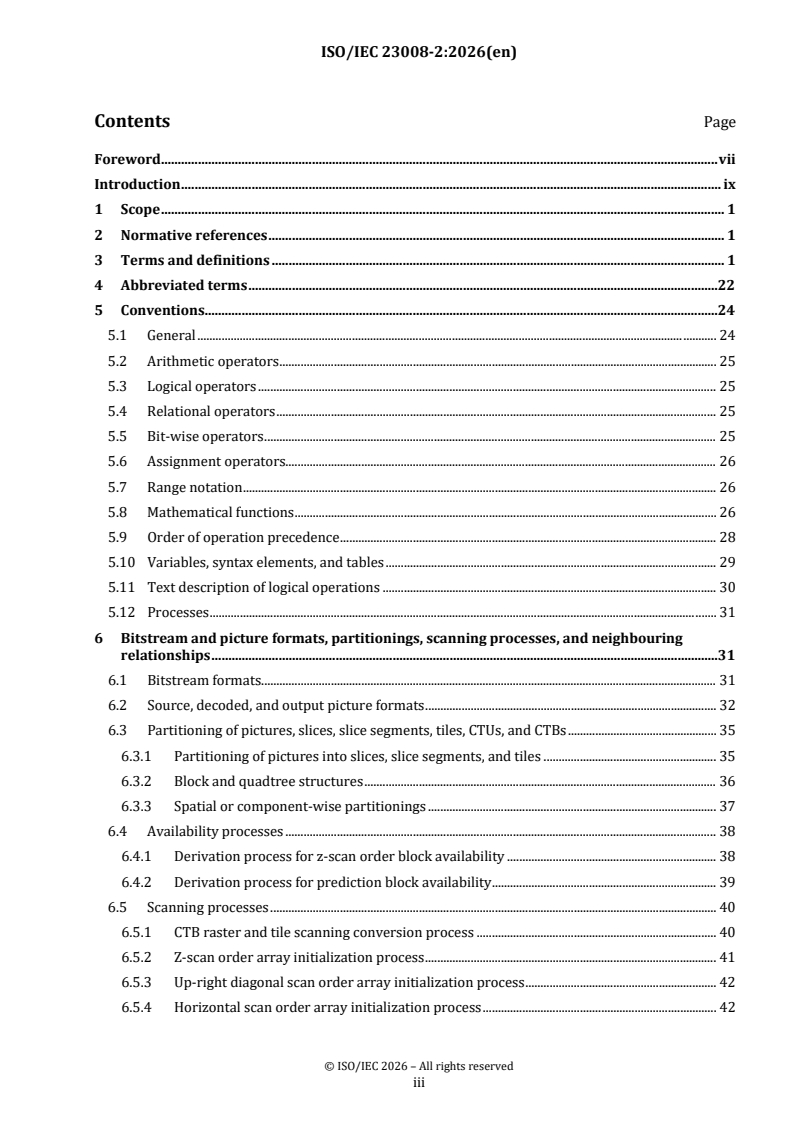
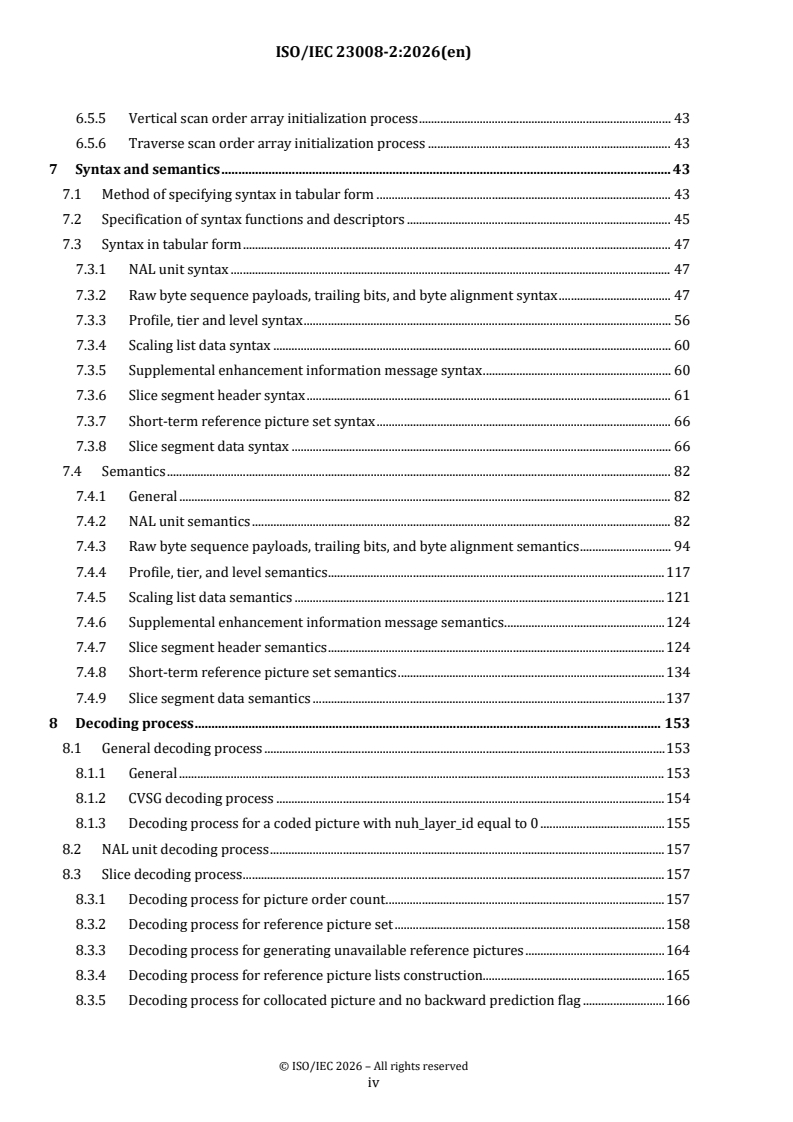
ISO/IEC 23008-2:2026 is an ISO International Standard that specifies high efficiency video coding. It defines how coded video is represented as a bitstream, how that bitstream is parsed, and how a decoder reconstructs pictures from it. The document is for encoder and decoder implementers, and for organizations that need a common video coding format for storage, broadcasting, streaming, and communications.
What does ISO/IEC 23008-2:2026 specify?
ISO/IEC 23008-2:2026 specifies high efficiency video coding, including the syntax, semantics, decoding process, parsing process, and sub-bitstream extraction process needed to exchange coded video between implementations. It also defines profile, tier, and level signaling, plus extension areas for enhancement information, usability information, multiview, scalability, and 3D coding.
The scope is intentionally technical: it covers how the coded video representation works, not how an encoder must choose its compression tools. Methods of framing NAL units other than the byte stream format are outside the document’s scope.
The document is organized into Clauses 1 to 10, followed by normative Annexes A to I.
| Annex | What it covers |
|---|---|
| Annex A | Profiles, tiers and levels |
| Annex B | Byte stream format |
| Annex C | Hypothetical reference decoder |
| Annex D | Supplemental enhancement information |
| Annex E | Video usability information |
| Annex F | Common specifications for multi-layer extensions |
| Annex G | Multiview high efficiency video coding |
| Annex H | Scalable high efficiency video coding |
| Annex I | 3D high efficiency video coding |
What are the key requirements of ISO/IEC 23008-2:2026?
ISO/IEC 23008-2:2026 uses one common coded-video syntax with explicit constraints, so different encoders and decoders can interoperate. The most important requirements are in Clauses 6 to 10 and Annex A, because they define the structure of the bitstream, the picture layout, the allowed subsets, and the decoder’s reconstruction steps.
Bitstream and picture structure
Clause 6.1 defines the two bitstream forms - NAL unit stream and byte stream - and explains how the byte stream is built from NAL units with start code prefixes. In practice, this tells transport, storage, and parser software how video data is packaged and recovered.
Clause 6.2 defines the source and decoded picture formats, including monochrome, YCbCr or YCgCo, GBR, and other tri-stimulus samplings. It also uses luma and chroma terminology consistently, which matters because the actual sample layout changes with chroma_format_idc and separate_colour_plane_flag.
Clause 6.3 partitions pictures into slices, slice segments, tiles, CTUs, and CTBs, while Clauses 6.4 and 6.5 define availability and scanning processes. In practice, these rules keep block addressing and neighbor dependencies consistent across implementations.
Syntax, semantics, and conformance signaling
Clause 7 defines the syntax tables and the semantics that interpret them. It covers NAL unit syntax, raw byte sequence payloads, profile, tier and level syntax, scaling list data, supplemental enhancement information, slice segment headers, short-term reference picture sets, and slice segment data. For implementers, this is the main parsing map for reading a bitstream in the correct order.
Clause 7 also defines the NAL unit types and how they form access units, coded video sequences, and coded video sequence groups. This is what lets a decoder identify random-access pictures, leading and trailing pictures, and the relationship between pictures and associated non-VCL NAL units.
Clause 7 constrains values such as nuh_layer_id, TemporalId, and slice_type in specific cases. Those constraints matter because they control layer handling, temporal scalability, and which pictures may depend on others.
Annex A limits the syntax further through profiles, tiers, and levels. In practice, this is the part buyers, integrators, and product teams use to decide what operating range a device or service supports.
Decoding, prediction, and filtering
Clause 8 defines how syntax elements become decoded samples. It includes NAL unit decoding, slice decoding, picture order count derivation, reference picture set handling, reference picture list construction, intra prediction, inter prediction, residual decoding, scaling and transformation, picture construction, and in-loop filtering. In practice, Clause 8 is the decoder recipe.
Clause 8 also covers deblocking filter processing and sample adaptive offset (SAO). These are the final reconstruction steps that adjust edges and sample values after prediction and transform, so they are important for both output quality and conformance.
Parsing and bitstream extraction
Clause 9 defines the parsing processes, including 0-th order Exp-Golomb codes and CABAC, which means context-based adaptive binary arithmetic coding (CABAC). This matters because a conforming decoder must support both variable-length and arithmetic parsing for slice segment data.
Clause 10 defines sub-bitstream extraction. That is the part used when a system needs to derive a smaller stream from a coded stream while keeping the coding rules intact.
What terms does ISO/IEC 23008-2:2026 define?
- Access unit - A set of NAL units that belong together, are consecutive in decoding order, and contain exactly one coded picture with nuh_layer_id equal to 0.
- Bitstream - The coded representation carried either as a NAL unit stream or as a byte stream.
- coded video sequence (CVS) - A sequence of access units that starts at an IRAP access unit with NoRaslOutputFlag equal to 1 and continues until the next such access unit.
- coded video sequence group (CVSG) - One or more consecutive CVSs that share the same active VPS RBSP until a different one is activated.
- coded picture buffer (CPB) - A first-in, first-out buffer of decoding units as used in the hypothetical reference decoder.
- hypothetical reference decoder (HRD) - The reference model used to define buffering, conformance, and removal behavior.
- video parameter set (VPS) - A non-VCL parameter set that carries sequence-level information used by the decoder.
Who uses ISO/IEC 23008-2:2026?
ISO/IEC 23008-2:2026 is used by encoder and decoder developers, chipset and software implementers, and conformance-test engineers who need a common definition of the bitstream and the decoding process. It is also used by product teams and buyers who need to choose supported profiles, tiers, and levels for a device, service, or workflow.
In practice, the standard is relevant to broadcast, camcorders, content production and distribution, digital cinema, home cinema, internet streaming, medical imaging, mobile streaming, real-time conversational services, remote video surveillance, storage media, and wireless display. The practical tasks are interoperability, conformance checking, transport packaging, decoder implementation, and selecting the supported operating point.
What changed in ISO/IEC 23008-2:2026 from the previous edition?
This seventh edition cancels and replaces ISO/IEC 23008-2:2025 and is technically revised.
The main changes stated for this edition are:
- specification of an additional profile, the Multiview Main 10profile;
- support for 12 additional SEI messages through referencing to Rec. ITU-T H.274 | ISO/IEC 23002-7;
- updates to the interface text for the two neural-network post-filter (NNPF) SEI messages;
- an extension to the film grain characteristics SEI message.
Which standards are used with ISO/IEC 23008-2:2026?
- ISO/CIE 11664-1 - Provides colorimetry definitions and standard colorimetric observers.
- ISO 12232 - Provides exposure index, ISO speed ratings, standard output sensitivity, and recommended exposure index for still-image related signaling.
- ISO/IEC 10646 - Provides the Universal Coded Character Set (UCS) for character encoding.
- ISO/IEC 11578 - Provides Remote Procedure Call (RPC) support as named in the references.
- ISO/IEC 23001-11 - Provides energy-efficient media consumption, identified as green metadata.
- Rec. ITU-T H.274 | ISO/IEC 23002-7 - Provides versatile supplemental enhancement information messages for coded video bitstreams.
- Rec. ITU-T T.35 - Provides allocation of ITU-T defined codes for non-standard facilities.
- IETF RFC 1321 - Provides the MD5 Message-Digest Algorithm.
- IETF RFC 5646 - Provides language tags.
What does the ISO/IEC 23008-2:2026 document contain?
ISO/IEC 23008-2:2026 contains the notation and convention rules used throughout the specification, including arithmetic, logical, and relational operators, syntax-element descriptions, and process notation. It then gives the bitstream and picture-format rules, followed by the detailed syntax and semantics for NAL units, parameter sets, slice headers, SEI, reference picture sets, and slice data.
The document also contains the decoding processes for intra and inter prediction, transform and residual handling, and in-loop filtering, plus the parsing rules for Exp-Golomb coding and CABAC. Annex C provides the hypothetical reference decoder and conformance framework, while Annex D and Annex E define the detailed SEI and VUI payload rules. Annexes F, G, H, and I extend the base syntax for multi-layer, multiview, scalable, and 3D use cases.
Relations
- Effective Date
- 24-Jan-2026
Get Certified
Connect with accredited certification bodies for this standard

BSI Group
BSI (British Standards Institution) is the business standards company that helps organizations make excellence a habit.

NYCE
Mexican standards and certification body.
Sponsored listings
Frequently Asked Questions
ISO/IEC 23008-2:2026 is a standard published by the International Organization for Standardization (ISO). Its full title is "Information technology — High efficiency coding and media delivery in heterogeneous environments — Part 2: High efficiency video coding". This standard covers: This document specifies high efficiency video coding.
This document specifies high efficiency video coding.
ISO/IEC 23008-2:2026 is classified under the following ICS (International Classification for Standards) categories: 35.040.40 - Coding of audio, video, multimedia and hypermedia information. The ICS classification helps identify the subject area and facilitates finding related standards.
ISO/IEC 23008-2:2026 has the following relationships with other standards: It is inter standard links to ISO/IEC 23008-2:2025. Understanding these relationships helps ensure you are using the most current and applicable version of the standard.
ISO/IEC 23008-2:2026 is available in PDF format for immediate download after purchase. The document can be added to your cart and obtained through the secure checkout process. Digital delivery ensures instant access to the complete standard document.
Standards Content (Sample)
Contents
- Introduction
- 1 Scope
- 2 Normative references
- 3 Terms and definitions
- 3.1 access unit
- 3.2 AC transform coefficient
- 3.3 associated IRAP picture
- 3.4 associated non-VCL NAL unit
- 3.5 associated VCL NAL unit
- 3.6 azimuth circle
- 3.7 base layer
- 3.8 bin
- 3.9 binarization
- 3.10 binarization process
- 3.11 bin string
- 3.12 bi-predictive slice
- 3.13 bitstream
- 3.14 block
- 3.15 broken link
- 3.16 broken link access access unit
- 3.17 broken link access picture
- 3.18 buffering period
- 3.19 byte
- 3.20 byte-aligned
- 3.21 byte stream
- 3.22 chroma
- 3.23 clean random access access unit
- 3.24 clean random access picture
- 3.25 coded picture
- 3.26 coded picture buffer
- 3.27 coded representation
- 3.28 coded slice segment NAL unit
- 3.29 coded layer-wise video sequence
- 3.30 coded video sequence
- 3.31 coded video sequence group
- 3.32 coding block
- 3.33 coding tree block
- 3.34 coding tree unit
- 3.35 coding unit
- 3.36 component
- 3.37 constituent picture
- 3.38 context variable
- 3.39 cropped decoded picture
- 3.40 decoded picture
- 3.41 decoded picture buffer
- 3.42 decoder
- 3.43 decoder under test
- 3.44 decoding order
- 3.45 decoding process
- 3.46 decoding unit
- 3.47 dependent slice segment
- 3.48 display process
- 3.49 elementary stream
- 3.50 elevation circle
- 3.51 emulation prevention byte
- 3.52 encoder
- 3.53 encoding process
- 3.54 field
- 3.55 filler data NAL unit
- 3.56 flag
- 3.57 frame
- 3.58 frequency index
- 3.59 global coordinate axes
- 3.60 great circle
- 3.61 hypothetical reference decoder
- 3.62 hypothetical stream scheduler
- 3.63 independent slice segment
- 3.64 instantaneous decoding refresh access unit
- 3.65 instantaneous decoding refresh picture
- 3.66 inter coding
- 3.67 inter prediction
- 3.68 intra coding
- 3.69 intra prediction
- 3.70 intra random access point access unit
- 3.71 intra random access point picture
- 3.72 intra slice
- 3.73 layer
- 3.74 layer identifier list
- 3.75 layer set
- 3.76 leading picture
Introduction
As the costs for both processing power and memory have reduced, network support for coded video data has diversified, and advances in video coding technology have progressed. The need has arisen for an industry standard for compressed video representation with substantially increased coding efficiency and enhanced robustness to network environments. Toward these ends, the ITU-T Video Coding Experts Group (VCEG) and the ISO/IEC Moving Picture Experts Group (MPEG) formed a Joint Collaborative Team on Video Coding (JCT-VC) in 2010 and a Joint Collaborative Team on 3D Video Coding Extension Development (JCT-3V) in 2012 for development of a new Recommendation | International Standard. This document was developed in the JCT-VC and the JCT-3V. Purpose This document was developed in response to the growing need for higher compression of moving pictures for various applications such as videoconferencing, digital storage media, television broadcasting, internet streaming, and communications. It is also designed to enable the use of the coded video representation in a flexible manner for a wide variety of network environments as well as to enable the use of multi-core parallel encoding and decoding devices. The use of this document allows motion video to be manipulated as a form of computer data and to be stored on various storage media, transmitted and received over existing and future networks and distributed on existing and future broadcasting channels. Supports for higher bit depths and enhanced chroma formats, including the use of full-resolution chroma are provided. Support for scalability enables video transmission on networks with varying transmission conditions and other scenarios involving multiple bit rate services. Support for multiview enables representation of video content with multiple camera views and optional auxiliary information. Support for 3D enables joint representation of video content and depth information with multiple camera views.
Applications This document is designed to cover a broad range of applications for video content including but not limited to the following:
- broadcast (cable TV on optical networks / copper, satellite, terrestrial, etc.);
- camcorders;
- content production and distribution;
- digital cinema;
- home cinema;
- internet streaming, download and play;
- medical imaging;
- mobile streaming, broadcast and communications;
- real-time conversational services (videoconferencing, videophone, telepresence, etc.);
- remote video surveillance;
- storage media (optical disks, digital video tape recorder, etc.);
ISO/IEC 23008-2:2026(en) - wireless display.
Publication and versions of this document This document has been jointly developed by ITU-T Video Coding Experts Group (VCEG) and the ISO/IEC Moving Picture Experts Group (MPEG). It is published as technically-aligned twin text in both ITU-T and ISO/IEC. As the basis text has been drafted to become both an ITU-T Recommendation and an ISO/IEC International Standard, the term "Specification" (with capitalization to indicate that it refers to the whole of the text) is used herein when the text refers to itself. This is the tenth version of this document and the sixth edition published by ISO/IEC. Rec. ITU-T H.265 | ISO/IEC 23008-2 version 1 refers to the first approved version of this document. The first edition published by ISO/IEC as ISO/IEC 23008-2:2013 corresponded to the first version. Rec. ITU-T H.265 | ISO/IEC 23008-2 version 2 refers to the integrated text additionally containing format range extensions, scalability extensions, multiview extensions, additional supplement enhancement information, and corrections to various minor defects in the prior content of the specification. The second edition published by ISO/IEC as ISO/IEC 23008-2:2015 corresponded to the second version.
Rec. ITU-T H.265 | ISO/IEC 23008-2 version 3 refers to the integrated text additionally containing 3D extensions, additional supplement enhancement information, and corrections to various minor defects in the prior content of the specification.
Rec. ITU-T H.265 | ISO/IEC 23008-2 version 4 refers to the integrated text additionally containing screen content coding extensions profiles, scalable range extensions profiles, additional high throughput profiles, additional supplement enhancement information, additional colour representation identifiers, and corrections to various minor defects in the prior content of the specification. The third edition published by ISO/IEC as ISO/IEC 23008-2:2017 corresponded to the fourth version. Rec. ITU-T H.265 | ISO/IEC 23008-2 version 5 refers to the integrated text additionally containing additional SEI messages that include omnidirectional video specific SEI messages, a Monochrome 10 profile, a Main 10 Still Picture profile, and corrections to various minor defects in the prior content of the specification.
Rec. ITU-T H.265 | ISO/IEC 23008-2 version 6 refers to the integrated text additionally containing additional SEI messages for SEI manifest and SEI prefix, and corrections to various minor defects in the prior content of the specification.
Rec. ITU-T H.265 | ISO/IEC 23008-2 version 7 refers to the integrated text additionally containing the fisheye video information SEI message and the annotated regions SEI message, and corrections to various minor defects in the prior content of the specification. The fourth edition published by ISO/IEC as ISO/IEC 23008-2:2020 corresponded to the seventh version.
Rec. ITU-T H.265 | ISO/IEC 23008-2 version 8 refers to the integrated text additionally containing the shutter interval SEI message and corrections to various minor defects in the prior content of the specification.
Rec. ITU-T H.265 | ISO/IEC 23008-2 version 9 refers to the integrated text additionally containing specification of levels 6.3, 7, 7.1, and 7.2, the specification of level 8.5 for the video profiles, and corrections to various minor defects in the prior content of the specification. This fifth edition published by ISO/IEC as ISO/IEC 23008-2:2023 corresponds to the ninth version.
ISO/IEC 23008-2:2026(en) Rec. ITU-T H.265 | ISO/IEC 23008-2 version 10 refers to the integrated text additionally containing specification of six additional profiles (the Multiview Extended, Multiview Extended 10, Multiview Monochrome, Multiview Monochrome 10, Multiview Monochrome 12, and Multiview Monochrome 16 profiles), the specification of three additional colour type identifiers, the specification of three additional SEI messages for neural network post-filter characteristics (NNPFC), neural-network postfilter activation (NNPFA), and phase indication (through referencing to Rec. ITU-T H.274 | ISO/IEC 23002-7), and corrections to various minor defects in the prior content of the specification. This sixth edition published by ISO/IEC as ISO/IEC 23008-2:2025 corresponds to the tenth version. Rec. ITU-T H.265 | ISO/IEC 23008-2 version 11 (the current version) refers to the integrated text additionally containing the specification of an additional profile (the Multiview 10 profile), the support of 12 new SEI messages through referencing to Rec. ITU-T H.274 | ISO/IEC 23002-7, namely the 1) SEI processing order, 2) processing order nesting, 3) encoder optimization information, 4) source picture timing information, 5) modality information, 6) digitally signed content initialization, 7) digitally signed content selection, 8) digitally signed content verification, 9) generative face video, 10) generative enhancement face video, 11) AI usage restrictions request, and 12) packed regions information SEI messages, some updates to the interface text for support of the two neural-network post-filter (NNPF) SEI messages, an extension to the film grain characteristics SEI message, and corrections to various minor defects in the prior content of the specification. This seventh edition published by ISO/IEC as ISO/IEC 23008-2:202X corresponds to the eleventh version.
Profiles, tiers, and levels This document is designed to be generic in the sense that it serves a wide range of applications, bit rates, resolutions, qualities, and services. Applications should cover, among other things, digital storage media, television broadcasting, and real-time communications. In the course of creating this document, various requirements from typical applications have been considered, necessary algorithmic elements have been developed, and these have been integrated into a single syntax. Hence, this document will facilitate video data interchange among different applications. Considering the practicality of implementing the full syntax of this document, however, a limited number of subsets of the syntax are also stipulated by means of "profiles", "tiers", and "levels". These and other related terms are formally defined in Clause 3.
A “profile” is a subset of the entire bitstream syntax that is specified in this document. Within the bounds imposed by the syntax of a given profile it is still possible to require a very large variation in the performance of encoders and decoders depending upon the values taken by syntax elements in the bitstream such as the specified size of the decoded pictures. In many applications, it is currently neither practical nor economical to implement a decoder capable of dealing with all hypothetical uses of the syntax within a particular profile.
In order to deal with this problem, "tiers" and "levels" are specified within each profile. A level of a tier is a specified set of constraints imposed on values of the syntax elements in the bitstream. These constraints may be simple limits on values. Alternatively they may take the form of constraints on arithmetic combinations of values (e.g. picture width multiplied by picture height multiplied by number of pictures decoded per second). A level specified for a lower tier is more constrained than a level specified for a higher tier.
Coded video content conforming to this document uses a common syntax. In order to achieve a subset of the complete syntax, flags, parameters, and other syntax elements are included in the bitstream that signal the presence or absence of syntactic elements that occur later in the bitstream.
ISO/IEC 23008-2:2026(en) Overview of the design characteristics The coded representation specified in the syntax is designed to enable a high compression capability for a desired image or video quality. The algorithm is typically not lossless, as the exact source sample values are typically not preserved through the encoding and decoding processes. A number of techniques may be used to achieve highly efficient compression. Encoding algorithms (not specified in this Recommendation | International Standard) may select between inter and intra coding for blockshaped regions of each picture. Inter coding uses motion vectors for block-based inter prediction to exploit temporal statistical dependencies between different pictures. Intra coding uses various spatial prediction modes to exploit spatial statistical dependencies in the source signal for a single picture. Motion vectors and intra prediction modes may be specified for a variety of block sizes in the picture. The prediction residual may then be further compressed using a transform to remove spatial correlation inside the transform block before it is quantized, producing a possibly irreversible process that typically discards less important visual information while forming a close approximation to the source samples. Finally, the motion vectors or intra prediction modes may also be further compressed using a variety of prediction mechanisms, and, after prediction, are combined with the quantized transform coefficient information and encoded using arithmetic coding. How to read this document It is suggested that the reader starts with Clause 1 (Scope) and moves on to Clause 3 (Terms and definitions). Clause 6 should be read for the geometrical relationship of the source, input, and output of the decoder. Clause 7 (Syntax and semantics) specifies the order to parse syntax elements from the bitstream. See 7.1 to 7.3 for syntactical order and see 7.4 for semantics; e.g. the scope, restrictions, and conditions that are imposed on the syntax elements. The actual parsing for most syntax elements is specified in Clause 9 (Parsing process). Clause 10 (Sub-bitstream extraction process) specifies the subbitstream extraction process. Finally, Clause 8 (Decoding process) specifies how the syntax elements are mapped into decoded samples. Throughout reading this document, the reader should refer to Clauses 2 (Normative references), 4 (Abbreviated terms), and 5 (Conventions) as needed. Annexes A through I also form an integral part of this document.
Annex A specifies profiles each being tailored to certain application domains, and defines the so-called tiers and levels of the profiles. Annex B specifies syntax and semantics of a byte stream format for delivery of coded video as an ordered stream of bytes. Annex C specifies the hypothetical reference decoder, bitstream conformance, decoder conformance, and the use of the hypothetical reference decoder to check bitstream and decoder conformance. Annex D specifies syntax and semantics for supplemental enhancement information message payloads. Annex E specifies syntax and semantics of the video usability information parameters of the sequence parameter set. Annex F specifies general multi-layer support for bitstreams and decoders. Annex G contains support for multiview coding. Annex H contains support for scalability. Annex I contains support for 3D coding. Throughout this document, statements appearing with the preamble "NOTE" are informative and are not an integral part of this document.
International Standard ISO/IEC 23008-2:2026(en)
Information technology — High efficiency coding and media delivery in heterogeneous environments — Part 2:
High efficiency video coding
1 Scope
This document specifies high efficiency video coding.
2 Normative references
The following documents are referred to in the text in such a way that some or all of their content constitutes requirements of this document. For dated references, only the edition cited applies. For undated references, the latest edition of the referenced document (including any amendments) applies. ISO/CIE 11664-1, Colorimetry — Part 1: CIE standard colorimetric observers ISO 12232, Photography — Digital still cameras — Determination of exposure index, ISO speed ratings, standard output sensitivity, and recommended exposure index ISO/IEC 10646, Information technology — Universal Coded Character Set (UCS) ISO/IEC 11578, Information technology — Open Systems Interconnection — Remote Procedure Call (RPC) ISO/IEC 23001-11, Information technology — MPEG systems technologies — Part 11: Energy-efficient media consumption (green metadata) Recommendation ITU-T H.274 | ISO/IEC 23002-7, Versatile supplemental enhancement information messages for coded video bitstreams Recommendation ITU-T T.35, Procedure for the allocation of ITU-T defined codes for non-standard facilities IETF RFC 1321, The MD5 Message-Digest Algorithm IETF RFC 5646, Tags for Identifying Languages
3 Terms and definitions
For the purposes of this document, the following terms and definitions apply. ISO and IEC maintain terminology databases for use in standardization at the following addresses:
- ISO Online browsing platform: available at https://www.iso.org/obp
- IEC Electropedia: available at https://www.electropedia.org/
ISO/IEC 23008-2:2026(en)
3.1 access unit
set of NAL units (3.87) that are associated with each other according to a specified classification rule, are consecutive in decoding order (3.44), and contain exactly one coded picture (3.25) with nuh_layer_id equal to 0 Note 1 to entry: In addition to containing the VCL NAL units (3.181) of the coded picture with nuh_layer_id equal to 0, an access unit can also contain non-VCL NAL units. The decoding of an access unit with the decoding process specified in Clause 8 always results in a decoded picture with nuh_layer_id equal to 0. Note 2 to entry: An access unit is defined differently in Annex F and might not contain a coded picture with nuh_layer_id equal to 0.
3.2 AC transform coefficient
transform coefficient (3.175) for which the frequency index (3.58) in at least one of the two dimensions is non-zero
3.3 associated IRAP picture
previous IRAP picture (3.71) in decoding order (3.44) (when present)
3.4 associated non-VCL NAL unit
non-VCL NAL unit (3.91) (when present) for a VCL NAL unit (3.180) where the VCL NAL unit is the associated VCL NAL unit (3.5) of the non-VCL NAL unit
3.5 associated VCL NAL unit
preceding VCL NAL unit (3.180) in decoding order (3.44) for a non-VCL NAL unit (3.91) with nal_unit_type equal to EOS_NUT, EOB_NUT, FD_NUT, or SUFFIX_SEI_NUT, or in the ranges of RSV_NVCL45..RSV_NVCL47 or UNSPEC56..UNSPEC63; or otherwise, the next VCL NAL unit in decoding order
3.6 azimuth circle
circle on a sphere connecting all points with the same azimuth value Note 1 to entry: An azimuth circle is always a great circle like a longitude line on the earth.
3.7 base layer
layer in which all NAL units (3.87) have nuh_layer_id equal to 0
3.8 bin
one bit of a bin string (3.11)
3.9 binarization
set of bin strings (3.11) for all possible values of a syntax element (3.162)
3.10 binarization process
unique mapping process of all possible values of a syntax element (3.162) onto a set of bin strings (3.11)
ISO/IEC 23008-2:2026(en)
3.11 bin string
intermediate binary representation of values of syntax elements (3.162) from the binarization (3.9) of the syntax element
3.12 bi-predictive slice
B slice slice (3.143) that is decoded using intra prediction (3.69) or using inter prediction (3.67) with at most two motion vectors (3.86) and reference indices (3.127) to predict the sample values of each block (3.14)
3.13 bitstream
sequence of bits, in the form of a NAL unit stream (3.88) or a byte stream (3.21), that forms the representation of coded pictures (3.25) and associated data forming one or more CVSs (3.30)
3.14 block
MxN (M-column by N-row) array of samples or an MxN array of transform coefficients (3.175)
3.15 broken link
location in a bitstream (3.13) at which it is indicated that some subsequent pictures (3.99) in decoding order (3.44) may contain serious visual artefacts due to unspecified operations performed in the generation of the bitstream
3.16 broken link access access unit
BLA access unit access unit (3.1) in which the coded picture (3.25) with nuh_layer_id equal to 0 is a BLA picture (3.17)
...