

ISO/IEC 23002-7:2026
(Main)Information technology — MPEG video technologies — Part 7: Versatile supplemental enhancement information messages for coded video bitstreams
- Abstract
This Specification specifies the syntax and semantics of video usability information (VUI) parameters and supplemental enhancement information (SEI) messages. The VUI parameters and SEI messages defined in this Specification are designed to be conveyed within coded video bitstreams in a manner specified in a video coding specification or to be conveyed by other means determined by the specifications for systems that make use of such coded video bitstreams. This Specification is particularly intended for use with coded video bitstreams as specified by Rec. ITU-T H.266 | ISO/IEC 23090-3, although it is drafted in a manner intended to be sufficiently generic that it can also be used with other types of coded video bitstreams. VUI parameters and SEI messages can assist in processes related to decoding, display or other purposes. However, unless otherwise specified in a referencing specification, the interpretation and use of the VUI parameters and SEI messages specified in this Specification is not a required functionality of a video decoder or receiving video system. Although semantics are specified for the VUI parameters and SEI messages, decoders and receiving video systems can simply ignore the content of the VUI parameters and SEI messages or can use them in a manner that somewhat differs from what is specified in this Specification.
- Status
- Published
- Publication Date
- 27-Sep-2026
- Current Stage
- 6060 - International Standard published - 60 Publication
- Start Date
- 28-Sep-2026
- Due Date
- 16-Jul-2027
- Completion Date
- 16-Jul-2027

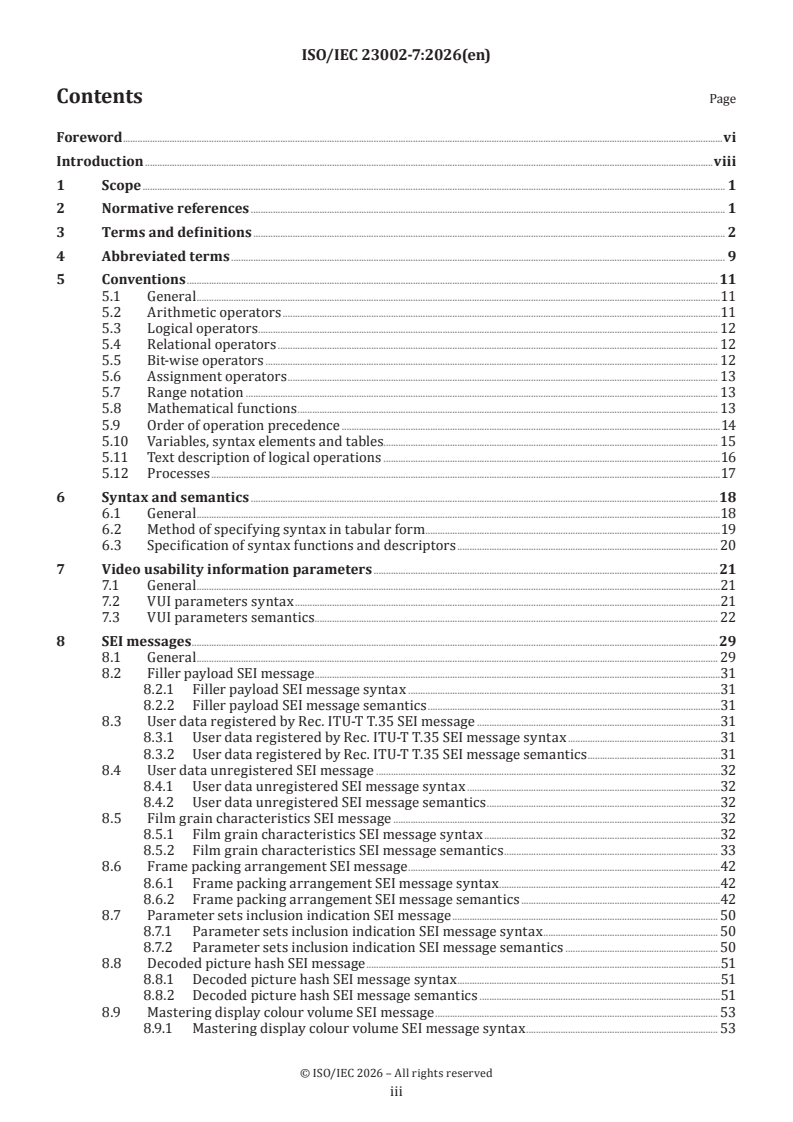
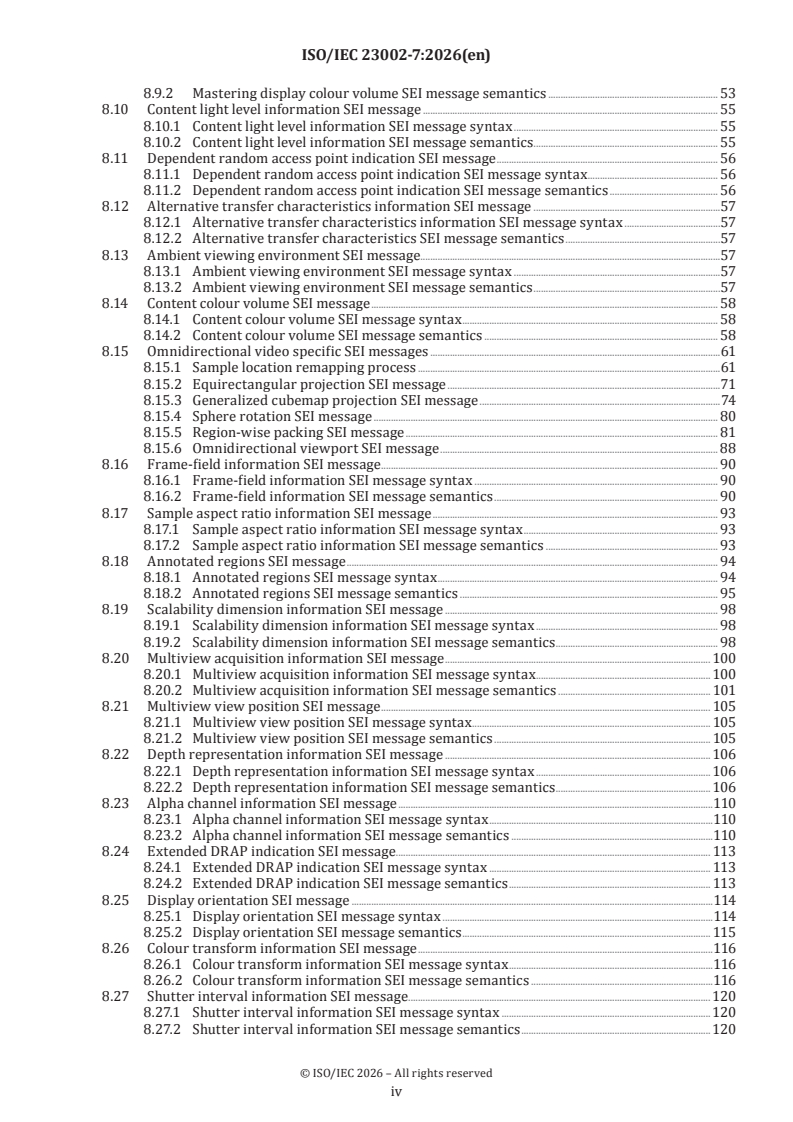
ISO/IEC 23002-7:2026 is an ISO International Standard for MPEG video technologies that specifies video usability information (VUI) parameters and supplemental enhancement information (SEI) messages for coded video bitstreams. It is intended for video coding specifications and systems that carry those bitstreams, especially Rec. ITU-T H.266 | ISO/IEC 23090-3, and it defines signaling that can support decoding, display, metadata exchange, and related processing.
What does ISO/IEC 23002-7:2026 specify?
ISO/IEC 23002-7:2026 specifies the syntax and semantics of VUI parameters and SEI messages, and it explains how those items are carried and interpreted in coded video bitstreams. Clause 6 sets out the container and payload rules that referencing specifications need, Clause 7 defines VUI parameters, Clause 8 defines SEI messages, and Clause 9 gives parsing support for k-th order Exp-Golomb codes.
The document is organized as follows:
- Clause 1 - Scope
- Clause 2 - Normative references
- Clause 3 - Terms and definitions
- Clause 4 - Abbreviated terms
- Clause 5 - Conventions
- Clause 6 - Syntax and semantics
- Clause 7 - Video usability information parameters
- Clause 8 - SEI messages
- Clause 9 - Parsing process for k-th order Exp-Golomb codes
In practice, the standard is meant to be referenced by other specifications. That matters because this document defines the signaling itself, while the referencing video coding or systems specification decides how the signaling is packed into a bitstream or used by a receiver.
What are the key requirements of ISO/IEC 23002-7:2026?
ISO/IEC 23002-7:2026 is mainly about how to signal extra video information cleanly and how decoders should treat it. The most important requirements are in the transport rules of Clause 6, the VUI rules of Clause 7, and the SEI message rules of Clause 8.
Transport and payload handling
Clause 6 says that a referencing specification shall define a container for VUI parameters or SEI messages and shall identify the payload length in bits. It also requires the payload size used for conformance to match the actual number of bits in the VUI or SEI syntax structure.
That matters because implementers need a clear boundary for parsing. The clause also states that if extra bits are present at the end of a VUI or SEI payload, a conforming decoder ignores them, which gives later editions room to extend payloads without breaking older decoders.
Clause 6 also defines helper functions such as more_data_in_payload( ), payload_extension_present( ), and read_bits( ). These are the parsing tools used by the syntax tables, so they matter for anyone implementing a bitstream reader.
VUI parameters in Clause 7
Clause 7 defines VUI parameters that apply to one or more CLVSs. The VUI flags describe source scan type, aspect ratio, overscan, colour description, and chroma sample location, so downstream systems can interpret the pictures correctly.
Two VUI flags are especially important in practice:
vui_progressive_source_flagandvui_interlaced_source_flagindicate whether the source should be treated as progressive, interlaced, unknown, or signaled at picture level through a frame-field information SEI message.vui_non_packed_constraint_flagandvui_non_projected_constraint_flagconstrain whether frame packing arrangement SEI messages, equirectangular projection SEI messages, or generalized cubemap projection SEI messages may appear for the CLVS.
Clause 7 also ties colour-related values to coding-independent code points from Rec. ITU-T H.273 | ISO/IEC 23091-2 and defines chroma-format-dependent behavior. In practice, that lets an encoder signal how to interpret the picture dimensions, colour handling, and chroma sample positions without hard-coding those assumptions into the decoder.
SEI message scope and persistence
Clause 8 says that SEI messages can have different persistence scopes. Some apply to the current picture, some to the current CLVS, and some are defined by the message syntax itself. The persistence scope is summarized in Table 4.
This matters because the same bitstream can carry both short-lived and longer-lived metadata. An implementer has to know whether a message affects only one picture, all later pictures in a layer, or a broader sequence.
Picture and display-related SEI messages
Clause 8 includes film grain characteristics, frame packing arrangement, frame-field information, sample aspect ratio information, display orientation, alternative transfer characteristics information, ambient viewing environment, and content light level information.
These messages are used when the bitstream needs to describe how pictures should be presented or interpreted. For example:
- film grain characteristics can model grain with additive or multiplicative blending
- frame packing arrangement can describe side-by-side, top-bottom, or temporal interleaving arrangements
- frame-field information can indicate how a picture should be displayed as progressive or interlaced content
- display orientation can signal horizontal flipping or rotation variants
For a buyer or engineering team, this means the standard supports signaling that affects display pipelines, stereoscopic presentation, and visual appearance after decoding.
Verification, access, and metadata SEI messages
Clause 8 also covers decoded picture hash, parameter sets inclusion indication, dependent random access point indication, extended DRAP indication, encoder optimization information, source picture timing information, and phase indication.
The decoded picture hash SEI message is especially practical for validation. It supports MD5, CRC, and checksum-based verification, so it can be used to check that a decoded picture matches the expected output.
Clause 8 additionally covers message families for object mask information, modality information, text description information, packed regions information, image format metadata, and AI usage restrictions request. These are relevant when a bitstream needs to carry descriptive or policy-related metadata alongside the picture content.
Omnidirectional, multiview, depth, and post-processing signaling
Clause 8 also covers omnidirectional video specific SEI messages, multiview acquisition information, multiview view position, depth representation information, alpha channel information, scalability dimension information, and neural-network post-filter messages.
These are the parts that matter for VR, 360-degree video, multiview rendering, auxiliary pictures, and neural-network-based post-processing. Clause 8.15 includes sample location remapping and projection-related messages, while the neural-network post-filter clauses define characteristics and activation signaling for post-processing workflows.
What terms does ISO/IEC 23002-7:2026 define?
- VUI (video usability information) - Parameters that signal how pictures should be interpreted, such as source scan type, aspect ratio, colour description, and chroma location.
- SEI (supplemental enhancement information) - Bitstream messages that carry additional information for decoding, display, verification, or other uses.
- CLVS (coded layer video sequence) - A sequence of picture units in one layer, used as a scope for several VUI and SEI meanings.
- CVS (coded video sequence) - A sequence of access units that forms one or more coded video sequences.
- IRAP (intra random access point) - A picture type that allows decoding to restart from that point within a layer.
- DRAP (dependent random access point) - A random-access concept used in SEI signaling related to dependent access behavior.
- NNPF (neural-network post-processing filter) - A neural-network-based post-processing function described by NNPFC and NNPFA SEI messages.
- PU (picture unit) - The unit that carries coded pictures in a layer-based bitstream structure.
Who uses ISO/IEC 23002-7:2026?
ISO/IEC 23002-7:2026 is used by standards developers, codec implementers, and system architects who need a common way to signal video interpretation data in coded video bitstreams. It is also relevant to encoder and decoder vendors that implement VUI or SEI support in products or libraries.
In practice, users include:
- video codec implementers working with H.266-style bitstreams
- streaming, broadcasting, and distribution system designers
- engineers handling stereoscopic, multiview, 360-degree, depth, alpha, or auxiliary-picture workflows
- teams building verification, conformance, or hashing tools
- quality managers checking that signaling matches the intended picture handling
- product teams that need to carry metadata such as display orientation, content light level, text description, or image format metadata
What changed in ISO/IEC 23002-7:2026 from the previous edition?
ISO/IEC 23002-7:2026 cancels and replaces ISO/IEC 23002-7:2024 and is described as a technically revised fourth edition.
The main changes stated in the foreword and introduction are:
- extensions to the film grain characteristics SEI message
- extensions to the neural-network post-filter characteristics SEI message
- extensions to the neural-network post-filter activation SEI message
- addition of the SEI processing order SEI message
- addition of the processing order nesting SEI message
- addition of the encoder optimization information SEI message
- addition of the source picture timing information SEI message
- addition of the object mask information SEI message
- addition of the modality information SEI message
- addition of the text description information SEI message
- addition of the generative face video SEI message and the generative enhancement face video SEI message
- addition of the digitally signed content initialization, selection, and verification SEI messages
- addition of the AI usage restrictions request SEI message
- addition of the packed regions information SEI message
- addition of the image format metadata SEI message
- corrections to various minor defects in the prior content
Which standards are used with ISO/IEC 23002-7:2026?
ISO/IEC 23002-7:2026 uses the following normative references:
- ISO/IEC 10646 - provides the Universal Coded Character Set for text data.
- ISO/IEC 11578:1996 - provides RPC-related identification referenced by metadata use cases.
- ISO 12234-2 - provides TIFF/EP image data format support.
- ISO 15076-1 - provides ICC profile architecture, profile format, and data structure.
- ISO 16684-1 - provides the XMP data model, serialization, and core properties.
- ISO 16684-3 - provides JSON-LD serialization of XMP.
- ISO 20677 - provides extensions to color management architecture and profile structure.
- ISO/IEC 21617-1 - provides JPEG Trust core foundation.
- Rec. ITU-T H.273 | ISO/IEC 23091-2 - provides coding-independent code points used for video-related signaling in Clause 7 and elsewhere.
- Rec. ITU-T T.35:2000 - provides the code allocation procedure used for registered user data.
- Rec. ITU-T T.871 | ISO/IEC 10918-5 - provides JFIF support relevant to image format metadata.
- CTA-766-D (ANSI) - provides region rating tables and content advisory descriptors.
- CIPA-DC-008-2023 - provides Exif metadata definitions.
- ISO/CIE 11664-1 - provides standard colorimetric observers.
- IETF RFC 1321 - provides the MD5 Message-Digest Algorithm used by decoded picture hash.
- IETF RFC 4151 - provides the tag URI scheme.
- IETF RFC 5646 - provides language tags.
- IETF RFC 3986 - provides generic URI syntax.
- NIST FIPS PUB 180-4 - provides the Secure Hash Standard.
What does the ISO/IEC 23002-7:2026 document contain?
ISO/IEC 23002-7:2026 contains syntax tables, semantic descriptions, and parsing rules for VUI parameters and a large set of SEI messages. It also includes convention rules for operators, precedence, syntax elements, ranges, and process notation, which support precise bitstream parsing.
The document contains:
- syntax and semantics for VUI parameters in Clause 7
- syntax and semantics for many SEI message types in Clause 8
- specialized processes for omnidirectional video mapping and sample location remapping
- equations and worked definitions for film grain, neural-network post-filter behavior, depth representation, and hash calculation
- figures and tables that illustrate packing arrangements, view handling, and signaling relationships
- a parsing process for k-th order Exp-Golomb codes in Clause 9
For implementation work, those contents are used to build encoders, decoders, conformance tests, verification tools, and system-level metadata handling for coded video bitstreams.
Relations
- Effective Date
- 13-Feb-2026
Get Certified
Connect with accredited certification bodies for this standard

BSI Group
BSI (British Standards Institution) is the business standards company that helps organizations make excellence a habit.

NYCE
Mexican standards and certification body.
Sponsored listings
Frequently Asked Questions
ISO/IEC 23002-7:2026 is a standard published by the International Organization for Standardization (ISO). Its full title is "Information technology — MPEG video technologies — Part 7: Versatile supplemental enhancement information messages for coded video bitstreams". This standard covers: This Specification specifies the syntax and semantics of video usability information (VUI) parameters and supplemental enhancement information (SEI) messages. The VUI parameters and SEI messages defined in this Specification are designed to be conveyed within coded video bitstreams in a manner specified in a video coding specification or to be conveyed by other means determined by the specifications for systems that make use of such coded video bitstreams. This Specification is particularly intended for use with coded video bitstreams as specified by Rec. ITU-T H.266 | ISO/IEC 23090-3, although it is drafted in a manner intended to be sufficiently generic that it can also be used with other types of coded video bitstreams. VUI parameters and SEI messages can assist in processes related to decoding, display or other purposes. However, unless otherwise specified in a referencing specification, the interpretation and use of the VUI parameters and SEI messages specified in this Specification is not a required functionality of a video decoder or receiving video system. Although semantics are specified for the VUI parameters and SEI messages, decoders and receiving video systems can simply ignore the content of the VUI parameters and SEI messages or can use them in a manner that somewhat differs from what is specified in this Specification.
This Specification specifies the syntax and semantics of video usability information (VUI) parameters and supplemental enhancement information (SEI) messages. The VUI parameters and SEI messages defined in this Specification are designed to be conveyed within coded video bitstreams in a manner specified in a video coding specification or to be conveyed by other means determined by the specifications for systems that make use of such coded video bitstreams. This Specification is particularly intended for use with coded video bitstreams as specified by Rec. ITU-T H.266 | ISO/IEC 23090-3, although it is drafted in a manner intended to be sufficiently generic that it can also be used with other types of coded video bitstreams. VUI parameters and SEI messages can assist in processes related to decoding, display or other purposes. However, unless otherwise specified in a referencing specification, the interpretation and use of the VUI parameters and SEI messages specified in this Specification is not a required functionality of a video decoder or receiving video system. Although semantics are specified for the VUI parameters and SEI messages, decoders and receiving video systems can simply ignore the content of the VUI parameters and SEI messages or can use them in a manner that somewhat differs from what is specified in this Specification.
ISO/IEC 23002-7:2026 is classified under the following ICS (International Classification for Standards) categories: 35.040.40 - Coding of audio, video, multimedia and hypermedia information. The ICS classification helps identify the subject area and facilitates finding related standards.
ISO/IEC 23002-7:2026 has the following relationships with other standards: It is inter standard links to ISO/IEC 23002-7:2024. Understanding these relationships helps ensure you are using the most current and applicable version of the standard.
ISO/IEC 23002-7:2026 is available in PDF format for immediate download after purchase. The document can be added to your cart and obtained through the secure checkout process. Digital delivery ensures instant access to the complete standard document.
Standards Content (Sample)
Contents
- Introduction
- 1 Scope
- 2 Normative references
- 3 Terms and definitions
- 3.2 APS
- 3.3 alpha blending
- 3.4 associated IRAP picture
- 3.5 associated inserted picture
- 3.6 azimuth circle
- 3.7 byte
- 3.8 chroma
- 3.9 CLVS
- 3.10 CLVSS PU
- 3.11 CLVSS
- 3.12 coded picture
- 3.13 coded slice NAL unit
- 3.14 coded video bitstream
- 3.15 CVS
- 3.16 CVSS AU
- 3.17 component
- 3.18 constituent picture
- 3.19 corresponding picture
- 3.20 cropped decoded picture
- 3.21 decoded picture
- 3.22 decoder
- 3.23 decoding order
- 3.24 decoding process
- 3.25 elevation circle
- 3.26 encoder
- 3.27 encoding process
- 3.28 field
- 3.29 flag
- 3.30 frame
- 3.31 global coordinate axes
- 3.32 gradual decoding refresh (GDR) picture
- 3.33 gradual decoding refresh (GDR) AU
- 3.34 great circle
- 3.35 inserted picture
- 3.36 inter prediction
- 3.37 IRAP AU
- 3.38 IRAP picture
- 3.39 layer
- 3.40 leading picture
- 3.41 local coordinate axes
- 3.42 luma
- 3.43 NAL unit
- 3.44 NAL unit stream
- 3.45 non-VCL NAL unit
- 3.46 omnidirectional video
- 3.47 output order
- 3.48 output time
- 3.49 packed region
- 3.50 picture
- 3.51 PPS
- 3.53 projected picture
- 3.54 projected region
- 3.55 projection
- 3.56 random access
- 3.57 RASL picture
- 3.58 reference picture
- 3.59 reference picture list
- 3.60 region-wise packed picture
- 3.61 region-wise packing
- 3.62 sample aspect ratio
- 3.63 SEI NAL unit
- 3.64 slice
- 3.65 source
- 3.66 sphere coordinates
- 3.67 sphere region
- 3.68 STSA picture
- 3.69 syntax element
- 3.70 syntax structure
- 3.71 SEI message
- 3.72 temporal sublayer
- 3.73 temporal sublayer identifier
- 3.74 tilt angle
- 3.75 trailing picture
- 3.76 VCL NAL unit
- 3.77 VUI parameters
- 3.78 viewport
Introduction
Versions of this Specification Rec. ITU-T H.274 | ISO/IEC 23002-7 version 1 refers to the first approved version of this Specification. The first edition published by ITU-T as Rec. ITU-T H.274 (08/2020) and by ISO/IEC as ISO/IEC 23002-7:2021 corresponded to the first version.
Rec. ITU-T H.274 | ISO/IEC 23002-7 version 2 refers to the integrated text containing nine additional SEI messages, namely the annotated regions SEI message, the alpha channel information SEI message, the depth representation information SEI message, the multiview acquisition information SEI message, the multiview view position SEI message, the scalability dimension information SEI message, the extended dependent random access point indication SEI message, the display orientation SEI message, and the colour transform information SEI message. Besides these additional SEI messages, this version also contains corrections to various minor defects in the prior content of the specification. The second edition published by ITU-T as Rec. ITU-T H.274 (05/2022) and by ISO/IEC as ISO/IEC 23002-7:2022 corresponds to the second version. Rec. ITU-T H.274 | ISO/IEC 23002-7 version 3 refers to the integrated text containing four additional SEI messages, namely the shutter interval information SEI message, the neural-network post-filter characteristics SEI message, the neural-network post-filter activation SEI message, and the phase indication SEI message. Besides these additional SEI messages, this version also contains corrections to various minor defects in the prior content of the specification. The third edition published by ISO/IEC as ISO/IEC 23002-7:2024 corresponds to the third version. This third edition of ISO/IEC 23002-7 corresponds to the third edition published by ITU-T as Rec. ITU-T H.274 (09/2023).
Rec. ITU-T H.274 | ISO/IEC 23002-7 version 4 (the current version) refers to the integrated text additionally containing extensions to the film grain characteristics SEI message, the neural-network post-filter characteristics SEI message, the neural-network post-filter activation SEI message, and 15 additional SEI messages, namely the SEI processing order SEI message, the processing order nesting SEI message, the encoder optimization information SEI message, the source picture timing information SEI message, the object mask information SEI message, the modality information SEI message, the text description information SEI message, the generative face video SEI message, the generative enhancement face video message, the digitally signed content initialization SEI message, the digitally signed content selection SEI message, digitally signed content verification SEI message, the AI usage restrictions request SEI message, the packed regions information SEI message, and the image format metadata SEI message. Additionally, the version 4 integrated text also contains corrections to various minor defects in the prior content of the Specification. The fourth edition published by ITU-T as Rec. ITU-T H.274 (XX/2026) corresponds to the fourth version. Conventions The term "this Specification" is used to refer to this Recommendation | International Standard. In this Specification, the following verbal forms are used:
- “shall” indicates a requirement. When used to express a mandatory constraint on the values of syntax elements or the values of variables derived from these syntax elements, it is the responsibility of the encoder to ensure that the constraint is fulfilled.
- “should” indicates a recommendation. It is used to refer to behaviour of an implementation that is encouraged to be followed under anticipated ordinary circumstances, but is not a requirement for conformance to this Specification.
- “may” indicates a permission.
- “can” indicates a possibility or a capability.
Information marked as “NOTE” is intended to assist the understanding or use of the document. “Notes to entry” used in Clause 3 provide additional information that supplements the terminological data and can contain provisions relating to the use of a term.
International Standard ISO/IEC 23002-7:2026(en) Information technology — MPEG video technologies — Part 7:
Versatile supplemental enhancement information messages for coded video bitstreams
1 Scope
This Specification specifies the syntax and semantics of video usability information (VUI) parameters and supplemental enhancement information (SEI) messages. The VUI parameters and SEI messages defined in this Specification are designed to be conveyed within coded video bitstreams in a manner specified in a video coding specification or to be conveyed by other means determined by the specifications for systems that make use of such coded video bitstreams. This Specification is particularly intended for use with coded video bitstreams as specified by Rec. ITU-T H.266 | ISO/IEC 23090-3, although it is drafted in a manner intended to be sufficiently generic that it can also be used with other types of coded video bitstreams. VUI parameters and SEI messages can assist in processes related to decoding, display or other purposes. However, unless otherwise specified in a referencing specification, the interpretation and use of the VUI parameters and SEI messages specified in this Specification is not a required functionality of a video decoder or receiving video system. Although semantics are specified for the VUI parameters and SEI messages, decoders and receiving video systems can simply ignore the content of the VUI parameters and SEI messages or can use them in a manner that somewhat differs from what is specified in this Specification.
2 Normative references
The following documents are referred to in the text in such a way that some or all of their content constitutes requirements of this Specification. For dated references, only the edition cited applies. For undated references, the latest edition of the referenced document (including any amendments) applies. ISO/IEC 10646, Information technology — Universal coded character set (UCS) ISO/IEC 11578:1996, Information technology — Open Systems Interconnection — Remote Procedure Call (RPC) ISO 12234-2, Electronic still-picture imaging — Removable memory — Part 2: TIFF/EP image data format ISO 15076-1, Image technology colour management — Architecture, profile format and data structure — Part 1: Based on ICC.1:2022 ISO 16684-1, Graphic technology — Extensible metadata platform (XMP) — Part 1: Data model, serialization and core properties ISO 16684-3, Graphic technology — Extensible metadata platform (XMP) specification — Part 3: JSON-LD serialization of XMP ISO 20677, Image technology colour management — Extensions to architecture, profile format and data structure ISO/IEC 21617-1, Information technology – JPEG Trust – Part 1: Core Foundation Rec. ITU-T H.273 | ISO/IEC 23091-2, Information technology — Coding-independent code points — Part 2: Video Rec. ITU-T T.35:2000, Procedure for the allocation of ITU-T defined codes for non-standard facilities
ISO/IEC 23002-7:2026(en) Rec. ITU-T T.871 | ISO/IEC 10918-5, Information technology – Digital compression and coding of continuoustone still images: JPEG File Interchange Format (JFIF) CTA-766-D (ANSI), U.S. and Canadian Region Rating Tables (RRT) and Content Advisory Descriptors for Transport of Content Advisory Information Using ATSC Program and System Information Protocol (PSIP) CIPA-DC-008-2023, Camera & Imaging Products Association Exif, Exchangeable image file format for digital still cameras ISO/CIE 11664-1, Colorimetry — Part 1: CIE standard colorimetric observers IETF RFC 1321, The MD5 Message-Digest Algorithm IETF RFC 4151, The ‘tag’ URI Scheme IETF RFC 5646, Tags for Identifying Languages.
IETF RFC 3986, Uniform Resource Identifiers (URI): Generic Syntax NIST FIPS PUB 180-4, Secure Hash Standard (SHS)
3 Terms and definitions
For the purposes of this Specification, the following terms and definitions apply. ISO and IEC maintain terminology databases for use in standardization at the following addresses:
- ISO Online browsing platform: available at https:// www .iso .org/ obp
- IEC Electropedia: available at https:// www .electropedia .org/ 3.1 AU access unit set of PUs that belong to different layers and contain coded pictures associated with the same output time
3.2 APS
adaptation parameter set syntax structure containing syntax elements that apply to zero or more slices as determined by zero or more syntax elements found in slice headers
3.3 alpha blending
process in which an auxiliary coded picture is used in combination with a primary coded picture and with other data not specified by this Specification in the display process Note 1 to entry: In an alpha blending process, the luma samples of an auxiliary coded picture are interpreted as indications of the degree of opacity (or, equivalently, the degrees of transparency) associated with corresponding samples of the primary coded picture.
3.4 associated IRAP picture
previous IRAP picture (when present) in decoding order, for a particular picture, in the same layer as the particular picture
ISO/IEC 23002-7:2026(en)
3.5 associated inserted picture
picture picB in a picture list picListA associated with a particular picture pica, where picB is a picture that is in picListA and is the corresponding picture of an inserted picture generated when applying the process indicated by an SEI message either to a corresponding picture of picA or to an associated inserted picture of picA Note 1 to entry: The particular picture picA itself can be a picture that is not in the picture list picListA associated with picA.
3.6 azimuth circle
circle on a sphere connecting all points with the same azimuth value Note 1 to entry: An azimuth circle is always a great circle like a longitude line on the earth.
3.7 byte
sequence of 8 bits, within which, when written or read as a sequence of bit values, the left-most and rightmost bits represent the most and least significant bits, respectively, and the bits are written or read from left to right
3.8 chroma
sample array or single sample representing one of the two colour difference signals related to the primary colours, represented by the symbols Cb and Cr Note 1 to entry: The term chroma is used rather than the term chrominance in order to avoid implying the use of linear light transfer characteristics that is often associated with the term chrominance.
3.9 CLVS
coded layer video sequence sequence of PUs of the same layer that consists, in decoding order, of a CLVSS PU, followed by zero or more PUs that are not CLVSS PUs, including all subsequent PUs up to but not including any subsequent PU that is a CLVSS PU
3.10 CLVSS PU
PU in which the coded picture is a CLVSS picture
3.11 CLVSS
coded layer video sequence start coded picture that starts a new CLVS as specified in a video coding specification Note 1 to entry: In Rec. ITU-T H.266 | ISO/IEC 23090-3, a CLVSS picture is an IRAP picture with NoIncorrectPicOutputFlag equal to 1 or a gradual decoding refresh picture with NoIncorrectPicOutputFlag equal to 1. In Rec. ITU-T H.265 | ISO/IEC 23008-2, a CLVSS picture is an IRAP picture with NoRaslOutputFlag equal to 1.
3.12 coded picture
coded representation of a picture containing all CTUs of the picture
3.13 coded slice NAL unit
NAL unit that contains a coded slice
3.14 coded video bitstream
sequence of bits that forms the representation of a sequence of AUs forming one or more CVSs
ISO/IEC 23002-7:2026(en)
3.15 CVS
coded video sequence sequence of AUs that consists, in decoding order, of a CVSS AU, followed by zero or more AUs that are not CVSS AUs, including all subsequent AUs up to but not including any subsequent AU that is a CVSS AU
3.16 CVSS AU
AU that has a PU for each layer present in the CVS and the coded picture in each PU is a CLVSS picture
3.17 component
array or single sample from one of the three arrays (luma and two chroma) that compose a picture in 4:2:0, 4:2:2, or 4:4:4 colour format or the array or a single sample of the array that compose a picture in monochrome format
3.18 constituent picture
part of a spatially frame-packed stereoscopic picture that corresponds to one view, or a picture itself when frame packing is not in use or the temporal interleaving frame packing arrangement is in use
3.19 corresponding picture
picture picB in a picture list picListA associated with a particular picture picA, where picB is either picA itself or a processed version of picA generated when the process indicated by an SEI message is applied for picA Note 1 to entry: The picture picA can be a picture that is not in picListA, in which case picB is a processed version of picA.
Note 2 to entry: When picA is in picListA, picB is picA itself.
3.20 cropped decoded picture
result of cropping a decoded picture based on the conformance cropping window for the corresponding coded picture
3.21 decoded picture
decoded picture is derived by decoding a coded picture
3.22 decoder
embodiment of a decoding process
3.23 decoding order
order in which syntax elements are conveyed in the coded video bitstream and are processed by a decoding process
3.24 decoding process
process that reads a coded video bitstream and derives decodedpictures from it
3.25 elevation circle
circle on a sphere connecting all points with the same elevation value Note 1 to entry: An elevation circle is similar to a latitude line on the earth. Except when the elevation value is zero, an elevation circle is not a great circle like a longitude circle on the earth.
ISO/IEC 23002-7:2026(en)
3.26 encoder
embodiment of an encoding process
3.27 encoding process
process that produces a coded video bitstream
3.28 field
assembly of alternative rows of samples of a frame
3.29 flag
variable or single-bit syntax element that can take one of the two possible values: 0 and 1
3.30 frame
composition of a top field and a bottom field, where sample rows 0, 2, 4, ... originate from the top field and sample rows 1, 3, 5, ... originate from the bottom field
3.31 global coordinate axes
coordinate axes associated with omnidirectional video that are associated with an externally referenceable position and orientation Note 1 to entry: The global coordinate axes could correspond to the position and orientation of a device or rig used for omnidirectional audio/video acquisition as well as the position of an observer's head in the three-dimensional space of the omnidirectional video rendering environment.
3.32 gradual decoding refresh (GDR) picture
coded picture starting from which all pictures in the same layer in both decoding order and output order can be decoded without first decoding any picture in the same layer earlier in decoding order in the coded video bitstream, such that when starting from a subsequent picture in decoding order for all pictures
3.33 gradual decoding refresh (GDR) AU
AU in which each coded picture is a GDR picture
3.34 great circle
intersection of a sphere and a plane that passes through the centre point of the sphere Note 1 to entry: A great circle is also known as an orthodrome or Riemannian circle.
3.35 inserted picture
picture that was interpolated or extrapolated when the process indicated by an SEI message (e.g., an NNPFA SEI message activating an NNPF with PictureRateUpsamplingFlag or TemporalExtrapolationFlag equal to 1) is applied
3.36 inter prediction
aspect of the decoding process for a coded picture that makes use of data derived from the decoding process of one or more previously decoded reference pictures
3.37 IRAP AU
AU in which each coded picture is an IRAP picture
ISO/IEC 23002-7:2026(en)
3.38 IRAP picture
coded picture starting from which all pictures in the same layer in both decoding order and output order can be decoded without first decoding any picture in the same layer earlier in decoding order in the coded video bitstream, such that when starting from the coded picture for all pictures in the same layer in both decoding order and output order the cropped decoded pictures are fully correct
3.39 layer
set of VCL NAL units that all have a particular value of layer identifier and the associated non-VCL NAL units, wherein the layer identifier is a variable for which the value is specified by a video coding specification Note 1 to entry: In the contexts of Rec. ITU-T H.266 | ISO/IEC 23090-3 and Rec. ITU-T H.265 | ISO/IEC 23008-2, the layer identifier is the value of the nuh_layer_id syntax element in the NAL unit header.
3.40 leading picture
picture that is in the same layer as the associated IRAP picture and precedes the associatedIRAP picture in output order
3.41 local coordinate axes
coordinate axes having a specified rotation relationship relative to the global coordinate axes
3.42 luma
sample array or single sample representing the monochrome signal related to the primary colours, represented by the symbol or subscript Y or L Note 1 to entry: The term luma is used rather than the term luminance in order to avoid implying the use of linear light transfer characteristics that is often associated with the term luminance. The symbol L is sometimes used instead of the symbol Y to avoid confusion with the symbol y as used for vertical location.
3.43 NAL unit
syntax structure containing an indication of the type of data that follows and bytes containing that data in a manner that enables the extraction of a string of data bits from the syntax structure
3.44 NAL unit stream
sequence of NAL units
3.45 non-VCL NAL unit
NAL unit that is not a VCL NAL unit
3.46 omnidirectional video
video content in a format that enables rendering according to the user's viewing orientation, e.g., if viewed using a head-mounted device, or according to a user's desired viewport, reflecting a potentially rotated viewing position
3.47 output order
order in which the decodedpictures are output from the decoder (for the decoded pictures that are to be output from the decoder)
3.48 output time
time when a decodedpicture is to be output from the decoder (for the decoded pictures that are to be output from the decoder)
ISO/IEC 23002-7:2026(en)
3.49 packed region
region in a region-wise packed picture that is mapped to a projected region according to a region-wise packing
3.50 picture
array of luma samples in monochrome format or an array of luma samples and two corresponding arrays of chroma samples in 4:2:0, 4:2:2, and 4:4:4 colour format Note 1 to entry: A picture could be either a frame or a field. However, in one CLVS, either all pictures are frames or all pictures are fields.
3.51 PPS
picture parameter set A syntax structure containing syntax elements that apply to zero or more entire coded pictures as determined by a syntax element that is the same for all slices of a picture and found in the picture header or slice headers of each picture 3.52 PU picture unit set of NAL units that contain all VCL NAL units of a coded picture and their associated non-VCL NAL units
3.53 projected picture
picture that uses a projection format for omnidirectional video
3.54 projected region
region in a projected picture that is mapped to a packed region according to a region-wise packing
3.55 projection
specified correspondence between the colour samples of a projected picture and azimuth and elevation positions on a sphere
3.56 random access
act of starting the decoding process for a coded video bitstream at a point other than the beginning of the bitstream
3.57 RASL picture
leading picture that cannot be correctly decoded when the decoding process starts from the associated IRAP picture
...