

ISO 18321:2015
(Main)Essential oils — Determination of peroxide value
General Information
- Abstract
ISO 18321:2015 specifies a method for the determination of the peroxide value in an essential oil. The peroxide value is a measure of the oxidation present.
- Status
- Published
- Publication Date
- 12-May-2015
- Technical Committee
- ISO/TC 54 - Essential oils
- Drafting Committee
- ISO/TC 54 - Essential oils
- Current Stage
- 9093 - International Standard confirmed
- Start Date
- 03-Dec-2025
- Completion Date
- 29-Aug-2026
Buy Documents


ISO 18321:2015 - Essential oils -- Determination of peroxide value
ISO 18321:2015 - Essential oils — Determination of peroxide value/13/2015
Overview - ISO 18321:2015 (Peroxide value in essential oils)
ISO 18321:2015 specifies an analytical method for the determination of the peroxide value in an essential oil. The peroxide value is a quantitative indicator of the oxidation present in an oil and is widely used in quality control to assess rancidity, storage stability and product acceptability. The method is an iodometric redox titration and can be performed by conventional volumetric titration or by potentiometric titration (recommended for highly coloured essential oils).
Key topics and technical requirements
- Principle: Iodide is oxidized by peroxides to release iodine, which is titrated with sodium thiosulfate (iodometry). End point can be detected visually with starch indicator or potentiometrically.
- Reagents and quality: Analytical-grade reagents and Grade 3 water (ISO 3696). Typical reagents include trichloromethane (chloroform) or cyclohexane, glacial acetic acid, saturated potassium iodide, and 0.01 N or 0.1 N sodium thiosulfate.
- Apparatus: Standard laboratory glassware (balance ±1 mg, 250 ml Erlenmeyer, shaker, pipettes, 10 ml burette) and optionally a potentiometer for automated titration.
- Sampling and preparation: Sampling and test-sample preparation are referenced to ISO 212 and ISO 356. Samples should be homogenized without heating/airation, tested immediately, and filtered if impurities are visible.
- Procedure: Typical test portion is 10 ml essential oil; add solvent, acetic acid and KI, shake, dilute with water, and titrate. Use 0.1 N thiosulfate when peroxide values are expected >20 mmol/l, 0.01 N for lower values. Perform a blank titration.
- Automated titration notes: Use amber autosampler vessels to prevent iodine formation; if automating KI addition, use a 70% KI solution in opaque bottles and adjust added volume.
- Results and calculation: Peroxide value is calculated from the difference between test and blank titrant volumes and titrant normality. Conversion from mmol/l to meq/kg uses a density-based factor.
- Precision: Repeatability: differences not exceeding 5% (absolute) or 0.1 (relative). Reproducibility: differences not exceeding 10% (absolute) or 0.3 (relative).
Applications and users
ISO 18321:2015 is used by:
- Quality control laboratories in the fragrance, flavor and aromatherapy industries
- Essential-oil producers and packers monitoring oxidation and shelf life
- Regulatory and testing laboratories verifying product conformity
- Analytical chemists developing stability and storage studies
Practical uses include routine peroxide monitoring, batch release testing, stability testing and comparative quality assessment.
Related standards
- ISO 212 - Essential oils: Sampling
- ISO 356 - Essential oils: Preparation of test samples
- ISO 3696 - Water for analytical laboratory use (Grade 3)
- (Referenced glassware standard) ISO 385
Keywords: ISO 18321:2015, peroxide value, essential oils, iodometry, potentiometric titration, oxidation testing, peroxide determination, quality control.
Buy Documents
ISO 18321:2015 - Essential oils -- Determination of peroxide value
ISO 18321:2015 - Essential oils — Determination of peroxide value/13/2015
Get Certified
Connect with accredited certification bodies for this standard

ECOCERT
Organic and sustainability certification.

Eurofins Food Testing Global
Global leader in food, environment, and pharmaceutical product testing.

Intertek Bangladesh
Intertek certification and testing services in Bangladesh.
Sponsored listings
Frequently Asked Questions
ISO 18321:2015 is a standard published by the International Organization for Standardization (ISO). Its full title is "Essential oils — Determination of peroxide value". This standard covers: ISO 18321:2015 specifies a method for the determination of the peroxide value in an essential oil. The peroxide value is a measure of the oxidation present.
ISO 18321:2015 specifies a method for the determination of the peroxide value in an essential oil. The peroxide value is a measure of the oxidation present.
ISO 18321:2015 is classified under the following ICS (International Classification for Standards) categories: 71.100.60 - Essential oils. The ICS classification helps identify the subject area and facilitates finding related standards.
ISO 18321:2015 is available in PDF format for immediate download after purchase. The document can be added to your cart and obtained through the secure checkout process. Digital delivery ensures instant access to the complete standard document.
Standards Content (Sample)
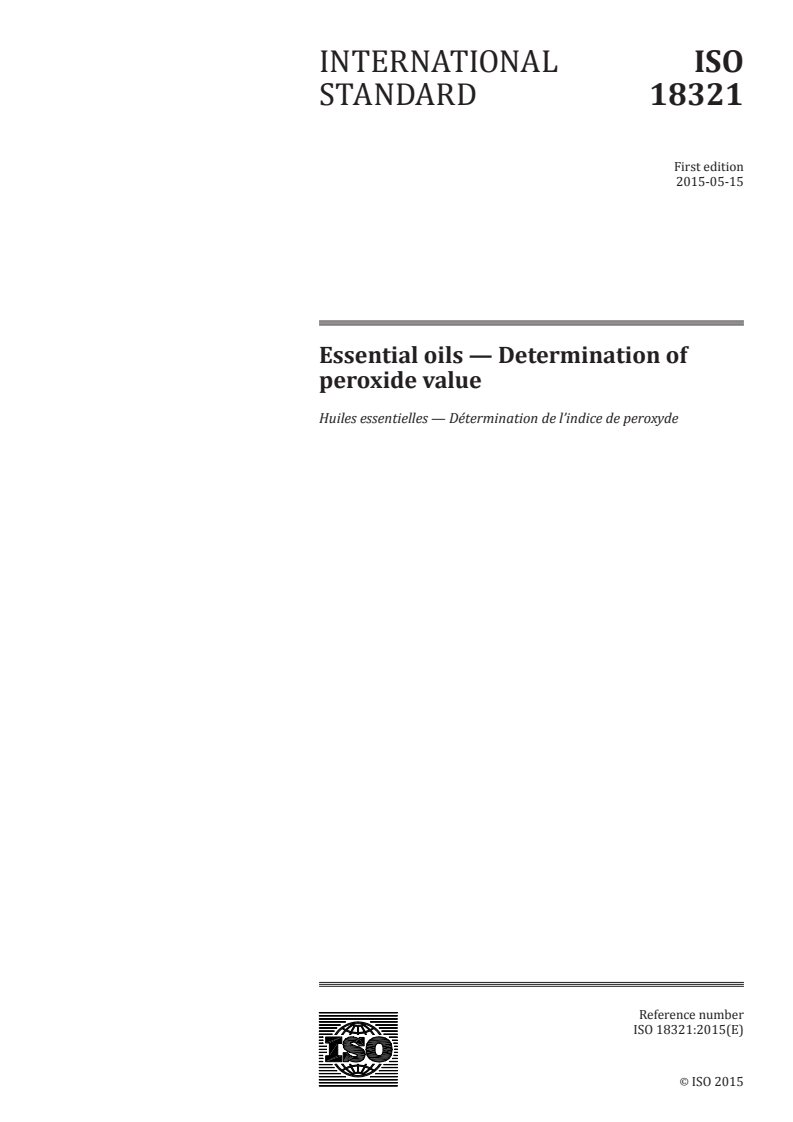
INTERNATIONAL ISO
STANDARD 18321
First edition
2015-05-15
Essential oils — Determination of
peroxide value
Huiles essentielles — Détermination de l’indice de peroxyde
Reference number
©
ISO 2015
© ISO 2015, Published in Switzerland
All rights reserved. Unless otherwise specified, no part of this publication may be reproduced or utilized otherwise in any form
or by any means, electronic or mechanical, including photocopying, or posting on the internet or an intranet, without prior
written permission. Permission can be requested from either ISO at the address below or ISO’s member body in the country of
the requester.
ISO copyright office
Ch. de Blandonnet 8 • CP 401
CH-1214 Vernier, Geneva, Switzerland
Tel. +41 22 749 01 11
Fax +41 22 749 09 47
copyright@iso.org
www.iso.org
ii © ISO 2015 – All rights reserved
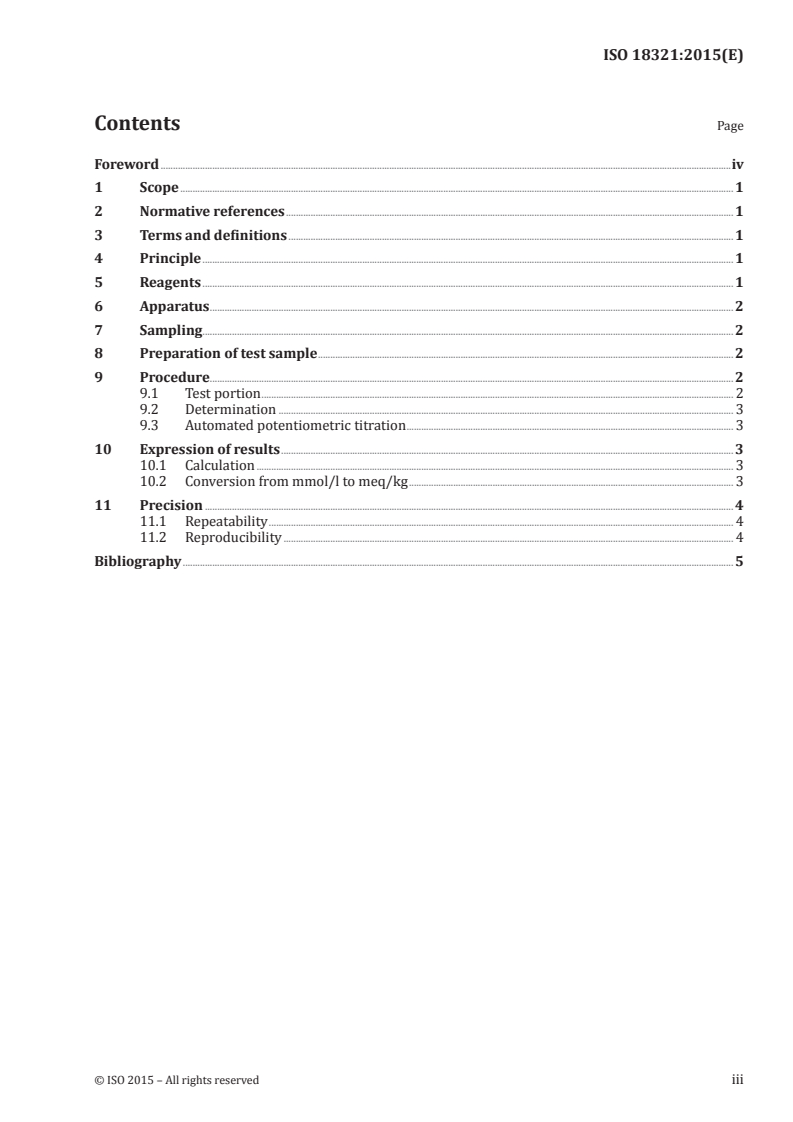
Contents Page
Foreword .iv
1 Scope . 1
2 Normative references . 1
3 Terms and definitions . 1
4 Principle . 1
5 Reagents . 1
6 Apparatus . 2
7 Sampling . 2
8 Preparation of test sample . 2
9 Procedure. 2
9.1 Test portion . 2
9.2 Determination . 3
9.3 Automated potentiometric titration . 3
10 Expression of results . 3
10.1 Calculation . 3
10.2 Conversion from mmol/l to meq/kg . 3
11 Precision . 4
11.1 Repeatability . 4
11.2 Reproducibility . 4
Bibliography . 5
Foreword
ISO (the International Organization for Standardization) is a worldwide federation of national standards
bodies (ISO member bodies). The work of preparing International Standards is normally carried out
through ISO technical committees. Each member body interested in a subject for which a technical
committee has been established has the right to be represented on that committee. International
organizations, governmental and non-governmental, in liaison with ISO, also take part in the work.
ISO collaborates closely with the International Electrotechnical Commission (IEC) on all matters of
electrotechnical standardization.
The procedures used to develop this document and those intended for its further maintenance are
described in the ISO/IEC Directives, Part 1. In particular the different approval criteria needed for the
different types of ISO documents should be noted. This document was drafted in accordance with the
editorial rules of the ISO/IEC Directives, Part 2 (see www.iso.org/directives).
Attention is drawn to the possibility that some of the elements of this document may be the subject of
patent rights. ISO shall not be held responsible for identifying any or all such patent rights. Details of any
patent rights identified during the development of the document will be in the Introduction and/or on
the ISO list of patent declarations received (see www.iso.org/patents).
Any trade name used in this document is information given for the convenience of users and does not
constitute an endorsement.
For an explanation on the meaning of ISO specific terms and expressions related to conformity
assessment, as well as information about ISO’s adherence to the WTO principles in the Technical Barriers
to Trade (TBT), see the following URL: Foreword — Supplementary information.
The committee responsible for this document is ISO/TC 54, Essential
...
INTERNATIONAL ISO
STANDARD 18321
First edition
2015-05-15
Essential oils — Determination of
peroxide value
Huiles essentielles — Détermination de l’indice de peroxyde
Reference number
©
ISO 2015
© ISO 2015, Published in Switzerland
All rights reserved. Unless otherwise specified, no part of this publication may be reproduced or utilized otherwise in any form
or by any means, electronic or mechanical, including photocopying, or posting on the internet or an intranet, without prior
written permission. Permission can be requested from either ISO at the address below or ISO’s member body in the country of
the requester.
ISO copyright office
Ch. de Blandonnet 8 • CP 401
CH-1214 Vernier, Geneva, Switzerland
Tel. +41 22 749 01 11
Fax +41 22 749 09 47
copyright@iso.org
www.iso.org
ii © ISO 2015 – All rights reserved
Contents Page
Foreword .iv
1 Scope . 1
2 Normative references . 1
3 Terms and definitions . 1
4 Principle . 1
5 Reagents . 1
6 Apparatus . 2
7 Sampling . 2
8 Preparation of test sample . 2
9 Procedure. 2
9.1 Test portion . 2
9.2 Determination . 3
9.3 Automated potentiometric titration . 3
10 Expression of results . 3
10.1 Calculation . 3
10.2 Conversion from mmol/l to meq/kg . 3
11 Precision . 4
11.1 Repeatability . 4
11.2 Reproducibility . 4
Bibliography . 5
Foreword
ISO (the International Organization for Standardization) is a worldwide federation of national standards
bodies (ISO member bodies). The work of preparing International Standards is normally carried out
through ISO technical committees. Each member body interested in a subject for which a technical
committee has been established has the right to be represented on that committee. International
organizations, governmental and non-governmental, in liaison with ISO, also take part in the work.
ISO collaborates closely with the International Electrotechnical Commission (IEC) on all matters of
electrotechnical standardization.
The procedures used to develop this document and those intended for its further maintenance are
described in the ISO/IEC Directives, Part 1. In particular the different approval criteria needed for the
different types of ISO documents should be noted. This document was drafted in accordance with the
editorial rules of the ISO/IEC Directives, Part 2 (see www.iso.org/directives).
Attention is drawn to the possibility that some of the elements of this document may be the subject of
patent rights. ISO shall not be held responsible for identifying any or all such patent rights. Details of any
patent rights identified during the development of the document will be in the Introduction and/or on
the ISO list of patent declarations received (see www.iso.org/patents).
Any trade name used in this document is information given for the convenience of users and does not
constitute an endorsement.
For an explanation on the meaning of ISO specific terms and expressions related to conformity
assessment, as well as information about ISO’s adherence to the WTO principles in the Technical Barriers
to Trade (TBT), see the following URL: Foreword — Supplementary information.
The committee responsible for this document is ISO/TC 54, Essential
...