


ISO/IEC TR 10182:2016
(Main)Information technology — Programming languages, their environments and system software interfaces — Guidelines for language bindings
Information technology — Programming languages, their environments and system software interfaces — Guidelines for language bindings
ISO/IEC TR 10182:2016 is based on experience gained in the standardization of two major areas in information processing. One area covers programming languages. The other area is composed of the services necessary to an application program to achieve a goal. The services are divided into coherent groups, each referred to as a SYSTEM FACILITY, that are accessed through a FUNCTIONAL INTERFACE. The specification of a system facility, referred to as a FUNCTIONAL SPECIFICATION, defines a collection of SYSTEM FUNCTIONS, each of which carries out some well-defined service. Since in principle there is no reason why a particular system facility should not be used by a program, regardless of the language in which is written, is the practice of system facility specifiers to define an 'abstract' functional interface that is language independent. In this way, the concepts in a particular system facility may be refined by experts in that area without regard for language peculiarities. An internally coherent view of a particular system facility is defined, relating the system functions to each other in a consistent way and relating the system functions to other layers within the system facility, including protocols for communication with other objects in the total system. However, if these two areas are standardized independently, it is not possible to guarantee that programs from one operating environment can be moved to another, even if the programs are written in a standard programming language and use only standard system facilities. A language binding of a system facility to a programming language provides language syntax that maps the system facility's functional interface. This allows a program written in the language to access the system functions constituting the system facility in a standard way. The purpose of a language binding is to achieve portability of a program that uses particular facilities in a particular language. Examples of system facilities that have had language bindings developed for them are GKS, NDL, and SQL (see Clause 3). It is anticipated that further language binding development will be required. Some system facilities currently being standardized have no language bindings and additional system facilities will be standardized. There is a possibility of n × m language bindings, where n is the number of languages and m the number of system facilities. The scope of this Technical Report is to classify language binding methods, reporting on particular instances in detail, and to produce suggested guidelines for future language binding standards. Note that the language bindings and the abstract facility interfaces must have a compatible run time representation, but the abstract facility does not necessarily have to be written in the host language. For example, if the application program is using a Pascal language binding and the corresponding facility is written in FORTRAN, there must be a compatible run time representation in that operating environment. How this compatibility is achieved is outside the scope of these guidelines. This is generally a property of the operating environment defined by the implementor, and is reviewed briefly in this Technical Report.
Technologies de l'information — Langages de programmation, leurs environnements et interfaces logicielles des systèmes — Techniques d'interface pour les normes de langages de programmation
General Information
- Status
- Published
- Publication Date
- 09-Mar-2016
- Current Stage
- 6060 - International Standard published
- Start Date
- 10-Mar-2016
- Completion Date
- 12-Feb-2026
Relations
- Effective Date
- 04-Nov-2015
Overview
ISO/IEC TR 10182:2016 provides guidance on language bindings between programming languages and abstract system facilities (functional interfaces). It consolidates experience from standardizing programming languages and system services, classifies common binding methods, reports practical instances, and offers suggested guidelines for future language binding standards. The Technical Report aims to improve portability by specifying how an abstract functional specification can be mapped to concrete language syntax so programs written in standard languages can access system functions in a standard way.
Key topics and technical requirements
- Classification of binding methods: Method descriptions include procedural interfaces, user-defined procedural interfaces, programming language extensions with native syntax, embedded alien syntax, and reusing existing language elements.
- Guidelines for binding development:
- Organizational guidelines for coordination between system facility committees and language committees.
- General technical guidelines on naming, parameter and data-type mapping, error handling, and visibility of identifiers.
- Method-dependent rules that advise on when to use each binding technique (e.g., standard procedural interface vs native syntax extensions).
- Functional specifications: Recommendations for writing abstract system facility specifications so they are suitable for binding to multiple host languages.
- Runtime representation: Emphasis that language bindings and abstract interfaces must have a compatible run-time representation; how compatibility is achieved is typically implementation-specific and outside the report’s scope.
- Documented examples and annexes: Informative examples (e.g., graphic binding examples) and an annex discussing GKS bindings illustrate issues and trade-offs.
Practical applications and users
ISO/IEC TR 10182 is practical for:
- Standards developers (system facility committees) defining functional specifications intended for multi-language use.
- Language committees crafting official language bindings or advising on language extensions.
- API designers and implementors who need to map abstract services (database, graphics, etc.) to concrete language constructs.
- Compiler and runtime engineers concerned with calling conventions and run-time representation compatibility.
- Organizations aiming to maximize software portability when using standard facilities such as GKS, NDL, and SQL.
Benefits include reduced duplication of effort, clearer binding method choices, and improved cross-language portability of applications that rely on standardized system facilities.
Related standards
- Examples referenced in the report: GKS, NDL, SQL (see report bibliography and Annex B for GKS-specific issues).
- ISO/IEC JTC 1/SC22 and related subcommittees coordinate language and binding work referenced by this Technical Report.

Get Certified
Connect with accredited certification bodies for this standard

BSI Group
BSI (British Standards Institution) is the business standards company that helps organizations make excellence a habit.

NYCE
Mexican standards and certification body.
Sponsored listings
Frequently Asked Questions
ISO/IEC TR 10182:2016 is a technical report published by the International Organization for Standardization (ISO). Its full title is "Information technology — Programming languages, their environments and system software interfaces — Guidelines for language bindings". This standard covers: ISO/IEC TR 10182:2016 is based on experience gained in the standardization of two major areas in information processing. One area covers programming languages. The other area is composed of the services necessary to an application program to achieve a goal. The services are divided into coherent groups, each referred to as a SYSTEM FACILITY, that are accessed through a FUNCTIONAL INTERFACE. The specification of a system facility, referred to as a FUNCTIONAL SPECIFICATION, defines a collection of SYSTEM FUNCTIONS, each of which carries out some well-defined service. Since in principle there is no reason why a particular system facility should not be used by a program, regardless of the language in which is written, is the practice of system facility specifiers to define an 'abstract' functional interface that is language independent. In this way, the concepts in a particular system facility may be refined by experts in that area without regard for language peculiarities. An internally coherent view of a particular system facility is defined, relating the system functions to each other in a consistent way and relating the system functions to other layers within the system facility, including protocols for communication with other objects in the total system. However, if these two areas are standardized independently, it is not possible to guarantee that programs from one operating environment can be moved to another, even if the programs are written in a standard programming language and use only standard system facilities. A language binding of a system facility to a programming language provides language syntax that maps the system facility's functional interface. This allows a program written in the language to access the system functions constituting the system facility in a standard way. The purpose of a language binding is to achieve portability of a program that uses particular facilities in a particular language. Examples of system facilities that have had language bindings developed for them are GKS, NDL, and SQL (see Clause 3). It is anticipated that further language binding development will be required. Some system facilities currently being standardized have no language bindings and additional system facilities will be standardized. There is a possibility of n × m language bindings, where n is the number of languages and m the number of system facilities. The scope of this Technical Report is to classify language binding methods, reporting on particular instances in detail, and to produce suggested guidelines for future language binding standards. Note that the language bindings and the abstract facility interfaces must have a compatible run time representation, but the abstract facility does not necessarily have to be written in the host language. For example, if the application program is using a Pascal language binding and the corresponding facility is written in FORTRAN, there must be a compatible run time representation in that operating environment. How this compatibility is achieved is outside the scope of these guidelines. This is generally a property of the operating environment defined by the implementor, and is reviewed briefly in this Technical Report.
ISO/IEC TR 10182:2016 is based on experience gained in the standardization of two major areas in information processing. One area covers programming languages. The other area is composed of the services necessary to an application program to achieve a goal. The services are divided into coherent groups, each referred to as a SYSTEM FACILITY, that are accessed through a FUNCTIONAL INTERFACE. The specification of a system facility, referred to as a FUNCTIONAL SPECIFICATION, defines a collection of SYSTEM FUNCTIONS, each of which carries out some well-defined service. Since in principle there is no reason why a particular system facility should not be used by a program, regardless of the language in which is written, is the practice of system facility specifiers to define an 'abstract' functional interface that is language independent. In this way, the concepts in a particular system facility may be refined by experts in that area without regard for language peculiarities. An internally coherent view of a particular system facility is defined, relating the system functions to each other in a consistent way and relating the system functions to other layers within the system facility, including protocols for communication with other objects in the total system. However, if these two areas are standardized independently, it is not possible to guarantee that programs from one operating environment can be moved to another, even if the programs are written in a standard programming language and use only standard system facilities. A language binding of a system facility to a programming language provides language syntax that maps the system facility's functional interface. This allows a program written in the language to access the system functions constituting the system facility in a standard way. The purpose of a language binding is to achieve portability of a program that uses particular facilities in a particular language. Examples of system facilities that have had language bindings developed for them are GKS, NDL, and SQL (see Clause 3). It is anticipated that further language binding development will be required. Some system facilities currently being standardized have no language bindings and additional system facilities will be standardized. There is a possibility of n × m language bindings, where n is the number of languages and m the number of system facilities. The scope of this Technical Report is to classify language binding methods, reporting on particular instances in detail, and to produce suggested guidelines for future language binding standards. Note that the language bindings and the abstract facility interfaces must have a compatible run time representation, but the abstract facility does not necessarily have to be written in the host language. For example, if the application program is using a Pascal language binding and the corresponding facility is written in FORTRAN, there must be a compatible run time representation in that operating environment. How this compatibility is achieved is outside the scope of these guidelines. This is generally a property of the operating environment defined by the implementor, and is reviewed briefly in this Technical Report.
ISO/IEC TR 10182:2016 is classified under the following ICS (International Classification for Standards) categories: 35.060 - Languages used in information technology. The ICS classification helps identify the subject area and facilitates finding related standards.
ISO/IEC TR 10182:2016 has the following relationships with other standards: It is inter standard links to ISO/IEC TR 10182:1993. Understanding these relationships helps ensure you are using the most current and applicable version of the standard.
ISO/IEC TR 10182:2016 is available in PDF format for immediate download after purchase. The document can be added to your cart and obtained through the secure checkout process. Digital delivery ensures instant access to the complete standard document.
Standards Content (Sample)
TECHNICAL ISO/IEC TR
REPORT 10182
First edition
2016-03-15
Information technology —
Programming languages, their
environments and system software
interfaces — Guidelines for language
bindings
Technologies de l’information — Langages de programmation, leurs
environnements et interfaces logicielles des systèmes — Techniques
d’interface pour les normes de langages de programmation
Reference number
©
ISO/IEC 2016
© ISO/IEC 2016, Published in Switzerland
All rights reserved. Unless otherwise specified, no part of this publication may be reproduced or utilized otherwise in any form
or by any means, electronic or mechanical, including photocopying, or posting on the internet or an intranet, without prior
written permission. Permission can be requested from either ISO at the address below or ISO’s member body in the country of
the requester.
ISO copyright office
Ch. de Blandonnet 8 • CP 401
CH-1214 Vernier, Geneva, Switzerland
Tel. +41 22 749 01 11
Fax +41 22 749 09 47
copyright@iso.org
www.iso.org
ii © ISO/IEC 2016 – All rights reserved
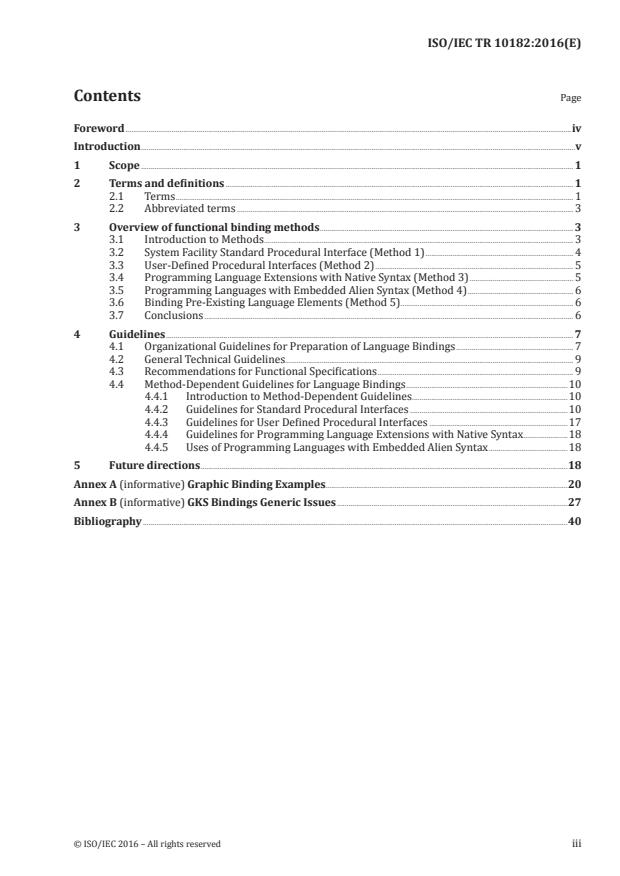
Contents Page
Foreword .iv
Introduction .v
1 Scope . 1
2 Terms and definitions . 1
2.1 Terms . 1
2.2 Abbreviated terms . 3
3 Overview of functional binding methods . 3
3.1 Introduction to Methods . 3
3.2 System Facility Standard Procedural Interface (Method 1) . 4
3.3 User-Defined Procedural Interfaces (Method 2) . 5
3.4 Programming Language Extensions with Native Syntax (Method 3) . 5
3.5 Programming Languages with Embedded Alien Syntax (Method 4) . 6
3.6 Binding Pre-Existing Language Elements (Method 5) . 6
3.7 Conclusions . 6
4 Guidelines . 7
4.1 Organizational Guidelines for Preparation of Language Bindings . 7
4.2 General Technical Guidelines. 9
4.3 Recommendations for Functional Specifications . 9
4.4 Method-Dependent Guidelines for Language Bindings .10
4.4.1 Introduction to Method-Dependent Guidelines .10
4.4.2 Guidelines for Standard Procedural Interfaces .10
4.4.3 Guidelines for User Defined Procedural Interfaces .17
4.4.4 Guidelines for Programming Language Extensions with Native Syntax .18
4.4.5 Uses of Programming Languages with Embedded Alien Syntax .18
5 Future directions .18
Annex A (informative) Graphic Binding Examples.20
Annex B (informative) GKS Bindings Generic Issues .27
Bibliography .40
© ISO/IEC 2016 – All rights reserved iii
Foreword
ISO (the International Organization for Standardization) and IEC (the International Electrotechnical
Commission) form the specialized system for worldwide standardization. National bodies that are
members of ISO or IEC participate in the development of International Standards through technical
committees established by the respective organization to deal with particular fields of technical
activity. ISO and IEC technical committees collaborate in fields of mutual interest. Other international
organizations, governmental and non-governmental, in liaison with ISO and IEC, also take part in the
work. In the field of information technology, ISO and IEC have established a joint technical committee,
ISO/IEC JTC 1.
The procedures used to develop this document and those intended for its further maintenance are
described in the ISO/IEC Directives, Part 1. In particular the different approval criteria needed for
the different types of document should be noted. This document was drafted in accordance with the
editorial rules of the ISO/IEC Directives, Part 2 (see www.iso.org/directives).
Attention is drawn to the possibility that some of the elements of this document may be the subject
of patent rights. ISO and IEC shall not be held responsible for identifying any or all such patent
rights. Details of any patent rights identified during the development of the document will be in the
Introduction and/or on the ISO list of patent declarations received (see www.iso.org/patents).
Any trade name used in this document is information given for the convenience of users and does not
constitute an endorsement.
For an explanation on the meaning of ISO specific terms and expressions related to conformity
assessment, as well as information about ISO’s adherence to the WTO principles in the Technical
Barriers to Trade (TBT), see the following URL: Foreword — Supplementary information.
The committee responsible for this Technical Report is ISO/IEC JTC 1, Information technology, Sub-
Committee SC 22, Programming languages, their environments and system software interfaces.
This first edition of ISO/IEC TR 10182:2016 cancels and replaces the first edition of
ISO/IEC TR 10182:1993, of which it constitutes a minor revision with the following changes:
— the references section has been deleted;
— minor editorial errors have been corrected.
iv © ISO/IEC 2016 – All rights reserved
Introduction
This Technical Report is a compilation of the experience and knowledge gained by the members of
ISO/IEC JTC1/SC22/WG11 (Techniques for Bindings) from the generation of programmers’ interfaces
to FUNCTIONAL INTERFACE STANDARDS. Although current experience was derived from the fields
of computer graphics and database management, the problems discussed are thought to be generally
applicable for mappings of other functional interface standards to programming languages. This
Technical Report is intended
a) to identify the problems and conflicts which shall be resolved;
b) to suggest guidelines for future use;
c) to provide scope and direction to required additional work, such as common procedural calling
mechanisms and data types; and
d) as a historical record of past experiences and decisions.
This Technical Report is incomplete; the authors have concentrated on those areas where experience
and expertise was readily available. The ideas and issues brought forward here emerged from more
than 10 years of work, and are represented in International Standards.
Clause 3 of this Technical Report contains the results of a survey of current methods used for language
binding development. Characteristics of each method are given, followed by reasons for the selection of
the method.
Application of the methods has suggested some guidelines that are presented in Clause 4. Clauses 3
and 4 contain documentation of the current state of language binding efforts; Clause 5 addresses future
directions for language bindings.
Circulation of this Technical Report is necessary at this stage, as input and discussion from representatives
of ISO/IEC JTC1/SC21 (functional specification standards developers), ISO/IEC JTC1/SC24 (computer
graphics standards developers), and ISO/IEC JTC1/SC22 (language standards developers) is urgently
sought. The Technical Report in its current form may be useful for those about to embark on language
binding developments.
© ISO/IEC 2016 – All rights reserved v
TECHNICAL REPORT ISO/IEC TR 10182:2016(E)
Information technology — Programming languages,
their environments and system software interfaces —
Guidelines for language bindings
1 Scope
This Technical Report is based on experience gained in the standardization of two major areas in
information processing. One area covers programming languages. The other area is composed of the
services necessary to an application program to achieve its goal. The services are divided into coherent
groups, each referred to as a SYSTEM FACILITY, that are accessed through a FUNCTIONAL INTERFACE.
The specification of a system facility, referred to as a FUNCTIONAL SPECIFICATION, defines a collection
of SYSTEM FUNCTIONS, each of which carries out some well-defined service.
Since in principle there is no reason why a particular system facility should not be used by a program,
regardless of the language in which it is written, it is the practice of system facility specifiers to define
an ‘abstract’ functional interface that is language independent. In this way, the concepts in a particular
system facility may be refined by experts in that area without regard for language peculiarities. An
internally coherent view of a particular system facility is defined, relating the system functions to each
other in a consistent way and relating the system functions to other layers within the system facility,
including protocols for communication with other objects in the total system.
However, if these two areas are standardized independently, it is not possible to guarantee that
programs from one operating environment can be moved to another, even if the programs are written
in a standard programming language and use only standard system facilities. A language binding of a
system facility to a programming language provides language syntax that maps the system facility’s
functional interface. This allows a program written in the language to access the system functions
constituting the system facility in a standard way. The purpose of a language binding is to achieve
portability of a program that uses particular facilities in a particular language. Examples of system
facilities that have had language bindings developed for them are GKS, NDL, and SQL (see Bibliography).
It is anticipated that further language binding development will be required. Some system facilities
currently being standardized have no language bindings and additional system facilities will be
standardized. There is a possibility of n × m language bindings, where n is the number of languages and
m the number of system facilities.
The scope of this Technical Report is to classify language binding methods, reporting on particular
instances in detail, and to produce suggested guidelines for future language binding standards.
Note that the language bindings and the abstract facility interfaces shall have a compatible run time
representation, but the abstract facility does not necessarily have to be written in the host language.
For example, if the application program is using a Pascal language binding and the corresponding
facility is written in FORTRAN, there shall be a compatible run time representation in that operating
environment. How this compatibility is achieved is outside the scope of these guidelines. This is
generally a property of the operating environment defined by the implementor, and is reviewed briefly
in this Technical Report.
2 Terms and definitions
2.1 Terms
ABSTRACT SERVICE INTERFACE: An interface having an abstract definition that defines the format and
the semantics of the function invoked independently of the concrete syntax (actual representation) of
the values and the invocation mechanism.
© ISO/IEC 2016 – All rights reserved 1
ALIEN SYNTAX: Syntax of a language other than the host language.
EMBEDDED ALIEN SYNTAX: Statements in a special language for access to a system facility, included in
a source program written in a standard programming language.
EXTERNAL IDENTIFIER: An identifier that is visible outside of a program.
FUNCTIONAL INTERFACE: The abstract definition of the interface to a system facility by which system
functions are provided.
FUNCTIONAL SPECIFICATION: The specification of a system facility. In the context of this Technical
Report, the functional specification is normally a potential or actual standard. For each system function
the specification defines the parameters for invocation and their effects.
HOST LANGUAGE: The programming language for which a standard language binding is produced; the
language in which a program is written.
IDENTIFIER: Name of an object in an application program that uses a system facility.
IMPLEMENTATION-DEFINED: Possibly differing between different processors for the same language,
but required by the language standard to be defined and documented by the implementor.
IMPLEMENTATION-DEPENDENT: Possibly differing between different processors for the same
language, and not necessarily defined for any particular processor.
IMPLEMENTOR: The individual or organization that realizes a system facility through software,
providing access to the system functions by means of the standard language bindings.
LANGUAGE BINDING OF f TO l or l LANGUAGE BINDING OF f: A specification of the standard interface to
facility f for programs written in language l.
LANGUAGE COMMITTEE: The ISO technical Subcommittee or Working Group responsible for the
definition of a programming language standard.
PROCEDURAL BINDING (system facility standard procedural interface): The definition of the interface
to a system facility available to users of a standard programming language through procedure calls.
PROCEDURAL INTERFACE DEFINITION LANGUAGE: A language for defining specific procedures for
interfacing to a system facility as used, for example, in ISO 8907:1987, Database Language NDL.
PROCEDURE: A general term used in this Technical Report to cover a programming language concept
which has different names in different programming languages — subroutine and function in FORTRAN,
procedure and function in Pascal, etc. A procedure is a programming language dependent method for
accessing one or more system functions from a program. A procedure has a name and a set of formal
parameters with defined data types. Invoking a procedure transfers control to that procedure.
PROCESSOR: A system or mechanism that accepts a program as input, prepares it for execution, and
executes the process so defined with data to produce results.
PROGRAMMING LANGUAGE EXTENSIONS WITH NATIVE SYNTAX or native syntax binding: The
functionality of the system facilities is incorporated into the host programming language so that
the system functions appear as natural parts of the language. The compiler processes the language
extensions and generates the appropriate calls to the system facility functions.
SYSTEM FACILITY: A coherent collection of services to be made available in some way to an application
program. The system facility may be defined as a set of discrete system functions with an abstract
service interface.
SYSTEM FACILITY COMMITTEE: The ISO technical subcommittee or Working Group responsible for the
development of the functional specification of a system facility.
2 © ISO/IEC 2016 – All rights reserved
SYSTEM FUNCTION: An individual component of a system facility, which normally has an identifying
title and possibly some parameters. A system function’s actions are defined by its relationships to other
system functions in the same system facility.
2.2 Abbreviated terms
CGI: Computer Graphics Interface standard (ISO DP) — a functional specification of the computer
graphics programming system facility.
GKS: Graphical Kernel System standard (ISO/IEC 7942-1) — a functional specification of the computer
graphics programming system facility.
MDL: Module Definition Language — a language for the specification of an interface to a generic system
facility. The MDL is used to generate a module to support the specific system facility access needs of an
application program.
NDL: Network Database Language — may be used to define the structure of a database using the
network model of data. NDL is defined in ISO 8907:1987 (see Bibliography). The standard also includes
the data manipulation functions and their language bindings.
PHIGS: Programmers Hierarchical Interactive Graphics System standard [ISO/IEC 9593 (all parts)], − a
functional specification of the 3-D computer graphics programming system facility.
SQL: Structured Query Language — defines the structure of a database using the relational model of data.
Database Language SQL is defined in ISO/IEC 9075-1, ISO/IEC 9075-2, ISO/IEC 9075-3, ISO/IEC 9075-4
and ISO/IEC 9075-11 (see Bibliography). The standard also includes the data manipulation functions
and their language bindings.
3 Overview of functional binding methods
3.1 Introduction to Methods
This section discusses the binding development problem in general by documenting a number of
different approaches to bindings. Each approach has its own characteristics from the points of view of
the user, the implementor, and the specifiers of standards.
The first task in specifying a binding of a system facility is to determine the usability, stability, and
implementation goals of both the binding and the system facility, and to use these to help select the
best method.
The functional binding methods are:
— Method 1. Provide a completely defined procedural interface (the System Facility Standard
Procedural Interface).
— Method 2. Provide a procedural interface definition language (User-Defined Procedural Interface).
— Method 3. Provide extensions to the programming language, using native syntax.
— Method 4. Allow alien syntax to be embedded in the programming language.
— Method 5. Binding pre-existing language elements.
Before addressing the individual methods, a discussion of a general issue that affects programming
language implementations is indicated. This issue is whether to increase the capability of a given
compiler to encompass the system facility, or to provide a pre-processor. Though this is of no direct
concern to language binding developers, they may wish to consider the feasibility of each option when
choosing a method.
© ISO/IEC 2016 – All rights reserved 3
A pre-processor is necessary for Method 4 above, and optional for Method 3. Method 1 does not require
a pre-processor but it may be useful to provide a utility that checks the syntax of all the procedure calls.
The function of a pre-processor is to scan a program source text, to identify alien syntax or syntax
associated with a given facility, and to replace this text by host language constructs (for example, calls
to system functions) that can be compiled by the standard compiler.
The advantages of a pre-processor are:
— A pre-processor can often carry out semantic checking not provided by the language compilers.
— A pre-processor can be independent of the particular language compiler.
— A pre-processor approach avoids problems that result from tampering with an existing language
standard or with certified compilers.
— If the system facility is enhanced, it is easier to modify a pre-processor than a full compiler.
The disadvantages are:
— A pre-processor requires an extra pass through the source.
— There may be a problem with multiple pre-processors for different system facilities existing in the
same environment.
— A pre-processor may produce code unfamiliar to the programmer and make debugging more
difficult — for example, it may change statement numbers.
— Depending on the language extensions, it may be necessary to analyse the syntax of most of the
language to detect the code to be replaced.
In the following sections, each functional binding method is discussed, circumstances that suggest a
method be used or avoided are given, and relevant advantages and disadvantages are defined.
There is often more than one way to implement a given method. In addition, it may be necessary to
implement more than one method for any given facility.
3.2 System Facility Standard Procedural Interface (Method 1)
With functional binding Method 1, the system facility is designed to support a fixed number of
procedures. Each procedure has formal parameters of defined data types and each procedure invocation
passes actual parameter values which match the data types.
Method 1 is appropriate when the syntax of the interface provided for each system function is fairly
simple and can be fully defined by a few parameters. The method can become unwieldy when the
functions that can be invoked use a large number of data types whose structure may be unknown until
the time of invocation, and require parameters or data types that are unknown in structure until the
time of invocation.
It is often useful to define subsets of the facility to suit different modes of use. For example, where the
functions are largely independent and a program only requires a few of them, it may be possible to
reduce the size of the run-time system by omitting portions of the system facility. These subsets are
reflected by levels of conformance to the functional interface standard.
Use of Method 1 requires that the procedural interface be redefined for each programming language, in
terms of the syntax and data types of that language. Thus, separate language binding standards to the
same functional interface standard are created.
Method 1 has been used by GKS and other graphics draft standards, where the syntax of the parameters
is fairly simple.
It should be noted that, if languages used a common procedure calling mechanism and equivalent sets
of data types (ISO/IEC JTC1 has assigned work items on these topics to SC22/WG 11), then it would be
4 © ISO/IEC 2016 – All rights reserved
possible to derive system facility standard procedural interfaces from the abstract definitions. It would
also be possible to derive system facility standard procedural interfaces from abstract definitions
under other conditions, particularly for languages of sufficient abstraction (like Pascal and Ada).
3.3 User-Defined Procedural Interfaces (Method 2)
With functional binding Method 2, the run-time procedural interface is defined by the user, and the
system functions invoked by the procedures are defined in a language appropriate to the system facility.
This method is appropriate when the interfaces to the system functions provided by the system facility
are too complex to be defined by a few parameters, and when they cannot be easily contained in an
exhaustive list.
Method 2 allows the binding document to be easily adapted to different programming languages, since
the binding only deals with data types. The naming of procedures and parameters is done by the user
and not the binding specifiers. The procedural interface definitions are compiled and the resulting
object module shall be linked both to the application program and to the system facility.
Advantages of Method 2 are:
— It may provide early diagnosis of errors.
— It is processed once and may allow specific optimization (for example, optimization of query
searches) leading to run-time economies.
— Modules may be shared among application programs, since they exist independently.
— The task of creating modules may be specialized and managed outside of the user’s program.
Disadvantages of Method 2 are:
— The definition of modules is an extra design step and risks poor usability when the programmer has
to define his own modules.
— The procedural interface definition language is another language to learn unless the procedural
interface language is part of the host language already.
— There is generally an administrative overhead for managing modules to ensure that they get
recompiled and relinked when necessary.
— Porting an application involves porting the program and all the referenced procedural interface
definition language modules.
— An additional compiler has to be provided for the procedural interface language unless the
procedural interface language is part of the host language already.
Database facilities use this method, where a Procedural Interface Definition Language (in the database
standards this is referred to as a Module Definition Language), containing both declarations and
procedural statements, is provided. A module may declare the data to be accessed as a view of the
database (as it may reference a predefined view) and it defines both the form and the execution of
database procedures.
3.4 Programming Language Extensions with Native Syntax (Method 3)
With functional binding Method 3, the functionality of the system facilities is incorporated into the
host programming language so that the system functions appear as natural parts of the language. The
compiler processes the language extensions and generates the appropriate calls to the system facility
functions.
This method is viable only when the system facility is stable and when the application requirements are
well understood, since the cost of changes to programming language standards is high.
© ISO/IEC 2016 – All rights reserved 5
The main advantage is usability. The users of the language have little extra to learn except the new
facilities. It also allows the language developers, when defining new versions of the language, to choose
a conforming subset of the facilities or to change the appearance of existing language facilities if they
believe this is helpful to their users. Another advantage is that new data types appropriate to the system
facility can be constructed.
The disadvantages are that Method 3 ties a compiler to a particular system facility definition. It also
ties the language specification to that of the system facility, making it highly desirable to process
the standardization of both specifications together if enhancements are needed. It may also be more
difficult to use this method in a mixed-language environment, since the same facilities may have
confusingly different appearances in different host languages.
Method 3 has been tried with the COBOL and FORTRAN database facilities (Codasyl and ANSI) and with
the graphics chapter for Basic.
3.5 Programming Languages with Embedded Alien Syntax (Method 4)
With functional binding Method 4, the system facilities are considered to be ‘driven’ by statements
written in a ‘system facility language’ rather than in the host programming language. The embedded
alien syntax shall be clearly distinguishable from the host language so that it can be processed by a pre-
processor.
Method 4 is suitable when the system facilities are too complex to be invoked by simple procedures (as
for Method 2, User-Defined Procedural Interfaces). The method could be implemented by having the
pre-processor generate Module Definitions as in Method 2.
The advantage of Method 4 over Method 2 is that simple programs, particularly those that may have a
short life, may be easier to create. The advantage of Method 4 over Method 3 is that the independence of
host language specifications from system facility specifications is maintained, so development of each
can progress more quickly.
The disadvantage of Method 4 over Method 2 is that this method substantially complicates the
relationships between applications and system facilities. Although the alien syntax should be very
similar for all host languages, the pre-processor will need to ‘know about’ the conventions of each host
language to be able to generate the correct interfacing code.
The disadvantage of Method 4 compared with Method 3 is that the programmer has to know two
languages and may be confused by the differences between them.
Method 4 is one of the options in the ISO database standards.
3.6 Binding Pre-Existing Language Elements (Method 5)
In some cases, the host language may contain language elements that can be directly identified with
corresponding elements of the abstract system facility. For example, in a binding to a system facility that
opened and closed files, the host language may already contain constructs for opening and closing files.
The advantage is that pre-existing constructs are used and no extra work in binding needs to be done.
If that facility is already present in the language, then making use of that facility avoids unnecessary
perturbations to the language.
Care should be taken that the language construct fully meets the requirements of the system facility.
3.7 Conclusions
The subsections above have described five different methods for developing functional bindings, and
the circumstances in which they can be used. None of the methods is appropriate in all circumstances,
or for all languages. In practice, a combination of methods may be appropriate. In some languages it is
necessary to combine Method 4 with Method 5.
6 © ISO/IEC 2016 – All rights reserved
It is possible, and often desirable, for a system facility to provide more than one method of binding, to
give the implementor and user a choice. However, if an implementor provides only one of the standard
methods, the user has no choice, and, unless there is a recognized way of converting between methods,
portability problems result.
The objective of a standard language binding is to enable a program to be portable when it is written
in a standard programming language and accesses a standard system facility. Often the system facility
is written in a different language from the application program and requires a certain compatibility
between the implementations of the two source language compilers. Of course, similar compatibility is
necessary for different compiler implementations of the same source language. In particular:
a) the procedure calling mechanisms should be compatible, and
b) corresponding data types should have compatible machine representations.
Often, but not always, the hardware and operating system will determine appropriate standards or
conventions for the representation of primitive data types and inter-program calls. Where there are
mismatches, it is necessary for the implementor to create a layer of software to perform conversions
between alternative data type representations or procedure calling mechanisms. There are now
ISO/IEC JTC1 work items addressing a) and b) above. These are: work item 22.16 — Specification
for a Model for Common Language-Independent Procedure Calling Mechanisms, and work item
22.17 — Specification for a Set of Common Language-Independent Data Types.
The methods described have been used in current ISO standards for database and graphics. Some
papers defining bindings for communications facilities have also been reviewed, but the strategy to be
adopted for ISO OSI bindings is yet to be determined.
4 Guidelines
4.1 Organizational Guidelines for Preparation of Language Bindings
This section describes some organizational guidelines that should be followed in order to facilitate
the generation of binding standards. A general statement of each guideline is given, followed by some
discussion. The guidelines appear in no particular order.
GUIDELINE 1
Standard bindings of some form should be developed for all standard system facilities that may be accessed from
a standard programming language.
Here, “standard” means that an ISO standard or draft standard exists for both the system facility and
the language.
There are standards describing system facilities which do not have standard language bindings
associated with them. Lack of a standard may lead to implementor-defined interfaces, causing loss of
portability.
GUIDELINE 2
Either the language committee or the system facility committee should have primary responsibility for the lan-
guage binding.
In this area, current practice is ‘whichever committee perceives the need for a binding’ or ‘if the
language has an external procedure call mechanism, then the system facility, otherwise the language
committee’. Unfortunately, sometimes a binding is required, yet no-one takes the initiative to start
binding work; some method for resolving this impasse is required.
It is expected that it is the primary responsibility of the system facility committee to establish a
reference binding to an arbitrary language and a generic binding. Subsequent bindings should be the
responsibility of the appropriate language committees. In practice it is expected that the system facility
committee will seek support from the applicable language committee in the creation of an arbitrary
© ISO/IEC 2016 – All rights reserved 7
binding. This would increase the likelihood of getting a full range of language bindings to make a system
facility useable. The system facility committee is more likely to have an interest in making the facilities
accessible; furthermore, language committees might not have the necessary expertise to develop
bindings to specialized facilities. Part of the primary responsibility is to respond to public comments.
GUIDELINE 3
Whichever committee is responsible for a particular binding, the other committee needs to be consulted as early
as possible. The two committees have complementary responsibilities and concerns.
A system facility committee is concerned with
— fidelity to the functional specification, including relevant level structures.
— similarity of program structure independent of the programming languages.
— suitability of the system facility for binding to the various languages.
A language committee is concerned with
— correctness of the binding definition, and adherence to good practice in the language, including the
avoidance of obsolete and deprecated features.
— consistency in the binding of similar concepts in similar ways throughout different bindings (for
example, ‘is a 2×3 matrix bound as a (3,2) array or a (2,3) array or a (6) array?’ is a question to be
answered by a language committee).
— the needs of programmers accessing more than one system facility in one program.
— suitability of the language for various binding methods.
Both committees are concerned with ease of use and orthogonality of concepts.
GUIDELINE 4
Specific guidelines should be produced alongside standards for particular system facilities and particular pro-
gramming languages.
— A set of guidelines for producing language bindings for a system facility should be associated with
the standard functional specification of any system facility.
— A set of guidelines for producing language bindings of different system facilities to a language should
be associated with the standard of any programming language.
Potentially, there is an n × m problem of agreeing and processing n language bindings to m system facilities.
Ideally, the development of appropriate guidelines should reduce the problem to one of order n+m.
Binding guidelines could be published as appendices to standards, and in some cases a supplemental
standard could be considered. Sample programs would also be helpful. Publication of such guidelines
by language committees would help not only system facility committees, but also any producers of
packages needing bindings to languages, and would thus help promote portability.
GUIDELINE 5
Draft proposals for bindings should not progress beyond the standardization stage of the system facility or the
language.
In addition, no system facility should progress to DIS (Draft International Standard) or IS (International
Standard) until there is at least one language binding at or above the level of DP (Draft Proposed
International Standard) or DIS, respectively. Users cannot fully judge a semantic standard without
seeing the specific syntax which is their only access to it. Also, there are some difficulties with abstract
semantics which are only revealed by the production of a language binding. Reference ISSUE 1: What
should be the criteria for determining if the functional interface standard should be bound to a
particular programming language?
8 © ISO/IEC 2016 – All rights reserved
4.2 General Technical Guidelines
This section contains guidelines that are general over all binding methods.
GUIDELINE 6
Language bindings to the same system facility should be similar in those respects where the languages are similar.
A functional specification might have a system facility data type that is easily represented in some
languages but not in others. For example, GKS uses points which can easily be represented as records
in Pascal and Ada, but not in FORTRAN. It seems unreasonable for the Pascal and Ada bindings to
be constrained by the FORTRAN binding. On the other hand, after language bindings for a few very
dissimilar languages have been produced, bindings for additional languages might be produced by
analogy.
GUIDELINE 7
Different language bindings to a system facility should not be the cause of substantial differences in program
structure except where warranted by substantial language differences.
Some factors inherent in the language substantially influence the structure of a program. For example,
a program written in a language with a WHILE construct is likely to possess a different structure than
a language without such a construct. However, the different bindings of the system facilities should
not be the cause of substantial differences in structure. An example of such a problem would be
if a functional parameter is bound as an output parameter in one language binding and as an input
parameter in another.
This principle may well break down when the languages have different processing paradigms or other
deep concepts, such as the inherent differences between imperative and functional languages.
GUIDELINE 8
A binding shall be reviewed and, if necessary, updated each time the system facility or the language standard is
enhanced. (The forward compatibility requirements of the user shall be identified and taken into consideration
when any of the standards is enhanced).
Reference ISSUE 2: To what event(s) should new versions of a binding be tied?
GUIDELINE 9
Bindings should take account of likely language processor limits. (A standard-conforming processor may fail to
process a standard-conforming program if it is caused to exceed its limits on size, complexity, etc.) Approaches
to handling such limits may appear in guidelines to bindings implementors and working papers.
As an example, a language processor may fail if its limits on number and length of identifiers are
exceeded.
Reference ISSUE 3: How are ‘real world’ limitations of the standard taken into consideration?
4.3 Recommendations for Functional Specifications
This section contains recommendations for the preparation of standard functional specifications
for system facilities. These recommendations are intended to assist the subsequent preparation of
language bindings to those functional specifications.
GUIDELINE 10
A functional specification should use an abstract description, and should avoid being influenced by a particular
programming language.
This very general statement is amplified in some of the guidelines that follow. This guideline allows a
language binding to be appropriate to its host language. There is a need for a formal notation for the
© ISO/IEC 2016 – All rights reserved 9
definition of abstract interfaces. The notation would need to be independent of programming languages
and of implementations.
GUIDELINE 11
A data type in a functional specification is not intended to correspond with a particular internal representation
in the host computer, but rather is an abstract entity intended to be mapped to the most appropriate type in the
host language.
Specifying and implementing language bindings to functional standards are made more difficult both by
differences between superficially similar data types in different languages, and by differences between
standard-conforming implementations of the same datatype of one language (which may be permitted
through properties of the datatype being left as implementation-defined or implementation-dependent
in the standard). Such differences make it difficult to be certain what properties a particular datatype
will possess in a given case. Basing the functional standard on a particular implementation model for a
particular language is likely to increase such problems, and Guideline 10 is aimed at discouraging this.
In general, the task of specifying and implementing bindings will be greatly eased by language
standards specifying required properties of datatypes more precisely than has been customary in the
past, and also by greater consistency and commonality in these respects between different languages
(an issue addressed by ISO/IEC JTC1 work item 22.17). This will aid the task of implementors in ensuring
compatible representations and consistent implementations of bindings, and enhance the portability of
application programs which need to invoke such bindings.
GUIDELINE 12
Parameters that take values that have predefined meanings should be defined in abstract terms, and not neces-
sarily be associated with numeric values. In certain situations, however, an ordering may be needed.
This guideline is intended to encourage the use of the enumerated data type, as in Pascal and Ada. Early
drafts of GKS used numeric values u
...
Questions, Comments and Discussion
Ask us and Technical Secretary will try to provide an answer. You can facilitate discussion about the standard in here.
Loading comments...