

ISO/IEC TR 27599:2025
(Main)Information technology — Brain-computer interfaces — Use cases
General Information
- Abstract
This document provides a collection of representative use cases of brain-computer interface (BCI) applications in a variety of domains: proposed medical and health, industrial controls, smart environment, etc. This document can be used for the development of potential standards, and it is valuable for a better comprehension of BCI. This document is also helpful for BCI industries and products that provide support for communications among interested parties and stakeholders. This document is applicable to all types of organizations (e.g. commercial enterprises, government agencies, not-for-profit organizations).
- Status
- Published
- Publication Date
- 08-May-2025
- Technical Committee
- SC 43 - ISO/IEC JTC 1/SC 43
- Drafting Committee
- SC 43 - ISO/IEC JTC 1/SC 43
- Current Stage
- 9092 - International Standard to be revised
- Start Date
- 03-Oct-2025
- Completion Date
- 29-Aug-2026

Overview
ISO/IEC TR 27599:2025 - Information technology - Brain-computer interfaces - Use cases is a technical report that collects representative BCI (brain‑computer interface) use cases across domains such as medical and health, smart environments, industrial controls, learning, gaming and security. The report is intended to support the development of future standards, improve comprehension of BCI technology, and facilitate communication among industry stakeholders. It is applicable to all organization types (commercial, government, not‑for‑profit).
Key document features:
- Edition 1.0 (2025-05) with comprehensive use‑case descriptions (see Clause 7).
- Data analysis, common challenges, and standardization requirements (Clauses 5–6).
- Informative annexes with figures (Annex A) and a use‑case template (Annex B).
Key topics and technical requirements
ISO/IEC TR 27599:2025 covers technical and practical aspects of BCI systems, including:
- Application domains and a catalog of use cases (smart ward, assistive communication, seizure detection, BCI‑controlled exoskeletons, aerospace, gaming, biometrics, etc.).
- Data characteristics and processing methods, notably EEG characteristics and signal‑processing approaches.
- Common challenges such as signal acquisition noise and interference, inter‑subject and inter‑device variability, algorithm classification accuracy, amount of data, labelling, experimental preparation, mind‑focusing requirements, data security, and implant safety.
- Types and setups (invasive vs non‑invasive), required acquisition setups, benefits and portability considerations.
- Standardization requirements analysis: categorization, statistics and discussion of what needs harmonization to accelerate interoperable BCI products and systems.
The report highlights practical technical requirements to consider when developing BCI devices, algorithms and services (data handling, security, reproducibility, portability and safety).
Applications and practical value
ISO/IEC TR 27599 is valuable for:
- BCI device manufacturers and hardware vendors designing EEG, fNIRS or implantable systems.
- Software and AI/ML developers building signal‑processing, classification and closed‑loop control systems.
- Healthcare providers and rehabilitation professionals deploying BCI for diagnostics, neurorehabilitation, seizure monitoring and closed‑loop neurostimulation.
- Systems integrators and smart‑environment designers implementing passive BCIs or BCI‑enabled interfaces.
- Researchers, regulators and standards developers using the use‑case catalog and standardization requirements as input to create formal standards, regulatory guidance, or procurement specifications.
Related standards
This technical report is intended to inform future standardization in BCI and intersects with broader information technology, medical device and safety standards (see clauses on normative references and standardization requirements).
Keywords: ISO/IEC TR 27599:2025, brain‑computer interface, BCI use cases, EEG, signal processing, standardization, BCI applications, medical BCI, smart environment, industrial BCI.
Relations
- Effective Date
- 03-Aug-2024
Get Certified
Connect with accredited certification bodies for this standard

BSI Group
BSI (British Standards Institution) is the business standards company that helps organizations make excellence a habit.

NYCE
Mexican standards and certification body.
Sponsored listings
Frequently Asked Questions
ISO/IEC TR 27599:2025 is a technical report published by the International Organization for Standardization (ISO). Its full title is "Information technology — Brain-computer interfaces — Use cases". This standard covers: This document provides a collection of representative use cases of brain-computer interface (BCI) applications in a variety of domains: proposed medical and health, industrial controls, smart environment, etc. This document can be used for the development of potential standards, and it is valuable for a better comprehension of BCI. This document is also helpful for BCI industries and products that provide support for communications among interested parties and stakeholders. This document is applicable to all types of organizations (e.g. commercial enterprises, government agencies, not-for-profit organizations).
This document provides a collection of representative use cases of brain-computer interface (BCI) applications in a variety of domains: proposed medical and health, industrial controls, smart environment, etc. This document can be used for the development of potential standards, and it is valuable for a better comprehension of BCI. This document is also helpful for BCI industries and products that provide support for communications among interested parties and stakeholders. This document is applicable to all types of organizations (e.g. commercial enterprises, government agencies, not-for-profit organizations).
ISO/IEC TR 27599:2025 is classified under the following ICS (International Classification for Standards) categories: 35.200 - Interface and interconnection equipment. The ICS classification helps identify the subject area and facilitates finding related standards.
ISO/IEC TR 27599:2025 has the following relationships with other standards: It is inter standard links to ISO 18744:2016/Amd 1:2026. Understanding these relationships helps ensure you are using the most current and applicable version of the standard.
ISO/IEC TR 27599:2025 is available in PDF format for immediate download after purchase. The document can be added to your cart and obtained through the secure checkout process. Digital delivery ensures instant access to the complete standard document.
Standards Content (Sample)
ISO/IEC TR 27599
Edition 1.0 2025-05
TECHNICAL
REPORT
Information technology – Brain-computer interfaces – Use cases
ICS 35.200 ISBN 978-2-8327-0400-4
All rights reserved. Unless otherwise specified, no part of this publication may be reproduced or utilized in any form or
by any means, electronic or mechanical, including photocopying and microfilm, without permission in writing from either
IEC or IEC's member National Committee in the country of the requester. If you have any questions about IEC copyright
or have an enquiry about obtaining additional rights to this publication, please contact the address below or your local
IEC member National Committee for further information.
IEC Secretariat Tel.: +41 22 919 02 11
3, rue de Varembé info@iec.ch
CH-1211 Geneva 20 www.iec.ch
Switzerland
About the IEC
The International Electrotechnical Commission (IEC) is the leading global organization that prepares and publishes
International Standards for all electrical, electronic and related technologies.
About IEC publications
The technical content of IEC publications is kept under constant review by the IEC. Please make sure that you have the
latest edition, a corrigendum or an amendment might have been published.
IEC publications search - IEC Products & Services Portal - products.iec.ch
webstore.iec.ch/advsearchform Discover our powerful search engine and read freely all the
The advanced search enables to find IEC publications by a
publications previews, graphical symbols and the glossary.
variety of criteria (reference number, text, technical With a subscription you will always have access to up to date
committee, …). It also gives information on projects, content tailored to your needs.
replaced and withdrawn publications.
Electropedia - www.electropedia.org
IEC Just Published - webstore.iec.ch/justpublished The world's leading online dictionary on electrotechnology,
Stay up to date on all new IEC publications. Just Published containing more than 22 500 terminological entries in English
details all new publications released. Available online and and French, with equivalent terms in 25 additional languages.
once a month by email. Also known as the International Electrotechnical Vocabulary
(IEV) online.
IEC Customer Service Centre - webstore.iec.ch/csc
If you wish to give us your feedback on this publication or
need further assistance, please contact the Customer
Service Centre: sales@iec.ch.
– 2 – ISO/IEC TR 27599:2025 © ISO/IEC 2025
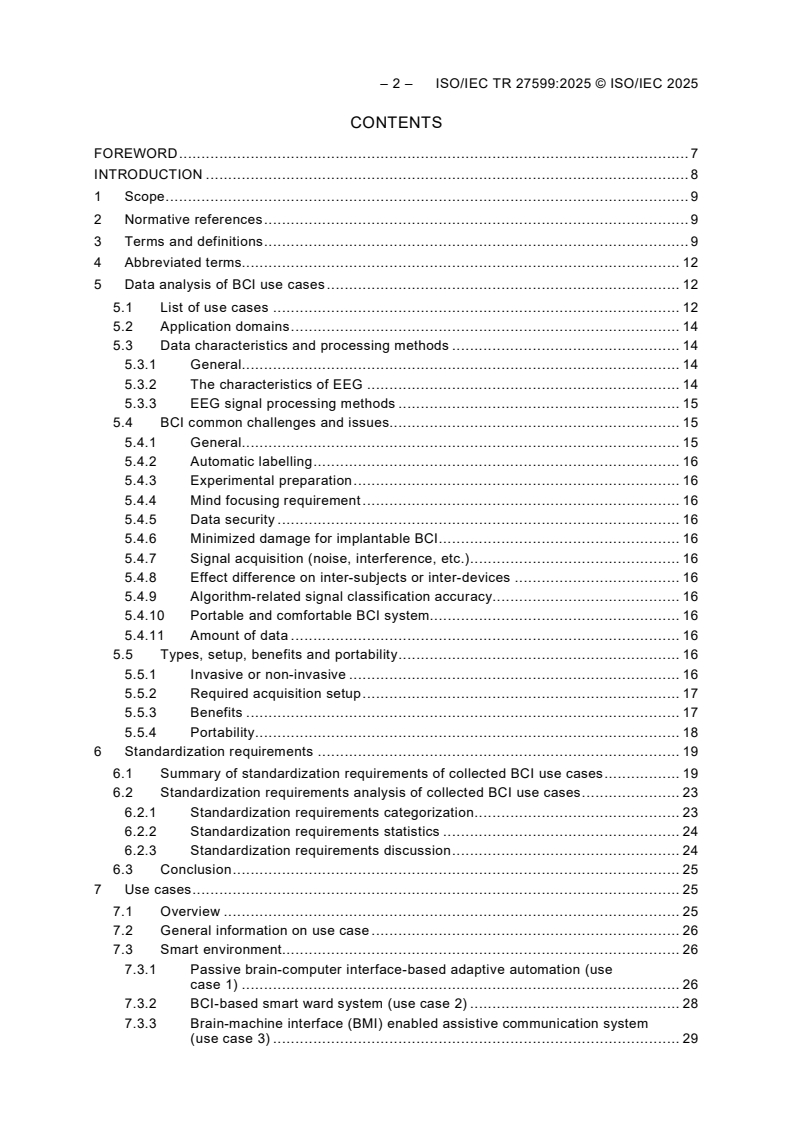
CONTENTS
FOREWORD . 7
INTRODUCTION . 8
1 Scope . 9
2 Normative references . 9
3 Terms and definitions . 9
4 Abbreviated terms. 12
5 Data analysis of BCI use cases . 12
5.1 List of use cases . 12
5.2 Application domains . 14
5.3 Data characteristics and processing methods . 14
5.3.1 General. 14
5.3.2 The characteristics of EEG . 14
5.3.3 EEG signal processing methods . 15
5.4 BCI common challenges and issues. 15
5.4.1 General. 15
5.4.2 Automatic labelling . 16
5.4.3 Experimental preparation . 16
5.4.4 Mind focusing requirement . 16
5.4.5 Data security . 16
5.4.6 Minimized damage for implantable BCI . 16
5.4.7 Signal acquisition (noise, interference, etc.) . 16
5.4.8 Effect difference on inter-subjects or inter-devices . 16
5.4.9 Algorithm-related signal classification accuracy. 16
5.4.10 Portable and comfortable BCI system. 16
5.4.11 Amount of data . 16
5.5 Types, setup, benefits and portability . 16
5.5.1 Invasive or non-invasive . 16
5.5.2 Required acquisition setup . 17
5.5.3 Benefits . 17
5.5.4 Portability . 18
6 Standardization requirements . 19
6.1 Summary of standardization requirements of collected BCI use cases . 19
6.2 Standardization requirements analysis of collected BCI use cases . 23
6.2.1 Standardization requirements categorization . 23
6.2.2 Standardization requirements statistics . 24
6.2.3 Standardization requirements discussion . 24
6.3 Conclusion . 25
7 Use cases . 25
7.1 Overview . 25
7.2 General information on use case . 26
7.3 Smart environment. 26
7.3.1 Passive brain-computer interface-based adaptive automation (use
case 1) . 26
7.3.2 BCI-based smart ward system (use case 2) . 28
7.3.3 Brain-machine interface (BMI) enabled assistive communication system
(use case 3) . 29
7.3.4 Monitoring and early warning technology for the fitness of special
operations personnel based on EEG signals (use case 4) . 32
7.4 Medical and health. 33
7.4.1 Minimally invasive implanted closed-loop brain-computer interface
system (use case 5) . 33
7.4.2 Neural state dependent closed-loop deep brain stimulation (use case 6). 35
7.4.3 Invasive brain cursor control system (use case 7) . 37
7.4.4 Multi-site closed-loop neurostimulation for clinical seizure modulation
(use case 8) . 38
7.4.5 AR-based brain-computer interface for upper limb rehabilitation (use
case 9) . 40
7.4.6 Brain-controlled robot grabbing to assist daily life (use case 10) . 42
7.4.7 Rehabilitation training system based on MI-BCI (use case 11) . 44
7.4.8 Brain-computer interface in diagnosis and treatment of depression (use
case 12) . 45
7.4.9 The M-score: motor function assessment using BCI (use case 13) . 46
7.4.10 Shen Gong robotics: BCI-driven rehabilitation training system (use
case 14) . 48
7.4.11 Music intervention based on brain-computer interface system (use
case 15) . 49
7.4.12 Wearable seizure onset detection system (use case 16) . 51
7.4.13 Clinical diagnosis and prognosis in patients with disorders of
consciousness (DOC) (use case 17) . 52
7.4.14 An adaptive AR display to improve situational awareness using BCI in
stressful and fatigue-inducing situations (use case 18) . 55
7.4.15 Portable brain-related symptom screening, monitoring and surveillance
system using non-invasive electroencephalograph (use case 19) . 58
7.4.16 Portable brain-related symptom management system using non-
invasive brain stimulation (use case 20) . 59
7.4.17 Automated seizure detection and prediction (use case 21) . 61
7.4.18 Near-infrared BCI intervention in patients with stroke (use case 22) . 62
7.4.19 Fusion of multi-modal fNIRs and EEG information for motor imagery
classification (use case 23) . 64
7.4.20 BCI controlled exoskeleton with seven degrees of freedom for
assistance and rehabilitation applications (use case 24) . 65
7.4.21 BCI controlled wheelchair for assistance and rehabilitation (use
case 25) . 66
7.5 Learning, education and training . 68
7.5.1 Reading assessment apparatus (RAA) (use case 26) . 68
7.5.2 BCI-based biofeedback for accelerated learning (use case 27) . 69
7.6 Industrial controls . 72
7.6.1 Brain-computer interface in aerospace applications (use case 28). 72
7.6.2 T-Drone (use case 29) . 74
7.7 Gaming. 76
7.7.1 Cognitive regulation based on brain-computer interface game (use
case 30) . 76
7.7.2 The MindGomoku: an online P300 BCI game (use case 31) . 77
7.8 Security and authentication. 79
7.8.1 Non-invasive brain signal-based biometrics system (use case 32) . 79
Annex A (informative) Figures from the collected use cases . 82
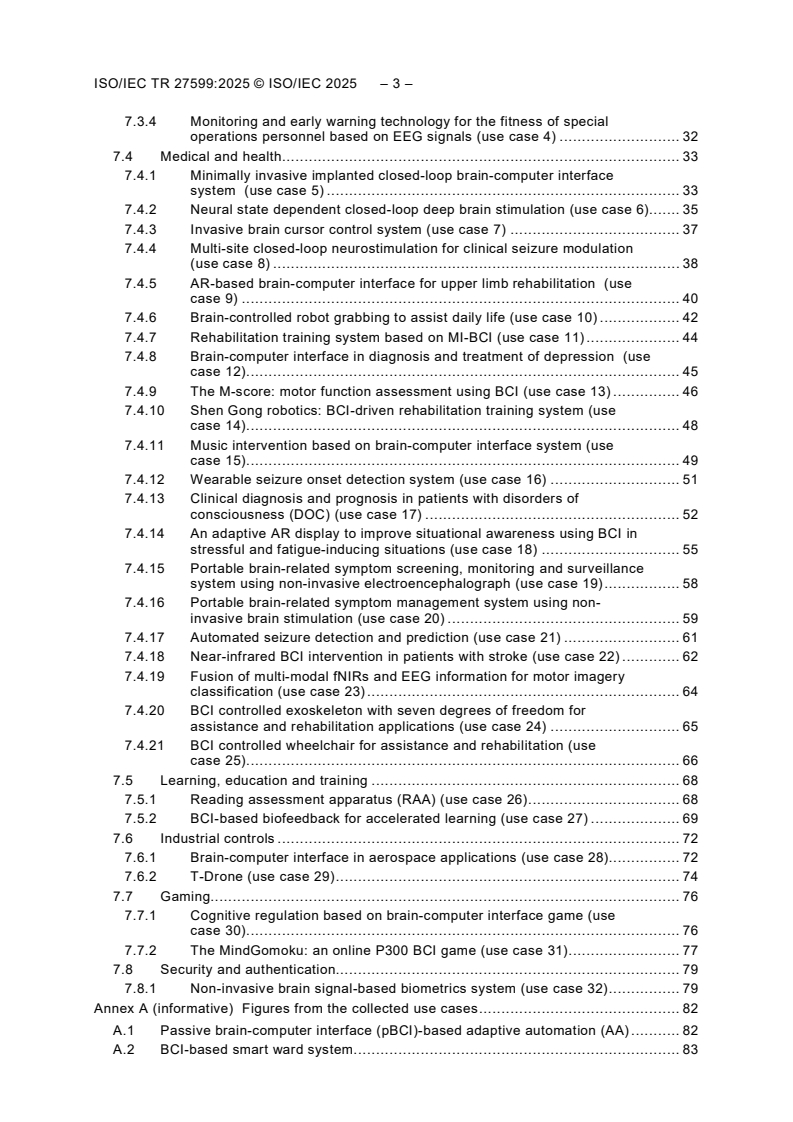
A.1 Passive brain-computer interface (pBCI)-based adaptive automation (AA) . 82
A.2 BCI-based smart ward system . 83
– 4 – ISO/IEC TR 27599:2025 © ISO/IEC 2025
A.3 Brain-machine interface (BMI) enabled assistive communication system . 83
A.4 Monitoring and early warning technology for the fitness of special operations
personnel based on EEG signals . 84
A.5 Minimally invasive implanted closed-loop brain-computer interface system . 84
A.6 Neural state dependent closed-loop deep brain stimulation . 85
A.7 Invasive brain cursor control system . 86
A.8 Multi-site closed-loop neurostimulation for clinical seizure modulation . 87
A.9 AR-based brain-computer interface . 89
A.10 Brain-controlled robot grabbing to assist daily life . 90
A.11 Rehabilitation training system based on MI-BCI . 91
A.12 Brain-computer interface in diagnosis and treatment of depression . 93
A.13 The M-score: motor function assessment using BCI . 94
A.14 Shen Gong robotics: BCI-driven rehabilitation training system . 95
A.15 Music intervention based on the brain-computer interface system . 96
A.16 Wearable seizure onset detection system . 98
A.17 Clinical diagnosis and prognosis in patients with DOC . 99
A.18 An adaptive AR display to improve situational awareness using BCI in
stressful and fatigue-inducing situations . 100
A.19 Portable brain-related symptom screening, monitoring and surveillance
system using non-invasive electroencephalograph . 101
A.20 Portable brain-related symptom management system using non-invasive
brain stimulation . 102
A.21 Automated seizure detection and prediction . 102
A.22 Near-infrared BCI intervention in patients with stroke . 102
A.23 Fusion of multi-modal fNIRs and EEG information for motor imagery
classification . 102
A.24 BCI controlled exoskeleton with seven degrees of freedom for assistance
and rehabilitation applications . 102
A.25 BCI controlled wheelchair for assistance and rehabilitation . 103
A.26 Reading assessment apparatus (RAA) . 104
A.27 BCI-based biofeedback for accelerated learning . 104
A.28 Brain-computer interface in aerospace applications . 105
A.29 T-Drone . 106
A.30 Cognitive regulation based on brain-computer interface game . 107
A.31 The MindGomoku: an online P300 BCI game . 108
A.32 Non-invasive brain signal-based biometrics system . 110
Annex B (informative) Use case template . 111
Bibliography . 112
Figure 1 – Application domains of all the collected BCI use cases . 14
Figure 2 – Common challenges among BCI use cases . 15
Figure 3 – Invasiveness of all the collected BCI use cases . 17
Figure 4 – Benefit of the BCI use cases . 18
Figure 5 – Portability of the use cases . 18
Figure 6 – Standardization requirements statistics of the collected BCI use cases . 24
Figure A.1 – Experimental demonstration of pBCI-based adaptive automation . 82
Figure A.2 – The BCI-based smart ward . 83
Figure A.3 – A BCI based real-time sensing equipment and early warning system . 84
Figure A.4 – Minimally invasive implanted closed-loop brain-computer interface system . 84
Figure A.5 – Neural state discrimination method . 85
Figure A.6 – Neurostimulator for deep brain stimulation therapy . 86
Figure A.7 – Invasive brain cursor control system . 86
Figure A.8 – Framework of hardware . 87
Figure A.9 – Framework of the classifier for seizure detection . 88
Figure A.10 – Flowchart of the AR-based brain-computer interface . 89
Figure A.11 – AR environment of the AR-based brain-computer interface . 89
Figure A.12 – Feedback of the AR-based brain-computer interface . 90
Figure A.13 – Brain-controlled robot grabbing to assist daily life . 90
Figure A.14 – Graphical user interface of brain-controlled robot grabbing to
assist daily life . 91
Figure A.15 – Rehabilitation training system based on MI-BCI . 91
Figure A.16 – Graphical user interface of the rehabilitation training system based on
MI-BCI . 92
Figure A.17 – Complete system setup and application environment . 93
Figure A.18 – The hardware system of the user case . 94
Figure A.19 – The system of Shen Gong robotics . 95
Figure A.20 – User gained improvement in handwriting after treatment using the Shen
Gong robotic series . 95
Figure A.21 – Product example . 96
Figure A.22 – Principles of brain-wave music . 96
Figure A.23 – Framework of system . 97
Figure A.24 – Wearable seizure onset detection system . 98
Figure A.25 – Patient with cognitive motor dissociation (CMD) selecting his or her own
photograph from two candidates using an EEG-based BCI . 99
Figure A.26 – A patient with disorders of consciousness is detecting awareness using
an EEG-based BCI . 99
Figure A.27 – The data processing and decision-making procedure of a trial for BCI-
based awareness detection . 100
Figure A.28 – An example of a stress-inducing experimental paradigm . 100
Figure A.29 – The outline of the experimental task to assess cognitive performance
when fatigued . 101
Figure A.30 – Clinic-to-home electroceutical platform . 101
Figure A.31 – Two high degree of freedom exoskeletons utilized in this use case, one
on the left is developed with portable design and the one on the right is developed with
stationary design . 102
Figure A.32 – The graphical user interface used in this use case . 103
Figure A.33 – Brain-controlled wheelchair with intelligent obstacle avoidance . 103
Figure A.34 – Reading assessment apparatus (RAA) . 104
Figure A.35 – A developed biofeedback-supported intelligent training system . 104
Figure A.36 – Overall architecture of the developed biofeedback-supported intelligent
training system . 105
Figure A.37 – The graphical user interface of the user case . 105
Figure A.38 – The hardware system of the user case . 106
Figure A.39 – Product example . 107
Figure A.40 – Framework of BCI game . 108
– 6 – ISO/IEC TR 27599:2025 © ISO/IEC 2025
Figure A.41 – The framework of the BCI game consisting of three subsystems: (a) data
acquisition, (b) data processing, and (c) visual and game terminal . 108
Figure A.42 – An illustration of MindGomoku . 109
Figure A.43 – Non-invasive brain signal-based biometrics system . 110
Table 1 – List of use cases . 13
Table 2 – The list of standardization requirements from all the collected BCI use cases . 20
Table B.1 – Use case template . 111
INFORMATION TECHNOLOGY –
BRAIN-COMPUTER INTERFACES –
USE CASES
FOREWORD
1) ISO (the International Organization for Standardization) and IEC (the International Electrotechnical Commission)
form the specialized system for worldwide standardization. National bodies that are members of ISO or IEC
participate in the development of International Standards through technical committees established by the
respective organization to deal with particular fields of technical activity. ISO and IEC technical committees
collaborate in fields of mutual interest. Other international organizations, governmental and non-governmental,
in liaison with ISO and IEC, also take part in the work.
2) The formal decisions or agreements of IEC and ISO on technical matters express, as nearly as possible, an
international consensus of opinion on the relevant subjects since each technical committee has representation
from all interested IEC and ISO National bodies.
3) IEC and ISO documents have the form of recommendations for international use and are accepted by IEC and
ISO National bodies in that sense. While all reasonable efforts are made to ensure that the technical content of
IEC and ISO documents is accurate, IEC and ISO cannot be held responsible for the way in which they are used
or for any misinterpretation by any end user.
4) In order to promote international uniformity, IEC and ISO National bodies undertake to apply IEC and
ISO documents transparently to the maximum extent possible in their national and regional publications. Any
divergence between any IEC and ISO document and the corresponding national or regional publication shall be
clearly indicated in the latter.
5) IEC and ISO do not provide any attestation of conformity. Independent certification bodies provide conformity
assessment services and, in some areas, access to IEC and ISO marks of conformity. IEC and ISO are not
responsible for any services carried out by independent certification bodies.
6) All users should ensure that they have the latest edition of this document.
7) No liability shall attach to IEC and ISO or their directors, employees, servants or agents including individual
experts and members of its technical committees and IEC and ISO National bodies for any personal injury,
property damage or other damage of any nature whatsoever, whether direct or indirect, or for costs (including
legal fees) and expenses arising out of the publication, use of, or reliance upon, this ISO/IEC document or any
other IEC and ISO documents.
8) Attention is drawn to the Normative references cited in this document. Use of the referenced publications is
indispensable for the correct application of this document.
9) IEC and ISO draw attention to the possibility that the implementation of this document may involve the use of (a)
patent(s). IEC and ISO take no position concerning the evidence, validity or applicability of any claimed patent
rights in respect thereof. As of the date of publication of this document, IEC and ISO had not received notice of
(a) patent(s), which may be required to implement this document. However, implementers are cautioned that this
may not represent the latest information, which may be obtained from the patent database available at
https://patents.iec.ch and www.iso.org/patents. IEC and ISO shall not be held responsible for identifying any or
all such patent rights.
ISO/IEC 27599 has been prepared by subcommittee SC 43: Brain-computer interfaces, of IEC
technical committee JTC 1: Information technology. It is a Technical Report.
The text of this Technical Report is based on the following documents:
Draft Report on voting
JTC1-SC43/134/DTR JTC1-SC43/152/RVDTR
Full information on the voting for its approval can be found in the report on voting indicated in
the above table.
The language used for the development of this Technical Report is English.
This document was drafted in accordance with ISO/IEC Directives, Part 2, and developed in
accordance with ISO/IEC Directives, Part 1, and the ISO/IEC Directives, JTC 1 Supplement
available at www.iec.ch/members_experts/refdocs and www.iso.org/directives.
– 8 – ISO/IEC TR 27599:2025 © ISO/IEC 2025
INTRODUCTION
Brain-computer interface (BCI) has unique technical aspects, and there are few similar
international standards or technical reports.
This document provides a collection of representative use cases of brain-computer interface
applications in a variety of domains. The current document reflects contributions and
discussions by ISO/IEC JTC 1/SC 43 experts and liaison members.
In particular, SC 43 performed research on the standardization requirements of BCI, and this
document presents the conclusions. BCI technology is gradually being applied to many real-
world application fields, including smart environments, medical and health, education, industrial
control, and gaming. In the future, this technology will bring new changes and developments in
more fields. Therefore, to ensure that BCI technology can better benefit humans, it is important
to carry out standardization research work on the technology, which mainly focuses on the
standardization of BCI technology, ethics, and safety.
INFORMATION TECHNOLOGY –
BRAIN-COMPUTER INTERFACES –
USE CASES
1 Scope
This document provides a collection of representative use cases of brain-computer interface
(BCI) applications in a variety of domains: proposed medical and health, industrial controls,
smart environment, etc.
This document can be used for the development of potential standards, and it is valuable for a
better comprehension of BCI.
This document is also helpful for BCI industries and products that provide support for
communications among interested parties and stakeholders.
This document is applicable to all types of organizations (e.g. commercial enterprises,
government agencies, not-for-profit organizations).
2 Normative references
ISO/IEC 8663, Information technology – Brain-computer interfaces – Vocabulary
3 Terms and definitions
For the purposes of this document, the terms and definitions given in ISO/IEC 8663 and the
following apply.
ISO and IEC maintain terminology databases for use in standardization at the following
addresses:
• IEC Electropedia: available at https://www.electropedia.org/
• ISO Online browsing platform: available at https://www.iso.org/obp
3.1
minimally invasive BCI
minutely invasive BCI
invasive brain-computer interface paradigm or system which requires a surgical procedure but
with a low risk of infection and a minimal contact or disruption of neural tissue and vasculature
Note 1 to entry: The electrodes can be placed outside the dura mater (epidural).
3.2
implanted sensor
implantable sensor
sensor which is placed inside the body after surgical incisions, providing accurate in vivo
physiological measurement in humans and other animals
___________
Under preparation. Stage at the time of publication: ISO/IEC CDV 8663:2024.
– 10 – ISO/IEC TR 27599:2025 © ISO/IEC 2025
3.3
classifier
trained model and its associated mechanism used to perform classification
[SOURCE: ISO/IEC TS 4213:2022, 3.1.2]
3.4
target stimulus
stimulus to which subjects in a test or procedure must respond
Note 1 to entry: Among many stimuli, a person selects the one to which he or she responds.
Note 2 to entry: Adapted from reference [1].
3.5
external stimulus
stimulus that originates from outside the organism and that does not rely on the subject's
reaction
Note 1 to entry: External stimulus can be an electrical, optical, auditory or mechanical signal, cue or event.
3.6
motion-onset visual evoked potential
mVEP
neural potential that occurs when motion-related stimuli are attended visually
Note 1 to entry: Adapted from reference [2].
3.7
deep brain stimulation
DBS
neurosurgical technique that uses implanted electrodes and electrical stimulation to treat neural
disorders
Note 1 to entry: Deep brain stimulation is the most performed surgical treatment for Parkinson's disease.
3.8
functional electrical stimulation
FES
activity-based intervention that extrinsically activates the neuromuscular system below the level
of the lesion, inducing plasticity of the neuromuscular and central nervous systems
3.9
mental state
mental property
mental condition
set of characteristics of a person's affective and psychological mode or status
3.10
vegetative state
clinical condition of complete unawareness of the self and the environment, accompanied by
sleep–wake cycles, with either complete or partial preservation of hypothalamic and brainstem
autonomic functions
Note 1 to entry: Adapted from reference [3].
3.11
minimally conscious state
clinical condition of severely altered consciousness in which minimal but definite behavioural
evidence of self or environmental awareness is demonstrated
Note 1 to entry: This definition is taken from reference [4].
3.12
awareness detection
method to explore and measure the quality or state of the subject's consciousness
Note 1 to entry: Usually, awareness detection is performed by evaluating vegetative state and minimally conscious
state.
3.13
biometrics system
system that enables a person to be identified and authenticated through capturing the
recognizable, verifiable, unique, and specific physiological data
3.14
cursor control
brain-computer interface system that presents a user with a movable item used to mark a
position and translates the moving direction by interpreting the user's neural activities
3.15
shared control
characterized by the use of both user control and an automation component
Note 1 to entry: A shared control BCI system uses both the direct input from the user by interpreting neural activities
and assistance from artificial intelligence technology.
3.16
online analysis
type of brain-computer interface (BCI) classification procedure that is performed immediately
following data acquisition, translating neural activities into BCI commands
Note 1 to entry: Online analysis must be used in real-time BCI applications.
3.17
offline analysis
offline training
type of brain-computer interface classification or training procedure performed at a separate
time after data acquisition is completed
3.18
classification accuracy
metric for evaluating classification models in brain-computer interface prediction
Note 1 to entry: Accuracy equals the number of correct predictions over the total number of actual predictions.
3.19
information transfer rate
ITR
evaluation metric devised for brain-computer interface systems that determines the amount of
information that is conveyed by a system's output per unit time
Note 1 to entry: Adapted from references [5] and [6].
– 12 – ISO/IEC TR 27599:2025 © ISO/IEC 2025
4 Abbreviated terms
ANN artificial neural network
AR augmented reality
BCI brain-computer interface
BMI brain-machine interface
CRS-R coma recovery scale – revised
CSP common spatial pattern
CT computed tomography
DBS deep brain stimulation
DOC disorders of consciousness
ECoG electrocorticogram
EEG electroencephalography
EER equal error rate
EMG electromyogram
EOG electro-oculogram
FBCCA filter bank canonical correlation analysis
FDA Food and Drug Administration
FES functional electrical stimulation
FPGA field-programmable gate array
fMRI functional magnetic resonance imaging
fNIRS functional near-infrared spectroscopy
iEEG intracranial electroencephalography
I/O input or output
ITR information transfer rate
LFP local field potential
LiDAR light detection and ranging
MI motor imagery
MRI magnetic resonance imaging
mVEP motion-onset visual evoked potential
NIRS near-infrared spectroscopy
PCA principal components analysis
RAA reading assessment apparatus
SEEG stereoelectroencephalography
SoC system on chip
SSVEP steady-state visual evoked potential
VR virtual reality
5 Data analysis of BCI use cases
5.1 List of use cases
Table 1 shows summary information for each of the 32 use cases, including name, application
domain, and status. Subclauses 7.3 to 7.8 provide details on each use case, listed by
application domain.
Table 1 – List of use cases
No. Title Application domain Status
Passive brain-computer interface (pBCI)-based adaptive Proof of
1 Smart environment
automation (AA) concept
2 BCI-based smart ward system Smart environment In operation
Brain-machine interface (BMI) enabled assistive Proof of
3 Smart environment
communication system concept
Monitoring and early warning technology for the fitness of
4 Smart environment In operation
special operations personnel based on EEG signals
Minimally invasive implanted closed-loop brain-computer Proof of
5 Medical and health
interface system concept
6 Neural state dependent closed-loop deep brain stimulation Medical and health In operation
Proof of
7 Invasive brain cursor control system Medical and health
concept
Multi-site closed-loop neurostimulation for clinical seizure
8 Medical and health Prototype
modulation
AR-based brain-computer interface for upper limb
9 Medical and health In operation
rehabilitation
10 Brain-controlled robot grabbing to assist daily life Medical and health In operation
11 Rehabilitation training system based on MI-BCI Medical and health In operation
Brain-computer interface in diagnosis and treatment of
12 Medical and health In operation
depression
Proof of
13 The M-score: motor function assessment using BCI Medical and health
concept
Shen Gong robotics: BCI-driven rehabilitation training Proof of
14 Medical and health
system concept
Music intervention based on brain-computer interface
15 Medical and health Prototype
system
Proof of
16 Wearable seizure onset detection system Medical and health
concept
Clinical diagnosis and prognosis in patients with disorders
17 Medical and health In operation
of consciousness (DOC)
An adaptive AR display to improve situational awareness
18 Medical and health In operation
using BCI in stressful and fatigue-inducing situations
Portable brain-related symptom screening, monitoring and
19 surveillance system using non-invasive Medical and health In operation
electroencephalograph
Portable brain-related symptom management system
20 Medical and health In operation
using non-invasive brain stimulation
Proof of
21 Automated seizure detection and prediction Medical and health
concept
Proof of
22 Near-infrared BCI intervention in patients with stroke Medical and health
concept
Fusion of multi-modal fNIRs and EEG information for Proof of
23 Medical and health
motor imagery classification concept
BCI controlled exoskeleton with seven degrees of freedom Proof of
24 Medical and health
for assistance and rehabilitation applications concept
Proof of
25 BCI controlled wheelchair for assistance and rehabilitation Medical and health
concept
Learning, education and Proof of
26 Reading assessment apparatus (RAA)
training concept
Learning, education and
27 BCI-based biofeedback for accelerated learning In operation
training
28 Brain-computer interface in aerospace applications Industrial controls In operation
29 T-Drone Industrial controls In operation
– 14 – ISO/IEC TR 27599:2025 © ISO/IEC 2025
No. Title Application domain Status
Cognitive regulation based on brain-computer interface
30 Gaming Prototype
game
31 The MindGomoku: an online P300 BCI game Gaming Prototype
Proof of
32 Non-invasive brain signal-based biometrics system Security and authentication
concept
5.2 Application domains
Figure 1 describes the distribution of use cases by application domain. Six application
domains – security and authentication, smart environment, medical and health, learning,
education and training, industrial controls, and gaming – were considered as target domains for
the use cases.
Figure 1 – Application domains of all the collected BCI use cases
5.3 Data characteristics and processing methods
5.3.1 General
BCI mainly identifies users' intentions by analysing the acquired brain electrical signals. There
are two main methods for collecting brain electrical signals: invasive and non-invasive. The
advantage of invasive methods is that the accuracy of electrical signals is high, but this method
has certain surgical risks. Relatively speaking, non-invasive methods are more convenient and
safer.
5.3.2 The characteristics of EEG
Electroencephalography (EEG) signals, as a kind of bioelectrical signal, directly reflect the
simplest brain activity. Compared with other physiological electrical signals, EEG signals have
the following five characteristics.
a) They are very weak, measured in microvolts (µV), with frequencies ranging from 0,5 Hz to
100 Hz. EEG signals are easily contaminated with noise, such as power-line interference,
electro-oculogram (EOG), and electromyogram (EMG).
b) The EEG signals exhibit strong randomness and instability, which means that the statistical
characteristics of the EEG are independent of time.
c) They are nonlinear because the relationship between the EEG signals and time does not
satisfy a linear function.
d) EEG signals have prominent frequency domain features. Specifically, they have relatively
stable frequency components. Different EEG frequency components have different
contributions to different brain activity states.
e) The EEG signals are coupled, meaning that different channels of EEG signals have a strong
interrelationship.
5.3.3 EEG signal processing methods
Because of these characteristics of EEG signals, they face great challenges in data processing.
The signal processing of BCI systems mainly includes four parts: pre-processing, feature
extraction, feature selection, and classification. First, the original EEG acquired is denoised by
pre-processing. Pre-processing aims to improve the quality of the brain signal and to highlight
the signal features. For EEG-based BCI system, pre-processing standardization terms include
referencing, ocular artifact removal, time or frequency or spatial-domain filtering, dimensionality
reduction, etc. For fMRI-based BCI, pre-processing standardization terms include slice timing,
motion correction, spatial normalization, smoothing, filtering, covariance regression and so on.
Then, feature extraction means extracting specific features from brain signals that correspond
to the users' neurological states. Classical brain signal features include temporal features
(e.g. phase locking value), frequency features (e.g. power spectral density), spatial features
(e.g. common spatial pattern), etc. Moreover, some feature selection methods, such as principal
components analysis (PCA), are often used to resolve the "curse of dimensionality". Machine
learning and deep learning algorithms are used to extract data features. Finally, the extracted
features are classified and translated into commands for external devices. It is important that
classification algorithms are evaluated to ensure their accuracy and reliability.
5.4 BCI common challenges and issues
5.4.1 General
The common challenges among all 32 use cases are summarized in Figure 2.
Figure 2 – Common challenges among BCI use cases
– 16 – ISO/IEC TR 27599:2025 © ISO/IEC 2025
5.4.2 Automatic labelling
Use cases 26 and 29 claim that the method is needed to automatically label and store video
feeds and tie to each session for reading assessment apparatus and T-Drone.
5.4.3 Experimental preparation
Use cases 13, 14 and 31 which focused on BCI-based motor function assessment, BCI-driven
Shen Gong robotics and the MindGomoku (an online P300 BCI game) seek a shorter procedure
of the experiment preparation.
5.4.4 Mind focusing requirement
Use cases 7, 9, 10, 18 and 29 ask for a focusing status, as stray thoughts can affect the system
during BCI experiments.
5.4.5 Data security
Use cases 5, 6, 7, 9, 11, 24, 26, 27, 29 and 32 emphasize the importance of data security,
especially for privacy concerns and the prevention of data or command changes by hackers.
5.4.6 Minimized damage for implantable BCI
Use cases 5 and 7 aimed at implantable BCI applications raise concerns for minimized damage
during scalp surgery. Minimally invasive surgi
...