

ISO 17557:2003
(Main)Plastics — Film and sheeting — Cast polypropylene (PP) films
General Information
- Abstract
ISO 17557:2003 specifies the requirements for cast polypropylene (PP) films, which are mainly used for packaging.
- Status
- Published
- Publication Date
- 09-Sep-2003
- Technical Committee
- ISO/TC 61/SC 11 - Products
- Drafting Committee
- ISO/TC 61/SC 11/WG 3 - Plastics films and sheeting
- Current Stage
- 9093 - International Standard confirmed
- Start Date
- 04-Dec-2023
- Completion Date
- 29-Aug-2026
Overview
ISO 17557:2003 - Plastics - Film and sheeting - Cast polypropylene (PP) films - specifies requirements and test methods for cast polypropylene films used mainly for packaging. The standard covers visual acceptability, dimensional tolerances, physical and barrier properties, packaging and marking, and the laboratory test procedures required to demonstrate compliance. It is intended for manufacturers, converters, quality laboratories and specifiers working with cast PP film, packaging film, and food-contact film applications.
Key topics and requirements
- Scope and classification: Films are classified into four types (homopolymer or copolymer; treated or untreated by corona/flame). This classification guides applicable property limits and marking.
- Appearance: Films must be free from visible flaws, wrinkles, stains or foreign matter that impair serviceability. Splices in rolls should be visibly marked.
- Dimensions and tolerances:
- Width tolerance: up to +5 mm above nominal width.
- Roll length tolerance: up to +1% above nominal length.
- Preferred core inside diameters: 76 mm or 152 mm.
- Thickness: average film thickness shall be within ±10% of the nominal value (examples given for 20–60 µm nominal thicknesses).
- Performance properties: The standard requires films to meet specified mechanical, optical and barrier properties (tensile strength and strain, haze for transparent films, water‑vapour transmission, wetting tension, dynamic coefficient of friction and threshold heat-sealing temperature). The threshold heat-sealing temperature is defined as the lowest temperature producing a seal strength of 3 N per 15 mm width.
- Testing and conditioning: Test procedures reference established ISO methods (e.g., ISO 291 for conditioning, ISO 527‑3 for tensile tests, ISO 4593 for thickness, ISO 14782 for haze, ISO 15106‑1/2/3 for water vapour transmission, ISO 8295/8296 for friction and wetting tension). Conditioning is typically at 23 ± 2 °C and 50 ± 5 % RH.
- Marking and packaging: Packages must indicate product name, classification (homopolymer/copolymer and treated/untreated), nominal thickness/width/length, manufacturing date and manufacturer/trademark.
Applications and users
- Film manufacturers and extruders producing cast polypropylene (PP) films
- Packaging engineers and converters specifying materials for food, consumer and industrial packaging
- Quality control and testing laboratories performing compliance testing and acceptance checks
- Product developers assessing barrier, optical and sealability properties for flexible packaging
Related standards
ISO 17557 references several normative test standards, including:
- ISO 291, ISO 527‑3, ISO 4593, ISO 8295, ISO 8296, ISO 14782, ISO 15106‑1/2/3
Keywords: ISO 17557:2003, cast polypropylene, PP films, packaging film, film thickness, tensile properties, water vapour transmission, corona treatment, wetting tension, heat-sealing temperature.
Get Certified
Connect with accredited certification bodies for this standard

DIN CERTCO
DIN Group product certification.

Smithers Quality Assessments
US management systems and product certification.
Sponsored listings
Frequently Asked Questions
ISO 17557:2003 is a standard published by the International Organization for Standardization (ISO). Its full title is "Plastics — Film and sheeting — Cast polypropylene (PP) films". This standard covers: ISO 17557:2003 specifies the requirements for cast polypropylene (PP) films, which are mainly used for packaging.
ISO 17557:2003 specifies the requirements for cast polypropylene (PP) films, which are mainly used for packaging.
ISO 17557:2003 is classified under the following ICS (International Classification for Standards) categories: 83.140.10 - Films and sheets. The ICS classification helps identify the subject area and facilitates finding related standards.
ISO 17557:2003 is available in PDF format for immediate download after purchase. The document can be added to your cart and obtained through the secure checkout process. Digital delivery ensures instant access to the complete standard document.
Standards Content (Sample)
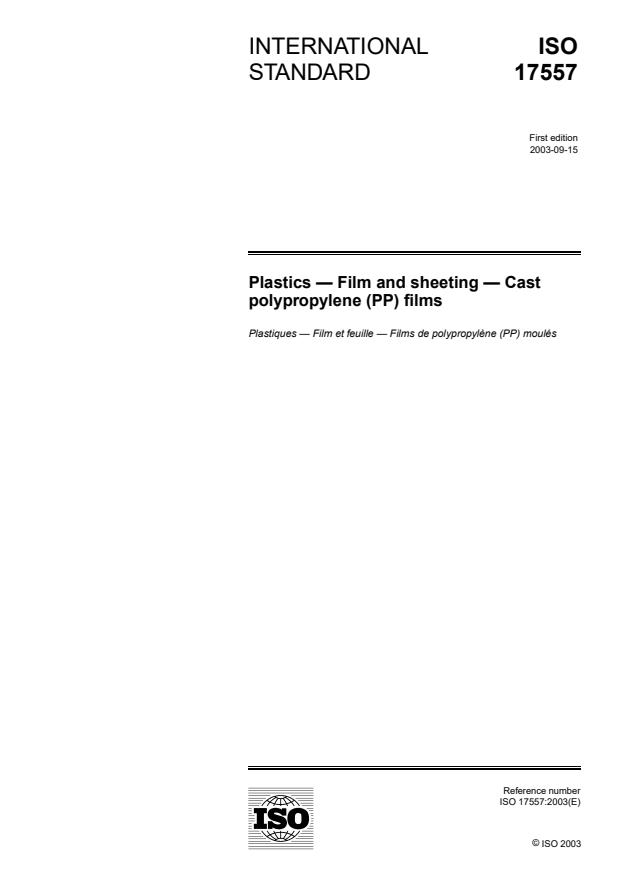
INTERNATIONAL ISO
STANDARD 17557
First edition
2003-09-15
Plastics — Film and sheeting — Cast
polypropylene (PP) films
Plastiques — Film et feuille — Films de polypropylène (PP) moulés
Reference number
©
ISO 2003
PDF disclaimer
This PDF file may contain embedded typefaces. In accordance with Adobe's licensing policy, this file may be printed or viewed but shall
not be edited unless the typefaces which are embedded are licensed to and installed on the computer performing the editing. In
downloading this file, parties accept therein the responsibility of not infringing Adobe's licensing policy. The ISO Central Secretariat
accepts no liability in this area.
Adobe is a trademark of Adobe Systems Incorporated.
Details of the software products used to create this PDF file can be found in the General Info relative to the file; the PDF-creation
parameters were optimized for printing. Every care has been taken to ensure that the file is suitable for use by ISO member bodies. In the
unlikely event that a problem relating to it is found, please inform the Central Secretariat at the address given below.
All rights reserved. Unless otherwise specified, no part of this publication may be reproduced or utilized in any form or by any means,
electronic or mechanical, including photocopying and microfilm, without permission in writing from either ISO at the address below or
ISO's member body in the country of the requester.
ISO copyright office
Case postale 56 CH-1211 Geneva 20
Tel. + 41 22 749 01 11
Fax + 41 22 749 09 47
E-mail copyright@iso.org
Web www.iso.org
Published in Switzerland
©
ii ISO 2003 – All rights reserved
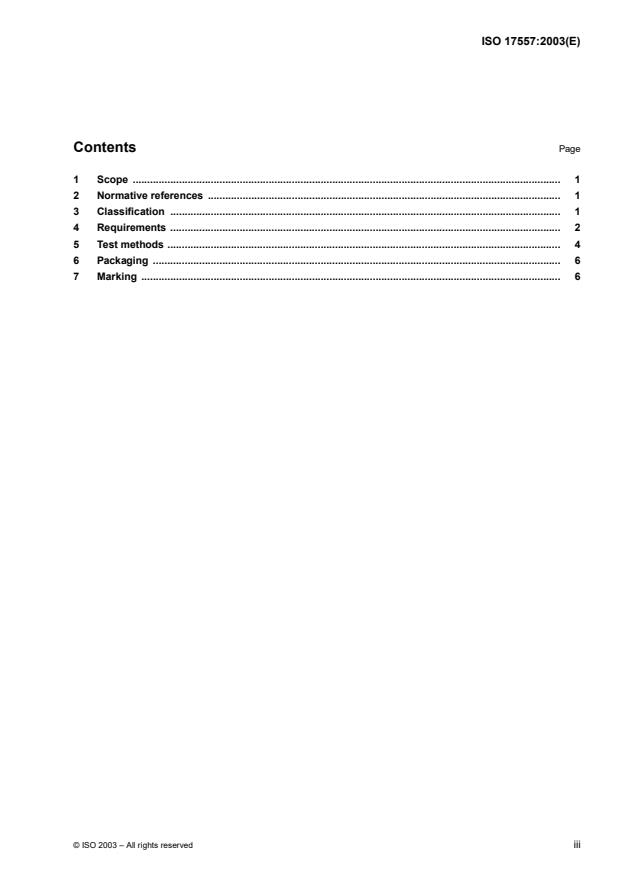
Contents Page
1 Scope . 1
2 Normative references . 1
3 Classification . 1
4 Requirements . 2
5 Test methods . 4
6 Packaging . 6
7 Marking . 6
©
ISO 2003 – All rights reserved iii
Foreword
ISO (the International Organization for Standardization) is a worldwide federation of national standards bodies
(ISO member bodies). The work of preparing International Standards is normally carried out through ISO
technical committees. Each member body interested in a subject for which a technical committee has been
established has the right to be represented on that committee. International organizations, governmental and
non-governmental, in liaison with ISO, also take part in the work. ISO collaborates closely with the International
Electrotechnical Commission (IEC) on all matters of electrotechnical standardization.
International Standards are drafted in accordance with the rules given in the ISO/IEC Directives, Part 2.
The main task of technical committees is to prepare International Standards. Draft International Standards
adopted by the technical committees are circulated to the member bodies for voting. Publication as an
International Standard requires approval by at least 75 % of the member bodies casting a vote.
Attention is drawn to the possibility that some of the elements of this document may be the subject of patent
rights. ISO shall not be held responsible for identifying any or all such patent rights.
ISO 17557 was prepared by Technical Committee ISO/TC 61, Plastics, Subcommittee SC 11, Products.
It is based on Japanese Standard JIS Z 1713:1997.
©
iv ISO 2003 – All rights reserved
INTERNATIONAL STANDARD ISO 17557:2003(E)
Plastics — Film and sheeting — Cast polypropylene (PP) films
1Scope
This International Standard specifies the requirements for cast polypropylene (PP) films, which are mainly used
for packaging.
2 Normative references
The following referenced documents are indispensable for the application of this document. For dated
references, only the edition cited applies. For undated references, the latest edition of the referenced document
(including any amendments) applies.
ISO 291:1997, Plastics — Standard atmospheres for conditioning and testing
ISO 527-3:1995, Plastics — Determination of tensile properties — Part 3: Test conditions for films and sheets
ISO 4593:1993, Plastics — Film and sheeting — Determination of thickness by mechanical scanning
ISO 8295:1995, Plastics — Film and sheeting — Determination of coefficients of friction
ISO 8296:1987, Plastics — Film and sheeting — Determination of wetting tension
ISO 14782:1999, Plastics — Determination of haze for transparent materials
ISO 15106-1:2003, Plastics — Film and sheeting — Determination of water vapour transmission rate — Part 1:
Humidity detection sensor method
ISO 15106-2:2003, Plastics — Film and sheeting — Determination of water vapour transmission rate — Part 2:
Infrared detection sensor method
ISO 15106-3:2003, Plastics — Film and sheeting — Determination of water vapour transmission rate — Part 3:
Electrolytic detection sensor method
3 Classification
Films are classified into four types as shown in Table 1.
Table 1 — Classification of films
a
Type 1 Homopolymer film subjected to corona discharge or flame treatment
a
Type 2 Homopolymer film not subjected to corona discharge or flame treatment
b
Type 3 Copolymer film subjected to corona discharge or flame treatment
b
Type 4 Copolymer film not subjected to corona discharge or flame treatment
a
Containing more than 95 % by mass of propylene.
b
Containing 50 % to 95 % by mass of propylene.
©
ISO 2003 – All rights reserved 1
4 Requirements
4.1 Appearance
Films shall be visibly free of flaws, slackness, wrinkles, stains, foreign matter or marks which could impair their
serviceability.
The splicing of two films in a roll should preferably be prominently marked to provide a visible indication when
the roll is viewed from the end. The method of marking the splice should be agreed upon between the interested
parties.
NOTE One acceptable method of doing this is to use coloured adhesive tape.
4.2 Dimensions
4.2.1 General
For any individual film selected at random from any delivery, the following dimensions, including their nominal
values, shall be as agreed upon between the interested parties.
4.2.2 Width
The film width shall lie between the nominal width and a value 5mm wider than the nominal width.
Examples of possible widths are shown in Table 2.
Table 2 — Exampl
...