


ISO 2859-1
(Main)Sampling procedures for inspection by attributes - Part 1: Sampling schemes indexed by acceptance quality limit (AQL) for lot-by-lot inspection
Sampling procedures for inspection by attributes - Part 1: Sampling schemes indexed by acceptance quality limit (AQL) for lot-by-lot inspection
Règles d’échantillonnage pour les contrôles par attributs — Partie 1: Procédures d’échantillonnage pour les contrôles lot par lot, indexés d’après le niveau de qualité acceptable (NQA)
Les procédures d'échantillonnage contenues dans la présente partie de l'ISO 2859 sont applicables, mais d'une manière non limitative, aux contrôles de différents domaines tels que: -produits Unis -composants ou madères premières -opérations -matériels en cours de fabrication -fournitures en stock -opérations d'entretien -informations ou enregistrements -procédures administratives. Ces procédures sont principalement destinées au contrôle de séries continues de lots, c'est-à-dire de séries suffisamment importantes pour permettre l'application des règles de modification du contrôle. Ces règles ont pour but: a) d'assurer la protection du client en cas de détection d'une détérioration de la qualité (par le passage à un contrôle renforcé ou l'interruption du contrôle); b) de constituer une incitation à réduire les coûts de contrôle (à la discrétion de l'autorité responsable) si la qualité se maintient continuellement bonne (par passage à un contrôle réduit). Les plans créchantillonnage de la présente partie de l'ISO 2859 peuvent aussi être utilisés pour le contrôle de lots isolés mais, dans ce cas, l'utilisateur doit avoir soin de consulter les courbes d'efficacité afin de trouver un plan qui lui donnera la protection désirée. Dans ce cas, l'utilisateur est également renvoyé aux plans d'échantillonnage indexés d'après la qualité limite (QL) spécifiés dans l'ISO 2859-2.
General Information
- Status
- Not Published
- Technical Committee
- ISO/TC 69/SC 5 - Acceptance sampling
- Drafting Committee
- ISO/TC 69/SC 5 - Acceptance sampling
- Current Stage
- 6000 - International Standard under publication
- Start Date
- 13-Dec-2025
- Completion Date
- 27-Dec-2025
Relations
- Effective Date
- 13-Aug-2022
- Effective Date
- 13-Aug-2022
- Effective Date
- 13-Aug-2022
ISO 2859-1 - Sampling procedures for inspection by attributes (AQL) - Overview
ISO 2859-1:2025 defines standardized sampling procedures for lot-by-lot inspection indexed by Acceptance Quality Limit (AQL). It provides tables, plans and rules to determine sample sizes and acceptance criteria when inspecting items by attributes (conforming / non‑conforming). The 2025 edition replaces the 1999 edition and incorporates amendments, adding updated guidance on skip‑lot inspection, producer/product qualification, and methods to construct operating characteristic (OC) and average sample number (ASN) curves.
Key topics and technical requirements
- Acceptance Quality Limit (AQL): Use and specification of AQLs and preferred AQL values to index sampling schemes.
- Sampling plans: Single, double and multiple sampling plans; fractional acceptance number plans (optional); sample size code letters and inspection levels.
- Inspection regimes: Rules and switching procedures for normal, tightened, reduced and skip‑lot inspection, including start/continuation/discontinuation rules.
- Drawing samples: Lot formation, presentation, random selection procedures and timing for taking samples (Annex C contains normative procedures for random selection for skip‑lot frequencies).
- Classification of non‑conformities: Expression, classes and handling of critical non‑conformities and disposition of non‑acceptable lots.
- Decision rules: Determination of acceptability (integer acceptance numbers), and procedures for resubmitted lots.
- Statistical performance: Guidance on OC curves, Average Outgoing Quality (AOQ), AOQL, Average Sample Number (ASN), and producer’s and consumer’s risks (tables and methods in Annex E and main text).
- Annexes and supporting material: Examples, construction methods for OC/ASN curves and sampling plan construction, skip‑lot guidance and informative strategies.
Practical applications and users
ISO 2859-1 is used where attribute (pass/fail) inspection governs acceptance decisions. Typical applications:
- Incoming inspection of components and raw materials
- Final inspection of finished products in manufacturing
- Supplier acceptance and contractual quality acceptance testing
- Quality management systems and auditors implementing statistically based acceptance rules
Primary users include quality managers, QA/QC inspectors, procurement teams, manufacturing engineers, statisticians and compliance auditors who need standardized, defensible lot acceptance criteria.
Related standards
- ISO 2859 series - complementary parts for acceptance sampling
- ISO 2859-0 - contains illustrative examples and is recommended for use together with Part 1
Keywords: ISO 2859-1, AQL, sampling procedures, acceptance sampling, lot-by-lot inspection, sampling plans, skip-lot inspection, OC curve, ASN, AOQL.
ISO/FDIS 2859-1 - Sampling procedures for inspection by attributes — Part 1: Sampling schemes indexed by acceptance quality limit (AQL) for lot-by-lot inspection Released:10/3/2025
REDLINE ISO/FDIS 2859-1 - Sampling procedures for inspection by attributes — Part 1: Sampling schemes indexed by acceptance quality limit (AQL) for lot-by-lot inspection Released:10/3/2025
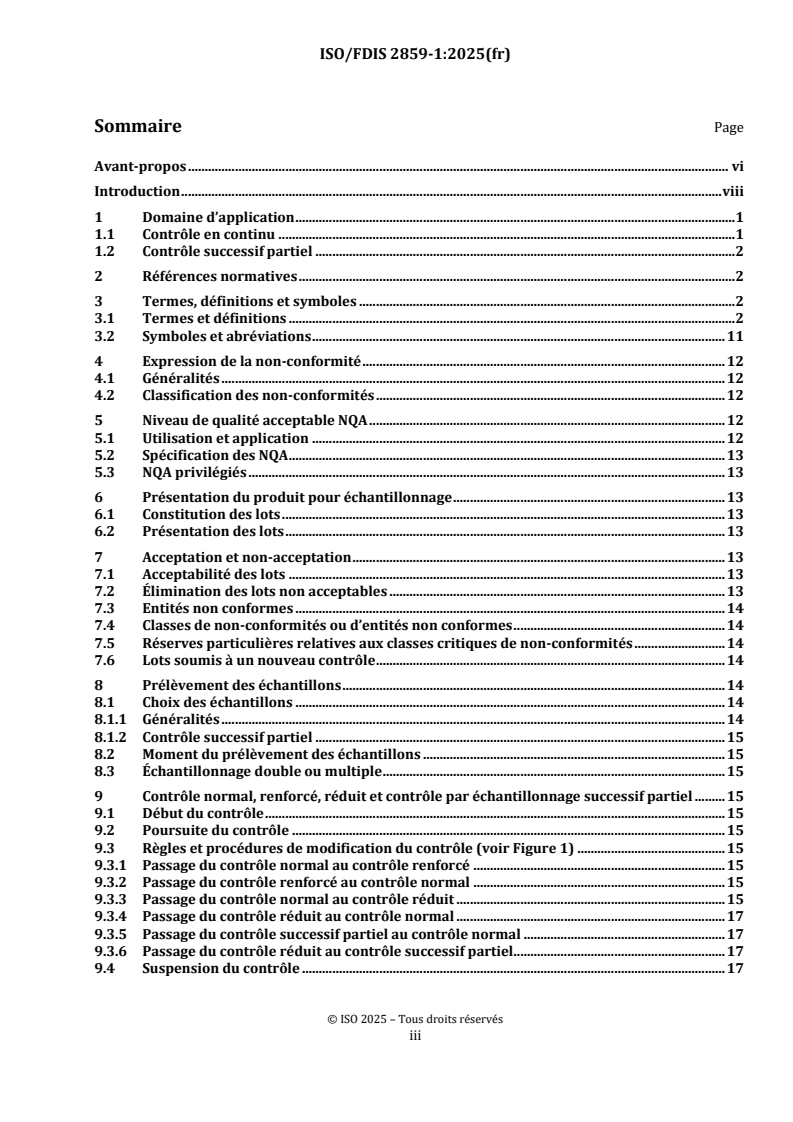
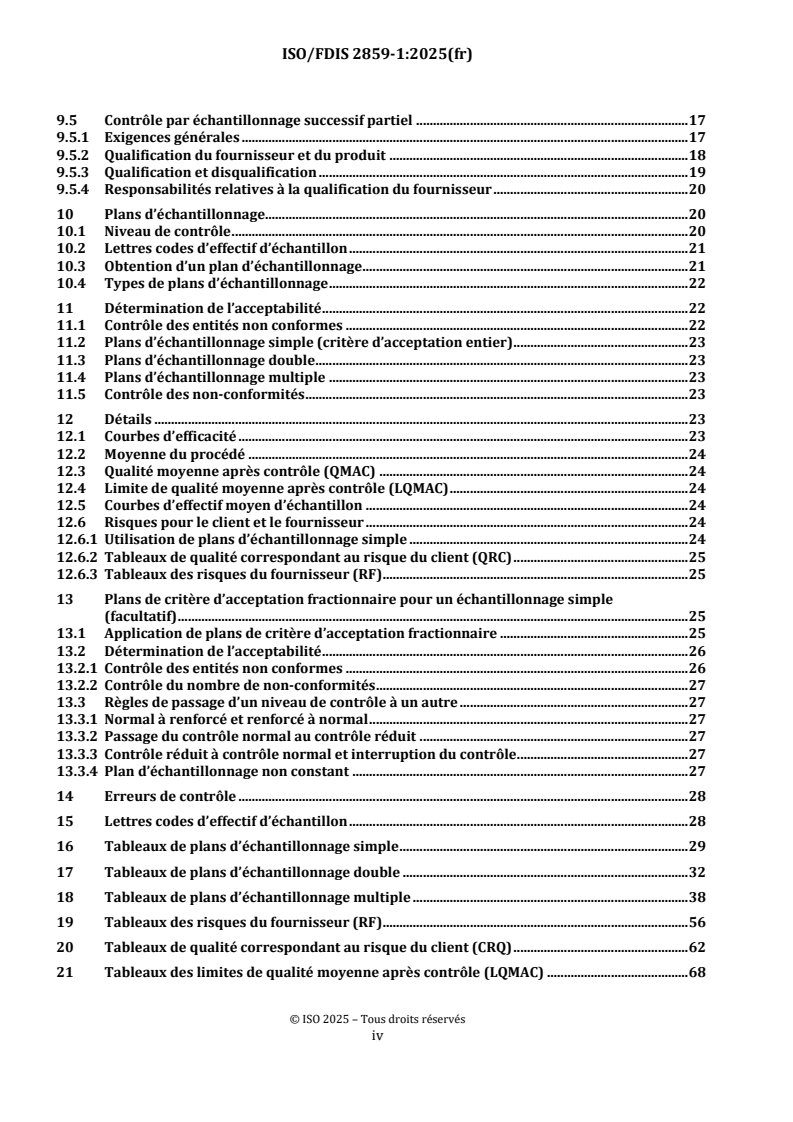
ISO/FDIS 2859-1 - Règles d’échantillonnage pour les contrôles par attributs — Partie 1: Procédures d’échantillonnage pour les contrôles lot par lot, indexés d’après le niveau de qualité acceptable (NQA) Released:12. 11. 2025
Frequently Asked Questions
ISO 2859-1 is a draft published by the International Organization for Standardization (ISO). Its full title is "Sampling procedures for inspection by attributes - Part 1: Sampling schemes indexed by acceptance quality limit (AQL) for lot-by-lot inspection". This standard covers: Les procédures d'échantillonnage contenues dans la présente partie de l'ISO 2859 sont applicables, mais d'une manière non limitative, aux contrôles de différents domaines tels que: -produits Unis -composants ou madères premières -opérations -matériels en cours de fabrication -fournitures en stock -opérations d'entretien -informations ou enregistrements -procédures administratives. Ces procédures sont principalement destinées au contrôle de séries continues de lots, c'est-à-dire de séries suffisamment importantes pour permettre l'application des règles de modification du contrôle. Ces règles ont pour but: a) d'assurer la protection du client en cas de détection d'une détérioration de la qualité (par le passage à un contrôle renforcé ou l'interruption du contrôle); b) de constituer une incitation à réduire les coûts de contrôle (à la discrétion de l'autorité responsable) si la qualité se maintient continuellement bonne (par passage à un contrôle réduit). Les plans créchantillonnage de la présente partie de l'ISO 2859 peuvent aussi être utilisés pour le contrôle de lots isolés mais, dans ce cas, l'utilisateur doit avoir soin de consulter les courbes d'efficacité afin de trouver un plan qui lui donnera la protection désirée. Dans ce cas, l'utilisateur est également renvoyé aux plans d'échantillonnage indexés d'après la qualité limite (QL) spécifiés dans l'ISO 2859-2.
Les procédures d'échantillonnage contenues dans la présente partie de l'ISO 2859 sont applicables, mais d'une manière non limitative, aux contrôles de différents domaines tels que: -produits Unis -composants ou madères premières -opérations -matériels en cours de fabrication -fournitures en stock -opérations d'entretien -informations ou enregistrements -procédures administratives. Ces procédures sont principalement destinées au contrôle de séries continues de lots, c'est-à-dire de séries suffisamment importantes pour permettre l'application des règles de modification du contrôle. Ces règles ont pour but: a) d'assurer la protection du client en cas de détection d'une détérioration de la qualité (par le passage à un contrôle renforcé ou l'interruption du contrôle); b) de constituer une incitation à réduire les coûts de contrôle (à la discrétion de l'autorité responsable) si la qualité se maintient continuellement bonne (par passage à un contrôle réduit). Les plans créchantillonnage de la présente partie de l'ISO 2859 peuvent aussi être utilisés pour le contrôle de lots isolés mais, dans ce cas, l'utilisateur doit avoir soin de consulter les courbes d'efficacité afin de trouver un plan qui lui donnera la protection désirée. Dans ce cas, l'utilisateur est également renvoyé aux plans d'échantillonnage indexés d'après la qualité limite (QL) spécifiés dans l'ISO 2859-2.
ISO 2859-1 is classified under the following ICS (International Classification for Standards) categories: 03.120.30 - Application of statistical methods. The ICS classification helps identify the subject area and facilitates finding related standards.
ISO 2859-1 has the following relationships with other standards: It is inter standard links to ISO 2859-1:1999, ISO 2859-1:1999/Cor 1:2001, ISO 2859-1:1999/Amd 1:2011. Understanding these relationships helps ensure you are using the most current and applicable version of the standard.
ISO 2859-1 is available in PDF format for immediate download after purchase. The document can be added to your cart and obtained through the secure checkout process. Digital delivery ensures instant access to the complete standard document.
Standards Content (Sample)
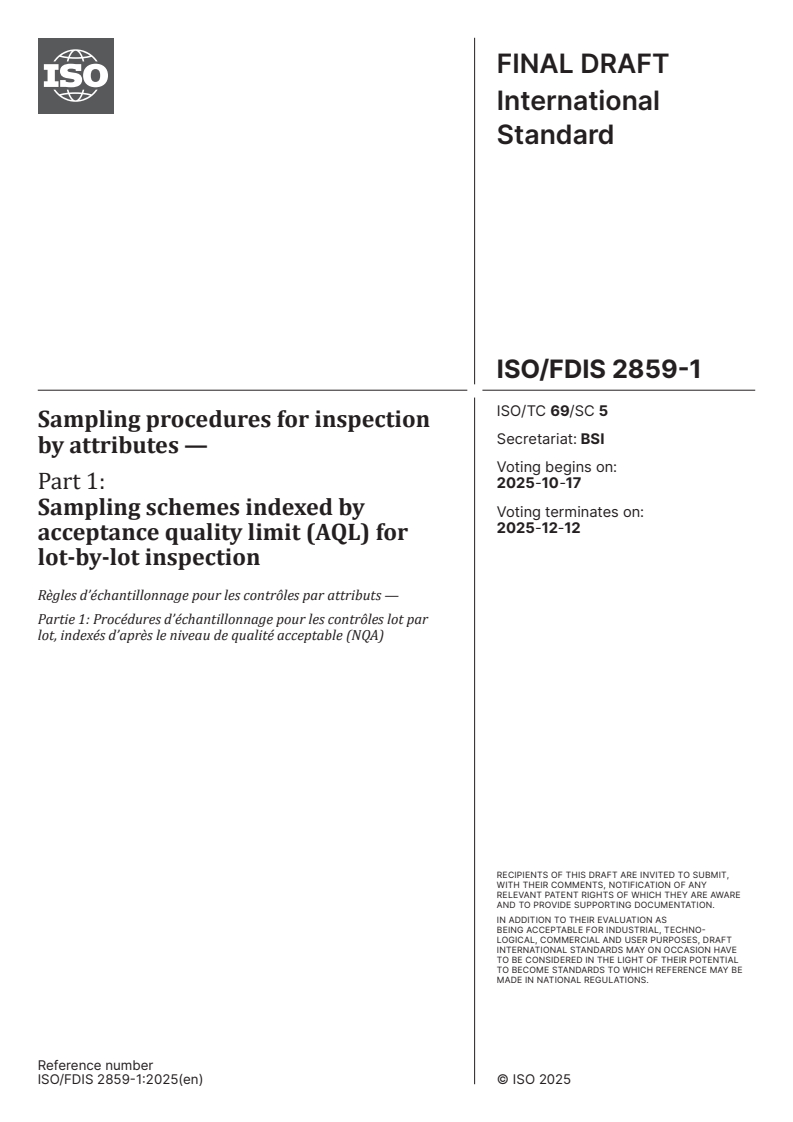
FINAL DRAFT
International
Standard
ISO/FDIS 2859-1
ISO/TC 69/SC 5
Sampling procedures for inspection
Secretariat: BSI
by attributes —
Voting begins on:
2025-10-17
Part 1:
Sampling schemes indexed by
Voting terminates on:
2025-12-12
acceptance quality limit (AQL) for
lot-by-lot inspection
Règles d’échantillonnage pour les contrôles par attributs —
Partie 1: Procédures d’échantillonnage pour les contrôles lot par
lot, indexés d’après le niveau de qualité acceptable (NQA)
RECIPIENTS OF THIS DRAFT ARE INVITED TO SUBMIT,
WITH THEIR COMMENTS, NOTIFICATION OF ANY
RELEVANT PATENT RIGHTS OF WHICH THEY ARE AWARE
AND TO PROVIDE SUPPOR TING DOCUMENTATION.
IN ADDITION TO THEIR EVALUATION AS
BEING ACCEPTABLE FOR INDUSTRIAL, TECHNO-
LOGICAL, COMMERCIAL AND USER PURPOSES, DRAFT
INTERNATIONAL STANDARDS MAY ON OCCASION HAVE
TO BE CONSIDERED IN THE LIGHT OF THEIR POTENTIAL
TO BECOME STAN DARDS TO WHICH REFERENCE MAY BE
MADE IN NATIONAL REGULATIONS.
Reference number
ISO/FDIS 2859-1:2025(en) © ISO 2025
FINAL DRAFT
ISO/FDIS 2859-1:2025(en)
International
Standard
ISO/FDIS 2859-1
ISO/TC 69/SC 5
Sampling procedures for inspection
Secretariat: BSI
by attributes —
Voting begins on:
Part 1:
Sampling schemes indexed by
Voting terminates on:
acceptance quality limit (AQL) for
lot-by-lot inspection
Règles d’échantillonnage pour les contrôles par attributs —
Partie 1: Procédures d’échantillonnage pour les contrôles lot par
lot, indexés d’après le niveau de qualité acceptable (NQA)
RECIPIENTS OF THIS DRAFT ARE INVITED TO SUBMIT,
WITH THEIR COMMENTS, NOTIFICATION OF ANY
RELEVANT PATENT RIGHTS OF WHICH THEY ARE AWARE
AND TO PROVIDE SUPPOR TING DOCUMENTATION.
© ISO 2025
IN ADDITION TO THEIR EVALUATION AS
All rights reserved. Unless otherwise specified, or required in the context of its implementation, no part of this publication may
BEING ACCEPTABLE FOR INDUSTRIAL, TECHNO-
LOGICAL, COMMERCIAL AND USER PURPOSES, DRAFT
be reproduced or utilized otherwise in any form or by any means, electronic or mechanical, including photocopying, or posting on
INTERNATIONAL STANDARDS MAY ON OCCASION HAVE
the internet or an intranet, without prior written permission. Permission can be requested from either ISO at the address below
TO BE CONSIDERED IN THE LIGHT OF THEIR POTENTIAL
or ISO’s member body in the country of the requester.
TO BECOME STAN DARDS TO WHICH REFERENCE MAY BE
MADE IN NATIONAL REGULATIONS.
ISO copyright office
CP 401 • Ch. de Blandonnet 8
CH-1214 Vernier, Geneva
Phone: +41 22 749 01 11
Email: copyright@iso.org
Website: www.iso.org
Published in Switzerland Reference number
ISO/FDIS 2859-1:2025(en) © ISO 2025
ii
ISO/FDIS 2859-1:2025(en)
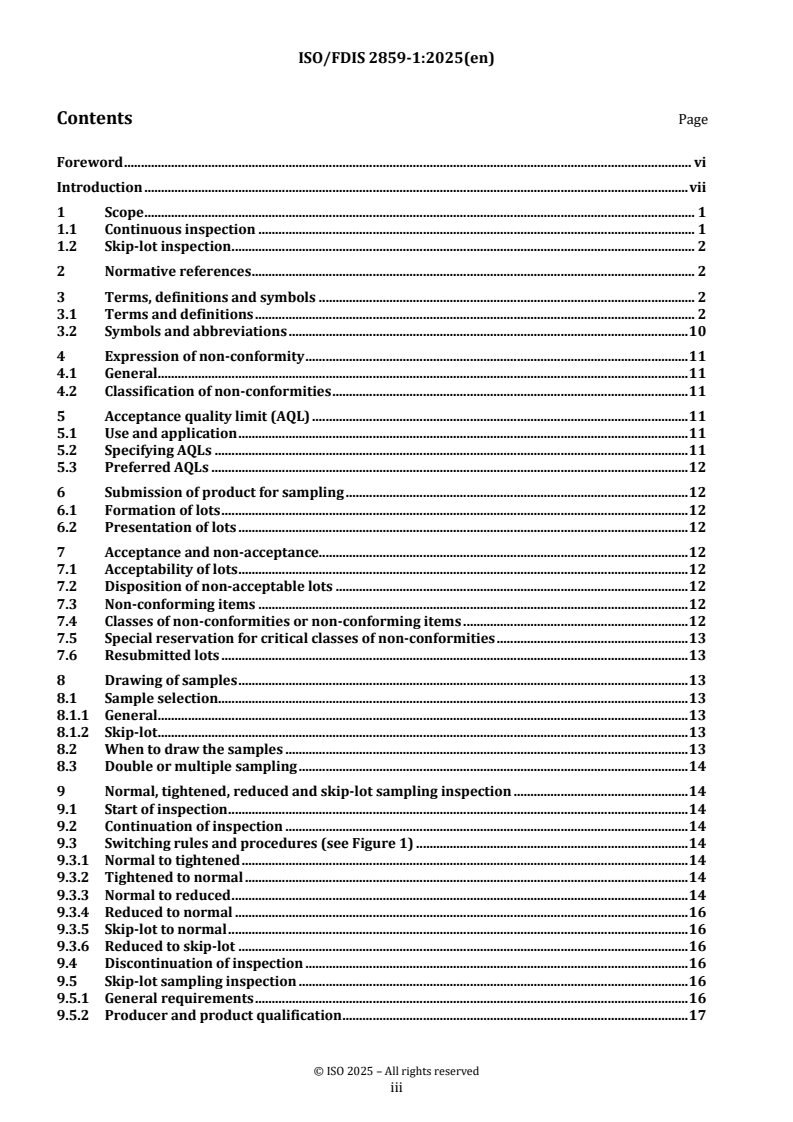
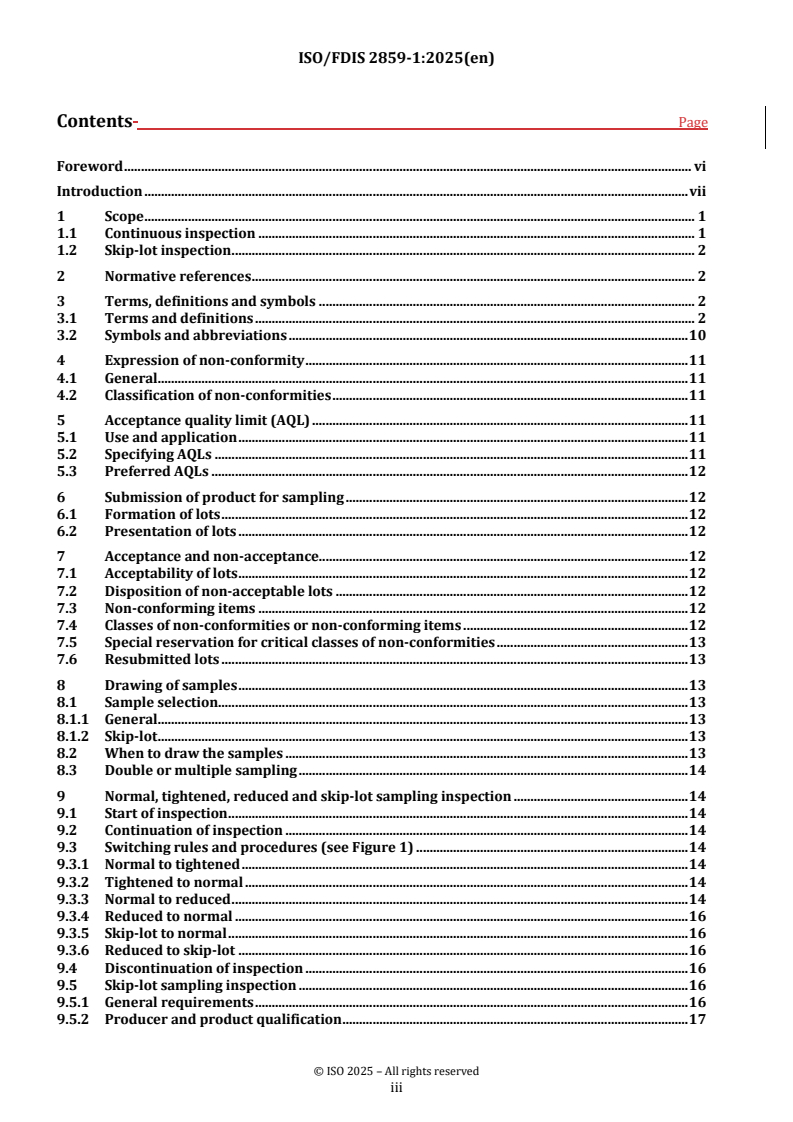
Contents Page
Foreword . vi
Introduction . vii
1 Scope . 1
1.1 Continuous inspection . 1
1.2 Skip-lot inspection . 2
2 Normative references . 2
3 Terms, definitions and symbols . 2
3.1 Terms and definitions . 2
3.2 Symbols and abbreviations . 10
4 Expression of non-conformity . 11
4.1 General. 11
4.2 Classification of non-conformities . 11
5 Acceptance quality limit (AQL) . 11
5.1 Use and application . 11
5.2 Specifying AQLs . 11
5.3 Preferred AQLs . 12
6 Submission of product for sampling . 12
6.1 Formation of lots . 12
6.2 Presentation of lots . 12
7 Acceptance and non-acceptance. 12
7.1 Acceptability of lots . 12
7.2 Disposition of non-acceptable lots . 12
7.3 Non-conforming items . 12
7.4 Classes of non-conformities or non-conforming items . 12
7.5 Special reservation for critical classes of non-conformities . 13
7.6 Resubmitted lots . 13
8 Drawing of samples . 13
8.1 Sample selection. 13
8.1.1 General. 13
8.1.2 Skip-lot . 13
8.2 When to draw the samples . 13
8.3 Double or multiple sampling . 14
9 Normal, tightened, reduced and skip-lot sampling inspection . 14
9.1 Start of inspection . 14
9.2 Continuation of inspection . 14
9.3 Switching rules and procedures (see Figure 1) . 14
9.3.1 Normal to tightened . 14
9.3.2 Tightened to normal . 14
9.3.3 Normal to reduced . 14
9.3.4 Reduced to normal . 16
9.3.5 Skip-lot to normal . 16
9.3.6 Reduced to skip-lot . 16
9.4 Discontinuation of inspection . 16
9.5 Skip-lot sampling inspection . 16
9.5.1 General requirements . 16
9.5.2 Producer and product qualification . 17
iii
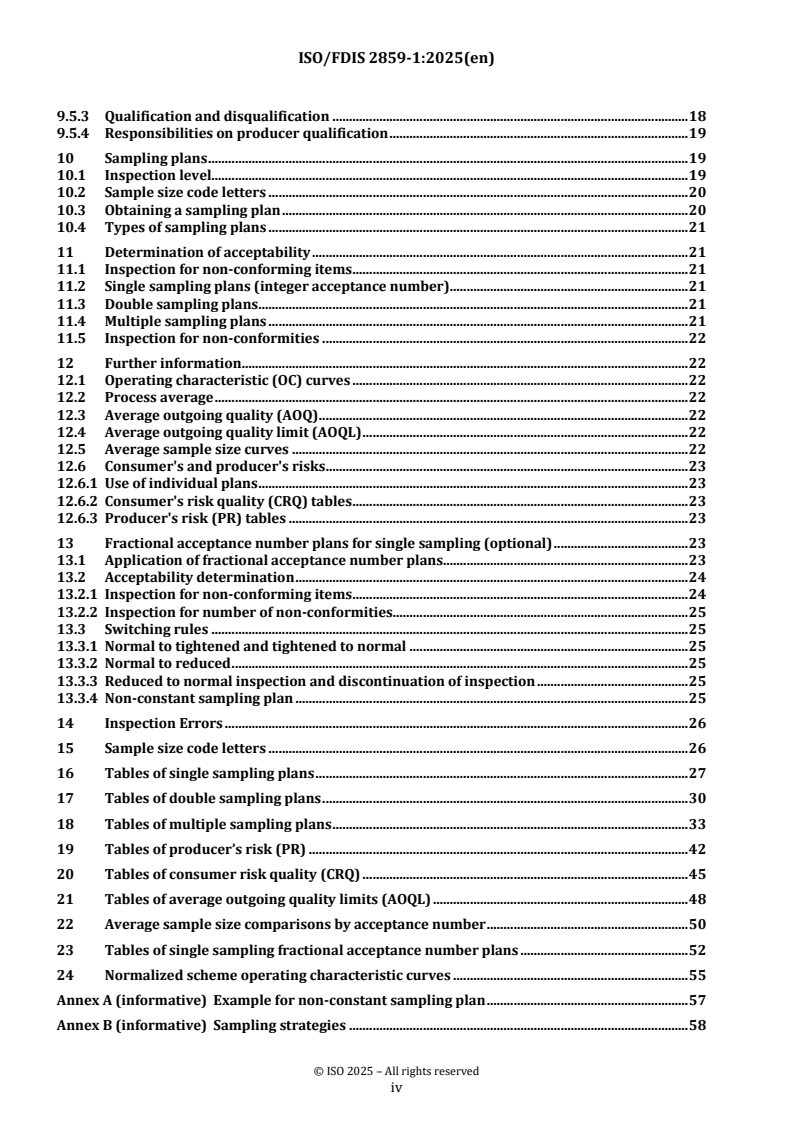
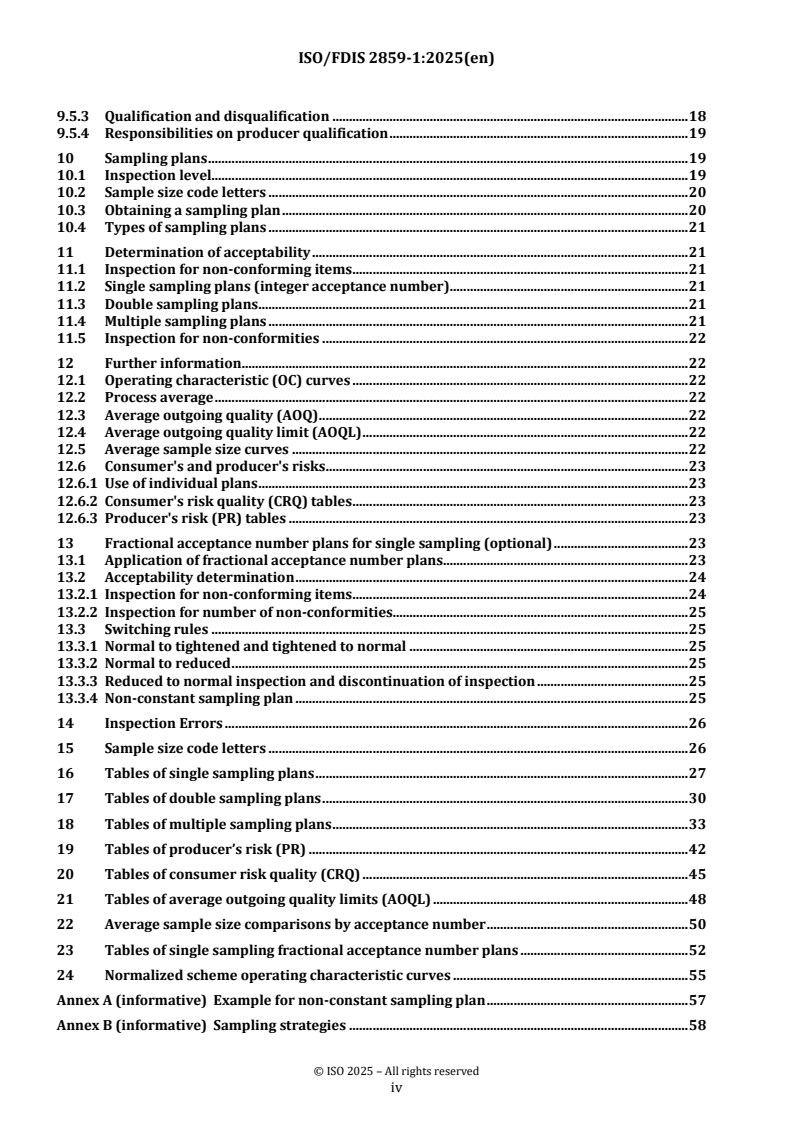
ISO/FDIS 2859-1:2025(en)
9.5.3 Qualification and disqualification . 18
9.5.4 Responsibilities on producer qualification . 19
10 Sampling plans . 19
10.1 Inspection level. 19
10.2 Sample size code letters . 20
10.3 Obtaining a sampling plan . 20
10.4 Types of sampling plans . 21
11 Determination of acceptability . 21
11.1 Inspection for non-conforming items . 21
11.2 Single sampling plans (integer acceptance number). 21
11.3 Double sampling plans . 21
11.4 Multiple sampling plans . 21
11.5 Inspection for non-conformities . 22
12 Further information . 22
12.1 Operating characteristic (OC) curves . 22
12.2 Process average . 22
12.3 Average outgoing quality (AOQ) . 22
12.4 Average outgoing quality limit (AOQL) . 22
12.5 Average sample size curves . 22
12.6 Consumer's and producer's risks. 23
12.6.1 Use of individual plans . 23
12.6.2 Consumer's risk quality (CRQ) tables . 23
12.6.3 Producer's risk (PR) tables . 23
13 Fractional acceptance number plans for single sampling (optional) . 23
13.1 Application of fractional acceptance number plans . 23
13.2 Acceptability determination . 24
13.2.1 Inspection for non-conforming items . 24
13.2.2 Inspection for number of non-conformities. 25
13.3 Switching rules . 25
13.3.1 Normal to tightened and tightened to normal . 25
13.3.2 Normal to reduced . 25
13.3.3 Reduced to normal inspection and discontinuation of inspection . 25
13.3.4 Non-constant sampling plan . 25
14 Inspection Errors . 26
15 Sample size code letters . 26
16 Tables of single sampling plans . 27
17 Tables of double sampling plans . 30
18 Tables of multiple sampling plans . 33
19 Tables of producer’s risk (PR) . 42
20 Tables of consumer risk quality (CRQ) . 45
21 Tables of average outgoing quality limits (AOQL) . 48
22 Average sample size comparisons by acceptance number . 50
23 Tables of single sampling fractional acceptance number plans . 52
24 Normalized scheme operating characteristic curves . 55
Annex A (informative) Example for non-constant sampling plan . 57
Annex B (informative) Sampling strategies . 58
iv
ISO/FDIS 2859-1:2025(en)
Annex C (normative) Procedures for random selection at the skip-lot sampling inspection
frequency . 60
Annex D (informative) Skip-lot sampling inspection. 61
Annex E (informative) The construction of operating characteristic (OC) and average sample
number (ASN) curves . 66
Annex F (informative) The Construction of Sampling Plans . 77
Bibliography . 81
v
ISO/FDIS 2859-1:2025(en)
Foreword
ISO (the International Organization for Standardization) is a worldwide federation of national standards
bodies (ISO member bodies). The work of preparing International Standards is normally carried out through
ISO technical committees. Each member body interested in a subject for which a technical committee has been
established has the right to be represented on that committee. International organizations, governmental and
non-governmental, in liaison with ISO, also take part in the work. ISO collaborates closely with the
International Electrotechnical Commission (IEC) on all matters of electrotechnical standardization.
The procedures used to develop this document and those intended for its further maintenance are described
in the ISO/IEC Directives, Part 1. In particular, the different approval criteria needed for the different types of
ISO document should be noted. This document was drafted in accordance with the editorial rules of the
ISO/IEC Directives, Part 2 (see www.iso.org/directives).
ISO draws attention to the possibility that the implementation of this document may involve the use of (a)
patent(s). ISO takes no position concerning the evidence, validity or applicability of any claimed patent rights
in respect thereof. As of the date of publication of this document, ISO had not received notice of (a) patent(s)
which may be required to implement this document. However, implementers are cautioned that this may not
represent the latest information, which may be obtained from the patent database available at
www.iso.org/patents. ISO shall not be held responsible for identifying any or all such patent rights.
Any trade name used in this document is information given for the convenience of users and does not
constitute an endorsement.
For an explanation of the voluntary nature of standards, the meaning of ISO specific terms and expressions
related to conformity assessment, as well as information about ISO's adherence to the World Trade
Organization (WTO) principles in the Technical Barriers to Trade (TBT), see www.iso.org/iso/foreword.html.
This document was prepared by Technical Committee ISO/TC 69, Applications of statistical methods,
Subcommittee SC 5, Acceptance sampling.
This third edition cancels and replaces the second edition (ISO 2859-1:1999), which has been
technically revised. It also incorporates ISO 2859-1:1999/Amd.1:2011 and ISO 2859-1:1999/Cor.1:2001.
The main changes are as follows:
— a new procedure for switching from normal (or reduced inspection) to skip-lot sampling inspection has
been added;
— guidance on the requirements for producer and product qualification for skip-lot sampling inspection has
been added;
— guidance on the efficacy of implementing skip-lot sampling inspection and some methods of randomly
selecting lots to inspect or skip has been added;
— the operating characteristic (OC) curves for each plan have been removed in favour of sharing methods
to create an individual plan's OC curve and Average Sample Number (ASN) curve, both of which are now
included in Annex E.
It is highly recommended that this document be used together with ISO 2859-0:1995, which contains
illustrative examples.
A list of all parts in the ISO 2859 series can be found on the ISO website.
Any feedback or questions on this document should be directed to the user’s national standards body. A
complete listing of these bodies can be found at www.iso.org/members.html.
vi
ISO/FDIS 2859-1:2025(en)
Introduction
The objectives of the methods laid down in this document are to ensure that lots of acceptable quality have a
high probability of acceptance and that the probability of not accepting inferior lots is as high as practicable.
This is achieved by means of the switching rules which control the change from the initial normal inspection
to tightened or reduced inspection and which provide the following:
a) An automatic protection to the consumer (by means of a switch to tightened inspection or discontinuation
of sampling inspection) if a deterioration in quality (i.e. an increase in non-conformities) be detected.
b) An incentive (at the discretion of the responsible authority) to reduce inspection costs (either by means
of a switch to a smaller sample size and/or to skip the inspection of randomly chosen lots) if consistently
good quality be achieved.
In this document, the acceptance of a lot is implicitly determined from an estimate of the percentage of non-
conforming items, or non-conformities per 100 items, in the process, based on a random sample of items from
the lot.
This document is intended for application to a continuing series of lots of discrete products all supplied by one
producer using one production process. If there are different producers or production processes, this
document is applied to each one separately.
This document is intended for application to a single quality characteristic by either counting the number of
non-conforming items in the sample (binomial distribution) or counting the number of non-conformities in a
sample (Poisson distribution).
The choice of the most suitable attributes plan requires experience, judgement, and some knowledge of both
statistics and the product to be inspected. Clause 5 of this document is intended to help those responsible for
specifying sampling plans in making this choice.
The basic definitions and notations are provided in Clause 3 and Clause 4. The operational rules are contained
in Clause 5 through Clause 11. Clause 12 provides further information on the monitoring of inspection results
and the underlying process. Clause 13 provides information on the application of fractional acceptance
number plans. The purpose of these plans is to provide a consistent progression from plans with acceptance
number zero and plans with acceptance number one. All the tables needed for the sampling procedures can
be found in Clause 15.
Five annexes are provided. Annex A is for information only and illustrates an example where the sampling
plan applied is non-constant. Annex B shows five different sampling strategies. Annex C specifies the
procedures for random selection at the skip-lot frequency. Annex D provides a comparison between skip-lot
and continuous sampling inspection in terms of average number of inspections, the producer’s and the
consumer’s risks. Annex E details the construction of the operating characteristic (OC) and average sample
Number curves.
vii
DRAFT International Standard ISO/FDIS 2859-1:2025(en)
Sampling procedures for inspection by attributes —
Part 1:
Sampling schemes indexed by acceptance quality limit (AQL) for lot-
by-lot inspection
1 Scope
This document specifies an acceptance sampling system of single, double, and multiple sampling plans for
inspection by attributes. This document specifies sampling schemes indexed by acceptance quality limit (AQL)
for inspection by attributes.
Its purpose is to incentivize the producer through the economic and psychological pressure of lot non-
acceptance to maintain a process average at least as good as the specified acceptance quality limit, while at
the same time providing an upper limit for the risk to the consumer of accepting the occasional poor lot.
Sampling schemes designated in this document are applicable, but not limited, to inspection of
— items, such as complete products, sub-assemblies or individual components,
— operations,
— materials in process,
— supplies in storage,
— maintenance operations,
— data or records, and
— administrative procedures.
1.1 Continuous inspection
These schemes are intended to be used for a continuing series of lots, that is, a series long enough to allow the
switching rules (9.3) to be applied. These rules provide:
a) a protection to the consumer (by means of a switch to tightened inspection or discontinuation of sampling
inspection) if a deterioration in quality be detected.
b) an incentive (at the discretion of the responsible authority) to reduce inspection costs (by means of a
switch to reduced inspection or the adoption of skip-lot sampling inspection (see 1.2)) if consistently good
quality be achieved.
ISO/FDIS 2859-1:2025(en)
1.2 Skip-lot inspection
This document also specifies optional skip-lot sampling inspection procedures (see 9.5) for acceptance
inspection by attributes. The purpose of these procedures is to provide a way of reducing the inspection effort
on products of high quality submitted by a producer who has a satisfactory quality assurance system and
effective quality controls. The reduction in inspection effort is achieved by determining at random, with a
specified probability, whether a lot presented for inspection will be accepted without inspection. This
procedure extends the principle of the random selection of sample items already applied in this document to
the random selection of lots. The skip-lot sampling inspection procedures specified in this document are
applicable to, but not limited to, inspection of the items detailed in 1.1.
2 Normative references
The following documents are referred to in the text in such a way that some or all of their content constitutes
requirements of this document. For dated references, only the edition cited applies. For undated references,
the latest edition of the referenced document (including any amendments) applies.
ISO 3534-1, Statistics — Vocabulary and symbols — Part 1: General statistical terms and terms used in
probability
ISO 3534-2, Statistics — Vocabulary and symbols — Part 2: Applied statistics
ISO 24153, Random sampling and randomization procedures
3 Terms, definitions and symbols
3.1 Terms and definitions
For the purposes of this document, the terms and definitions given in ISO 3534-1 and ISO 3534-2, and the
following apply.
NOTE For ease of reference, the definitions of some of these terms are quoted from ISO 3534-1 and ISO 3534-2, while
others are redefined or newly defined.
3.1.1
acceptance quality limit
AQL
worst tolerable quality level (3.1.29)
Note 1 to entry: This concept only applies when a sampling scheme with rules for switching and for discontinuation, such
as in ISO 2859-1 or ISO 3951, is used.
Note 2 to entry: Although individual lots with quality as bad as the acceptance quality limit may be accepted with fairly
high probability, the designation of an acceptance quality limit does not suggest that this is a desirable quality level.
Note 3 to entry: Sampling schemes found in International Standards such as this part of ISO 2859 with their rules for
switching and for discontinuation of sampling inspection, are designed to encourage producers to have process averages
consistently better than the AQL. If producers fail to do so, there is a high probability of being switched from normal
inspection to tightened inspection where lot acceptance becomes more difficult. Once on tightened inspection, unless
action is taken to improve the process, it is very likely that the rule requiring discontinuation of sampling inspection
pending such improvement will be invoked.
[SOURCE: ISO 3534-2:2006, 4.6.15, modified — Original Note 4 to entry removed.]
ISO/FDIS 2859-1:2025(en)
3.1.2
acceptance score
indicator that is used for fractional acceptance number plans to determine lot acceptability
Note 1 to entry: See Section 13.2.1.2.
3.1.3
average outgoing quality
AOQ
expected average quality level (3.1.29) of outgoing product for a given value of incoming product quality
Note 1 to entry: Unless otherwise specified, the average outgoing quality is calculated over all accepted lots plus all non-
accepted lots after the latter have been inspected 100 % and the non-conforming items replaced by conforming items.
Note 2 to entry: The approximation used here is: “Average outgoing quality = incoming process quality × probability of
acceptance”. This formula is exact for accept-zero plans and overestimates otherwise.
[SOURCE: ISO 3534-2:2006, 4.7.1, modified —The original Note 2 to entry removed and Note 3 renumbered.]
3.1.4
average outgoing quality limit
AOQL
maximum value that AOQ (3.1.3) can be, over all possible values of incoming product quality which might be
submitted, for a given acceptance sampling plan, and with rectification of all non-accepted lots unless specified
otherwise
Note 1 to entry: It represents the maximum long run percentage non-conforming that the consumer can see under these
circumstances.
[SOURCE: ISO 3534-2:2006, 4.7.2, modified — Maximum long run percentage added.]
3.1.5
average sample number
ASN
average number of units in sample (3.1.32) inspected per lot (3.1.15) in reaching decisions to accept or not to
accept when using a given acceptance sampling plan (3.1.34)
Note 1 to entry: ASN is dependent on the actual quality level of the submitted lots.
[SOURCE: ISO 3534-2:2006, 4.7.3, modified — Average sample number (ASN) is the preferred term and
equivalent to the admitted term average sample size (ASSI) in the source.]
3.1.6
consumer
user or buyer as appropriate
Note 1 to entry: The consumer and the producer may even be different departments of the same company.
Note 2 to entry: See also producer (3.1.26).
3.1.7
consumer's risk quality
CRQ
lot or process quality level (3.1.29) that in the sampling plan corresponds to a specified consumer's risk
ISO/FDIS 2859-1:2025(en)
Note 1 to entry: Consumer's risk is usually 10 %.
Note 2 to entry: See also limiting quality, LQ (3.1.14)
3.1.8
defect
non-fulfilment of a requirement related to an intended or specified use
Note 1 to entry: The distinction between the concepts defect and non-conformity (3.1.20) is important as it has legal
connotations, particularly those associated with product liability issues. Consequently, the term “defect” should be used
with extreme caution.
[SOURCE: ISO 3534-2:2006, 3.1.12, modified — Note 2 to entry removed.]
3.1.9
disqualification
failure to qualify for skip-lot sampling inspection (3.1.37)
3.1.10
inspection
activity such as measuring, examining, testing, or gauging one or more characteristics of a product or service,
and comparing the results with specified requirements in order to establish whether conformity is achieved
for each characteristic
[SOURCE ISO 3534-2:2006, 4.1.2, modified — "judgement" has been changed to "comparing results with
required specification". The definition here includes the notion of establishing conformity on one or more
characteristics.]
3.1.11
inspection by attributes
inspection whereby the presence or absence of one or more specified characteristics of each item in a sample
(3.1.32) is observed to establish statistically the acceptability of a lot (3.1.15) or process
Note 1 to entry: Inspection by attributes includes inspection for conformity of items as well as inspection for number of
non-conformities per hundred items.
[SOURCE: ISO 3534-2:2006, 4.2.12, acceptance sampling by attributes, modified — Term, note 1 to entry
added.]
3.1.12
interruption
cessation of skip-lot sampling inspection (3.1.37) ending with a return to continuous inspection
3.1.13
item
anything that can be described and considered separately
EXAMPLE
— a physical item;
— a defined amount of bulk material;
— a service, activity or process;
— an organization, system, person;
— some combination thereof.
ISO/FDIS 2859-1:2025(en)
Note 1 to entry: Object is a deprecated term.
[SOURCE: ISO 3534-2:2006, 1.2.11, modified — "process" and "organisation" added. Note 1 to entry removed
and Note 2 renumbered.]
3.1.14
limiting quality
LQ
quality level (3.1.29) which is the limit of an unsatisfactory process average when a continuing series of lots
is considered
Note 1 to entry: when a lot is considered in isolation, a quality level which for the purposes of sampling inspection has a
low probability of acceptance
Note 2 to entry: See also consumer’s risk quality, CRQ (3.1.7)
[SOURCE: ISO 3534-2:2006, 4.6.14, limiting quality level, modified — Term, notes 1 and 2 to entry added.]
3.1.15
lot
definite amount of some product, material or service, constituted under essentially the same conditions, and
collected together
Note 1 to entry: This definition differs from that in ISO 3534-2:2006, 1.2.4.
Note 2 to entry: An inspection lot may consist of several batches or parts of batches.
3.1.16
lot size
number of items in a lot
3.1.17
non-conforming item
item (3.1.12) with one or more non-conformities
Note 1 to entry: See notes to non-conformity (3.1.20)
[SOURCE: ISO 3534-2:2006, 1.2.12, modified — Note 1 to entry added.]
3.1.18
non-conformities per 100 items in a sample
one hundred times the number of non-conformities (3.1.20) in the sample divided by the sample size, viz:
d
n
where
d is the number of non-conformities in the sample;
n is the sample size.
ISO/FDIS 2859-1:2025(en)
3.1.19
non-conformities per 100 items in a population or lot
one hundred times the number of non-conformities (3.1.20) in the population or lot divided by the population
or lot size, viz:
D
100p= 100
N
where
p is the number of non-conformities per item;
D is the number of non-conformities in the population or lot;
N is the population or lot size.
Note 1 to entry: An item may contain one or more non-conformities.
3.1.20
non-conformity
non-fulfilment of a requirement
Note 1 to entry: See notes to defect (3.1.8).
Note 2 to entry: Non-conformity will generally be classified according to its degree of seriousness such as:
— Class A: those non-conformities of a type considered to be of the highest concern; in acceptance sampling such types
of non-conformities will be assigned a very small acceptance quality limit value.
— Class B: those non-conformities of a type considered to have the next lower degree of concern; therefore, these can
be assigned a larger acceptance quality limit value than those in class A and smaller than in class C, if a third class
exists, etc.
Note 3 to entry: Adding characteristics and classes of non-conformities will generally affect the overall probability of
acceptance of the product.
Note 4 to entry: The number of classes, the assignment into a class, and the choice of acceptance quality limit for each
class, shall be appropriate to the quality requirements of the specific situation.
[SOURCE: ISO 3534-2:2006, 3.1.11, modified — Notes 2, 3, and 4 added.]
3.1.21
normal inspection
inspection level which is used when there is no reason to suspect that the process average (3.1.25) differs from
an acceptable level.
Note 1 to entry: inspection using a sampling plan (3.1.34) with an acceptance criterion that has been devised to secure
the producer a high probability of acceptance when the process average (3.1.25) of the lot is better than the acceptance
quality limit (3.1.1).
Note 2 to entry: This definition differs from that in ISO 3534-2:2006, 4.1.10.
3.1.22
original inspection
inspection (3.1.10) of a lot (3.1.15), or other amount, not previously inspected
ISO/FDIS 2859-1:2025(en)
Note 1 to entry: This is in contrast, for example, to inspection of a lot which has previously been designated as not
acceptable and which is submitted again for inspection after having been further sorted, reprocessed, etc.
[SOURCE: ISO 3534-2:2006, 4.1.16]
3.1.23
percent non -conforming in a sample
one hundred times the number of non-conforming items (3.1.17) in the sample divided by the sample size, viz:
d
100
n
where
d is the number of non-conforming items in the sample;
n is the sample size.
3.1.24
percent non-conforming in a population or lot
one hundred times the number of non-conforming items (3.1.17) in the population or lot divided by the
population or lot size, viz:
D
100p= 100
N
where
p is the proportion of non-conforming items;
D is the number of non-conforming items in the population or lot;
N is the population or lot size.
Note 1 to entry: In this document the terms percent non-conforming (3.1.23) in a sample and percent non-conforming
(3.1.23) in a population or lot or non-conformities per 100 items in a sample (3.1.18) and non-conformities per 100 items
in a population or lot (3.1.19) are mainly used in place of the theoretical terms "proportion of non-conforming items" and
"non-conformities per item" because the former terms are the most widely used.
3.1.25
process average
quality level (3.1.29) during a period when the process is in a state of statistical control
3.1.26
producer
seller, supplier, vendor, manufacturer or producer as appropriate for the situation
Note 1 to entry: The producer and the consumer may even be different departments in the same company.
Note 2 to entry: The producer is important in this part of the ISO 2859 standard as it depends on the operation of the
switching rules in response to changes in quality level. Only the producer is in a position to do this. Although Sellers and
vendors may also change quality through screening lots from the manufacturer.
Note 3 to entry: See also consumer (3.1.6).
ISO/FDIS 2859-1:2025(en)
3.1.27
producer’s risk
PR
probability of nonacceptance when the quality level (3.1.29) has a value stated by the plan as acceptable
Note 1 to entry: Quality level could relate to fraction non-conforming and be acceptable to AQL.
Note 2 to entry: Interpretation of the producer’s risk requires knowledge of the stated quality level.
[SOURCE: ISO 3534-2:2006, 4.6.4.]
3.1.28
product qualification
assessment of the product to determine its suitability for skip-lot sampling inspection (3.1.37)
3.1.29
quality level
quality expressed as a percentage of non-conforming items (3.1.24) or number of non-conformities per 100
items in the lot (3.1.19)
[SOURCE: ISO 3534-2:2006, 4.6.16, modified — for non-conforming items, rate is replaced with percentage
and for non-conformities, rate of , is deleted and, per 100 items, added.]
3.1.30
reduced inspection
inspection less severe than normal inspection (3.1.21) to which the latter is switched when inspection results
of a predetermined number of lots indicate that the quality level (3.1.29) achieved by the process is better
than that specified
Note 1 to entry: Reduced inspection may be invoked when the inspection results of a predetermined number of
consecutive lots indicate that the process average (3.1.25)is better than the AQL (3.1.1).
[SOURCE: ISO 3534-2:2006, 4.1.11, modified — Notes 1 to entry added.]
3.1.31
responsible authority
person(s) or organization who has the responsibility and authority to manage implementation of sampling
procedures as per this document.
Note 1 to entry: The responsible authority may be
a) the producer (3.1.26),
b) the consumer (3.1.6),
c) an independent verification or certification authority, and
d) any of a), b) or c), differing according to function (see Note 2) as described in a written agreement between two of
the parties, for example a document between producer and consumer.
Note 2 to entry: this term is used to maintain the neutrality of this document (primarily for specification purposes),
irrespective of which party is invoking or applying it.
Note 3 to entry: The duties and functions of a responsible authority are outlined in this document (see 5.2, 6.2, 7.2, 7.3,
7.5, 7.6, 9.1, 9.3.3, 9.4, 9.5, 10.1, 10.3, 13.1).
ISO/FDIS 2859-1:2025(en)
3.1.32
sample
set of one or more items taken from a lot and intended to provide information on the lot
Note 1 to entry: This definition differs from that in ISO 3534-2:2006, 1.2.17.
3.1.33
sample size
number of items in the sample
Note 1 to entry: This definition differs from that in ISO 3534-2:2006, 1.2.26.
3.1.34
sampling plan
plan which states the sample size(s) to be used and the associated criteria for lot acceptance
Note 1 to entry: A single sampling plan is a combination of sample size and acceptance and rejection numbers. Double
and multiple sampling plans are a combination of two or more sample sizes and associated acceptance and rejection
numbers for the first sample and for subsequent combined samples.
Note 2 to entry: A sampling plan does not contain the rules on how to draw the sample.
Note 3 to entry: For the purposes of this document, a distinction should be made between the terms sampling plan
(3.1.34) sampling scheme (3.1.35) and sampling system (3.1.36).
[SOURCE: ISO 3534-2:2006, 4.3.3, acceptance sampling plan, modified — Term, notes 1, 2 and 3 to entry
added.]
3.1.35
sampling scheme
combination of sampling plans with switching rules for changing from one plan to another
Note 1 to entry: See Section 9.3.
[SOURCE: ISO 3534-2:2006, 4.3.2. acceptance sampling scheme, modified — Term.]
3.1.36
sampling system
collection of sampling plans, or of sampling schemes, each with its own rules for changing plans, together with
sampling procedures including criteria by which appropriate plans or schemes may be chosen
Note 1 to entry: This document is a sampling system indexed by lot-size ranges, inspection levels and AQLs. A sampling
system for LQ plans is given in ISO 2859-2.
Note 2 to entry: This definition differs from that in ISO 3534-2:2006, 5.4.1.
3.1.37
skip-lot sampling inspection
inspection in which some lots in a series are accepted without inspection, when the sampling results for
10 immediately preceding lots meet the stated criteria
Note 1 to entry: The lots to be inspected are chosen randomly in accordance with the skip-lot inspection frequency of
2 in 5.
[SOURCE: ISO 3534-2:2006, 4.2.5, modified — "a stated number of" changed to 10 and Note 1 to entry added.]
©
...
ISO/FDIS 2859-1:2025(en)
ISO/TC 69/SC 5
Secretariat: BSI
Date:
2025-07-28xx
Sampling procedures for inspection by attributes —
Part 1: Sampling schemes indexed by acceptance quality limit (AQL) for lot-by-lot inspection
Règles d'échantillonnage pour les contrôles par attributs —
Partie 1: Procédures d'échantillonnage pour les contrôles lot par lot, indexés d'après le niveau de
qualité acceptable (NQA)
ISO/FDIS 2859-1:2025(en)
All rights reserved. Unless otherwise specified, or required in the context of its implementation, no part of this
publication may be reproduced or utilized otherwise in any form or by any means, electronic or mechanical,
including photocopying, or posting on the internet or an intranet, without prior written permission.
Permission can be requested from either ISO at the address below or ISO’s member body in the country of the
requester.
ISO copyright office
CP 401 • Ch. de Blandonnet 8
CH-1214 Vernier, Geneva
Phone: + 41 22 749 01 11
E-mail: copyright@iso.org
Website: www.iso.org
Published in Switzerland
ii
ISO/FDIS 2859-1:2025(en)
Contents Page
Foreword . vi
Introduction . vii
1 Scope . 1
1.1 Continuous inspection . 1
1.2 Skip-lot inspection . 2
2 Normative references . 2
3 Terms, definitions and symbols . 2
3.1 Terms and definitions . 2
3.2 Symbols and abbreviations . 10
4 Expression of non-conformity . 11
4.1 General. 11
4.2 Classification of non-conformities . 11
5 Acceptance quality limit (AQL) . 11
5.1 Use and application . 11
5.2 Specifying AQLs . 11
5.3 Preferred AQLs . 12
6 Submission of product for sampling . 12
6.1 Formation of lots . 12
6.2 Presentation of lots . 12
7 Acceptance and non-acceptance. 12
7.1 Acceptability of lots . 12
7.2 Disposition of non-acceptable lots . 12
7.3 Non-conforming items . 12
7.4 Classes of non-conformities or non-conforming items . 12
7.5 Special reservation for critical classes of non-conformities . 13
7.6 Resubmitted lots . 13
8 Drawing of samples . 13
8.1 Sample selection. 13
8.1.1 General. 13
8.1.2 Skip-lot . 13
8.2 When to draw the samples . 13
8.3 Double or multiple sampling . 14
9 Normal, tightened, reduced and skip-lot sampling inspection . 14
9.1 Start of inspection . 14
9.2 Continuation of inspection . 14
9.3 Switching rules and procedures (see Figure 1) . 14
9.3.1 Normal to tightened . 14
9.3.2 Tightened to normal . 14
9.3.3 Normal to reduced . 14
9.3.4 Reduced to normal . 16
9.3.5 Skip-lot to normal . 16
9.3.6 Reduced to skip-lot . 16
9.4 Discontinuation of inspection . 16
9.5 Skip-lot sampling inspection . 16
9.5.1 General requirements . 16
9.5.2 Producer and product qualification . 17
iii
ISO/FDIS 2859-1:2025(en)
9.5.3 Qualification and disqualification . 18
9.5.4 Responsibilities on producer qualification . 19
10 Sampling plans . 19
10.1 Inspection level. 19
10.2 Sample size code letters . 20
10.3 Obtaining a sampling plan . 20
10.4 Types of sampling plans . 21
11 Determination of acceptability . 21
11.1 Inspection for non-conforming items . 21
11.2 Single sampling plans (integer acceptance number). 21
11.3 Double sampling plans . 21
11.4 Multiple sampling plans . 21
11.5 Inspection for non-conformities . 22
12 Further information . 22
12.1 Operating characteristic (OC) curves . 22
12.2 Process average . 22
12.3 Average outgoing quality (AOQ) . 22
12.4 Average outgoing quality limit (AOQL) . 22
12.5 Average sample size curves . 22
12.6 Consumer's and producer's risks. 23
12.6.1 Use of individual plans . 23
12.6.2 Consumer's risk quality (CRQ) tables . 23
12.6.3 Producer's risk (PR) tables . 23
13 Fractional acceptance number plans for single sampling (optional) . 23
13.1 Application of fractional acceptance number plans . 23
13.2 Acceptability determination . 24
13.2.1 Inspection for non-conforming items . 24
13.2.2 Inspection for number of non-conformities. 25
13.3 Switching rules . 25
13.3.1 Normal to tightened and tightened to normal . 25
13.3.2 Normal to reduced . 25
13.3.3 Reduced to normal inspection and discontinuation of inspection . 25
13.3.4 Non-constant sampling plan . 25
14 Inspection Errors . 26
15 Sample size code letters . 26
16 Tables of single sampling plans . 27
17 Tables of double sampling plans . 30
18 Tables of multiple sampling plans . 33
19 Tables of producer’s risk (PR) . 42
20 Tables of consumer risk quality (CRQ) . 45
21 Tables of average outgoing quality limits (AOQL) . 48
22 Average sample size comparisons by acceptance number . 50
23 Tables of single sampling fractional acceptance number plans . 52
24 Normalized scheme operating characteristic curves . 55
Annex A (informative) Example for non-constant sampling plan . 57
Annex B (informative) Sampling strategies . 58
iv
ISO/FDIS 2859-1:2025(en)
Annex C (normative) Procedures for random selection at the skip-lot sampling inspection
frequency . 60
Annex D (informative) Skip-lot sampling inspection. 61
Annex E (informative) The construction of operating characteristic (OC) and average sample
number (ASN) curves . 66
Annex F (informative) The Construction of Sampling Plans . 77
Bibliography . 81
v
ISO/FDIS 2859-1:2025(en)
Foreword
ISO (the International Organization for Standardization) is a worldwide federation of national standards
bodies (ISO member bodies). The work of preparing International Standards is normally carried out through
ISO technical committees. Each member body interested in a subject for which a technical committee has been
established has the right to be represented on that committee. International organizations, governmental and
non-governmental, in liaison with ISO, also take part in the work. ISO collaborates closely with the
International Electrotechnical Commission (IEC) on all matters of electrotechnical standardization.
The procedures used to develop this document and those intended for its further maintenance are described
in the ISO/IEC Directives, Part 1. In particular, the different approval criteria needed for the different types of
ISO document should be noted. This document was drafted in accordance with the editorial rules of the
ISO/IEC Directives, Part 2 (see www.iso.org/directives).
ISO draws attention to the possibility that the implementation of this document may involve the use of (a)
patent(s). ISO takes no position concerning the evidence, validity or applicability of any claimed patent rights
in respect thereof. As of the date of publication of this document, ISO had not received notice of (a) patent(s)
which may be required to implement this document. However, implementers are cautioned that this may not
represent the latest information, which may be obtained from the patent database available at
www.iso.org/patents. ISO shall not be held responsible for identifying any or all such patent rights.
Any trade name used in this document is information given for the convenience of users and does not
constitute an endorsement.
For an explanation of the voluntary nature of standards, the meaning of ISO specific terms and expressions
related to conformity assessment, as well as information about ISO's adherence to the World Trade
Organization (WTO) principles in the Technical Barriers to Trade (TBT), see www.iso.org/iso/foreword.html.
This document was prepared by Technical Committee ISO/TC 69, Applications of statistical methods,
Subcommittee SC 5, Acceptance sampling.
This third edition cancels and replaces the second edition (ISO 2859-1:1999), which has been technically
revised. It also incorporates ISO 2859-1:1999/Amd.1:2011 and ISO 2859-1:1999/Cor.1:2001.
The main changes are as follows:—:
— a new procedure for switching from normal (or reduced inspection) to skip-lot sampling inspection has
been added;
— guidance on the requirements for producer and product qualification for skip-lot sampling inspection has
been added;
— guidance on the efficacy of implementing skip-lot sampling inspection and some methods of randomly
selecting lots to inspect or skip has been added;
— the operating characteristic (OC) curves for each plan have been removed in favour of sharing methods
to create an individual plan's OC curve and Average Sample Number (ASN) curve, both of which are now
included in Annex E.
It is highly recommended that this document be used together with ISO 2859-0:1995, which contains
illustrative examples.
A list of all parts in the ISO 2859 series can be found on the ISO website.
Any feedback or questions on this document should be directed to the user’s national standards body. A
complete listing of these bodies can be found at www.iso.org/members.html.
vi
ISO/FDIS 2859-1:2025(en)
Introduction
The objectives of the methods laid down in this document are to ensure that lots of acceptable quality have a
high probability of acceptance and that the probability of not accepting inferior lots is as high as practicable.
This is achieved by means of the switching rules which control the change from the initial normal inspection
to tightened or reduced inspection and which provide the following:
a) An automatic protection to the consumer (by means of a switch to tightened inspection or discontinuation
of sampling inspection) if a deterioration in quality (i.e. an increase in nonconformitiesnon-conformities)
be detected.
b) An incentive (at the discretion of the responsible authority) to reduce inspection costs (either by means
of a switch to a smaller sample size and/or to skip the inspection of randomly chosen lots) if consistently
good quality be achieved.
In this document, the acceptance of a lot is implicitly determined from an estimate of the percentage of
nonconformingnon-conforming items, or nonconformitiesnon-conformities per 100 items, in the process,
based on a random sample of items from the lot.
This document is intended for application to a continuing series of lots of discrete products all supplied by one
producer using one production process. If there are different producers or production processes, this
document is applied to each one separately.
This document is intended for application to a single quality characteristic by either counting the number of
nonconformingnon-conforming items in the sample (binomial distribution) or counting the number of
nonconformitiesnon-conformities in a sample (Poisson distribution).
The choice of the most suitable attributes plan requires experience, judgement, and some knowledge of both
statistics and the product to be inspected. Clause 5 of this document is intended to help those responsible for
specifying sampling plans in making this choice.
The basic definitions and notations are provided in Clause 3 and Clause 4. The operational rules are contained
in Clause 5 through Clause 11. Clause 12 provides further information on the monitoring of inspection results
and the underlying process. Clause 13 provides information on the application of fractional acceptance
number plans. The purpose of these plans is to provide a consistent progression from plans with acceptance
number zero and plans with acceptance number one. All the tables needed for the sampling procedures can
be found in Clause 15.
Five annexes are provided. Annex A is for information only and illustrates an example where the sampling
plan applied is non-constant. Annex B shows five different sampling strategies. Annex C specifies the
procedures for random selection at the skip-lot frequency. Annex D provides a comparison between skip-lot
and continuous sampling inspection in terms of average number of inspections, the producer’s and the
consumer’s risks. Annex E details the construction of the operating characteristic (OC) and average sample
Number curves.
vii
DRAFT International Standard ISO/FDIS 2859-1:2025(en)
Sampling procedures for inspection by attributes —
Part 1:
Sampling schemes indexed by acceptance quality limit (AQL) for lot-
by-lot inspection
1 Scope
This document specifies an acceptance sampling system of single, double, and multiple sampling plans for
inspection by attributes. This document specifies sampling schemes indexed by acceptance quality limit (AQL)
for inspection by attributes.
Its purpose is to incentivize the producer through the economic and psychological pressure of lot non-
acceptance to maintain a process average at least as good as the specified acceptance quality limit, while at
the same time providing an upper limit for the risk to the consumer of accepting the occasional poor lot.
Sampling schemes designated in this document are applicable, but not limited, to inspection of
— items, such as complete products, sub-assemblies or individual components,
— operations,
— materials in process,
— supplies in storage,
— maintenance operations,
— data or records, and
— administrative procedures.
1.1 Continuous inspection
These schemes are intended to be used for a continuing series of lots, that is, a series long enough to allow the
switching rules (9.3) to be applied. These rules provide:
a) a protection to the consumer (by means of a switch to tightened inspection or discontinuation of sampling
inspection) if a deterioration in quality be detected.
b) an incentive (at the discretion of the responsible authority) to reduce inspection costs (by means of a
switch to reduced inspection or the adoption of skip-lot sampling inspection (see 1.2)) if consistently good
quality be achieved.
ISO/FDIS 2859-1:2025(en)
1.2 Skip-lot inspection
This document also specifies optional skip-lot sampling inspection procedures (see 9.5) for acceptance
inspection by attributes. The purpose of these procedures is to provide a way of reducing the inspection effort
on products of high quality submitted by a producer who has a satisfactory quality assurance system and
effective quality controls. The reduction in inspection effort is achieved by determining at random, with a
specified probability, whether a lot presented for inspection will be accepted without inspection. This
procedure extends the principle of the random selection of sample items already applied in this document to
the random selection of lots. The skip-lot sampling inspection procedures specified in this document are
applicable to, but not limited to, inspection of the items detailed in 1.1.
2 Normative references
The following documents are referred to in the text in such a way that some or all of their content constitutes
requirements of this document. For dated references, only the edition cited applies. For undated references,
the latest edition of the referenced document (including any amendments) applies.
ISO 3534-1:2006, Statistics — Vocabulary and symbols — Part 1: General statistical terms and terms used in
probability
ISO 3534-2:2006, Statistics — Vocabulary and symbols — Part 2: Applied statistics
ISO 24153:2009, Random sampling and randomization procedures
3 Terms, definitions and symbols
3.1 Terms and definitions
For the purposes of this document, the terms and definitions given in ISO 3534-1:2006 and ISO 3534-2:2006,
and the following apply.
NOTE For ease of reference, the definitions of some of these terms are quoted from ISO 3534-1:2006 and ISO 3534-
2:2006, while others are redefined or newly defined.
3.1.1
acceptance quality limit
AQL
worst tolerable quality level (3.1.29)
Note 1 to entry: This concept only applies when a sampling scheme with rules for switching and for discontinuation,
such as in ISO 2859-1 or ISO 3951, is used.
Note 2 to entry: Although individual lots with quality as bad as the acceptance quality limit may be accepted with fairly
high probability, the designation of an acceptance quality limit does not suggest that this is a desirable quality level.
Note 3 to entry: Sampling schemes found in International Standards such as this part of ISO 2859 with their rules for
switching and for discontinuation of sampling inspection, are designed to encourage producers to have process averages
consistently better than the AQL. If producers fail to do so, there is a high probability of being switched from normal
inspection to tightened inspection where lot acceptance becomes more difficult. Once on tightened inspection, unless
action is taken to improve the process, it is very likely that the rule requiring discontinuation of sampling inspection
pending such improvement will be invoked.
ISO/FDIS 2859-1:2025(en)
[SOURCE: ISO 3534-2:2006, 4.6.15, modified –— Original Note 4 to entry removed.]
3.1.2
acceptance score
indicator that is used for fractional acceptance number plans to determine lot acceptability
Note 1 to entry: See: Section 13.2.1.2.
3.1.3
average outgoing quality
AOQ
expected average quality level (3.1.29) of outgoing product for a given value of incoming product quality
Note 1 to entry: Unless otherwise specified, the average outgoing quality is calculated over all accepted lots plus all non-
accepted lots after the latter have been inspected 100 % and the nonconformingnon-conforming items replaced by
conforming items.
Note 2 to entry: The approximation used here is: “Average outgoing quality = incoming process quality × probability of
acceptance”. This formula is exact for accept-zero plans and overestimates otherwise.
[SOURCE: ISO 3534-2:2006, 4.7.1, modified - —The original Note 2 to entry removed and Note 3 renumbered.]
3.1.4
average outgoing quality limit
AOQL
maximum value that AOQ (3.1.3) can be, over all possible values of incoming product quality which might be
submitted, for a given acceptance sampling plan, and with rectification of all non-accepted lots unless specified
otherwise
Note 1 to entry: It represents the maximum long run percentage nonconformingnon-conforming that the consumer can
see under these circumstances.
[SOURCE: ISO 3534-2:2006, 4.7.2, modified –— Maximum long run percentage added.]
3.1.5
average sample number
ASN
average number of units in sample (3.1.32) inspected per lot (3.1.15) in reaching decisions to accept or not to
accept when using a given acceptance sampling plan (3.1.34)
Note 1 to entry: ASN is dependent on the actual quality level of the submitted lots.
[SOURCE: ISO 3534-2:2006, 4.7.3, modified –— Average sample number (ASN) is the preferred term and
equivalent to the admitted term average sample size (ASSI) in the source].]
3.1.6
consumer
user or buyer as appropriate
Note 1 to entry: The consumer and the producer may even be different departments of the same company.
Note 2 to entry: See also producer (3.1.26).
ISO/FDIS 2859-1:2025(en)
3.1.7
consumer's risk quality
CRQ
lot or process quality level (3.1.29) that in the sampling plan corresponds to a specified consumer's risk
Note 1 to entry: Consumer's risk is usually 10 %.
Note 2 to entry: See also limiting quality, LQ (3.1.14)
3.1.8
defect
non-fulfilment of a requirement related to an intended or specified use
Note 1 to entry: The distinction between the concepts defect and nonconformitynon-conformity (3.1.20) is important as
it has legal connotations, particularly those associated with product liability issues. Consequently, the term “defect”
should be used with extreme caution.
[SOURCE: ISO 3534-2:2006, 3.1.12, modified -— Note 2 to entry removed.]
3.1.9
disqualification
failure to qualify for skip-lot sampling inspection (3.1.37)
3.1.10
inspection
activity such as measuring, examining, testing, or gauging one or more characteristics of a product or service,
and comparing the results with specified requirements in order to establish whether conformity is achieved
for each characteristic
[SOURCE ISO 3534-2:2006, 4.1.2, modified -— "judgement" has been changed to "comparing results with
required specification". The definition here includes the notion of establishing conformity on one or more
characteristics.]
3.1.11
inspection by attributes
inspection whereby the presence or absence of one or more specified characteristics of each item in a sample
(3.1.32) is observed to establish statistically the acceptability of a lot (3.1.15) or process
Note 1 to entry: Inspection by attributes includes inspection for conformity of items as well as inspection for number of
nonconformitiesnon-conformities per hundred items.
[SOURCE: ISO 3534-2:2006, 4.2.12, acceptance sampling by attributes, modified -— Term, note 1 to entry
added.]
3.1.12
interruption
cessation of skip-lot sampling inspection (3.1.37) ending with a return to continuous inspection
3.1.13
item
anything that can be described and considered separately
EXAMPLE
— a physical item;
ISO/FDIS 2859-1:2025(en)
— a defined amount of bulk material;
— a service, activity or process;
— an organization, system, person;
— some combination thereof.
Note 1 to entry: Object is a deprecated term.
[SOURCE: ISO 3534-2:2006, 1.2.11, modified -— "process" and "organisation" added. Note 1 to entry removed
and Note 2 renumbered.]
3.1.14
limiting quality
LQ
quality level (3.1.29) which is the limit of an unsatisfactory process average when a continuing series of lots
is considered
Note 1 to entry: when a lot is considered in isolation, a quality level which for the purposes of sampling inspection has a
low probability of acceptance
Note 2 to entry: See also consumer’s risk quality, CRQ (3.1.7)
[SOURCE: ISO 3534-2:2006, 4.6.14, limiting quality level, modified –— Term, notes 1 and 2 to entry added.]
3.1.15
lot
definite amount of some product, material or service, constituted under essentially the same conditions, and
collected together
Note 1 to entry: This definition differs from that in ISO 3534-2:2006, 1.2.4.
Note 2 to entry: An inspection lot may consist of several batches or parts of batches.
3.1.16
lot size
number of items in a lot
3.1.17
nonconformingnon-conforming item
item (3.1.12) with one or more nonconformitiesnon-conformities
Note 1 to entry: See notes to nonconformitynon-conformity (3.1.20)
[SOURCE: ISO 3534-2:2006, 1.2.12, modified -— Note 1 to entry added.]
ISO/FDIS 2859-1:2025(en)
3.1.18
nonconformitiesnon-conformities per 100 items in a sample
one hundred times the number of nonconformitiesnon-conformities (3.1.20) in the sample divided by the
sample size, viz:
d
n
where:
— d is the number of nonconformitiesnon-conformities in the sample;
— n is the sample size.
3.1.19
nonconformitiesnon-conformities per 100 items in a population or lot
one hundred times the number of nonconformitiesnon-conformities (3.1.20) in the population or lot divided by
the population or lot size, viz:
D
100p= 100
N
where
— p is the number of nonconformitiesnon-conformities per item;
— D is the number of nonconformitiesnon-conformities in the population or lot;
— N is the population or lot size.
Note 1 to entry: An item may contain one or more nonconformitiesnon-conformities.
ISO/FDIS 2859-1:2025(en)
3.1.20
nonconformity
non-conformity
non-fulfilment of a requirement
Note 1 to entry: See notes to defect (3.1.8)).
Note 2 to entry: NonconformityNon-conformity will generally be classified according to its degree of seriousness such as:
— Class A: those nonconformitiesnon-conformities of a type considered to be of the highest concern; in acceptance
sampling such types of nonconformitiesnon-conformities will be assigned a very small acceptance quality limit value.
— Class B: those nonconformitiesnon-conformities of a type considered to have the next lower degree of concern;
therefore, these can be assigned a larger acceptance quality limit value than those in class A and smaller than in class
C, if a third class exists, etc.
Note 3 to entry: Adding characteristics and classes of nonconformitiesnon-conformities will generally affect the overall
probability of acceptance of the product.
Note 4 to entry: The number of classes, the assignment into a class, and the choice of acceptance quality limit for each
class, shall be appropriate to the quality requirements of the specific situation.
[SOURCE: ISO 3534-2:2006, 3.1.11, modified -— Notes 2, 3, and 4 added.]
3.1.21
normal inspection
inspection level which is used when there is no reason to suspect that the process average (3.1.25) differs from
an acceptable level.
Note 1 to entry: inspection using a sampling plan (3.1.34) with an acceptance criterion that has been devised to secure
the producer a high probability of acceptance when the process average (3.1.25) of the lot is better than the acceptance
quality limit (3.1.1).
Note 2 to entry: This definition differs from that in ISO 3534-2:2006, 4.1.10.
3.1.22
original inspection
inspection (3.1.10) of a lot (3.1.15), or other amount, not previously inspected
Note 1 to entry: This is in contrast, for example, to inspection of a lot which has previously been designated as not
acceptable and which is submitted again for inspection after having been further sorted, reprocessed, etc.
[SOURCE: ISO 3534-2:2006, 4.1.16]
3.1.23
percent nonconformingnon -conforming in a sample
one hundred times the number of nonconformingnon-conforming items (3.1.17) in the sample divided by the
sample size, viz:
d
100
n
ISO/FDIS 2859-1:2025(en)
where
— d is the number of nonconforming items in the sample
— n is the sample size
d is the number of non-conforming items in the sample;
n is the sample size.
3.1.24
percent nonconformingnon-conforming in a population or lot
one hundred times the number of nonconformingnon-conforming items (3.1.17) in the population or lot
divided by the population or lot size, viz:
D
100p= 100
N
where
— p is the proportion of nonconforming items
— D is the number of nonconforming items in the population or lot
— N is the population or lot size
p is the proportion of non-conforming items;
D is the number of non-conforming items in the population or lot;
N is the population or lot size.
Note 1 to entry: In this document the terms percent nonconformingnon-conforming (3.1.23) in a sample and percent
nonconformingnon-conforming (3.1.23) in a population or lot or nonconformitiesnon-conformities per 100 items in a
sample (3.1.18) and nonconformitiesnon-conformities per 100 items in a population or lot (3.1.19) are mainly used in place
of the theoretical terms "proportion of nonconformingnon-conforming items" and "nonconformitiesnon-conformities
per item" because the former terms are the most widely used.
3.1.25
process average
quality level (3.1.29) during a period when the process is in a state of statistical control.
3.1.26
producer
seller, supplier, vendor, manufacturer or producer as appropriate for the situation
Note 1 to entry: The producer and the consumer may even be different departments in the same company.
Note 2 to entry: The producer is important in this part of the ISO 2859 standard as it depends on the operation of the
switching rules in response to changes in quality level. Only the producer is in a position to do this. Although Sellers and
vendors may also change quality through screening lots from the manufacturer.
Note 3 to entry: See also consumer (3.1.6)).
ISO/FDIS 2859-1:2025(en)
3.1.27
producer’s risk
PR
probability of nonacceptance when the quality level (3.1.29) has a value stated by the plan as acceptable
Note 1 to entry: Quality level could relate to fraction nonconformingnon-conforming and be acceptable to AQL.
Note 2 to entry: Interpretation of the producer’s risk requires knowledge of the stated quality level.
[SOURCE: ISO 3534-2:2006, 4.6.4.]
3.1.28
product qualification
assessment of the product to determine its suitability for skip-lot sampling inspection (3.1.37)
3.1.29
quality level
quality expressed as a percentage of nonconformingnon-conforming items (3.1.24) or number of
nonconformitiesnon-conformities per 100 items in the lot (3.1.19)
[SOURCE: ISO 3534-2:2006, 4.6.16, modified –— for nonconformingnon-conforming items, rate is replaced
with percentage and for nonconformitiesnon-conformities, rate of , is deleted and, per 100 items, added.]
3.1.30
reduced inspection
inspection less severe than normal inspection (3.1.21) to which the latter is switched when inspection results
of a predetermined number of lots indicate that the quality level (3.1.29) achieved by the process is better
than that specified
Note 1 to entry: Reduced inspection may be invoked when the inspection results of a predetermined number of
consecutive lots indicate that the process average (3.1.25)is better than the AQL (3.1.1).
[SOURCE: ISO 3534-2:2006, 4.1.11, modified -— Notes 1 to entry added.]
3.1.31
responsible authority
person(s) or organization who has the responsibility and authority to manage implementation of sampling
procedures as per this document.
Note 1 to entry: The responsible authority may be
a) the producer (3.1.26),
b) the consumer (3.1.6),
c) an independent verification or certification authority, and
d) any of a), b) or c), differing according to function (see Note 2) as described in a written agreement between two of
the parties, for example a document between producer and consumer.
Note 2 to entry: this term is used to maintain the neutrality of this document (primarily for specification purposes),
irrespective of which party is invoking or applying it.
ISO/FDIS 2859-1:2025(en)
Note 3 to entry: The duties and functions of a responsible authority are outlined in this document (see 5.2, 6.2, 7.2, 7.3,
7.5, 7.6, 9.1, 9.3.3, 9.4, 9.5, 10.1, 10.3, 13.1).
3.1.32
sample
set of one or more items taken from a lot and intended to provide information on the lot
Note 1 to entry: This definition differs from that in ISO 3534-2:2006, 1.2.17.
3.1.33
sample size
number of items in the sample
Note 1 to entry: This definition differs from that in ISO 3534-2:2006, 1.2.26.
3.1.34
sampling plan
plan which states the sample size(s) to be used and the associated criteria for lot acceptance
Note 1 to entry: A single sampling plan is a combination of sample size and acceptance and rejection numbers. Double
and multiple sampling plans are a combination of two or more sample sizes and associated acceptance and rejection
numbers for the first sample and for subsequent combined samples.
Note 2 to entry: A sampling plan does not contain the rules on how to draw the sample.
Note 3 to entry: For the purposes of this document, a distinction should be made between the terms sampling plan
(3.1.34) sampling scheme (3.1.35) and sampling system (3.1.36)).
[SOURCE: ISO 3534-2:2006, 4.3.3, acceptance sampling plan, modified –— Term, notes 1, 2 and 3 to entry
added.]
3.1.35
sampling scheme
combination of sampling plans with switching rules for changing from one plan to another
Note 1 to entry: See: Section 9.3.
[SOURCE: ISO 3534-2:2006, 4.3.2. acceptance sampling scheme, modified -— Term].]
3.1.36
sampling system
collection of sampling plans, or of sampling schemes, each with its own rules for changing plans, together with
sampling procedures including criteria by which appropriate plans or schemes may be chosen
Note 1 to entry: This document is a sampling system indexed by lot-size ranges, inspection levels and AQLs. A sampling
system for LQ plans is given in ISO 2859-2.
Note 2 to entry: This definition differs from that in ISO 3534-2:2006, 5.4.1.
ISO/FDIS 2859-1:2025(en)
3.1.37
skip-lot sampling inspection
inspection in which some lots in a series are accepted without inspection, when the sampling results for
10 immediately preceding lots meet the stated criteria
Note 1 to entry: The lots to be inspected are chosen randomly in accordance with the skip-lot inspection frequency of
2 in 5.
[SOURCE: ISO 3534-2:2006, 4.2.5, modified -— "a stated number of" changed to 10 and Note 1 to entry added.]
3.1.38
switching score
indicator that is used under normal inspection (3.1.21) to determine whether the current inspection results
are sufficient to allow for a switch to reduced inspection (3.1.28)
Note 1 to entry: See: Section 9.3.3.2.
3.1.39
tightened inspection
inspection more severe than normal inspection (3.1.21) , to which the latter is switched when inspection
results of a predetermined number of lots indicate that the quality level (3.1.29) achie
...
PROJET FINAL
Norme
internationale
ISO/FDIS 2859-1
ISO/TC 69/SC 5
Règles d’échantillonnage pour les
Secrétariat: BSI
contrôles par attributs —
Début de vote:
2025-10-17
Partie 1:
Procédures d’échantillonnage
Vote clos le:
2025-12-12
pour les contrôles lot par lot,
indexés d’après le niveau de qualité
acceptable (NQA)
Sampling procedures for inspection by attributes —
Part 1: Sampling schemes indexed by acceptance quality limit
(AQL) for lot-by-lot inspection
LES DESTINATAIRES DU PRÉSENT PROJET SONT
INVITÉS À PRÉSENTER, AVEC LEURS OBSERVATIONS,
NOTIFICATION DES DROITS DE PROPRIÉTÉ DONT ILS
AURAIENT ÉVENTUELLEMENT CONNAISSANCE ET À
FOURNIR UNE DOCUMENTATION EXPLICATIVE.
OUTRE LE FAIT D’ÊTRE EXAMINÉS POUR
ÉTABLIR S’ILS SONT ACCEPTABLES À DES FINS
INDUSTRIELLES, TECHNOLOGIQUES ET COM-MERCIALES,
AINSI QUE DU POINT DE VUE DES UTILISATEURS, LES
PROJETS DE NORMES
INTERNATIONALES DOIVENT PARFOIS ÊTRE CONSIDÉRÉS
DU POINT DE VUE DE LEUR POSSI BILITÉ DE DEVENIR DES
NORMES POUVANT
SERVIR DE RÉFÉRENCE DANS LA RÉGLEMENTATION
NATIONALE.
Numéro de référence
ISO/FDIS 2859-1:2025(fr) © ISO 2025
PROJET FINAL
ISO/FDIS 2859-1:2025(fr)
Norme
internationale
ISO/FDIS 2859-1
ISO/TC 69/SC 5
Règles d’échantillonnage pour les
Secrétariat: BSI
contrôles par attributs —
Début de vote:
Partie 1: 2025-10-17
Procédures d’échantillonnage
Vote clos le:
2025-12-12
pour les contrôles lot par lot,
indexés d’après le niveau de qualité
acceptable (NQA)
Sampling procedures for inspection by attributes —
Part 1: Sampling schemes indexed by acceptance quality limit
(AQL) for lot-by-lot inspection
LES DESTINATAIRES DU PRÉSENT PROJET SONT
INVITÉS À PRÉSENTER, AVEC LEURS OBSERVATIONS,
NOTIFICATION DES DROITS DE PROPRIÉTÉ DONT ILS
AURAIENT ÉVENTUELLEMENT CONNAISSANCE ET À
FOURNIR UNE DOCUMENTATION EXPLICATIVE.
DOCUMENT PROTÉGÉ PAR COPYRIGHT
OUTRE LE FAIT D’ÊTRE EXAMINÉS POUR
ÉTABLIR S’ILS SONT ACCEPTABLES À DES FINS
© ISO 2025 INDUSTRIELLES, TECHNOLOGIQUES ET COM-MERCIALES,
AINSI QUE DU POINT DE VUE DES UTILISATEURS, LES
Tous droits réservés. Sauf prescription différente ou nécessité dans le contexte de sa mise en œuvre, aucune partie de cette
PROJETS DE NORMES
INTERNATIONALES DOIVENT PARFOIS ÊTRE CONSIDÉRÉS
publication ne peut être reproduite ni utilisée sous quelque forme que ce soit et par aucun procédé, électronique ou mécanique,
DU POINT DE VUE DE LEUR POSSI BILITÉ DE DEVENIR DES
y compris la photocopie, ou la diffusion sur l’internet ou sur un intranet, sans autorisation écrite préalable. Une autorisation peut
NORMES POUVANT
être demandée à l’ISO à l’adresse ci-après ou au comité membre de l’ISO dans le pays du demandeur.
SERVIR DE RÉFÉRENCE DANS LA RÉGLEMENTATION
NATIONALE.
ISO copyright office
Case postale 401 • Ch. de Blandonnet 8
CH-1214 Vernier, Genève
Tél.: +41 22 749 01 11
E-mail: copyright@iso.org
Web: www.iso.org
Publié en Suisse Numéro de référence
ISO/FDIS 2859-1:2025(fr) © ISO 2025
ii
ISO/FDIS 2859-1:2025(fr)
Sommaire Page
Avant-propos . vi
Introduction . viii
1 Domaine d’application . 1
1.1 Contrôle en continu . 1
1.2 Contrôle successif partiel . 2
2 Références normatives . 2
3 Termes, définitions et symboles . 2
3.1 Termes et définitions . 2
3.2 Symboles et abréviations . 11
4 Expression de la non-conformité . 12
4.1 Généralités . 12
4.2 Classification des non-conformités . 12
5 Niveau de qualité acceptable NQA . 12
5.1 Utilisation et application . 12
5.2 Spécification des NQA . 13
5.3 NQA privilégiés . 13
6 Présentation du produit pour échantillonnage . 13
6.1 Constitution des lots . 13
6.2 Présentation des lots . 13
7 Acceptation et non-acceptation . 13
7.1 Acceptabilité des lots . 13
7.2 Élimination des lots non acceptables . 13
7.3 Entités non conformes . 14
7.4 Classes de non-conformités ou d’entités non conformes . 14
7.5 Réserves particulières relatives aux classes critiques de non-conformités . 14
7.6 Lots soumis à un nouveau contrôle . 14
8 Prélèvement des échantillons . 14
8.1 Choix des échantillons . 14
8.1.1 Généralités . 14
8.1.2 Contrôle successif partiel . 15
8.2 Moment du prélèvement des échantillons . 15
8.3 Échantillonnage double ou multiple . 15
9 Contrôle normal, renforcé, réduit et contrôle par échantillonnage successif partiel . 15
9.1 Début du contrôle . 15
9.2 Poursuite du contrôle . 15
9.3 Règles et procédures de modification du contrôle (voir Figure 1) . 15
9.3.1 Passage du contrôle normal au contrôle renforcé . 15
9.3.2 Passage du contrôle renforcé au contrôle normal . 15
9.3.3 Passage du contrôle normal au contrôle réduit . 15
9.3.4 Passage du contrôle réduit au contrôle normal . 17
9.3.5 Passage du contrôle successif partiel au contrôle normal . 17
9.3.6 Passage du contrôle réduit au contrôle successif partiel. 17
9.4 Suspension du contrôle . 17
iii
ISO/FDIS 2859-1:2025(fr)
9.5 Contrôle par échantillonnage successif partiel . 17
9.5.1 Exigences générales . 17
9.5.2 Qualification du fournisseur et du produit . 18
9.5.3 Qualification et disqualification . 19
9.5.4 Responsabilités relatives à la qualification du fournisseur . 20
10 Plans d’échantillonnage. 20
10.1 Niveau de contrôle . 20
10.2 Lettres codes d’effectif d’échantillon . 21
10.3 Obtention d’un plan d’échantillonnage . 21
10.4 Types de plans d’échantillonnage . 22
11 Détermination de l’acceptabilité . 22
11.1 Contrôle des entités non conformes . 22
11.2 Plans d’échantillonnage simple (critère d’acceptation entier) . 23
11.3 Plans d’échantillonnage double . 23
11.4 Plans d’échantillonnage multiple . 23
11.5 Contrôle des non-conformités . 23
12 Détails . 23
12.1 Courbes d’efficacité . 23
12.2 Moyenne du procédé . 24
12.3 Qualité moyenne après contrôle (QMAC) . 24
12.4 Limite de qualité moyenne après contrôle (LQMAC) . 24
12.5 Courbes d’effectif moyen d’échantillon . 24
12.6 Risques pour le client et le fournisseur . 24
12.6.1 Utilisation de plans d’échantillonnage simple . 24
12.6.2 Tableaux de qualité correspondant au risque du client (QRC) . 25
12.6.3 Tableaux des risques du fournisseur (RF) . 25
13 Plans de critère d’acceptation fractionnaire pour un échantillonnage simple
(facultatif) . 25
13.1 Application de plans de critère d’acceptation fractionnaire . 25
13.2 Détermination de l’acceptabilité . 26
13.2.1 Contrôle des entités non conformes . 26
13.2.2 Contrôle du nombre de non-conformités . 27
13.3 Règles de passage d’un niveau de contrôle à un autre . 27
13.3.1 Normal à renforcé et renforcé à normal . 27
13.3.2 Passage du contrôle normal au contrôle réduit . 27
13.3.3 Contrôle réduit à contrôle normal et interruption du contrôle . 27
13.3.4 Plan d’échantillonnage non constant . 27
14 Erreurs de contrôle . 28
15 Lettres codes d’effectif d’échantillon . 28
16 Tableaux de plans d’échantillonnage simple . 29
17 Tableaux de plans d’échantillonnage double . 32
18 Tableaux de plans d’échantillonnage multiple . 38
19 Tableaux des risques du fournisseur (RF) . 56
20 Tableaux de qualité correspondant au risque du client (CRQ) . 62
21 Tableaux des limites de qualité moyenne après contrôle (LQMAC) . 68
iv
ISO/FDIS 2859-1:2025(fr)
22 Comparaisons de l’effectif moyen d’échantillon en fonction du critère d’acceptation . 72
23 Tableaux des plans d’échantillonnage simple à critère d’acceptation fractionnaire . 75
24 Courbes d’efficacité de la procédure normalisée . 80
Annexe A (informative) Exemple de plan d’échantillonnage non constant . 82
Annexe B (informative) Stratégies d’échantillonnage . 84
Annexe C (normative) Procédures de sélection aléatoire à la fréquence appliquée dans le
cadre d’un contrôle par échantillonnage successif partiel . 86
Annexe D (informative) Contrôle par échantillonnage successif partiel . 87
Annexe E (informative) Construction des courbes d’efficacité et de l’effectif moyen de
l’échantillon (EMC) . 94
Annexe F (informative) Élaboration des plans d’échantillonnage . 106
Bibliographie . 110
v
ISO/FDIS 2859-1:2025(fr)
Avant-propos
L’ISO (Organisation internationale de normalisation) est une fédération mondiale d’organismes
nationaux de normalisation (comités membres de l’ISO). L’élaboration des Normes internationales est
en général confiée aux comités techniques de l’ISO. Chaque comité membre intéressé par une étude a
le droit de faire partie du comité technique créé à cet effet. Les organisations internationales,
gouvernementales et non gouvernementales, en liaison avec l’ISO participent également aux travaux.
L’ISO collabore étroitement avec la Commission électrotechnique internationale (IEC) en ce qui
concerne la normalisation électrotechnique.
Les procédures utilisées pour élaborer le présent document et celles destinées à sa mise à jour sont
décrites dans les Directives ISO/IEC, Partie 1. Il convient, en particulier, de prendre note des différents
critères d’approbation requis pour les différents types de documents ISO. Le présent document a été
rédigé conformément aux règles de rédaction données dans les Directives ISO/IEC, Partie 2
(voir www.iso.org/directives).
L’ISO attire l’attention sur le fait que la mise en application du présent document peut entraîner
l’utilisation d’un ou de plusieurs brevets. L’ISO ne prend pas position quant à la preuve, à la validité et
à l’applicabilité de tout droit de brevet revendiqué à cet égard. À la date de publication du présent
document, l’ISO n’avait pas reçu notification qu’un ou plusieurs brevets pouvaient être nécessaires à sa
mise en application. Toutefois, il y a lieu d’avertir les responsables de la mise en application du présent
document que des informations plus récentes sont susceptibles de figurer dans la base de données de
brevets, disponible à l’adresse www.iso.org/brevets. L’ISO ne saurait être tenue pour responsable de
ne pas avoir identifié de tels droits de propriété et averti de leur existence.
Les appellations commerciales éventuellement mentionnées dans le présent document sont données
pour information, par souci de commodité, à l’intention des utilisateurs et ne sauraient constituer un
engagement.
Pour une explication de la nature volontaire des normes, la signification des termes et expressions
spécifiques de l’ISO liés à l’évaluation de la conformité, ou pour toute information au sujet de
l’adhésion de l’ISO aux principes de l’Organisation mondiale du commerce (OMC) concernant les
obstacles techniques au commerce (OTC), voir www.iso.org/avant-propos.
Le présent document a été élaboré par le comité technique ISO/TC 69, Application des méthodes
statistiques, sous-comité SC 5, Échantillonnage en vue d’acceptation.
Cette troisième édition annule et remplace la deuxième édition (ISO 2859-1:1999), qui a fait l’objet
d’une révision technique. Elle intègre également l’ISO 2859-1:1999/A1:2011 et l’ISO 2859-
1:1999/AC1:2001.
Les principales modifications sont les suivantes :
— une nouvelle procédure pour passer d’un contrôle normal (ou réduit) à un contrôle par
échantillonnage successif partiel a été ajoutée ;
— des recommandations relatives aux exigences en matière de qualification des fournisseurs et des
produits pour le contrôle par échantillonnage successif partiel ont été ajoutées ;
vi
ISO/FDIS 2859-1:2025(fr)
— des recommandations relatives à l’efficacité de la mise en œuvre du contrôle par échantillonnage
successif partiel et de certaines méthodes de sélection aléatoire des lots à contrôler ou à ignorer
ont été ajoutées ;
— les courbes d’efficacité de chaque plan ont été supprimées au profit de méthodes de partage
permettant de créer une courbe d’efficacité et une courbe de l’effectif moyen d’échantillon (EMC)
pour chaque plan, toutes deux figurant désormais à l’Annexe E.
Il est fortement recommandé d’utiliser le présent document conjointement avec l’ISO 2859-0:1995,
qui contient des exemples illustratifs.
Une liste de toutes les parties de la série ISO 2859 se trouve sur le site Web de l’ISO.
Il convient que l’utilisateur adresse tout retour d’information ou toute question concernant le présent
document à l’organisme national de normalisation de son pays. Une liste exhaustive desdits
organismes se trouve à l’adresse www.iso.org/fr/members.html.
vii
ISO/FDIS 2859-1:2025(fr)
Introduction
Les objectifs des méthodes spécifiées dans le présent document sont de s’assurer que des lots d’une
qualité acceptable ont une forte probabilité d’être acceptés et que des lots de qualité inférieure ont une
probabilité d’être refusés aussi forte que possible. Ces objectifs sont atteints grâce aux règles de
passage d’un niveau de contrôle à un autre qui contrôlent le passage du contrôle normal initial à un
contrôle renforcé ou réduit et qui assurent :
a) une protection automatique du client (en passant à un contrôle renforcé ou en arrêtant le contrôle
par échantillonnage) en cas de détection d’une dégradation de la qualité (c’est-à-dire une
augmentation du nombre de non-conformités) ;
b) une incitation (à la discrétion de l’autorité responsable) à réduire les coûts de contrôle (en passant
à un effectif d’échantillon plus réduit et/ou en ignorant le contrôle de lots sélectionnés
aléatoirement) si une bonne qualité est régulièrement atteinte.
Dans le présent document, l’acceptation d’un lot est implicitement déterminée par une estimation du
pourcentage d’entités non conformes, ou de non-conformités pour 100 entités, dans le processus,
à partir d’un échantillon aléatoire d’entités issues du lot.
Le présent document est destiné à des séries continues de lots de produits distincts, tous fournis par
un même fournisseur utilisant un processus de production unique. S’il y a plusieurs fournisseurs ou
processus de production, ce document s’applique séparément à chacun d’eux.
Le présent document est destiné à être appliqué à une seule caractéristique qualité en comptant le
nombre d’entités non conformes dans l’échantillon (loi binomiale) ou en comptant le nombre de
non-conformités dans un échantillon (loi de Poisson).
Le choix du plan par attributs le plus adapté exige de l’expérience, du discernement et une certaine
connaissance des statistiques et du produit à contrôler. L’Article 5 du présent document est destiné à
faciliter la tâche des personnes en charge de définir des plans d’échantillonnage.
Les définitions de base et les notations sont fournies dans les Articles 3 et 4. Les règles opérationnelles
sont décrites dans les Articles 5 à 11. L’Article 12 fournit de plus amples informations sur le suivi des
résultats de contrôle et le processus sous-jacent. L’Article 13 fournit des informations sur l’application
des plans à critère d’acceptation fractionnaire. L’objectif de ces plans est d’assurer une progression
cohérente entre les plans à critère d’acceptation zéro et les plans à critère d’acceptation un. Tous les
tableaux nécessaires aux règles d’échantillonnage se trouvent dans l’Article 15.
Cinq annexes sont jointes. L’Annexe A est fournie à titre d’information uniquement et illustre un
exemple où le plan d’échantillonnage appliqué n’est pas constant. L’Annexe B expose cinq stratégies
d’échantillonnage différentes. L’Annexe C spécifie les procédures de sélection aléatoire à la fréquence
de l’échantillonnage successif partiel. L’Annexe D fournit une comparaison entre le contrôle successif
partiel et le contrôle par échantillonnage continu en termes de nombre moyen de contrôles, de risques
du fournisseur et de risques du client. L’Annexe E détaille la construction des courbes d’efficacité et de
l’effectif moyen d’échantillon.
viii
PROJET FINAL Norme internationale ISO/FDIS 2859-1:2025(fr)
Règles d’échantillonnage pour les contrôles par attributs
—
Partie 1 :
Procédures d’échantillonnage pour les contrôles lot par
lot, indexés d’après le niveau de qualité acceptable (NQA)
1 Domaine d’application
Le présent document spécifie un système d’échantillonnage pour l’acceptation des plans
d’échantillonnage simple, double et multiple pour un contrôle par attributs. Le présent document
spécifie les procédures d’échantillonnage indexées par le niveau de qualité acceptable (NQA) pour le
contrôle par attributs.
Son objectif est d’inciter le fournisseur, par la pression économique et psychologique que représente la
non-acceptation d’un lot, à maintenir une moyenne du procédé au moins aussi bonne que le niveau de
qualité acceptable spécifié, tout en fixant une limite supérieure au risque encouru par le client s’il
accepte occasionnellement un lot de qualité inférieure.
Les procédures d’échantillonnage désignées dans le présent document s’appliquent, sans toutefois s’y
limiter, au contrôle :
— des entités, telles que les produits complets, les sous-ensembles ou les composants individuels ;
— des opérations ;
— des matières en cours de transformation ;
— des biens stockés ;
— des opérations de maintenance ;
— des données ou enregistrements ;
— des procédures administratives.
1.1 Contrôle en continu
Ces procédures d’échantillonnage sont destinées à être utilisées pour une série continue de lots,
c’est-à-dire une série suffisamment longue pour permettre l’application des règles de modification du
contrôle (9.3). Ces règles assurent :
a) une protection du client (en passant à un contrôle renforcé ou en arrêtant le contrôle par
échantillonnage) en cas de détection d’une dégradation de la qualité ;
ISO/FDIS 2859-1:2025(fr)
b) une incitation (à la discrétion de l’autorité responsable) à réduire les coûts de contrôle (en passant
à un contrôle réduit ou à un contrôle par échantillonnage successif partiel [voir 1.2]) si une bonne
qualité est régulièrement atteinte.
1.2 Contrôle successif partiel
Le présent document spécifie également des règles facultatives de contrôle par échantillonnage
successif partiel (voir 9.5) pour le contrôle pour acceptation par attributs L’objectif de ces règles est de
fournir un moyen de réduire l’effort nécessaire au contrôle pour les produits de haute qualité
présentés par un fournisseur qui dispose d’un système d’assurance qualité satisfaisant et de contrôles
de qualité efficaces. La réduction de l’effort de contrôle est obtenue en déterminant au hasard, avec
une probabilité spécifiée, si un lot présenté au contrôle sera accepté sans contrôle. Cette règle étend le
principe de la sélection aléatoire d’échantillons d’entités déjà appliqué dans le présent document à la
sélection aléatoire de lots. Les règles de contrôle par échantillonnage successif partiel spécifiées dans
le présent document s’appliquent, sans toutefois s’y limiter, au contrôle des entités mentionnées en
1.1.
2 Références normatives
Les documents suivants sont cités dans le texte de sorte qu’ils constituent, pour tout ou partie de leur
contenu, des exigences du présent document. Pour les références datées, seule l’édition citée
s’applique. Pour les références non datées, la dernière édition du document de référence s’applique (y
compris les éventuels amendements).
ISO 3534-1, Statistique — Vocabulaire et symboles — Partie 1 : Termes statistiques généraux et termes
utilisés en calcul des probabilités.
ISO 3534-2, Statistique — Vocabulaire et symboles — Partie 2 : Statistique appliquée.
ISO 24153, Modes opératoires d’échantillonnage et de répartition aléatoires.
3 Termes, définitions et symboles
3.1 Termes et définitions
Pour les besoins du présent document, les termes et définitions de l’ISO 3534-1 et de l’ISO 3534-2,
ainsi que les suivants, s’appliquent.
NOTE Pour faciliter la référence, les définitions de certains de ces termes sont citées dans l’ISO 3534-1 et
l’ISO 3534-2, tandis que d’autres sont redéfinis ou nouvellement définis.
3.1.1
niveau de qualité acceptable
NQA
plus mauvais niveau de qualité (3.1.29) tolérable
Note 1 à l’article : Ce concept ne s’applique que dans le cas où une procédure d’échantillonnage comportant des
règles de modification et de suspension de contrôle, telles que définies dans l’ISO 2859-1 ou l’ISO 3951, est
utilisée.
ISO/FDIS 2859-1:2025(fr)
Note 2 à l’article : Bien que des lots individuels de qualité aussi mauvaise que le niveau de qualité acceptable
puissent être acceptés avec une assez forte probabilité, la désignation d’un niveau de qualité acceptable ne
suggère pas que ce soit un niveau de qualité souhaitable.
Note 3 à l’article : Les procédures d’échantillonnage définies dans les Normes internationales telles que la
présente partie de l’ISO 2859, avec leurs règles de passage et d’interruption de contrôle par échantillonnage,
sont destinées à encourager les fournisseurs à obtenir des qualités moyennes de processus nettement meilleures
que le niveau de qualité acceptable. Faute de quoi il y a un grand risque de passer du contrôle normal au contrôle
renforcé, auquel cas les critères d’acceptation des lots deviennent plus exigeants. Une fois en contrôle renforcé,
et à moins que des actions soient entreprises pour améliorer le processus, il est très probable que la règle
d’interruption du contrôle par échantillonnage soit invoquée dans l’attente de cette amélioration.
[SOURCE : ISO 3534-2:2006, 4.6.15, modifié — La Note 4 à l’article a été supprimée.]
3.1.2
score d’acceptation
indicateur utilisé pour des plans à critère d’acceptation fractionnaire pour déterminer l’acceptabilité
du lot
Note 1 à l’article : Voir paragraphe 13.2.1.2.
3.1.3
qualité moyenne après contrôle
QMAC
niveau de qualité (3.1.29) moyenne prévisible d’un produit après contrôle pour une qualité
déterminée du produit avant contrôle
Note 1 à l’article : Sauf indication contraire, la qualité moyenne après contrôle est calculée sur tous les lots
acceptés et sur tous les lots non acceptés après que ces derniers ont été contrôlés à 100 %, et que toutes les
entités non conformes ont été remplacées par des entités conformes.
Note 2 à l’article : Une approximation souvent utilisée est : « qualité moyenne après contrôle = qualité du
processus avant contrôle × probabilité d’acceptation ». Cette formule est exacte pour les plans d’acceptation zéro
et constitue une surestimation dans d’autres cas.
[SOURCE : ISO 3534-2:2006, 4.7.1, modifié — La Note 2 à l’article d’origine a été supprimée et la
Note 3 à l’article a été renumérotée.]
3.1.4
limite de qualité moyenne après contrôle
LQMAC
QMAC (3.1.3) maximale pour toutes les valeurs possibles du niveau de qualité du produit avant
contrôle, pour un plan d’échantillonnage pour acceptation donné et la rectification de tous les lots non
acceptés, sauf spécification contraire
Note 1 à l’article: Elle représente le pourcentage maximal de non-conformes à long terme que le client peut
constater dans ces circonstances.
[SOURCE : ISO 3534-2:2006, 4.7.2, modifié — Le pourcentage maximal à long terme a été ajouté.]
3.1.5
effectif moyen d’échantillon
EMC
valeur moyenne des unités dans l’échantillon (3.1.32) contrôlé par lot (3.1.15) pour prendre les
ISO/FDIS 2859-1:2025(fr)
décisions d’accepter ou de ne pas accepter en fonction d’un plan d’échantillonnage (3.1.34) pour
acceptation donné
Note 1 à l’article : L’EMC dépend du niveau de qualité réel des lots présentés.
[SOURCE : ISO 3534-2:2006, 4.7.3, modifié — dans la version anglaise, « Average Sample Number
(ASN) » est devenu le terme recommandé, en tant qu’équivalent du terme « Average Sample SIze
(ASSI) » donné dans la source anglaise.]
3.1.6
client
utilisateur ou acheteur, selon le cas
Note 1 à l’article: Le client et le fournisseur peuvent également être des départements distincts de la même
entreprise.
Note 2 à l’article : Voir également fournisseur (3.1.26).
3.1.7
qualité correspondant au risque du client
QRC
niveau de qualité (3.1.29) du lot ou du processus qui, dans un plan d’échantillonnage, correspond au
risque du client spécifié
Note 1 à l’article : Le risque du client est généralement de 10 %.
Note 2 à l’article : Voir également la qualité limite, QL (3.1.14).
3.1.8
défaut
non-satisfaction d’une exigence relative à une utilisation prévue ou spécifiée
Note 1 à l’article : La distinction faite entre les concepts défaut et non-conformité (3.1.20) est importante, car elle
comporte des connotations juridiques, particulièrement celles liées à la responsabilité du fait du produit.
En conséquence, il convient d’utiliser le terme « défaut » avec une extrême précaution.
[SOURCE : ISO 3534-2:2006, 3.1.12, modifié — La Note 2 à l’article a été supprimée.]
3.1.9
disqualification
absence de qualification pour un contrôle par échantillonnage successif partiel (3.1.37)
3.1.10
contrôle
activité consistant à mesurer, examiner, soumettre à essai ou jauger une ou plusieurs caractéristiques
d’un produit ou d’un service, et à comparer les résultats aux exigences spécifiées afin d’établir si la
conformité est atteinte pour chaque caractéristique
[SOURCE : ISO 3534-2:2006, 4.1.2, modifié — « jugement » a été remplacé par « à comparer les
résultats aux exigences spécifiées ». La présente définition inclut la notion d’établissement de la
conformité sur une ou plusieurs caractéristiques.]
ISO/FDIS 2859-1:2025(fr)
3.1.11
contrôle par attributs
contrôle où la présence ou l’absence d’une ou plusieurs caractéristiques spécifiées pour chaque entité
d’un échantillon (3.1.32) est observée pour établir de manière statistique l’acceptabilité d’un lot
(3.1.15) ou d’un produit
Note 1 à l’article : Le contrôle par attributs comprend le contrôle de la conformité des entités ainsi que le
contrôle du nombre de non-conformités pour cent entités.
[SOURCE : ISO 3534-2:2006, 4.2.12, contrôle par échantillonnage pour acceptation par attributs,
modifié — Le terme a été modifié et la Note 1 à l’article a été ajoutée.]
3.1.12
interruption
arrêt du contrôle par échantillonnage successif partiel (3.1.37) se terminant par un retour au contrôle
en continu
3.1.13
entité
tout ce qui peut être décrit et considéré séparément
EXEMPLE
— une entité physique ;
— une quantité définie de matériau en vrac ;
— un service, une activité ou un processus ;
— un organisme, une personne, un système ;
— une combinaison de l’ensemble.
Note 1 à l’article : « Objet » est un terme à proscrire.
[SOURCE : ISO 3534-2:2006, 1.2.11, modifié — Dans la version française, le terme « individu » a été
remplacé par « entité » pour éviter toute confusion. Les mots « un processus » et « un organisme » ont
été ajoutés. La Note 1 à l’article a été supprimée et la Note 2 à l’article a été renumérotée.]
3.1.14
qualité limite
QL
niveau de qualité (3.1.29) qui est la limite non acceptable de la qualité moyenne d’un procédé quand
une série continue de lots est considérée
Note 1 à l’article : Pour un lot considéré isolément, niveau de qualité qui, en contrôle par échantillonnage,
correspond à une probabilité d’acceptation relativement faible.
Note 2 à l’article : Voir également « qualité correspondant au risque du client », QRC (3.1.7).
[SOURCE : ISO 3534-2:2006, 4.6.14, niveau de qualité limite, modifié — Le terme a été modifié et les
Notes 1 et 2 à l’article ont été ajoutées.]
3.1.15
lot
ISO/FDIS 2859-1:2025(fr)
quantité définie d’un produit, d’une matière ou d’un service, constituée essentiellement dans les
mêmes conditions et rassemblée
Note 1 à l’article : Cette définition diffère de celle de l’ISO 3534-2:2006, 1.2.4.
Note 2 à l’article : Un lot de contrôle peut être constitué de plusieurs lots ou parties de lots.
3.1.16
effectif de lot
nombre d’entités dans un lot
3.1.17
entité non conforme
entité (3.1.12) avec une ou plusieurs non-conformités
Note 1 à l’article : Voir les notes du terme « non-conformité » (3.1.20).
[SOURCE : ISO 3534-2:2006, 1.2.12, modifié — La Note 1 à l’article a été ajoutée.]
3.1.18
nombre de non-conformités par 100 entités dans un échantillon
cent fois le nombre de non-conformités (3.1.20) de l’échantillon divisé par l’effectif d’échantillon, soit :
d
n
où
d est le nombre de non-conformités dans l’échantillon ;
n est l’effectif d’échantillon
3.1.19
nombre de non-conformités par 100 entités dans une population ou un lot
cent fois le nombre de non-conformités (3.1.20) de la population ou du lot divisés par l’effectif de la
population ou du lot, soit :
D
100p= 100
N
où
p est le nombre de non-conformités par entité ;
D est le nombre de non-conformités dans la population ou le lot ;
N est la population ou l’effectif de lot
Note 1 à l’article : Une entité peut avoir une ou plusieurs non-conformités.
3.1.20
non-conformité
non-satisfaction d’une exigence
ISO/FDIS 2859-1:2025(fr)
Note 1 à l’article : Voir les notes du terme « défaut » (3.1.8).
Note 2 à l’article : Une non-conformité est généralement classée en fonction de son degré de gravité :
— classe A : les non-conformités d’un type considéré comme le plus préoccupant ; dans l’échantillonnage
d’acceptation, ces types de non-conformités se verront attribuer une valeur limite de niveau de qualité
acceptable très faible ;
— classe B : les non-conformités d’un type considéré comme ayant le degré de préoccupation immédiatement
inférieur ; par conséquent, il est possible de leur attribuer une valeur limite de niveau de qualité acceptable
supérieure à celle de la classe A et inférieure à celle de la classe C, s’il existe une troisième classe, etc.
Note 3 à l’article : L’ajout de caractéristiques et de catégories de non-conformités affecte généralement la
probabilité globale d’acceptation du produit.
Note 4 à l’article : Le nombre de classes, l’affectation à une classe et le choix du niveau de qualité acceptable pour
chaque classe doivent être adaptés aux exigences de qualité de la situation spécifique.
[SOURCE : ISO 3534-2:2006, 3.1.11, modifié — Les Notes 2, 3 et 4 à l’article ont été ajoutées.]
3.1.21
contrôle normal
niveau de contrôle utilisé lorsqu’il n’y a aucune raison de penser que la moyenne du procédé (3.1.25)
diffère d’un niveau acceptable
Note 1 à l’article : Il s’agit d’un contrôle basé sur un plan d’échantillonnage (3.1.34) avec un critère d’acceptation
qui a été conçu pour garantir au fournisseur une forte probabilité d’acceptation lorsque la moyenne du procédé
(3.1.25) du lot est supérieure au niveau de qualité acceptable (3.1.1).
Note 2 à l’article : Cette définition diffère de celle de l’ISO 3534-2:2006, 4.1.10.
3.1.22
contrôle en première présentation
contrôle (3.1.10) d’un lot (3.1.15), ou d’autre quantité, non contrôlé préalablement
Note 1 à l’article : Ceci est contraire, par exemple, au contrôle d’un lot ayant été précédemment déclaré comme
non acceptable et qui est présenté à nouveau au contrôle après avoir été trié, retraité, etc.
[SOURCE : ISO 3534-2:2006, 4.1.16]
3.1.23
pourcentage de non-conformes dans un échantillon
cent fois le nombre d’entités non conformes (3.1.17) de l’échantillon divisé par l’effectif d’échantillon,
soit :
d
100
n
où
d est le nombre d’entités non conformes dans l’échantillon ;
n est l’effectif d’échantillon
ISO/FDIS 2859-1:2025(fr)
3.1.24
pourcentage de non-conformes dans une population ou un lot
cent fois le nombre d’entités non conformes (3.1.17) de la population ou du lot divisés par l’effectif de la
population ou du lot, soit :
D
100p= 100
N
où
p est la proportion d’entités non conformes ;
D est le nombre d’entités non conformes dans la population ou le lot ;
N est la population ou l’effectif de lot
Note 1 à l’article : Dans le présent document, les termes pourcentage de non-conformes (3.1.23) dans un
échantillon et pourcentage de non-conformes (3.1.23) dans une population ou un lot ou nombre de non-
conformités par 100 entités dans un échantillon (3.1.18) et nombre de non-conformités par 100 entités dans une
population ou un lot (3.1.19) sont principalement utilisés à la place des termes théoriques « proportion d’entités
non conformes » et « non-conformités par entité », car les premiers sont les plus largement utilisés.
3.1.25
moyenne du procédé
niveau de qualité (3.1.29) pendant une période où le procédé est dans un état de maîtrise statistique
3.1.26
fournisseur
fournisseur, vendeur, fabricant ou producteur, selon la situation
Note 1 à l’article: le fournisseur et le client peuvent également être des départements distincts de la même
entreprise.
Note 2 à l’article : Le fournisseur est important dans la présente partie de l’ISO 2859, car il dépend du
fonctionnement des règles de modification du contrôle en réponse aux changements de niveau de qualité. Seul le
fournisseur est en mesure de procéder de la sorte, bien que les vendeurs puissent également influer sur la
qualité en sélectionnant les lots provenant du fabricant.
Note 3 à l’article : Voir également client (3.1.6).
3.1.27
risque du fournisseur
RF
probabilité de non-acceptation lorsque le niveau de qualité (3.1.29) a une valeur définie par le plan
comme acceptable
Note 1 à l’article : Le niveau de qualité peut concerner la proportion de non-conformes et être acceptable pour le
NQA.
Note 2 à l’article : L’interprétation du risque du fournisseur requiert la connaissance du niveau de qualité
spécifié.
[SOURCE : ISO 3534-2:2006, 4.6.4.]
ISO/FDIS 2859-1:2025(fr)
3.1.28
qualification du produit
évaluation du produit afin de déterminer s’il peut faire l’objet d’un contrôle par échantillonnage
successif partiel (3.1.37)
3.1.29
niveau de qualité
qualité exprimée en pourcentage d’entités non conformes (3.1.24) ou en nombre de non-conformités
par 100 entités dans le lot (3.1.19)
[SOURCE : ISO 3534-2:2006, 4.6.16, modifié — Dans la version anglaise, « rate » a été remplacé par
« percentage » pour les entités non conformes et « rate of » a été supprimé pour les non-conformités ;
« par 100 entités dans le lot » a été ajouté.]
3.1.30
contrôle réduit
contrôle moins sévère que le contrôle normal (3.1.21), auquel on peut passer lorsque les résultats du
contrôle d’un nombre prédéterminé de lots indiquent que le niveau de qualité (3.1.29) obtenu par le
processus est plus élevé que celui spéc
...
Questions, Comments and Discussion
Ask us and Technical Secretary will try to provide an answer. You can facilitate discussion about the standard in here.
Loading comments...