


ISO/IEC 9899:1990/Amd 1:1995
(Amendment)Programming languages — C — Amendment 1: C Integrity
Programming languages — C — Amendment 1: C Integrity
Langages de programmation — C — Amendement 1: Intégrité de C
General Information
- Status
- Withdrawn
- Publication Date
- 29-Mar-1995
- Withdrawal Date
- 29-Mar-1995
- Technical Committee
- ISO/IEC JTC 1/SC 22 - Programming languages, their environments and system software interfaces
- Drafting Committee
- ISO/IEC JTC 1/SC 22/WG 14 - C
- Current Stage
- 9599 - Withdrawal of International Standard
- Start Date
- 16-Dec-1999
- Completion Date
- 12-Feb-2026
Relations
- Effective Date
- 06-Jun-2022
- Effective Date
- 15-Apr-2008
- Effective Date
- 15-Apr-2008
Get Certified
Connect with accredited certification bodies for this standard

BSI Group
BSI (British Standards Institution) is the business standards company that helps organizations make excellence a habit.

NYCE
Mexican standards and certification body.
Sponsored listings
Frequently Asked Questions
ISO/IEC 9899:1990/Amd 1:1995 is a standard published by the International Organization for Standardization (ISO). Its full title is "Programming languages — C — Amendment 1: C Integrity". This standard covers: Programming languages — C — Amendment 1: C Integrity
Programming languages — C — Amendment 1: C Integrity
ISO/IEC 9899:1990/Amd 1:1995 is classified under the following ICS (International Classification for Standards) categories: 35.060 - Languages used in information technology. The ICS classification helps identify the subject area and facilitates finding related standards.
ISO/IEC 9899:1990/Amd 1:1995 has the following relationships with other standards: It is inter standard links to ISO/IEC 9899:1990, ISO/IEC 9899:1999; is excused to ISO/IEC 9899:1990. Understanding these relationships helps ensure you are using the most current and applicable version of the standard.
ISO/IEC 9899:1990/Amd 1:1995 is available in PDF format for immediate download after purchase. The document can be added to your cart and obtained through the secure checkout process. Digital delivery ensures instant access to the complete standard document.
Standards Content (Sample)
INTERNATIONAL ISO/IEC
STANDARD
First edition
1990-12-15
AMENDMENT I
1995-04-O 1
Programming languages - C
AMENDMENT 1: C Integrity
Langages de programmation - C
AMENDEMENT I: lntkgritk de C
Reference number
ilSO/lEC 9899:1990/Amd.1:1995(E)
0 ISO/IEC
ISO/IEC 9899: 1990/Amd. 1: 1995 (E)
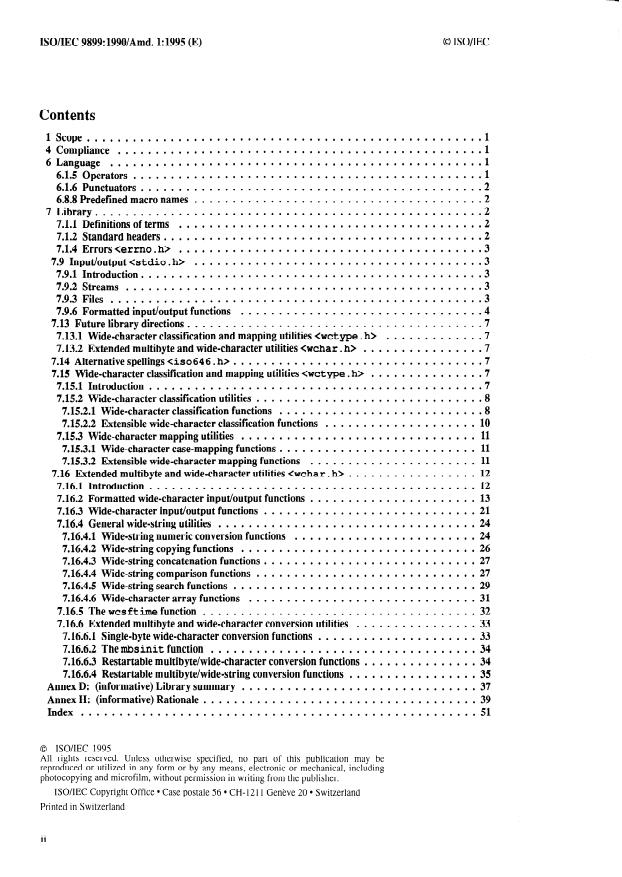
Contents
.
1Scope .
.
4 Compliance .
............................................... -1
6 Language
.l
6.1.5 Operators .
.,,.2
6.1.6Punctuators .
6.8.8 Predefined macro names l . l l l l l l l l l l l l q l l l l . l l l l l l q q . l l l l e l l l .2
...2
7Library .
....................................... .2
7.1.1 Definitions ofterms
.2
7.1.2 Standard headers. .
.3
7.1.4 Errors .
.
7.9 Input/output .
.3
7.9.1 Introduction, .
.3
7.9.2 Streams .
.
7.9.3FiIes. .
.4
...............................
7.9.6 Formatted input/output functions
.7
......................................
7.13 Future library directions
............ .7
7.13.1 Wide-character classification and mapping utilities
. h> . 7
7.13.2 Extended multibyte and wide-character utilities
.7
7.14 Alternativespellings .
. h> . 7
7.15 Wide-character classification and mapping utilities
.7
7.151 Introduction .
.............................. 8
7.152 Wide-character classification utilities
........................... 8
7.1X2.1 Wide-character classification functions
.................... 10
7.X2.2 Extensible wide-character classification functions
............................... 11
7.15.3 Wide-character mapping utilities
.......................... 11
7.15.3.1 Wide-character case-mapping functions
...................... 11
7.15.3.2 Extensible wide-character mapping functions
. h> . 12
7.16 Extended multibyte and wide-character utilities
........................................... 12
7.16.1 Introduction
7.16.2 Formatted wide-character input/output functions .
7.163 Wide-character input/output functions .
7.16.4 General wide-string utilities .
7.16.4.1 Wide-string numeric conversion functions .
7.16.4.2 Wide-string copying functions .
7.16.4.3 Wide-string concatenation functions .
7.16.4.4 Wide-string comparison functions .
7.16.4.5 Wide-string search functions .
7.16.4.6 Wide-character array functions .
7.16.5 The wcsftime function .
................
7.16.6 Extended multibyte and wide-character conversion utilities
..................... 33
7.16.6.1 Single-byte wide-character conversion functions
................................... 34
7.16.6.2 Thembsinit function
............... 34
7.16.6.3 Restartable multibyte/wide-character conversion functions
.................
7.16.6.4 Restartable multibyte/wide-string conversion functions
Annex D: (informative) Library summary .
Annex H: (informative) Rationale .
..S 1
Index. .
0 ISO/IEC 1995
All rights reserved. Unless otherwise specified, no part of this publication may be
reproduced or utilized in any form or by any means, electronic or mechanical, including
photocopying and microfilm, without permission in writing from the publisher.
ISO/IEC Copyright Office l Case postale 56 l CH- 1211 Geneve 20 l Switzerland
Printed in Switzerland
ii
ISO/IEC 9899: 199O/Amd.l: 1995(E)
o ISO/IEC
Foreword
IS0 (the International Organization for Standardization) and IEC (the Inter-
national Electrotechnical Commission) form the specialized system for worldwide
standardization. National bodies that are members of IS0 or IEC participate in the
development of International Standards through technical committees established
by the respective organization to deal with particular fields of technical activity.
IS0 and IEC technical committees collaborate in fields of mutual interest. Other
international organizations, governmental and non-governmental, in liaison with
IS0 and IEC, also take part in the work.
In the field of information technology, IS0 and IEC have established a joint
technical committee, ISO/IEC JTC 1. Draft International Standards adopted by the
joint technical committee are circulated to national bodies for voting. Publication
as an International Standard requires approval by at least 75 % of the national
bodies casting a vote.
Amendment 1 to International Standard ISO/IEC 9899:1990 was prepared by
Joint Technical Committee ISO/IEC JTC 1, Information technology,
Subcommittee 22, Programming languages, their environments and system
software interfaces.
Annexes A and B of this amendment are for informati on only.
. . .
ISO/IEC 9899: 1990iAmd. 1: 1995 (E) 0 ISO/IEC
Introduction
This first amendment to ISO/IEC 9899: 1990 primarily consists of a set of library extensions that provide a
complete and consistent set of utilities for application programming using multibyte and wide characters. It
also contains extensions that provide alternate spellings for certain tokens.
The base standard deliberately chose not to include a complete multibyte and wide-character library. Instead,
it defined just enough support to provide a firm foundation, both in the library and language proper, on which
implementations and programming expertise could grow. Vendors did implement such extensions; this first
amendment reflects the studied and careful inclusion of the best of today’s existing art in this area.
The base standard also chose to provide only minimal support for writing C source code in character sets
that redefine some of the punctuation characters, such as national variants of IS0 646. The alternate spellings
provided here can be used to write many (but not all) tokens that are less readable when expressed in terms of
trigraphs.
This first amendment to ISO/IEC 9899: 1990 is divided into three major subdivisions:
- those additions and changes that affect the preliminary subdivision of ISO/IEC 9899:1990 (clauses 1
through 4);
- those additions and changes that affect the language syntax, constraints, and semantics (ISO/IEC 9899: 1990
clause 6);
- those additions and changes that affect library facilities (ISO/IEC 9899: 1990 clause 7).
Examples are provided to illustrate possible forms of the constructions described. Footnotes are provided
to emphasize consequences of the rules described in that subclause or elsewhere in this first amendment.
References are used to refer both to the base standard and to related subclauses within this document. These
two can be distinguished either by context or are labeled as referring to the base standard (as above). Annex A
summarizes the contents of this first amendment. Annex B provides a rationale.
iv
ISO/IEC 9899:1990/Amendment 1: 1995 (E)
0 ISO/IEC
Programming languages - C
AMENDMENT 1: C Integrity
1 Scope
This amendment defines extensions to ISO/IEC 9899: 1990 that provide a more complete set of multibyte
and wide-character utilities, as well as alternative spellings for certain tokens. Use of these features can help
promote international portability of C programs.
This amendment specifies extensions that affect various clauses of ISO/IEC 9899: 1990:
- To the compliance clause (clause 4), the additional header is provided by both freestanding
and hosted implementations.
- To the language clause (clause 6), six additional tokens are accepted.
- To the library clause (clause 7), new capabilities are specified for the existing formatted input/output
functions (7.9.6).
- To the library clause (clause 7), the additional header is provided, which defines a macro,
several types, and many functions, including:
l wide-character testing functions, iswalnurn for example;
and iswctype;
l extensible wide-character classification functions, wctype
l wide-character case-mapping functions, towlower and towupper;
l extensible wide-character case-mapping functions, wet rans and t owct rans.
- To the library clause (clause 7), the additional header is provided, which defines several
macros, several types, and many functions, including:
l formatted wide-character input/output functions, fwprint f for example;
wide-character input/output functions, f get wc for example;
wide-string numeric conversion functions, wcs t od for example;
l wide-string general utility functions, wcscpy for example;
l a wide-string time conversion function, WCS f t ime;
example;
l restartable multibyte/wide-character conversion functions, mbrt owe for
multibyte/wide-string conversion functions, mbs rt owes and wcsrtornbs.
l restartable
4 Compliance
The description is adjusted so that the standard header is included in the list of headers that
must be provided by both freestanding and hosted implementations.
Forward References: alternate spellings (7.14).
6 Language
Subclauses 6.1.5 and 6.1.6 of ISO/IEC 9899: 1990 are adjusted to include the following six additional tokens.
In all aspects of the language, these six tokens
%> %: %:%:
<: :> <%
behave, respectively, the same as these existing six tokens
# ##
[ 1 { 1
except for their spelling?
6.1.5 Operators
Syntax
also one of
operator:
1) Thus [ and < : behave differently when “stringized” (see ISO/IEC 9899:1990 subclause 6X3.2), but can otherwise be freely
interchanged.
ISO/IEC 9899: 1990/Amendment 1: 1995 (E) 0 ISO/IEC
<: :> %: %:%:
Constraints
Theoperators [ 1, (),and? : (independent of spelling) shall occur in pairs, possibly separated by
expressions. The operators # and ## (also spelled % : and % : % : , respectively) shall occur in macro-defining
preprocessing directives only.
6.1.6 Punctuators
Syntax
punctuator: also one of
:> <% %> %:
<:
Constraints
The punctuators [ ] , ( ) , and ( } (independent of spelling) shall occur (after translation phase 4) in pairs,
possibly separated by expressions, declarations, or statements. The punctuator # (also spelled % : ) shall occur
in preprocessing directives only.
6.8.8 Predefined macro names
Subclause 6.8.8 is adjusted to include the following macro name defined by the implementation:
STDC VERSION
-- --
-
which expands to the decimal constant 19 94 0 9L, intended to indicate an implementation conforming to this
amendment.
7 Library
Various portions of clause 7 of ISO/IEC 9899: 1990 are adjusted to include the following specifications.
The identifiers with external linkage declared in either or which are not already
reserved as identifiers with external linkage by ISO/IEC 9899:1990 are reserved for use as identifiers with
external linkage only if at least one inclusion of either or occurs in one or more
of the translation units that constitute the prog~am.~)
7.1.1 Definitions of terms
A wide character is a code value (a binary encoded integer) of an object of type wchar t that corresponds
-
to a member of the extended character set.3)
A null wide character is a wide character with code value zero.
A wide string is a contiguous sequence of wide characters terminated by and including the first null wide
character. Apointer to a wide string is a pointer to its initial (lowest addressed) wide character. The length of
a wide string is the number of wide characters preceding the null wide character and the value of a wide string
is the sequence of code values of the contained wide characters, in order.
Ash@ sequence is acontiguous sequence of bytes within a multibyte string that (potentially) causes a change
in shift state. (See ISO/IEC 9899: 1990 subclause 5.2.1.2.) A shift sequence shall not have a corresponding
wide character; it is instead taken to be an adjunct to an adjacent multibyte character.4’
7.1.2 Standard headers
The list of standard headers is adjusted to include three new headers, ,
standard
Xwctype. and .
h>,
2) This behavior differs from those identifiers with external linkage associated with the headers listed in and referenced by ISO/IEC
9899:1990 subclauses 7.1.2 and 7.1.3, which are always reserved. Note that including either of these headers in a translation unit will
affect other translation units in the same program, even though they do not include either header. The Standard C library should not
itself include any of these headers.
3) An equivalent definition can be found in subclause 6.1.3.4 of ISO/IEC 9899: 1990.
4) For state-dependent encodings, the values for MB~CURJ4AX and MB-UN kf?~X must thus be large enough to count all the bytes in
any complete multibyte character plus at least one adjacent shift sequence ofmaximum length. Whether these counts provide for more
than one shift sequence is the implementation’s choice.
ISO/IEC 9899:1990/Amendment 1: 1995 (E)
0 ISO/IEC
7.1.4 Errors
The list of macros defined inkerrno . h> is adjusted to include a new macro, EILSEQ.
7.9 Input/output
7.9.1 Introduction
The header declares a number of functions useful for wide-character input and output.
The wide-character input/output functions described in this subclause provide operations analogous to most
of those described in ISO/IEC 9899:1990 subclause 7.9, except that the fundamental units internal to the
program are wide characters. The external representation (in the file) is a sequence of “generalized” multibyte
characters, as described further in subclause 7.9.3, below.
The input/output functions described here and in ISO/IEC 9899:1990 are given the following collective
terms:
The wide-character inputjimctions - those functions described in this subclause that perform input into
wide characters and wide strings: fgetwc, fgetws, getwc, getwchar, fwscanf, and wscanf.
The wide-character output jimctions - those functions described in this subclause that perform output
from widecharactersandwidestrings: fputwc, fputws,putwc,putwchar, fwprintf,wprintf,
vfwprintf,andvwprintf.
The wide-character inputloutputjknctions - the union of the ungetwc function, the wide-character input
functions, and the wide-character output functions.
The byte input/output jknctions - the ungetc function and the input/output functions described in
ISO/IEC 9899:1990 subclause 7.9: fgetc, fgets, fprintf, fputc, fputs, fread, fscanf,
fwrite, getc, getchar, gets, printf, putt, putchar, puts, scanf, vfprintf, and
vprintf.
,
7.9.2 Streams
The definition of a stream is adjusted to include an orientation for both text and binary streams. After a
stream is associated with an external file, but before any operations are performed on it, the stream is without
orientation. Once a wide-character input/output function has been applied to a stream without orientation, the
stream becomes wide-oriented. Similarly, once a byte input/output function has been applied to a stream
without orientation, the stream becomes byte-oriented. Only a call to the f reopen function or the fwide
function can otherwise alter the orientation of a stream. (A successful call to freopen removes any
orientation.)5)
Byte input/output functions shall not be applied to a wide-oriented stream; and wide-character input/output
functions shall not be applied to a byte-oriented stream. The remaining stream operations do not affect and are
not affected by a stream’s orientation, except for the following additional restrictions:
- Binary wide-oriented streams have the file-positioning restrictions ascribed to both text and binary streams.
- For wide-oriented streams, after a successful call to a file-positioning function that leaves the file position
indicator prior to the end-of-file, a wide-character output function can overwrite a partial multibyte
character; any file contents beyond the byte(s) written are henceforth undefined.
Each wide-oriented stream has an associated &state t object that stores the current parse state of the
stream. A successful call to fgetpos stores a representat& of the value of this mbstate t object as part
of the value of the fpos t object. A later successful call to f setpos using the same storz fpos t value
restores the value of the &ociated mbstate t object as well as the position within the controlled%ream.
7.9.3 Files
Although both text and binary wide-oriented streams are conceptually sequences of wide characters, the
external file associated with a wide-oriented stream is a sequence of multibyte characters, generalized as
follows:
5) The three predefined streams stdin, stdout, and stderr are unoriented at program startup.
0 ISO/IEC
ISO/IEC 9899: 1990/Amendment 1: 1995 (E)
- Multibyte encodings within files may contain embedded null bytes (unlike multibyte encodings valid for
use internal to the program).
I
- A file need not begin nor end in the initial shift state?
characters may differ among files. Both the nature and choice of
Moreover, the encodings used for multibyte
such encodings are implementation defined.
The wide-character input functions read multibyte characters from the stream and convert them to wide
characters as if they were read by successive calls to the fgetwc function. Each conversion occurs as if by a
call to the mbrtowc function, with the conversion state described by the stream’s own x&state-t object.
The wide-character output functions convert wide characters to multibyte characters and write them to the
stream as if they were written by successive calls to the fputwc function. Each conversion occurs as if by a
t object.
call to the wcrto& function, with the conversion state described by the stream’s own rnbstate
An encoding error occurs if the character sequence presented to the underlying mbrtowc function does
not form a valid (generalized) multibyte character, or if the code value passed to the underlying wcrtornb
does not correspond to a valid (generalized) multibyte character. The wide-character input/output functions
and the byte input/output functions store the value of the macro EILSEQ in errno if and only if an encoding
error occurs.
Forward References: the fgetwc function (7.16.3.1), the fputwc function (7.16.3.2), conversion state
(7.16.6), the mbrtowc function (7.16.6.3.2), the wcrtornb function (7.16.6.3.3).
7.9.6 Formatted input/output functions
7.9.6.1 The fprintf function
Adjust the description of the qualifiers h, 1, and L to include the additional phrases:
an optional 1 specifying that a following c conversion specifier applies to a wint t argument; an
optional 1 specifying that a following s conversion specifier applies to a pointer-to a wchar t
argument;
Replace the description of the c conversion specifier with:
C If no 1 qualifier is present, the int argument is converted to an unsigned char, and the resulting
character is written. Otherwise, the wint-t argument is converted as if by an 1s conversion specifi-
cation with no precision and an argument that points to a two-element array of wchar-t, the first
element containing the wint argument to the lc conversion specification and the second a null wide
character.
Replace the description of the s conversion specifier with:
If no 1 qualifier is present, the argument shall be a pointer to an array of character type?) Characters
S
from the array are written up to (but not including) a terminating null character. If the precision is
specified, no more than that many characters are written. If the precision is not specified or is greater
than the size of the array, the array shall contain a null character.
If an 1 qualifier is present, the argument shall be a pointer to an array of wchar t type. Wide characters
from the array are converted to multibyte characters (each as if by a call to the icrtomb function, with
the conversion state described by an mbs t ate t object initialized to zero before the first wide character
-
is converted) up to and including a terminating null wide character. The resulting multibyte characters
are written up to (but not including) the terminating null character (byte). If no precision is specified, the
array shall contain a null wide character. If a precision is specified, no more than that many characters
(bytes) are written (including shift sequences, if any), and the array shall contain a null wide character
if, to equal the multibyte character sequence length given by the precision, the function would need to
access a wide character one past the end of the array. In no case is a partial multibyte character written.*)
6) Setting the file position indicator to end-of-file, as with f seek ( file, 0, SEEK END) , has undefined behavior for a binary
stream (because of possible trailing null characters) or for any stream with state-deperident encoding that does not assuredly end in
the initial shift state.
7) No special provisions are made for multibyte characters.
8) Redundant shift sequences may result if multibyte characters have a state-dependent encoding.
0 ISO/IEC ISO/IEC 9899:1990/Amendment 1: 1995 (E)
The above extension is applicable to all the formatted output functions specified in ISO/IEC 9899: 1990.
Examples
The examples are adjusted to include the following:
In this example, multibyte characters do not have a state-dependent encoding, and the multibyte members
of the extended character set each consist of two bytes, the first of which is denoted here by a 0 and the second
by an uppercase letter.
Given the following wide string with length seven,
static wchar t wstr[] = L1lUXUYabdJZOW1l;
-
the seven calls
fprintf (stdout I I* 11234567890123 1 \P) ;
fprintf (stdout, I1 1%131s 1 \n”, wstr) ;
fprintf (stdout, I1 I%-13.91s 1 \n”, wstr) ;
fprintf (stdout, I1 1813.101s 1 \n”, wstr) ;
fprintf (stdout, I1 1%13.11s 1 \n”, wstr) ;
I’ 1%13.151s 1 \n”, &wstr [2] ) ;
fprintf (stdout,
fprintf(stdout, 111%131cl\n11, wstr[5]);
will print the following seven lines:
I UXUYabdJZDW~
ICiXlXab67Z 1
UXlIYabcUZ I
I
I UXUYabdJZClWI
abdlZl3W I
I
I q Jz I
Forward References: conversion state (7.16.6, the wcrt omb function (7.16.6.3.3).
7.9.6.2 The fscanf function
Adjust the description of the qualifiers h, 1, and L to include the additional sentences:
The conversion specifiers c, s, and [ shall be preceded by 1 if the corresponding argument is a pointer
to wchar t rather than a pointer to a character type.
Replace the definition of directive failure (page 135, lines 34-36, beginning with, “If the length of the input
item is zero.“) with:
If the length of the input item is zero, the execution of the directive fails; this condition is a matching
failure unless end-of-file, an encoding error, or a read error prevented input from the stream, in which
case it is an input failure.
Replace the description of the s conversion specifier with:
S Matches a sequence of non-white-space characters?) If no 1 qualifier is present, the corresponding
argument shall be a pointer to a character array large enough to accept the sequence and a terminating
null character, which will be added automatically.
If an 1 qualifier is present, the input shall be a sequence of multibyte characters that begins in the initial
shift state. Each multibyte character is converted to a wide character as if by a call to the mbrtowc
function, with the conversion state described by an rnbstate t object initialized to zero before the
first multibyte character is converted. The corresponding argument shall be a pointer to an array of
wchar t large enough to accept the sequence and the terminating null wide character, which will be
added a
Replace the first two sentences of the description of the [ conversion specifier with:
9) No special provisions are made for multibyte characters in the matching rules used by any of the conversion specifiers 8, [, or c -
the extent of the input field is still determined on a byte-by-byte basis. The resulting field must nevertheless be a sequence of multibyte
characters that begins in the initial shift state.
ISO/IEX 9899: 1990/Amendment 1: 1995 (E) 0 ISO/IEC
1 Matches a nonempty sequence of characters from a set of expected characters (the scanset). If no 1
qualifier is present, the corresponding argument shall be a pointer to a character array large enough to
accept the sequence and a terminating null character, which will be added automatically.
If an 1 qualifier is present, the input shall be a sequence of multibyte characters that begins in the initial
shift state. Each multibyte character is converted to a wide character as if by a call to the mbrtowc
function, with the conversion state described by an mbstate t object initialized to zero before the
first multibyte character is converted. The corresponding argument shall be a pointer to an array of
wchar t large enough to accept the sequence and the terminating null wide character, which will be
added a‘;;tomatically.
Replace the description of the c conversion specifier with:
C Matches a sequence of characters of the number specified by the field width (1 if no field width is present
in the directive). If no 1 qualifier is present, the corresponding argument shall be a pointer to a character
array large enough to accept the sequence. No null character is added.
If an 1 qualifier is present, the input shall be a sequence of multibyte characters that begins in the initial
shift state. Each multibyte character in the sequence is converted to a wide character as if by a call to the
znbrtowc function, with the conversion state described by an r&state t object initialized to zero
before the first multibyte character is converted. The corresponding a.rgu&nt shall be a pointer to the
initial element of an array of wchar t large enough to accept the resulting sequence of wide characters.
No null wide character is added.
-
The above extension is applicable to all the formatted input functions specified in ISO/IEC 9899: 1990.
Examples
The examples are adjusted to include the following:
In these examples, multibyte characters do have a state-dependent encoding, and multibyte members of the
extended character set consist of two bytes, the first of which is denoted here by a 0 and the second by an
uppercase letter, but are only recognized as such when in the alternate shift state. The shift sequences are
denoted by ?’ and k, in which the first causes entry into the alternate shift state.
After the call:
1.
#include
/* */
chk*str[50];
fscanf(stdin, rra%sWl str);
with the input line:
a?hXUY&bc
str will contain kW3Y&\O assuming that none of the bytes of the shift sequences (or of the multibyte
characters, in the more general case) appears to be a single-byte white-space character.
2 . In contrast, after the call:
#include
#include
/*.*/
wchar t wstr[50];
fscanz(stdin, Ua%lsU, wstr);
with the same input line, wstr will contain the two wide characters that correspond to UX and UY and
a terminating null wide character.
. However, the call:
#include
#include
/*.*/
wchar t wstr[50];
fscanf(stdin, WakIXk%lsU, wstr);
ISO/IEC 9899:1990/Amendment 1: 1995 (E)
0 ISO/IEC
with the same input line will return zero due to a matching failure against the & sequence in the format
string.
4 . Assuming that the first byte of the multibyte character UX is the same as the first byte of the multibyte
character DY, after the call:
#include
#include
/*.*/
wchar t wstr[50];
fscanf(stdin, WaklY&%ls", wstr);
with the same input line, zero will again be returned, but stdin will be left with a partially consumed
multibyte character.
Forward References: conversion state (7.16.6), the wcrtomb function (7.16.6.3.3).
7.13 Future library directions
The list of headers and their reserved identifiers is adjusted to include the following:
7.13.1 Wide-character classification and mapping utilities
Function names that begin with is or to and a lowercase letter (followed combination of digits,
bY my
letters, and underscore) may be added to the declarations in the header.
7.13.2 Extended multibyte and wide-character utilities
Function names that begin with WCS and a lowercase letter (followed by any combination of digits, letters,
header.
and underscore) may be added to the declarations in the
Lowercase letters may be added to the conversion specifiers in fwprint f and fwscanf.
7.14 Alternative spellings
The header defines the following eleven macros (on the left) that expand correspond-
ing tokens (on theright):
and &&
and eq &=
bitgnd &
bitor
I
ry
compl
not !
not-eq !=
or
I I
or-eq =
I
A
xor
xor-eq *=
7.15 Wide-character classification and mapping utilities
7.151 Introduction
The header declares three data types, one macro, and many functions.lo)
The types declared are
wint t
-
which is an integral type unchanged by default argument promotions that can hold any value corresponding to
members of the extended character set, as well as at least one value that does not correspond to any member
of the extended character set (See WEOF below)Y
wctrans t
which is a scalar type that can hold values which represent locale-specific character mappings, and
10) See “future library directions” (7.13).
11) wchar-t and wint-t can be the same integral type.
0 ISO/IEC
ISO/IEC 9899: 1990/Amendment 1: 1995 (E)
wctype-t
which is a scalar type that can hold values which represent locale-specific character classifications.
The macro defined is
WEOF
which expands to a constant expression of type wint-t whose value does not correspond to any member of
the extended character set. 12) It is accepted (and returned) by several functions in this subclause to indicate
end-@==Ze, that is, no more input from a stream. It is also used as a wide-character value that does not correspond
to any member of the extended character set.
The functions declared are grouped as follows:
- Functions that provide wide-character classification;
- Extensible functions that provide wide-character classification;
- Functions that provide wide-character case mapping;
- Extensible functions that provide wide-character mapping.
For all functions described in this subclause that accept an argument of type wint t, the value shall be
representable as a wchar t or shall equal the value of the macro WEOF. If this argument has any other value,
the behavior is undefined,
TYPE category of the current locale.
The behavior of these functions is affected by the L
7.15.2 Wide-character classification utilities
The header declares several functions useful for classifying wide characters.
The term printing wide character refers to a member of a locale-specific set of wide characters, each of
which occupies at least one printing position on a display device. The term control wide character refers to a
member of a locale-specific set of wide characters that are not printing wide characters.
7.15.2.1 Wide-character classification functions
The functions in this subclause return nonzero (true) if and only if the value of the argument WC conforms
to that in the description of the function.
Except for the iswgraph and iswpunct functions with respect to printing white-space wide characters
0therthanL’ ’ , each of the following eleven functions returns true for each wide character that corresponds
(as if by a call to the wctob function) to a character (byte) for which the respectively matching character
testing function from ISO/IEC 9899: 1990 subclause 7.3.1 returns true.13)
Forward References: the wctob function (7.16.6.1.2).
7.15.2.1.1 The iswalnum function
Synopsis
#include
int iswalnum(wint_t; wc);
Description
The iswalnumfunction tests for any wide character for which iswalpha or iswdigit is true.
7.15.2.1.2 The iswalpha function
Synopsis
#include
int iswalpha(wintJ WC);
12) The value of the macro WEOF may differ from that of EOF and need not be negative.
13) For example, if the expression i salpha (wet ob (WC) ) evaluates to true, then the call i swalpha (WC) must also return true. But,
==
if the expression isgraph (wctob (WC) ) evaluates to true (which cannot occur for WC L’ ’ of course), then either
iswgraph (WC) or iswprint (WC) && iswspace (WC) must be true, but not both.
0 ISO/IEC ISO/IEC 9899:1990/Amendment 1: 1995 (E)
Description
The iswalpha function tests for any wide character for which iswupper or iswlower is true, or any
widecharacterthatisoneofalocale-specificsetofwidecharactersforwhichnoneofiswcntrl,iswdigit,
iswpunct,oriswspaceistrue.
7.15.2.1.3 The iswcntrl function
Synopsis
#include
int iswcntrl(wint_t wc);
Description
The iswcntrl function tests for any control wide character.
7.15.2.1.4 The iswdigit function
Synopsis
#include
int iswdigit(wint-t WC);
Description
The iswdigit function tests for any wide character that corresponds to a decimal-digit character (as
defined in ISO/IEC 9899: 1990 subclause 5.2.1).
7.15.2.1.5 The i s wgraph function
Synopsis
#include
int iswgraph(wint_t WC);
Description
The iswgraph function tests for any wide character for which iswprint is true and iswspace is
false.14)
7.15.2.1.6 The iswlower function
Synopsis
#include
int iswlower(wintJ WC);
Description
The iswlower function tests for any wide character that corresponds to a lowercase letter or is one of a
locale-specificsetofwidecharactersforwhichnoneof iswcntrl,iswdigit,iswpunct,or iswspace
is true.
7.15.2.1.7 The imprint function
Synopsis
#include
int iswprint(wintJ ‘WC);
Description
The iswprint function tests for any printing wide character.
7.15.2.1.8 The iswpunct function
Synopsis
#include
int iswpunct(wint t WC);
14) Note that the behavior of the i swgraph and i swpunct functions may differ from their matching functions in ISO/IEC 9899:1990
subclause 7.3.1 with respect to printing white space basic execution characters other than ’ ’ .
0 ISO/IEC
ISO/IEC 9899: 1990/Amendment 1: 1995 (E)
Description
The iswpunct function tests for any printing wide character that is one of a locale-specific set of wide
characters for which neither iswspace nor iswalnum is true.
7.15.2.1.9 The iswspace function
Synopsis
#include
int iswspace(wint_t WC);
Description
The iswspace function tests for any wide character that corresponds to a locale-specific set of wide
characters for which none of iswalnum, iswgraph, or iswpunct is true.
7.15.2.1.10 The iswupper function
Synopsis
#include
int iswupper(wintJ WC);
Description
The iswupper function tests for any wide character that corresponds to an uppercase letter or is one of a
locale-specific set of wide characters for which none of iswcntrl, iswdigit, iswpunct, or iswspace
is true.
7.15.2.1.11 The iswxdigit function
Synopsis
#include
int iswxdigit(wintJ WC);
Description
The is-digit function tests for any widecharacter thatcorrespondsto ahexadecimal-digit character
(as defined in ISO/IEC 9899: 1990 subclause 6.1.3.2).
7.15.2.2 Extensible wide-character classification functions
extensible wide-character classification as well as testing
The functions wctype and iswctype provide
bed in the previous subclause (452.1).
equivalent to that performed by the functions descri
7.15.2.2.1 The wctype function
Synopsis
#include
wctype(const char *property);
Description
t that describes a class of wide characters
The wctype function constructs a value with type wctype
identified by the string argument property.
The eleven strings listed in the description of the iswctype function shall be valid in all locales as
propertyargumentstothewctypefunction.
Returns
Ifpropertyidentifiesavalidclassofwidecharactersaccordingtothe LC CTYPE categoryofthecurrent
locale, the wctype function returns a nonzero value that is valid as the secof;b argument to the iswctype
function; otherwise, it returns zero.
7.15.2.2.2 The iswctype function
Synopsis
#include
int iswctype(wint WC, wctype t desc);
OISO/IEC ISO/IEC 9899:1990/Amendment 1: 1995 (E)
Description
The iswctype function determines whether the wide character WC has the property described by desc.
The current setting of the L TYPE category shall be the same as during the call to wctype that returned
the value desc.
Each of the following eleven expressions has a truth-value equivalent to the call to the wide-character testing
function (4.5.2.1) in the comment that follows the expression:
/* iswalnum(wc) */
iswctype(wc, wctype(lalnumll))
wctype ('alpha')) /* iswalpha(wc) */
iswctype(wc,
/* iswcntrl(wc) */
iswctype(wc, wctype (Vntrl”) )
iswctype(wc, wctype (I’digit”) ) /* iswdigit(wc) */
iswctype wctype I1graphlr)) /* iswgraph(wc) */
WC,
wctype "lower")) /* iswlower(wc) */
iswctype
WC,
iswctype wctype llprintl)) /* iswprint(wc) */
WC,
wctype "punct") ) /* iswpunct(wc) */
iswctype
WC,
wctype "space")) /* iswspace(wc) */
iswctype
WC,
iswctype wctype Wpper'l)) /* iswupper(wc) */
WC,
iswctype wctype “xdigit ‘I) ) /* iswxdigit(wc) */
WC?
Returns
n
The iswctype function returns onzero if and only if the value of the wide character WC has the
(true>
property described by desc.
7.15.3 Wide-character mapping utilities
The header declares several functions useful for mapping wide characters.
7.15.3.1 Wide-character case-mapping functions
7.15.3.1.1 The towlower function
Synopsis
#include
wint t towlower (wint-t wc) ;
-
Description
The towlower function converts an uppercase letter to the corresponding lowercase letter.
Returns
If the argument is a wide character for which iswupper is true and there is a corresponding wide character
for which iswlower is true, the towlower function returns the corresponding wide character; otherwise,
the argument is returned unchanged.
7.15.3.1.2 The towupper function
Synopsis
#include
wint_t towupper(wintJ wc);
Description
Thetowupper function converts alowercaseletter to the corresponding uppercase letter.
Returns
If the argument is a wide character for which iswlower is true and there is a corresponding wide character
for which iswupper is true, the towupper function returns the corresponding wide character; otherwise,
the argument is returned unchanged.
7.15.3.2 Extensible wide-character mapping functions
rans and towct rans provide extensible wide-character mapping
The functions wet as well as case
that performed by the functions described in
mapping equivalent to the previous subclause (4 53.1).
ISO/IEC 9899: 1990/Amendment 1: 1995 (E) 0 ISO/IEC
7.15.3.2.1 The wctrans function
Synopsis
#include
wctrans-t wctrans (const char *property) ;
Description
The wctrans function constructs a value with type wctrans t that describes a mapping between wide
characters identified by the string argument property.
The two strings listed in the description of the towctrans function shall be valid in all locales as
property arguments to the wctrans function.
Returns
If property identifies a valid mapping of wide characters according to the LC CTYPE category of the
current locale, the wctrans function returns a nonzero value that is valid as thesecond argument to the
towct rans function; otherwise, it returns zero.
7.15.3.2.2 The towctrans function
#include
wint t towctrans(wint t WC, wctrans t desc);
-
Description
The towct rans function maps the wide character WC using the mapping described by desc. The current
setting of the LC CTYPE category shall be the same as during the call to towctrans that returned the value
-
desc.
Each of the following two expressions behaves the same as the call to the wide-character case-mapping
function (4.5.3.1) in the comment that follows the expression:
/* towlower */
towctrans (wc, wctrans (“tolower*‘) )
towctrans (WC, wctrans ( VouppeP) ) /* towupper */
Returns
value of WC using the described by desc.
The towct function returns the
-ng
7.16 Extended multibyte and wide-character utilities
7.16.1 Introduction
The header declares four data types, one tag, four macros, and many functions?)
The types declared are wcha and size t (both described in ISO/IEC 9899: 1990 subclause 7.1.6),
mbstate t
-
which is an object type other than an array type that can hold the conversion state information necessary to
convert between sequences of multibyte characters and wide characters, and
wint t
described in subclause 4.5.1.
The tag tm is declared as naming an incomplete structure type, the contents of which are described in
ISO/IEC 9899:1990 subclause 7.12.1.
The macros defined are NULL (described in ISO/lEC 9899: 1990 subclause 7.1.6),
WCHAR MAX
which is the maximum value representable by an object of type wchar
t,16)
WCHAR MIN
15) See “future library directions” (7.13).
16) The values WCHARJAX and WCHARJIN do not necessarily correspond to members of the extended character set.
0 ISO/IEC ISO/IEC 9899: 1990/Amendment 1: 1995 (E)
which is the minimum value representable by an object of type wchar t, and
-
WEOF
described in subclause 4.5.2.
The functions declared are grouped as follows:
- Functions that perform input and output of wide characters, or multibyte characters, or both;
- Functions that provide wide--string numeric conversion;
- Functions that perform general wide-string manipulation;
- A function for wide-string date and time conversion; and
- Functions that provide extended capabilities for conversion between multibyte and wide-character se-
quences.
Unless explicitly stated otherwise, if the execution of a function described in this subclause causes copying
to take place between objects that overlap, the behavior is undefined.
7.16.2 Formatted wide-character input/output functions
7.16.2.1 The fwprintf function
Synopsis
#include
#include
int fwprintf (FILE *stream, con& wchar t *format, . . .) ;
-
Description
The fwprint f function writes output to the stream pointed to by stream, under control of the wide
string pointed to by format that specifies how subsequent arguments are converted for output. If there are
insufficient arguments for the format, the behavior is undefined. If the format is exhausted while arguments
remain, the excess arguments are evaluated (as always) but are otherwise ignored. The fwprint f function
returns when the end of the format string is encountered.
The format is composed of zero or more directives: ordinary wide characters (not %), and conversion
specifications. The processing of conversion specifications is as if they were replaced in the format string by
and converting
wide-character strings that are each the result of fetching zero or more subsequent arguments
them, if applicable, according to the corresponding c
...
Questions, Comments and Discussion
Ask us and Technical Secretary will try to provide an answer. You can facilitate discussion about the standard in here.
Loading comments...