

ISO 5196-1:1980
(Main)Magnesium alloys — Determination of thorium — Part 1: Gravimetric method
General Information
- Abstract
The method is applicable to products having thorium contents between 0,2 and 5,0 % (m/m). Specifies principle, reagents, apparatus, sampling, procedure, expression of results and test report.
- Status
- Published
- Publication Date
- 31-Oct-1980
- Technical Committee
- ISO/TC 79 - Light metals and their alloys
- Drafting Committee
- ISO/TC 79 - Light metals and their alloys
- Current Stage
- 9093 - International Standard confirmed
- Start Date
- 17-Oct-2022
- Completion Date
- 29-Aug-2026
Buy Documents


ISO 5196-1:1980 - Magnesium alloys — Determination of thorium — Part 1: Gravimetric method Released:11/1/1980


ISO 5196-1:1980 - Alliages de magnésium — Dosage du thorium — Partie 1: Méthode gravimétrique Released:11/1/1980

ISO 5196-1:1980 - Alliages de magnésium — Dosage du thorium — Partie 1: Méthode gravimétrique Released:11/1/1980
Overview
ISO 5196-1:1980 - "Magnesium alloys - Determination of thorium - Part 1: Gravimetric method" specifies a gravimetric chemical-analysis procedure to quantify thorium in magnesium alloys. Published in 1980, the standard covers principle, reagents, apparatus, sampling guidance, the stepwise analytical procedure, expression of results and test-report requirements. The method is applicable to products with thorium contents between 0.2% and 5.0% (m/m).
Key topics and technical requirements
- Scope and applicability: Designed for magnesium alloys containing 0.2–5.0% thorium by mass.
- Principle: Dissolve the alloy in hydrochloric acid, separate thorium as a benzoate, convert to thorium oxalate and then to thorium oxide by calcination; weigh the oxide gravimetrically.
- Reagents (analytical grade): hydrochloric acid (concentrated and diluted strengths described), benzoic acid (20 g/L and 2.5 g/L solutions), oxalic acid (saturated solution and wash solution), ammonium chloride, hydroxylamine hydrochloride, ammonium hydroxide, bromophenol blue indicator, distilled water.
- Sampling: Laboratory test-piece preparation guidance given (chip thickness ≤ 1 mm). Specific sample masses: typically 5 g for 0.2–1.5% Th, 3 g for 1.5–3.0% Th, and 2 g for 3.0–5.0% Th.
- Procedure highlights:
- Dissolution in HCl, boiling and filtration if needed.
- Precipitation of thorium as benzoate, then conversion to oxalate.
- Filtration, washing with oxalic-acid wash solution, transfer to pre-calcined porcelain crucible.
- Incinerate the filter (~500 °C) and calcine at 950 °C to constant mass to obtain thorium oxide for weighing.
- Expression of results: Thorium content is calculated from the mass of thorium oxide using a conversion factor (0.8788) to report percentage by mass. Full test-report content required (method reference, results and format, details of deviations, etc.).
Applications and who uses it
- Metallurgical and quality-control laboratories performing chemical analysis of magnesium alloys.
- Alloy producers and suppliers requiring certification of alloy composition for product specification and traceability.
- Materials testing and inspection bodies that verify compliance with contract or regulatory requirements.
- Research and development teams characterizing alloy formulations where thorium is an additive.
Related standards
- Developed by ISO/TC 79 (Light metals and their alloys). The standard notes that specific international guidance on sampling of magnesium and its alloys will be provided in a subsequent ISO publication.
Keywords: ISO 5196-1:1980, magnesium alloys, thorium determination, gravimetric method, thorium analysis, chemical analysis, thorium oxide, calcination, laboratory procedure.
Buy Documents
ISO 5196-1:1980 - Magnesium alloys — Determination of thorium — Part 1: Gravimetric method Released:11/1/1980
ISO 5196-1:1980 - Alliages de magnésium — Dosage du thorium — Partie 1: Méthode gravimétrique Released:11/1/1980
ISO 5196-1:1980 - Alliages de magnésium — Dosage du thorium — Partie 1: Méthode gravimétrique Released:11/1/1980
Get Certified
Connect with accredited certification bodies for this standard

Element Materials Technology
Materials testing and product certification.

Inštitut za kovinske materiale in tehnologije
Institute of Metals and Technology. Materials testing, metallurgical analysis, NDT.
Sponsored listings
Frequently Asked Questions
ISO 5196-1:1980 is a standard published by the International Organization for Standardization (ISO). Its full title is "Magnesium alloys — Determination of thorium — Part 1: Gravimetric method". This standard covers: The method is applicable to products having thorium contents between 0,2 and 5,0 % (m/m). Specifies principle, reagents, apparatus, sampling, procedure, expression of results and test report.
The method is applicable to products having thorium contents between 0,2 and 5,0 % (m/m). Specifies principle, reagents, apparatus, sampling, procedure, expression of results and test report.
ISO 5196-1:1980 is classified under the following ICS (International Classification for Standards) categories: 77.120.20 - Magnesium and magnesium alloys. The ICS classification helps identify the subject area and facilitates finding related standards.
ISO 5196-1:1980 is available in PDF format for immediate download after purchase. The document can be added to your cart and obtained through the secure checkout process. Digital delivery ensures instant access to the complete standard document.
Standards Content (Sample)
nal Standard
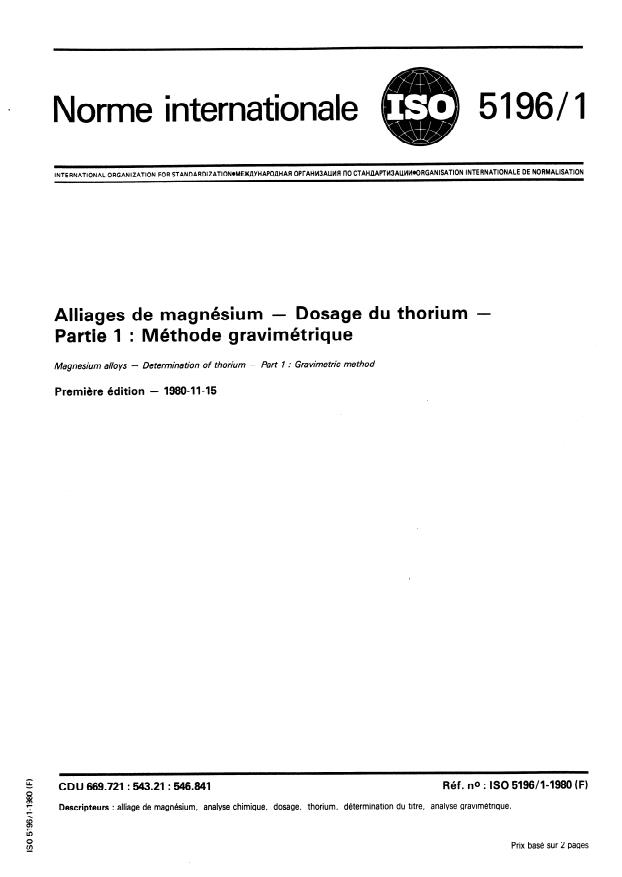
5196/1
INTERNATIONAL ORGANIZATION FOR STANDARDIZATION.MEX&YHAPOfiHAR OPrAHM3AL&lR fl0 CTAH,QAPTbl3Ai&4M.ORGANISATlON INTERNATIONALE DE 6JORMALISATION
Determination of thorium -
Magnesium alloys -
Part 1 : Gravimetric method
Alliages de magnksium - Dosage du thorium - Partie 1 : Mthode gravimktrique
First edition - 1980-11-15
UDC 669.721 : 543.21 : 546.841
Ref. No. ISO 5196/1-1980 (E)
Descriptors : magnesium alloys, Chemical analysis, determination of content, thorium, titration, gravimetric analysis.
\
Price based on 2 pages
Foreword
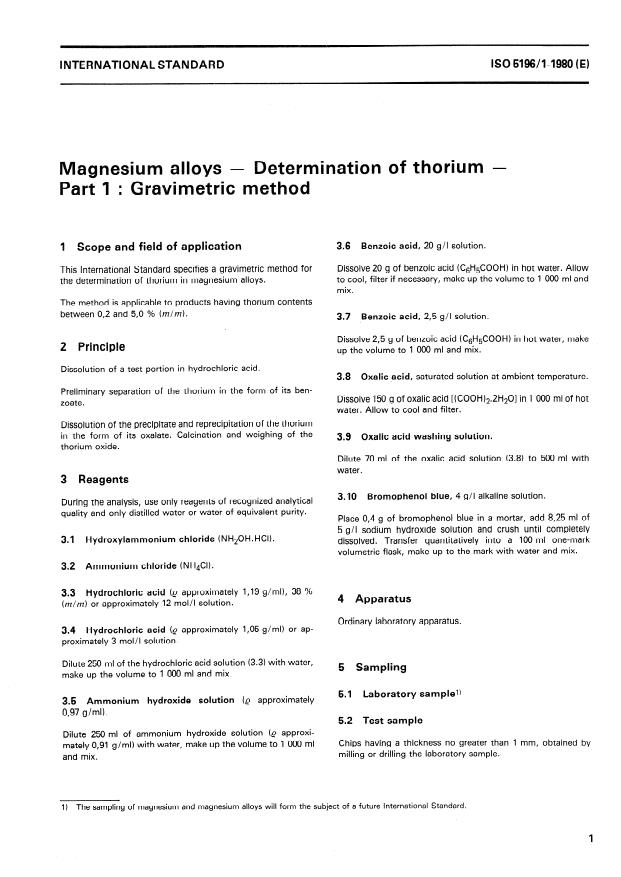
ISO (the International Organization for Standardization) is a worldwide federation of
national Standards institutes (ISO member bedies). The work of developing Inter-
national Standards is carried out through ISO technical committees. Every member
body interested in a subject for which a technical committee has been set up has the
right to be represented on that committee. International organizations, governmental
and non-governmental, in liaison with ISO, also take part in the work.
Draft International Standards adopted by the technical committees are circulated to
the member bodies for approval before their acceptance as International Standards by
the ISO Council.
International Standard ISO 5196/1 was developed by Technical Committee
ISO/TC 79, Light metals and their aloys, and was circulated to the member bodies in
August 1979.
lt has been approved by the member bodies of the following countries :
Australia India South Africa, Rep. of
Austria Italy Spain
Sweden
China Japan
Czechoslovakia Norway United Kingdom
Philippines
France USSR
Germany, F. R. Portugal Yugoslavia
Hungary Romania
No member body expressed disapproval of the document.
0 International Organkation for Standardkation, 1980
Printed in Switzerland
ISO 5196/1-1980 (E)
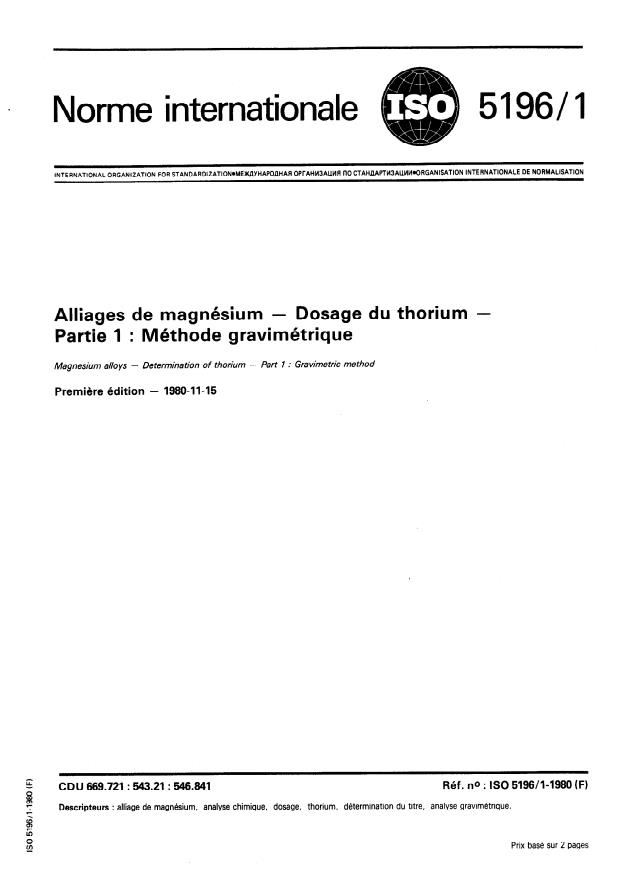
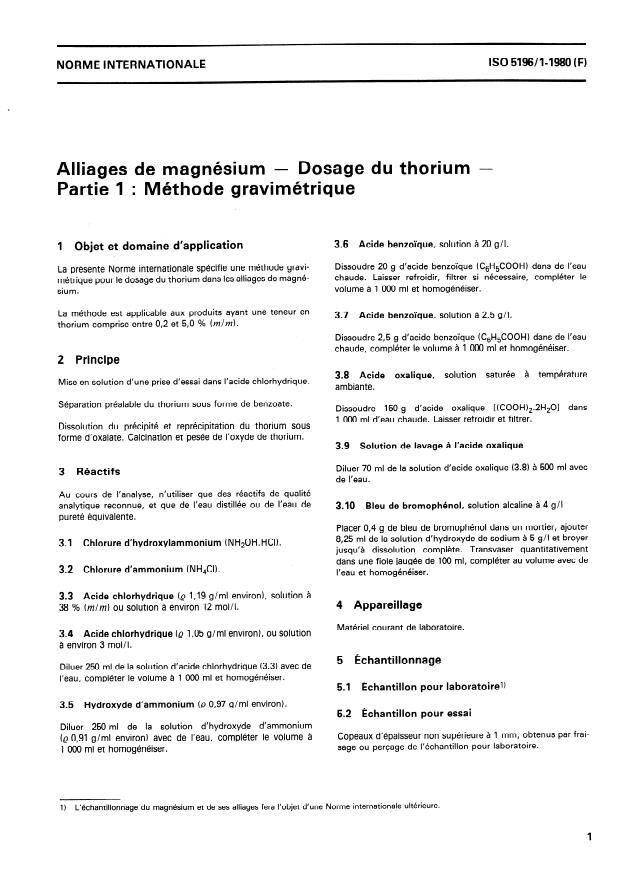
INTERNATIONALSTANDARD
Magnesium alloys - Determination of thorium -
Part 1 : Gravimetric method
3.6 Benzoic acid, 20 g/l Solution.
Scope and field of application
This International Standard specifies a gravimetric method for Dissolve 20 g of benzoic acid (C~H&OOH) in hot water. Allow
to cool, filter if necessary, make up the volume to 1 000 ml and
the determination of thorium in magnesium alloys.
mix.
The method is applicable to products having thorium contents
between 0,2 and 5,0 % (mlm).
3.7 Benzoic acid, 2,5 g/l Solution.
Dissolve 2,5 g of benzoic acid (CGH&OOH) in hot water, make
2 Principle
up the volume to 1 000 ml and mix.
Dissolution of a test Portion in hydrochloric acid.
3.8 Oxalic .acid, saturated Solution at ambient temperature.
Preliminary Separation of the thorium in the form of its ben-
Dissolve 150 g of oxalic acid [(COOH),.2Hz0] in 1 000 ml of hot
zoate.
water. Allow to cool and filter.
Dissolution of the precipitate and reprecipitation of the thorium
in the form of its oxalate. Calcination and weighing of the
3.9 Oxalic acid washing Solution.
thorium Oxide.
Dilute 70 ml of the oxalic acid Solution (3.8) to 500 ml with
water.
3 Reagents
3.10 Bromophenol blue, 4 g/l alkaline Solution.
During the analysis, use only reagents of recognized analytical
quality and only distilled water or water of equivalent purity.
Place 0,4 g of bromophenol blue in a mortar, add 8,25 ml of
5 g/l sodium hydroxide Solution and crush until completely
3.1 Hydroxylammonium chloride (NH,OH.HCI).
dissolved. Transfer quantitatively into a 100 ml one-mark
volumetric flask, make up to the mark with water and mix.
3.2 Ammonium chloride (NHJI).
3.3 Hydrochlorit acid (Q approximately 1,19 g/ml), 38 %
4 Apparatus
(mlm) or approximately 12 mol/1 Solution.
Ordinary laboratory apparatus.
3.4 Hydrochlorit acid (Q approximately 1,05 g/ml) or ap-
proximately 3 mol/1 Solution.
Dilute 250 ml of the hydrochloric acid Solution (3.3) with water
...
5196/1
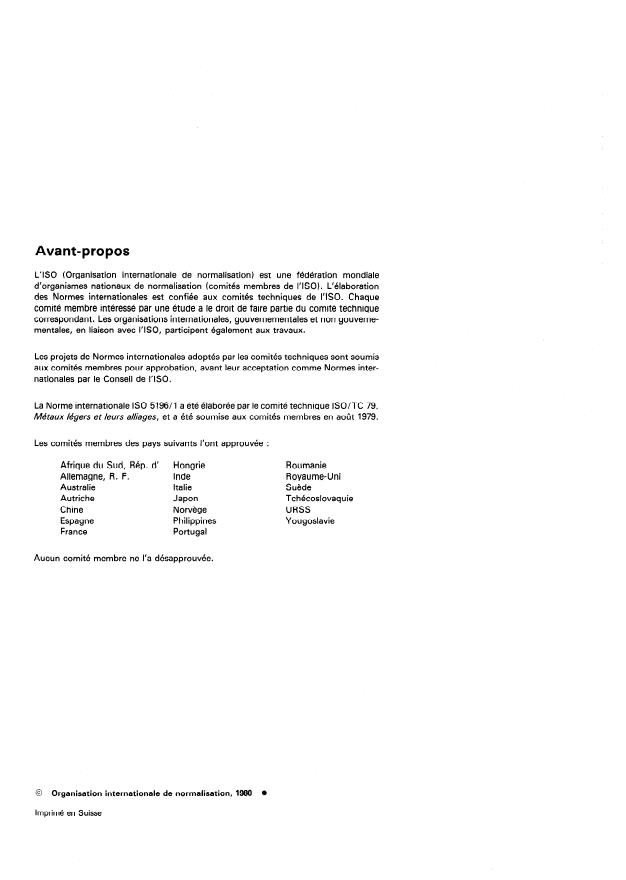
Norme internationale
INTERNATIONAL ORGANIZATION FOR STANDARDIZATION.ME~YHAPOJIHAR OPI-AHM3ALUlR n0 CTAH~PTH3A~MM.ORGANISATION INTERNATIONALE DE NORMALISATION
Alliages de magnésium - Dosage du thorium -
Partie 1 : Méthode gravimétrique
Magnesium alloys - Determina tion of thorium - Part I : Gravimetric me thod
Première édition - 1980-11-15
CDU 669.721 : 543.21 : 546.841 Réf. no : ISO 5196/1-1980 (F)
Descripteurs : alliage de magnésium, analyse chimique, dosage, thorium, détermination du titre, analyse gravimétrique.
Prix basé sur 2 pages
Avant-propos
L’ISO (Organisation internationale de normalisation) est une fédération mondiale
d’organismes nationaux de normalisation (comités membres de I’ISO). L’élaboration
des Normes internationales est confiée aux comités techniques de I’ISO. Chaque
comité membre intéressé par une étude a le droit de faire partie du comité technique
correspondant. Les organisations internationales, gouvernementales et non gouverne-
mentales, en liaison avec I’ISO, participent également aux travaux.
Les projets de Normes internationales adoptés par les comités techniques sont soumis
aux comités membres pour approbation, avant leur acceptation comme Normes inter-
nationales par le Conseil de I’ISO.
La Norme internationale ISO 5196/1 a été élaborée par le comité technique ISO/TC 79,
Métaux kgers et leurs alliages, et a été soumise aux comités membres en août 1979.
Les comités membres des pays suivants l’ont approuvée :
Afrique du Sud, Rép. d’ Hongrie Roumanie
Royaume-Uni
Allemagne, R. F. Inde
Italie Suède
Australie
Autriche Japon Tchécoslovaquie
Norvège URSS
Chine
Espagne Philippines Yougoslavie
France Portugal
Aucun comité membre ne l’a désapprouvée.
0 Organisation internationale de normalisation, 1980
Imprimé en Suisse
ISO 5196/1-1980 (F)
NORME INTERNATIONALE
Alliages de magnésium - Dosage du thorium -
Partie 1 : Méthode gravimétrique
3.6 Acide benzoïque, solution à 20 g/l.
1 Objet et domaine d’application
Dissoudre 20 g d’acide benzoïque (C6H&OOH) dans de l’eau
La présente Norme internationale spécifie une méthode gravi-
chaude. Laisser refroidir, filtrer si nécessaire, compléter le
métrique pour le dosage du thorium dans les alliages de magné-
volume à 1 000 ml et homogénéiser.
sium.
La méthode est applicable aux produits ayant une teneur en
3.7 Acide benzoïque, solution à 2,5 g/l.
thorium comprise entre 0,2 et 5,0 % (mlm).
Dissoudre 2,5 g d’acide benzoïque (C6H&OOH) dans de l’eau
chaude, compléter le volume à 1 000 ml et homogénéiser.
2 Principe
solution saturée à température
3.8 Acide oxalique,
Mise en solution d’une prise d’essai dans l’acide chlorhydrique.
ambiante.
Séparation préalable du thorium sous forme de benzoate.
Dissoudre 150 g d’acide oxalique [KOOH)2.2H201 dans
1 000 ml d’eau chaude. Laisser refroidir et filtrer.
Dissolution du précipité et reprécipitation du thorium sous
forme d’oxalate. Calcination et pesée de l’oxyde de thorium.
3.9 Solution de lavage à l’acide oxalique
Diluer 70 ml de la solution d’acide oxalique (3.8) à 500 ml avec
3 Réactifs
de l’eau.
Au cours de l’analyse, n’utiliser que des réactifs de qualité
analytique reconnue, et que de l’eau distillée ou de l’eau de
3.10 Bleu de bromophénol, solution alcaline à 4 g/l
pureté équivalente.
Placer 0,4 g de bleu de bromophénol dans un mortier, ajouter
8,25 ml de la solution d’hydroxyde de sodium à 5 g/l et broyer
3.1 Chlorure d’hydroxylammonium (NH20H.HCI).
jusqu’à dissolution complète. Transvaser quantitativement
dans une fiole jaugée de 100 ml, compléter au volume avec de
3.2 Chlorure d’ammonium (NHJI).
l’eau et homogénéiser.
3.3 Acide chlorhydrique (Q 1,19 g/ml environ), solution à
4 Appareillage
38 % (mlm) ou solution à environ 12 mol/l.
Matériel courant de laboratoire.
3.4 Acide chlorhydrique (Q 1,05 g/ml environ), ou solution
à environ 3 mol/l.
5 Échantillonnage
Diluer 250 ml de la solution d’acide chlorhydrique (3.3) avec de
l’eau, compléter le volume à 1 000 ml et homogénéiser.
5.1 Échantillon pour
...
5196/1
Norme internationale
INTERNATIONAL ORGANIZATION FOR STANDARDIZATION.ME~YHAPOJIHAR OPI-AHM3ALUlR n0 CTAH~PTH3A~MM.ORGANISATION INTERNATIONALE DE NORMALISATION
Alliages de magnésium - Dosage du thorium -
Partie 1 : Méthode gravimétrique
Magnesium alloys - Determina tion of thorium - Part I : Gravimetric me thod
Première édition - 1980-11-15
CDU 669.721 : 543.21 : 546.841 Réf. no : ISO 5196/1-1980 (F)
Descripteurs : alliage de magnésium, analyse chimique, dosage, thorium, détermination du titre, analyse gravimétrique.
Prix basé sur 2 pages
Avant-propos
L’ISO (Organisation internationale de normalisation) est une fédération mondiale
d’organismes nationaux de normalisation (comités membres de I’ISO). L’élaboration
des Normes internationales est confiée aux comités techniques de I’ISO. Chaque
comité membre intéressé par une étude a le droit de faire partie du comité technique
correspondant. Les organisations internationales, gouvernementales et non gouverne-
mentales, en liaison avec I’ISO, participent également aux travaux.
Les projets de Normes internationales adoptés par les comités techniques sont soumis
aux comités membres pour approbation, avant leur acceptation comme Normes inter-
nationales par le Conseil de I’ISO.
La Norme internationale ISO 5196/1 a été élaborée par le comité technique ISO/TC 79,
Métaux kgers et leurs alliages, et a été soumise aux comités membres en août 1979.
Les comités membres des pays suivants l’ont approuvée :
Afrique du Sud, Rép. d’ Hongrie Roumanie
Royaume-Uni
Allemagne, R. F. Inde
Italie Suède
Australie
Autriche Japon Tchécoslovaquie
Norvège URSS
Chine
Espagne Philippines Yougoslavie
France Portugal
Aucun comité membre ne l’a désapprouvée.
0 Organisation internationale de normalisation, 1980
Imprimé en Suisse
ISO 5196/1-1980 (F)
NORME INTERNATIONALE
Alliages de magnésium - Dosage du thorium -
Partie 1 : Méthode gravimétrique
3.6 Acide benzoïque, solution à 20 g/l.
1 Objet et domaine d’application
Dissoudre 20 g d’acide benzoïque (C6H&OOH) dans de l’eau
La présente Norme internationale spécifie une méthode gravi-
chaude. Laisser refroidir, filtrer si nécessaire, compléter le
métrique pour le dosage du thorium dans les alliages de magné-
volume à 1 000 ml et homogénéiser.
sium.
La méthode est applicable aux produits ayant une teneur en
3.7 Acide benzoïque, solution à 2,5 g/l.
thorium comprise entre 0,2 et 5,0 % (mlm).
Dissoudre 2,5 g d’acide benzoïque (C6H&OOH) dans de l’eau
chaude, compléter le volume à 1 000 ml et homogénéiser.
2 Principe
solution saturée à température
3.8 Acide oxalique,
Mise en solution d’une prise d’essai dans l’acide chlorhydrique.
ambiante.
Séparation préalable du thorium sous forme de benzoate.
Dissoudre 150 g d’acide oxalique [KOOH)2.2H201 dans
1 000 ml d’eau chaude. Laisser refroidir et filtrer.
Dissolution du précipité et reprécipitation du thorium sous
forme d’oxalate. Calcination et pesée de l’oxyde de thorium.
3.9 Solution de lavage à l’acide oxalique
Diluer 70 ml de la solution d’acide oxalique (3.8) à 500 ml avec
3 Réactifs
de l’eau.
Au cours de l’analyse, n’utiliser que des réactifs de qualité
analytique reconnue, et que de l’eau distillée ou de l’eau de
3.10 Bleu de bromophénol, solution alcaline à 4 g/l
pureté équivalente.
Placer 0,4 g de bleu de bromophénol dans un mortier, ajouter
8,25 ml de la solution d’hydroxyde de sodium à 5 g/l et broyer
3.1 Chlorure d’hydroxylammonium (NH20H.HCI).
jusqu’à dissolution complète. Transvaser quantitativement
dans une fiole jaugée de 100 ml, compléter au volume avec de
3.2 Chlorure d’ammonium (NHJI).
l’eau et homogénéiser.
3.3 Acide chlorhydrique (Q 1,19 g/ml environ), solution à
4 Appareillage
38 % (mlm) ou solution à environ 12 mol/l.
Matériel courant de laboratoire.
3.4 Acide chlorhydrique (Q 1,05 g/ml environ), ou solution
à environ 3 mol/l.
5 Échantillonnage
Diluer 250 ml de la solution d’acide chlorhydrique (3.3) avec de
l’eau, compléter le volume à 1 000 ml et homogénéiser.
5.1 Échantillon pour
...