


ISO/IEC 18974:2023
(Main)Information technology — OpenChain security assurance specification
Information technology — OpenChain security assurance specification
This specification contains the key requirements of a quality open source software security assurance program that establishes trust between organizations exchanging software solutions comprised of open source software.
Titre manque
General Information
- Status
- Published
- Publication Date
- 13-Dec-2023
- Technical Committee
- ISO/IEC JTC 1 - Information technology
- Drafting Committee
- ISO/IEC JTC 1 - Information technology
- Current Stage
- 6060 - International Standard published
- Start Date
- 14-Dec-2023
- Due Date
- 25-Jan-2025
- Completion Date
- 14-Dec-2023
Overview
ISO/IEC 18974:2023 - OpenChain security assurance specification defines the core requirements for a quality open source software (OSS) security assurance program. Published by ISO/IEC and maintained by the OpenChain Project, this specification is intended to build trust between organizations that exchange software solutions containing open source components. The standard focuses on the “what” and “why” of security assurance - especially checking OSS against publicly known vulnerabilities (CVE, GitHub/GitLab alerts, package manager alerts) - while remaining implementation‑agnostic so organizations of any size can adapt it.
Key topics and requirements
ISO/IEC 18974:2023 structures program requirements and the associated verification materials (records) required to demonstrate conformance. Major technical topics include:
Program foundation (Clause 4.1)
- Written open source software security assurance policy, communicated and reviewed.
- Defined roles and responsibilities, required competencies, and evidence of training or experience.
- Participant awareness of policy, objectives and implications of non‑conformance.
- Clear program scope aligned with organizational risk policy and measurable metrics.
Tasks and resourcing (Clause 4.2)
- Access to necessary tools, data and personnel.
- Ensuring the program is effectively resourced for continuous vulnerability monitoring and management.
OSS content review and approval (Clause 4.3)
- Use and maintenance of a Software Bill of Materials (SBOM) - structured component records (name, version, origin, dependencies, timestamps).
- Processes for security assurance: identifying, tracking and responding to known and newly discovered vulnerabilities.
Adherence and verification (Clause 4.4)
- Criteria for completeness of the program and rules governing certification duration.
- Concrete verification materials such as documented policies, role matrices, competency evidence, SBOMs and review records.
Applications - who should use it
- Software vendors, OEMs, system integrators and SaaS providers shipping products that include open source components.
- Security, compliance, product and supply‑chain teams implementing vulnerability triage, SBOM management and customer assurance.
- Procurement and legal functions seeking to establish trust with customers and partners through documented security assurance practices.
Benefits include consistent vulnerability handling, improved supply‑chain transparency, and an auditable set of verification materials for customer or partner agreements.
Related standards and references
- ISO/IEC 5230 (OpenChain / open source license compliance) - complementary process management standard.
- NTIA “Minimum Elements for an SBOM” - referenced for SBOM content and component records.
- SPDX (format for SBOMs) and public vulnerability repositories such as the CVE database are relevant implementation references.
Keywords: ISO/IEC 18974:2023, OpenChain security assurance specification, open source security, SBOM, CVE, software supply chain, security assurance program.
Get Certified
Connect with accredited certification bodies for this standard

BSI Group
BSI (British Standards Institution) is the business standards company that helps organizations make excellence a habit.

NYCE
Mexican standards and certification body.
Sponsored listings
Frequently Asked Questions
ISO/IEC 18974:2023 is a standard published by the International Organization for Standardization (ISO). Its full title is "Information technology — OpenChain security assurance specification". This standard covers: This specification contains the key requirements of a quality open source software security assurance program that establishes trust between organizations exchanging software solutions comprised of open source software.
This specification contains the key requirements of a quality open source software security assurance program that establishes trust between organizations exchanging software solutions comprised of open source software.
ISO/IEC 18974:2023 is classified under the following ICS (International Classification for Standards) categories: 35.020 - Information technology (IT) in general. The ICS classification helps identify the subject area and facilitates finding related standards.
ISO/IEC 18974:2023 is available in PDF format for immediate download after purchase. The document can be added to your cart and obtained through the secure checkout process. Digital delivery ensures instant access to the complete standard document.
Standards Content (Sample)
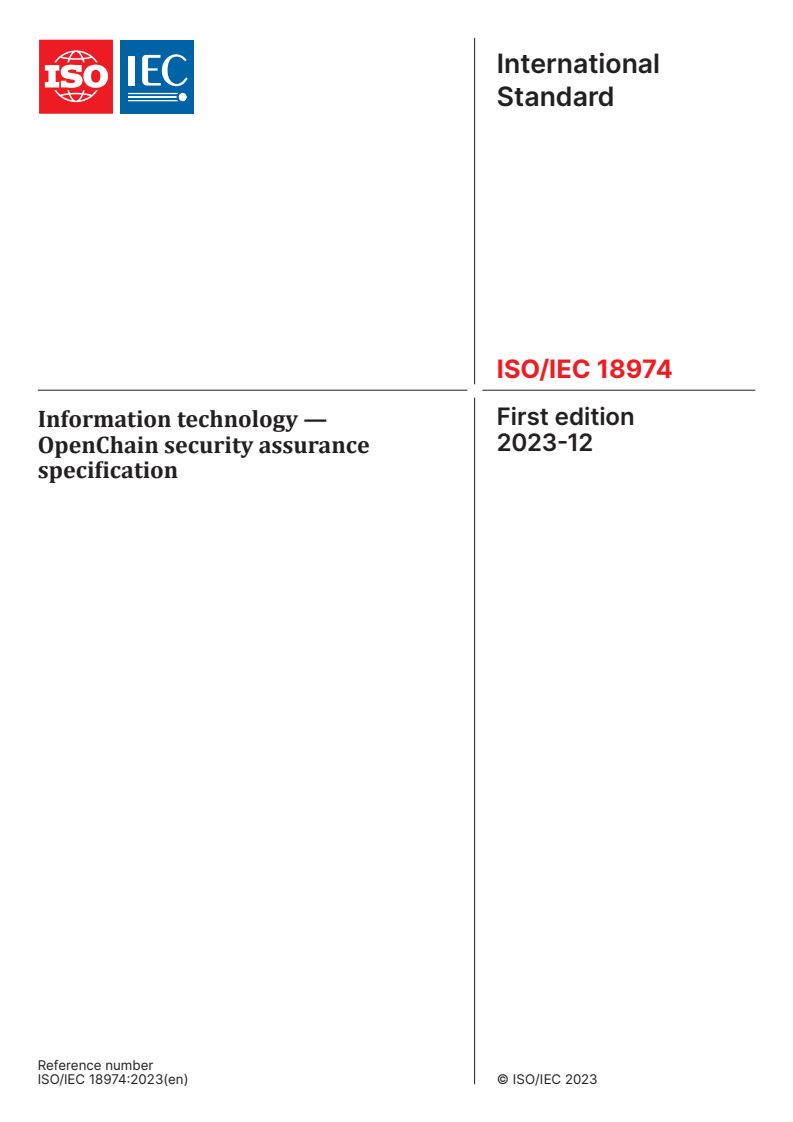
International
Standard
ISO/IEC 18974
First edition
Information technology —
2023-12
OpenChain security assurance
specification
Reference number
© ISO/IEC 2023
All rights reserved. Unless otherwise specified, or required in the context of its implementation, no part of this publication may
be reproduced or utilized otherwise in any form or by any means, electronic or mechanical, including photocopying, or posting on
the internet or an intranet, without prior written permission. Permission can be requested from either ISO at the address below
or ISO’s member body in the country of the requester.
ISO copyright office
CP 401 • Ch. de Blandonnet 8
CH-1214 Vernier, Geneva
Phone: +41 22 749 01 11
Email: copyright@iso.org
Website: www.iso.org
Published in Switzerland
© ISO/IEC 2023 – All rights reserved
ii
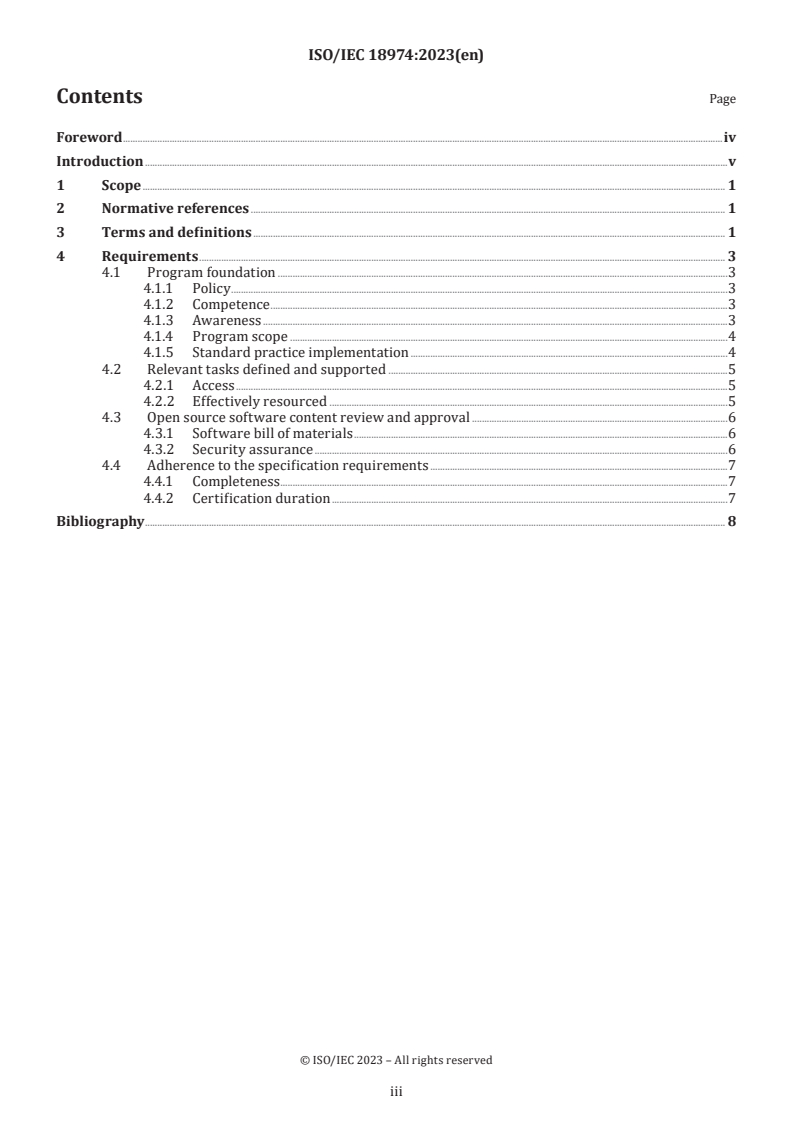
Contents Page
Foreword .iv
Introduction .v
1 Scope . 1
2 Normative references . 1
3 Terms and definitions . 1
4 Requirements . 3
4.1 Program foundation .3
4.1.1 Policy .3
4.1.2 Competence .3
4.1.3 Awareness .3
4.1.4 Program scope .4
4.1.5 Standard practice implementation .4
4.2 Relevant tasks defined and supported .5
4.2.1 Access .5
4.2.2 Effectively resourced .5
4.3 Open source software content review and approval .6
4.3.1 Software bill of materials .6
4.3.2 Security assurance .6
4.4 Adherence to the specification requirements .7
4.4.1 Completeness .7
4.4.2 Certification duration .7
Bibliography . 8
© ISO/IEC 2023 – All rights reserved
iii
Foreword
ISO (the International Organization for Standardization) and IEC (the International Electrotechnical
Commission) form the specialized system for worldwide standardization. National bodies that are
members of ISO or IEC participate in the development of International Standards through technical
committees established by the respective organization to deal with particular fields of technical activity.
ISO and IEC technical committees collaborate in fields of mutual interest. Other international organizations,
governmental and non-governmental, in liaison with ISO and IEC, also take part in the work.
The procedures used to develop this document and those intended for its further maintenance are described
in the ISO/IEC Directives, Part 1. In particular, the different approval criteria needed for the different types
of document should be noted (see www.iso.org/directives or www.iec.ch/members_experts/refdocs).
ISO and IEC draw attention to the possibility that the implementation of this document may involve the
use of (a) patent(s). ISO and IEC take no position concerning the evidence, validity or applicability of any
claimed patent rights in respect thereof. As of the date of publication of this document, ISO and IEC had not
received notice of (a) patent(s) which may be required to implement this document. However, implementers
are cautioned that this may not represent the latest information, which may be obtained from the patent
database available at www.iso.org/patents and https://patents.iec.ch ISO and IEC shall not be held
responsible for identifying any or all such patent rights.
Any trade name used in this document is information given for the convenience of users and does not
constitute an endorsement.
For an explanation of the voluntary nature of standards, the meaning of ISO specific terms and expressions
related to conformity assessment, as well as information about ISO's adherence to the World Trade
Organization (WTO) principles in the Technical Barriers to Trade (TBT), see www.iso.org/iso/foreword.html.
In the IEC, see www.iec.ch/understanding-standards.
This document was prepared by the Joint Development Foundation (JDF) (as OpenChain Security Assurance
Specification 1.1) and drafted in accordance with its editorial rules. It was adopted, under the JTC 1 PAS
procedure, by Joint Technical Committee ISO/IEC JTC 1, Information technology.
Any feedback or questions on this document should be directed to the user’s national standards
body. A complete listing of these bodies can be found at www.iso.org/members.html and
www.iec.ch/national-committees.
© ISO/IEC 2023 – All rights reserved
iv
Introduction
The OpenChain Project (see [4]) is working towards a supply chain where open source is delivered with
trusted and consistent compliance information. As part of this mission, the OpenChain Project maintains
ISO/IEC 5230 (see [1]), the International Standard for open source license compliance. A natural next step
in support of the broader mission was to develop a guide to identify and present the minimum core set
of requirements every security assurance program should satisfy with respect to the use of open source
software.
For context, ISO/IEC 5230 is a process management specification that identifies inbound, internal and
outbound inflection points where a process, policy or training should exist. The identification and tracking
of software used and deployed is an inherent part of getting this right, and this allows the approach to also
be useful for security or export control.
The OpenChain Project community noticed ISO/IEC 5230 being used in the security domain and decided to
develop this security specification to satisfy market demand. This specification is intended to identify and
describe the key requirements of a quality security assurance program in the context of using open source
Software. It focuses on a narrow subset of primary concern: checking open source Software against publicly
known security vulnerabilities like CVEs, GitHub/GitLab vulnerability reports, and so on.
This specification focuses on the “what” and “why” aspects of a quality security assurance program rather
than delving into to “how” and “when.” This was a conscious decision to ensure flexibility for organizations
of any size and in any market to use this specification. This approach, along with the types of processes
identified, is built on more than five years of practical, global feedback around the creation and management
of such programs. The result is that a company can frame a program that precisely fits their supply chain
requirements, scoped to a single product or a complete legal entity, and take this solution to market quickly
and effectively.
This specification was derived from [5]. That reference document went through a final approval process via
the OpenChain Project’s normal voting practice to transform into this published security specification. The
scope of this specification may expand over time based on community feedback.
Clause 4 defines the requirements that a program must satisfy to achieve a core level of security assurance.
Each requirement consists of one or more verification materials (i.e., records) that must be produced to
satisfy the requirement. Verification materials are not required to be made public, though an organization
may choose to provide them to others, potentially under a Non-Disclosure Agreement (NDA).
This specification is maintained by the OpenChain Project. Information about participation in that
maintenance is available at https://www.openchainproject.org/community.
© ISO/IEC 2023 – All rights reserved
v
International Standard ISO/IEC 18974:2023(en)
Information technology — OpenChain security assurance
specification
1 Scope
This specification contains the key requirements of a quality open source software security assurance
program that establishes trust between organizations exchanging software solutions comprised of open
source software.
2 Normative references
The following documents are referred to in the text in such a way that some or all of their content constitutes
requirements of this document. For dated references, only the edition cited applies. For undated references,
the latest edition of the referenced document (including any amendments) applies.
Free Software Definition, Free Software Foundation, www .gnu .org/ philosophy/ free -sw .html
The Minimum Elements For a Software Bill of Materials (SBOM), The United States Department of Commerce,
July 12, 2021, https:// www .ntia .doc .gov/ files/ ntia/ publications/ sbom _minimum _elements _report .pdf
Open Source Definition, Open Source Software Initiative, www .opensource .org/ osd
3 Terms and definitions
For the purposes of this document, the following terms and definitions apply.
ISO and IEC maintain terminology databases for use in standardization at the following addresses:
— ISO Online browsing platform: available at https:// www .iso .org/ obp
— IEC Electropedia: available at https:// www .electropedia .org/
3.1
component record
data set containing supplier name, component name, version of the component, other unique identifiers,
dependency relationship, author of SBOM data and timestamp, as defined by NTIA minimum elements for
SBoM
3.2
customer agreement
agreement that the processes used to find, track or fix security issues are regarded as sufficient and correct
by relevant customers or user organizations if applicable
3.3
common vulnerabilities and exposures
CVE
disclosed computer software security issues and flaws in a public database
Note 1 to entry: When someone refers to a CVE, they mean a security flaw that has been assigned a CVE ID number
within the database. The CVE database is sponsored by the US Department of Homeland Security (DHS) and the
Cybersecurity and Infrastructure Security Agency (CISA).
© ISO/IEC 2023 – All rights reserved
3.4
documented evidence
explicitly stored data that outlines, explains or records information related to activities and actions referred
to in this specification
3.5
known vulnerability
security vulnerability previously discovered in open source software (3.7) components that are publicly
available, including any publicly published vulnerabilities including, but not limited to, CVEs, GitHub/GitLab
vulnerability alerts, and package manager alerts
3.6
newly discovered vulnerability
security vulnerability just discovered in open source software (3.7) components that are publicly available,
including any publicly published vulnerabilities including, but not limited to, CVEs (3.3), GitHu
...
Questions, Comments and Discussion
Ask us and Technical Secretary will try to provide an answer. You can facilitate discussion about the standard in here.
Loading comments...