

ISO 11501:1995
(Main)Plastics — Film and sheeting — Determination of dimensional change on heating
General Information
- Abstract
Relates to a method of determining the dimensional change in the longitudinal and transverse directions, of plastics films and sheeting on heating. This method may be applied to plastics sheets, whether qualified as thermoshrinking or not.
- Status
- Published
- Publication Date
- 20-Sep-1995
- Technical Committee
- ISO/TC 61/SC 11 - Products
- Drafting Committee
- ISO/TC 61/SC 11/WG 3 - Plastics films and sheeting
- Current Stage
- 9093 - International Standard confirmed
- Start Date
- 08-Dec-2025
- Completion Date
- 29-Aug-2026
Buy Documents
ISO 11501:1995 - Plastics — Film and sheeting — Determination of dimensional change on heating Released:9/21/1995
ISO 11501:1995 - Plastiques — Film et feuille — Détermination de la variation dimensionnelle apres chauffage Released:9/21/1995
ISO 11501:1995 - Plastiques — Film et feuille — Détermination de la variation dimensionnelle apres chauffage Released:9/21/1995
Overview
ISO 11501:1995 specifies a laboratory method for determining the dimensional change on heating of plastics film and sheeting (up to 1 mm thick). The test measures changes in the longitudinal (machine) and transverse directions after controlled heating on a kaolin bed in a circulating-air oven. The procedure applies to both thermoshrinking/thermoforming materials and non‑shrink films, and is used to express shrinkage or elongation as a percentage change in gauge length.
Key topics and requirements
- Scope: Films and sheets up to 1 mm thick; measurement of dimensional change in longitudinal and transverse directions.
- Specimens: Three specimens ~120 mm × 120 mm, cut from centre and sides, with samples taken at least 50 mm from sheet edges; conditioned per ISO 291 prior to testing.
- Apparatus:
- Circulating-air oven with minimum six air changes per hour; oven temperature controlled to keep test assembly within ±2 °C (±1 °C if specified temperature < 100 °C).
- Metal container with a kaolin bed (~20 mm depth) sized to hold specimens flat without deformation.
- Temperature-measuring device (probe immersed in kaolin), graduated scale (0.5 mm resolution), stopwatch.
- Procedure:
- Mark longitudinal and transverse gauge lengths, measure initial lengths (L0, T0).
- Heat specimens on kaolin bed for specified time and temperature.
- After heating, cool specimens at least 30 minutes in the conditioning atmosphere and remeasure lengths (L, T).
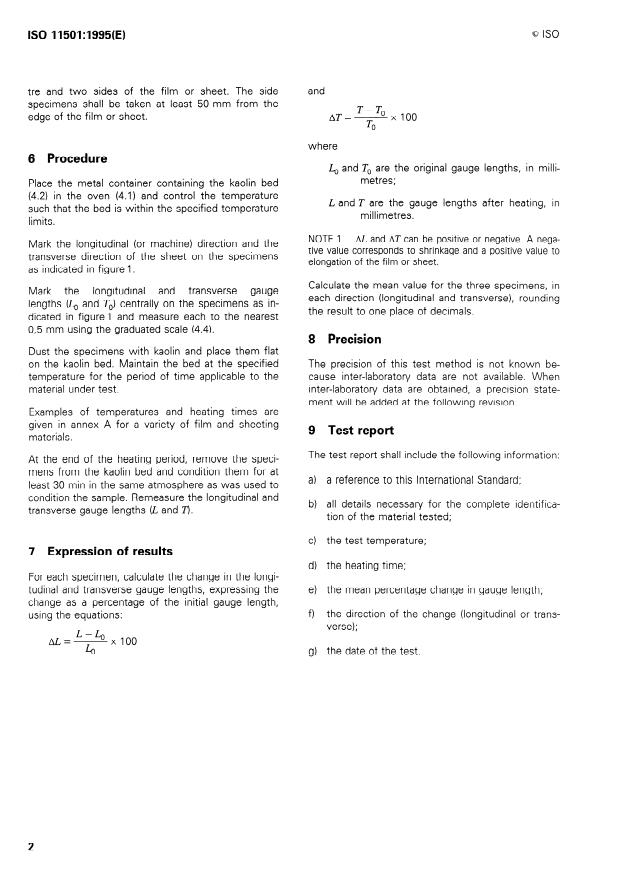
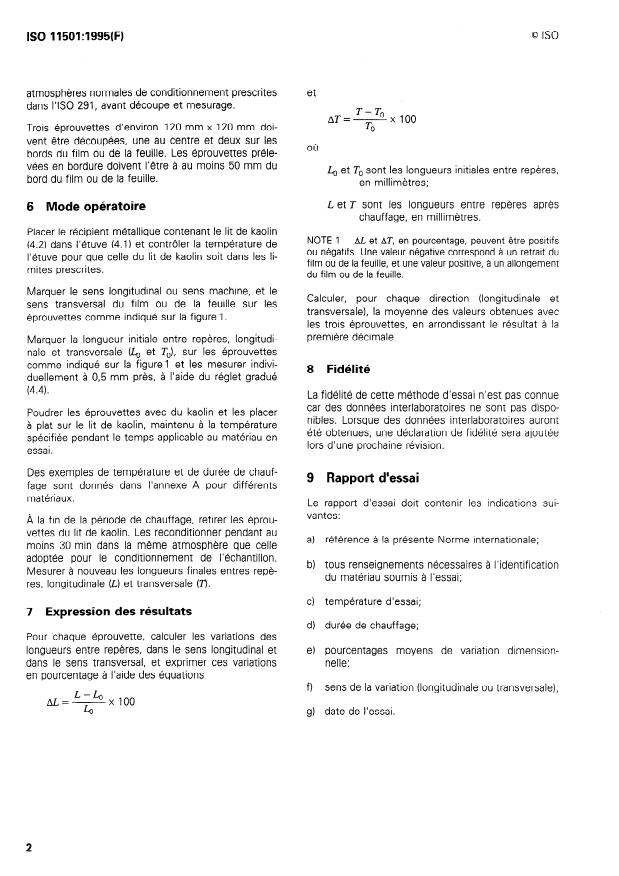
- Calculate percentage change: ΔL = (L − L0) / L0 × 100 (similarly ΔT).
- Reporting: Include reference to ISO 11501, material identification, test temperature and heating time, mean percentage change, direction of change, and test date.
- Annex A (informative): Provides example heating times (e.g., 5 min for non‑shrink films; 30 min for thermoshrinking/thermoforming) and recommended temperatures for common polymers (PVC, PE, PP, ABS, PMMA, cellulose acetate).
Applications and users
ISO 11501 is used to:
- Verify thermal dimensional stability for packaging films, shrink films, thermoformed parts and industrial sheets.
- Support quality control, material comparison, and supplier specifications for converters, film producers, and materials laboratories.
- Evaluate material suitability for processes involving heat (shrink tunnels, thermoforming ovens, heat-sealing).
Primary users:
- Plastics testing laboratories, quality engineers, R&D teams, converters (packaging, thermoforming), and standards/ compliance professionals.
Related standards
- ISO 291 - Standard atmospheres for conditioning and testing plastics (referenced for specimen conditioning).
Keywords: ISO 11501:1995, dimensional change, plastics film and sheeting, thermal shrinkage, kaolin bed, circulating-air oven, gauge length, thermoforming test.
Relations
- Effective Date
- 09-Feb-2026
- Effective Date
- 09-Feb-2026
- Effective Date
- 09-Feb-2026
- Effective Date
- 09-Feb-2026
- Effective Date
- 09-Feb-2026
- Effective Date
- 09-Feb-2026
- Effective Date
- 09-Feb-2026
Buy Documents
ISO 11501:1995 - Plastics — Film and sheeting — Determination of dimensional change on heating Released:9/21/1995
ISO 11501:1995 - Plastiques — Film et feuille — Détermination de la variation dimensionnelle apres chauffage Released:9/21/1995
ISO 11501:1995 - Plastiques — Film et feuille — Détermination de la variation dimensionnelle apres chauffage Released:9/21/1995
Get Certified
Connect with accredited certification bodies for this standard

DIN CERTCO
DIN Group product certification.

Smithers Quality Assessments
US management systems and product certification.
Sponsored listings
Frequently Asked Questions
ISO 11501:1995 is a standard published by the International Organization for Standardization (ISO). Its full title is "Plastics — Film and sheeting — Determination of dimensional change on heating". This standard covers: Relates to a method of determining the dimensional change in the longitudinal and transverse directions, of plastics films and sheeting on heating. This method may be applied to plastics sheets, whether qualified as thermoshrinking or not.
Relates to a method of determining the dimensional change in the longitudinal and transverse directions, of plastics films and sheeting on heating. This method may be applied to plastics sheets, whether qualified as thermoshrinking or not.
ISO 11501:1995 is classified under the following ICS (International Classification for Standards) categories: 83.140.10 - Films and sheets. The ICS classification helps identify the subject area and facilitates finding related standards.
ISO 11501:1995 has the following relationships with other standards: It is inter standard links to EN ISO 15013:2022, EN ISO 14631:1999, EN ISO 15015:2011, EN ISO 14631:2021, EN ISO 15013:2007, EN ISO 11833-2:2006, EN ISO 15015:2025. Understanding these relationships helps ensure you are using the most current and applicable version of the standard.
ISO 11501:1995 is available in PDF format for immediate download after purchase. The document can be added to your cart and obtained through the secure checkout process. Digital delivery ensures instant access to the complete standard document.
Standards Content (Sample)
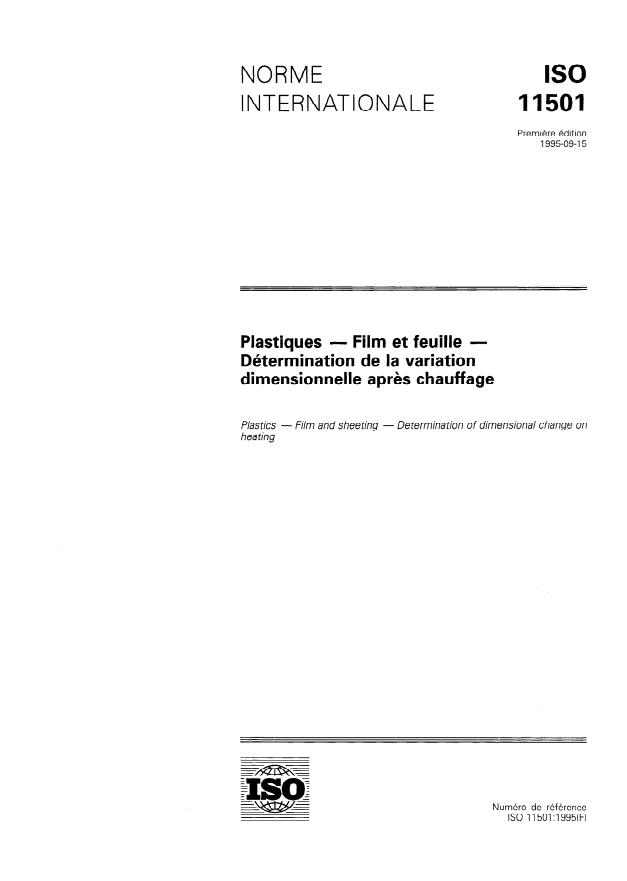
INTERNATIONAL
ISO
STANDARD
First edition
1995-09-15
Plastics - Film and sheeting -
Determination of dimensional Change on
heating
Plas tiques - Film et feuille - Determination de Ia Variation
dimensionnelle apr& chauffage
Reference number
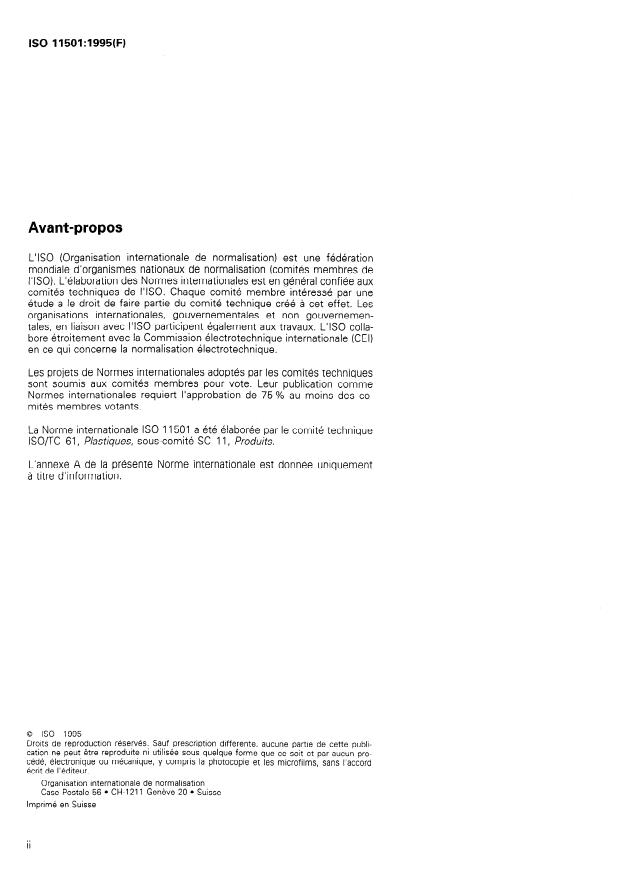
Foreword
ISO (the International Organization for Standardization) is a worldwide
federation of national Standards bodies (ISO member bodies). The work
of preparing International Standards is normally carried out through ISO
technical committees. Esch member body interested in a subject for
which a technical committee has been established has the right to be
represented on that committee. International organizations, governmental
and non-governmental, in liaison with ISO, also take part in the work. ISO
collaborates closely with the International Electrotechnical Commission
(IEC) on all matters of electrotechnical standardization.
Draft International Standards adopted by the technical committees are
circulated to the member bodies for voting. Publication as an International
Standard requires approval by at least 75 % of the member bodies casting
a vote.
International Standard ISO 11501 was prepared by Technical Committee
lSO/TC 61, Plastics, Subcommittee SC 11, Products.
Annex A of this International Standard is for information only.
0 ISO 1995
All rights reserved. Unless otherwise specified, no part of this publication may be reproduced
or utilized in any form or by any means, electronie or mechanical, rncluding photocopying and
microfilm, without Permission in writing from the publisher.
International Organrzation for Standardization
Case Postale 56 l CH-l 211 Geneve 20 l Switzerland
Printed in Switzerland
ii
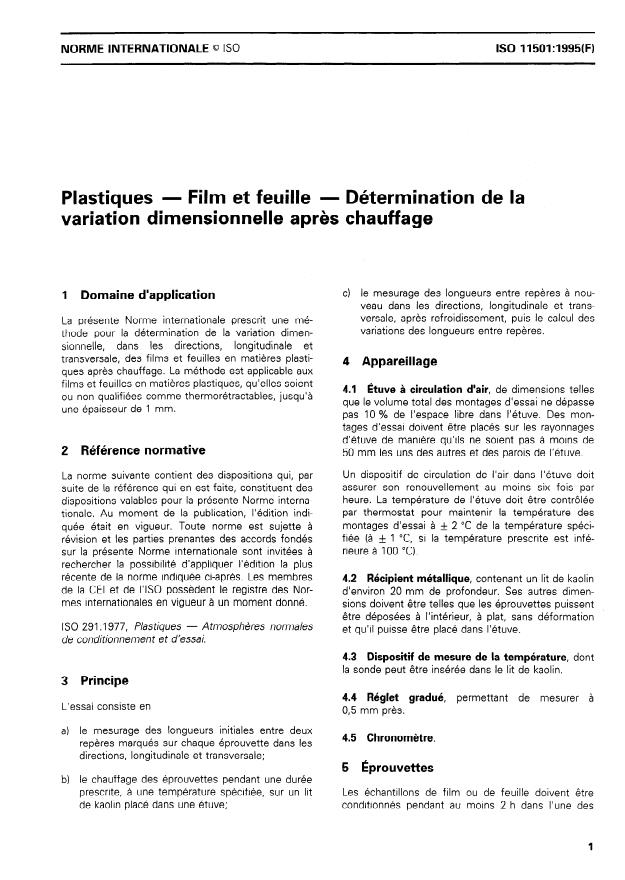
INTERNATIONAL STANDARD 0 ISO
Plastics - Film and sheeting - Determination of
heatina
dimensional Change on
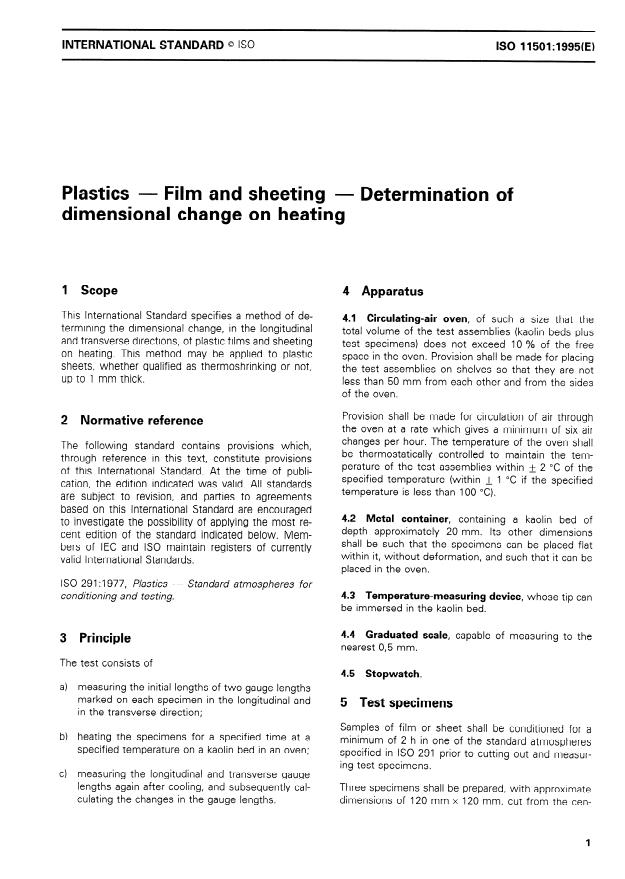
1 Scope 4 Apparatus
This International Standard specifies a method of de-
4.1 Circulating-air oven, of such a size that the
termining the dimensional Change, in the longitudinal
total volume of the test assemblies (kaolin beds plus
and transverse directions, of plastic films and sheeting
test specimens) does not exceed IO % of the free
on heating. This method may be applied to plastic
space in the oven. Provision shall be made for placing
sheets, whether qualified as thermoshrinking or not,
the test assemblies on shelves so that they are not
up to 1 mm thick.
less than 50 mm from each other and from the sides
of the oven.
Provision shall be made for circulation of air through
2 Normative reference
the oven at a rate which gives a minimum of six air
changes per hour. The temperature of the oven shall
The following Standard contains provisions which,
be thermostatically controlled to maintain the tem-
through reference in this text, constitute provisions
perature of the test assemblies within + 2 “C of the
-
of this International Standard. At the time of publi-
specified temperature (within + 1 “C if the specified
cation, the edition indicated was valid. All Standards
temperature is less than 100 ‘0.
are subject to revision, and Parties to agreements
based on this International Standard are encouraged
4.2 Metal Container, containing a kaolin bed of
to investigate the possibility of applying the most re-
depth approximately 20 mm. Its other dimensions
cent edition of the Standard indicated below. Mem-
shall be such that the specimens tan be placed flat
bers of IEC and ISO maintain registers of currently
within it, without deformation, and such that it tan be
valid International Standards.
placed in the oven.
ISO 291 :1977, Plastics - Standard atmospheres for
4.3 Temperature-measuring device, whose tip tan
conditioning and testing.
be immersed in the kaolin bed.
4.4 Graduated scale, capable of measuring to the
3 Principle
nearest 0,5 mm.
The test consists of
4.5 Stopwatch.
a) measuring the initial lengths of two gauge lengths
marked on each specimen in the longitudinal and
5 Test specimens
in the transverse direction;
Samples of film or sheet shall be conditioned for a
b) heating the specimens for a specified time at a
minimum of 2 h in one of the Standard atmospheres
specified
...
Iso
NORME
INTERNATIONALE 11501
Première édition
1995-09-I 5
Film et feuille -
Plastiques -
Détermination de la variation
dimensionnelle après chauffage
- Determination of dimensional change on
P/as tics - Film and sheeting
hea ting
Numéro de référence
Avant-propos
L’ISO (Organisation internationale de normalisation) est une fédération
mondiale d’organismes nationaux de normalisation (comités membres de
I’ISO). L’élaboration des Normes internationales est en général confiée aux
comités techniques de I’ISO. Chaque comité membre intéressé par une
étude a le droit de faire partie du comité technique créé à cet effet. Les
organisations internationales, gouvernementales et non gouvernemen-
tales, en liaison avec I’ISO participent également aux travaux. L’ISO colla-
bore étroitement avec la Commission électrotechnique internationale (CEI)
en ce qui concerne la normalisation électrotechnique.
Les projets de Normes internationales adoptés par les comités techniques
sont soumis aux comités membres pour vote. Leur publication comme
Normes internationales requiert l’approbation de 75 % au moins des co-
mités membres votants.
La Norme internationale ISO 11501 a été élaborée par le comité technique
lSO/TC 61, Plastiques, sous-comité SC 11, Produits.
la présen te Norme internationale est donnée
L’annexe A de uniquement
ation.
à titre d’inform
0 ISO 1995
Droits de reproduction réservés. Sauf prescription différente, aucune partie de cette publi-
cation ne peut être reproduite ni utilisée SOUS quelque forme que ce soit et par aucun pro-
cédé, électronique ou mécanique, y compris la photocopie et les microfilms, sans l’accord
écrit de l’éditeur.
Organisation internationale de normali sation
56 l CH-121 1 G enève 2 0 l Suisse
Case Postale
Imprimé en Suisse
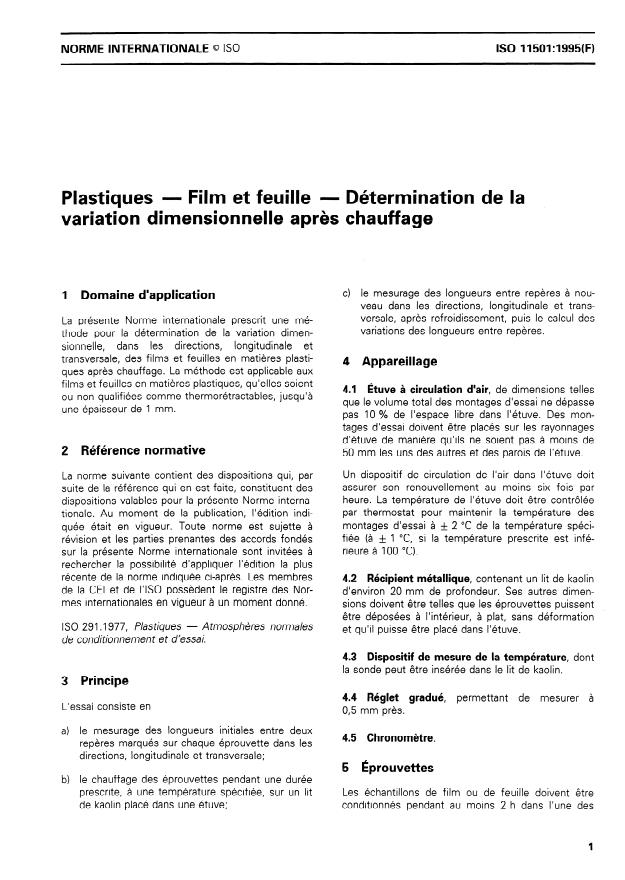
NORME INTERNATIONALE 0 KO ISO 11501:1995(F)
Plastiques - Film et feuille - Détermination de la
variation dimensionnelle après chauffage
c) le mesurage des longueurs entre repères à nou-
1 Domaine d’application
veau dans les directions, longitudinale et trans-
versale, après refroidissement, puis le calcul des
La présente Norme internationale prescrit une mé-
variations des longueurs entre repères.
thode pour la détermination de la variation dimen-
dans les directions, longitudinale et
sionnelle,
transversale, des films et feuilles en matières plasti-
4 Appareillage
ques après chauffage. La méthode est applicable aux
films et feuilles en matières plastiques, qu’elles soient
4.1 Étuve à circulation d’air, de dimensions telles
ou non qualifiées comme thermorétractables, jusqu’à
que le volume total des montages d’essai ne dépasse
une épaisseur de 1 mm.
pas 10 % de l’espace libre dans l’étuve. Des mon-
tages d’essai doivent être placés sur les rayonnages
d’étuve de manière qu’ils ne soient pas à moins de
2 Référence normative
50 mm les uns des autres et des parois de l’étuve.
La norme suivante contient des dispositions qui, par Un dispositif de circulation de l’air dans l’étuve doit
assurer son renouvellement au moins six fois par
suite de la référence qui en est faite, constituent des
heure. La température de l’étuve doit être contrôlée
dispositions valables pour la présente Norme interna-
par thermostat pour maintenir la température des
tionale. Au moment de la publication, l’édition indi-
montages d’essai à + 2 “C de la température spéci-
quée était en vigueur. Toute norme est sujette à
fiée (à + 1 “C, si la température prescrite est infé-
révision et les parties prenantes des accords fondés
rieure àloo OC).
sur la présente Norme internationale sont invitées à
rechercher la possibilité d’appliquer l’édition la plus
récente de la norme indiquée ci-après. Les membres
4.2 Récipient métallique, contenant un lit de kaolin
de la CEI et de NS0 possèdent le registre des Nor-
d’environ 20 mm de profondeur. Ses autres dimen-
mes internationales en vigueur à un moment donné.
sions doivent être telles que les éprouvettes puissent
être déposées à l’intérieur, à plat, sans déformation
ISO 291:1977, Plastiques - Atmosphères normales
et qu’il puisse être placé dans l’étuve.
de conditionnement et d’essai.
4.3 Dispositif de mesure de la température, dont
la sonde peut être insérée dans le lit de kaolin.
3 Principe
4.4 Réglet gradué, permettant de mesurer à
L’essai consiste en
0,5 mm près.
a) le mesurage des longueurs initiales entre deux
4.5 Chronomètre.
repères marqués sur chaque éprouvette dans les
directions, longitudinale et transversale;
5 Éprouvettes
b) le chauffage des éprouvettes pendant une durée
prescrite, à u
...
Iso
NORME
INTERNATIONALE 11501
Première édition
1995-09-I 5
Film et feuille -
Plastiques -
Détermination de la variation
dimensionnelle après chauffage
- Determination of dimensional change on
P/as tics - Film and sheeting
hea ting
Numéro de référence
Avant-propos
L’ISO (Organisation internationale de normalisation) est une fédération
mondiale d’organismes nationaux de normalisation (comités membres de
I’ISO). L’élaboration des Normes internationales est en général confiée aux
comités techniques de I’ISO. Chaque comité membre intéressé par une
étude a le droit de faire partie du comité technique créé à cet effet. Les
organisations internationales, gouvernementales et non gouvernemen-
tales, en liaison avec I’ISO participent également aux travaux. L’ISO colla-
bore étroitement avec la Commission électrotechnique internationale (CEI)
en ce qui concerne la normalisation électrotechnique.
Les projets de Normes internationales adoptés par les comités techniques
sont soumis aux comités membres pour vote. Leur publication comme
Normes internationales requiert l’approbation de 75 % au moins des co-
mités membres votants.
La Norme internationale ISO 11501 a été élaborée par le comité technique
lSO/TC 61, Plastiques, sous-comité SC 11, Produits.
la présen te Norme internationale est donnée
L’annexe A de uniquement
ation.
à titre d’inform
0 ISO 1995
Droits de reproduction réservés. Sauf prescription différente, aucune partie de cette publi-
cation ne peut être reproduite ni utilisée SOUS quelque forme que ce soit et par aucun pro-
cédé, électronique ou mécanique, y compris la photocopie et les microfilms, sans l’accord
écrit de l’éditeur.
Organisation internationale de normali sation
56 l CH-121 1 G enève 2 0 l Suisse
Case Postale
Imprimé en Suisse
NORME INTERNATIONALE 0 KO ISO 11501:1995(F)
Plastiques - Film et feuille - Détermination de la
variation dimensionnelle après chauffage
c) le mesurage des longueurs entre repères à nou-
1 Domaine d’application
veau dans les directions, longitudinale et trans-
versale, après refroidissement, puis le calcul des
La présente Norme internationale prescrit une mé-
variations des longueurs entre repères.
thode pour la détermination de la variation dimen-
dans les directions, longitudinale et
sionnelle,
transversale, des films et feuilles en matières plasti-
4 Appareillage
ques après chauffage. La méthode est applicable aux
films et feuilles en matières plastiques, qu’elles soient
4.1 Étuve à circulation d’air, de dimensions telles
ou non qualifiées comme thermorétractables, jusqu’à
que le volume total des montages d’essai ne dépasse
une épaisseur de 1 mm.
pas 10 % de l’espace libre dans l’étuve. Des mon-
tages d’essai doivent être placés sur les rayonnages
d’étuve de manière qu’ils ne soient pas à moins de
2 Référence normative
50 mm les uns des autres et des parois de l’étuve.
La norme suivante contient des dispositions qui, par Un dispositif de circulation de l’air dans l’étuve doit
assurer son renouvellement au moins six fois par
suite de la référence qui en est faite, constituent des
heure. La température de l’étuve doit être contrôlée
dispositions valables pour la présente Norme interna-
par thermostat pour maintenir la température des
tionale. Au moment de la publication, l’édition indi-
montages d’essai à + 2 “C de la température spéci-
quée était en vigueur. Toute norme est sujette à
fiée (à + 1 “C, si la température prescrite est infé-
révision et les parties prenantes des accords fondés
rieure àloo OC).
sur la présente Norme internationale sont invitées à
rechercher la possibilité d’appliquer l’édition la plus
récente de la norme indiquée ci-après. Les membres
4.2 Récipient métallique, contenant un lit de kaolin
de la CEI et de NS0 possèdent le registre des Nor-
d’environ 20 mm de profondeur. Ses autres dimen-
mes internationales en vigueur à un moment donné.
sions doivent être telles que les éprouvettes puissent
être déposées à l’intérieur, à plat, sans déformation
ISO 291:1977, Plastiques - Atmosphères normales
et qu’il puisse être placé dans l’étuve.
de conditionnement et d’essai.
4.3 Dispositif de mesure de la température, dont
la sonde peut être insérée dans le lit de kaolin.
3 Principe
4.4 Réglet gradué, permettant de mesurer à
L’essai consiste en
0,5 mm près.
a) le mesurage des longueurs initiales entre deux
4.5 Chronomètre.
repères marqués sur chaque éprouvette dans les
directions, longitudinale et transversale;
5 Éprouvettes
b) le chauffage des éprouvettes pendant une durée
prescrite, à u
...