

ISO/IEC 13886:1996
(Main)Information technology — Language-Independent Procedure Calling (LIPC)
General Information
- Abstract
Specifies a model for procedure calls, and a reference syntax for mapping to and from the model. The syntax is referred to as the Interface Definition Notation. The model includes procedure invocation, parameter passing, completion status and environmental issues.
- Status
- Published
- Publication Date
- 27-Mar-1996
- Current Stage
- 9093 - International Standard confirmed
- Start Date
- 24-Sep-2024
- Completion Date
- 29-Aug-2026
Overview
ISO/IEC 13886:1996 - Information technology: Language‑Independent Procedure Calling (LIPC) defines a formal, language‑neutral model for procedure calls and a reference syntax for mapping language-specific call semantics to that model. The syntax - the Interface Definition Notation (IDN) - provides a way to describe procedure invocation, parameter passing, completion status and environmental issues (non‑local references and state). ISO/IEC 13886 is intended to enable mixed‑language programming, common procedure libraries, and language‑independent tools by specifying how different programming languages map their native calling conventions to a single model.
Key Topics
- Procedure calling model: A formal model of procedure invocation, execution contexts, and closures that language processors can map to/from.
- Parameter passing mechanisms: Defined calling modes (input, input/output, return behavior) and detailed parameter marshalling/unmarshalling rules including pointer and private types handling.
- Execution control and termination: Synchronous vs asynchronous calls, normal and abnormal termination, external cancellation and predefined termination conditions.
- Global state and non‑local references: Definition of boxes (containers), global symbols and global state, and how these interact across language boundaries.
- Interface Definition Notation (IDN): A reference syntax for describing interface types, datatypes, procedures, value references and imports to support cross‑language bindings.
- Conformance modes: Client mode and server mode conformance expectations for language processors.
- Annexes and mappings: Informative annexes with binding guidance, examples of parameter conventions, and an alignment overview with RPC/IDL concepts.
Applications and Who Uses It
ISO/IEC 13886 (LIPC) is practical for:
- Language designers defining standard mappings from native call semantics to a language‑independent model.
- Compiler and runtime implementers creating client/server mode bindings or mixed‑language execution environments.
- Middleware and tool vendors building IDL/IDL‑like interface tools, procedure libraries, or cross‑language stubs and skeletons.
- Systems integrators implementing heterogeneous systems where procedures are invoked across different languages or processors. It is useful wherever consistent procedure calling semantics, parameter marshalling, and predictable cross‑language invocation behavior are required - while noting the standard does not specify transport/communication protocols or concrete parameter representations.
Related Standards
- ISO/IEC 11404:1996 - Language‑independent datatypes (used by LIPC for datatype definitions)
- ISO/IEC 8824‑1 / 8825‑1 - ASN.1 and encoding rules (referenced)
- ISO/IEC 10646‑1:1993, ISO 2375:1985 - character sets and escape sequence references
- Annex D of ISO/IEC 13886 compares LIPC concepts with RPC/IDL approaches (ISO/IEC 11578/RPC alignment).
Keywords: ISO/IEC 13886, Language‑Independent Procedure Calling, LIPC, Interface Definition Notation, procedure calling model, parameter passing, mixed‑language programming, interface mapping.
Relations
- Effective Date
- 06-Jun-2022
Get Certified
Connect with accredited certification bodies for this standard

BSI Group
BSI (British Standards Institution) is the business standards company that helps organizations make excellence a habit.

NYCE
Mexican standards and certification body.
Sponsored listings
Frequently Asked Questions
ISO/IEC 13886:1996 is a standard published by the International Organization for Standardization (ISO). Its full title is "Information technology — Language-Independent Procedure Calling (LIPC)". This standard covers: Specifies a model for procedure calls, and a reference syntax for mapping to and from the model. The syntax is referred to as the Interface Definition Notation. The model includes procedure invocation, parameter passing, completion status and environmental issues.
Specifies a model for procedure calls, and a reference syntax for mapping to and from the model. The syntax is referred to as the Interface Definition Notation. The model includes procedure invocation, parameter passing, completion status and environmental issues.
ISO/IEC 13886:1996 is classified under the following ICS (International Classification for Standards) categories: 35.060 - Languages used in information technology. The ICS classification helps identify the subject area and facilitates finding related standards.
ISO/IEC 13886:1996 has the following relationships with other standards: It is inter standard links to ISO 4263-3:2006. Understanding these relationships helps ensure you are using the most current and applicable version of the standard.
ISO/IEC 13886:1996 is available in PDF format for immediate download after purchase. The document can be added to your cart and obtained through the secure checkout process. Digital delivery ensures instant access to the complete standard document.
Standards Content (Sample)
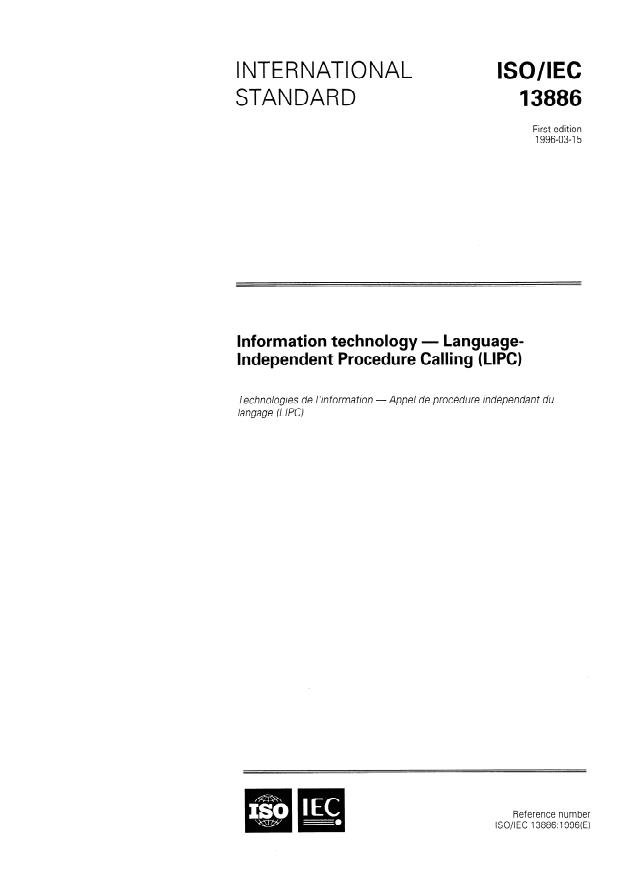
INTERNATIONAL
lSO/IEC
STANDARD
First edition
1996-03-l 5
Information technology - Language-
Independent Procedure Calling (LIPC)
Technologies de I ‘information
- Appel de procbdure indbpendant du
langage (L/PC)
Reference number
ISO/lEC 13886:1996(E)
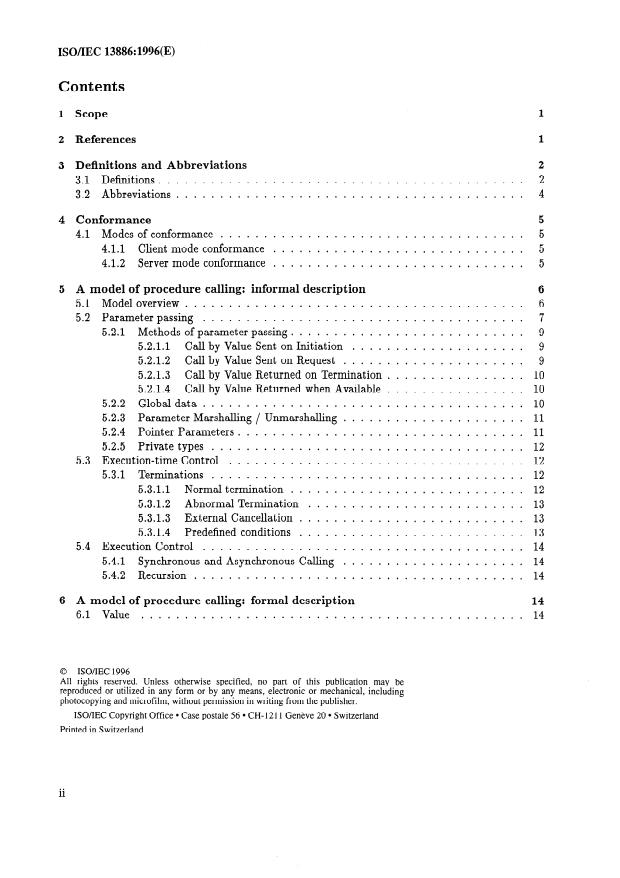
Contents
1 Scope
2 References
3 Definitions and Abbreviations
3.1 Definitions. .
3.2 Abbreviations .
4 Conformance
4.1 Modes of conformance .
4.1.1 Client mode conformance .
.............................
4.1.2 Server mode conformance
5 A model of procedure calling: informal description
5.1 Model overview . 6
5.2 Parameter passing . 7
5.2.1 Methods of parameter passing . 9
5.2.1.1 Call by Value Sent on Initiation . 9
Call by Value Sent on Request . 9
5.2.1.2
5.2.1.3 Call by Value Returned on Termination . 10
5.2.1.4 Call by Value Returned when Available .
5.2.2 Global data .
5.2.3 Parameter Marshalling / Unmarshalling . 11
5.2.4 Pointer Parameters .
5.2.5 Private types . 12
5.3 Execution-time Control . 12
5.3.1 Terminations . 12
Normal termination . 12
5.3.1.1
5.3.1.2 Abnormal Termination . 13
......................... .
5.3.1.3 External Cancellation 13
5.3.1.4 Predefined conditions . 13
5.4 Execution Control . . 14
5.4.1 Synchronous and Asynchronous Calling . 14
..................................... 14
5.4.2 Recursion
6 A model of procedure calling: formal description
6.1 Value . . . . . . . . . . . . . . . . . . . . . . . . . . . . . . . . . . “. 14
0 ISO/IEC 1996
All rights reserved. Unless otherwise specified, no part of this publication may be
reproduced or utilized in any form or by any means, electronic or mechanical, including
photocopying and microfilm, without permission in writing from the publisher.
ISO/IEC Copyright Office l Case postale 56 l CH-1211 Geneve 20 l Switzerland
Printed in Switzerland
ISO/IEC 13886: 1996(E)
@ ISO/IEC
................................... 14
6.2 Boxes and global state
........................................... 15
6.3 Symbol
......................................
6.4 Procedure image
......................................... 16
6.5 Association
..................................... 17
6.6 Procedure closures
.......................... 17
6.7 Boxes, pointers, values, and datatypes
......................................
6.8 Interface closure
6.9 Interfacetype .
........................................
6.10 Specifications
................................ 20
6.11 Basic procedure invocation
......................................
6.12 Type correctness
..........................................
6.13 Associates
.................................
6.13.1 Simple Associates
...............................
6.13.2 Generalized Associates
............................ 23
6.14 Execution and Invocation contexts
...................................
6.15 Parameter translations
.............................
6.16 Defining Translation Procedures
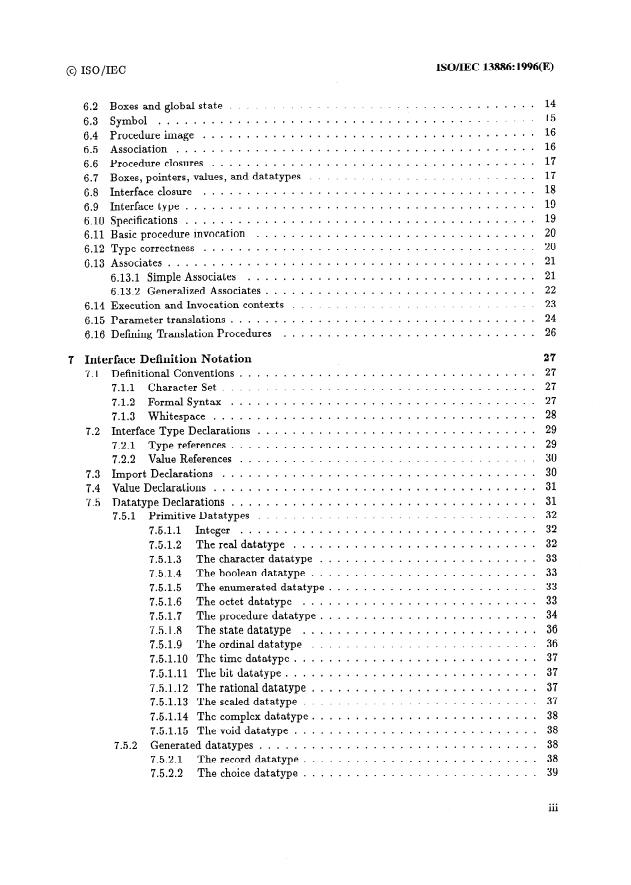
7 Interface Definition Notation
.................................. 27
7.1 Definitional Conventions
....................................
71.1 Character Set
...................................
7.1.2 Formal Syntax
.....................................
7.1.3 Whitespace
................................ 29
7.2 Interface Type Declarations
...................................
7.2.1 Type references
..................................
7.2.2 Value References
....................................
7.3 Import Declarations
.....................................
7.4 Value Declarations
................................... 31
7.5 Datatype Declarations
................................ 32
7.5.1 Primitive Datatypes
.................................. 32
7.5.1.1 Integer
............................
7.5.1.2 The real datatype
.........................
7.5.1.3 The character datatype
.......................... 33
7.5.1.4 The boolean datatype
........................
7.5.1.5 The enumerated datatype
........................... 33
7.5.1.6 The octet datatype
.........................
7.5.1.7 The procedure datatype
...........................
7.5.1.8 The state datatype
..........................
7.5.1.9 The ordinal datatype
............................ 37
7.5.1.10 The time datatype
............................ 37
7.5.1.11 The bit datatype.
.......................... 37
7.5.1.12 The rational datatype
........................... 37
7.5.1.13 The scaled datatype
..........................
7.5.1.14 The complex datatype
............................
7.5.1.15 The void datatype
................................
7.5.2 Generated datatypes
...........................
7.5.2.1 The record datatype
........................... 39
7.5.2.2 The choice datatype
. . .
@ ISO/IEC
........................... 39
7.5.2.3 The array datatype
..........................
7.5.2.4 The pointer datatype
...................................... 40
7.5.3 Subtypes
.................................... 40
7.6 Parameterized Types
.......................................... 41
7.7 Identifiers
.............................. 42
7.7.1 Value references to fields
7.7.2 Value references to parameters, return-args, or to fields contained within them 42
...................... 43
7.7.3 Value references to formal-value-parms
....................... 43
7.7.4 Value references to value-expressions
.................... 43
7.7.5 Value references to enumeration-identifiers
............................... 44
7.7.6 Termination references
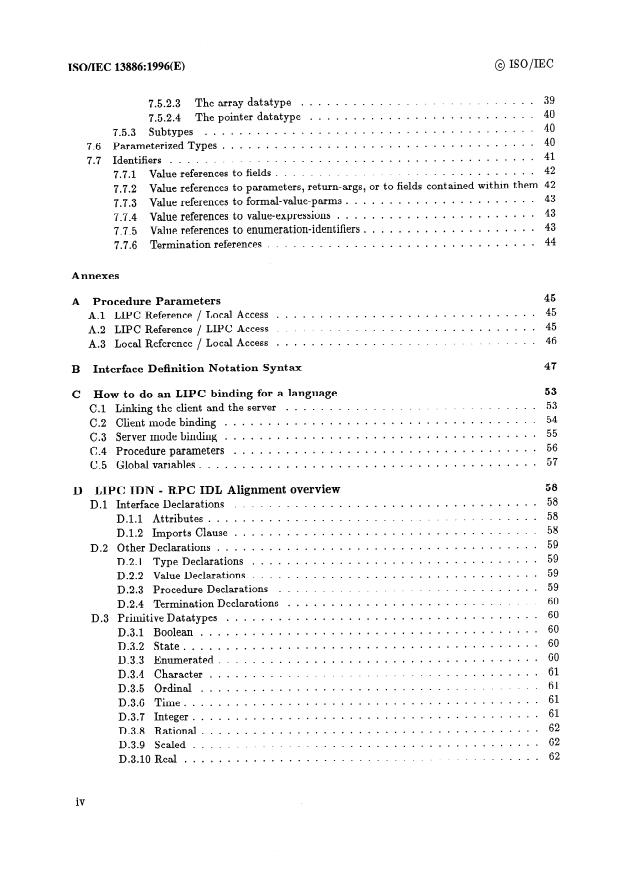
Annexes
A Procedure Parameters
.............................. 45
A.1 LIPC Reference / Local Access
..............................
A.2 LIPC! Reference / LIPC Access
..............................
A.3 Local Reference / Local Access
B Interface Definition Notation Syntax
C How to do an LIPC binding for a language
............................. 53
C.1 Linking the client and the server
.................................... 54
C.2 Client mode binding
.................................... 55
C.3 Server mode binding
................................... 56
C.4 Procedure parameters
....................................... 57
C.5 Global variables
D LIPC IDN - RPC IDL Alignment overview
................................... 58
D.l Interface Declarations
...................................... 58
D.l.l Attributes
...................................
D.l.2 Imports Clause
.....................................
D.2 Other Declarations
................................. 59
D.2.1 Type Declarations
................................. 59
D.2.2 Value Declarations
.............................. 59
D.2.3 Procedure Declarations
............................. 60
D.2.4 Termination Declarations
.................................... 60
D.3 Primitive Datatypes
....................................... 60
D.3.1 Boolean
......................................... 60
D.3.2 State
.................................... 60
D.3.3 Enumerated.
...................................... 61
D.3.4 Character
....................................... 61
D.3.5 Ordinal
.......................................
D.3.6 Time.
........................................ 61
D.3.7 Integer
....................................... 62
D.3.8 Rational
........................................
D.3.9 Scaled
......................................... 62
D.3.10 Real
iv
ISO/IEC 13886: 1996(E)
@ ISO/IEC
.....................................
D.3.11Complex.
D.3.12Void .
D.4 Type Qualifiers .
D.5 Generated Datatypes .
D.5.1 Choice .
D.5.2 Pointer .
D.5.3 Procedure .
....................................
D.6 Aggregate Datatypes
D.6.1 Record. .
D.6.2 Set. .
D.6.3 Bag .
D.6.4 Sequence .
........................................
D.6.5 Array
D.6.6 Table .
............................
D.7 Derived Datatypes and Generators
...................................
D.7.1 Naturalnumber
D.7.2 Modulo .
D.7.3 Bit .
D.7.4 Bitstring. .
D.7.5 Characterstring .
....................................
D.7.6 Timeinterval
D.7.7 Octet .
D.7.8 Octetstring .
.......................................
D.7.9 Private
D.8 Other RPC Datatypes .
. “Dependent Values” .
D.9
D.10 Cross References .
V
@ ISO/IEC
Foreword
IS0 (the International Organization for Standardization) and IEC (the International Electrotech-
nical Commission) form the specialized system for worldwide standardization. National bodies
that are members of IS0 or IEC participate in the development of International Standards through
technical committees established by the respective organizations to deal with particular fields of
technical activity. IS0 and IEC technical committees collaborate in fields of mutual interest. Other
international organizations, governmental and non-governmental, in liaison with IS0 and IEC, also
take part in the work.
In the field of information technology, IS0 and IEC have established a joint technical committee,
ISO/IEC JTC 1. Draft International Standards adopted by the joint technical cotittee are
circulated to national bodies for voting. Publication as an International Standard requires approval
by at least 75 % of the national bodies casting a vote.
International Standard ISO/IEC 13886 was prepared by Joint Technical Committee ISO/IEC
JTC 1, Information technology, Subcommittee SC 22, Programming languages, their environments
and system software interfaces.
Annexes A to D of this International Standard are for information only.
vi
@ ISO/IEC ISO/IEC 13886: 1996(E)
Introduction
The purpose of this International Standard is to provide a common model for language standards for
the concept of procedure calling. It is an enabling standard to aid in the development of language-
independent tools and services, common procedure libraries and mixed language programming. In
mixed language applications, server procedures would execute on language processors operating
in server mode, and the procedures would be called from language processors operating in client
mode. Note that the languages need not be different, and if the processors are the same the model
collapses into conventional single processor programming.
Most programming languages include the concepts of procedures and their invocation. The main
variance between the methods used in various programming languages lies in the ways parameters
are passed between the client and server procedures. Procedure calling is a simple concept at the
functional level, but the interaction of procedure calling with datatyping and program structure
along with the many variations on procedure calling and restrictions on calling that are applied by
various programmin g languages transforms the seemingly simple concept of procedure calling into
a more complex feature of programming languages.
The need for a standard model for procedure calling is evident from the multitude of variants of
procedure calling in the standardized languages. The existence of this International Standard for
Language-Independent Procedure Calling (LIPC) d oes not require that all programming languages
should adopt this model as their sole means of procedure calling. The nominal requirement is
for programming languages to provide a mapping to LIPC from their native procedure calling
mechanism, and to be able to accept calls from other programmin g languages who have defined a
mapping to this International Standard.
This International Standard is a specification of a common model for procedure calling. It is not
intended to be a specification of how an implementation of the LIPC is to be provided. Also, it
is important to note that it does not address the question of how the procedure call initiated by
the client mode processor is communicated to the server mode processor, or how the results are
returned. The model defined in this International Standard is intended for use by languages so
that they may provide standard mappings from their native procedure model. This International
Standard depends on the International Standard for Language-Independent Datatypes, ISO/IEC
11404, for the definition of the datatypes that are to be supported in the model for LIPC that it
provides.
vii
This page intentionally left blank
INTERNATIONAL STANDARD @ ISO/IEC
Information technology -
Language-Independent Procedure Calling (LIPC)
1 Scope
This International Standard specifies a model for procedure calls, and a reference syntax for map-
to and from the model. This syntax is referred to as the Interface Definition Notation. The
Pi%
‘I
model defined in this International Standard includes such features as procedure invocation, pa-
rameter passing, completion status, and environmental issues relating to non-local references and
state.
This International Standard does not specify:
l the method by which the procedure call initiated by the client mode processor is communi-
cated to the server mode language processor;
l the minimum requirements of a data processing system that is capable of supporting an
implementation of a language processor to support LIPC;
l the mechanism by which programs written to support LIPC are transformed for use by a
data processing system;
l the representation of a parameter.
NOTE - Originally it was the intention to align the definitions and concepts of this International
Standard with those of the RPC standard (ISO/IEC 11578). Unfortunately, in a late stage of the
development process of the RPC standard it was decided to use for that standard a completely
different approach. Hence the intended alignment did not materialize.
Annex D gives an overview of the differences between the concepts as defined by this Interna-
tional Standard and the RPC standard.
2 Normative References
The following standards contain provisions which, through reference in this text, constitute pro-
visions of this International Standard. At the time of publication, the editions indicated were
valid. All standards are subject to revision, and parties to agreements based on this International
Standard are encouraged to investigate the possibility of applying the most recent editions of the
standards indicated below. Members of IEC and IS0 maintain registers of current valid Interna-
tional Standards.
Procedure for registration of escape sequences.
IS0 23751985, Data processing -
Universal Multiple-Octet Coded Character
ISO/IEC! 10646-l: 1993, Information technology -
Set (KS) - Part 1: Architecture and Basic Multilingual Plane.
- Programming languages, their environments
ISO/IEC 11404:1996, Information technology
and system software interfaces - Language-independent datatypes.
ISO/IEC 8824-l: 1995, Information technology - Abstract Syntax Notation One (ASN. 1):
Specification of basic notation.
ISOIIEC 8825~1:1995, Information technology - ASN.1 encoding rules: Specification of Basic
Encoding Rules (BER), Canonical Encoding Rules (CER) and Distinguished Encoding Rules
(DER).
3 Definitions and Abbreviations
3.1 Definitions
For the purposes of this International Standard, the following definitions apply.
3.1.1 actual parameter: A value that is bound to a formal parameter during the execution of
a procedure.
3.1.2 association: Any mapping from a set of symbols to values.
3.1.3 box: A model of a variable or container that holds a value of a particular type.
3.1.4 client interface binding: The possession by the client procedure of an interface reference.
3.1.5 client procedure: A sequence of instructions which invokes another procedure.
3.1.6 complete procedure closure: A procedure closure, all of whose global symbols
are
mapped.
3.1.7 configuration: Host and target computers, any operating system(s) and software used
to operate a processor.
3.1.8 execution sequence: A succession of global states ~1, ~2, . . . where each state beyond
the first is derived from the preceding one by a single create operation or a single write operation.
3.1.9 formal parameter: The name symbol of a parameter used in the definition of a procedure
to which a value will be bound during execution.
3.1.10 global state: The set of all existing boxes and their currently assigned values.
3.1.11 global symbol:
Symbol used to refer to values that are permanently associated with a
procedure.
3.1.12 implementation defined:
An implementation defined feature is a feature that is
left implementation dependent by this International Standard, but any implement ation claiming
conformity to this International Standard shall explicitly specify how this feature is provided.
@ ISO/IEC
3.1.13 implementation dependent: An implementation dependent feature is a feature which
shall be provided by an implementation claiming conformity to this International Standard, but
the implementation need not to specify how the feature is provided.
A formal parameter
3.1.14 input parameter: with an attribute indicating that the corre-
actual parameter is to be made available to the server procedure on entry
sponding from the client
procedure.
3.1.15 input/output parameter: A formal parameter with an attribute indicating that the
corresponding actual parameters are made available to the server procedure on entry from the client
procedure and to the client procedure on return from the server procedure.
3.1.16 interface closure: A collection of names and a collection of procedure closures, with a
mapping between them.
3.1.17 interface execution context:
The union of the procedure execution contexts for a
given interface closure.
3.1.18 interface reference: An identifier that denotes a particular interface instance.
3.1.19 interface type: A collection of names and a collection of procedure types, with a
mapping between them.
3.1.20 interface type identifier: An identifier that denotes an interface type.
3.1.21 invocation association: The invocation association of a procedure closure
Association> applied to a set of actual parameter values is the association of the closure augmented
by a mapping of all local symbols to values and all formal parameter symbols to the corresponding
actual parameter values. Thus it is a binding to values of all symbols in the procedure image for
the duration of the’ invocation.
3.1.22 invocation context:
For a particular procedure call, the instance of the objects
referenced by the procedure, where the lifetime of the objects is bounded by the lifetime of the call.
3.1.23 marshalling: A process of collecting actual parameters, possibly converting them, and
assembling them for transfer.
3.1.24 output parameter: A formal parameter with an attribute indicating that the corre-
sponding actual parameter is to be made available to the client procedure on return from the server
procedure.
3.1.25 parameter: A parameter is used to communicate a value from a client to a server
procedure. The value supplied by the client is the actual parameter, the formal parameter is used
to identify the received value in the server procedure.
3.1.26 partial procedure closure: A procedure closure, some of whose global symbols are
not mapped. Procedure closures may be complete, with all global symbols mapped, or partial with
one or more global symbols not mapped.
3.1.27 procedure: The procedure value.
3.1.28 procedure call: The act of invoking a procedure.
3.1.29 procedure closure: A pair where the association
defines the mapping for the image’s global symbols and no others.
@ ISO/IEC
Procedure closures are the values of procedure type referred to in ISO/IEC 11404 -
NOTE -
Language-Independent Datatypes.
For a particular procedure, an instance of the objects
3.1.30 procedure execution context:
satisfying the external references necessary to allow the procedure to operate, where these objects
have a lifetime longer than a single call of that procedure.
A representation of a value of a particular procedure type, which
3.1.31 procedure image:
embodies a particular sequence of instructions to be performed when the procedure is called.
3.1.32 procedure invocation: The object which represents the triple: procedure image,
execution context, and invocation context.
The name of a procedure within an interface type definition.
3.1.33 procedure name:
The act of return from the server procedure with a specific termi-
3.1.34 procedure return:
nation.
The family of datatypes each of whose members is a collection of
3.1.35 procedure type:
operations on values of other datatypes. Note, this is a different definition from procedure value.
3.1.36 procedure value: A closed sequence of instructions that is entered from, and returns
control to, an external source.
3.1.37 processor: A compiler or interpreter working in combination with a configuration.
3.1.38 server procedure: The procedure which is invoked by a procedure call.
3.1.39 symbol: A program entity used to refer to a value.
3.1.40 termination: A predefined status related to the completion of a procedure call.
3.1.41 unmarshalling: The process of disassembling the transferred parameters, possibly
converting them, for use by the server procedure on invocation or by the client procedure upon
procedure return.
3.1.42 value: The set Value contains all the values that might arise in a program execution.
3.2 Abbreviations
3.2.1 ASN.l: Abstract Syntax Notation - One
3.2.2 IDN: Interface Definition Notation
3.2.3 LID: Language-Independent Datatypes, as defined in ISO/IEC 11404:1995.
3.2.4 LIPC: Language-Independent Procedure Calling
@ ISO/IEC ISO/IEC 13886: 1996(E)
4 Conformance
A language processor may conform to this International Standard by mapping its native procedure
calling mechanism to the LIPC model that this International Standard defines.
NOTE - The term “language processor” used in this clause may be extended to include
anything which processes information and contains a procedure dling mechanism.
4.1 Modes of conformance
A language processor claiming conformance to this International Standard shall conform in either
or both of the following ways.
4.1.1 Client mode conformance
In order to conform in client mode, a language processor shall allow programs written in its lan-
guage to call procedures written in another language and supported by another processor, using
the language-independent procedure calling (LIP C) as p rovided by clauses 5, 6 and 7 of this Inter-
national Standard. In this case it is said to conform in (and be able of operating in) client mode.
As part of this, the language processor shall define a mapping from its own procedure calling model
to the LIPC model.
NOTE - If a program using the LIPC facility is to be portable between processors which
conform in client mode, the program and processors will also need to conform to the relevant
language standard and the relevant standards binding for that language to the LIPC and LID
standards.
4.1.2 Server mode conformance
In order to conform in server mode, a language processor shall allow programs written in another
language to call procedures written in its language (i.e. it will accept and execute procedure calls
generated by another processor which is executing in a program that is written in that other
language and which is operating in client mode, and return control to that client processor upon
completion), using the language-independent procedure calling (LIPC) as provided by clauses 5, 6
and 7 of this International Standard. In this case it is said to conform in (and be able of operating
As part of this, the language processor shall define a mapping from the LIPC
in) server mode.
model to its own procedure calling model.
NOTES
1 It’ is also possible in principle for a client processor to use the model for procedure calls
defined in this International Standard to call procedures in the same language; executing on
a server processor in the same language, and if the processor conforms in both client and
server mode, it is even possible for it to serve itself using this model.
2 If a procedure is to be portable between processors which conform in server mode and the
procedure is still to be called by client processors and programs, the procedure, and the
processors, will also need to conform to the relevant language standard and the relevant
standards binding for that language to the LIPC and LID standards.
5 A model of procedure calling: informal description
5.1 Model overview
A procedure is defined to be a closed sequence of instructions that is entered from, and returns
control to, an external source.
The general structure of a procedure call can be described as a single thread of execution in
a particular program where the flow of control is passed from one procedure to another. The
originator of the call is known as the client procedure and the procedure being called is referred to
as the server procedure.
It is possible for a server procedure to also be a client procedure if it makes a call
NOTE 1 -
to another procedure in order to complete its desired function.
Procedures have the ability to exchange data between the client and server via the use of parameters
(see 5.2). In addition, client and server procedures may also share data through the use of global
data (see 5.2.2). In order for the parameters specified by the client procedure to be interpreted
correctly, the parameters are required to be marshalled (see 5.2.3) to a base form for transmission
that is shared by both the client and the server procedure. After the data has been transmitted,
the server procedure must then unmarshall (see 5.2.3) the data from the base form into datatypes
that are defined in the server language or in the language binding to ISO/IEC 11404 - Language-
Independent Datatypes for that particular language.
- An example of the process of marshalling and unmarshalling of parameters would be
NOTE 2
if a Pascal client procedure made a call to a Fortran server procedure passing a single character
parameter by value. The Pascal “char” datatype would map to a LID character. In order to
have the LID character be transmitted to the server procedure, the LID character is marshalled
to an appropriate ASN.l value, for example, which is a form that would be understood by both
the client and server procedures. The ASN.1 value would then be transmitted to the server and
upon receipt it is unmarshalled into a LID character, which in turn maps to a “character*l” in
Fortran.
The following diagram outlines the basic components of the language-independent call model:
@ ISO/IEC
Contract
e--e
Client Procedure - Server Procedure
MarshaIIing u nmarshalling
Interface Interface
Actual
Contract
I .
Y
I I
A r-l
1 Client Provider 1-u c Server Provider
c
Language-Independent Procedure CaII Model
This model illustrates how the client and server procedures communicate when their implementa-
tions conform to this International Standard. The virtual contract between the client procedure and
server procedure is defined by the Interface Definition Notation contained within this International
Standard. Upon the instantiation of a call, the marshalling interface marshalls the parameters and
passes this information on to the client LIPC provider. The client LIPC provider is connected to
the server LIPC provider via the actual contract which is the transmissible form (e.g., ASN.l).
The server LIPC provider then unmarshalls the data, via the unmarshalling interface, into a form
that is compatible with the server procedure. Upon return, the process is reversed with the un-
marshalling interface now being the marshalling interface and the marshalling interface now being
the unmarshalling interface.
5.2 Parameter passing
Any datatype defined in ISO/IEC 11404 - Language-Independent Datatypes can be the datatype of
a formal parameter of a language-independent procedure call. This International Standard defines
parameter passing solely on the passing of values. Therefore an actual parameter is any value of the
datatype required by the call. The parameter passing model defined in this International Standard
is a strongly typed model.
NOTE 1 - Weak typing can be accomplished by relaxing association rules and adding implicit
datatype conversions in the language bindings to this International Standard.
The following notes relate the common parameter passing mechanisms that are found in existing
languages to the four denned parameter passing schemes that are defined in this International
Standard.
@ ISO/IEC
NOTES
2 Call by Value (In parameters): This is the simplest of all common parameter passing mech-
anisms and appears directly in LIPC as Call by Value Sent on Initiation (see 5.2.1.1). The
virtual contract is fulfilled by the client evaluating the actual parameter and sending the
value to the server procedure, and the server procedure accepting it. No further action is
The server procedure does what it likes with the received
required of the client procedure.
value, but can make no further demands on the client with respect to the actual parameter
that generated the value.
Call by Value Return (Out parameters): This common parameter passing mechanism is also
directly supported in LIPC by Call by Value Returned as Specified. The virtual contract for
this mechanism involves the concept of passing a parameter only as a means of receiving a
value. If in a specific language binding, a parameter is passed at the language processor level,
what is passed is an implicit pointer to a value of the datatype concerned, which the server
procedure contracts to set. The server procedure cannot access the value of the datatype
prior to the call. Some languages, in their datatyping model, explicitly distinguish between
the datatypes of values held by variables and those of the variables themselves. For example,
some languages have an explicit dereference (i.e., obtain the value of). For languages without
such a model, the LIPC model allows that distinction to be made at the language binding
service contract level without disturbing the virtual contract model.
4 Call by Value Sent and Return (In-out parameters): This common parameter passing mech-
anism is an in/out mechanism where the actual parameter can be evaluated to a destination
for Call by Value Returned on Termination (see.5.2.1.3). However, in the LIPC model it is
regarded as a parameter with both that property and that of Call by Value Sent on Initiation
(see 5.2.1.1). Equivalently, it can be expanded into two implicit parameters, one of each kind.
The actual parameter corresponding to a formal parameter of a given datatype “t” must be
capable, on evaluation, of yielding a destination for such a value (i.e., an implicit or explicit
pointer to a value of datatype “t”). For the “in” part of the in/out specification, the current
value held in that destination on initiation of the call is retrieved by the client and relayed
to the server procedure. The destination itself is also recorded. In the virtual contract the
client receives the returned value, the “out” part of the in/out specification, from the server
procedure and sends it to that destination.
Where the language binding or service contract passes the destination itself to the server
procedure as part of the copy-in/copy-out, the server procedure must contract to retrieve
the “in” value immediately on transfer and then to send the returned “out” value to the
destination on completion of the call. While the call is in progress, the client explicitly or
implicitly marks the destination as ‘read once only, write once only’ as far as the server
procedure is concerned and any attempt by the server procedure to violate that condition is
an error.
5 Call by Reference: In this case a formal parameter of datatype “t” is interpreted as an implicit
‘pointer to “t”’ and the actual parameter must evaluate to such a pointer accordingly. This
pointer to “t” is then passed by value as an “in” parameter.
The pointer is not passed as an in/out parameter since this cause an extra level of
indirect addressing.
The virtual contract is that the client provides an access path to the destination. The
destination is fixed, but the access path can be used by the server procedure both reading
and writing of values of datatype “t”. In the close-coupled case the service contract may well
involve passing the actual destination with the client needing to take no further action until
the call is complete. In a loosely-coupled service environment the service contract wiIl involve
client action during the call, responding to requests by the server for a value of datatype
“t” to be read or written. In effect this would be reciprocal calls with the “in” and “out”
directions reversed.
These reciprocal calls implied by Call by Reference in a loosely-coupled environment represent
a potentially significant overhead, which may result in Call by Reference not being supported
ISO/IEC 13886: 1996(E)
@ ISO/IEC
in such services.
5.2.1 Methods of parameter passing
There are four basic kinds of parameter passing defined in this International Standard:
1. Call by Value Sent on Initiation
2. Call by Value Sent on Request
3. Call by Value Returned on Termination
4. Call by Value Returned when Available
Call by Value Sent on Initiation
5.2.1.1
This is the simplest form of parameter passing. The formal parameter of the server procedure
receives a value of the datatype concerned. The virtual contract is that the client evaluates the
actual parameter and supplies the resulting value at the time of transfer of control. The server
procedure accepts this value and no further interaction takes place with respect to this parameter.
NOTE - This type of parameter passing is commonly known as Call by Value.
5.2.1.2 Call by Value Sent on Request
The virtual contract for this type of parameter passing is that the client undertakes to evaluate the
actual parameter and supply the resulting value, but only upon receipt of a request to do so from
the server procedure. The evaluation and passing of the actual parameter takes place if and only
if the server procedure requests it. This can be done at the beginning of the call, or while the call
is in progress.
The essential difference from Call by Value Sent on Initiation is that in some cases the value sent
will be different.
NOTES
1 While this mechanism is not common to programming languages as an explicit standards
requirement, it is an optimization mechanism for programming language implementations.
2 An example of the use of Call by Value Sent on Request is when a client wishes the server
procedure to record a time, and wishes that to be done at a specific point during the execution
of the call, rather than at the initiation of the call.
3 The use by the server of a parameter of the Call by Value Sent on Request type can be
regarded as a call of an implicit procedure parameter where the server procedure does the
evaluation one time. Any further reference in the server procedure to the formal parameter
simply uses that same value. The server procedure does not issue a further request for a
value.
@ ISO/IEC
5.2.1.3 Call by Value Returned on Termination
In this type of parameter passing, the virtual contract is that at the completion of the call, the
server procedure will supply a value of the datatype of the formal parameter and the client will
accept it and send the returned value to the appropriate destination.
NOTE 1 - This type of parameter passing is better known as Call by Value Return and is
essentially the “out” equivalent of Call by Value Sent on Initiation.
Conceptually the client and not the server procedure sends the returned value to the destination,
because the client language or mapping determines the interpretation of the destination and the
process of return.
2’
NOTES
2 In a closely coupled environment where providing the actual destination (perhaps even the
hardware address) to the server procedure is a trivial task, there is no reason why the
actual service contract at the implementation level should not include providing the actual
destination to the server procedure, which then sends its returned value directly there. This
is an additional service level function that the server procedure contracts to perform for the
client procedure, which does not affect the logical division of responsibility at the virtual
contract level.
3 This kind of parameter passing also accommodates the return of a value for the procedure
as a whole, in the case of function procedures. Parameter passing utilizing Call by Value
Returned on Termination accommodates function procedures through the use of an additional
anonymous parameter.
5.2.1.4 Call by Value Returned when Available
In this type of parameter passing, the server procedure returns the parameter value at any time
after the returned value is available. It could be returned while the call is still in progress, at the
completion of the call, or some time later. What time is chosen is determined by the binding of the
LIPC based service and is not defined by this International Standard. All the LIPC model requires
is that this possibility can be accommodated. The virtual contract is that whenever the server
procedure returns the value, the client will accept it and send the returned value to the appropriate
destination.
NOTE - In this type of parameter passing, the possibility that the returned value will be
returned more than once is not excluded.
5.2.2 Global data
The term global data is used for data defined in a shared execution context that can be referenced by
another procedure executing in a different invocation context within the same execution context.
Conceptually, global data requires the marshalling/unmarshalling of global data into individual
information units. Implementations conforming to this International Standard may support an
implementation-defined mechanism for the sharing of global data and may support partitioning
of global data. Partitioning of data refers to the abilky to insulate data from a procedure. It is
@ ISO/IEC
recommended that implementations support global data via implicit parameters that are passed
on the call, but this may not be the only valid mechanism where the marshalling/unmarshalling
operations are known to be trivial.
NOTES
1 In the IDN, global data is represented as an explicit parameter to the procedure. In a
ular language mapping, these explicit parameters can be provided to the proced ure
using such mechanis ms as external variables and as such are implicit parameters.
2 Global data should be available to the server by the time it is needed (i.e., before invocation,
at invocation, before use is required, or at the time access is required).
3 The mechanism by which objects in the invocation context are associated to the global
objects may be defined by the language, language mapping, or left to the implementation.
5.2.3 Parameter Mars halling / Unmars balling
Data which is communicated between the client and server procedure needs to be assembled in a
transmissible form. This transmissible form will allow the client and server procedures to encode
their LID mapped data into a form that is suitable for both language-independent calling on the
same system and remote procedure calls. The specification of this transmissible form is outside the
scope of this International Standard.
NOTE - The Abstract Syntax Notation - One is a suitable specification of a transmissible
form.
The marshalling of data refers to what the client procedure must do in order to transform its data
into a form for transmission to the server procedure. Unmarshalling of data refers to what the
server procedure must do in order to take the data passed by the client procedure and transform
this into data suitable for the language of the server procedure. Marshalling is not limited to calling
a procedure. Upon return, the server procedure must marshall any returned data into the form
shared by the two procedures. Unmarshalling of data is not limited to the server procedure, since
the client procedure must be able to unmarshall any data that is returned by the server procedure.
Since marshalling and unmarshalling of data for procedure calls is often complex and degrades per-
formance, an implementation may want to perform optimization of this process wherever possible.
Optimizations will likely be available when the client and server systems are homogeneous and the
languages involved in the procedure call have the same data representation.
5.2.4 Pointer Parameters
A Call by Value Sent on Initiation of a pointer allows access to the entity pointed to. The pointer
value itself cannot be changed by the server procedure in order for the pointer to refer to something
else after the call.
For example, if the value sent is a pointer to a record, after the calI the pointer still
NOTE -
points to the same record even though the values in the fields of the record may have changed.
@ ISO/IEC
If changing what the pointer refers to is needed, then another level of indirect referencing has to
be invoked, either directly (as with call by reference) or indirectly (as with call by value-return).
An access path via pointer parameters implies access to all lower levels, including the primitive
datatype values referenced by the lowest level pointers.
5.2.5 Private types
A private type is a datatype that is protected from modification within the server procedure re-
gardless of the attributes on a parameter being passed as a private type. No operations shall
...