


ISO/IEC/IEEE 26511:2011
(Main)Systems and software engineering — Requirements for managers of user documentation
Systems and software engineering — Requirements for managers of user documentation
ISO/IEC 26511:2011 specifies procedures for managing user documentation throughout the software life cycle. It applies to people or organizations producing suites of documentation, to those undertaking a single documentation project, and to documentation produced internally, as well as to documentation contracted to outside service organizations. It provides an overview of the software documentation and information management processes, and also presents aspects of portfolio planning and content management that user documentation managers apply. It covers management activities in starting a project, including setting up procedures and specifications, establishing infrastructure, and building a team. It includes examples of roles needed on a user documentation team. It addresses measurements and estimates needed for management control, and the use of supporting processes such as change management, schedule and cost control, resource management, and quality management and process improvement. It includes requirements for key documents produced for user documentation management, including documentation plans and documentation management plans. ISO/IEC 26511:2011 is independent of the software tools that may be used to produce or manage documentation, and applies to both printed documentation and on-screen documentation. Much of its guidance is applicable to user documentation for systems including hardware as well as software.
Ingénierie des systèmes et du logiciel — Exigences pour les gestionnaires de la documentation d'utilisation
General Information
- Status
- Withdrawn
- Publication Date
- 23-Nov-2011
- Withdrawal Date
- 23-Nov-2011
- Technical Committee
- ISO/IEC JTC 1/SC 7 - Software and systems engineering
- Drafting Committee
- ISO/IEC JTC 1/SC 7/WG 2 - System software documentation
- Current Stage
- 9599 - Withdrawal of International Standard
- Start Date
- 12-Dec-2018
- Completion Date
- 12-Feb-2026
Relations
- Effective Date
- 27-Feb-2016
- Effective Date
- 03-Sep-2011
Get Certified
Connect with accredited certification bodies for this standard

BSI Group
BSI (British Standards Institution) is the business standards company that helps organizations make excellence a habit.
BSCIC Certifications Pvt. Ltd.
Established 2006, accredited by NABCB, JAS-ANZ, EIAC, IAS. CDSCO Notified Body.

Intertek India Pvt. Ltd.
Delivers Assurance, Testing, Inspection & Certification since 1993 with 26 labs and 32 offices.
Sponsored listings
Frequently Asked Questions
ISO/IEC/IEEE 26511:2011 is a standard published by the International Organization for Standardization (ISO). Its full title is "Systems and software engineering — Requirements for managers of user documentation". This standard covers: ISO/IEC 26511:2011 specifies procedures for managing user documentation throughout the software life cycle. It applies to people or organizations producing suites of documentation, to those undertaking a single documentation project, and to documentation produced internally, as well as to documentation contracted to outside service organizations. It provides an overview of the software documentation and information management processes, and also presents aspects of portfolio planning and content management that user documentation managers apply. It covers management activities in starting a project, including setting up procedures and specifications, establishing infrastructure, and building a team. It includes examples of roles needed on a user documentation team. It addresses measurements and estimates needed for management control, and the use of supporting processes such as change management, schedule and cost control, resource management, and quality management and process improvement. It includes requirements for key documents produced for user documentation management, including documentation plans and documentation management plans. ISO/IEC 26511:2011 is independent of the software tools that may be used to produce or manage documentation, and applies to both printed documentation and on-screen documentation. Much of its guidance is applicable to user documentation for systems including hardware as well as software.
ISO/IEC 26511:2011 specifies procedures for managing user documentation throughout the software life cycle. It applies to people or organizations producing suites of documentation, to those undertaking a single documentation project, and to documentation produced internally, as well as to documentation contracted to outside service organizations. It provides an overview of the software documentation and information management processes, and also presents aspects of portfolio planning and content management that user documentation managers apply. It covers management activities in starting a project, including setting up procedures and specifications, establishing infrastructure, and building a team. It includes examples of roles needed on a user documentation team. It addresses measurements and estimates needed for management control, and the use of supporting processes such as change management, schedule and cost control, resource management, and quality management and process improvement. It includes requirements for key documents produced for user documentation management, including documentation plans and documentation management plans. ISO/IEC 26511:2011 is independent of the software tools that may be used to produce or manage documentation, and applies to both printed documentation and on-screen documentation. Much of its guidance is applicable to user documentation for systems including hardware as well as software.
ISO/IEC/IEEE 26511:2011 is classified under the following ICS (International Classification for Standards) categories: 35.080 - Software. The ICS classification helps identify the subject area and facilitates finding related standards.
ISO/IEC/IEEE 26511:2011 has the following relationships with other standards: It is inter standard links to ISO/IEC/IEEE 26511:2018, ISO/IEC TR 9294:2005. Understanding these relationships helps ensure you are using the most current and applicable version of the standard.
ISO/IEC/IEEE 26511:2011 is available in PDF format for immediate download after purchase. The document can be added to your cart and obtained through the secure checkout process. Digital delivery ensures instant access to the complete standard document.
Standards Content (Sample)
INTERNATIONAL ISO/IEC/
STANDARD IEEE
First edition
2011-12-01
Corrected version
2012-03-15
Systems and software engineering —
Requirements for managers of user
documentation
Ingénierie des systèmes et du logiciel — Exigences pour les
gestionnaires de la documentation d'utilisation
Reference number
ISO/IEC/IEEE 26511:2012(E)
©
ISO/IEC 2012
©
IEEE 2012
ISO/IEC/IEEE 26511:2012(E)
© ISO/IEC 2012
© IEEE 2012
All rights reserved. Unless otherwise specified, no part of this publication may be reproduced or utilized in any form or by any means,
electronic or mechanical, including photocopying and microfilm, without permission in writing from ISO, IEC or IEEE at the respective
address below.
ISO copyright office IEC Central Office Institute of Electrical and Electronics Engineers, Inc.
Case postale 56 3, rue de Varembé 3 Park Avenue, New York
CH-1211 Geneva 20 CH-1211 Geneva 20 NY 10016-5997, USA
Tel. + 41 22 749 01 11 Switzerland E-mail stds.ipr@ieee.org
Fax + 41 22 749 09 47 E-mail inmail@iec.ch Web www.ieee.org
E-mail copyright@iso.org Web www.iec.ch
Web www.iso.org
Published in Switzerland
© ISO/IEC 2012 – All rights reserved
ii © IEEE 2012 – All rights reserved
ISO/IEC/IEEE 26511:2012(E)
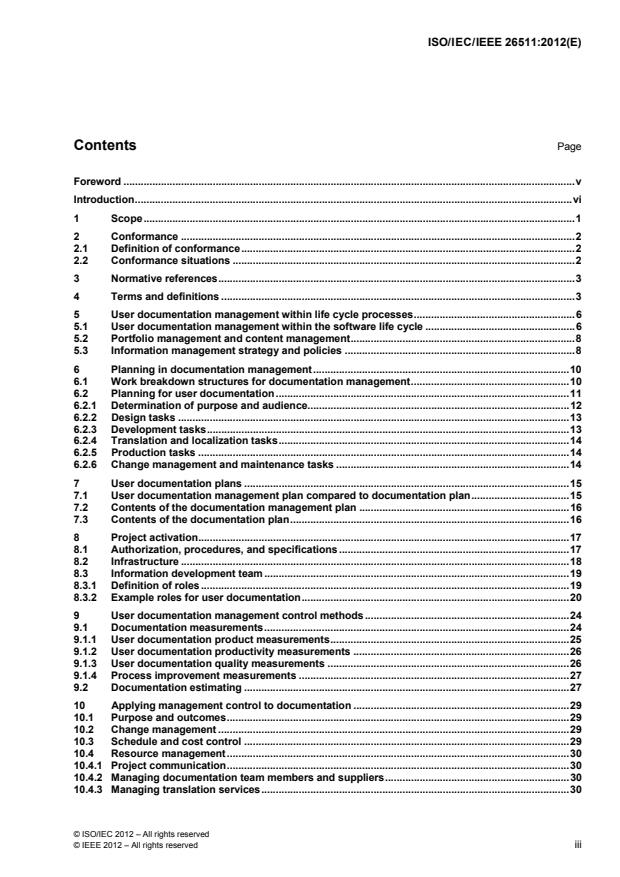
Contents Page
Foreword . v
Introduction . vi
1 Scope . 1
2 Conformance . 2
2.1 Definition of conformance . 2
2.2 Conformance situations . 2
3 Normative references . 3
4 Terms and definitions . 3
5 User documentation management within life cycle processes . 6
5.1 User documentation management within the software life cycle . 6
5.2 Portfolio management and content management . 8
5.3 Information management strategy and policies . 8
6 Planning in documentation management . 10
6.1 Work breakdown structures for documentation management . 10
6.2 Planning for user documentation . 11
6.2.1 Determination of purpose and audience . 12
6.2.2 Design tasks . 13
6.2.3 Development tasks . 13
6.2.4 Translation and localization tasks . 14
6.2.5 Production tasks . 14
6.2.6 Change management and maintenance tasks . 14
7 User documentation plans . 15
7.1 User documentation management plan compared to documentation plan . 15
7.2 Contents of the documentation management plan . 16
7.3 Contents of the documentation plan . 16
8 Project activation . 17
8.1 Authorization, procedures, and specifications . 17
8.2 Infrastructure . 18
8.3 Information development team . 19
8.3.1 Definition of roles . 19
8.3.2 Example roles for user documentation . 20
9 User documentation management control methods . 24
9.1 Documentation measurements . 24
9.1.1 User documentation product measurements . 25
9.1.2 User documentation productivity measurements . 26
9.1.3 User documentation quality measurements . 26
9.1.4 Process improvement measurements . 27
9.2 Documentation estimating . 27
10 Applying management control to documentation . 29
10.1 Purpose and outcomes . 29
10.2 Change management . 29
10.3 Schedule and cost control . 29
10.4 Resource management . 30
10.4.1 Project communication . 30
10.4.2 Managing documentation team members and suppliers . 30
10.4.3 Managing translation services . 30
© ISO/IEC 2012 – All rights reserved
© IEEE 2012 – All rights reserved iii
ISO/IEC/IEEE 26511:2012(E)
10.5 Quality management .31
10.5.1 Managing for product quality—reviews and tests .31
10.5.2 Risk and problem management .31
10.5.3 Process improvement .32
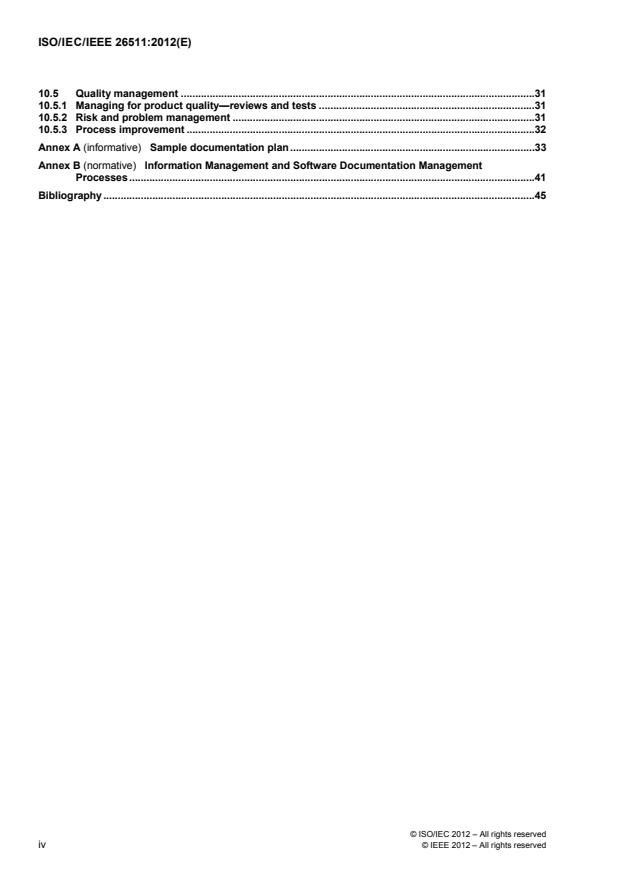
Annex A (informative) Sample documentation plan .33
Annex B (normative) Information Management and Software Documentation Management
Processes .41
Bibliography .45
© ISO/IEC 2012 – All rights reserved
iv © IEEE 2012 – All rights reserved
ISO/IEC/IEEE 26511:2012(E)
Foreword
ISO (the International Organization for Standardization) and IEC (the International Electrotechnical
Commission) form the specialized system for worldwide standardization. National bodies that are members of
ISO or IEC participate in the development of International Standards through technical committees established
by the respective organization to deal with particular fields of technical activity. ISO and IEC technical
committees collaborate in fields of mutual interest. Other international organizations, governmental and non-
governmental, in liaison with ISO and IEC, also take part in the work. In the field of information technology, ISO
and IEC have established a joint technical committee, ISO/IEC JTC 1.
IEEE Standards documents are developed within the IEEE Societies and the Standards Coordinating
Committees of the IEEE Standards Association (IEEE-SA) Standards Board. The IEEE develops its standards
through a consensus development process, approved by the American National Standards Institute, which
brings together volunteers representing varied viewpoints and interests to achieve the final product. Volunteers
are not necessarily members of the Institute and serve without compensation. While the IEEE administers the
process and establishes rules to promote fairness in the consensus development process, the IEEE does not
independently evaluate, test, or verify the accuracy of any of the information contained in its standards.
International Standards are drafted in accordance with the rules given in the ISO/IEC Directives, Part 2.
The main task of ISO/IEC JTC 1 is to prepare International Standards. Draft International Standards adopted
by the joint technical committee are circulated to national bodies for voting. Publication as an International
Standard requires approval by at least 75 % of the national bodies casting a vote.
Attention is called to the possibility that implementation of this standard may require the use of subject matter
covered by patent rights. By publication of this standard, no position is taken with respect to the existence or
validity of any patent rights in connection therewith. ISO/IEEE is not responsible for identifying essential
patents or patent claims for which a license may be required, for conducting inquiries into the legal validity or
scope of patents or patent claims or determining whether any licensing terms or conditions provided in
connection with submission of a Letter of Assurance or a Patent Statement and Licensing Declaration Form, if
any, or in any licensing agreements are reasonable or non-discriminatory. Users of this standard are expressly
advised that determination of the validity of any patent rights, and the risk of infringement of such rights, is
entirely their own responsibility. Further information may be obtained from ISO or the IEEE Standards
Association.
ISO/IEC/IEEE 26511 was prepared by Joint Technical Committee ISO/IEC JTC 1, Information technology,
Subcommittee SC 7, Software and systems engineering, in cooperation with the Systems and Software
Engineering Committee of the IEEE Computer Society, under the Partner Standards Development
Organization cooperation agreement between ISO and IEEE.
This first edition of ISO/IEC/IEEE 26511 cancels and replaces ISO/IEC TR 9294:2005, which has been
technically revised.
In this corrected version, the cover pages, front matter, page headers and footers have been corrected to
reflect that ISO/IEC/IEEE 26511 is a joint development project under the Partner Standards Development
Organization cooperation agreement between ISO and IEEE.
© ISO/IEC 2012 – All rights reserved
© IEEE 2012 – All rights reserved v
ISO/IEC/IEEE 26511:2012(E)
Introduction
Effective management of the software user documentation tasks is essential in order to ensure that
documentation is usable, accurate, delivered when needed by the users, produced efficiently, and maintained
consistent with the software. This International Standard addresses the management of user documentation in
relation to both initial development and subsequent releases of the software and user documentation.
Anyone who uses application software needs accurate information about how the software will help the user
accomplish a task. The documentation can be the first tangible item that the user sees, and if so, it can
influence the user’s first impressions of the product. If the information is supplied in a convenient form and is
easy to find and understand, the users can quickly become proficient at using the product. Hence, a well-
managed documentation process not only assists the user and helps to reduce the cost of training and
support, but also enhances the reputation of the product, its producer, and its suppliers.
Although many software designers aim to have user interfaces that behave so intuitively that very little
separate documentation is needed, this approach is rarely possible in practice. User documentation is an
essential component of usable software products.
Documentation is often regarded as something done after the software has been implemented. However, for
quality software documentation, its development should be regarded as an integral part of the software life-
cycle process from the planning and design stages onwards. If done properly, documentation or information
management is a big enough job to require process planning in its own right.
This International Standard was developed to assist users of ISO/IEC 15288:2008 (IEEE Std 15288-2008),
Systems and software engineering — System life cycle processes, or ISO/IEC 12207:2008 (IEEE Std 12207-
2008), Systems and software engineering — Software life cycle processes, to manage software user
documentation as part of the software life cycle. This International Standard defines the documentation
process from the manager's standpoint. It was developed to assist those who provide input to, perform, and
evaluate user documentation management.
NOTE: Other International Standards in the ISO/IEC 265NN family address the documentation and information
management processes from the viewpoint of documentation designers/developers, testers and reviewers, and acquirers
and suppliers.
This International Standard applies to people or organizations producing suites of documentation, to those
undertaking a single documentation project, and for documentation produced internally as well as to
documentation contracted to outside service organizations. Beyond the development and production of a user
manual, help system, or set of documentation for a single software product, it applies to a broader range of
documentation management situations, including user documentation for those who install, implement,
administer, and operate software for end users. Frequently, user documentation managers are responsible for
the development and reuse of information (content management) for:
multiple updates of user documentation as the software version is updated;
multiple reuses or adaptations of information to support related software products;
multiple translated or localized versions of user documentation;
a portfolio of unrelated documentation projects being managed concurrently within an organization.
This International Standard is not intended to advocate the use of either printed or electronic (on-screen)
media for documentation, or of any particular information management, content management, documentation
testing, or project management tools or protocols. The requirements are media-independent, as far as
possible. This International Standard may be applied to user documentation for systems including software as
well as to software user documentation.
© ISO/IEC 2012 – All rights reserved
vi © IEEE 2012 – All rights reserved
INTERNATIONAL STANDARD ISO/IEC/IEEE 26511:2012(E)
Systems and software engineering — Requirements for
managers of user documentation
1 Scope
This International Standard supports the needs of software users for consistent, complete, accurate, and
usable documentation. It provides requirements for strategy, planning, performance, and control for
documentation managers. It specifies procedures for managing user documentation throughout the software
life cycle. It also includes requirements for key documents produced for user documentation management,
including documentation plans and documentation management plans.
This International Standard provides an overview of the software documentation and information management
processes which are specialized for user documentation in this International Standard. It also presents
aspects of portfolio planning and content management for user documentation. Specifically, it addresses the
following:
• management requirements in starting a project, including setting up procedures and specifications,
establishing infrastructure, and building a team, with examples of roles needed on a user documentation
team;
• measurements and estimates needed for management control;
• the application of management control to user documentation work;
• the use of supporting processes such as change management, schedule and cost control, resource
management, quality management and process improvement.
The works listed in the Bibliography provide guidance on the processes of managing, preparing, and testing
user documentation.
NOTE 1: Related standards of value to documentation managers and others involved in the process include
ISO/IEC 26514:2008, Systems and software engineering — Requirements for designers and developers of user
documentation (also available as IEEE Std 26514-2010, IEEE Standard for Adoption of ISO/IEC 26514:2008, Systems
and Software Engineering — Requirements for Designers and Developers of User Documentation); ISO/IEC 26513:2009,
Systems and software engineering — Requirements for testers and reviewers of user documentation (also available as
IEEE Std 26513-2010, IEEE Standard for Adoption of ISO/IEC 26513:2009, Systems and Software Engineering —
Requirements for Testers and Reviewers of User Documentation); and ISO/IEC/IEEE 26512:2011, Systems and software
engineering — Requirements for acquirers and suppliers of user documentation.
This International Standard is applicable for use by managers of user documentation projects or organizations
with information designers and documentation developers. This International Standard may also be consulted
by those with other roles and interests in the documentation process:
• managers of the software development process;
• acquirers of documentation prepared by suppliers;
• experienced writers who develop the written content for user documentation;
• developers of tools for creating on-screen documentation;
© ISO/IEC 2012 – All rights reserved
© IEEE 2012 – All rights reserved 1
ISO/IEC/IEEE 26511:2012(E)
• human-factors experts who identify principles for making documentation more accessible and easily used;
• graphic designers with expertise in electronic media;
• user interface designers and ergonomics experts working together to design the presentation of the
documentation on the screen.
This International Standard may be applied to manage the following types of documentation, although it does
not cover all aspects of them:
• documentation for user assistance, training, marketing, and systems documentation for product design
and development, based on reuse of user documentation topics;
• documentation of products other than software;
• multimedia marketing presentations using animation, video, and sound;
• computer-based training (CBT) packages and specialized course materials intended primarily for use in
formal training programs;
• maintenance documentation describing the internal operation of systems software.
NOTE 2: ISO/IEC/IEEE 15289:2011 provides more detailed content for life-cycle process information items
(documentation).
2 Conformance
2.1 Definition of conformance
This International Standard may be used as a conformance document for projects and organizations claiming
conformance to ISO/IEC 15288:2008 (IEEE Std 15288-2008), Systems and software engineering — System
life cycle processes, or ISO/IEC 12207:2008 (IEEE Std 12207-2008), Systems and software engineering —
Software life cycle processes.
This International Standard is meant to be tailored so that only necessary and cost-effective requirements are
applied to documentation. Tailoring may take the form of specifying approaches to conform to its normative
requirements, or altering its recommendations and approaches to reflect the particular software and
documentation project more explicitly. Tailoring decisions made by the acquirer should be specified in the
contract.
NOTE: Annex A (normative) of ISO/IEC 12207:2008 (IEEE Std 12207-2008) describes the tailoring process
Throughout this International Standard, "shall" is used to express a provision that is binding, "should" to
express a recommendation among other possibilities, and "may" to indicate a course of action permissible
within the limits of this International Standard.
Use of the nomenclature of this International Standard for the parts of user documentation (for example,
chapters, topics, pages, screens, windows) is not required to claim conformance.
2.2 Conformance situations
Conformance of software user documentation management may be interpreted differently for various
situations. Regardless of whether the organization or project has tailored the selected software life cycle
processes or adopted them in full, the organization or project may claim conformance to this International
Standard for its information management and software documentation management processes, or for both.
© ISO/IEC 2012 – All rights reserved
2 © IEEE 2012 – All rights reserved
ISO/IEC/IEEE 26511:2012(E)
The relevant situation shall be identified when conformity is claimed for an organization: the organization shall
make public a document declaring its tailoring of the process.
NOTE 1: One possible way for an organization to deal with clauses that cite "the documentation plan" is to specify that
they shall be interpreted in the project plans for any particular documentation project.
• When conformance is claimed for a project, the project plans or the contract shall document the tailoring
of the documentation requirements.
NOTE 2: A project’s claim of conformance is typically specified with respect to the organization’s claim of conformance.
• In a multi-supplier program: it can be the case that no individual project may claim conformance because
no single contract is responsible for all the required management activities. Nevertheless, the program, as
a whole, may claim conformance if each of the required activities is produced by an identified party. The
program plans shall document the tailoring of the required tasks, and their assignment to the various
parties, as well as the interpretation of clauses of this International Standard that reference "the contract".
• This International Standard may be included or referenced in contracts or similar agreements when the
parties (called the acquirer and the producer or supplier) agree that the supplier will manage
documentation services in accordance with this International Standard. It may also be adopted as an in-
house standard by a project or organization that decides to manage its documentation services in
accordance with this International Standard.
3 Normative references
The following referenced documents are indispensable for the application of this document. For dated
references, only the edition cited applies. For undated references, the latest edition of the referenced
document (including any amendments) applies.
ISO/IEC 12207:2008 (IEEE Std 12207-2008), Systems and software engineering — Software life cycle
processes
ISO/IEC/IEEE 24765:2010, Systems and software engineering — Vocabulary
4 Terms and definitions
For the purposes of this document, the terms and definitions given in ISO/IEC/IEEE 24765:2010 and the
following apply.
NOTE 1: The verb “include” used in this International Standard indicates that either (1) the information is present or (2)
a reference to the information is listed.
NOTE 2: Throughout this International Standard the term “documentation” refers to software user documentation. This
International Standard refers to the “user documentation manager” or “the manager”, which applies to anyone performing
the required user documentation management activities, regardless of title or responsibilities for cost management.
4.1
audience
category of users sharing the same or similar characteristics and needs (for example, reason for using the
documentation, tasks, education level, abilities, training, experience)
[ISO/IEC 26514:2008]
NOTE: There can be different audiences for documentation (for example, management, data entry, maintenance) that
determine the content, structure, and use of the intended documentation.
© ISO/IEC 2012 – All rights reserved
© IEEE 2012 – All rights reserved 3
ISO/IEC/IEEE 26511:2012(E)
4.2
complete
including all critical information and any necessary, relevant information for the intended
audience
4.3
configuration management
discipline applying technical and administrative direction and surveillance to identify and document the
functional and physical characteristics of a configuration item, control changes to those characteristics, record
and report change processing and implementation status, and verify compliance with specified requirements
4.4
content management
control of units of information with their metadata, to allow selective reuse in documents or information items
with variable structures and formats
EXAMPLE: Content management for user documentation means management of help topics, explanations of
concepts, troubleshooting procedures, compliance statements, and variables such as the names and host platforms of
software products, with metadata tags that are applied to format output.
4.5
critical information
information describing the safe use of the software, the security of the information created with the software,
or the protection of the sensitive personal information created by or stored with the software
[ISO/IEC 26514:2008]
4.6
customer
organization or person that receives a product or service
NOTE: In the context of this International Standard, the product is the user documentation.
[ISO/IEC 12207:2008]
4.7
document, noun
separately identified piece of documentation which could be part of a documentation set
[ISO/IEC 26514:2008]
4.8
document set
collection of documentation that has been segmented into separately identified volumes or files for ease of
distribution or use
[ISO/IEC 26514:2008]
4.9
documentation
information that explains how to use a software product
[ISO/IEC 26514:2008]
NOTE 1: It may be provided as separate documentation, as embedded documentation, or both.
NOTE 2: In this International Standard, the term “documentation” is synonymous with the terms “user documentation”
and “software user documentation”.
EXAMPLE: Printed manuals, on-screen information and stand-alone on-screen help.
© ISO/IEC 2012 – All rights reserved
4 © IEEE 2012 – All rights reserved
ISO/IEC/IEEE 26511:2012(E)
4.10
illustration
graphic element set apart from the main body of text and normally cited within the main text
NOTE: In this International Standard, the term “illustration” is used as the generic term for tables, figures, exhibits,
screen captures, flow charts, diagrams, drawings, icons, and other graphic elements.
4.11
information design
process of developing content that meets the needs of the audience
4.12
localization
creation of a national or specific regional version of a product
NOTE: It is possible to perform the localization process separately from the translation process.
4.13
minimalism
approach that includes critical information and the least amount of other information in documentation needed
to be complete
4.14
procedure
ordered series of steps that a user follows to do one or more tasks
4.15
process
set of interrelated activities, which transform inputs into outputs
[ISO/IEC 12207:2008, definition 3.17]
4.16
project
endeavor with defined start and finish dates undertaken to create a product or service in accordance with
specified resources and requirements
[ISO/IEC 12207:2008, ISO/IEC 15288:2008]
4.17
product authority
person or persons with overall responsibility for the capabilities and quality of a product
4.18
risk
combination of the probability of an event and its consequence
[ISO/IEC 16085:2006]
4.19
quality
ability of a product, service, system, component, or process to meet customer or user needs, expectations, or
requirements
[ISO/IEC/IEEE 24765:2010]
© ISO/IEC 2012 – All rights reserved
© IEEE 2012 – All rights reserved 5
ISO/IEC/IEEE 26511:2012(E)
4.20
step
one element (numbered list item) in a procedure that tells a user to perform an action (or actions)
[ISO/IEC 26514:2008]
NOTE 1: Responses by the software are not considered to be steps.
NOTE 2: A step contains one or more actions.
4.21
strategy
organization's overall plan of development, describing the effective use of resources in support of the
organization in its future activities
[ISO/IEC 38500:2008]
4.22
usability
extent to which a product can be used by specified users to achieve specified goals with effectiveness,
efficiency, and satisfaction in a specified context of use
[ISO/IEC 25062:2006]
4.23
user documentation
information to describe, explain, or instruct how to use software
[ISO/IEC 26514:2008]
NOTE: User documentation includes documentation to explain or instruct how to install, implement, administer, or
operate software for end users.
4.24
work breakdown structure
WBS
a deliverable-oriented hierarchical decomposition of the work to be executed by the project team to
accomplish the project objectives and create the required deliverables
NOTE: It organizes and defines the total scope of the project.
[A Guide to the Project Management Body of Knowledge (PMBOK® Guide) – Fourth Edition]
5 User documentation management within life cycle processes
5.1 User documentation management within the software life cycle
As defined in ISO/IEC 12207:2008 Systems and software engineering — Software life cycle processes, user
documentation management is performed as a supporting process within the software or system life cycle.
User documentation is developed in preliminary versions along with the software architectural design, and
updated as needed during the software detailed design, software construction, software integration, software
qualification testing, and software maintenance activities.
NOTE 1: User documentation may also be developed for previously released software or acquired for commercial off-
the-shelf software.
NOTE 2: ISO/IEC/IEEE 26515, Software and systems engineering — Developing user documentation in an agile
environment, has more information on the relation of user documentation development to software development.
© ISO/IEC 2012 – All rights reserved
6 © IEEE 2012 – All rights reserved
ISO/IEC/IEEE 26511:2012(E)
Whether or not user documentation is prepared as part of the software life cycle, the documentation product
has its own life cycle, including the stages of process implementation; design and development; production;
and maintenance.
User documentation management shall be applied to the other activities in the documentation life cycle:
• analysis and design, which includes preparing the documentation designs for the project; collecting
information about the software product and users, their tasks, and their needs for information; and
designing documentation based on those needs;
• development and review, which includes structuring the content for usability, applying the documentation
design by creating the written and graphic content, implementing the information in the specified media,
editing and reviewing the content, and evaluating the user documentation with the rest of the product;
• production, which includes the integration, preparation, reproduction, and packaging and distribution of
the documentation;
• maintenance, which includes keeping the documentation accurate and controlling document versions
throughout the software product life cycle, including modifications for improved usability.
From the perspective of ISO/IEC 12207:2008, Systems and software engineering — Software life cycle
processes, user documentation managers shall carry out the supporting processes of information
management and software documentation management in accordance with 6.3.6 and 7.2.1 of
ISO/IEC 12207:2008.
NOTE 3: For ease of reference, the text of these processes is included in Annex B.
The user documentation manager shall perform these management activities as part of a Plan-Do-Check-Act
cycle:
1) setting user documentation strategy and objectives and preparing a documentation management plan
2) planning the user documentation project
3) controlling the user documentation project
4) selecting and implementing documentation resources, tools, and supporting systems
5) conducting process improvement for information management and documentation
As a result of successful implementation of the information management and software documentation
management processes:
• a strategy identifying the documentation to be produced during the life cycle of the software product or
service is developed;
• the standards to be applied for the development of the software documentation are identified;
• the documentation to be produced by the process or project is identified;
• the content and purpose of all documentation is specified, reviewed and approved;
• the documentation is developed and made available in accordance with identified standards;
• the documentation is maintained in accordance with defined criteria.
© ISO/IEC 2012 – All rights reserved
© IEEE 2012 – All rights reserved 7
ISO/IEC/IEEE 26511:2012(E)
5.2 Portfolio management and content management
The software user documentation management process described in the previous section has the viewpoint of
a single life cycle for an individual product, such as a single user manual, help system, or documentation set.
This document takes the perspective of user documentation managers handling multiple projects and
products. Thus, user documentation management usually involves the application of the portfolio
management process, as stated in clause 6.2.3 of ISO/IEC 12207:2008.
The purpose of the Project Portfolio Management Process is to initiate and sustain necessary, sufficient, and
suitable projects in order to meet the strategic objectives of the organization.
This process commits the investment of adequate organization funding and resources, and sanctions the
authorities needed to establish selected projects. It performs continued qualification of projects to confirm they
justify, or can be redirected to justify, continued investment.
As a result of the successful implementation of the Project Portfolio Management Process:
• business venture opportunities, investments or necessities are qualified, prioritized, and selected;
• resources and budgets for each project are identified and allocated;
• project management accountability and authorities are defined;
• projects meeting agreement and stakeholder requirements are sustained; and
• projects not meeting agreement or stakeholder requirements are redirected or cancelled.
The user documentation manager shall perform portfolio planning for documentation projects consistent with
the organization's overall portfolio planning.
To sustain a portfolio of user documentation products and maintain consistency, content management is an
efficient approach to avoid the repetitive effort of creating and formatting multiple documents covering similar
information topics. Content management separates the content of the information products from their output
formats. In a sense, content management is portfolio management applied to information assets, rather than
to output software products or user documentation.
Software user documentation managers shall develop, implement, and maintain a content management
strategy. The content management strategy shall specify the types of content that will be managed for reuse
as a strategic priority and the types of output information items (documentation) that will be produced as a
strategic priority, using the managed content. The content management strategy may define accountability
and authorities for content management processes and systems. It may identify intended stakeholders and
content users, including users of localized or translated content. It may establish thresholds to determine
which types of content will be managed and maintained.
The content management strategy does not dictate the use of any specific content management system or
document production tools.
NOTE: The Darwin Information Typing Architecture (DITA) is a document creation and management specification that
builds content reuse into the authoring process (www.oasis-open.org)
5.3 Information management strategy and policies
User documentation management planning requires key decisions about work effort: who should do the work,
using what sources of information, when and where, and using what tools. But before the manager goes far
into detailed planning for projects, an information management strategy is needed: does the work need to be
done at all, and how thoroughly does each aspect need to be performed?
© ISO/IEC 2012 – All rights reserved
8 © IEEE 2012 – All rights reserved
ISO/IEC/IEEE 26511:2012(E)
The manager shall establish an information management or user software documentation management
strategy. The strategy describes how user software documentation supports the organization's goals and
serves its customers, and identifies priorities for its products and services. The strategy should be developed
in consultation with the user documentation stakeholders (those individuals and organizations which have an
interest in the effectiveness of the documentation). Stakeholders can include high-level executives, project
authorities, help desk and service desk staff, customers, and business analysts.
An important principle in user documentation strategy is minimalism. Since it is not possible to document
every detail of every software product, managers of user documentation need to take a more strategic view to
prioritize documentation efforts so that they support the needs of the users, the customers, and the producing
organization. Minimalism means that user documentation will include the critical information and the
information needed by the users for their primary tasks. User documentation should be task-oriented, rather
than covering every detail of the internal architecture of the software. Time and effort should not be spent
documenting software features that can be readily discovered and easily understood by the users with the
software's graphical user interface. With a minimalist perspective, the user documentation should not attempt
to account for the use of every feature and every possible path through the software.
User documentation should be audience-oriented. Users can be managers, analysts, office personnel,
professionals with no software expertise, maintenance programmers, etc. Depending on the tasks, they need
various degrees of detail and different presentations of material. As part of information management strategy
for user documentation, managers should plan for information reuse and adaptation (content management) to
efficiently and effectively support its identified audiences. Then the documentation plan should specify what
different types of information will be provided for different users.
Information management strategy should be communicated through documentation policies. Documentation
policies prepared and supported by high-level management provide guidance to all decision-makers. Policies
provide broad direction, and not detailed prescriptions on what to do or how to manage and prepare
documentation. Formal, well-publicised policies should be established and communicated to everyone
affected by the policies.
Documentation policies shall identify which documentation standards will be used. Compliance with relevant
information storage, records management, and presentation standards and conventions may be required
according to agreements and regulation. Existing standards should be adopted wherever possible. Where no
suitable standards exist, standards and guidelines should be developed.
User documentation strategies, policies, and standards should enable managers to determine:
• what document types are required;
• how much documentation is to be provided;
• what the documents are to contain;
• what level of quality is to be achieved;
• when the documents are to be produced;
• how the documentation is to be stored, maintained, and communicated.
When an information management strategy has been established and the costs and expected benefits of
organizational resources and projects have been estimated, the user documentation manager should apply
the strategy to:
• evaluate the feasibility of achieving the goals of the projects with available resources and constraints;
• prioritize the projects to be started;
• establish thresholds to determine which projects will be executed.
© ISO/IEC 2012 – All rights reserved
© IEEE 2012 – All rights reserved 9
ISO/IEC/IEEE 26511:2012(E)
6 Planning in documentation management
6.1 Work breakdown structures for documentation management
By defining the elements of the project, the work breakdown structure (WBS) is the foundation of effective
planning, estimating, and reporting. The WBS should be used for estimating both time and other costs for
each element, and also for tracking both time and other costs as they are expended. A consistent WBS is the
frame of reference for initial estimation, ongoing reporting, corrective action (where variances indicate
problems or opportunities), and perhaps for billing. The manager shall define a work breakdown structure at
the level of each documentation project or element within the delivered information. The number of levels for
documentation elements in the WBS depends on the scope of the effort and the level of detail needed for
tracking cost, schedule, and technical quality. For WBS purposes, "elements" may be:
• document types, such as instructional mat
...
Questions, Comments and Discussion
Ask us and Technical Secretary will try to provide an answer. You can facilitate discussion about the standard in here.
Loading comments...