

ISO/IEC/IEEE 26511:2018
(Main)Systems and software engineering — Requirements for managers of information for users of systems, software, and services
General Information
- Abstract
This document supports the needs of users for consistent, complete, accurate, and usable information. It provides requirements for strategy, planning, managing, staffing, translation, production, and quality and process-maturity assessment for managers of information for users. It specifies processes and procedures for managing information for users throughout the product- or systems-development life cycle. It also includes requirements for key documents produced for managing information for users, including strategic and project plans. This document provides an overview of the information-management processes that are specific for the management of information for users. It addresses the following activities: — developing a comprehensive strategy for information development; — assessing user information needs; — planning and managing an information-development project; — staffing and forming information-development teams; — reviewing and testing information for users; — managing the translation process; — publishing and delivering information for users; — evaluating customer satisfaction and information quality; — measuring productivity, efficiency, and costs; and — evaluating organizational maturity. The guidance in this document applies to multiple project management approaches, including both agile and traditional practices. Traditional practices can encompass predictive, waterfall, or other top-down management methods. Where certain practices are common in agile project management, they are noted. This document is applicable for use by managers of information for users or organizations with information developers. This document can also be consulted by those with other roles and interests in the process of developing information for users: — managers of the product and system development process; — acquirers of information for users prepared by suppliers; — experienced information developers who prepare information for users; — human-factors experts who identify principles for making information for users more accessible and easily used; and — user interface designers and ergonomics experts working together to design the presentation of information. This document can be applied to manage the following types of information for users, although it does not cover all aspects of them: — information for user assistance, training, marketing, and systems documentation for product design and development, based on reuse of user information topics; — multimedia marketing presentations using animation, video, and sound; — information developed for virtual and augmented reality presentations; — computer-based training (CBT) packages and course materials intended primarily for use in formal training programs; and — information describing the internal operation of products.
- Status
- Published
- Publication Date
- 11-Dec-2018
- Technical Committee
- ISO/IEC JTC 1/SC 7 - Software and systems engineering
- Drafting Committee
- ISO/IEC JTC 1/SC 7/WG 2 - System software documentation
- Current Stage
- 9092 - International Standard to be revised
- Start Date
- 13-Dec-2024
- Completion Date
- 29-Aug-2026
Buy Documents
ISO/IEC/IEEE 26511:2018 - Systems and software engineering -- Requirements for managers of information for users of systems, software, and services
ISO/IEC/IEEE 26511:2018 - Systems and software engineering — Requirements for managers of information for users of systems, software, and services/12/2018
Overview
ISO/IEC/IEEE 26511:2018 defines requirements for managers of information for users of systems, software, and services. The standard supports consistent, complete, accurate, and usable user information by specifying requirements for strategy, planning, staffing, production, translation/localization, quality, and process-maturity assessment. It prescribes processes and procedures for managing information-for-users throughout the product or systems development life cycle and applies to both agile and traditional project approaches.
Key Topics and Requirements
- Information-development strategy: establishing vision, organizational alignment, portfolio decisions, and long-term content lifecycle policies.
- User needs assessment: methods to identify and document user information needs and stakeholder requirements.
- Project planning and management: defining scope, deliverables, schedules, risk analysis, cost/time estimation, and integrated information plans.
- Staffing and team formation: role definitions, skills assessment, hiring, outsourcing, training, succession planning, and team alignment with engineering lifecycles.
- Content production and quality: review processes, testing of user information, quality controls, and process-maturity evaluation.
- Translation and localization: language and character-set requirements, timing, deliverables, selection of localization service providers, and translation cost estimation.
- Content operations: content management system (CMS) decisions, version/change control, archiving, publishing/delivery channels, security, and disaster recovery.
- Measurement and evaluation: customer satisfaction, information quality metrics, productivity, efficiency, and cost measurement.
- Scope of content types: user assistance, training, marketing, multimedia (including VR/AR), computer-based training (CBT), and internal product-operation documentation.
Practical Applications
ISO/IEC/IEEE 26511:2018 is a practical framework for organizations that must manage user-facing documentation and content at scale. Typical uses:
- Building a content strategy and lifecycle policy for product documentation.
- Planning and executing documentation projects with measurable schedules, budgets, and risk controls.
- Establishing metrics for information quality, customer satisfaction, and productivity.
- Managing translation and localization programs for multi-language products.
- Selecting and operating a CMS and defining versioning, archiving, and delivery workflows.
- Integrating information-development practices into agile or traditional software/system engineering processes.
Who Should Use It
- Managers of information for users and documentation leads
- Technical writers and information developers
- Product and engineering managers procuring user information from suppliers
- Localization and translation managers
- Human-factors, UI/UX, and ergonomics experts involved in user assistance design
Related Standards
For comprehensive implementation, consult other ISO/IEC/IEEE systems and software engineering standards addressing lifecycle processes, usability, and documentation governance. For procurement or process-maturity alignment, pair 26511 requirements with organizational quality and process-improvement frameworks.
Relations
- Effective Date
- 27-Feb-2016
Buy Documents
ISO/IEC/IEEE 26511:2018 - Systems and software engineering -- Requirements for managers of information for users of systems, software, and services
ISO/IEC/IEEE 26511:2018 - Systems and software engineering — Requirements for managers of information for users of systems, software, and services/12/2018
Get Certified
Connect with accredited certification bodies for this standard

BSI Group
BSI (British Standards Institution) is the business standards company that helps organizations make excellence a habit.

BSCIC Certifications Pvt. Ltd.
Established 2006, accredited by NABCB, JAS-ANZ, EIAC, IAS. CDSCO Notified Body.

Intertek India Pvt. Ltd.
Delivers Assurance, Testing, Inspection & Certification since 1993 with 26 labs and 32 offices.
Sponsored listings
Frequently Asked Questions
ISO/IEC/IEEE 26511:2018 is a standard published by the International Organization for Standardization (ISO). Its full title is "Systems and software engineering — Requirements for managers of information for users of systems, software, and services". This standard covers: This document supports the needs of users for consistent, complete, accurate, and usable information. It provides requirements for strategy, planning, managing, staffing, translation, production, and quality and process-maturity assessment for managers of information for users. It specifies processes and procedures for managing information for users throughout the product- or systems-development life cycle. It also includes requirements for key documents produced for managing information for users, including strategic and project plans. This document provides an overview of the information-management processes that are specific for the management of information for users. It addresses the following activities: — developing a comprehensive strategy for information development; — assessing user information needs; — planning and managing an information-development project; — staffing and forming information-development teams; — reviewing and testing information for users; — managing the translation process; — publishing and delivering information for users; — evaluating customer satisfaction and information quality; — measuring productivity, efficiency, and costs; and — evaluating organizational maturity. The guidance in this document applies to multiple project management approaches, including both agile and traditional practices. Traditional practices can encompass predictive, waterfall, or other top-down management methods. Where certain practices are common in agile project management, they are noted. This document is applicable for use by managers of information for users or organizations with information developers. This document can also be consulted by those with other roles and interests in the process of developing information for users: — managers of the product and system development process; — acquirers of information for users prepared by suppliers; — experienced information developers who prepare information for users; — human-factors experts who identify principles for making information for users more accessible and easily used; and — user interface designers and ergonomics experts working together to design the presentation of information. This document can be applied to manage the following types of information for users, although it does not cover all aspects of them: — information for user assistance, training, marketing, and systems documentation for product design and development, based on reuse of user information topics; — multimedia marketing presentations using animation, video, and sound; — information developed for virtual and augmented reality presentations; — computer-based training (CBT) packages and course materials intended primarily for use in formal training programs; and — information describing the internal operation of products.
This document supports the needs of users for consistent, complete, accurate, and usable information. It provides requirements for strategy, planning, managing, staffing, translation, production, and quality and process-maturity assessment for managers of information for users. It specifies processes and procedures for managing information for users throughout the product- or systems-development life cycle. It also includes requirements for key documents produced for managing information for users, including strategic and project plans. This document provides an overview of the information-management processes that are specific for the management of information for users. It addresses the following activities: — developing a comprehensive strategy for information development; — assessing user information needs; — planning and managing an information-development project; — staffing and forming information-development teams; — reviewing and testing information for users; — managing the translation process; — publishing and delivering information for users; — evaluating customer satisfaction and information quality; — measuring productivity, efficiency, and costs; and — evaluating organizational maturity. The guidance in this document applies to multiple project management approaches, including both agile and traditional practices. Traditional practices can encompass predictive, waterfall, or other top-down management methods. Where certain practices are common in agile project management, they are noted. This document is applicable for use by managers of information for users or organizations with information developers. This document can also be consulted by those with other roles and interests in the process of developing information for users: — managers of the product and system development process; — acquirers of information for users prepared by suppliers; — experienced information developers who prepare information for users; — human-factors experts who identify principles for making information for users more accessible and easily used; and — user interface designers and ergonomics experts working together to design the presentation of information. This document can be applied to manage the following types of information for users, although it does not cover all aspects of them: — information for user assistance, training, marketing, and systems documentation for product design and development, based on reuse of user information topics; — multimedia marketing presentations using animation, video, and sound; — information developed for virtual and augmented reality presentations; — computer-based training (CBT) packages and course materials intended primarily for use in formal training programs; and — information describing the internal operation of products.
ISO/IEC/IEEE 26511:2018 is classified under the following ICS (International Classification for Standards) categories: 35.080 - Software. The ICS classification helps identify the subject area and facilitates finding related standards.
ISO/IEC/IEEE 26511:2018 has the following relationships with other standards: It is inter standard links to ISO/IEC/IEEE 26511:2011. Understanding these relationships helps ensure you are using the most current and applicable version of the standard.
ISO/IEC/IEEE 26511:2018 is available in PDF format for immediate download after purchase. The document can be added to your cart and obtained through the secure checkout process. Digital delivery ensures instant access to the complete standard document.
Standards Content (Sample)
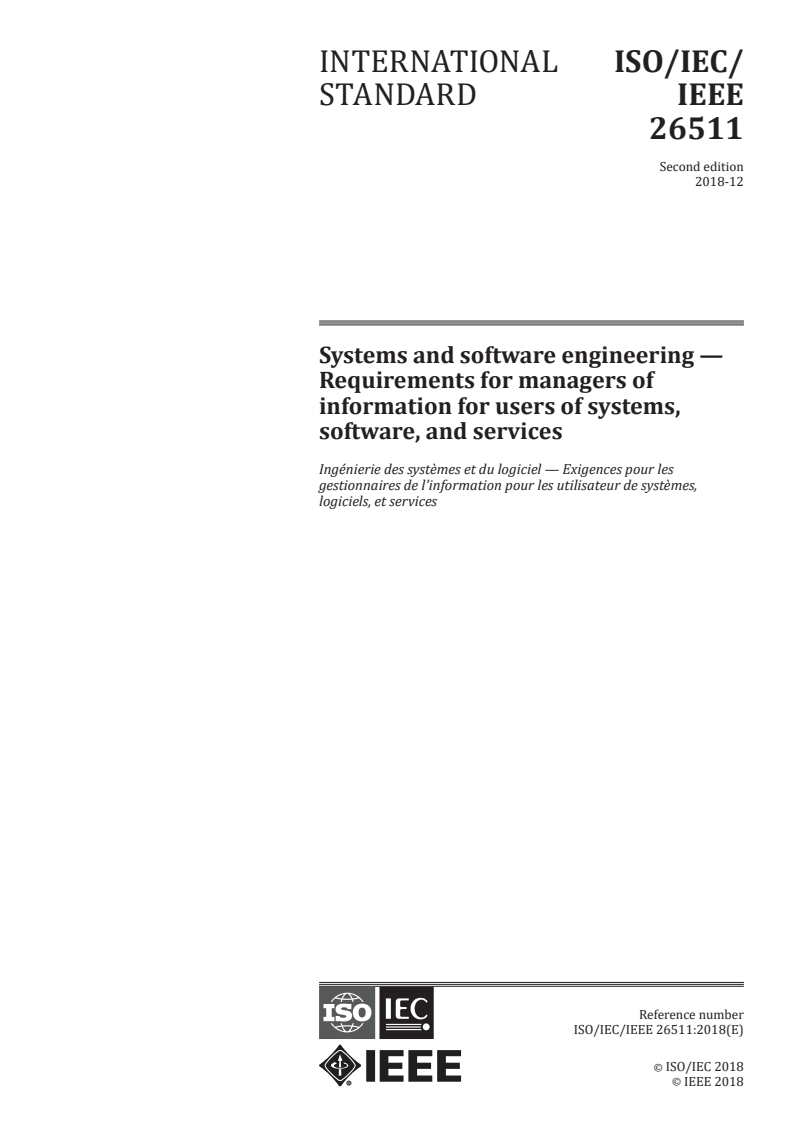
INTERNATIONAL ISO/IEC/
STANDARD IEEE
Second edition
2018-12
Systems and software engineering —
Requirements for managers of
information for users of systems,
software, and services
Ingénierie des systèmes et du logiciel — Exigences pour les
gestionnaires de l'information pour les utilisateur de systèmes,
logiciels, et services
Reference number
©
ISO/IEC 2018
©
IEEE 2018
© ISO/IEC 2018
© IEEE 2018
All rights reserved. Unless otherwise specified, or required in the context of its implementation, no part of this publication may
be reproduced or utilized otherwise in any form or by any means, electronic or mechanical, including photocopying, or posting
on the internet or an intranet, without prior written permission. Permission can be requested from either ISO or IEEE at the
respective address below or ISO’s member body in the country of the requester.
ISO copyright office Institute of Electrical and Electronics Engineers, Inc
CP 401 • Ch. de Blandonnet 8 3 Park Avenue, New York
CH-1214 Vernier, Geneva NY 10016-5997, USA
Phone: +41 22 749 01 11
Fax: +41 22 749 09 47
Email: copyright@iso.org Email: stds.ipr@ieee.org
Website: www.iso.org Website: www.ieee.org
Published in Switzerland
© ISO/IEC 2018 – All rights reserved
ii © IEEE 2018 – All rights reserved
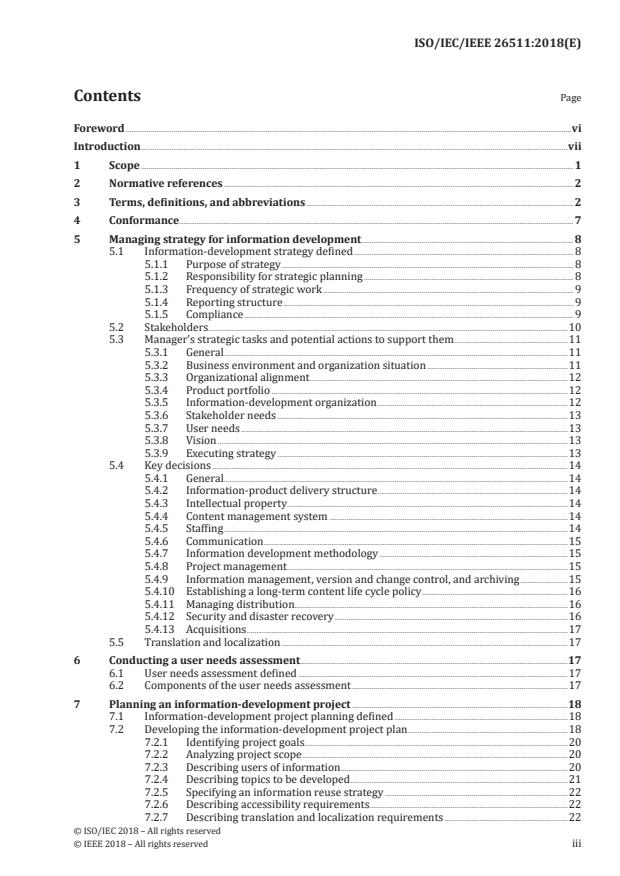
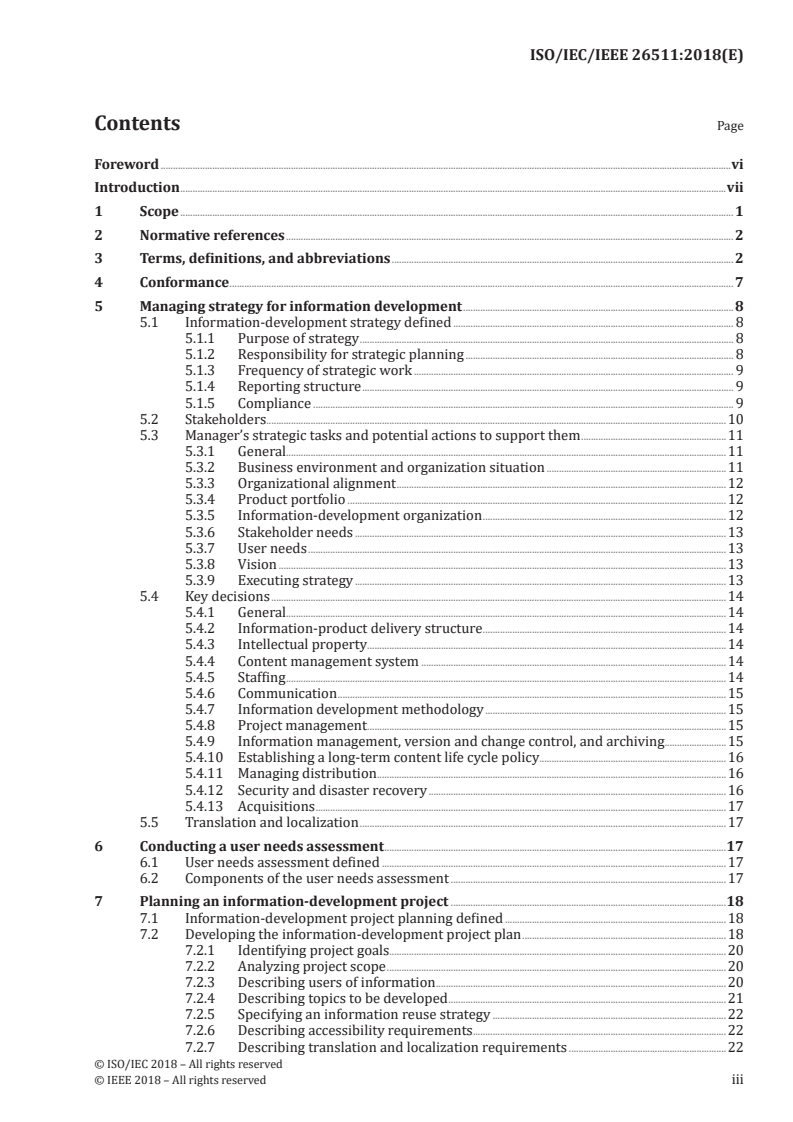
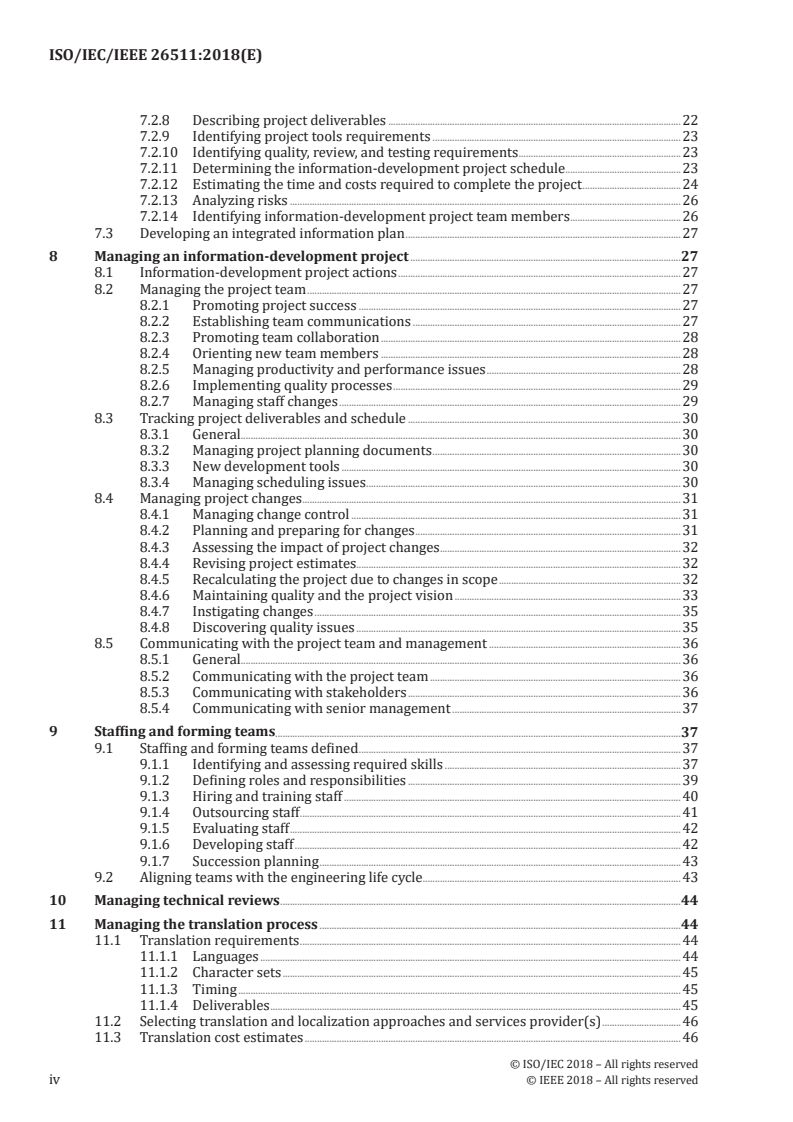
Contents Page
Foreword .vi
Introduction .vii
1 Scope . 1
2 Normative references . 2
3 Terms, definitions, and abbreviations . 2
4 Conformance . 7
5 Managing strategy for information development . 8
5.1 Information-development strategy defined . 8
5.1.1 Purpose of strategy . 8
5.1.2 Responsibility for strategic planning . 8
5.1.3 Frequency of strategic work . 9
5.1.4 Reporting structure . 9
5.1.5 Compliance . 9
5.2 Stakeholders .10
5.3 Manager’s strategic tasks and potential actions to support them .11
5.3.1 General.11
5.3.2 Business environment and organization situation .11
5.3.3 Organizational alignment .12
5.3.4 Product portfolio .12
5.3.5 Information-development organization .12
5.3.6 Stakeholder needs .13
5.3.7 User needs .13
5.3.8 Vision .13
5.3.9 Executing strategy .13
5.4 Key decisions .14
5.4.1 General.14
5.4.2 Information-product delivery structure .14
5.4.3 Intellectual property . .14
5.4.4 Content management system .14
5.4.5 Staffing .14
5.4.6 Communication .15
5.4.7 Information development methodology .15
5.4.8 Project management .15
5.4.9 Information management, version and change control, and archiving .15
5.4.10 Establishing a long-term content life cycle policy . .16
5.4.11 Managing distribution . .16
5.4.12 Security and disaster recovery .16
5.4.13 Acquisitions .17
5.5 Translation and localization .17
6 Conducting a user needs assessment .17
6.1 User needs assessment defined .17
6.2 Components of the user needs assessment .17
7 Planning an information-development project .18
7.1 Information-development project planning defined .18
7.2 Developing the information-development project plan .18
7.2.1 Identifying project goals.20
7.2.2 Analyzing project scope .20
7.2.3 Describing users of information .20
7.2.4 Describing topics to be developed .21
7.2.5 Specifying an information reuse strategy .22
7.2.6 Describing accessibility requirements .22
7.2.7 Describing translation and localization requirements .22
© ISO/IEC 2018 – All rights reserved
© IEEE 2018 – All rights reserved iii
7.2.8 Describing project deliverables .22
7.2.9 Identifying project tools requirements .23
7.2.10 Identifying quality, review, and testing requirements .23
7.2.11 Determining the information-development project schedule .23
7.2.12 Estimating the time and costs required to complete the project .24
7.2.13 Analyzing risks .26
7.2.14 Identifying information-development project team members .26
7.3 Developing an integrated information plan .27
8 Managing an information-development project .27
8.1 Information-development project actions .27
8.2 Managing the project team .27
8.2.1 Promoting project success .27
8.2.2 Establishing team communications .27
8.2.3 Promoting team collaboration .28
8.2.4 Orienting new team members .28
8.2.5 Managing productivity and performance issues .28
8.2.6 Implementing quality processes .29
8.2.7 Managing staff changes .29
8.3 Tracking project deliverables and schedule .30
8.3.1 General.30
8.3.2 Managing project planning documents .30
8.3.3 New development tools .30
8.3.4 Managing scheduling issues .30
8.4 Managing project changes .31
8.4.1 Managing change control .31
8.4.2 Planning and preparing for changes .31
8.4.3 Assessing the impact of project changes .32
8.4.4 Revising project estimates.32
8.4.5 Recalculating the project due to changes in scope .32
8.4.6 Maintaining quality and the project vision .33
8.4.7 Instigating changes .35
8.4.8 Discovering quality issues .35
8.5 Communicating with the project team and management .36
8.5.1 General.36
8.5.2 Communicating with the project team .36
8.5.3 Communicating with stakeholders .36
8.5.4 Communicating with senior management .37
9 Staffing and forming teams.37
9.1 Staffing and forming teams defined .37
9.1.1 Identifying and assessing required skills .37
9.1.2 Defining roles and responsibilities .39
9.1.3 Hiring and training staff .40
9.1.4 Outsourcing staff .41
9.1.5 Evaluating staff .42
9.1.6 Developing staff .42
9.1.7 Succession planning .43
9.2 Aligning teams with the engineering life cycle .43
10 Managing technical reviews .44
11 Managing the translation process .44
11.1 Translation requirements .44
11.1.1 Languages .44
11.1.2 Character sets .45
11.1.3 Timing .45
11.1.4 Deliverables .45
11.2 Selecting translation and localization approaches and services provider(s) .46
11.3 Translation cost estimates .46
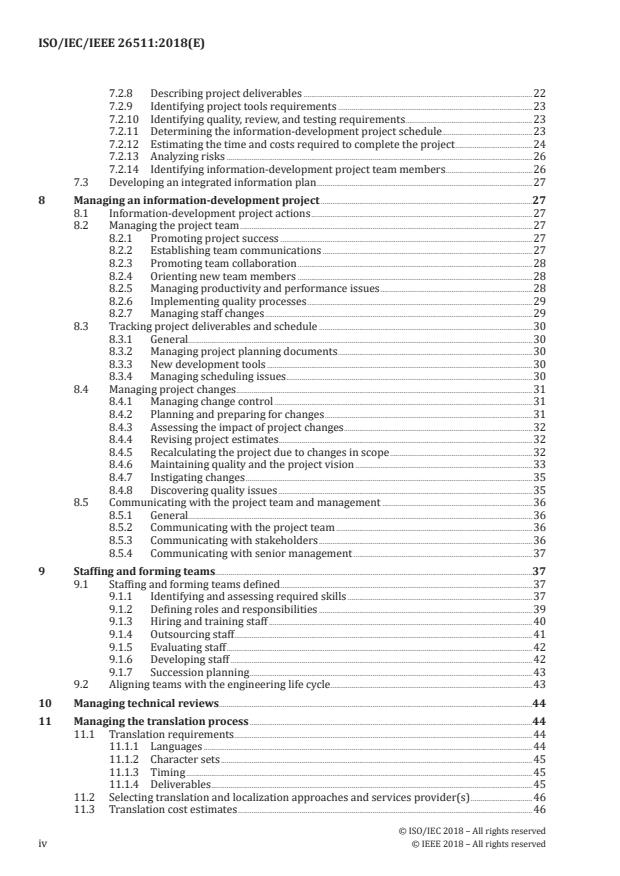
© ISO/IEC 2018 – All rights reserved
iv © IEEE 2018 – All rights reserved
11.4 Translation memory management .46
11.5 Machine translation .46
11.6 Translation review and quality control .47
11.7 Terminology management .47
11.8 Writing for translation .47
11.9 Managing the translation and localization of the user interface .48
11.10 Guidelines for user interface translation and localization:.48
12 Managing final production and delivery .48
12.1 Final production and delivery defined .48
12.1.1 Final approvals .48
12.1.2 During production .49
12.1.3 At delivery .49
12.2 Before production time . .50
13 Measuring content quality and user satisfaction .50
13.1 Measuring content quality and user satisfaction defined .50
13.1.1 Measuring quality defects .51
13.1.2 Measuring user satisfaction .52
13.1.3 Correcting quality defects and improving the process .53
13.1.4 Using user feedback to validate measurements and improve processes .53
13.2 Identifying predictive measurements for preventive action .54
14 Measuring productivity, efficiency, and cost .54
14.1 Importance of measuring cost, productivity, and efficiency .54
14.1.1 Operational costs .54
14.1.2 Labor costs .55
14.1.3 Non-labor costs .55
14.1.4 Translation, printing, and publishing costs .55
14.2 Project costs and time tracking .55
14.2.1 Time intervals.55
14.2.2 Time allocation .56
14.2.3 Typical activities for tracking time .56
14.2.4 Overtime.56
14.2.5 Monitoring project costs .56
14.2.6 Reporting project costs .57
14.3 Productivity measurements .57
14.4 Efficiency measurements .58
14.4.1 Content re-use .59
14.4.2 Content rework .59
14.4.3 Cycle time .59
15 Evaluating organization process maturity .60
15.1 Organization process maturity evaluation .60
15.2 Process Improvement .61
Annex A (informative) User and task analysis .62
Annex B (informative) Project plan example .65
Annex C (informative) Translation management .69
Bibliography .76
IEEE notices and abstract .78
© ISO/IEC 2018 – All rights reserved
© IEEE 2018 – All rights reserved v
Foreword
ISO (the International Organization for Standardization) and IEC (the International Electrotechnical
Commission) form the specialized system for worldwide standardization. National bodies that are
members of ISO or IEC participate in the development of International Standards through technical
committees established by the respective organization to deal with particular fields of technical
activity. ISO and IEC technical committees collaborate in fields of mutual interest. Other international
organizations, governmental and non-governmental, in liaison with ISO and IEC, also take part in the
work. In the field of information technology, ISO and IEC have established a joint technical committee,
ISO/IEC JTC 1.
IEEE Standards documents are developed within the IEEE Societies and the Standards Coordinating
Committees of the IEEE Standards Association (IEEE-SA) Standards Board. The IEEE develops its
standards through a consensus development process, approved by the American National Standards
Institute, which brings together volunteers representing varied viewpoints and interests to achieve the
final product. Volunteers are not necessarily members of the Institute and serve without compensation.
While the IEEE administers the process and establishes rules to promote fairness in the consensus
development process, the IEEE does not independently evaluate, test, or verify the accuracy of any of
the information contained in its standards.
International Standards are drafted in accordance with the rules given in the ISO/IEC Directives, Part
2 (see www .iso .org/directives).
The main task of the joint technical committee is to prepare International Standards. Draft International
Standards adopted by the joint technical committee are circulated to national bodies for voting.
Publication as a standard requires approval by at least 75 % of the national bodies casting a vote.
Attention is called to the possibility that implementation of this standard may require the use of subject
matter covered by patent rights. By publication of this standard, no position is taken with respect
to the existence or validity of any patent rights in connection therewith. ISO/IEEE is not responsible
for identifying essential patents or patent claims for which a license may be required, for conducting
inquiries into the legal validity or scope of patents or patent claims or determining whether any
licensing terms or conditions provided in connection with submission of a Letter of Assurance or a
Patent Statement and Licensing Declaration Form, if any, or in any licensing agreements are reasonable
or non-discriminatory. Users of this standard are expressly advised that determination of the validity
of any patent rights, and the risk of infringement of such rights, is entirely their own responsibility.
Further information may be obtained from ISO or the IEEE Standards Association.
This document was prepared by Joint Technical Committee ISO/IEC JTC 1, Information technology,
Subcommittee SC 7, Software and systems engineering, in cooperation with the Software & Systems
Engineering Standards Committee of the IEEE Computer Society of the IEEE, under the Partner
Standards Development Organization cooperation agreement between ISO and IEEE.
This second edition of ISO/IEC/IEEE 26511 cancels and replaces ISO/IEC/IEEE 26511:2011, which has
been technically revised. The main changes compared to the previous edition are as follows:
— increased emphasis on strategic planning to develop a comprehensive content strategy;
— introduction of comprehensive information for managing the translation and localization process;
— comprehensive requirements for conducting a user needs assessment;
— comprehensive requirements for managing an ongoing project;
— focused information on customer quality and project productivity and efficiency measurements; and
— information on process maturity.
Any feedback or questions on this document should be directed to the user’s national standards body. A
complete listing of these bodies can be found at www .iso .org/members .html.
© ISO/IEC 2018 – All rights reserved
vi © IEEE 2018 – All rights reserved
Introduction
Effective management of information for users makes information for users usable, accurate, and
delivered when needed by the users. Information managed effectively is produced efficiently and
maintained in response to software and system updates and changing user requirements. This
document addresses the management of information for users in terms of the overall strategic direction
of the information, its initial development, and its subsequent updates.
The role of the information-development manager is comprehensive. The manager is responsible
for strategic planning, project planning, project management, staff development and assessment,
translation, production and delivery, and quality and productivity measurements. The manager may
delegate some or all of these responsibilities to well-qualified staff members.
Information development takes place in organizations of all types, including government entities,
corporations, and non-profit organizations.
Effective, well-designed, appropriately delivered information for users increases the return on
investment for the development of a software or systems product. It helps to reduce the cost of training
and support, enabling the users to decrease the time required to productively use a product. As such, it
enhances the reputation of the product, its producer, and its suppliers.
The development of effective information for users should be regarded as an integral part of the
software and systems lifecycle processes from the planning and design stages onwards.
This document was developed to assist users of ISO/IEC/IEEE 15288:2015, Systems and software
engineering — System life cycle processes or ISO/IEC/IEEE 12207:2017, Systems and software engineering
— Software life cycle processes to manage information for users as part of the Information Management
process. This document defines the information-management process from the information-
development manager's point of view. It was developed to assist those who provide input to, perform,
and evaluate information-development.
NOTE Other documents in the ISO/IEC 265NN family address the documentation and information
management processes from the viewpoint of information designers and developers, testers and reviewers, and
acquirers and suppliers.
Beyond the development and production of user manuals, help systems, or sets of information for a
single software product, it applies to a broader range of information management opportunities,
including information for those who install, implement, administer, and operate software, services,
and systems for end users. Frequently, information-development managers are responsible for the
development and reuse of information (content management) for the following:
— updates of user information as the software or system is updated;
— reuse or adaptations of information to support related products;
— multiple translated or localized versions of information for users; and
— a portfolio of unrelated information-development projects being managed concurrently within an
organization.
This document is not intended to advocate the use of either printed or electronic media for information
for users or any particular information management, content management, information testing, or
project management tools or protocols.
© ISO/IEC 2018 – All rights reserved
© IEEE 2018 – All rights reserved vii
INTERNATIONAL STANDARD ISO/IEC/IEEE 26511:2018(E)
Systems and software engineering — Requirements for
managers of information for users of systems, software,
and services
1 Scope
This document supports the needs of users for consistent, complete, accurate, and usable information.
It provides requirements for strategy, planning, managing, staffing, translation, production, and quality
and process-maturity assessment for managers of information for users. It specifies processes and
procedures for managing information for users throughout the product- or systems-development life
cycle. It also includes requirements for key documents produced for managing information for users,
including strategic and project plans.
This document provides an overview of the information-management processes that are specific for
the management of information for users. It addresses the following activities:
— developing a comprehensive strategy for information development;
— assessing user information needs;
— planning and managing an information-development project;
— staffing and forming information-development teams;
— reviewing and testing information for users;
— managing the translation process;
— publishing and delivering information for users;
— evaluating customer satisfaction and information quality;
— measuring productivity, efficiency, and costs; and
— evaluating organizational maturity.
The guidance in this document applies to multiple project management approaches, including both
agile and traditional practices. Traditional practices can encompass predictive, waterfall, or other top-
down management methods. Where certain practices are common in agile project management, they
are noted.
This document is applicable for use by managers of information for users or organizations with
information developers. This document can also be consulted by those with other roles and interests in
the process of developing information for users:
— managers of the product and system development process;
— acquirers of information for users prepared by suppliers;
— experienced information developers who prepare information for users;
— human-factors experts who identify principles for making information for users more accessible
and easily used; and
— user interface designers and ergonomics experts working together to design the presentation of
information.
© ISO/IEC 2018 – All rights reserved
© IEEE 2018 – All rights reserved 1
This document can be applied to manage the following types of information for users, although it does
not cover all aspects of them:
— information for user assistance, training, marketing, and systems documentation for product design
and development, based on reuse of user information topics;
— multimedia marketing presentations using animation, video, and sound;
— information developed for virtual and augmented reality presentations;
— computer-based training (CBT) packages and course materials intended primarily for use in formal
training programs; and
— information describing the internal operation of products.
2 Normative references
The following documents are referred to in the text in such a way that some or all of their content
constitutes requirements of this document. For dated references, only the edition cited applies. For
undated references, the latest edition of the referenced document (including any amendments) applies.
ISO/IEC/IEEE 12207:2017, Systems and software engineering — Software life cycle processes
ISO/IEC/IEEE 15288:2015, Systems and software engineering — System life cycle processes
3 Terms, definitions, and abbreviations
For the purposes of this document, the following terms and definitions apply.
ISO, IEC and IEEE maintain terminological databases for use in standardization at the following
addresses:
— IEC Electropedia: available at http: //www .electropedia .org
— ISO Online browsing platform: available at https: //www .iso .org/obp
— IEEE Standards Dictionary Online: available at http: //ieeexplore .ieee .org/xpls/dictionary
NOTE 1 The verb “include” used in this document indicates that either (1) the information is present or (2) a
reference to the information is listed.
NOTE 2 This document refers to “the manager,” which applies to anyone performing the required management
activities, regardless of title or responsibilities.
NOTE 3 Additional terms and definitions relating to information management can be found is ISO/IEC/IEEE
24765:2017, Systems and software engineering — Vocabulary.
3.1 Terms and definitions
3.1.1
accessibility
extent to which products, systems, services, environments and facilities can be used by people from
a population with the widest range of characteristics and capabilities to achieve a specified goal in a
specified context of use
[SOURCE: ISO/IEC 25064:2013]
© ISO/IEC 2018 – All rights reserved
2 © IEEE 2018 – All rights reserved
3.1.2
annotated topic list
ATL
list of all topics to be included in an information-development project with annotations that can include
writer, where used, file name, and additional data
3.1.3
archiving
process of placing a version of a document in a less frequently used storage area
3.1.4
augmented reality system
view of the physical world that is supplemented by computer-generated text, images, data, or other media
3.1.5
authoring environment
toolset used to create, store, and manage content units
3.1.6
burndown chart
graph that represents the work remaining to do on a project
3.1.7
component content management system
CCMS
content management system that supports the entire document- or information-development life cycle
from authoring through review and publishing, including the reuse of modular content
3.1.8
conditional text
text that is marked to be excluded from one or more versions of a final content deliverable
3.1.9
customer
organization or person that receives a product or service
[SOURCE: ISO/IEC/IEEE 12207:2017, modified, Note 1 to entry and EXAMPLE have been deleted.]
3.1.10
cycle time
time associated with one complete operation of a repetitive process
[SOURCE: ISO 16484-2:2004]
3.1.11
disaster recovery
ability of the Information and Communications Technology elements of an organization to support its
critical business functions to an acceptable level within a predetermined period following a disaster
[SOURCE: ISO/IEC 19086-1:2016, modified, ICT has been replaced by Information and Communications
Technology.]
3.1.12
disposition
range of processes associated with implementing retention, destruction or transfer decisions which are
documented in disposition or other instruments
[SOURCE: ISO 16175-2:2011, modified, article “a” has been removed before the word “range.”]
© ISO/IEC 2018 – All rights reserved
© IEEE 2018 – All rights reserved 3
3.1.13
Darwin Information Typing Architecture
DITA
XML-based architecture for authoring, producing, and delivering topic-oriented, information-typed
content that can be reused and single-sourced in a variety of ways
3.1.14
embedded help system
information for users that is delivered as an integral part of a piece of software
3.1.15
extensible markup language
XML
formal language used to specify the structure of XML documents, specified in the XML Schema Part 1
—Structures Recommendation
[SOURCE: ISO 10303-28:2007]
3.1.16
information architecture
structure of an information space and the semantics for accessing required task objects, system objects
and other information
[SOURCE: ISO/IEC TR 25060:2010, modified, domain has been removed from the
beginning of the definition and NOTE has been removed.]
3.1.17
information developer
person who prepares the content and visuals for information for users
3.1.18
information type
category of topics, such as concepts, tasks, or reference
3.1.19
intellectual property
output of creative human thought process that has some intellectual or informational value
3.1.20
markup language
method of defining and describing the structure of different types of electronic documents
3.1.21
metadata
data that describe other data
[SOURCE: ISO/IEC 25024:2015]
3.1.22
minimalism
principle for the selection of information for users that supports task performance, troubleshooting,
and problem resolution
[SOURCE: ISO/IEC/IEEE 26515]
3.1.23
process maturity
extent to which an organizational unit consistently implements processes within a defined scope that
contributes to the achievement of its business needs (current or projected)
[SOURCE: ISO/IEC 33001:2015, modified, term was originally “organizational process maturity,”
definition included article “the” preceding the definition, and Note 1 to entry has been removed.]
© ISO/IEC 2018 – All rights reserved
4 © IEEE 2018 – All rights reserved
...
INTERNATIONAL ISO/IEC/
STANDARD IEEE
Second edition
2018-12
Systems and software engineering —
Requirements for managers of
information for users of systems,
software, and services
Ingénierie des systèmes et du logiciel — Exigences pour les
gestionnaires de l'information pour les utilisateur de systèmes,
logiciels, et services
Reference number
©
ISO/IEC 2018
©
IEEE 2018
© ISO/IEC 2018
© IEEE 2018
All rights reserved. Unless otherwise specified, or required in the context of its implementation, no part of this publication may
be reproduced or utilized otherwise in any form or by any means, electronic or mechanical, including photocopying, or posting
on the internet or an intranet, without prior written permission. Permission can be requested from either ISO or IEEE at the
respective address below or ISO’s member body in the country of the requester.
ISO copyright office Institute of Electrical and Electronics Engineers, Inc
CP 401 • Ch. de Blandonnet 8 3 Park Avenue, New York
CH-1214 Vernier, Geneva NY 10016-5997, USA
Phone: +41 22 749 01 11
Fax: +41 22 749 09 47
Email: copyright@iso.org Email: stds.ipr@ieee.org
Website: www.iso.org Website: www.ieee.org
Published in Switzerland
© ISO/IEC 2018 – All rights reserved
ii © IEEE 2018 – All rights reserved
Contents Page
Foreword .vi
Introduction .vii
1 Scope . 1
2 Normative references . 2
3 Terms, definitions, and abbreviations . 2
4 Conformance . 7
5 Managing strategy for information development . 8
5.1 Information-development strategy defined . 8
5.1.1 Purpose of strategy . 8
5.1.2 Responsibility for strategic planning . 8
5.1.3 Frequency of strategic work . 9
5.1.4 Reporting structure . 9
5.1.5 Compliance . 9
5.2 Stakeholders .10
5.3 Manager’s strategic tasks and potential actions to support them .11
5.3.1 General.11
5.3.2 Business environment and organization situation .11
5.3.3 Organizational alignment .12
5.3.4 Product portfolio .12
5.3.5 Information-development organization .12
5.3.6 Stakeholder needs .13
5.3.7 User needs .13
5.3.8 Vision .13
5.3.9 Executing strategy .13
5.4 Key decisions .14
5.4.1 General.14
5.4.2 Information-product delivery structure .14
5.4.3 Intellectual property . .14
5.4.4 Content management system .14
5.4.5 Staffing .14
5.4.6 Communication .15
5.4.7 Information development methodology .15
5.4.8 Project management .15
5.4.9 Information management, version and change control, and archiving .15
5.4.10 Establishing a long-term content life cycle policy . .16
5.4.11 Managing distribution . .16
5.4.12 Security and disaster recovery .16
5.4.13 Acquisitions .17
5.5 Translation and localization .17
6 Conducting a user needs assessment .17
6.1 User needs assessment defined .17
6.2 Components of the user needs assessment .17
7 Planning an information-development project .18
7.1 Information-development project planning defined .18
7.2 Developing the information-development project plan .18
7.2.1 Identifying project goals.20
7.2.2 Analyzing project scope .20
7.2.3 Describing users of information .20
7.2.4 Describing topics to be developed .21
7.2.5 Specifying an information reuse strategy .22
7.2.6 Describing accessibility requirements .22
7.2.7 Describing translation and localization requirements .22
© ISO/IEC 2018 – All rights reserved
© IEEE 2018 – All rights reserved iii
7.2.8 Describing project deliverables .22
7.2.9 Identifying project tools requirements .23
7.2.10 Identifying quality, review, and testing requirements .23
7.2.11 Determining the information-development project schedule .23
7.2.12 Estimating the time and costs required to complete the project .24
7.2.13 Analyzing risks .26
7.2.14 Identifying information-development project team members .26
7.3 Developing an integrated information plan .27
8 Managing an information-development project .27
8.1 Information-development project actions .27
8.2 Managing the project team .27
8.2.1 Promoting project success .27
8.2.2 Establishing team communications .27
8.2.3 Promoting team collaboration .28
8.2.4 Orienting new team members .28
8.2.5 Managing productivity and performance issues .28
8.2.6 Implementing quality processes .29
8.2.7 Managing staff changes .29
8.3 Tracking project deliverables and schedule .30
8.3.1 General.30
8.3.2 Managing project planning documents .30
8.3.3 New development tools .30
8.3.4 Managing scheduling issues .30
8.4 Managing project changes .31
8.4.1 Managing change control .31
8.4.2 Planning and preparing for changes .31
8.4.3 Assessing the impact of project changes .32
8.4.4 Revising project estimates.32
8.4.5 Recalculating the project due to changes in scope .32
8.4.6 Maintaining quality and the project vision .33
8.4.7 Instigating changes .35
8.4.8 Discovering quality issues .35
8.5 Communicating with the project team and management .36
8.5.1 General.36
8.5.2 Communicating with the project team .36
8.5.3 Communicating with stakeholders .36
8.5.4 Communicating with senior management .37
9 Staffing and forming teams.37
9.1 Staffing and forming teams defined .37
9.1.1 Identifying and assessing required skills .37
9.1.2 Defining roles and responsibilities .39
9.1.3 Hiring and training staff .40
9.1.4 Outsourcing staff .41
9.1.5 Evaluating staff .42
9.1.6 Developing staff .42
9.1.7 Succession planning .43
9.2 Aligning teams with the engineering life cycle .43
10 Managing technical reviews .44
11 Managing the translation process .44
11.1 Translation requirements .44
11.1.1 Languages .44
11.1.2 Character sets .45
11.1.3 Timing .45
11.1.4 Deliverables .45
11.2 Selecting translation and localization approaches and services provider(s) .46
11.3 Translation cost estimates .46
© ISO/IEC 2018 – All rights reserved
iv © IEEE 2018 – All rights reserved
11.4 Translation memory management .46
11.5 Machine translation .46
11.6 Translation review and quality control .47
11.7 Terminology management .47
11.8 Writing for translation .47
11.9 Managing the translation and localization of the user interface .48
11.10 Guidelines for user interface translation and localization:.48
12 Managing final production and delivery .48
12.1 Final production and delivery defined .48
12.1.1 Final approvals .48
12.1.2 During production .49
12.1.3 At delivery .49
12.2 Before production time . .50
13 Measuring content quality and user satisfaction .50
13.1 Measuring content quality and user satisfaction defined .50
13.1.1 Measuring quality defects .51
13.1.2 Measuring user satisfaction .52
13.1.3 Correcting quality defects and improving the process .53
13.1.4 Using user feedback to validate measurements and improve processes .53
13.2 Identifying predictive measurements for preventive action .54
14 Measuring productivity, efficiency, and cost .54
14.1 Importance of measuring cost, productivity, and efficiency .54
14.1.1 Operational costs .54
14.1.2 Labor costs .55
14.1.3 Non-labor costs .55
14.1.4 Translation, printing, and publishing costs .55
14.2 Project costs and time tracking .55
14.2.1 Time intervals.55
14.2.2 Time allocation .56
14.2.3 Typical activities for tracking time .56
14.2.4 Overtime.56
14.2.5 Monitoring project costs .56
14.2.6 Reporting project costs .57
14.3 Productivity measurements .57
14.4 Efficiency measurements .58
14.4.1 Content re-use .59
14.4.2 Content rework .59
14.4.3 Cycle time .59
15 Evaluating organization process maturity .60
15.1 Organization process maturity evaluation .60
15.2 Process Improvement .61
Annex A (informative) User and task analysis .62
Annex B (informative) Project plan example .65
Annex C (informative) Translation management .69
Bibliography .76
IEEE notices and abstract .78
© ISO/IEC 2018 – All rights reserved
© IEEE 2018 – All rights reserved v
Foreword
ISO (the International Organization for Standardization) and IEC (the International Electrotechnical
Commission) form the specialized system for worldwide standardization. National bodies that are
members of ISO or IEC participate in the development of International Standards through technical
committees established by the respective organization to deal with particular fields of technical
activity. ISO and IEC technical committees collaborate in fields of mutual interest. Other international
organizations, governmental and non-governmental, in liaison with ISO and IEC, also take part in the
work. In the field of information technology, ISO and IEC have established a joint technical committee,
ISO/IEC JTC 1.
IEEE Standards documents are developed within the IEEE Societies and the Standards Coordinating
Committees of the IEEE Standards Association (IEEE-SA) Standards Board. The IEEE develops its
standards through a consensus development process, approved by the American National Standards
Institute, which brings together volunteers representing varied viewpoints and interests to achieve the
final product. Volunteers are not necessarily members of the Institute and serve without compensation.
While the IEEE administers the process and establishes rules to promote fairness in the consensus
development process, the IEEE does not independently evaluate, test, or verify the accuracy of any of
the information contained in its standards.
International Standards are drafted in accordance with the rules given in the ISO/IEC Directives, Part
2 (see www .iso .org/directives).
The main task of the joint technical committee is to prepare International Standards. Draft International
Standards adopted by the joint technical committee are circulated to national bodies for voting.
Publication as a standard requires approval by at least 75 % of the national bodies casting a vote.
Attention is called to the possibility that implementation of this standard may require the use of subject
matter covered by patent rights. By publication of this standard, no position is taken with respect
to the existence or validity of any patent rights in connection therewith. ISO/IEEE is not responsible
for identifying essential patents or patent claims for which a license may be required, for conducting
inquiries into the legal validity or scope of patents or patent claims or determining whether any
licensing terms or conditions provided in connection with submission of a Letter of Assurance or a
Patent Statement and Licensing Declaration Form, if any, or in any licensing agreements are reasonable
or non-discriminatory. Users of this standard are expressly advised that determination of the validity
of any patent rights, and the risk of infringement of such rights, is entirely their own responsibility.
Further information may be obtained from ISO or the IEEE Standards Association.
This document was prepared by Joint Technical Committee ISO/IEC JTC 1, Information technology,
Subcommittee SC 7, Software and systems engineering, in cooperation with the Software & Systems
Engineering Standards Committee of the IEEE Computer Society of the IEEE, under the Partner
Standards Development Organization cooperation agreement between ISO and IEEE.
This second edition of ISO/IEC/IEEE 26511 cancels and replaces ISO/IEC/IEEE 26511:2011, which has
been technically revised. The main changes compared to the previous edition are as follows:
— increased emphasis on strategic planning to develop a comprehensive content strategy;
— introduction of comprehensive information for managing the translation and localization process;
— comprehensive requirements for conducting a user needs assessment;
— comprehensive requirements for managing an ongoing project;
— focused information on customer quality and project productivity and efficiency measurements; and
— information on process maturity.
Any feedback or questions on this document should be directed to the user’s national standards body. A
complete listing of these bodies can be found at www .iso .org/members .html.
© ISO/IEC 2018 – All rights reserved
vi © IEEE 2018 – All rights reserved
Introduction
Effective management of information for users makes information for users usable, accurate, and
delivered when needed by the users. Information managed effectively is produced efficiently and
maintained in response to software and system updates and changing user requirements. This
document addresses the management of information for users in terms of the overall strategic direction
of the information, its initial development, and its subsequent updates.
The role of the information-development manager is comprehensive. The manager is responsible
for strategic planning, project planning, project management, staff development and assessment,
translation, production and delivery, and quality and productivity measurements. The manager may
delegate some or all of these responsibilities to well-qualified staff members.
Information development takes place in organizations of all types, including government entities,
corporations, and non-profit organizations.
Effective, well-designed, appropriately delivered information for users increases the return on
investment for the development of a software or systems product. It helps to reduce the cost of training
and support, enabling the users to decrease the time required to productively use a product. As such, it
enhances the reputation of the product, its producer, and its suppliers.
The development of effective information for users should be regarded as an integral part of the
software and systems lifecycle processes from the planning and design stages onwards.
This document was developed to assist users of ISO/IEC/IEEE 15288:2015, Systems and software
engineering — System life cycle processes or ISO/IEC/IEEE 12207:2017, Systems and software engineering
— Software life cycle processes to manage information for users as part of the Information Management
process. This document defines the information-management process from the information-
development manager's point of view. It was developed to assist those who provide input to, perform,
and evaluate information-development.
NOTE Other documents in the ISO/IEC 265NN family address the documentation and information
management processes from the viewpoint of information designers and developers, testers and reviewers, and
acquirers and suppliers.
Beyond the development and production of user manuals, help systems, or sets of information for a
single software product, it applies to a broader range of information management opportunities,
including information for those who install, implement, administer, and operate software, services,
and systems for end users. Frequently, information-development managers are responsible for the
development and reuse of information (content management) for the following:
— updates of user information as the software or system is updated;
— reuse or adaptations of information to support related products;
— multiple translated or localized versions of information for users; and
— a portfolio of unrelated information-development projects being managed concurrently within an
organization.
This document is not intended to advocate the use of either printed or electronic media for information
for users or any particular information management, content management, information testing, or
project management tools or protocols.
© ISO/IEC 2018 – All rights reserved
© IEEE 2018 – All rights reserved vii
INTERNATIONAL STANDARD ISO/IEC/IEEE 26511:2018(E)
Systems and software engineering — Requirements for
managers of information for users of systems, software,
and services
1 Scope
This document supports the needs of users for consistent, complete, accurate, and usable information.
It provides requirements for strategy, planning, managing, staffing, translation, production, and quality
and process-maturity assessment for managers of information for users. It specifies processes and
procedures for managing information for users throughout the product- or systems-development life
cycle. It also includes requirements for key documents produced for managing information for users,
including strategic and project plans.
This document provides an overview of the information-management processes that are specific for
the management of information for users. It addresses the following activities:
— developing a comprehensive strategy for information development;
— assessing user information needs;
— planning and managing an information-development project;
— staffing and forming information-development teams;
— reviewing and testing information for users;
— managing the translation process;
— publishing and delivering information for users;
— evaluating customer satisfaction and information quality;
— measuring productivity, efficiency, and costs; and
— evaluating organizational maturity.
The guidance in this document applies to multiple project management approaches, including both
agile and traditional practices. Traditional practices can encompass predictive, waterfall, or other top-
down management methods. Where certain practices are common in agile project management, they
are noted.
This document is applicable for use by managers of information for users or organizations with
information developers. This document can also be consulted by those with other roles and interests in
the process of developing information for users:
— managers of the product and system development process;
— acquirers of information for users prepared by suppliers;
— experienced information developers who prepare information for users;
— human-factors experts who identify principles for making information for users more accessible
and easily used; and
— user interface designers and ergonomics experts working together to design the presentation of
information.
© ISO/IEC 2018 – All rights reserved
© IEEE 2018 – All rights reserved 1
This document can be applied to manage the following types of information for users, although it does
not cover all aspects of them:
— information for user assistance, training, marketing, and systems documentation for product design
and development, based on reuse of user information topics;
— multimedia marketing presentations using animation, video, and sound;
— information developed for virtual and augmented reality presentations;
— computer-based training (CBT) packages and course materials intended primarily for use in formal
training programs; and
— information describing the internal operation of products.
2 Normative references
The following documents are referred to in the text in such a way that some or all of their content
constitutes requirements of this document. For dated references, only the edition cited applies. For
undated references, the latest edition of the referenced document (including any amendments) applies.
ISO/IEC/IEEE 12207:2017, Systems and software engineering — Software life cycle processes
ISO/IEC/IEEE 15288:2015, Systems and software engineering — System life cycle processes
3 Terms, definitions, and abbreviations
For the purposes of this document, the following terms and definitions apply.
ISO, IEC and IEEE maintain terminological databases for use in standardization at the following
addresses:
— IEC Electropedia: available at http: //www .electropedia .org
— ISO Online browsing platform: available at https: //www .iso .org/obp
— IEEE Standards Dictionary Online: available at http: //ieeexplore .ieee .org/xpls/dictionary
NOTE 1 The verb “include” used in this document indicates that either (1) the information is present or (2) a
reference to the information is listed.
NOTE 2 This document refers to “the manager,” which applies to anyone performing the required management
activities, regardless of title or responsibilities.
NOTE 3 Additional terms and definitions relating to information management can be found is ISO/IEC/IEEE
24765:2017, Systems and software engineering — Vocabulary.
3.1 Terms and definitions
3.1.1
accessibility
extent to which products, systems, services, environments and facilities can be used by people from
a population with the widest range of characteristics and capabilities to achieve a specified goal in a
specified context of use
[SOURCE: ISO/IEC 25064:2013]
© ISO/IEC 2018 – All rights reserved
2 © IEEE 2018 – All rights reserved
3.1.2
annotated topic list
ATL
list of all topics to be included in an information-development project with annotations that can include
writer, where used, file name, and additional data
3.1.3
archiving
process of placing a version of a document in a less frequently used storage area
3.1.4
augmented reality system
view of the physical world that is supplemented by computer-generated text, images, data, or other media
3.1.5
authoring environment
toolset used to create, store, and manage content units
3.1.6
burndown chart
graph that represents the work remaining to do on a project
3.1.7
component content management system
CCMS
content management system that supports the entire document- or information-development life cycle
from authoring through review and publishing, including the reuse of modular content
3.1.8
conditional text
text that is marked to be excluded from one or more versions of a final content deliverable
3.1.9
customer
organization or person that receives a product or service
[SOURCE: ISO/IEC/IEEE 12207:2017, modified, Note 1 to entry and EXAMPLE have been deleted.]
3.1.10
cycle time
time associated with one complete operation of a repetitive process
[SOURCE: ISO 16484-2:2004]
3.1.11
disaster recovery
ability of the Information and Communications Technology elements of an organization to support its
critical business functions to an acceptable level within a predetermined period following a disaster
[SOURCE: ISO/IEC 19086-1:2016, modified, ICT has been replaced by Information and Communications
Technology.]
3.1.12
disposition
range of processes associated with implementing retention, destruction or transfer decisions which are
documented in disposition or other instruments
[SOURCE: ISO 16175-2:2011, modified, article “a” has been removed before the word “range.”]
© ISO/IEC 2018 – All rights reserved
© IEEE 2018 – All rights reserved 3
3.1.13
Darwin Information Typing Architecture
DITA
XML-based architecture for authoring, producing, and delivering topic-oriented, information-typed
content that can be reused and single-sourced in a variety of ways
3.1.14
embedded help system
information for users that is delivered as an integral part of a piece of software
3.1.15
extensible markup language
XML
formal language used to specify the structure of XML documents, specified in the XML Schema Part 1
—Structures Recommendation
[SOURCE: ISO 10303-28:2007]
3.1.16
information architecture
structure of an information space and the semantics for accessing required task objects, system objects
and other information
[SOURCE: ISO/IEC TR 25060:2010, modified, domain has been removed from the
beginning of the definition and NOTE has been removed.]
3.1.17
information developer
person who prepares the content and visuals for information for users
3.1.18
information type
category of topics, such as concepts, tasks, or reference
3.1.19
intellectual property
output of creative human thought process that has some intellectual or informational value
3.1.20
markup language
method of defining and describing the structure of different types of electronic documents
3.1.21
metadata
data that describe other data
[SOURCE: ISO/IEC 25024:2015]
3.1.22
minimalism
principle for the selection of information for users that supports task performance, troubleshooting,
and problem resolution
[SOURCE: ISO/IEC/IEEE 26515]
3.1.23
process maturity
extent to which an organizational unit consistently implements processes within a defined scope that
contributes to the achievement of its business needs (current or projected)
[SOURCE: ISO/IEC 33001:2015, modified, term was originally “organizational process maturity,”
definition included article “the” preceding the definition, and Note 1 to entry has been removed.]
© ISO/IEC 2018 – All rights reserved
4 © IEEE 2018 – All rights reserved
...