

ISO/IEEE FDIS 11073-10417
(Main)Health informatics — Device interoperability — Part 10417: Personal health device communication, device specialization, glucose meter
- Abstract
Within the context of the ISO/IEEE 11073 family of standards for device communication, ISO/IEEE 11073-10417:2017 establishes a normative definition of communication between personal telehealth glucose meter devices and compute engines (e.g., cell phones, personal computers, personal health appliances, and set top boxes) in a manner that enables plug-and-play interoperability. It leverages appropriate portions of existing standards, including ISO/IEEE 11073 terminology, information models, application profile standards, and transport standards. It specifies the use of specific term codes, formats, and behaviors in telehealth environments restricting optionality in base frameworks in favor of interoperability. This standard defines a common core of communication functionality for personal telehealth glucose meters.
- Status
- Not Published
- Technical Committee
- ISO/TC 215 - Health informatics
- Drafting Committee
- ISO/TC 215/WG 2 - Systems and Device Interoperability
- Current Stage
- 5020 - Proof sent to secretariat or FDIS ballot initiated: 8 weeks - 50 Approval
- Start Date
- 14-Jul-2026
- Due Date
- 14-Jul-2026
- Completion Date
- 14-Jul-2026
Buy Documents

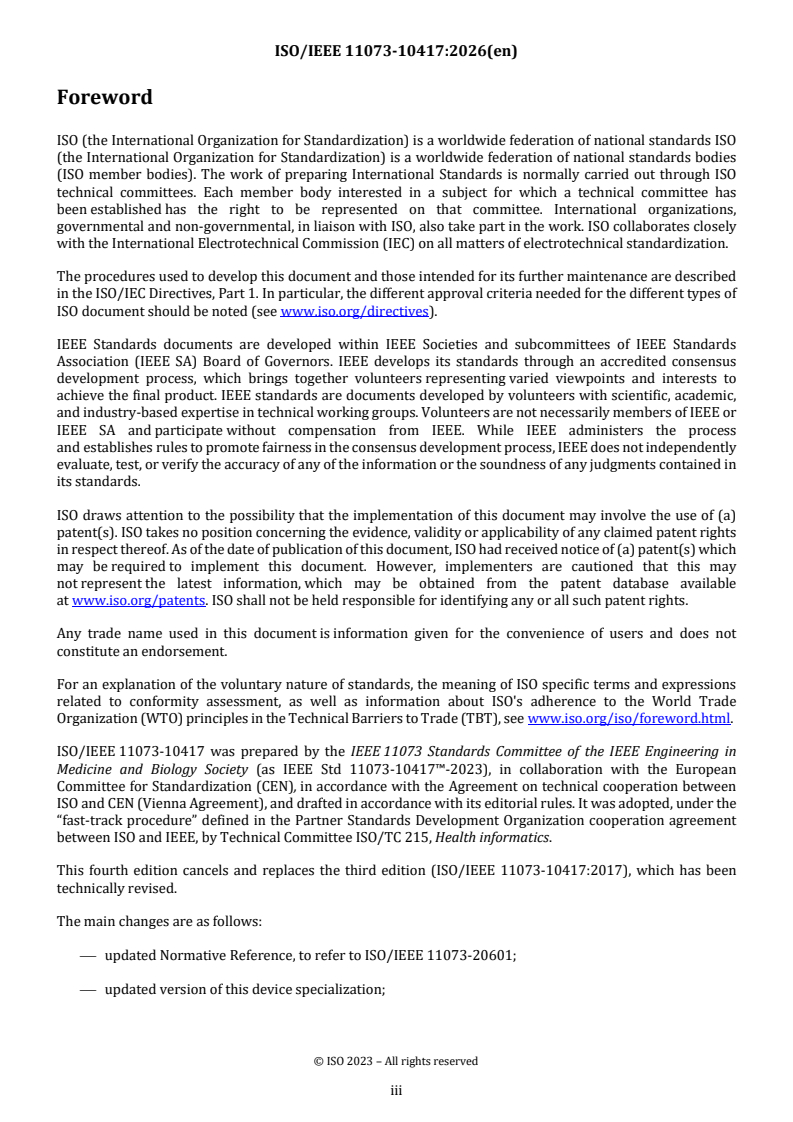
ISO/IEEE FDIS 11073-10417 - Health informatics — Device interoperability — Part 10417: Personal health device communication, device specialization, glucose meter

ISO/IEEE FDIS 11073-10417 - Informatique de santé — Interopérabilité des dispositifs — Partie 10417: Communication entre dispositifs de santé personnels, spécialisation des dispositifs, glucomètre
ISO/IEEE FDIS 11073-10417 is an ISO/IEEE standard for personal health device communication in the ISO/IEEE 11073 family. It specifies how a glucose meter exchanges data with a compute engine such as a cell phone, personal computer, personal health appliance, or set-top box so the devices can interoperate in a plug-and-play way. The document is aimed at device vendors, software developers, integrators, and test teams that need a shared glucose meter data model and communication behavior.
What does ISO/IEEE FDIS 11073-10417 specify?
ISO/IEEE FDIS 11073-10417 specifies the glucose meter device specialization for personal health device communication. It narrows the base ISO/IEEE 11073-20601 framework to a common core for glucose meters, using defined term codes, formats, and behaviors to support interoperability.
Clause 1 states the scope and purpose. Clauses 4 to 10 cover the personal health device framework, glucose meter concepts, the domain information model, service and communication models, test associations, and conformance. Annex B and Annex C are normative; Annex A, D, E, and F are informative.
| Annex | What it covers |
|---|---|
| A | Bibliography |
| B | Any additional ASN.1 definitions |
| C | Allocation of identifiers |
| D | Message sequence examples |
| E | Protocol data unit examples |
| F | Revision history |
The standard focuses on glucose meter agents and their communication with managers, rather than redefining the whole ISO/IEEE 11073-20601 framework. It also states that real-time sample array objects and scanner objects are not required, and that no class extensions are defined.
What are the key requirements of ISO/IEEE FDIS 11073-10417?
ISO/IEEE FDIS 11073-10417 turns the generic 11073-20601 framework into a glucose meter profile with specific object classes, services, message rules, and conformance tests. For implementers, the main task is to build the required objects and services exactly as the specialization defines them, then declare conformance with the right level and configuration.
Information model and object rules
- Clause 6 defines the glucose meter domain information model, including the medical device system (MDS) object, numeric objects, enumeration objects, PM-store objects, and their attributes, methods, and events. In practice, this is the core data model that the manager reads and the agent reports.
- Clause 6.3 uses attribute qualifiers M, C, R, NR, and O to show whether an attribute is mandatory, conditional, recommended, not recommended, or optional. This matters because it tells an implementer what must be present in a conforming agent and what can be left out.
- Clause 6.12 allows vendor-specific metrics and attributes, but they must use the private numbering space 0xF000 to 0xFFFF and the extended configuration ID range. This lets a manufacturer add extra features without colliding with standard codes.
- Clauses 6.2, 6.7, 6.10, and 6.11 keep the specialization focused: no class extensions are defined, real-time sample array objects are not required, scanner objects are not required, and no class extension objects are defined. That reduces implementation scope for ordinary glucose meters.
Services and communication behavior
- Clause 7 limits the supported object access services to GET, SET, Event report, and Action. GET is used to read MDS and PM-store attributes, SET has no settable attributes defined here, Event report carries configuration and measurement data, and Action includes commands such as Set-Time and segment-related actions.
- Clause 7.3 requires confirmed event reports and agent-initiated measurement transmission. A manager shall support both single-person and multiple-person event reports, while a glucose meter agent may support one or both. In practice, this lets the same standard work for home use and clinic workflows.
- Clause 8.2 sets application protocol data unit (APDU) size limits and requires larger backlogs to be split into multiple event reports when needed. That is important for portable meters because limited message size affects how many measurements can be sent in one transfer.
- Clause 8.4 names two standard configurations, 0x06A5 and 0x06A6, and allows extended configurations with reserved IDs. This is what the manager and agent use during association and configuration negotiation.
- Clause 8.5.3 says multiple pending glucose measurements may be sent in one event report, up to the allowed limit, and otherwise must be split. This helps reduce message overhead and power use.
- Clause 8.6 allows time synchronization, but the synchronization mechanism itself is outside the standard. If time sync is used, the Mds-Time-Info attribute must report it so the manager can align timestamps correctly.
Testing and conformance
- Clause 9 defines a test association for the standard configuration in which the meter simulates a blood glucose measurement. The test-data bit is set if measurement-status is supported, which helps automated verification without manual measurement steps.
- Clause 10 defines conformance to the domain information model class hierarchy, nomenclature code values, protocol and service models, and communication service model. Vendors declare this through implementation conformance statements (ICSs), including how they apply the standard and any extensions.
What terms does ISO/IEEE FDIS 11073-10417 define?
ISO/IEEE FDIS 11073-10417 defines the key roles and objects used in glucose meter communication. These terms are the vocabulary that keeps agent and manager implementations aligned.
- agent - A node that collects and transmits personal health data to an associated manager.
- manager - A node that receives data from one or more agent systems; the standard also uses compute engine for this role.
- glucose meter - A medical device for determining the approximate concentration of glucose in the blood.
- domain information model (DIM) - The hierarchical model that describes an agent as a set of objects and their attributes.
- medical device system (MDS) - The top-level device object that represents the glucose meter system and its attributes, methods, and events.
- protocol data unit (PDU) - The protocol message unit used for communication exchanges between the agent and the manager.
- implementation conformance statements (ICSs) - Statements that describe how a product conforms to the standard and which options or extensions it uses.
Who uses ISO/IEEE FDIS 11073-10417?
ISO/IEEE FDIS 11073-10417 is used by glucose meter manufacturers, personal health device platform developers, mobile app developers, and gateway or set-top-box integrators. It is also used by test laboratories and quality teams that need repeatable checks for association, configuration, data reporting, and conformance.
Health care professionals use systems built to this standard when they download glucose logs in an office or clinic setting. Product teams use it when they need meters that can send data to phones, PCs, personal health appliances, or other manager devices in home or clinical environments.
What changed in ISO/IEEE FDIS 11073-10417 from the previous edition?
ISO/IEEE FDIS 11073-10417 is the fourth edition and it cancels and replaces the third edition, ISO/IEEE 11073-10417:2017. The document states that it was technically revised.
The changes stated in the document include:
- updated normative reference to ISO/IEEE 11073-20601
- updated version of the device specialization
- updated association details for the newer version
- wording updates in 6.3 and 6.12
- added Clause 3.4 on compliance with other standards
- updated attribute-id-list text in 8.5.2 to match 20601-V4
- made ISO/IEEE 11073-10101 a normative reference
- clarified nomenclature precedence across 10101, 20601, 104xx, and this standard
- tied nomenclature-version to the corresponding protocol-version
- updated Annex E examples to use base offset time
Which standards are used with ISO/IEEE FDIS 11073-10417?
ISO/IEEE FDIS 11073-10417 is used with ISO/IEEE 11073-20601 and ISO/IEEE 11073-10101. Clause 2 says these are indispensable for applying the document.
- ISO/IEEE 11073-20601 - Provides the optimized exchange protocol, modeling constructs, MDERs, and the base communication framework that this specialization uses.
- ISO/IEEE 11073-10101 - Provides the nomenclature used for object and attribute codes.
What does the ISO/IEEE FDIS 11073-10417 document contain?
The document contains the full glucose meter specialization built on the ISO/IEEE 11073 personal health device framework. Its main body moves from scope and definitions to the glucose meter domain information model, service model, communication model, test associations, and conformance.
It includes an object instance diagram for the glucose meter DIM, tables that define glucose concentration types and object attributes, and a service mapping table for GET, Event report, and ACTION services. Annex B supplies ASN.1 definitions for new data types, and Annex C allocates identifier codes and nomenclature values used by the standard.
Annex D and Annex E provide message sequence examples and protocol data unit examples for association, configuration, data reporting, and disassociation. Annex F records the revision history.
Relations
- Effective Date
- 30-May-2026
- Effective Date
- 16-May-2026
Buy Documents
ISO/IEEE FDIS 11073-10417 - Health informatics — Device interoperability — Part 10417: Personal health device communication, device specialization, glucose meter
ISO/IEEE FDIS 11073-10417 - Informatique de santé — Interopérabilité des dispositifs — Partie 10417: Communication entre dispositifs de santé personnels, spécialisation des dispositifs, glucomètre
Get Certified
Connect with accredited certification bodies for this standard

BSI Group
BSI (British Standards Institution) is the business standards company that helps organizations make excellence a habit.

NYCE
Mexican standards and certification body.
Sponsored listings
Frequently Asked Questions
ISO/IEEE FDIS 11073-10417 is a draft published by the International Organization for Standardization (ISO). Its full title is "Health informatics — Device interoperability — Part 10417: Personal health device communication, device specialization, glucose meter". This standard covers: Within the context of the ISO/IEEE 11073 family of standards for device communication, ISO/IEEE 11073-10417:2017 establishes a normative definition of communication between personal telehealth glucose meter devices and compute engines (e.g., cell phones, personal computers, personal health appliances, and set top boxes) in a manner that enables plug-and-play interoperability. It leverages appropriate portions of existing standards, including ISO/IEEE 11073 terminology, information models, application profile standards, and transport standards. It specifies the use of specific term codes, formats, and behaviors in telehealth environments restricting optionality in base frameworks in favor of interoperability. This standard defines a common core of communication functionality for personal telehealth glucose meters.
Within the context of the ISO/IEEE 11073 family of standards for device communication, ISO/IEEE 11073-10417:2017 establishes a normative definition of communication between personal telehealth glucose meter devices and compute engines (e.g., cell phones, personal computers, personal health appliances, and set top boxes) in a manner that enables plug-and-play interoperability. It leverages appropriate portions of existing standards, including ISO/IEEE 11073 terminology, information models, application profile standards, and transport standards. It specifies the use of specific term codes, formats, and behaviors in telehealth environments restricting optionality in base frameworks in favor of interoperability. This standard defines a common core of communication functionality for personal telehealth glucose meters.
ISO/IEEE FDIS 11073-10417 is classified under the following ICS (International Classification for Standards) categories: 35.240.80 - IT applications in health care technology. The ICS classification helps identify the subject area and facilitates finding related standards.
ISO/IEEE FDIS 11073-10417 has the following relationships with other standards: It is inter standard links to prEN ISO/IEEE 11073-10417, ISO/IEEE 11073-10417:2017. Understanding these relationships helps ensure you are using the most current and applicable version of the standard.
ISO/IEEE FDIS 11073-10417 is available in PDF format for immediate download after purchase. The document can be added to your cart and obtained through the secure checkout process. Digital delivery ensures instant access to the complete standard document.
Standards Content (Sample)
Contents
- Introduction
- 1. Overview
- 1.1 Scope
- 1.2 Purpose
- 1.3 Context
- 1.4 Word usage
- 2. Normative references
- 3. Definitions, acronyms, and abbreviations
- 3.1 Definitions
- 3.2 Acronyms and abbreviations
- 4. Introduction to ISO/IEEE 11073 personal health devices
- 4.1 General
- 4.2 Introduction to IEEE 11073-20601 modeling constructs
- 4.3 Compliance with other standards
- 5. Glucose meter device concepts and modalities
- 5.1 General
- 6. Glucose meter domain information model
- 6.1 Overview
- 6.2 Class extensions
- 6.3 Object instance diagram
- 6.4 Types of configuration
- 6.5 Medical device system object
- 6.6 Numeric objects
- 6.7 Real-time sample array objects
- 6.8 Enumeration objects
- 6.9 PM-store objects
- 6.10 Scanner objects
- 6.11 Class extension objects
- 6.12 Glucose meter information model extensibility rules
- 7. Glucose meter service model
- 7.1 General
- 7.2 Object access services
- 7.3 Object access event report services
- 8. Glucose meter communication model
- 8.1 Overview
- 8.2 Communication characteristics
- 8.3 Association procedure
- 8.4 Configuring procedure
- 8.5 Operating procedure
- 8.6 Time synchronization
- 9. Test associations
- 9.1 Behavior with standard configuration
- 9.2 Behavior with extended configurations
- 10. Conformance
- 10.1 Applicability
- 10.2 Conformance specification
- 10.3 Levels of conformance
- 10.4 Implementation conformance statements (ICSs)
- Annex A
- Bibliography
- Annex B
- Annex C
- Annex D
- Annex E
- Annex F
Introduction
This introduction is not part of IEEE Std 11073-10417™-2023, Health Informatics—Device Interoperability— Part 10417: Personal Health Device Communication—Device Specialization—Glucose Meter. ISO/IEEE 11073 standards enable communication between medical devices and external computer
systems. This document uses the optimized framework created in ISO/IEEE 11073-20601 and describes a specific, interoperable communication approach for glucose meters. These standards align with and draw on the existing clinically focused standards to provide support for communication of data from clinical or personal health devices.
Information on references can be found in Clause 2.
ISO/IEEE 11073-10417:2026(en) Contents 1. Overview ...................................................................................................................................................13 1.1 Scope ..................................................................................................................................................13 1.2 Purpose ...............................................................................................................................................13 1.3 Context ...............................................................................................................................................13 1.4 Word usage .........................................................................................................................................14 2. Normative references .................................................................................................................................14 3. Definitions, acronyms, and abbreviations .................................................................................................15 3.1 Definitions ..........................................................................................................................................15 3.2 Acronyms and abbreviations ..............................................................................................................15 4. Introduction to ISO/IEEE 11073 personal health devices .........................................................................16 4.1 General ...............................................................................................................................................16 4.2 Introduction to IEEE 11073-20601 modeling constructs ...................................................................16 4.3 Compliance with other standards ........................................................................................................17 5. Glucose meter device concepts and modalities .........................................................................................17 5.1 General ...............................................................................................................................................17 6. Glucose meter domain information model ................................................................................................19 6.1 Overview ............................................................................................................................................19 6.2 Class extensions ..................................................................................................................................19 6.3 Object instance diagram .....................................................................................................................19 6.4 Types of configuration ........................................................................................................................20 6.5 Medical device system object .............................................................................................................21 6.6 Numeric objects ..................................................................................................................................25 6.7 Real-time sample array objects ...........................................................................................................33 6.8 Enumeration objects ...........................................................................................................................33 6.9 PM-store objects .................................................................................................................................37 6.10 Scanner objects .................................................................................................................................41 6.11 Class extension objects .....................................................................................................................41 6.12 Glucose meter information model extensibility rules .......................................................................41 7. Glucose meter service model .....................................................................................................................41 7.1 General ...............................................................................................................................................41 7.2 Object access services.........................................................................................................................41 7.3 Object access event report services ....................................................................................................42 8. Glucose meter communication model .......................................................................................................44 8.1 Overview ............................................................................................................................................44 8.2 Communication characteristics ...........................................................................................................44 8.3 Association procedure ........................................................................................................................44 8.4 Configuring procedure ........................................................................................................................46 8.5 Operating procedure ...........................................................................................................................50 8.6 Time synchronization .........................................................................................................................51 9. Test associations ........................................................................................................................................51 9.1 Behavior with standard configuration .................................................................................................51 9.2 Behavior with extended configurations ..............................................................................................51 10. Conformance ...........................................................................................................................................51 10.1 Applicability .....................................................................................................................................51 10.2 Conformance specification ...............................................................................................................52 10.3 Levels of conformance .....................................................................................................................52 10.4 Implementation conformance statements (ICSs) ..............................................................................52
ISO/IEEE 11073-10417:2026(en) Annex A (informative) Bibliography ............................................................................................................57 Annex B (normative) Any additional ASN.1 definitions ..............................................................................58 Annex C (normative) Allocation of identifiers ..............................................................................................59 Annex D (informative) Message sequence examples ....................................................................................63 Annex E (informative) Protocol data unit examples .....................................................................................65 Annex F (informative) Revision history ........................................................................................................75
ISO/IEEE 11073-10417:2026(en) Health Informatics—Device Interoperability Part 10417: Personal Health Device Communication—Device Specialization— Glucose Meter
1. Overview
1.1 Scope
Within the context of the ISO/IEEE 11073 family of standards for device communication, this standard establishes a normative definition of communication between personal telehealth glucose meter devices and compute engines (e.g., cell phones, personal computers, personal health appliances, and set-top boxes) in a manner that enables plug-and-play interoperability. It leverages appropriate portions of existing standards, including ISO/IEEE 11073 terminology, information models, application profile standards, and transport standards. It specifies the use of specific term codes, formats, and behaviors in telehealth environments restricting optionality in base frameworks in favor of interoperability. This standard defines a common core of communication functionality for personal telehealth glucose meters.
1.2 Purpose
This standard addresses the need for an openly defined, independent standard that support information exchange to and from personal health devices and compute engines (e.g., cell phones, personal computers, personal health appliances, and set-top boxes). Interoperability is key to growing the potential market for these devices and enabling people to be better informed participants in the management of their health.
1.3 Context
See ISO/IEEE 11073-20601 for an overview of the environment within which this standard is written. This standard defines the device specialization for the insulin pump, being a specific agent type, and provides a description of the device concepts, its capabilities, and its implementation according to this standard.
This standard is based on ISO/IEEE 11073-20601 which in turn draws information from both
ISO/IEEE 11073-10201 [B7] and ISO/IEEE 11073-20101 [B8]. The medical device encoding rules (MDERs) used within this standard are fully described in ISO/IEEE 11073-20601.
Information on references can be found in Clause 2.
The numbers in brackets correspond to those of the bibliography in Annex A.
ISO/IEEE 11073-10417:2026(en) IEEE Std 11073-10417-2023 Health Informatics—Device Interoperability—Part 10417: Personal Health Device Communication Device Specialization—Glucose Meter The object classes and attributes in this standard are identified by nomenclature codes. Each code consists of a reference identifier (RefID) string and an integer code value. By using a consistent nomenclature, interoperability is enhanced as all implementations maintain the same semantic meaning for the numeric codes. This standard leverages the existing nomenclature codes in ISO/IEEE 11073- 10101. Between this standard, ISO/IEEE 11073-10101, ISO/IEEE 11073-20601, and other IEEE Std 11073-104zz, all required nomenclature codes for implementation are documented. New codes may be defined in newer versions/ revisions of each of these documents. In the case of a conflict, where one term code has been assigned to two separate semantic concepts with different RefIDs, in general the oldest definition that is in actual use should take precedence. The same policy applies when one RefID has two different code values assigned in different specifications. The resolution of such conflicts will be determined through joint action by the responsible working groups and other stakeholders, and any corrective action will be published as corrigenda.
NOTE—In this standard, IEEE Std 11073-104zz is used to refer to the collection of device specialization standards
that utilize ISO/IEEE 11073-20601, where zz can be any number from 01 to 99, inclusive.
1.4 Word usage
The word shall indicates mandatory requirements strictly to be followed in order to conform to the 10,11 standard and from which no deviation is permitted (shall equals is required to). The word should indicates that among several possibilities one is recommended as particularly suitable, without mentioning or excluding others; or that a certain course of action is preferred but not necessarily required (should equals is recommended that).
The word may is used to indicate a course of action permissible within the limits of the standard (may equals is permitted to).
The word can is used for statements of possibility and capability, whether material, physical, or causal (can equals is able to).
2. Normative references
The following referenced documents are indispensable for the application of this document (i.e., they must be understood and used, so that each referenced document is cited in text and its relationship to this document is explained). For dated references, only the edition cited applies. For undated references, the latest edition of the referenced document (including any amendments or corrigenda) applies. ISO/IEEE 11073-10101, Health informatics—Point-of-care medical device communication—Part
10101: Nomenclature.
ISO/IEEE 11073-20601, Health informatics—Personal health device communication—Part 20601:
Application Profile—Optimized Exchange Protocol.
See Annex A for all informative material referenced by this standard.
Notes in text, tables, and figures are given for information only and do not contain requirements needed to implement the standard.
The use of the word must is deprecated and cannot be used when stating mandatory requirements; must is used only to describe unavoidable situations.
The use of will is deprecated and cannot be used when stating mandatory requirements; will is used only in statements of fact.
ISO/IEEE publications are available from the International Organization for Standardization (https://www.iso.org/) and The Institute of Electrical and Electronics Engineers (https://standards.ieee.org/).
ISO/IEEE 11073-10417:2026(en) IEEE Std 11073-10417-2023 Health Informatics—Device Interoperability—Part 10417: Personal Health Device Communication Device Specialization—Glucose Meter
3. Definitions, acronyms, and abbreviations
3.1 Definitions
For the purposes of this document, the following terms and definitions apply. The IEEE Standards
Dictionary Online should be consulted for terms not defined in this clause. agent: A node that collects and transmits personal health data to an associated manager. class: In object-oriented modeling, it describes the attributes, methods, and events that objects instantiated from the class utilize.
compute engine: See: manager.
device: A term used to refer to a physical apparatus implementing either an agent or a manager role. glucagon: Naturally occurring hormone released by the pancreas when glucose levels are low. glucose: Commonly referred to as “sugar,” it is the major source of energy used by the body cells. glucose meter: A medical device for determining the approximate concentration of glucose in the blood.
handle: An unsigned 16-bit number that is locally unique and identifies one of the object instances within an agent. Syn: obj-handle.
manager: A node receiving data from one or more agent systems. Some examples of managers include a cellular phone, health appliance, set-top box, or computer system. Syn: compute engine. obj-handle: See: handle.
object: In object-oriented modeling, a particular instantiation of a class. The instantiation realizes attributes, methods, and events from the class.
occlusion: Total obstruction of the infusion set that prevents administering insulin. personal health device: A device used in personal health applications. Syn: personal telehealth device.
personal telehealth device: See: personal health device.
3.2 Acronyms and abbreviations
APDU application protocol data unit ASN.1 Abstract Syntax Notation One AST alternative site testing DIM domain information model EUI-64 extended unique identifier (64 bits) HbA1c hemoglobin bound to glucose (the A1c form) HCP health care provider
IEEE Standards Dictionary Online is available at: http://dictionary.ieee.org. An IEEE Account is required for access to the dictionary, and one can be created at no charge on the dictionary sign-in page.
ISO/IEEE 11073-10417:2026(en) IEEE Std 11073-10417-2023 Health Informatics—Device Interoperability—Part 10417: Personal Health Device Communication Device Specialization—Glucose Meter ICS implementation conformance statements ISF insulin sensitivity factor MDC medical device communication MDER medical device encoding rules MDS medical device system MOC managed object class OID object identifier PDU protocol data unit PHD personal health device VMO virtual medical object VMS virtual medical system
4. Introduction to ISO/IEEE 11073 personal health devices
4.1 General
This standard and the remainder of the series of ISO/IEEE 11073 personal health device (PHD) standards fit in the larger context of the ISO/IEEE 11073 series of standards. The full suite of standards enables agents to interconnect and interoperate with managers and with computerized healthcare information systems. See ISO/IEEE 11073-20601 for a description of the guiding principles for this series of ISO/IEEE 11073 Personal Health Device standards.
ISO/IEEE 11073-20601 supports the modeling and implementation of an extensive set of personal health devices. This standard defines aspects of the glucose meter device. It describes all aspects necessary to implement the application layer services and data exchange protocol between an ISO/IEEE 11073 PHD glucose meter agent and a manager. This standard defines a subset of the objects and functionality contained in ISO/IEEE 11073-20601 and extends and adds definitions where appropriate. All new definitions are given in Annex B in Abstract Syntax Notation One (ASN.1) [B9]. All nomenclature codes referenced in this standard are collected in Annex C.
4.2 Introduction to IEEE 11073-20601 modeling constructs
4.2.1 General
The ISO/IEEE 11073 series of standards, and in particular ISO/IEEE 11073-20601, is based on an object-oriented systems management paradigm. The overall system model is divided into three principal components: the domain information model (DIM), the service model, and the communication model. See ISO/IEEE 11073-20601 for a detailed description of the modeling constructs.
4.2.2 Domain information model
The DIM is a hierarchical model that describes an agent as a set of objects. These objects and their attributes represent the elements that control behavior and report on the status of the agent and data that an agent can communicate to a manager. Communication between the agent and the manager is defined by the application protocol in the ISO/IEEE 11073-20601.
ISO/IEEE 11073-10417:2026(en) IEEE Std 11073-10417-2023 Health Informatics—Device Interoperability—Part 10417: Personal Health Device Communication Device Specialization—Glucose Meter
4.2.3 Service model
The service model defines the conceptual mechanisms for the data exchange services. Such services are mapped to messages that are exchanged between the agent and the manager. Protocol messages within the ISO/IEEE 11073 series of standards are defined in ASN.1. The messages defined in ISO/IEEE 11073-20601 can coexist with messages defined in other standard application profiles defined in the ISO/IEEE 11073 series of standards.
...
Contents
- Introduction
- 1. Vue d'ensemble
- 1.1 Domaine d'application
- 1.2 Objet
- 1.3 Contexte
- 1.4 Termes et leur emploi
- 2. Références normatives
- 3. Définitions, acronymes et abréviations
- 3.1 Définitions
- 3.2 Acronymes et abréviations
- 4. Introduction à l'ISO/IEEE 11073, Dispositifs de santé personnels
- 4.1 Généralités
- 4.3 Conformité à d'autres normes
- 5. Concepts et modalités du dispositif de mesure du glucose
- 5.1 Généralités
- 6. Modèle d’information du domaine du glucomètre
- 6.1 Vue d'ensemble
- 6.2 Extensions de classe
- 6.3 Diagramme d'instance d'objet
- 6.4 Types de configuration
- 6.5 Objet du système de dispositif médical
- 6.6 Objets numériques
- 6.7 Objets de matrice d'échantillons en temps réel
- 6.8 Objets de dénombrement
- 6.9 Objets PM-store
- 6.10 Objets du scanner
- 6.11 Objets d'extension de classe
- 6.12 Règles d’extensibilité du modèle d’information du glucomètre
- 7. Modèle de service du glucomètre
- 7.1 Généralités
- 7.2 Services d'accès aux objets
- 7.3 Services de rapport d'événement d'accès à l'objet
- 8. Modèle de communication du glucomètre
- 8.1 Vue d'ensemble
- 8.2 Caractéristiques de communication
- 8.3 Procédure d'association
- 4. Le gestionnaire peut prendre en charge des versions de protocole supplémentaires et les
- 8.4 Procédure de configuration
- 8.5 Mode opératoire
- 8.6 Synchronisation temporelle
- 9. Associations d'essais
- 9.1 Comportement avec une configuration standard
- 9.2 Comportement avec des configurations étendues
- 10. Conformité
- 10.1 Applicabilité
- 10.2 Spécification de conformité
- 10.3 Niveaux de conformité
- 10.4 Déclarations de conformité de mise en œuvre (ICS)
- Annexe A
- Bibliographie
- Annexe B
- Annexe C
- Annexe D
- Annexe E
- Annexe F
Introduction
Cette introduction ne fait pas partie de l'IEEE 11073-10417™-2023, Informatique de santé — Interopérabilité des dispositifs — Partie 10417: Communication entre dispositifs de santé personnels — Spécialisation des dispositifs — Glucomètre. Les normes ISO/IEEE 11073 permettent la communication entre les dispositifs médicaux et les systèmes informatiques externes. Le présent document utilise le cadre optimisé créé dans l’ISO/IEEE
11073-20601 et décrit une approche de communication spécifique et interopérable pour les glucomètres. Ces normes s’alignent sur les normes existantes axées sur les aspects cliniques et s’en inspirent pour fournir un soutien à la communication des données provenant des dispositifs de santé cliniques ou personnels.
Des informations sur les références sont données à l'Article 2.
ISO/IEEE 11073-10417:2026(fr) Sommaire 1. Vue d'ensemble ................................................................................................................................... 13 1.1 Domaine d'application ................................................................................................................. 13 1.2 Objet ............................................................................................................................................ 13 1.3 Contexte ....................................................................................................................................... 13 1.4 Termes et leur emploi .................................................................................................................. 14 2. Références normatives ........................................................................................................................ 14 3. Définitions, acronymes et abréviations ............................................................................................... 15 3.1 Définitions ................................................................................................................................... 15 3.2 Acronymes et abréviations .......................................................................................................... 16 4. Introduction à l'ISO/IEEE 11073, Dispositifs de santé personnels ..................................................... 16 4.1 Généralités ................................................................................................................................... 16 4.2 Introduction aux constructions de modélisation IEEE 11073-20601 ........................................... 17 4.3 Conformité à d'autres normes ...................................................................................................... 17 5. Concepts et modalités du dispositif de mesure du glucose ................................................................. 18 5.1 Généralités ................................................................................................................................... 18 6. Modèle d’information du domaine du glucomètre ............................................................................. 19 6.1 Vue d'ensemble ............................................................................................................................ 19 6.2 Extensions de classe .................................................................................................................... 19 6.3 Diagramme d'instance d'objet ...................................................................................................... 19 6.4 Types de configuration ................................................................................................................ 21 6.5 Objet du système de dispositif médical ....................................................................................... 22 6.6 Objets numériques ....................................................................................................................... 25 6.7 Objets de matrice d'échantillons en temps réel ............................................................................ 34 6.8 Objets de dénombrement ............................................................................................................. 34 6.9 Objets PM-store ........................................................................................................................... 39 6.10 Objets du scanner ....................................................................................................................... 42 6.11 Objets d'extension de classe ....................................................................................................... 42 6.12 Règles d’extensibilité du modèle d’information du glucomètre ................................................ 43 7. Modèle de service du glucomètre ....................................................................................................... 43 7.1 Généralités ................................................................................................................................... 43 7.2 Services d'accès aux objets .......................................................................................................... 43 7.3 Services de rapport d'événement d'accès à l'objet ........................................................................ 43 8. Modèle de communication du glucomètre.......................................................................................... 47 8.1 Vue d'ensemble ............................................................................................................................ 47 8.2 Caractéristiques de communication ............................................................................................. 47 8.3 Procédure d'association ................................................................................................................ 47 8.4 Procédure de configuration .......................................................................................................... 49 8.5 Mode opératoire ........................................................................................................................... 53 8.6 Synchronisation temporelle ......................................................................................................... 54 9. Associations d'essais ........................................................................................................................... 54 9.1 Comportement avec une configuration standard ......................................................................... 54 9.2 Comportement avec des configurations étendues ........................................................................ 55 10. Conformité ........................................................................................................................................ 55 10.1 Applicabilité .............................................................................................................................. 55 10.2 Spécification de conformité ....................................................................................................... 55 10.3 Niveaux de conformité .............................................................................................................. 55
ISO/IEEE 11073-10417:2026(fr) 10.4 Déclarations de conformité de mise en œuvre (ICS) ................................................................. 56 Annexe A (informative) Bibliographie ................................................................................................... 61 Annexe B (normative) Toute définition supplémentaire de l'ASN.1 ...................................................... 62 Annexe C (normative) Attribution des identificateurs............................................................................ 63 Annexe D (informative) Exemples de séquences de messages .............................................................. 67 Annexe E (informative) Exemples d'unités de données de protocole ..................................................... 69 Annexe F (informative) Historique des révisions ................................................................................... 79
ISO/IEEE 11073-10417:2026(fr) Informatique de santé — Interopérabilité des dispositifs Partie 10417: Communication entre dispositifs de santé personnels — Spécialisation des dispositifs — Glucomètre
1. Vue d'ensemble
1.1 Domaine d'application
Dans le contexte de la famille de normes ISO/IEEE 11073 pour la communication entre dispositifs, la présente norme établit une définition normative de la communication entre les dispositifs de mesure de la glycémie à usage personnel et les moteurs de calcul (par exemple, téléphones cellulaires, ordinateurs personnels, appareils de santé personnels et décodeurs) d'une manière qui permet l'interopérabilité plugand-play. Elle s'appuie sur des parties appropriées de normes existantes, notamment la terminologie ISO/IEEE 11073, les modèles d'information, les normes de profil d'application et les normes de transport. Elle spécifie l'utilisation de codes de termes, de formats et de comportements spécifiques dans les environnements de télésanté limitant l'optionnalité dans les cadres de base en faveur de l'interopérabilité. La présente norme définit un noyau commun de fonctionnalités de communication pour les glucomètres individuels de télésanté.
1.2 Objet
La présente norme traite de la nécessité d'établir une norme indépendante et clairement définie qui appuie l'échange d'information entre les dispositifs de santé personnels et les moteurs de calcul (p. ex. téléphones cellulaires, ordinateurs personnels, appareils de santé personnels et décodeurs). L’interopérabilité est essentielle pour développer le marché potentiel de ces dispositifs et permettre aux personnes d’être mieux informées et de participer à la gestion de leur santé.
1.3 Contexte
Voir l'ISO/IEEE 11073-20601 pour une vue d'ensemble de l'environnement dans lequel la présente norme est rédigée.
Des informations sur les références sont données à l'Article 2.
ISO/IEEE 11073-10417:2026(fr) IEEE Std 11073-10417-2023 Informatique de santé — Interopérabilité des dispositifs — Partie 10417: Communication des dispositifs de santé personnels Spécialisation du dispositif — glucomètre La présente norme définit la spécialisation du dispositif pour la pompe à insuline, qui est un type d'agent spécifique, et fournit une description des concepts du dispositif, de ses capacités et de sa mise en œuvre conformément à la présente norme.
La présente norme est fondée sur l'ISO/IEEE 11073-20601 qui, à son tour, tire des informations de
l'ISO/IEEE 11073-10201 [B7] et ISO/IEEE 11073-20101 [B8]. Les règles de codage des dispositifs médicaux (MDER) utilisées dans la présente norme sont décrites en détail dans l'ISO/IEEE 11073-20601. Les classes d'objets et les attributs de la présente norme sont identifiés par des codes de nomenclature. Chaque code se compose d'une chaîne d'identificateur de référence (RefID) et d'une valeur de code entier. En utilisant une nomenclature cohérente, l'interopérabilité est améliorée car toutes les mises en œuvre conservent la même signification sémantique pour les codes numériques. La présente norme utilise les codes de nomenclature existants de l'ISO/IEEE 11073-10101. Entre la présente norme, l'ISO/IEEE 11073-10101, l'ISO/IEEE 11073-20601 et d'autres normes IEEE 11073-104zz, tous les codes de nomenclature requis pour la mise en œuvre sont documentés. De nouveaux codes peuvent être définis dans de nouvelles versions/révisions de chacun de ces documents. En cas de conflit, lorsqu'un code de terme a été attribué à deux concepts sémantiques distincts avec des RefID différents, il convient en général que la définition la plus ancienne qui est réellement utilisée prévale. La même politique s'applique lorsqu'un RefID a deux valeurs de code différentes assignées dans des spécifications différentes. La résolution de ces conflits sera déterminée par une action conjointe des groupes de travail responsables et d'autres parties prenantes, et toute action corrective sera publiée sous forme de rectificatifs. NOTE — Dans la présente norme, la norme IEEE Std 11073-104zz est utilisée pour faire référence à la collection de normes de spécialisation de dispositifs qui utilisent l'ISO/IEEE 11073-20601, où zz peut être un nombre
quelconque compris entre 01 et 99, inclus.
1.4 Termes et leur emploi
Le terme doit indique les exigences obligatoires à respecter strictement pour être conforme à la norme et 9,10 à pour lesquelles aucun écart n'est autorisé (doit équivaut à "il est exigé de"). Le terme il convient de indique qu'entre plusieurs possibilités, l'une est recommandée comme étant particulièrement appropriée, sans mentionner ni exclure les autres; ou qu'un plan d'action donné est préféré mais pas nécessairement exigé (il convient équivaut à il est recommandé). Le terme peut (autorisation) est utilisé pour indiquer un plan d'action admissible dans les limites de la norme (peut équivaut à il est admis de).
Le terme peut (possibilité) est utilisé pour exprimer des possibilités et des capacités, qu'elles soient matérielles, physiques ou causales (peut équivaut à est capable de).
2. Références normatives
Les documents de référence suivants sont indispensables pour l'application du présent document (c'est- à-dire qu'ils doivent être compris et utilisés, de sorte que chaque document de référence soit cité dans le texte et que sa relation avec le présent document soit expliquée). Pour les références datées, seule l'édition citée s'applique. Pour les références non datées, la dernière édition du document de référence (y compris les éventuels amendements ou corrigenda) s'applique.
Les chiffres entre parenthèses correspondent à ceux de la bibliographie de l'Annexe A.
Les notes dans le texte, les tableaux et les figures sont donnés uniquement à titre d'information et ne contiennent pas les exigences nécessaires à la mise en œuvre de la norme.
L'utilisation du terme doit est déconseillée et ne peut pas être utilisée lors de l'établissement d'exigences obligatoires; doit est utilisé uniquement pour décrire des situations inévitables.
L'utilisation de la volonté est déconseillée et ne peut pas être utilisée lors de l'établissement d'exigences obligatoires; la volonté est utilisée uniquement dans les déclarations de fait.
ISO/IEEE 11073-10417:2026(fr) IEEE Std 11073-10417-2023 Informatique de santé — Interopérabilité des dispositifs — Partie 10417: Communication des dispositifs de santé personnels Spécialisation du dispositif — glucomètre ISO/IEEE 11073-10101, Informatique de santé — Communication des dispositifs médicaux au point de
service — Partie 10101: Nomenclature.
ISO/IEEE 11073-20601, Informatique de santé — Communication des dispositifs de santé personnels - Partie 20601: Profil d'application — Protocole d'échange optimisé. Voir l'Annexe A pour tous les documents informatifs référencés par la présente norme.
3. Définitions, acronymes et abréviations
3.1 Définitions
Pour les besoins du présent document, les termes et définitions suivants s'appliquent. Il convient de
consulter le dictionnaire des normes IEEE en ligne pour les termes non définis dans le présent article. agent: nœud qui collecte et transmet des données de santé personnelles à un gestionnaire associé. classe: dans la modélisation orientée objet, elle décrit les attributs, méthodes et événements que les objets instanciés à partir de la classe utilisent.
moteur informatique: Voir: gestionnaire.
dispositif: terme utilisé pour désigner un appareil physique mettant en œuvre soit un rôle d'agent, soit un rôle de gestionnaire.
glucagon: hormone naturelle libérée par le pancréas lorsque les niveaux de glucose sont bas. glucose: communément appelé « sucre », il est la principale source d'énergie utilisée par les cellules du corps.
glucomètre: dispositif médical permettant de déterminer la concentration approximative en glucose dans le sang.
handle: numéro 16 bits non signé qui est localement unique et identifie l'une des instances d'objet dans un agent. Syn: obj-handle.
gestionnaire: nœud recevant des données d'un ou de plusieurs systèmes d'agent. Des exemples de gestionnaires comprennent un téléphone cellulaire, un appareil de santé, un décodeur ou un système informatique. Syn: moteur de calcul.
obj-handle: Voir: handle.
objet: dans la modélisation orientée objet, une instanciation particulière d'une classe. L'instanciation réalise les attributs, les méthodes et les événements de la classe. occlusion: obstruction totale du dispositif de perfusion qui empêche l’administration d’insuline. dispositif de santé personnel: dispositif utilisé dans les applications de santé personnelle. Syn: appareil de télésanté personnel.
Les publications ISO/IEEE sont disponibles auprès de l'Organisation internationale de normalisation (https://www.iso.org/) et de l'Institut des ingénieurs en électricité et électronique (https://standards.ieee.org/).
IEEE Standards Dictionary Online est disponible à l'adresse: http://dictionary.ieee.org. Un compte IEEE est requis pour accéder au dictionnaire et peut être créé gratuitement sur la page de connexion au dictionnaire.
ISO/IEEE 11073-10417:2026(fr) IEEE Std 11073-10417-2023 Informatique de santé — Interopérabilité des dispositifs — Partie 10417: Communication des dispositifs de santé personnels Spécialisation du dispositif — glucomètre appareil de télésanté individuel: Voir: appareil de santé individuel.
3.2 Acronymes et abréviations
APDU unité de données du protocole d'application ASN.1 Syntaxe abstraite Notation 1 AST essai alternatif sur site DIM modèle d'information de domaine EUI-64 identifiant unique étendu (64 bits) HbA1c hémoglobine liée au glucose (forme A1c) HCP prestataire de soins de santé ICS déclarations de conformité de mise en œuvre ISF facteur de sensibilité à l'insuline MDC communication avec les dispositifs médicaux MDER règles de codage des dispositifs médicaux MDS système de dispositif médical MOC classe d'objet managé OID identificateur d'objet PDU unité de données de protocole PHD dispositif de santé individuel VMO objet médical virtuel VMS système médical virtuel
4. Introduction à l'ISO/IEEE 11073, Dispositifs de santé personnels
4.1 Généralités
La présente norme et le reste de la série de normes ISO/IEEE 11073 relatives aux dispositifs de santé personnels (PHD) s'inscrivent dans le contexte plus large de la série de normes ISO/IEEE 11073. La série complète de normes permet aux agents de s'interconnecter et d'interagir avec les gestionnaires et avec les systèmes informatisés d'information de santé. Voir l'ISO/IEEE 11073-20601 pour une description des principes directeurs de cette série de normes ISO/IEEE 11073 sur les dispositifs de santé personnels. L’ISO/IEEE 11073-20601 prend en charge la modélisation et la mise en œuvre d’un vaste ensemble de dispositifs de santé individuelle. La présente norme définit les aspects du dispositif de mesure du glucose. Elle décrit tous les aspects nécessaires à la mise en œuvre des services de la couche application et du protocole d'échange de données entre un agent glucomètre PHD ISO/IEEE 11073 et un gestionnaire. La présente norme définit un sous-ensemble des objets et fonctionnalités contenus dans l'ISO/IEEE 11073- 20601 et étend et ajoute des définitions, le cas échéant. Toutes les nouvelles définitions sont données dans l'Annexe B de la Note syntaxique abstraite 1 (ASN.1) [B9]. Tous les codes de nomenclature référencés dans la présente norme sont rassemblés dans l'Annexe C.
...