

ISO/TR 6203:2026
(Main)Health informatics — Personalized digital health — Common factors for frailty assessment
- Abstract
This document reviews existing frailty indices and identifies common factors of frailty, laying a foundation for developing standardized frailty prediction models that can be used across clinical and demographic contexts to improve early identification and intervention efforts.
- Status
- Published
- Publication Date
- 05-Oct-2026
- Technical Committee
- ISO/TC 215 - Health informatics
- Drafting Committee
- ISO/TC 215/WG 11 - Personalized digital health
- Current Stage
- 6060 - International Standard published
- Start Date
- 06-Oct-2026
- Completion Date
- 06-Oct-2026

ISO/TR 6203:2026 is an ISO Technical Report from ISO/TC 215 on health informatics. It reviews existing frailty indices and identifies common factors of frailty so readers can judge what belongs in standardized frailty prediction models for clinical, community, and population-health use.
This document is aimed at clinicians, researchers, and health-system teams working in personalized digital health. It helps them compare frailty tools, understand the shared predictors behind those tools, and see how those predictors can support earlier identification and intervention.
What does ISO/TR 6203:2026 specify?
ISO/TR 6203:2026 reviews frailty assessment instruments and the common factors that appear across them, with the stated aim of supporting future frailty prediction models. The document is organized as a technical review rather than a prescriptive standard.
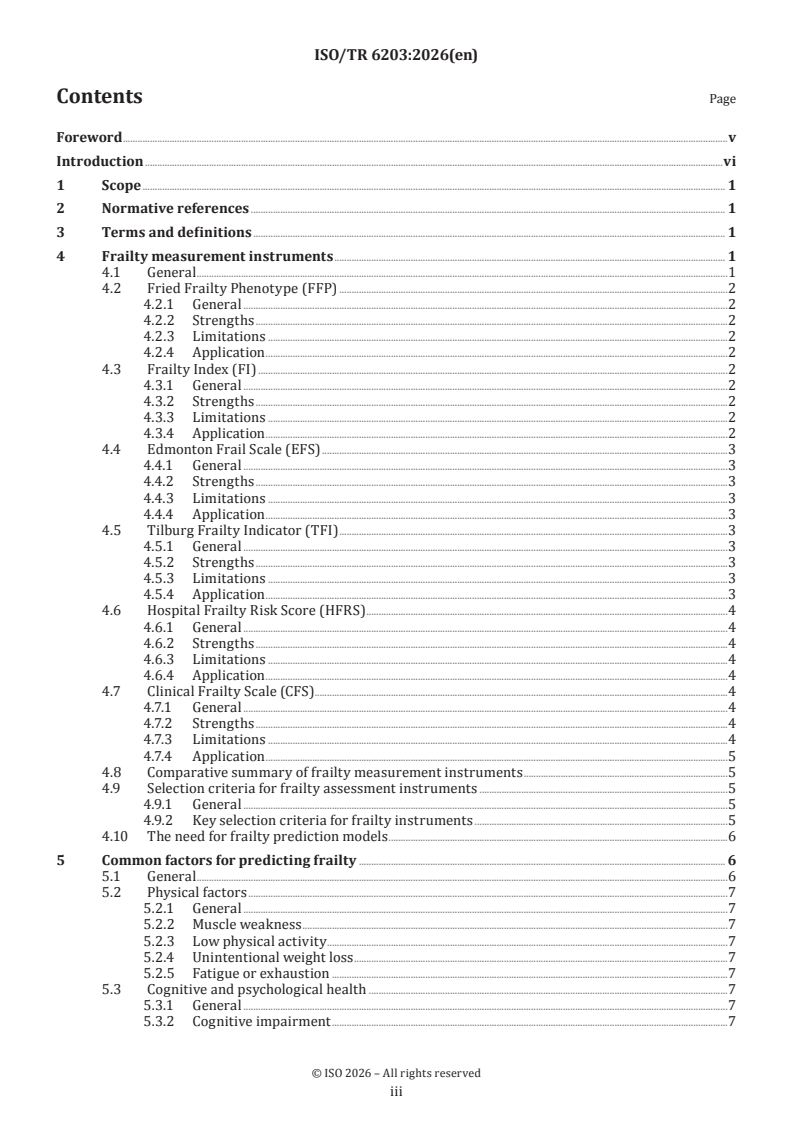
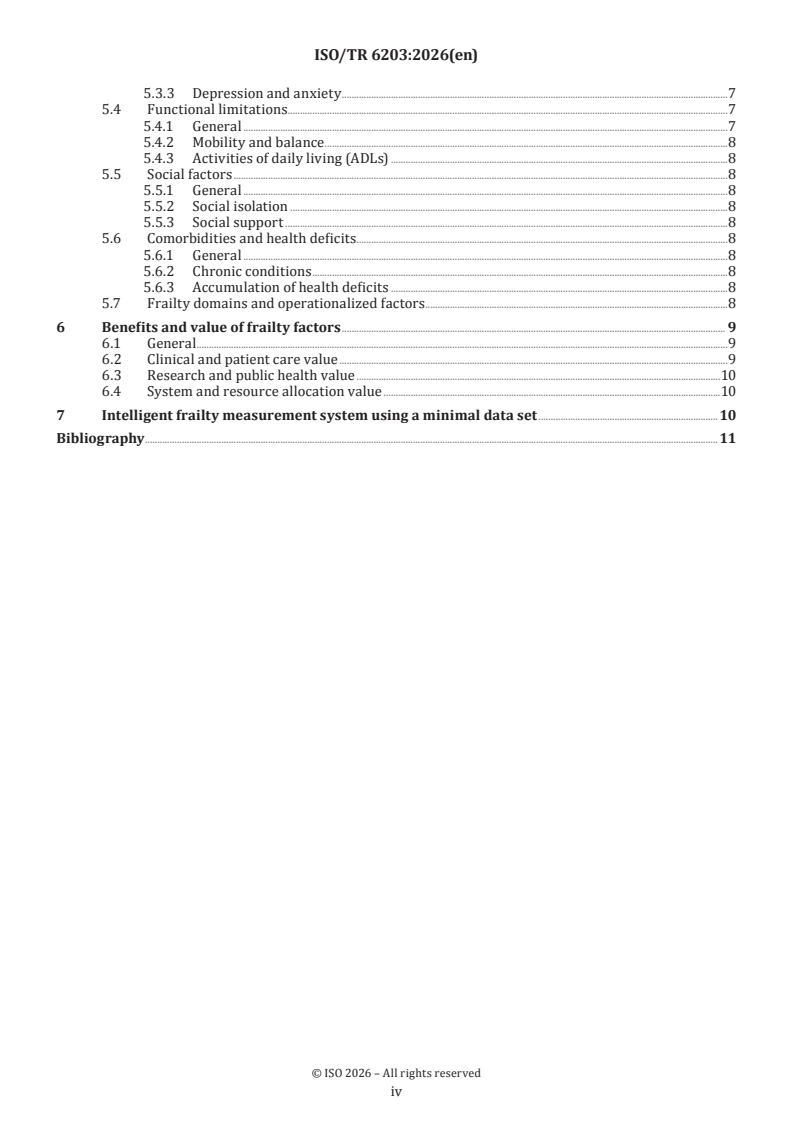
Clause 1 gives the scope. Clause 2 states that there are no normative references. Clause 3 defines the key terms used in the report. Clause 4 compares major frailty measurement instruments and gives selection criteria. Clause 5 reviews common factors for predicting frailty. Clause 6 explains the value of frailty factors for care, research, and resource allocation. Clause 7 describes an intelligent frailty measurement system using a minimal data set.
What are the key points of ISO/TR 6203:2026?
ISO/TR 6203:2026 does not set mandatory requirements. Its main technical value is that it compares frailty tools, identifies shared predictors, and shows how those predictors can be used in predictive models.
Frailty measurement instruments
Clause 4 compares the Fried Frailty Phenotype (FFP), Frailty Index (FI), Edmonton Frail Scale (EFS), Tilburg Frailty Indicator (TFI), Hospital Frailty Risk Score (HFRS), and Clinical Frailty Scale (CFS). The comparison matters because each tool fits different settings - for example, outpatient screening, primary care, research databases, hospital risk prediction, or acute care.
Clause 4 also summarizes strengths and limitations. In practice, this helps a reader decide whether they need a physical-performance tool, a multidimensional self-report tool, a hospital-data tool, or a clinician-judgment scale.
Selection criteria for choosing a frailty tool
Clause 4.9 highlights six selection criteria: validation, reliability and feasibility, applicability to diverse patient populations, predictive value, gradation of frailty, and alignment between the measurement focus and the intended setting. These points matter because a frailty tool is only useful if it can be applied consistently to the people and data available.
Common factors for predicting frailty
Clause 5 groups common factors into physical, cognitive and psychological, functional, social, and comorbidity-related domains. The report repeatedly links these domains to operational indicators such as muscle weakness, low physical activity, unintentional weight loss, fatigue or exhaustion, cognitive impairment, depression and anxiety, mobility and balance, activities of daily living (ADLs), social isolation, social support, chronic conditions, and accumulated health deficits. This matters because prediction models need shared variables, not just a label of frailty.
Why the factors matter
Clause 6 explains the value of these factors for clinical and patient care, research and public health, and system and resource allocation. In practice, this supports earlier identification of vulnerable older adults, better study designs, and more targeted use of health resources.
Digital monitoring approach
Clause 7 describes an intelligent frailty measurement system using a minimal data set (MDS). It uses non-wearable sensors, ambient sensing, gait analysis, space monitoring, and cloud-based AI to track trends over time and support automated life-space assessment (LSA). That is relevant to people designing home-based monitoring and predictive digital health services.
What terms does ISO/TR 6203:2026 define?
- Frailty - a state of increased vulnerability to poor recovery after a stressor event, with higher risk of adverse outcomes such as falls, delirium, and disability.
- Personalized digital health - electronic services that support the health of individuals when they can add and handle their health information.
- Common factors - a core set of physical, cognitive, psychological, and daily functioning domains used to determine a patient’s frailty.
- Fried Frailty Phenotype (FFP) - a frailty instrument based on five criteria: unintentional weight loss, exhaustion, low physical activity, slowness, and weakness.
- Frailty Index (FI) - a cumulative-deficit approach that scores frailty from the number of health deficits present.
- Hospital Frailty Risk Score (HFRS) - a hospital-based frailty risk measure that uses administrative health data to predict adverse outcomes.
- Clinical Frailty Scale (CFS) - a 9-point clinician-assessed scale for grading fitness and frailty in older adults.
Who uses ISO/TR 6203:2026?
ISO/TR 6203:2026 is used by geriatric clinicians, primary care teams, hospital staff, health informaticians, researchers, public health planners, and developers of digital health and AI-based monitoring systems. They use it to choose frailty instruments, compare data sources, design predictive models, and plan early intervention pathways for older adults.
Which standards are used with ISO/TR 6203:2026?
ISO/TR 6203:2026 states that there are no normative references. It uses ISO/TS 6201:2025 as the source for the definition of personalized digital health.
What does the ISO/TR 6203:2026 document contain?
ISO/TR 6203:2026 contains comparative descriptions of major frailty instruments, selection criteria for choosing among them, and a structured review of common frailty factors. Table 1 compares the instruments by focus, strengths, limitations, and best-suited settings.
Table 2 maps frailty domains to operationalized factors and example instruments, showing how concepts such as mobility, cognition, social isolation, chronic conditions, and accumulated deficits are measured in practice. Clause 7 adds a sensor- and AI-based approach for continuous home monitoring using a minimal data set, including gait speed, room-use patterns, trend analysis, and automated LSA.
The bibliography shows the research base behind the report and points to the studies and reviews that informed the discussion.
Get Certified
Connect with accredited certification bodies for this standard

BSI Group
BSI (British Standards Institution) is the business standards company that helps organizations make excellence a habit.

NYCE
Mexican standards and certification body.
Sponsored listings
Frequently Asked Questions
ISO/TR 6203:2026 is a technical report published by the International Organization for Standardization (ISO). Its full title is "Health informatics — Personalized digital health — Common factors for frailty assessment". This standard covers: This document reviews existing frailty indices and identifies common factors of frailty, laying a foundation for developing standardized frailty prediction models that can be used across clinical and demographic contexts to improve early identification and intervention efforts.
This document reviews existing frailty indices and identifies common factors of frailty, laying a foundation for developing standardized frailty prediction models that can be used across clinical and demographic contexts to improve early identification and intervention efforts.
ISO/TR 6203:2026 is classified under the following ICS (International Classification for Standards) categories: 35.240.80 - IT applications in health care technology. The ICS classification helps identify the subject area and facilitates finding related standards.
ISO/TR 6203:2026 is available in PDF format for immediate download after purchase. The document can be added to your cart and obtained through the secure checkout process. Digital delivery ensures instant access to the complete standard document.
Standards Content (Sample)
Technical
Report
ISO/TR 6203
First edition
Health informatics — Personalized
2026-10
digital health — Common factors for
frailty assessment
Informatique de santé — Santé numérique personnalisée —
Facteurs communs pour l'évaluation de la fragilité
Reference number
© ISO 2026
All rights reserved. Unless otherwise specified, or required in the context of its implementation, no part of this publication may
be reproduced or utilized otherwise in any form or by any means, electronic or mechanical, including photocopying, or posting on
the internet or an intranet, without prior written permission. Permission can be requested from either ISO at the address below
or ISO’s member body in the country of the requester.
ISO copyright office
CP 401 • Ch. de Blandonnet 8
CH-1214 Vernier, Geneva
Phone: +41 22 749 01 11
Email: copyright@iso.org
Website: www.iso.org
Published in Switzerland
ii
Contents Page
Foreword .v
Introduction .vi
1 Scope . 1
2 Normative references . 1
3 Terms and definitions . 1
4 Frailty measurement instruments . 1
4.1 General .1
4.2 Fried Frailty Phenotype (FFP) .2
4.2.1 General .2
4.2.2 Strengths .2
4.2.3 Limitations .2
4.2.4 Application .2
4.3 Frailty Index (FI) .2
4.3.1 General .2
4.3.2 Strengths .2
4.3.3 Limitations .2
4.3.4 Application .2
4.4 Edmonton Frail Scale (EFS) .3
4.4.1 General .3
4.4.2 Strengths .3
4.4.3 Limitations .3
4.4.4 Application .3
4.5 Tilburg Frailty Indicator (TFI) .3
4.5.1 General .3
4.5.2 Strengths .3
4.5.3 Limitations .3
4.5.4 Application .3
4.6 Hospital Frailty Risk Score (HFRS) .4
4.6.1 General .4
4.6.2 Strengths .4
4.6.3 Limitations .4
4.6.4 Application .4
4.7 Clinical Frailty Scale (CFS) .4
4.7.1 General .4
4.7.2 Strengths .4
4.7.3 Limitations .4
4.7.4 Application .5
4.8 Comparative summary of frailty measurement instruments .5
4.9 Selection criteria for frailty assessment instruments .5
4.9.1 General .5
4.9.2 Key selection criteria for frailty instruments .5
4.10 The need for frailty prediction models .6
5 Common factors for predicting frailty . 6
5.1 General .6
5.2 Physical factors .7
5.2.1 General .7
5.2.2 Muscle weakness .7
5.2.3 Low physical activity .7
5.2.4 Unintentional weight loss .7
5.2.5 Fatigue or exhaustion .7
5.3 Cognitive and psychological health .7
5.3.1 General .7
5.3.2 Cognitive impairment .7
iii
5.3.3 Depression and anxiety .7
5.4 Functional limitations . .7
5.4.1 General .7
5.4.2 Mobility and balance .8
5.4.3 Activities of daily living (ADLs) .8
5.5 Social factors .8
5.5.1 General .8
5.5.2 Social isolation .8
5.5.3 Social support .8
5.6 Comorbidities and health deficits . .8
5.6.1 General .8
5.6.2 Chronic conditions .8
5.6.3 Accumulation of health deficits .8
5.7 Frailty domains and operationalized factors .8
6 Benefits and value of frailty factors . 9
6.1 General .9
6.2 Clinical and patient care value .9
6.3 Research and public health value .10
6.4 System and resource allocation value .10
7 Intelligent frailty measurement system using a minimal data set .10
Bibliography .11
iv
Foreword
ISO (the International Organization for Standardization) is a worldwide federation of national standards
bodies (ISO member bodies). The work of preparing International Standards is normally carried out through
ISO technical committees. Each member body interested in a subject for which a technical committee
has been established has the right to be represented on that committee. International organizations,
governmental and non-governmental, in liaison with ISO, also take part in the work. ISO collaborates closely
with the International Electrotechnical Commission (IEC) on all matters of electrotechnical standardization.
The procedures used to develop this document and those intended for its further maintenance are described
in the ISO/IEC Directives, Part 1. In particular, the different approval criteria needed for the different types
of ISO documents should be noted. This document was drafted in accordance with the editorial rules of the
ISO/IEC Directives, Part 2 (see www.iso.org/directives).
ISO draws attention to the possibility that the implementation of this document may involve the use of (a)
patent(s). ISO takes no position concerning the evidence, validity or applicability of any claimed patent
rights in respect thereof. As of the date of publication of this document, ISO had not received notice of (a)
patent(s) which may be required to implement this document. However, implementers are cautioned that
this may not represent the latest information, which may be obtained from the patent database available at
www.iso.org/patents. ISO shall not be held responsible for identifying any or all such patent rights.
Any trade name used in this document is information given for the convenience of users and does not
constitute an endorsement.
For an explanation of the voluntary nature of standards, the meaning of ISO specific terms and expressions
related to conformity assessment, as well as information about ISO’s adherence to the World Trade
Organization (WTO) principles in the Technical Barriers to Trade (TBT), see www.iso.org/iso/foreword.html.
This document was prepared by Technical Committee ISO/TC 215, Health informatics.
Any feedback or questions on this document should be directed to the user’s national standards body. A
complete listing of these bodies can be found at www.iso.org/members.html.
v
Introduction
Frailty is a clinical condition characterized by an increased vulnerability to stressors, arising from
cumulative declines across multiple physiological systems. This multidimensional syndrome results in
diminished strength, endurance and resilience, and is commonly associated with adverse health outcomes,
including falls, hospitalization and death. With the global population aging rapidly, understanding frailty is
crucial for improving the quality of care and enhancing health outcomes among older adults. As a condition
that exacerbates the risks of dependency and healthcare utilization, frailty places a significant burden on
healthcare systems, making it a priority area in geriatrics and public health.
Traditionally, frailty is assessed through various indices and measurements, such as the Fried Frailty
Phenotype (FFP), the Frailty Index (FI), the Edmonton Frail Scale (EFS), and the Hospital Frailty Risk
Score (HFRS). Each of these instruments offers distinct insights into frailty by focusing on different health
dimensions. For instance, the FFP emphasizes physical characteristics such as weakness and slowness, while
the FI aggregates deficits across physical, cognitive and social domains. Although these instruments have
been valuable in identifying frail individuals, they have limitations in capturing the dynamic and predictive
aspects of frailty, particularly when applied in diverse healthcare settings. Moreover, traditional indices
often require clinical assessments or extensive health records, which can limit their practical application in
large-scale population health monitoring.
In their 2015 article, Rockwood, Theou, and Mitnitski explain that frailty instruments are used for multiple
distinct purposes, including diagnosis, risk stratification, guiding clinical care, measuring outcomes
and scientific investigation. The authors highlight the critical distinction between broad, dichotomous
instruments for screening and more granular, scaled instruments for comprehensive assessment. The choice
[1]
of instrument is guided by its intended purpose .
In light of these limitations, there is a growing interest in developing predictive models that can forecast
frailty onset and progression, rather than solely relying on current frailty status. Predictive models leverage
administrative health data and advanced algorithms to identify individuals at risk of becoming frail, enabling
earlier interventions that could potentially prevent frailty or mitigate its impact. This predictive approach is
particularly valuable in resource-constrained settings, where proactively identifying at-risk individuals can
optimize healthcare resource allocation and improve patient outcomes.
Several predictive models of frailty have been introduced in recent years, utilizing various types of data,
including socio-demographic factors, clinical histories, and even genetic and biomarker data. Rockwood,
Theou, and Mitnitski presents the latest evidence about frailty and the management of frail patients with
[1]
acute cardiovascular disease and suggests avenues for future research . These models offer a promising
alternative to traditional frailty indices by providing personalized risk assessments and supporting
proactive healthcare strategies. However, there is still a need to establish standardized factors of frailty that
can serve as foundation for developing robust, universally applicable frailty prediction models.
This document aims to identify common factors of frailty, which can inform the construction of standardized
frailty assessment models in the future, and it is heavily influenced by Reference [1]. By examining these
predictors, this document seeks to ultimately support the creation of a standardized approach to frailty
prediction that can be integrated into routine clinical and public health practices.
vi
Technical Report ISO/TR 6203:2026(en)
Health informatics — Personalized digital health — Common
factors for frailty assessment
1 Scope
This document reviews existing frailty indices and identifies common factors of frailty, laying a foundation
for developing standardized frailty prediction models that can be used across clinical and demographic
contexts to improve early identification and intervention efforts.
2 Normative references
There are no normative references in this document.
3 Terms and definitions
ISO and IEC maintain terminology databases for use in standardization at the following addresses:
— ISO Online browsing platform: available at https:// www .iso .org/ obp
— IEC Electropedia: available at https:// www .electropedia .org/
3.1
frailty
state of increased vulnerability to poor resolution of homoeostasis after a stressor event, which increases
the risk of adverse outcomes, including falls, delirium, and disability
Note 1 to entry: Adapted from Reference [4].
3.2
personalized digital health
electronic services that support health of individuals when they can add and handle their health information
[SOURCE: ISO/TS 6201:2025, 3.4]
3.3
common factors
core set spanning physical, cognitive, psychological, and daily functioning domains to determine a patient’s
frailty (3.1)
Note 1 to entry: Adapted from Reference [5].
4 Frailty measurement instruments
4.1 General
To comprehensively assess frailty in older adults, various frailty measurement instruments have been
developed, each focusing on distinct aspects of physical, psychological and social health. These instruments
include the Fried Frailty Phenotype (FFP), the Frailty Index (FI), the Edmonton Frail Scale (EFS), the Tilburg
Frailty Indicator (TFI), the Hospital Frailty Risk Score (HFRS) and the Clinical Frailty Scale (CFS), among
others. This clause compares them by examining their theoretical underpinnings, primary values measured,
and utility across different settings, underscoring the strengths and limitations of each approach.
4.2 Fried Frailty Phenotype (FFP)
4.2.1 General
[13]
The Fried Frailty Phenotype, introduced in 2001 , is one of the most widely used frailty assessment
instruments. It identifies frailty based on five criteria: unintentional weight loss, exhaustion, low physical
activity, slowness and weakness. Individuals are classified as frail if they meet three or more of these
criteria, pre-frail if they meet one or two, and non-frail if they meet none.
4.2.2 Strengths
The FFP’s criteria are straightforward, focusing on observable physical manifestations of frailty. This
specificity makes it useful in clinical settings where physical health parameters can be measured
consistently.
4.2.3 Limitations
The FFP is limited to physical frailty and does not account for psychological or social domains, which are
critical to understanding the broader scope of frailty. Additionally, it requires physical assessments such as
[7][11]
grip strength, which can be resource-intensive.
4.2.4 Application
FFP is effective in outpatient or community-based screenings but is less comprehensive for assessing frailty
in hospitalized or cognitively impaired populations.
4.3 Frailty Index (FI)
4.3.1 General
[12]
Developed by Rockwood and Mitnitski , the Frailty Index calculates frailty based on the accumulation
of health deficits, including symptoms, disabilities and comorbidities. The FI produces a continuous score
that quantifies frailty severity by dividing the number of deficits by the total possible, generating a score
between 0 and 1.
4.3.2 Strengths
The FI provides a comprehensive view of frailty, encompassing a wide array of physical, cognitive and social
deficits. Its continuous scoring method allows for nuanced gradations of frailty and is adaptable to diverse
settings.
4.3.3 Limitations
The FI’s reliance on detailed health records can be challenging to implement in settings with limited
resources or incomplete patient histories. Additionally, the broad scope of the FI can make it less sensitive to
[8][9]
specific frailty aspects .
4.3.4 Application
The FI is ideal for research contexts and large-scale health databases, where extensive data is available. It is
also suitable for hospitalized populations where patient records are readily accessible.
4.4 Edmonton Frail Scale (EFS)
4.4.1 General
The Edmonton Frail Scale is a multidimensional instrument developed to assess frailty across nine domains,
including cognition, general health status, functional independence, social support, medication use, nutrition,
[14]
mood, continence and functional performance . It is a quick instrument requiring both self-reported data
and simple clinical assessments.
4.4.2 Strengths
EFS is designed for ease of use and brevity, covering both physical and psychosocial aspects of frailty, which
makes it accessible in primary care and clinical settings. The instrument’s multidimensional approach
provides a more holistic view of frailty.
4.4.3 Limitations
The reliance on self-reported responses can introduce subjectivity and limit its accuracy in populations
with cognitive impairment. Additionally, the EFS’s components can require adaptations to maintain cultural
[8]
relevance across different populations .
4.4.4 Application
EFS is widely used in outpatient, primary care and community settings, where quick, comprehensive
assessments are needed.
4.5 Tilburg Frailty Indicator (TFI)
4.5.1 General
The Tilburg Frailty Indicator assesses frailty based on physical, psychological and social domains, using self-
reported responses to identify deficits in each area. The TFI defines frailty as the presence of impairments
[15]
across these dimensions, highlighting the multidimensional nature of frailty .
4.5.2 Strengths
The TFI’s inclusion of social and psychological domains offers a broader understanding of frailty that aligns
with the multidimensional frailty model. Its reliance on self-reports makes it easy to administer, particularly
in community and home care settings.
4.5.3 Limitations
As with other self-reported instruments, the TFI is not always suitable for populations with cognitive
impairments, and it can be prone to bias in self-assessment. Its focus on subjective criteria can
...