

ISO 25157:2013
(Main)Essential oil of rose, Chinese Kushui type (Rosa sertata x Rosa rugosa)
General Information
- Abstract
ISO 25157:2013 specifies certain characteristics of the essential oil of rose, Chinese Kushui type (Rosa sertata × Rosa rugosa) cultivated mainly in China, in order to facilitate assessment of its quality.
- Status
- Published
- Publication Date
- 09-Apr-2013
- Technical Committee
- ISO/TC 54 - Essential oils
- Drafting Committee
- ISO/TC 54 - Essential oils
- Current Stage
- 9093 - International Standard confirmed
- Start Date
- 04-Dec-2023
- Completion Date
- 29-Aug-2026
Buy Documents


ISO 25157:2013 - Essential oil of rose, Chinese Kushui type (Rosa sertata x Rosa rugosa)

ISO 25157:2013 - Essential oil of rose, Chinese Kushui type (Rosa sertata x Rosa rugosa)/10/2013
Overview - ISO 25157:2013, Essential oil of rose (Chinese Kushui)
ISO 25157:2013 specifies quality characteristics for the essential oil of rose, Chinese Kushui type (Rosa sertata × Rosa rugosa), cultivated mainly in China. The standard provides objective criteria and test-method references to facilitate consistent quality assessment, laboratory testing, packaging/labeling and trade of this rose essential oil.
Key topics and technical requirements
The standard defines organoleptic, physical and chromatographic requirements, and refers to established ISO test methods:
- Appearance & colour: liquid or partly crystallized; light yellow to yellow-brown.
- Odour: characteristic, full-bodied floral/rose.
- Relative density (d20): 0.880 – 0.930 (see ISO 279).
- Refractive index (n20): 1.4680 – 1.4798 (see ISO 280).
- Optical rotation (20 °C): between −10.3° and −0.5° (see ISO 592).
- Freezing point: 11 °C – 14 °C (see ISO 1041).
- Ester value: 18 – 24 (see ISO 709).
- Chromatographic profile (GC): normative profile obtained by gas chromatography (ISO 11024). Key components and proportion ranges include:
- Citronellol: 40.0 – 50.0%
- Geraniol: 6.0 – 18.0%
- Nerol: 2.0 – 5.5%
- Citronellyl acetate: 2.5 – 4.5%
- Linalool: 1.0 – 3.5%, plus other markers (farnesol, eugenol methyl ether, paraffins etc.).
- Flashpoint (informative): mean value reported as +61 °C (semi‑automatic closed cup test; see Annex B and ISO/TR 11018).
- Sampling: comply with ISO 212; minimum test sample 25 ml.
- Packaging & labelling: in accordance with ISO/TR 210 and ISO/TR 211.
Applications and practical value
ISO 25157:2013 is used to:
- Guide quality control and acceptance criteria in production and distillation facilities for Chinese Kushui rose oil.
- Support laboratory testing and method selection (GC profiling, density, refractive index, optical rotation).
- Enable buyers, traders and regulators to verify authenticity, detect adulteration and ensure consistent product specifications in supply chains.
- Provide safety/transport information (flashpoint guidance) for logistics and insurance.
Who should use this standard
- Essential oil producers and distillers (Rosa sertata × Rosa rugosa)
- Analytical laboratories and QC teams performing GC and physico‑chemical tests
- Importers, exporters and commodity traders of rose oil
- Cosmetic and fragrance formulators specifying raw material quality
- Regulatory and safety officers handling classification, labeling and transport
Related standards
ISO/TR 210, ISO/TR 211, ISO 212, ISO 279, ISO 280, ISO 592, ISO 709, ISO 1041, ISO 11024, ISO/TR 11018, ISO/TR 21092.
Keywords: ISO 25157:2013, essential oil of rose, Chinese Kushui, Rosa sertata × Rosa rugosa, chromatographic profile, gas chromatography, quality assessment, citronellol, geraniol.
Buy Documents
ISO 25157:2013 - Essential oil of rose, Chinese Kushui type (Rosa sertata x Rosa rugosa)
ISO 25157:2013 - Essential oil of rose, Chinese Kushui type (Rosa sertata x Rosa rugosa)/10/2013
Get Certified
Connect with accredited certification bodies for this standard

ECOCERT
Organic and sustainability certification.

Eurofins Food Testing Global
Global leader in food, environment, and pharmaceutical product testing.

Intertek Bangladesh
Intertek certification and testing services in Bangladesh.
Sponsored listings
Frequently Asked Questions
ISO 25157:2013 is a standard published by the International Organization for Standardization (ISO). Its full title is "Essential oil of rose, Chinese Kushui type (Rosa sertata x Rosa rugosa)". This standard covers: ISO 25157:2013 specifies certain characteristics of the essential oil of rose, Chinese Kushui type (Rosa sertata × Rosa rugosa) cultivated mainly in China, in order to facilitate assessment of its quality.
ISO 25157:2013 specifies certain characteristics of the essential oil of rose, Chinese Kushui type (Rosa sertata × Rosa rugosa) cultivated mainly in China, in order to facilitate assessment of its quality.
ISO 25157:2013 is classified under the following ICS (International Classification for Standards) categories: 71.100.60 - Essential oils. The ICS classification helps identify the subject area and facilitates finding related standards.
ISO 25157:2013 is available in PDF format for immediate download after purchase. The document can be added to your cart and obtained through the secure checkout process. Digital delivery ensures instant access to the complete standard document.
Standards Content (Sample)
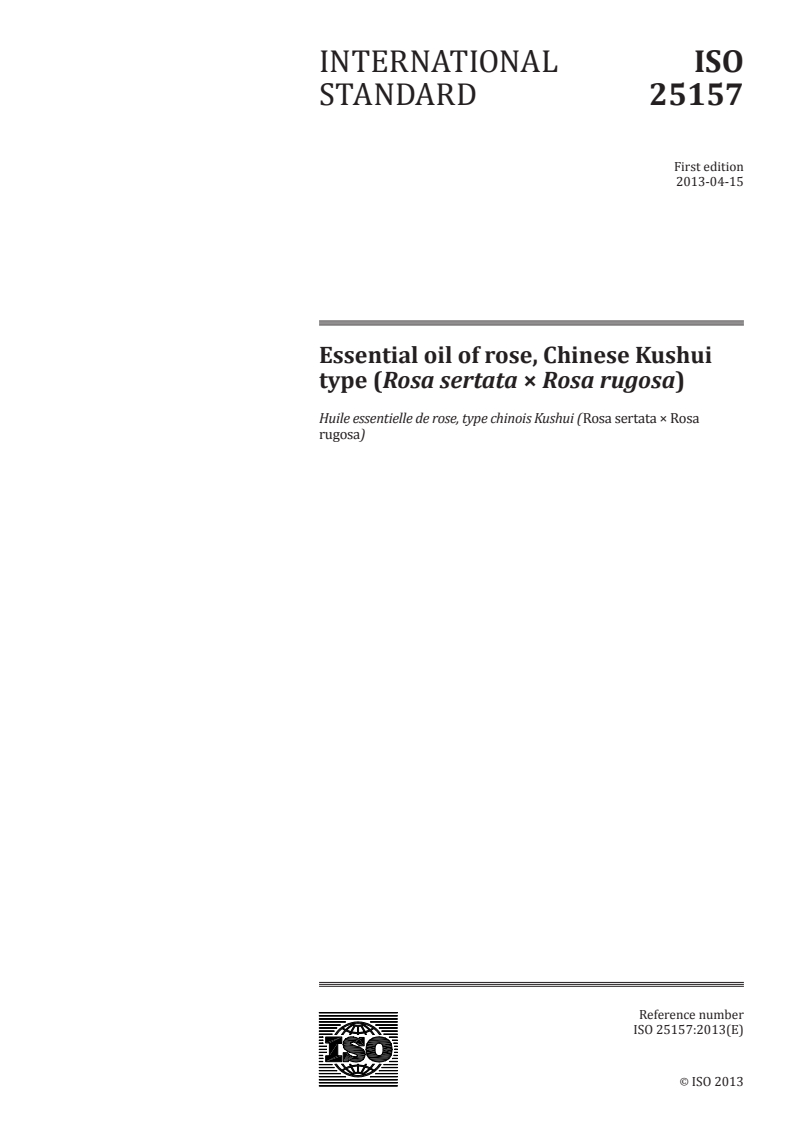
INTERNATIONAL ISO
STANDARD 25157
First edition
2013-04-15
Essential oil of rose, Chinese Kushui
type (Rosa sertata × Rosa rugosa)
Huile essentielle de rose, type chinois Kushui (Rosa sertata × Rosa
rugosa)
Reference number
©
ISO 2013
© ISO 2013
All rights reserved. Unless otherwise specified, no part of this publication may be reproduced or utilized otherwise in any form
or by any means, electronic or mechanical, including photocopying, or posting on the internet or an intranet, without prior
written permission. Permission can be requested from either ISO at the address below or ISO’s member body in the country of
the requester.
ISO copyright office
Case postale 56 • CH-1211 Geneva 20
Tel. + 41 22 749 01 11
Fax + 41 22 749 09 47
E-mail copyright@iso.org
Web www.iso.org
Published in Switzerland
ii © ISO 2013 – All rights reserved
Foreword
ISO (the International Organization for Standardization) is a worldwide federation of national standards
bodies (ISO member bodies). The work of preparing International Standards is normally carried out
through ISO technical committees. Each member body interested in a subject for which a technical
committee has been established has the right to be represented on that committee. International
organizations, governmental and non-governmental, in liaison with ISO, also take part in the work.
ISO collaborates closely with the International Electrotechnical Commission (IEC) on all matters of
electrotechnical standardization.
The procedures used to develop this document and those intended for its further maintenance are
described in the ISO/IEC Directives, Part 1. In particular the different approval criteria needed for the
different types of ISO documents should be noted. This document was drafted in accordance with the
editorial rules of the ISO/IEC Directives, Part 2, www.iso.org/directives.
Attention is drawn to the possibility that some of the elements of this document may be the subject of
patent rights. ISO shall not be held responsible for identifying any or all such patent rights. Details of
any patent rights identified during the development of the document will be in the Introduction and/or
on the ISO list of patent declarations received, www.iso.org/patents.
Any trade name used in this document is information given for the convenience of users and does not
constitute an endorsement.
The committee responsible for this document is ISO/TC 54, Essential oils.
INTERNATIONAL STANDARD ISO 25157:2013(E)
Essential oil of rose, Chinese Kushui type (Rosa sertata ×
Rosa rugosa)
1 Scope
This International Standard specifies certain characteristics of the essential oil of rose, Chinese Kushui
type (Rosa sertata × Rosa rugosa) cultivated mainly in China, in order to facilitate assessment of its quality.
2 Normative references
The following documents, in whole or in part, are normatively referenced in this document and are
indispensable for its application. For dated references, only the edition cited applies. For undated
references, the latest edition of the referenced document (including any amendments) applies.
ISO/TR 210, Essential oils — General rules for packaging, conditioning and storage
ISO/TR 211, Essential oils — General rules for labelling and marking of containers
ISO 212, Essential oils — Sampling
ISO 279, Essential oils — Determination of relative density at 20 °C — Reference method
ISO 280, Essential oils — Determination of refractive index
ISO 592, Essential oils — Determination of optical rotation
ISO 709, Essential oils — Determination of ester value
ISO 1041, Essential oils — Determination of freezing point
ISO 11024 (all parts), Essential oils — General guidance on chromatographic profiles
3 Terms and definitions
For the purposes of this document, the following terms and definitions apply.
3.1
essential oil of rose, Chinese Kushui type
essential oil obtained by steam distillation of the flowers of Rosa sertata × Rosa rugosa cultivated
mainly in China
[2]
Note 1 to entry: For information on the CAS number, see ISO/TR 21092.
4 Requirements
4.1 Appearance
Liquid or more or less crystallized.
4.2 Colour
Light yellow or yellow brown.
4.3 Odour
Characteristic, full-bodied, floral, rose.
Relative density at 20 °C d
Minimum: 0,880.
Maximum: 0,930.
4.4 Refractive index at 20 °C
Minimum: 1,4680.
Maximum: 1,4798.
4.5 Optical rotation at 20 °C
Between −10,3° and −0,5°.
4.6 Freezing point
Between 11 °C and 14 °C.
4.7 Ester value
Minimum: 18.
Maximum: 24.
4.8 Chromatographic profile
Carry out the analysis of the essential oil by gas chromatography. Identify in the chromatogram obtained
the representative and characteristic components shown in Table 1. The proportions of these components,
indicated by the integrator, shall be as shown in Table 1. This constitutes the chromatographic profile
of the essential oil.
4.9 Flashpoint
Information on the flashpoint is given in Annex B.
5 Sampling
Sampling shall be performed in accordance with ISO 212.
Minimum volume of test sample: 25 ml.
NOTE This volume allows each of the tests specified in this International Standard to be carried out at least once.
2 © ISO 2013 – All rights reserved
Table 1 — Chromatographic profile
Minimum Maximum
Components
% %
a
Ethanol n.d. 1,0
a
cis-Rose oxide n.d. 0,5
Linalool 1,0 3,5
a
β-Phenylethyl alcohol n.d. 0,3
Citronellol 40,0 50,0
N
...
INTERNATIONAL ISO
STANDARD 25157
First edition
2013-04-15
Essential oil of rose, Chinese Kushui
type (Rosa sertata × Rosa rugosa)
Huile essentielle de rose, type chinois Kushui (Rosa sertata × Rosa
rugosa)
Reference number
©
ISO 2013
© ISO 2013
All rights reserved. Unless otherwise specified, no part of this publication may be reproduced or utilized otherwise in any form
or by any means, electronic or mechanical, including photocopying, or posting on the internet or an intranet, without prior
written permission. Permission can be requested from either ISO at the address below or ISO’s member body in the country of
the requester.
ISO copyright office
Case postale 56 • CH-1211 Geneva 20
Tel. + 41 22 749 01 11
Fax + 41 22 749 09 47
E-mail copyright@iso.org
Web www.iso.org
Published in Switzerland
ii © ISO 2013 – All rights reserved
Foreword
ISO (the International Organization for Standardization) is a worldwide federation of national standards
bodies (ISO member bodies). The work of preparing International Standards is normally carried out
through ISO technical committees. Each member body interested in a subject for which a technical
committee has been established has the right to be represented on that committee. International
organizations, governmental and non-governmental, in liaison with ISO, also take part in the work.
ISO collaborates closely with the International Electrotechnical Commission (IEC) on all matters of
electrotechnical standardization.
The procedures used to develop this document and those intended for its further maintenance are
described in the ISO/IEC Directives, Part 1. In particular the different approval criteria needed for the
different types of ISO documents should be noted. This document was drafted in accordance with the
editorial rules of the ISO/IEC Directives, Part 2, www.iso.org/directives.
Attention is drawn to the possibility that some of the elements of this document may be the subject of
patent rights. ISO shall not be held responsible for identifying any or all such patent rights. Details of
any patent rights identified during the development of the document will be in the Introduction and/or
on the ISO list of patent declarations received, www.iso.org/patents.
Any trade name used in this document is information given for the convenience of users and does not
constitute an endorsement.
The committee responsible for this document is ISO/TC 54, Essential oils.
INTERNATIONAL STANDARD ISO 25157:2013(E)
Essential oil of rose, Chinese Kushui type (Rosa sertata ×
Rosa rugosa)
1 Scope
This International Standard specifies certain characteristics of the essential oil of rose, Chinese Kushui
type (Rosa sertata × Rosa rugosa) cultivated mainly in China, in order to facilitate assessment of its quality.
2 Normative references
The following documents, in whole or in part, are normatively referenced in this document and are
indispensable for its application. For dated references, only the edition cited applies. For undated
references, the latest edition of the referenced document (including any amendments) applies.
ISO/TR 210, Essential oils — General rules for packaging, conditioning and storage
ISO/TR 211, Essential oils — General rules for labelling and marking of containers
ISO 212, Essential oils — Sampling
ISO 279, Essential oils — Determination of relative density at 20 °C — Reference method
ISO 280, Essential oils — Determination of refractive index
ISO 592, Essential oils — Determination of optical rotation
ISO 709, Essential oils — Determination of ester value
ISO 1041, Essential oils — Determination of freezing point
ISO 11024 (all parts), Essential oils — General guidance on chromatographic profiles
3 Terms and definitions
For the purposes of this document, the following terms and definitions apply.
3.1
essential oil of rose, Chinese Kushui type
essential oil obtained by steam distillation of the flowers of Rosa sertata × Rosa rugosa cultivated
mainly in China
[2]
Note 1 to entry: For information on the CAS number, see ISO/TR 21092.
4 Requirements
4.1 Appearance
Liquid or more or less crystallized.
4.2 Colour
Light yellow or yellow brown.
4.3 Odour
Characteristic, full-bodied, floral, rose.
Relative density at 20 °C d
Minimum: 0,880.
Maximum: 0,930.
4.4 Refractive index at 20 °C
Minimum: 1,4680.
Maximum: 1,4798.
4.5 Optical rotation at 20 °C
Between −10,3° and −0,5°.
4.6 Freezing point
Between 11 °C and 14 °C.
4.7 Ester value
Minimum: 18.
Maximum: 24.
4.8 Chromatographic profile
Carry out the analysis of the essential oil by gas chromatography. Identify in the chromatogram obtained
the representative and characteristic components shown in Table 1. The proportions of these components,
indicated by the integrator, shall be as shown in Table 1. This constitutes the chromatographic profile
of the essential oil.
4.9 Flashpoint
Information on the flashpoint is given in Annex B.
5 Sampling
Sampling shall be performed in accordance with ISO 212.
Minimum volume of test sample: 25 ml.
NOTE This volume allows each of the tests specified in this International Standard to be carried out at least once.
2 © ISO 2013 – All rights reserved
Table 1 — Chromatographic profile
Minimum Maximum
Components
% %
a
Ethanol n.d. 1,0
a
cis-Rose oxide n.d. 0,5
Linalool 1,0 3,5
a
β-Phenylethyl alcohol n.d. 0,3
Citronellol 40,0 50,0
N
...