


ISO/IEC 21778:2017
(Main)Information technology — The JSON data interchange syntax
Information technology — The JSON data interchange syntax
JSON is a lightweight, text-based, language-independent syntax for defining data interchange formats. It was derived from the ECMAScript programming language, but is programming language independent. JSON defines a small set of structuring rules for the portable representation of structured data. The goal of ISO/IEC 21778:2017 is only to define the syntax of valid JSON texts. Its intent is not to provide any semantics or interpretation of text conforming to that syntax. It also intentionally does not define how a valid JSON text might be internalized into the data structures of a programming language. There are many possible semantics that could be applied to the JSON syntax and many ways that a JSON text can be processed or mapped by a programming language. Meaningful interchange of information using JSON requires agreement among the involved parties on the specific semantics to be applied. Defining specific semantic interpretations of JSON is potentially a topic for other specifications. Similarly, language mappings of JSON can also be independently specified. For example, ECMA-262 defines mappings between valid JSON texts and ECMAScript's runtime data structures.
Technologies de l'information — Syntaxe d'échange de données JSON
General Information
- Status
- Published
- Publication Date
- 14-Nov-2017
- Current Stage
- 9093 - International Standard confirmed
- Start Date
- 06-Mar-2023
- Completion Date
- 12-Feb-2026
Overview
ISO/IEC 21778:2017 is the international standard that defines the JSON data interchange syntax. It specifies the exact syntax of valid JSON texts: tokens, structural characters, strings, numbers, arrays and objects, and permitted escape sequences. The standard is intentionally syntax-only - it does not define semantics, language-specific mappings, or how JSON texts are internalized by programming languages. JSON texts are defined as sequences of Unicode code points and the standard relies on Unicode (ISO/IEC 10646 / The Unicode Standard) for character semantics.
Key Topics and Technical Requirements
- Conformance: A conforming JSON text strictly follows the grammar in ISO/IEC 21778:2017. A conforming JSON processor should reject non-conforming input; processors may impose additional semantic restrictions.
- Tokens & Structure: Defines six structural tokens ([ ] { } : ,), literal name tokens (
true,false,null), strings, numbers and whitespace rules. - Values: A JSON value can be an object, array, number, string,
true,false, ornull. - Objects & Arrays: Objects are unordered collections of name/value pairs (names are strings). Arrays are ordered lists of values. The syntax imposes no semantic rules about name uniqueness or ordering.
- Numbers: Decimal digit sequences with optional minus sign, fractional part, and exponent. No superfluous leading zeros. Numeric values like
NaNorInfinityare not permitted. - Strings & Escapes: Strings are quoted Unicode sequences. Mandatory escaping for quotation mark, reverse solidus (
\), control characters; supports common escapes (\",\\,\n,\t, etc.) and\uXXXXUnicode escapes. Surrogate pairs are used for code points beyond the Basic Multilingual Plane; interpretation of surrogate pairs is a semantic choice for processors. - Unicode: JSON texts are sequences of Unicode code points; the standard references ISO/IEC 10646 and Unicode versions for code point meaning.
- Limitations: JSON does not directly support cyclic graphs or raw binary data; semantics and specific language mappings are out of scope.
Applications and Who Uses It
- API designers & developers: Ensure data exchanged via REST/HTTP conforms to a stable, interoperable JSON syntax.
- Library and parser authors: Implement conformant JSON parsers/serializers that follow token, string and number rules.
- Standards bodies and protocol designers: Reference ISO/IEC 21778 when defining JSON-based profiles or application semantics.
- System integrators & QA: Validate JSON conformance across services to avoid subtle interoperability issues. Practical use cases include web APIs, configuration files, log formats, data interchange between heterogeneous systems, and as a foundational syntax for higher-level specifications.
Related Standards
- ECMA-404 (ECMA International) - ECMA definition of JSON syntax
- IETF RFC 8259 - The JSON Data Interchange Format (intended to be syntactically aligned)
- ISO/IEC 10646 / The Unicode Standard - character encoding references
Keywords: ISO/IEC 21778:2017, JSON syntax, JSON standard, data interchange, JSON conformance, RFC 8259, ECMA-404, Unicode.
Get Certified
Connect with accredited certification bodies for this standard

BSI Group
BSI (British Standards Institution) is the business standards company that helps organizations make excellence a habit.

NYCE
Mexican standards and certification body.
Sponsored listings
Frequently Asked Questions
ISO/IEC 21778:2017 is a standard published by the International Organization for Standardization (ISO). Its full title is "Information technology — The JSON data interchange syntax". This standard covers: JSON is a lightweight, text-based, language-independent syntax for defining data interchange formats. It was derived from the ECMAScript programming language, but is programming language independent. JSON defines a small set of structuring rules for the portable representation of structured data. The goal of ISO/IEC 21778:2017 is only to define the syntax of valid JSON texts. Its intent is not to provide any semantics or interpretation of text conforming to that syntax. It also intentionally does not define how a valid JSON text might be internalized into the data structures of a programming language. There are many possible semantics that could be applied to the JSON syntax and many ways that a JSON text can be processed or mapped by a programming language. Meaningful interchange of information using JSON requires agreement among the involved parties on the specific semantics to be applied. Defining specific semantic interpretations of JSON is potentially a topic for other specifications. Similarly, language mappings of JSON can also be independently specified. For example, ECMA-262 defines mappings between valid JSON texts and ECMAScript's runtime data structures.
JSON is a lightweight, text-based, language-independent syntax for defining data interchange formats. It was derived from the ECMAScript programming language, but is programming language independent. JSON defines a small set of structuring rules for the portable representation of structured data. The goal of ISO/IEC 21778:2017 is only to define the syntax of valid JSON texts. Its intent is not to provide any semantics or interpretation of text conforming to that syntax. It also intentionally does not define how a valid JSON text might be internalized into the data structures of a programming language. There are many possible semantics that could be applied to the JSON syntax and many ways that a JSON text can be processed or mapped by a programming language. Meaningful interchange of information using JSON requires agreement among the involved parties on the specific semantics to be applied. Defining specific semantic interpretations of JSON is potentially a topic for other specifications. Similarly, language mappings of JSON can also be independently specified. For example, ECMA-262 defines mappings between valid JSON texts and ECMAScript's runtime data structures.
ISO/IEC 21778:2017 is classified under the following ICS (International Classification for Standards) categories: 35.060 - Languages used in information technology. The ICS classification helps identify the subject area and facilitates finding related standards.
ISO/IEC 21778:2017 is available in PDF format for immediate download after purchase. The document can be added to your cart and obtained through the secure checkout process. Digital delivery ensures instant access to the complete standard document.
Standards Content (Sample)
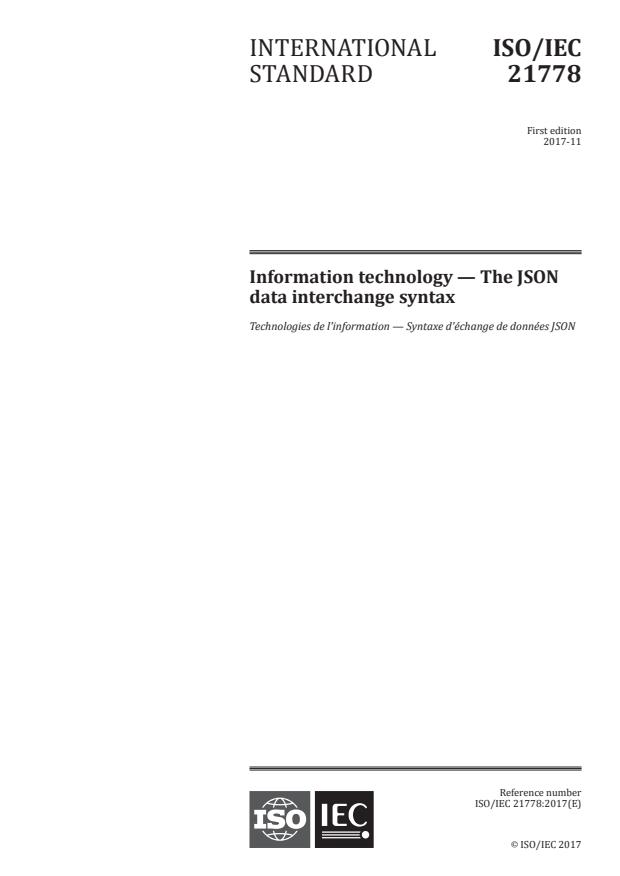
INTERNATIONAL ISO/IEC
STANDARD 21778
First edition
2017-11
Information technology — The JSON
data interchange syntax
Technologies de l'information — Syntaxe d'échange de données JSON
Reference number
©
ISO/IEC 2017
© ISO/IEC 2017, Published in Switzerland
All rights reserved. Unless otherwise specified, no part of this publication may be reproduced or utilized otherwise in any form
or by any means, electronic or mechanical, including photocopying, or posting on the internet or an intranet, without prior
written permission. Permission can be requested from either ISO at the address below or ISO’s member body in the country of
the requester.
ISO copyright office
Ch. de Blandonnet 8 • CP 401
CH-1214 Vernier, Geneva, Switzerland
Tel. +41 22 749 01 11
Fax +41 22 749 09 47
copyright@iso.org
www.iso.org
ii © ISO/IEC 2017 – All rights reserved
Contents Page
Foreword .iv
Introduction .v
1 Scope . 1
2 Conformance . 1
3 Normative References . 1
4 JSON Text . 1
5 JSON Values . 2
6 Objects . 2
7 Arrays . 3
8 Numbers . 3
9 String . 4
Bibliography . 6
© ISO/IEC 2017 – All rights reserved iii
Foreword
ISO (the International Organization for Standardization) and IEC (the International Electrotechnical
Commission) form the specialized system for worldwide standardization. National bodies that are
members of ISO or IEC participate in the development of International Standards through technical
committees established by the respective organization to deal with particular fields of technical
activity. ISO and IEC technical committees collaborate in fields of mutual interest. Other international
organizations, governmental and non-governmental, in liaison with ISO and IEC, also take part in the
work. In the field of information technology, ISO and IEC have established a joint technical committee,
ISO/IEC JTC 1.
The procedures used to develop this document and those intended for its further maintenance are
described in the ISO/IEC Directives, Part 1. In particular the different approval criteria needed for
the different types of document should be noted. This document was drafted in accordance with the
editorial rules of the ISO/IEC Directives, Part 2 (see www.iso.org/directives).
Attention is drawn to the possibility that some of the elements of this document may be the subject
of patent rights. ISO and IEC shall not be held responsible for identifying any or all such patent
rights. Details of any patent rights identified during the development of the document will be in the
Introduction and/or on the ISO list of patent declarations received (see www.iso.org/patents).
Any trade name used in this document is information given for the convenience of users and does not
constitute an endorsement.
For an explanation on the voluntary nature of standards, the meaning of ISO specific terms and
expressions related to conformity assessment, as well as information about ISO's adherence to the
World Trade Organization (WTO) principles in the Technical Barriers to Trade (TBT) see the following
URL: www.iso.org/iso/foreword.html.
ISO/IEC 21778 was prepared by Ecma International (as ECMA‐404) and was adopted, under a special
"fast‐track procedure", by Joint Technical Committee ISO/IEC JTC 1, Information technology, in parallel
with its approval by national bodies of ISO and IEC.
iv © ISO/IEC 2017 – All rights reserved
Introduction
1)
JSON is a text syntax that facilitates structured data interchange between all programming
languages. JSON is a syntax of braces, brackets, colons, and commas that is useful in many contexts,
profiles, and applications. JSON stands for JavaScript Object Notation and was inspired by the object
literals of JavaScript aka ECMAScript as defined in the ECMAScript Language Specification, Third
[1]
Edition. However, it does not attempt to impose ECMAScript’s internal data representations on
other programming languages. Instead, it shares a small subset of ECMAScript’s syntax with all
other programming languages. The JSON syntax is not a specification of a complete data interchange.
Meaningful data interchange requires agreement between a producer and consumer on the semantics
attached to a particular use of the JSON syntax. What JSON does provide is the syntactic framework to
which such semantics can be attached
JSON syntax describes a sequence of Unicode code points. JSON also depends on Unicode in the hex
numbers used in the \u escapement notation.
JSON is agnostic about the semantics of numbers. In any programming language, there can be a variety
of number types of various capacities and complements, fixed or floating, binary or decimal. That can
make interchange between different programming languages difficult. JSON instead offers only the
representation of numbers that humans use: a sequence of digits. All programming languages know
how to make sense of digit sequences even if they disagree on internal representations. That is enough
to allow interchange.
Programming languages vary widely on whether they support objects, and if so, what characteristics
and constraints the objects offer. The models of object systems can be wildly divergent and are
continuing to evolve. JSON instead provides a simple notation for expressing collections of name/value
pairs. Most programming languages will have some feature for representing such collections, which
can go by names like record, struct, dict, map, hash, or object.
JSON also provides support for ordered lists of values. All programming languages will have some
feature for representing such lists, which can go by names like array, vector, or list. Because
objects and arrays can nest, trees and other complex data structures can be represented. By accepting
JSON’s simple convention, complex data structures can be easily interchanged between incompatible
programming languages.
JSON does not support cyclic graphs, at least not directly. JSON is not indicated for applications requiring
binary data.
It is expected that other standards will refer to this one, strictly adhering to the JSON syntax, while
imposing semantics interpretation and restrictions on various encoding details. Such standards may
require specific behaviours. JSON itself specifies no behaviour.
Because it is so simple, it is not expected that the JSON grammar will ever change. This gives JSON, as a
foundational notation, tremendous stability.
JSON was first
...
Questions, Comments and Discussion
Ask us and Technical Secretary will try to provide an answer. You can facilitate discussion about the standard in here.
Loading comments...