


ISO/IEC 15444-9:2005/Amd 4:2010
(Amendment)Information technology — JPEG 2000 image coding system: Interactivity tools, APIs and protocols — Part 9: — Amendment 4: JPIP server and client profiles
Information technology — JPEG 2000 image coding system: Interactivity tools, APIs and protocols — Part 9: — Amendment 4: JPIP server and client profiles
Technologies de l'information — Système de codage d'images JPEG 2000: Outils d'interactivité, interfaces de programmes d'application et protocoles — Partie 9: — Amendement 4: Profils du serveur JPIP et du client
General Information
- Status
- Withdrawn
- Publication Date
- 14-Dec-2010
- Current Stage
- 9599 - Withdrawal of International Standard
- Start Date
- 11-May-2023
- Completion Date
- 12-Feb-2026
Relations
- Effective Date
- 06-Jun-2022
- Effective Date
- 26-Nov-2021
- Effective Date
- 15-Apr-2008





Get Certified
Connect with accredited certification bodies for this standard

BSI Group
BSI (British Standards Institution) is the business standards company that helps organizations make excellence a habit.

NYCE
Mexican standards and certification body.
Sponsored listings
Frequently Asked Questions
ISO/IEC 15444-9:2005/Amd 4:2010 is a standard published by the International Organization for Standardization (ISO). Its full title is "Information technology — JPEG 2000 image coding system: Interactivity tools, APIs and protocols — Part 9: — Amendment 4: JPIP server and client profiles". This standard covers: Information technology — JPEG 2000 image coding system: Interactivity tools, APIs and protocols — Part 9: — Amendment 4: JPIP server and client profiles
Information technology — JPEG 2000 image coding system: Interactivity tools, APIs and protocols — Part 9: — Amendment 4: JPIP server and client profiles
ISO/IEC 15444-9:2005/Amd 4:2010 is classified under the following ICS (International Classification for Standards) categories: 35.040 - Information coding; 35.040.30 - Coding of graphical and photographical information. The ICS classification helps identify the subject area and facilitates finding related standards.
ISO/IEC 15444-9:2005/Amd 4:2010 has the following relationships with other standards: It is inter standard links to ISO/IEC 15444-9:2005, ISO/IEC 15444-9:2023; is excused to ISO/IEC 15444-9:2005. Understanding these relationships helps ensure you are using the most current and applicable version of the standard.
ISO/IEC 15444-9:2005/Amd 4:2010 is available in PDF format for immediate download after purchase. The document can be added to your cart and obtained through the secure checkout process. Digital delivery ensures instant access to the complete standard document.
Standards Content (Sample)
INTERNATIONAL ISO/IEC
STANDARD 15444-9
First edition
2005-12-01
AMENDMENT 4
2010-12-15
Information technology — JPEG 2000
image coding system: Interactivity tools,
APIs and protocols
AMENDMENT 4: JPIP server and client
profiles
Technologies de l'information — Système de codage d'images
JPEG 2000: Outils d'interactivité, interfaces de programmes
d'application et protocoles
AMENDEMENT 4: Profils du serveur JPIP et du client
Reference number
ISO/IEC 15444-9:2005/Amd.4:2010(E)
©
ISO/IEC 2010
ISO/IEC 15444-9:2005/Amd.4:2010(E)
PDF disclaimer
This PDF file may contain embedded typefaces. In accordance with Adobe's licensing policy, this file may be printed or viewed but
shall not be edited unless the typefaces which are embedded are licensed to and installed on the computer performing the editing. In
downloading this file, parties accept therein the responsibility of not infringing Adobe's licensing policy. The ISO Central Secretariat
accepts no liability in this area.
Adobe is a trademark of Adobe Systems Incorporated.
Details of the software products used to create this PDF file can be found in the General Info relative to the file; the PDF-creation
parameters were optimized for printing. Every care has been taken to ensure that the file is suitable for use by ISO member bodies. In
the unlikely event that a problem relating to it is found, please inform the Central Secretariat at the address given below.
© ISO/IEC 2010
All rights reserved. Unless otherwise specified, no part of this publication may be reproduced or utilized in any form or by any means,
electronic or mechanical, including photocopying and microfilm, without permission in writing from either ISO at the address below or
ISO's member body in the country of the requester.
ISO copyright office
Case postale 56 • CH-1211 Geneva 20
Tel. + 41 22 749 01 11
Fax + 41 22 749 09 47
E-mail copyright@iso.org
Web www.iso.org
Published by ISO in 2011
Published in Switzerland
ii © ISO/IEC 2010 – All rights reserved
ISO/IEC 15444-9:2005/Amd.4:2010(E)
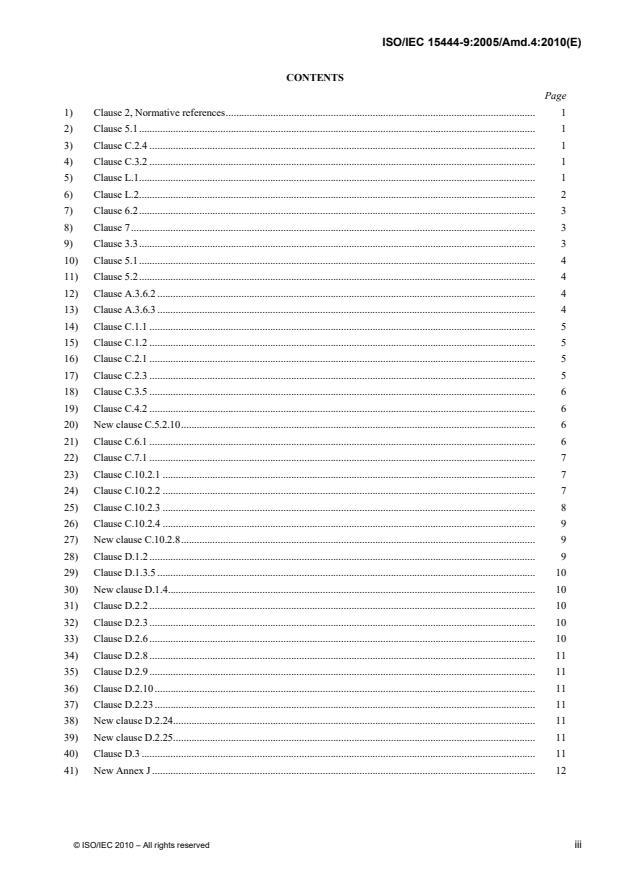
CONTENTS
Page
1) Clause 2, Normative references . 1
2) Clause 5.1 . 1
3) Clause C.2.4 . 1
4) Clause C.3.2 . 1
5) Clause L.1 . 1
6) Clause L.2 . 2
7) Clause 6.2 . 3
8) Clause 7 . 3
9) Clause 3.3 . 3
10) Clause 5.1 . 4
11) Clause 5.2 . 4
12) Clause A.3.6.2 . 4
13) Clause A.3.6.3 . 4
14) Clause C.1.1 . 5
15) Clause C.1.2 . 5
16) Clause C.2.1 . 5
17) Clause C.2.3 . 5
18) Clause C.3.5 . 6
19) Clause C.4.2 . 6
20) New clause C.5.2.10 . 6
21) Clause C.6.1 . 6
22) Clause C.7.1 . 7
23) Clause C.10.2.1 . 7
24) Clause C.10.2.2 . 7
25) Clause C.10.2.3 . 8
26) Clause C.10.2.4 . 9
27) New clause C.10.2.8 . 9
28) Clause D.1.2 . 9
29) Clause D.1.3.5 . 10
30) New clause D.1.4 . 10
31) Clause D.2.2 . 10
32) Clause D.2.3 . 10
33) Clause D.2.6 . 10
34) Clause D.2.8 . 11
35) Clause D.2.9 . 11
36) Clause D.2.10 . 11
37) Clause D.2.23 . 11
38) New clause D.2.24 . 11
39) New clause D.2.25 . 11
40) Clause D.3 . 11
41) New Annex J . 12
© ISO/IEC 2010 – All rights reserved iii
ISO/IEC 15444-9:2005/Amd.4:2010(E)
Page
Annex J – Profiles and variants for interoperability and testing . 12
J.1 Introduction . 12
J.2 Definition of variants . 12
J.3 Definition of profiles . 13
J.4 Testing methodology . 15
42) Bibliography . 19
Electronic attachment = JPIP test data and scripts
iv © ISO/IEC 2010 – All rights reserved
ISO/IEC 15444-9:2005/Amd.4:2010(E)
Foreword
IISO (the International Organization for Standardization) and IEC (the International Electrotechnical
Commission) form the specialized system for worldwide standardization. National bodies that are members of
ISO or IEC participate in the development of International Standards through technical committees
established by the respective organization to deal with particular fields of technical activity. ISO and IEC
technical committees collaborate in fields of mutual interest. Other international organizations, governmental
and non-governmental, in liaison with ISO and IEC, also take part in the work. In the field of information
technology, ISO and IEC have established a joint technical committee, ISO/IEC JTC 1.
International Standards are drafted in accordance with the rules given in the ISO/IEC Directives, Part 2.
The main task of the joint technical committee is to prepare International Standards. Draft International
Standards adopted by the joint technical committee are circulated to national bodies for voting. Publication as
an International Standard requires approval by at least 75 % of the national bodies casting a vote.
Attention is drawn to the possibility that some of the elements of this document may be the subject of patent
rights. ISO and IEC shall not be held responsible for identifying any or all such patent rights.
ISO/IEC 15444-9:2005/Amd.4 was prepared jointly by Joint Technical Committee ISO/IEC JTC 1, Information
technology, Subcommittee SC 29, Coding of audio, picture, multimedia and hypermedia information in
collaboration with ITU-T. The identical text is published as Rec. ITU-T.808(2005)/Amd.4 (05/2010).
© ISO/IEC 2010 – All rights reserved v
ISO/IEC 15444-9:2005/Amd.4:2010 (E)
INTERNATIONAL STANDARD
RECOMMENDATION ITU-T
Information technology – JPEG 2000 image coding system:
Interactivity tools, APIs and protocols
Amendment 4
JPIP server and client profiles
1) Clause 2, Normative references
Add the following reference to clause 2:
– Recommendation ITU-T T.803 (2002) | ISO/IEC 15444-4:2004, Information technology – JPEG 2000 image
coding system: Conformance testing.
2) Clause 5.1
a) Replace the definition of TOKEN by:
TOKEN = 1*(ALPHA / DIGIT / "." / "_" / "-")
b) Add the following token at the end of the ABNF-rules:
IDTOKEN = 1*(TOKEN / ";")
3) Clause C.2.4
Replace the definition of the target-id by the following:
target-id = IDTOKEN
4) Clause C.3.2
Replace the definition of the channel-id by the following:
channel-id = IDTOKEN
5) Clause L.1
Add to the list of fields in L.1 the following:
;=================================
; C.4.5 Frame Size for Variable Dimension Data (fvsiz)
;=================================
fvsiz = "fvsiz" "=" 1#UINT ["," round-direction]
round-direction = "round-up" / "round-down" / "closest"
;=================================
; C.4.7 Offset for Variable Dimension Data (rvoff)
;=================================
rvoff = "rvoff" "=" 1#UINT
;=================================
Rec. ITU-T T.808 (2005)/Amd.4 (05/2010) 1
ISO/IEC 15444-9:2005/Amd.4:2010 (E)
; C.4.8 Region Size for Variable Dimension Data(rvsiz)
;=================================
rvsiz = "rvsiz" "=" 1#UINT
6) Clause L.2
a) Replace the list of jpip-response headers by the following:
jpip-response-header =
/ JPIP-tid ; D.2.2
/ JPIP-cnew ; D.2.3
/ JPIP-qid ; D.2.4
/ JPIP-fsiz ; D.2.5
/ JPIP-rsiz ; D.2.6
/ JPIP-roff ; D.2.7
/ JPIP-fvsiz ; D.2.8
/ JPIP-rvsiz ; D.2.9
/ JPIP-rvoff ; D.2.10
/ JPIP-comps ; D.2.11
/ JPIP-stream ; D.2.12
/ JPIP-context ; D.2.13
/ JPIP-roi ; D.2.14
/ JPIP-layers ; D.2.15
/ JPIP-srate ; D.2.16
/ JPIP-metareq ; D.2.17
/ JPIP-len ; D.2.18
/ JPIP-quality ; D.2.19
/ JPIP-type ; D.2.20
/ JPIP-mset ; D.2.21
/ JPIP-cap ; D.2.22
/ JPIP-pref ; D.2.23
/ JPIP-align ; D.2.24
/ JPIP-subtarget ; D.2.25
b) Add respectively the following items to the list of JPIP Response BNF:
;=================================
; D.2.8 Frame Size for Variable Dimension Data (JPIP-fvsiz)
;=================================
JPIP-fvsiz = "JPIP-fvsiz" ":" LWSP 1#UINT
;=================================
; D.2.9 Region Size for Variable Dimension Data(JPIP-rvsiz)
;=================================
2 Rec. ITU-T T.808 (2005)/Amd.4 (05/2010)
ISO/IEC 15444-9:2005/Amd.4:2010 (E)
JPIP-rvsiz = "JPIP-rvsiz" ":" LWSP 1#UINT
;=================================
; D.2.10 Offset for Variable Dimension Data (JPIP-rvoff)
;=================================
JPIP-rvoff = "JPIP-rvoff" ":" LWSP 1#UINT
;=================================
; D.2.24 Alignment (JPIP-align)
;=================================
JPIP-align = "JPIP-align" ":" LWSP "yes" / "no"
;=================================
; D.2.25 Subtarget (JPIP-subtarget)
;=================================
JPIP-subtarget = "JPIP-subtarget" ":" LWSP byte-range / src-codestream-specs
7) Clause 6.2
a) Replace the third point of the second paragraph by the following:
– Annex C defines the client request syntax. The client shall produce compliant requests and the server
shall be able to parse, interpret and respond to all compliant requests.
b) Add the following to 6.2:
– Server and client conformance is further structured into profiles and variants. Profiles define which fields
servers must support and implement beyond simply parsing and interpreting. Variants define the
operating modes and features of the JPIP standard a client and server use to transmit data. Clients and
servers must provide a common subset of variants in order to interoperate. See Annex J for details about
conformance and testing for conformance.
8) Clause 7
Change clause 7 to:
Conformance with this Recommendation | International Standard by a client means that the client's JPIP requests are
well structured, valid and conformant to the JPIP client requests as defined by this Recommendation | International
Standard, and that it is able to parse the JPIP responses defined by this Recommendation | International Standard.
Conformance with this Recommendation | International Standard by a server means that the server's JPIP responses are
well structured, valid and conformant to the JPIP server response signalling as defined by this Recommendation |
International Standard, and is able to parse the JPIP requests defined by this Recommendation | International Standard.
Servers shall parse and interpret all normative request types and shall respond to all compliant requests. Compliance to
a profile requires servers furthermore to support and implement all mandatory fields within that profile to the extent
defined in Annex J.
Conformance, profiles and conformance testing methodologies of this Recommendation | International Standard are
defined in Annex J.
It is expected that server applications may reduce efficiency by sending additional data not explicitly requested for or
redundant data depending on the network quality-of-service. Such implementation decisions are application specific and
provide the JPIP system with high utility.
9) Clause 3.3
Add the following definitions:
3.3.24 profile: Conformance is structured according to profiles; a profile defines the set of request fields that a server
is expected to support and implement and a client communicating with a server in this profile may issue expecting the
Rec. ITU-T T.808 (2005)/Amd.4 (05/2010) 3
ISO/IEC 15444-9:2005/Amd.4:2010 (E)
server to support them. A server is conforming to a profile if it supports and implements all request fields within this
profile to the extent defined in Annex J.
3.3.25 variant: Variants define the operating modes and features of the JPIP standard that a client and a server use to
exchange requests and data. Clients and servers must provide a common subset of variants in order to interoperate.
10) Clause 5.1
In 5.1, delete the definition of ENCODED-CHAR, and insert the following definition instead, and replace all
occurrences of ENCODED-CHAR by OCTAL-ENCODED-CHAR:
OCTAL-ENCODED-CHAR = "\" QUADDIG OCTDIG OCTDIG
QUADDIG = "0" / "1" / "2" / "3"
OCTDIG = "0" / "1" / "2" / "3" / "4" / "5" / "6" / "7"
11) Clause 5.2
Replace all occurrences of ENCODED-CHAR by OCTAL-ENCODED-CHAR and replace the first paragraph of 5.2
by the following:
box-type specifies the four characters of the box type. For each character in the box type, if the character is
alpha-numeric (A.Z, a.z or 0.9), the character is written directly into the string. If the character is a space (\040), then
that character shall be encoded as the underscore character ("_") or by octal encoding. For any other character, a
4-character string is written in its place, consisting of a backslash character ("\") followed by three octal digits
representing the value of the character from the box type in octal. The compatibility-code is encoded the same
way that a box-type is encoded.
12) Clause A.3.6.2
At the end of A.3.6.2, replace the example Figure A.10 by the following:
13) Clause A.3.6.3
a) After the last paragraph of A.3.6.3, add a Note:
NOTE – The above definition implies that the placeholder box may be truncated after the last used field, but intermediate fields,
even if unused, must be present.
b) In Table A.3, row five – the description of the flag value 01xx – change the last sentence of the description in
the right column to:
The value of the NCS field shall be treated as if it was set to "1" regardless of the actual value of that field when the
field is present.
4 Rec. ITU-T T.808 (2005)/Amd.4 (05/2010)
ISO/IEC 15444-9:2005/Amd.4:2010 (E)
c) Add the word "minimal" to the beginning of the description of each cut-off point in Figure A.11.
14) Clause C.1.1
Replace the last sentence of the paragraph by:
Finally, even with a conforming request, a server might not implement all possible request fields or combinations there-
of, but it must parse and interpret all normative request fields and respond appropriately, even if this response is an
error. Details of what servers are expected to implement are defined in Annex J.
NOTE – Which responses or methods for signalling error conditions are appropriate depends on the transport layer used.
Clause D.1 provides examples for servers using HTTP as transport protocol.
15) Clause C.1.2
a) Remove the Note before the definition of the jpip-request-field and add the following:
The fields in the request shall be sent in compliance with the selected transport protocol. For example, in HTTP, the
requests may be part of the query field of a GET request, or the body of a POST request, with individual request fields
separated by a "&" character – see Annexes F, G and H for details. In contexts such as these, certain characters found
within the BNF syntax or the request parameters may need to be escaped in order to avoid ambiguity. For example, a
request field of the form "target=me&my dog" should be escaped in an HTTP context, becoming
"target=me%26my%20dog", so as to avoid confusion with the "&" used to separate request fields. As another
example, "metareq=[roid/w]" should be escaped in an HTTP context, becoming
"metareq=%5broid/w%5d" so as to avoid the use of non-URI character – see IETF RFC 2396 for more on
reserved characters, disambiguation and escaping via the hex-hex encoding. Parsers of requests found in such contexts
should be prepared to perform hex-hex decoding of each request field.
b) Replace the view-window field list by the following:
view-window-field = fsiz ; C.4.2
/ roff ; C.4.3
/ rsiz ; C.4.4
/ fvsiz ; C.4.5
/ comps ; C.4.6
/ rvoff ; C.4.7
/ rvsiz ; C.4.8
/ stream ; C.4.9
/ context ; C.4.10
/ srate ; C.4.11
/ roi ; C.4.12
/ layers ; C.4.13
16) Clause C.2.1
Replace the eighth paragraph (before the examples) of C.2.1 by the following:
If the channel ID request field is included in the request, the request need not include Target, Sub-Target or Target ID
fields.
17) Clause C.2.3
Replace the body of C.2.3 by:
subtarget = "subtarget" "=" byte-range / src-codestream-specs
byte-range = UINT-RANGE
src-codestream-specs = "c" UINT-RANGE
This field may be used to qualify the original named resource through the specification of a byte range or a range of
codestreams in the original resource. The logical target is to be interpreted as the indicated byte range or a range of
Rec. ITU-T T.808 (2005)/Amd.4 (05/2010) 5
ISO/IEC 15444-9:2005/Amd.4:2010 (E)
codestreams of the original named resource. For the purpose of requests and responses involving this logical target, the
codestreams in this target shall be assigned consecutive indices starting from zero.
NOTE – Defining a logical target as a range of codestreams thus relabels the codestreams, and effectively replaces the
codestream indices, if any, in the original resource by consecutive indices starting from zero.
The lower and upper bounds of the supplied byte-range are inclusive, where bytes or codestreams are counted from
zero.
18) Clause C.3.5
Replace the body of C.3.5 by the following:
This field is used to specify a Request ID value. Each channel has its own request queue, with its own Request ID
counter. The server may process requests which do not contain a Request ID, or whose Request ID is zero, on a
first-come-first-served basis. However, it shall not process a request which arrives with a Request ID value of n until it
has processed all requests with request ID values of n to n–1, inclusive. Here n is the qid supplied in the request
0 0
which originally created the channel, or is equal to 1 if no qid was present when creating the channel.
NOTE – The response to a request containing cnew which results in the creation of a new channel is processed as if the request
were issued in the new channel. This means the next request with a non-zero qid value to be processed in the new channel has
the qid value n +1.
19) Clause C.4.2
Replace the right-side entry of Table C.1 defining the meaning of ROUND-DOWN by the following:
For each requested codestream, the largest codestream image resolution whose width and height are both less than or
equal to the specified size shall be selected. If there is none, then the smallest available codestream image resolution
shall be used. This is the default value when the round-direction parameter is not specified.
20) New clause C.5.2.10
At the end of C.5.2, add C.5.2.10:
C.5.2.10 Special considerations for cross-reference boxes
If any cross-reference boxes are identified by a metadata request, the server shall also include in its response such
additional metadata as may be required for the client to determine the metadata-bins, if any, which contain the original
file byte contents that are referenced by such cross-reference boxes.
NOTE – If a cross-reference box has a streaming equivalent placeholder, the placeholder box itself provides the identity of a
metadata-bin which contains the original cross-referenced content. Otherwise, the server is required to send at least the box
header (or corresponding placeholder boxes) for every box in the original file which contains data referenced by the cross-
reference box.
21) Clause C.6.1
Replace the body of C.6.1 by the following:
len = "len" "=" UINT
This field specifies a restriction on the amount of data, in units of bytes, that the client requests from the server. For JPP
and JPT image return types, the limit includes payload and VBAS headers. The EOR message (header and body, see
Annex D) does not contribute to the limit.
If the len field is not present, the server should send image data to the client until such point as all of the relevant data
has been sent, a quality limit is reached (see C.6.2), or the response is interrupted by the arrival of a new request that
does not include a wait request field with a value of "yes" (see C.7.2). The client should use len=0 if it requires
response headers only and no entity body (see Annex F). Nevertheless, transport protocols that require framing of
responses require an EOR message (see Annex G).
6 Rec. ITU-T T.808 (2005)/Amd.4 (05/2010)
ISO/IEC 15444-9:2005/Amd.4:2010 (E)
22) Clause C.7.1
Replace the first paragraph of C.7.1 by the following:
This field specifies whether the server response data shall be aligned on "natural boundaries". The default value is "no".
If the server supports aligned responses and the value is "yes", any JPT-stream or JPP-stream message delivered in
response to this request which crosses any natural boundary shall terminate at any subsequent natural boundary. Servers
that do not support data alignment but receive an alignment request with the value "yes" shall indicate this by the
Alignment Response defined in D.2.24.
The natural boundaries for each data-bin type are listed in Table C.3. A message is said to cross a natural boundary if it
includes the last byte prior to the boundary and the first byte after the boundary.
NOTE – For example, a precinct data-bin crosses a natural boundary if it includes the last byte of one packet and the first byte of
the next packet. Note carefully that aligned response messages are not actually required to terminate at a natural boundary unless
they cross a boundary. This means, for example, that the response may include partial packets from precincts, which may be
necessary if a prevailing byte limit prevents the delivery of complete packets.
23) Clause C.10.2.1
a) Replace the first paragraph (the syntax description) of the client preferences by the following:
pref = "pref" "=" 1#(related-pref-set ["/r"])
related-pref-set = view-window-pref ; C.10.2.2
/ colour-meth-pref ; C.10.2.3
/ max-bandwidth ; C.10.2.4
/ bandwidth-slice ; C.10.2.5
/ placeholder-pref ; C.10.2.6
/ codestream-seq-pref ; C.10.2.7
/ conciseness-pref ; C.10.2.8
/ other
other = TOKEN
b) Replace the fourth paragraph of the client preferences by the following:
Unless otherwise stated, each related-pref-set specifies an ordered list of individual preference tokens, from
most preferred to least preferred. Where possible, the server shall respect the client preferences identified by this request
field. If a related-pref-set is followed by the "/r" modifier (required), the server shall either support one of
the preferences listed in the related-pref-set, or else it shall respond with an error. In the latter case, the server
shall return an Unavailable preference response header which identifies any related-pref-set which had the
"/r" modifier but could not be supported. See D.2.23 for more on the Unavailable preference response header.
Supporting a preference means that the server provides functionality which affects its behaviour in accordance with the
preference. This addresses the server's functionality rather than the specific parameters established by other aspects of
the request.
24) Clause C.10.2.2
Replace C.10.2.2 by the following:
view-window-pref = "fullwindow" / "progressive"
This Recommendation | International Standard defines two options to specify the behaviour of the server in the event
that the request cannot be serviced exactly as stated. These two options are specified in Table C.8.
Rec. ITU-T T.808 (2005)/Amd.4 (05/2010) 7
ISO/IEC 15444-9:2005/Amd.4:2010 (E)
Table C.8 – View-window handling preferences
Option Meaning
"fullwindow" The server shall honour the view-window request parameters but is allowed to deliver the data in
arbitrary order. In the event that the server does modify view-window request parameters, the
modified view window must be such that the minimal set of data to completely satisfy the modified
view-window shall be identical to the minimal set of data required to satisfy the originally requested
view-window.
"progressive" The server may modify the view-window request parameters in order to retain the progressive
properties of the response data. In the event that the server does modify view-window request
parameters, the modified view window must be such that the minimal set of data to completely satisfy
the modified view-window shall be a subset of the minimal set of data required to satisfy the
originally requested view-window.
If neither "fullwindow" nor "progressive" is specified in the Client Preferences request field, the server shall
infer that the client's preference is "progressive".
NOTE – The interpretation of "progressive" delivery may be affected by the presence of a Delivery Rate request field, as
explained in C.7.4. The view-window-pref field provides strategies for a server operating under resource constraints to satisfy a
request that might otherwise exceed these resources. The "progressive" mode allows the server to shrink the source window
in order to provide a more uniform progression over the view window, whereas the "fullwindow" mode allows the server to
reorder data arbitrarily in order to deliver the full window.
25) Clause C.10.2.3
a) Replace the third paragraph of the body of the clause by the following:
If the Client Preferences request field does not contain any colourspace method preferences or the server does not
support this field but is able to retrieve the client capabilities, then the supported colourspace methods are defined
according to the information contained within the Capability field, and no preference is defined.
b) Replace the fifth paragraph of the body of the clause by the following:
The optional meth-limit value specifies a limit on the APPROX value for that particular colourspace method. When
using these preferences to select a colourspace specification, the server shall consider a colourspace method
specification with an APPROX value of meth-limit or less as if the actual APPROX value was 1 (exact). This
allows clients to specify the point at which colour fidelity is not important for a particular colourspace method, for the
current application. For example, a page-layout application that is only concerned with aligning the image data with
other elements on the page may not care at all about colour fidelity and set meth-limit to 4, meaning that the
accuracy of the colourspace methods is unimportant. Another application that displays images on a low-quality screen
may set meth-limit to 3, to indicate that as long as the colour accuracy is reasonable, it would be satisfied. The
characters of the field shall be interpreted as an unsigned decimal integer. Allowed values are defined by the definition
of the APPROX field in Table M.24 of Rec. ITU-T T.801 | ISO/IEC 15444-2, and by extensions and amendments to
that Recommendation | International Standard. If the optional meth-limit value is not supplied, the default value
shall be the largest value defined in that Recommendation | International Standard.
c) Replace the flow chart of Figure C.3 by the following:
spec[i].APPROX
= 0 > 0
priority[i] = 3000 – priority[i] = 2000 + spec[i].APPROX –
spec[i].PREC spec[i].PREC
If spec[i].APPROX ≤
priority[i] = 257 –
limit[spec[i].METH]
spec[i].PREC
then:
priority[i] = 1000 –
spec[i].PREC
If spec[i].APPROX > priority[i] = 256 +
limit[spec[i].METH] spec[i].APPROX –
then: spec[i].PREC
Figure C.3 – Colourspace specification box selection procedure
8 Rec. ITU-T T.808 (2005)/Amd.4 (05/2010)
limit[spec[i].METH]
> 0 = 0
ISO/IEC 15444-9:2005/Amd.4:2010 (E)
26) Clause C.10.2.4
Replace the definition of the max-bandwidth field by the following:
max-bandwidth = "mbw:" mbw
mbw = NONZERO ["K" / "M" / "G" / "T"]
27) New clause C.10.2.8
Insert the following text under C.10.2.8 after C.10.2.7:
C.10.2.8 Conciseness preference
conciseness-pref = "loose" / "concise"
This preference may be used to indicate how strictly a server shall bind its response to the request made by the client,
and how much excess data (i.e., data included in the response that is not required to satisfy the request) the server is
allowed to include. Allowed values of the conciseness-preference are specified in Table C.12. Servers may ignore any
"/r" modifier applied to this preference, and its usage is discouraged because its meaning is undefined.
Table C.12 – Conciseness preferences
"concise" The server should produce the smallest response that it is capable of that satisfies the
request.
"loose" The server may include data which it deems appropriate to the request beyond the data
necessary to satisfy the request.
NOTE – To the extent that the requested view window is modified in accordance with response headers (see D.2), the above
definitions are to be interpreted in terms of the modified view window.
Example: Consider a client that performs a series of requests whose view window follows an identifiable trajectory. If
the conciseness-pref is not set to "concise", the server may include data anticipating the future interests of the client.
A client might use the conciseness-pref set to "concise" to discourage the server from following such a strategy.
28) Clause D.1.2
Replace the list of jpip response headers by the following:
jpip-response-header =
/ JPIP-tid ; D.2.2
/ JPIP-cnew ; D.2.3
/ JPIP-qid ; D.2.4
/ JPIP-fsiz ; D.2.5
/ JPIP-rsiz ; D.2.6
/ JPIP-roff ; D.2.7
/ JPIP-fvsiz ; D.2.8
/ JPIP-rvsiz ; D.2.9
/ JPIP-rvoff ; D.2.10
/ JPIP-comps ; D.2.11
/ JPIP-stream ; D.2.12
/ JPIP-context ; D.2.13
/ JPIP-roi ; D.2.14
/ JPIP-layers ; D.2.15
/ JPIP-srate ; D.2.16
/ JPIP-metareq ; D.2.17
/ JPIP-len ; D.2.18
/ JPIP-quality ; D.2.19
/ JPIP-type ; D.2.20
/ JPIP-mset ; D.2.21
/ JPIP-cap ; D.2.22
/ JPIP-pref ; D.2.23
/ JPIP-align ; D.2.24
/ JPIP-subtarget ; D.2.25
Rec. ITU-T T.808 (2005)/Amd.4 (05/2010) 9
ISO/IEC 15444-9:2005/Amd.4:2010 (E)
29) Clause D.1.3.5
Replace the body of D.1.3.5 by the following:
This status code should be issued if the server cannot locate the logical target to which the request refers, through the
"target" request field, the "target-id" request field, or any other means such as the component of
an HTTP GET or POST request.
NOTE – This status code should also be issued if a "subtarget" request field refers to a non-existent or inappropriate byte
range within the requested resource.
30) New clause D.1.4
After D.1.3, add D.1.4:
D.1.4 Impact of errors on the server state
In an event the server issues an error code different from 200 and 202, it shall not modify its state by processing request
fields contained in the corresponding request and shall not return response data. The server shall, however, update the
qid. In case the error code generated by a client-preferences request using the "/r" modifier is not supported by the
server, and the server is operating in a session, it is desirable that the server keeps the session available for future
requests.
NOTE – If the server is operating in a session, an alternative option for the server would be to first return an error code and then
terminate the session, e.g., return 503 for all further requests on this session.
Example: Consider a client issuing the invalid request:
cid=1&rsiz=100,100&fsiz=100,100&cnew=2&roff=-1,-1
then the server shall report this invalid request, shall not process the request for the view window, shall not modify its
cache model and shall not create a new channel. It shall abort the request and return an error code.
Example: Consider a client issuing the valid request:
cid=1&rsiz=10000,10000&fsiz=10000,10000&pref=fullwindow/r
and the server cannot honour the view-window pref "fullwindow" for the requested window size, then the server
shall not process the request, shall not return any data for the request, and shall issue the error code 501 including the
JPIP-response header "JPIP-pref: fullwindow/r" without modifying its internal state. It should keep the
session available for future requests if feasible, though.
31) Clause D.2.2
Change the first sentence of D.2.2 by:
The server shall send this response header if the server's unique target identifier differs in any way from the identifier
supplied with a Target ID request field.
32) Clause D.2.3
Change the ABNF definition of JPIP-cnew as follows:
JPIP-cnew = "JPIP-cnew" ":" LWSP "cid" "=" channel-id["," 1#(transport-param "="
1*(IDTOKEN / "=" / "/" / "\"))]
33) Clause D.2.6
At the end of D.2.6, add a note:
NOTE – A server shall only modify view-windows in accordance with Table C.8, the description of the view-window-prefs,
in C.10.2.2. Specifically, a server is not allowed to enlarge the requested view window. It may, however, at its discretion,
transmit data outside of the requested view window in accordance with Table C.12, the description of the conciseness-pref,
in C.10.2.8.
10 Rec. ITU-T T.808 (2005)/Amd.4 (05/2010)
ISO/IEC 15444-9:2005/Amd.4:2010 (E)
34) Clause D.2.8
Replace the definition of JPIP-fvsiz by the following:
JPIP-fvsiz = "JPIP-fvsiz" ":" LWSP 1#UINT
35) Clause D.2.9
Replace the definition of JPIP-rvsiz by the following:
JPIP-rvsiz = "JPIP-rvsiz" ":" LWSP 1#UINT
36) Clause D.2.10
Replace the definition of JPIP-rvoff by the following:
JPIP-rvoff = "JPIP-rvoff" ":" LWSP 1#UINT
37) Clause D.2.23
Replace the first paragraph of D.2.23 (Unavailable preference) by the following:
This response header should be provided if, and only if, a Client Preferences request field contained a related-
pref-set with the "/r" modifier (required), which the server was unwilling to support. In this case, an error value
should also be returned for the response status code. The value string consists of one or more of the related-pref-
sets that could not be supported, repeated in the same form as they appeared in the Client Preferences request, except
that numerical parameters only need to be represented to sufficient accuracy to avoid any ambiguity in identifying the
unsupported preference.
38) New clause D.2.24
At the end of D.2, add D.2.24:
D.2.24 Alignment (JPIP-align)
JPIP-align = "JPIP-align" ":" LWSP "yes" / "no"
This response header should be provided if the server alignment guarantee differs from that requested by the client.
(See C.7.1.)
39) New clause D.2.25
At the end of D.2, add D.2.25:
D.2.25 Subtarget (JPIP-subtarget)
JPIP-subtarget = "JPIP-subtarget" ":" LWSP byte-range / src-codestream-specs
This response header should be provided if the subtarget identified by the server differs from that requested by the
client. (See C.2.3.)
40) Clause D.3
In D.3, change the third paragraph to the following, and replace the fourth paragraph with the Note below:
The EOR message, header and body, is the only message which does not contribute to the byte count restriction
associated with the Maximum Response Length request field as defined in C.6.1.
NOTE – The EOR message means that the server has delivered all the pertinent contents of the relevant data-bins for a client
request. This is not necessarily the entire contents of those data-bins. The response is terminated when a client specified limit has
been reached. If no limit was specified, then the EOR message would mean that all the contents of the relevant data-bins have
been served.
Rec. ITU-T T.808 (2005)/Amd.4 (05/2010) 11
ISO/IEC 15444-9:2005/Amd.4:2010 (E)
41) New Annex J
Insert the following annex between Annexes I and J. The current annexes J to M shall be renamed to Annexes K to N
and references shall be fixed accordingly.
Annex J
Profiles and var
...
INTERNATIONAL ISO/IEC
STANDARD 15444-9
First edition
2005-12-01
AMENDMENT 4
2010-12-15
Information technology — JPEG 2000
image coding system: Interactivity tools,
APIs and protocols
AMENDMENT 4: JPIP server and client
profiles
Technologies de l'information — Système de codage d'images
JPEG 2000: Outils d'interactivité, interfaces de programmes
d'application et protocoles
AMENDEMENT 4: Profils du serveur JPIP et du client
Reference number
ISO/IEC 15444-9:2005/Amd.4:2010(E)
©
ISO/IEC 2010
ISO/IEC 15444-9:2005/Amd.4:2010(E)
PDF disclaimer
PDF files may contain embedded typefaces. In accordance with Adobe's licensing policy, such files may be printed or viewed but shall
not be edited unless the typefaces which are embedded are licensed to and installed on the computer performing the editing. In
downloading a PDF file, parties accept therein the responsibility of not infringing Adobe's licensing policy. The ISO Central Secretariat
accepts no liability in this area.
Adobe is a trademark of Adobe Systems Incorporated.
Details of the software products used to create the PDF file(s) constituting this document can be found in the General Info relative to
the file(s); the PDF-creation parameters were optimized for printing. Every care has been taken to ensure that the files are suitable for
use by ISO member bodies. In the unlikely event that a problem relating to them is found, please inform the Central Secretariat at the
address given below.
This DVD contains the publication ISO/IEC 15444-9:2005/Amd.4:2010, which is identical to
Rec. ITU-T.808(2005)/Amd.4 (05/2010), in portable document format (PDF), which can be viewed using
Adobe® Acrobat® Reader.
Adobe and Acrobat are trademarks of Adobe Systems Incorporated.
© ISO/IEC 2010
All rights reserved. Unless required for installation or otherwise specified, no part of this DVD may be reproduced, stored in a retrieval
system or transmitted in any form or by any means without prior permission from ISO. Requests for permission to reproduce this product
should be addressed t
...
Questions, Comments and Discussion
Ask us and Technical Secretary will try to provide an answer. You can facilitate discussion about the standard in here.
Loading comments...