

ISO 23977-1:2020
(Main)Plastics — Determination of the aerobic biodegradation of plastic materials exposed to seawater — Part 1: Method by analysis of evolved carbon dioxide
General Information
- Abstract
This document specifies a laboratory test method for determining the degree and rate of the aerobic biodegradation level of plastic materials. Biodegradation is determined by measuring the CO2 evolved from plastic materials when exposed to seawater sampled from coastal areas under laboratory conditions. The conditions described in this document might not always correspond to the optimum conditions for the maximum degree of biodegradation, however this test method is designed to give an indication of the potential biodegradability of plastic materials. NOTE This document addresses plastic materials but can also be used for other materials.
- Status
- Published
- Publication Date
- 09-Nov-2020
- Technical Committee
- ISO/TC 61/SC 14 - Environmental aspects
- Drafting Committee
- ISO/TC 61/SC 14/WG 2 - Biodegradability
- Current Stage
- 9060 - Close of review
- Completion Date
- 04-Jun-2031
Buy Documents


ISO 23977-1:2020 - Plastics -- Determination of the aerobic biodegradation of plastic materials exposed to seawater
ISO 23977-1:2020 - Plastics — Determination of the aerobic biodegradation of plastic materials exposed to seawater — Part 1: Method by analysis of evolved carbon dioxide/10/2020

ISO 23977-1:2020 - Plastiques -- Détermination de la biodégradation aérobie des matériaux plastiques exposés à l'eau de mer
ISO 23977-1:2020 - Plastiques — Détermination de la biodégradation aérobie des matériaux plastiques exposés à l'eau de mer — Partie 1: Méthode par analyse du dioxyde de carbone libéré/30/2021
Overview
ISO 23977-1:2020 - Plastics - Determination of the aerobic biodegradation of plastic materials exposed to seawater - Part 1: Method by analysis of evolved carbon dioxide - defines a laboratory respirometric test method to assess the potential aerobic biodegradability of plastics (and other materials) when exposed to natural seawater. The standard follows CO2 evolution from material samples incubated with seawater (with or without a small amount of sediment) to determine the degree and rate of biodegradation under controlled mesophilic conditions (typically 15 °C–25 °C, not exceeding 28 °C). Results are expressed as a percentage of the theoretical amount of evolved CO2 (ThCO2).
Key topics and technical requirements
- Test principle: Monitoring evolved carbon dioxide (CO2) as a proxy for aerobic biodegradation by marine microorganisms (respirometry).
- Test variations:
- Pelagic seawater test - seawater only, simulating offshore, low-current pelagic conditions.
- Suspended sediment seawater test - seawater plus small sediment addition, simulating more dynamic coastal conditions.
- Sample handling and environment: Seawater sampled from coastal areas; incubation in the dark or diffused light; enclosure free of vapours inhibitory to marine microbes; temperature control to ±1 °C.
- Duration and phases: Static aqueous test system run for up to two years with defined lag, biodegradation and plateau phases; maximum level of biodegradation determined from plateau.
- Analytical and ancillary requirements: Use of recognized analytical-grade reagents; measurement and calculation of CO2 evolved vs ThCO2; TOC/DOC considerations and pre-conditioning of inoculum where appropriate.
- Documentation: Test setup, sampling, CO2 measurement data, calculation method, and validity criteria are required in the test report.
Applications and users
ISO 23977-1:2020 is relevant for:
- Manufacturers and product developers assessing marine biodegradability of plastic formulations, biodegradable polymers, coatings and additives.
- Environmental and materials testing laboratories performing standardized biodegradability testing by CO2 evolution (respirometric systems).
- Regulators, certification bodies and ecolabelling schemes that need laboratory data to support environmental claims related to marine degradation.
- Researchers studying plastic–microbe interactions, environmental fate modeling and comparative performance of polymer materials in marine-like conditions.
Practical benefits include consistent, reproducible laboratory data to compare materials’ potential biodegradability in seawater and to inform risk assessment, material selection and product stewardship.
Related standards
ISO 23977-1 forms part of a suite of biodegradation standards. Relevant referenced and related documents include ISO 5667-3 (water sampling), ISO 8245 (TOC/DOC), ISO 10210 (sample preparation), ISO 14852/14851/14855 series and other ISO methods for biodegradation in compost, soil, sediment and aqueous systems. ISO 23977-2 addresses complementary marine test conditions.
Relations
- Effective Date
- 09-Feb-2026
Buy Documents
ISO 23977-1:2020 - Plastics -- Determination of the aerobic biodegradation of plastic materials exposed to seawater
ISO 23977-1:2020 - Plastics — Determination of the aerobic biodegradation of plastic materials exposed to seawater — Part 1: Method by analysis of evolved carbon dioxide/10/2020
ISO 23977-1:2020 - Plastiques -- Détermination de la biodégradation aérobie des matériaux plastiques exposés à l'eau de mer
ISO 23977-1:2020 - Plastiques — Détermination de la biodégradation aérobie des matériaux plastiques exposés à l'eau de mer — Partie 1: Méthode par analyse du dioxyde de carbone libéré/30/2021
Get Certified
Connect with accredited certification bodies for this standard

DIN CERTCO
DIN Group product certification.

Smithers Quality Assessments
US management systems and product certification.
Sponsored listings
Frequently Asked Questions
ISO 23977-1:2020 is a standard published by the International Organization for Standardization (ISO). Its full title is "Plastics — Determination of the aerobic biodegradation of plastic materials exposed to seawater — Part 1: Method by analysis of evolved carbon dioxide". This standard covers: This document specifies a laboratory test method for determining the degree and rate of the aerobic biodegradation level of plastic materials. Biodegradation is determined by measuring the CO2 evolved from plastic materials when exposed to seawater sampled from coastal areas under laboratory conditions. The conditions described in this document might not always correspond to the optimum conditions for the maximum degree of biodegradation, however this test method is designed to give an indication of the potential biodegradability of plastic materials. NOTE This document addresses plastic materials but can also be used for other materials.
This document specifies a laboratory test method for determining the degree and rate of the aerobic biodegradation level of plastic materials. Biodegradation is determined by measuring the CO2 evolved from plastic materials when exposed to seawater sampled from coastal areas under laboratory conditions. The conditions described in this document might not always correspond to the optimum conditions for the maximum degree of biodegradation, however this test method is designed to give an indication of the potential biodegradability of plastic materials. NOTE This document addresses plastic materials but can also be used for other materials.
ISO 23977-1:2020 is classified under the following ICS (International Classification for Standards) categories: 83.080.01 - Plastics in general. The ICS classification helps identify the subject area and facilitates finding related standards.
ISO 23977-1:2020 has the following relationships with other standards: It is inter standard links to EN ISO 22403:2021. Understanding these relationships helps ensure you are using the most current and applicable version of the standard.
ISO 23977-1:2020 is available in PDF format for immediate download after purchase. The document can be added to your cart and obtained through the secure checkout process. Digital delivery ensures instant access to the complete standard document.
Standards Content (Sample)
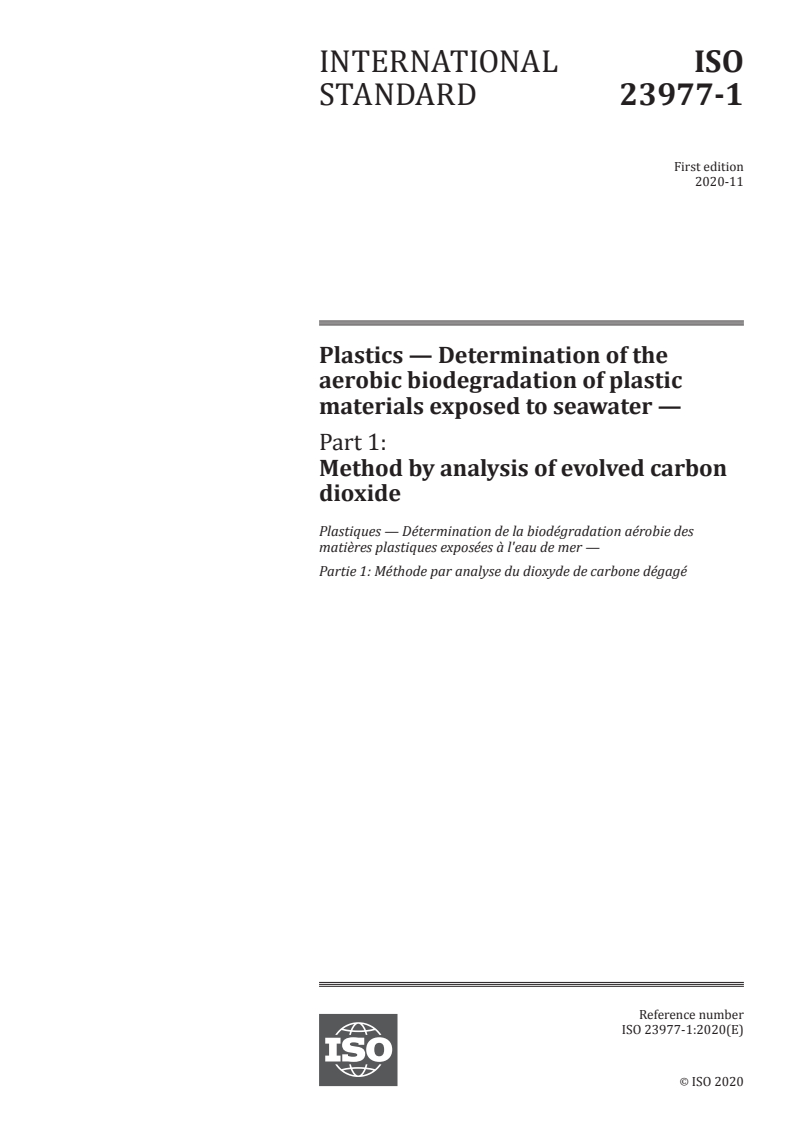
INTERNATIONAL ISO
STANDARD 23977-1
First edition
2020-11
Plastics — Determination of the
aerobic biodegradation of plastic
materials exposed to seawater —
Part 1:
Method by analysis of evolved carbon
dioxide
Plastiques — Détermination de la biodégradation aérobie des
matières plastiques exposées à l'eau de mer —
Partie 1: Méthode par analyse du dioxyde de carbone dégagé
Reference number
©
ISO 2020
© ISO 2020
All rights reserved. Unless otherwise specified, or required in the context of its implementation, no part of this publication may
be reproduced or utilized otherwise in any form or by any means, electronic or mechanical, including photocopying, or posting
on the internet or an intranet, without prior written permission. Permission can be requested from either ISO at the address
below or ISO’s member body in the country of the requester.
ISO copyright office
CP 401 • Ch. de Blandonnet 8
CH-1214 Vernier, Geneva
Phone: +41 22 749 01 11
Email: copyright@iso.org
Website: www.iso.org
Published in Switzerland
ii © ISO 2020 – All rights reserved
Contents Page
Foreword .iv
Introduction .v
1 Scope . 1
2 Normative references . 1
3 Terms and definitions . 1
4 Principle . 3
5 Test environment . 3
6 Reagents . 3
7 Apparatus . 4
8 Procedure. 5
8.1 Test material . 5
8.2 Reference materials . 5
8.3 Test set up . 6
8.4 Pre-conditioning phase . 6
8.5 Start of the test . 6
8.6 Carbon dioxide measurement . 7
8.7 End of the test . 7
9 Calculation and expression of results . 8
9.1 Calculation . 8
9.1.1 Amount of CO produced . 8
9.1.2 Percentage of biodegradation.10
9.2 Visual inspection .11
9.3 Expression and interpretation of results .11
10 Validity of results .11
11 Test report .12
Annex A (informative) Example of a respirometric system .13
Bibliography .15
Foreword
ISO (the International Organization for Standardization) is a worldwide federation of national standards
bodies (ISO member bodies). The work of preparing International Standards is normally carried out
through ISO technical committees. Each member body interested in a subject for which a technical
committee has been established has the right to be represented on that committee. International
organizations, governmental and non-governmental, in liaison with ISO, also take part in the work.
ISO collaborates closely with the International Electrotechnical Commission (IEC) on all matters of
electrotechnical standardization.
The procedures used to develop this document and those intended for its further maintenance are
described in the ISO/IEC Directives, Part 1. In particular, the different approval criteria needed for the
different types of ISO documents should be noted. This document was drafted in accordance with the
editorial rules of the ISO/IEC Directives, Part 2 (see www .iso .org/ directives).
Attention is drawn to the possibility that some of the elements of this document may be the subject of
patent rights. ISO shall not be held responsible for identifying any or all such patent rights. Details of
any patent rights identified during the development of the document will be in the Introduction and/or
on the ISO list of patent declarations received (see www .iso .org/ patents).
Any trade name used in this document is information given for the convenience of users and does not
constitute an endorsement.
For an explanation of the voluntary nature of standards, the meaning of ISO specific terms and
expressions related to conformity assessment, as well as information about ISO's adherence to
the World Trade Organization (WTO) principles in the Technical Barriers to Trade (TBT), see
www .iso .org/ iso/ foreword .html.
This document was prepared by Technical Committee ISO/TC 61, Plastics, Subcommittee SC 14,
Environmental aspects.
A list of all parts in the ISO 23997 series can be found on the ISO website.
Any feedback or questions on this document should be directed to the user’s national standards body. A
complete listing of these bodies can be found at www .iso .org/ members .html.
iv © ISO 2020 – All rights reserved
Introduction
According to the United Nations Environment Program (UNEP), one of the most notable properties of
synthetic polymers and plastics is their durability which, combined with their accidental loss, deliberate
release and poor waste management has resulted in the ubiquitous presence of plastic in oceans (UNEP,
[16]
2015 ).
It is well known and documented that marine litter can pose risks and a negative impact on living
marine organisms and on human beings. Degradability of plastic materials exposed to the marine
environment is one of the factors affecting impact and strength of effects. The uncontrolled dispersion
of biodegradables plastics in natural environments is not desirable. The biodegradability of products
cannot be considered as an excuse to spread wastes that should be recovered and recycled. However,
test methods to measure rate and level of biodegradation in natural environments are of interest in
order to better characterize the behaviour of plastics in these very particular environments. Thus, the
degree and rate of biodegradation is of major interest in order to obtain an indication of the potential
biodegradability of plastic materials when exposed to different marine habitats.
ISO/TC 61/SC 14 has established several test methods for biodegradation testing of plastic materials
under laboratory conditions covering different environmental compartments and test conditions, as
shown in Table 1.
Table 1 — Test methods for biodegradation testing of plastics
Conditions
Test methods
Environmental compartment Presence/absence of oxygen
ISO 14855-1
Controlled composting conditions Aerobic conditions
ISO 14855-2
High-solids anaerobic-digestion
Anaerobic conditions ISO 15985
conditions
Controlled anaerobic slurry system Anaerobic conditions ISO 13975
Soil Aerobic conditions ISO 17556
ISO 14851
Aerobic conditions
Aqueous medium ISO 14852
Anaerobic conditions ISO 14853
a
ISO 18830
Seawater/sandy sediment interface Aerobic conditions
a
ISO 19679
a
Marine sediment Aerobic conditions ISO 22404
a
ISO 23977-1
Seawater Aerobic conditions
a
ISO 23977-2
a
Test method for measuring biodegradation of plastic materials when exposed to marine microbes.
All marine biodegradation test methods are based on exposure of plastic materials to marine samples
(seawater and/or sediment) taken from shoreline areas. By a quantitative viewpoint, these methods
are not equivalent, because, for example, the microbial density in seawater is generally lower compared
to the density determined in sediment. In addition, the microbial composition and diversity can be
different. Moreover, as a rule, the nutrient concentration found in sediment is normally higher compared
to the concentration in seawater.
This document provides a test method for determining the biodegradation level of plastic materials
exposed to the microbial population present in seawater from a pelagic zone under laboratory
conditions. The biodegradation is followed by measuring the evolved CO .
The test is performed with either seawater only (“pelagic seawater test”) or with seawater to which
little sediment was added (“suspended sediment seawater test”).
The pelagic seawater test simulates the conditions found in offshore areas with low water currents and
low tidal movements, whereas the suspended sediment seawater test simulates conditions which might
be found in coastal areas with stronger water currents and tidal movements.
vi © ISO 2020 – All rights reserved
INTERNATIONAL STANDARD ISO 23977-1:2020(E)
Plastics — Determination of the aerobic biodegradation of
plastic materials exposed to seawater —
Part 1:
Method by analysis of evolved carbon dioxide
1 Scope
This document specifies a laboratory test method for determining the degree and rate of the aerobic
biodegradation level of plastic materials. Biodegradation is determined by measuring the CO evolved
from plastic materials when exposed to seawater sampled from coastal areas under laboratory
conditions.
The conditions described in this document might not always correspond to the optimum conditions for
the maximum degree of biodegradation, however this test method is designed to give an indication of
the potential biodegradability of plastic materials.
NOTE This document addresses plastic materials but can also be used for other materials.
2 Normative references
The following documents are referred to in the text in such a way that some or all of their content
constitutes requirements of this document. For dated references, only the edition cited applies. For
undated references, the latest edition of the referenced document (including any amendments) applies.
ISO 5667-3, Water quality — Sampling — Part 3: Preservation and handling of water samples
ISO 8245, Water quality — Guidelines for the determination of total organic carbon (TOC) and dissolved
organic carbon (DOC)
ISO 10210, Plastics — Methods for the preparation of samples for biodegradation testing of plastic
materials
ISO 10523, Water quality — Determination of pH
ISO 11261, Soil quality — Determination of total nitrogen — Modified Kjeldahl method
3 Terms and definitions
For the purposes of this document, the following terms and definitions apply.
ISO and IEC maintain terminological databases for use in standardization at the following addresses:
— ISO Online browsing platform: available at https:// www .iso .org/ obp
— IEC Electropedia: available at http:// www .electropedia .org/
3.1
pelagic zone
water body above the seafloor
Note 1 to entry: It is also referred to as the open water or the water column.
Note 2 to entry: The surface of the pelagic zone is moved by wind-driven waves, is in contact with the atmosphere
and exposed to sunlight. With increasing depth pressure increases, temperature decreases, and light and surface
wave energy are attenuated.
[SOURCE: ISO 22766:2020, 3.4]
3.2
dissolved inorganic carbon
DIC
part of the inorganic carbon in water which cannot be removed by specified phase separation
−2
Note 1 to entry: Phase separation can be achieved for example by centrifugation at 40 000 m⋅s for 15 min or by
membrane filtration using membranes with pores of 0,2 μm to 0,45 μm diameter.
[SOURCE: ISO 14852:—, 3.4]
3.3
theoretical amount of evolved carbon dioxide
ThCO
maximum theoretical amount of carbon dioxide evolved after completely oxidizing a chemical
compound, calculated from the molecular formula
Note 1 to entry: It is expressed as milligrams of carbon dioxide evolved per milligram or gram of test compound.
[SOURCE: ISO 14852:—, 3.5]
3.4
total organic carbon
TOC
amount of carbon bound in an organic compound
Note 1 to entry: It is expressed as milligrams of carbon per 100 mg of the compound.
[SOURCE: ISO 17556:2019, 3.14]
3.5
dissolved organic carbon
DOC
part of the organic carbon in water which cannot be removed by specified phase separation
−2
Note 1 to entry: Phase separation can be achieved for example by centrifugation at 40 000 m⋅s for 15 min or by
membrane filtration using membranes with pores of 0,2 μm to 0,45 μm diameter.
[SOURCE: ISO 14852:—, 3.7]
3.6
lag phase
time from the start of a test until adaptation and/or selection of the degrading microorganisms is
achieved and the degree of biodegradation of a chemical compound or organic matter has increased to
about 10 % of the maximum level of biodegradation (3.8)
Note 1 to entry: It is measured in days.
[SOURCE: ISO 14852:—, 3.8]
3.7
biodegradation phase
time from the end of the lag phase (3.6) of a test until the plateau phase has been reached
Note 1 to entry: It is measured in days.
[SOURCE: ISO 14852:—, 3.10]
2 © ISO 2020 – All rights reserved
3.8
maximum level of biodegradation
degree of biodegradation of a chemical compound or organic matter in a test, above which no further
biodegradation takes place during the test
Note 1 to entry: It is measured in per cent.
[SOURCE: ISO 14852:—, 3.9]
3.9
plateau phase
time from the end of the biodegradation phase (3.7) until the end of a test
Note 1 to entry: It is measured in days.
[SOURCE: ISO 14852:—, 3.11]
3.10
pre-conditioning
pre-incubation of an inoculum under the conditions of the subsequent test in the absence of the chemical
compound or organic matter under test, with the aim of improving the test by acclimatization of the
microorganisms to the test conditions
[SOURCE: ISO 14852:—, 3.13]
4 Principle
This document describes two variations of a test method for determining the biodegradability of plastic
materials by the indigenous population of microorganisms in natural seawater using a static aqueous
test system. The test is performed under mesophilic test conditions for up to two years by incubating
plastic materials with either seawater only (“pelagic seawater test”) or with seawater to which low
amount of sediment has been added (“suspended sediment seawater test”), coming from the same site
as that from which the seawater was taken.
Biodegradation is followed by measuring the evolution of carbon dioxide using a suitable, analytical
method. The level of biodegradation is determined by comparing the amount of carbon dioxide evolved
with the theoretical amount [theoretical amount of evolved carbon dioxide (ThCO )] and expressed in
percentage. The test result is the maximum level of biodegradation, determined from the plateau phase
of the biodegradation curve. The principle of a system for measuring evolved carbon dioxide is given in
ISO 14852:—, Annex A.
5 Test environment
Incubation shall take place in the dark or in diffused light, in an enclosure which is free from vapours
inhibitory to marine microorganisms and which is maintained at a constant mesophilic temperature.
It should preferably be between 15 °C to 25 °C, but not exceeding 28 °C, to an accuracy of ±1 °C. Any
change in temperature shall be justified and clearly indicated in the test report.
NOTE Test results are obtained for temperatures that can be different from real conditions in marine
environment.
6 Reagents
Use only reagents of recognized analytical grade.
6.1 Water
Distilled or deionized water, free of toxic substances (copper in particular) and containing less than
2 mg/l of TOC.
6.2 Natural seawater/sediment
Sampling, preservation, handling, transport and storage of natural seawater, and, if applicable,
sediment collected from the same site as that from which the seawater is taken, shall be in accordance
with ISO 5667-3.
Prior to use, remove coarse particles from the seawater and, if applicable, from the sediment by
appropriate means. The procedure used shall be reported.
Seawater can be filtered using a paper filter in order to remove coarse particles. It is recommended to
reduce the amount of coarse particles in sediment by means of at least two washing steps using filtered
seawater without coarse particles.
Measure TOC, pH and nitrogen content of seawater and, if applicable, of sediment samples according to
ISO 8245, ISO 10523 and ISO 11261, respectively.
If the TOC content of the seawater sample is found to be high, the seawater should be pre-conditioned
for about a week prior to use. If, for instance, the background concentration of TOC exceeds about 20 %
of the total TOC after addition of the test item, then pre-condition the seawater and, if applicable, the
sediment by stirring under aerobic conditions at the test temperature and in the dark or in diffuse light
in order to reduce the content of easily degradable organic material.
Provide the following information on the seawater, and, if applicable, on the sediment sample itself:
— date of collection;
— depth of collection (m);
— appearance of sample - turbid, clear, etc.;
— temperature at the time of collection (°C);
— salinity (PSU);
— total organic carbon (TOC; mg/l);
— nitrogen (total-N; mg/l);
— pH;
— description of the pre-conditioning process, if applicable.
7 Apparatus
Ensure that all glassware is thoroughly cleaned and, in particular, free from organic or toxic matter.
Required is usual laboratory equipment, plus the following.
7.1 Test flasks. Biometric flasks of the volume of about 300 ml are appropriate. The vessels shall be
located in a constant temperature room or in an apparatus fitted with a thermostat (e.g. water-bath).
Reactors with higher or lower volumes can be used, if environmental conditions are not affected.
7.2 Container for the CO absorber, (e.g. glass beaker) to be located in the headspace of a test flask
and filled with 10 ml of Ba(OH) 0,012 5 mol/l or 3 ml of KOH 0,5 mol/l.
As an alternative to Ba(OH) and KOH 4 ml of NaOH 1 mol/l can be used as a CO -absorber.
2 2
A suitable apparatus is shown in Annex A, Figure A.1.
4 © ISO 2020 – All rights reserved
7.3 Analytical equipment for determining carbon dioxide, consisting of any suitable apparatus
with sufficient accuracy, such as a CO or dissolved inorganic carbon (DIC) analyser or apparatus for
titrimetric determination after complete absorption in a basic solution, shall be used.
7.4 Analytical balance, which shall have a sensitivity of at least 0,1 mg.
7.5 Magnetic stirrer.
7.6 pH meter.
8 Procedure
8.1 Test material
The sample shall be of known mass and contain enough carbon to yield CO that can be adequately
measured by the chosen system. Use a test material concentration of at least 100 mg per litre of seawater.
This mass of the sample should correspond to TOC of about 60 mg/l. The maximum mass of sample per
flask is limited by the oxygen supply in the glass flask. The recommended amount per litre seawater
is 150 mg to 300 mg of test material per litre seawater. Calculate the TOC from the chemical formula
or determine it by means of a suitable analytical technique (e.g. elemental analysis or measurement in
accordance with ISO 8245) and calculate the ThCO .
The test material is added to a test flask, either as powder or in the form of a film. If the test material
is used in the form of powder, particles of known, narrow size distribution should be used. A particle-
size distribution with a maximum diameter of 250 µm is recommended. The preparation of powder
shall be performed in accordance with ISO 10210. If the test material is used in the form of a film, it
can be added either as pieces in the range of 0,2 cm × 0,2 cm to 0,5 cm × 0,5 cm or as a single plastic
strip (width: approximately 1,0 cm, length: depending on weight of the polymer and thickness of the
film). It is recommended that the plastic strip is fixed in, for example, a Polytetrafluoroethylene (PTFE)
1)
coated fibre ne
...
INTERNATIONAL ISO
STANDARD 23977-1
First edition
2020-11
Plastics — Determination of the
aerobic biodegradation of plastic
materials exposed to seawater —
Part 1:
Method by analysis of evolved carbon
dioxide
Plastiques — Détermination de la biodégradation aérobie des
matières plastiques exposées à l'eau de mer —
Partie 1: Méthode par analyse du dioxyde de carbone dégagé
Reference number
©
ISO 2020
© ISO 2020
All rights reserved. Unless otherwise specified, or required in the context of its implementation, no part of this publication may
be reproduced or utilized otherwise in any form or by any means, electronic or mechanical, including photocopying, or posting
on the internet or an intranet, without prior written permission. Permission can be requested from either ISO at the address
below or ISO’s member body in the country of the requester.
ISO copyright office
CP 401 • Ch. de Blandonnet 8
CH-1214 Vernier, Geneva
Phone: +41 22 749 01 11
Email: copyright@iso.org
Website: www.iso.org
Published in Switzerland
ii © ISO 2020 – All rights reserved
Contents Page
Foreword .iv
Introduction .v
1 Scope . 1
2 Normative references . 1
3 Terms and definitions . 1
4 Principle . 3
5 Test environment . 3
6 Reagents . 3
7 Apparatus . 4
8 Procedure. 5
8.1 Test material . 5
8.2 Reference materials . 5
8.3 Test set up . 6
8.4 Pre-conditioning phase . 6
8.5 Start of the test . 6
8.6 Carbon dioxide measurement . 7
8.7 End of the test . 7
9 Calculation and expression of results . 8
9.1 Calculation . 8
9.1.1 Amount of CO produced . 8
9.1.2 Percentage of biodegradation.10
9.2 Visual inspection .11
9.3 Expression and interpretation of results .11
10 Validity of results .11
11 Test report .12
Annex A (informative) Example of a respirometric system .13
Bibliography .15
Foreword
ISO (the International Organization for Standardization) is a worldwide federation of national standards
bodies (ISO member bodies). The work of preparing International Standards is normally carried out
through ISO technical committees. Each member body interested in a subject for which a technical
committee has been established has the right to be represented on that committee. International
organizations, governmental and non-governmental, in liaison with ISO, also take part in the work.
ISO collaborates closely with the International Electrotechnical Commission (IEC) on all matters of
electrotechnical standardization.
The procedures used to develop this document and those intended for its further maintenance are
described in the ISO/IEC Directives, Part 1. In particular, the different approval criteria needed for the
different types of ISO documents should be noted. This document was drafted in accordance with the
editorial rules of the ISO/IEC Directives, Part 2 (see www .iso .org/ directives).
Attention is drawn to the possibility that some of the elements of this document may be the subject of
patent rights. ISO shall not be held responsible for identifying any or all such patent rights. Details of
any patent rights identified during the development of the document will be in the Introduction and/or
on the ISO list of patent declarations received (see www .iso .org/ patents).
Any trade name used in this document is information given for the convenience of users and does not
constitute an endorsement.
For an explanation of the voluntary nature of standards, the meaning of ISO specific terms and
expressions related to conformity assessment, as well as information about ISO's adherence to
the World Trade Organization (WTO) principles in the Technical Barriers to Trade (TBT), see
www .iso .org/ iso/ foreword .html.
This document was prepared by Technical Committee ISO/TC 61, Plastics, Subcommittee SC 14,
Environmental aspects.
A list of all parts in the ISO 23997 series can be found on the ISO website.
Any feedback or questions on this document should be directed to the user’s national standards body. A
complete listing of these bodies can be found at www .iso .org/ members .html.
iv © ISO 2020 – All rights reserved
Introduction
According to the United Nations Environment Program (UNEP), one of the most notable properties of
synthetic polymers and plastics is their durability which, combined with their accidental loss, deliberate
release and poor waste management has resulted in the ubiquitous presence of plastic in oceans (UNEP,
[16]
2015 ).
It is well known and documented that marine litter can pose risks and a negative impact on living
marine organisms and on human beings. Degradability of plastic materials exposed to the marine
environment is one of the factors affecting impact and strength of effects. The uncontrolled dispersion
of biodegradables plastics in natural environments is not desirable. The biodegradability of products
cannot be considered as an excuse to spread wastes that should be recovered and recycled. However,
test methods to measure rate and level of biodegradation in natural environments are of interest in
order to better characterize the behaviour of plastics in these very particular environments. Thus, the
degree and rate of biodegradation is of major interest in order to obtain an indication of the potential
biodegradability of plastic materials when exposed to different marine habitats.
ISO/TC 61/SC 14 has established several test methods for biodegradation testing of plastic materials
under laboratory conditions covering different environmental compartments and test conditions, as
shown in Table 1.
Table 1 — Test methods for biodegradation testing of plastics
Conditions
Test methods
Environmental compartment Presence/absence of oxygen
ISO 14855-1
Controlled composting conditions Aerobic conditions
ISO 14855-2
High-solids anaerobic-digestion
Anaerobic conditions ISO 15985
conditions
Controlled anaerobic slurry system Anaerobic conditions ISO 13975
Soil Aerobic conditions ISO 17556
ISO 14851
Aerobic conditions
Aqueous medium ISO 14852
Anaerobic conditions ISO 14853
a
ISO 18830
Seawater/sandy sediment interface Aerobic conditions
a
ISO 19679
a
Marine sediment Aerobic conditions ISO 22404
a
ISO 23977-1
Seawater Aerobic conditions
a
ISO 23977-2
a
Test method for measuring biodegradation of plastic materials when exposed to marine microbes.
All marine biodegradation test methods are based on exposure of plastic materials to marine samples
(seawater and/or sediment) taken from shoreline areas. By a quantitative viewpoint, these methods
are not equivalent, because, for example, the microbial density in seawater is generally lower compared
to the density determined in sediment. In addition, the microbial composition and diversity can be
different. Moreover, as a rule, the nutrient concentration found in sediment is normally higher compared
to the concentration in seawater.
This document provides a test method for determining the biodegradation level of plastic materials
exposed to the microbial population present in seawater from a pelagic zone under laboratory
conditions. The biodegradation is followed by measuring the evolved CO .
The test is performed with either seawater only (“pelagic seawater test”) or with seawater to which
little sediment was added (“suspended sediment seawater test”).
The pelagic seawater test simulates the conditions found in offshore areas with low water currents and
low tidal movements, whereas the suspended sediment seawater test simulates conditions which might
be found in coastal areas with stronger water currents and tidal movements.
vi © ISO 2020 – All rights reserved
INTERNATIONAL STANDARD ISO 23977-1:2020(E)
Plastics — Determination of the aerobic biodegradation of
plastic materials exposed to seawater —
Part 1:
Method by analysis of evolved carbon dioxide
1 Scope
This document specifies a laboratory test method for determining the degree and rate of the aerobic
biodegradation level of plastic materials. Biodegradation is determined by measuring the CO evolved
from plastic materials when exposed to seawater sampled from coastal areas under laboratory
conditions.
The conditions described in this document might not always correspond to the optimum conditions for
the maximum degree of biodegradation, however this test method is designed to give an indication of
the potential biodegradability of plastic materials.
NOTE This document addresses plastic materials but can also be used for other materials.
2 Normative references
The following documents are referred to in the text in such a way that some or all of their content
constitutes requirements of this document. For dated references, only the edition cited applies. For
undated references, the latest edition of the referenced document (including any amendments) applies.
ISO 5667-3, Water quality — Sampling — Part 3: Preservation and handling of water samples
ISO 8245, Water quality — Guidelines for the determination of total organic carbon (TOC) and dissolved
organic carbon (DOC)
ISO 10210, Plastics — Methods for the preparation of samples for biodegradation testing of plastic
materials
ISO 10523, Water quality — Determination of pH
ISO 11261, Soil quality — Determination of total nitrogen — Modified Kjeldahl method
3 Terms and definitions
For the purposes of this document, the following terms and definitions apply.
ISO and IEC maintain terminological databases for use in standardization at the following addresses:
— ISO Online browsing platform: available at https:// www .iso .org/ obp
— IEC Electropedia: available at http:// www .electropedia .org/
3.1
pelagic zone
water body above the seafloor
Note 1 to entry: It is also referred to as the open water or the water column.
Note 2 to entry: The surface of the pelagic zone is moved by wind-driven waves, is in contact with the atmosphere
and exposed to sunlight. With increasing depth pressure increases, temperature decreases, and light and surface
wave energy are attenuated.
[SOURCE: ISO 22766:2020, 3.4]
3.2
dissolved inorganic carbon
DIC
part of the inorganic carbon in water which cannot be removed by specified phase separation
−2
Note 1 to entry: Phase separation can be achieved for example by centrifugation at 40 000 m⋅s for 15 min or by
membrane filtration using membranes with pores of 0,2 μm to 0,45 μm diameter.
[SOURCE: ISO 14852:—, 3.4]
3.3
theoretical amount of evolved carbon dioxide
ThCO
maximum theoretical amount of carbon dioxide evolved after completely oxidizing a chemical
compound, calculated from the molecular formula
Note 1 to entry: It is expressed as milligrams of carbon dioxide evolved per milligram or gram of test compound.
[SOURCE: ISO 14852:—, 3.5]
3.4
total organic carbon
TOC
amount of carbon bound in an organic compound
Note 1 to entry: It is expressed as milligrams of carbon per 100 mg of the compound.
[SOURCE: ISO 17556:2019, 3.14]
3.5
dissolved organic carbon
DOC
part of the organic carbon in water which cannot be removed by specified phase separation
−2
Note 1 to entry: Phase separation can be achieved for example by centrifugation at 40 000 m⋅s for 15 min or by
membrane filtration using membranes with pores of 0,2 μm to 0,45 μm diameter.
[SOURCE: ISO 14852:—, 3.7]
3.6
lag phase
time from the start of a test until adaptation and/or selection of the degrading microorganisms is
achieved and the degree of biodegradation of a chemical compound or organic matter has increased to
about 10 % of the maximum level of biodegradation (3.8)
Note 1 to entry: It is measured in days.
[SOURCE: ISO 14852:—, 3.8]
3.7
biodegradation phase
time from the end of the lag phase (3.6) of a test until the plateau phase has been reached
Note 1 to entry: It is measured in days.
[SOURCE: ISO 14852:—, 3.10]
2 © ISO 2020 – All rights reserved
3.8
maximum level of biodegradation
degree of biodegradation of a chemical compound or organic matter in a test, above which no further
biodegradation takes place during the test
Note 1 to entry: It is measured in per cent.
[SOURCE: ISO 14852:—, 3.9]
3.9
plateau phase
time from the end of the biodegradation phase (3.7) until the end of a test
Note 1 to entry: It is measured in days.
[SOURCE: ISO 14852:—, 3.11]
3.10
pre-conditioning
pre-incubation of an inoculum under the conditions of the subsequent test in the absence of the chemical
compound or organic matter under test, with the aim of improving the test by acclimatization of the
microorganisms to the test conditions
[SOURCE: ISO 14852:—, 3.13]
4 Principle
This document describes two variations of a test method for determining the biodegradability of plastic
materials by the indigenous population of microorganisms in natural seawater using a static aqueous
test system. The test is performed under mesophilic test conditions for up to two years by incubating
plastic materials with either seawater only (“pelagic seawater test”) or with seawater to which low
amount of sediment has been added (“suspended sediment seawater test”), coming from the same site
as that from which the seawater was taken.
Biodegradation is followed by measuring the evolution of carbon dioxide using a suitable, analytical
method. The level of biodegradation is determined by comparing the amount of carbon dioxide evolved
with the theoretical amount [theoretical amount of evolved carbon dioxide (ThCO )] and expressed in
percentage. The test result is the maximum level of biodegradation, determined from the plateau phase
of the biodegradation curve. The principle of a system for measuring evolved carbon dioxide is given in
ISO 14852:—, Annex A.
5 Test environment
Incubation shall take place in the dark or in diffused light, in an enclosure which is free from vapours
inhibitory to marine microorganisms and which is maintained at a constant mesophilic temperature.
It should preferably be between 15 °C to 25 °C, but not exceeding 28 °C, to an accuracy of ±1 °C. Any
change in temperature shall be justified and clearly indicated in the test report.
NOTE Test results are obtained for temperatures that can be different from real conditions in marine
environment.
6 Reagents
Use only reagents of recognized analytical grade.
6.1 Water
Distilled or deionized water, free of toxic substances (copper in particular) and containing less than
2 mg/l of TOC.
6.2 Natural seawater/sediment
Sampling, preservation, handling, transport and storage of natural seawater, and, if applicable,
sediment collected from the same site as that from which the seawater is taken, shall be in accordance
with ISO 5667-3.
Prior to use, remove coarse particles from the seawater and, if applicable, from the sediment by
appropriate means. The procedure used shall be reported.
Seawater can be filtered using a paper filter in order to remove coarse particles. It is recommended to
reduce the amount of coarse particles in sediment by means of at least two washing steps using filtered
seawater without coarse particles.
Measure TOC, pH and nitrogen content of seawater and, if applicable, of sediment samples according to
ISO 8245, ISO 10523 and ISO 11261, respectively.
If the TOC content of the seawater sample is found to be high, the seawater should be pre-conditioned
for about a week prior to use. If, for instance, the background concentration of TOC exceeds about 20 %
of the total TOC after addition of the test item, then pre-condition the seawater and, if applicable, the
sediment by stirring under aerobic conditions at the test temperature and in the dark or in diffuse light
in order to reduce the content of easily degradable organic material.
Provide the following information on the seawater, and, if applicable, on the sediment sample itself:
— date of collection;
— depth of collection (m);
— appearance of sample - turbid, clear, etc.;
— temperature at the time of collection (°C);
— salinity (PSU);
— total organic carbon (TOC; mg/l);
— nitrogen (total-N; mg/l);
— pH;
— description of the pre-conditioning process, if applicable.
7 Apparatus
Ensure that all glassware is thoroughly cleaned and, in particular, free from organic or toxic matter.
Required is usual laboratory equipment, plus the following.
7.1 Test flasks. Biometric flasks of the volume of about 300 ml are appropriate. The vessels shall be
located in a constant temperature room or in an apparatus fitted with a thermostat (e.g. water-bath).
Reactors with higher or lower volumes can be used, if environmental conditions are not affected.
7.2 Container for the CO absorber, (e.g. glass beaker) to be located in the headspace of a test flask
and filled with 10 ml of Ba(OH) 0,012 5 mol/l or 3 ml of KOH 0,5 mol/l.
As an alternative to Ba(OH) and KOH 4 ml of NaOH 1 mol/l can be used as a CO -absorber.
2 2
A suitable apparatus is shown in Annex A, Figure A.1.
4 © ISO 2020 – All rights reserved
7.3 Analytical equipment for determining carbon dioxide, consisting of any suitable apparatus
with sufficient accuracy, such as a CO or dissolved inorganic carbon (DIC) analyser or apparatus for
titrimetric determination after complete absorption in a basic solution, shall be used.
7.4 Analytical balance, which shall have a sensitivity of at least 0,1 mg.
7.5 Magnetic stirrer.
7.6 pH meter.
8 Procedure
8.1 Test material
The sample shall be of known mass and contain enough carbon to yield CO that can be adequately
measured by the chosen system. Use a test material concentration of at least 100 mg per litre of seawater.
This mass of the sample should correspond to TOC of about 60 mg/l. The maximum mass of sample per
flask is limited by the oxygen supply in the glass flask. The recommended amount per litre seawater
is 150 mg to 300 mg of test material per litre seawater. Calculate the TOC from the chemical formula
or determine it by means of a suitable analytical technique (e.g. elemental analysis or measurement in
accordance with ISO 8245) and calculate the ThCO .
The test material is added to a test flask, either as powder or in the form of a film. If the test material
is used in the form of powder, particles of known, narrow size distribution should be used. A particle-
size distribution with a maximum diameter of 250 µm is recommended. The preparation of powder
shall be performed in accordance with ISO 10210. If the test material is used in the form of a film, it
can be added either as pieces in the range of 0,2 cm × 0,2 cm to 0,5 cm × 0,5 cm or as a single plastic
strip (width: approximately 1,0 cm, length: depending on weight of the polymer and thickness of the
film). It is recommended that the plastic strip is fixed in, for example, a Polytetrafluoroethylene (PTFE)
1)
coated fibre ne
...
NORME ISO
INTERNATIONALE 23977-1
Première édition
2020-11
Plastiques — Détermination de la
biodégradation aérobie des matériaux
plastiques exposés à l'eau de mer —
Partie 1:
Méthode par analyse du dioxyde de
carbone libéré
Plastics — Determination of the aerobic biodegradation of plastic
materials exposed to seawater —
Part 1: Method by analysis of evolved carbon dioxide
Numéro de référence
DOCUMENT PROTÉGÉ PAR COPYRIGHT
© ISO 2020
Tous droits réservés. Sauf prescription différente ou nécessité dans le contexte de sa mise en œuvre, aucune partie de cette
publication ne peut être reproduite ni utilisée sous quelque forme que ce soit et par aucun procédé, électronique ou mécanique,
y compris la photocopie, ou la diffusion sur l’internet ou sur un intranet, sans autorisation écrite préalable. Une autorisation peut
être demandée à l’ISO à l’adresse ci-après ou au comité membre de l’ISO dans le pays du demandeur.
ISO copyright office
Case postale 401 • Ch. de Blandonnet 8
CH-1214 Vernier, Genève
Tél.: +41 22 749 01 11
E-mail: copyright@iso.org
Web: www.iso.org
Publié en Suisse
ii
Sommaire Page
Avant-propos .iv
Introduction .v
1 Domaine d’application . 1
2 Références normatives .1
3 Termes et définitions . 1
4 Principe. 3
5 Environnement d’essai .3
6 Réactifs . 4
7 Appareillage . 5
8 Mode opératoire . 5
8.1 Matériau d’essai . 5
8.2 Matériaux de référence . 6
8.3 Configuration d’essai . 6
8.4 Phase de préconditionnement . 6
8.5 Début de l’essai . 7
8.6 Mesurage du dioxyde de carbone . 8
8.7 Fin de l’essai . 8
9 Calcul et expression des résultats .8
9.1 Calcul . 8
9.1.1 Quantité de CO produit . 8
9.1.2 Pourcentage de biodégradation . 11
9.2 Inspection visuelle . 11
9.3 Expression et interprétation des résultats . 11
10 Validité des résultats.12
11 Rapport d’essai .12
Annexe A (informative) Exemple de système respirométrique .14
Bibliographie .16
iii
Avant-propos
L’ISO (Organisation internationale de normalisation) est une fédération mondiale d’organismes
nationaux de normalisation (comités membres de l’ISO). L’élaboration des Normes internationales est
en général confiée aux comités techniques de l’ISO. Chaque comité membre intéressé par une étude
a le droit de faire partie du comité technique créé à cet effet. Les organisations internationales,
gouvernementales et non gouvernementales, en liaison avec l’ISO participent également aux travaux.
L’ISO collabore étroitement avec la Commission électrotechnique internationale (IEC) en ce qui
concerne la normalisation électrotechnique.
Les procédures utilisées pour élaborer le présent document et celles destinées à sa mise à jour sont
décrites dans les Directives ISO/IEC, Partie 1. Il convient, en particulier, de prendre note des différents
critères d’approbation requis pour les différents types de documents ISO. Le présent document a été
rédigé conformément aux règles de rédaction données dans les Directives ISO/IEC, Partie 2 (voir
www.iso.org/directives).
L’attention est attirée sur le fait que certains des éléments du présent document peuvent faire l’objet de
droits de propriété intellectuelle ou de droits analogues. L’ISO ne saurait être tenue pour responsable
de ne pas avoir identifié de tels droits de propriété et averti de leur existence. Les détails concernant
les références aux droits de propriété intellectuelle ou autres droits analogues identifiés lors de
l’élaboration du document sont indiqués dans l’Introduction et/ou dans la liste des déclarations de
brevets reçues par l’ISO (voir www.iso.org/brevets).
Les appellations commerciales éventuellement mentionnées dans le présent document sont données
pour information, par souci de commodité, à l’intention des utilisateurs et ne sauraient constituer un
engagement.
Pour une explication de la nature volontaire des normes, la signification des termes et expressions
spécifiques de l’ISO liés à l’évaluation de la conformité, ou pour toute information au sujet de l’adhésion
de l’ISO aux principes de l’Organisation mondiale du commerce (OMC) concernant les obstacles
techniques au commerce (OTC), voir www.iso.org/avant-propos.
Le présent document a été élaboré par le comité technique ISO/TC 61, Plastiques, sous-comité SC 14,
Aspects liés à l’environnement.
Une liste de toutes les parties de la série ISO 23997 se trouve sur le site web de l’ISO.
Il convient que l’utilisateur adresse tout retour d’information ou toute question concernant le présent
document à l’organisme national de normalisation de son pays. Une liste exhaustive desdits organismes
se trouve à l’adresse www.iso.org/fr/members.html.
iv
Introduction
Selon le Programme des Nations Unies pour l’environnement (PNUE), l’une des propriétés les plus
notables des polymères synthétiques et des plastiques est leur durabilité qui, combinée à leur perte
accidentelle, leur déversement délibéré ou une mauvaise gestion des déchets, a conduit à l’omniprésence
[16]
des plastiques dans les océans (PNUE, 2015 ).
On sait, et cela a été documenté, que les déchets marins peuvent présenter des risques et avoir un
impact négatif sur les organismes marins vivants et les êtres humains. La dégradabilité des matériaux
plastiques exposés à l’environnement marin est l’un des facteurs ayant une incidence sur l’impact et
la force des effets. La dispersion incontrôlée des plastiques biodégradables dans les environnements
naturels n’est pas souhaitable. La biodégradabilité des produits ne peut pas être considérée comme
une excuse pour épandre des déchets qui devraient être valorisés et recyclés. Cependant, les méthodes
d’essai permettant de mesurer le taux et le niveau de biodégradation dans les environnements naturels
présentent un intérêt, car elles permettent de mieux caractériser le comportement des plastiques dans
ces environnements très particuliers. Ainsi, le taux et le niveau de biodégradation présentent un intérêt
majeur pour obtenir une indication de la biodégradabilité potentielle des matériaux plastiques lorsqu’ils
sont exposés à différents habitats marins.
L’ISO/TC 61/SC 14 a mis au point plusieurs méthodes d’essai portant sur la biodégradation des matériaux
plastiques dans des conditions de laboratoire couvrant différents compartiments environnementaux et
différentes conditions d’essai, comme indiqué dans le Tableau 1.
Tableau 1 — Méthodes d’essai sur la biodégradation des plastiques
Conditions
Méthodes d’essai
Compartiment environnemental Présence/absence d’oxygène
ISO 14855-1
Conditions de compostage contrô-
Conditions aérobies
lées
ISO 14855-2
Conditions de digestion anaérobie à
Conditions anaérobies ISO 15985
teneur élevée en solides
Système de boue anaérobie contrô- ISO 13975
Conditions anaérobies
lée
Sol Conditions aérobies ISO 17556
ISO 14851
Conditions aérobies
Milieu aqueux ISO 14852
Conditions anaérobies ISO 14853
a
ISO 18830
Interface eau de mer/sédiment
Conditions aérobies
sableux a
ISO 19679
a
Sédiment marin Conditions aérobies ISO 22404
a
ISO 23977-1
Eau de mer Conditions aérobies
a
ISO 23977-2
a
Méthode d’essai pour mesurer la biodégradation des matériaux plastiques exposés à des microbes marins.
Toutes les méthodes d’essai de biodégradation marine reposent sur une exposition des matériaux
plastiques à des échantillons marins (eau de mer et/ou sédiment) prélevés dans des zones côtières.
D’un point de vue quantitatif, ces méthodes ne sont pas équivalentes, car, par exemple, la densité
microbienne dans l’eau de mer est généralement plus faible que la densité déterminée dans le sédiment.
En outre, la composition et la diversité microbiennes peuvent être différentes. De plus, en règle générale,
la concentration en nutriments trouvée dans le sédiment est normalement plus élevée que celle dans
l’eau de mer.
Le présent document fournit une méthode d’essai permettant de déterminer le niveau de biodégradation
des matériaux plastiques exposés à la population microbienne présente dans l’eau de mer provenant
v
d’une zone pélagique, dans des conditions de laboratoire. La biodégradation est obtenue en mesurant le
CO libéré.
L’essai est réalisé uniquement avec de l’eau de mer («essai avec eau de mer pélagique») ou avec de l’eau
de mer à laquelle un peu de sédiment a été ajouté («essai avec eau de mer et sédiment en suspension»).
L’essai avec eau de mer pélagique simule les conditions présentes dans des zones au large des côtes avec
de faibles courants et de faibles mouvements de marées, tandis que l’essai avec eau de mer et sédiment
en suspension simule des conditions pouvant être présentes dans des zones côtières avec de plus forts
courants et mouvements de marées.
vi
NORME INTERNATIONALE ISO 23977-1:2020(F)
Plastiques — Détermination de la biodégradation aérobie
des matériaux plastiques exposés à l'eau de mer —
Partie 1:
Méthode par analyse du dioxyde de carbone libéré
1 Domaine d’application
Le présent document spécifie une méthode d’essai en laboratoire permettant de déterminer le taux et
le niveau de biodégradation aérobie des matériaux plastiques. La biodégradation est déterminée en
mesurant le CO libéré par des matériaux plastiques exposés à de l’eau de mer prélevée dans des zones
côtières, dans des conditions de laboratoire.
Les conditions décrites dans le présent document ne correspondent pas nécessairement aux conditions
optimales permettant d’obtenir le taux maximal de biodégradation; cependant, cette méthode d’essai
est conçue pour donner une indication de la biodégradabilité potentielle des matériaux plastiques.
NOTE Le présent document concerne les matériaux plastiques, mais il peut aussi être utilisé pour d’autres
matériaux.
2 Références normatives
Les documents suivants sont cités dans le texte de sorte qu’ils constituent, pour tout ou partie de leur
contenu, des exigences du présent document. Pour les références datées, seule l’édition citée s’applique.
Pour les références non datées, la dernière édition du document de référence s’applique (y compris les
éventuels amendements).
ISO 5667-3, Qualité de l'eau — Échantillonnage — Partie 3: Conservation et manipulation des échantillons
d'eau
ISO 8245, Qualité de l'eau — Lignes directrices pour le dosage du carbone organique total (COT) et du
carbone organique dissous (COD)
ISO 10210, Plastiques — Méthodes de préparation des échantillons pour les essais de biodégradation des
matériaux plastiques
ISO 10523, Qualité de l'eau — Détermination du pH
ISO 11261, Qualité du sol — Dosage de l'azote total — Méthode de Kjeldahl modifiée
3 Termes et définitions
Pour les besoins du présent document, les termes et définitions suivants s’appliquent.
L’ISO et l’IEC tiennent à jour des bases de données terminologiques destinées à être utilisées en
normalisation, consultables aux adresses suivantes:
— ISO Online browsing platform: disponible à l’adresse https:// www .iso .org/ obp
— IEC Electropedia: disponible à l’adresse https:// www .electropedia .org/
3.1
zone pélagique
masse d’eau au-dessus du fond océanique
Note 1 à l'article: Est aussi appelée eau libre ou colonne d’eau.
Note 2 à l'article: La surface de la zone pélagique est mue par des vagues poussées par le vent, est en contact avec
l’atmosphère et est exposée aux rayons du soleil. Au fur et mesure que la pression augmente en profondeur, la
température diminue et la lumière et l’énergie des vagues en surface sont atténuées.
[SOURCE: ISO 22766:2020, 3.4]
3.2
carbone inorganique dissous
CID
proportion du carbone inorganique contenu dans l’eau qui ne peut pas être éliminée par une séparation
de phase spécifique
−2
Note 1 à l'article: La séparation de phase peut être obtenue par exemple par centrifugation à 40 000 m⋅s pendant
15 min ou par une filtration sur membrane au moyen de membranes ayant des pores de 0,2 µm à 0,45 µm de
diamètre.
[SOURCE: ISO 14852:—, 3.4]
3.3
quantité théorique de dioxyde de carbone libéré
ThCO
quantité théorique maximale de dioxyde de carbone libéré après l’oxydation complète d’un composé
chimique, calculée d’après la formule moléculaire
Note 1 à l'article: Elle est exprimée en milligrammes de dioxyde de carbone libéré par milligramme ou par
gramme de composé soumis à essai.
[SOURCE: ISO 14852:—, 3.5]
3.4
carbone organique total
COT
quantité de carbone incluse dans un composé organique
Note 1 à l'article: Il est exprimé en milligrammes de carbone par 100 mg de composé.
[SOURCE: ISO 17556:2019, 3.14]
3.5
carbone organique dissous
COD
proportion du carbone organique contenu dans l’eau qui ne peut pas être éliminée par une séparation
de phase spécifique
−2
Note 1 à l'article: La séparation de phase peut être obtenue par exemple par centrifugation à 40 000 m⋅s pendant
15 min ou par une filtration sur membrane au moyen de membranes ayant des pores de 0,2 µm à 0,45 µm de
diamètre.
[SOURCE: ISO 14852:—, 3.7]
3.6
phase de latence
durée écoulée à partir du début de l’essai jusqu’à l’obtention de l’adaptation et/ou de la sélection des
micro-organismes qui provoquent la dégradation, et jusqu’à ce que le taux de biodégradation du composé
chimique ou de la matière organique ait atteint environ 10 % du niveau maximal de biodégradation (3.8)
Note 1 à l'article: Elle est mesurée en jours.
[SOURCE: ISO 14852:—, 3.8]
3.7
phase de biodégradation
durée depuis la fin de la phase de latence (3.6) de l’essai jusqu’à ce que l’on ait obtenu la phase stationnaire
Note 1 à l'article: Elle est mesurée en jours.
[SOURCE: ISO 14852:—, 3.10]
3.8
niveau maximal de biodégradation
degré de biodégradation d’un composé chimique ou d’une matière organique lors d’un essai, au-dessus
duquel la biodégradation ne se poursuit pas
Note 1 à l'article: Il est mesuré en pourcentage.
[SOURCE: ISO 14852:—, 3.9]
3.9
phase stationnaire
durée écoulée entre la fin de la phase de biodégradation (3.7) et la fin de l’essai
Note 1 à l'article: Elle est mesurée en jours.
[SOURCE: ISO 14852:—, 3.11]
3.10
préconditionnement
pré-incubation d’un inoculum dans les conditions de l’essai effectué ultérieurement, en l’absence de la
matière organique ou du composé chimique à analyser, dans le but d’améliorer l’essai par acclimatation
des micro-organismes aux conditions d’essai
[SOURCE: ISO 14852:—, 3.13]
4 Principe
Le présent document décrit deux variantes d’une méthode d’essai permettant de déterminer la
biodégradabilité des matériaux plastiques par la population indigène de micro-organismes dans l’eau
de mer naturelle à l’aide d’un système d’essai aqueux statique. L’essai est réalisé dans des conditions
d’essai mésophiles, pour une durée allant jusqu’à deux ans, en incubant des matériaux plastiques
uniquement avec de l’eau de mer («essai avec eau de mer pélagique») ou avec de l’eau de mer à laquelle
une petite quantité de sédiment a été ajoutée («essai avec eau de mer et sédiment en suspension»),
provenant du même site que l’eau de mer prélevée.
La biodégradation est obtenue en mesurant la libération de dioxyde de carbone à l’aide d’une méthode
analytique adaptée. Le niveau de biodégradation est déterminé en comparant la quantité de dioxyde de
carbone libéré avec la quantité théorique [quantité théorique de dioxyde de carbone libéré (ThCO )] et
en l’exprimant en pourcentage. Le résultat d’essai est le niveau maximal de biodégradation, déterminé
à partir du plateau de la courbe de biodégradation. Le principe de fonctionnement d’un système d’essai
permettant de mesurer le dioxyde de carbone libéré est présenté dans l’ISO 14852:—, Annexe A.
5 Environnement d’essai
L’incubation doit avoir lieu dans l’obscurité ou sous une lumière diffuse dans une enceinte exempte de
vapeurs susceptibles d’inhiber les micro-organismes marins et qui est maintenue à une température
mésophile constante. Il convient de préférence qu’elle soit comprise entre 15 °C et 25 °C, sans toutefois
dépasser 28 °C, avec une précision de ±1 °C. Tout changement de température doit être justifié et
clairement indiqué dans le rapport d’essai.
NOTE Les résultats d’essai sont obtenus pour des températures pouvant être différentes des conditions
réelles en environnement marin.
6 Réactifs
Utiliser uniquement des réactifs de qualité analytique reconnue.
6.1 Eau
Eau distillée ou déionisée, exempte de substances toxiques (en particulier, le cuivre) et contenant moins
de 2 mg/l de COT.
6.2 Eau de mer naturelle/sédiment
L’échantillonnage, la préservation, la manipulation, le transport et le stockage de l’eau de mer naturelle
et, le cas échéant, du sédiment recueilli sur le même site que celui de l’eau de mer prélevée, doivent être
conformes à l’ISO 5667-3.
Avant utilisation, retirer les particules grossières de l’eau de mer et, le cas échéant, du sédiment par des
moyens appropriés. Le mode opératoire utilisé doit figurer dans le rapport d’essai.
L’eau de mer peut être filtrée sur un papier-filtre pour éliminer les particules grossières. Il est
recommandé de réduire la quantité de particules grossières dans le sédiment en réalisant au moins
deux étapes de lavage avec de l’eau de mer filtrée sans particules grossières.
Mesurer le COT, le pH et la teneur en azote des échantillons d’eau de mer et, le cas échéant, de sédiment
conformément à l’ISO 8245, l’ISO 10523 et l’ISO 11261, respectivement.
Si la teneur en COT de l’échantillon d’eau de mer est trop élevée, il convient de préconditionner l’eau de
mer pendant environ une semaine avant utilisation. Si, par exemple, la concentration de fond du COT
dépasse d’environ 20 % le COT total après ajout de l’élément d’essai, alors préconditionner l’eau de mer
et, le cas échéant, le sédiment par agitation dans des conditions aérobies à la température d’essai et
dans l’obscurité ou sous une lumière diffuse, afin de réduire la teneur en matière organique facilement
dégradable.
Fournir les informations suivantes sur l’échantillon d’eau de mer et, le cas échéant, de sédiment:
— date de collecte;
— profondeur de collecte (m);
— aspect de l’échantillon - trouble, clair, etc.;
— température au moment de la collecte (°C);
— salinité (PSU);
— carbone organique total (COT; mg/l);
— azote (N total; mg/l);
— pH;
— description du processus de préconditionnement, le cas échéant.
7 Appareillage
S’assurer que toute la verrerie de laboratoire a été soigneusement nettoyée et, en particulier, qu’elle
est exempte de toute trace de substances organiques ou toxiques. Est nécessaire le matériel courant de
laboratoire, et ce qui suit.
7.1 Fioles d’essai. Des fioles biométriques d’un volume d’environ 300 ml conviennent. Les récipients
doivent être placés dans une salle à température constante ou dans un appareil muni d’un thermostat
(par exemple bain-marie).
Des réacteurs de volumes supérieurs ou inférieurs peuvent être utilisés si cela n’influe pas sur les
conditions environnementales.
7.2 Récipient pour l’absorbeur de CO (par exemple bécher en verre) à placer dans l’espace de tête
de la fiole d’essai et à remplir avec 10 ml de Ba(OH) à 0,012 5 mol/l ou avec 3 ml de KOH à 0,5 mol/l.
Autrement, il est possible d’utiliser 4 ml de NaOH à 1 mol/l comme absorbeur de CO à la place du
Ba(OH) et du KOH.
Un appareillage adapté est illustré dans l’Annexe A, Figure A.1.
7.3 Équipement analytique pour la détermination du dioxyde de carbone, c’est-à-dire tout
appareil adapté ayant une exactitude suffisante, tel qu’un analyseur de CO ou de carbone inorganique
dissous (CID) ou un appareil pour la détermination titrimétrique après absorption complète dans une
solution basique.
7.4 Balance analytique, devant avoir une sensibilité d’au moins 0,1 mg.
7.5 Agitateur magnétique.
7.6 pH-mètre.
8 Mode opératoire
8.1 Matériau d’essai
L’échantillon doit avoir une masse connue et contenir suffisamment de carbone pour donner une
quantité de CO susceptible d’être mesurée de manière adéquate par le système choisi. Utiliser une
concentration de matériau d’essai d’au moins 100 mg/l d’eau de mer. Il convient que cette masse
d’échantillon corresponde à un COT d’environ 60 mg/l. La masse maximale d’échantillon par fiole est
limitée par l’alimentation en oxygène de la fiole en verre. La quantité recommandée est de 150 mg à
300 mg de matériau d’essai par litre d’eau de mer. Calculer le COT d’après la formule chimique ou le
déterminer par une technique d’analyse appropriée (par exemple analyse élémentaire ou mesurage
conformément à l’ISO 8245) et calculer la ThCO .
Introduire le matériau d’essai dans une fiole d’essai sous forme de poudre ou de film. Si le matériau d’essai
est utilisé sous forme de poudre, il est recommandé d’utiliser des particules ayant une distribution
granulométrique étroite connue. Une distribution granulométrique avec un diamètre maximal de
250 µm est recommandée. La préparation de la poudre doit être réalisée conformément à l’ISO 10210.
Si le matériau d’essai est utilisé sous forme de film, il peut être ajouté soit sous forme de morceaux
mesurant de 0,2 cm × 0,2 cm à 0,5 cm × 0,5 cm, soit sous la forme d’une bande de plastique (largeur:
environ 1,0 cm, longueur: en fonction du poids du polymère et de l’épaisseur du film). Il est recommandé
de fixer la bande de plastique, par exemple dans un filet en fibres revêtues de polytétrafluoroéthylène
1)
(PTFE) (dimension: environ 4 cm × 9 cm, taille de maille: 5 mm × 5 mm). Le filet en fibres est plié en
2 couches (d’environ 2 cm × 9 cm) et la bande de plastique est fixée entre les deux. Ensuite, les deux
bords du filet en fibres sont a
...
NORME ISO
INTERNATIONALE 23977-1
Première édition
2020-11
Plastiques — Détermination de la
biodégradation aérobie des matériaux
plastiques exposés à l'eau de mer —
Partie 1:
Méthode par analyse du dioxyde de
carbone libéré
Plastics — Determination of the aerobic biodegradation of plastic
materials exposed to seawater —
Part 1: Method by analysis of evolved carbon dioxide
Numéro de référence
DOCUMENT PROTÉGÉ PAR COPYRIGHT
© ISO 2020
Tous droits réservés. Sauf prescription différente ou nécessité dans le contexte de sa mise en œuvre, aucune partie de cette
publication ne peut être reproduite ni utilisée sous quelque forme que ce soit et par aucun procédé, électronique ou mécanique,
y compris la photocopie, ou la diffusion sur l’internet ou sur un intranet, sans autorisation écrite préalable. Une autorisation peut
être demandée à l’ISO à l’adresse ci-après ou au comité membre de l’ISO dans le pays du demandeur.
ISO copyright office
Case postale 401 • Ch. de Blandonnet 8
CH-1214 Vernier, Genève
Tél.: +41 22 749 01 11
E-mail: copyright@iso.org
Web: www.iso.org
Publié en Suisse
ii
Sommaire Page
Avant-propos .iv
Introduction .v
1 Domaine d’application . 1
2 Références normatives .1
3 Termes et définitions . 1
4 Principe. 3
5 Environnement d’essai .3
6 Réactifs . 4
7 Appareillage . 5
8 Mode opératoire . 5
8.1 Matériau d’essai . 5
8.2 Matériaux de référence . 6
8.3 Configuration d’essai . 6
8.4 Phase de préconditionnement . 6
8.5 Début de l’essai . 7
8.6 Mesurage du dioxyde de carbone . 8
8.7 Fin de l’essai . 8
9 Calcul et expression des résultats .8
9.1 Calcul . 8
9.1.1 Quantité de CO produit . 8
9.1.2 Pourcentage de biodégradation . 11
9.2 Inspection visuelle . 11
9.3 Expression et interprétation des résultats . 11
10 Validité des résultats.12
11 Rapport d’essai .12
Annexe A (informative) Exemple de système respirométrique .14
Bibliographie .16
iii
Avant-propos
L’ISO (Organisation internationale de normalisation) est une fédération mondiale d’organismes
nationaux de normalisation (comités membres de l’ISO). L’élaboration des Normes internationales est
en général confiée aux comités techniques de l’ISO. Chaque comité membre intéressé par une étude
a le droit de faire partie du comité technique créé à cet effet. Les organisations internationales,
gouvernementales et non gouvernementales, en liaison avec l’ISO participent également aux travaux.
L’ISO collabore étroitement avec la Commission électrotechnique internationale (IEC) en ce qui
concerne la normalisation électrotechnique.
Les procédures utilisées pour élaborer le présent document et celles destinées à sa mise à jour sont
décrites dans les Directives ISO/IEC, Partie 1. Il convient, en particulier, de prendre note des différents
critères d’approbation requis pour les différents types de documents ISO. Le présent document a été
rédigé conformément aux règles de rédaction données dans les Directives ISO/IEC, Partie 2 (voir
www.iso.org/directives).
L’attention est attirée sur le fait que certains des éléments du présent document peuvent faire l’objet de
droits de propriété intellectuelle ou de droits analogues. L’ISO ne saurait être tenue pour responsable
de ne pas avoir identifié de tels droits de propriété et averti de leur existence. Les détails concernant
les références aux droits de propriété intellectuelle ou autres droits analogues identifiés lors de
l’élaboration du document sont indiqués dans l’Introduction et/ou dans la liste des déclarations de
brevets reçues par l’ISO (voir www.iso.org/brevets).
Les appellations commerciales éventuellement mentionnées dans le présent document sont données
pour information, par souci de commodité, à l’intention des utilisateurs et ne sauraient constituer un
engagement.
Pour une explication de la nature volontaire des normes, la signification des termes et expressions
spécifiques de l’ISO liés à l’évaluation de la conformité, ou pour toute information au sujet de l’adhésion
de l’ISO aux principes de l’Organisation mondiale du commerce (OMC) concernant les obstacles
techniques au commerce (OTC), voir www.iso.org/avant-propos.
Le présent document a été élaboré par le comité technique ISO/TC 61, Plastiques, sous-comité SC 14,
Aspects liés à l’environnement.
Une liste de toutes les parties de la série ISO 23997 se trouve sur le site web de l’ISO.
Il convient que l’utilisateur adresse tout retour d’information ou toute question concernant le présent
document à l’organisme national de normalisation de son pays. Une liste exhaustive desdits organismes
se trouve à l’adresse www.iso.org/fr/members.html.
iv
Introduction
Selon le Programme des Nations Unies pour l’environnement (PNUE), l’une des propriétés les plus
notables des polymères synthétiques et des plastiques est leur durabilité qui, combinée à leur perte
accidentelle, leur déversement délibéré ou une mauvaise gestion des déchets, a conduit à l’omniprésence
[16]
des plastiques dans les océans (PNUE, 2015 ).
On sait, et cela a été documenté, que les déchets marins peuvent présenter des risques et avoir un
impact négatif sur les organismes marins vivants et les êtres humains. La dégradabilité des matériaux
plastiques exposés à l’environnement marin est l’un des facteurs ayant une incidence sur l’impact et
la force des effets. La dispersion incontrôlée des plastiques biodégradables dans les environnements
naturels n’est pas souhaitable. La biodégradabilité des produits ne peut pas être considérée comme
une excuse pour épandre des déchets qui devraient être valorisés et recyclés. Cependant, les méthodes
d’essai permettant de mesurer le taux et le niveau de biodégradation dans les environnements naturels
présentent un intérêt, car elles permettent de mieux caractériser le comportement des plastiques dans
ces environnements très particuliers. Ainsi, le taux et le niveau de biodégradation présentent un intérêt
majeur pour obtenir une indication de la biodégradabilité potentielle des matériaux plastiques lorsqu’ils
sont exposés à différents habitats marins.
L’ISO/TC 61/SC 14 a mis au point plusieurs méthodes d’essai portant sur la biodégradation des matériaux
plastiques dans des conditions de laboratoire couvrant différents compartiments environnementaux et
différentes conditions d’essai, comme indiqué dans le Tableau 1.
Tableau 1 — Méthodes d’essai sur la biodégradation des plastiques
Conditions
Méthodes d’essai
Compartiment environnemental Présence/absence d’oxygène
ISO 14855-1
Conditions de compostage contrô-
Conditions aérobies
lées
ISO 14855-2
Conditions de digestion anaérobie à
Conditions anaérobies ISO 15985
teneur élevée en solides
Système de boue anaérobie contrô- ISO 13975
Conditions anaérobies
lée
Sol Conditions aérobies ISO 17556
ISO 14851
Conditions aérobies
Milieu aqueux ISO 14852
Conditions anaérobies ISO 14853
a
ISO 18830
Interface eau de mer/sédiment
Conditions aérobies
sableux a
ISO 19679
a
Sédiment marin Conditions aérobies ISO 22404
a
ISO 23977-1
Eau de mer Conditions aérobies
a
ISO 23977-2
a
Méthode d’essai pour mesurer la biodégradation des matériaux plastiques exposés à des microbes marins.
Toutes les méthodes d’essai de biodégradation marine reposent sur une exposition des matériaux
plastiques à des échantillons marins (eau de mer et/ou sédiment) prélevés dans des zones côtières.
D’un point de vue quantitatif, ces méthodes ne sont pas équivalentes, car, par exemple, la densité
microbienne dans l’eau de mer est généralement plus faible que la densité déterminée dans le sédiment.
En outre, la composition et la diversité microbiennes peuvent être différentes. De plus, en règle générale,
la concentration en nutriments trouvée dans le sédiment est normalement plus élevée que celle dans
l’eau de mer.
Le présent document fournit une méthode d’essai permettant de déterminer le niveau de biodégradation
des matériaux plastiques exposés à la population microbienne présente dans l’eau de mer provenant
v
d’une zone pélagique, dans des conditions de laboratoire. La biodégradation est obtenue en mesurant le
CO libéré.
L’essai est réalisé uniquement avec de l’eau de mer («essai avec eau de mer pélagique») ou avec de l’eau
de mer à laquelle un peu de sédiment a été ajouté («essai avec eau de mer et sédiment en suspension»).
L’essai avec eau de mer pélagique simule les conditions présentes dans des zones au large des côtes avec
de faibles courants et de faibles mouvements de marées, tandis que l’essai avec eau de mer et sédiment
en suspension simule des conditions pouvant être présentes dans des zones côtières avec de plus forts
courants et mouvements de marées.
vi
NORME INTERNATIONALE ISO 23977-1:2020(F)
Plastiques — Détermination de la biodégradation aérobie
des matériaux plastiques exposés à l'eau de mer —
Partie 1:
Méthode par analyse du dioxyde de carbone libéré
1 Domaine d’application
Le présent document spécifie une méthode d’essai en laboratoire permettant de déterminer le taux et
le niveau de biodégradation aérobie des matériaux plastiques. La biodégradation est déterminée en
mesurant le CO libéré par des matériaux plastiques exposés à de l’eau de mer prélevée dans des zones
côtières, dans des conditions de laboratoire.
Les conditions décrites dans le présent document ne correspondent pas nécessairement aux conditions
optimales permettant d’obtenir le taux maximal de biodégradation; cependant, cette méthode d’essai
est conçue pour donner une indication de la biodégradabilité potentielle des matériaux plastiques.
NOTE Le présent document concerne les matériaux plastiques, mais il peut aussi être utilisé pour d’autres
matériaux.
2 Références normatives
Les documents suivants sont cités dans le texte de sorte qu’ils constituent, pour tout ou partie de leur
contenu, des exigences du présent document. Pour les références datées, seule l’édition citée s’applique.
Pour les références non datées, la dernière édition du document de référence s’applique (y compris les
éventuels amendements).
ISO 5667-3, Qualité de l'eau — Échantillonnage — Partie 3: Conservation et manipulation des échantillons
d'eau
ISO 8245, Qualité de l'eau — Lignes directrices pour le dosage du carbone organique total (COT) et du
carbone organique dissous (COD)
ISO 10210, Plastiques — Méthodes de préparation des échantillons pour les essais de biodégradation des
matériaux plastiques
ISO 10523, Qualité de l'eau — Détermination du pH
ISO 11261, Qualité du sol — Dosage de l'azote total — Méthode de Kjeldahl modifiée
3 Termes et définitions
Pour les besoins du présent document, les termes et définitions suivants s’appliquent.
L’ISO et l’IEC tiennent à jour des bases de données terminologiques destinées à être utilisées en
normalisation, consultables aux adresses suivantes:
— ISO Online browsing platform: disponible à l’adresse https:// www .iso .org/ obp
— IEC Electropedia: disponible à l’adresse https:// www .electropedia .org/
3.1
zone pélagique
masse d’eau au-dessus du fond océanique
Note 1 à l'article: Est aussi appelée eau libre ou colonne d’eau.
Note 2 à l'article: La surface de la zone pélagique est mue par des vagues poussées par le vent, est en contact avec
l’atmosphère et est exposée aux rayons du soleil. Au fur et mesure que la pression augmente en profondeur, la
température diminue et la lumière et l’énergie des vagues en surface sont atténuées.
[SOURCE: ISO 22766:2020, 3.4]
3.2
carbone inorganique dissous
CID
proportion du carbone inorganique contenu dans l’eau qui ne peut pas être éliminée par une séparation
de phase spécifique
−2
Note 1 à l'article: La séparation de phase peut être obtenue par exemple par centrifugation à 40 000 m⋅s pendant
15 min ou par une filtration sur membrane au moyen de membranes ayant des pores de 0,2 µm à 0,45 µm de
diamètre.
[SOURCE: ISO 14852:—, 3.4]
3.3
quantité théorique de dioxyde de carbone libéré
ThCO
quantité théorique maximale de dioxyde de carbone libéré après l’oxydation complète d’un composé
chimique, calculée d’après la formule moléculaire
Note 1 à l'article: Elle est exprimée en milligrammes de dioxyde de carbone libéré par milligramme ou par
gramme de composé soumis à essai.
[SOURCE: ISO 14852:—, 3.5]
3.4
carbone organique total
COT
quantité de carbone incluse dans un composé organique
Note 1 à l'article: Il est exprimé en milligrammes de carbone par 100 mg de composé.
[SOURCE: ISO 17556:2019, 3.14]
3.5
carbone organique dissous
COD
proportion du carbone organique contenu dans l’eau qui ne peut pas être éliminée par une séparation
de phase spécifique
−2
Note 1 à l'article: La séparation de phase peut être obtenue par exemple par centrifugation à 40 000 m⋅s pendant
15 min ou par une filtration sur membrane au moyen de membranes ayant des pores de 0,2 µm à 0,45 µm de
diamètre.
[SOURCE: ISO 14852:—, 3.7]
3.6
phase de latence
durée écoulée à partir du début de l’essai jusqu’à l’obtention de l’adaptation et/ou de la sélection des
micro-organismes qui provoquent la dégradation, et jusqu’à ce que le taux de biodégradation du composé
chimique ou de la matière organique ait atteint environ 10 % du niveau maximal de biodégradation (3.8)
Note 1 à l'article: Elle est mesurée en jours.
[SOURCE: ISO 14852:—, 3.8]
3.7
phase de biodégradation
durée depuis la fin de la phase de latence (3.6) de l’essai jusqu’à ce que l’on ait obtenu la phase stationnaire
Note 1 à l'article: Elle est mesurée en jours.
[SOURCE: ISO 14852:—, 3.10]
3.8
niveau maximal de biodégradation
degré de biodégradation d’un composé chimique ou d’une matière organique lors d’un essai, au-dessus
duquel la biodégradation ne se poursuit pas
Note 1 à l'article: Il est mesuré en pourcentage.
[SOURCE: ISO 14852:—, 3.9]
3.9
phase stationnaire
durée écoulée entre la fin de la phase de biodégradation (3.7) et la fin de l’essai
Note 1 à l'article: Elle est mesurée en jours.
[SOURCE: ISO 14852:—, 3.11]
3.10
préconditionnement
pré-incubation d’un inoculum dans les conditions de l’essai effectué ultérieurement, en l’absence de la
matière organique ou du composé chimique à analyser, dans le but d’améliorer l’essai par acclimatation
des micro-organismes aux conditions d’essai
[SOURCE: ISO 14852:—, 3.13]
4 Principe
Le présent document décrit deux variantes d’une méthode d’essai permettant de déterminer la
biodégradabilité des matériaux plastiques par la population indigène de micro-organismes dans l’eau
de mer naturelle à l’aide d’un système d’essai aqueux statique. L’essai est réalisé dans des conditions
d’essai mésophiles, pour une durée allant jusqu’à deux ans, en incubant des matériaux plastiques
uniquement avec de l’eau de mer («essai avec eau de mer pélagique») ou avec de l’eau de mer à laquelle
une petite quantité de sédiment a été ajoutée («essai avec eau de mer et sédiment en suspension»),
provenant du même site que l’eau de mer prélevée.
La biodégradation est obtenue en mesurant la libération de dioxyde de carbone à l’aide d’une méthode
analytique adaptée. Le niveau de biodégradation est déterminé en comparant la quantité de dioxyde de
carbone libéré avec la quantité théorique [quantité théorique de dioxyde de carbone libéré (ThCO )] et
en l’exprimant en pourcentage. Le résultat d’essai est le niveau maximal de biodégradation, déterminé
à partir du plateau de la courbe de biodégradation. Le principe de fonctionnement d’un système d’essai
permettant de mesurer le dioxyde de carbone libéré est présenté dans l’ISO 14852:—, Annexe A.
5 Environnement d’essai
L’incubation doit avoir lieu dans l’obscurité ou sous une lumière diffuse dans une enceinte exempte de
vapeurs susceptibles d’inhiber les micro-organismes marins et qui est maintenue à une température
mésophile constante. Il convient de préférence qu’elle soit comprise entre 15 °C et 25 °C, sans toutefois
dépasser 28 °C, avec une précision de ±1 °C. Tout changement de température doit être justifié et
clairement indiqué dans le rapport d’essai.
NOTE Les résultats d’essai sont obtenus pour des températures pouvant être différentes des conditions
réelles en environnement marin.
6 Réactifs
Utiliser uniquement des réactifs de qualité analytique reconnue.
6.1 Eau
Eau distillée ou déionisée, exempte de substances toxiques (en particulier, le cuivre) et contenant moins
de 2 mg/l de COT.
6.2 Eau de mer naturelle/sédiment
L’échantillonnage, la préservation, la manipulation, le transport et le stockage de l’eau de mer naturelle
et, le cas échéant, du sédiment recueilli sur le même site que celui de l’eau de mer prélevée, doivent être
conformes à l’ISO 5667-3.
Avant utilisation, retirer les particules grossières de l’eau de mer et, le cas échéant, du sédiment par des
moyens appropriés. Le mode opératoire utilisé doit figurer dans le rapport d’essai.
L’eau de mer peut être filtrée sur un papier-filtre pour éliminer les particules grossières. Il est
recommandé de réduire la quantité de particules grossières dans le sédiment en réalisant au moins
deux étapes de lavage avec de l’eau de mer filtrée sans particules grossières.
Mesurer le COT, le pH et la teneur en azote des échantillons d’eau de mer et, le cas échéant, de sédiment
conformément à l’ISO 8245, l’ISO 10523 et l’ISO 11261, respectivement.
Si la teneur en COT de l’échantillon d’eau de mer est trop élevée, il convient de préconditionner l’eau de
mer pendant environ une semaine avant utilisation. Si, par exemple, la concentration de fond du COT
dépasse d’environ 20 % le COT total après ajout de l’élément d’essai, alors préconditionner l’eau de mer
et, le cas échéant, le sédiment par agitation dans des conditions aérobies à la température d’essai et
dans l’obscurité ou sous une lumière diffuse, afin de réduire la teneur en matière organique facilement
dégradable.
Fournir les informations suivantes sur l’échantillon d’eau de mer et, le cas échéant, de sédiment:
— date de collecte;
— profondeur de collecte (m);
— aspect de l’échantillon - trouble, clair, etc.;
— température au moment de la collecte (°C);
— salinité (PSU);
— carbone organique total (COT; mg/l);
— azote (N total; mg/l);
— pH;
— description du processus de préconditionnement, le cas échéant.
7 Appareillage
S’assurer que toute la verrerie de laboratoire a été soigneusement nettoyée et, en particulier, qu’elle
est exempte de toute trace de substances organiques ou toxiques. Est nécessaire le matériel courant de
laboratoire, et ce qui suit.
7.1 Fioles d’essai. Des fioles biométriques d’un volume d’environ 300 ml conviennent. Les récipients
doivent être placés dans une salle à température constante ou dans un appareil muni d’un thermostat
(par exemple bain-marie).
Des réacteurs de volumes supérieurs ou inférieurs peuvent être utilisés si cela n’influe pas sur les
conditions environnementales.
7.2 Récipient pour l’absorbeur de CO (par exemple bécher en verre) à placer dans l’espace de tête
de la fiole d’essai et à remplir avec 10 ml de Ba(OH) à 0,012 5 mol/l ou avec 3 ml de KOH à 0,5 mol/l.
Autrement, il est possible d’utiliser 4 ml de NaOH à 1 mol/l comme absorbeur de CO à la place du
Ba(OH) et du KOH.
Un appareillage adapté est illustré dans l’Annexe A, Figure A.1.
7.3 Équipement analytique pour la détermination du dioxyde de carbone, c’est-à-dire tout
appareil adapté ayant une exactitude suffisante, tel qu’un analyseur de CO ou de carbone inorganique
dissous (CID) ou un appareil pour la détermination titrimétrique après absorption complète dans une
solution basique.
7.4 Balance analytique, devant avoir une sensibilité d’au moins 0,1 mg.
7.5 Agitateur magnétique.
7.6 pH-mètre.
8 Mode opératoire
8.1 Matériau d’essai
L’échantillon doit avoir une masse connue et contenir suffisamment de carbone pour donner une
quantité de CO susceptible d’être mesurée de manière adéquate par le système choisi. Utiliser une
concentration de matériau d’essai d’au moins 100 mg/l d’eau de mer. Il convient que cette masse
d’échantillon corresponde à un COT d’environ 60 mg/l. La masse maximale d’échantillon par fiole est
limitée par l’alimentation en oxygène de la fiole en verre. La quantité recommandée est de 150 mg à
300 mg de matériau d’essai par litre d’eau de mer. Calculer le COT d’après la formule chimique ou le
déterminer par une technique d’analyse appropriée (par exemple analyse élémentaire ou mesurage
conformément à l’ISO 8245) et calculer la ThCO .
Introduire le matériau d’essai dans une fiole d’essai sous forme de poudre ou de film. Si le matériau d’essai
est utilisé sous forme de poudre, il est recommandé d’utiliser des particules ayant une distribution
granulométrique étroite connue. Une distribution granulométrique avec un diamètre maximal de
250 µm est recommandée. La préparation de la poudre doit être réalisée conformément à l’ISO 10210.
Si le matériau d’essai est utilisé sous forme de film, il peut être ajouté soit sous forme de morceaux
mesurant de 0,2 cm × 0,2 cm à 0,5 cm × 0,5 cm, soit sous la forme d’une bande de plastique (largeur:
environ 1,0 cm, longueur: en fonction du poids du polymère et de l’épaisseur du film). Il est recommandé
de fixer la bande de plastique, par exemple dans un filet en fibres revêtues de polytétrafluoroéthylène
1)
(PTFE) (dimension: environ 4 cm × 9 cm, taille de maille: 5 mm × 5 mm). Le filet en fibres est plié en
2 couches (d’environ 2 cm × 9 cm) et la bande de plastique est fixée entre les deux. Ensuite, les deux
bords du filet en fibres sont a
...