

ISO 5529:2007
(Main)Wheat — Determination of the sedimentation index — Zeleny test
General Information
- Abstract
ISO 5529:2007 describes a method, known as the Zeleny sedimentation test, for assessing one of the factors determining the quality of wheat as a means of predicting the baking strength of the flour which can be made from it. The method is applicable only to Triticum aestivum L. wheat.
- Status
- Published
- Publication Date
- 27-Aug-2007
- Technical Committee
- ISO/TC 34/SC 4 - Cereals and pulses
- Drafting Committee
- ISO/TC 34/SC 4 - Cereals and pulses
- Current Stage
- 9093 - International Standard confirmed
- Start Date
- 25-Jan-2024
- Completion Date
- 29-Aug-2026
Buy Documents


ISO 5529:2007 - Wheat — Determination of the sedimentation index — Zeleny test Released:8/28/2007
ISO 5529:2007 - Blé tendre — Détermination de l'indice de sédimentation — Test de Zélény Released:8/28/2007
Overview
ISO 5529:2007 - "Wheat - Determination of the sedimentation index - Zeleny test" defines a laboratory method (the Zeleny sedimentation test) for assessing a key quality attribute of wheat (Triticum aestivum L.). The test measures the sedimentation index - the volume (mL) of sediment formed when a precisely prepared test flour is suspended in an acid–alcohol medium - and is used to help predict the baking strength of flour produced from the wheat.
Key topics and technical requirements
- Scope: Applicable only to Triticum aestivum L. wheat for prediction of flour baking strength.
- Principle: Protein swelling in an acid medium produces a sediment whose volume correlates with gluten quality and baking performance.
- Reagents: Includes lactic acid (stock solution prepared by refluxing and titration to a defined molarity), propan-2-ol (isopropanol), bromophenol blue dye and standard titrants/indicators. The standard specifies reagent grades and storage/use windows (e.g., test solution use 48 h to 15 days after preparation).
- Apparatus: Typical lab equipment plus specified items such as test mills (see Annex A), a 150 µm sieve (ISO 565), 100 mL graduated flat-bottom cylinders, a timed cylinder shaker, pipettes (ISO 648), and analytical balances.
- Test flour preparation: Grinding and sieving conditions are specified (particle size <150 µm; extracted mass ~10% of original grain) to ensure reproducible results.
- Procedure: Weigh 3.20 g test portions, add dye, perform staged shaking with the test solution, allow a fixed standing time (300 s ± 5 s), then record sediment volume to the nearest mL.
- Result expression and quality control: The sedimentation index is reported as whole millilitres. Rules for averaging, repeat testing when results exceed the repeatability limit, and how to handle multiple determinations are given.
- Precision: Repeatability, reproducibility and critical difference metrics are provided (interlaboratory data summarized in Annex B).
Applications and users
ISO 5529:2007 is used by:
- Cereal quality and milling laboratories for routine quality control and specification testing.
- Grain traders and breeders to help screen wheat lots for end-use (baking) suitability.
- Food technologists and research labs assessing protein quality, dough/baking performance correlations.
- Regulatory and standards bodies when harmonized analytical methods are required.
Practical value: the Zeleny test is quick, relatively low-cost and widely accepted as a predictor of flour baking strength, supporting purchasing decisions, variety selection and process control.
Related standards
- ISO 13690 (sampling recommendations)
- ISO 565 (test sieves)
- ISO 648 (pipettes)
- ISO 3696 (water for laboratories)
- ISO 712 (moisture determination)
Keywords: ISO 5529:2007, Zeleny test, sedimentation index, wheat quality, Triticum aestivum, baking strength, test flour, lactic acid, propan-2-ol, repeatability, reproducibility.
Relations
- Effective Date
- 15-Apr-2008
Buy Documents
ISO 5529:2007 - Wheat — Determination of the sedimentation index — Zeleny test Released:8/28/2007
ISO 5529:2007 - Blé tendre — Détermination de l'indice de sédimentation — Test de Zélény Released:8/28/2007
Get Certified
Connect with accredited certification bodies for this standard

BSI Group
BSI (British Standards Institution) is the business standards company that helps organizations make excellence a habit.

Bureau Veritas
Bureau Veritas is a world leader in laboratory testing, inspection and certification services.

DNV
DNV is an independent assurance and risk management provider.
Sponsored listings
Frequently Asked Questions
ISO 5529:2007 is a standard published by the International Organization for Standardization (ISO). Its full title is "Wheat — Determination of the sedimentation index — Zeleny test". This standard covers: ISO 5529:2007 describes a method, known as the Zeleny sedimentation test, for assessing one of the factors determining the quality of wheat as a means of predicting the baking strength of the flour which can be made from it. The method is applicable only to Triticum aestivum L. wheat.
ISO 5529:2007 describes a method, known as the Zeleny sedimentation test, for assessing one of the factors determining the quality of wheat as a means of predicting the baking strength of the flour which can be made from it. The method is applicable only to Triticum aestivum L. wheat.
ISO 5529:2007 is classified under the following ICS (International Classification for Standards) categories: 67.060 - Cereals, pulses and derived products. The ICS classification helps identify the subject area and facilitates finding related standards.
ISO 5529:2007 has the following relationships with other standards: It is inter standard links to ISO 5529:1992. Understanding these relationships helps ensure you are using the most current and applicable version of the standard.
ISO 5529:2007 is available in PDF format for immediate download after purchase. The document can be added to your cart and obtained through the secure checkout process. Digital delivery ensures instant access to the complete standard document.
Standards Content (Sample)
INTERNATIONAL ISO
STANDARD 5529
Third edition
2007-09-01
Wheat — Determination of the
sedimentation index — Zeleny test
Blé tendre — Détermination de l'indice de sédimentation —
Test de Zélény
Reference number
©
ISO 2007
PDF disclaimer
This PDF file may contain embedded typefaces. In accordance with Adobe's licensing policy, this file may be printed or viewed but
shall not be edited unless the typefaces which are embedded are licensed to and installed on the computer performing the editing. In
downloading this file, parties accept therein the responsibility of not infringing Adobe's licensing policy. The ISO Central Secretariat
accepts no liability in this area.
Adobe is a trademark of Adobe Systems Incorporated.
Details of the software products used to create this PDF file can be found in the General Info relative to the file; the PDF-creation
parameters were optimized for printing. Every care has been taken to ensure that the file is suitable for use by ISO member bodies. In
the unlikely event that a problem relating to it is found, please inform the Central Secretariat at the address given below.
© ISO 2007
All rights reserved. Unless otherwise specified, no part of this publication may be reproduced or utilized in any form or by any means,
electronic or mechanical, including photocopying and microfilm, without permission in writing from either ISO at the address below or
ISO's member body in the country of the requester.
ISO copyright office
Case postale 56 • CH-1211 Geneva 20
Tel. + 41 22 749 01 11
Fax + 41 22 749 09 47
E-mail copyright@iso.org
Web www.iso.org
Published in Switzerland
ii © ISO 2007 – All rights reserved
Contents Page
Foreword. iv
1 Scope . 1
2 Normative references . 1
3 Terms and definitions. 1
4 Principle. 1
5 Reagents. 2
5.1 Reagents for the sedimentation test. 2
5.2 Preparation of the solutions . 2
6 Apparatus . 3
7 Sampling. 3
8 Preparation of the test flour. 4
9 Procedure . 4
9.1 Test portion . 4
9.2 Determination. 4
10 Expression of results . 4
11 Precision. 5
11.1 Interlaboratory test . 5
11.2 Repeatability limit . 5
11.3 Reproducibility limit . 5
11.4 Critical difference. 5
12 Test report . 6
Annex A (normative) Sample grinding and sieving conditions according to the different types of
mills. 7
Annex B (informative) Interlaboratory test results . 9
Bibliography . 12
Foreword
ISO (the International Organization for Standardization) is a worldwide federation of national standards bodies
(ISO member bodies). The work of preparing International Standards is normally carried out through ISO
technical committees. Each member body interested in a subject for which a technical committee has been
established has the right to be represented on that committee. International organizations, governmental and
non-governmental, in liaison with ISO, also take part in the work. ISO collaborates closely with the
International Electrotechnical Commission (IEC) on all matters of electrotechnical standardization.
International Standards are drafted in accordance with the rules given in the ISO/IEC Directives, Part 2.
The main task of technical committees is to prepare International Standards. Draft International Standards
adopted by the technical committees are circulated to the member bodies for voting. Publication as an
International Standard requires approval by at least 75 % of the member bodies casting a vote.
Attention is drawn to the possibility that some of the elements of this document may be the subject of patent
rights. ISO shall not be held responsible for identifying any or all such patent rights.
ISO 5529 was prepared by Technical Committee ISO/TC 34, Food products, Subcommittee SC 4, Cereals
and pulses.
This third edition cancels and replaces the second edition (ISO 5529:1992), which has been technically
revised.
iv © ISO 2007 – All rights reserved
INTERNATIONAL STANDARD ISO 5529:2007(E)
Wheat — Determination of the sedimentation index — Zeleny
test
1 Scope
This International Standard describes a method, known as the Zeleny sedimentation test, for assessing one of
the factors determining the quality of wheat as a means of predicting the baking strength of the flour which can
be made from it.
The method is applicable only to Triticum aestivum L. wheat.
2 Normative references
The following referenced documents are indispensable for the application of this document. For dated
references, only the edition cited applies. For undated references, the latest edition of the referenced
document (including any amendments) applies.
ISO 565, Test sieves — Metal wire cloth, perforated metal plate and electroformed sheet — Nominal sizes of
openings
ISO 648, Laboratory glassware — One-mark pipettes
ISO 3696, Water for analytical laboratory use — Specification and test methods
3 Terms and definitions
For the purposes of this document, the following terms and definitions apply.
3.1
sedimentation index
number indicating the volume of the sediment obtained, under the conditions specified in this International
Standard, from a suspension of test flour, prepared from the wheat, in a solution of lactic acid and propan-2-ol
NOTE 1 The sedimentation index is determined by the Zeleny test.
NOTE 2 The volume is expressed in millilitres.
4 Principle
The measurement principle is based on the ability of the flour proteins to swell in an acid medium.
Test flour, prepared from wheat under specified grinding and sieving conditions, is suspended in a solution of
lactic acid and propan-2-ol in the presence of a dye. After specified shaking and rest times, the obtained
sediment volume corresponds to the sedimentation of the flour particles.
5 Reagents
Use reagents of recognized analytical grade, unless otherwise specified, and water complying with grade 2 in
accordance with ISO 3696, unless otherwise stated.
5.1 Reagents for the sedimentation test
5.1.1 Lactic (2-hydroxypropanoic) acid solution, at an aqueous volume fraction of 90 %, M = 90,08 g/mol,
d = 1,20 to 1,22.
5.1.2 Propan-2-ol, at a volume fraction of 99 % to 100 %, M = 60,10 g/mol.
5.1.3 Sodium hydroxide, standard solution, ρ(NaOH) = 40 g/l.
5.1.4 Bromophenol blue, C H Br O S, solution.
19 10 4 5
In a 1 000 ml volumetric flask (6.6), dissolve 4 mg of bromophenol blue in water, then make up to the mark
with water.
5.1.5 Phenolphthalein, C H O , solution.
20 14 4
In a 100 ml volumetric flask (6.7), dissolve 1 g of phenolphthalein in ethanol at an aqueous volume fraction of
95 % to 96 %, then make up to the mark with ethanol.
5.2 Preparation of the solutions
5.2.1 Lactic acid stock solution
Pour 235 ml of lactic acid solution (5.1.1) into a 1 000 ml volumetric flask (6.6) and adjust to the mark with
water. Transfer the solution to the flask (6.8) and place the latter on the heating mantle (6.9). Bring to the boil
and reflux for 6 h.
Concentrated lactic acid solution contains associated molecules which, on dilution, dissociate slowly to
equilibrium. Boiling accelerates this dissociation process which is essential in order to obtain reproducible
sedimentation values.
Leave to cool for at least 2 h prior to titration. Then titrate (6.12) 10 ml of this solution against sodium
hydroxide (5.1.3) using phenolphthalein (5.1.5) as indicator (10 ml of lactic acid solution require about 28 ml of
sodium hydroxide). The concentration found shall be between 2,7 mol/l and 2,8 mol/l.
Store the lactic acid stock solution in a tinted glass bottle.
5.2.2 Test solution
In a 1 000 ml volumetric flask (6.6), mix 180 ml of the lactic acid stock solution (5.2.1) and 200 ml of
propan-2-ol (5.1.2), then make up to the mark with water.
Store in a stoppered bottle. After preparation, only use the reagent after it has stood for a minimum of 48 h
and within a maximum period of 15 days.
2 © ISO 2007 – All rights reserved
6 Apparatus
Usual laboratory apparatus and, in particular, the following.
1)
6.1 Test mill (see Annex A).
2)
6.2 Woven metal wire sieve , in accordance with the specifications of ISO 565, of nominal aperture size
150 µm, of diameter 200 mm, moved by an appropriate automatic vibration device of eccentricity 50 mm and
−1
rotational frequency 200 min .
6.3 Laboratory sample divider.
6.4 Flat-bottom cylinders, of capacity 100 ml, graduated in millilitres, with a distance of 180 mm to
185 mm between the bottom and the 100 ml mark, and equipped with plastic or glass stoppers.
−1
6.5 Cylinder shaker, fitted with a time switch and providing a shaking frequency of 40 min ; each cycle
shall be through 60° (30° above and below the horizontal).
6.6 One-mark volumetric flasks, of capacity 1 000 ml.
6.7 One-mark volumetric flask, of capacity 100 ml.
6.8 Flask, of capacity 1 500 ml, equipped with a reflux condenser.
6.9 Heating mantle.
6.10 One-mark pipettes, of capacity 25 ml and 50 ml, conforming to ISO 648, or automatic dispensers.
6.11 Analytical balance, capable of weighing to the nearest 0,01 g, with a readability of 0,001 g.
6.12 Equipment used for the titration of the lactic acid stock solution (5.2.1).
6.12.1 Two-mark pipette, of capacity 10 ml.
6.12.2 Burette, of capacity 50 ml, graduated in 0,1 ml increments.
6.12.3 Beaker, of capacity 50 ml.
6.12.4 Magnetic stirrer and stirrer bar.
6.13 Stopwatch.
7 Sampling
A representative sample should have been sent to the laboratory. It should not have been damaged or
changed during transport or storage.
Sampling is not part of the method specified in this International Standard. A recommended sampling method
is given in ISO 13690.
1) The Miag-Grobschrotmühle; Brabender-Sedimat; Strand-Roll, model SRM; Straube, model W.1; and Tag-Heppenstall
are examples of suitable products available commercially. This information is given for the convenience of u
...
NORME ISO
INTERNATIONALE 5529
Troisième édition
2007-09-01
Blé tendre — Détermination de l'indice
de sédimentation — Test de Zélény
Wheat — Determination of the sedimentation index — Zeleny test
Numéro de référence
©
ISO 2007
PDF – Exonération de responsabilité
Le présent fichier PDF peut contenir des polices de caractères intégrées. Conformément aux conditions de licence d'Adobe, ce fichier
peut être imprimé ou visualisé, mais ne doit pas être modifié à moins que l'ordinateur employé à cet effet ne bénéficie d'une licence
autorisant l'utilisation de ces polices et que celles-ci y soient installées. Lors du téléchargement de ce fichier, les parties concernées
acceptent de fait la responsabilité de ne pas enfreindre les conditions de licence d'Adobe. Le Secrétariat central de l'ISO décline toute
responsabilité en la matière.
Adobe est une marque déposée d'Adobe Systems Incorporated.
Les détails relatifs aux produits logiciels utilisés pour la création du présent fichier PDF sont disponibles dans la rubrique General Info
du fichier; les paramètres de création PDF ont été optimisés pour l'impression. Toutes les mesures ont été prises pour garantir
l'exploitation de ce fichier par les comités membres de l'ISO. Dans le cas peu probable où surviendrait un problème d'utilisation,
veuillez en informer le Secrétariat central à l'adresse donnée ci-dessous.
DOCUMENT PROTÉGÉ PAR COPYRIGHT
© ISO 2007
Droits de reproduction réservés. Sauf prescription différente, aucune partie de cette publication ne peut être reproduite ni utilisée sous
quelque forme que ce soit et par aucun procédé, électronique ou mécanique, y compris la photocopie et les microfilms, sans l'accord écrit
de l'ISO à l'adresse ci-après ou du comité membre de l'ISO dans le pays du demandeur.
ISO copyright office
Case postale 56 • CH-1211 Geneva 20
Tel. + 41 22 749 01 11
Fax. + 41 22 749 09 47
E-mail copyright@iso.org
Web www.iso.org
Publié en Suisse
ii © ISO 2007 – Tous droits réservés
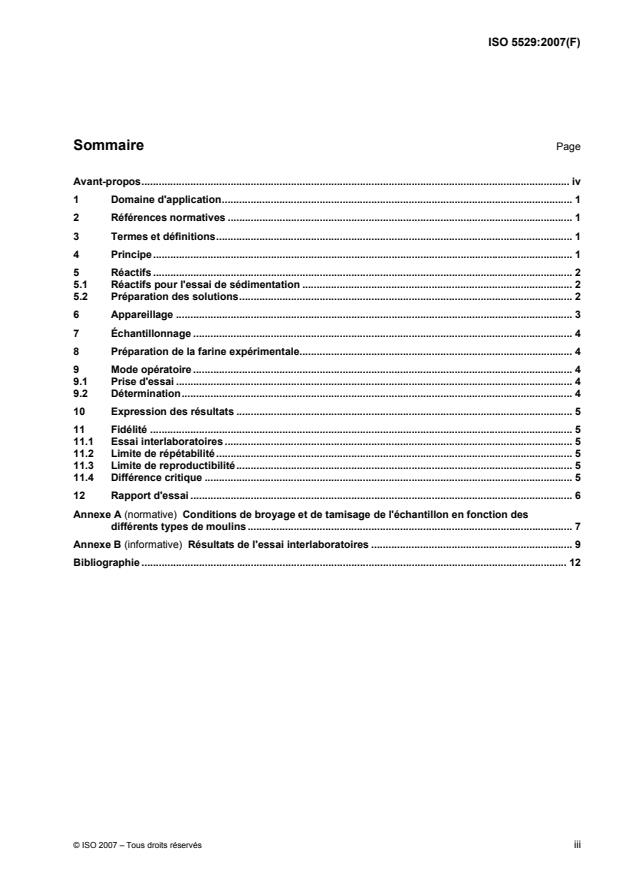
Sommaire Page
Avant-propos. iv
1 Domaine d'application. 1
2 Références normatives . 1
3 Termes et définitions. 1
4 Principe. 1
5 Réactifs . 2
5.1 Réactifs pour l'essai de sédimentation . 2
5.2 Préparation des solutions. 2
6 Appareillage . 3
7 Échantillonnage . 4
8 Préparation de la farine expérimentale. 4
9 Mode opératoire . 4
9.1 Prise d'essai . 4
9.2 Détermination. 4
10 Expression des résultats . 5
11 Fidélité . 5
11.1 Essai interlaboratoires . 5
11.2 Limite de répétabilité. 5
11.3 Limite de reproductibilité. 5
11.4 Différence critique . 5
12 Rapport d'essai . 6
Annexe A (normative) Conditions de broyage et de tamisage de l'échantillon en fonction des
différents types de moulins . 7
Annexe B (informative) Résultats de l'essai interlaboratoires . 9
Bibliographie . 12
Avant-propos
L'ISO (Organisation internationale de normalisation) est une fédération mondiale d'organismes nationaux de
normalisation (comités membres de l'ISO). L'élaboration des Normes internationales est en général confiée
aux comités techniques de l'ISO. Chaque comité membre intéressé par une étude a le droit de faire partie du
comité technique créé à cet effet. Les organisations internationales, gouvernementales et non
gouvernementales, en liaison avec l'ISO participent également aux travaux. L'ISO collabore étroitement avec
la Commission électrotechnique internationale (CEI) en ce qui concerne la normalisation électrotechnique.
Les Normes internationales sont rédigées conformément aux règles données dans les Directives ISO/CEI,
Partie 2.
La tâche principale des comités techniques est d'élaborer les Normes internationales. Les projets de Normes
internationales adoptés par les comités techniques sont soumis aux comités membres pour vote. Leur
publication comme Normes internationales requiert l'approbation de 75 % au moins des comités membres
votants.
L'attention est appelée sur le fait que certains des éléments du présent document peuvent faire l'objet de
droits de propriété intellectuelle ou de droits analogues. L'ISO ne saurait être tenue pour responsable de ne
pas avoir identifié de tels droits de propriété et averti de leur existence.
L'ISO 5529 a été élaborée par le comité technique ISO/TC 34, Produits alimentaires, sous-comité SC 4,
Céréales et légumineuses.
Cette troisième édition annule et remplace la deuxième édition (ISO 5529:1992), qui a fait l'objet d'une
révision technique.
iv © ISO 2007 – Tous droits réservés
NORME INTERNATIONALE ISO 5529:2007(F)
Blé tendre — Détermination de l'indice de sédimentation —
Test de Zélény
1 Domaine d'application
La présente Norme internationale décrit une méthode d'appréciation d'un des facteurs de la qualité du blé
tendre en relation avec la force boulangère de la farine qui peut être faite à partir de ce blé, par l'essai dit
«test de sédimentation de Zélény».
La méthode s'applique uniquement au blé tendre Triticum aestivum L.
2 Références normatives
Les documents de référence suivants sont indispensables pour l'application du présent document. Pour les
références datées, seule l'édition citée s'applique. Pour les références non datées, la dernière édition du
document de référence s'applique (y compris les éventuels amendements).
ISO 565, Tamis de contrôle — Tissus métalliques, tôles métalliques perforées et feuilles électroformées —
Dimensions nominales des ouvertures
ISO 648, Verrerie de laboratoire — Pipettes à un trait
ISO 3696, Eau pour laboratoire à usage analytique — Spécification et méthodes d'essai
3 Termes et définitions
Pour les besoins du présent document, les termes et définitions suivants s'appliquent.
3.1
indice de sédimentation
indice de Zélény
nombre indiquant le volume du dépôt obtenu dans les conditions spécifiées dans la présente Norme
internationale, à partir d'une suspension de farine expérimentale de blé tendre dans une solution d'acide
lactique et de 2-propanol
NOTE 1 L'indice de sédimentation est déterminé par l'essai de sédimentation dit «test de Zélény».
NOTE 2 Le volume est exprimé en millilitres.
4 Principe
Le principe de la mesure repose sur l'aptitude des protéines de la farine à gonfler en milieu acide.
De la farine expérimentale préparée à partir de blé tendre, dans des conditions spécifiées de broyage et de
tamisage, est mise en suspension dans une solution d'acide lactique et de 2-propanol en présence d'un
colorant. Après des temps d'agitation et de repos définis, le volume de dépôt obtenu correspond à la
sédimentation des particules de farine.
5 Réactifs
Sauf indication contraire, utiliser uniquement des réactifs de qualité analytique reconnue et de l'eau
respectant une qualité 2, conformément à l'ISO 3696.
5.1 Réactifs pour l'essai de sédimentation
5.1.1 Solution d'acide lactique (2-hydroxypropanoïque), à une fraction volumique aqueuse de 90 %,
M = 90,08 g/mol, d = 1,20 à 1,22.
5.1.2 2-Propanol, à une fraction volumique de 99 % à 100 %, M = 60,10 g/mol.
5.1.3 Hydroxyde de sodium, solution étalon, ρ(NaOH) = 40 g/l.
5.1.4 Bleu de bromophénol, C H Br O S, solution.
19 10 4 5
Dans une fiole jaugée de 1 000 ml (6.6), dissoudre 4 mg de bleu de bromophénol dans de l'eau, puis ajuster
au trait avec de l'eau.
5.1.5 Phénophtaléine, C H O , solution.
20 14 4
Dans une fiole jaugée de 100 ml (6.7), dissoudre 1 g de phénolphtaléine dans de l'éthanol, fraction volumique
aqueuse de 95 % à 96 %, puis ajuster au trait avec de l'éthanol.
5.2 Préparation des solutions
5.2.1 Solution mère d'acide lactique
Verser 235 ml de solution d'acide lactique (5.1.1) dans une fiole jaugée de 1 000 ml (6.6) et ajuster au trait
avec de l'eau. Transvaser la solution dans le ballon (6.8) et placer celui-ci sur le chauffe-ballon (6.9). Porter à
ébullition sous reflux pendant 6 h.
La solution d'acide lactique concentré contient des molécules associées qui, à la dilution, se dissocient
lentement jusqu'à un certain équilibre. L'ébullition accélère ce processus de dissociation qui est indispensable
pour obtenir des valeurs de sédimentation reproductibles.
Laisser refroidir 2 h minimum avant le titrage. Titrer ensuite (6.12) 10 ml de cette solution avec la solution
étalon d'hydroxyde de sodium (5.1.3) en présence de phénophtaléine (5.1.5) (pour 10 ml d'acide lactique,
environ 28 ml de solution d'hydroxyde de sodium sont nécessaires). Le titre trouvé doit être compris
entre 2,7 mol/l et 2,8 mol/l.
Conserver la solution mère d'acide lactique dans un flacon en verre teinté.
5.2.2 Solution d'essai
Dans une fiole jaugée de 1 000 ml (6.6), mélanger 180 ml de la solution mère d'acide lactique (5.2.1)
avec 200 ml de 2-propanol (5.1.2), puis ajuster au trait avec de l'eau.
Conserver en flacon bouché et n'utiliser le réactif qu'après 48 h de repos et dans un délai maximal de 15 jours
après sa préparation.
2 © ISO 2007 – Tous droits réservés
6 Appareillage
Matériel courant de laboratoire et, en particulier, ce qui suit.
1)
6.1 Moulin d'essai (voir Annexe A).
2)
6.2 Tamis à toile métallique , conforme aux spécifications de l'ISO 565, de 150 µm d'ouverture nominale
de maille, de 200 mm de diamètre et mû par un dispositif de vibration automatique approprié de 50 mm
−1
d'excentricité et de 200 min de fréquence de rotation.
6.3 Diviseur d'échantillon pour laboratoire.
6.4 Éprouvettes cylindriques à fond plat, de 100 ml de capacité, graduées en millilitres, de 180 mm
à 185 mm de distance entre le fond et la marque de 100 ml et munies d'un bouchon en verre ou en matière
plastique.
6.5 Agitateur pour éprouvettes cylindriques, muni d'une minuterie et permettant une fréquence
−1
d'agitation de 40 min ; chaque cycle doit avoir une amplitude de 60° (30° de part et d'autre de l'horizontale).
6.6 Fioles jaugées à un trait, de 1 000 ml de capacité.
6.7 Fiole jaugée à un trait, de 100 ml de capacité.
6.8 Ballon, de 1 500 ml de capacité, équipé d'un réfrigérant à reflux.
6.9 Chauffe-ballon.
6.10 Pipettes à un trait, de 25 ml et de 50 ml de capacité, conformes à l'ISO 648, ou doseurs
automatiques.
6.11 Balance analytique, capable de peser à 0,01 g près, avec une lisibilité de 0,001 g.
6.12 Matériel utilisé pour le titrage de la solution mère d'acide lactique (5.2.1).
6.12.1 Pipette à deux traits, de 10 ml de capacité.
6.12.2 Burette, de 50 ml de capacité, graduée en 0,1 ml.
6.12.3 Bécher, de 50 ml de capacité.
6.12.4 Agitateur magnétique et barreau.
6.13 Chronomètre.
1) The Miag-Grobschrotmühle; Brabender-Sedimat; Strand-Roll, model SRM; Straube, model W.1; et Tag-Heppenstall
sont des exemples de produits appropriés disponibles sur le marché. Cette information est donnée à l'intention des
utilisateurs de la présente Norme internationale et ne signifie nullement que l'ISO approuve ou recommande l'emploi
exclusif des produits ainsi désignés.
2) Le dispositif de tamisage est intégré dans le moulin Brabender-Sedimat (voir A.3).
7 Échantillonnage
Il est important que le laboratoire reçoive un échantillon qui soit véritablement représentatif et qui n'ait pas été
endommagé ou modifié lors du transport ou de l'entreposage.
L'échantillonnage ne fait pas partie de la méthode spécifiée dans la présente Norme internationale. Une
méthode d'échantillonnage recommandée est donnée dans l'ISO 13690.
8 Préparation de la farine expérimen
...