

ISO 12812-1:2017
(Main)Core banking — Mobile financial services — Part 1: General framework
General Information
- Abstract
ISO 12812-1:2017 defines the general framework of mobile financial services (payment and banking services involving a mobile device), with a focus on: a) a set of definitions commonly agreed by the international financial industry; b) the opportunities offered by mobile devices for the development of such services; c) the promotion of an environment that reduces or minimizes obstacles for mobile financial service providers who wish to provide a sustainable and reliable service to a wide range of customers (persons and businesses), while ensuring that customers' interests are protected; d) the different types of mobile financial services accessed through a mobile device including mobile proximate payments, mobile remote payments and mobile banking, which are detailed in other parts of ISO 12812; e) the mobile financial services supporting technologies; f) the stakeholders involved in the mobile payment ecosystems. ISO 12812-1:2017 includes the following informative annexes: - an overview of other standardization initiatives in mobile financial services (Annex A); - a description of possible mobile payment business models (Annex B); - a description of typical payment instruments which may be used (Annex C).
- Status
- Published
- Publication Date
- 27-Mar-2017
- Technical Committee
- ISO/TC 68/SC 9 - Information exchange for financial services
- Drafting Committee
- ISO/TC 68/SC 9 - Information exchange for financial services
- Current Stage
- 9093 - International Standard confirmed
- Start Date
- 29-Jun-2022
- Completion Date
- 29-Aug-2026
Overview
ISO 12812-1:2017 - Core banking - Mobile financial services - Part 1: General framework - defines a high‑level framework for mobile financial services (MFS) that involve a mobile device. The standard sets out commonly agreed definitions for the international financial industry, describes opportunities enabled by mobile devices, and promotes an environment that reduces barriers for service providers while protecting customers’ interests. It covers the main service types (mobile proximate payments, mobile remote payments and mobile banking), supporting technologies and the stakeholders that make up mobile payment ecosystems.
Key topics and technical focus
ISO 12812-1:2017 addresses technical and business topics that help achieve interoperable, secure and consumer‑friendly mobile financial services:
- Definitions and terminology - common language for MFSPs, banks and vendors to avoid ambiguity.
- Interoperability concept - objectives and considerations at both the business and technical layers to enable cross‑provider and cross‑channel payments.
- Customer relationships and contracts - legal/contractual roles, enrolment and customer protection principles.
- Mobile payment and banking functions - lifecycle elements such as issuance, activation, selection, identification, authentication, authorization, transaction data integrity, clearing/settlement and end‑of‑service.
- Service types - distinctions between proximate (in‑store/contactless and barcode) and remote payments (online/person‑to‑person) and mobile banking channels (apps, mobile web, SMS).
- Supporting technologies - mobile device, communication interfaces, local interfaces, applications, mobile wallet, secure element, trusted execution environment (TEE), secured servers and service management.
- Ecosystem stakeholders - banks, MFSPs, mobile network operators, payment scheme operators, merchants, regulators and technology vendors.
- Informative annexes - overview of other standardization initiatives, business models and payment instruments (Annexes A–C).
Practical applications and who uses it
ISO 12812-1 is a foundational reference for organizations designing, deploying or regulating mobile financial services:
- Banks and core banking providers integrating mobile channels.
- Mobile financial service providers (MFSPs) and fintechs building wallets, payment apps or P2P services.
- Payment scheme operators and acquirers seeking interoperable flows.
- Mobile network operators and device vendors implementing secure elements or TEE‑based solutions.
- Regulators and auditors assessing consumer protection and operational resilience.
- System integrators and security architects planning authentication, authorization and settlement workflows.
Related standards
- ISO 12812 (all parts) - Part 1 provides the general framework; other parts give detailed specifications for mobile proximate payments, mobile remote payments and mobile banking.
- Annex A points to additional standardization initiatives to consult for technical or regional requirements.
Keywords: ISO 12812-1:2017, mobile financial services, mobile payments, mobile banking, interoperability, MFSPs, mobile wallet, secure element, TEE, core banking.
Relations
- Effective Date
- 09-Feb-2026
Get Certified
Connect with accredited certification bodies for this standard

Great Wall Tianjin Quality Assurance Center
Established 1993, first batch to receive national accreditation with IAF recognition.
Hong Kong Quality Assurance Agency (HKQAA)
Hong Kong's leading certification body.

Innovative Quality Certifications Pvt. Ltd. (IQCPL)
Known for integrity, providing ethical & impartial Assessment & Certification. CMMI Institute Partner.
Sponsored listings
Frequently Asked Questions
ISO 12812-1:2017 is a standard published by the International Organization for Standardization (ISO). Its full title is "Core banking — Mobile financial services — Part 1: General framework". This standard covers: ISO 12812-1:2017 defines the general framework of mobile financial services (payment and banking services involving a mobile device), with a focus on: a) a set of definitions commonly agreed by the international financial industry; b) the opportunities offered by mobile devices for the development of such services; c) the promotion of an environment that reduces or minimizes obstacles for mobile financial service providers who wish to provide a sustainable and reliable service to a wide range of customers (persons and businesses), while ensuring that customers' interests are protected; d) the different types of mobile financial services accessed through a mobile device including mobile proximate payments, mobile remote payments and mobile banking, which are detailed in other parts of ISO 12812; e) the mobile financial services supporting technologies; f) the stakeholders involved in the mobile payment ecosystems. ISO 12812-1:2017 includes the following informative annexes: - an overview of other standardization initiatives in mobile financial services (Annex A); - a description of possible mobile payment business models (Annex B); - a description of typical payment instruments which may be used (Annex C).
ISO 12812-1:2017 defines the general framework of mobile financial services (payment and banking services involving a mobile device), with a focus on: a) a set of definitions commonly agreed by the international financial industry; b) the opportunities offered by mobile devices for the development of such services; c) the promotion of an environment that reduces or minimizes obstacles for mobile financial service providers who wish to provide a sustainable and reliable service to a wide range of customers (persons and businesses), while ensuring that customers' interests are protected; d) the different types of mobile financial services accessed through a mobile device including mobile proximate payments, mobile remote payments and mobile banking, which are detailed in other parts of ISO 12812; e) the mobile financial services supporting technologies; f) the stakeholders involved in the mobile payment ecosystems. ISO 12812-1:2017 includes the following informative annexes: - an overview of other standardization initiatives in mobile financial services (Annex A); - a description of possible mobile payment business models (Annex B); - a description of typical payment instruments which may be used (Annex C).
ISO 12812-1:2017 is classified under the following ICS (International Classification for Standards) categories: 03.060 - Finances. Banking. Monetary systems. Insurance. The ICS classification helps identify the subject area and facilitates finding related standards.
ISO 12812-1:2017 has the following relationships with other standards: It is inter standard links to EN 18184:2025. Understanding these relationships helps ensure you are using the most current and applicable version of the standard.
ISO 12812-1:2017 is available in PDF format for immediate download after purchase. The document can be added to your cart and obtained through the secure checkout process. Digital delivery ensures instant access to the complete standard document.
Standards Content (Sample)
INTERNATIONAL ISO
STANDARD 12812-1
First edition
2017-03
Core banking — Mobile financial
services —
Part 1:
General framework
Opérations bancaires de base — Services financiers mobiles —
Partie 1: Cadre général
Reference number
©
ISO 2017
© ISO 2017, Published in Switzerland
All rights reserved. Unless otherwise specified, no part of this publication may be reproduced or utilized otherwise in any form
or by any means, electronic or mechanical, including photocopying, or posting on the internet or an intranet, without prior
written permission. Permission can be requested from either ISO at the address below or ISO’s member body in the country of
the requester.
ISO copyright office
Ch. de Blandonnet 8 • CP 401
CH-1214 Vernier, Geneva, Switzerland
Tel. +41 22 749 01 11
Fax +41 22 749 09 47
copyright@iso.org
www.iso.org
ii © ISO 2017 – All rights reserved
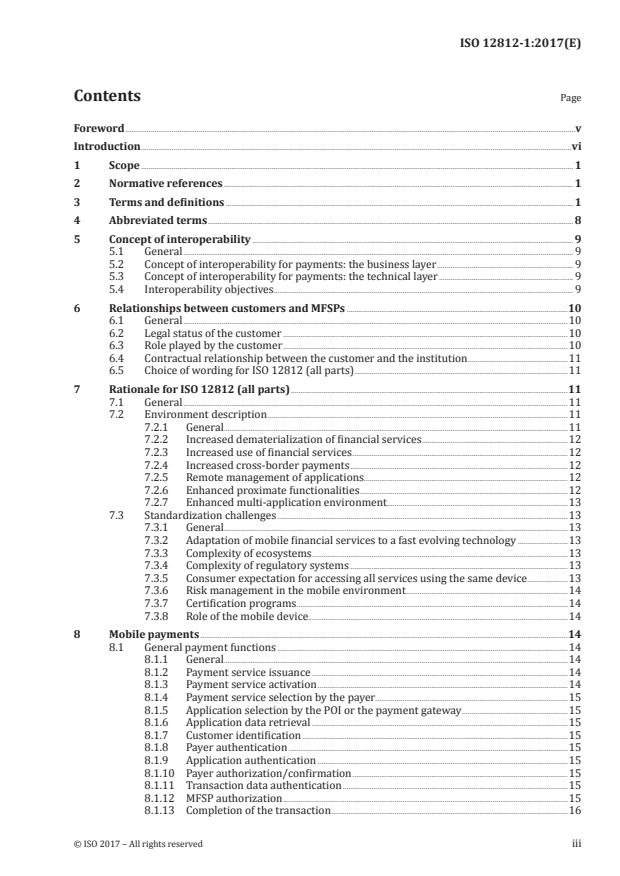
Contents Page
Foreword .v
Introduction .vi
1 Scope . 1
2 Normative references . 1
3 Terms and definitions . 1
4 Abbreviated terms . 8
5 Concept of interoperability . 9
5.1 General . 9
5.2 Concept of interoperability for payments: the business layer . 9
5.3 Concept of interoperability for payments: the technical layer . 9
5.4 Interoperability objectives. 9
6 Relationships between customers and MFSPs .10
6.1 General .10
6.2 Legal status of the customer .10
6.3 Role played by the customer .10
6.4 Contractual relationship between the customer and the institution .11
6.5 Choice of wording for ISO 12812 (all parts) .11
7 Rationale for ISO 12812 (all parts) .11
7.1 General .11
7.2 Environment description .11
7.2.1 General.11
7.2.2 Increased dematerialization of financial services . .12
7.2.3 Increased use of financial services .12
7.2.4 Increased cross-border payments .12
7.2.5 Remote management of applications . .12
7.2.6 Enhanced proximate functionalities .12
7.2.7 Enhanced multi-application environment . .13
7.3 Standardization challenges .13
7.3.1 General.13
7.3.2 Adaptation of mobile financial services to a fast evolving technology .13
7.3.3 Complexity of ecosystems .13
7.3.4 Complexity of regulatory systems .13
7.3.5 Consumer expectation for accessing all services using the same device .13
7.3.6 Risk management in the mobile environment .14
7.3.7 Certification programs .14
7.3.8 Role of the mobile device .14
8 Mobile payments .14
8.1 General payment functions .14
8.1.1 General.14
8.1.2 Payment service issuance .14
8.1.3 Payment service activation .14
8.1.4 Payment service selection by the payer .15
8.1.5 Application selection by the POI or the payment gateway .15
8.1.6 Application data retrieval .15
8.1.7 Customer identification .15
8.1.8 Payer authentication .15
8.1.9 Application authentication .15
8.1.10 Payer authorization/confirmation .15
8.1.11 Transaction data authentication .15
8.1.12 MFSP authorization .15
8.1.13 Completion of the transaction .16
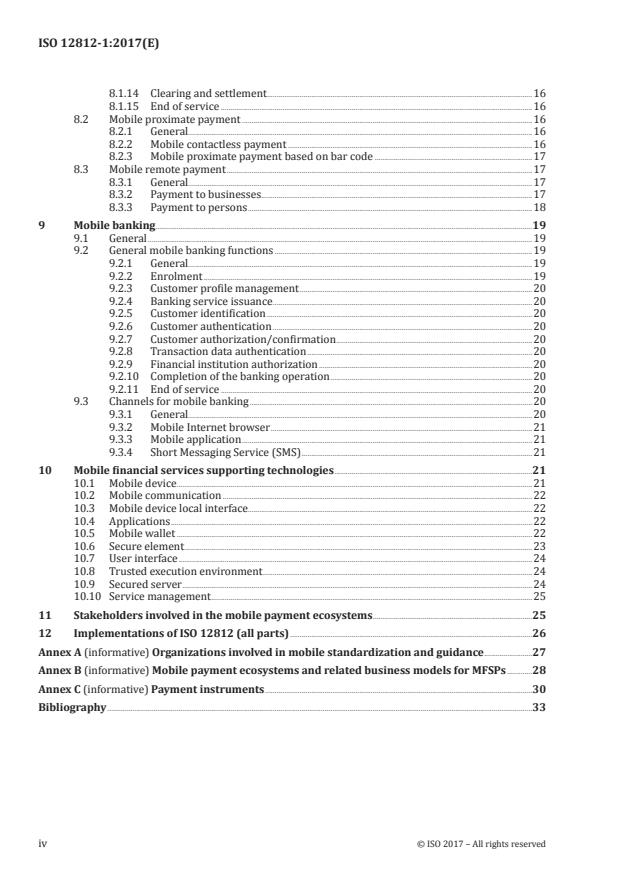
8.1.14 Clearing and settlement .16
8.1.15 End of service .16
8.2 Mobile proximate payment .16
8.2.1 General.16
8.2.2 Mobile contactless payment .16
8.2.3 Mobile proximate payment based on bar code .17
8.3 Mobile remote payment .17
8.3.1 General.17
8.3.2 Payment to businesses . .17
8.3.3 Payment to persons .18
9 Mobile banking .19
9.1 General .19
9.2 General mobile banking functions .19
9.2.1 General.19
9.2.2 Enrolment .19
9.2.3 Customer profile management .20
9.2.4 Banking service issuance .20
9.2.5 Customer identification .20
9.2.6 Customer authentication .20
9.2.7 Customer authorization/confirmation .20
9.2.8 Transaction data authentication .20
9.2.9 Financial institution authorization .20
9.2.10 Completion of the banking operation .20
9.2.11 End of service .20
9.3 Channels for mobile banking .20
9.3.1 General.20
9.3.2 Mobile Internet browser .21
9.3.3 Mobile application .21
9.3.4 Short Messaging Service (SMS) .21
10 Mobile financial services supporting technologies .21
10.1 Mobile device .21
10.2 Mobile communication .22
10.3 Mobile device local interface.22
10.4 Applications .22
10.5 Mobile wallet .22
10.6 Secure element .23
10.7 User interface .24
10.8 Trusted execution environment .24
10.9 Secured server .24
10.10 Service management .25
11 Stakeholders involved in the mobile payment ecosystems .25
12 Implementations of ISO 12812 (all parts) .26
Annex A (informative) Organizations involved in mobile standardization and guidance .27
Annex B (informative) Mobile payment ecosystems and related business models for MFSPs .28
Annex C (informative) Payment instruments .30
Bibliography .33
iv © ISO 2017 – All rights reserved
Foreword
ISO (the International Organization for Standardization) is a worldwide federation of national standards
bodies (ISO member bodies). The work of preparing International Standards is normally carried out
through ISO technical committees. Each member body interested in a subject for which a technical
committee has been established has the right to be represented on that committee. International
organizations, governmental and non-governmental, in liaison with ISO, also take part in the work.
ISO collaborates closely with the International Electrotechnical Commission (IEC) on all matters of
electrotechnical standardization.
The procedures used to develop this document and those intended for its further maintenance are
described in the ISO/IEC Directives, Part 1. In particular the different approval criteria needed for the
different types of ISO documents should be noted. This document was drafted in accordance with the
editorial rules of the ISO/IEC Directives, Part 2 (see www .iso .org/ directives).
Attention is drawn to the possibility that some of the elements of this document may be the subject of
patent rights. ISO shall not be held responsible for identifying any or all such patent rights. Details of
any patent rights identified during the development of the document will be in the Introduction and/or
on the ISO list of patent declarations received (see www .iso .org/ patents).
Any trade name used in this document is information given for the convenience of users and does not
constitute an endorsement.
For an explanation on the voluntary nature of standards, the meaning of ISO specific terms and
expressions related to conformity assessment, as well as information about ISO’s adherence to the
World Trade Organization (WTO) principles in the Technical Barriers to Trade (TBT) see the following
URL: w w w . i s o .org/ iso/ foreword .html.
This document was prepared by Technical Committee ISO/TC 68, Financial services, Subcommittee SC 7,
Core banking.
A list of all the parts in the ISO 12812 series can be found on the ISO website.
Introduction
The use of mobile devices to conduct financial services (i.e. payments and banking) is occurring
following the steady rise in the number of customers using the Internet for these services. As an
evolving market, mobile financial services are being developed and implemented on various bases
throughout the different regions of the world and also among the various providers of such services. In
these conditions, the purpose of the ISO 12812 (all parts) is to facilitate and promote interoperability,
security and quality of mobile financial services. At the same time, it is important that stakeholders in the
services can benefit from the evolution and service providers remain commercially free and competitive
in order to pursue their own business strategies. ISO 12812 (all parts) addresses the interoperability
only at the technical layer by considering the impact of new components and/or interfaces induced by
the introduction of a mobile device in financial services. The intentions of ISO 12812 (all parts) are as
follows.
a) To advance interoperability of mobile financial services globally by defining requirements based
on a common terminology and basic principles for the design and operation of mobile financial
services.
b) To define technical components and their interfaces, as well as roles that may be performed by
different actors in addition to mobile financial service providers (e.g. mobile network operators,
trusted service managers). These components and their interfaces, as well as roles, are defined
according to identified use cases. Future use cases may be considered during the maintenance of
ISO 12812 (all parts).
c) To identify existing standards on which mobile financial services should be based, as well as
possible gaps.
Standardization in this area is beneficial for the sound development of the mobile financial services
market because it will:
— facilitate and promote interoperability between the different components or functions building
mobile financial services;
— build a safe environment so that consumers and merchants can trust the service and allow the
mobile financial service providers to manage their risks;
— promote consumer protection mechanisms including fair contract terms, rules on transparency of
charges, clarification of liability, complaints mechanisms and dispute resolution;
— enable the consumer to choose from different providers of devices or mobile financial services
including the possibility to contract with several mobile financial service providers for services on
the same device;
— enable the consumer to transfer a mobile financial service from one device to another one
(portability);
— promote a consistent consumer experience among various mobile financial services and mobile
financial service providers with easy-to-use interfaces.
To achieve these objectives, each part of ISO 12812 (all parts) will specify the necessary technical
mechanisms and, when relevant, refer to existing standards as appropriate.
ISO 12812 (all parts) provides a framework flexible enough to accommodate new mobile device
technologies, as well as to allow various business models. At the same time, it enables compliance with
applicable regulations including data privacy, protection of personally-identifiable data, consumer
protection, anti-money laundering and prevention of financial crime.
It is not the intention of ISO 12812 (all parts) to duplicate or to seek to replace any existing standard
in the area of mobile financial services (e.g. communication protocols, mobile devices). It is also not
the intention to drive technology to any specific application or to restrict the development of future
vi © ISO 2017 – All rights reserved
technologies or solutions. Messages and data elements to be exchanged at the interfaces between
the different components or actors of the system may be those already specified [e.g. ISO 20022,
ISO 8583 (all parts)].
ISO 12812 (all parts) recognizes the need for unbanked or under-banked consumers to access mobile
financial services. It also recognizes that these services may be provided by diverse types of institutions
in accordance with the applicable regulation(s).
The ISO 12812 series consists of the following parts:
— Part 1: General framework — The introduction of the standard with descriptions of some
fundamental bases on which the other parts are built;
— Part 2: Security and data protection for mobile financial services — Definition of a general
framework for the secure execution of mobile financial services;
— Part 3: Financial application lifecycle management — The lifecycle of the application including
roles and infrastructure for secure provisioning;
— Part 4: Mobile payments to persons — Use cases and requirements for interoperability;
— Part 5: Mobile payments to businesses — Use cases and requirements for interoperability.
INTERNATIONAL STANDARD ISO 12812-1:2017(E)
Core banking — Mobile financial services —
Part 1:
General framework
1 Scope
This document defines the general framework of mobile financial services (payment and banking
services involving a mobile device), with a focus on:
a) a set of definitions commonly agreed by the international financial industry;
b) the opportunities offered by mobile devices for the development of such services;
c) the promotion of an environment that reduces or minimizes obstacles for mobile financial service
providers who wish to provide a sustainable and reliable service to a wide range of customers
(persons and businesses), while ensuring that customers’ interests are protected;
d) the different types of mobile financial services accessed through a mobile device including mobile
proximate payments, mobile remote payments and mobile banking, which are detailed in other
parts of ISO 12812;
e) the mobile financial services supporting technologies;
f) the stakeholders involved in the mobile payment ecosystems.
This document includes the following informative annexes:
— an overview of other standardization initiatives in mobile financial services (Annex A);
— a description of possible mobile payment business models (Annex B);
— a description of typical payment instruments which may be used (Annex C).
2 Normative references
There are no normative references in this document.
3 Terms and definitions
For the purposes of this document, the following terms and definitions apply.
ISO and IEC maintain terminological databases for use in standardization at the following addresses:
— IEC Electropedia: available at http:// www .electropedia .org/
— ISO Online browsing platform: available at http:// www .iso .org/ obp
3.1
acquirer
institution (3.17) that has contracted with the merchant (3.19)/payee (3.38) in order to process the
payment transaction (3.40) data and transmit onwards in the payment system (3.45)
Note 1 to entry: This role might or might not be performed by the merchant/payee institution.
3.2
alias
pseudonym for the payer (3.39) and/or the payee (3.38) uniquely linked to the name and account
associated to the payment instrument (3.43)
EXAMPLE Mobile phone number.
3.3
application
set of program modules (application software) and/or data (application data) needed to provide
functionality for a mobile financial service (3.25)
EXAMPLE Payment application, authentication application, user interface application, mobile wallet (3.35).
3.4
authentication
provision of assurance that a claimed characteristic of an entity is correct
Note 1 to entry: The provision of assurance may be given by verifying the identity of an individual, device or
process.
[SOURCE: ISO/IEC 27000:2016, 2.7, modified —Note 1 to entry has been added.]
3.5
authentication credential
data provided by the mobile financial service provider (MFSP) (3.27) to the customer (3.12) in order to
allow the authentication of the customer
EXAMPLE PIN, mobile code.
3.6
bar code
optical machine-readable representation of data
Note 1 to entry: Bar codes include QR codes (ISO/IEC 18004), Data Matrix (ISO/IEC 16022) and MaxiCode
(ISO/IEC 16023).
3.7
cardholder verification method
CVM
particular case of user verification method (UVM) (3.63) when the payment instrument (3.43) is a card
3.8
consumer
person using a mobile device (3.24) to purchase goods or services and who is acting for purposes other
than trade, business or profession
3.9
contactless
radio frequency technology operating at very short ranges so that the user has to perform a voluntary
gesture in order that a communication is initiated between two devices by approaching them
Note 1 to entry: Contactless is not to be confused with wireless which is a more general term.
Note 2 to entry: Contactless technology is specified in ISO/IEC 14443.
3.10
credential
data provided to the customer (3.12) for identification/authentication purposes
2 © ISO 2017 – All rights reserved
3.11
credit transfer
payment initiated by the payer (3.39) which results in transferring an amount of money from a payer’s
account to a payee’s (3.38) account
3.12
customer
person or business that has contracted with an MFSP in order to use mobile financial services (3.25)
3.13
direct debit
payment initiated by the payee (3.38) which results in transferring an amount of money from a payer’s
(3.39) account to a payee’s account
Note 1 to entry: A direct debit is usually pre-authorized in the form of a mandate between the payer and the payee.
3.14
electronic money
electronically stored monetary value measured in currency and stored on a device, such as a mobile
device (3.24), or at a server remotely and that can be purchased by a consumer (3.8) and used for payment
3.15
host card emulation
HCE
implementation of contactless (3.9) payments where the payment application is held in the mobile device
(3.24) host
3.16
identification credential
data provided by an institution (3.17) to the customer (3.12) in order to allow the identification of the
customer
3.17
institution
entity authorized to provide financial services under the applicable regulation(s)
3.18
know your customer
KYC
process to verify the identity of a customer (3.12) in order to prevent financial crime, money laundering
and terrorism financing
3.19
merchant
business that accepts mobile payments (3.29) for the goods or services purchased by a consumer (3.8)
3.20
mobile banking
access to and execution of online banking services through a mobile device (3.24)
3.21
mobile card payment
mobile payment (3.29) using a card payment credential (3.41) and a card infrastructure for authorization
and settlement
3.22
mobile code
authentication credential (3.5) used as UVM and entered via the mobile device (3.24)
3.23
mobile contactless payment
mobile proximate payment where the payer (3.39) and the payee (3.38) communicate directly using
contactless (3.9) technologies
3.24
mobile device
personal device with mobile communication
EXAMPLE Mobile phone, smartphone (3.56), tablet.
Note 1 to entry: A mobile device can have an NFC capability.
3.25
mobile financial service
MFS
mobile payment (3.29) (including retail payment) and mobile banking (3.20) service
3.26
mobile financial service program
MFS program
set of rules, practices and standards agreed between the MFSPs participating in the program for the
functioning of the MFS
3.27
mobile financial service provider
MFSP
institution (3.17) that has contracted with the customer (3.12) and that is responsible for providing the
mobile financial service (3.25) to that customer
3.28
mobile network operator
MNO
mobile telecommunication operator that provides a range of mobile communication services, including
over the air (3.37) connectivity
3.29
mobile payment
payment involving a mobile device (3.24) and using a payment instrument (3.43) and associated
infrastructures
3.30
mobile payment ecosystem
set of stakeholders which interact to form a stable functioning payment system (3.45) in the mobile
environment
3.31
mobile proximate payment
mobile payment (3.29) where the payer (3.39) and payee (3.38) (and/or his/her equipment) are in the
same location
Note 1 to entry: This terminology is preferred to mobile proximity payment as the wording proximity has a
specific meaning for contactless (3.9) standards (ISO/IEC 14443).
Note 2 to entry: Mobile proximate payments include, but are not limited to, mobile contactless payments (3.23).
3.32
mobile remote payment
mobile payment (3.29) whereby the transaction is conducted over a mobile communication network and
which can be made independently from the payee’s (3.38) location (and/or his/her equipment)
4 © ISO 2017 – All rights reserved
3.33
mobile service
service accessed through a mobile device (3.24)
EXAMPLE Mobile financial service (3.25), transit/public transport, shopping, loyalty and information.
3.34
mobile service provider
entity providing a mobile service (3.33) to the end-user
Note 1 to entry: For mobile financial service (3.25), the service provider is called a mobile financial service provider
(MFSP) (3.27).
Note 2 to entry: The definition does not include suppliers (vendors) to the mobile service providers and which
are not known by the end-user.
3.35
mobile wallet
digital container accessed by the mobile device (3.24) that allows a consumer (3.8) to store applications
and credentials (3.10) being used for mobile financial and non-financial services
Note 1 to entry: This container may reside on a mobile device owned by the consumer (i.e. the holder of the
wallet) or may be remotely hosted on a server (or a combination thereof) or on a merchant (3.19) website.
3.36
near field communication
NFC
contactless (3.9) communication interface and protocol specified by ISO/IEC 18092 and ISO/IEC 21481
3.37
over the air
OTA
data channel operated by a mobile network operator (3.28) for the remote management of components
resident in the mobile device (3.24)
3.38
payee
person or legal entity who is the intended recipient of funds which have been the subject of a payment
transaction (3.40)
3.39
payer
person or legal entity who authorizes a payment transaction (3.40)
3.40
payment
payment transaction
act of placing, transferring or withdrawing funds, irrespective of any underlying obligations between
the payer (3.39) and the payee (3.38)
3.41
payment credential
data provided by the MFSP to the customer (3.12) in order to allow the identification of the customer
account associated to the payment instrument (3.43)
EXAMPLE IBAN, PAN.
3.42
payment gateway
service located on a distant server for the acceptance of mobile remote payments (3.32)
3.43
payment instrument
personalized device and/or set of procedures agreed between the payer (3.39) and the institution (3.17)
and used by the payer in order to conduct a payment transaction (3.40)
EXAMPLE Credit transfer (3.11), card payment and electronic money (3.14).
3.44
payment scheme
set of rules, practices, standards and/or implementation guidelines agreed between scheme participants
for the functioning of payment services and which is separated from any infrastructure or payment
system (3.45) that supports its operation
3.45
payment system
funds transfer system with formal and standardized arrangements and common rules for the
processing, clearing and/or settlement of payment transactions (3.40)
3.46
payment to business
payment transaction (3.40) where the payee (3.38) is a business
3.47
payment to person
payment transaction (3.40) where the payee (3.38) is a person
3.48
point of interaction
POI
device used for the acceptance of mobile payments (3.29)
EXAMPLE POS, vending machine, ATM for proximate payments and payment gateway (3.42) for remote
payments.
Note 1 to entry: The POI may be a mobile device (3.24).
3.49
remittance
transfer of an amount of money between two persons
Note 1 to entry: In the context of ISO 12812 (all parts), remittance includes domestic and cross-border transfer
of money.
3.50
secure element
SE
tamper-resistant platform in the mobile device (3.24) capable of securely hosting and executing
applications and associated confidential and cryptographic data (e.g. key management)
EXAMPLE UICC, embedded secure elements, chip cards and SD cards.
3.51
SE provider
entity that owns the original access rights to the SE
3.52
secured server
secure environment (3.53) located on a server
6 © ISO 2017 – All rights reserved
3.53
secure environment
system that implements the controlled storage and processing of information in order to protect
personal and/or confidential data
Note 1 to entry: In the context of mobile financial services (3.25), it can be located in the mobile device (3.24),
such as a secure element (3.50), a trusted execution environment (3.60) or software with supplementary security
controls (3.54), or in a remote secured server (3.52).
3.54
security controls
management, operational and technical controls (i.e. safeguards or countermeasures) prescribed for
an information system to protect the confidentiality, integrity and availability of the system and its
information
3.55
short message service
SMS
service that enables a mobile phone or a server to send messages of limited length to one or several
mobile phone(s)
3.56
smartphone
mobile device (3.24) that performs functions of a computer such as data storage, capability to run
downloadable applications and Internet access
3.57
strong authentication
authentication procedure using a minimum of two independent (from the security point of view)
authentication mechanisms, with at least one of them being dynamic
3.58
third party
party who is not one of the parties primarily involved in a transaction
3.59
tokenization
process by which a payment credential (3.41) is replaced with a surrogate value called a payment token
Note 1 to entry: Tokenization can be undertaken to enhance transaction efficiency, improve transaction security,
increase service transparency, or to provide a method for third-party enablement.
3.60
trusted execution environment
TEE
aspect of the mobile device (3.24) comprising hardware and/or software which provides security
services to the mobile device computing environment, protects data against general software attacks
and isolates hardware and software security resources from the operating system
3.61
trusted service manager
TSM
trusted third party (3.62) acting on behalf of the secure environment (3.53) provider and/or the mobile
financial service provider (3.27) in order to perform the provisioning and management of the application
3.62
trusted third party
third party (3.58) trusted by other entities with respect to security-related activities
3.63
user verification method
UVM
method verifying that the person who uses the mobile financial service (3.25) is the legitimate customer
(3.12) of the mobile financial service provider (3.27)
Note 1 to entry: A UVM can be based on the processing of authentication credentials (3.5).
3.64
unstructured supplementary services data
USSD
functionality built into the GSM standard to support transmitting information over the signalling
channels of the GSM network
4 Abbreviated terms
ATM Automated Teller Machine
CVM Cardholder Verification Method
IBAN International Bank Account Number
HCE Host Card Emulation
KYC Know Your Customer
MFS Mobile Financial Service
MFSP Mobile Financial Service Provider
MNO Mobile Network Operator
NFC Near Field Communication
OS Operating System
OTA Over The Air
PAN Primary Account Number
PIN Personal Identification Number
POI Point Of Interaction
POS Point Of Sale
QR Quick Response
SE Secure Element
SMS Short Message Service
TEE Trusted Execution Environment
UICC Universal Integrated Circuit Card
USSD Unstructured Supplementary Services Data
UVM User Verification Method
8 © ISO 2017 – All rights reserved
5 Concept of interoperability
5.1 General
Numerous definitions exist for the term interoperability. Some limit the concept at a technical level
such that interoperability is the ability of systems to provide services to and accept services from other
systems and to enable them to operate effectively together.
NOTE According to ISO/IEC 2382, interoperability is defined as “capability to communicate, execute
programs, or transfer data among various functional units in a manner that requires the user to have little or no
knowledge of the unique characteristics of those units”.
Other definitions include the role of organizations in deciding to work together by using systems able to
operate together. In that context, interoperability is the ability for systems and organizations to work
together (inter-operate).
Payments generally involve several parties forming a chain of technical components or systems. In that
context, the concept of interoperability includes two layers: a business layer and a technical layer.
5.2 Concept of interoperability for payments: the business layer
In payments, the business layer of the interoperability concept is essential so that any two
organizations in the payment chain have decided to work together by agreeing terms and conditions
of their cooperation. This is typically the case of the relationship between a merchant and its
acquirer/institution. The merchant may only offer the consumer means of payments provided by
that given acquirer/institution (or several acquirers/institutions if the merchant has contracted with
several of them). The consumer may have subscribed to some means of payment with one or several
payment service providers. The consequence of business interoperability is that a consumer may use
one of these means of payment which are accepted by the merchant.
5.3 Concept of interoperability for payments: the technical layer
For the technical layer, interoperability means that an organization may easily operate with several
other entities for a given service attributable to systems that are compatible. In information
technologies, and particularly for payments, this principle implies that the interfaces between two
successive components of the payment chain are standardized allowing solutions to be implemented
by several vendors. For some interfaces, more than one standard may exist, impacting the level of
interoperability with less efficient processes within the entities being involved at that interface if
several standards are implemented. Interoperability does not necessary imply that a single standard
exists at a given interface.
The term compatibility is equivalent to the technical layer of the concept of interoperability.
NOTE In daily life, when a consumer has to substitute a component of a device by a new one, compatibility is
required. This is, for example, the case for a supply power adapter of a mobile device. A new supply power adapter
is compatible with the device on the conditions that both power supplied and plug fit the features of the device.
For payment, a solution of a vendor is compatible with the system of an organization if it may easily
substitute an already installed compatible solution of another vendor. This compatibility is facilitated if
both solutions are compliant with a common standard.
The technical layer of the interoperability concept includes different aspects such as implementations
of application, function, security, communication, protocol, data element and operation.
5.4 Interoperability objectives
The objective of ISO 12812 (all parts) is to address interoperability only at the technical layer.
ISO 1281
...