

ISO 16625:2025
(Main)Cranes and hoists — Selection of wire ropes, drums and sheaves
General Information
- Abstract
This document provides a proof of competence and criteria for the selection of steel wire ropes used in cranes as defined in ISO 4306-1. The influence of the geometry of the rope drive, as well as drum and sheave geometry, are incorporated in the proof of competence. This document does not apply to fibre ropes.
- Status
- Published
- Publication Date
- 06-Feb-2025
- Technical Committee
- ISO/TC 96/SC 3 - Selection of ropes
- Drafting Committee
- ISO/TC 96/SC 3/WG 3 - Selection of wire ropes, drums and sheaves
- Current Stage
- 6060 - International Standard published
- Start Date
- 07-Feb-2025
- Due Date
- 13-Dec-2024
- Completion Date
- 07-Feb-2025


Overview
ISO 16625:2025 - "Cranes and hoists - Selection of wire ropes, drums and sheaves" provides a structured proof-of-competence framework and selection criteria for steel wire ropes used in cranes (as defined in ISO 4306-1). The standard covers how rope-drive geometry and drum / sheave geometry influence rope stresses and life expectancy. It replaces the 2013 edition and introduces a cycle-based approach and a new mathematical method for assessing fatigue strength (S–N curves and a characteristic reference point).
Key topics and technical requirements
- Scope and terminology: Definitions for running ropes and stationary ropes, design life, work cycles and rope bending diameter.
- Proof of competence: Methodologies for demonstrating adequate performance, separated into:
- Static strength proofs (including limit design rope forces).
- Fatigue strength proofs using a new reference point and S–N curves that account for different D/d ratios (drum/sheave bending diameter over rope diameter).
- Multilayer spooling specific proofs for ropes that coil in multiple layers on drums.
- Geometry effects: Incorporation of rope-drive geometry, drum and sheave groove radii, fleet angles, and reeving arrangements into force and fatigue calculations.
- Rope types and terminations: Guidance on rope selection, rope terminations (ferrules, socketing, swage terminals) and how termination type affects allowable forces.
- Operational and inspection criteria: Discard criteria, estimated number of relevant bending cycles, and assumed number of hoist ropes over the design life.
- Symbols and parameters: Comprehensive symbol set (design forces, limit forces, factors for lubrication, diameter influence, etc.) used in proofs.
Applications and users
ISO 16625:2025 is intended for practical use by:
- Crane and hoist designers - to select ropes, drums and sheaves and to verify static and fatigue competence.
- Manufacturers and rope suppliers - for specification and testing of wire ropes and terminations.
- Safety engineers and inspectors - to assess discard criteria, inspection intervals and maintenance planning.
- Consultants and certifying bodies - performing conformity assessments and design reviews.
Typical applications include hoist rope specification, verifying multilayer drum arrangements, calculating design rope forces under different reeving and fleet-angle conditions, and using S–N based fatigue proofs to predict rope life in cycles.
Related standards
ISO 16625:2025 is intended to be used alongside relevant standards such as:
- ISO 2408, ISO 4301-1, ISO 4306-1, ISO 4309
- ISO 8686 (design loads series), ISO 17893, ISO 20332
- EN 13411 series (rope terminations)
Keywords: ISO 16625:2025, wire ropes, cranes, hoists, drums, sheaves, rope selection, proof of competence, fatigue strength, static strength, multilayer spooling, D/d ratio, S–N curve.
Relations
- Effective Date
- 23-Apr-2020
Frequently Asked Questions
ISO 16625:2025 is a standard published by the International Organization for Standardization (ISO). Its full title is "Cranes and hoists — Selection of wire ropes, drums and sheaves". This standard covers: This document provides a proof of competence and criteria for the selection of steel wire ropes used in cranes as defined in ISO 4306-1. The influence of the geometry of the rope drive, as well as drum and sheave geometry, are incorporated in the proof of competence. This document does not apply to fibre ropes.
This document provides a proof of competence and criteria for the selection of steel wire ropes used in cranes as defined in ISO 4306-1. The influence of the geometry of the rope drive, as well as drum and sheave geometry, are incorporated in the proof of competence. This document does not apply to fibre ropes.
ISO 16625:2025 is classified under the following ICS (International Classification for Standards) categories: 53.020.30 - Accessories for lifting equipment. The ICS classification helps identify the subject area and facilitates finding related standards.
ISO 16625:2025 has the following relationships with other standards: It is inter standard links to ISO 16625:2013. Understanding these relationships helps ensure you are using the most current and applicable version of the standard.
ISO 16625:2025 is available in PDF format for immediate download after purchase. The document can be added to your cart and obtained through the secure checkout process. Digital delivery ensures instant access to the complete standard document.
Standards Content (Sample)
International
Standard
ISO 16625
Second edition
Cranes and hoists — Selection of
2025-02
wire ropes, drums and sheaves
Appareils de levage à charge suspendue et treuils — Choix des
câbles, tambours et poulies
Reference number
© ISO 2025
All rights reserved. Unless otherwise specified, or required in the context of its implementation, no part of this publication may
be reproduced or utilized otherwise in any form or by any means, electronic or mechanical, including photocopying, or posting on
the internet or an intranet, without prior written permission. Permission can be requested from either ISO at the address below
or ISO’s member body in the country of the requester.
ISO copyright office
CP 401 • Ch. de Blandonnet 8
CH-1214 Vernier, Geneva
Phone: +41 22 749 01 11
Email: copyright@iso.org
Website: www.iso.org
Published in Switzerland
ii
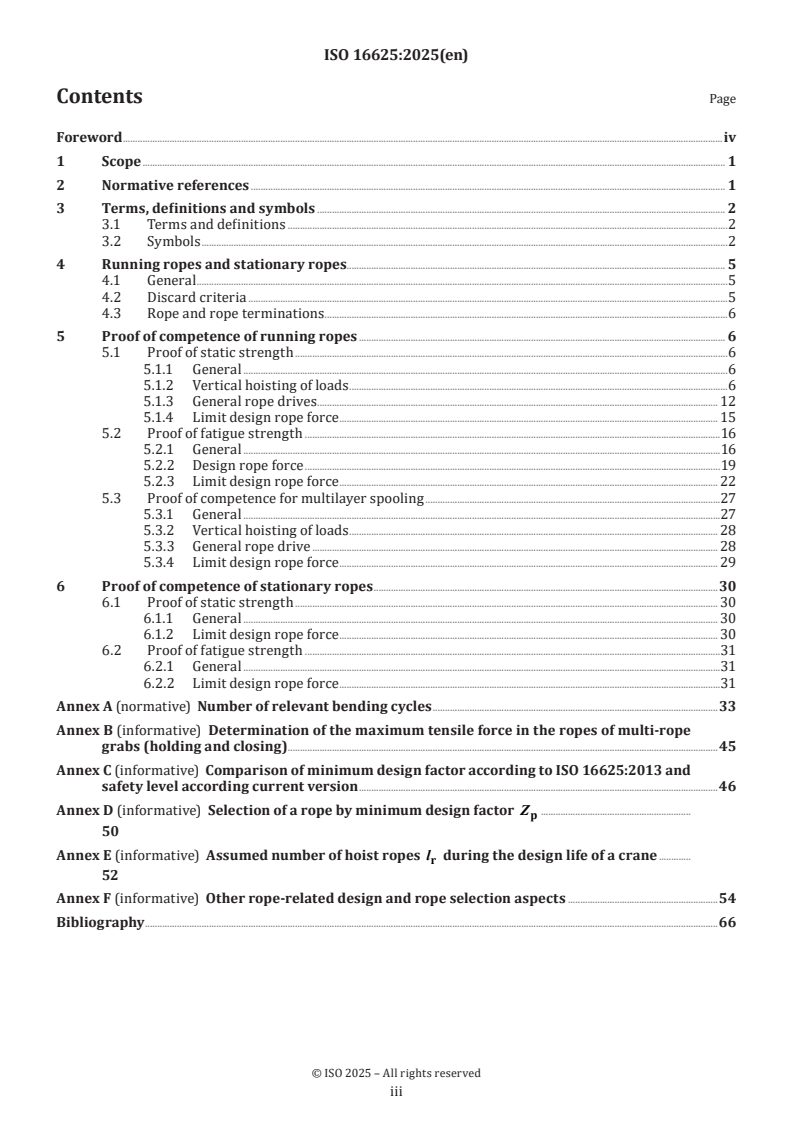
Contents Page
Foreword .iv
1 Scope . 1
2 Normative references . 1
3 Terms, definitions and symbols . 2
3.1 Terms and definitions .2
3.2 Symbols .2
4 Running ropes and stationary ropes. 5
4.1 General .5
4.2 Discard criteria .5
4.3 Rope and rope terminations .6
5 Proof of competence of running ropes . 6
5.1 Proof of static strength .6
5.1.1 General .6
5.1.2 Vertical hoisting of loads .6
5.1.3 General rope drives . 12
5.1.4 Limit design rope force . 15
5.2 Proof of fatigue strength .16
5.2.1 General .16
5.2.2 Design rope force .19
5.2.3 Limit design rope force . 22
5.3 Proof of competence for multilayer spooling .27
5.3.1 General .27
5.3.2 Vertical hoisting of loads . 28
5.3.3 General rope drive . 28
5.3.4 Limit design rope force . 29
6 Proof of competence of stationary ropes .30
6.1 Proof of static strength . 30
6.1.1 General . 30
6.1.2 Limit design rope force . 30
6.2 Proof of fatigue strength .31
6.2.1 General .31
6.2.2 Limit design rope force .31
Annex A (normative) Number of relevant bending cycles .33
Annex B (informative) Determination of the maximum tensile force in the ropes of multi-rope
grabs (holding and closing) . .45
Annex C (informative) Comparison of minimum design factor according to ISO 16625:2013 and
safety level according current version .46
Annex D (informative) Selection of a rope by minimum design factor Z .
p
Annex E (informative) Assumed number of hoist ropes l during the design life of a crane .
r
Annex F (informative) Other rope-related design and rope selection aspects .54
Bibliography .66
iii
Foreword
ISO (the International Organization for Standardization) is a worldwide federation of national standards
bodies (ISO member bodies). The work of preparing International Standards is normally carried out through
ISO technical committees. Each member body interested in a subject for which a technical committee
has been established has the right to be represented on that committee. International organizations,
governmental and non-governmental, in liaison with ISO, also take part in the work. ISO collaborates closely
with the International Electrotechnical Commission (IEC) on all matters of electrotechnical standardization.
The procedures used to develop this document and those intended for its further maintenance are described
in the ISO/IEC Directives, Part 1. In particular the different approval criteria needed for the different types
of ISO documents should be noted. This document was drafted in accordance with the editorial rules of the
ISO/IEC Directives, Part 2 (see www.iso.org/directives).
ISO draws attention to the possibility that the implementation of this document may involve the use of (a)
patent(s). ISO takes no position concerning the evidence, validity or applicability of any claimed patent
rights in respect thereof. As of the date of publication of this document, ISO had not received notice of (a)
patent(s) which may be required to implement this document. However, implementers are cautioned that
this may not represent the latest information, which may be obtained from the patent database available at
www.iso.org/patents. ISO shall not be held responsible for identifying any or all such patent rights.
Any trade name used in this document is information given for the convenience of users and does not
constitute an endorsement.
For an explanation on the meaning of ISO specific terms and expressions related to conformity assessment,
as well as information about ISO's adherence to the World Trade Organization (WTO) principles in the
Technical Barriers to Trade (TBT) see the following URL: www.iso.org/iso/foreword.html.
This document was prepared by Technical Committee ISO/TC 96, Cranes, Subcommittee SC 3, Selection of ropes.
This second edition cancels and replaces the first edition (ISO 16625:2013), which has been technically
revised.
The main changes are as follows:
— rope selection has been based on working cycles as opposed to the previous time-based concept;
— different proofs of competence for running ropes (static, fatigue, multilayer spooling) and stationary
ropes (static, fatigue) have been incorporated;
— the substantial innovation of this document lies in a new mathematical approach for the proof of fatigue
strength of running steel wire ropes. A new reference point has been introduced as a characteristic value
for the fatigue strength, from which the S-N curves of the fatigue strength of steel wire ropes at different
D/d-ratios are described;
— additional annexes have been introduced:
— Annex A (normative) Number of relevant bending cycles;
— Annex B (informative) Determination of the maximum tensile force in the ropes of multi-rope grabs
(holding and closing);
— Annex C (informative) Comparison of the minimum design factor according to ISO 16625:2013 and
safety level according current version;
— Annex D (informative) Selection of a rope by minimum design factor Z ;
p
— Annex E (informative) Assumed number of hoist ropes l during life of a crane.
r
This document is intended to be used together with the ISO 4301-1 or other applicable part of the ISO 4301
series, ISO 4309, ISO 8686-1 or applicable part of the ISO 8686 series.
iv
Any feedback or questions on this document should be directed to the user’s national standards body. A
complete listing of these bodies can be found at www.iso.org/members.html.
v
International Standard ISO 16625:2025(en)
Cranes and hoists — Selection of wire ropes, drums and sheaves
1 Scope
This document provides a proof of competence and criteria for the selection of steel wire ropes used in
cranes as defined in ISO 4306-1.
The influence of the geometry of the rope drive, as well as drum and sheave geometry, are incorporated in
the proof of competence.
This document does not apply to fibre ropes.
2 Normative references
The following documents are referred to in the text in such a way that some or all of their content constitutes
requirements of this document. For dated references, only the edition cited applies. For undated references,
the latest edition of the referenced document (including any amendments) applies.
ISO 2408, Steel wire ropes — Requirements
ISO 4301-1, Cranes — Classification — Part 1: General
ISO 4306-1, Cranes — Vocabulary — Part 1: General
ISO 4309, Cranes — Wire ropes — Care and maintenance, inspection and discard
ISO 8686-1:2012, Cranes — Design principles for loads and load combinations — Part 1: General
ISO 8686-2, Cranes — Design principles for loads and load combinations — Part 2: Mobile cranes
ISO 8686-3, Cranes — Design principles for loads and load combinations — Part 3: Tower cranes
ISO 8686-4, Cranes — Design principles for loads and load combinations — Part 4: Jib cranes
ISO 8686-5, Cranes — Design principles for loads and load combinations — Part 5: Overhead travelling and
portal bridge cranes
ISO 8793, Steel wire ropes — Ferrule-secured eye terminations
ISO 17558, Steel wire ropes — Socketing procedures — Molten metal and resin socketing
ISO 17893, Steel wire ropes — Vocabulary, designation and classification
ISO 20332, Cranes — Proof of competence of steel structures
EN 13411-3, Terminations for steel wire ropes — Safety — Part 3: Ferrules and ferrule-securing
EN 13411-4, Terminations for steel wire ropes — Safety — Part 4: Metal and resin socketing
EN 13411-6, Terminations for steel wire ropes — Safety — Part 6: Asymmetric wedge sockets
EN 13411-8, Terminations for steel wire ropes — Safety — Part 8: Swage Terminals and Swaging
3 Terms, definitions and symbols
3.1 Terms and definitions
For the purposes of this document, the terms and definitions given in ISO 4301-1, ISO 4306-1, ISO 17893 and
the following apply.
ISO and IEC maintain terminology databases for use in standardization at the following addresses:
— ISO Online browsing platform: available at https:// www .iso .org/ obp
— IEC Electropedia: available at https:// www .electropedia .org/
3.1.1
running rope
rope which is wound on and off a drum and bent over sheaves and/or drums, therefore stressed mainly by
bending and secondly by tension
3.1.2
stationary rope
rope fixed at both ends, primarily under tensile load, and which is not subject on coiling (winding) on a
drum or over a sheave
3.1.3
design life
estimation of the intended period of use for a crane, or component based on its original design specification
and taking into consideration the load cycles and load spectrum expected during its intended usage
Note 1 to entry: According to ISO 4301-1, a rope is considered to be a component in this document.
[SOURCE: ISO 12482:2014, 3.2, modified]
3.1.4
work cycle
operating sequence starting from hoisting a load, transferring the load, lowering and grounding the load,
detaching the load and moving the unloaded load lifting attachment back to a starting position ready to
hoist another load
[SOURCE: ISO 12482:2014, 3.6]
3.1.5
rope bending diameter
diameter of the axis of the rope in the state when bent over a sheave or a drum
3.2 Symbols
The main symbols used in this document are given in ISO 4301-1, ISO 8686-1, ISO 20332 and Table 1.
Table 1 — Symbols
Symbols Description
A Classes for group classification of a crane or hoist (see ISO 4301-1)
A Classes for group classification of a component (see ISO 4301-1)
C
a Acceleration or deceleration
C Total number of working cycles during design life of a crane (see ISO 4301-1)
C Total number of working cycles during the design life of a rope
r
D Rope bending diameter
D Rope bending diameter of drum
TTaabbllee 11 ((ccoonnttiinnueuedd))
Symbols Description
D Rope bending diameter of sheave
d Nominal rope diameter
F, S Rope tension force
F Horizontal force acting on the hoist load
h
F Minimum breaking force of the rope (see ISO 17893)
min
F Limit design rope force for the proof of fatigue strength
Rd,f
F Limit design rope force for multilayer spooling
Rd,m
F Limit design rope force for the proof of static strength
Rd,s
Reference value of rope tensile force to describe the reference point of the S-N curve
F
ref
(Wöhler-curve) at the proof of fatigue strength
F Design rope force
Sd
F Design rope force for the proof of fatigue strength
Sd,f
F Design rope force for multilayer spooling
Sd,m
F Design rope force for the proof of static strength
Sd,s
f Factor of further influences to the rope tension force F
F ref
f Factor of influence of wire tensile strength
F1
f Factor of fleet angle influence
F2
f Factor of lubrication influence
F3
f Factor of groove radius influence
F4
Rope force increasing factor from rope reeving efficiency to be used at the proof of static
f
S1
strength
f Rope force increasing factor from non-parallel falls to be used at the proof of static strength
S2
f Rope force increasing factor from horizontal forces to be used at the proof of static strength
S3
Rope force reduction factor due to the type of rope termination to be used at the proof
f
S4
of static strength
*
Rope force increasing factor from non-parallel falls to be used at the proof of fatigue strength
f
S2
*
Rope force increasing factor from horizontal forces to be used at the proof of fatigue strength
f
S3
f Factor of further influences to the reference number of bending cycles w
w ref
f Factor of rope type influence
w1
f Factor of rope diameter influence
w2
g Acceleration due to gravity
K Load spectrum factor (see ISO 4301-1)
p
k Rope force spectrum factor
r
l Number of ropes assumed to be used during the design life of the crane
r
m Exponent, slope of the S-N curve (Wöhler-curve)
m Mass of the hoist (gross) load (see ISO 8686-1)
H
m Mass of the hoist load or that part of the mass of the hoist load that is acting on the rope falls
Hr
m Portion of the total mass of the hoist load m that is acting on the closing ropes
Hr,1 H
m Portion of the total mass of the hoist load m that is acting on the holding ropes
Hr,2 H
m Mass of the portion of the suspended ropes of the hoist drive
R
N Number of tensile force cycles at reference point (see also ISO 20332)
ref
N Total number of tensile force cycles during the design life of a crane (see ISO 20332)
t
Number of contact points passed by a part of the rope that initiates a change of curvature
n
in the rope
n Number of tensile force cycles
TTaabbllee 11 ((ccoonnttiinnueuedd))
Symbols Description
n Mechanical advantage
m
n Number of fixed sheaves between drum and moving part
s
p Proof of fatigue strength for running ropes
f,r
p Proof of fatigue strength for stationary ropes
f,s
p Proof of competence for multilayer spooling for running ropes
m,r
p Proof of static strength for running ropes
s,r
p Proof of static strength for stationary ropes
s,s
q(z) Normalized position density
R Rope grade (see ISO 2232)
r
r Groove radius
g
Design load effect in rope drive k of ropes or rope falls, as an inner force, resulting from
S
k
load combination F
j
S Resulting design force in particular rope
r
S Design load effect in particular rope
r1
S Design load effect in particular rope arising from local effects
r2
s Rope force history parameter
r
w Number of bending cycles
w Bending count of a particular type of bending
c
w Assumed total number of bending cycles during the design life of a crane
Crane
w Maximum number of bending cycles in the most unfavourable part of the reeving system
max
Reference number of bending cycles of the S-N curve (Wöhler-curve) for the proof of
w
ref
fatigue strength
w Total number of bending cycles during the design life of a rope in the rope section
tot
*
Assumed total number of bending cycles during the design life of a rope
w
Z Minimum design factor
p
z, z , z , z , z Position coordinates
i min max ref
α Deflection angle
β Maximum angle between falls and line of action of force
max
β(z) Angle between falls and line of action of force depending on coordinate z
γ Angle between direction of gravity and rope projected in plane of F and g
h
γ Risk coefficient (see ISO 8686-1)
n
γ Partial safety factor (see ISO 8686-1)
p
γ Rope resistance factor to be used at the proof of static strength and multilayer spooling
rb
Factor to adapt the minimum breaking force of the rope F to the reference rope tension
min
γ
ref
force F at the proof of fatigue strength
ref
γ Rope resistance factor to be used at the proof of fatigue strength
rf
γ Minimum rope resistance factor to prevent from exceeding the Donandt-force
rfD
δ Fleet angle
ε Angle between sheave planes
η Efficiency of applied rope, sheave and bearing
s
η Total rope reeving efficiency of the rope drive
tot
ν Relative total number of cycles
r
ϕ Dynamic factor for inertial and gravity effects
*
ϕ Dynamic factor for inertial effects at the proof of fatigue strength and multilayer spooling
TTaabbllee 11 ((ccoonnttiinnueuedd))
Symbols Description
Dynamic factor for inertial and gravity effects when hoisting an unrestrained grounded
ϕ
load (see ISO 8686-1)
ϕ Dynamic factor for inertial effect (see ISO 8686-1)
Dynamic factor for inertial and gravity effects when hoisting an unrestrained grounded
ϕ
load under dynamic test load conditions (see ISO 8686-1)
ω Groove opening angle
4 Running ropes and stationary ropes
4.1 General
Running ropes on cranes are stressed by tensile loads and by bending over sheaves and/or on drum. These
cyclic load effects constitute a cumulative fatigue effect to the rope. Within this document this effect is
expressed with the rope force history parameter s , which is independent of time. For the fatigue proof of
r
competence, it is essential to select a proper number of ropes l , which are assumed to be used during the
r
design life of the crane or hoist. Guidance for the choice of l is given in Annex E.
r
Stationary ropes are considered to be part of the cranes load bearing structure and are stressed primarily
by tensile loads.
For both categories of wire ropes, running ropes and stationary ropes, several proofs of competence shall be
performed.
For running ropes:
— static proof of competence, see 5.1;
— fatigue proof of competence, see 5.2;
— proof of competence for ropes in multilayer spooling, see 5.3, if applicable.
For stationary ropes:
— static proof of competence, see 6.1;
— fatigue proof of competence, see 6.2.
NOTE 1 Only in exceptional cases where some essential information regarding the crane or hoist is missing or some
essential parameter values are unknown and cannot be obtained from the documentation of the crane or hoist, a
selection of the wire rope according Annex D can be done in order to provide a minimum safety level.
NOTE 2 For the purposes of this document, ‘single-layer ropes’ and ‘parallel-closed ropes’, as defined in ISO 17893,
are referred to as ‘standard ropes’ to distinguish themselves from ‘rotation-resistant ropes’.
NOTE 3 Single-layer ropes and parallel-closed ropes are sometimes referred to as ‘non-rotation-resistant ropes’.
4.2 Discard criteria
To ensure the safe use of the wire rope, the discard criteria of ISO 4309 shall apply.
If the intended number of ropes l to be used during the design life of the crane is greater than 1, then the
r
design life of the specified rope shall be chosen to exceed the periodic inspection interval of the rope always.
When polymer sheaves are used exclusively in conjunction with single-layer spooling, the deterioration of
the rope is likely to advance at a greater rate internally than externally.
Further information is given in Annex F, F.3.
4.3 Rope and rope terminations
The wire rope shall meet the requirements specified in ISO 2408.
Ropes selected shall be fit for the application and be made of suitable materials so that they withstand the
design forces during the design life of the rope.
The operating environment shall be taken into account and, if necessary, greasing, galvanising or special
rope materials shall be considered.
Rope terminations shall meet the requirements of one or more of the following standards: ISO 8793,
ISO 17558, EN 13411-3, EN 13411-4, EN 13411-6, EN 13411-8.
Rope terminations shall be such that bending of the rope adjacent to the termination and other additional
stresses on the rope are eliminated.
For non-rotation resistant ropes, the end termination shall be made in such a way that it is not possible for
the rope to twist around the longitudinal axis. For rotation resistant ropes, a swivel can be integrated in the
end termination to relieve any twist induced into the rope reeving system.
Further information is given in Annex F, F.10.2 and F.11.
5 Proof of competence of running ropes
5.1 Proof of static strength
5.1.1 General
The proof of static strength according to Formula (1) shall be provided for all relevant load combinations
according to ISO 8686-1, or ISO 8686-2, ISO 8686-3, ISO 8686-4 or ISO 8686-5, as applicable, considering the
rope specific effects described in this document.
pF: ≤ F (1)
sr, Sd,s Rd,s
where
p
is the proof of static strength for running ropes;
sr,
F
is the design rope force for the proof of static strength;
Sd,s
F
is the limit design rope force for the proof of static strength.
Rd,s
5.1.2 Vertical hoisting of loads
5.1.2.1 Design rope force
The design rope force F in vertical hoisting of loads shall be calculated according to Formula (2):
Sd,s
mg×
Hr
F = ××φγff×××f ×γ (2)
Sd,s S1 S2 S3 pn
n
m
where
m is the mass of the hoist load ( m ) or that part of the mass of the hoist load that is acting
Hr H
on the rope falls under consideration (see Figure 1). The mass of the hoist load includes
the masses of the payload, load-lifting attachments and a portion of the suspended hoist
ropes. In statically undetermined systems, the unequal load distribution between ropes
depends on elasticities and shall be taken into account;
g
is the acceleration due to gravity;
n
is the mechanical advantage of reeving;
m
φ
is the dynamic factor for inertial and gravity effects, see 5.1.2.2;
f to f
are the rope force increasing factors, see 5.1.2.3;
S1 S3
γ
is the partial safety factor (see ISO 8686-1):
p
γ =13, 4
for regular loads (load combinations A),
p
γ =12, 2
for occasional loads (load combinations B),
p
γ =11, 0
or exceptional loads (load combinations C);
p
γ
is the risk coefficient, where applicable (see ISO 8686-1, additionally ISO 12100 may be
n
used for risk assessment).
Key
1 rope number 1
2 rope number 2
mass of the hoist load
m
H
a distance between line of action of rope drive 1 to the centre of gravity of the hoist load
b distance between line of action of rope drive 2 to the centre of gravity of the hoist load
Figure 1 — Example for acting ropes on eccentric mass of hoist load
Further information regarding the determination of the maximum tensile force in the ropes of multi-rope
grabs is given in Annex B.
5.1.2.2 Inertial and gravitational effects acting vertically on the load
5.1.2.2.1 General
For vertical hoisting of loads the maximum inertial effects from either hoisting an unrestrained grounded
load or from acceleration or deceleration of same shall be taken into account by the dynamic factor φ , given
in 5.1.2.2.2 to 5.1.2.2.4 according to ISO 8686-1.
5.1.2.2.2 Hoisting an unrestrained grounded load
The dynamic factor φ to consider hoisting of an unrestrained grounded load shall be calculated according to
Formula (3):
φφ= (3)
where φ is the dynamic factor for inertial and gravity effects when hoisting an unrestrained grounded load
(see ISO 8686-1).
5.1.2.2.3 Accelerating a suspended load
The dynamic factor φ to consider accelerating a suspended load shall be calculated according to Formula (4):
a
φφ=+1 × (4)
g
where
φ
is the dynamic factor for inertial effects when accelerating or decelerating a suspended load (see
ISO 8686-1);
a
is the vertical acceleration of the suspended load;
g
is the acceleration due to gravity.
5.1.2.2.4 Hoisting of dynamic test load
The dynamic factor φ to consider hoisting of a dynamic test load shall be calculated according to Formula (5):
φφ= (5)
where φ is the dynamic factor for inertial and gravity effects when hoisting an unrestrained grounded load
under dynamic test load conditions (see ISO 8686-1).
NOTE When testing a crane typically dynamic and static tests are performed (see ISO 4310).
5.1.2.2.5 Loads caused by emergency cut-out
The dynamic factor φ to consider loads caused by emergency cut-out shall be calculated according to
Formula (6):
a
φφ=+1 × (6)
g
where
φ
is the dynamic factor for inertial effects when accelerating a suspended load in an emergency cut-
out situation (see ISO 8686-1);
a
is the vertical acceleration or deceleration of the suspended load;
g
is the acceleration due to gravity.
5.1.2.3 Rope force increasing factors
5.1.2.3.1 Rope reeving efficiency
The rope force increasing factor from rope reeving efficiency f shall be calculated according to
S1
Formula (7):
f = (7)
S1
η
tot
with
n n
s m
()ηη1−()
S S
η =× (8)
tot
n 1−η
m S
where
η
is the total rope reeving efficiency of the rope drive;
tot
η
is the efficiency of applied rope, sheave and bearing:
S
for sheave with roller bearing, commonly used η =0,985
S
for sheave with plain bearing, commonly used η =0,965
S
NOTE The values for η vary due to the rope design, D/d-ratio and bearing type;
S
n
is the mechanical advantage of reeving (see example in Figure 2);
m
n
is the number of fixed sheaves between drum and moving part.
s
Figure 2 — Example of a rope reeving
5.1.2.3.2 Non-parallel falls
When the rope falls are not parallel, the rope force is increased. The rope force increasing factor from non-
parallel falls f shall be determined for the most unfavourable position.
S2
The rope force increasing factor from non-parallel falls f shall be calculated according to Formula (9):
S2
f = (9)
S2
cos β
max
where β is the maximum angle between falls and line of action of force, see Figure 3.
max
Figure 3 — Angle ββ at inclined rope falls
max
5.1.2.3.3 Horizontal forces acting on the hoist load
The rope force increasing effect due to horizontal forces (e.g. by trolley or crane accelerations, wind) may be
neglected in applications with free swinging loads.
However, in applications with several non-parallel and independent ropes (e.g. anti-oscillatory reeving, see
Figure 4) horizontal forces increase the rope force considerably. This effect shall be taken into account.
Simplified, the rope force increasing factor from horizontal forces f may be calculated according to
S3
Formula (10):
F
h
f =+12≤ (10)
S3
mg××tanγ
Hr
where
F
is the horizontal force acting on the hoist load;
h
m is the mass of the hoist load ( m ) or that part of the mass of the hoist load that is acting on the
Hr H
rope falls under consideration (see Figure 1). The mass of the hoist load includes the masses of
the payload, load-lifting attachments and a portion of the suspended hoist ropes. In statically
undetermined systems, the unequal load distribution between ropes depends on elasticities and
shall be taken into account;
g
is the acceleration due to gravity;
γ
is the angle between direction of gravity and the rope projected in the plane determined by F
h
and direction of gravity g .
Figure 4 — Load suspension with inclined and independent ropes
Increase of load effects due to φ and f in Formula (2) may be handled separately, only in cases where
S3
simultaneous action of horizontal and vertical accelerations is prevented by technical means (e.g. by the
control system).
In case conditions of this subclause apply, f is usually already incorporated in f in the plane of the
S2 S3
horizontal force acting. In the plane perpendicular to this force, the effect of inclined rope falls shall be
considered.
5.1.3 General rope drives
5.1.3.1 Design rope force
Figure 5 illustrates the general determination of the design rope force using the limit state method for the
proof of competence.
Key
1 load and load combinations, see Table 2 and ISO 8686-1:2012, Table 3
f characteristic load action i acting on the component including dynamic factors φ
i i
combined load actions from load combination j
F
j
design load effects in rope drive k of ropes or rope falls, such as inner forces, resulting from load combination
S
k
F
j
S design load effect in the particular rope as a result of load effects S including rope force increasing factors
r1 k
f and f
S1 S2
additional design load effect in the particular rope arising from local effects, e.g. rope pre-tensioning force (in
S
r2
case this load effect has not been applied as load action)
resulting design force in particular rope
FS=
Sd r
limit design rope force
F
Rd
minimum breaking force of the rope
F
min
partial safety factors applied to individual load actions according to the load combination under consideration
γ
p
risk coefficient, where applicable (see ISO 8686-1, additionally ISO 12100 may be used for risk assessment)
γ
n
rope resistance factor
γ
rb
Figure 5 — Flow chart of limit state method for the proof of competence of wire ropes
NOTE A flow chart similar to Figure 5 can be found in ISO 8686-1:2012, Annex A, where it is used to explain the
proof of competence of structural parts using the limit state method.
Step '1' in Figure 5 illustrates the creation of the relevant load combinations, which shall be applied on the
mechanical model. It is important that for general rope drives additional load actions shall be considered,
which are not given in ISO 8686-1:2012, Table 3. These additional load actions shall be taken from Table 2.
These load actions shall be multiplied with their partial safety factor γ and added to each relevant load
p
combination. Hence, Table 2 shall always be used in conjunction with ISO 8686-1:2012, Table 3, where all
further information regarding load actions and load combinations are given.
Table 2 — Additional loads and their partial safety factors γγ
p
Categories
Loads, f Load combinations A Load combinations B Load combinations C
i
of loads
Partial safety factors Partial safety factors Partial safety factors
γγ γγ γγ
p p p
Travel resistance force 1,34 1,22 1,1
Rope pre-tensioning
force without con- 1,22 1,16 1,1
a
Regular trolled application
Rope pre-tensioning
force with controlled 1,16 1,1 1,05
a
application
a
Controlled application means that the rope pre-tensioning force is quantified, and its application is measurable, e.g. by a
torque wrench.
The design rope force F in general rope drives shall be calculated according to Formula (11):
Sd,s
S
k
FS==SS+= ××ff +S (11)
Sd,s rr12r S1 S2 r2
n
m
where
S
is the resulting design force in particular rope;
r
S
is the design load effect in particular rope;
r1
S
is the design load effect in particular rope arising from local effects;
r2
S is the design load effects in rope drive k of ropes or rope falls, as an inner force, resulting
k
from load combination F ;
j
n
is the mechanical advantage of reeving;
m
ff,
are the rope force increasing factors, see 5.1.2.3.
SS12
Figure 6 illustrates general rope drives with different load actions and dynamic effects leading to a complex
state of loading.
a) Examples for general rope drive with translatory and rotatory masses
b) Example for general rope drive including rope pre-tension
Key
m , m , m , m rotatory rope driven masses
r r1 r2 r3
m , m , m translational rope driven masses
t t1 t2
design load effects, see 5.1.3.1
SS,
rk
F , F , F forces induced by wind forces, or by resistances, or by rope tightening forces
w r t
accelerations
a, g, ∝
n mechanical advantage
m
Figure 6 — Examples for general rope drives
5.1.4 Limit design rope force
The limit design rope force F shall be calculated according to Formula (12):
Rd,s
F
min
F =×min{ff;} (12)
Rds, SS45
γ
rb
with γγ=×γ (13)
rb ms
where
F
is the specified minimum breaking force of the rope, see ISO 17893;
min
γ
is the rope resistance factor and results to 2,0;
rb
f
is the rope force reduction factor due to the type of rope termination, see Table 3;
S4
f
is the rope force reduction factor due to D/d-ratio of drum or sheave and rope, see Formula (14);
S5
γ
is the general resistance factor γ = 1,1, see ISO 8686-1;
m
m
γ
is the specific resistance factor γ = 1,82 for a proof of competence against breaking strength of
s
s
a wire rope taking into account the decrease of the minimum breaking load over the operating
time as well as the exceeding of the yield point of individual wires in the rope.
Table 3 — Reduction factors f
S4
Reduction factors f
Rope termination
S4
Metal sockets 1,0
Resin sockets 1,0
Swage sockets 0,9
Ferrule-secured sockets 0,9
Wedge socketing 0,8
a
Wire rope grips 0,8
a
not allowed for lifting loads
The rope force reduction factor f due to D/d-ratio of drum or sheave and rope shall be calculated as follows:
S5
f =−1 (14)
S5
09,
D
()
d
where
D is the minimum rope bending diameter of drum or sheave in the rope drive;
d is the nominal rope diameter.
The D/d-ratio shall not be chosen less than 11,2 in order not to fall below the validity range of the Formula (14).
If the proof of static strength becomes the decisive proof of competence, a change of the type of the rope
termination can have an influence on the limit design rope force. This information shall be included in the
operating manual of the crane.
NOTE 1 Rope terminations at the drum side using safety windings (refer to F.11.2) do not need to be considered as
they do not reduce the breaking force of the rope.
NOTE 2 The values of the "design factor” Z quoted in ISO 16625:2013, are in all cases greater than the rope
p
resistance factor γ , as partial safety factors and other load increasing factors are included in the design rope force,
rb
see Annex C.
5.2 Proof of fatigue strength
5.2.1 General
According to test results, the endurable number of bending cycles w for ropes until breakage corresponds
to the ratio of the reference rope tension force F and the rope tension force F to the power of m ,
ref
multiplied with the reference number of bending cycles w and thus corresponds to the original Miner-
ref
Rule. The endurable number of bending cycles w shall be calculated according to Formula (15):
m
F
ref
w = ×w (15)
ref
F
where
w
is the endurable number of bending cycles;
F
is the reference rope tension force;
ref
F
is the rope tension force;
m
is the exponent, slope of the S-N curve (Wöhler-curve);
w
is the reference number of bending cycles.
ref
The exponent m in Formula (15), which is the slope of the S-N curve (Wöhler-curve) in a double logarithmic
representation, depends on the quotient of the decisive rope bending diameter D in the rope drive and the
nominal rope diameter d . The exponent m shall be calculated according to Formula (16):
D
ml=×26,,og −16 (16)
d
where
m
is the exponent, slope of the S-N curve (Wöhler-curve);
D
is the rope bending diameter;
d
is the nominal rope diameter.
NOTE The values for the reference number of bending cycles w and the reference rope tension force F can
ref ref
be derived from testing.
The reference rope tension force as well as the number of bending cycles at the reference point allow a
uniform description of the different fatigue strength lines of the fatigue bending strength of steel wire ropes
at different ratios of the rope bending diameter to the rope diameter. Contrary to the usual fatigue strength
calculation of components, the reference point for marking the S-N curve (Wöhler-curve) is not located near
the endurance limit any longer, but at the other end of the life time curve. This change makes sense as tests
have shown that all fatigue strength lines intersect at this single point approximately.
The reference point of the S-N curves (Wöhler curves) of a rope represents the characteristic value of
fatigue strength against breakage at reference bending cycles under constant force range loading and with a
probability of survival of 97,7 % (mean value minus two standard deviations obtained at normal distribution
and single sided test) valid for all diameter ratios D/d of sheave and rope.
The typical fatigue behaviour of a rope for different bending diameters (rope bending diameter D ) is shown
in Figure 7.
Key
X rope tensile force (logarithmic representation)
Y rope bending cycles (logarithmic representation)
reference point of fatigue life time curves defined by F and w
ref ref
level of minimum rope breaking force F
min
3 Donandt-force, limit value of the fatigue life time curve associated with a significant drop of the endurable
number of bending cycles
D , D , D , D fatigue life time curves with increasing rope bending diameters from D to D and hence an increasing
I II III IV I IV
exponent
Figure 7 — Example of rope fatigue life time curves and definition of the reference point
The fact that the D/d-ratio increases the number of bending cycles w , is incorporated in Formula (15) by the
exponent m .
The decisive rope bending diameter D ,used in Formula (16), shall be calculated according to Formula (17):
Dm= in DD; (17)
{}
where
D
is the rope bending diameter of the drum (see Figure F.2);
D
is the rope bending diameter of the sheave (see Figure F.3).
The D/d-ratio shall not be chosen less than 11,2 in order not to fall below the validity range of the Formula (16)
for the exponent m .
The
...