


ISO/TS 21868:2021
(Main)Textile floor coverings — State of the art and guidance on maintenance and cleaning
Textile floor coverings — State of the art and guidance on maintenance and cleaning
This document specifies guidelines for the development of specific textile floor covering maintenance and cleaning standards, procedures and criteria to reflect locally specific conditions. This document specifies the factors which are likely to impact the final results of textile floor covering cleaning, defining maintenance and cleaning terms to highlight differences. It establishes low-cost, non-residue and environmentally-friendly guidance for textile floor covering maintenance and cleaning under the premise of maximizing the use value of textile floor covering.
Revêtements de sol textiles — Etat de l'art et recommandations relatives à l'entretien et au nettoyage
General Information
- Status
- Withdrawn
- Publication Date
- 23-Jun-2021
- Technical Committee
- ISO/TC 219 - Floor coverings
- Drafting Committee
- ISO/TC 219/WG 1 - Textile floor coverings
- Current Stage
- 9599 - Withdrawal of International Standard
- Start Date
- 07-Feb-2023
- Completion Date
- 12-Feb-2026
Relations
- Effective Date
- 06-Jun-2022

ISO/TS 21868:2021 - Textile floor coverings — State of the art and guidance on maintenance and cleaning Released:6/24/2021

ISO/TS 21868:2021 - Textile floor coverings — State of the art and guidance on maintenance and cleaning Released:6/24/2021
Frequently Asked Questions
ISO/TS 21868:2021 is a technical specification published by the International Organization for Standardization (ISO). Its full title is "Textile floor coverings — State of the art and guidance on maintenance and cleaning". This standard covers: This document specifies guidelines for the development of specific textile floor covering maintenance and cleaning standards, procedures and criteria to reflect locally specific conditions. This document specifies the factors which are likely to impact the final results of textile floor covering cleaning, defining maintenance and cleaning terms to highlight differences. It establishes low-cost, non-residue and environmentally-friendly guidance for textile floor covering maintenance and cleaning under the premise of maximizing the use value of textile floor covering.
This document specifies guidelines for the development of specific textile floor covering maintenance and cleaning standards, procedures and criteria to reflect locally specific conditions. This document specifies the factors which are likely to impact the final results of textile floor covering cleaning, defining maintenance and cleaning terms to highlight differences. It establishes low-cost, non-residue and environmentally-friendly guidance for textile floor covering maintenance and cleaning under the premise of maximizing the use value of textile floor covering.
ISO/TS 21868:2021 is classified under the following ICS (International Classification for Standards) categories: 97.150 - Floor coverings. The ICS classification helps identify the subject area and facilitates finding related standards.
ISO/TS 21868:2021 has the following relationships with other standards: It is inter standard links to ISO/TS 21868:2023. Understanding these relationships helps ensure you are using the most current and applicable version of the standard.
ISO/TS 21868:2021 is available in PDF format for immediate download after purchase. The document can be added to your cart and obtained through the secure checkout process. Digital delivery ensures instant access to the complete standard document.
Standards Content (Sample)
TECHNICAL ISO/TS
SPECIFICATION 21868
First edition
2021-06
Textile floor coverings — State of the
art and guidance on maintenance and
cleaning
Revêtements de sol textiles — Etat de l'art et recommandations
relatives à l'entretien et au nettoyage
Reference number
©
ISO 2021
© ISO 2021
All rights reserved. Unless otherwise specified, or required in the context of its implementation, no part of this publication may
be reproduced or utilized otherwise in any form or by any means, electronic or mechanical, including photocopying, or posting
on the internet or an intranet, without prior written permission. Permission can be requested from either ISO at the address
below or ISO’s member body in the country of the requester.
ISO copyright office
CP 401 • Ch. de Blandonnet 8
CH-1214 Vernier, Geneva
Phone: +41 22 749 01 11
Email: copyright@iso.org
Website: www.iso.org
Published in Switzerland
ii © ISO 2021 – All rights reserved
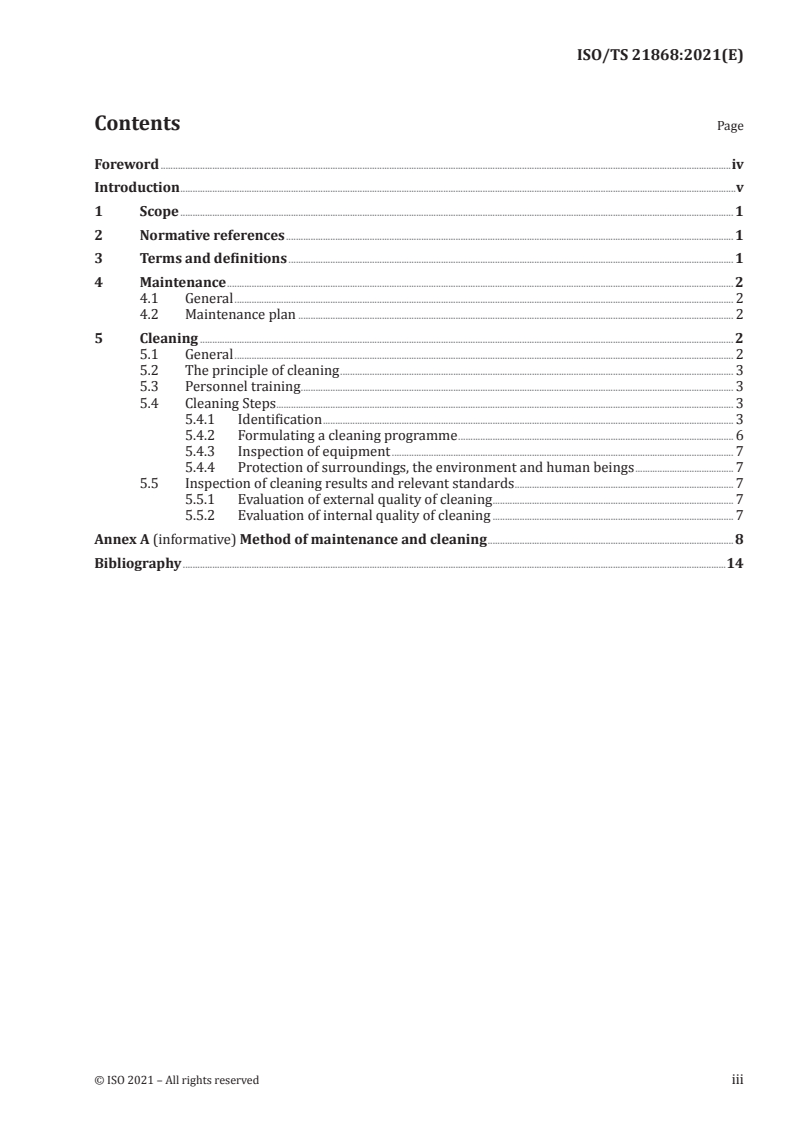
Contents Page
Foreword .iv
Introduction .v
1 Scope . 1
2 Normative references . 1
3 Terms and definitions . 1
4 Maintenance . 2
4.1 General . 2
4.2 Maintenance plan . 2
5 Cleaning . 2
5.1 General . 2
5.2 The principle of cleaning . 3
5.3 Personnel training . 3
5.4 Cleaning Steps . 3
5.4.1 Identification . 3
5.4.2 Formulating a cleaning programme . 6
5.4.3 Inspection of equipment . 7
5.4.4 Protection of surroundings, the environment and human beings . 7
5.5 Inspection of cleaning results and relevant standards . 7
5.5.1 Evaluation of external quality of cleaning . 7
5.5.2 Evaluation of internal quality of cleaning . 7
Annex A (informative) Method of maintenance and cleaning . 8
Bibliography .14
Foreword
ISO (the International Organization for Standardization) is a worldwide federation of national standards
bodies (ISO member bodies). The work of preparing International Standards is normally carried out
through ISO technical committees. Each member body interested in a subject for which a technical
committee has been established has the right to be represented on that committee. International
organizations, governmental and non-governmental, in liaison with ISO, also take part in the work.
ISO collaborates closely with the International Electrotechnical Commission (IEC) on all matters of
electrotechnical standardization.
The procedures used to develop this document and those intended for its further maintenance are
described in the ISO/IEC Directives, Part 1. In particular, the different approval criteria needed for the
different types of ISO documents should be noted. This document was drafted in accordance with the
editorial rules of the ISO/IEC Directives, Part 2 (see www .iso .org/ directives).
Attention is drawn to the possibility that some of the elements of this document may be the subject of
patent rights. ISO shall not be held responsible for identifying any or all such patent rights. Details of
any patent rights identified during the development of the document will be in the Introduction and/or
on the ISO list of patent declarations received (see www .iso .org/ patents).
Any trade name used in this document is information given for the convenience of users and does not
constitute an endorsement.
For an explanation of the voluntary nature of standards, the meaning of ISO specific terms and
expressions related to conformity assessment, as well as information about ISO's adherence to the
World Trade Organization (WTO) principles in the Technical Barriers to Trade (TBT), see www .iso .org/
iso/ foreword .html.
This document was prepared by Technical Committee ISO/TC 219, Floor coverings.
Any feedback or questions on this document should be directed to the user’s national standards body. A
complete listing of these bodies can be found at www .iso .org/ members .html.
iv © ISO 2021 – All rights reserved
Introduction
This document is designed for global governments, relative enterprise associations and textile floor
covering maintenance and cleaning enterprises to develop their own specific textile floor covering
maintenance and cleaning standards or procedures in accordance with the local conditions. Due to
diversity of different regions in climates, customs and developing levels in the world, it is extremely
difficult to create a specific textile floor covering maintenance and cleaning standard as a template
which is globally workable. In addition, the factors which impact the result of cleaning are so abundant
and the combinations of these factors so tremendous that particular programmes are necessary to
acquire the best result of textile floor covering cleaning.
This guidance standard manages to list all the factors which affect the final results of cleaning, against
which global governments, relative enterprises associations and textile floor covering maintenance and
cleaning enterprises are able to establish the above-mentioned particular programmes (procedures or
criteria) in their standards accordingly. Therefore, this standard is intended to be used by end-users to
perform any specific maintenance and cleaning jobs.
This comprehensive guidance standard is intended to pave the way for global governments and relative
enterprise associations to establish specific standards for:
— regulating the development of the textile floor covering cleaning industry,
— promoting the development of the textile floor covering cleaning detergent and equipment industry,
— improving textile floor covering cleaning techniques, and
— improving sales of textile floor coverings,
since specific textile floor covering maintenance and cleaning standards are still absent in most nations.
NOTE The term "textile floor coverings" applies to wall to wall carpets, broadloom carpets, rugs, mat and
tile carpets.
TECHNICAL SPECIFICATION ISO/TS 21868:2021(E)
Textile floor coverings — State of the art and guidance on
maintenance and cleaning
1 Scope
This document specifies guidelines for the development of specific textile floor covering maintenance
and cleaning standards, procedures and criteria to reflect locally specific conditions. This document
specifies the factors which are likely to impact the final results of textile floor covering cleaning,
defining maintenance and cleaning terms to highlight differences. It establishes low-cost, non-residue
and environmentally-friendly guidance for textile floor covering maintenance and cleaning under the
premise of maximizing the use value of textile floor covering.
2 Normative references
There are no normative references in this document.
3 Terms and definitions
For the purposes of this document, the following terms and definitions apply.
ISO and IEC maintain terminological databases for use in standardization at the following addresses:
— ISO Online browsing platform: available at https:// www .iso .org/ obp
— IEC Electropedia: available at http:// www .electropedia .org/
3.1
soil
any matter that is foreign to the construction of the textile floor covering
3.2
spill
wet, dry, oily or combination states of matter that are accidentally deposited on the textile floor covering
Note 1 to entry: Depending on the composition of the spill, quick response time and cleaning procedures can
assist in minimizing the probability of it becoming a spot or a stain.
3.3
spot
foreign material on the surface of a fibre, usually changing the texture of the fibre
EXAMPLE Sticky, oily, greasy, stiff.
Note 1 to entry: Spots can usually be removed. However, some spots, if left untreated for too long, can become
stains.
3.4
stain
indication of the addition of colour, frequently in liquid or pigment form that has been strongly attracted
to the textile floor covering fibre
Note 1 to entry: This added dye or pigment can bind to a dye site and actually alter the structure of the fibre. Not
all stains respond positively to removal efforts.
3.5
interim cleaning
removal of topical appearance soil from textile flooring and return of the textile floor covering to a dry
and usable state within a short period of time
3.6
restorative cleaning
thorough removal of soil both on the textile floor covering surface and embedded within the textile
floor covering construction
4 Maintenance
4.1 General
Maintenance is the protection of textile floor coverings, vacuuming and timely removal of spills and
dust which can be operated by non-professionals. Textile floor covering maintenance requires a user to
develop a maintenance programme, which can be provided with the help of the textile floor covering
manufacturer or provided or assisted by a contracted textile floor covering cleaner.
The significance of textile floor covering maintenance is that it is the first key step in extending the
service life of the textile floor covering, and the simplest and most economical and effective means of
preventing the textile floor covering from being soiled.
4.2 Maintenance plan
The maintenance includes:
— Laying of door mats, which are for scraping soil and absorbing moisture. Pay attention to the length
of door mats to prevent people from stepping over them. If necessary, a reminder for scraping shoes
is recommended in case the door mat is too small.
— Timely removal of spills.
— Division of the textile floor coverings regions based on varying traffic frequency and varying
functions to formulate a vacuum cycle accordingly.
— Protection of the textile floor coverings during the laying and maintenance of other flooring
materials and furniture nearby.
— Provision of temporary or permanent convenient bins and ashtrays in special function areas.
— Controlling of the dehumidification equipment to maintain the necessary dryness to prevent the
room from developing mildew.
The maintenance programme should be discussed and made when customizing the textile floor
coverings with the assistance of the textile floor covering manufacturer or professional textile floor
covering cleaner to match the overall interior space design.
5 Cleaning
5.1 General
Cleaning is the process of locating, identifying, containing, removing and properly disposing of soil,
performed by professionals with professional equipment and under standard programmes.
Cleaning requires professional personnel and equipment to be implemented in accordance with
professional programmes. Either interim cleaning or restorative cleaning, professional personnel,
professional equipment and conformant procedures are necessary. Cleaning is mostly likely to be
2 © ISO 2021 – All rights reserved
conducted by an independent service provider, either a professional cleaning service company or
the manufacturer, other than the user, unless the user keeps a professional team with professional
equipment, cleaning agents and a professional programme.
5.2 The principle of cleaning
The principles of cleaning are:
— Restoring the use value of textile floor coverings.
— Green environmental protection before and after cleaning.
— Having practices which are harmless to practitioners and users.
— Maintaining or restoring special properties attached to textile floor coverings: including but not
limited to fire proof post-treatment and anti-static post-treatment.
At the same time, it should be clear that cleaning a textile floor covering is not to transform the textile
floor covering into a new one, but to remove the soil on the textile floor covering as completely as
possible, and if necessary, repairs can be performed. Even after professional cleaning, it is possible that
damage will not be able to be reversed due to permanent changes of colour or fibre.
5.3 Personnel training
Qualified and professional personnel are prerequisites for ensuring cleaning quality, cleaning
personnel safety and environmental protection. Cleaning personnel shall be professionally trained by a
professional company or organization before going on duty. The training shall cover not only cleaning,
but also textile floor covering quality, laying and repairing.
5.4 Cleaning Steps
5.4.1 Identification
5.4.1.1 General
Identification is the most important step in a textile floor covering cleaning process and a complete
identification of the factors which affect the cleaning result is required for the development of cleaning
standards or individual cleaning programmes.
5.4.1.2 Identification of textile floor covering appearance and defects
Observe the overall state of the textile floor covering appearance and search for defects. Locate the
spill, spot and stain. Ask the textile floor covering user about the textile floor covering laying time,
the time and manner of the most recent cleaning, and ask the textile floor covering user for a textile
floor covering maintenance programme and its relative execution record if the user has this, in order to
determine roughly how to clean it.
5.4.1.3 Identification of textile floor covering laying quality
The laying quality defects mentioned below will directly lead to defects in cleaning results:
a) If the textile floor covering is not stretched tightly and results in surface wrinkles, during the
cleaning process, the textile floor covering surface can show watermark and shadow after cleaning
and even damage to part of the textile floor covering pile.
b) If the edge of the textile floor covering is unevenly trimmed, leading lead to burrs, during the
cleaning process, the pile can be pulled out, seriously damaging the textile floor covering.
c) If the textile floor covering is not fixed firmly, during the cleaning process, the textile floor covering
can shrink and cause crevices.
d) If the textile floor covering is not spliced strongly, the textile floor covering seam will crack after
drying.
5.4.1.4 Identification of the textile floor covering surroundings
Identify adjacent furniture, equipment, floor coverings and the building itself to avoid any damage,
harm or electric shock when on-site cleaning is conducted.
5.4.1.5 Identification of climate and season
Identifying local climate and seasons is necessary to restore the qualified water content of the textile
floor covering after cleaning in time.
5.4.1.6 Identification of special textile floor covering function
Determine whether the textile floor covering has special functions in a special functional area. Post-
treatment of fire-proof and anti-static functions shall be maintained or restored after cleaning. Special
attention should be drawn to these special locations, such as laboratories, hospitals, workshops for
electronic devices and elevators, as well as certain special functional areas of a hotel. For example,
static electricity can damage elevators; being fire-proof can be a requirement for an area in a hotel
where smoking is permitted permanently or temporarily.
5.4.1.7 Identification of product quality
a) Ask textile floor covering users for product labels and cleaning instructions from textile floor
covering manufacturers.
b) Determine the material of the textile floor covering pile (see Table 1), the type of pile, the length of
pile, the pile weight.
c) Determine the structure of the textile floor covering formation: hand-knotted, hand-tufted, semi-
handmade, machine made, etc.
d) Determine whether the formation of textile floor coverings and the adhesive (if any) adapts to
washing, and the times of washing.
e) Determine the physical and chemical properties of the base material.
f) Determine if there are post-treatments, such as fireproof post-treatment and/or anti-static post-
treatment, to ensure that cleaning does not compromise the special properties, or completely
restore these properties by reprocessing the post treatments.
Table 1 — Fibre identification burn test
Withdrawn
Fibre Burning Flame colour Smoke Odour Residue
from flame
Burns
Cotton, Continues to
readily Yellow White Burning paper Soft grey ash
rayon burn
and quickly
Burns Continues to Grey ash,
Linen Orange White Burning grass
readily burn skeleton of fabric
Self-extinguish- Does not flare Black brittle
Wool Burns slowly White Burning hair
ing up swollen ash
Self-extinguish- Does not flare Burns to black
Silk Burns slowly White Burning hair
ing up ash
4 © ISO 2021 – All rights reserved
Table 1 (continued)
Withdrawn
Fibre Burning Flame colour Smoke Odour Residue
from flame
Burns and Continues to Pleasant,
Polyester Red/yellow Black Dark, hard bead
melts burn and melt distinctive
Burns slowly Often self- Light coloured or
Nylon Yellow White Burning wax
and melts extinguishing fawn hard bead
Burns and Continues to Luminous red Acrid,
Acrylic Black Brittle black bead
melts burn and melt smoky flame charred meat
Light
Polypropyl- Burns and Burns and
Yellow Asphalt paraffin Tough, hard, dark
ene melts melts
grey
5.4.1.8 Identification of the cleaning objectives
a) Appearance identification method: identify the material by observing the appearance of the soil,
for example: various food juices, paint stains, etc.
b) Colour identification method: Identify the material by unique colour of the soil, such as ink, dye,
paint, blood stains, etc.
c) Sensory identification method: Identify the material by hand feeling and observation, such as sugar
stains and glue. This should rely on the accumulation of long-term experience and knowledge.
d) Location identification method: Identify soil based on its location.
e) Odour identification method: Identify soil based on the unique smell of soil, such as perfume, wine,
chewing gum, etc.
f) Chemical testing: For particularly expensive textile floor coverings, laboratory chemical methods
should be used for identification if necessary.
g) Ask for the customs of using textile floor covering; in case of close touch with human being,
especially with bare skin, inactivation is necessary.
It is necessary to identify the states of soil according to the classification of the three types defined above,
i.e. spill, spot and stain. Spill, spot and stain removal chemicals shall be of a type that does not harm
textile floor coverings when used in accordance with the chemical manufacturer’s recommendations.
See Table 2 for the types of soil and the relative detergent categories of disposal.
Table 2 — Soil guide
Acid Neutral Alkaline Citrus Enzyme
Rust Dry
Deter- Deter- Deter- Deter- Oxidizer Deter-
Remover Vacuum
gent gent gent gent gent
Blood ① ② ③
Browning
① ②
(cellulosic)
Chewing gum ①
Coffee ② ① ⑤ ④ ③
Cola ① ②
Copler toner ④ ①②③
Grease & oil ①
Ice melt build up ② ①
Ink (waterbased) ① ② ③
Marker ① ②
Table 2 (continued)
Acid Neutral Alkaline Citrus Enzyme
Rust Dry
Deter- Deter- Deter- Deter- Oxidizer Deter-
Remover Vacuum
gent gent gent gent gent
Milk ①
Mustard ② ① ④ ③
Nail polish ② ① ③
Paint (oil-based) ① ②
Paint (latex) ② ①
Rust ② ①
Urine ① ③ ②
Vomit ① ③ ②
① Step One ② Step Two (if necessary) ③ Step Three (if necessary) ④ Step Four (if necessary) ⑤ Step Five (if
necessary)
CAUTION — Textile floor covering cleaning and maintenance enterprises shall fix specific formula and
concentration after identifying product quality and cleaning objectives to ensure no harm to the textile
floor covering, cleaning practitioners and environment. If detergents are purchased from detergent sup-
pliers, textile floor covering cleaning and maintenance enterprises shall follow the instructions for that
detergent. If necessary, a test on a small part of the textile floor covering shall be performed prior to the
cleaning operation to ensure the safety and applicability of the detergent.
5.4.1.9 Identification of allergy patient and weak human beings
This subclause concerns allergy patient or weak human being in hospital, kindergarten, baby nursing
homes and senior nursing centres. Less chemical detergent usage, no residue and inactivation can be
considered. For allergy patients, the relative allergens shall be clarified before cleaning to avoid any
allergenic chemical detergent and/or thorough inactivation of the allergenic living organism shall be
carried out to protect users' health and safety.
5.4.1.10 Note and confirmation
The above identification should be recorded. In particular, the results of laying quality defects and
other textile floor covering defect identifi
...
TECHNICAL ISO/TS
SPECIFICATION 21868
First edition
2021-06
Textile floor coverings — State of the
art and guidance on maintenance and
cleaning
Revêtements de sol textiles — Etat de l'art et recommandations
relatives à l'entretien et au nettoyage
Reference number
©
ISO 2021
© ISO 2021
All rights reserved. Unless otherwise specified, or required in the context of its implementation, no part of this publication may
be reproduced or utilized otherwise in any form or by any means, electronic or mechanical, including photocopying, or posting
on the internet or an intranet, without prior written permission. Permission can be requested from either ISO at the address
below or ISO’s member body in the country of the requester.
ISO copyright office
CP 401 • Ch. de Blandonnet 8
CH-1214 Vernier, Geneva
Phone: +41 22 749 01 11
Email: copyright@iso.org
Website: www.iso.org
Published in Switzerland
ii © ISO 2021 – All rights reserved
Contents Page
Foreword .iv
Introduction .v
1 Scope . 1
2 Normative references . 1
3 Terms and definitions . 1
4 Maintenance . 2
4.1 General . 2
4.2 Maintenance plan . 2
5 Cleaning . 2
5.1 General . 2
5.2 The principle of cleaning . 3
5.3 Personnel training . 3
5.4 Cleaning Steps . 3
5.4.1 Identification . 3
5.4.2 Formulating a cleaning programme . 6
5.4.3 Inspection of equipment . 7
5.4.4 Protection of surroundings, the environment and human beings . 7
5.5 Inspection of cleaning results and relevant standards . 7
5.5.1 Evaluation of external quality of cleaning . 7
5.5.2 Evaluation of internal quality of cleaning . 7
Annex A (informative) Method of maintenance and cleaning . 8
Bibliography .14
Foreword
ISO (the International Organization for Standardization) is a worldwide federation of national standards
bodies (ISO member bodies). The work of preparing International Standards is normally carried out
through ISO technical committees. Each member body interested in a subject for which a technical
committee has been established has the right to be represented on that committee. International
organizations, governmental and non-governmental, in liaison with ISO, also take part in the work.
ISO collaborates closely with the International Electrotechnical Commission (IEC) on all matters of
electrotechnical standardization.
The procedures used to develop this document and those intended for its further maintenance are
described in the ISO/IEC Directives, Part 1. In particular, the different approval criteria needed for the
different types of ISO documents should be noted. This document was drafted in accordance with the
editorial rules of the ISO/IEC Directives, Part 2 (see www .iso .org/ directives).
Attention is drawn to the possibility that some of the elements of this document may be the subject of
patent rights. ISO shall not be held responsible for identifying any or all such patent rights. Details of
any patent rights identified during the development of the document will be in the Introduction and/or
on the ISO list of patent declarations received (see www .iso .org/ patents).
Any trade name used in this document is information given for the convenience of users and does not
constitute an endorsement.
For an explanation of the voluntary nature of standards, the meaning of ISO specific terms and
expressions related to conformity assessment, as well as information about ISO's adherence to the
World Trade Organization (WTO) principles in the Technical Barriers to Trade (TBT), see www .iso .org/
iso/ foreword .html.
This document was prepared by Technical Committee ISO/TC 219, Floor coverings.
Any feedback or questions on this document should be directed to the user’s national standards body. A
complete listing of these bodies can be found at www .iso .org/ members .html.
iv © ISO 2021 – All rights reserved
Introduction
This document is designed for global governments, relative enterprise associations and textile floor
covering maintenance and cleaning enterprises to develop their own specific textile floor covering
maintenance and cleaning standards or procedures in accordance with the local conditions. Due to
diversity of different regions in climates, customs and developing levels in the world, it is extremely
difficult to create a specific textile floor covering maintenance and cleaning standard as a template
which is globally workable. In addition, the factors which impact the result of cleaning are so abundant
and the combinations of these factors so tremendous that particular programmes are necessary to
acquire the best result of textile floor covering cleaning.
This guidance standard manages to list all the factors which affect the final results of cleaning, against
which global governments, relative enterprises associations and textile floor covering maintenance and
cleaning enterprises are able to establish the above-mentioned particular programmes (procedures or
criteria) in their standards accordingly. Therefore, this standard is intended to be used by end-users to
perform any specific maintenance and cleaning jobs.
This comprehensive guidance standard is intended to pave the way for global governments and relative
enterprise associations to establish specific standards for:
— regulating the development of the textile floor covering cleaning industry,
— promoting the development of the textile floor covering cleaning detergent and equipment industry,
— improving textile floor covering cleaning techniques, and
— improving sales of textile floor coverings,
since specific textile floor covering maintenance and cleaning standards are still absent in most nations.
NOTE The term "textile floor coverings" applies to wall to wall carpets, broadloom carpets, rugs, mat and
tile carpets.
TECHNICAL SPECIFICATION ISO/TS 21868:2021(E)
Textile floor coverings — State of the art and guidance on
maintenance and cleaning
1 Scope
This document specifies guidelines for the development of specific textile floor covering maintenance
and cleaning standards, procedures and criteria to reflect locally specific conditions. This document
specifies the factors which are likely to impact the final results of textile floor covering cleaning,
defining maintenance and cleaning terms to highlight differences. It establishes low-cost, non-residue
and environmentally-friendly guidance for textile floor covering maintenance and cleaning under the
premise of maximizing the use value of textile floor covering.
2 Normative references
There are no normative references in this document.
3 Terms and definitions
For the purposes of this document, the following terms and definitions apply.
ISO and IEC maintain terminological databases for use in standardization at the following addresses:
— ISO Online browsing platform: available at https:// www .iso .org/ obp
— IEC Electropedia: available at http:// www .electropedia .org/
3.1
soil
any matter that is foreign to the construction of the textile floor covering
3.2
spill
wet, dry, oily or combination states of matter that are accidentally deposited on the textile floor covering
Note 1 to entry: Depending on the composition of the spill, quick response time and cleaning procedures can
assist in minimizing the probability of it becoming a spot or a stain.
3.3
spot
foreign material on the surface of a fibre, usually changing the texture of the fibre
EXAMPLE Sticky, oily, greasy, stiff.
Note 1 to entry: Spots can usually be removed. However, some spots, if left untreated for too long, can become
stains.
3.4
stain
indication of the addition of colour, frequently in liquid or pigment form that has been strongly attracted
to the textile floor covering fibre
Note 1 to entry: This added dye or pigment can bind to a dye site and actually alter the structure of the fibre. Not
all stains respond positively to removal efforts.
3.5
interim cleaning
removal of topical appearance soil from textile flooring and return of the textile floor covering to a dry
and usable state within a short period of time
3.6
restorative cleaning
thorough removal of soil both on the textile floor covering surface and embedded within the textile
floor covering construction
4 Maintenance
4.1 General
Maintenance is the protection of textile floor coverings, vacuuming and timely removal of spills and
dust which can be operated by non-professionals. Textile floor covering maintenance requires a user to
develop a maintenance programme, which can be provided with the help of the textile floor covering
manufacturer or provided or assisted by a contracted textile floor covering cleaner.
The significance of textile floor covering maintenance is that it is the first key step in extending the
service life of the textile floor covering, and the simplest and most economical and effective means of
preventing the textile floor covering from being soiled.
4.2 Maintenance plan
The maintenance includes:
— Laying of door mats, which are for scraping soil and absorbing moisture. Pay attention to the length
of door mats to prevent people from stepping over them. If necessary, a reminder for scraping shoes
is recommended in case the door mat is too small.
— Timely removal of spills.
— Division of the textile floor coverings regions based on varying traffic frequency and varying
functions to formulate a vacuum cycle accordingly.
— Protection of the textile floor coverings during the laying and maintenance of other flooring
materials and furniture nearby.
— Provision of temporary or permanent convenient bins and ashtrays in special function areas.
— Controlling of the dehumidification equipment to maintain the necessary dryness to prevent the
room from developing mildew.
The maintenance programme should be discussed and made when customizing the textile floor
coverings with the assistance of the textile floor covering manufacturer or professional textile floor
covering cleaner to match the overall interior space design.
5 Cleaning
5.1 General
Cleaning is the process of locating, identifying, containing, removing and properly disposing of soil,
performed by professionals with professional equipment and under standard programmes.
Cleaning requires professional personnel and equipment to be implemented in accordance with
professional programmes. Either interim cleaning or restorative cleaning, professional personnel,
professional equipment and conformant procedures are necessary. Cleaning is mostly likely to be
2 © ISO 2021 – All rights reserved
conducted by an independent service provider, either a professional cleaning service company or
the manufacturer, other than the user, unless the user keeps a professional team with professional
equipment, cleaning agents and a professional programme.
5.2 The principle of cleaning
The principles of cleaning are:
— Restoring the use value of textile floor coverings.
— Green environmental protection before and after cleaning.
— Having practices which are harmless to practitioners and users.
— Maintaining or restoring special properties attached to textile floor coverings: including but not
limited to fire proof post-treatment and anti-static post-treatment.
At the same time, it should be clear that cleaning a textile floor covering is not to transform the textile
floor covering into a new one, but to remove the soil on the textile floor covering as completely as
possible, and if necessary, repairs can be performed. Even after professional cleaning, it is possible that
damage will not be able to be reversed due to permanent changes of colour or fibre.
5.3 Personnel training
Qualified and professional personnel are prerequisites for ensuring cleaning quality, cleaning
personnel safety and environmental protection. Cleaning personnel shall be professionally trained by a
professional company or organization before going on duty. The training shall cover not only cleaning,
but also textile floor covering quality, laying and repairing.
5.4 Cleaning Steps
5.4.1 Identification
5.4.1.1 General
Identification is the most important step in a textile floor covering cleaning process and a complete
identification of the factors which affect the cleaning result is required for the development of cleaning
standards or individual cleaning programmes.
5.4.1.2 Identification of textile floor covering appearance and defects
Observe the overall state of the textile floor covering appearance and search for defects. Locate the
spill, spot and stain. Ask the textile floor covering user about the textile floor covering laying time,
the time and manner of the most recent cleaning, and ask the textile floor covering user for a textile
floor covering maintenance programme and its relative execution record if the user has this, in order to
determine roughly how to clean it.
5.4.1.3 Identification of textile floor covering laying quality
The laying quality defects mentioned below will directly lead to defects in cleaning results:
a) If the textile floor covering is not stretched tightly and results in surface wrinkles, during the
cleaning process, the textile floor covering surface can show watermark and shadow after cleaning
and even damage to part of the textile floor covering pile.
b) If the edge of the textile floor covering is unevenly trimmed, leading lead to burrs, during the
cleaning process, the pile can be pulled out, seriously damaging the textile floor covering.
c) If the textile floor covering is not fixed firmly, during the cleaning process, the textile floor covering
can shrink and cause crevices.
d) If the textile floor covering is not spliced strongly, the textile floor covering seam will crack after
drying.
5.4.1.4 Identification of the textile floor covering surroundings
Identify adjacent furniture, equipment, floor coverings and the building itself to avoid any damage,
harm or electric shock when on-site cleaning is conducted.
5.4.1.5 Identification of climate and season
Identifying local climate and seasons is necessary to restore the qualified water content of the textile
floor covering after cleaning in time.
5.4.1.6 Identification of special textile floor covering function
Determine whether the textile floor covering has special functions in a special functional area. Post-
treatment of fire-proof and anti-static functions shall be maintained or restored after cleaning. Special
attention should be drawn to these special locations, such as laboratories, hospitals, workshops for
electronic devices and elevators, as well as certain special functional areas of a hotel. For example,
static electricity can damage elevators; being fire-proof can be a requirement for an area in a hotel
where smoking is permitted permanently or temporarily.
5.4.1.7 Identification of product quality
a) Ask textile floor covering users for product labels and cleaning instructions from textile floor
covering manufacturers.
b) Determine the material of the textile floor covering pile (see Table 1), the type of pile, the length of
pile, the pile weight.
c) Determine the structure of the textile floor covering formation: hand-knotted, hand-tufted, semi-
handmade, machine made, etc.
d) Determine whether the formation of textile floor coverings and the adhesive (if any) adapts to
washing, and the times of washing.
e) Determine the physical and chemical properties of the base material.
f) Determine if there are post-treatments, such as fireproof post-treatment and/or anti-static post-
treatment, to ensure that cleaning does not compromise the special properties, or completely
restore these properties by reprocessing the post treatments.
Table 1 — Fibre identification burn test
Withdrawn
Fibre Burning Flame colour Smoke Odour Residue
from flame
Burns
Cotton, Continues to
readily Yellow White Burning paper Soft grey ash
rayon burn
and quickly
Burns Continues to Grey ash,
Linen Orange White Burning grass
readily burn skeleton of fabric
Self-extinguish- Does not flare Black brittle
Wool Burns slowly White Burning hair
ing up swollen ash
Self-extinguish- Does not flare Burns to black
Silk Burns slowly White Burning hair
ing up ash
4 © ISO 2021 – All rights reserved
Table 1 (continued)
Withdrawn
Fibre Burning Flame colour Smoke Odour Residue
from flame
Burns and Continues to Pleasant,
Polyester Red/yellow Black Dark, hard bead
melts burn and melt distinctive
Burns slowly Often self- Light coloured or
Nylon Yellow White Burning wax
and melts extinguishing fawn hard bead
Burns and Continues to Luminous red Acrid,
Acrylic Black Brittle black bead
melts burn and melt smoky flame charred meat
Light
Polypropyl- Burns and Burns and
Yellow Asphalt paraffin Tough, hard, dark
ene melts melts
grey
5.4.1.8 Identification of the cleaning objectives
a) Appearance identification method: identify the material by observing the appearance of the soil,
for example: various food juices, paint stains, etc.
b) Colour identification method: Identify the material by unique colour of the soil, such as ink, dye,
paint, blood stains, etc.
c) Sensory identification method: Identify the material by hand feeling and observation, such as sugar
stains and glue. This should rely on the accumulation of long-term experience and knowledge.
d) Location identification method: Identify soil based on its location.
e) Odour identification method: Identify soil based on the unique smell of soil, such as perfume, wine,
chewing gum, etc.
f) Chemical testing: For particularly expensive textile floor coverings, laboratory chemical methods
should be used for identification if necessary.
g) Ask for the customs of using textile floor covering; in case of close touch with human being,
especially with bare skin, inactivation is necessary.
It is necessary to identify the states of soil according to the classification of the three types defined above,
i.e. spill, spot and stain. Spill, spot and stain removal chemicals shall be of a type that does not harm
textile floor coverings when used in accordance with the chemical manufacturer’s recommendations.
See Table 2 for the types of soil and the relative detergent categories of disposal.
Table 2 — Soil guide
Acid Neutral Alkaline Citrus Enzyme
Rust Dry
Deter- Deter- Deter- Deter- Oxidizer Deter-
Remover Vacuum
gent gent gent gent gent
Blood ① ② ③
Browning
① ②
(cellulosic)
Chewing gum ①
Coffee ② ① ⑤ ④ ③
Cola ① ②
Copler toner ④ ①②③
Grease & oil ①
Ice melt build up ② ①
Ink (waterbased) ① ② ③
Marker ① ②
Table 2 (continued)
Acid Neutral Alkaline Citrus Enzyme
Rust Dry
Deter- Deter- Deter- Deter- Oxidizer Deter-
Remover Vacuum
gent gent gent gent gent
Milk ①
Mustard ② ① ④ ③
Nail polish ② ① ③
Paint (oil-based) ① ②
Paint (latex) ② ①
Rust ② ①
Urine ① ③ ②
Vomit ① ③ ②
① Step One ② Step Two (if necessary) ③ Step Three (if necessary) ④ Step Four (if necessary) ⑤ Step Five (if
necessary)
CAUTION — Textile floor covering cleaning and maintenance enterprises shall fix specific formula and
concentration after identifying product quality and cleaning objectives to ensure no harm to the textile
floor covering, cleaning practitioners and environment. If detergents are purchased from detergent sup-
pliers, textile floor covering cleaning and maintenance enterprises shall follow the instructions for that
detergent. If necessary, a test on a small part of the textile floor covering shall be performed prior to the
cleaning operation to ensure the safety and applicability of the detergent.
5.4.1.9 Identification of allergy patient and weak human beings
This subclause concerns allergy patient or weak human being in hospital, kindergarten, baby nursing
homes and senior nursing centres. Less chemical detergent usage, no residue and inactivation can be
considered. For allergy patients, the relative allergens shall be clarified before cleaning to avoid any
allergenic chemical detergent and/or thorough inactivation of the allergenic living organism shall be
carried out to protect users' health and safety.
5.4.1.10 Note and confirmation
The above identification should be recorded. In particular, the results of laying quality defects and
other textile floor covering defect identifi
...
Questions, Comments and Discussion
Ask us and Technical Secretary will try to provide an answer. You can facilitate discussion about the standard in here.
Loading comments...