

ISO 3548-3:2023
(Main)Plain bearings — Thin-walled half bearings with or without flange — Part 3: Determination of the peripheral length
General Information
- Abstract
This document specifies, according to ISO 12301, the checking of the peripheral length of thin-walled half bearings with or without flange, and describes the necessary checking methods and measuring equipment. Thin-walled half bearings are flexible and, in the free condition, do not conform to a cylindrical profile. This is one reason the peripheral length of the half bearings can only be measured under a constraining load by use of specialized measuring equipment. In addition, measuring equipment different from that illustrated in this document can be used, provided the measuring accuracy of the equipment is consistent with the specifications given in Clause 17. This document does not include the measurement of the parting line taper. This document applies to thin-walled half bearings, the specifications of which are given in ISO 3548‑1.
- Status
- Published
- Publication Date
- 15-Mar-2023
- Technical Committee
- ISO/TC 123/SC 5 - Quality analysis and assurance
- Drafting Committee
- ISO/TC 123/SC 5 - Quality analysis and assurance
- Current Stage
- 6060 - International Standard published
- Start Date
- 16-Mar-2023
- Due Date
- 01-Aug-2022
- Completion Date
- 16-Mar-2023
Overview
ISO 3548-3:2023 - Plain bearings - Thin-walled half bearings with or without flange - Part 3: Determination of the peripheral length - defines how to check and measure the peripheral length of thin-walled half bearings. The standard recognizes that these flexible half bearings do not keep a cylindrical shape in the free state, so peripheral length measurement must be performed under a constraining load with specialized measuring equipment. The document describes measurement methods, gauging tools, correction factors and accuracy requirements for reliable peripheral length determination.
Key Topics and Requirements
- Measurement principle: Peripheral length is the circumferential length between parting line faces and must be measured under a constraining load to produce repeatable results.
- Measurement methods: Two principal checking methods are specified (Method A and Method B). The standard covers selection, designation and procedural differences between them.
- Measuring equipment requirements: Detailed requirements include tolerance on checking load setting, speed of approach of the measuring head, construction of the measuring head, accuracy of metering bars and dial gauges, and general instrument accuracy. Alternative equipment is permitted if it meets the accuracy limits in Clause 17.
- Gauging tools and datum establishment: Definitions and requirements for master checking blocks, series checking blocks, master shells and comparison shells used to establish the measurement datum.
- Correction factors and marking: Procedures to determine and apply correction factors for reference tooling (master blocks, series tools, shells) are described, including acceptable wear limits and marking conventions.
- Errors and uncertainty: Identification of error sources (measuring equipment, checking block, correction factor, half bearing behavior, and choice of method) and guidance on repeatability, reproducibility and comparability (Annex E).
- Documentation and control: Specifications to be included on bearing drawings and procedures for control and verification of checking means.
Applications and Who Uses It
ISO 3548-3:2023 is intended for:
- Manufacturers of plain bearings and thin-walled half bearings who need standardized dimensional control.
- Quality assurance and metrology engineers responsible for peripheral length measurement and inspection.
- Tooling and inspection equipment designers supplying master/series checking blocks and shells.
- Procurement, design and maintenance teams specifying bearing tolerances and production acceptance criteria.
Practical benefits include consistent peripheral length measurement, reduced measurement uncertainty, improved interchangeability and documented inspection procedures for production and incoming inspection.
Related Standards
- ISO 3548-1 - Thin-walled half bearings: tolerances, design features and methods of test (applies to the part geometry covered by ISO 3548-3).
- ISO 12301 - Quality control techniques and inspection of geometrical and material quality characteristics (referenced for checking methodology).
Keywords: ISO 3548-3:2023, thin-walled half bearings, peripheral length measurement, plain bearings, checking methods, measuring equipment, correction factor, master checking block.
Relations
- Effective Date
- 23-Apr-2020
Frequently Asked Questions
ISO 3548-3:2023 is a standard published by the International Organization for Standardization (ISO). Its full title is "Plain bearings — Thin-walled half bearings with or without flange — Part 3: Determination of the peripheral length". This standard covers: This document specifies, according to ISO 12301, the checking of the peripheral length of thin-walled half bearings with or without flange, and describes the necessary checking methods and measuring equipment. Thin-walled half bearings are flexible and, in the free condition, do not conform to a cylindrical profile. This is one reason the peripheral length of the half bearings can only be measured under a constraining load by use of specialized measuring equipment. In addition, measuring equipment different from that illustrated in this document can be used, provided the measuring accuracy of the equipment is consistent with the specifications given in Clause 17. This document does not include the measurement of the parting line taper. This document applies to thin-walled half bearings, the specifications of which are given in ISO 3548‑1.
This document specifies, according to ISO 12301, the checking of the peripheral length of thin-walled half bearings with or without flange, and describes the necessary checking methods and measuring equipment. Thin-walled half bearings are flexible and, in the free condition, do not conform to a cylindrical profile. This is one reason the peripheral length of the half bearings can only be measured under a constraining load by use of specialized measuring equipment. In addition, measuring equipment different from that illustrated in this document can be used, provided the measuring accuracy of the equipment is consistent with the specifications given in Clause 17. This document does not include the measurement of the parting line taper. This document applies to thin-walled half bearings, the specifications of which are given in ISO 3548‑1.
ISO 3548-3:2023 is classified under the following ICS (International Classification for Standards) categories: 21.100.10 - Plain bearings. The ICS classification helps identify the subject area and facilitates finding related standards.
ISO 3548-3:2023 has the following relationships with other standards: It is inter standard links to ISO 3548-3:2012. Understanding these relationships helps ensure you are using the most current and applicable version of the standard.
ISO 3548-3:2023 is available in PDF format for immediate download after purchase. The document can be added to your cart and obtained through the secure checkout process. Digital delivery ensures instant access to the complete standard document.
Standards Content (Sample)
INTERNATIONAL ISO
STANDARD 3548-3
Second edition
2023-03
Plain bearings — Thin-walled half
bearings with or without flange —
Part 3:
Determination of the peripheral
length
Paliers lisses — Demi-coussinets minces à collerette ou sans
collerette —
Partie 3: Détermination de la longueur développée
Reference number
© ISO 2023
All rights reserved. Unless otherwise specified, or required in the context of its implementation, no part of this publication may
be reproduced or utilized otherwise in any form or by any means, electronic or mechanical, including photocopying, or posting on
the internet or an intranet, without prior written permission. Permission can be requested from either ISO at the address below
or ISO’s member body in the country of the requester.
ISO copyright office
CP 401 • Ch. de Blandonnet 8
CH-1214 Vernier, Geneva
Phone: +41 22 749 01 11
Email: copyright@iso.org
Website: www.iso.org
Published in Switzerland
ii
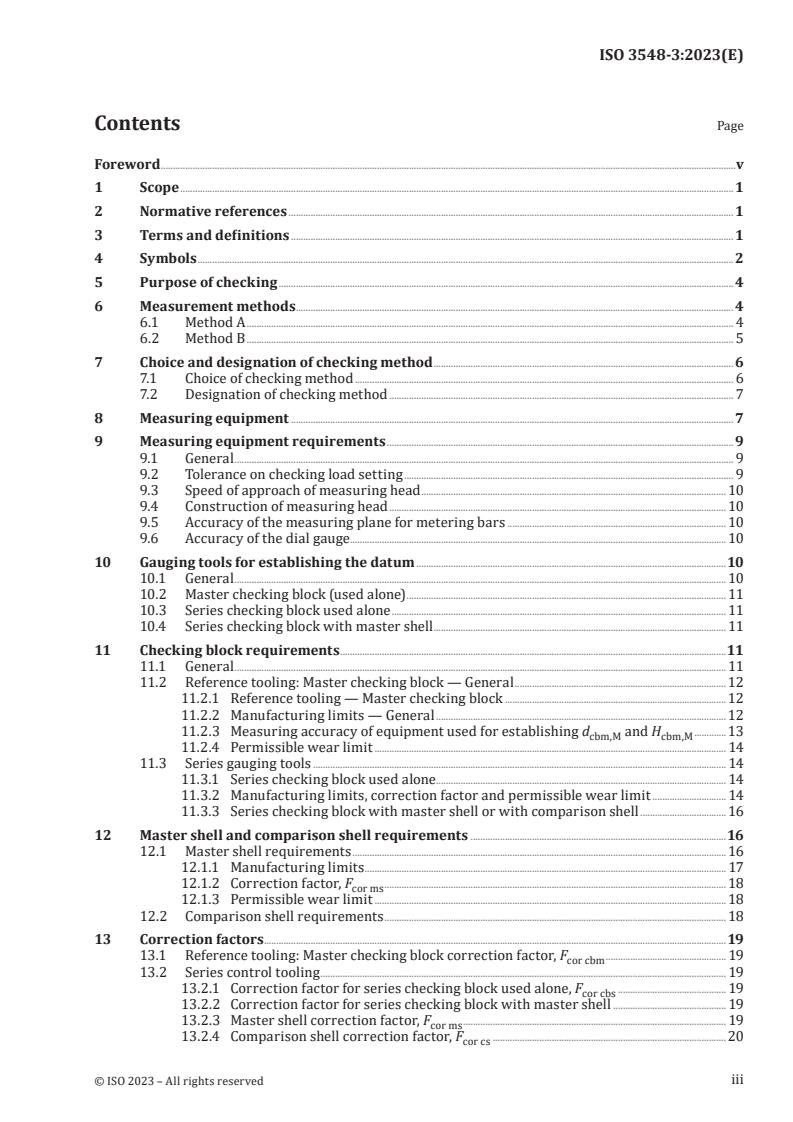
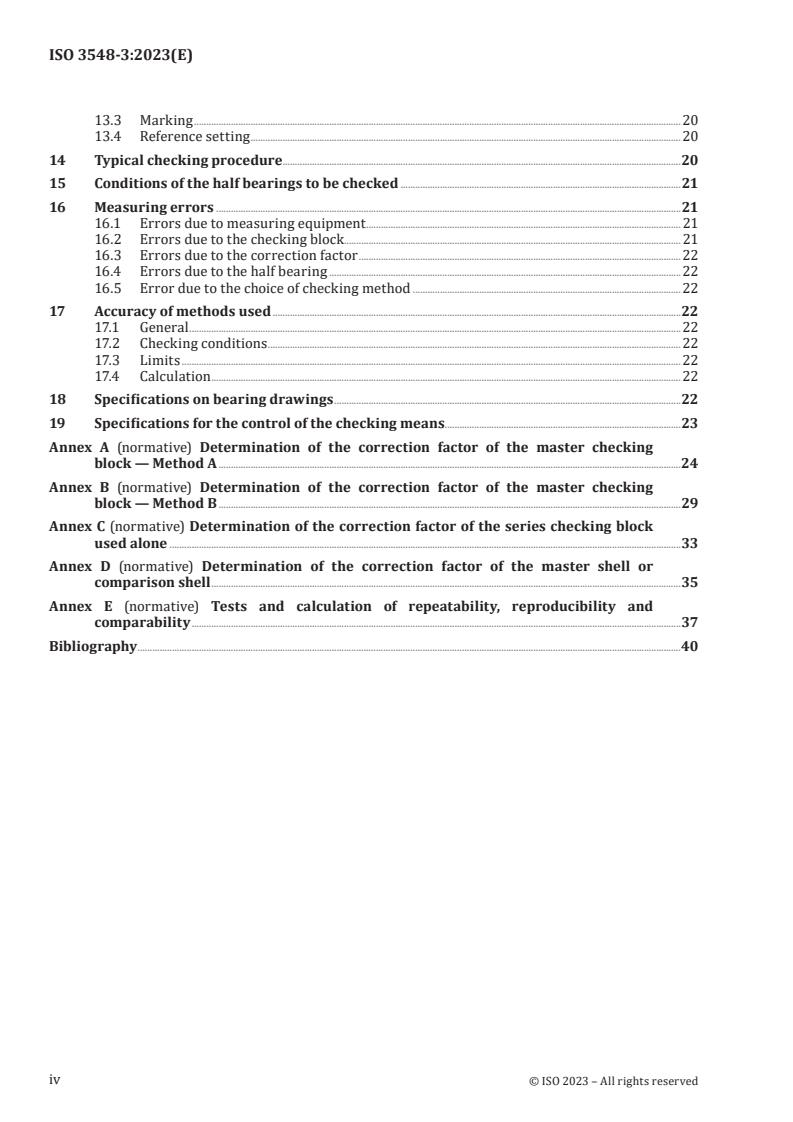
Contents Page
Foreword .v
1 Scope . 1
2 Normative references . 1
3 Terms and definitions . 1
4 Symbols . 2
5 Purpose of checking .4
6 Measurement methods . 4
6.1 Method A . 4
6.2 Method B . 5
7 Choice and designation of checking method . 6
7.1 Choice of checking method . 6
7.2 Designation of checking method . 7
8 Measuring equipment . 7
9 Measuring equipment requirements .9
9.1 General . 9
9.2 Tolerance on checking load setting . 9
9.3 Speed of approach of measuring head . 10
9.4 Construction of measuring head . 10
9.5 Accuracy of the measuring plane for metering bars . 10
9.6 Accuracy of the dial gauge . . . 10
10 Gauging tools for establishing the datum .10
10.1 General . 10
10.2 Master checking block (used alone) . 11
10.3 Series checking block used alone . 11
10.4 Series checking block with master shell . 11
11 Checking block requirements .11
11.1 General . 11
11.2 Reference tooling: Master checking block — General .12
11.2.1 Reference tooling — Master checking block .12
11.2.2 Manufacturing limits — General .12
11.2.3 Measuring accuracy of equipment used for establishing d and H .13
cbm,M cbm,M
11.2.4 Permissible wear limit . 14
11.3 Series gauging tools . 14
11.3.1 Series checking block used alone . . 14
11.3.2 Manufacturing limits, correction factor and permissible wear limit . 14
11.3.3 Series checking block with master shell or with comparison shell . 16
12 Master shell and comparison shell requirements .16
12.1 Master shell requirements . 16
12.1.1 Manufacturing limits . 17
12.1.2 Correction factor, F . 18
cor ms
12.1.3 Permissible wear limit . 18
12.2 Comparison shell requirements . 18
13 Correction factors .19
13.1 Reference tooling: Master checking block correction factor, F . 19
cor cbm
13.2 Series control tooling . 19
13.2.1 Correction factor for series checking block used alone, F . 19
cor cbs
13.2.2 Correction factor for series checking block with master shell . 19
13.2.3 Master shell correction factor, F . 19
cor ms
13.2.4 Comparison shell correction factor, F . 20
cor cs
iii
13.3 Marking . 20
13.4 Reference setting . 20
14 Typical checking procedure.20
15 Conditions of the half bearings to be checked .21
16 Measuring errors .21
16.1 Errors due to measuring equipment . 21
16.2 Errors due to the checking block . 21
16.3 Errors due to the correction factor . 22
16.4 Errors due to the half bearing .22
16.5 Error due to the choice of checking method . 22
17 Accuracy of methods used .22
17.1 General .22
17.2 Checking conditions . 22
17.3 Limits . 22
17.4 Calculation . 22
18 Specifications on bearing drawings .22
19 Specifications for the control of the checking means .23
Annex A (normative) Determination of the correction factor of the master checking
block — Method A .24
Annex B (normative) Determination of the correction factor of the master checking
block — Method B .29
Annex C (normative) Determination of the correction factor of the series checking block
used alone .33
Annex D (normative) Determination of the correction factor of the master shell or
comparison shell .35
Annex E (normative) Tests and calculation of repeatability, reproducibility and
comparability .37
Bibliography .40
iv
Foreword
ISO (the International Organization for Standardization) is a worldwide federation of national standards
bodies (ISO member bodies). The work of preparing International Standards is normally carried out
through ISO technical committees. Each member body interested in a subject for which a technical
committee has been established has the right to be represented on that committee. International
organizations, governmental and non-governmental, in liaison with ISO, also take part in the work.
ISO collaborates closely with the International Electrotechnical Commission (IEC) on all matters of
electrotechnical standardization.
The procedures used to develop this document and those intended for its further maintenance are
described in the ISO/IEC Directives, Part 1. In particular, the different approval criteria needed for the
different types of ISO documents should be noted. This document was drafted in accordance with the
editorial rules of the ISO/IEC Directives, Part 2 (see www.iso.org/directives).
Attention is drawn to the possibility that some of the elements of this document may be the subject of
patent rights. ISO shall not be held responsible for identifying any or all such patent rights. Details of
any patent rights identified during the development of the document will be in the Introduction and/or
on the ISO list of patent declarations received (see www.iso.org/patents).
Any trade name used in this document is information given for the convenience of users and does not
constitute an endorsement.
For an explanation of the voluntary nature of standards, the meaning of ISO specific terms and
expressions related to conformity assessment, as well as information about ISO's adherence to
the World Trade Organization (WTO) principles in the Technical Barriers to Trade (TBT), see
www.iso.org/iso/foreword.html.
This document was prepared by Technical Committee ISO/TC 123, Plain Bearings, Subcommittee SC 5,
Quality analysis and assurance.
This second edition cancels and replaces the first edition (ISO 3548-3:2012), which has been technically
revised.
The main changes are as follows:
— the errors in the calculation form in Annex A, Figure A.1 and Figure A.4 have been corrected;
— the errors in the calculation form in Annex B, Figure B.1 and Figure B.3 have been corrected;
— the errors in the formulae and in the calculated example in Clause E.3 have been corrected.
A list of all parts in the ISO 3548 series can be found on the ISO website.
Any feedback or questions on this document should be directed to the user’s national standards body. A
complete listing of these bodies can be found at www.iso.org/members.html.
v
INTERNATIONAL STANDARD ISO 3548-3:2023(E)
Plain bearings — Thin-walled half bearings with or
without flange —
Part 3:
Determination of the peripheral length
1 Scope
This document specifies, according to ISO 12301, the checking of the peripheral length of thin-walled
half bearings with or without flange, and describes the necessary checking methods and measuring
equipment.
Thin-walled half bearings are flexible and, in the free condition, do not conform to a cylindrical profile.
This is one reason the peripheral length of the half bearings can only be measured under a constraining
load by use of specialized measuring equipment.
In addition, measuring equipment different from that illustrated in this document can be used, provided
the measuring accuracy of the equipment is consistent with the specifications given in Clause 17.
This document does not include the measurement of the parting line taper.
This document applies to thin-walled half bearings, the specifications of which are given in ISO 3548-1.
2 Normative references
The following documents are referred to in the text in such a way that some or all of their content
constitutes requirements of this document. For dated references, only the edition cited applies. For
undated references, the latest edition of the referenced document (including any amendments) applies.
ISO 3548-1, Plain bearings — Thin-walled half bearings with or without flange — Part 1: Tolerances, design
features and methods of test
ISO 12301, Plain bearings — Quality control techniques and inspection of geometrical and material quality
characteristics
3 Terms and definitions
For the purposes of this document, the following terms and definitions apply.
ISO and IEC maintain terminology databases for use in standardization at the following addresses:
— ISO Online browsing platform: available at https:// www .iso .org/ obp
— IEC Electropedia: available at https:// www .electropedia .org/
3.1
peripheral length
circumferential length which runs from one parting line face to the other
3.2
crush height
a
value by which a half bearing, fitted in a checking block of bore diameter, d , under a pre-determined
cb
checking load, F, exceeds the defined peripheral length (3.1) of the checking block bore
Note 1 to entry: In practice, the datum serves as a basis for measuring a (see Figure 1).
Note 2 to entry: The symbol for crush height “(nip)” is no longer used and has been replaced with “a”.
Figure 1 — Crush height, a
3.3
repeatability
closeness of agreement between successive results obtained with the same method on the same test
piece, under the same conditions
Note 1 to entry: Repeatability is assessed from the standard deviation of repeatability σ (see Annex E).
Δ
3.4
reproducibility
closeness of agreement between individual results obtained with the same method on the same
test piece but under different conditions (same or different operator, same, identical or different
measurement equipment, same or different checking place and different times)
Note 1 to entry: For the purposes of this document, reproducibility is the difference between the two averages
obtained from two sets of measuring equipment (see Annex E).
3.5
comparability
accuracy in the case of operators working in different checking places at different periods and each of
them achieving individual results, one using method A and the other using method B, on the same plain
bearing test piece in different checking blocks
Note 1 to entry: Comparability is assessed from the difference between the two averages obtained from the two
methods (see Annex E).
4 Symbols
For the purposes of this document, the following symbols of Table 1 apply.
Table 1 — Symbols and units
Symbol Parameter Unit
a Crush height µm
B Width of the half bearing without flange mm
TTabablele 1 1 ((ccoonnttiinnueuedd))
Symbol Parameter Unit
B Checking block width of the construction for flanged half bearings mm
B Checking block width (bottom width of checking lock) mm
B Checking block width of the construction for half bearings without flange mm
d Diameter mm
D Outside diameter mm
E Elasticity modulus MPa
f Friction coefficient in calculation of deflection under load —
F Checking load (Method A) N
F Checking load, side 1 (Method B) N
F Checking load, side 2 (Method B) N
F Correction factor mm
cor
h Fillet radius between back and flange on flanged half bearing mm
H Distance from the bottom of the checking block bore to the datum face mm
cb
ΔH Elastic deformation of the height of the checking block under load mm
cb
K Checking block chamfer of the construction for half bearings without flange mm
K Checking block chamfer of the construction for flanged half bearings mm
l Peripheral length mm
Δl Deviation of the actual peripheral length of the checking block mm
p Elastic depression of the metering bar mm
E
Ra Surface roughness µm
s Wall thickness mm
t Tolerance value of several features (F, i = 1 to 9) mm
i
t Tolerance of B mm
bms ms
t Tolerance of d mm
dcbm cbm
t Tolerance of d mm
dcbs cbs
t Tolerance of H mm
Hcbm cbm
t Tolerance of H mm
Hcbs cbs
t Tolerance of s mm
sms ms
U Uncertainty of measurement µm
W Width of the metering bar contact area mm
x Measured value of bearing no. i out of bearing set number 1 µm
1i
Measured value of bearing no. i out of bearing set number 2 µm
x
2i
x Arithmetic mean value of measured bearings out of bearing set number 1 µm
Arithmetic mean value of measured bearings out of bearing set number 2 µm
x
x Arithmetic mean value of set of bearings measured according to method A µm
A
Arithmetic mean value of set of bearings measured according to method B µm
x
B
*
Arithmetic mean value x corrected with empirical correction factor δ µm
x A
A
*
µm
Arithmetic mean value x corrected with empirical correction factor δ
B
x
B
z Distance between flanges of the flanged half bearing mm
Empirical correction to compensate for the difference in elastic deflections
δ mm
under load between method A and method B
δ Correction, approximated by calculation mm
x
σ Standard deviation —
The characteristic subscripts are given in Table 2.
Table 2 — Subscripts
Subscript Description
A measurement method A
B measurement method B
B1 position 1 of measurement method B
B2 position 2 of measurement method B
bs bearing to be checked
cb checking block
cbm master checking block
cbs series checking block
cs comparison shell
M measured
max maximum
mean arithmetic mean
min minimum
ms master shell
new origin, beginning of use
th theoretical
tot total
worn wear limit, end of use
1,2 consecutive number
NOTE The following notation for multi-subscripts is used: literal subscripts are
separated by a blank, however, additionally needed numbers are directly connected to the
subscript.
5 Purpose of checking
In order to ensure the required mounting compression (interference fit) for the half bearings in the
housing bore, the crush height tolerances shall be kept as specified in ISO 3548-1 and ISO 12301.
6 Measurement methods
6.1 Method A
The checking load, F, is directly applied via the measuring head with a pivoting metering bar to one
parting line face of the half bearing while the other parting line face is in contact with a fixed stop (see
Figure 2).
The measured crush height according to method A is indicated a .
A
Key
1 fixed stop
2 dial gauge
3 movable measuring head
4 datum
5 metering bar
6 checking block
Figure 2 — Measuring principle of method A
6.2 Method B
The checking loads, F and F , are applied via the measuring head and two metering bars to both parting
1 2
line faces of the half bearing (see Figure 3).
The crush height of method B is the sum of the measurements on the two sides [as shown in Formula (2)]:
aa=+ a (2)
BB12B
Key
1 dial gauge
2 datum
3 rigid metering bar
4 checking block
5 pivoting toe piece
NOTE Bearings can also be checked using two pivoting metering bars.
Figure 3 — Measuring principle of method B
NOTE In the case of method A, the fixed stop exerts the required counterforce, which, in the case of method B,
is applied directly by the measuring equipment via two metering bars.
EXAMPLE
Method A F = 6 000 N
Method B F = 6 000 N
F = 6 000 N
7 Choice and designation of checking method
7.1 Choice of checking method
Recommendations for choosing either method A or method B, based on dimensions of the half bearings
to be checked, are given in Table 3.
However, any size of bearing can be tested by either method by agreement between the manufacturer
and user. In that case, a correction, δ, should be applied to compensate for the difference in deflections
at parting line face(s) under load between method A and method B, and should be implemented as
shown in Formula (3):
aa=+ aa+=δδ+ (3)
AB12BB
The value of δ shall be determined empirically by actual measurements obtained on the two different
types of equipment used. Since the detailed design of the checking feature shall be varied between
different manufacturers, the value of δ established by one manufacturer cannot be transferred to
another, who shall determine it separately. See example in Annex E.
For general guidance, the value of δ can be derived from the formula (Euler-Eytelwein) used in the
mathematical analysis of belt friction, which gives Formula (4):
dF⋅
cb M −−ffππ /2
δ = ⋅+12ee− (4)
()
sB⋅ 2Ef
ms ms
With a value of the friction coefficient f = 0,15, Formula (4) becomes Formula (5):
dF⋅
−7 cb M
δ =⋅710 ⋅ (5)
f =01, 5
sB⋅
ms ms
Table 3 — Selection of checking method
Recommended checking method
D
bs
mm
D ≤ 200 A, B
bs
200 < D ≤ 500 B
bs
7.2 Designation of checking method
An example of the designation of method B for checking thin-walled half bearings with an outside
diameter, D of 340 mm is as follows:
bs
Method ISO 3548-3-B-340
8 Measuring equipment
Figures 4 and 5 show typical measuring equipment for the measurement of the crush height by
method A and by method B, respectively.
Key
1 checking block 6 pressure cylinder
2 pivoting metering bar 7 movable measuring head
3 pressure adjustment valve 8 dial gauge
4 drive motor 9 pressure gauge
5 oil pump
Figure 4 — Typical measuring equipment with one column for method A
NOTE Figures 4 and 5 show hydraulically operated equipment. Pneumatically or mechanically operated
equipment can also be used.
Key
1 rigid metering bar 5 hydraulic ram
2 dial gauge 6 pivoting toe piece
3 movable measuring gauge 7 dial gauge
4 pressure gauge 8 checking block
NOTE The bearings can also be checked using two pivoting metering bars for the rigid metering bar.
Figure 5 — Typical measuring equipment with two columns, for method B
9 Measuring equipment requirements
9.1 General
The most important factors affecting the accuracy of the measuring equipment (and hence the measured
crush height) are given in the following subclauses.
9.2 Tolerance on checking load setting
The permissible tolerances are given in Table 4.
Table 4 — Tolerance ranges for checking loads
Tolerance on F
F t
F
N %
F ≤ 2 000 ±1,25
2 000 < F ≤ 5 000 ±1,00
5 000 < F ≤ 10 000 ±0,75
10 000 < F ≤ 50 000 ±0,50
50 000 < F ±0,25
9.3 Speed of approach of measuring head
The checking load, F, shall be applied to the parting line face(s) of the half bearing so that shock load
shall not occur. The speed of approach shall be consistent.
NOTE A guideline for speed of approach is (10 ± 2) mm/s.
For devices in which the speed of approach cannot be altered, the load shall be applied, released and
applied a second time before the measurement is made.
9.4 Construction of measuring head
The measuring head shall be so designed and manufactured that it is accurately guided and moves
normal to the datum of the checking block. The deviation from parallelism between the metering bar(s)
in the measuring head and the supporting plane of the checking block shall not exceed 0,04 mm per
100 mm in in direction of parting line.
9.5 Accuracy of the measuring plane for metering bars
Specifications on the accuracy of the measuring plane of the metering bars are given in Table 5.
Table 5 — Tolerances of the measuring plane for metering bars
Surface roughness Tolerance on flatness
D Ra t
bs 3
mm µm mm
D ≤ 160 0,2 0,001 5
bs
160 < D ≤ 340 0,003 0
bs
0,4
340 < D ≤ 500 0,004 0
bs
9.6 Accuracy of the dial gauge
The uncertainty of measurement is u ≤ |1,2| µm (±2σ) with σ = 0,3 µm.
10 Gauging tools for establishing the datum
10.1 General
The following equipment can be used for carrying out measurements:
— a master checking block for reference measurements (see Clause 11), or
— a series checking block for series control in production (see Clause 11), or
— a master shell for series control in production (see Clause 12).
It shall be used in three ways (as indicated in 10.2, 10.3 and 10.4) to establish the appropriate datum for
setting the gauge.
10.2 Master checking block (used alone)
The master checking block is the comparison basis for the other checking blocks used for series control.
10.3 Series checking block used alone
The peripheral length of the bore of this type of checking block is determined by comparison with the
master checking block.
lt is applied in series control without using a master shell or a comparison shell.
10.4 Series checking block with master shell
The peripheral length of the checking block bore is determined by the master shell or comparison shell,
the peripheral length of which was determined in the master checking block.
This combination of gau
...