

ISO 11992-1:2019
(Main)Road vehicles — Interchange of digital information on electrical connections between towing and towed vehicles — Part 1: Physical and data-link layers
General Information
- Abstract
This document describes the data link layer (DLL) and physical layer (PHY) for the two CAN-based network interfaces specified in the 11992-series. The DLL sub-clauses are composed of: — DLL protocol entity requirements; — DLL device interface requirements; and — DLL network system requirements. Normally, the physical signalling sub-layer is implemented in the CAN protocol controller. The physical medium attachment sub-layer is normally implemented in the CAN transceiver or the System Base Chip (SBC). Optionally, it can comprise also additional protection circuitry. The media-dependent sub-layer comprises the connectors and the cabling. The physical signalling (PS) sub-clauses are composed of: — PS entity requirements; — PS device interface requirements; and — PS network system requirements. The physical medium attachment (PMA) sub-clauses are composed of: — PMA protocol entity requirements; and — PMA device interface requirements. The physical medium dependent (PMD) sub-clauses are composed of: — PMD entity requirements; — PMD device interface requirements; and — PMD network system requirements.
- Status
- Published
- Publication Date
- 01-May-2019
- Technical Committee
- ISO/TC 22/SC 31 - Data communication
- Drafting Committee
- ISO/TC 22/SC 31/WG 4 - Network applications
- Current Stage
- 9093 - International Standard confirmed
- Start Date
- 02-Jul-2025
- Completion Date
- 29-Aug-2026
Buy Documents
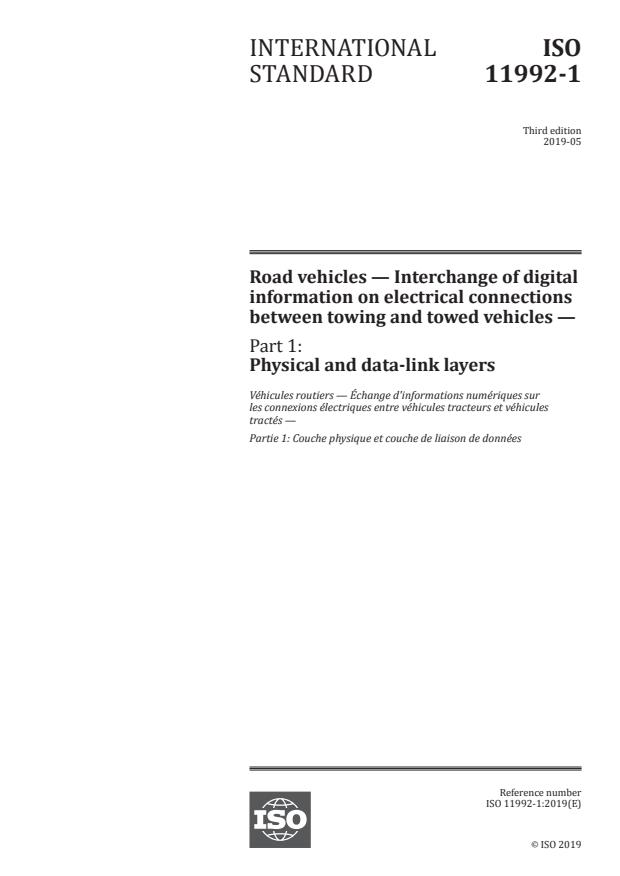
ISO 11992-1:2019 - Road vehicles -- Interchange of digital information on electrical connections between towing and towed vehicles
ISO 11992-1:2019 - Road vehicles — Interchange of digital information on electrical connections between towing and towed vehicles — Part 1: Physical and data-link layers/2/2019
Overview
ISO 11992-1:2019 - "Road vehicles - Interchange of digital information on electrical connections between towing and towed vehicles - Part 1: Physical and data-link layers" defines the lower OSI-layer requirements for CAN-based communication between towing and towed vehicles (typically vehicles with maximum authorised total mass > 3 500 kg). This third edition updates the data link layer (DLL) and physical layer (PHY) definitions for safe, interoperable digital interchange over the electrical connection (cabling and connectors) between tractor and trailer.
Key points:
- Covers the Data Link Layer (DLL) and Physical Layer (PHY) split into Physical Signalling (PS), Physical Medium Attachment (PMA) and Physical Medium Dependent (PMD) sub-layers.
- Targets CAN-based interfaces used across the ISO 11992 series.
- Adds clarifications, requirement statements and an informative Annex A on bus failure management.
Key Topics and Requirements
- Data Link Layer (DLL)
- Compliance with ISO 11898-1 is required for the DLL protocol entity (REQ 2.1).
- Frame format restriction: devices shall transmit only data frames in CEFF (Classical Extended Frame Format) (REQ 2.2).
- No remote-frame requests: DLL device interfaces shall not request data via remote frames (REQ 2.3).
- Physical Layer (PHY)
- Divided into PS, PMA and PMD sub-layers.
- PS (Physical Signalling): PS entity and device interfaces shall conform to ISO 11898-1; bit-timing settings determine transmission speed and resynchronisation capability. Fault confinement behavior follows ISO 11898-1 (REQ 1.1, REQ 1.2).
- PMA (Physical Medium Attachment): typically implemented in the CAN transceiver or System Base Chip (SBC); may include protective circuitry.
- PMD (Physical Medium Dependent): connectors, cabling and electro-mechanical components that implement the media-dependent sub-layer.
- Network and device interface requirements and numbered requirement statements for traceability and implementation.
Applications and Who Uses It
ISO 11992-1:2019 is intended for:
- OEM engineers and vehicle network architects designing towing–towed communications (tractor–trailer).
- CAN controller and CAN transceiver (PMA) developers.
- Electronic Control Unit (ECU) and System Base Chip (SBC) designers.
- Wiring harness, connector and cabling manufacturers (PMD scope).
- Vehicle integrators, fleets and maintenance/diagnostics teams implementing compliant diagnostic and communication frameworks.
Practical uses include secure transfer of braking, lighting, diagnostics and other vehicle control data across the electrical coupling between towing and towed units.
Related Standards
- ISO 11898-1 (CAN data link layer and physical signalling) - normative reference
- Other ISO 11992 parts (application-layer, diagnostics): ISO 11992-2, -3, -4
- Vehicle diagnostics and transport layers: ISO 14229 series, ISO 15765-2, ISO 7638-1, ISO 12098
Keywords: ISO 11992-1:2019, CAN, data link layer, physical layer, towing and towed vehicles, CAN transceiver, PMA, PMD, PS, vehicle networks, electrical connections, tractor–trailer communication.
Relations
- Effective Date
- 04-Nov-2015
Buy Documents
ISO 11992-1:2019 - Road vehicles -- Interchange of digital information on electrical connections between towing and towed vehicles
ISO 11992-1:2019 - Road vehicles — Interchange of digital information on electrical connections between towing and towed vehicles — Part 1: Physical and data-link layers/2/2019
Get Certified
Connect with accredited certification bodies for this standard

TÜV Rheinland
TÜV Rheinland is a leading international provider of technical services.

TÜV SÜD
TÜV SÜD is a trusted partner of choice for safety, security and sustainability solutions.

DEKRA Certification Inc.
DEKRA US certification services.
Sponsored listings
Frequently Asked Questions
ISO 11992-1:2019 is a standard published by the International Organization for Standardization (ISO). Its full title is "Road vehicles — Interchange of digital information on electrical connections between towing and towed vehicles — Part 1: Physical and data-link layers". This standard covers: This document describes the data link layer (DLL) and physical layer (PHY) for the two CAN-based network interfaces specified in the 11992-series. The DLL sub-clauses are composed of: — DLL protocol entity requirements; — DLL device interface requirements; and — DLL network system requirements. Normally, the physical signalling sub-layer is implemented in the CAN protocol controller. The physical medium attachment sub-layer is normally implemented in the CAN transceiver or the System Base Chip (SBC). Optionally, it can comprise also additional protection circuitry. The media-dependent sub-layer comprises the connectors and the cabling. The physical signalling (PS) sub-clauses are composed of: — PS entity requirements; — PS device interface requirements; and — PS network system requirements. The physical medium attachment (PMA) sub-clauses are composed of: — PMA protocol entity requirements; and — PMA device interface requirements. The physical medium dependent (PMD) sub-clauses are composed of: — PMD entity requirements; — PMD device interface requirements; and — PMD network system requirements.
This document describes the data link layer (DLL) and physical layer (PHY) for the two CAN-based network interfaces specified in the 11992-series. The DLL sub-clauses are composed of: — DLL protocol entity requirements; — DLL device interface requirements; and — DLL network system requirements. Normally, the physical signalling sub-layer is implemented in the CAN protocol controller. The physical medium attachment sub-layer is normally implemented in the CAN transceiver or the System Base Chip (SBC). Optionally, it can comprise also additional protection circuitry. The media-dependent sub-layer comprises the connectors and the cabling. The physical signalling (PS) sub-clauses are composed of: — PS entity requirements; — PS device interface requirements; and — PS network system requirements. The physical medium attachment (PMA) sub-clauses are composed of: — PMA protocol entity requirements; and — PMA device interface requirements. The physical medium dependent (PMD) sub-clauses are composed of: — PMD entity requirements; — PMD device interface requirements; and — PMD network system requirements.
ISO 11992-1:2019 is classified under the following ICS (International Classification for Standards) categories: 43.040.15 - Car informatics. On board computer systems. The ICS classification helps identify the subject area and facilitates finding related standards.
ISO 11992-1:2019 has the following relationships with other standards: It is inter standard links to ISO 11992-1:2003. Understanding these relationships helps ensure you are using the most current and applicable version of the standard.
ISO 11992-1:2019 is available in PDF format for immediate download after purchase. The document can be added to your cart and obtained through the secure checkout process. Digital delivery ensures instant access to the complete standard document.
Standards Content (Sample)
INTERNATIONAL ISO
STANDARD 11992-1
Third edition
2019-05
Road vehicles — Interchange of digital
information on electrical connections
between towing and towed vehicles —
Part 1:
Physical and data-link layers
Véhicules routiers — Échange d'informations numériques sur
les connexions électriques entre véhicules tracteurs et véhicules
tractés —
Partie 1: Couche physique et couche de liaison de données
Reference number
©
ISO 2019
© ISO 2019
All rights reserved. Unless otherwise specified, or required in the context of its implementation, no part of this publication may
be reproduced or utilized otherwise in any form or by any means, electronic or mechanical, including photocopying, or posting
on the internet or an intranet, without prior written permission. Permission can be requested from either ISO at the address
below or ISO’s member body in the country of the requester.
ISO copyright office
CP 401 • Ch. de Blandonnet 8
CH-1214 Vernier, Geneva
Phone: +41 22 749 01 11
Fax: +41 22 749 09 47
Email: copyright@iso.org
Website: www.iso.org
Published in Switzerland
ii © ISO 2019 – All rights reserved
Contents Page
Foreword .iv
Introduction .v
1 Scope . 1
2 Normative references . 1
3 Terms and definitions . 2
4 Abbreviated terms . 4
5 Data link layer (DLL) . 4
5.1 General . 4
5.2 DLL protocol entity requirements . . 4
5.3 DLL device interface requirements . 4
6 Physical layer (PHY) . 5
6.1 General . 5
6.2 Physical signalling (PS) requirements . 5
6.2.1 General. 5
6.2.2 PS entity requirements . 5
6.2.3 PS device interface requirements. 5
6.3 Physical medium attachment (PMA) requirements . 6
6.3.1 PMA entity requirements . 6
6.3.2 PMA device interface requirements .13
6.4 Physical media dependent (PMD) sub-layer requirements .14
6.4.1 PMD entity requirements .14
6.4.2 PMD device interface requirements .14
6.5 Network wiring harness system requirements .16
Annex A (informative) Implementation examples of the bus failure management .20
Bibliography .22
Foreword
ISO (the International Organization for Standardization) is a worldwide federation of national standards
bodies (ISO member bodies). The work of preparing International Standards is normally carried out
through ISO technical committees. Each member body interested in a subject for which a technical
committee has been established has the right to be represented on that committee. International
organizations, governmental and non-governmental, in liaison with ISO, also take part in the work.
ISO collaborates closely with the International Electrotechnical Commission (IEC) on all matters of
electrotechnical standardization.
The procedures used to develop this document and those intended for its further maintenance are
described in the ISO/IEC Directives, Part 1. In particular, the different approval criteria needed for the
different types of ISO documents should be noted. This document was drafted in accordance with the
editorial rules of the ISO/IEC Directives, Part 2 (see www .iso .org/directives).
Attention is drawn to the possibility that some of the elements of this document may be the subject of
patent rights. ISO shall not be held responsible for identifying any or all such patent rights. Details of
any patent rights identified during the development of the document will be in the Introduction and/or
on the ISO list of patent declarations received (see www .iso .org/patents).
Any trade name used in this document is information given for the convenience of users and does not
constitute an endorsement.
For an explanation of the voluntary nature of standards, the meaning of ISO specific terms and
expressions related to conformity assessment, as well as information about ISO's adherence to the
World Trade Organization (WTO) principles in the Technical Barriers to Trade (TBT) see www .iso
.org/iso/foreword .html.
This document was prepared by Technical Committee ISO/TC 22, Road vehicles, Subcommittee SC 31,
Data communication.
This third edition cancels and replaces the second edition (ISO 11992-1:2003) which has been
technically revised.
The main changes compared to the previous edition are as follows:
— wording improvements and clarifications;
— introduction of requirement statements; and
— addition of informative Annex A, Implementation examples of the bus failure management.
A list of all parts in the ISO 11992 series can be found on the ISO website.
Any feedback or questions on this document should be directed to the user’s national standards body. A
complete listing of these bodies can be found at www .iso .org/members .html.
iv © ISO 2019 – All rights reserved
Introduction
The ISO 11992 series specifies the interchange of digital information between road vehicles with a
maximum authorised total mass greater than 3 500 kg. The series also specifies digital information
interchange for towed vehicles, including communication between towed vehicles in terms of
parameters and requirements of the lower OSI layers (physical and data link layer) of the electrical
connection used to connect the electrical and electronic systems.
This document specifies the data link and physical layer requirements of the CAN communication bus
between towing and towed vehicles.
This document has been structured according to the Open Systems Interconnection (OSI) Basic
Reference Model, in accordance with ISO/IEC 7498-1 and ISO/IEC 10731, which structures
communication systems into seven layers. When mapped on this model, the application protocol and
data link layer framework requirements specified/referenced in a ISO 11992 series standard are
structured according to Figure 1.
Figure 1 illustrates the following communication frameworks:
— normal vehicle communication framework;
— vehicle diagnostic communication framework;
— vehicle-specific use case framework; and
— vehicle lower-layers framework.
The normal vehicle communication framework is composed of ISO 11992-2 and ISO 11992-3.
[3] [12]
The vehicle diagnostic communication framework is composed of ISO 14229-1 , ISO 14229-2 ,
[13] [3]
ISO 14229-3 and ISO 11992-4 .
The vehicle-specific use case framework is composed of ISO 11992-4, ISO 22901-1 or vehicle
manufacturer-specific diagnostic data definition.
[14] [6]
The vehicle lower-layers framework is composed of ISO 15765-2 , ISO 11898-1, 1, ISO 7638-1 and
[10]
ISO 12098 .
Figure 1 — Towing and towed vehicles framework documents reference according to the OSI
model
Figure 2 shows the implementation example of the lower-layers block diagram.
vi © ISO 2019 – All rights reserved
Figure 2 — Implementation example of lower-layers block diagram
The above requirements structure has been chosen to provide the following developers with relevant
requirements:
— transceiver developers;
— device (e.g., electronic control unit) developers; and
— towing and towed vehicle network developers.
All requirements are numbered and headlined uniquely, so that each implementer can reference them.
INTERNATIONAL STANDARD ISO 11992-1:2019(E)
Road vehicles — Interchange of digital information
on electrical connections between towing and towed
vehicles —
Part 1:
Physical and data-link layers
1 Scope
This document describes the data link layer (DLL) and physical layer (PHY) for the two CAN-based
network interfaces specified in the 11992-series.
The DLL sub-clauses are composed of:
— DLL protocol entity requirements;
— DLL device interface requirements; and
— DLL network system requirements.
Normally, the physical signalling sub-layer is implemented in the CAN protocol controller. The physical
medium attachment sub-layer is normally implemented in the CAN transceiver or the System Base Chip
(SBC). Optionally, it can comprise also additional protection circuitry. The media-dependent sub-layer
comprises the connectors and the cabling.
The physical signalling (PS) sub-clauses are composed of:
— PS entity requirements;
— PS device interface requirements; and
— PS network system requirements.
The physical medium attachment (PMA) sub-clauses are composed of:
— PMA protocol entity requirements; and
— PMA device interface requirements.
The physical medium dependent (PMD) sub-clauses are composed of:
— PMD entity requirements;
— PMD device interface requirements; and
— PMD network system requirements.
2 Normative references
The following documents are referred to in the text in such a way that some or all of their content
constitutes requirements of this document. For dated references, only the edition cited applies. For
undated references, the latest edition of the referenced document (including any amendments) applies.
ISO 4141-1, Road vehicles — Multi-core connecting cables — Part 1: Test methods and requirements for
basic performance sheathed cables
ISO 11898-1, Road vehicles — Controller area network (CAN) — Part 1: Data link layer and physical
signalling
3 Terms and definitions
For the purposes of this document, the following terms and definitions apply.
ISO and IEC maintain terminological databases for use in standardization at the following addresses:
— ISO Online browsing platform: available at https: //www .iso .org/obp
— IEC Electropedia: available at http: //www .electropedia .org/
3.1
1-wire operation
communication on either CAN_L or CAN_H with reference to ground and V potential during fault-
s
tolerant operation mode
3.2
2-wire operation
communication on CAN_L and CAN_H, with reference to ground and V potential, in nominal (non fault-
s
tolerant) operation mode
3.3
bus
communication link between two communication entities
3.4
CAN_H
CAN_L
particular cable and/or contact of the communication connection
3.5
differential transmission
transmission of digital information carried by voltage between the two conductors of the electrical
connections
3.6
maximum authorised total mass
vehicle mass determined as a maximum by the administrative authority for operating conditions laid
down by that authority
Note 1 to entry: In some jurisdictions this will be known as the Gross Vehicle Weight Rating or the Gross
Combination Weight Rating.
[SOURCE: ISO 1176:1990, 4.8, modified — NOTES 1 and 2 replaced by a new Note 1 to entry]
3.7
data link layer protocol entity
DLL protocol entity
functional part of the electronic component implementing the DLL protocol as standardised in
ISO 11898-1
3.8
data link layer device interface
DLL device interface
electronic device interface compliant with ISO 11898-1 optionally with functional restrictions
EXAMPLE No transmission of remote frames or transmission of extended frame formatted messages only.
2 © ISO 2019 – All rights reserved
3.9
data link layer network system
DLL network system
logical DLL system comprising two additional interoperable nodes compliant with ISO 11898-1
3.10
physical signalling entity
PS entity
functional part of the electronic component implementing the DLL protocol as standardised in
ISO 11898-1
3.11
physical signalling device interface
PS device interface
electronic interface compliant with ISO 11898-1 and detailed bit-timing configuration including
configured re-synchronisation capability
3.12
physical signalling network system
PS network system
network with devices with an interoperable bit-timing and bit synchronisation compliant with
ISO 11898-1
3.13
physical medium attachment entity
PMA entity
electronic component (transceiver) or part of an electronic component (system base chip)
3.14
physical medium attachment device interface
PMA device interface
electronic device interface comprising a PMA entity and optionally additional circuitry
3.15
physical medium attachment network system
PMA network system
network system comprising two devices with physical media attachment interfaces compliant to this
document
3.16
physical medium dependent entities
PMD entities
connectors, cabling, and other electro-mechanical network components
3.17
physical medium dependent device interface
PMD device interface
connectors, cabling, and other electro-mechanical components
3.18
physical medium dependent network system
PMD network system
electro-mechanical interface of a single device
3.19
towed vehicle
unpowered vehicle that is towed by a towing vehicle or another unpowered vehicle
[SOURCE: ISO 3833:1977, 3.2, modified — definition editorially revised]
3.20
towing vehicle
motor vehicle or unpowered vehicle, which tows a succeeding unpowered vehicle
4 Abbreviated terms
AC alternating current
CAN controller area network
CEFF classical extended frame format
DC direct current
DLL data link layer
ECU electronic control unit
PHY physical layer
PMA physical medium attachment
PMD physical medium dependent
PS physical signalling
5 Data link layer (DLL)
5.1 General
The data link layer provides the functional and procedural means to transfer data between network
devices and provides the means to detect and possibly correct errors that can occur in the physical
layer. The DLL is concerned with local delivery of frames (PDUs) between devices on the CAN network.
The DLL endeavours to arbitrate between parties contending for access to a medium, without concern
for their ultimate destination. When devices attempt to use a medium simultaneously, frame collisions
occur. The data-link protocol specifies how devices detect and recover from such collisions and may
provide mechanisms to reduce or prevent them.
5.2 DLL protocol entity requirements
The DLL protocol entity transfers data between network nodes on the CAN network. The following
requirements are applicable.
REQ 2.1 DLL — ISO 11898-1
The DLL protocol entity shall comply with ISO 11898-1.
5.3 DLL device interface requirements
REQ 2.2 DLL — Allowed data frame format
The DLL device interface shall transmit only data frames in CEFF (Classical Extended Frame Format).
REQ 2.3 DLL — Remote frames
The DLL device interface shall not request remotely data frames by means of remote frames.
4 © ISO 2019 – All rights reserved
6 Physical layer (PHY)
6.1 General
The PHY is divided in three sub-layers:
— physical signalling (PS),
— physical medium attachment (PMA), and
— physical medium dependent (PMD) sub-layers.
6.2 Physical signalling (PS) requirements
6.2.1 General
The physical signalling sub-layer, as specified in ISO 11898-1, determines the transmission speed and
the recent re-synchronisation capability.
6.2.2 PS entity requirements
The physical signalling entity is normally part of the CAN controller implementation.
REQ 1.1 PHY — PS entity requirements — ISO 11898-1 conformance
The PS entity shall comply with ISO 11898-1.
REQ 1.2 PHY — PS entity requirements — Fault confinement
The fault confinement entity used for the data link layer shall be in accordance with ISO 11898-1.
6.2.3 PS device interface requirements
The bit-timing settings determine the transmission speed and the re-synchronisation capability. The
programming of the bit time depends on the internal signal delay time and the capacitive load.
REQ 1.3 PHY — PS device interface requirements — Bit-rate
The PS device shall be configured that it transmits frames at a bit-rate of 125 kbit/s.
REQ 1.4 PHY — PS device interface requirements — Oscillator frequency
The oscillator frequency from which the data rate is derived shall have a maximum relative tolerance
of ±0,01 %.
REQ 1.5 PHY — PS device interface requirements — Bit timing settings
To ensure proper operation under worst case conditions, the parameters specified in Table 1 shall apply
and following requirements shall be fulfilled.
— Only signal edges from recessive-to-dominant-shall be used for synchronisation.
— Single sampling shall be used.
Table 1 — Bit timing parameters
Value
Parameter Notation Unit
Min. Nominal Max.
Bit time without synchronisation (logical) t µs 7,999 2 8,0 8,000 8
a
Internal signal delay time t µs — — 0,4
del
Synchronisation jump width t ns — — 500
sjw
b
Sample point t µs 6 + t — 7
sjw
a
Period of time between transmit logic input signal and receive logic output signal at state transition, bus length = 0 m.
b
See ISO 11898-1.
6.3 Physical medium attachment (PMA) requirements
6.3.1 PMA entity requirements
REQ 1.6 PHY — PMA entity requirements — PMD interface
The PMA entity shall provide the differential voltage V as specified in Equation (1).
diff
REQ 1.7 PHY — PMA entity requirements — Dominant state
In the logical “dominant” state, the voltage levels of CAN_H and CAN_L shall be as specified in Equation (2).
REQ 1.8 PHY — PMA entity requirements — Recessive state
In the logical "recessive" state, the voltage levels of CAN_H and CAN_L shall be as specified in Equation (3).
Definition of Equation (1)
VV=−V (1)
diff CAN_LCAN_H
This results in a value of:
V = 1/3 × V at recessive state, and
diff s
V = −1/3 × V at dominant state.
diff s
Definition of Equation (2)
VV=×
CAN_Hs
(2)
VV=×
CAN_Ls
where V is the supply voltage of the device connected to the bus.
s
Definition of Equation (3)
VV=×
CAN_Hs
(3)
VV=×
CAN_Ls
Figure 3 shows the dominant and recessive state of CAN_H and CAN_L.
6 © ISO 2019 – All rights reserved
Key
0 dominant: Logic "0"
1 recessive: Logic "1"
Figure 3 — Dominant and recessive state of CAN_H and CAN_L
REQ 1.8 PHY — PMA entity requirements — DC parameters
The DC parameter of a PMA entity shall be within the ranges specified in Table 2 and Table 3, as appro-
priate. The parameters are valid for 2-wire operation, and for non-affected parts of the interface in the
case of 1-wire operation.
Table 2 specifies the DC parameters for the recessive state with the two connectors mated.
Table 2 — DC parameters for the recessive state
Value
Para
...
INTERNATIONAL ISO
STANDARD 11992-1
Third edition
2019-05
Road vehicles — Interchange of digital
information on electrical connections
between towing and towed vehicles —
Part 1:
Physical and data-link layers
Véhicules routiers — Échange d'informations numériques sur
les connexions électriques entre véhicules tracteurs et véhicules
tractés —
Partie 1: Couche physique et couche de liaison de données
Reference number
©
ISO 2019
© ISO 2019
All rights reserved. Unless otherwise specified, or required in the context of its implementation, no part of this publication may
be reproduced or utilized otherwise in any form or by any means, electronic or mechanical, including photocopying, or posting
on the internet or an intranet, without prior written permission. Permission can be requested from either ISO at the address
below or ISO’s member body in the country of the requester.
ISO copyright office
CP 401 • Ch. de Blandonnet 8
CH-1214 Vernier, Geneva
Phone: +41 22 749 01 11
Fax: +41 22 749 09 47
Email: copyright@iso.org
Website: www.iso.org
Published in Switzerland
ii © ISO 2019 – All rights reserved
Contents Page
Foreword .iv
Introduction .v
1 Scope . 1
2 Normative references . 1
3 Terms and definitions . 2
4 Abbreviated terms . 4
5 Data link layer (DLL) . 4
5.1 General . 4
5.2 DLL protocol entity requirements . . 4
5.3 DLL device interface requirements . 4
6 Physical layer (PHY) . 5
6.1 General . 5
6.2 Physical signalling (PS) requirements . 5
6.2.1 General. 5
6.2.2 PS entity requirements . 5
6.2.3 PS device interface requirements. 5
6.3 Physical medium attachment (PMA) requirements . 6
6.3.1 PMA entity requirements . 6
6.3.2 PMA device interface requirements .13
6.4 Physical media dependent (PMD) sub-layer requirements .14
6.4.1 PMD entity requirements .14
6.4.2 PMD device interface requirements .14
6.5 Network wiring harness system requirements .16
Annex A (informative) Implementation examples of the bus failure management .20
Bibliography .22
Foreword
ISO (the International Organization for Standardization) is a worldwide federation of national standards
bodies (ISO member bodies). The work of preparing International Standards is normally carried out
through ISO technical committees. Each member body interested in a subject for which a technical
committee has been established has the right to be represented on that committee. International
organizations, governmental and non-governmental, in liaison with ISO, also take part in the work.
ISO collaborates closely with the International Electrotechnical Commission (IEC) on all matters of
electrotechnical standardization.
The procedures used to develop this document and those intended for its further maintenance are
described in the ISO/IEC Directives, Part 1. In particular, the different approval criteria needed for the
different types of ISO documents should be noted. This document was drafted in accordance with the
editorial rules of the ISO/IEC Directives, Part 2 (see www .iso .org/directives).
Attention is drawn to the possibility that some of the elements of this document may be the subject of
patent rights. ISO shall not be held responsible for identifying any or all such patent rights. Details of
any patent rights identified during the development of the document will be in the Introduction and/or
on the ISO list of patent declarations received (see www .iso .org/patents).
Any trade name used in this document is information given for the convenience of users and does not
constitute an endorsement.
For an explanation of the voluntary nature of standards, the meaning of ISO specific terms and
expressions related to conformity assessment, as well as information about ISO's adherence to the
World Trade Organization (WTO) principles in the Technical Barriers to Trade (TBT) see www .iso
.org/iso/foreword .html.
This document was prepared by Technical Committee ISO/TC 22, Road vehicles, Subcommittee SC 31,
Data communication.
This third edition cancels and replaces the second edition (ISO 11992-1:2003) which has been
technically revised.
The main changes compared to the previous edition are as follows:
— wording improvements and clarifications;
— introduction of requirement statements; and
— addition of informative Annex A, Implementation examples of the bus failure management.
A list of all parts in the ISO 11992 series can be found on the ISO website.
Any feedback or questions on this document should be directed to the user’s national standards body. A
complete listing of these bodies can be found at www .iso .org/members .html.
iv © ISO 2019 – All rights reserved
Introduction
The ISO 11992 series specifies the interchange of digital information between road vehicles with a
maximum authorised total mass greater than 3 500 kg. The series also specifies digital information
interchange for towed vehicles, including communication between towed vehicles in terms of
parameters and requirements of the lower OSI layers (physical and data link layer) of the electrical
connection used to connect the electrical and electronic systems.
This document specifies the data link and physical layer requirements of the CAN communication bus
between towing and towed vehicles.
This document has been structured according to the Open Systems Interconnection (OSI) Basic
Reference Model, in accordance with ISO/IEC 7498-1 and ISO/IEC 10731, which structures
communication systems into seven layers. When mapped on this model, the application protocol and
data link layer framework requirements specified/referenced in a ISO 11992 series standard are
structured according to Figure 1.
Figure 1 illustrates the following communication frameworks:
— normal vehicle communication framework;
— vehicle diagnostic communication framework;
— vehicle-specific use case framework; and
— vehicle lower-layers framework.
The normal vehicle communication framework is composed of ISO 11992-2 and ISO 11992-3.
[3] [12]
The vehicle diagnostic communication framework is composed of ISO 14229-1 , ISO 14229-2 ,
[13] [3]
ISO 14229-3 and ISO 11992-4 .
The vehicle-specific use case framework is composed of ISO 11992-4, ISO 22901-1 or vehicle
manufacturer-specific diagnostic data definition.
[14] [6]
The vehicle lower-layers framework is composed of ISO 15765-2 , ISO 11898-1, 1, ISO 7638-1 and
[10]
ISO 12098 .
Figure 1 — Towing and towed vehicles framework documents reference according to the OSI
model
Figure 2 shows the implementation example of the lower-layers block diagram.
vi © ISO 2019 – All rights reserved
Figure 2 — Implementation example of lower-layers block diagram
The above requirements structure has been chosen to provide the following developers with relevant
requirements:
— transceiver developers;
— device (e.g., electronic control unit) developers; and
— towing and towed vehicle network developers.
All requirements are numbered and headlined uniquely, so that each implementer can reference them.
INTERNATIONAL STANDARD ISO 11992-1:2019(E)
Road vehicles — Interchange of digital information
on electrical connections between towing and towed
vehicles —
Part 1:
Physical and data-link layers
1 Scope
This document describes the data link layer (DLL) and physical layer (PHY) for the two CAN-based
network interfaces specified in the 11992-series.
The DLL sub-clauses are composed of:
— DLL protocol entity requirements;
— DLL device interface requirements; and
— DLL network system requirements.
Normally, the physical signalling sub-layer is implemented in the CAN protocol controller. The physical
medium attachment sub-layer is normally implemented in the CAN transceiver or the System Base Chip
(SBC). Optionally, it can comprise also additional protection circuitry. The media-dependent sub-layer
comprises the connectors and the cabling.
The physical signalling (PS) sub-clauses are composed of:
— PS entity requirements;
— PS device interface requirements; and
— PS network system requirements.
The physical medium attachment (PMA) sub-clauses are composed of:
— PMA protocol entity requirements; and
— PMA device interface requirements.
The physical medium dependent (PMD) sub-clauses are composed of:
— PMD entity requirements;
— PMD device interface requirements; and
— PMD network system requirements.
2 Normative references
The following documents are referred to in the text in such a way that some or all of their content
constitutes requirements of this document. For dated references, only the edition cited applies. For
undated references, the latest edition of the referenced document (including any amendments) applies.
ISO 4141-1, Road vehicles — Multi-core connecting cables — Part 1: Test methods and requirements for
basic performance sheathed cables
ISO 11898-1, Road vehicles — Controller area network (CAN) — Part 1: Data link layer and physical
signalling
3 Terms and definitions
For the purposes of this document, the following terms and definitions apply.
ISO and IEC maintain terminological databases for use in standardization at the following addresses:
— ISO Online browsing platform: available at https: //www .iso .org/obp
— IEC Electropedia: available at http: //www .electropedia .org/
3.1
1-wire operation
communication on either CAN_L or CAN_H with reference to ground and V potential during fault-
s
tolerant operation mode
3.2
2-wire operation
communication on CAN_L and CAN_H, with reference to ground and V potential, in nominal (non fault-
s
tolerant) operation mode
3.3
bus
communication link between two communication entities
3.4
CAN_H
CAN_L
particular cable and/or contact of the communication connection
3.5
differential transmission
transmission of digital information carried by voltage between the two conductors of the electrical
connections
3.6
maximum authorised total mass
vehicle mass determined as a maximum by the administrative authority for operating conditions laid
down by that authority
Note 1 to entry: In some jurisdictions this will be known as the Gross Vehicle Weight Rating or the Gross
Combination Weight Rating.
[SOURCE: ISO 1176:1990, 4.8, modified — NOTES 1 and 2 replaced by a new Note 1 to entry]
3.7
data link layer protocol entity
DLL protocol entity
functional part of the electronic component implementing the DLL protocol as standardised in
ISO 11898-1
3.8
data link layer device interface
DLL device interface
electronic device interface compliant with ISO 11898-1 optionally with functional restrictions
EXAMPLE No transmission of remote frames or transmission of extended frame formatted messages only.
2 © ISO 2019 – All rights reserved
3.9
data link layer network system
DLL network system
logical DLL system comprising two additional interoperable nodes compliant with ISO 11898-1
3.10
physical signalling entity
PS entity
functional part of the electronic component implementing the DLL protocol as standardised in
ISO 11898-1
3.11
physical signalling device interface
PS device interface
electronic interface compliant with ISO 11898-1 and detailed bit-timing configuration including
configured re-synchronisation capability
3.12
physical signalling network system
PS network system
network with devices with an interoperable bit-timing and bit synchronisation compliant with
ISO 11898-1
3.13
physical medium attachment entity
PMA entity
electronic component (transceiver) or part of an electronic component (system base chip)
3.14
physical medium attachment device interface
PMA device interface
electronic device interface comprising a PMA entity and optionally additional circuitry
3.15
physical medium attachment network system
PMA network system
network system comprising two devices with physical media attachment interfaces compliant to this
document
3.16
physical medium dependent entities
PMD entities
connectors, cabling, and other electro-mechanical network components
3.17
physical medium dependent device interface
PMD device interface
connectors, cabling, and other electro-mechanical components
3.18
physical medium dependent network system
PMD network system
electro-mechanical interface of a single device
3.19
towed vehicle
unpowered vehicle that is towed by a towing vehicle or another unpowered vehicle
[SOURCE: ISO 3833:1977, 3.2, modified — definition editorially revised]
3.20
towing vehicle
motor vehicle or unpowered vehicle, which tows a succeeding unpowered vehicle
4 Abbreviated terms
AC alternating current
CAN controller area network
CEFF classical extended frame format
DC direct current
DLL data link layer
ECU electronic control unit
PHY physical layer
PMA physical medium attachment
PMD physical medium dependent
PS physical signalling
5 Data link layer (DLL)
5.1 General
The data link layer provides the functional and procedural means to transfer data between network
devices and provides the means to detect and possibly correct errors that can occur in the physical
layer. The DLL is concerned with local delivery of frames (PDUs) between devices on the CAN network.
The DLL endeavours to arbitrate between parties contending for access to a medium, without concern
for their ultimate destination. When devices attempt to use a medium simultaneously, frame collisions
occur. The data-link protocol specifies how devices detect and recover from such collisions and may
provide mechanisms to reduce or prevent them.
5.2 DLL protocol entity requirements
The DLL protocol entity transfers data between network nodes on the CAN network. The following
requirements are applicable.
REQ 2.1 DLL — ISO 11898-1
The DLL protocol entity shall comply with ISO 11898-1.
5.3 DLL device interface requirements
REQ 2.2 DLL — Allowed data frame format
The DLL device interface shall transmit only data frames in CEFF (Classical Extended Frame Format).
REQ 2.3 DLL — Remote frames
The DLL device interface shall not request remotely data frames by means of remote frames.
4 © ISO 2019 – All rights reserved
6 Physical layer (PHY)
6.1 General
The PHY is divided in three sub-layers:
— physical signalling (PS),
— physical medium attachment (PMA), and
— physical medium dependent (PMD) sub-layers.
6.2 Physical signalling (PS) requirements
6.2.1 General
The physical signalling sub-layer, as specified in ISO 11898-1, determines the transmission speed and
the recent re-synchronisation capability.
6.2.2 PS entity requirements
The physical signalling entity is normally part of the CAN controller implementation.
REQ 1.1 PHY — PS entity requirements — ISO 11898-1 conformance
The PS entity shall comply with ISO 11898-1.
REQ 1.2 PHY — PS entity requirements — Fault confinement
The fault confinement entity used for the data link layer shall be in accordance with ISO 11898-1.
6.2.3 PS device interface requirements
The bit-timing settings determine the transmission speed and the re-synchronisation capability. The
programming of the bit time depends on the internal signal delay time and the capacitive load.
REQ 1.3 PHY — PS device interface requirements — Bit-rate
The PS device shall be configured that it transmits frames at a bit-rate of 125 kbit/s.
REQ 1.4 PHY — PS device interface requirements — Oscillator frequency
The oscillator frequency from which the data rate is derived shall have a maximum relative tolerance
of ±0,01 %.
REQ 1.5 PHY — PS device interface requirements — Bit timing settings
To ensure proper operation under worst case conditions, the parameters specified in Table 1 shall apply
and following requirements shall be fulfilled.
— Only signal edges from recessive-to-dominant-shall be used for synchronisation.
— Single sampling shall be used.
Table 1 — Bit timing parameters
Value
Parameter Notation Unit
Min. Nominal Max.
Bit time without synchronisation (logical) t µs 7,999 2 8,0 8,000 8
a
Internal signal delay time t µs — — 0,4
del
Synchronisation jump width t ns — — 500
sjw
b
Sample point t µs 6 + t — 7
sjw
a
Period of time between transmit logic input signal and receive logic output signal at state transition, bus length = 0 m.
b
See ISO 11898-1.
6.3 Physical medium attachment (PMA) requirements
6.3.1 PMA entity requirements
REQ 1.6 PHY — PMA entity requirements — PMD interface
The PMA entity shall provide the differential voltage V as specified in Equation (1).
diff
REQ 1.7 PHY — PMA entity requirements — Dominant state
In the logical “dominant” state, the voltage levels of CAN_H and CAN_L shall be as specified in Equation (2).
REQ 1.8 PHY — PMA entity requirements — Recessive state
In the logical "recessive" state, the voltage levels of CAN_H and CAN_L shall be as specified in Equation (3).
Definition of Equation (1)
VV=−V (1)
diff CAN_LCAN_H
This results in a value of:
V = 1/3 × V at recessive state, and
diff s
V = −1/3 × V at dominant state.
diff s
Definition of Equation (2)
VV=×
CAN_Hs
(2)
VV=×
CAN_Ls
where V is the supply voltage of the device connected to the bus.
s
Definition of Equation (3)
VV=×
CAN_Hs
(3)
VV=×
CAN_Ls
Figure 3 shows the dominant and recessive state of CAN_H and CAN_L.
6 © ISO 2019 – All rights reserved
Key
0 dominant: Logic "0"
1 recessive: Logic "1"
Figure 3 — Dominant and recessive state of CAN_H and CAN_L
REQ 1.8 PHY — PMA entity requirements — DC parameters
The DC parameter of a PMA entity shall be within the ranges specified in Table 2 and Table 3, as appro-
priate. The parameters are valid for 2-wire operation, and for non-affected parts of the interface in the
case of 1-wire operation.
Table 2 specifies the DC parameters for the recessive state with the two connectors mated.
Table 2 — DC parameters for the recessive state
Value
Para
...