

ISO 15106-5:2015
(Main)Plastics — Film and sheeting — Determination of water vapour transmission rate — Part 5: Pressure sensor method
General Information
- Abstract
ISO 15106-5:2015 specifies a method for determining the water vapour transmission rate of plastic film, plastic sheeting, and multi-layer structures including plastics, using a pressure sensor.
- Status
- Published
- Publication Date
- 12-Apr-2015
- Technical Committee
- ISO/TC 61/SC 11 - Products
- Drafting Committee
- ISO/TC 61/SC 11/WG 3 - Plastics films and sheeting
- Current Stage
- 9093 - International Standard confirmed
- Start Date
- 08-Dec-2025
- Completion Date
- 29-Aug-2026
Buy Documents
ISO 15106-5:2015 - Plastics -- Film and sheeting -- Determination of water vapour transmission rate
ISO 15106-5:2015 - Plastics — Film and sheeting — Determination of water vapour transmission rate — Part 5: Pressure sensor method/13/2015
Overview
ISO 15106-5:2015 - titled "Plastics - Film and sheeting - Determination of water vapour transmission rate - Part 5: Pressure sensor method" - specifies a laboratory method for measuring the water vapour transmission rate (WVTR) of plastic film, plastic sheeting, and multi‑layer structures using a pressure sensor. The method provides relatively rapid WVTR measurement across a wide range of permeability values by detecting pressure increase on the downstream side as water vapour permeates through the specimen.
Key topics and technical requirements
- Principle: A specimen seals two chambers (upstream and downstream). The upstream is filled with controlled water vapour; permeation is measured as pressure rise in the downstream chamber.
- Apparatus components:
- Transmission cell with constant transmission area (typical diameter 5–200 mm).
- Pressure sensor for downstream chamber (recommended sensitivity ~0.2 Pa).
- Water vapour generator with reservoir pressure sensor (min. sensitivity ~20 Pa).
- Cell volume‑control device (to extend measurement range) and vacuum pump (ultimate vacuum ≤ 1 Pa).
- Specimens & conditioning:
- Representative, defect‑free specimens; larger than the transmission area.
- Typical testing of three specimens unless agreed otherwise.
- Conditioning to the chosen test temperature and humidity prior to testing.
- Test conditions: Standard selectable conditions include 25, 40, 60 °C (all at 90% RH) and 85 °C at 85% RH (± specified tolerances).
- Procedure: Evacuate chambers, introduce water vapour upstream, record downstream pressure vs. time, determine steady‑state slope (dp/dt).
- Calculation: WVTR is calculated from downstream volume, transmission area, temperature and measured dp/dt (formula in clause 10).
- Quality controls: Background measurement (cell without sample) recommended; report must include apparatus, sample details, area, thickness, conditioning, and mean result.
- Precision: Interlaboratory precision not yet established (no precision statement in this edition).
Applications and users
ISO 15106-5 is applicable wherever accurate WVTR/WV permeability data are needed for plastic films and multilayer laminates. Typical users include:
- Packaging engineers assessing moisture barrier for food, pharmaceuticals, electronics.
- Materials scientists and R&D teams developing barrier films and coatings.
- Quality control and test laboratories performing standardized WVTR certification.
- Suppliers specifying barrier performance for multi‑layer structures.
Benefits include rapid measurement capability and suitability for a wide WVTR range; important when comparing barrier performance or validating new materials.
Related standards
- ISO 15106 series (other detection methods): Part 1 (humidity sensor), Part 2 (infrared), Part 3 (electrolytic), Part 4 (gas‑chromatographic), Part 6 (atmospheric pressure ionization MS), Part 7 (calcium corrosion).
- ISO 4593:1993 (thickness determination of films and sheeting) is referenced in the bibliography.
Buy Documents
ISO 15106-5:2015 - Plastics -- Film and sheeting -- Determination of water vapour transmission rate
ISO 15106-5:2015 - Plastics — Film and sheeting — Determination of water vapour transmission rate — Part 5: Pressure sensor method/13/2015
Get Certified
Connect with accredited certification bodies for this standard

DIN CERTCO
DIN Group product certification.

Smithers Quality Assessments
US management systems and product certification.
Sponsored listings
Frequently Asked Questions
ISO 15106-5:2015 is a standard published by the International Organization for Standardization (ISO). Its full title is "Plastics — Film and sheeting — Determination of water vapour transmission rate — Part 5: Pressure sensor method". This standard covers: ISO 15106-5:2015 specifies a method for determining the water vapour transmission rate of plastic film, plastic sheeting, and multi-layer structures including plastics, using a pressure sensor.
ISO 15106-5:2015 specifies a method for determining the water vapour transmission rate of plastic film, plastic sheeting, and multi-layer structures including plastics, using a pressure sensor.
ISO 15106-5:2015 is classified under the following ICS (International Classification for Standards) categories: 83.140.10 - Films and sheets. The ICS classification helps identify the subject area and facilitates finding related standards.
ISO 15106-5:2015 is available in PDF format for immediate download after purchase. The document can be added to your cart and obtained through the secure checkout process. Digital delivery ensures instant access to the complete standard document.
Standards Content (Sample)
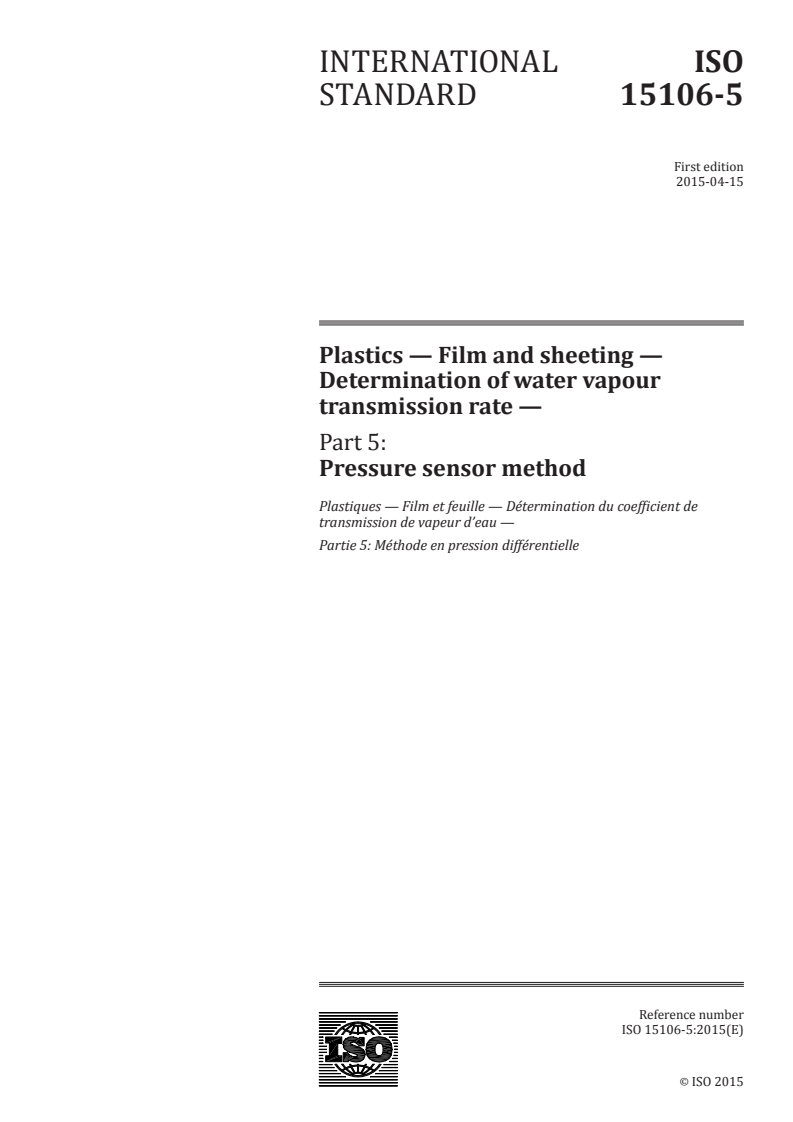
INTERNATIONAL ISO
STANDARD 15106-5
First edition
2015-04-15
Plastics — Film and sheeting —
Determination of water vapour
transmission rate —
Part 5:
Pressure sensor method
Plastiques — Film et feuille — Détermination du coefficient de
transmission de vapeur d’eau —
Partie 5: Méthode en pression différentielle
Reference number
©
ISO 2015
© ISO 2015
All rights reserved. Unless otherwise specified, no part of this publication may be reproduced or utilized otherwise in any form
or by any means, electronic or mechanical, including photocopying, or posting on the internet or an intranet, without prior
written permission. Permission can be requested from either ISO at the address below or ISO’s member body in the country of
the requester.
ISO copyright office
Case postale 56 • CH-1211 Geneva 20
Tel. + 41 22 749 01 11
Fax + 41 22 749 09 47
E-mail copyright@iso.org
Web www.iso.org
Published in Switzerland
ii © ISO 2015 – All rights reserved
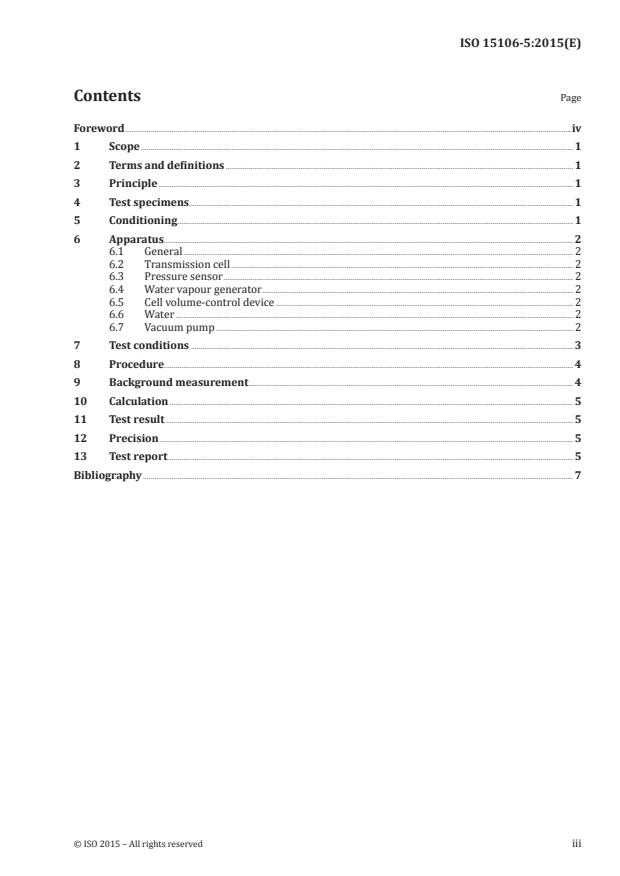
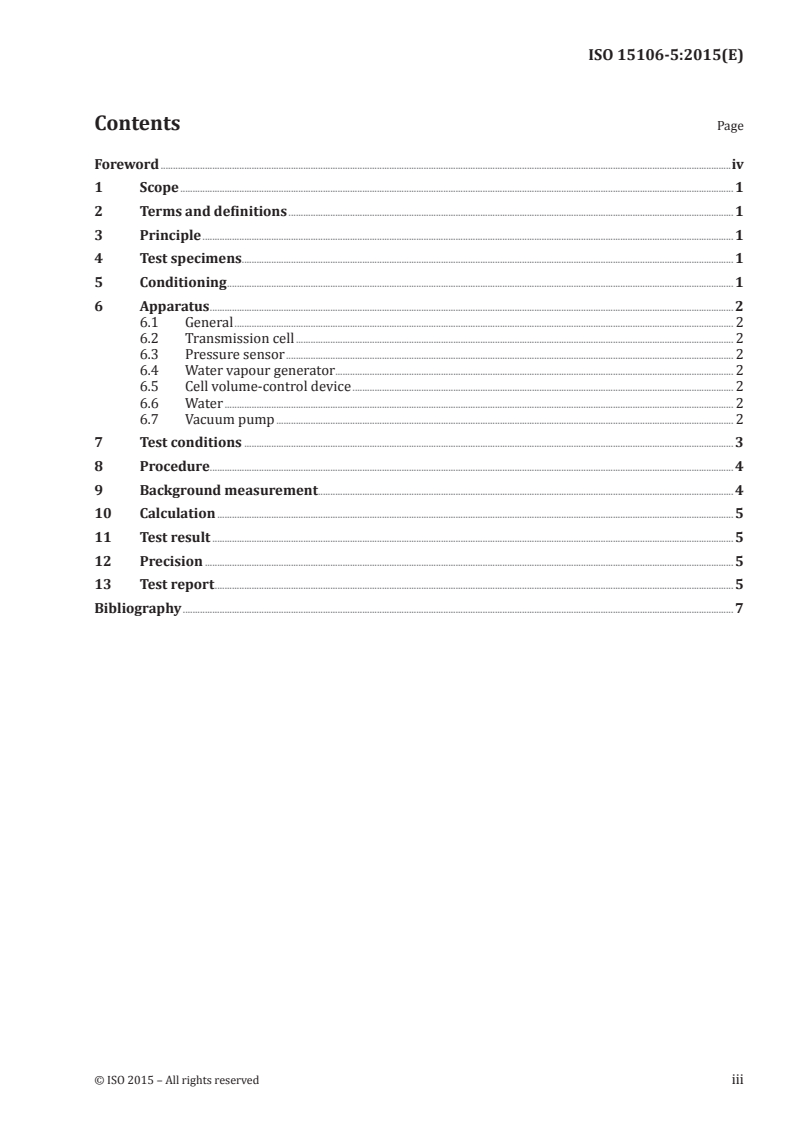
Contents Page
Foreword .iv
1 Scope . 1
2 Terms and definitions . 1
3 Principle . 1
4 Test specimens. 1
5 Conditioning . 1
6 Apparatus . 2
6.1 General . 2
6.2 Transmission cell . 2
6.3 Pressure sensor . 2
6.4 Water vapour generator . 2
6.5 Cell volume-control device . 2
6.6 Water . 2
6.7 Vacuum pump . 2
7 Test conditions . 3
8 Procedure. 4
9 Background measurement . 4
10 Calculation . 5
11 Test result . 5
12 Precision . 5
13 Test report . 5
Bibliography . 7
Foreword
ISO (the International Organization for Standardization) is a worldwide federation of national standards
bodies (ISO member bodies). The work of preparing International Standards is normally carried out
through ISO technical committees. Each member body interested in a subject for which a technical
committee has been established has the right to be represented on that committee. International
organizations, governmental and non-governmental, in liaison with ISO, also take part in the work.
ISO collaborates closely with the International Electrotechnical Commission (IEC) on all matters of
electrotechnical standardization.
The procedures used to develop this document and those intended for its further maintenance are
described in the ISO/IEC Directives, Part 1. In particular the different approval criteria needed for the
different types of ISO documents should be noted. This document was drafted in accordance with the
editorial rules of the ISO/IEC Directives, Part 2 (see www.iso.org/directives).
Attention is drawn to the possibility that some of the elements of this document may be the subject of
patent rights. ISO shall not be held responsible for identifying any or all such patent rights. Details of
any patent rights identified during the development of the document will be in the Introduction and/or
on the ISO list of patent declarations received (see www.iso.org/patents).
Any trade name used in this document is information given for the convenience of users and does not
constitute an endorsement.
For an explanation on the meaning of ISO specific terms and expressions related to conformity
assessment, as well as information about ISO’s adherence to the WTO principles in the Technical Barriers
to Trade (TBT) see the following URL: Foreword - Supplementary information
The committee responsible for this document is ISO/TC 61, Plastics, Subcommittee SC 11, Products.
ISO 15106 consists of the following parts, under the general title Plastics — Film and sheeting ―
Determination of water vapour transmission rate:
— Part 1: Humidity detection sensor method
— Part 2: Infrared detection sensor method
— Part 3: Electrolytic detection sensor method
— Part 4: Gas-chromatographic detection sensor method
— Part 5: Pressure sensor method
— Part 6: Atmospheric pressure ionization mass spectrometer method
— Part 7: Calcium corrosion method
iv © ISO 2015 – All rights reserved
INTERNATIONAL STANDARD ISO 15106-5:2015(E)
Plastics — Film and sheeting — Determination of water
vapour transmission rate —
Part 5:
Pressure sensor method
1 Scope
This part of ISO 15106 specifies a method for determining the water vapour transmission rate of plastic
film, plastic sheeting, and multi-layer structures including plastics, using a pressure sensor.
NOTE The method provides rapid measurement over a wide range of water vapour transmission rates.
2 Terms and definitions
For the purposes of this document, the following terms and definitions apply.
2.1
water vapour transmission rate
amount of water vapour transmitted through unit area of test specimen per unit time under specified
conditions
Note 1 to entry: Water vapour transmission rate is expressed in grams per square metre per 24 h [g
...
INTERNATIONAL ISO
STANDARD 15106-5
First edition
2015-04-15
Plastics — Film and sheeting —
Determination of water vapour
transmission rate —
Part 5:
Pressure sensor method
Plastiques — Film et feuille — Détermination du coefficient de
transmission de vapeur d’eau —
Partie 5: Méthode en pression différentielle
Reference number
©
ISO 2015
© ISO 2015
All rights reserved. Unless otherwise specified, no part of this publication may be reproduced or utilized otherwise in any form
or by any means, electronic or mechanical, including photocopying, or posting on the internet or an intranet, without prior
written permission. Permission can be requested from either ISO at the address below or ISO’s member body in the country of
the requester.
ISO copyright office
Case postale 56 • CH-1211 Geneva 20
Tel. + 41 22 749 01 11
Fax + 41 22 749 09 47
E-mail copyright@iso.org
Web www.iso.org
Published in Switzerland
ii © ISO 2015 – All rights reserved
Contents Page
Foreword .iv
1 Scope . 1
2 Terms and definitions . 1
3 Principle . 1
4 Test specimens. 1
5 Conditioning . 1
6 Apparatus . 2
6.1 General . 2
6.2 Transmission cell . 2
6.3 Pressure sensor . 2
6.4 Water vapour generator . 2
6.5 Cell volume-control device . 2
6.6 Water . 2
6.7 Vacuum pump . 2
7 Test conditions . 3
8 Procedure. 4
9 Background measurement . 4
10 Calculation . 5
11 Test result . 5
12 Precision . 5
13 Test report . 5
Bibliography . 7
Foreword
ISO (the International Organization for Standardization) is a worldwide federation of national standards
bodies (ISO member bodies). The work of preparing International Standards is normally carried out
through ISO technical committees. Each member body interested in a subject for which a technical
committee has been established has the right to be represented on that committee. International
organizations, governmental and non-governmental, in liaison with ISO, also take part in the work.
ISO collaborates closely with the International Electrotechnical Commission (IEC) on all matters of
electrotechnical standardization.
The procedures used to develop this document and those intended for its further maintenance are
described in the ISO/IEC Directives, Part 1. In particular the different approval criteria needed for the
different types of ISO documents should be noted. This document was drafted in accordance with the
editorial rules of the ISO/IEC Directives, Part 2 (see www.iso.org/directives).
Attention is drawn to the possibility that some of the elements of this document may be the subject of
patent rights. ISO shall not be held responsible for identifying any or all such patent rights. Details of
any patent rights identified during the development of the document will be in the Introduction and/or
on the ISO list of patent declarations received (see www.iso.org/patents).
Any trade name used in this document is information given for the convenience of users and does not
constitute an endorsement.
For an explanation on the meaning of ISO specific terms and expressions related to conformity
assessment, as well as information about ISO’s adherence to the WTO principles in the Technical Barriers
to Trade (TBT) see the following URL: Foreword - Supplementary information
The committee responsible for this document is ISO/TC 61, Plastics, Subcommittee SC 11, Products.
ISO 15106 consists of the following parts, under the general title Plastics — Film and sheeting ―
Determination of water vapour transmission rate:
— Part 1: Humidity detection sensor method
— Part 2: Infrared detection sensor method
— Part 3: Electrolytic detection sensor method
— Part 4: Gas-chromatographic detection sensor method
— Part 5: Pressure sensor method
— Part 6: Atmospheric pressure ionization mass spectrometer method
— Part 7: Calcium corrosion method
iv © ISO 2015 – All rights reserved
INTERNATIONAL STANDARD ISO 15106-5:2015(E)
Plastics — Film and sheeting — Determination of water
vapour transmission rate —
Part 5:
Pressure sensor method
1 Scope
This part of ISO 15106 specifies a method for determining the water vapour transmission rate of plastic
film, plastic sheeting, and multi-layer structures including plastics, using a pressure sensor.
NOTE The method provides rapid measurement over a wide range of water vapour transmission rates.
2 Terms and definitions
For the purposes of this document, the following terms and definitions apply.
2.1
water vapour transmission rate
amount of water vapour transmitted through unit area of test specimen per unit time under specified
conditions
Note 1 to entry: Water vapour transmission rate is expressed in grams per square metre per 24 h [g
...