

ISO 13143:2025
(Main)Electronic fee collection — Evaluation of on-board and roadside equipment for conformity to ISO 12813
General Information
- Abstract
This document specifies the test suite structure (TSS) and test purposes (TPs) for evaluating the conformity of on-board equipment (OBE) and roadside equipment (RSE) to ISO 12813. It provides a basis for conformance tests for dedicated short-range communication (DSRC) OBE and RSE to support interoperability between different equipment supplied by different manufacturers. ISO 12813 specifies requirements for the compliance check communication (CCC) interface level, but not for the OBE or RSE internal functional behaviour. Consequently, tests regarding OBE and RSE functional behaviour remain outside the scope of this document.
- Status
- Published
- Publication Date
- 27-Feb-2025
- Technical Committee
- ISO/TC 204 - Intelligent transport systems
- Drafting Committee
- ISO/TC 204 - Intelligent transport systems
- Current Stage
- 6060 - International Standard published
- Start Date
- 28-Feb-2025
- Due Date
- 06-May-2025
- Completion Date
- 28-Feb-2025
Buy Documents


ISO 13143:2025 - Electronic fee collection — Evaluation of on-board and roadside equipment for conformity to ISO 12813 Released:28. 02. 2025


ISO 13143:2025 - Perception de télépéage — Évaluation des équipements embarqués et en bord de route quant a la conformité avec l'ISO 12813 Released:28. 02. 2025
Overview
ISO 13143:2025 - Electronic fee collection - Evaluation of on-board and roadside equipment for conformity to ISO 12813 specifies the Test Suite Structure (TSS) and Test Purposes (TPs) used to evaluate the conformity of Dedicated Short-Range Communication (DSRC) on-board equipment (OBE) and roadside equipment (RSE) to ISO 12813. The standard defines how conformance testing is organised to support interoperability between equipment from different manufacturers, focusing on the Compliance Check Communication (CCC) interface level. Internal functional behaviour of OBE/RSE is explicitly outside the scope.
Key topics and technical requirements
- Test Suite Structure (TSS): Organized by protocol layers - Physical, Data Link Control (DLC) including MAC/LLC sublayers, and Application layer - with subgroups and inherited test cases from base specifications.
- Test Purposes (TPs): Each TP is defined with a unique ID, title, normative reference, origin (identical/derived/specific), initial conditions, and stimulus/expected behaviour. Naming convention: TP///- (e.g., TP/PHY/OBE/BV-01).
- Valid / Invalid Behaviour Classification: Tests are grouped as BV (behaviour valid) or BI (behaviour invalid) to verify both correct and erroneous protocol handling.
- Reference to Base Standards: TPs may be identical to, derived from, or specific relative to existing conformance tests in standards such as ETSI/TS 102 486-2-2, EN 15876, and the referenced ISO 12813:2024.
- Normative Annexes and Reports: Annex A/B contain normative TPs for OBE and RSE; Annex C/D provide protocol conformance test report proformas (PCTR) that conformity assessment bodies must complete. The PCTR supports manufacturers’ declarations of conformity.
- Laboratory Requirements: Physical layer (radio) tests shall be performed in a radio wave laboratory.
Practical applications
- Ensures interoperability of DSRC OBE and RSE in electronic fee collection (EFC) systems.
- Provides a repeatable, harmonized basis for conformance evaluation, type approval, and procurement verification of tolling equipment.
- Supports creation of test suites and automated test systems for protocol conformance at physical, link and application layers.
- Helps regulators, toll operators and certification bodies compare test results across locations and times.
Who should use this standard
- OBE and RSE manufacturers developing DSRC compliance.
- Conformity assessment bodies and test laboratories performing protocol conformance testing.
- Tolling authorities, ITS integrators, and procurement teams specifying interoperability requirements.
- Standards implementers and developers building CCC-compliant systems per ISO 12813.
Related standards (referenced)
- ISO 12813:2024 - Compliance check communication for autonomous systems (CCC)
- ISO 17573-2 - EFC system architecture - vocabulary
- EN 15509, EN 15876, ETSI/TS 102 486-2-2, ISO 14907-2 and others cited for inherited TPs
Keywords: ISO 13143:2025, electronic fee collection, EFC, DSRC, OBE, RSE, ISO 12813, conformance testing, test suite structure, test purposes, compliance check communication, interoperability.
Relations
- Effective Date
- 12-Feb-2026
- Effective Date
- 06-Jun-2022
Buy Documents
ISO 13143:2025 - Electronic fee collection — Evaluation of on-board and roadside equipment for conformity to ISO 12813 Released:28. 02. 2025
ISO 13143:2025 - Perception de télépéage — Évaluation des équipements embarqués et en bord de route quant a la conformité avec l'ISO 12813 Released:28. 02. 2025
Get Certified
Connect with accredited certification bodies for this standard

BSI Group
BSI (British Standards Institution) is the business standards company that helps organizations make excellence a habit.

Great Wall Tianjin Quality Assurance Center
Established 1993, first batch to receive national accreditation with IAF recognition.
Hong Kong Quality Assurance Agency (HKQAA)
Hong Kong's leading certification body.
Sponsored listings
Frequently Asked Questions
ISO 13143:2025 is a standard published by the International Organization for Standardization (ISO). Its full title is "Electronic fee collection — Evaluation of on-board and roadside equipment for conformity to ISO 12813". This standard covers: This document specifies the test suite structure (TSS) and test purposes (TPs) for evaluating the conformity of on-board equipment (OBE) and roadside equipment (RSE) to ISO 12813. It provides a basis for conformance tests for dedicated short-range communication (DSRC) OBE and RSE to support interoperability between different equipment supplied by different manufacturers. ISO 12813 specifies requirements for the compliance check communication (CCC) interface level, but not for the OBE or RSE internal functional behaviour. Consequently, tests regarding OBE and RSE functional behaviour remain outside the scope of this document.
This document specifies the test suite structure (TSS) and test purposes (TPs) for evaluating the conformity of on-board equipment (OBE) and roadside equipment (RSE) to ISO 12813. It provides a basis for conformance tests for dedicated short-range communication (DSRC) OBE and RSE to support interoperability between different equipment supplied by different manufacturers. ISO 12813 specifies requirements for the compliance check communication (CCC) interface level, but not for the OBE or RSE internal functional behaviour. Consequently, tests regarding OBE and RSE functional behaviour remain outside the scope of this document.
ISO 13143:2025 is classified under the following ICS (International Classification for Standards) categories: 03.220.20 - Road transport; 35.240.60 - IT applications in transport. The ICS classification helps identify the subject area and facilitates finding related standards.
ISO 13143:2025 has the following relationships with other standards: It is inter standard links to EN ISO 13143:2025, ISO 13143-1:2020. Understanding these relationships helps ensure you are using the most current and applicable version of the standard.
ISO 13143:2025 is available in PDF format for immediate download after purchase. The document can be added to your cart and obtained through the secure checkout process. Digital delivery ensures instant access to the complete standard document.
Standards Content (Sample)
International
Standard
ISO 13143
First edition
Electronic fee collection —
Evaluation of on-board and
2025-02
roadside equipment for conformity
to ISO 12813
Perception de télépéage — Évaluation des équipements embarqués
et en bord de route quant à la conformité avec l'ISO 12813
Reference number
© ISO 2025
All rights reserved. Unless otherwise specified, or required in the context of its implementation, no part of this publication may
be reproduced or utilized otherwise in any form or by any means, electronic or mechanical, including photocopying, or posting on
the internet or an intranet, without prior written permission. Permission can be requested from either ISO at the address below
or ISO’s member body in the country of the requester.
ISO copyright office
CP 401 • Ch. de Blandonnet 8
CH-1214 Vernier, Geneva
Phone: +41 22 749 01 11
Email: copyright@iso.org
Website: www.iso.org
Published in Switzerland
ii
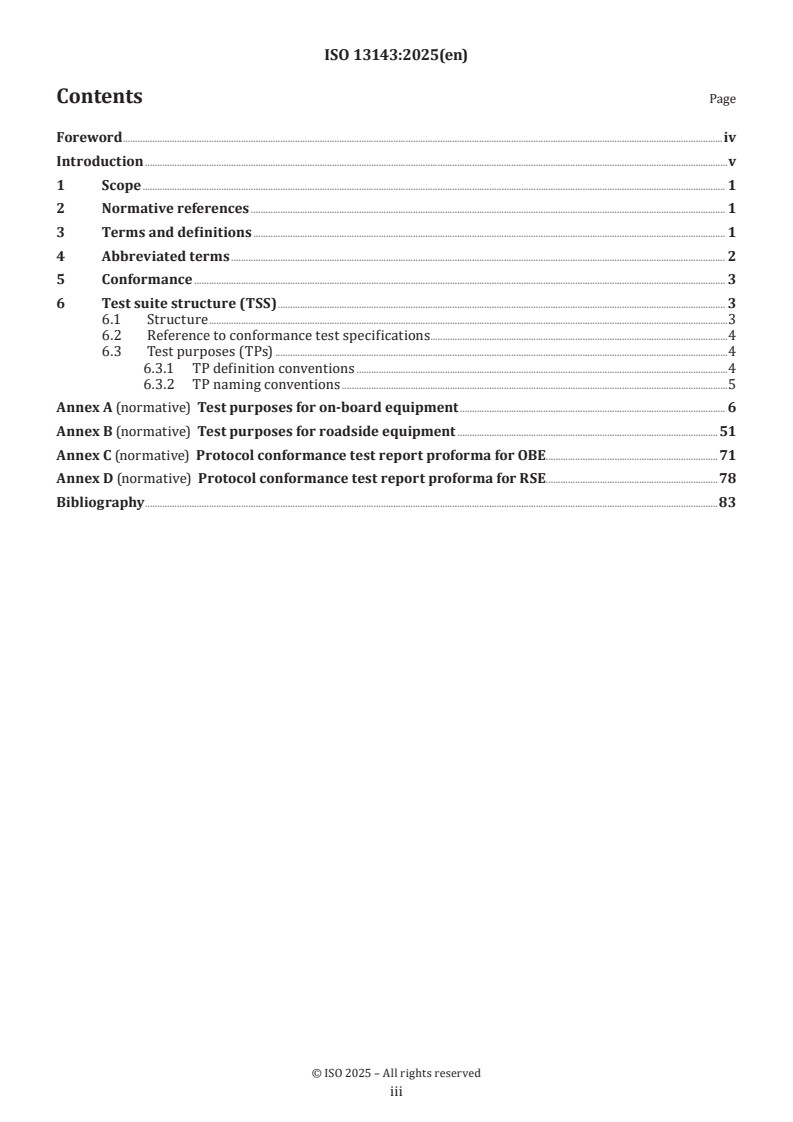
Contents Page
Foreword .iv
Introduction .v
1 Scope . 1
2 Normative references . 1
3 Terms and definitions . 1
4 Abbreviated terms . 2
5 Conformance . 3
6 Test suite structure (TSS) . 3
6.1 Structure .3
6.2 Reference to conformance test specifications . .4
6.3 Test purposes (TPs) .4
6.3.1 TP definition conventions .4
6.3.2 TP naming conventions .5
Annex A (normative) Test purposes for on-board equipment . 6
Annex B (normative) Test purposes for roadside equipment .51
Annex C (normative) Protocol conformance test report proforma for OBE .71
Annex D (normative) Protocol conformance test report proforma for RSE.78
Bibliography .83
iii
Foreword
ISO (the International Organization for Standardization) is a worldwide federation of national standards
bodies (ISO member bodies). The work of preparing International Standards is normally carried out through
ISO technical committees. Each member body interested in a subject for which a technical committee
has been established has the right to be represented on that committee. International organizations,
governmental and non-governmental, in liaison with ISO, also take part in the work. ISO collaborates closely
with the International Electrotechnical Commission (IEC) on all matters of electrotechnical standardization.
The procedures used to develop this document and those intended for its further maintenance are described
in the ISO/IEC Directives, Part 1. In particular, the different approval criteria needed for the different types
of ISO document should be noted. This document was drafted in accordance with the editorial rules of the
ISO/IEC Directives, Part 2 (see www.iso.org/directives).
ISO draws attention to the possibility that the implementation of this document may involve the use of (a)
patent(s). ISO takes no position concerning the evidence, validity or applicability of any claimed patent
rights in respect thereof. As of the date of publication of this document, ISO had not received notice of (a)
patent(s) which may be required to implement this document. However, implementers are cautioned that
this may not represent the latest information, which may be obtained from the patent database available at
www.iso.org/patents. ISO shall not be held responsible for identifying any or all such patent rights.
Any trade name used in this document is information given for the convenience of users and does not
constitute an endorsement.
For an explanation of the voluntary nature of standards, the meaning of ISO specific terms and expressions
related to conformity assessment, as well as information about ISO's adherence to the World Trade
Organization (WTO) principles in the Technical Barriers to Trade (TBT), see www.iso.org/iso/foreword.html.
This document was prepared by Technical Committee ISO/TC 204, Intelligent transport systems, in
collaboration with the European Committee for Standardization (CEN) Technical Committee CEN/TC 278,
Intelligent transport systems, in accordance with the Agreement on technical cooperation between ISO and
CEN (Vienna Agreement).
This first edition of ISO 13143 cancels and replaces the second edition of ISO 13143-1:2020, which has been
technically revised.
The main changes are as follows:
— updates have been made to reflect changes in the underlying normative references, in particular
ISO 12813, in which data and coding specifications have been revised;
1)
— the terms and definitions have been updated and ISO 17573-2:— has been included as the primary
source for harmonized terminology across electronic fee collection (EFC) standards;
— references to underlying standards have been updated.
Any feedback or questions on this document should be directed to the user’s national standards body. A
complete listing of these bodies can be found at www.iso.org/members.html.
1) Under preparation. Stage at the time of publication: ISO/DIS 17573-2:2025.
iv
Introduction
On-board equipment (OBE) that uses satellite-based positioning technology to collect data required for
charging for the use of roads operates in an autonomous way (i.e. without relying on dedicated roadside
infrastructure). The OBE records the amount of road usage in all toll charging systems it passes through.
This document specifies the process and tests for evaluation of OBE and roadside equipment (RSE) for
conformity to ISO 12813.
ISO 12813 specifies requirements for dedicated short-range communication (DSRC) between OBE and an
interrogator for the purpose of checking conformance of road use with a local toll regime. It assumes an
electronic fee collection (EFC) services architecture according to ISO 17573-1.
This document is intended to:
— assess OBE and RSE capabilities;
— assess OBE and RSE behaviour;
— serve as a guide for OBE and RSE conformance evaluation and type approval;
— achieve comparability between the results of the corresponding tests applied in different places at
different times; and
— facilitate communication between parties.
v
International Standard ISO 13143:2025(en)
Electronic fee collection — Evaluation of on-board and
roadside equipment for conformity to ISO 12813
1 Scope
This document specifies the test suite structure (TSS) and test purposes (TPs) for evaluating the conformity
of on-board equipment (OBE) and roadside equipment (RSE) to ISO 12813.
It provides a basis for conformance tests for dedicated short-range communication (DSRC) OBE and RSE to
support interoperability between different equipment supplied by different manufacturers.
ISO 12813 specifies requirements for the compliance check communication (CCC) interface level, but not
for the OBE or RSE internal functional behaviour. Consequently, tests regarding OBE and RSE functional
behaviour remain outside the scope of this document.
2 Normative references
The following documents are referred to in the text in such a way that some or all of their content constitutes
requirements of this document. For dated references, only the edition cited applies. For undated references,
the latest edition of the referenced document (including any amendments) applies.
ISO 3166-1, Codes for the representation of names of countries and their subdivisions — Part 1: Country code
ISO 12813:2024, Electronic fee collection — Compliance check communication for autonomous systems
ISO 14816, Road transport and traffic telematics — Automatic vehicle and equipment identification —
Numbering and data structure
ISO 14907-2:2021, Electronic fee collection — Test procedures for user and fixed equipment — Part 2:
Conformance test for the on-board unit application interface
2)
ISO 17573-2 , Electronic fee collection — System architecture for vehicle related tolling — Part 2: Vocabulary
EN 12834:2003, Road transport and traffic telematics — Dedicated Short Range Communication (DSRC) —
DSRC application layer
EN 13372:2004, Road Transport and Traffic Telematics (RTTT) — Dedicated short-range communication —
Profiles for RTTT applications
EN 15509:2023, Electronic fee collection — Interoperability application profile for DSRC
EN 15876, Electronic fee collection — Conformity evaluation of on-board and roadside equipment to EN 15509
ETSI/TS 102 486-2-2:2008, Intelligent Transport Systems (ITS); Road Transport and Traffic Telematics (RTTT);
Test specifications for Dedicated Short Range Communication (DSRC) transmission equipment; Part 2: DSRC
application layer; Sub-Part 2: Test Suite Structure and Test Purposes (TSS & TP)
3 Terms and definitions
For the purposes of this document, the terms and definitions given in ISO 17573-2 and the following apply.
2) Under preparation. Stage at the time of publication: ISO/DIS 17573-2:2025.
ISO and IEC maintain terminology databases for use in standardization at the following addresses:
— ISO Online browsing platform: available at https:// www .iso .org/ obp
— IEC Electropedia: available at https:// www .electropedia .org/
3.1
Element
DSRC directory containing application information in the form of attributes
[SOURCE: ISO 14906:2022, 3.8]
3.3
protocol implementation conformance statement
ICS for an implementation or system claimed to conform to a given protocol specification
[SOURCE: ISO/IEC 9646-1:1994, 3.3.80]
4 Abbreviated terms
AC_CR access credentials
AID application identifier
APDU application protocol data unit
AP application process
ATS abstract test suite
BI behaviour invalid (i.e. invalid behaviour tests)
BST beacon service table
BV behaviour valid (i.e. valid behaviour tests)
CCC compliance check communication
DLC data link control
DSRC dedicated short-range communication
DUT device under test
EFC electronic fee collection
EID element identifier
ICS implementation conformance statement
LLC logical link control
MAC medium access control
OBE on-board equipment
PCTR protocol conformance test report
PDU protocol data unit
PICS protocol implementation conformance statement
PIXIT protocol implementation extra information for testing
RSE roadside equipment
SCTR system conformance test report
T-APDU transfer-application protocol data unit
TP test purpose
TSS test suite structure
VST vehicle service table
5 Conformance
The conformance tests shall be performed as specified in Annex A and Annex B for OBE and RSE respectively.
The conformity assessment body of the OBE and RSE, respectively, is responsible for providing a conformance
test report.
The conformity assessment body of the OBE shall complete the protocol conformance test report (PCTR) for
the OBE as specified in Annex C.
The conformity assessment body of the RSE shall complete the PCTR for the RSE as specified in Annex D.
NOTE The PCTR forms a basis for the manufacturer’s declaration of conformity.
6 Test suite structure (TSS)
6.1 Structure
Table 1 shows the test suite structure (TSS) including its subgroups that are inherited from other
specifications.
Table 1 — Test suite structure
Group Type of DUT Behaviour
Physical layer OBE Valid behaviour (BV)
Invalid behaviour (BI)
RSE BV
BI
Data link control (DLC) OBE BV
Medium access control (MAC) sublayer
BI
RSE BV
BI
DLC OBE BV
Logical link control (LLC) sublayer
BI
RSE BV
BI
Application layer OBE BV
BI
RSE BV
BI
Physical layer tests shall be performed in a radio wave laboratory.
6.2 Reference to conformance test specifications
Conformance to a profile standard implies conformance to the related base standards. Hence, a number of
test cases for the CCC application are identical to the conformance test cases for the related base standards.
Other test cases are derived from the base standards conformance test cases, by applying some restrictions
or choices in elements such as the parameters values, according to the elements stated in the profile
standard. Specific conformance test cases for the CCC application are identified for statements contained in
the CCC application, which have no equivalence in the base standards. These latter cases cover, for example,
the application layer data test purposes. This document considers existing test purposes for conformance to
the base standards by referencing them, so that:
a) for test purposes that are identical to those specified in the base standards conformance test cases (see
e.g. ETSI/TS 102 486-2-2 or EN 15876), a direct reference is reported;
NOTE For the reader’s convenience, the title or a verbal description of the referenced test purpose is provided,
together with the reference.
b) for test purposes that are derived from those specified in the base standards conformance test cases, a
direct reference is reported, plus an indication of how the referred test purpose has been modified for
the profile conformance testing;
c) for test purposes that are specific to the standard profile, a complete description is provided.
An indication of whether a test purpose is identical, derived or specific is given in each test purpose.
6.3 Test purposes (TPs)
6.3.1 TP definition conventions
The TPs are specified following the template and rules shown in Table 2.
Table 2 — TP definition rules
TP ID according to Title
the TP naming conventions Reference
TP origin
Initial condition
Stimulus and expected behaviour
TP ID The TP ID is a unique identifier. It is specified according to the TP naming conventions
defined in 6.3.2.
Title Short description of TP objective.
Reference Contains the reference (document, clause, paragraph) to the subject to be validated by
the actual TP.
TP origin Indicates if the TP is identical to a TP specified in another test standard, derived from a
TP specified in another test standard, or specific for this standard profile.
Initial condition The condition specifies the required initial state of the device under test (DUT) at the
time of launching of the actual TP.
Stimulus and expected Definition of the events the tester performs and the events that are expected from the
behaviour DUT to conform to the base specification.
6.3.2 TP naming conventions
Each TP is given a unique identification. This unique identification is built up to contain the following string
of information:
TP/ //-
TP : to indicate that it is a test purpose;
: to which group among those specified in Table 1 the TP applies;
: type of DUT (i.e. OBE or RSE);
: type of testing (i.e. Valid behaviour tests, BV, or Invalid behaviour tests, BI);
: sequential TP number (01 to 99).
The naming conventions are as described in Table 3.
Table 3 — TP naming conventions
applicable for OBE/RSE PHY Physical layer
applicable for OBE/RSE MAC/LLC MAC/LLC sublayer
applicable for OBE/RSE AP-BAS Application layer – I Kernel support
applicable for OBE AP-FUN Application layer – T Kernel support
applicable for OBE AP-DAT Application layer – Data attributes support
applicable for OBE AP-SEC Application layer – Security Level 1 support
applicable for RSE AP-GET Application layer - GET-rq protocol data unit (PDU) test purposes,
applicable for RSE AP-STA Application layer - GET-STAMPED-rq PDU test purposes
applicable for RSE AP-MMI Application layer - SET-MMI-rq PDU test purposes
applicable for RSE AP-ECH Application layer - ECHO-rq PDU test purposes
applicable for RSE AP-REL Application layer - EVENT-REPORT-rq PDU test purposes
Annex A
(normative)
Test purposes for on-board equipment
A.1 General
A.1.1 Content
This annex contains the test purposes (TPs) for the conformity evaluation of OBE to ISO 12813.
A.1.2 Symbols in TP descriptions
For the application layer test purposes (see Clause A.4), a special notation and symbol convention is used, as
specified in Table A.1.
Table A.1 — Description of TP symbols
Symbol Description
XXX.rq ⇒ The tester sends the XXX.rq protocol data unit (PDU) to the device under test (DUT).
⇐ YYY.rs The DUT sends the YYY.rs PDU to the tester.
A ≡ B Test purpose A “is congruent to” test purpose B. The notation "Test purpose A ≡ Test purpose B" means
that test purpose A is the same as test purpose B. If differences in parameters or parameter values have
to be applied, these differences are indicated in the text immediately below.
A → B Object A “is transformed” into object B. So, a notation like “Table X → Table Y” means that, for the scope
of the TP, any reference of Table X should be changed into a reference to Table Y.
= Means “assignment”, i.e. a notation like “accessCredentials = a value” means that the field accessCreden-
tials is given a value.
Ø Means “empty” or “not set”, i.e. a notation like “accessCredentials = Ø → accessCredentials = calculated
value”, for a given TP, means “change all occurrences in which the field accessCredentials has not been
assigned to a calculation of the value accessCredentials to a given value".
A.2 Physical layer
In accordance with ISO 12813:2024, 5.5.2, all test purposes TP/PHY/OBE/Bx/yy specified in EN 15876 shall
be applicable for the conformity evaluation of OBE to CEN–DSRC-based CCC as specified in ISO 12813:2024,
Table B.9, Item 1.
A.3 MAC and LLC
In accordance with ISO 12813:2024, 5.5.2, all test purposes TP/MAC/OBE/Bx/yy and TP/LLC/OBE/Bx/
yy specified in EN 15876 are applicable for the conformity evaluation of OBE to CEN–DSRC-based CCC as
specified in ISO 12813:2024, Table B.9, Item 1.
A.4 Application Layer
A.4.1 Structure of BST and VST
A.4.1.1 BST
The BST general structure, as is transmitted to the OBE, shall be in accordance with Table A.2.
Table A.2 — BST general structure
Length Allowed values
T-APDUs 4 bits ‘1000’ indicating initialisation-request
(BST)
Option indicator 1 bit (nonmandApplications opt.) 0/1
RSE manufacturerid 16 bits In accordance with ISO 14816
individualid 27 bits As specified by manufacturer
Time 32 bits UNIX real time
Profile 1 bit (Profile ext.) 0 (= no extension)
7 bits In accordance with the Profile in
EN 13372:2004, 6.3.2
MandAp- 1 bit (mandApplications ext.) 0 (= no extension)
plications
7 bits (number of applications) M
CCC 1 bit (eid opt.) 0 (= eid not present)
applica-
1 bit (parameter opt.) 0 (= parameter not present)
tion
aid 1 bit (aid ext.) 0 (= no extension)
5 bits 20 (= CCC application)
Applica-
tion 2
1 bit (eid opt.) 0/1
(not CCC)
1 bit (parameter opt.) 0/1
aid 1 bit (aid ext.) 0 (= no extension)
5 bits ≠ 20 (= no CCC application)
eid 1 bit (eid ext.) 0 (= no extension)
7 bits Any
parameter ApplicationContextMark in accordance
with EN 12834:2003, Annex A
… . .
Applica-
tion M
1 bit (eid opt.) 0/1
(not CCC)
1 bit (parameter opt.) 0/1
aid 1 bit (aid ext.) 0 (= no extension)
5 bits ≠ 20 (= no CCC application)
eid 1 bit (eid ext.) 0 (= no extension)
7 bits Any
parameter ApplicationContextMark in accordance
with EN 12834:2003, Annex A
TTabablele A A.22 ((ccoonnttiinnueuedd))
Length Allowed values
Nonmand 1 bit (mandApplications ext.) 0 (= no extension)
Applica-
7 bits (number of applications) Can be in the range of 0 . N, provid-
tions
ed the maximum framelength is not
exceeded.
Application 1 Same length and allowed values as in “Application 2 (not CCC)” of mandApplica-
tions
(not CCC)
... ...
Application N Same lengt and allowed values as in “Application 2 (not CCC)” of mandApplica-
tions
(not CCC)
profileL- 1 bit (profileList ext.) 0 (= no extension)
ist
7 bits (number of profiles) Can be in the range of 0.K provided the
maximum framelength is not exceeded.
Profile 1 1 bit (Profile ext.) 0 (= no extension)
7 bits Profile in accordance with
EN 12834:2003, Annex A and
EN 13372:2004, 6.3.2
... ... ...
Profile K 1 bit (Profile ext.) 0 (= no extension)
7 bits Profile in accordance with
EN 12834:2003, Annex A and
EN 13372:2004, 6.3.2
A.4.1.2 VST
The general structure for a VST indicating one CCC application as is transmitted by the OBE shall be in
accordance with Table A.3.
In addition to the CCC application the VST may optionally indicate one or more non-CCC applications.
Table A.3 — VST1 (security level 1): valid VST indicating one CCC application
Length Allowed value
Fill 4 bits Any
1 bit (Profile ext.) 0 (= no extension)
Profile
Profile in accordance with
7 bits
EN 12834:2003, Annex A
1 bit (applications ext.) 0 (= no extension)
Can be in the range of 0.M
7 bits (number of depending on OBE support
applic.) and provided the maximum
framelength is not exceeded
1 bit (eid opt.) 1 (= eid present)
1 bit (parameter opt.) 1 (= parameter present)
1 bit (aid ext.) 0 (= no extension)
aid
5 bits 20 (= CCC application)
1 bit (eid ext.) 0 (= no extension)
eid
Any (≠ other eid used in this
7 bits
VST)
TTabablele A A.33 ((ccoonnttiinnueuedd))
Length Allowed value
1 bit (Container ext.) 0 (= no extension)
7 bits (Container
2 (= OCTET STRING)
CHOICE)
1 bit (octet string ext.) 0 (= no extension)
7 bits (octet string
length)
In accordance with ISO 3166-
10 bits (CountryCode)
Contract
Provider
14 bits (IssuerIdenti- In accordance with
fier) ISO 14816
CccContext-
typeOf
Mark 16 bits Any
Contract
CCC
application
Applica- 1 bit (contextVersion
0 (= no extension)
context
tions ext.)
Version
7 bits Any
para
meter
1 bit (Container ext.) 0 (= no extension)
7 bits (Container
2 (= OCTET STRING)
CHOICE)
1 bit (octet string ext.) 0 (= no extension)
7 bits (octet string
length)
AC_Master
8 bits Any
KeyRef
AC_CR-
Reference
AC_CR-
8 bits Any
Diversifier
1 bit (Container ext.) 0 (= no extension)
7 bits (Container
2 (= OCTET STRING)
CHOICE)
1 bit (octet string ext.) 0 (= no extension)
7 bits (octet string
length)
RndOBE 32 bits Any
TTabablele A A.33 ((ccoonnttiinnueuedd))
Length Allowed value
1 bit (eid opt.) 0/1
1 bit (parameter opt.) 0/1
1 bit (aid ext.) 0 (= no extension)
DSRCApplicationEntityID,
aid
5 bits in accordance with
EN 12834:2003, Annex A
Application 2
1 bit (eid ext.) 0 (= no extension)
eid
Any (≠ other eid used in this
7 bits
VST)
ApplicationContextMark,
parameter in accordance with
EN 12834:2003, Annex A
…
1 bit (eid opt.) 0/1
1 bit (parameter opt.) 0/1
1 bit (aid ext.) 0 (= no extension)
DSRCApplicationEntityID,
aid
Application M 5 bits in accordance with
N 12834:2003, Annex A
1 bit (eid ext.) 0 (= no extension)
eid
Any (≠ other eid used in this
7 bits
VST)
ApplicationContextMark,
parameter in accordance with
EN 12834:2003, Annex A
OBE 1 bit (obeStatus opt.) 0/1
Configura-
equipmentClass 15 bits Any
tion
manufacturerId 16 bits Any
obeStatus 16 bits Any
OBE may optionally transmit a VST containing two CCC applications.
If OBE supports this optional function, the structure for a VST indicating two CCC applications (VST2) shall
be in accordance with Table A.4.
VST2 shall indicate the presence of two CCC applications with the following definitions (refer to
ISO 12813:2024, 9.2.3):
— one CCC application shall conform to ISO 12813:2024; and
— the other CCC application shall conform to ISO 12813:2015.
NOTE Evaluation of conformance with ISO 12813:2015 is outside the scope of this document.
In addition to the CCC applications, the VST may optionally indicate one or more non-CCC applications.
Table A.4 — VST2 (security level 1) — Valid VST indicating two CCC applications
Length Allowed value
Fill 4 bits Any
1 bit (Profile ext.) 0 (= no extension)
Profile
Profile in accordance with
7 bits
EN 12834:2003, Annex A
1 bit (applications ext.) 0 (= no extension)
Shall be in the range of 2.M
7 bits (number of
provided the maximum
applic.)
framelength is not exceeded
1 bit (eid opt.) 1 (= eid present)
1 bit (parameter opt.) 1 (= parameter present)
1 bit (aid ext.) 0 (= no extension)
aid
5 bits 20 (= CCC application)
1 bit (eid ext.) 0 (= no extension)
eid
7 bits Any
1 bit (Container ext.) 0 (= no extension)
7 bits (Container
2 (= OCTET STRING)
CHOICE)
1 bit (octet string ext.) 0 (= no extension)
7 bits (octet string
length)
In accordance with ISO 3166-
10 bits (CountryCode)
Contract
Provider
14 bits (IssuerIdenti- In accordance with
fier) ISO 14816
CCC
Applica- CccContext- TypeOf
applica- 16 bits Any
tions Marl1 Contract
tion1
1 bit (contextVersion
0 (= no extension)
ext.)
context
Version
para
7 bits Any
meter
1 bit (Container ext.) 0 (= no extension)
7 bits (Container
2 (= OCTET STRING)
CHOICE)
1 bit (octet string ext.) 0 (= no extension)
7 bits (octet string
length)
AC_Master
8 bits Any
KeyRef
AC_CR-
Reference
AC_CR-
8 bits Any
Diversifier
1 bit (Container ext.) 0 (= no extension)
7 bits (Container
2 (= OCTET STRING)
CHOICE)
1 bit (octet string ext.) 0 (= no extension)
7 bits (octet string
length)
RndOBE 32 bits Any
TTabablele A A.44 ((ccoonnttiinnueuedd))
Length Allowed value
1 bit (eid opt.) 1 (= eid present)
1 bit (parameter opt.) 1 (= parameter present)
1 bit (aid ext.) 0 (= no extension)
aid
5 bits 20 (= CCC application)
1 bit (eid ext.) 0 (= no extension)
eid
7 bits ≠ eid of CCC application1
1 bit (Container ext.) 0 (= no extension)
7 bits (Container
2 (= OCTET STRING)
CHOICE)
1 bit (octet string ext.) 0 (= no extension)
7 bits (octet string
length)
In accordance with ISO 3166-
10 bits (CountryCode)
Contract
Provider
14 bits (IssuerIdenti- In accordance with
fier) ISO 14816
TypeOf
CccContext- 16 bits Any
Contract
Mark2
1 bit (contextVersion
0 (= no extension)
ext.)
context
CCC
Version
applica- 7 bits Any
tion2
1 bit (Container ext.) 0 (= no extension)
para 7 bits (Container
2 (= OCTET STRING)
meter CHOICE)
1 bit (octet string ext.) 0 (= no extension)
7 bits (octet string
length)
AC_Master
8 bits Any
KeyRef
AC_CR-
Reference
AC_CR-
8 bits Any
Diversifier
1 bit (Container ext.) 0 (= no extension)
7 bits (Container
2 (= OCTET STRING)
CHOICE)
1 bit (octet string ext.) 0 (= no extension)
7 bits (octet string
length)
RndOBE 32 bits Any
:::
1 bit (eid opt.) 1 (= eid present)
1 bit (parameter opt.) 0 (= parameter not present)
1 bit (aid ext.) 0 (= no extension)
Optional applica-
aid
tion M (non-CCC
5 bits ≠ 20
application)
1 bit (eid ext.) 0 (= no extension)
eid
Any (≠ other eid used in this
7 bits
VST)
TTabablele A A.44 ((ccoonnttiinnueuedd))
Length Allowed value
obe 1 bit (obeStatus opt.) 1 (= obeStatus present)
Configura-
equipmentClass 15 bits Any
tion
manufacturerId 16 bits Any
obeStatus 16 bits Any
A.4.2 PDUs parameters
A.4.2.1 Parameters of request PDUs
Request APDUs shall be as specified in Table A.5 – Table A.9.
No other request commands are used by the CCC application.
Fill bits shall always be set to zero.
Table A.5 — GET-Rq parameters (security level 1)
EN 12834:2003, Annex A EN 15509:2023, Table B.16
GET-Rq fill =
eid =
accessCredentials optional mandatory
iid optional prohibited
attributeIdList optional mandatory
Table A.6 — Action-Rq parameters for GET_STAMPED action (security level 1)
EN 12834:2003, Annex A EN 15509:2023, Table B.20 and
ISO 12813
ACTION-Rq mode TRUE
eid =
actionType 0 (GET_STAMPED)
accessCredentials optional mandatory
actionParameters optional GetStampedRq
iid optional prohibited
Table A.7 — Action-Rq parameters for SET_MMI action
EN 12834:2003, Annex A EN 15509:2023, Table B.20 and
ISO 12813
ACTION-Rq mode =
eid 0
actionType 10 (SET_MMI)
accessCredentials optional prohibited
actionParameters optional SetMMIRq
iid optional prohibited
Table A.8 — Action-Rq parameters for ECHO action
EN 12834:2003, Annex A EN 15509:2023, Table B.20 and
ISO 12813
ACTION-Rq mode =
eid 0
actionType 15 (ECHO)
accessCredentials optional prohibited
actionParameters optional mandatory
iid optional prohibited
Table A.9 — EVENT-REPORT-Rq parameters
EN 12834:2003, Annex A EN 15509:2023, Table B.22 and
ISO 12813
EVENT-RE- mode =
PORT-Rq
eid 0
eventType 0 (release)
accessCredentials optional prohibited
eventParameters optional prohibited
iid optional prohibited
A.4.2.2 Parameters of response PDUs
Response APDUs shall be as specified in Table A.10 – Table A.13.
No other request commands are used by CCC application.
Fill bits shall always be set to zero.
Table A.10 — GET-Rs parameters
EN 12834:2003, Annex A EN 15509:2023, Table B.17
GET-Rs fill =
eid =
Iid optional prohibited
attributeList optional mandatory
ret optional mandatory
Table A.11 — Action-Rs parameters for GET_STAMPED action
EN 12834:2003, Annex A EN 15509:2023, Table B.21 and
ISO 12813
ACTION-Rs fill =
eid =
iid optional prohibited
responseParameter optional mandatory
ret optional mandatory
Table A.12 — Action-Rs parameters for SET_MMI action
EN 12834:2003, Annex A EN 15509:2023, Table B.21 and
ISO 12813
ACTION-Rs fil =
eid 0
iid optional prohibited
responseParameter optional prohibited
ret optional mandatory
Table A.13 — Action-Rs parameters for ECHO action
EN 12834:2003, Annex A EN 15509:2023, Table B.21 and
ISO 12813
ACTION-Rs fill =
eid 0
iid optional prohibited
responseParameter optional conditional (present when ret = 0)
ret optional mandatory
A.4.3 Application I-kernel TPs for OBE, security level 1
A.4.3.1 General
TPs specified in A.4.3 apply to security level 1 as specified in ISO 12813:2024, Table B.6, Item 1 and to
initialisation and termination processes specified in ISO 12813:2024, Table B.7, Items 1 and 5.
A.4.3.2 Data structures
For the purpose of this conformance test, the following BSTs described in:
— Table A.14 for a valid BST used in BV TPs, and
— Table A.15 for an invalid BST used in BI TPs
shall be transmitted to the DUT. Invalid values are indicated using a table footnote.
NOTE BST2 contains erroneous parameters in form of a CCC application inserted as non-mandatory application.
Table A.14 — BST1
Length Value
Option indicator 1 bit (nonmandApplications opt.) 0 (= nonmandApplications not
present)
RSE manufacturerid 16 bits Registered value
individualid 27 bits Any
Time 32 bits Any
profile 1 bit (Profile ext.) 0 (= no extension)
7 bits 0
TTabablele A A.1144 ((ccoonnttiinnueuedd))
Length Value
MandApplica- 1 bit (mandApplications ext.) 0 (= no extension)
tions
7 bits (number of applications) 1
CCC 1 bit (eid opt.) 0 (= eid not present)
applica-
1 bit (parameter opt.) 0 (= parameter not present)
tion
aid 1 bit (aid ext.) 0 (= no extension)
5 bits 20 (= CCC application)
profileList 1 bit (profileList ext.) 0 (= no extension)
7 bits (number of profiles) 0 (= list empty)
Table A.15 — BST2
Length Value
Option indicator 1 bit (nonmandApplications opt.) 1 (= nonmandApplications pres-
ent)
RSE manufacturerid 16 bits Registered value
individualid 27 bits Any
Time 32 bits Any
profile 1 bit (Profile ext.) 0 (= no extension)
7 bits 0
MandApplications 1 bit (mandApplications ext.) 0 (= no extension)
7 bits (number of applications) 1
Application 1 bit (eid opt.) 1 (= eid present)
#1
1 bit (parameter opt.) 0 (= parameter not present)
(not CCC)
aid 1 bit (aid ext.) 0 (= no extension)
5 bits ≠ 20 (AID that is not supported by
the OBE)
eid 1 bit (eid ext.) 0 (= no extension)
7 bits Any
nonmandApplica- 1 bit (nonmandApplications ext.) 0 (= no extension)
tions
7 bits (number of applications) 1
a a
CCC 1 bit (eid opt.) 0 (= eid not present)
a
application
a a
1 bit (parameter opt.) 0 (= parameter not present)
a a a
aid 1 bit (aid ext.) 0 (= no extension)
a a
5 bits 20 (= CCC application)
profileList 1 bit (profileList ext.) 0 (= no extension)
7 bits (number of profiles) 0 (= list empty)
a
Invalid value.
A.4.3.3 BV test purposes
The test subgroup objectives are:
a) to test the behaviour of the DUT in relation to:
— valid BST, and
— valid EVENT-REPORT-Rq (Release);
b) to test the DUT support of:
— BeaconId,
— Time,
— Profile,
— Applications, and
— LID.
TPs to assess conformity of Application I-kernel functions for OBE, security level 1, for valid behaviour shall
be performed as specified in Tables A.16 to A.21.
NOTE TPs with ID TP/AP-BAS/OBE/BV/05 to TP/AP-BAS/OBE/BV/08 have not been used to be in line with the
numbering in ETSI/TS 102 486–2-2.
Table A.16 — TP/AP BAS/OBE/BV/01
TP/AP-BAS/OBE/BV/01 Receive and manage INITIALISATION.request (BST)
TP origin Identical to TP/AL-I/OBE/BV/01 in ETSI/TS 102 486–2-2:2008, 5.4.1
Reference ISO 12813:2024, 7.1.2
Initial condition In accordance with TP/AL-I/OBE/BV/01 in ETSI/TS 102 486–2-2:2008, 5.4.1
Stimulus and expected be- In accordance with TP/AL-I/OBE/BV/01 in ETSI/TS 102 486–2-2:2008, 5.4.1
haviour
Table A.17 — TP/AP BAS/OBE/BV/02
TP/AP-BAS/OBE/BV/02 Receive and manage EVENTREPORT request (RELEASE) with mode = 0
TP origin Identical to TP/AL-I/OBE/BV/02 in ETSI/TS 102 486–2-2:2008, 5.4.1
Reference ISO 12813:2024, 7.1.6
Initial condition In accordance with TP/AL-I/OBE/BV/02 in ETSI/TS 102 486–2-2:2008, 5.4.1
Stimulus and expected be- In accordance with TP/AL-I/OBE/BV/02 in ETSI/TS 102 486–2-2:2008, 5.4.1
haviour
Table A.18 — TP/AP BAS/OBE/BV/03
TP/AP-BAS/OBE/BV/03 Read and manage the BeaconID in the BST
TP origin Identical to TP/AL-I/OBE/BV/03 in ETSI/TS 102 486–2-2:2008, 5.4.1
Reference ISO 12813:2024, 7.1.2
Initial condition Identical to TP/AL-I/OBE/BV/03 in ETSI/TS 102 486–2-2:2008, 5.4.1
Stimulus and expected be- In accordance with TP/AL-I/OBE/BV/03 in ETSI/TS 102 486–2-2:2008, 5.4.1
haviour
Table A.19 — TP/AP BAS/OBE/BV/04
TP/AP-BAS/OBE/BV/04 Read and manage time of reception of BST in parameter Time in BST
TP origin Identical to TP/AL-I/OBE/BV/04 in ETSI/TS 102 486–2-2:2008, 5.4.1
Reference ISO 12813:2024, 7.1.2
Initial condition Identical to TP/AL-I/OBE/BV/04 in ETSI/TS 102 486–2-2:2008, 5.4.1
Test execution option This TP may be optionally modified in comparison to the original specification
in ETSI/TS 102 486-2-2 depending on the time source of the DUT. Tests with OBE
which derive their internal time from sources other than the BST received (e.g. from
GNSS or CN) may require an additional delay in step 5 for more than 255 seconds
before submitting the next BST.
Stimulus and expected be- In accordance with TP/AL-I/OBE/BV/04 in ETSI/TS 102 486–2-2:2008, 5.4.1
haviour
Table A.20 — TP/AP BAS/OBE/BV/09
TP/AP-BAS/OBE/BV/09 Manage profile selection
TP origin Identical to TP/AL-I/OBE/BV/09 in ETSI/TS 102 486–2-2:2008, 5.4.1
Reference ISO 12813:2024, 7.1.2
Initial condition In accordance with TP/AL-I/OBE/BV/09 in ETSI/TS 102 486–2-2:2008, 5.4.1
Stimulus and expected be- In accordance with TP/AL-I/OBE/BV/09 in ETSI/TS 102 486–2-2:2008, 5.4.1
haviour
Table A.21 — TP/AP BAS/OBE/BV/10
TP/AP-BAS/OBE/BV/10 Verify that the DUT replies to a BST with a VST
TP origin Specific
Reference ISO 12813:2024, 7.1.2
Initial condition DUT not in sleep mode and not yet initialised
Stimulus and expected Tester DUT
behaviour
BST1
1 ⇒
VST1 or VST2
2 ⇐
Verify length and allowed
values of VST1 (in accordance
with Table A.3) respectively
VST2 (in accordance with
Table A.4)
IF verification performed in
step 3 was not successful THEN
TP failed
A.4.3.4 BI test purposes
The test subgroup objective is:
— to check the behaviour of the DUT in response to invalid messages.
TPs to assess conformity of Application I-kernel functions for OBE, security level 1, for invalid behaviour
shall be performed as specified in Tables A.22 to A.24.
Table A.22 — TP/AP BAS/OBE/BI/01
TP/AP-BAS/OBE/BI/01 Manage profile selection
TP origin Identical to TP/AL-I/OBE/BI/01 in ETSI/TS 102 486–2-2:2008, 5.4.2
Reference ISO 12813:2024, 7.1.2
Initial condition In accordance with TP/AL-I/OBE/BI/01 in ETSI/TS 102 486–2-2:2008, 5.4.2
Stimulus and expected In accordance with TP/AL-I/OBE/BI/01 in ETSI/TS 102 486–2-2, 5.4.2
behaviour
Table A.23 — TP/AP BAS/OBE/BI/02
TP/AP-BAS/OBE/BI/02 Manage applications
TP origin Identical to TP/AL-I/OBE/BI/02 in ETSI/TS 102 486–2-2:2008, 5.4.2
Reference ISO 12813:2024, 7.1.2
Initial condition In accordance with TP/AL-I/OBE/BI/02 in ETSI/TS 102 486–2-2:2008, 5.4.2
Stimulus and expected In accordance with TP/AL-I/OBE/BI/02 in ETSI/TS 102 486–2-2:2008, 5.4.2
behaviour
Table A.24 — TP/AP BAS/OBE/BI/03
TP/AP-BAS/OBE/BI/03 Verify that the DUT handles BST with CCC application marked as non-mandato-
ry application
TP origin Specific
Reference ISO 12813:2024, 7.1.2
Initial condition DUT not in sleep mode and not yet initialised
Stimulus and expected Tester DUT
behaviour
BST2
1 ⇒
Verify that DUT does not
initialise with INITIALISATION-
response (VST1 or VST2).
IF verification performed in
step 2 was not successful THEN
TP failed
A.4.4 Application T-kernel TPs for OBE
A.4.4.1 General
These TPs apply to the layer 7 functions related to T-kernel as specified in ISO 12813:2024, Table B.7, Items 2 to 6.
A.4.4.2 BV test purposes
The test subgroup objective is:
— to test the behaviour of the DUT in relation to syntactically and contextual correct behaviour of the
test system.
TPs to assess conformity of Application T-kernel functions for OBE for valid behaviour shall be performed as
specified in Tables A.25 to A.37.
NOTE TPs with IDs TP/AP-FUN/OBE/BV/02 to TP/AP-FUN/OBE/BV/07, TP/AP-FUN/OBE/BV/15 and TP/AP-FUN/
OBE/BV/18 have not been used to be in line with the numbering in ETSI/TS 102 486–2-2.
Table A.25 — TP/AP FUN/OBE/BV/01
TP/AP-FUN/OBE/BV/01 Receive GET.request and manage GET.response with
LID = private
TP origin Identical to TP/AL-T/OBE/BV/01 in ETSI/TS 102 486–2-2:2008, 5.2.1
Reference ISO 12813:2024, 7.1.3
Initial condition In accordance with TP/AL-T/OBE/BV/01 in ETSI/TS 102 486–2-2:2008, 5.2.1
Stimulus and expected be- In accordance with TP/AL-T/OBE/BV/01 in ETSI/TS 102 486–2-2:2008, 5.2.1.
haviour
NOTE Request with accessCredentials.
Table A.26 — TP/AP FUN/OBE/BV/08
TP/AP-FUN/OBE/BV/08 Receive ACTION.request with mode = 1, manage
ACTION.response with LID = private
TP origin Identical to TP/AL-T/OBE/BV/08 in ETSI/TS 102 486–2-2:2008, 5.2.1
Reference ISO 12813:2024, 7.1.4, 7.1.5
Initial condition In accordance with TP/AL-T/OBE/BV/08 in ETSI/TS 102 486–2-2:2008, 5.2.1
Stimulus and expected be- In accordance with TP/AL-T/OBE/BV/08 in ETSI/TS 102 486–2-2:2008, 5.2.1
haviour
NOTE Request with accessCredentials for GET_STAMPED and without accessCredentials for SET_MMI, ECHO.
Table A.27 — TP/AP FUN/OBE/BV/09
TP/AP-FUN/OBE/BV/09 Receive ACTION.request with mode = 0 and LID = private
TP origin Identical to TP/AL-T/OBE/BV/09 in ETSI/TS 102 486–2-2:2008, 5.2.1
Reference ISO 12813:2024, 7.1.4, 7.1.5
Initial condition In accordance with TP/AL-T/OBE/BV/09 in ETSI/TS 102 486–2-2:2008, 5.2.1
Stimulus and expected be- In accordance with TP/AL-T/OBE/BV/09 in ETSI/TS 102 486–2-2:2008, 5.2.1
haviour
NOTE Request without accessCredentials.
Table A.28 — TP/AP FUN/OBE/BV/10
TP/AP-FUN/OBE/BV/10 Receive ACTION.request with mode = 0 and LID = private
TP origin Identical to TP/AL-T/OBE/BV/10 in ETSI/TS 102 486–2-2:2008, 5.2.1
Reference ISO 12813:2024, 7.1.4, 7.1.5
Initial condition In accordance with TP/AL-T/OBE/BV/10 in ETSI/TS 102 486–2-2:2008, 5.2.1
Stimulus and expected be- In accordance with TP/AL-T/OBE/BV/10 in ETSI/TS 102 486–2-2:2008, 5.2.1
haviour
NOTE Request without accessCredentials.
Table A.29 — TP/AP FUN/OBE/BV/11
TP/AP-FUN/OBE/BV/11 Verify that the OBE can receive ACTION.request with mode = 0 with
LID = broadcast after initialisation
TP origin Identical to TP/AL-T/OBE/BV/11 in ETSI/TS 102 486–2-2:2008, 5.2.1
Reference ISO 12813:2024, 7.1.4, 7.1.5
Initial condition In accorda
...
Norme
internationale
ISO 13143
Première édition
Perception de télépéage —
Évaluation des équipements
2025-02
embarqués et en bord de route quant
à la conformité avec l'ISO 12813
Electronic fee collection — Evaluation of on-board and roadside
equipment for conformity to ISO 12813
Numéro de référence
DOCUMENT PROTÉGÉ PAR COPYRIGHT
© ISO 2025
Tous droits réservés. Sauf prescription différente ou nécessité dans le contexte de sa mise en œuvre, aucune partie de cette
publication ne peut être reproduite ni utilisée sous quelque forme que ce soit et par aucun procédé, électronique ou mécanique,
y compris la photocopie, ou la diffusion sur l’internet ou sur un intranet, sans autorisation écrite préalable. Une autorisation peut
être demandée à l’ISO à l’adresse ci-après ou au comité membre de l’ISO dans le pays du demandeur.
ISO copyright office
Case postale 401 • Ch. de Blandonnet 8
CH-1214 Vernier, Genève
Tél.: +41 22 749 01 11
E-mail: copyright@iso.org
Web: www.iso.org
Publié en Suisse
ii
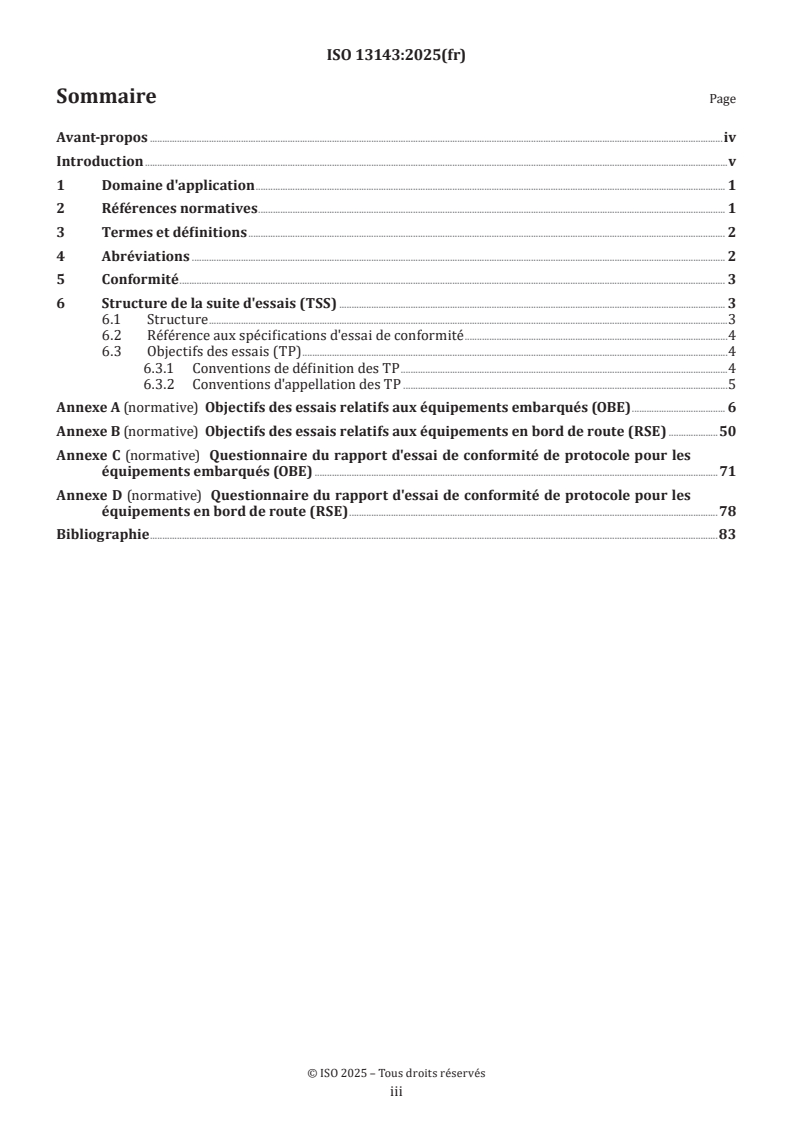
Sommaire Page
Avant-propos .iv
Introduction .v
1 Domaine d'application . 1
2 Références normatives . 1
3 Termes et définitions . 2
4 Abréviations . 2
5 Conformité . 3
6 Structure de la suite d'essais (TSS) . 3
6.1 Structure .3
6.2 Référence aux spécifications d'essai de conformité .4
6.3 Objectifs des essais (TP) .4
6.3.1 Conventions de définition des TP .4
6.3.2 Conventions d'appellation des TP .5
Annexe A (normative) Objectifs des essais relatifs aux équipements embarqués (OBE) . 6
Annexe B (normative) Objectifs des essais relatifs aux équipements en bord de route (RSE) .50
Annexe C (normative) Questionnaire du rapport d'essai de conformité de protocole pour les
équipements embarqués (OBE) .71
Annexe D (normative) Questionnaire du rapport d'essai de conformité de protocole pour les
équipements en bord de route (RSE) .78
Bibliographie .83
iii
Avant-propos
L'ISO (Organisation internationale de normalisation) est une fédération mondiale d'organismes nationaux
de normalisation (comités membres de l'ISO). L'élaboration des Normes internationales est en général
confiée aux comités techniques de l'ISO. Chaque comité membre intéressé par une étude a le droit de faire
partie du comité technique créé à cet effet. Les organisations internationales, gouvernementales et non
gouvernementales, en liaison avec l'ISO participent également aux travaux. L'ISO collabore étroitement avec
la Commission électrotechnique internationale (IEC) en ce qui concerne la normalisation électrotechnique.
Les procédures utilisées pour élaborer le présent document et celles destinées à sa mise à jour sont
décrites dans les Directives ISO/IEC, Partie 1. Il convient, en particulier, de prendre note des différents
critères d'approbation requis pour les différents types de documents ISO. Le présent document a
été rédigé conformément aux règles de rédaction données dans les Directives ISO/IEC, Partie 2 (voir
www.iso.org/directives).
L’ISO attire l’attention sur le fait que la mise en application du présent document peut entraîner l’utilisation
d’un ou de plusieurs brevets. L’ISO ne prend pas position quant à la preuve, à la validité et à l’applicabilité de
tout droit de brevet revendiqué à cet égard. À la date de publication du présent document, l’ISO n'avait pas
reçu notification qu’un ou plusieurs brevets pouvaient être nécessaires à sa mise en application. Toutefois,
il y a lieu d’avertir les responsables de la mise en application du présent document que des informations
plus récentes sont susceptibles de figurer dans la base de données de brevets, disponible à l'adresse
www.iso.org/brevets. L’ISO ne saurait être tenue pour responsable de ne pas avoir identifié tout ou partie de
tels droits de propriété.
Les appellations commerciales éventuellement mentionnées dans le présent document sont données pour
information, par souci de commodité, à l'intention des utilisateurs et ne sauraient constituer un engagement.
Pour une explication de la nature volontaire des normes, la signification des termes et expressions
spécifiques de l'ISO liés à l'évaluation de la conformité, ou pour toute information au sujet de l'adhésion de
l'ISO aux principes de l'Organisation mondiale du commerce (OMC) concernant les obstacles techniques au
commerce (OTC), voir www.iso.org/iso/foreword.html.
Le présent document a été élaboré par le comité technique ISO/TC 204, Systèmes de transport intelligents, en
collaboration avec le comité technique CEN/TC 278, Systèmes de transport intelligents du Comité européen
de normalisation (CEN) conformément à l'Accord de coopération technique entre l'ISO et le CEN (Accord de
Vienne).
Cette première édition de l’ISO 13143 annule et remplace la deuxième édition de l'ISO 13143-1:2020 qui a fait
l'objet d'une révision technique.
Les principales modifications sont les suivantes:
— mise à jour visant à refléter les modifications apportées aux références normatives, en particulier
l'ISO 12813, dans laquelle les données et les spécifications de codage ont été mise à jour;
1)
— les termes et définitions ont été mis à jour et l'ISO 17573-2:— a été incluse comme source d'informations
principale pour assurer l'harmonisation de la terminologie entre les normes relatives à la perception de
télépéage (EFC);
— les références aux normes sous-jacantes ont été mises à jour.
Il convient d’adresser tout commentaire ou toute question à propos du présent document à l’organisme
de normalisation national de l’utilisateur. Une liste complète de ces organismes est disponible à l’adresse
www.iso.org/members.html.
1) En cours d'élaboration. Stade au moment de la publication: ISO/DIS 17573-2:2025.
iv
Introduction
Les équipements embarqués qui s'appuient sur la technologie de localisation par satellite pour collecter les
données nécessaires au calcul de la redevance d'usage du réseau routier fonctionnent de manière autonome,
autrement dit sans reposer sur une infrastructure en bord de route dédiée. L'équipement embarqué consigne
le taux d'utilisation du réseau routier dans l'ensemble des systèmes de péage par lesquels il transite.
Le présent document spécifie le processus et les essais destinés à évaluer la conformité à l'ISO 12813 des
équipements embarqués (OBE, On-Board Equipment) et des équipements en bord de route (RSE, RoadSide
Equipment).
L'ISO 12813 spécifie les exigences concernant les communications dédiées à courte portée (DSRC, Dedicated
Short-Range Communication) entre un équipement embarqué et un interrogateur dans le but de vérifier la
conformité de l'usage du réseau routier par rapport au régime de péage local. Cela suppose une architecture
de services de perception de télépéage (EFC, Electronic Fee Collection) conforme à l'ISO 17573-1.
Le présent document vise à:
— évaluer les capacités des OBE et RSE;
— évaluer le comportement des OBE et RSE;
— servir de guide pour l'évaluation de la conformité et l'approbation de type des OBE et RSE;
— permettre la comparabilité des résultats des essais correspondants appliqués en différents lieux à
différents moments; et
— faciliter les communications entre les différentes parties.
v
Norme internationale ISO 13143:2025(fr)
Perception de télépéage — Évaluation des équipements
embarqués et en bord de route quant à la conformité avec
l'ISO 12813
1 Domaine d'application
Le présent document spécifie la structure de la suite d'essais (TSS, Test Suite Structure) et les objectifs des
essais (TP, Test Purposes) pour évaluer la conformité des équipements embarqués (OBE) et des équipements
en bord de route (RSE) par rapport à l'ISO 12813.
Il fournit une base pour les essais de conformité des OBE et RSE destinés aux communications dédiées à
courte portée (DSRC) afin de permettre l'interopérabilité entre les différents équipements fournis par
différents fabricants.
L'ISO 12813 spécifie les exigences applicables pour le niveau de l'interface de communication de contrôle de
conformité (CCC, Compliance Check Communication), mais ne concernent pas le comportement fonctionnel
interne des OBE et RSE. Par conséquent, les essais relatifs au comportement fonctionnel des OBE et RSE
restent en dehors du domaine d'application du présent document.
2 Références normatives
Les documents suivants sont cités dans le texte de sorte qu'ils constituent, pour tout ou partie de leur
contenu, des exigences du présent document. Pour les références datées, seule l'édition citée s'applique. Pour
les références non datées, la dernière édition du document de référence s'applique (y compris les éventuels
amendements).
ISO 3166-1, Codes pour la représentation des noms de pays et de leurs subdivisions — Partie 1: Codes de pays
ISO 12813:2024, Perception de télépéage — Communication de contrôle de conformité pour systèmes autonomes
ISO 14816, Télématique de la circulation et du transport routier — Identification automatique des véhicules et
des équipements — Codification et structure des données
ISO 14907-2:2021, Perception du télépéage — Modes opératoires relatifs aux équipements embarqués et aux
équipements fixes — Partie 2: Essai de conformité de l'interface d'application de l'unité embarquée
2)
ISO 17573-2 , Perception de télépéage – Architecture de systèmes pour le péage lié aux véhicules — Partie 2:
Vocabulaire
EN 12834:2003, Télématique de la circulation et du transport routier — Communication à courte portée —
Couche applicative
EN 13372:2004, Télématique de la circulation et du transport routier — Communication à courte portée
véhicule/infrastructure — Profiles pour les applications de télématique routière
EN 15509:2023, Perception de télépéage — Profil d’application d’interopérabilité pour DSRC
EN 15876, Perception de télépéage — Évaluation de conformité des équipements embarqués et des équipements
d’infrastructures routières à l’EN 15509
ETSI/TS 102 486-2-2:2008, Intelligent Transport Systems (ITS) — Road Transport and Traffic Telematics
(RTTT) — Test specifications for Dedicated Short Range Communication (DSRC) transmission equipment —
2) En cours d'élaboration. Stade au moment de la publication: ISO/DIS 17573-2:2025.
Part 2: DSRC application layer — Sub-Part 2: Test Suite Structure and Test Purposes (TSS & TP) (disponible en
anglais seulement)
3 Termes et définitions
Pour les besoins du présent document, les termes et les définitions de l’ISO 17573-2 ainsi que les suivants
s’appliquent.
L’ISO et l’IEC tiennent à jour des bases de données terminologiques destinées à être utilisées en normalisation,
consultables aux adresses suivantes:
— ISO Online browsing platform: disponible à l’adresse https:// www .iso .org/ obp
— IEC Electropedia: disponible à l’adresse https:// www .electropedia .org/
3.1
Elément
répertoire DSRC (communications dédiées à courte portée) contenant des informations d'application sous la
forme d'attributs
[SOURCE: ISO 14906:2022, 3.8]
3.2
déclaration de conformité d'une mise en œuvre de protocole
déclaration de conformité d'une mise en œuvre ou d'un système, déclarée conforme à une spécification de
protocole donnée
[SOURCE: ISO/IEC 9646-1:1994, 3.3.80]
4 Abréviations
AC_CR (Access Credentials) autorisations d'accès
AID (Application Identifier) identifiant d'application
APDU (Application Protocol Data Unit) unité de données de protocole d'application
AP (Application Process) processus d'application
ATS (Abstract Test Suite) suite d'essais abstraite
BI (Behaviour Invalid) comportement non valide (cf. essais de comporte-
ment non valide)
BST (Beacon Service Table) table de service des balises
BV (Behaviour Valid) comportement valide (cf. essais de comportement
valide)
CCC (Compliance Check Communication) communications de contrôle de conformité
DLC (Data Link Control) contrôle de liaison de données
DSRC (Dedicated Short-Range Communication) communications dédiées à courte portée
DUT (Device Under Test) dispositif sous test
EFC (Electronic Fee Collection) perception de télépéage
EID (Element IDentifier) identifiant d'élément
ICS (Implementation Conformance Statement) déclaration de conformité d'une mise en œuvre
LLC (Logical Link Control) contrôle de liaison logique
MAC (Medium Access Control) contrôle d'accès au support
OBE (On-Board Equipment) équipement embarqué
PCTR (Protocol Conformance Test Report) rapport d'essai de conformité de protocole
PDU (Protocol Data Unit) unité de données de protocole
PICS (Protocol Implementation Conformance State- déclaration de conformité d'une mise en œuvre de
ment) protocole
PIXIT (Protocol Implementation eXtra informations complémentaires de mise en œuvre
Information for Testing) nécessaires aux essais
RSE (RoadSide Equipment) équipement en bord de route
SCTR (System Conformance Test Report) rapport d'essai de conformité du système
T-APDU (Transfer-Application Protocol unité de données de protocole d'application de
Data Unit) transfert
TP (Test Purpose) objectif d’essai
TSS (Test Suite Structure) structure de la suite d'essais
VST (Vehicle Service Table) table de service des véhicules
5 Conformité
Les tests de conformité doivent être efféctués conformément à l’Annexe A et l’Annexe B respectivement pour
l’OBE et le RSE.
L’organisme d’évaluation de la conformité de l'OBE et du RSE, respectivement, sont chargés de produire un
rapport d'essai de conformité.
L’organisme d’évaluation de la conformité de l'OBE doit compléter le questionnaire du rapport d'essai de
conformité de protocole (PCTR) pour l'OBE, conformément à l'Annexe C.
L’organisme d’évaluation de la conformité du RSE doit compléter le questionnaire du PCTR pour le RSE,
conformément à l'Annexe D.
NOTE Le PCTR constitue une base pour la declaration de conformité du fabricant.
6 Structure de la suite d'essais (TSS)
6.1 Structure
Le Tableau 1 donne la structure de la TSS, y compris ses sous-groupes hérités d'autres spécifications.
Tableau 1 — Structure de la suite d'essais
Groupe Type de DUT Comportement
Couche physique OBE Comportement valide (BV)
Comportement non valide (BI)
RSE BV
BI
Contrôle de liaison de données (DLC) OBE BV
Sous-couche Contrôle d'accès au support (MAC)
BI
RSE BV
BI
Sous-couche Contrôle de liaison logique (LLC) OBE BV
de DLC
BI
RSE BV
BI
Couche application OBE BV
BI
RSE BV
BI
Les essais de la couche physique doivent être effectués dans un laboratoire d'essai radio.
6.2 Référence aux spécifications d'essai de conformité
La conformité à une norme de profil implique la conformité aux normes de base associées. C'est pourquoi
un certain nombre de cas de test pour l'application CCC sont identiques aux cas d'essai de conformité des
normes de base associées. D'autres cas de test sont dérivés des cas d'essai de conformité des normes de base
en appliquant des restrictions ou des choix tels que les valeurs de paramètres, selon les éléments spécifiés
dans la norme de profil. Des cas d'essai de conformité spécifiques à l'application CCC sont identifiés pour les
déclarations contenues dans l'application CCC qui n'ont aucune équivalence dans les normes de base. Ces
derniers cas recouvrent, par exemple, les objectifs des essais relatifs aux données de la couche application.
Le présent document tient compte des objectifs des essais déjà définis pour la conformité aux normes de
base en les référençant de la manière suivante:
a) Pour les objectifs des essais identiques à ceux spécifiés dans les cas d'essai de conformité des normes de
base (voir ETSI/TS 102 486-2-2 ou EN 15876, par exemple), une référence directe est indiquée;
NOTE Pour faciliter la lecture, la référence est accompagnée du titre ou d'une description explicite de
l'objectif des essais désignés.
b) Pour les objectifs des essais dérivés de ceux spécifiés dans les cas d'essai de conformité des normes de
base, une référence directe est indiquée. Le document indique également la manière dont l’objectif des
essais désignés a été modifié pour les essais de conformité de profil.
c) Pour les objectifs des essais spécifiques au profil de norme, une description complète est donnée.
Dans chaque objectif d’essai, une indication permet de déterminer si celui-ci est identique, dérivé ou
spécifique.
6.3 Objectifs des essais (TP)
6.3.1 Conventions de définition des TP
Les TP sont spécifiés conformément au modèle et aux règles indiqués dans le Tableau 2.
Tableau 2 — Règles de définition des TP
ID de TP selon Intitulé
les conventions d'appellation des TP Référence
Origine du TP
Condition initiale
Stimulus et comportement attendu
ID de TP L'ID de TP est un identifiant unique. Il est spécifié conformément aux conventions
d'appellation des TP définies au Paragraphe 6.3.2.
Intitulé Brève description de l'objectif du TP.
Référence Contient la référence (document, article, paragraphe) de l'objet que doit valider le TP
concerné.
Origine du TP Indique si le TP est identique à un TP spécifié dans une autre norme d'essai, dérivé d'un
TP défini dans une autre norme d'essai ou spécifique à ce profil de norme.
Condition initiale Cette condition spécifie l'état initial requis pour le dispositif sous test (DUT) au moment
de lancer le TP considéré.
Stimulus et comporte- Définition des événements que le testeur accomplit, ainsi que des événements que le
ment attendu DUT est censé accomplir pour se conformer à la spécification de base.
6.3.2 Conventions d'appellation des TP
Chaque TP se voit attribuer une identification unique. Cette identification unique est une chaîne
d'informations construite selon la syntaxe suivante:
TP/ //-
TP : indique qu'il s'agit d'un objectif d’essai;
: groupe auquel s'applique le TP parmi les groupes spécifiés dans le Tableau 1;
: type de DUT (à savoir OBE ou RSE);
: type d'essai (à savoir essais de comportement valide (BV) ou essais de comportement non
valide (BI));
: numéro séquentiel de TP (01 à 99).
Les conventions d'appellation des TP sont décrites dans le Tableau 3.
Tableau 3 — Conventions d'appellation des TP
applicable aux OBE/RSE PHY Couche physique
applicable aux OBE/RSE MAC/LLC Sous-couche MAC/LLC
applicable aux OBE/RSE AP-BAS Couche application – Prise en charge du noyau I
applicable aux OBE AP-FUN Couche application – Prise en charge du noyau T
applicable aux OBE AP-DAT Couche application – Prise en charge des attributs de données
applicable aux OBE AP-SEC Couche application – Prise en charge du niveau de sécurité 1
applicable aux RSE AP-GET Couche application – Objectifs des essais relatifs à la PDU GET-rq
applicable aux RSE AP-STA Couche application – Objectifs des essais relatifs à la PDU GET-STAM-
PED-rq
applicable aux RSE AP-MMI Couche application – Objectifs des essais relatifs à la PDU SET-MMI-rq
applicable aux RSE AP-ECH Couche application – Objectifs des essais relatifs à la PDU ECHO-rq
applicable aux RSE AP-REL Couche application – Objectifs des essais relatifs à la PDU EVENT-RE-
PORT-rq
Annexe A
(normative)
Objectifs des essais relatifs aux équipements embarqués (OBE)
A.1 Généralités
A.1.1 Contenu
La présente annexe décrit les objectifs des essais (TP) relatifs à l'évaluation de conformité des OBE par
rapport à l'ISO 12813.
A.1.2 Symboles inclus dans les descriptions de TP
Pour les objectifs des essais relatifs à la couche application (voir Article A.4), une notation et une convention
de symboles particulières sont utilisées et sont spécifiées dans le Tableau A.1.
Tableau A.1 — Description des symboles de TP
Symbole Description
XXX.rq ⇒ Le testeur envoie l'unité de donnée de protocole (PDU) XXX.rq au dispositif sous test (DUT).
⇐ YYY.rs Le DUT envoie la PDU YYY.rs au testeur.
A ≡ B L’objectif d'essai A «est cohérent avec» l’objectif d’essai B. Autrement dit, une notation de type «objectif
d’essai A ≡ objectif d’essai B» signifie que l’objectif d'essai A est identique à l'objectif d’essai B. Si des
différences de paramètres ou de valeurs de paramètres doivent être appliquées, ces différences sont
indiquées dans le texte situé immédiatement en dessous.
A → B L'objet A «est transformé» en objet B. Autrement dit, une notation de type «Tableau X → Tableau Y»
signifie que, en ce qui concerne le champ d'application du TP, il convient de remplacer les références au
Tableau X par des références au Tableau Y.
= Signifie «affectation». Autrement dit, une notation de type «accessCredentials = valeur» signifie que le
champ accessCredentials se voit affecter une valeur.
Ø Signifie «vide» ou «non défini». Autrement dit, une notation de type «accessCredentials = Ø → access-
Credentials = valeur calculée», pour un TP donné, signifie «remplacer par une valeur calculée toutes les
occurrences où aucune valeur n'a été affectée au champ accessCredentials».
A.2 Couche physique
Conformément à l'ISO 12813:2024, 5.5.2, tous les objectifs des essais TP/PHY/OBE/Bx/yy spécifiés dans
l'EN 15876 doivent s'appliquer à l'évaluation de la conformité des OBE par rapport aux CCC basées CEN-DSRC
spécifiées dans l'ISO 12813:2024, Tableau B.9, N° d'élément 1.
A.3 MAC et LLC
Conformément à l'ISO 12813:2024, 5.5.2, tous les objectifs des essais TP/MAC/OBE/Bx/yy et TP/LLC/ OBE/
Bx/yy spécifiés dans l'EN 15876 s'appliquent à l'évaluation de la conformité des OBE par rapport aux CCC
basées CEN-DSRC spécifiés dans l'ISO 12813:2024, Tableau B.9, N° d'élément 1.
A.4 Couche application
A.4.1 Structure des tables de service des balises (BST) et des tables de service des
véhicules (VST)
A.4.1.1 BST
La structure générale d'une BST lorsqu'elle est transmise à l'OBE doit être conforme au Tableau A.2.
Tableau A.2 — Structure générale d'une BST
Longueur Valeurs admises
T-APDU 4 bits '1000' indiquant une demande d'initiali-
sation (BST)
Indicateur d'option 1 bit (nonmandApplications facultatif) 0/1
RSE manufacturerid 16 bits Selon l'ISO 14816
individualid 27 bits Valeur spécifiée par le constructeur
Time 32 bits Temps réel UNIX
Profile 1 bit (extension de Profile) 0 (= aucune extension)
7 bits Profile conformément à
l'EN 13372:2004, 6.3.2
MandAp- 1 bit (extension de mandApplications) 0 (= aucune extension)
plications
7 bits (nombre d'applications) M
Applica- 1 bit (eid facultatif) 0 (= eid non présent)
tion
1 bit (paramètre facultatif) 0 (= paramètre non présent)
CCC
aid 1 bit (extension de aid) 0 (= aucune extension)
5 bits 20 (= application CCC)
Applica-
tion 2
1 bit (eid facultatif) 0/1
(non CCC)
1 bit (paramètre facultatif) 0/1
aid 1 bit (extension de aid) 0 (= aucune extension)
5 bits ≠ 20 (= application non CCC)
eid 1 bit (extension de eid) 0 (= aucune extension)
7 bits Toutes
para ApplicationContextMark conformément
mètre à l'EN 12834:2003, Annexe A
… . .
Applica-
tion M
1 bit (eid facultatif) 0/1
(non CCC)
1 bit (paramètre facultatif) 0/1
aid 1 bit (extension de aid) 0 (= aucune extension)
5 bits ≠ 20 (= application non CCC)
eid 1 bit (extension de eid) 0 (= aucune extension)
7 bits Toutes
para ApplicationContextMark conformément
mètre à
l'EN 12834:2003, Annexe A
TTabableleaauu A A.22 ((ssuuiitte)e)
Longueur Valeurs admises
Nonmand 1 bit (extension de mandApplications) 0 (= aucune extension)
Applica-
7 bits (nombre d'applications) Peut être compris entre 0 et N, à condi-
tions
tion que la longueur maximale de la
trame ne soit pas dépassée.
Application 1 Même longueur et mêmes valeurs autorisées que dans «Application 2 (non CCC)»
de mandApplications
(non CCC)
... ...
Application N Même longueur et mêmes valeurs autorisées que dans «Application 2 (non CCC)»
de mandApplications
(non CCC)
profile- 1 bit (extension de profileList) 0 (= aucune extension)
List
7 bits (nombre de profils) Peut être compris entre 0 et K, à condi-
tion que la longueur maximale de la
trame ne soit pas dépassée
Profile 1 1 bit (extension de Profile) 0 (= aucune extension)
7 bits Profile conformément à
l'EN 12834:2003, Annexe A et à
l'EN 13372:2004, 6.3.2
... ... ...
Profile K 1 bit (extension de Profile) 0 (= aucune extension)
7 bits Profile conformément à
l'EN 12834:2003, Annexe A et à
l'EN 13372:2004, 6.3.2
A.4.1.2 VST
la structure générale d'une VST indiquant une application CCC lorsqu'elle est transmise par l'OBE doit être
conforme au Tableau A.3.
Outre l'application CCC, la VST peut éventuellement indiquer une ou plusieurs applications non CCC.
Tableau A.3 — VST1 (niveau de sécurité 1) — VST valide indiquant une application CCC
Longueur Valeurs admises
Fill 4 bits Toutes
1 bit (extension de
0 (= aucune extension)
Profile)
Profile
Profile conformément à
7 bits
l'EN 12834:2003, Annexe A
1 bit (extension de
0 (= aucune extension)
Applications)
Peut être compris entre 0
7 bits (nombre d'appli- et M, à condition que la lon-
cations) gueur maximale de la trame
ne soit pas dépassée
1 bit (eid facultatif) 1 (= eid présent)
1 bit (paramètre facul-
1 (= paramètre présent)
tatif)
1 bit (extension de aid) 0 (= aucune extension)
aid
5 bits 20 (= application CCC)
TTabableleaauu A A.33 ((ssuuiitte)e)
Longueur Valeurs admises
1 bit (extension de eid) 0 (= aucune extension)
eid
Toutes (≠ autre eid utilisé
7 bits
dans cette VST)
1 bit (extension de
0 (= aucune extension)
Container)
7 bits (CHOIX du
2 (= CHAÎNE D'OCTETS)
Container)
1 bit (extension de la
0 (= aucune extension)
chaîne d'octets)
7 bits (longueur de la
chaîne d'octets)
10 bits (CountryCode) Selon l'ISO 3166-1
Contract
14 bits (IssuerIdenti-
Provider
Selon l'ISO 14816
fier)
CccContext- TypeOf
16 bits Toutes
Mark Contract
Application
CCC
Applica- 1 bit (extension de
0 (= aucune extension)
Context
tions contextVersion)
Version
7 bits Toutes
para
1 bit (extension de
mètre
0 (= aucune extension)
Container)
7 bits (CHOIX du
2 (= CHAÎNE D'OCTETS)
Container)
1 bit (extension de la
0 (= aucune extension)
chaîne d'octets)
7 bits (longueur de la
chaîne d'octets)
AC_Master
8 bits Toutes
KeyRef
AC_CR-
Reference
AC_CR-
8 bits Toutes
Diversifier
1 bit (extension de
0 (= aucune extension)
Container)
7 bits (CHOIX du
2 (= CHAÎNE D'OCTETS)
Container)
1 bit (extension de la
0 (= aucune extension)
chaîne d'octets)
7 bits (longueur de la
chaîne d'octets)
RndOBE 32 bits Toutes
TTabableleaauu A A.33 ((ssuuiitte)e)
Longueur Valeurs admises
1 bit (eid facultatif) 0/1
1 bit (paramètre facul-
0/1
tatif)
1 bit (extension de aid) 0 (= aucune extension)
DSRCApplicationEntityID
aid
5 bits conformément à
Application 2 l'EN 12834:2003, Annexe A
1 bit (extension de eid) 0 (= aucune extension)
eid
Toutes (≠ autre eid utilisé
7 bits
dans cette VST)
ApplicationContextMark
para
conformément à
mètre
l'EN 12834:2003, Annexe A
…
1 bit (eid facultatif) 0/1
1 bit (paramètre facul-
0/1
tatif)
1 bit (extension de aid) 0 (= aucune extension)
DSRCApplicationEntityID
aid
Application M 5 bits conformément à
l'EN 12834:2003, Annexe A
1 bit (extension de eid) 0 (= aucune extension)
eid
Toutes (≠ autre eid utilisé
7 bits
dans cette VST)
ApplicationContextMark
para
conformément à
mètre
l'EN 12834:2003, Annexe A
1 bit (obeStatus facul-
Configura-
0/1
tatif)
tion
de l'OBE
equipmentClass 15 bits Toutes
manufacturerId 16 bits Toutes
obeStatus 16 bits Toutes
L’OBE peut éventuellement transmettre un VST contenant deux applications CCC.
Si l’OBE prend en charge cette fonction optionnelle, la structure d'une VST indiquant deux applications CCC
doit être conforme au Tableau A.4.
VST2 doit indiquer la présence de deux applications CCC avec les définitions suivantes (voir
l'ISO 12813:2024, 9.2.3):
— une application CCC doit être conforme à l'ISO 12813:2024; et
— l'autre application CCC doit être conforme à l'ISO 12813:2015.
NOTE L'évaluation de la conformité à l'ISO 12813:2015 ne fait pas partie du domaine d'application du présent
document.
Outre les applications CCC, la VST peut éventuellement indiquer une ou plusieurs applications non CCC.
Tableau A.4 — VST2 (niveau de sécurité 1) — VST valide indiquant deux applications CCC
Longueur Valeurs admises
Fill 4 bits Toutes
1 bit (extension de
0 (= aucune extension)
Profile)
Profile
Profile conformément à
7 bits
l'EN 12834:2003, Annexe A
1 bit (extension de
0 (= aucune extension)
Applications)
Doit être compris entre 2
7 bits (nombre d'appli- et M à condition que la lon-
cations) gueur maximale de latrame
ne soit pas dépassée
1 bit (eid facultatif) 1 (= eid présent)
1 bit (paramètre facul-
1 (= paramètre présent)
tatif)
1 bit (extension de aid) 0 (= aucune extension)
aid
5 bits 20 (= application CCC)
1 bit (extension de eid) 0 (= aucune extension)
eid
7 bits Toutes
1 bit (extension de
0 (= aucune extension)
Container)
7 bits (CHOIX du
2 (= CHAÎNE D'OCTETS)
Container)
1 bit (extension de la
0 (= aucune extension)
chaîne d'octets)
7 bits (longueur de la
chaîne d'octets)
10 bits (CountryCode) Selon l'ISO 3166-1
Contract
14 bits (IssuerIdenti-
Provider
Selon l'ISO 14816
fier)
Applica- Application TypeOf
CccContext- 16 bits Toutes
tions CCC 1 Contract
Marl1
1 bit (extension de
0 (= aucune extension)
contextVersion)
Context
Version
para
7 bits Toutes
mètre
1 bit (extension de
0 (= aucune extension)
Container)
7 bits (CHOIX du
2 (= CHAÎNE D'OCTETS)
Container)
1 bit (extension de la
0 (= aucune extension)
chaîne d'octets)
7 bits (longueur de la
chaîne d'octets)
AC_Master
8 bits Toutes
KeyRef
AC_CR-
Reference
AC_CR-
8 bits Toutes
Diversifier
TTabableleaauu A A.44 ((ssuuiitte)e)
Longueur Valeurs admises
1 bit (extension de
0 (= aucune extension)
Container)
7 bits (CHOIX du
2 (= CHAÎNE D'OCTETS)
Container)
1 bit (extension de la
0 (= aucune extension)
chaîne d'octets)
7 bits (longueur de la
chaîne d'octets)
RndOBE 32 bits Toutes
1 bit (eid facultatif) 1 (= eid présent)
1 bit (paramètre facul-
1 (= paramètre présent)
tatif)
1 bit (extension de aid) 0 (= aucune extension)
aid
5 bits 20 (= application CCC)
1 bit (extension de eid) 0 (= aucune extension)
eid
7 bits ≠ eid de l'application CCC 1
1 bit (extension de
0 (= aucune extension)
Container)
7 bits (CHOIX du
2 (= CHAÎNE D'OCTETS)
Container)
1 bit (extension de la
0 (= aucune extension)
chaîne d'octets)
7 bits (longueur de la
chaîne d'octets)
10 bits (CountryCode) Selon l'ISO 3166-1
Contract
14 bits (IssuerIdenti-
Provider
Selon l'ISO 14816
fier)
TypeOf
CccContext- 16 bits Toutes
Contract
Mark2
1 bit (extension de
0 (= aucune extension)
contextVersion)
Context
Version
Application
7 bits Toutes
CCC 2
1 bit (extension de
0 (= aucune extension)
Container)
para 7 bits (CHOIX du
2 (= CHAÎNE D'OCTETS)
mètre Container)
1 bit (extension de la
0 (= aucune extension)
chaîne d'octets)
7 bits (longueur de la
chaîne d'octets)
AC_Master
8 bits Toutes
KeyRef
AC_CR-
Reference
AC_CR-
8 bits Toutes
Diversifier
TTabableleaauu A A.44 ((ssuuiitte)e)
Longueur Valeurs admises
1 bit (extension de
0 (= aucune extension)
Container)
7 bits (CHOIX du
2 (= CHAÎNE D'OCTETS)
Container)
1 bit (extension de la
0 (= aucune extension)
chaîne d'octets)
7 bits (longueur de la
chaîne d'octets)
RndOBE 32 bits Toutes
:::
1 bit (eid facultatif) 1 (= eid présent)
1 bit (paramètre facul-
0 (= paramètre non présent)
tatif)
1 bit (extension de aid) 0 (= aucune extension)
Application M en
aid
option (non CCC)
5 bits ≠ 20
1 bit (extension de eid) 0 (= aucune extension)
eid
Toutes (≠ autre eid utilisé
7 bits
dans cette VST)
1 bit (obeStatus facul-
obe
1 (= obeStatus présent)
tatif)
Configura-
tion
equipmentClass 15 bits Toutes
manufacturerId 16 bits Toutes
obeStatus 16 bits Toutes
A.4.2 Paramètres des PDU
A.4.2.1 Paramètres des PDU de demande
La demande APDU doit être conforme aux spécifications du Tableau A.5 – Tableau A.9.
L'application CCC n'utilise pas d'autres commandes de demande.
Les bits de remplissage (fill) doivent toujours être mis à zéro.
Tableau A.5 — Paramètres GET-Rq (niveau de sécurité 1)
EN 12834:2003, Annexe A EN 15509:2023, Tableau B.16
GET-Rq fill =
eid =
accessCredentials facultatif obligatoire
iid facultatif interdit
attributeIdList facultatif obligatoire
Tableau A.6 — Paramètres Action-Rq pour l'action GET_STAMPED (niveau de sécurité 1)
EN 12834:2003, Annexe A EN 15509:2023, Tableau B.20 et
ISO 12813
ACTION-Rq mode TRUE
eid =
actionType 0 (GET_STAMPED)
accessCredentials facultatif obligatoire
actionParameters facultatif GetStampedRq
iid facultatif interdit
Tableau A.7 — Paramètres Action-Rq pour l'action SET_MMI
EN 12834:2003, Annexe A EN 15509:2023, Tableau B.20
et ISO 12813
ACTION-Rq mode =
eid 0
actionType 10 (SET_MMI)
accessCredentials facultatif interdit
actionParameters facultatif SetMMIRq
iid facultatif interdit
Tableau A.8 — Paramètres Action-Rq pour l'action ECHO
EN 12834:2003, Annexe A EN 15509:2023, Tableau B.20 et
ISO 12813
ACTION-Rq mode =
eid 0
actionType 15 (ECHO)
accessCredentials facultatif interdit
actionParameters facultatif obligatoire
iid facultatif interdit
Tableau A.9 — Paramètres EVENT-REPORT-Rq
EN 12834:2003, Annexe A EN 15509:2023, Tableau B.22
et ISO 12813
EVENT-RE- mode =
PORT-Rq
eid 0
eventType 0 (libérer)
accessCredentials facultatif interdit
eventParameters facultatif interdit
iid facultatif interdit
A.4.2.2 Paramètres des PDU de réponse
La réponse APDU doit être conforme aux spécifications du Tableau A.10 – Tableau A.13.
L'application CCC n'utilise pas d'autres commandes de demande.
Les bits de remplissage (fill) doivent toujours être mis à zéro.
Tableau A.10 — Paramètres GET-Rs
EN 12834:2003, Annexe A EN 15509:2023, Tableau B.17
GET-Rs fill =
eid =
Iid facultatif interdit
attributeList facultatif obligatoire
ret facultatif obligatoire
Tableau A.11 — Paramètres Action-Rs pour l'action GET_STAMPED
EN 12834:2003, Annexe A EN 15509:2023, Tableau B.21 et
ISO 12813
ACTION-Rs fill =
eid =
iid facultatif interdit
responseParameter facultatif obligatoire
ret facultatif obligatoire
Tableau A.12 — Paramètres Action-Rs pour l'action SET_MMI
EN 12834:2003, Annexe A EN 15509:2023, Tableau B.21 et
ISO 12813
ACTION-Rs fil =
eid 0
iid facultatif interdit
responseParameter facultatif interdit
ret facultatif obligatoire
Tableau A.13 — Paramètres Action-Rs pour l'action ECHO
EN 12834:2003, Annexe A EN 15509:2023, Tableau B.21 et
ISO 12813
ACTION-Rs fill =
eid 0
iid facultatif interdit
responseParameter facultatif conditionnel (présent si ret = 0)
ret facultatif obligatoire
A.4.3 TP relatifs au noyau d'application I de l'OBE, niveau de sécurité 1
A.4.3.1 Généralités
Les TP spécifiés en A.4.3 s'appliquent au niveau de sécurité 1 spécifié dans l'ISO 12813:2024, Tableau B.6,
N° d'élément 1, ainsi qu'aux processus d'initialisation et de résiliation spécifiés dans l'ISO 12813:2024,
Tableau B.7, N° d'éléments 1 et 5.
A.4.3.2 Structures de données
Pour les besoins de cet essai de conformité, les BST décrites dans les tableaux suivants:
— Tableau A.14 pour un BST valide utilisé dans les TP BV; et
— Tableau A.15 pour un BST non valide utilisé dans les TP BI
doivent être transmises au DUT. Les valeurs non valides sont indiquées à l’aide d’une note de bas de tableau.
NOTE BST2 contient des paramètres erronés sous la forme d’une application CCC insérée comme application non
obligatoire.
Tableau A.14 — BST1
Longueur Valeur
Indicateur d'option 1 bit (nonmandApplications faculta- 0 (= nonmandApplications non
tif) présent)
RSE manufacturerid 16 bits Valeur enregistrée
individualid 27 bits Toutes
Time 32 bits Toutes
Profile 1 bit (extension de Profile) 0 (= aucune extension)
7 bits 0
MandApplica- 1 bit (extension de mandApplications) 0 (= aucune extension)
tions
7 bits (nombre d'applications) 1
CCC 1 bit (eid facultatif) 0 (= eid non présent)
applica-
1 bit (paramètre facultatif) 0 (= paramètre non présent)
tion
aid 1 bit (extension de aid) 0 (= aucune extension)
5 bits 20 (= application CCC)
profileList 1 bit (extension de profileList) 0 (= aucune extension)
7 bits (nombre de profils) 0 (= liste vide)
Tableau A.15 — BST2
Longueur Valeur
Indicateur d'option 1 bit (nonmandApplications 1 (= nonmandApplications pré-
facultatif) sent)
RSE manufacturerid 16 bits Valeur enregistrée
individualid 27 bits Toutes
Time 32 bits Toutes
Profile 1 bit (extension de Profile) 0 (= aucune extension)
7 bits 0
MandApplications 1 bit (extension de mandAppli- 0 (= aucune extension)
cations)
7 bits (nombre d'applications) 1
Application1 1 bit (eid facultatif) 1 (= eid présent)
(non CCC)
1 bit (paramètre facultatif) 0 (= paramètre non présent)
aid 1 bit (extension de aid) 0 (= aucune extension)
5 bits ≠ 20 (AID non pris en charge par
l'OBE)
eid 1 bit (extension de eid) 0 (= aucune extension)
7 bits Toutes
a
Invalid value.
TTabableleaauu A A.1155 ((ssuuiitte)e)
Longueur Valeur
nonmandApplica- 1 bit (extension de nonmandAp- 0 (= aucune extension)
tions plications)
7 bits (nombre d'applications) 1
a a
CCC 1 bit (eid facultatif) 0 (= eid non présent)
application
a a
1 bit (paramètre facultatif) 0 (= paramètre non présent)
a a
aid 1 bit (extension de aid) 0 (= aucune extension)
a a
5 bits 20 (= application CCC)
profileList 1 bit (extension de profileList) 0 (= aucune extension)
7 bits (nombre de profils) 0 (= liste vide)
a
Invalid value.
A.4.3.3 Objectifs des essais relatifs aux BV
Objectifs du sous-groupe d'essais:
a) évaluer le comportement du DUT face à:
— une BST valide; et
— une demande EVENT-REPORT-Rq (libérer) valide;
b) vérifier que le DUT prend en charge les attributs suivants:
— BeaconId;
— Time;
— Profile;
— Applications; et
— LID.
Les TP visant à évaluer la conformité des fonctions du noyau de l'application I pour l'OBE, niveau de sécurité
1, pour un comportement valide, doivent être effectuées comme indiqué dans les Tableaux A.16 à A.21.
NOTE Les TP identifiés par les ID TP/AP-BAS/OBE/BV/05 à TP/AP-BAS/OBE/BV/08 n'ont pas été utilisés afin que
le document reste cohérent avec la numérotation de l'ETSI/TS 102 486–2-2:2008.
Tableau A.16 — TP/AP-BAS/OBE/BV/01
TP/AP-BAS/OBE/BV/01 Recevoir et gérer une demande INITIALISATION.rq (BST)
Origine du TP Identique à TP/AL-I/OBE/BV/01 dans l'ETSI/TS 102 486–2-2:2008:2008, 5.4.1
Référence ISO 12813:2024, 7.1.2
Condition initiale Conformément à TP/AL-I/OBE/BV/01 dans l'ETSI/TS 102 486–2-2:2008:2008, 5.4.1
Stimulus et comportement Conformément à TP/AL-I/OBE/BV/01 dans l'ETSI/TS 102 486–2-2:2008:2008, 5.4.1.
attendu
Tableau A.17 — TP/AP-BAS/OBE/BV/02
TP/AP-BAS/OBE/BV/02 Recevoir et gérer une demande EVENT-REPORT.rq (RELEASE) avec mode = 0
Origine du TP Identique à TP/AL-I/OBE/BV/02 dans l'ETSI/TS 102 486–2-2:2008, 5.4.1
Référence ISO 12813:2024, 7.1.6
Condition initiale Conformément à TP/AL-I/OBE/BV/02 dans l'ETSI/TS 102 486–2-2:2008, 5.4.1
Stimulus et comportement Conformément à TP/AL-I/OBE/BV/02 dans l'ETSI/TS 102 486–2-2:2008, 5.4.1.
attendu
Tableau A.18 — TP/AP-BAS/OBE/BV/03
TP/AP-BAS/OBE/BV/03 Lire et gérer l'attribut BeaconID dans la BST
Origine du TP Identique à TP/AL-I/OBE/BV/03 dans l'ETSI/TS 102 486–2-2:2008, 5.4.1
Référence ISO 12813:2024, 7.1.2
Condition initiale Identique à TP/AL-I/OBE/BV/03 dans l'ETSI/TS 102 486–2-2:2008, 5.4.1
Stimulus et comportement Conformément à TP/AL-I/OBE/BV/03 dans l'ETSI/TS 102 486–2-2:2008, 5.4.1.
attendu
Tableau A.19 — TP/AP-BAS/OBE/BV/04
TP/AP-BAS/OBE/BV/04 Lire et gérer l'heure de réception de la BST indiquée dans le paramètre Time
de la BST
Origine du TP Identique à TP/AL-I/OBE/BV/04 dans l'ETSI/TS 102 486–2-2:2008, 5.4.1
Référence ISO 12813:2024, 7.1.2
C
...