

ISO 5422:1982
(Main)Road vehicles — Anchorages for towing ropes, cables or bars
General Information
- Abstract
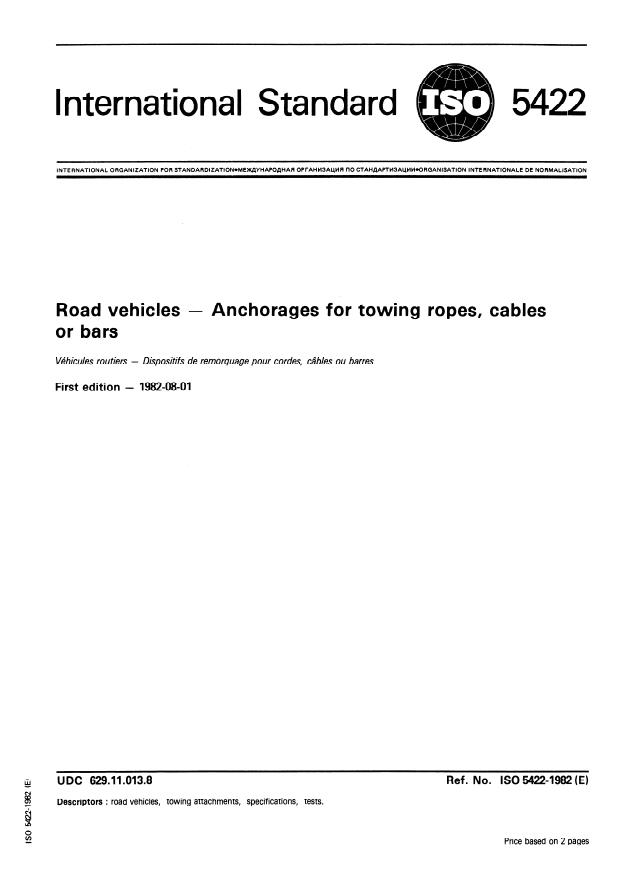
Specifies the characteristics of the towing anchorages mounted on road vehicles, allowing them to be towed or to tow another vehicle. Applies to passenger cars as defined in ISO 3833 and to other vehicles which have a maximum authorized total weight not exceeding 3,5 tonnes. The shape of the anchorages is left to the manufacturer's option.
- Status
- Published
- Publication Date
- 31-Jul-1982
- Current Stage
- 9093 - International Standard confirmed
- Start Date
- 25-Jan-2023
- Completion Date
- 29-Aug-2026
Buy Documents

ISO 5422:1982 - Road vehicles — Anchorages for towing ropes, cables or bars Released:8/1/1982

ISO 5422:1982 - Véhicules routiers — Dispositifs de remorquage pour cordes, câbles ou barres Released:8/1/1982

ISO 5422:1982 - Véhicules routiers — Dispositifs de remorquage pour cordes, câbles ou barres Released:8/1/1982
Overview
ISO 5422:1982 - Road vehicles: Anchorages for towing ropes, cables or bars - specifies requirements for towing anchorages (tow eyes/hooks) fixed to road vehicles so they can be towed or tow another vehicle. The standard applies to passenger cars (as defined in ISO 3833) and other vehicles with a maximum authorized total weight not exceeding 3.5 tonnes. It covers anchorage location, minimum functional dimensions, strength, test methods and identification.
Key topics and technical requirements
- Scope and applicability: Passenger cars and light vehicles up to 3.5 t (maximum authorized total mass).
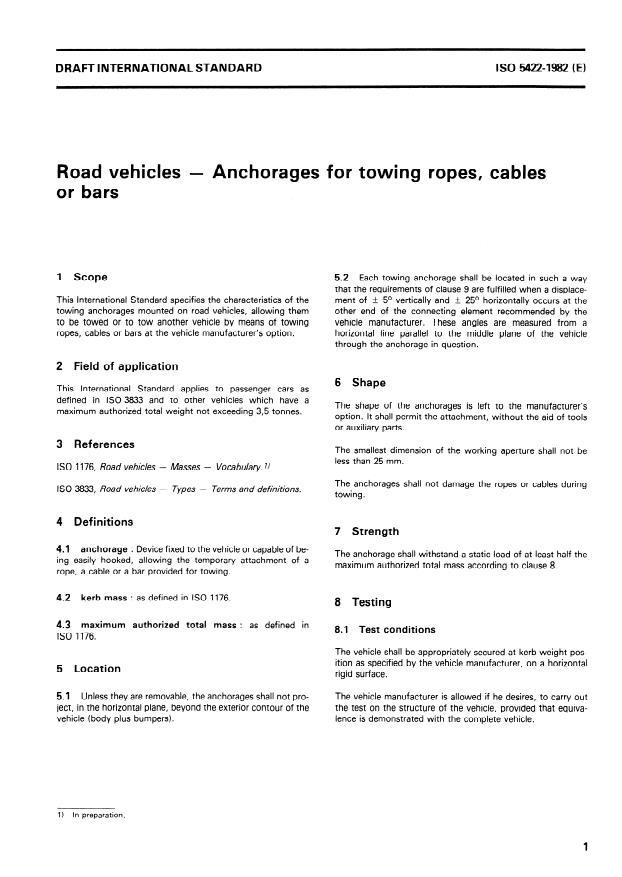
- Shape and attachment: The shape of anchorages is left to the manufacturer’s option but must permit attachment without tools or auxiliary parts.
- Working aperture: The smallest dimension of the working aperture shall be not less than 25 mm to accept standard ropes, cables or bars.
- Strength requirement: Each anchorage shall withstand a static load of at least half the vehicle’s maximum authorized total mass.
- Location constraints: Anchorages must not project horizontally beyond the vehicle’s exterior contour (body plus bumpers) unless removable, and must be positioned so specified angular displacements at the other end of the connecting element are achievable (see clause 5.2).
- Durability and safety: Anchorages shall not damage towing ropes or cables during use and shall not cause damage to nearby mandatory systems (lighting, signalling, braking or steering) that would prevent normal operation.
- Testing procedures: Two static tractive tests - one horizontal in the longitudinal direction and a second at a specified angle - are required. Tests are performed with the vehicle secured at kerb mass on a horizontal rigid surface. If towing bars are used, compressive tests may also be required.
- Identification: Anchorages must be identified by the manufacturer in a suitable manner.
Applications and who uses this standard
- Vehicle manufacturers (design and production of OEM tow points)
- Component suppliers and aftermarket tow-eye manufacturers
- Test laboratories and certification bodies performing strength and compliance tests
- Fleet operators, recovery services and vehicle repairers specifying safe towing points
- Regulatory authorities and type-approval engineers referencing towing attachment safety
Related standards
- ISO 3833 - Road vehicles - Types - Terms and definitions (passenger car definition)
- ISO 1176 - Road vehicles - Masses - Vocabulary (kerb mass, maximum authorized mass)
ISO 5422:1982 is a practical reference for designing, testing and identifying safe towing anchorages on light vehicles, improving recovery safety and ensuring consistent performance of towing attachments. Keywords: ISO 5422:1982, towing anchorages, road vehicles, tow hooks, tow eyes, towing ropes, towing bars, vehicle testing.
Buy Documents
ISO 5422:1982 - Road vehicles — Anchorages for towing ropes, cables or bars Released:8/1/1982
ISO 5422:1982 - Véhicules routiers — Dispositifs de remorquage pour cordes, câbles ou barres Released:8/1/1982
ISO 5422:1982 - Véhicules routiers — Dispositifs de remorquage pour cordes, câbles ou barres Released:8/1/1982
Get Certified
Connect with accredited certification bodies for this standard

TÜV Rheinland
TÜV Rheinland is a leading international provider of technical services.

TÜV SÜD
TÜV SÜD is a trusted partner of choice for safety, security and sustainability solutions.

DEKRA Certification Inc.
DEKRA US certification services.
Sponsored listings
Frequently Asked Questions
ISO 5422:1982 is a standard published by the International Organization for Standardization (ISO). Its full title is "Road vehicles — Anchorages for towing ropes, cables or bars". This standard covers: Specifies the characteristics of the towing anchorages mounted on road vehicles, allowing them to be towed or to tow another vehicle. Applies to passenger cars as defined in ISO 3833 and to other vehicles which have a maximum authorized total weight not exceeding 3,5 tonnes. The shape of the anchorages is left to the manufacturer's option.
Specifies the characteristics of the towing anchorages mounted on road vehicles, allowing them to be towed or to tow another vehicle. Applies to passenger cars as defined in ISO 3833 and to other vehicles which have a maximum authorized total weight not exceeding 3,5 tonnes. The shape of the anchorages is left to the manufacturer's option.
ISO 5422:1982 is classified under the following ICS (International Classification for Standards) categories: 43.040.70 - Couplings. The ICS classification helps identify the subject area and facilitates finding related standards.
ISO 5422:1982 is available in PDF format for immediate download after purchase. The document can be added to your cart and obtained through the secure checkout process. Digital delivery ensures instant access to the complete standard document.
Standards Content (Sample)
International Standard
INTERNATIONAL ORGANIZATION FOR STANDARDIZATIONWlE))(LIYHAPO~HAR OPTAHW3ALWlfl l-l0 CTAH~APTbl3AWlM@ORGANISATION INTERNATIONALE DE NORMALISATION
- Anchorages for towing ropes, cables
Road vehicles
or bars
V&icuies reu tiers - Dispositifs de remorguage pour Cordes, cables ou barres
First edition - 1982-08-01
Ref. No. ISO 54224982 (E)
UDC 629.11.013.8
: road vehicles, towing attachments, specifications, tests.
Descriptors
Price based on 2 pages
Foreword
ISO (the International Organization for Standardization) is a worldwide federation of
national Standards institutes (SS0 member bedies). The work of developing lnter-
national Standards is carried out through ISO technical committees. Every member
body interested in a subject for which a technical committee has been set up has the
right to be represented on that committee. International organizations, governmental
and non-governmental, in liaison with ISO, also take part in the work.
Draft International Standards adopted by the technical committees are circulated to
the member bodies for approval before their acceptance as International Standards by
the ISO Council.
International Standard ISO 5422 was developed by Technical Committee ISO/TC 22,
Road vehicles, and was circulated to the member bodies in January 1981.
lt has been approved by the member bodies of the foliowing countries :
Iran South Africa, Rep. of
Austria
Belgium Italy Spain
Bulgaria Korea, Dem, P. Rep. of Sweden
Korea, Rep. sf Switzerland
China
Czechoslovakia Netherlands United Kingdom
Egypt, Arab Rep. of New Zealand USSR
Poland
France
Germany, F. R. Romania
of the document on
The member body of the following country expressed disapproval
technical grounds
Japan
International Organkation for Standardkation, 1982
Printed in Switzerland
ISO 5422-1982 (EI
DRAFT INTERNATIONALSTANDARD
- Anchorages for towing ropes, cables
Road vehicles
or bars
5.2 Esch towing anchorage shall be located in such a way
1 Scope
that the requirements of clause 9 are fulfilled when a displace-
ment of + 5’ vertically and $r 25’ horizontally occurs at the
This International Standard specifies the characteristics of the
other end of the connecting element recommended by the
towing anchorages mounted on road vehicles, allowing them
to be towed or to tow another vehicle by means of towing vehicle manufacturer. These angles are measured from a
horizontal line parallel to the middle plane of the vehicle
ropes, cables or bars at the vehicle manufacturer’s Option.
through the anchorage in question.
2 Field of application
6 Shape
This International Standard applies to passenger cars as
def
...
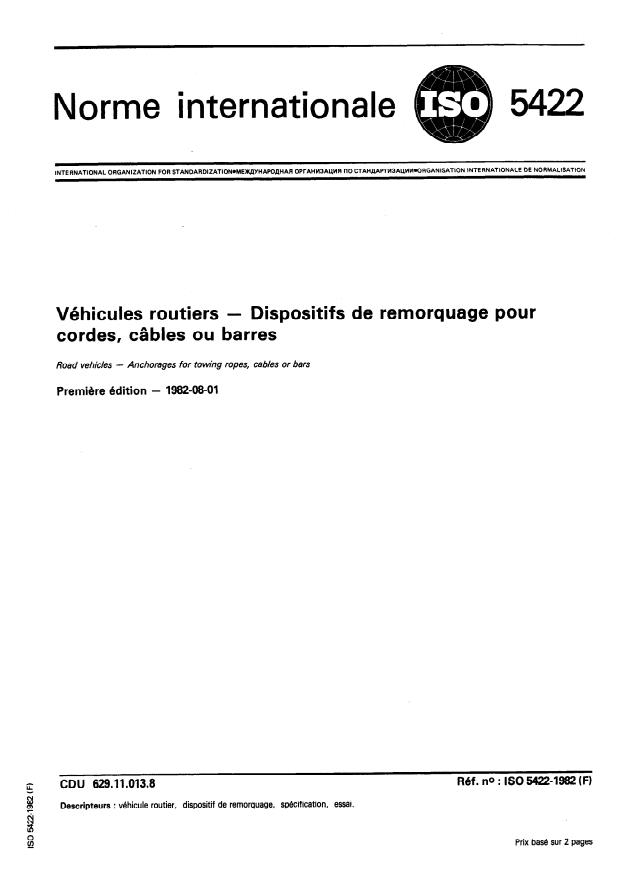
Norme internationale
INTEFtNATIONAL ORGANIZATION FOR STANDARDIZATION.ME)I(LLYHAPO~HAR OPTAHH3Al#lR n0 CTAH&WTM3Al@lM~RGANISATION INTERNATIONALE DE NORMALISATION
- Dispositifs de remorquage pour
Véhicules routiers
cordes, câbles ou barres
Road vehicles - Anchorages for towing ropes, tables or bars
Premibe édition - 1982-08-01
CDU 629.11.013.8 Réf. no : ISO 54224982 (F)
îz
Y
p Descripteurs : véhicule routier, dispositif de remorquage, spécification, essai.
I
M
;x
s1
Prix basé sur 2 pages
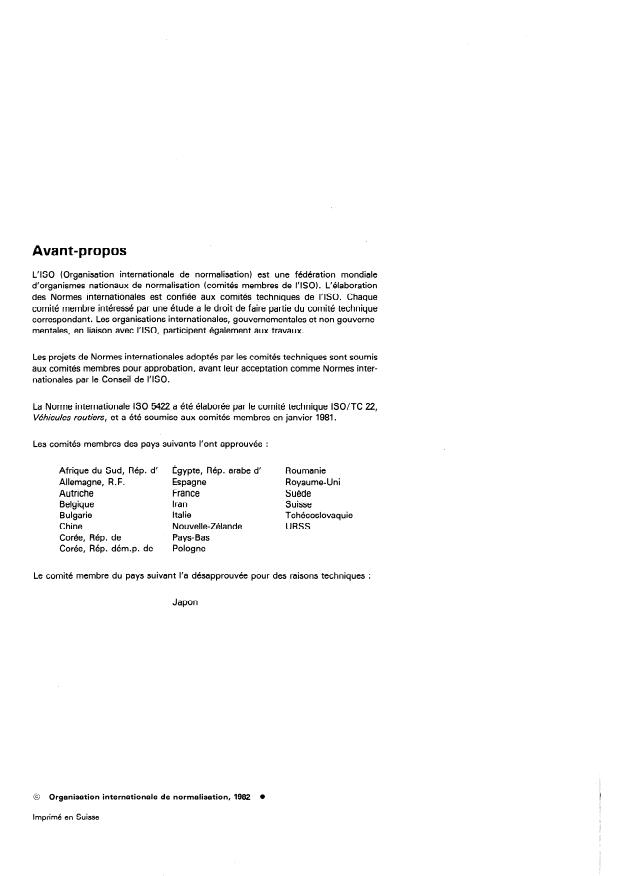
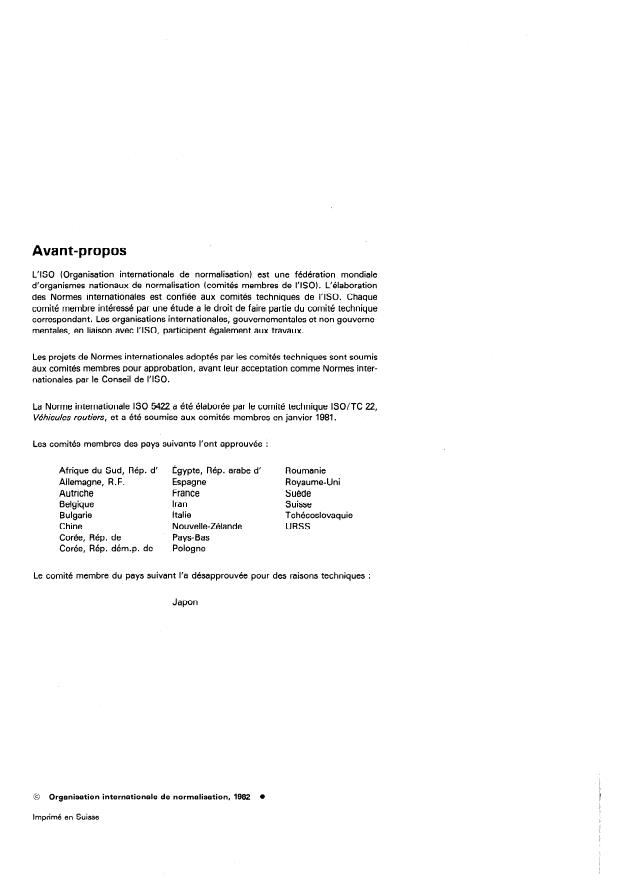
Avant-propos
L’ISO (Organisation internationale de normalisation) est une fédération mondiale
d’organismes nationaux de normalisation (comités membres de I’ISO). L’élaboration
des Normes internationales est confiée aux comités techniques de I’ISO. Chaque
comité membre intéressé par une étude a le droit de faire partie du comité technique
correspondant. Les organisations internationales, gouvernementales et non gouverne-
mentales, en liaison avec I’ISO, participent également aux travaux.
Les projets de Normes internationales adoptés par les comités techniques sont soumis
aux comités membres pour approbation, avant leur acceptation comme Normes inter-
nationales par le Conseil de I’ISO.
La Norme internationale ISO 5422 a été élaborée par le comité technique ISO/TC 22,
Whicules routiers, et a été soumise aux comités membres en janvier 1981.
Les comités membres des pays suivants l’ont approuvée :
Afrique du Sud, Rép. d’ Égypte, Rép. arabe d’ Roumanie
Allemagne, R. F. Espagne Royaume-Uni
Autriche France Suède
Belgique Iran Suisse
Bulgarie Italie Tchécoslovaquie
Chine Nouvelle-Zélande URSS
Corée, Rép. de Pays-Bas
Corée, Rép. dém.p. de Pologne
Le comité membre du pays suivant l’a désapprouvée pour des raisons techniques :
Japon
Organisation internationale de normalisation, 1982
Imprimé en Suisse
~ ~~~
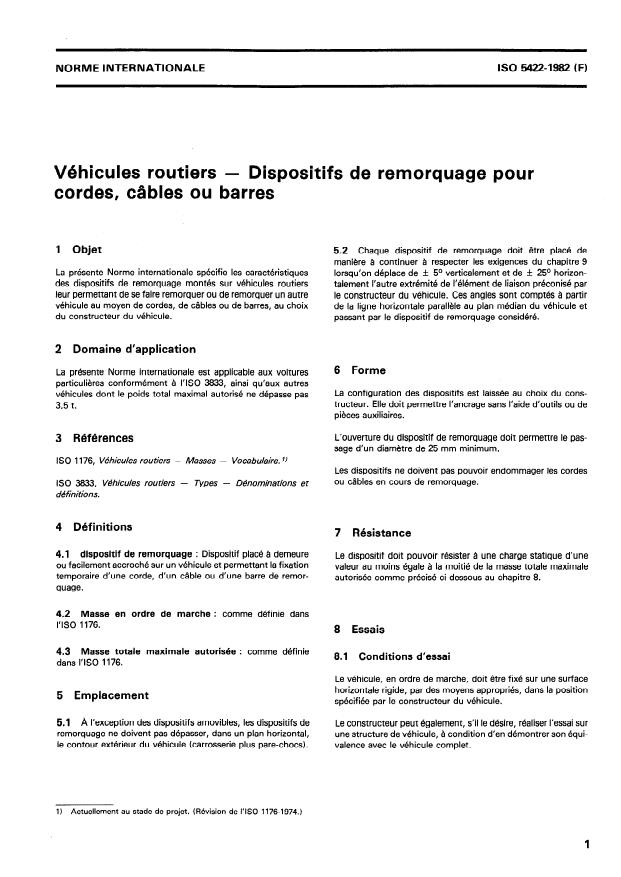
ISO 54224982 (F)
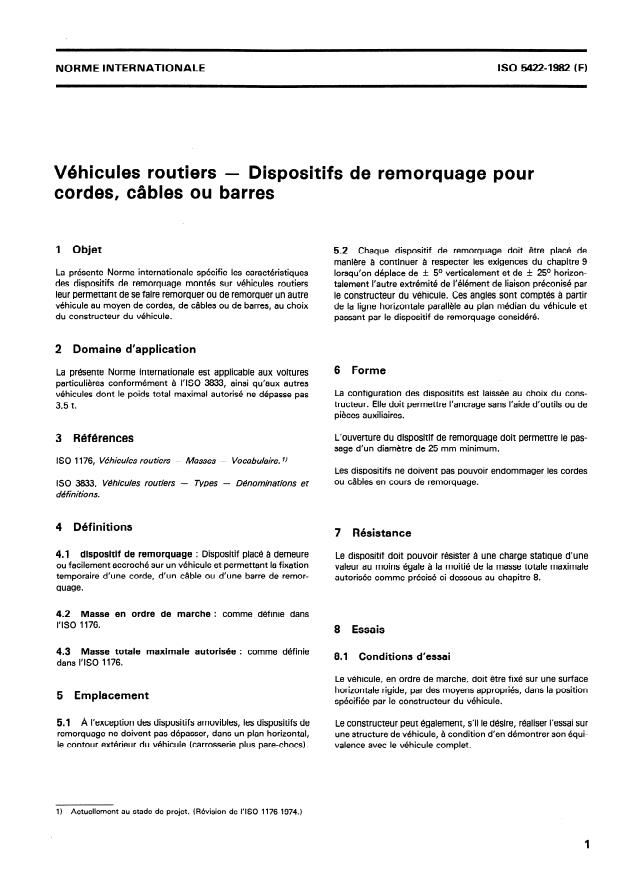
NORME INTERNATIONALE
Véhicules routiers - Dispositifs de remorquage pour
cordes, câbles ou barres
5.2 Chaque dispositif de remorquage doit être placé de
1 Objet
manière à continuer à respecter les exigences du chapitre 9
La présente Norme internationale spécifie les caractéristiques lorsqu’on déplace de + 5O verticalement et de + 25O horizon-
des dispositifs de remorquage montés sur véhicules routiers talement l’autre extrémité de l’élément de liaison préconisé par
leur permettant de se faire remorquer ou de remorquer un autre le constructeur du véhicule. Ces angles sont comptés à partir
véhicule au moyen de cordes, de câbles ou de barres, au choix
de la ligne horizontale paralléle au plan médian du véhicule et
du constructeur du véhicule. passant par le dispositif de remorquage considéré.
2 Domaine d’application
6 Forme
La présente Norme internationale est applicable aux voitures
particulières conformément à I’ISO 3833, ainsi qu’aux autres
La configuration des dispositifs est laissée au choix du cons-
véhicules dont le poids total maximal autorisé ne dépasse pas
t
...
Norme internationale
INTEFtNATIONAL ORGANIZATION FOR STANDARDIZATION.ME)I(LLYHAPO~HAR OPTAHH3Al#lR n0 CTAH&WTM3Al@lM~RGANISATION INTERNATIONALE DE NORMALISATION
- Dispositifs de remorquage pour
Véhicules routiers
cordes, câbles ou barres
Road vehicles - Anchorages for towing ropes, tables or bars
Premibe édition - 1982-08-01
CDU 629.11.013.8 Réf. no : ISO 54224982 (F)
îz
Y
p Descripteurs : véhicule routier, dispositif de remorquage, spécification, essai.
I
M
;x
s1
Prix basé sur 2 pages
Avant-propos
L’ISO (Organisation internationale de normalisation) est une fédération mondiale
d’organismes nationaux de normalisation (comités membres de I’ISO). L’élaboration
des Normes internationales est confiée aux comités techniques de I’ISO. Chaque
comité membre intéressé par une étude a le droit de faire partie du comité technique
correspondant. Les organisations internationales, gouvernementales et non gouverne-
mentales, en liaison avec I’ISO, participent également aux travaux.
Les projets de Normes internationales adoptés par les comités techniques sont soumis
aux comités membres pour approbation, avant leur acceptation comme Normes inter-
nationales par le Conseil de I’ISO.
La Norme internationale ISO 5422 a été élaborée par le comité technique ISO/TC 22,
Whicules routiers, et a été soumise aux comités membres en janvier 1981.
Les comités membres des pays suivants l’ont approuvée :
Afrique du Sud, Rép. d’ Égypte, Rép. arabe d’ Roumanie
Allemagne, R. F. Espagne Royaume-Uni
Autriche France Suède
Belgique Iran Suisse
Bulgarie Italie Tchécoslovaquie
Chine Nouvelle-Zélande URSS
Corée, Rép. de Pays-Bas
Corée, Rép. dém.p. de Pologne
Le comité membre du pays suivant l’a désapprouvée pour des raisons techniques :
Japon
Organisation internationale de normalisation, 1982
Imprimé en Suisse
~ ~~~
ISO 54224982 (F)
NORME INTERNATIONALE
Véhicules routiers - Dispositifs de remorquage pour
cordes, câbles ou barres
5.2 Chaque dispositif de remorquage doit être placé de
1 Objet
manière à continuer à respecter les exigences du chapitre 9
La présente Norme internationale spécifie les caractéristiques lorsqu’on déplace de + 5O verticalement et de + 25O horizon-
des dispositifs de remorquage montés sur véhicules routiers talement l’autre extrémité de l’élément de liaison préconisé par
leur permettant de se faire remorquer ou de remorquer un autre le constructeur du véhicule. Ces angles sont comptés à partir
véhicule au moyen de cordes, de câbles ou de barres, au choix
de la ligne horizontale paralléle au plan médian du véhicule et
du constructeur du véhicule. passant par le dispositif de remorquage considéré.
2 Domaine d’application
6 Forme
La présente Norme internationale est applicable aux voitures
particulières conformément à I’ISO 3833, ainsi qu’aux autres
La configuration des dispositifs est laissée au choix du cons-
véhicules dont le poids total maximal autorisé ne dépasse pas
t
...