

ISO 8838:2024
(Main)Plain bearings — Water-lubricated plain bearing materials
General Information
- Abstract
This document specifies requirements for the selection and use of water-lubricated plain bearing materials used in different equipment and plants under various lubrication conditions, such as — fluid-film lubrication condition, — mixed lubrication condition, and — condition comprising a non-lubrication condition which shifts to a fluid-film lubrication condition. In addition, this document also specifies requirements for mating (shaft) material, the lubrication method and for items to consider during the design of water-lubricated plain bearing materials. The water used as a lubricant is pure water, tap water, river water or seawater. This document does not apply to the water solution of chemicals, refrigerants, liquid fuels, etc.
- Status
- Published
- Publication Date
- 04-Sep-2024
- Technical Committee
- ISO/TC 123/SC 7 - Special types of plain bearings
- Drafting Committee
- ISO/TC 123/SC 7 - Special types of plain bearings
- Current Stage
- 6060 - International Standard published
- Start Date
- 05-Sep-2024
- Due Date
- 25-Oct-2024
- Completion Date
- 05-Sep-2024
Overview
ISO 8838:2024 - Plain bearings - Water-lubricated plain bearing materials defines requirements for the selection and use of water-lubricated plain bearing materials and their mating (shaft) materials. The standard covers bearings operating under fluid‑film, mixed, and non‑lubricated → fluid‑film conditions using water as the lubricant (pure, tap, river or seawater). It also addresses lubrication methods, design considerations, and material compatibility. This document excludes water solutions containing chemicals, refrigerants or liquid fuels.
Key topics and requirements
- Material families specified: wood‑based; carbon‑based; rubber‑based; thermosetting resin; fluoro resin (PTFE/PFA/FEP); thermoplastic resins (PA, POM, PPS, PEEK, PU, PES); ceramic (Si3N4, SiC, Sialon); and cermet (WC, TiC, Cr3C2 coatings).
- Mating (shaft) materials: guidance on corrosion resistance and high surface hardness (preferably HV 600 or higher) to resist wear from hard foreign matter; exceptions for rubber bearings where shaft hardness can be lower.
- Lubrication methods: describes water supply strategies - forced supply, circulating supply, and fully immersed operation - and associated selection implications.
- Design considerations: temperature effects (freezing/boiling limits), low viscosity and limited elastohydrodynamic support of water versus oil, corrosion risk, and foreign‑matter removal strategies.
- Material properties: notes on self‑lubricating vs non‑self‑lubricating materials (e.g., many resin and carbon types are self‑lubricating; ceramics and cermets generally are not) and seawater compatibility (risk of galvanic corrosion with some carbon materials).
- Scope limits and normative references: refers to ISO 4378 parts, ISO 1043‑1 and ISO 8044; cites ISO 19259 and ISO 20054 as additional material sources.
Practical applications and who uses this standard
ISO 8838:2024 is directly applicable to:
- Marine engineers (stern tubes, propulsion bearings)
- Pump and submersible equipment manufacturers
- Hydroelectric turbine and generator designers
- Water treatment and valve equipment OEMs
- Materials and tribology engineers specifying bearings for water-lubricated environments
- Maintenance and reliability teams assessing retrofit or replacement options
Use cases include selection of seawater‑compatible bearing linings, specifying shaft surface hardness and plating, defining water supply arrangements, and designing bearings to tolerate abrasive contaminants (sand, grit) and temperature limits.
Related standards
- ISO 4378 (Parts 1–3) - plain bearing terminology, properties, friction and wear, lubrication
- ISO 1043‑1 - plastics symbols/abbreviations
- ISO 8044 - corrosion vocabulary
- ISO 19259, ISO 20054 - additional bearing material references
Keywords: ISO 8838:2024, water‑lubricated plain bearings, bearing materials, mating shaft materials, seawater compatibility, fluid‑film lubrication, mixed lubrication, bearing design.
Frequently Asked Questions
ISO 8838:2024 is a standard published by the International Organization for Standardization (ISO). Its full title is "Plain bearings — Water-lubricated plain bearing materials". This standard covers: This document specifies requirements for the selection and use of water-lubricated plain bearing materials used in different equipment and plants under various lubrication conditions, such as — fluid-film lubrication condition, — mixed lubrication condition, and — condition comprising a non-lubrication condition which shifts to a fluid-film lubrication condition. In addition, this document also specifies requirements for mating (shaft) material, the lubrication method and for items to consider during the design of water-lubricated plain bearing materials. The water used as a lubricant is pure water, tap water, river water or seawater. This document does not apply to the water solution of chemicals, refrigerants, liquid fuels, etc.
This document specifies requirements for the selection and use of water-lubricated plain bearing materials used in different equipment and plants under various lubrication conditions, such as — fluid-film lubrication condition, — mixed lubrication condition, and — condition comprising a non-lubrication condition which shifts to a fluid-film lubrication condition. In addition, this document also specifies requirements for mating (shaft) material, the lubrication method and for items to consider during the design of water-lubricated plain bearing materials. The water used as a lubricant is pure water, tap water, river water or seawater. This document does not apply to the water solution of chemicals, refrigerants, liquid fuels, etc.
ISO 8838:2024 is classified under the following ICS (International Classification for Standards) categories: 21.100.10 - Plain bearings. The ICS classification helps identify the subject area and facilitates finding related standards.
ISO 8838:2024 is available in PDF format for immediate download after purchase. The document can be added to your cart and obtained through the secure checkout process. Digital delivery ensures instant access to the complete standard document.
Standards Content (Sample)
International
Standard
ISO 8838
First edition
Plain bearings — Water-lubricated
2024-09
plain bearing materials
Paliers lisses — Matériaux de paliers lisses lubrifiés à l'eau
Reference number
© ISO 2024
All rights reserved. Unless otherwise specified, or required in the context of its implementation, no part of this publication may
be reproduced or utilized otherwise in any form or by any means, electronic or mechanical, including photocopying, or posting on
the internet or an intranet, without prior written permission. Permission can be requested from either ISO at the address below
or ISO’s member body in the country of the requester.
ISO copyright office
CP 401 • Ch. de Blandonnet 8
CH-1214 Vernier, Geneva
Phone: +41 22 749 01 11
Email: copyright@iso.org
Website: www.iso.org
Published in Switzerland
ii
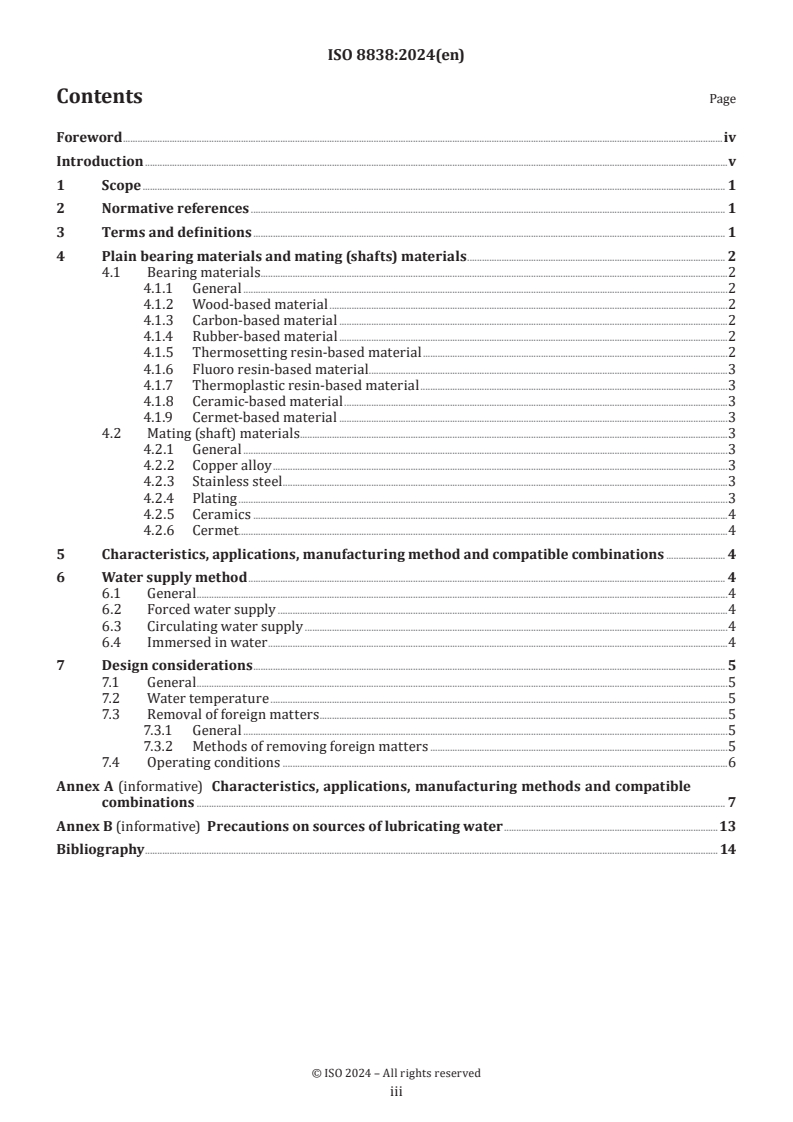
Contents Page
Foreword .iv
Introduction .v
1 Scope . 1
2 Normative references . 1
3 Terms and definitions . 1
4 Plain bearing materials and mating (shafts) materials . 2
4.1 Bearing materials . .2
4.1.1 General .2
4.1.2 Wood-based material .2
4.1.3 Carbon-based material .2
4.1.4 Rubber-based material .2
4.1.5 Thermosetting resin-based material .2
4.1.6 Fluoro resin-based material .3
4.1.7 Thermoplastic resin-based material .3
4.1.8 Ceramic-based material .3
4.1.9 Cermet-based material .3
4.2 Mating (shaft) materials.3
4.2.1 General .3
4.2.2 Copper alloy .3
4.2.3 Stainless steel .3
4.2.4 Plating .3
4.2.5 Ceramics .4
4.2.6 Cermet.4
5 Characteristics, applications, manufacturing method and compatible combinations . 4
6 Water supply method . 4
6.1 General .4
6.2 Forced water supply .4
6.3 Circulating water supply .4
6.4 Immersed in water .4
7 Design considerations . 5
7.1 General .5
7.2 Water temperature .5
7.3 Removal of foreign matters .5
7.3.1 General .5
7.3.2 Methods of removing foreign matters .5
7.4 Operating conditions .6
Annex A (informative) Characteristics, applications, manufacturing methods and compatible
combinations . 7
Annex B (informative) Precautions on sources of lubricating water .13
Bibliography . 14
iii
Foreword
ISO (the International Organization for Standardization) is a worldwide federation of national standards
bodies (ISO member bodies). The work of preparing International Standards is normally carried out through
ISO technical committees. Each member body interested in a subject for which a technical committee
has been established has the right to be represented on that committee. International organizations,
governmental and non-governmental, in liaison with ISO, also take part in the work. ISO collaborates closely
with the International Electrotechnical Commission (IEC) on all matters of electrotechnical standardization.
The procedures used to develop this document and those intended for its further maintenance are described
in the ISO/IEC Directives, Part 1. In particular, the different approval criteria needed for the different types
of ISO document should be noted. This document was drafted in accordance with the editorial rules of the
ISO/IEC Directives, Part 2 (see www.iso.org/directives).
ISO draws attention to the possibility that the implementation of this document may involve the use of (a)
patent(s). ISO takes no position concerning the evidence, validity or applicability of any claimed patent
rights in respect thereof. As of the date of publication of this document, ISO has not received notice of (a)
patent(s) which may be required to implement this document. However, implementers are cautioned that
this may not represent the latest information, which may be obtained from the patent database available at
www.iso.org/patents. ISO shall not be held responsible for identifying any or all such patent rights.
Any trade name used in this document is information given for the convenience of users and does not
constitute an endorsement.
For an explanation of the voluntary nature of standards, the meaning of ISO specific terms and expressions
related to conformity assessment, as well as information about ISO's adherence to the World Trade
Organization (WTO) principles in the Technical Barriers to Trade (TBT), see www.iso.org/iso/foreword.html.
This document was prepared by Technical Committee ISO/TC 123, Plain bearings, Subcommittee SC 7, Special
types of plain bearings.
Any feedback or questions on this document should be directed to the user’s national standards body. A
complete listing of these bodies can be found at www.iso.org/members.html.
iv
Introduction
Water-lubricated bearings are widely used in fields such as submersible pumps, marine stern tubes,
hydroelectric generator turbines, water treatment equipment, water valves and rolling equipment for
steelmaking.
Water-lubricated plain bearings are used for the following conditions or reasons:
a) oil or greases cannot be used due to equipment usage conditions;
b) there is plenty of water available as a lubricant around the equipment;
c) even if water for lubrication leaks, it does not pollute the environment like oil or grease.
However, when using water as a lubricant, it is necessary to take the following into account:
— water freezes at 0 °C or below and becomes vapor at 100 °C or above, at normal pressure, therefore losing
load carrying capacity;
— water has low viscosity in comparison with oil;
— water cannot support a high load because the increase in viscosity that occurs in oil lubrication
(elastohydrodynamic lubrication: EHL) when it is under high pressure cannot be expected in water.
— water does not have the ability that oil and grease have to prevent corrosion on shafts and bearings.
While water-lubricated plain bearings have been used in various fields around the world and the water
that is used as a lubricant has its own specific features differing from oil, there have been no International
Standards that apply to water-lubricated plain bearings thus far.
v
International Standard ISO 8838:2024(en)
Plain bearings — Water-lubricated plain bearing materials
1 Scope
This document specifies requirements for the selection and use of water-lubricated plain bearing materials
used in different equipment and plants under various lubrication conditions, such as
— fluid-film lubrication condition,
— mixed lubrication condition, and
— condition comprising a non-lubrication condition which shifts to a fluid-film lubrication condition.
In addition, this document also specifies requirements for mating (shaft) material, the lubrication method
and for items to consider during the design of water-lubricated plain bearing materials.
The water used as a lubricant is pure water, tap water, river water or seawater. This document does not
apply to the water solution of chemicals, refrigerants, liquid fuels, etc.
2 Normative references
The following documents are referred to in the text in such a way that some or all of their content constitutes
requirements of this document. For dated references, only the edition cited applies. For undated references,
the latest edition of the referenced document (including any amendments) applies.
ISO 1043-1, Plastics — Symbols and abbreviated terms — Part 1: Basic polymers and their special characteristics
ISO 4378-1, Plain bearings — Terms, definitions, classification and symbols — Part 1: Design, bearing materials
and their properties
ISO 4378-2, Plain bearings — Terms, definitions, classification and symbols — Part 2: Friction and wear
ISO 4378-3, Plain bearings — Terms, definitions, classification and symbols — Part 3: Lubrication
ISO 8044, Corrosion of metals and alloys — Vocabulary
3 Terms and definitions
For the purposes of this document, the terms and definitions given in ISO 1043-1, ISO 4378-1, ISO 4378-2,
ISO 4378-3 and ISO 8044 apply.
ISO and IEC maintain terminological databases for use in standardization at the following addresses:
— ISO Online browsing platform: available at https:// www .iso .org/ obp
— IEC Electropedia: available at https:// www .electropedia .org/
4 Plain bearing materials and mating (shafts) materials
4.1 Bearing materials
4.1.1 General
Depending on the equipment, bearings are used in the following lubrication conditions:
a) bearing is constantly immersed in water;
b) there is no lubrication at first and water is supplied after the start of operation;
c) water is forcibly supplied from the beginning.
When required to operate without lubrication, a bearing material with a self-lubricating property shall be
selected. When used in seawater, a bearing material that does not cause galvanic corrosion shall be selected.
NOTE In addition to the materials listed below, the bearing materials listed in ISO 19259 and ISO 20054 are also
used for water-lubricated bearing materials.
4.1.2 Wood-based material
Lignum vitae or materials such as maple and beech impregnated with wax can be used.
Wood-based material has self-lubricating properties.
4.1.3 Carbon-based material
Artificial graphite with or without the following can be used:
a) impregnated resin (phenolic resin, etc.);
b) low melting point metals (such as Cu, Sn, Cu-Sn alloy, etc.).
Carbon-based material has self-lubricating properties, however, there is a risk of galvanic corrosion when
used in seawater.
NOTE Terms related to galvanic corrosion are defined in ISO 8044.
4.1.4 Rubber-based material
Natural rubber (NR) or synthetic rubber, such as chloroprene rubber (CR), acrylonitrile-butadiene rubber
(NBR), and styrene-butadiene rubber (SBR), can be used.
NOTE Other rubber-based materials are defined in ISO 1629.
These rubber-based materials are typically bonded to the inner surface of the metal tube or fibre-reinforced
plastic tube. They are resistant to abrasive wear, however, they do not have self-lubricating properties.
4.1.5 Thermosetting resin-based material
Thermosetting resin such as phenolic resin and unsaturated polyester resin reinforced with fibre or woven
fabric, and, as needed, added with fillers such as graphite, carbon fibre and polytetrafluoroethylene (PTFE)
to improve sliding characteristics can be used.
Thermosetting resin-based material has self-lubricating properties and impact load resistance.
4.1.6 Fluoro resin-based material
Fluoro resin such as PTFE, tetrafluoroethylene-perfluoroalkylvinylether copolymer resin (PFA) and
tetrafluoroethylene-hexafluoropropylene copolymer resin (FEP) added with fillers such as glass fibre and
carbon fibre to improve wear resistance can be used.
Fluoro resin-based material is used as solid type or multilayer type bonded to a metal substrate. It has self-
lubricating properties.
4.1.7 Thermoplastic resin-based material
Thermoplastic resin such as polyamide (PA), polyoxymethylene (POM), polyphenylenesulfide (PPS),
polyetheretherketone (PEEK), polyurethane (PU) and polyethersulfone (PES) added with fillers such as
glass fibre, carbon fibre and PTFE to improve wear resistance and lubricity can be used.
Thermoplastic resin-based material has self-lubricating properties.
4.1.8 Ceramic-based material
Silicon nitride (Si N ), silicon carbide (SiC) or Sialon (Si N -Al O ) can be used.
3 4 3 4 2 3
These ceramic-based materials are resistant to abrasive wear, however, they do not have self-lubricating
properties.
4.1.9 Cermet-based material
Composite materials of ceramics and metals, such as tungsten carbide (WC) based alloy or titanium carbide
(TiC) based alloy, are the most commonly used among cermet-based materials. Cromium carbide (Cr C )
3 2
alloy is used for a coating on a metal substrate.
These cermet-based materials are resistant to abrasive wear, however, they do not have self-lubricating
properties.
4.2 Mating (shaft) materials
4.2.1 General
Lubricating water does not prevent corrosion like oil or grease, so the mating shaft selected shall be
corrosion resistant. A material with high surface hardness, preferably HV 600 or higher and wear resistance
should be selected, in case hard foreign matter, such as sand, enters between sliding surfaces of the bearing
and mating shaft.
However, when using a rubber bearing, the shaft does not need to have a hard surface, because the elastic
deformation of the rubber traps hard foreign matters resulting in less damage to the shaft.
4.2.2 Copper alloy
A bronze sleeve should be fitted on to a steel shaft for marine propulsion shafts.
4.2.3 Stainless steel
Austenitic, martensitic, two-phase precipitation hardening stainless steel, high nitrogen steel or the like
should be used.
NOTE Chemical composition, mechanical properties, etc. of stainless steels ar
...