

ISO/IEC 9075-4:2016/Cor 2:2022
(Corrigendum)Information technology — Database languages — SQL — Part 4: Persistent stored modules (SQL/PSM) — Technical Corrigendum 2
General Information
- Abstract
- Status
- Withdrawn
- Publication Date
- 23-Jun-2022
- Technical Committee
- ISO/IEC JTC 1/SC 32 - Data management and interchange
- Drafting Committee
- ISO/IEC JTC 1/SC 32 - Data management and interchange
- Current Stage
- 9599 - Withdrawal of International Standard
- Start Date
- 01-Jun-2023
- Completion Date
- 29-Aug-2026

Overview
ISO/IEC 9075-4:2016/Cor 2:2022 is a Technical Corrigendum (published June 2022) to the ISO/IEC 9075‑4:2016 standard - the SQL part that defines Persistent Stored Modules (SQL/PSM). Prepared by ISO/IEC JTC 1/SC 32 (Data management and interchange), this corrigendum provides clarifications and corrections to the SQL/PSM specification. It updates syntax rules, lexical elements, access-control semantics, handler and control‑flow behavior, and Information Schema references to improve interoperability and conformance for SQL stored procedures and modules.
Key Topics and Requirements
- Clarification of timestamp precision - refines wording about the creation timestamp type for modules (precision/representation is implementation-defined).
- Lexical elements and identifiers - fixes and tightens syntax rules for names and user-defined type name (UDTN) handling to avoid ambiguity when schema names are omitted.
- Routine invocation and assignment rules - supplies corrected syntax and argument handling for routine invocation and store-assignment semantics, pointing to cross-references in ISO/IEC 9075‑2 where applicable.
- Access control / privileges - replaces ambiguous language (e.g., use of “may”) with precise rules: EXECUTE privilege requirements for SQL-server modules and schema-level routines are clarified, including which routines are considered subject routines for revoke logic.
- Handler execution and SQL-client modules - improves error/exception handling rules for SQL procedure statements, notably the behavior when no “most appropriate” handler exists and how unhandled SQLSTATE values are treated.
- Control statements (loops) - reinstates repetition semantics for loop statements and clarifies interactions with exception and leave statements.
- Information Schema corrections - corrects and removes erroneous references and column names in INFORMATION_SCHEMA views related to MODULES and shortname views.
Applications and Users
This corrigendum is essential for:
- Database product implementers (engine and SQL runtime developers) who must align stored‑procedure behavior and security semantics with the SQL standard.
- Language designers and SQL implementers validating parser/BNF changes and lexical rules.
- DBA and application developers relying on predictable stored-procedure execution, exception handling, and privilege enforcement.
- Conformance and test-suite authors who create SQL/PSM compliance tests and Information Schema checks.
Related Standards
- ISO/IEC 9075‑4:2016 (SQL/PSM) - base standard being corrected.
- ISO/IEC 9075‑2 - referenced for store-assignment and procedure-statement rules.
- ISO/IEC JTC 1/SC 32 publications on data management and interchange.
Keywords: SQL/PSM, ISO/IEC 9075-4, Technical Corrigendum, persistent stored modules, SQL stored procedures, Information Schema, SQL standard, database security, EXECUTE privilege.
Relations
- Effective Date
- 06-Jun-2022
- Effective Date
- 11-Feb-2023
Get Certified
Connect with accredited certification bodies for this standard

BSI Group
BSI (British Standards Institution) is the business standards company that helps organizations make excellence a habit.

NYCE
Mexican standards and certification body.
Sponsored listings
Frequently Asked Questions
ISO/IEC 9075-4:2016/Cor 2:2022 is a standard published by the International Organization for Standardization (ISO). Its full title is "Information technology — Database languages — SQL — Part 4: Persistent stored modules (SQL/PSM) — Technical Corrigendum 2". This standard covers: Information technology — Database languages — SQL — Part 4: Persistent stored modules (SQL/PSM) — Technical Corrigendum 2
Information technology — Database languages — SQL — Part 4: Persistent stored modules (SQL/PSM) — Technical Corrigendum 2
ISO/IEC 9075-4:2016/Cor 2:2022 is classified under the following ICS (International Classification for Standards) categories: 35.060 - Languages used in information technology. The ICS classification helps identify the subject area and facilitates finding related standards.
ISO/IEC 9075-4:2016/Cor 2:2022 has the following relationships with other standards: It is inter standard links to ISO/IEC 9075-4:2016, ISO/IEC 9075-4:2023. Understanding these relationships helps ensure you are using the most current and applicable version of the standard.
ISO/IEC 9075-4:2016/Cor 2:2022 is available in PDF format for immediate download after purchase. The document can be added to your cart and obtained through the secure checkout process. Digital delivery ensures instant access to the complete standard document.
Standards Content (Sample)
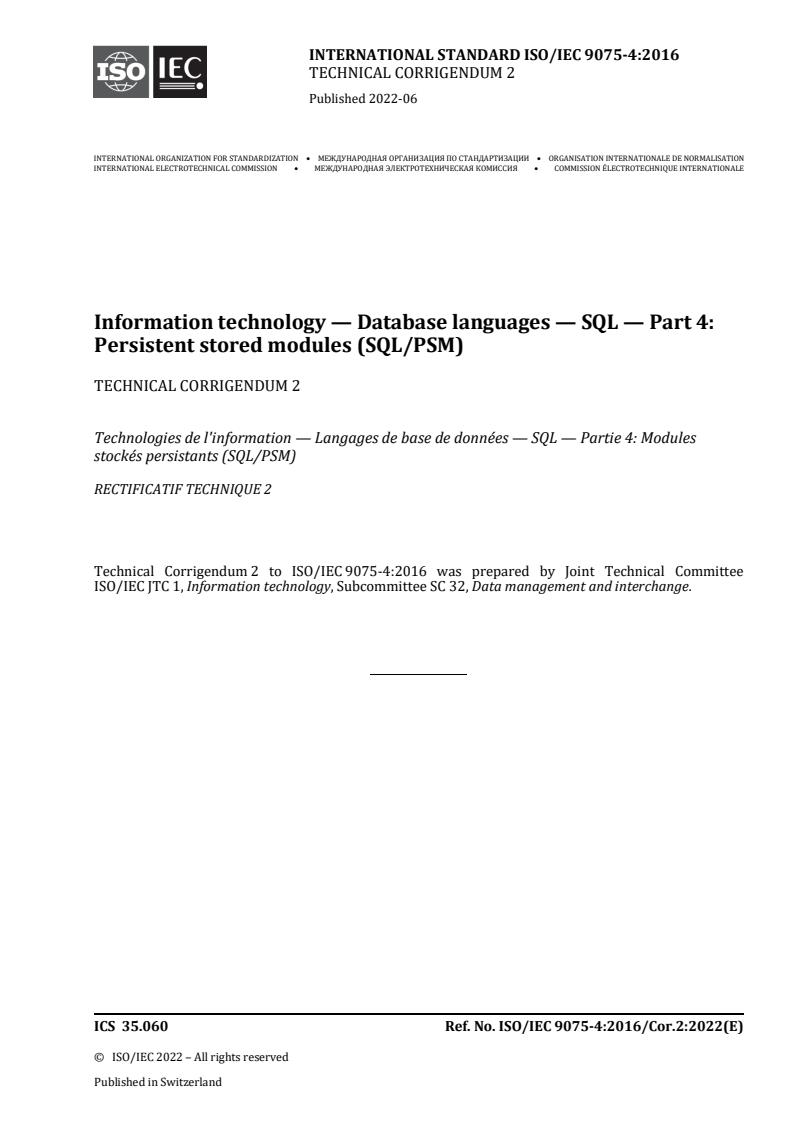
INTERNATIONAL STANDARD ISO/IEC 9075-4:2016
TECHNICAL CORRIGENDUM 2
Published 2022-06
INTERNATIONAL ORGANIZATION FOR STANDARDIZATION • МЕЖДУНАРОДНАЯ ОРГАНИЗАЦИЯ ПО СТАНДАРТИЗАЦИИ • ORGANISATION INTERNATIONALE DE NORMALISATION
INTERNATIONAL ELECTROTECHNICAL COMMISSION • МЕЖДУНАРОДНАЯ ЭЛЕКТРОТЕХНИЧЕСКАЯ КОМИССИЯ • COMMISSION ÉLECTROTECHNIQUE INTERNATIONALE
Information technology — Database languages — SQL — Part 4:
Persistent stored modules (SQL/PSM)
TECHNICAL CORRIGENDUM 2
Technologies de l'information — Langages de base de données — SQL — Partie 4: Modules
stockés persistants (SQL/PSM)
RECTIFICATIF TECHNIQUE 2
Technical Corrigendum 2 to ISO/IEC 9075-4:2016 was prepared by Joint Technical Committee
ISO/IEC JTC 1, Information technology, Subcommittee SC 32, Data management and interchange.
ICS 35.060 Ref. No. ISO/IEC 9075-4:2016/Cor.2:2022(E)
© ISO/IEC 2022 – All rights reserved
Published in Switzerland
ISO/IEC9075-4:2016/Cor.2:2022(E)
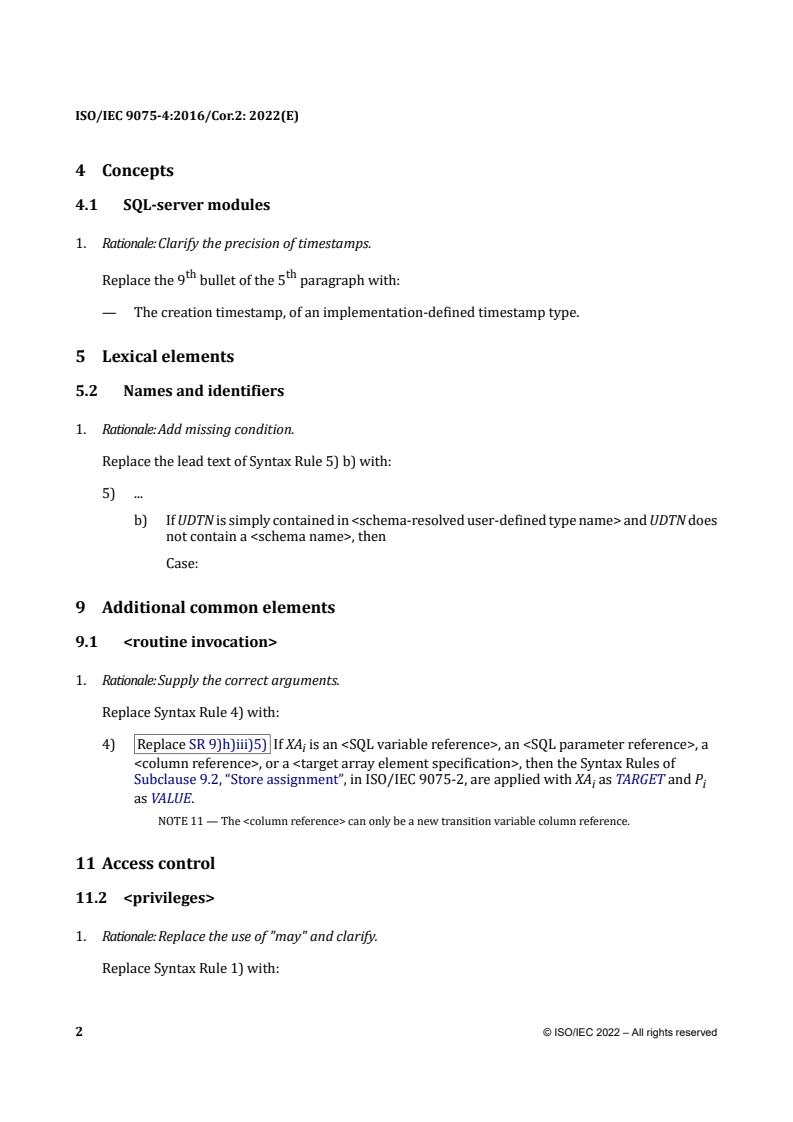
4 Concepts
4.1 SQL-servermodules
1. Rationale:Clarifytheprecisionoftimestamps.
th th
Replacethe9 bulletofthe5 paragraphwith:
— Thecreationtimestamp,ofanimplementation-definedtimestamptype.
5 Lexicalelements
5.2 Namesandidentifiers
1. Rationale:Addmissingcondition.
ReplacetheleadtextofSyntaxRule5)b)with:
5) .
b) IfUDTNissimplycontainedinandUDTNdoes
notcontaina,then
Case:
9 Additionalcommonelements
9.1
1. Rationale:Supplythecorrectarguments.
ReplaceSyntaxRule4)with:
4) ReplaceSR9)h)iii)5)IfXAisan,an,a
i
,ora,thentheSyntaxRulesof
Subclause9.2,“Storeassignment”,inISO/IEC9075-2,areappliedwithXAasTARGETandP
i i
asVALUE.
NOTE11—Thecanonlybeanewtransitionvariablecolumnreference.
11Accesscontrol
11.2
1. Rationale:Replacetheuseof"may"andclarify.
ReplaceSyntaxRule1)with:
2 © ISO/IEC 2022 – All rights reserved
ISO/IEC9075-4:2016/Cor.2:2022(E)
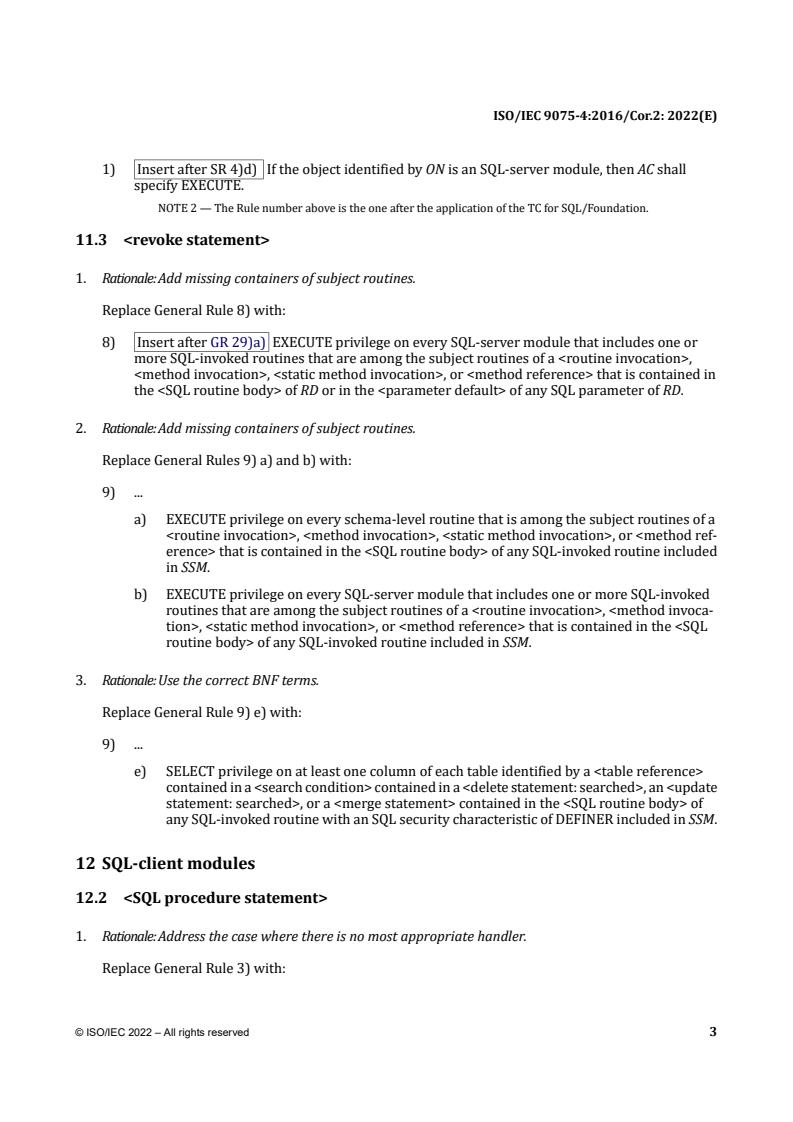
1) InsertafterSR4)d) IftheobjectidentifiedbyONisanSQL-servermodule,thenACshall
specifyEXECUTE.
NOTE2—TheRulenumberaboveistheoneaftertheapplicationoftheTCforSQL/Foundation.
11.3
1. Rationale:Addmissingcontainersofsubjectroutines.
ReplaceGeneralRule8)with:
8) InsertafterGR29)a)EXECUTEprivilegeoneverySQL-servermodulethatincludesoneor
moreSQL-invokedroutinesthatareamongthesubjectroutinesofa,
,,orthatiscontainedin
theofRDorintheofanySQLparameterofRD.
2. Rationale:Addmissingcontainersofsubjectroutines.
ReplaceGeneralRules9)a)andb)with:
9) .
a) EXECUTEprivilegeoneveryschema-levelroutinethatisamongthesubjectroutinesofa
,,,or
erence>thatiscontainedintheofanySQL-invokedroutineinclu
...