

ISO/TS 23148:2024
(Main)Compatibility of lubricants with synthetic male condoms
General Information
- Abstract
This document provides guidance on assessing the effect or compatibility of an additional or personal lubricant with synthetic male condoms (excluding synthetic polyisoprene condoms). It also applies to topical medicines and any other substances that come into contact with such condoms. It describes the measurement of changes in physical properties of the condoms after exposure to the test substance (i.e. lubricant, topical medicine, etc.) and specifies the pass/fail criteria for such changes. This document is intended to be used for evaluating the compatibility of chosen additional lubricants or topical medicines with chosen synthetic condoms. Each lubricant type is evaluated specifically against each condom material for which compatibility is claimed. This document is not applicable to the assessment of the compatibility of lubricants applied to a condom at the time of manufacture. It is not directly applicable to female condoms, although similar principles can apply.
- Status
- Published
- Publication Date
- 14-Mar-2024
- Technical Committee
- ISO/TC 157 - Non-systemic contraceptives and STI barrier prophylactics
- Drafting Committee
- ISO/TC 157 - Non-systemic contraceptives and STI barrier prophylactics
- Current Stage
- 6060 - International Standard published
- Start Date
- 15-Mar-2024
- Due Date
- 17-Oct-2025
- Completion Date
- 15-Mar-2024
Overview
ISO/TS 23148:2024 - Compatibility of lubricants with synthetic male condoms - is a technical specification that provides guidance for evaluating how additional or personal lubricants, topical medicines, and other substances affect the physical properties of synthetic male condoms (excluding synthetic polyisoprene). The document describes laboratory methods to measure changes in tensile and inflation (airburst) properties after controlled exposure and specifies pass/fail criteria for compatibility claims.
Key topics and requirements
- Scope: Tests apply to additional/personal lubricants, topical medicines and other substances that may contact synthetic condoms in use. Not applicable to lubricants applied during manufacture or directly to female condoms (though similar principles may apply).
- Test principle: Measure changes in tensile properties and inflation (airburst) after 60 minutes exposure at body temperature (recommend 3 hours for female condoms if considered).
- Sample types:
- Rings cut from condoms for tensile testing (force and elongation at break - see Annex A).
- Whole condom areas relevant to inflation testing per ISO 23409.
- Controls:
- Negative control (e.g., distilled water where suitable).
- Benchmark control (substance that causes minimal, acceptable change).
- Positive control (known to cause deterioration).
- Pass/fail criteria: Specified statistical comparisons of treated vs control groups; Annex B covers confidence-interval calculation for ratio of two means.
- Apparatus and procedure: Test apparatus and methods align with ISO 19671; includes sample size, quantity of test substance, cleaning, heating to body temperature, and standardized inflation/tensile test execution.
- Limitations: The method evaluates physical compatibility (tensile/airburst) only and does not determine clinical safety or predict all in-use failures. Results are specific to the tested condom product and lubricant combination unless material equivalence is demonstrated.
Practical applications and users
ISO/TS 23148:2024 is intended for:
- Lubricant manufacturers - to substantiate compatibility claims for specific synthetic condom materials.
- Condom manufacturers - to qualify third‑party lubricants and topical medicines for use with their products.
- Independent test laboratories - to perform standardized compatibility testing (tensile and inflation).
- Regulatory bodies and QA teams - for product evaluation, labeling support and risk assessment during product development or market surveillance.
- R&D and product developers - to screen formulations (including volatile silicone fractions like Cyclomethicone D5 mentioned in the introduction) that may transiently affect condom strength.
Related standards
- ISO 23409 - Male condoms: requirements and inflation test methods for synthetic materials
- ISO 19671 - Additional lubricants for natural rubber latex condoms (comparative approach)
- ISO 4074 - Natural rubber latex male condoms - requirements and test methods
Keywords: ISO/TS 23148:2024, compatibility of lubricants with synthetic male condoms, lubricant compatibility testing, tensile testing, inflation (airburst) testing, topical medicines, condom material compatibility, pass/fail criteria.
Get Certified
Connect with accredited certification bodies for this standard

BSI Group
BSI (British Standards Institution) is the business standards company that helps organizations make excellence a habit.

TÜV Rheinland
TÜV Rheinland is a leading international provider of technical services.

TÜV SÜD
TÜV SÜD is a trusted partner of choice for safety, security and sustainability solutions.
Sponsored listings
Frequently Asked Questions
ISO/TS 23148:2024 is a technical specification published by the International Organization for Standardization (ISO). Its full title is "Compatibility of lubricants with synthetic male condoms". This standard covers: This document provides guidance on assessing the effect or compatibility of an additional or personal lubricant with synthetic male condoms (excluding synthetic polyisoprene condoms). It also applies to topical medicines and any other substances that come into contact with such condoms. It describes the measurement of changes in physical properties of the condoms after exposure to the test substance (i.e. lubricant, topical medicine, etc.) and specifies the pass/fail criteria for such changes. This document is intended to be used for evaluating the compatibility of chosen additional lubricants or topical medicines with chosen synthetic condoms. Each lubricant type is evaluated specifically against each condom material for which compatibility is claimed. This document is not applicable to the assessment of the compatibility of lubricants applied to a condom at the time of manufacture. It is not directly applicable to female condoms, although similar principles can apply.
This document provides guidance on assessing the effect or compatibility of an additional or personal lubricant with synthetic male condoms (excluding synthetic polyisoprene condoms). It also applies to topical medicines and any other substances that come into contact with such condoms. It describes the measurement of changes in physical properties of the condoms after exposure to the test substance (i.e. lubricant, topical medicine, etc.) and specifies the pass/fail criteria for such changes. This document is intended to be used for evaluating the compatibility of chosen additional lubricants or topical medicines with chosen synthetic condoms. Each lubricant type is evaluated specifically against each condom material for which compatibility is claimed. This document is not applicable to the assessment of the compatibility of lubricants applied to a condom at the time of manufacture. It is not directly applicable to female condoms, although similar principles can apply.
ISO/TS 23148:2024 is classified under the following ICS (International Classification for Standards) categories: 11.200 - Birth control. Mechanical contraceptives. The ICS classification helps identify the subject area and facilitates finding related standards.
ISO/TS 23148:2024 is available in PDF format for immediate download after purchase. The document can be added to your cart and obtained through the secure checkout process. Digital delivery ensures instant access to the complete standard document.
Standards Content (Sample)
Technical
Specification
ISO/TS 23148
First edition
Compatibility of lubricants with
2024-03
synthetic male condoms
Compatibilité des lubrifiants avec les préservatifs masculins en
matière synthétique
Reference number
© ISO 2024
All rights reserved. Unless otherwise specified, or required in the context of its implementation, no part of this publication may
be reproduced or utilized otherwise in any form or by any means, electronic or mechanical, including photocopying, or posting on
the internet or an intranet, without prior written permission. Permission can be requested from either ISO at the address below
or ISO’s member body in the country of the requester.
ISO copyright office
CP 401 • Ch. de Blandonnet 8
CH-1214 Vernier, Geneva
Phone: +41 22 749 01 11
Email: copyright@iso.org
Website: www.iso.org
Published in Switzerland
ii
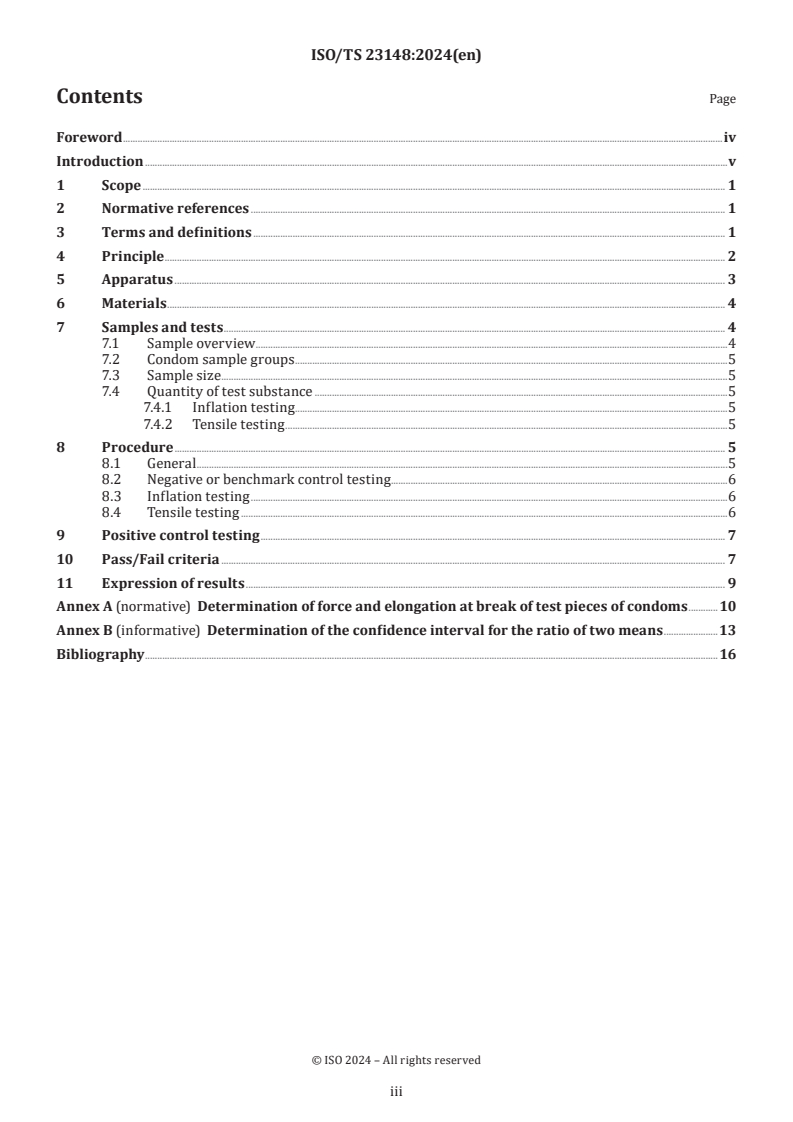
Contents Page
Foreword .iv
Introduction .v
1 Scope . 1
2 Normative references . 1
3 Terms and definitions . 1
4 Principle . 2
5 Apparatus . 3
6 Materials . 4
7 Samples and tests . 4
7.1 Sample overview .4
7.2 Condom sample groups .5
7.3 Sample size .5
7.4 Quantity of test substance .5
7.4.1 Inflation testing .5
7.4.2 Tensile testing .5
8 Procedure . 5
8.1 General .5
8.2 Negative or benchmark control testing .6
8.3 Inflation testing .6
8.4 Tensile testing .6
9 Positive control testing . 7
10 Pass/Fail criteria . 7
11 Expression of results . 9
Annex A (normative) Determination of force and elongation at break of test pieces of condoms .10
Annex B (informative) Determination of the confidence interval for the ratio of two means .13
Bibliography .16
iii
Foreword
ISO (the International Organization for Standardization) is a worldwide federation of national standards
bodies (ISO member bodies). The work of preparing International Standards is normally carried out through
ISO technical committees. Each member body interested in a subject for which a technical committee
has been established has the right to be represented on that committee. International organizations,
governmental and non-governmental, in liaison with ISO, also take part in the work. ISO collaborates closely
with the International Electrotechnical Commission (IEC) on all matters of electrotechnical standardization.
The procedures used to develop this document and those intended for its further maintenance are described
in the ISO/IEC Directives, Part 1. In particular, the different approval criteria needed for the different types
of ISO document should be noted. This document was drafted in accordance with the editorial rules of the
ISO/IEC Directives, Part 2 (see www.iso.org/directives).
ISO draws attention to the possibility that the implementation of this document may involve the use of (a)
patent(s). ISO takes no position concerning the evidence, validity or applicability of any claimed patent
rights in respect thereof. As of the date of publication of this document, ISO had not received notice of (a)
patent(s) which may be required to implement this document. However, implementers are cautioned that
this may not represent the latest information, which may be obtained from the patent database available at
www.iso.org/patents. ISO shall not be held responsible for identifying any or all such patent rights.
Any trade name used in this document is information given for the convenience of users and does not
constitute an endorsement.
For an explanation of the voluntary nature of standards, the meaning of ISO specific terms and expressions
related to conformity assessment, as well as information about ISO's adherence to the World Trade
Organization (WTO) principles in the Technical Barriers to Trade (TBT), see www.iso.org/iso/foreword.html.
This document was prepared by Technical Committee ISO/TC 157, Non-systematic contraceptive and STI
barrier prophylactics.
Any feedback or questions on this document should be directed to the user’s national standards body. A
complete listing of these bodies can be found at www.iso.org/members.html.
iv
Introduction
Weakening of natural rubber latex is known to occur after contact with certain lubricants, particularly
petroleum-based products with relatively low molecular weights.
Similarly, lubricants can affect condoms made from other materials.
This specification was developed to assist in developing methods for lubricant manufacturers to determine
whether or not a particular personal lubricant or topical medicine has a significant effect on the tensile
and airburst properties of condoms made from synthetic materials. It is also applicable to topical medicines
and other chemicals that might come in contact with vulval, vaginal, oral or rectal tissues, and hence with
condoms.
Strictly, the tests described in this document only show the compatibility of a specific lubricant with a
specific condom relating to a suitable baseline product (lubricant/control). However, depending on the
purpose of those tests, one can generalize the results to similar condoms or lubricants.
This test method does not determine the safety of either the test substance or the condom.
This test method is intended to determine if the tensile or airburst properties of the condom have been
significantly affected by the test substance. It is generally assumed that materials that adversely affect the
physical properties of the condoms to a material extent will cause additional failure in use, although that has
not been determined clinically.
Some substances used as additional condom lubricants contain volatile fractions which may affect condom
strength when they are first applied, but then evaporate rapidly. The condom’s strength may (or may not)
change again as a result. Depending on the duration of this effect, it may affect the condom's performance
in use. Typical candidate substances that can transiently weaken a condom (depending on the condom
material) include Cyclomethicone D5, lighter volatile fractions and phenyl trimethicone. Conversely, heavier
volatile silicone fractions can be protective until they evaporate.
Condoms made from synthetic polyisoprene behave similarly to natural latex condoms, and may be tested
according to ISO 19671.
v
Technical Specification ISO/TS 23148:2024(en)
Compatibility of lubricants with synthetic male condoms
1 Scope
This document provides guidance on assessing the effect or compatibility of an additional or personal
lubricant with synthetic male condoms (excluding synthetic polyisoprene condoms). It also applies to topical
medicines and any other substances that come into contact with such condoms. It describes the measurement
of changes in physical properties of the condoms after exposure to the test substance (i.e. lubricant, topical
medicine, etc.) and specifies the pass/fail criteria for such changes.
This document is intended to be used for evaluating the compatibility of chosen additional lubricants or
topical medicines with chosen synthetic condoms. Each lubricant type is evaluated specifically against each
condom material for which compatibility is claimed.
This document is not applicable to the assessment of the compatibility of lubricants applied to a condom
at the time of manufacture. It is not directly applicable to female condoms, although similar principles can
apply.
2 Normative references
The following documents are referred to in the text in such a way that some or all of their content constitutes
requirements of this document. For dated references, only the edition cited applies. For undated references,
the latest edition of the referenced document (including any amendments) applies.
ISO 4074, Natural rubber latex male condoms — Requirements and test methods
ISO 19671, Additional lubricants for male natural rubber latex condoms — Effect on condom strength
ISO 23409, Male condoms — Requirements and test methods for condoms made from synthetic materials
3 Terms and definitions
For the purposes of this document, the terms and definitions given in ISO 4074, ISO 23409 and the following
apply.
ISO and IEC maintain terminology databases for use in standardization at the following addresses:
— ISO Online browsing platform: available at https:// www .iso .org/ obp
— IEC Electropedia: available at https:// www .electropedia .org/
3.1
benchmark substance
readily available substance causing little change in the condom’s physical properties against which the test
substance’s effect on the condom may be compared,
3.2
negative control
test substance (3.6) which is known to cause no change in the physical properties of the condom being
evaluated
3.3
personal lubricant
additional lubricant intended for application by the user at the time of condom use
3.4
positive control
test substance (3.6) which is known to cause deterioration in the physical properties of the condom being
evaluated
3.5
synthetic material
any base material other than 100 % natural rubber latex that is used to make condoms
3.6
test substance
personal lubricant (3.3), topical medicine (3.7) or other material which is being tested for compatibility with
condoms
3.7
topical medicine
medicine intended to be used on the skin of the genital area, vulvally, vaginally, orally or rectally, and which
might come into contact with a condom in use
4 Principle
This test method measures the change in tensile properties and inflation properties of synthetic condoms,
after 60 min of contact with a lubricant or other test substance to which this document refers. This period
of exposure has been chosen as being longer than the expected length of use of male condoms. For female
condoms (not specifically covered by this specification), which can be inserted well before any sexual
activity, an exposure time of 3 h should be considered.
For tensile testing, rings cut from condoms are exposed to the test substance, heated to body temperature,
cleaned of excess test substance, and tested for force at break and percent elongation at break in accordance
with Annex A. Those properties are compared to control rings that are subjected to the same procedures
using a negative control or benchmark substance instead of the test substance.
For inflation testing, the parts of the condoms which are subject to inflation in the inflation test are exposed
to the test substance and are then heated to body temperature. The condoms are then subjected to inflation
testing as prescribed in ISO 23409. The results are compared to control condoms that are exposed to a
negative control or benchmark substance in the same way instead of the test substance.
In ISO 19671, the approach taken is to check the compatibility of a particular lubricant with male latex
condoms in general. In that case, 3 different products are required, and their design properties are
constrained to be representative of typical, widely manufactured condoms. They are thus neither excessively
thick or thin, and have no texture. A range for their tensile strength is also specified.
In the case of synthetic condoms, the range of different products available is much narrower than that of
natural latex condoms. On the other hand, unlike male latex condoms, several different base materials may
be used. In many cases, therefore, there will only be one or two products from each base material on any
particular market. In some cases, although two products are made from the same class of materials (e.g.
polyurethane) there can be different subclasses, and/or different methods of processing that result in quite
different physical properties and susceptibilities. It will often not be possible, then, to draw conclusions
about the applicability of a particular test substance to a class of condom base materials.
Unless uniformity of material properties across condom products is established beforehand by means of
documented information, it is recommended that the test procedure outlined below be applied for a specific
test substance and every relevant specific synthetic condom product.
If a group of condom products from the same base material is shown to behave identically, then it is
acceptable to assess the compatibility of that group with a particular lubricant. In that case, the criteria for
determining the range of condoms for which the results apply should be documented and included with the
results of the tests.
The test apparatus and methods outlined in this document shall be identical to those required in ISO 19671.
The essential principle of the test is to compare the tensile and/or inflation properties of the condoms when
treated with the test substance with those properties when the condoms are treated with the negative or
benchmark control. In ISO 19671, the negative control stipulated is distilled water, and it is assumed that it
has no effect on the physical properties of the condoms. In fact, hydration of the rubber film may well have a
small effect on physical properties.
In many cases, distilled water is a suitable negative control for synthetic condoms, but there can be instances
of condoms made from synthetic materials which are adversely affected by water. One example is condoms
made from water-borne polyurethane dispersions.
Where distilled water does not constitute a negative control, the manufacturer of the condoms is encouraged
to include this information in the product data sheet, and to recommend a suitable negative control or
benchmark control substance.
For the purposes of this document, a benchmark control substance is one that may have a deleterious
effect on the physical properties of the condom, but the effect is small enough to leave the condom fit for
purpose in use. Condoms that conform to ISO 23409 shall have been subjected to a clinical trial, and shown
satisfactory slippage and breakage in use, even though there may have been some weakening by contact
with body secretions.
The human body is more than two thirds water by weight. Bodily fluids contain water, and the condoms
themselves need to be relatively unaffected by the fluids they are likely to encounter in human use. Many
bodily fluids are slightly saline. Normal (physiological) saline is a 0,9 % solution of sodium chloride in distilled
water. It is isotonic with blood and other body fluids. Sodium ions are the main electrolytes in extracellular
fluid, integral to the distribution of fluids and other electrolytes. Chloride ions act as a buffering agent in the
lungs and tissues. Normal saline is widely used intravenously and topically (e.g. for cleaning wounds, nasal
and ocular irrigation).
Therefore, a benchmark control substance of Normal Saline should be considered, unless a suitable
alternative has been recommended by the manufacturer of the synthetic condom.
-6 2
Polydimethylsiloxane (viscosity 100 to 300 × 10 m /s) is widely used for lubricating both natural rubber
latex and synthetic condoms. It is known to have a small reversible effect on the physical properties of
natural rubber. It may also be a suitable negative or benchmark control.
It is the responsibility of the laboratory doing the test to ensure that the negative or benchmark control
used does not have an excessively deleterious effects on the condom. This may be done through thorough
investigation of the published properties and compatibilities of the condom material, and/or physical
comparison testing of condoms which have been wet with the proposed negative or benchmark control and
those that have not.
5 Apparatus
5.3 Specimen containers for tensile testing, capable of holding one tensile sample and sealing volatile
components of the test substance, so they cannot escape into the atmosphere. The excess head space in the
container should be kept to a minimum.
NOTE A glass jar is a suitable container.
5.4 Tensile tester and roller grips, capable of testing ring specimens according to Annex A.
5.5 Ring-cutting die, mechanical press, and replaceable cutting surface, for cutting ring specimens from
condoms, conforming to Annex A.
5.6 Mounts, suitable for holding ring samples while they are being coated with test substance. These
mounts may be two cylindrical rollers about 15 mm in diameter, placed with their axes about 50 mm apart,
over which the samples are stretched. Refer to Annex A.
5.7 Soft paintbrush, suitable for spreading the test substance on the condoms. A width of approximately
10 mm and thickness 5 mm to 10 mm, is recommended.
5.8 Cylindrical mounts, suitable for coating and storing condom samples for inflation testing. These can
be glass test tubes 32 mm to 38 mm in diameter, or plastic rods with approximately hemispherical ends,
mounted in such a way that the condoms can easily be unrolled onto them.
NOTE The tubes are intended to produce a smooth condom surface for applying the test substance, and also to
allow easy removal of the condom after coating. The dimensions are not critical.
5.9 Inflation tester, suitable for testing condoms in accordance with ISO 23409:2011, Annex H.
5.10 Syringes or pipettes, for dosing 1,5 ml and 0,2 ml of the substance under test.
5.11 Small beaker or cylindrical container, about 30 mm in diameter, for storing the test substance and
for moistening paintbrushes.
6 Materials
6.1 Test condoms, conforming to ISO 23409, to which the test substance is applied. The condoms should
be smooth and parallel-sided.
6.2 Negative control substance or benchmark substance, as discussed in Clause 4.
6.3 Solvents, including water, isopropanol (IPA), and mild detergent, for cleaning laboratory
equipment and supplies after each test substance group has been tested.
6.4 Cornstarch, or similar inert powder, to assist in dimensional measurements and tensile testing
(optional).
6.5 Low-lint laboratory-grade paper towels, for removing test substance from test samples after oven
conditioning.
7 Samples and tests
7.1 Sample overview
7.1.1 Where documented information is available to indicate that two or more condom products from
different manufacturers are made with essentially identical specifications, raw materials and manufacturing
processes, then one product may be used as representative of all such products. In that case, the test result
can be applied to all condom products in such a group
Similarly, if one manufacturer produces a range of synthetic condom products with essentially identical raw
materials and manufacturing processes, then the most vulnerable of the products may be identified through
a risk analysis, and that product may be used to represent all the products in the range for the purpose of
compatibility.
If the condom products cannot be grouped in this way, then the compatibility testing shall be done for each
condom-test substance combination.
7.1.2 Each variant of condom should be supplied lubricated,
...