

IEC 60072-1:2022
(Main)Rotating electrical machines - Dimensions and output series - Part 1: Frame numbers 56 to 400 and flange numbers 55 to 1080
General Information
- Abstract
IEC 60072-1:2022 is applicable for the majority of rotating electrical machines for industrial purposes within the dimension range and output powers.
- Foot- mounted: shaft heights: 56 mm to 400 mm
- Flange- mounted: pitch circle diameter of flange: 55 mm to 1 080 mm.
This seventh edition cancels and replaces the sixth edition published in 1991. This edition includes the following significant technical changes with respect to the previous edition:
a. modification of the series title;
b. complete revision on the basis of EN 50347;
c. integration of the relationships between frame size, shaft extensions, rated outputs and flange numbers;
d. additional tolerances and measurements for shafts;
e. modification of Annex A with additional frame numbers and relationships between frame size and rated power.
- Status
- Published
- Publication Date
- 29-Mar-2022
- Technical Committee
- TC 2 - Rotating machinery
- Drafting Committee
- WG 12 - TC 2/WG 12
- Current Stage
- PPUB - Publication issued
- Start Date
- 30-Mar-2022
- Completion Date
- 25-Apr-2022
Overview
IEC 60072-1:2022 is the seventh edition of the international standard published by the International Electrotechnical Commission (IEC). It focuses on the dimensions and output series of rotating electrical machines, specifically covering frame numbers from 56 to 400 and flange numbers from 55 to 1080. This standard is crucial for manufacturers, designers, and users of industrial rotating electrical machines, ensuring interoperability, compatibility, and uniformity within defined dimensional and power output ranges.
Applicable mainly to foot-mounted machines with shaft heights ranging from 56 mm to 400 mm, and flange-mounted machines with flange pitch circle diameters between 55 mm and 1080 mm, IEC 60072-1:2022 replaces the 1991 sixth edition. Key updates reflect a comprehensive revision aligned with EN 50347, enhanced shaft tolerances, and integrated relationships between frame sizes, shaft extensions, rated outputs, and flange numbers.
Key Topics
Frame Numbers & Flange Numbers
The standard defines frame sizes from 56 to 400 and flange sizes from 55 to 1080 mm pitch circle diameter, providing detailed dimensional requirements for consistent machine design.Fixing Dimensions & Tolerances
Specific tolerances for mounting and shaft extension dimensions ensure modularity and interchangeability of motor components across manufacturers and applications.Shaft Extensions & Keyways
The document details shaft end dimensions, parallelism requirements, and allowable lateral displacement of keyways to optimize mechanical coupling and reduce wear.Rated Output Series
IEC 60072-1 specifies preferred rated output values tied to frame sizes and mounting configurations, facilitating standardized power classifications.Measurement Methods
Clear measurement protocols address run-out, concentricity, perpendicularity, and parallelism to verify compliance with the dimensional standards.Updated Annexes
Annex A introduces new frame numbers and relationships between frame size and rated power, while Annex B provides additional recommended letters and dimensions for specialized equipment.
Applications
IEC 60072-1:2022 is highly valuable in industrial settings involving electric motors used in:
Manufacturing and Process Industries
Ensures motor compatibility with machine tools, conveyors, pumps, and compressors through standardized frame and flange dimensions.Machine Building and Automation
Facilitates modular design and reduces custom engineering efforts by adopting uniform output series and mounting dimensions.Maintenance and Replacement
Simplifies motor replacement with standard shaft and mounting sizes, minimizing downtime and inventory complexity.Motor Design and Production
Supports OEMs in producing compliant motors suitable for global markets, ensuring adherence to IEC international standards.
This standard aids engineers, procurement teams, and equipment manufacturers in selecting and specifying rotating electrical machines with confidence in mechanical fit, performance, and safety.
Related Standards
For comprehensive application and safety considerations, IEC 60072-1 references and aligns with other key standards, including:
IEC 60079-0: Explosive atmospheres – Equipment general requirements
Relevant for motors operating in hazardous environments ensuring safe design conditions.EN 50347: European normative basis on motor frame dimension harmonization, which underpins the complete revision in this IEC edition.
ISO 128-3:2020: Technical product documentation – Provides guidance on dimensioning methods supporting the measurement stipulations in IEC 60072-1.
Additional parts of the IEC 60072 series address other frame and flange sizes or output series for extensive coverage of rotating electrical machines worldwide.
By adhering to IEC 60072-1:2022, stakeholders align with internationally recognized dimensioning and power output standards for rotating electrical machines, fostering product quality, interchangeability, and operational efficiency across multiple industrial applications.
Get Certified
Connect with accredited certification bodies for this standard

IMQ S.p.A. (Certification)
Italian electrical product certification.

SLG Prüf- und Zertifizierungs GmbH
German testing and certification body.

UL Solutions
Global safety science company with testing, inspection and certification.
Sponsored listings
Frequently Asked Questions
IEC 60072-1:2022 is a standard published by the International Electrotechnical Commission (IEC). Its full title is "Rotating electrical machines - Dimensions and output series - Part 1: Frame numbers 56 to 400 and flange numbers 55 to 1080". This standard covers: IEC 60072-1:2022 is applicable for the majority of rotating electrical machines for industrial purposes within the dimension range and output powers. - Foot- mounted: shaft heights: 56 mm to 400 mm - Flange- mounted: pitch circle diameter of flange: 55 mm to 1 080 mm. This seventh edition cancels and replaces the sixth edition published in 1991. This edition includes the following significant technical changes with respect to the previous edition: a. modification of the series title; b. complete revision on the basis of EN 50347; c. integration of the relationships between frame size, shaft extensions, rated outputs and flange numbers; d. additional tolerances and measurements for shafts; e. modification of Annex A with additional frame numbers and relationships between frame size and rated power.
IEC 60072-1:2022 is applicable for the majority of rotating electrical machines for industrial purposes within the dimension range and output powers. - Foot- mounted: shaft heights: 56 mm to 400 mm - Flange- mounted: pitch circle diameter of flange: 55 mm to 1 080 mm. This seventh edition cancels and replaces the sixth edition published in 1991. This edition includes the following significant technical changes with respect to the previous edition: a. modification of the series title; b. complete revision on the basis of EN 50347; c. integration of the relationships between frame size, shaft extensions, rated outputs and flange numbers; d. additional tolerances and measurements for shafts; e. modification of Annex A with additional frame numbers and relationships between frame size and rated power.
IEC 60072-1:2022 is classified under the following ICS (International Classification for Standards) categories: 29.160.01 - Rotating machinery in general. The ICS classification helps identify the subject area and facilitates finding related standards.
IEC 60072-1:2022 is available in PDF format for immediate download after purchase. The document can be added to your cart and obtained through the secure checkout process. Digital delivery ensures instant access to the complete standard document.
Standards Content (Sample)
IEC 60072-1 ®
Edition 7.0 2022-03
INTERNATIONAL
STANDARD
NORME
INTERNATIONALE
Rotating electrical machines – Dimensions and output series –
Part 1: Frame numbers 56 to 400 and flange numbers 55 to 1080
Machines électriques tournantes –Dimensions et séries de puissances –
Partie 1: Désignation des carcasses entre 56 et 400 et des brides
entre 55 et 1080
All rights reserved. Unless otherwise specified, no part of this publication may be reproduced or utilized in any form
or by any means, electronic or mechanical, including photocopying and microfilm, without permission in writing from
either IEC or IEC's member National Committee in the country of the requester. If you have any questions about IEC
copyright or have an enquiry about obtaining additional rights to this publication, please contact the address below or
your local IEC member National Committee for further information.
Droits de reproduction réservés. Sauf indication contraire, aucune partie de cette publication ne peut être reproduite
ni utilisée sous quelque forme que ce soit et par aucun procédé, électronique ou mécanique, y compris la photocopie
et les microfilms, sans l'accord écrit de l'IEC ou du Comité national de l'IEC du pays du demandeur. Si vous avez des
questions sur le copyright de l'IEC ou si vous désirez obtenir des droits supplémentaires sur cette publication, utilisez
les coordonnées ci-après ou contactez le Comité national de l'IEC de votre pays de résidence.
IEC Secretariat Tel.: +41 22 919 02 11
3, rue de Varembé info@iec.ch
CH-1211 Geneva 20 www.iec.ch
Switzerland
About the IEC
The International Electrotechnical Commission (IEC) is the leading global organization that prepares and publishes
International Standards for all electrical, electronic and related technologies.
About IEC publications
The technical content of IEC publications is kept under constant review by the IEC. Please make sure that you have the
latest edition, a corrigendum or an amendment might have been published.
IEC publications search - webstore.iec.ch/advsearchform IEC Products & Services Portal - products.iec.ch
The advanced search enables to find IEC publications by a Discover our powerful search engine and read freely all the
variety of criteria (reference number, text, technical publications previews. With a subscription you will always
committee, …). It also gives information on projects, replaced have access to up to date content tailored to your needs.
and withdrawn publications.
Electropedia - www.electropedia.org
IEC Just Published - webstore.iec.ch/justpublished
The world's leading online dictionary on electrotechnology,
Stay up to date on all new IEC publications. Just Published
containing more than 22 300 terminological entries in English
details all new publications released. Available online and
and French, with equivalent terms in 19 additional languages.
once a month by email.
Also known as the International Electrotechnical Vocabulary
(IEV) online.
IEC Customer Service Centre - webstore.iec.ch/csc
If you wish to give us your feedback on this publication or
need further assistance, please contact the Customer Service
Centre: sales@iec.ch.
A propos de l'IEC
La Commission Electrotechnique Internationale (IEC) est la première organisation mondiale qui élabore et publie des
Normes internationales pour tout ce qui a trait à l'électricité, à l'électronique et aux technologies apparentées.
A propos des publications IEC
Le contenu technique des publications IEC est constamment revu. Veuillez vous assurer que vous possédez l’édition la
plus récente, un corrigendum ou amendement peut avoir été publié.
Recherche de publications IEC - IEC Products & Services Portal - products.iec.ch
webstore.iec.ch/advsearchform Découvrez notre puissant moteur de recherche et consultez
La recherche avancée permet de trouver des publications IEC gratuitement tous les aperçus des publications. Avec un
en utilisant différents critères (numéro de référence, texte, abonnement, vous aurez toujours accès à un contenu à jour
comité d’études, …). Elle donne aussi des informations sur adapté à vos besoins.
les projets et les publications remplacées ou retirées.
Electropedia - www.electropedia.org
IEC Just Published - webstore.iec.ch/justpublished
Le premier dictionnaire d'électrotechnologie en ligne au
Restez informé sur les nouvelles publications IEC. Just
monde, avec plus de 22 300 articles terminologiques en
Published détaille les nouvelles publications parues.
anglais et en français, ainsi que les termes équivalents dans
Disponible en ligne et une fois par mois par email.
19 langues additionnelles. Egalement appelé Vocabulaire
Electrotechnique International (IEV) en ligne.
Service Clients - webstore.iec.ch/csc
Si vous désirez nous donner des commentaires sur cette
publication ou si vous avez des questions contactez-nous:
sales@iec.ch.
IEC 60072-1 ®
Edition 7.0 2022-03
INTERNATIONAL
STANDARD
NORME
INTERNATIONALE
Rotating electrical machines – Dimensions and output series –
Part 1: Frame numbers 56 to 400 and flange numbers 55 to 1080
Machines électriques tournantes –Dimensions et séries de puissances –
Partie 1: Désignation des carcasses entre 56 et 400 et des brides
entre 55 et 1080
INTERNATIONAL
ELECTROTECHNICAL
COMMISSION
COMMISSION
ELECTROTECHNIQUE
INTERNATIONALE
ICS 29.160.01 ISBN 978-2-8322-1093-0
– 2 – IEC 60072-1:2022 © IEC 2022
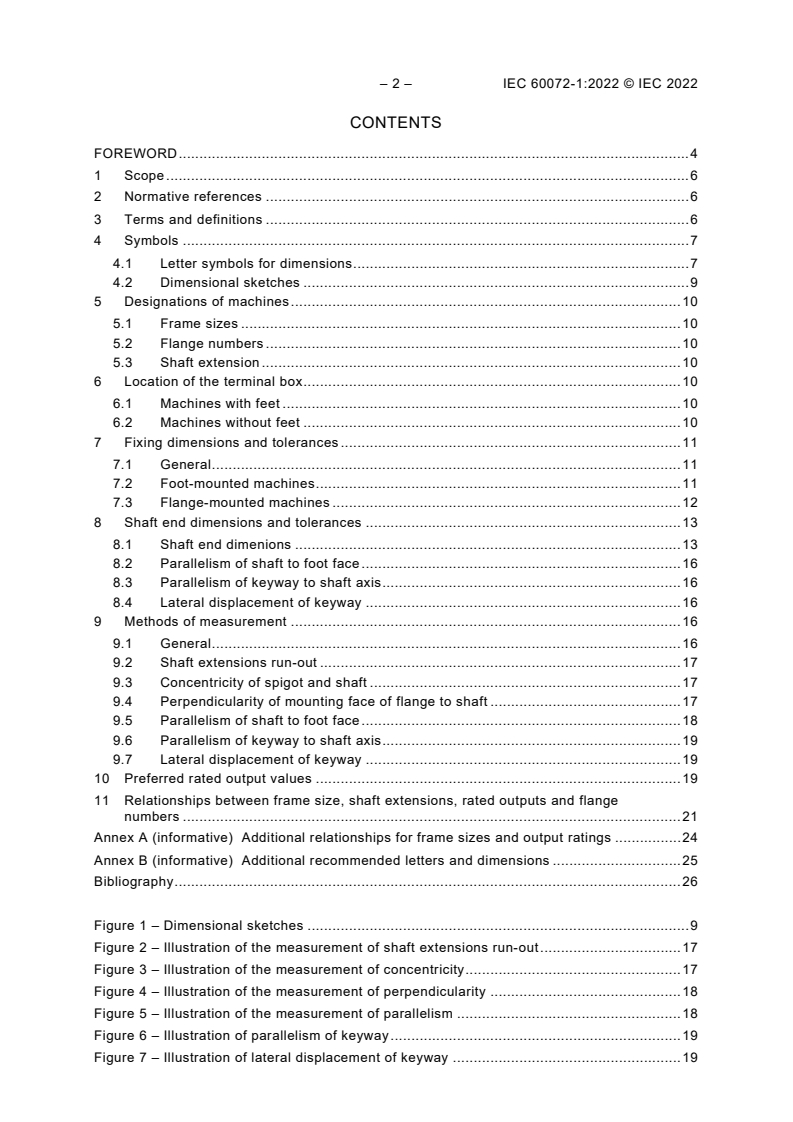
CONTENTS
FOREWORD . 4
1 Scope . 6
2 Normative references . 6
3 Terms and definitions . 6
4 Symbols . 7
4.1 Letter symbols for dimensions . 7
4.2 Dimensional sketches . 9
5 Designations of machines . 10
5.1 Frame sizes . 10
5.2 Flange numbers . 10
5.3 Shaft extension . 10
6 Location of the terminal box . 10
6.1 Machines with feet . 10
6.2 Machines without feet . 10
7 Fixing dimensions and tolerances . 11
7.1 General . 11
7.2 Foot-mounted machines . 11
7.3 Flange-mounted machines . 12
8 Shaft end dimensions and tolerances . 13
8.1 Shaft end dimenions . 13
8.2 Parallelism of shaft to foot face . 16
8.3 Parallelism of keyway to shaft axis . 16
8.4 Lateral displacement of keyway . 16
9 Methods of measurement . 16
9.1 General . 16
9.2 Shaft extensions run-out . 17
9.3 Concentricity of spigot and shaft . 17
9.4 Perpendicularity of mounting face of flange to shaft . 17
9.5 Parallelism of shaft to foot face . 18
9.6 Parallelism of keyway to shaft axis . 19
9.7 Lateral displacement of keyway . 19
10 Preferred rated output values . 19
11 Relationships between frame size, shaft extensions, rated outputs and flange
numbers . 21
Annex A (informative) Additional relationships for frame sizes and output ratings . 24
Annex B (informative) Additional recommended letters and dimensions . 25
Bibliography . 26
Figure 1 – Dimensional sketches . 9
Figure 2 – Illustration of the measurement of shaft extensions run-out . 17
Figure 3 – Illustration of the measurement of concentricity . 17
Figure 4 – Illustration of the measurement of perpendicularity . 18
Figure 5 – Illustration of the measurement of parallelism . 18
Figure 6 – Illustration of parallelism of keyway . 19
Figure 7 – Illustration of lateral displacement of keyway . 19
Table 1 – Dimensions for machines with shaft height from 56 mm to 400 mm . 11
Table 2 – Dimensions and tolerances for flanges with pitch circle diameters from 55
mm to 1 080 mm . 12
Table 3 – Dimensions and tolerances for shaft ends . 14
Table 4 – Tolerance for parallelism shaft to foot face . 16
Table 5 – Tolerance for parallelism of keyway to shaft axis . 16
Table 6 – Preferred rated output values . 20
Table 7 – Totally enclosed fan-cooled induction motors (IC41) with squirrel-cage rotor . 21
Table 8 – Totally enclosed fan cooled induction motors (IC41) with slip ring rotor . 22
Table 9 – Ventilated induction motors (IC01) with squirrel-cage rotor . 23
Table 10 – Ventilated induction motors (IC01) with slip ring rotor . 23
Table A.1 – Relationships between frame size and rated output for 50 Hz increased
safety "eb" . 24
Table B.1 – Additional frame letters and B dimensions in mm . 25
– 4 – IEC 60072-1:2022 © IEC 2022
INTERNATIONAL ELECTROTECHNICAL COMMISSION
____________
ROTATING ELECTRICAL MACHINES –
DIMENSIONS AND OUTPUT SERIES –
Part 1: Frame numbers 56 to 400 and flange
numbers 55 to 1080
FOREWORD
1) The International Electrotechnical Commission (IEC) is a worldwide organization for standardization comprising
all national electrotechnical committees (IEC National Committees). The object of IEC is to promote international
co-operation on all questions concerning standardization in the electrical and electronic fields. To this end and
in addition to other activities, IEC publishes International Standards, Technical Specifications, Technical Reports,
Publicly Available Specifications (PAS) and Guides (hereafter referred to as “IEC Publication(s)”). Their
preparation is entrusted to technical committees; any IEC National Committee interested in the subject dealt with
may participate in this preparatory work. International, governmental and non-governmental organizations liaising
with the IEC also participate in this preparation. IEC collaborates closely with the International Organization for
Standardization (ISO) in accordance with conditions determined by agreement between the two organizations.
2) The formal decisions or agreements of IEC on technical matters express, as nearly as possible, an international
consensus of opinion on the relevant subjects since each technical committee has representation from all
interested IEC National Committees.
3) IEC Publications have the form of recommendations for international use and are accepted by IEC National
Committees in that sense. While all reasonable efforts are made to ensure that the technical content of IEC
Publications is accurate, IEC cannot be held responsible for the way in which they are used or for any
misinterpretation by any end user.
4) In order to promote international uniformity, IEC National Committees undertake to apply IEC Publications
transparently to the maximum extent possible in their national and regional publications. Any divergence between
any IEC Publication and the corresponding national or regional publication shall be clearly indicated in the latter.
5) IEC itself does not provide any attestation of conformity. Independent certification bodies provide conformity
assessment services and, in some areas, access to IEC marks of conformity. IEC is not responsible for any
services carried out by independent certification bodies.
6) All users should ensure that they have the latest edition of this publication.
7) No liability shall attach to IEC or its directors, employees, servants or agents including individual experts and
members of its technical committees and IEC National Committees for any personal injury, property damage or
other damage of any nature whatsoever, whether direct or indirect, or for costs (including legal fees) and
expenses arising out of the publication, use of, or reliance upon, this IEC Publication or any other IEC
Publications.
8) Attention is drawn to the Normative references cited in this publication. Use of the referenced publications is
indispensable for the correct application of this publication.
9) Attention is drawn to the possibility that some of the elements of this IEC Publication may be the subject of patent
rights. IEC shall not be held responsible for identifying any or all such patent rights.
International Standard IEC 60072-1 has been prepared by IEC technical committee 2: Rotating
machinery.
This seventh edition cancels and replaces the sixth edition published in 1991. This edition
constitutes a technical revision.
This edition includes the following significant technical changes with respect to the previous
edition:
a) modification of the series title;
b) complete revision on the basis of EN 50347;
c) integration of the relationships between frame size, shaft extensions, rated outputs and
flange numbers;
d) additional tolerances and measurements for shafts;
e) modification of Annex A with additional frame numbers and relationships between frame
size and rated power.
The text of this International Standard is based on the following documents:
Draft Report on voting
2/2059/CDV 2/2082/RVC
Full information on the voting for its approval can be found in the report on voting indicated in
the above table.
The language used for the development of this International Standard is English.
A list of all parts in the IEC 60072 series, published under the general title Rotating electrical
machines – Dimensions and output series, can be found on the IEC website.
Future documents in this series will carry the new general title as cited above. Titles of existing
documents in this series will be updated at the time of the next edition.
This document was drafted in accordance with ISO/IEC Directives, Part 2, and developed in
accordance with ISO/IEC Directives, Part 1 and ISO/IEC Directives, IEC Supplement, available
at www.iec.ch/members_experts/refdocs. The main document types developed by IEC are
described in greater detail at www.iec.ch/standardsdev/publications.
The committee has decided that the contents of this document will remain unchanged until the
stability date indicated on the IEC website under webstore.iec.ch in the data related to the
specific document. At this date, the document will be
• reconfirmed,
• withdrawn,
• replaced by a revised edition, or
• amended.
– 6 – IEC 60072-1:2022 © IEC 2022
ROTATING ELECTRICAL MACHINES –
DIMENSIONS AND OUTPUT SERIES –
Part 1: Frame numbers 56 to 400 and flange
numbers 55 to 1080
1 Scope
This part of IEC 60072 is applicable for the majority of rotating electrical machines for industrial
purposes within the dimension range and output powers:
Foot- mounted: shaft heights: 56 mm to 400 mm.
Flange- mounted: pitch circle diameter of flange: 55 mm to 1 080 mm.
It specifies the fixing dimensions, shaft extension dimensions and the assignment of output
powers and frame sizes.
2 Normative references
The following documents are referred to in the text in such a way that some or all of their content
constitutes requirements of this document. For dated references, only the edition cited applies.
For undated references, the latest edition of the referenced document (including any
amendments) applies.
IEC 60079-0, Explosive atmospheres – Part 0: Equipment – Generel requirements
ISO 128-3:2020, Technical product documentation (TPD) – General principles of representation
– Part 3: Views, sections and cuts
ISO 273, Fasteners – Clearance holes for bolts and screws
ISO 286 (all parts), Geometrical product specifications (GPS) – ISO code system for tolerances
on linear sizes
ISO 1101, Geometrical product specifications (GPS) – Geometrical tolerancing – Tolerances of
form, orientation, location and run-out
ISO 2768-1, General tolerances – Part 1: Tolerances for linear and angular dimensions without
individual tolerance indications
3 Terms and definitions
No terms and definitions are listed in this document.
ISO and IEC maintain terminology databases for use in standardization at the following
addresses:
• IEC Electropedia: available at http://www.electropedia.org/
• ISO Online browsing platform: available at http://www.iso.org/obp
4 Symbols
4.1 Letter symbols for dimensions
The dimensional sketches in Figure 1 illustrate the symbols defined below. Mandatory
dimensions are marked with *.
*A distance between centre-lines of fixing holes (end view)
AA width of the end of the feet (end view)
AB overall dimension across the feet (end view)
AC maximum width (envelope size) of the machine (e.g. fan cover; excluded are terminal
box and feet)
AC’ maximum height (envelope size) of the machine
AD distance from the centre-line of the machine to extreme outside of the terminal box or
other most salient part mounted on the side of the machine
*B distance between the centre-lines of the fixing holes (side view)
BA length of the feet (drive end side; side view)
BB overall dimension across the feet (side view)
BC distance from the shoulder on the shaft at D-end to the beginning of the foot (side view)
BD length of the feet (non-drive end side; side view)
*C distance from the shoulder on the shaft at D-end to the centre-line of the mounting holes
in the nearest feet
CA distance from the shoulder on the shaft at N-end to the centre-line of the mounting holes
in the nearest feet
*CB rounding fillet at the shoulder on the shaft at D-end
CC rounding fillet at the shoulder on the shaft at N-end
*D diameter of the shaft extension at D-end
DA diameter of the shaft extension at N-end
*DB thread-size in the centre hole at D-end
DC thread-size in the centre hole at N-end
*E length of the shaft extension from the shoulder at D-end
EA length of the shaft extension from the shoulder at N-end
*EB length of the key at D-end
EC length of the key at N-end
*ED distance from the shoulder on the shaft at D-end to the nearest end of the keyway
EE distance from the shoulder on the shaft at N-end to the nearest end of the keyway
*F width of the keyway or key of the shaft extension at D-end
FA width of the keyway or key of the shaft extension at N-end
*FB rounding fillet in the bottom of the keyway at D-end
FC rounding fillet in the bottom of the keyway at N-end
G distance from the bottom of the keyway to the opposite surface of the shaft extension at
D-end
*GA distance from the top of the key to the opposite surface of the shaft extension at D-end
GB distance from the bottom of the keyway to the opposite surface of the shaft extension at
N-end
GC distance from the top of the key to the opposite surface of the shaft extension at N-end
*GD height of the key of the shaft extension at D-end
– 8 – IEC 60072-1:2022 © IEC 2022
*GE depth of the keyway at the crown of the shaft extension at D-end
GF height of the key of the shaft extension at N-end
GH depth of the keyway at the crown of the shaft extension at N-end
*H distance form the centre-line of the shaft to the bottom of the feet (basic dimension)
HA thickness of the feet
HC distance from the top of the horizontal machine to the bottom of the feet
HD distance from the top of the lifting eye, the terminal box or other most salient part
mounted on the top of the machine to the bottom of the feet
*K diameter of the holes or width of the slots (end view) in the feet of the machine
KA in case of long holes: width of the slots (side view) in the feet
L overall length of the machine with a single shaft extension
LA thickness of the flange
LB distance from the mounting surface of the flange to the end of the machine
LC overall length of the machine when there is a shaft extension at N-end
LR distance from the end of the machine to the ring bolt
*M pitch circle diameter of the fixing holes
*N diameter of the spigot
*P outside diameter of the flange, or in the case of a non-circular outline twice the maximum
radial dimension
*R distance from the mounting surface of the flange to the shoulder on the shaft
*S diameter of the fixing holes in the mounting flange or nominal diameter of thread
SR thread diameter of ring bolt
*T depth of the spigot
NOTE The definition of D-end and N-end of a motor is given in IEC 60034-7.
4.2 Dimensional sketches
Key
1) FF - flange with through holes; access to back; FT - flange with thread; no access to back
2) This ISO symbol indicates the projection method used (ISO 128-3:2020)
Figure 1 – Dimensional sketches
– 10 – IEC 60072-1:2022 © IEC 2022
5 Designations of machines
5.1 Frame sizes
Electrical machines may be designated by the frame size. The frame sizes are defined as the
distance from the centre line of the shaft to the bottom of the feet (H dimension). The dimensions
for H and the correlation to the fixing dimensions (A, B, C and K) are given in Table 1.
Recommended letters for frame sizes:
S short length frame size;
M middle length frame size;
L long length frame size.
Additional recommended frame number letters are given in Annex B, Table B.1.
NOTE The frame sizes are also applicable for non feet motors.
5.2 Flange numbers
The flange numbers are defined as the pitch circle diameter M. The dimensions for M and the
correlation to the fixing dimensions (N, P, R, S and T) are given in Table 2. The location of the
holes in the mounting flange are shown in Figure 1.
Recommended letters for flange numbers:
FF flange with through holes;
FT flange with thread.
5.3 Shaft extension
The designation of the shaft is defined with the diameter of the shaft extension D. The
dimensions for D and the correlation to the relevant dimensions (e.g. E, Key) are given in
Table 3.
6 Location of the terminal box
6.1 Machines with feet
The terminal box on a motor should be situated with its centre-line within a sector ranging from
the top to 10° below the horizontal centre-line of the motor on the right hand side, when looking
at the D-end of the motor.
It is recommended that unless the terminal box is on the top, motors be so constructed that the
terminal box may be located on the left-hand side by the manufacturer, if requested by the user
at the time when the motor is ordered.
NOTE Provision is preferably made so as to enable the cable entry to the terminal box to be in any one of the four
directions at right angles.
6.2 Machines without feet
No recommendation.
7 Fixing dimensions and tolerances
7.1 General
Shaft extension, flange numbers, foot dimension and output allocation to frame size are given
in Clause 11, Table 7 through Table 10.
7.2 Foot-mounted machines
A, B, C and K dimensions shall be selected from Table 1.
Table 1 – Dimensions for machines with shaft height from 56 mm to 400 mm
d d d b c
Frame H A B C K Bolt or
a
number screw
Nominal
mm mm mm mm
Nominal Maximum
deviation
mm mm
56M 56 −0,5 90 71 36 5,8 M5
63M 63 −0,5 100 80 40 7 M6
71M 71 −0,5 112 90 45 7 M6
80M 80 −0,5 125 100 50 10 M8
90S 90 −0,5 140 100 56 10 M8
90L 90 −0,5 140 125 56 10 M8
100L 100 −0,5 160 140 63 12 M10
(112S) 112 −0,5 190 114 70 12 M10
112M 112 −0,5 190 140 70 12 M10
(112L) 112 −0,5 190 159 70 12 M10
132S 132 −0,5 216 140 89 12 M10
132M 132 −0,5 216 178 89 12 M10
(132L) 132 −0,5 216 203 89 12 M10
(160S) 160 −0,5 254 178 108 14,5 M12
160M 160 −0,5 254 210 108 14,5 M12
160L 160 −0,5 254 254
108 14,5 M12
(180S) 180 −0,5 279 203 121 14,5 M12
180M 180 −0,5 279 241 121 14,5 M12
180L 180 −0,5 279 279 121 14,5 M12
(200S) 200 −0,5 318 228 133 18,5 M16
200M 200 −0,5 318 267 133 18,5 M16
200L 200 −0,5 318 305 133 18,5 M16
225S 225 −0,5 356 286
149 18,5 M16
225M 225 −0,5 356 311 149 18,5 M16
(225L) 225 −0,5 356 356 149 18,5 M16
250S 250 −0,5 406 311 168 24 M20
250M 250 −0,5 406 349 168 24 M20
(250L) 250 −0,5 406 406 168 24 M20
– 12 – IEC 60072-1:2022 © IEC 2022
d d d b c
Frame H A B C K Bolt or
a
number screw
Nominal
mm mm mm mm
Nominal Maximum
deviation
mm mm
280S 280 −1 457 368 190 24 M20
280M 280 −1 457 419 190 24 M20
(280L) 280 −1 457 457 190 24 M20
315S 315 −1 508 406 216 28 M24
315M 315 −1 508 457 216 28 M24
(315L) 315 −1 508 508 216 28 M24
355S 355 −1 610 500 254 28 M24
355M 355 −1 610 560 254 28 M24
355L 355 −1 610 630 254 28 M24
400S 400 −1 686 560 280 35 M30
400M 400 −1 686 630 280 35 M30
400L 400 −1 686 710 280 35 M30
a
Frame numbers within brackets should be regarded as non preferred for AC induction machines.
b
The nominal K dimensions are selected from the coarse series in ISO 273 and have a tolerance of H17
according to the ISO 286 series. For long holes the tolerance applies to the width of the slot. Open-ended slots
are not recommended.
c
Recommended bolt or screw for fixing the motor-feet to the basement.
d
The tolerance of this dimension is taken from the coarse series in ISO 2768-1.
7.3 Flange-mounted machines
Machines having both feet and flange shall have A, B and C dimensions selected from Table 1.
Table 2 – Dimensions and tolerances for flanges with pitch
circle diameters from 55 mm to 1 080 mm
e
Flange Pitch Diameter of Outside Distance Number S Distance Concentricity
number circle the spigot diameter of holes and
d
R Free Tapped T
diameter perpendi-
a
(FF/FT) N P
holes holes
cularity
a
M
b c
(FF) (FT)
- mm mm ISO mm max. mm - mm - mm max. µm max.
Tol.
55 55 40 j6 70 0 4 5,8 M5 2,5 80
65 65 50 j6 80 0 4 5,8 M5 2,5 80
75 75 60 j6 90 0 4 5,8 M5 2,5 80
85 85 70 j6 105 0 4 7 M6 2,5
100 100 80 j6 120 0 4 7 M6 3 80
115 115 95 j6 140 0 4 10 M8 3 80
130 110 j6 160 0 4 10 M8 3,5 100
165 165 130 j6 200 0 4 12 M10 3,5 100
215 215 180 j6 250 0 4 14,5 M12 4 100
e
Flange Pitch Diameter of Outside Distance Number S Distance Concentricity
number circle the spigot diameter of holes and
d
R Free Tapped T
diameter perpendi-
a
(FF/FT) N P
holes holes
cularity
a
M
b c
(FF) (FT)
- mm mm ISO mm max. mm - mm - mm max. µm max.
Tol.
265 265 230 j6 300 0 4 14,5 M12 4 100
300 300 250 j6 350 0 4 18,5 M16 5 125
350 350 300 h6 400 0 4 18,5 M16 5 125
400 400 350 h6 450 0 8 18,5 M16 5 125
500 500 450 h6 550 0 8 18,5 M16 5 125
600 600 550 h6 660 0 8 24 M20 6 160
740 740 680 h6 800 0 8 24 M20 6 160
940 940 880 h6 1 000 0 8 28 M24 6 200
1 080 1 080 1 000 h6 1 150 0 8 28 M24 6 200
a
By agreement the external outline of mounting flanges may be other than circular. Dimension P may deviate
from that given in the table only on the minus side.
b
The nominal free hole dimensions are selected from the coarse series in ISO 273 and have a tolerance of H17
according to the ISO 286 series.
c
For FT flange-mounted machines, it is recommended that the free holes in the mounting part should be as shown
for the corresponding size of the FF flange.
d
The corner radius between the spigot and flange face shall not exceed 0,8 mm.
e
Concentricity (defined in ISO 1101) of spigot to shaft and perpendicularity of flange-face to shaft. The values
are the maximum permissible change in the indicator reading, measured according to the methods in 9.3 and
9.4. By agreement values may be reduced to 50 % of the specified dimensions.
NOTE More dimensions are shown for larger sizes in IEC 60072-2 and for smaller built-in motors in IEC 60072-3.
8 Shaft end dimensions and tolerances
8.1 Shaft end dimenions
Table 3 shows the relevant dimensions for shafts, keys and keyways.
– 14 – IEC 60072-1:2022 © IEC 2022
Table 3 – Dimensions and tolerances for shaft ends
a b c h h f g
Diameter Length Run-out Radius Thread of Key Keyway GA Distance
CB (CC) centre DB ED (EE)
d
D / (DA) E (EA) Length Width Height Width Depth Radius (GC)
(DC)
EB (EC) F (FA) GD (GF) F (FA) GE (GH) FB (FC)
mm ISO T mm µm mm max. mm min. mm mm ISO mm mm Tol. mm mm mm mm
ol. max. min.
e
ISO Tol. h9 Tol ISO Tol. N9 µm
7 j6 16 30 0,4 M3 12 2 2 h9 2 1,2 +100 0,16 0,08 7,8 2
9 j6 20 30 0,4 M3 14 3 3 h9 3 1,8 +100 0,16 0,08 10,2 3
11 j6 23 35 0,6 M4 16 4 4 h9 4 2,5 +100 0,16 0,08 12,5 3,5
14 j6 30 35 0,6 M5 22 5 5 h9 5 3 +100 0,25 0,16 16 4
19 j6 40 40 0,6 M6 32 6 6 h9 6 3,5 +100 0,25 0,16
21,5 4
24 j6 50 40 0,6 M8 40 8 7 h11 8 4 +200 0,25 0,16 27 5
28 j6 60 40 1,0 M10 50 8 7 h11 8 4 +200 0,25 0,16 31 5
38 k6 80 50 1,0
M12 70 10 8 h11 10 5 +200 0,4 0,25 41 5
42 k6 110 50 1,0 M16 90 12 8 h11 12 5 +200 0,4 0,25 45 10
48 k6 110 50 1,0 M16 100 14 9 h11
14 5,5 +200 0,4 0,25 51,5 5
55 m6 110 60 1,6 M20 100 16 10 h11 16 6 +200 0,4 0,25 59 5
60 m6 140 60 1,6 M20 125 18 11 h11 18 7 +200 0,4 0,25 64 7,5
m6 140 60 1,6 M20 125 18 11 h11 18 7 +200 0,4 0,25 69 7,5
70 m6 140 60 1,6 M20 125 20 12 h11 20 7,5 +200 0,6 0,4 74,5 7,5
75 m6 140 60 1,6 M20 125 20 12 h11 20 7,5 +200 0,6 0,4 79,5 7,5
80 m6 170 60 1,6 M20 140 22 14 h11 22 9 +200 0,6 0,4 85 15
90 m6 170 70 2,5 M24 140 25 14 h11 25 9 +200 0,6 0,4 95 15
95 m6 170 70 2,5 M24 140 25 14 h11 25 9 +200 0,8 0,6 100 15
100 m6 210 70 2,5 M24 180 28 16 h11 28 10 +200 0,8 0,6 106 15
110 m6 210 70 2,5 M24 180 28 16 h11 28 10 +200 0,8 0,6 116 15
120 m6 210 70 2,5 M24 180 32 18 h11 32 11 +200 0,8 0,6 127 15
a b c h h f g
Diameter Length Run-out Radius Thread of Key Keyway GA Distance
CB (CC) centre DB ED (EE)
d
D / (DA) E (EA) (GC)
Length Width Height Width Depth Radius
(DC)
EB (EC) F (FA) GD (GF) F (FA) GE (GH) FB (FC)
mm ISO T mm µm mm max. mm min. mm mm ISO mm mm Tol. mm mm mm mm
ol. max. min.
e
ISO Tol. h9 Tol ISO Tol. N9 µm
125 m6 210 80 2,5 M24 180 32 18 h11 32 11 +200 0,8 0,6 132 15
130 m6 250 80 4 M24 200 32 18 h11 32 11 +200 0,8 0,6 137 25
140 m6 250 80 4 M30 200 36 20 h11 36 12 +300 1,2 1 148 25
150 m6 250 80 4 M30 200 36 20 h11 36 12 +300 1,2 1 158 25
a
For diameters up to 25 mm, a shoulder of 0,5 mm is considered sufficient. In these cases the radius CB should not exceed the radial step at the shaft shoulder.
b
The shaft length dimension is subject to a tolerance of −0,5 mm on all sizes.
c
The values for shaft extension run-out (defined in ISO 1101) are the maximum permissible change in the indicator reading, measured according to the method in 9.2. By agreement,
values may be reduced to 50 % of the specified dimensions.
d
EB is for a key with round ends in a closed keyway; a plain ended key for an open ended keyway is permissible with a length not less than EB-F.
e
The keyway tolerance N9 applies for normal keys, P9 is applicable for fitted keys by agreement.
f
Tolerances for GA can be calculated from values of the other dimensions given in Table 3.
g
It is preferable for the key to be symmetric to the shaft length.
h
Other key and keyway dimensions may be used by agreement.
– 16 – IEC 60072-1:2022 © IEC 2022
8.2 Parallelism of shaft to foot face
The H dimension and the tolerance at drive-end (E) are defined in Table 1. If both ends are
nd
accessible (e.g. 2 shaft end) an additional, independent parallelism tolerance requirement is
defined. This parallelism tolerance is calculated proportionally for the total shaft length and
shown in Table 4.
Table 4 – Tolerance for parallelism shaft to foot face
Limits of variation between measurements
of H taken at extreme ends of shaft
mm
H nominal
mm Shaft length L / LC
mm
< 2,5 H ≥ 2,5 H ≤ 4 H > 4 H
≥ 56 up to 250 0,5 0,8 1
> 250 up to 400 1 1,5 2
NOTE 1 The tolerance is valid over the full length of the shaft, including extensions.
NOTE 2 The method of measurement is shown in 9.5.
8.3 Parallelism of keyway to shaft axis
The tolerance for parallelism shall be in accordance with Table 5. It is defined as the limit
variation between the keyway median longitudinal plane and the theoretical keyway median
longitudinal plane which contains the shaft axis. The distance between those two planes, taken
at each end of the usable length of the keyway, shall lie within the limit values in Table 5.
Table 5 – Tolerance for parallelism of keyway to shaft axis
EB (EC) nominal
Limit of deviation from theoretical
position at extreme ends of EB (EC)
mm
mm
≤ 100 ≤ 0,05
> 100 ≤ 0,000 5 × EB (EC)
An illustration of the measurement required is shown in Figure 6.
8.4 Lateral displacement of keyway
The tolerance for lateral displacement is 0,1 mm. It is defined as the greatest deviation at any
point along the usable length of the keyway. This deviation is the distance from the centre-line
of the keyway to the plane through the centre-line of the shaft extension perpendicular to the
true position of the bottom of the keyway.
An illustration of the measurement required is shown in Figure 7.
9 Methods of measurement
9.1 General
The definition of the geometrical tolerances is given in ISO 1101.
9.2 Shaft extensions run-out
Apply the point of the indicator to the shaft, midway along its length. Read the maximum and
minimum values on the indicator through one slow revolution of the shaft. The difference
between the readings shall not exceed the value given in Table 3.
The test may be carried out with the motor set up in either a horizontal or vertical position and
with the indicator fixed directly to it or mounted on a common surface plate supporting both
motor and indicator. See Figure 2.
Figure 2 – Illustration of the measurement of shaft extensions run-out
9.3 Concentricity of spigot and shaft
Fix the indicator rigidly on the shaft extension, by means of a device similar to that shown in
Figure 3, at a distance of about 10 mm from the mounting face of the flange. Read the maximum
and minimum values on the indicator through one slow revolution of the shaft. The difference
between the extreme readings of the concentricity test indicator shall not exceed the values
given in Table 2.
It is recommended that the test be carried out on the machine set up with its shaft vertical so
as to make the measurement free from the effect of gravity.
Dimensions in millimetres
Figure 3 – Illustration of the measurement of concentricity
9.4 Perpendicularity of mounting face of flange to shaft
Fix the indicator rigidly on the shaft extension, by means of a device similar to that shown in
Figure 4, at a distance of about 10 mm from the mounting face of the flange. Read the maximum
and minimum values on the indicator through one slow revolution of the shaft.
– 18 – IEC 60072-1:2022 © IEC 2022
The difference between the extreme readings of the perpendicularity indicator shall not exceed
the values given in Table 2.
It is recommended that the test be carried out on the machine set up with its shaft vertical so
as to eliminate the axial clearance in the bearing.
Dimensions in millimetres
Figure 4 – Illustration of the measurement of perpendicularity
9.5 Parallelism of shaft to foot face
The measurement points for H may be over the shaft extension length (E) and the dimensions
shall be in the tolerances given in Table 1.
If the shaft-end at the non drive-end is accessable, the parallelism tolerance from 8.2 is valid.
The deviation of any measurements of the dimension H (drive-end and non drive-end) shall be
according to the defined tolerances from Table 4. See Figure 5.
Key
* Limits of variation between measurements of H taken at extreme ends of shaft (mm) from Table 4.
Figure 5 – Illustration of the measurement of parallelism
9.6 Parallelism of keyway to shaft axis
See Figure 6.
Key
* Deviation from theoretical position
** Keyway median longitudinal plane
*** Shaft axis and theoretical keyway median longitudinal plane
Figure 6 – Illustration of parallelism of keyway
9.7 Lateral displacement of keyway
See Figure 7.
Key
* Lateral displacement
** Centre-line of keyway
*** Shaft centre-line plane
Figure 7 – Illustration of lateral displacement of keyway
10 Preferred rated output values
See Table 6.
– 20 – IEC 60072-1:2022 © IEC 2022
Table 6 – Preferred rated output values
kW (kVA)
Primary series Secondary series
0,06
0,09
0,12
0,18
0,25
0,37
0,55
0,75
1,1
1,5 1,8
2,2
3 3,7
5,5 6,3
7,5 9,2
11 13
15 17
18,5
22 20
30 32
37 40
45 50
55 63
75 80
90 100
110 125
132 150
160 185
200 220
250 300
280 335
355 375
400 425
450 475
500 530
560 600
630 670
710 750
800 850
900 950
1 000
11 Relationships between frame size, shaft extensions, rated outputs and
flange numbers
The preferred relationship for IEC frame size and output power, flange and shaft dimensions
for induction motors are shown in Table 7 through Table 10.
For motors with feet, columns A, B and C apply. For motors with flange, columns B, C and D
apply. For motors with flange and feet, all the columns (A, B, C and D) apply.
NOTE 1 Alternative executions can be agreed between manufacturer and customer.
NOTE 2 Other motor types or options are shown in Annex A, Table A.1.
Where a second shaft extension and/or flange is required, their dimensions shall be subject to
agreement between the manufacturer and the customer.
Table 7 – Totally enclosed fan-cooled induction
motors (IC41) with squirrel-cage rotor
Standard output
A B C D
Shaft extension Rated output Flange number
diameter
Frame
2 4, 6, 8 2 4 6 8 Free Tapped
size
poles poles poles poles poles poles holes holes
mm mm kW kW kW kW (FF) (FT)
56M 9 9 0,09 or 0,12 0,06 or 0,09 F100 F65
63M 11 11 0,18 or 0,25 0,12 or 0,18 F115 F75
71M 14 14 0,37 or 0,55 0,25 or 0,37 F130 F85
80M 19 19 0,75 or 1,1 0,55 or 0,75 0,37 or 0,55 F165 F100
90S 1,5 1,1 0,75 0,37
24 24 F165 F115
90L 2,2 1,5 1,1 0,55
100L 28 28 3 2,2 or 3 1,5 0,75 or 1,1 F215 F130
112M 28 28 4 4 2,2 1,5 F215 F130
132S 38 5,5 or 7,5 5,5 3 2,2
38 F265 F165
132M 38 - 7,5 4 or 5,5 3
160M 42 11 or 15 11 7,5 4 or 5,5
42 F300 F215
160L 42 18,5 15 11 7,5
180M 48 22 18,5 - -
48 F300
180L 48 - 22 15 11
200L 55 55 30 or 37 30 18,5 or 22 15 F350
225S 60 - 37 18,5
55 30 F400
225M 60 45 45 22
250M 60 65 55 55 37 30 F500
280S 75 75 75 45 37
65 F500
280M 75 90 90 55 45
315S 80 110 110 75 55
315M 65 80 132 132 90 75 F600
315L 90 160 or 200 160 or 200 110, 132, 160 90, 110, 132
– 22 – IEC 60072-1:2022 © IEC 2022
Standard output
A B C D
Shaft extension Rated output Flange number
diameter
Frame
2 4, 6, 8 2 4 6 8 Free Tapped
size
poles poles poles poles poles poles holes holes
mm mm kW kW kW kW (FF) (FT)
100 250 or 315
355 110 400 or 450 F740
120 500
130 560 or 630
400 F940
140 710
NOTE 3 Table 7 is also valid for flameproof motors according to IEC 60079-1.
NOTE 4 On high efficiency classes the preferred frame size may not be possible.
NOTE 5 Alternative assignments are common in certain regions (e.g. Nema).
Table 8 – Totally enclosed fan cooled induction motors (IC41) with slip ring rotor
Standard output
A B C D
Rated ouput Flange number
Shaft extension 4 6 8 Free Tapped
Frame size diameter Poles Poles Poles Holes holes
mm kW kW kW FF FT
160M 7,5 5,5 4,0
42 F300 F215
160L 11 7,5 5,5
180L 48 15 11 7,5 F300
200L 55 18,5 or 22 15 11 F350
225M 60 30 18,5 or 22 15 or 18,5 F400
250M 65 37 or 45 30 22 F500
280S 55 37 30
75 F500
280M 75 45 37
315S 90
...