

IEC 60876-1:2012
(Main)Fibre optic interconnecting devices and passive components - Fibre optic spatial switches - Part 1: Generic specification
General Information
- Abstract
IEC 60876-1:2012 applies to fibre optic switches possessing all of the following general features:
- they are passive in that they contain no optoelectronic or other transducing elements;
- they have one or more ports for the transmission of optical power and two or more states in which power may be routed or blocked between these ports;
- the ports are optical fibres or fibre optic connectors. This fourth edition cancels and replaces the third edition published in 2001. It constitutes a technical revision. The changes with respect to the previous edition are to remove quality assessment procedures and to reconsider definitions. Key words: fibre optic switches
- Status
- Published
- Publication Date
- 12-Jul-2012
- Technical Committee
- SC 86B - Fibre optic interconnecting devices and passive components
- Drafting Committee
- WG 7 - TC 86/SC 86B/WG 7
- Current Stage
- DELPUB - Deleted Publication
- Start Date
- 22-Aug-2014
- Completion Date
- 28-Aug-2026
Buy Documents

IEC 60876-1:2012 - Fibre optic interconnecting devices and passive components - Fibre optic spatial switches - Part 1: Generic specification Released:7/13/2012



IEC 60876-1:2012 - Fibre optic interconnecting devices and passive components - Fibre optic spatial switches - Part 1: Generic specification Released:7/13/2012
Overview
IEC 60876-1:2012 - Edition 4.0 - is the international generic specification for passive fibre optic spatial switches. It applies to switches that:
- are passive (contain no optoelectronic or other transducing elements),
- provide one or more optical ports and two or more states in which optical power can be routed or blocked, and
- have ports that are optical fibres or fibre‑optic connectors.
This fourth edition (2012) cancels and replaces the 2001 edition; key editorial changes include the removal of quality assessment procedures and a re‑consideration of definitions.
Key topics and technical requirements
IEC 60876-1 establishes a generic framework covering:
- Classification: device type, style, variant, assessment levels and normative reference extensions; transfer matrices and port mapping are used to describe routing behavior.
- Terminology and definitions specific to fibre optic spatial switches, referenced to IEC vocabularies.
- Documentation and specification system: required drawings, symbols, test and measurement descriptions, and test reports.
- Design and construction guidance: materials, workmanship, identification and marking of components and packages.
- Performance parameters and measurement procedures (referencing IEC 61300 series for test methods).
- Packaging, storage and safety requirements appropriate for passive fibre devices.
- Conformance and interlinking with related interface, performance and reliability standards.
Annex A provides informative examples of switch technologies and typical switching behaviours (examples illustrated include mechanical, MEMS and other passive switch types).
Practical applications and who uses this standard
IEC 60876-1 is intended for:
- Manufacturers of passive fibre optic switches for standardized product specification, drawings, and marking.
- Test laboratories and quality engineers using the standard’s definitions and test/reporting conventions.
- System integrators and network designers specifying passive switching components for telecom, datacom and sensor networks.
- Procurement and compliance teams requiring a consistent, international reference for tendering and conformity.
Typical applications include optical network reconfiguration, data center fiber management, test & measurement setups, and passive switching in sensing and instrumentation where optoelectronic switching is not required.
Related standards (selected)
- IEC 61300 (Basic test and measurement procedures for fibre optic interconnecting devices)
- IEC 60825-1 (Safety of laser products)
- IEC 60050 / Electropedia (Terminology)
- IEC 62047-1 (MEMS glossary/definitions)
- ISO standards for drawing and dimensional tolerances (ISO 129‑1, ISO 286‑1, ISO 1101)
Keywords: IEC 60876-1:2012, fibre optic spatial switches, fibre optic switches, passive fibre optic switches, optical fibre connectors, switch classification, fibre optic standards.
Relations
- Effective Date
- 05-Sep-2023
- Effective Date
- 05-Sep-2023
Buy Documents
IEC 60876-1:2012 - Fibre optic interconnecting devices and passive components - Fibre optic spatial switches - Part 1: Generic specification Released:7/13/2012
IEC 60876-1:2012 - Fibre optic interconnecting devices and passive components - Fibre optic spatial switches - Part 1: Generic specification Released:7/13/2012
Get Certified
Connect with accredited certification bodies for this standard

ANCE
Mexican certification and testing association.

Intertek Slovenia
Intertek testing, inspection, and certification services in Slovenia.

LNE (Laboratoire National de Métrologie et d'Essais)
French national laboratory for metrology and testing.
Sponsored listings
Frequently Asked Questions
IEC 60876-1:2012 is a standard published by the International Electrotechnical Commission (IEC). Its full title is "Fibre optic interconnecting devices and passive components - Fibre optic spatial switches - Part 1: Generic specification". This standard covers: IEC 60876-1:2012 applies to fibre optic switches possessing all of the following general features: - they are passive in that they contain no optoelectronic or other transducing elements; - they have one or more ports for the transmission of optical power and two or more states in which power may be routed or blocked between these ports; - the ports are optical fibres or fibre optic connectors. This fourth edition cancels and replaces the third edition published in 2001. It constitutes a technical revision. The changes with respect to the previous edition are to remove quality assessment procedures and to reconsider definitions. Key words: fibre optic switches
IEC 60876-1:2012 applies to fibre optic switches possessing all of the following general features: - they are passive in that they contain no optoelectronic or other transducing elements; - they have one or more ports for the transmission of optical power and two or more states in which power may be routed or blocked between these ports; - the ports are optical fibres or fibre optic connectors. This fourth edition cancels and replaces the third edition published in 2001. It constitutes a technical revision. The changes with respect to the previous edition are to remove quality assessment procedures and to reconsider definitions. Key words: fibre optic switches
IEC 60876-1:2012 is classified under the following ICS (International Classification for Standards) categories: 33.180.20 - Fibre optic interconnecting devices. The ICS classification helps identify the subject area and facilitates finding related standards.
IEC 60876-1:2012 has the following relationships with other standards: It is inter standard links to IEC 60876-1:2001, IEC 60876-1:2014. Understanding these relationships helps ensure you are using the most current and applicable version of the standard.
IEC 60876-1:2012 is available in PDF format for immediate download after purchase. The document can be added to your cart and obtained through the secure checkout process. Digital delivery ensures instant access to the complete standard document.
Standards Content (Sample)
IEC 60876-1 ®
Edition 4.0 2012-07
INTERNATIONAL
STANDARD
colour
inside
Fibre optic interconnecting devices and passive components – Fibre optic
spatial switches –
Part 1: Generic specification
All rights reserved. Unless otherwise specified, no part of this publication may be reproduced or utilized in any form
or by any means, electronic or mechanical, including photocopying and microfilm, without permission in writing from
either IEC or IEC's member National Committee in the country of the requester.
If you have any questions about IEC copyright or have an enquiry about obtaining additional rights to this publication,
please contact the address below or your local IEC member National Committee for further information.
IEC Central Office Tel.: +41 22 919 02 11
3, rue de Varembé Fax: +41 22 919 03 00
CH-1211 Geneva 20 info@iec.ch
Switzerland www.iec.ch
About the IEC
The International Electrotechnical Commission (IEC) is the leading global organization that prepares and publishes
International Standards for all electrical, electronic and related technologies.
About IEC publications
The technical content of IEC publications is kept under constant review by the IEC. Please make sure that you have the
latest edition, a corrigenda or an amendment might have been published.
Useful links:
IEC publications search - www.iec.ch/searchpub Electropedia - www.electropedia.org
The advanced search enables you to find IEC publications The world's leading online dictionary of electronic and
by a variety of criteria (reference number, text, technical electrical terms containing more than 30 000 terms and
committee,…). definitions in English and French, with equivalent terms in
It also gives information on projects, replaced and additional languages. Also known as the International
withdrawn publications. Electrotechnical Vocabulary (IEV) on-line.
IEC Just Published - webstore.iec.ch/justpublished Customer Service Centre - webstore.iec.ch/csc
Stay up to date on all new IEC publications. Just Published If you wish to give us your feedback on this publication
details all new publications released. Available on-line and or need further assistance, please contact the
also once a month by email. Customer Service Centre: csc@iec.ch.
IEC 60876-1 ®
Edition 4.0 2012-07
INTERNATIONAL
STANDARD
colour
inside
Fibre optic interconnecting devices and passive components – Fibre optic
spatial switches –
Part 1: Generic specification
INTERNATIONAL
ELECTROTECHNICAL
COMMISSION
PRICE CODE
V
ICS 33.180.20 ISBN 978-2-83220-213-5
– 2 – 60876-1 IEC:2012(E)
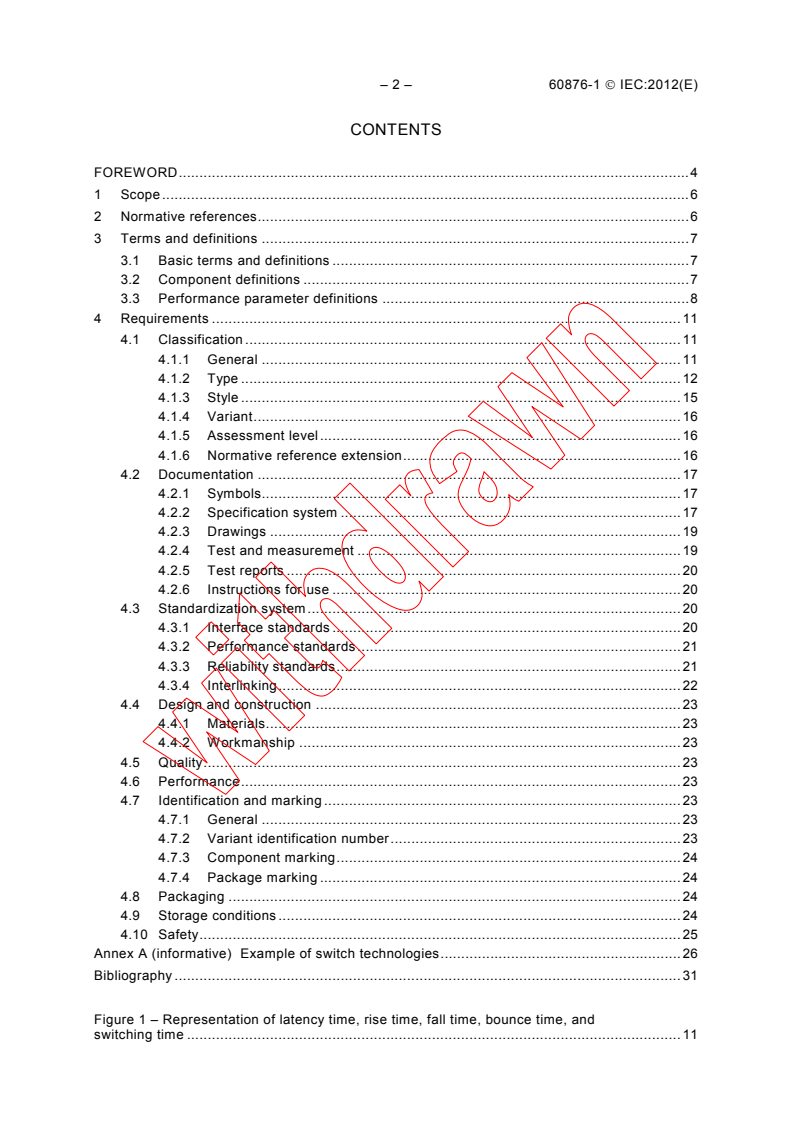
CONTENTS
FOREWORD . 4
1 Scope . 6
2 Normative references . 6
3 Terms and definitions . 7
3.1 Basic terms and definitions . 7
3.2 Component definitions . 7
3.3 Performance parameter definitions . 8
4 Requirements . 11
4.1 Classification . 11
4.1.1 General . 11
4.1.2 Type . 12
4.1.3 Style . 15
4.1.4 Variant . 16
4.1.5 Assessment level . 16
4.1.6 Normative reference extension . 16
4.2 Documentation . 17
4.2.1 Symbols . 17
4.2.2 Specification system . 17
4.2.3 Drawings . 19
4.2.4 Test and measurement . 19
4.2.5 Test reports . 20
4.2.6 Instructions for use . 20
4.3 Standardization system . 20
4.3.1 Interface standards . 20
4.3.2 Performance standards . 21
4.3.3 Reliability standards . 21
4.3.4 Interlinking . 22
4.4 Design and construction . 23
4.4.1 Materials . 23
4.4.2 Workmanship . 23
4.5 Quality . 23
4.6 Performance . 23
4.7 Identification and marking . 23
4.7.1 General . 23
4.7.2 Variant identification number . 23
4.7.3 Component marking . 24
4.7.4 Package marking . 24
4.8 Packaging . 24
4.9 Storage conditions . 24
4.10 Safety . 25
Annex A (informative) Example of switch technologies . 26
Bibliography . 31
Figure 1 – Representation of latency time, rise time, fall time, bounce time, and
switching time . 11
60876-1 IEC:2012(E) – 3 –
Figure 2 – Single-pole, single-throw switch . 13
Figure 3 – Transfer matrix for one input port and one output port . 13
Figure 4 – Single-pole, throw switch . 13
Figure 5 – Transfer matrix for one input port and N output ports . 13
Figure 6 – N-port matrix switch . 14
Figure 7 – Transfer matrix for N-ports switch . 14
Figure 8 – Four-port switch without crossover . 14
Figure 9 – Four-port switch with crossover . 15
Figure 10 – Configuration A, a device containing integral fibre optic pigtails without
connectors . 15
Figure 11 – Configuration B, a device containing integral fibre optic pigtails, with a
connector on each pigtail. 15
Figure 12 – Configuration C, a device containing a fibre optic connector as an integral
part of the device housing . 16
Figure 13 – Standards . 22
Figure A.1 – Example of 1×2 MO switch . 26
Figure A.2 – Example of mechanical switch (mirror driving type) . 27
Figure A.3 – Example of mechanical switch (fibre driving type) . 28
Figure A.4 – Example of MEMS switch . 28
Figure A.5 – Example of TO switch . 29
Figure A.6 – Output power of TO switch . 29
Figure A.7 – Example of switching response of TO switch. 30
Figure A.8 – 1×N and N×N examples of TO switch . 30
Table 1 – Example of a typical switch classification . 12
Table 2 – Transfer matrix of a four-port switch without crossover . 14
Table 3 – Transfer matrix of a four-port switch with crossover . 15
Table 4 – The IEC specification structure . 18
Table 5 – Standards interlink matrix . 23
– 4 – 60876-1 IEC:2012(E)
INTERNATIONAL ELECTROTECHNICAL COMMISSION
____________
FIBRE OPTIC INTERCONNECTING DEVICES
AND PASSIVE COMPONENTS –
FIBRE OPTIC SPATIAL SWITCHES –
Part 1: Generic specification
FOREWORD
1) The International Electrotechnical Commission (IEC) is a worldwide organization for standardization comprising
all national electrotechnical committees (IEC National Committees). The object of IEC is to promote
international co-operation on all questions concerning standardization in the electrical and electronic fields. To
this end and in addition to other activities, IEC publishes International Standards, Technical Specifications,
Technical Reports, Publicly Available Specifications (PAS) and Guides (hereafter referred to as “IEC
Publication(s)”). Their preparation is entrusted to technical committees; any IEC National Committee interested
in the subject dealt with may participate in this preparatory work. International, governmental and non-
governmental organizations liaising with the IEC also participate in this preparation. IEC collaborates closely
with the International Organization for Standardization (ISO) in accordance with conditions determined by
agreement between the two organizations.
2) The formal decisions or agreements of IEC on technical matters express, as nearly as possible, an international
consensus of opinion on the relevant subjects since each technical committee has representation from all
interested IEC National Committees.
3) IEC Publications have the form of recommendations for international use and are accepted by IEC National
Committees in that sense. While all reasonable efforts are made to ensure that the technical content of IEC
Publications is accurate, IEC cannot be held responsible for the way in which they are used or for any
misinterpretation by any end user.
4) In order to promote international uniformity, IEC National Committees undertake to apply IEC Publications
transparently to the maximum extent possible in their national and regional publications. Any divergence
between any IEC Publication and the corresponding national or regional publication shall be clearly indicated in
the latter.
5) IEC itself does not provide any attestation of conformity. Independent certification bodies provide conformity
assessment services and, in some areas, access to IEC marks of conformity. IEC is not responsible for any
services carried out by independent certification bodies.
6) All users should ensure that they have the latest edition of this publication.
7) No liability shall attach to IEC or its directors, employees, servants or agents including individual experts and
members of its technical committees and IEC National Committees for any personal injury, property damage or
other damage of any nature whatsoever, whether direct or indirect, or for costs (including legal fees) and
expenses arising out of the publication, use of, or reliance upon, this IEC Publication or any other IEC
Publications.
8) Attention is drawn to the Normative references cited in this publication. Use of the referenced publications is
indispensable for the correct application of this publication.
9) Attention is drawn to the possibility that some of the elements of this IEC Publication may be the subject of
patent rights. IEC shall not be held responsible for identifying any or all such patent rights.
International Standard IEC 60876-1 has been prepared by subcommittee SC86B: Fibre optic
interconnecting devices and passive components, of IEC technical committee 86: Fibre optics.
This fourth edition cancels and replaces the third edition published in 2001. It constitutes a
technical revision. The changes with respect to the previous edition are to remove quality
assessment procedures and to reconsider definitions.
60876-1 IEC:2012(E) – 5 –
The text of this standard is based on the following documents:
CDV Report on voting
86B/3276/CDV 86B/3339/RVC
Full information on the voting for the approval of this standard can be found in the report on
voting indicated in the above table.
This publication has been drafted in accordance with the ISO/IEC Directives, Part 2.
A list of all the parts in the IEC 60876 series, published under the general title Fibre optic
interconnecting devices and passive components-Fibre optic spatial switches can be found on
the IEC website.
Future standards in this series will carry the new general title as cited above. Titles of existing
standards in this series will be updated at the time of the next edition.
The committee has decided that the contents of this publication will remain unchanged until the
stability date indicated on the IEC web site under "http://webstore.iec.ch" in the data related to
the specific publication. At this date, the publication will be
• reconfirmed,
• withdrawn,
• replaced by a revised edition, or
• amended.
A bilingual version of this publication may be issued at a later date.
IMPORTANT – The 'colour inside' logo on the cover page of this publication
indicates that it contains colours which are considered to be useful for the correct
understanding of its contents. Users should therefore print this document using a
colour printer.
– 6 – 60876-1 IEC:2012(E)
FIBRE OPTIC INTERCONNECTING DEVICES
AND PASSIVE COMPONENTS –
FIBRE OPTIC SPATIAL SWITCHES –
Part 1: Generic specification
1 Scope
This part of IEC 60876 applies to fibre optic switches possessing all of the following general
features:
– they are passive in that they contain no optoelectronic or other transducing elements;
– they have one or more ports for the transmission of optical power and two or more states in
which power may be routed or blocked between these ports;
– the ports are optical fibres or fibre optic connectors.
2 Normative references
The following documents, in whole or in part, are normatively referenced in this document and
are indispensable for its application. For dated references, only the edition cited applies. For
undated references, the latest edition of the referenced document (including any amendments)
applies.
IEC 60027 (all parts), Letter symbols to be used in electrical technology
IEC 60050 (all parts), International Electrotechnical Vocabulary (available at
)
IEC 60617 (all parts), Graphical symbols for diagrams (available at )
IEC 60695-11-5, Fire hazard testing – Part 11-5: Test flames – Needle-flame test method –
Apparatus, confirmatory test arrangement and guidance
IEC 60825-1, Safety of laser products – Part 1: Equipment classification and requirements
IEC 61300 (all parts), Fibre optic interconnecting devices and passive components – Basic test
and measurement procedures
IEC/TR 61930, Fibre optic graphical symbology
IEC 62047-1, Semiconductor devices – Micro-electromechanical devices – Part 1: Terms and
definitions
ISO 129-1, Technical drawings – Indication of dimensions and tolerances – Part 1: General
principles
ISO 286-1, Geometrical product specification (GPS) – ISO code system for tolerances on linear
sizes – Part 1: Basis of tolerances, deviations and fits
ISO 1101, Geometrical Product Specifications (GPS) – Geometrical tolerancing – Tolerances of
form, orientation, location and run-out
60876-1 IEC:2012(E) – 7 –
ISO 8601, Data elements and interchange formats – Information interchange – Representation
of dates and times
3 Terms and definitions
For the purposes of this part of IEC 60876, the definitions given in IEC 60050-731 apply,
together with the following definitions.
3.1 Basic terms and definitions
3.1.1
port
optical fibre or fibre optic connector attached to a passive component for the entry and/or exit
of optical power
3.1.2
transfer matrix
optical properties of a fibre optic switch can be defined in a n × n matrix of coefficients (n is the
number of ports)
Note 1 to entry: The T matrix represents the on-state paths (worst-case transmission) and the T° matrix represents
the off-state paths (worst-case isolation).
3.1.3
transfer coefficient
element t or t° of the transfer matrix
ij ij
Note 1 to entry: Each transfer coefficient t is the worst-case (minimum) fraction of power transferred from port i to
ij
port j for any state with path ij switched on. Each coefficient t° is the worst-case (maximum) fraction of power
ij
transferred from port i to port j for any state with path ij switched off.
3.1.4
logarithmic transfer matrix
a = –10 log t
ij ij
where
is the optical power reduction in decibels out of port j with unit power into port i, i.e.
a
ij
t is the transfer coefficient.
ij
Note 1 to entry: Similarly, for the off state, a° = –10 log t°
ij ij
3.2 Component definitions
3.2.1
optical switch
passive component processing one or more ports which selectively transmits, redirects or
blocks optical power in an optical fibre transmission line
3.2.2
switch state
particular optical configuration of a switch, whereby optical power is transmitted or blocked
between specific ports in a predetermined manner
3.2.3
actuation mechanism
physical means (mechanical, electrical, acoustic, optical, etc.) by which a switch is designed to
change between states
– 8 – 60876-1 IEC:2012(E)
3.2.4
actuation energy
input energy required to place a switch in a specific state
3.2.5
latching switch
switch that maintains its last state and specified performance level when the actuation energy
which initiated the change is removed
3.2.6
non-latching switch
switch that reverts to a home state or undefined state when the actuation energy which initiated
a change is removed
3.2.7
blocking
inability to establish a connection from a free input port to a free output port due to the
existence of some other established connection
Note 1 to entry: Blocking and various degrees of non-blocking operation functionalities are of various types.
“Strict-sense non-blocking” refers to a switch matrix in which it is always possible to establish a connection between
any free input port and any free output port irrespective of previously established connections.
“Wide-sense non-blocking” refers to a matrix in which it is always possible to establish a desired connection
provided that some systematic procedure is followed in setting up connections. Some multistage switching
architectures fall into this category.
“Rearrangeably non-blocking” refers to a switch matrix in which any free input port can be connected to any free
output port provided that other established connections are unconnected and then reconnected as part of making
the new connection.
3.2.8
magneto-optic effect switch
MO switch
optical switch which uses the magneto-optic effect (phenomenon of polarization state change
in transmitted light and reflected light due to a magnetic field)
3.2.9
mechanical switch
optical switch, which realises the switching function by driving of the movable part
3.2.10
micro-electromechanical system switch
MEMS switch
optical switch using MEMS technology, as defined in IEC 62047-1
3.2.11
thermo-optic effect switch
TO switch
optical switch which uses the thermo-optic effect (phenomenon of refractive index change
caused by temperature variation)
3.3 Performance parameter definitions
3.3.1
insertion loss
element a (where i ≠ j) of the logarithmic transfer matrix
ij
Note 1 to entry: It is the reduction in optical power between an input and output port of a passive component
expressed in decibels and is defined as follows:
a = –10 log (P /P )
ij j i
60876-1 IEC:2012(E) – 9 –
where
P is the optical power launched into the input port, and
i
P is the optical power received from the output port.
j
Note 2 to entry: The insertion loss values depend on the state of the switch.
3.3.2
return loss
element a (where i = j) of the logarithmic transfer matrix
ij
Note 1 to entry: It is the fraction of input power that is returned from the input port of a passive component and is
defined as follows:
RL = –10 log (P /P )
i refl i
where
P is the optical power launched into the input port, and
i
P is the optical power received back from the same port.
refl
Note 2 to entry: The return loss values depend on the state of the switch.
3.3.3
operating wavelength
λ
nominal wavelength at which a passive component is designed to operate with the specified
performance
3.3.4
latency time
3.3.4.1
latency time
t
l
elapsed time when the output power of a
specified output port reaches 10 % of its steady-state value of the output power from the time
the actuation energy is applied
SEE: Figure 1
3.3.4.2
latency time
t ’
l
elapsed time when the output power of a
specified output port reaches 90 % of its steady-state value of the output power from the time
the actuation energy is removed
SEE: Figure 1
3.3.5
rise time
elapsed time when the output power of the specified output port rises from 10 % of the steady-
state value to 90 % of the steady-state value
3.3.6
fall time
elapsed time when the output power of the specified output port falls from 90 % of the
steady-state value to 10 % of the steady-state value
– 10 – 60876-1 IEC:2012(E)
3.3.7
bounce time
3.3.7.1
bounce time
t
b
elapsed time when the output power of a
specified output port maintains between 90 % and 110 % of its steady-state value of the output
power from the first time the output power of a specified output port reaches to 90 % of its
steady-state value of the output power
SEE: Figure 1
3.3.7.2
bounce time
t ’
b
elapsed time when the output power of a
specified output port maintains between 0 % and 10 % of its steady-state value of the output
power from the first time the output power of a specified output port reaches to 10 % of its
steady-state value of the output power
SEE: Figure 1
3.3.8
switching time
3.3.8.1
switching time
t
s
the switching time is defined as follows:
= t + t + t
t
s l r b
where
t is latency time;
l
t is rise time;
r
t is bounce time.
b
3.3.8.2
switching time
t ’
s
the switching time is defined as follows:
t ’ = t ’ + t + t ’
s l f b
where
t ’ is latency time;
l
t is fall time;
f
t ’ is bounce time.
b
60876-1 IEC:2012(E) – 11 –
Actuation energy supply
Output port power
110 % of steady-state
Power
Steady-state
90 % of steady-state
10 % of steady-state
t t ’
t t ’ t b Time
l t l f
r
b
t ’
t
s
s
t t ’ Swithing time
s, s
t t ’ Latency time
l, l
t Rise time
r
t Fall time
f
t , t ’ Bounce time
b b
IEC 1321/12
Figure 1 – Representation of latency time, rise time,
fall time, bounce time, and switching time
Note 1 to entry: In the case in which, for any reason, the steady-state power of the isolated state is not zero, all
the power levels leading to the definitions of latency time, rise time, fall time, bounce time, and thus of switching
time, should be normalized subtracting from them the steady-state power of the isolated state, before applying such
definitions.
3.3.9
switching time matrix
matrix of coefficients in which each coefficient S is the longest switching time to turn path ij on
ij
or off from any initial state
4 Requirements
4.1 Classification
4.1.1 General
Fibre optic spatial switches shall be classified based on the following:
– type;
– style;
– variant;
– assessment level;
– normative reference extensions.
Table 1 is an example of a switch classification.
– 12 – 60876-1 IEC:2012(E)
Table 1 – Example of a typical switch classification
Type:
1×2 mechanical switch
Style: – Configuration B
– IEC type A1 a fibre
– F-SMA connector
Variants: Means of mounting
Assessment level:
A
Normative reference extensions: .
4.1.2 Type
4.1.2.1 General
Switches are divided into types by their actuation mechanism, latching and topology (optical
switching function).
There are multiple actuation mechanisms of switches. The following is a non-exhaustive list of
examples of current technologies used in the industry:
– magneto-optic effect (MO);
– mechanical;
– micro-electromechanical system (MEMS);
– thermo-optic effect (TO).
Switches are divided into two types based on the latching function as follows:
– latching switch;
– non-latching switch.
There are an essentially infinite number of possible topologies. Each topology is illustrated by a
schematic diagram and defined by a unique transfer matrix.
The following device topologies include only those which are in common use within the industry
at present. The schematic diagrams which follow do not necessarily correspond to the physical
layout of the switch and its ports.
The examples given in 4.1.2.2 to 4.1.2.4 apply to unidirectional switches only, where t ≠ t . For
ij ji
bi-directional switches, t = t in each transfer matrix below.
ij ji
4.1.2.2 Single-pole, single-throw switch
Figure 2 shows a single-pole, single-throw switch.
60876-1 IEC:2012(E) – 13 –
Off
1 2
On
IEC 1322/12
Figure 2 – Single-pole, single-throw switch
This switch has one input port and one output port. Figure 3 shows the transfer matrix
describing the device.
t t
11 21
T=
t t
12 22
IEC 1323/12
Figure 3 – Transfer matrix for one input port and one output port
Ideally, t is 1 and the other coefficients are 0 when the switch is on. When the switch is off,
all coefficients are 0.
4.1.2.3 Single-pole, N-throw switch
Figure 4 shows a single-pole, N-throw switch.
.
.
.
.
N
+ 1
IEC 1324/12
Figure 4 – Single-pole, throw switch
This switch has one input port and N output ports. Figure 5 shows the transfer matrix
describing the device.
t t ⋅ ⋅ ⋅ t
11 12 1 N+1
t
⋅
T=
⋅ t ⋅
ij
⋅
t ⋅ t
N+11 N+1N+1
IEC 1325/12
Figure 5 – Transfer matrix for one input port and N output ports
Ideally, in the first position of the switch, t is 1 and the other coefficients are 0. In the generic
i-th position of the switch, the t transfer coefficient is 1 and the others are 0.
1 i+1
4.1.2.4 N-port matrix switch
Figure 6 shows an N-port matrix switch.
– 14 – 60876-1 IEC:2012(E)
. . . .
1 2 3 N
IEC 1326/12
Figure 6 – N-port matrix switch
This switch has N ports. Figure 7 shows the transfer matrix describing the device.
t t ⋅ ⋅ ⋅ t
11 12 1 N
t
⋅
T=
⋅ t ⋅
ij
⋅
t ⋅ t
N11 NN
IEC 1327/12
Figure 7 – Transfer matrix for N-ports switch
A 2×2 matrix switch is a particular case with two input and two output ports.
In one type, it is possible to have four positions with the transfer coefficients t and t always
14 23
zero while t and t have the values indicated in Table 2. Figure 8 shows a four-port switch
13 24
without crossover.
Table 2 – Transfer matrix of a four-port switch without crossover
Transfer coefficient State
1 2 3 4
t 1 0 1 0
t 1 1 0 0
1 3
State 1
4 State 4
1 3
State 2
4 State 3
IEC 1328/12
Figure 8 – Four-port switch without crossover
In another type, a four-port crossover switch or by-pass switch is described. This switch has
two input and two output ports. The transfer coefficients are indicated in Table 3. Figure 9
shows a four-port switch with crossover.
60876-1 IEC:2012(E) – 15 –
Table 3 – Transfer matrix of a four-port switch with crossover
Transfer coeff
...
IEC 60876-1 ®
Edition 4.0 2012-07
INTERNATIONAL
STANDARD
NORME
INTERNATIONALE
colour
inside
Fibre optic interconnecting devices and passive components – Fibre optic
spatial switches –
Part 1: Generic specification
Dispositifs d'interconnexion et composants passifs à fibres optiques –
Commutateurs spatiaux à fibres optiques –
Partie 1: Spécification générique
All rights reserved. Unless otherwise specified, no part of this publication may be reproduced or utilized in any form
or by any means, electronic or mechanical, including photocopying and microfilm, without permission in writing from
either IEC or IEC's member National Committee in the country of the requester.
If you have any questions about IEC copyright or have an enquiry about obtaining additional rights to this publication,
please contact the address below or your local IEC member National Committee for further information.
Droits de reproduction réservés. Sauf indication contraire, aucune partie de cette publication ne peut être reproduite ni
utilisée sous quelque forme que ce soit et par aucun procédé, électronique ou mécanique, y compris la photocopie et les
microfilms, sans l'accord écrit de la CEI ou du Comité national de la CEI du pays du demandeur.
Si vous avez des questions sur le copyright de la CEI ou si vous désirez obtenir des droits supplémentaires sur cette
publication, utilisez les coordonnées ci-après ou contactez le Comité national de la CEI de votre pays de résidence.
IEC Central Office Tel.: +41 22 919 02 11
3, rue de Varembé Fax: +41 22 919 03 00
CH-1211 Geneva 20 info@iec.ch
Switzerland www.iec.ch
About the IEC
The International Electrotechnical Commission (IEC) is the leading global organization that prepares and publishes
International Standards for all electrical, electronic and related technologies.
About IEC publications
The technical content of IEC publications is kept under constant review by the IEC. Please make sure that you have the
latest edition, a corrigenda or an amendment might have been published.
Useful links:
IEC publications search - www.iec.ch/searchpub Electropedia - www.electropedia.org
The advanced search enables you to find IEC publications The world's leading online dictionary of electronic and
by a variety of criteria (reference number, text, technical electrical terms containing more than 30 000 terms and
committee,…). definitions in English and French, with equivalent terms in
It also gives information on projects, replaced and additional languages. Also known as the International
withdrawn publications. Electrotechnical Vocabulary (IEV) on-line.
IEC Just Published - webstore.iec.ch/justpublished Customer Service Centre - webstore.iec.ch/csc
Stay up to date on all new IEC publications. Just Published If you wish to give us your feedback on this publication
details all new publications released. Available on-line and or need further assistance, please contact the
also once a month by email. Customer Service Centre: csc@iec.ch.
A propos de la CEI
La Commission Electrotechnique Internationale (CEI) est la première organisation mondiale qui élabore et publie des
Normes internationales pour tout ce qui a trait à l'électricité, à l'électronique et aux technologies apparentées.
A propos des publications CEI
Le contenu technique des publications de la CEI est constamment revu. Veuillez vous assurer que vous possédez
l’édition la plus récente, un corrigendum ou amendement peut avoir été publié.
Liens utiles:
Recherche de publications CEI - www.iec.ch/searchpub Electropedia - www.electropedia.org
La recherche avancée vous permet de trouver des Le premier dictionnaire en ligne au monde de termes
publications CEI en utilisant différents critères (numéro de électroniques et électriques. Il contient plus de 30 000
référence, texte, comité d’études,…). termes et définitions en anglais et en français, ainsi que
Elle donne aussi des informations sur les projets et les les termes équivalents dans les langues additionnelles.
publications remplacées ou retirées. Egalement appelé Vocabulaire Electrotechnique
International (VEI) en ligne.
Just Published CEI - webstore.iec.ch/justpublished
Service Clients - webstore.iec.ch/csc
Restez informé sur les nouvelles publications de la CEI.
Just Published détaille les nouvelles publications parues. Si vous désirez nous donner des commentaires sur
Disponible en ligne et aussi une fois par mois par email. cette publication ou si vous avez des questions
contactez-nous: csc@iec.ch.
IEC 60876-1 ®
Edition 4.0 2012-07
INTERNATIONAL
STANDARD
NORME
INTERNATIONALE
colour
inside
Fibre optic interconnecting devices and passive components – Fibre optic
spatial switches –
Part 1: Generic specification
Dispositifs d'interconnexion et composants passifs à fibres optiques –
Commutateurs spatiaux à fibres optiques –
Partie 1: Spécification générique
INTERNATIONAL
ELECTROTECHNICAL
COMMISSION
COMMISSION
ELECTROTECHNIQUE
PRICE CODE
INTERNATIONALE
CODE PRIX V
ICS 33.180.20 ISBN 978-2-83220-663-8
– 2 – 60876-1 IEC:2012
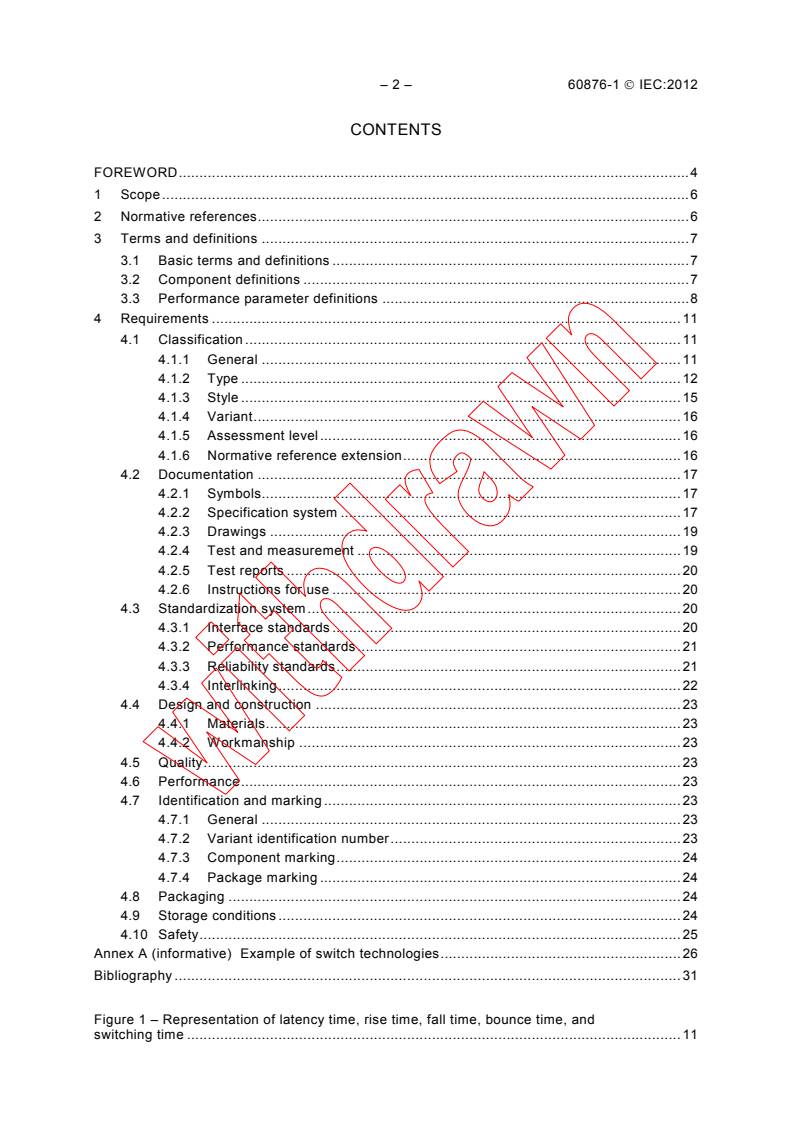
CONTENTS
FOREWORD . 4
1 Scope . 6
2 Normative references . 6
3 Terms and definitions . 7
3.1 Basic terms and definitions . 7
3.2 Component definitions . 7
3.3 Performance parameter definitions . 8
4 Requirements . 11
4.1 Classification . 11
4.1.1 General . 11
4.1.2 Type . 12
4.1.3 Style . 15
4.1.4 Variant . 16
4.1.5 Assessment level . 16
4.1.6 Normative reference extension . 16
4.2 Documentation . 17
4.2.1 Symbols . 17
4.2.2 Specification system . 17
4.2.3 Drawings . 19
4.2.4 Test and measurement . 19
4.2.5 Test reports . 20
4.2.6 Instructions for use . 20
4.3 Standardization system . 20
4.3.1 Interface standards . 20
4.3.2 Performance standards . 21
4.3.3 Reliability standards . 21
4.3.4 Interlinking . 22
4.4 Design and construction . 23
4.4.1 Materials . 23
4.4.2 Workmanship . 23
4.5 Quality . 23
4.6 Performance . 23
4.7 Identification and marking . 23
4.7.1 General . 23
4.7.2 Variant identification number . 23
4.7.3 Component marking . 24
4.7.4 Package marking . 24
4.8 Packaging . 24
4.9 Storage conditions . 24
4.10 Safety . 25
Annex A (informative) Example of switch technologies . 26
Bibliography . 31
Figure 1 – Representation of latency time, rise time, fall time, bounce time, and
switching time . 11
60876-1 IEC:2012 – 3 –
Figure 2 – Single-pole, single-throw switch . 13
Figure 3 – Transfer matrix for one input port and one output port . 13
Figure 4 – Single-pole, throw switch . 13
Figure 5 – Transfer matrix for one input port and N output ports . 13
Figure 6 – N-port matrix switch . 14
Figure 7 – Transfer matrix for N-ports switch . 14
Figure 8 – Four-port switch without crossover . 14
Figure 9 – Four-port switch with crossover . 15
Figure 10 – Configuration A, a device containing integral fibre optic pigtails without
connectors . 15
Figure 11 – Configuration B, a device containing integral fibre optic pigtails, with a
connector on each pigtail. 15
Figure 12 – Configuration C, a device containing a fibre optic connector as an integral
part of the device housing . 16
Figure 13 – Standards . 22
Figure A.1 – Example of 1×2 MO switch . 26
Figure A.2 – Example of mechanical switch (mirror driving type) . 27
Figure A.3 – Example of mechanical switch (fibre driving type) . 28
Figure A.4 – Example of MEMS switch . 28
Figure A.5 – Example of TO switch . 29
Figure A.6 – Output power of TO switch . 29
Figure A.7 – Example of switching response of TO switch. 30
Figure A.8 – 1×N and N×N examples of TO switch . 30
Table 1 – Example of a typical switch classification . 12
Table 2 – Transfer matrix of a four-port switch without crossover . 14
Table 3 – Transfer matrix of a four-port switch with crossover . 15
Table 4 – The IEC specification structure . 18
Table 5 – Standards interlink matrix . 23
– 4 – 60876-1 IEC:2012
INTERNATIONAL ELECTROTECHNICAL COMMISSION
____________
FIBRE OPTIC INTERCONNECTING DEVICES
AND PASSIVE COMPONENTS –
FIBRE OPTIC SPATIAL SWITCHES –
Part 1: Generic specification
FOREWORD
1) The International Electrotechnical Commission (IEC) is a worldwide organization for standardization comprising
all national electrotechnical committees (IEC National Committees). The object of IEC is to promote
international co-operation on all questions concerning standardization in the electrical and electronic fields. To
this end and in addition to other activities, IEC publishes International Standards, Technical Specifications,
Technical Reports, Publicly Available Specifications (PAS) and Guides (hereafter referred to as “IEC
Publication(s)”). Their preparation is entrusted to technical committees; any IEC National Committee interested
in the subject dealt with may participate in this preparatory work. International, governmental and non-
governmental organizations liaising with the IEC also participate in this preparation. IEC collaborates closely
with the International Organization for Standardization (ISO) in accordance with conditions determined by
agreement between the two organizations.
2) The formal decisions or agreements of IEC on technical matters express, as nearly as possible, an international
consensus of opinion on the relevant subjects since each technical committee has representation from all
interested IEC National Committees.
3) IEC Publications have the form of recommendations for international use and are accepted by IEC National
Committees in that sense. While all reasonable efforts are made to ensure that the technical content of IEC
Publications is accurate, IEC cannot be held responsible for the way in which they are used or for any
misinterpretation by any end user.
4) In order to promote international uniformity, IEC National Committees undertake to apply IEC Publications
transparently to the maximum extent possible in their national and regional publications. Any divergence
between any IEC Publication and the corresponding national or regional publication shall be clearly indicated in
the latter.
5) IEC itself does not provide any attestation of conformity. Independent certification bodies provide conformity
assessment services and, in some areas, access to IEC marks of conformity. IEC is not responsible for any
services carried out by independent certification bodies.
6) All users should ensure that they have the latest edition of this publication.
7) No liability shall attach to IEC or its directors, employees, servants or agents including individual experts and
members of its technical committees and IEC National Committees for any personal injury, property damage or
other damage of any nature whatsoever, whether direct or indirect, or for costs (including legal fees) and
expenses arising out of the publication, use of, or reliance upon, this IEC Publication or any other IEC
Publications.
8) Attention is drawn to the Normative references cited in this publication. Use of the referenced publications is
indispensable for the correct application of this publication.
9) Attention is drawn to the possibility that some of the elements of this IEC Publication may be the subject of
patent rights. IEC shall not be held responsible for identifying any or all such patent rights.
International Standard IEC 60876-1 has been prepared by subcommittee 86B: Fibre optic
interconnecting devices and passive components, of IEC technical committee 86: Fibre optics.
This fourth edition cancels and replaces the third edition published in 2001. It constitutes a
technical revision. The changes with respect to the previous edition are to remove quality
assessment procedures and to reconsider definitions.
This bilingual version (2013-02) corresponds to the monolingual English version, published in
2012-07.
60876-1 IEC:2012 – 5 –
The text of this standard is based on the following documents:
CDV Report on voting
86B/3276/CDV 86B/3339/RVC
Full information on the voting for the approval of this standard can be found in the report on
voting indicated in the above table.
The French version of this standard has not been voted upon.
This publication has been drafted in accordance with the ISO/IEC Directives, Part 2.
A list of all the parts in the IEC 60876 series, published under the general title Fibre optic
interconnecting devices and passive components-Fibre optic spatial switches can be found on
the IEC website.
Future standards in this series will carry the new general title as cited above. Titles of existing
standards in this series will be updated at the time of the next edition.
The committee has decided that the contents of this publication will remain unchanged until the
stability date indicated on the IEC web site under "http://webstore.iec.ch" in the data related to
the specific publication. At this date, the publication will be
• reconfirmed,
• withdrawn,
• replaced by a revised edition, or
• amended.
IMPORTANT – The 'colour inside' logo on the cover page of this publication
indicates that it contains colours which are considered to be useful for the correct
understanding of its contents. Users should therefore print this document using a
colour printer.
– 6 – 60876-1 IEC:2012
FIBRE OPTIC INTERCONNECTING DEVICES
AND PASSIVE COMPONENTS –
FIBRE OPTIC SPATIAL SWITCHES –
Part 1: Generic specification
1 Scope
This part of IEC 60876 applies to fibre optic switches possessing all of the following general
features:
– they are passive in that they contain no optoelectronic or other transducing elements;
– they have one or more ports for the transmission of optical power and two or more states in
which power may be routed or blocked between these ports;
– the ports are optical fibres or fibre optic connectors.
2 Normative references
The following documents, in whole or in part, are normatively referenced in this document and
are indispensable for its application. For dated references, only the edition cited applies. For
undated references, the latest edition of the referenced document (including any amendments)
applies.
IEC 60027 (all parts), Letter symbols to be used in electrical technology
IEC 60050 (all parts), International Electrotechnical Vocabulary (available at
)
IEC 60617 (all parts), Graphical symbols for diagrams (available at )
IEC 60695-11-5, Fire hazard testing – Part 11-5: Test flames – Needle-flame test method –
Apparatus, confirmatory test arrangement and guidance
IEC 60825-1, Safety of laser products – Part 1: Equipment classification and requirements
IEC 61300 (all parts), Fibre optic interconnecting devices and passive components – Basic test
and measurement procedures
IEC/TR 61930, Fibre optic graphical symbology
IEC 62047-1, Semiconductor devices – Micro-electromechanical devices – Part 1: Terms and
definitions
ISO 129-1, Technical drawings – Indication of dimensions and tolerances – Part 1: General
principles
ISO 286-1, Geometrical product specification (GPS) – ISO code system for tolerances on linear
sizes – Part 1: Basis of tolerances, deviations and fits
ISO 1101, Geometrical Product Specifications (GPS) – Geometrical tolerancing – Tolerances of
form, orientation, location and run-out
60876-1 IEC:2012 – 7 –
ISO 8601, Data elements and interchange formats – Information interchange – Representation
of dates and times
3 Terms and definitions
For the purposes of this part of IEC 60876, the definitions given in IEC 60050-731 apply,
together with the following definitions.
3.1 Basic terms and definitions
3.1.1
port
optical fibre or fibre optic connector attached to a passive component for the entry and/or exit
of optical power
3.1.2
transfer matrix
optical properties of a fibre optic switch can be defined in a n × n matrix of coefficients (n is the
number of ports)
Note 1 to entry: The T matrix represents the on-state paths (worst-case transmission) and the T° matrix represents
the off-state paths (worst-case isolation).
3.1.3
transfer coefficient
element t or t° of the transfer matrix
ij ij
Note 1 to entry: Each transfer coefficient t is the worst-case (minimum) fraction of power transferred from port i to
ij
port j for any state with path ij switched on. Each coefficient t° is the worst-case (maximum) fraction of power
ij
transferred from port i to port j for any state with path ij switched off.
3.1.4
logarithmic transfer matrix
a = –10 log t
ij ij
where
is the optical power reduction in decibels out of port j with unit power into port i, i.e.
a
ij
t is the transfer coefficient.
ij
Note 1 to entry: Similarly, for the off state, a° = –10 log t°
ij ij
3.2 Component definitions
3.2.1
optical switch
passive component processing one or more ports which selectively transmits, redirects or
blocks optical power in an optical fibre transmission line
3.2.2
switch state
particular optical configuration of a switch, whereby optical power is transmitted or blocked
between specific ports in a predetermined manner
3.2.3
actuation mechanism
physical means (mechanical, electrical, acoustic, optical, etc.) by which a switch is designed to
change between states
– 8 – 60876-1 IEC:2012
3.2.4
actuation energy
input energy required to place a switch in a specific state
3.2.5
latching switch
switch that maintains its last state and specified performance level when the actuation energy
which initiated the change is removed
3.2.6
non-latching switch
switch that reverts to a home state or undefined state when the actuation energy which initiated
a change is removed
3.2.7
blocking
inability to establish a connection from a free input port to a free output port due to the
existence of some other established connection
Note 1 to entry: Blocking and various degrees of non-blocking operation functionalities are of various types.
“Strict-sense non-blocking” refers to a switch matrix in which it is always possible to establish a connection between
any free input port and any free output port irrespective of previously established connections.
“Wide-sense non-blocking” refers to a matrix in which it is always possible to establish a desired connection
provided that some systematic procedure is followed in setting up connections. Some multistage switching
architectures fall into this category.
“Rearrangeably non-blocking” refers to a switch matrix in which any free input port can be connected to any free
output port provided that other established connections are unconnected and then reconnected as part of making
the new connection.
3.2.8
magneto-optic effect switch
MO switch
optical switch which uses the magneto-optic effect (phenomenon of polarization state change
in transmitted light and reflected light due to a magnetic field)
3.2.9
mechanical switch
optical switch, which realises the switching function by driving of the movable part
3.2.10
micro-electromechanical system switch
MEMS switch
optical switch using MEMS technology, as defined in IEC 62047-1
3.2.11
thermo-optic effect switch
TO switch
optical switch which uses the thermo-optic effect (phenomenon of refractive index change
caused by temperature variation)
3.3 Performance parameter definitions
3.3.1
insertion loss
element a (where i ≠ j) of the logarithmic transfer matrix
ij
Note 1 to entry: It is the reduction in optical power between an input and output port of a passive component
expressed in decibels and is defined as follows:
a = –10 log (P /P )
ij j i
60876-1 IEC:2012 – 9 –
where
P is the optical power launched into the input port, and
i
P is the optical power received from the output port.
j
Note 2 to entry: The insertion loss values depend on the state of the switch.
3.3.2
return loss
element a (where i = j) of the logarithmic transfer matrix
ij
Note 1 to entry: It is the fraction of input power that is returned from the input port of a passive component and is
defined as follows:
RL = –10 log (P /P )
i refl i
where
P is the optical power launched into the input port, and
i
P is the optical power received back from the same port.
refl
Note 2 to entry: The return loss values depend on the state of the switch.
3.3.3
operating wavelength
λ
nominal wavelength at which a passive component is designed to operate with the specified
performance
3.3.4
latency time
3.3.4.1
latency time
t
l
elapsed time when the output power of a
specified output port reaches 10 % of its steady-state value of the output power from the time
the actuation energy is applied
SEE: Figure 1
3.3.4.2
latency time
t ’
l
elapsed time when the output power of a
specified output port reaches 90 % of its steady-state value of the output power from the time
the actuation energy is removed
SEE: Figure 1
3.3.5
rise time
elapsed time when the output power of the specified output port rises from 10 % of the steady-
state value to 90 % of the steady-state value
3.3.6
fall time
elapsed time when the output power of the specified output port falls from 90 % of the
steady-state value to 10 % of the steady-state value
– 10 – 60876-1 IEC:2012
3.3.7
bounce time
3.3.7.1
bounce time
t
b
elapsed time when the output power of a
specified output port maintains between 90 % and 110 % of its steady-state value of the output
power from the first time the output power of a specified output port reaches to 90 % of its
steady-state value of the output power
SEE: Figure 1
3.3.7.2
bounce time
t ’
b
elapsed time when the output power of a
specified output port maintains between 0 % and 10 % of its steady-state value of the output
power from the first time the output power of a specified output port reaches to 10 % of its
steady-state value of the output power
SEE: Figure 1
3.3.8
switching time
3.3.8.1
switching time
t
s
the switching time is defined as follows:
= t + t + t
t
s l r b
where
t is latency time;
l
t is rise time;
r
t is bounce time.
b
3.3.8.2
switching time
t ’
s
the switching time is defined as follows:
t ’ = t ’ + t + t ’
s l f b
where
t ’ is latency time;
l
t is fall time;
f
t ’ is bounce time.
b
60876-1 IEC:2012 – 11 –
Actuation energy supply
Output port power
110 % of steady-state
Power
Steady-state
90 % of steady-state
10 % of steady-state
t t ’
t t ’ t b Time
l t l f
r
b
t ’
t
s
s
t t ’ Swithing time
s, s
t t ’ Latency time
l, l
t Rise time
r
t Fall time
f
t , t ’ Bounce time
b b
IEC 1321/12
Figure 1 – Representation of latency time, rise time,
fall time, bounce time, and switching time
Note 1 to entry: In the case in which, for any reason, the steady-state power of the isolated state is not zero, all
the power levels leading to the definitions of latency time, rise time, fall time, bounce time, and thus of switching
time, should be normalized subtracting from them the steady-state power of the isolated state, before applying such
definitions.
3.3.9
switching time matrix
matrix of coefficients in which each coefficient S is the longest switching time to turn path ij on
ij
or off from any initial state
4 Requirements
4.1 Classification
4.1.1 General
Fibre optic spatial switches shall be classified based on the following:
– type;
– style;
– variant;
– assessment level;
– normative reference extensions.
Table 1 is an example of a switch classification.
– 12 – 60876-1 IEC:2012
Table 1 – Example of a typical switch classification
Type:
1×2 mechanical switch
Style: – Configuration B
– IEC type A1 a fibre
– F-SMA connector
Variants: Means of mounting
Assessment level:
A
Normative reference extensions: .
4.1.2 Type
4.1.2.1 General
Switches are divided into types by their actuation mechanism, latching and topology (optical
switching function).
There are multiple actuation mechanisms of switches. The following is a non-exhaustive list of
examples of current technologies used in the industry:
– magneto-optic effect (MO);
– mechanical;
– micro-electromechanical system (MEMS);
– thermo-optic effect (TO).
Switches are divided into two types based on the latching function as follows:
– latching switch;
– non-latching switch.
There are an essentially infinite number of possible topologies. Each topology is illustrated by a
schematic diagram and defined by a unique transfer matrix.
The following device topologies include only those which are in common use within the industry
at present. The schematic diagrams which follow do not necessarily correspond to the physical
layout of the switch and its ports.
The examples given in 4.1.2.2 to 4.1.2.4 apply to unidirectional switches only, where t ≠ t . For
ij ji
bi-directional switches, t = t in each transfer matrix below.
ij ji
4.1.2.2 Single-pole, single-throw switch
Figure 2 shows a single-pole, single-throw switch.
60876-1 IEC:2012 – 13 –
Off
1 2
On
IEC 1322/12
Figure 2 – Single-pole, single-throw switch
This switch has one input port and one output port. Figure 3 shows the transfer matrix
describing the device.
t t
11 21
T=
t t
12 22
IEC 1323/12
Figure 3 – Transfer matrix for one input port and one output port
Ideally, t is 1 and the other coefficients are 0 when the switch is on. When the switch is off,
all coefficients are 0.
4.1.2.3 Single-pole, N-throw switch
Figure 4 shows a single-pole, N-throw switch.
.
.
.
.
N
+ 1
IEC 1324/12
Figure 4 – Single-pole, throw switch
This switch has one input port and N output ports. Figure 5 shows the transfer matrix
describing the device.
t t ⋅ ⋅ ⋅ t
11 12 1 N+1
t
⋅
T=
⋅ t ⋅
ij
⋅
t ⋅ t
N+11 N+1N+1
IEC 1325/12
Figure 5 – Transfer matrix for one input port and N output ports
Ideally, in the first position of the switch, t is 1 and the other coefficients are 0. In the generic
i-th position of the switch, the t transfer coefficient is 1 and the others are 0.
1 i+1
4.1.2.4 N-port matrix switch
Figure 6 shows an N-port matrix switch.
– 14 – 60876-1 IEC:2012
. . . .
1 2 3 N
IEC 1326/12
Figure 6 – N-port matrix switch
This switch has N ports. Figure 7 shows the transfer matrix describing the device.
t t ⋅ ⋅ ⋅ t
11 12 1 N
t
⋅
T=
⋅ t ⋅
ij
⋅
t ⋅ t
N11 NN
IEC 1327/12
Figure 7 – Transfer matrix for N-ports switch
A 2×2 matrix switch is a particular case with two input and two output ports.
In one type, it is possible to have four positions with the transfer coefficients t and t always
14 23
zero while t and t have the values indicated in Table 2. Figure 8 shows a four-port switch
13 24
without crossover.
Table 2 – Transfer matrix of a four-port switch without crossover
Transfer coefficient State
1 2 3 4
t 1 0 1 0
t 1 1 0 0
1 3
State 1
4 State 4
1 3
State 2
4 State 3
IEC 1328/12
Figure 8 – Four-port switch without crossover
In another type, a four-port crossover switch or by-pass switch is described. This switch has
two input and two output ports. The transfer coefficients are indicated in Table 3. Figure 9
shows a four-port switch with crossover.
60876-1 IEC:2012 – 15 –
Table 3 – Transfer matrix of a four-port switch with crossover
Transfer coefficient State
1 2
1 0
t
t 1 0
t 0 1
t 0 1
1 3 State 1
2 4 State 2
IEC 1329/12
Figure 9 – Four-port switch with crossover
4.1.3 Style
Switches may be classified into styles based upon fibre type, connector type, cable type,
housing shape and dimensions and configuration.
The configuration of the switch ports is classified as follows.
Figure 10 shows the configuration A, device containing integral fibre optic pigtails without
connectors.
Switch
IEC 1330/12
Figure 10 – Configuration A, a device containing integral fibre optic pigtails
without connectors
Figure 11 shows the configuration B, a device containing integral fibre optic pigtails, with a
connector on each pigtail.
Switch
IEC 1331/12
Figure 11 – Configuration B, a device containing integral fibre optic pigtails,
with a connector on each pigtail
Figure 12 shows the configuration C, a device containing a fibre optic connector as an integral
part of the device housing.
– 16 – 60876-1 IEC:2012
Switch
IEC 1332/12
Figure 12 – Configuration C, a device containing a fibre optic connector
as an integral part of the device housing
Configuration D is a device containing some combination of the interfacing features of the
preceding configurations.
4.1.4 Variant
The switch variant identifies those features which encompass structurally similar components.
Examples of features which define a variant include, but are not limited to the following:
– orientation of ports on housing;
– means for mounting.
4.1.5 Assessment level
Assessment level defines the inspection levels and the acceptable quality level (AQL) of groups
A and B and the periodicity of inspection of groups C and D. Detail specifications shall specify
one or more assessment levels, each of which shall be designated by a capital letter.
The following are the preferred levels.
Assessment level A
– group A inspection: inspection level II, AQL = 4 %
– group B inspection: inspection level II, AQL = 4 %
– group C inspection: 24-month periods
– group D inspection: 48-month periods
Assessment level B
– group A inspection: inspection level II, AQL = 1 %
– group B inspection: inspection level II, AQL = 1 %
– group C inspection: 18-month periods
– group D inspection: 36-month periods
Assessment level C
– group A inspection: inspection level II, AQL = 0,4 %
– group B inspection: inspection level II, AQL = 0,4 %
– group C inspection: 12-month periods
– group D inspection: 24-month periods
One additional assessment level may be added in the detail specification. When this is done,
the capital letter X shall be used.
4.1.6 Normative reference extension
Normative reference extensions are used to identify integrated independent standards
specifications or other reference documents into blank detail specifications.
60876-1 IEC:2012 – 17 –
Unless specified exception is noted, additional requirements imposed by an extension are
mandatory. Usage is primarily intended to merge associated components to form hybrid
devices, or integrated functional application requirements that are dependent on technical
expertise other than fibre optics.
Published reference documents produced by the ITU, consistent with the scope statements of
the relevant IEC specification series may be used as extensions. Published documents
produced by other regional standardization bodies such as ANSI, CENELEC, JIS, etc., may be
referenced in a bibliography attached to the generic specification.
Some spatial switch configurations require special qualification provisions which shall not be
imposed universally. This accommodates individual component design configurations,
specialized field tooling or specific application processes. In this case, requirements are
necessary to assure repeatable performance or adequate safety and provide additional
guidance for complete product specification and they shall be defined in the relevant
specification. These extensions are mandatory whenever they are used to prepare, assemble
or install a spatial switch either for field application usage or preparation of qualification test
specimens. The relevant specification shall clarify all stipulations. However, design and style-
dependent extensions shall not be imposed universally.
In the event of conflicting requirements, precedence, in descending order, shall be the generic
specification over mandatory extension, over blank detail, over detail specification, over
application-specific extension.
Examples of optical connector extensions are given as follows:
• using IEC 61754-4 and IEC 61754-2 to partially define a future IEC 60874 specification for
a duplex type SC/BFOC/2,5 hybrid connector adapter;
• using IEC 61754-13 and IEC 60869-1 to partially define a future IEC 60874 specification for
an integrated type FC preset attenuated optical connector;
• using IEC 61754-4 and IEC 61073-1 to partially define a future IEC 60874 specification for
a duplex SC receptacle incorporating integral mechanical splices.
Other examples of requirements for normative extensions are as follows.
• Some commercial or residential building applications may require direct reference to
specific safety codes and regulations or incorporate other specific material flammability or
toxicity requirements for specialized locations.
• Specialized field tooling may require an extension to implement specific ocular safety,
electrical shock, burn hazard avoidance requirements, or require isolation procedures to
prevent potential ignition of combustible gases.
4.2 Documentation
4.2.1 Symbols
Graphical and letter symbols shall, whenever possible, be taken from IEC 60027, IEC 60617
and IEC/TR 61930.
4.2.2 Specification system
4.2.2.1 General
This specification is part of the IEC specification system. Subsidiary specifications shall consist
of blank detail specifications and detail specifications. This system is shown in Table 4. There
are no sectional specifications for switches.
– 18 – 60876-1 IEC:2012
Table 4 – The IEC specification structure
Specification level Examples of information to be included Applicable to
Assessment system rules
Inspection rules
Optical measurement methods
Environmental test methods
Sampling plans
Identification rules
Two or more component families
Basics
or sub-families
Marking standards
Dimensional standards
Terminology
Symbol standards
Preferred number series
SI units
Specific terminology
Specific symbols
Specific units
Preferred values
Generic Marking Component family
Quality assessment procedures
Selection of tests
Qualification approval procedures
Capability approval procedures
Quality conformance test schedule
Groups of types having a
Blank detail Inspection requirements
common test schedule
Information common to a number of types
Individual values
Specific information
Detail Individual type
Completed quality conformance test
schedules
4.2.2.2 Blank detail specification
Blank detail specifications are not, by themselves, a specification level. They are associated
with the generic specification.
Each blank detail specification shall contain:
– the minimum mandatory test schedules and performance requirements;
– one or more assessment levels;
– the preferred format for stating the required information in the detail specification;
– in case of hybrid components, including connectors, add appropriate entry fields to show
the reference normative document, document title and issue date.
4.2.2.3 Detail specification
A specific switch is described by a corresponding detail specification, which is prepared by
filling in the blanks of the blank detail specification. Within the constraints imposed by this
60876-1 IEC:2012 – 19 –
generic specification, the blank detail specification may be filled in by any national committee
of the IEC, thereby defining a particular switch design as an official IEC standard.
Detail specifications shall specify the following, as applicable:
– type (see 4.1.2);
– style (see 4.1.3);
– variant(s) (see 4.1.4);
– assessment level (see 4.1.5);
– part identification number for each variant (see 4.7.2);
– drawings and dimensions required (see 4.2.3);
– quality assessment test schedules (see 4.1.5);
– performance requirements (see 4.6).
4.2.3 Drawings
4.2.3.1 General
The drawings and dimensions given in detail specifications shall not restrict themselves to
details of construction, nor shall they be used as manufacturing drawings.
4.2.3.2 Projection system
Either first-angle or third-angle projection shall be used for the drawings in documents covered
by this specification. All drawings within a document shall use the same projection system and
the drawings shall state which system is used.
4.2.3.3 Dimensional system
All dimensions shall be given in accordance with ISO 129-1, ISO 286-1 and ISO 1101.
The metric system shall be used in all specifications.
Dimensions shall not contain more than five significant digits.
When units are converted, a note shall be added in each detail specification.
4.2.4 Test and measurement
4.2.4.1 Test and measurement procedures
The test and measurement procedures for optical, mechanical and environmental
characteristics of switches to be used shall be defined and selected preferably from the
IEC 61300 series.
The size measurement method to be used shall be specified in the detail specification for
dimensions which are specified within
...