

IEC TS 63264:2026
(Main)Composite insulators with integrated optical fibres for AC voltages greater than 1 000 V and DC voltage greater than 1 500 V - Definitions, tests methods and acceptance criteria
General Information
- Abstract
IEC TS 63264:2026 applies to composite insulators equipped with optical fibres (fibre optic element), consisting of a load-bearing insulating core or tube, a housing (surrounding the insulating core) made of polymeric material, a fibre optic element integrated into the core or housing, or embedded in a filling media inside the inner volume of a hollow core, and end fittings permanently attached to the insulating core.
The object of this document is to
- define the terms used,
- specify additional test methods and provide additions and modifications to tests referred,
- specify acceptance criteria.
This document is to be used in addition to the respective product standard applicable to the product, application and design to which the fibre optic element has been added. Furthermore, this document does not include requirements dealing with the choice of insulators for specific operating conditions or environments.
- Status
- Published
- Publication Date
- 07-Apr-2026
- Technical Committee
- TC 36 - Insulators
- Drafting Committee
- PT 63264 - TC 36/PT 63264
- Current Stage
- PPUB - Publication issued
- Start Date
- 08-Apr-2026
- Completion Date
- 01-May-2026
Buy Documents
IEC TS 63264:2026 - Composite insulators with integrated optical fibres for AC voltages greater than 1 000 V and DC voltage greater than 1 500 V - Definitions, tests methods and acceptance criteria
Overview
IEC TS 63264:2026 is a technical specification published by the International Electrotechnical Commission (IEC) that addresses composite insulators with integrated optical fibres for use in electrical systems operating at AC voltages above 1,000 V and DC voltages above 1,500 V. The standard defines terminology, prescribes additional test methods, and specifies acceptance criteria for the integration of fibre optic elements into composite insulators, supplementing corresponding product standards.
This specification targets manufacturers, test laboratories, and asset operators looking to ensure the reliability, quality, and safe operation of composite insulators with integrated optical fibres in high-voltage transmission and distribution applications.
Key Topics
- Composite Insulator Design: Combines a load-bearing insulating core or tube, a polymeric housing, and fibre optic elements. End fittings are permanently attached to ensure mechanical integrity.
- Integration of Optical Fibres: Optical fibres can be integrated into the core, housing, or internal volume (via a filling medium) without compromising the insulator's primary electrical and mechanical functions.
- Definitions and Terminology: Provides standardized language for discussing components such as cores, tubes, housings, sheds, end fittings, fibre optic elements, and feedthroughs.
- Testing and Verification:
- Design Tests: Validate the suitability of a particular composite insulator design incorporating optical fibres.
- Type Tests: Confirm main characteristics influenced by design, geometry, and incorporated optical fibres.
- Sample Tests: Assess quality across production lots.
- Routine Tests: Detect and eliminate manufacturing defects in each insulator.
- Acceptance Criteria: Outlines performance thresholds for both mechanical and optical characteristics, such as attenuation measurement and fibre optic element endurance under thermal and environmental stresses.
- Marking and Identification: Ensures traceability and compliance with relevant product standards.
Applications
Composite insulators with integrated optical fibres are primarily applied in high-voltage transmission and distribution networks where real-time condition monitoring and data transmission are crucial. Key use cases include:
- Power Transmission Lines: Enhanced monitoring of line status and integrity by leveraging the dual mechanical and sensing functionality of composite insulators.
- Substation Equipment: Integration with circuit breakers, transformers, or signal columns for both electrical insulation and data communication.
- Smart Grid Infrastructure: Facilitating advanced diagnostics, predictive maintenance, and automation by transmitting sensor data through the integrated optical fibres.
- Harsh or Remote Environments: Reliable performance in areas with challenging environmental conditions due to the robust design and stringent acceptance testing.
Related Standards
IEC TS 63264:2026 is meant to be used alongside existing IEC product standards for insulators and fibre optic components. Relevant standards include:
- IEC 62217: Polymeric HV insulators for indoor and outdoor use - General definitions, test methods and acceptance criteria
- IEC 61109: Insulators for overhead lines - Composite suspension and tension insulators for AC systems above 1,000 V
- IEC 61462: Composite hollow insulators for use in electrical equipment above 1,000 V AC and 1,500 V DC
- IEC 61300 series: Basic test and measurement procedures for fibre optic interconnecting devices
- IEC 60050-471: International Electrotechnical Vocabulary for Insulators
By adhering to IEC TS 63264:2026, manufacturers and users can ensure interoperability, safety, and performance consistency for composite insulators with integrated optical fibres in modern power systems.
Buy Documents
IEC TS 63264:2026 - Composite insulators with integrated optical fibres for AC voltages greater than 1 000 V and DC voltage greater than 1 500 V - Definitions, tests methods and acceptance criteria
Get Certified
Connect with accredited certification bodies for this standard

IMQ S.p.A. (Certification)
Italian electrical product certification.

SLG Prüf- und Zertifizierungs GmbH
German testing and certification body.

UL Solutions
Global safety science company with testing, inspection and certification.
Sponsored listings
Frequently Asked Questions
IEC TS 63264:2026 is a technical specification published by the International Electrotechnical Commission (IEC). Its full title is "Composite insulators with integrated optical fibres for AC voltages greater than 1 000 V and DC voltage greater than 1 500 V - Definitions, tests methods and acceptance criteria". This standard covers: IEC TS 63264:2026 applies to composite insulators equipped with optical fibres (fibre optic element), consisting of a load-bearing insulating core or tube, a housing (surrounding the insulating core) made of polymeric material, a fibre optic element integrated into the core or housing, or embedded in a filling media inside the inner volume of a hollow core, and end fittings permanently attached to the insulating core. The object of this document is to - define the terms used, - specify additional test methods and provide additions and modifications to tests referred, - specify acceptance criteria. This document is to be used in addition to the respective product standard applicable to the product, application and design to which the fibre optic element has been added. Furthermore, this document does not include requirements dealing with the choice of insulators for specific operating conditions or environments.
IEC TS 63264:2026 applies to composite insulators equipped with optical fibres (fibre optic element), consisting of a load-bearing insulating core or tube, a housing (surrounding the insulating core) made of polymeric material, a fibre optic element integrated into the core or housing, or embedded in a filling media inside the inner volume of a hollow core, and end fittings permanently attached to the insulating core. The object of this document is to - define the terms used, - specify additional test methods and provide additions and modifications to tests referred, - specify acceptance criteria. This document is to be used in addition to the respective product standard applicable to the product, application and design to which the fibre optic element has been added. Furthermore, this document does not include requirements dealing with the choice of insulators for specific operating conditions or environments.
IEC TS 63264:2026 is classified under the following ICS (International Classification for Standards) categories: 29.080.10 - Insulators. The ICS classification helps identify the subject area and facilitates finding related standards.
IEC TS 63264:2026 is available in PDF format for immediate download after purchase. The document can be added to your cart and obtained through the secure checkout process. Digital delivery ensures instant access to the complete standard document.
Standards Content (Sample)
IEC TS 63264 ®
Edition 1.0 2026-04
TECHNICAL
SPECIFICATION
Composite insulators with integrated optical fibres for AC voltages greater than
1 000 V and DC voltage greater than 1 500 V - Definitions, test methods and
acceptance criteria
ICS 29.080.10 ISBN 978-2-8327-1177-4
All rights reserved. Unless otherwise specified, no part of this publication may be reproduced or utilized in any form or
by any means, electronic or mechanical, including photocopying and microfilm, without permission in writing from either
IEC or IEC's member National Committee in the country of the requester. If you have any questions about IEC copyright
or have an enquiry about obtaining additional rights to this publication, please contact the address below or your local
IEC member National Committee for further information.
IEC Secretariat Tel.: +41 22 919 02 11
3, rue de Varembé info@iec.ch
CH-1211 Geneva 20 www.iec.ch
Switzerland
About the IEC
The International Electrotechnical Commission (IEC) is the leading global organization that prepares and publishes
International Standards for all electrical, electronic and related technologies.
About IEC publications
The technical content of IEC publications is kept under constant review by the IEC. Please make sure that you have the
latest edition, a corrigendum or an amendment might have been published.
IEC publications search - IEC Products & Services Portal - products.iec.ch
webstore.iec.ch/advsearchform Discover our powerful search engine and read freely all the
The advanced search enables to find IEC publications by a
publications previews, graphical symbols and the glossary.
variety of criteria (reference number, text, technical With a subscription you will always have access to up to date
committee, …). It also gives information on projects, content tailored to your needs.
replaced and withdrawn publications.
Electropedia - www.electropedia.org
IEC Just Published - webstore.iec.ch/justpublished The world's leading online dictionary on electrotechnology,
Stay up to date on all new IEC publications. Just Published containing more than 22 500 terminological entries in English
details all new publications released. Available online and and French, with equivalent terms in 25 additional languages.
once a month by email. Also known as the International Electrotechnical Vocabulary
(IEV) online.
IEC Customer Service Centre - webstore.iec.ch/csc
If you wish to give us your feedback on this publication or
need further assistance, please contact the Customer
Service Centre: sales@iec.ch.
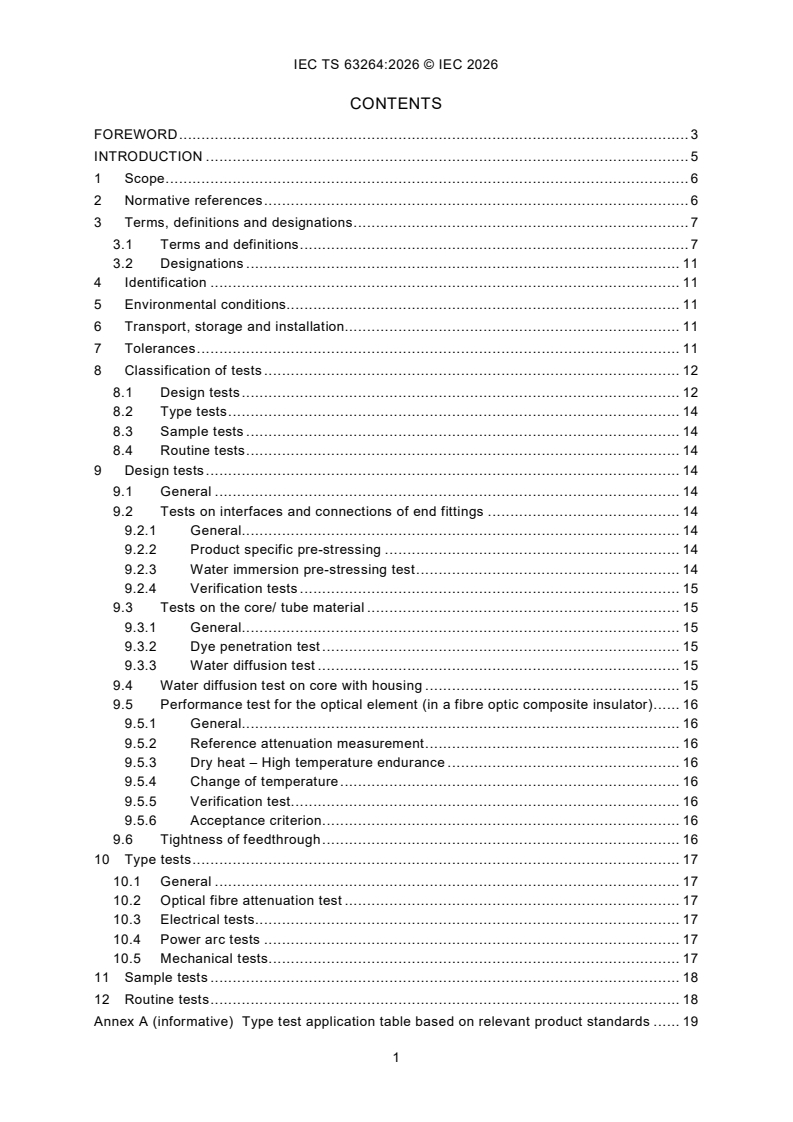
CONTENTS
FOREWORD . 3
INTRODUCTION . 5
1 Scope . 6
2 Normative references . 6
3 Terms, definitions and designations . 7
3.1 Terms and definitions . 7
3.2 Designations . 11
4 Identification . 11
5 Environmental conditions . 11
6 Transport, storage and installation. 11
7 Tolerances . 11
8 Classification of tests . 12
8.1 Design tests . 12
8.2 Type tests . 14
8.3 Sample tests . 14
8.4 Routine tests . 14
9 Design tests . 14
9.1 General . 14
9.2 Tests on interfaces and connections of end fittings . 14
9.2.1 General. 14
9.2.2 Product specific pre-stressing . 14
9.2.3 Water immersion pre-stressing test . 14
9.2.4 Verification tests . 15
9.3 Tests on the core/ tube material . 15
9.3.1 General. 15
9.3.2 Dye penetration test . 15
9.3.3 Water diffusion test . 15
9.4 Water diffusion test on core with housing . 15
9.5 Performance test for the optical element (in a fibre optic composite insulator) . 16
9.5.1 General. 16
9.5.2 Reference attenuation measurement . 16
9.5.3 Dry heat – High temperature endurance . 16
9.5.4 Change of temperature . 16
9.5.5 Verification test . 16
9.5.6 Acceptance criterion . 16
9.6 Tightness of feedthrough . 16
10 Type tests . 17
10.1 General . 17
10.2 Optical fibre attenuation test . 17
10.3 Electrical tests . 17
10.4 Power arc tests . 17
10.5 Mechanical tests . 17
11 Sample tests . 18
12 Routine tests . 18
Annex A (informative) Type test application table based on relevant product standards . 19
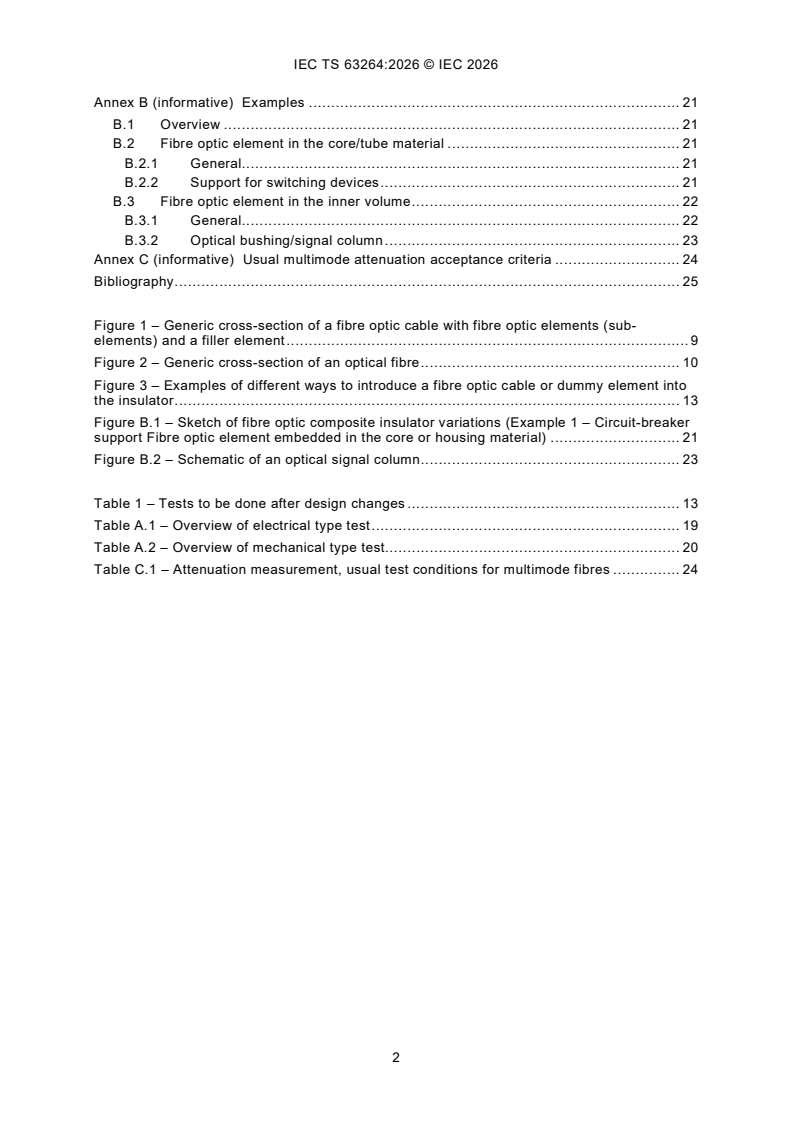
Annex B (informative) Examples . 21
B.1 Overview . 21
B.2 Fibre optic element in the core/tube material . 21
B.2.1 General. 21
B.2.2 Support for switching devices . 21
B.3 Fibre optic element in the inner volume . 22
B.3.1 General. 22
B.3.2 Optical bushing/signal column . 23
Annex C (informative) Usual multimode attenuation acceptance criteria . 24
Bibliography . 25
Figure 1 – Generic cross-section of a fibre optic cable with fibre optic elements (sub-
elements) and a filler element . 9
Figure 2 – Generic cross-section of an optical fibre . 10
Figure 3 – Examples of different ways to introduce a fibre optic cable or dummy element into
the insulator . 13
Figure B.1 – Sketch of fibre optic composite insulator variations (Example 1 – Circuit-breaker
support Fibre optic element embedded in the core or housing material) . 21
Figure B.2 – Schematic of an optical signal column . 23
Table 1 – Tests to be done after design changes . 13
Table A.1 – Overview of electrical type test . 19
Table A.2 – Overview of mechanical type test. 20
Table C.1 – Attenuation measurement, usual test conditions for multimode fibres . 24
INTERNATIONAL ELECTROTECHNICAL COMMISSION
____________
Composite insulators with integrated optical fibres for AC voltages
greater than 1 000 V and DC voltage greater than 1 500 V -
Definitions, tests methods and acceptance criteria
FOREWORD
1) The International Electrotechnical Commission (IEC) is a worldwide organization for standardization comprising
all national electrotechnical committees (IEC National Committees). The object of IEC is to promote international
co-operation on all questions concerning standardization in the electrical and electronic fields. To this end and
in addition to other activities, IEC publishes International Standards, Technical Specifications, Technical Reports,
Publicly Available Specifications (PAS) and Guides (hereafter referred to as “IEC Publication(s)”). Their
preparation is entrusted to technical committees; any IEC National Committee interested in the subject dealt with
may participate in this preparatory work. International, governmental and non-governmental organizations liaising
with the IEC also participate in this preparation. IEC collaborates closely with the International Organization for
Standardization (ISO) in accordance with conditions determined by agreement between the two organizations.
2) The formal decisions or agreements of IEC on technical matters express, as nearly as possible, an international
consensus of opinion on the relevant subjects since each technical committee has representation from all
interested IEC National Committees.
3) IEC Publications have the form of recommendations for international use and are accepted by IEC National
Committees in that sense. While all reasonable efforts are made to ensure that the technical content of IEC
Publications is accurate, IEC cannot be held responsible for the way in which they are used or for any
misinterpretation by any end user.
4) In order to promote international uniformity, IEC National Committees undertake to apply IEC Publications
transparently to the maximum extent possible in their national and regional publications. Any divergence between
any IEC Publication and the corresponding national or regional publication shall be clearly indicated in the latter.
5) IEC itself does not provide any attestation of conformity. Independent certification bodies provide conformity
assessment services and, in some areas, access to IEC marks of conformity. IEC is not responsible for any
services carried out by independent certification bodies.
6) All users should ensure that they have the latest edition of this publication.
7) No liability shall attach to IEC or its directors, employees, servants or agents including individual experts and
members of its technical committees and IEC National Committees for any personal injury, property damage or
other damage of any nature whatsoever, whether direct or indirect, or for costs (including legal fees) and
expenses arising out of the publication, use of, or reliance upon, this IEC Publication or any other IEC
Publications.
8) Attention is drawn to the Normative references cited in this publication. Use of the referenced publications is
indispensable for the correct application of this publication.
9) IEC draws attention to the possibility that the implementation of this document may involve the use of (a)
patent(s). IEC takes no position concerning the evidence, validity or applicability of any claimed patent rights in
respect thereof. As of the date of publication of this document, IEC had not received notice of (a) patent(s), which
may be required to implement this document. However, implementers are cautioned that this may not represent
the latest information, which may be obtained from the patent database available at https://patents.iec.ch. IEC
shall not be held responsible for identifying any or all such patent rights.
IEC TS 63264 has been prepared by IEC technical committee 36: Insulators. It is a Technical
Specification.
The text of this Technical Specification is based on the following documents:
Draft Report on voting
36/633/DTS 36/651/RVDTS
Full information on the voting for its approval can be found in the report on voting indicated in
the above table.
The language used for the development of this Technical Specification is English.
This document was drafted in accordance with ISO/IEC Directives, Part 2, and developed in
accordance with ISO/IEC Directives, Part 1 and ISO/IEC Directives, IEC Supplement, available
at www.iec.ch/members_experts/refdocs. The main document types developed by IEC are
described in greater detail at www.iec.ch/publications.
The committee has decided that the contents of this document will remain unchanged until the
stability date indicated on the IEC website under webstore.iec.ch in the data related to the
specific document. At this date, the document will be
– reconfirmed,
– withdrawn, or
– revised.
INTRODUCTION
Composite insulators with integrated optical fibres, herein after referred to as "fibre optic
composite insulators", consist of an insulating tube or core, bearing the mechanical load and
protected by a polymeric housing. In addition, optical fibres (fibre optic elements) are
incorporated into the insulator to transfer electromagnetic waves (e.g. light), energy, data
(information), or other types of signals. Despite these common features, the materials used,
and the design details employed by different manufacturers may differ. The mechanical load is
transmitted to the core by metallic end fittings. When implementing a fibre optic element within
the insulator, the electrical integrity of the element needs to be ensured by the manufacturer
and it will not be tested and verified within this document in lifetime aspects. This document
considers three design principles:
– Implementation of the fibre optic element into the polymeric housing,
– Implementation of the fibre optic element into the load-bearing core, or
– Implementation of the fibre optic element into the inner volume of a hollow core.
The grouping of the tests in this document follows the structure of IEC 62217 and the product
standards. It provides additions and modifications to design-, type-, sample and routine tests
to be considered when optical elements are incorporated into the respective fibre optic product.
Fibre optic composite insulators need to take into consideration the specific product application
or standards, such as IEC 61109 for composite Long Rod insulators or IEC 61462 for composite
hollow-core insulators. For easier use, Annex A offers an overview on the applicability of tests
on the respective fibre optic composite insulator design. Guidance on the application of fibre
optic elements in some examples are given in Annex B.
1 Scope
This Technical Specification applies to composite insulators equipped with optical fibres (fibre
optic element), consisting of a load-bearing insulating core or tube, a housing (surrounding the
insulating core) made of polymeric material, a fibre optic element integrated into the core or
housing, or embedded in a filling media inside the inner volume of a hollow core, and end fittings
permanently attached to the insulating core.
The object of this document is to
– define the terms used,
– specify additional test methods and provide additions and modifications to tests referred,
– specify acceptance criteria.
This document is to be used in addition to the respective product standard applicable to the
product, application and design to which the fibre optic element has been added. Furthermore,
this document does not include requirements dealing with the choice of insulators for specific
operating conditions or environments.
2 Normative references
The following documents are referred to in the text in such a way that some or all of their content
constitutes requirements of this document. For dated references, only the edition cited applies.
For undated references, the latest edition of the referenced document (including any
amendments) applies.
IEC 60050-471, International Electrotechnical Vocabulary (IEV) - Part 471: Insulators
IEC 61109:2008, Insulators for overhead lines - Composite suspension and tension insulators
for a.c. systems with a nominal voltage greater than 1 000 V - Definitions, test methods and
acceptance criteria
lEC 61300-2-18, Fibre optic interconnecting devices and passive components - Basic test and
measurement procedures - Part 2-18: Tests - Dry heat
lEC 61300-2-22, Fibre optic interconnecting devices and passive components - Basic test and
measurement procedures - Part 2-22: Tests - Change of temperature
IEC 61300-3-4, Fibre optic interconnecting devices and passive components - Basic test and
measurement procedures - Part 3-4: Examinations and measurements - Attenuation
IEC 61462, Composite hollow insulators - Pressurized and unpressurized insulators for use in
electrical equipment with AC rated voltage greater than 1 000 V AC and D.C. voltage greater
than 1500V - Definitions, test methods, acceptance criteria and design recommendations
IEC 62217, Polymeric HV insulators for indoor and outdoor use - General definitions, test
methods and acceptance criteria
3 Terms, definitions and designations
3.1 Terms and definitions
For the purposes of this document, the following terms and definitions apply.
ISO and IEC maintain terminology databases for use in standardization at the following
addresses:
– IEC Electropedia: available at https://www.electropedia.org/
– ISO Online browsing platform: available at https://www.iso.org/obp
3.1.1
polymeric insulator
insulator whose insulating body consists of at least one organic based material
Note 1 to entry: Polymeric insulators are also known as non-ceramic insulators.
Note 2 to entry: Coupling devices may be attached to the ends of the insulating body.
[SOURCE: IEC 60050-471:2007, 471-01-13]
3.1.2
composite insulator
insulator made of at least two insulating parts, namely a core and a housing, equipped with
metal fittings
Note 1 to entry: Composite insulators, for example, can consist either of individual sheds mounted on the core, with
or without an intermediate sheath, or alternatively, of a housing directly moulded or cast in one or several pieces on
to the core.
[SOURCE: IEC 60050-471:2007, 471-01-02]
3.1.3
core (of a composite insulator)
central insulating part of an insulator which provides the mechanical characteristics
Note 1 to entry: The housing and sheds are not part of the core.
[SOURCE: IEC 60050-471:2007, 471-01-11]
3.1.4
tube
core
central internal insulating part of a composite hollow insulator which provides the mechanical
characteristics
Note 1 to entry: The housing and sheds are not part or the core.
Note 2 to entry: The tube is generally cylindrical or conical but may have other shapes (for example barrel). The
tube is made of resin impregnated fibres.
Note 3 to entry: Resin impregnated fibres are structured in such a manner as to achieve sufficient mechanical
strength. Layers of different fibres may be used to fulfil special requirements.
[SOURCE: IEC 60050-471:2007,471-01-03, modified – addition of "tube" in term, addition of
"internal", addition of "composite hollow", addition of Notes 2 and 3 to entry]
3.1.5
insulator trunk
central insulating part of an insulator from which the sheds project
Note 1 to entry: Also known as shank on smaller insulators.
[SOURCE: IEC 60050-471:2007, 471-01-11]
3.1.6
housing
external insulating part of a composite insulator providing the necessary creepage distance and
protecting core from environment
Note 1 to entry: An intermediate sheath made of insulating material may be part of the housing.
[SOURCE: IEC 60050-471:2007, 471-01-09]
3.1.7
shed (of an insulator)
insulating part, projecting from the insulator trunk, intended to increase the creepage distance
Note 1 to entry: The shed can be with or without ribs.
[SOURCE: IEC 60050-471:2007, 471-01-15]
3.1.8
interfaces
surface between the different materials
Note 1 to entry: Various interfaces exist in most composite insulators, e.g.:
– between housing and end fittings;
– between various parts of the housing; e.g. between sheds, or between sheath and sheds;
– between core and housing.
3.1.9
end fitting
integral component or formed part of an insulator intended to connect it to a supporting
structure, or to a conductor, or to an item of equipment, or to another insulator
Note 1 to entry: Where the end fitting is metallic, in general the term "metal fitting" is used.
[SOURCE: IEC 60050-471:2007, 471-01-06]
3.1.10
coupling
part of the end fitting which transmits the load to the accessories external to the insulator
[SOURCE: IEC 62217:2012, 3.14, modified – "fixing device" replaced by "end fitting",
"hardware" replaced by "accessories"]
3.1.11
filling medium
material to fill the space or void inside the insulator core and fibre optic elements
3.1.12
fibre optic element
element consisting of one or more optical fibres to transfer light, which can be used as energy
or information (binary data or other types of signals) which can be additionally protected by
non-conductive materials
Note 1 to entry: Fibre optic cables can also be considered as fibre optic elements, which consist of optical fibre(s),
and other sub-elements embedded in a cable filling medium and covered by protective cable sheath (see also
Figure 1).
Figure 1 – Generic cross-section of a fibre optic cable with fibre optic elements
(sub-elements) and a filler element
3.1.13
fibre optic cable
assembly comprising one or more optical fibres or fibre bundles inside a common covering
designed to protect them against mechanical stresses and other environmental influences while
retaining the transmission quality of the fibres
Note 1 to entry: For this kind of application only non-conductive materials shall be used.
[SOURCE: IEC 60050-731:1991, 731-04-01, modified – Note to entry modified]
3.1.14
fibre optic composite insulator
composite insulator (IEC 60050-471) with integrated fibre optic element
Note 1 to entry: This can be done by
– implementation of the fibre optic element into the polymeric housing,
– implementation of the fibre optic element into the load-bearing core or
– implementation of the fibre optic element into the inner volume of a hollow core.
3.1.15
attenuation
measure of the decreasing transmission light power in a fibre at a given wavelength in a fibre
optic element
Note 1 to entry: This includes the transmission loss caused by light scattering and absorption. It can also include
the transmission loss introduced by splices and connectors.
The definition is:
A(λ) = l 10 lg (P1(λ) l P2(λ))I
Where
A(λ) is the attenuation, in dB, at wavelength λ;
P1(λ) is the transmission light power traversing one cross-section (marker 1);
P2(λ) is the transmission light power traversing a second cross-section (marker 2).
Note 2 to entry: It depends on the nature and length and condition of the fibre and is also affected by measurement
conditions.
Note 3 to entry: The term loss is used synonymously with attenuation in this document.
[SOURCE: IEC/IEEE 62582-5:2015, 3.5, modified – "in a fibre optic element" added in
definition, Notes to entry modified]
3.1.16
dummy element
element representing the fibre optic cable during tests and prestressing procedures if the
included components such as fibres and filling medium cannot withstand the proposed
prestressing or testing procedures
Note 1 to entry: The dummy element shall be made of the same surface material as the fibre optic cable which is
used at the final application to ensure comparable interface conditions.
Example If in the final application a Ø 5 mm polyethylene tube with a silicone filling gel and encapsulated fibre optic
is used, and the filling gel does not withstand the water immersion prestressing procedure proposed in Clause 9, a
solid polyethylene profile with identical material and diameter can be used.
Note 2 to entry: Where an internal component of the insulator is removed for testing purposes it can be replaced
with a dummy element, also referred to as "filler" or "cable dummy".
3.1.17
optical fibres
multimode or single-mode optical fibres for signal or power transmission
Note 1 to entry: Optical fibres are usually coated with an additional protective layer (primary and secondary coating,
also considered as buffer (see also Figure 2) that can also be coloured.
Note 2 to entry: In the context of this technical specification, the coating or coatings are considered as parts of the
optical fibre.
Figure 2 – Generic cross-section of an optical fibre
-------------------
...