

IEC 60869-1:1999
(Main)Fibre optic attenuators - Part 1: Generic specification
General Information
- Abstract
Applies to fibre optic attenuators which have all of the following general features: they are passive in that they contain no optoelectronic or other transducing elements; they have two ports for the transmission of optical power, and attenuate the transmitted power in a fixed or variable fashion; the ports are optical fibres or optical fibre connectors. It establishes uniform requirements for attenuator requirements and procedures for quality assessment.
- Status
- Published
- Publication Date
- 29-Nov-1999
- Technical Committee
- SC 86B - Fibre optic interconnecting devices and passive components
- Drafting Committee
- WG 7 - TC 86/SC 86B/WG 7
- Current Stage
- DELPUB - Deleted Publication
- Start Date
- 12-Dec-2012
- Completion Date
- 28-Aug-2026
Overview
IEC 60869-1:1999 is an international standard published by the International Electrotechnical Commission (IEC) that specifies generic requirements for fibre optic attenuators. These passive optical components are designed to reduce the power level of optical signals in fibre optic communication systems without converting them to electrical signals. The standard applies to attenuators with two ports, which may be optical fibres or fibre connectors, and covers fixed or variable attenuation functionality.
This third edition, released in November 1999, establishes uniform requirements for construction, quality, performance, identification, and testing procedures. It aims to ensure compatibility, reliability, and safety in optical networks by providing detailed specifications for manufacturers and users.
Key Topics
Scope and Definitions: IEC 60869-1 covers fibre optic attenuators that are passive devices with two optical ports and no active optoelectronic elements. It defines key terminology relevant to attenuators and their classifications.
Classification System: The standard categorizes attenuators based on type, style, variant, environmental category, and quality assurance level to facilitate standardized design and testing.
Design and Construction: It specifies approved materials and workmanship practices that maintain component integrity and performance under various environmental conditions.
Performance Criteria: Requirements cover attenuation accuracy, insertion loss, return loss, and stability to guarantee consistent optical power reduction within specified tolerances.
Documentation and Marking: Manufacturers must provide comprehensive documentation including drawings, symbols, test data sheets, and clear labeling for traceability and correct usage.
Quality Assurance Procedures: IEC 60869-1 details rigorous testing protocols, including initial manufacturing assessment, lot-by-lot inspections, periodic checks, and qualification approval processes to ensure ongoing compliance.
Safety and Storage: Guidelines ensure safe handling, packaging, and storage conditions to preserve attenuator functionality and prevent damage prior to installation.
Applications
Fibre optic attenuators compliant with IEC 60869-1:1999 are essential components in a variety of optical communication and data transmission systems, including:
Telecommunication Networks: Managing signal levels to avoid receiver saturation and optimize performance in long-haul and metropolitan optical fibre links.
Optical Instrumentation: Providing controlled attenuation during testing, measurement, and calibration of fibre optic equipment.
Local Area Networks (LANs): Enabling balanced optical power distribution among multiple users.
Cable Television (CATV): Adjusting optical signals in distribution networks to maintain optimal signal-to-noise ratios.
Optical Access Systems: Ensuring consistent power levels in fiber-to-the-home (FTTH) and similar applications for reliable service delivery.
Related Standards
IEC 60869-1:1999 aligns with and references other key IEC standards to ensure comprehensive standardization across optical components, including:
IEC 60050: International Electrotechnical Vocabulary – provides general terminology applied throughout IEC documents.
IEC 60027, IEC 60417, IEC 60617: Standards covering graphical and letter symbols used in electrotechnical documentation.
Optical Interface Standards: Codifies connector types and interface requirements to ensure compatibility between attenuators and fibre optic systems.
Performance and Reliability Standards: Additional IEC documents specify testing for insertion loss, return loss, environmental resilience, and long-term reliability.
By conforming to IEC 60869-1, manufacturers and system integrators ensure that fibre optic attenuators meet recognized international quality and safety benchmarks, promoting interoperability and performance consistency in global optical networks.
Relations
- Effective Date
- 05-Sep-2023
Get Certified
Connect with accredited certification bodies for this standard

ANCE
Mexican certification and testing association.

Intertek Slovenia
Intertek testing, inspection, and certification services in Slovenia.

LNE (Laboratoire National de Métrologie et d'Essais)
French national laboratory for metrology and testing.
Sponsored listings
Frequently Asked Questions
IEC 60869-1:1999 is a standard published by the International Electrotechnical Commission (IEC). Its full title is "Fibre optic attenuators - Part 1: Generic specification". This standard covers: Applies to fibre optic attenuators which have all of the following general features: they are passive in that they contain no optoelectronic or other transducing elements; they have two ports for the transmission of optical power, and attenuate the transmitted power in a fixed or variable fashion; the ports are optical fibres or optical fibre connectors. It establishes uniform requirements for attenuator requirements and procedures for quality assessment.
Applies to fibre optic attenuators which have all of the following general features: they are passive in that they contain no optoelectronic or other transducing elements; they have two ports for the transmission of optical power, and attenuate the transmitted power in a fixed or variable fashion; the ports are optical fibres or optical fibre connectors. It establishes uniform requirements for attenuator requirements and procedures for quality assessment.
IEC 60869-1:1999 is classified under the following ICS (International Classification for Standards) categories: 33.180.20 - Fibre optic interconnecting devices. The ICS classification helps identify the subject area and facilitates finding related standards.
IEC 60869-1:1999 has the following relationships with other standards: It is inter standard links to IEC 60869-1:2012. Understanding these relationships helps ensure you are using the most current and applicable version of the standard.
IEC 60869-1:1999 is available in PDF format for immediate download after purchase. The document can be added to your cart and obtained through the secure checkout process. Digital delivery ensures instant access to the complete standard document.
Standards Content (Sample)
NORME CEI
INTERNATIONALE IEC
60869-1
INTERNATIONAL
QC 800000
STANDARD
Troisième édition
Third edition
1999-11
Atténuateurs à fibres optiques –
Partie 1:
Spécification générique
Fibre optic attenuators –
Part 1:
Generic specification
Numéro de référence
Reference number
CEI/IEC 60869-1:1999
Numéros des publications Numbering
Depuis le 1er janvier 1997, les publications de la CEI As from 1 January 1997 all IEC publications are
sont numérotées à partir de 60000. issued with a designation in the 60000 series.
Publications consolidées Consolidated publications
Les versions consolidées de certaines publications de Consolidated versions of some IEC publications
la CEI incorporant les amendements sont disponibles. including amendments are available. For example,
Par exemple, les numéros d’édition 1.0, 1.1 et 1.2 edition numbers 1.0, 1.1 and 1.2 refer, respectively, to
indiquent respectivement la publication de base, la the base publication, the base publication incor-
publication de base incorporant l’amendement 1, et la porating amendment 1 and the base publication
publication de base incorporant les amendements 1 incorporating amendments 1 and 2.
et 2.
Validité de la présente publication Validity of this publication
Le contenu technique des publications de la CEI est The technical content of IEC publications is kept
constamment revu par la CEI afin qu'il reflète l'état under constant review by the IEC, thus ensuring that
actuel de la technique. the content reflects current technology.
Des renseignements relatifs à la date de reconfir- Information relating to the date of the reconfirmation
mation de la publication sont disponibles dans le of the publication is available in the IEC catalogue.
Catalogue de la CEI.
Les renseignements relatifs à des questions à l’étude et Information on the subjects under consideration and
des travaux en cours entrepris par le comité technique work in progress undertaken by the technical
qui a établi cette publication, ainsi que la liste des committee which has prepared this publication, as well
publications établies, se trouvent dans les documents ci- as the list of publications issued, is to be found at the
dessous: following IEC sources:
• «Site web» de la CEI* • IEC web site*
• Catalogue des publications de la CEI • Catalogue of IEC publications
Publié annuellement et mis à jour Published yearly with regular updates
régulièrement
(Catalogue en ligne)* (On-line catalogue)*
• Bulletin de la CEI • IEC Bulletin
Disponible à la fois au «site web» de la CEI* Available both at the IEC web site* and
et comme périodique imprimé as a printed periodical
Terminologie, symboles graphiques Terminology, graphical and letter
et littéraux symbols
En ce qui concerne la terminologie générale, le lecteur For general terminology, readers are referred to
se reportera à la CEI 60050: Vocabulaire Electro- IEC 60050: International Electrotechnical Vocabulary
technique International (VEI). (IEV).
Pour les symboles graphiques, les symboles littéraux For graphical symbols, and letter symbols and signs
et les signes d'usage général approuvés par la CEI, le approved by the IEC for general use, readers are
lecteur consultera la CEI 60027: Symboles littéraux à referred to publications IEC 60027: Letter symbols to
utiliser en électrotechnique, la CEI 60417: Symboles be used in electrical technology, IEC 60417: Graphical
graphiques utilisables sur le matériel. Index, relevé et symbols for use on equipment. Index, survey and
compilation des feuilles individuelles, et la CEI 60617: compilation of the single sheets and IEC 60617:
Symboles graphiques pour schémas. Graphical symbols for diagrams.
* Voir adresse «site web» sur la page de titre. * See web site address on title page.
NORME CEI
INTERNATIONALE IEC
60869-1
INTERNATIONAL
QC 800000
STANDARD
Troisième édition
Third edition
1999-11
Atténuateurs à fibres optiques –
Partie 1:
Spécification générique
Fibre optic attenuators –
Part 1:
Generic specification
IEC 1999 Droits de reproduction réservés Copyright - all rights reserved
Aucune partie de cette publication ne peut être reproduite ni No part of this publication may be reproduced or utilized in
utilisée sous quelque forme que ce soit et par aucun procédé, any form or by any means, electronic or mechanical,
électronique ou mécanique, y compris la photo-copie et les including photocopying and microfilm, without permission in
microfilms, sans l'accord écrit de l'éditeur. writing from the publisher.
International Electrotechnical Commission 3, rue de Varembé Geneva, Switzerland
Telefax: +41 22 919 0300 e-mail: inmail@iec.ch IEC web site http://www.iec.ch
CODE PRIX
Commission Electrotechnique Internationale
T
PRICE CODE
International Electrotechnical Commission
Pour prix, voir catalogue en vigueur
For price, see current catalogue
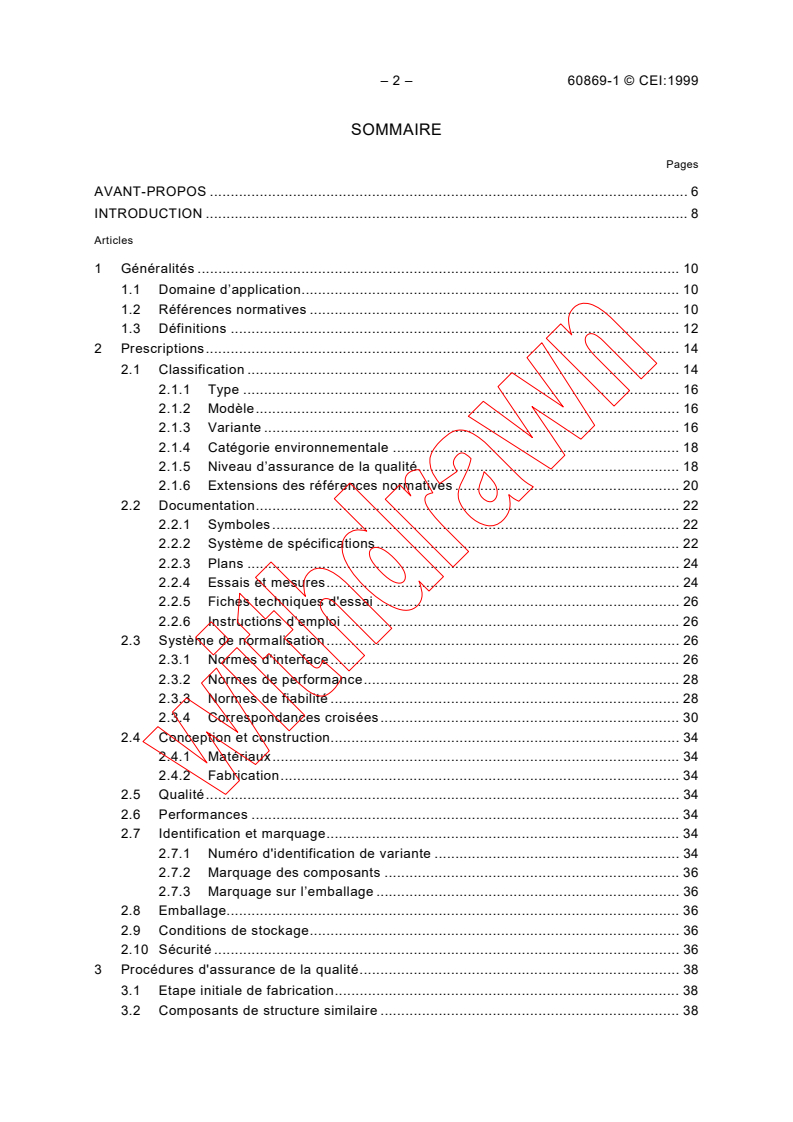
– 2 – 60869-1 © CEI:1999
SOMMAIRE
Pages
AVANT-PROPOS . 6
INTRODUCTION .8
Articles
1 Généralités .10
1.1 Domaine d’application. 10
1.2 Références normatives . 10
1.3 Définitions . 12
2 Prescriptions.14
2.1 Classification . 14
2.1.1 Type . 16
2.1.2 Modèle. 16
2.1.3 Variante . 16
2.1.4 Catégorie environnementale . 18
2.1.5 Niveau d’assurance de la qualité. 18
2.1.6 Extensions des références normatives . 20
2.2 Documentation. 22
2.2.1 Symboles . 22
2.2.2 Système de spécifications. 22
2.2.3 Plans . 24
2.2.4 Essais et mesures. 24
2.2.5 Fiches techniques d'essai . 26
2.2.6 Instructions d’emploi . 26
2.3 Système de normalisation. 26
2.3.1 Normes d'interface. 26
2.3.2 Normes de performance. 28
2.3.3 Normes de fiabilité . 28
2.3.4 Correspondances croisées. 30
2.4 Conception et construction. 34
2.4.1 Matériaux. 34
2.4.2 Fabrication. 34
2.5 Qualité. 34
2.6 Performances . 34
2.7 Identification et marquage. 34
2.7.1 Numéro d'identification de variante . 34
2.7.2 Marquage des composants . 36
2.7.3 Marquage sur l’emballage . 36
2.8 Emballage. 36
2.9 Conditions de stockage. 36
2.10 Sécurité . 36
3 Procédures d'assurance de la qualité. 38
3.1 Etape initiale de fabrication. 38
3.2 Composants de structure similaire . 38
60869-1 © IEC:1999 – 3 –
CONTENTS
Page
FOREWORD . 7
INTRODUCTION .9
Clause
1 General. 11
1.1 Scope . 11
1.2 Normative references. 11
1.3 Definitions . 13
2 Requirements . 15
2.1 Classification . 15
2.1.1 Type . 17
2.1.2 Style . 17
2.1.3 Variant . 17
2.1.4 Environmental category. 19
2.1.5 Assessment level . 19
2.1.6 Normative reference extensions . 21
2.2 Documentation. 23
2.2.1 Symbols. 23
2.2.2 Specification system . 23
2.2.3 Drawings. 25
2.2.4 Tests and measurements . 25
2.2.5 Test data sheets . 27
2.2.6 Instructions for use . 27
2.3 Standardization system. 27
2.3.1 Interface standards . 27
2.3.2 Performance standards . 29
2.3.3 Reliability standards. 29
2.3.4 Interlinking . 31
2.4 Design and construction . 35
2.4.1 Materials. 35
2.4.2 Workmanship . 35
2.5 Quality. 35
2.6 Performance . 35
2.7 Identification and marking . 35
2.7.1 Variant identification number. 35
2.7.2 Component marking . 37
2.7.3 Package marking . 37
2.8 Packaging. 37
2.9 Storage conditions . 37
2.10 Safety . 37
3 Quality assessment procedures . 39
3.1 Primary stage of manufacture . 39
3.2 Structurally similar components . 39
– 4 – 60869-1 © CEI:1999
Articles Pages
3.3 Procédures d'homologation. 38
3.3.1 Procédure d'échantillonnage fixe. 40
3.3.2 Procédures de contrôle lot par lot et périodique . 40
3.3.3 Spécimen d’homologation . 40
3.3.4 Taille de l'échantillonnage. 40
3.3.5 Préparation des spécimens . 40
3.3.6 Essais d’homologation . 40
3.3.7 Défaillances d’homologation . 40
3.3.8 Maintenance des homologations . 42
3.3.9 Rapport d’homologation . 42
3.4 Contrôle de conformité de la qualité. 42
3.4.1 Contrôle lot par lot . 42
3.4.2 Contrôle périodique. 44
3.5 Certificats de conformité des lots livrés. 44
3.6 Livraisons différées. 46
3.7 Livraison autorisée avant la fin des essais du groupe B . 46
3.8 Autres méthodes d'essai. 46
3.9 Paramètres non vérifiés . 46
60869-1 © IEC:1999 – 5 –
Clause Page
3.3 Qualification approval procedures. 39
3.3.1 Fixed sample procedure. 41
3.3.2 Lot-by-lot and periodic procedures . 41
3.3.3 Qualifying specimen. 41
3.3.4 Sample size . 41
3.3.5 Preparation of specimens. 41
3.3.6 Qualification testing . 41
3.3.7 Qualification failures . 41
3.3.8 Maintenance of qualification approval . 43
3.3.9 Qualification report. 43
3.4 Quality conformance inspection . 43
3.4.1 Lot-by-lot inspection. 43
3.4.2 Periodic inspection. 45
3.5 Certified record of released lots . 45
3.6 Delayed deliveries . 47
3.7 Delivery release before completion of group B tests. 47
3.8 Alternative test methods . 47
3.9 Unchecked parameters . 47
– 6 – 60869-1 © CEI:1999
COMMISSION ÉLECTROTECHNIQUE INTERNATIONALE
–––––––––––
ATTÉNUATEURS À FIBRES OPTIQUES –
Partie 1: Spécification générique
AVANT-PROPOS
1) La CEI (Commission Électrotechnique Internationale) est une organisation mondiale de normalisation
composée de l'ensemble des comités électrotechniques nationaux (Comités nationaux de la CEI). La CEI a
pour objet de favoriser la coopération internationale pour toutes les questions de normalisation dans les
domaines de l'électricité et de l'électronique. A cet effet, la CEI, entre autres activités, publie des Normes
internationales. Leur élaboration est confiée à des comités d'études, aux travaux desquels tout Comité national
intéressé par le sujet traité peut participer. Les organisations internationales, gouvernementales et non
gouvernementales, en liaison avec la CEI, participent également aux travaux. La CEI collabore étroitement
avec l'Organisation Internationale de Normalisation (ISO), selon des conditions fixées par accord entre les
deux organisations.
2) Les décisions ou accords officiels de la CEI concernant les questions techniques représentent, dans la mesure
du possible, un accord international sur les sujets étudiés, étant donné que les Comités nationaux intéressés
sont représentés dans chaque comité d’études.
3) Les documents produits se présentent sous la forme de recommandations internationales. Ils sont publiés
comme normes, spécifications techniques, rapports techniques ou guides et agréés comme tels par les
Comités nationaux.
4) Dans le but d'encourager l'unification internationale, les Comités nationaux de la CEI s'engagent à appliquer de
façon transparente, dans toute la mesure possible, les Normes internationales de la CEI dans leurs normes
nationales et régionales. Toute divergence entre la norme de la CEI et la norme nationale ou régionale
correspondante doit être indiquée en termes clairs dans cette dernière.
5) La CEI n’a fixé aucune procédure concernant le marquage comme indication d’approbation et sa responsabilité
n’est pas engagée quand un matériel est déclaré conforme à l’une de ses normes.
6) L’attention est attirée sur le fait que certains des éléments de la présente Norme internationale peuvent faire
l’objet de droits de propriété intellectuelle ou de droits analogues. La CEI ne saurait être tenue pour
responsable de ne pas avoir identifié de tels droits de propriété et de ne pas avoir signalé leur existence.
La Norme internationale CEI 60869-1 a été établie par le sous-comité 86B: Dispositifs
d’interconnexion et composants passifs à fibres optiques, du comité d’études 86 de la CEI:
Fibres optiques.
Cette troisième édition annule et remplace la deuxième édition parue en 1994 et constitue
une révision technique.
Le texte de cette norme est issu des documents suivants:
FDIS Rapport de vote
86B/1248/FDIS 86B/1283/RVD
Le rapport de vote indiqué dans le tableau ci-dessus donne toute information sur le vote ayant
abouti à l'approbation de cette norme.
Le numéro QC qui figure sur la page de couverture de la présente publication est le numéro
de spécification dans le Système CEI d’assurance de la qualité des composants électroniques
(IECQ).
Cette publication a été rédigée selon les Directives ISO/CEI, Partie 3.
Le comité a décidé que cette publication reste valable jusqu'en 2008.
A cette date, selon décision préalable du comité, la publication sera
• reconduite;
• supprimée;
• remplacée par une édition révisée, ou
•
amendée.
60869-1 © IEC:1999 – 7 –
INTERNATIONAL ELECTROTECHNICAL COMMISSION
––––––––––––––
FIBRE OPTIC ATTENUATORS –
Part 1: Generic specification
FOREWORD
1) The IEC (International Electrotechnical Commission) is a worldwide organization for standardization comprising
all national electrotechnical committees (IEC National Committees). The object of the IEC is to promote
international co-operation on all questions concerning standardization in the electrical and electronic fields. To
this end and in addition to other activities, the IEC publishes International Standards. Their preparation is
entrusted to technical committees; any IEC National Committee interested in the subject dealt with may
participate in this preparatory work. International, governmental and non-governmental organizations liaising
with the IEC also participate in this preparation. The IEC collaborates closely with the International
Organization for Standardization (ISO) in accordance with conditions determined by agreement between the
two organizations.
2) The formal decisions or agreements of the IEC on technical matters express, as nearly as possible, an
international consensus of opinion on the relevant subjects since each technical committee has representation
from all interested National Committees.
3) The documents produced have the form of recommendations for international use and are published in the form
of standards, technical specifications, technical reports or guides and they are accepted by the National
Committees in that sense.
4) In order to promote international unification, IEC National Committees undertake to apply IEC International
Standards transparently to the maximum extent possible in their national and regional standards. Any
divergence between the IEC Standard and the corresponding national or regional standard shall be clearly
indicated in the latter.
5) The IEC provides no marking procedure to indicate its approval and cannot be rendered responsible for any
equipment declared to be in conformity with one of its standards.
6) Attention is drawn to the possibility that some of the elements of this International Standard may be the subject
of patent rights. The IEC shall not be held responsible for identifying any or all such patent rights.
International Standard IEC 60869-1 has been prepared by subcommittee 86B: Fibre optic
interconnecting devices and passive components, of IEC technical committee 86: Fibre optics.
This third edition cancels and replaces the second edition published in 1994 and constitutes a
technical revision.
The text of this standard is based on the following documents:
FDIS Report on voting
86B/1248/FDIS 86B/1283/RVD
Full information on the voting for the approval of this standard can be found in the report on
voting indicated in the above table.
The QC number that appears on the front cover of this publication is the specification number
in the IEC Quality Assessment System for Electronic Components (IECQ).
This publication has been drafted in accordance with the ISO/IEC Directives, Part 3.
The committee has decided that this publication remains valid until 2008.
At this date, in accordance with the committee's decision, the publication will be
• reconfirmed;
withdrawn;
replaced by a revised edition, or
amended.
– 8 – 60869-1 © CEI:1999
INTRODUCTION
La présente partie de la CEI 60869 est divisée en trois articles.
Le premier article, intitulé «Généralités», contient des informations générales qui se
rapportent à la présente spécification générique.
Le second article, intitulé «Prescriptions», contient toutes les prescriptions auxquelles les
atténuateurs concernés par cette norme doivent satisfaire. Les prescriptions de classification,
le système de spécification CEI, la documentation, les matériaux, la qualité d’exécution, la
qualité, l’aptitude à la fonction, l’identification et l’emballage sont traités.
Le troisième article, intitulé «Procédures d’assurance de la qualité», contient l’ensemble des
procédures qu’il faut suivre pour un contrôle de qualité correct des produits concernés par la
présente norme.
60869-1 © IEC:1999 – 9 –
INTRODUCTION
This part of IEC 60869 is divided into three clauses.
Clause 1 is entitled "General" and contains general information pertaining to this generic
specification.
Clause 2 is entitled "Requirements" and contains all the requirements to be met by
attenuators covered by this standard. This includes requirements for classification, the IEC
specification system, documentation, materials, workmanship, quality, performance, identification,
and packaging.
Clause 3 is entitled "Quality assessment procedures" and contains all of the procedures which
must be followed for proper quality assessment of products covered by this standard.
– 10 – 60869-1 © CEI:1999
ATTÉNUATEURS À FIBRES OPTIQUES –
Partie 1: Spécification générique
1 Généralités
1.1 Domaine d’application
La présente partie de la CEI 60869 s’applique aux atténuateurs à fibres optiques. Ceux-ci
présentent toutes les caractéristiques générales suivantes:
– ils sont passifs dans le sens où ils ne contiennent aucun élément optoélectronique ou
transducteur;
– ils disposent de deux portes pour la transmission de la puissance optique et atténuent
l’énergie transmise de manière fixe ou variable;
– les portes sont des fibres optiques ou des connecteurs à fibres optiques.
La présente norme établit les prescriptions uniformes relatives aux:
– prescriptions d’atténuateur;
– procédures de contrôle de la qualité.
La présente norme ne comprend pas les procédures de mesure et d’essais, ces dernières
étant décrites dans la CEI 61300-1, la série CEI 61300-2 et la série CEI 61300-3.
1.2 Références normatives
Les documents normatifs suivants contiennent des dispositions qui, par suite de la référence
qui y est faite, constituent des dispositions valables pour la présente partie de la CEI 60869.
Pour les références datées, les amendements ultérieurs ou les révisions de ces publications
ne s’appliquent pas. Toutefois, les parties prenantes aux accords fondés sur la présente
partie de la CEI 60869 sont invitées à rechercher la possibilité d'appliquer les éditions les
plus récentes des documents normatifs indiqués ci-après. Pour les références non datées, la
dernière édition du document normatif en référence s’applique. Les membres de la CEI et de
l'ISO possèdent le registre des Normes internationales en vigueur.
CEI QC 001001:1998, Règles fondamentales du système CEI d’assurance de la qualité des
composants électroniques (IECQ)
CEI QC 001002-2:1998, Règles de procédure du système CEI d'assurances de la qualité des
composants électriques (IECQ) – Partie 2: Documentation
CEI QC 001002-3:1998, Règles de procédure du système CEI d’assurance de la qualité des
composants électroniques (IECQ) – Partie 3: Procédure d'agrément de savoir-faire (publiée
actuellement en anglais seulement)
Guide CEI 102:1996, Composants électroniques – Structure des spécifications pour
l’assurance de la qualité (Homologation et agrément de savoir-faire)
CEI 60027 (toutes les parties), Symboles littéraux à utiliser en électrotechnique
CEI 60050(731):1991, Vocabulaire Electrotechnique International (VEI) – Chapitre 731:
Télécommunications par fibres optiques
CEI 60410:1973, Plans et règles d’échantillonnage pour les contrôles par attributs
CEI 60617 (toutes les parties), Symboles graphiques pour schémas
60869-1 © IEC:1999 – 11 –
FIBRE OPTIC ATTENUATORS –
Part 1: Generic specification
1 General
1.1 Scope
This part of IEC 60869 applies to fibre optic attenuators. These have all of the following
general features:
– they are passive in that they contain no opto-electronic or other transducing elements;
– they have two ports for the transmission of optical power and attenuate the transmitted
power in a fixed or variable fashion;
– the ports are optical fibres or optical fibre connectors.
This standard establishes uniform requirements for the following:
– attenuator requirements;
– quality assessment procedures.
This standard does not cover test and measurement procedures, which are described in
IEC 61300-1, in the serie IEC 61300-2 and the serie 61300-3.
1.2 Normative references
The following normative documents contain provisions which, through reference in this text,
constitute provisions of this part of IEC 60869. For dated references, subsequent amendments to,
or revisions of, any of these publications do not apply. However, parties to agreements based
on this part of IEC 60869 are encouraged to investigate the possibility of applying the most
recent editions of the normative documents indicated below. For undated references, the
latest edition of the normative document referred to applies. Members of IEC and ISO
maintain registers of currently valid International Standards.
IEC QC 001001:1998, Basic rules of the IEC Quality Assessment System for Electronic Com-
ponents (IECQ)
IEC QC 001002-2:1998, Rules of Procedure of the IEC Quality Assessment System for
Electronic Components (IECQ) – Part 2: Documentation
IEC QC 001002-3:1998, Rules of procedure of the IEC Quality Assessment System for
Electronic Components (IECQ) – Part 3: Approval procedures
IEC Guide 102:1996, Electronic components – Specification structures for quality assessment
(Qualification approval and capability approval)
IEC 60027 (all parts), Letter symbols to be used in electrical technology
IEC 60050(731):1991, International Electrotechnical Vocabulary (IEV) – Chapter 731: Optical
fibre communication
IEC 60410:1973, Sampling plans and procedures for inspection by attributes
IEC 60617 (all parts), Graphical symbols for diagrams
– 12 – 60869-1 © CEI:1999
CEI 60695-2-2:1991, Essais relatifs aux risques du feu – Partie 2: Méthodes d’essai – Section 2:
Essai au brûleur-aiguille
CEI 60825-1:1998, Sécurité des appareils à laser – Partie 1: Classification des matériels,
prescriptions et guide de l’utilisateur
ISO 129:1985, Dessins techniques – Cotation – Principes généraux, définitions, méthodes
d’exécution et indications spéciales
ISO 286-1:1988, Systèmes ISO de tolérances et d’ajustements – Partie 1: Base des
tolérances, écarts et ajustements
ISO 370:1975, Dimensions tolérancées – Conversion d’inches en millimètres et réciproquement
ISO/DIS 1101, Spécifications géométriques des produits – Tolérancement géométrique –
Généralités, définitions, symboles, indications sur les dessins
ISO 8601:1988, Eléments de données et formats d’échange – Echange d’information –
Représentation de la date et de l’heure
1.3 Définitions
Pour les besoins de la présente partie de la CEI 60869, les termes et définitions donnés dans
la CEI 60050(731), ainsi que les suivants s’appliquent.
1.3.1
atténuateur
composant passif qui produit une atténuation contrôlée du signal dans une ligne de
transmission par fibre optique
1.3.2
fibre amorce
fibre de courte longueur, bretelle ou câble formant une porte pour composants à fibres
optiques
1.3.3
porte
fibre optique ou connecteur à fibres optiques fixé à un composant passif pour coupler la
puissance optique en entrée et/ou sortie
1.3.4
atténuation
réduction de la puissance optique entre la porte d’entrée et la porte de sortie d’un composant
passif, exprimée en décibels. Elle est donnée par l’expression suivante
a = –10 log (P /P )
1 0
où P est la puissance optique injectée dans la porte d’entrée et P est la puissance optique
0 1
reçue de la porte de sortie
1.3.5
valeur d’atténuation
terme synonyme de la perte d’insertion lorsqu’il s’applique aux atténuateurs
1.3.6
atténuation minimale
terme applicable uniquement aux atténuateurs variables. Il s’agit de la plus faible valeur
d’atténuation pour le réglage du dispositif
60869-1 © IEC:1999 – 13 –
IEC 60695-2-2:1991, Fire hazard testing – Part 2: Test methods – Section 2: Needle-flame
test
IEC 60825-1:1998, Safety of laser products – Part 1: Equipment classification, requirements
and user’s guide
lSO 129:1985, Technical drawings – Dimensioning – General principles, definitions, methods
of execution and special indications
ISO 286-1:1988, ISO system of limits and fits – Part 1: Bases of tolerances, deviations and
fits
ISO 370:1975, Toleranced dimensions – Conversion from inches into millimetres and vice
versa
ISO/DIS 1101, Geometrical Product Specifications (GPS) – Geometrical tolerancing –
Generalities, definitions, symbols, indications on drawings
ISO 8601:1988, Data elements and interchange formats – Information interchange –
Representation of dates and times
1.3 Definitions
For the purpose of this part of IEC 60869, the definitions contained in IEC 60050(731) as well
as the following definitions apply.
1.3.1
attenuator
passive component which produces a controlled signal attenuation in an optical fibre
transmission line
1.3.2
fibre optic pigtail
short length of fibre, jumper or cable forming an optical port for a fibre optic component
1.3.3
port
optical fibre or optical fibre connector attached to a passive component for the entry and/or
exit of optical power
1.3.4
attenuation
reduction in optical power between an input and output port of a passive component,
expressed in decibel; it is defined as follows:
a = –10 log (P /P )
1 0
where P is the optical power launched into the input port, and P the power received from the
0 1
output port
1.3.5
attenuation value
term synonymous with insertion loss when applied to attenuators
1.3.6
minimum attenuation
term applicable only to variable attenuators; it is the lowest attenuation to which the device
may be adjusted
– 14 – 60869-1 © CEI:1999
1.3.7
atténuation différentielle
terme uniquement applicable aux atténuateurs variables. Il se rapporte à la différence entre
l’atténuation du dispositif à une valeur de réglage donnée et l’atténuation minimale
1.3.8
puissance réfléchie
fraction de la puissance d’entrée qui est renvoyée de la porte d’un composant passif. Cette
valeur est donnée par l’expression suivante
RL = –10 log (P /P )
1 0
où P est la puissance optique injectée dans la porte, et P la puissance optique reçue en
0 1
retour de la même porte
1.3.9
longueur d’onde de fonctionnement
longueur d’onde nominale λ, à laquelle un composant passif est destiné à fonctionner avec
les qualités de fonctionnement spécifiées
1.3.10
domaine de longueurs d’onde de fonctionnement – bande passante
domaine spécifié de longueurs d’onde λ à λ autour d’une longueur d’onde de
i min i max
fonctionnement nominal λ , dans lequel un composant passif est destiné à fonctionner avec
i
les qualités de fonctionnement spécifiées
2 Prescriptions
Les prescriptions pour atténuateurs couvertes par le présent article sont destinées à aider à
la classification d’un atténuateur donné dans une spécification particulière.
2.1 Classification
Les atténuateurs sont classés selon les catégories suivantes:
– type;
– modèle;
– variante;
– catégorie environnementale;
– niveau d’assurance de la qualité;
– extensions des références normatives.
Un exemple de classification typique d'atténuateur est donné ci-après:
Type: – variable en continu
Modèle: – configuration
– fibre type A1a de la CEI
– connecteur F-SMA
Variante: – moyens de montage
Niveau d’assurance – A
de la qualité:
60869-1 © IEC:1999 – 15 –
1.3.7
incremental attenuation
term applicable only to variable attenuators; it refers to the difference between the attenuation
of the device at a given setting and the minimum attenuation
1.3.8
return loss
fraction of input power that is returned from the port of a passive component; it is defined as
follows:
RL = –10 log (P /P )
1 0
where P is the optical power launched into the port, and P the optical power received back
0 1
from the same port
1.3.9
operating wavelength
nominal wavelength λ at which a passive component is designed to operate with the specified
performance
1.3.10
operating wavelength range – bandpass
specified range of wavelengths from λ to λ about a nominal operating wavelength λ ,
i min i max i
within which a passive component is designed to operate with the specified performance
2 Requirements
The requirements for attenuators covered by this clause are intended to aid in classifying an
attenuator in a detail specification.
2.1 Classification
Attenuators are classified by the following categories:
– type;
– style;
– variant;
– environmental category;
– assessment level;
– normative reference extensions.
An example of a typical attenuator classification is as follows:
Type: – continuously variable
Style: – configuration
– IEC type A1a fibre
– F-SMA connector
Variant: – means of mounting
Assessment level: – A
– 16 – 60869-1 © CEI:1999
2.1.1 Type
Les types d’atténuateurs sont définis par la fonction qui leur est destinée. Il existe trois types
d’atténuateurs:
– fixe;
– variable en continu;
– variable pas à pas.
2.1.2 Modèle
Les atténuateurs peuvent être classés en modèles sur la base du type de fibre, du type de
connecteur, du type de câble, de la forme et des dimensions du boîtier et de la configuration.
La configuration des portes d’atténuateur est classée de la manière suivante:
– Configuration A – Dispositif comportant des fibres amorces intégrées sans connecteurs.
Atténuateur
dB
IEC 1517/99
– Configuration B – Dispositif comportant des fibres amorces intégrées, avec un connecteur
sur chaque fibre amorce.
Atténuateur
dB
IEC 1518/99
– Configuration C – Dispositif comportant des connecteurs optiques faisant partie intégrante
du boîtier du dispositif.
Atténuateur
dB
IEC 1519/99
– Configuration D – Dispositif comportant une certaine combinaison des interfaces des
configurations précédentes.
2.1.3 Variante
La variante d’un atténuateur identifie les caractéristiques des composants structurellement
associables (voir 3.2).
Exemples non exhaustifs de caractéristiques définissant des variantes:
– orientation des portes sur le boîtier;
– moyens de montage.
60869-1 © IEC:1999 – 17 –
2.1.1 Type
Attenuator types are defined by their intended function. There are three types of attenuators:
– fixed;
– continuously variable;
– discrete step variable.
2.1.2 Style
Attenuators may be classified into styles based upon fibre type, connector type, cable type,
housing shape and dimensions and configuration.
The configuration of the attenuator ports is classified as follows:
– Configuration A – A device containing integral fibre optic pigtails without connectors.
Attenuator
dB
IEC 1517/99
– Configuration B – A device containing integral fibre optic pigtails, with a connector on each
pigtail.
Attenuator
dB
IEC 1518/99
– Configuration C – A device containing fibre optic connectors as an integral part of the
device housing.
Attenuator
dB
IEC 1519/99
– Configuration D – A device containing some combination of the interfacing features of the
preceding configurations.
2.1.3 Variant
The attenuator variant identifies those features which encompass structurally similar
components (see 3.2).
Examples of features which define a variant include, but are not limited to the following:
– orientation of ports on housing;
– means for mounting.
– 18 – 60869-1 © CEI:1999
2.1.4 Catégorie environnementale
Différentes catégories environnementales sont données dans les spécifications particulières
cadre associées à la présente norme; elles définissent les séquences d’essai nécessaires
pour l’assurance de la qualité.
Les rédacteurs de spécifications particulières peuvent ajouter des essais/des groupes d’essai
à une catégorie environnementale particulière.
Cependant, le rédacteur de spécifications particulières ne doit pas enlever d’essai ou modifier
l’ordre d’une catégorie environnementale standard.
Lorsqu’un rédacteur de spécifications particulières ajoute des essais à une catégorie
spécifiée, cette catégorie environnementale doit être accompagnée du signe (+).
EXEMPLE:
– catégorie environnementale ii +
– catégorie environnementale v +
2.1.5 Niveau d’assurance de la qualité
La spécification particulière doit comprendre tous les essais nécessaires à l’assurance de la
qualité.
Chaque essai doit être attribué à l’un des quatre groupes désignés par A, B, C et D.
La spécification particulière doit préciser un ou plusieurs niveaux d’assurance de la qualité,
chacun de ces niveaux devant être désigné par une lettre capitale. Le niveau d’assurance de
la qualité définit le rapport entre les niveaux de contrôle/NQA pour les groupes A et B et les
périodes de contrôle des groupes C et D.
Les niveaux suivants sont préférentiels:
– niveau d’assurance de la qualité A
• contrôle du groupe A: niveau de contrôle II, NQA = 4 %
contrôle du groupe B: niveau de contrôle II, NQA = 4 %
contrôle du groupe C: périodes de 24 mois
contrôle du groupe D: périodes de 48 mois
– niveau d’assurance de la qualité B
contrôle du groupe A: niveau de contrôle II, NQA = 1 %
contrôle du groupe B: niveau de contrôle II, NQA = 1 %
contrôle du groupe C: périodes de 18 mois
contrôle du groupe D: périodes de 36 mois
– niveau d’assurance de la qualité C
contrôle du groupe A: niveau de contrôle II, NQA = 0,4 %
contrôle du groupe B: niveau de contrôle II, NQA = 0,4 %
contrôle du groupe C: périodes de 12 mois
contrôle du groupe D: périodes de 24 mois
60869-1 © IEC:1999 – 19 –
2.1.4 Environmental category
Various environmental categories are given in the blank detail specifications associated with
this standard; these define the test sequences needed for quality assurance.
Detail specification writers may add tests and/or groups of tests to a particular environmental
category.
However, the detail specification writer shall not remove tests nor alter the sequence of an
environmental category standard.
When a detail specification writer adds tests to a specified category, the environmen
...