

IEC 61757-5-1:2021
(Main)Fibre optic sensors - Part 5-1: Tilt measurement - Tilt sensors based on fibre Bragg gratings
General Information
- Abstract
IEC 61757-5-1:2021 defines the terminology, structure, characteristics and their measurement method including the procedures, for an optical tilt sensor based on fibre Bragg gratings (FBGs) as the sensitive element.
- Status
- Published
- Publication Date
- 06-Jul-2021
- Technical Committee
- SC 86C - Fibre optic systems, sensing and active devices
- Drafting Committee
- WG 2 - TC 86/SC 86C/WG 2
- Current Stage
- PPUB - Publication issued
- Start Date
- 07-Jul-2021
- Completion Date
- 28-Jul-2021

Overview
IEC 61757-5-1:2021 is an international standard developed by the International Electrotechnical Commission (IEC) that specifies the terminology, structure, characteristics, and measurement procedures for optical tilt sensors based on fibre Bragg gratings (FBGs). As part of the IEC 61757 series focusing on fibre optic sensors, this section addresses the unique requirements for tilt measurement applications where FBGs serve as the sensitive element. The standard provides a comprehensive framework to ensure consistent performance evaluation, reliability, and interoperability of FBG tilt sensors in various practical environments.
Key Topics
Fibre Bragg Grating (FBG) Technology: The standard covers FBGs as phase diffraction gratings inscribed within optical fibres, detailing their role as sensitive elements that reflect specific wavelengths (Bragg wavelength) in response to applied tilt.
Sensor Structure and Configuration: Definitions and guidelines for various FBG tilt sensor configurations, including single and multiple FBGs within a fibre, are provided. Explanations of typical set-ups for both absolute and relative tilt measurements are included.
Terminology and Symbols: IEC 61757-5-1 introduces specific terms (e.g., "gauge factor," "reference wavelength," "temperature compensation constant") and their correct usage, promoting international conformity.
Measurement and Calibration Procedures: The standard outlines methods for testing and reporting critical parameters such as Bragg wavelength, spectral width, and reflectivity, as well as sampling strategies for product validation.
Stability and Reliability: Provisions on the stability behavior of FBG tilt sensors address drift, creep, and hysteresis to ensure dependable long-term performance.
Applications
Fibre optic tilt sensors based on FBGs offer distinct advantages in a wide range of real-world applications, including:
Structural Health Monitoring: Used in bridges, buildings, and other infrastructure, FBG tilt sensors provide precise monitoring of angular displacement or inclination, helping to assess structural stability and integrity over time.
Geotechnical Engineering: In civil engineering, these sensors measure tilt in slopes, embankments, and dams to provide early warning of movements or potential failures.
Oil and Gas: FBG-based tilt sensors are deployed in downhole monitoring to detect wellbore deformation or casing tilt, especially where harsh environmental conditions render electronic sensors impractical.
Industrial Equipment: Equipment positioning and stability can be continually monitored, ensuring optimal performance and proactive maintenance.
Aerospace and Transportation: Tilt sensors help monitor the angular orientation of critical components, improving safety and performance via real-time data acquisition.
The use of fibre Bragg grating technology provides benefits such as immunity to electromagnetic interference, high temperature resilience, and the ability to multiplex multiple sensors along a single optical fibre for distributed sensing.
Related Standards
To ensure broad compatibility, IEC 61757-5-1:2021 references several related International Standards, including:
- IEC 60050 (IEV): International Electrotechnical Vocabulary for consistent terminology.
- IEC 60068-2: Environmental testing standards.
- IEC 61300-2: Basic test and measurement procedures for fibre optic devices.
- IEC 61757 (series): General and specific requirements for fibre optic sensors.
- IEC 61757-1-1:2020: Strain sensors based on fibre Bragg gratings.
- IEC 61754: Fibre optic connector interfaces.
- IEC 62129 series: Calibration of wavelength/optical frequency measurement instruments.
- ISO/IEC GUIDE 98-3: Guide to the expression of uncertainty in measurement.
By adopting IEC 61757-5-1, stakeholders in high-value infrastructure, industrial automation, and scientific research can ensure reliable, interoperable, and future-proof deployment of optical tilt sensors based on fibre Bragg grating technology.
For more information, always consult the latest version of the standard from authorized distributors or the IEC webstore.
Get Certified
Connect with accredited certification bodies for this standard

ANCE
Mexican certification and testing association.

Intertek Slovenia
Intertek testing, inspection, and certification services in Slovenia.

LNE (Laboratoire National de Métrologie et d'Essais)
French national laboratory for metrology and testing.
Sponsored listings
Frequently Asked Questions
IEC 61757-5-1:2021 is a standard published by the International Electrotechnical Commission (IEC). Its full title is "Fibre optic sensors - Part 5-1: Tilt measurement - Tilt sensors based on fibre Bragg gratings". This standard covers: IEC 61757-5-1:2021 defines the terminology, structure, characteristics and their measurement method including the procedures, for an optical tilt sensor based on fibre Bragg gratings (FBGs) as the sensitive element.
IEC 61757-5-1:2021 defines the terminology, structure, characteristics and their measurement method including the procedures, for an optical tilt sensor based on fibre Bragg gratings (FBGs) as the sensitive element.
IEC 61757-5-1:2021 is classified under the following ICS (International Classification for Standards) categories: 33.180.99 - Other fibre optic equipment. The ICS classification helps identify the subject area and facilitates finding related standards.
IEC 61757-5-1:2021 is available in PDF format for immediate download after purchase. The document can be added to your cart and obtained through the secure checkout process. Digital delivery ensures instant access to the complete standard document.
Standards Content (Sample)
IEC 61757-5-1 ®
Edition 1.0 2021-07
INTERNATIONAL
STANDARD
NORME
INTERNATIONALE
Fibre optic sensors –
Part 5-1: Tilt measurement – Tilt sensors based on fibre Bragg gratings
Capteurs fibroniques –
Partie 5-1: Mesure d’inclinaison – Capteurs d’inclinaison basés sur des réseaux
de Bragg à fibres
All rights reserved. Unless otherwise specified, no part of this publication may be reproduced or utilized in any form
or by any means, electronic or mechanical, including photocopying and microfilm, without permission in writing from
either IEC or IEC's member National Committee in the country of the requester. If you have any questions about IEC
copyright or have an enquiry about obtaining additional rights to this publication, please contact the address below or
your local IEC member National Committee for further information.
Droits de reproduction réservés. Sauf indication contraire, aucune partie de cette publication ne peut être reproduite ni
utilisée sous quelque forme que ce soit et par aucun procédé, électronique ou mécanique, y compris la photocopie et
les microfilms, sans l'accord écrit de l'IEC ou du Comité national de l'IEC du pays du demandeur. Si vous avez des
questions sur le copyright de l'IEC ou si vous désirez obtenir des droits supplémentaires sur cette publication, utilisez
les coordonnées ci-après ou contactez le Comité national de l'IEC de votre pays de résidence.
IEC Central Office Tel.: +41 22 919 02 11
3, rue de Varembé info@iec.ch
CH-1211 Geneva 20 www.iec.ch
Switzerland
About the IEC
The International Electrotechnical Commission (IEC) is the leading global organization that prepares and publishes
International Standards for all electrical, electronic and related technologies.
About IEC publications
The technical content of IEC publications is kept under constant review by the IEC. Please make sure that you have the
latest edition, a corrigendum or an amendment might have been published.
IEC publications search - webstore.iec.ch/advsearchform IEC online collection - oc.iec.ch
The advanced search enables to find IEC publications by a Discover our powerful search engine and read freely all the
variety of criteria (reference number, text, technical publications previews. With a subscription you will always have
committee, …). It also gives information on projects, replaced access to up to date content tailored to your needs.
and withdrawn publications.
Electropedia - www.electropedia.org
IEC Just Published - webstore.iec.ch/justpublished
The world's leading online dictionary on electrotechnology,
Stay up to date on all new IEC publications. Just Published
containing more than 22 000 terminological entries in English
details all new publications released. Available online and once
and French, with equivalent terms in 18 additional languages.
a month by email.
Also known as the International Electrotechnical Vocabulary
(IEV) online.
IEC Customer Service Centre - webstore.iec.ch/csc
If you wish to give us your feedback on this publication or need
further assistance, please contact the Customer Service
Centre: sales@iec.ch.
A propos de l'IEC
La Commission Electrotechnique Internationale (IEC) est la première organisation mondiale qui élabore et publie des
Normes internationales pour tout ce qui a trait à l'électricité, à l'électronique et aux technologies apparentées.
A propos des publications IEC
Le contenu technique des publications IEC est constamment revu. Veuillez vous assurer que vous possédez l’édition la
plus récente, un corrigendum ou amendement peut avoir été publié.
Recherche de publications IEC - Découvrez notre puissant moteur de recherche et consultez
webstore.iec.ch/advsearchform gratuitement tous les aperçus des publications. Avec un
La recherche avancée permet de trouver des publications IEC abonnement, vous aurez toujours accès à un contenu à jour
en utilisant différents critères (numéro de référence, texte, adapté à vos besoins.
comité d’études, …). Elle donne aussi des informations sur les
projets et les publications remplacées ou retirées. Electropedia - www.electropedia.org
Le premier dictionnaire d'électrotechnologie en ligne au monde,
IEC Just Published - webstore.iec.ch/justpublished
avec plus de 22 000 articles terminologiques en anglais et en
Restez informé sur les nouvelles publications IEC. Just
français, ainsi que les termes équivalents dans 16 langues
Published détaille les nouvelles publications parues.
additionnelles. Egalement appelé Vocabulaire
Disponible en ligne et une fois par mois par email.
Electrotechnique International (IEV) en ligne.
Service Clients - webstore.iec.ch/csc
Si vous désirez nous donner des commentaires sur cette
publication ou si vous avez des questions contactez-nous:
sales@iec.ch.
IEC online collection - oc.iec.ch
IEC 61757-5-1 ®
Edition 1.0 2021-07
INTERNATIONAL
STANDARD
NORME
INTERNATIONALE
Fibre optic sensors –
Part 5-1: Tilt measurement – Tilt sensors based on fibre Bragg gratings
Capteurs fibroniques –
Partie 5-1: Mesure d’inclinaison – Capteurs d’inclinaison basés sur des réseaux
de Bragg à fibres
INTERNATIONAL
ELECTROTECHNICAL
COMMISSION
COMMISSION
ELECTROTECHNIQUE
INTERNATIONALE
ICS 33.180.99 ISBN 978-2-8322-9949-4
– 2 – IEC 61757-5-1:2021 © IEC 2021
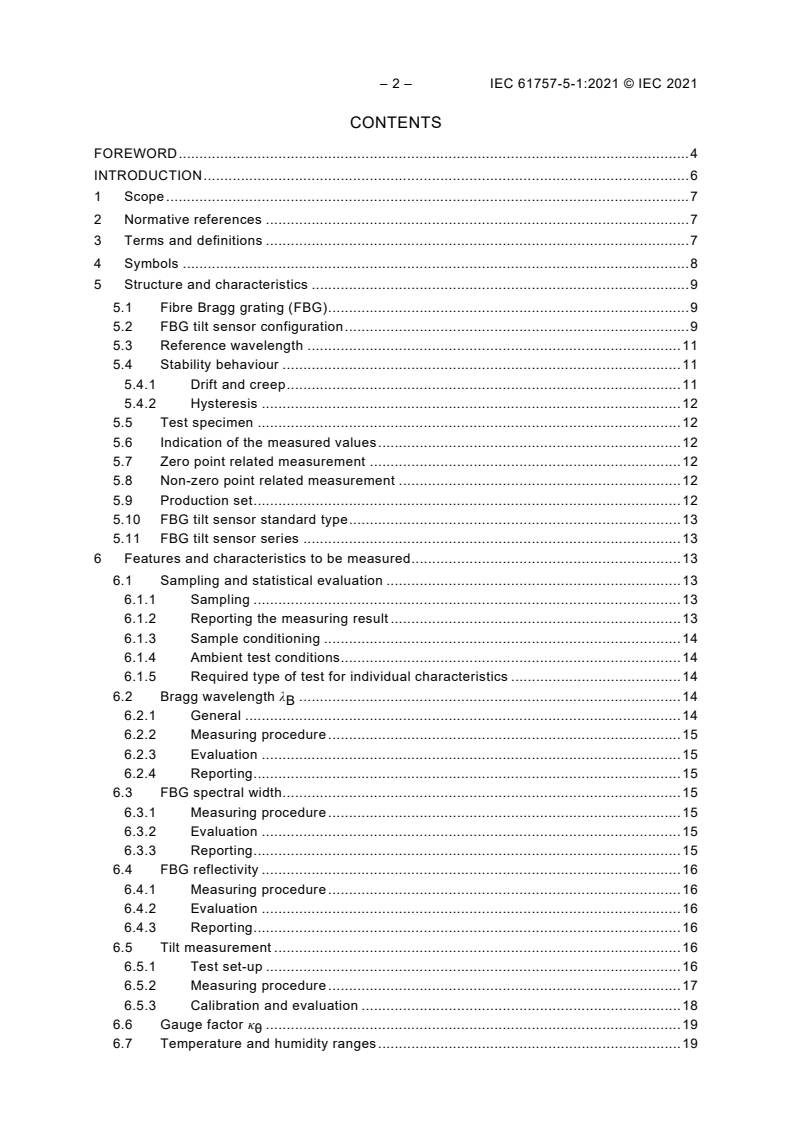
CONTENTS
FOREWORD . 4
INTRODUCTION . 6
1 Scope . 7
2 Normative references . 7
3 Terms and definitions . 7
4 Symbols . 8
5 Structure and characteristics . 9
5.1 Fibre Bragg grating (FBG) . 9
5.2 FBG tilt sensor configuration . 9
5.3 Reference wavelength . 11
5.4 Stability behaviour . 11
5.4.1 Drift and creep . 11
5.4.2 Hysteresis . 12
5.5 Test specimen . 12
5.6 Indication of the measured values . 12
5.7 Zero point related measurement . 12
5.8 Non-zero point related measurement . 12
5.9 Production set . 12
5.10 FBG tilt sensor standard type . 13
5.11 FBG tilt sensor series . 13
6 Features and characteristics to be measured . 13
6.1 Sampling and statistical evaluation . 13
6.1.1 Sampling . 13
6.1.2 Reporting the measuring result . 13
6.1.3 Sample conditioning . 14
6.1.4 Ambient test conditions . 14
6.1.5 Required type of test for individual characteristics . 14
6.2 Bragg wavelength λ . 14
Β
6.2.1 General . 14
6.2.2 Measuring procedure . 15
6.2.3 Evaluation . 15
6.2.4 Reporting . 15
6.3 FBG spectral width. 15
6.3.1 Measuring procedure . 15
6.3.2 Evaluation . 15
6.3.3 Reporting . 15
6.4 FBG reflectivity . 16
6.4.1 Measuring procedure . 16
6.4.2 Evaluation . 16
6.4.3 Reporting . 16
6.5 Tilt measurement . 16
6.5.1 Test set-up . 16
6.5.2 Measuring procedure . 17
6.5.3 Calibration and evaluation . 18
6.6 Gauge factor κ . 19
θ
6.7 Temperature and humidity ranges . 19
6.7.1 General . 19
6.7.2 Measuring procedure . 19
6.7.3 Evaluation . 20
6.7.4 Reporting . 20
7 Features and characteristics to be reported . 20
7.1 Construction details . 20
7.2 Configuration of the FBG tilt sensor . 20
7.3 Temperature and humidity range . 20
7.4 Connecting requirement . 20
8 Recommendations for use of FBG measuring instruments . 20
Figure 1 – Examples for measuring single axis tilt changes . 10
Figure 2 – Examples of Bragg wavelength change caused by tilt . 10
Figure 3 – Example of tilt sensor using FBG (schematic diagram) . 11
Figure 4 – Schematic diagram of tilt measurement system . 16
Figure 5 – Example of temperature dependence of the Bragg wavelengths of two
FBGs . 17
Figure 6 – Example of tilt dependence of the Bragg wavelengths of FBG1 and FBG2 . 18
Table 1 – Required type of test for individual characteristics . 14
– 4 – IEC 61757-5-1:2021 © IEC 2021
INTERNATIONAL ELECTROTECHNICAL COMMISSION
____________
FIBRE OPTIC SENSORS –
Part 5-1: Tilt measurement –
Tilt sensors based on fibre Bragg gratings
FOREWORD
1) The International Electrotechnical Commission (IEC) is a worldwide organization for standardization comprising
all national electrotechnical committees (IEC National Committees). The object of IEC is to promote
international co-operation on all questions concerning standardization in the electrical and electronic fields. To
this end and in addition to other activities, IEC publishes International Standards, Technical Specifications,
Technical Reports, Publicly Available Specifications (PAS) and Guides (hereafter referred to as “IEC
Publication(s)”). Their preparation is entrusted to technical committees; any IEC National Committee interested
in the subject dealt with may participate in this preparatory work. International, governmental and non-
governmental organizations liaising with the IEC also participate in this preparation. IEC collaborates closely
with the International Organization for Standardization (ISO) in accordance with conditions determined by
agreement between the two organizations.
2) The formal decisions or agreements of IEC on technical matters express, as nearly as possible, an international
consensus of opinion on the relevant subjects since each technical committee has representation from all
interested IEC National Committees.
3) IEC Publications have the form of recommendations for international use and are accepted by IEC National
Committees in that sense. While all reasonable efforts are made to ensure that the technical content of IEC
Publications is accurate, IEC cannot be held responsible for the way in which they are used or for any
misinterpretation by any end user.
4) In order to promote international uniformity, IEC National Committees undertake to apply IEC Publications
transparently to the maximum extent possible in their national and regional publications. Any divergence
between any IEC Publication and the corresponding national or regional publication shall be clearly indicated in
the latter.
5) IEC itself does not provide any attestation of conformity. Independent certification bodies provide conformity
assessment services and, in some areas, access to IEC marks of conformity. IEC is not responsible for any
services carried out by independent certification bodies.
6) All users should ensure that they have the latest edition of this publication.
7) No liability shall attach to IEC or its directors, employees, servants or agents including individual experts and
members of its technical committees and IEC National Committees for any personal injury, property damage or
other damage of any nature whatsoever, whether direct or indirect, or for costs (including legal fees) and
expenses arising out of the publication, use of, or reliance upon, this IEC Publication or any other IEC
Publications.
8) Attention is drawn to the Normative references cited in this publication. Use of the referenced publications is
indispensable for the correct application of this publication.
9) Attention is drawn to the possibility that some of the elements of this IEC Publication may be the subject of
patent rights. IEC shall not be held responsible for identifying any or all such patent rights.
IEC 61757-5-1 has been prepared by subcommittee 86C: Fibre optic systems and active
devices, of IEC technical committee TC86: Fibre optics. It is an International Standard.
The text of this International Standard is based on the following documents:
Draft Report on voting
86C/1699/CDV 86C/1718/RVC
Full information on the voting for its approval can be found in the report on voting indicated in
the above table.
The language used for the development of this International Standard is English.
This document was drafted in accordance with ISO/IEC Directives, Part 2, and developed in
accordance with ISO/IEC Directives, Part 1 and ISO/IEC Directives, IEC Supplement,
available at www.iec.ch/members_experts/refdocs. The main document types developed by
IEC are described in greater detail at www.iec.ch/standardsdev/publications.
A list of all parts in the IEC 61757 series, published under the general title Fibre optic sensors,
can be found on the IEC website.
The committee has decided that the contents of this document will remain unchanged until the
stability date indicated on the IEC website under webstore.iec.ch in the data related to the
specific document. At this date, the document will be
• reconfirmed,
• withdrawn,
• replaced by a revised edition, or
• amended.
– 6 – IEC 61757-5-1:2021 © IEC 2021
INTRODUCTION
The IEC 61757 series is published with the following logic: the sub-parts are numbered as
IEC 61757-M-T, where M denotes the measure and T, the technology.
FIBRE OPTIC SENSORS –
Part 5-1: Tilt measurement –
Tilt sensors based on fibre Bragg gratings
1 Scope
This part of IEC 61757 defines the terminology, structure, characteristics and their
measurement method including the procedures, for an optical tilt sensor based on fibre Bragg
gratings (FBGs) as the sensitive element.
2 Normative references
The following documents are referred to in the text in such a way that some or all of their
content constitutes requirements of this document. For dated references, only the edition
cited applies. For undated references, the latest edition of the referenced document (including
any amendments) applies.
IEC 60050 (all parts), International Electrotechnical Vocabulary (IEV) (available at
www.electropedia.org)
IEC 60068-2 (all parts), Environmental testing – Part 2X: Tests
IEC 61300-2 (all parts), Fibre optic interconnecting devices and passive components – Basic
test and measurement procedures – Part 2X: Tests
IEC 61754 (all parts), Fibre optic interconnecting devices and passive components – Fibre
optic connector interfaces
IEC 61757, Fibre optic sensors – Generic specification
IEC 61757-1-1:2020, Fibre optic sensors – Part 1-1: Strain measurement – Strain sensors
based on fibre Bragg gratings
IEC 62129-1, Calibration of wavelength/optical frequency measurement instruments – Part 1:
Optical spectrum analyzers
IEC 62129-2, Calibration of wavelength/optical frequency measurement instruments – Part 2:
Michelson interferometer single wavelength meters
IEC 62129-3, Calibration of wavelength/optical frequency measurement instruments – Part 3:
Optical frequency meters internally referenced to a frequency comb
ISO/IEC GUIDE 98-3, Uncertainty of measurement – Part 3: Guide to the expression of
uncertainty in measurement (GUM:1995)
3 Terms and definitions
For the purposes of this document, the terms and definitions given in IEC 61757,
IEC 61757-1-1, IEC 60050 (all parts) and the following apply.
– 8 – IEC 61757-5-1:2021 © IEC 2021
ISO and IEC maintain terminological databases for use in standardization at the following
addresses:
• ISO Online browsing platform: available at https://www.iso.org/obp
• IEC Electropedia: available at http://www.electropedia.org/
3.1
tilt
angle of rotation
for a point rotating around a fixed axis, quotient of the length travelled by the point, and the
distance from the point to the axis, taken positive or negative, according to whether the
rotation is observed to be in the counterclockwise sense or in the clockwise sense,
respectively, for an observer looking in the direction opposite to the direction of the axis
Note 1 to entry: Angle of rotation can take any real value, whereas the angle or plane angle defined in geometry
(see IEC 60050-102:2007, 102-04-14) is non-negative and restricted to the closed interval [0, π].
Note 2 to entry: The coherent SI unit of angle is radian (symbol rad). Other units accepted for use with the SI are
degree (symbol °), minute (symbol ′), and second (symbol ″): 1 ° = (π/180) rad, 1′ = (1/60) °, 1″ = (1/60)′.
[SOURCE: IEC 60050-113:2011, 113-01-43, modified – in the term, "oriented angle" has been
replaced with "tilt"]
3.2
FBG tilt sensor
fibre optic sensor that uses one or more fibre Bragg gratings as a sensitive element for tilt
measurements in either single axis or multiple axes
3.3
gauge factor
κ
θ
ratio of the relative change in wavelength Δλ/λ to a tilt change Δθ introduced to an FBG tilt
sensor and expressed by the gauge factor κ with a unit of 1/rad measured by the
θ
manufacturer, and expressed as:
Δλ
κ =
θ
λθΔ
Note 1 to entry: The gauge factor κ is used by manufacturers to express the tilt response of their products.
θ
Note 2 to entry: The gauge factor κ for an FBG tilt sensor assumes a linear characteristic. Considering the whole
θ
measurement system (sensor, device, cabling), it can be separately defined for the components of the
measurement system. It is only valid for defined conditions. In the case of a non-linear characteristic, the gauge
factor κ is considered as linear within a defined permissible error.
θ
3.4
temperature compensation constant
constant for correcting the influence of temperature changes when the tilt is obtained from the
wavelength changes
Note 1 to entry: The temperature compensation constant should be provided by the manufacturer.
4 Symbols
For the purposes of this document, the following symbols apply:
C temperature compensation constant
D displacement
Δθ tilt change
ΔT temperature change
κ gauge factor
θ
L length
Λ FBG period
λ Bragg wavelength
B
λ reference wavelength
5 Structure and characteristics
5.1 Fibre Bragg grating (FBG)
Fibre Bragg gratings are phase diffraction gratings inscribed into optical waveguides. They
are frequently produced using ultraviolet (UV) light (e.g. by an excimer laser at 248 nm). The
fibre is exposed to an interference pattern of this UV radiation. UV photosensitive processes
then produce changes in the refractive index of the fibre core which is susceptible to these.
The interference pattern is an image in the fibre core of a periodically changing refractive
index. Incident and transported light along the fibre is additively superposed for a certain
wavelength at these points (constructive interference); this spectral part of the incident light is
reflected. In the transmitted light, this wavelength (denoted Bragg wavelength λ ) is
Β
attenuated according to FBG reflectivity.
The value of the reflected Bragg wavelength λ is determined from the Bragg condition:
Β
λΛ=2⋅⋅n (1)
B eff
According to Formula (1), the Bragg wavelength λ of the FBG depends on the effective
Β
refractive index of the FBG and the FBG period Λ. The spectral width of the Bragg wavelength
peak is essentially determined by the number of grating periods and the magnitude of the
refractive index modulation (see IEC 61757-1-1:2020, 5.1).
5.2 FBG tilt sensor configuration
The FBG tilt sensor can be made of various materials and with various forms as a segment of
optical fibre with one or more FBG sensors (in the following denoted Bragg grating fibre). The
FBG tilt sensor is capable of measuring both absolute and relative tilt, but it is more suitable
for tilt monitoring using relative tilt changes. The reference axis for absolute tilt measurements
is the vertical axis.
If the sensor is tilted in such a way that the tilt changes the tensile force applied to the FBG
sensor, the tilt can be measured by measuring the reflected Bragg wavelength of the FBG
(see Figure 1a) and Figure 1b)). In the example of Figure 1a), the tilt change causes a change
in torque due to the repositioning of the weight, which in turn causes a change in the tensile
force applied to the FBG, resulting in a change in the FBG reflected wavelength (see
Figure 2a), Figure 2b) and Figure 2c)). The method used to convert a tilt change into a
change of the Bragg wavelength is not part of this document and can be different depending
on the manufacturer.
– 10 – IEC 61757-5-1:2021 © IEC 2021
a) rotation type b) metal plate type
Figure 1 – Examples for measuring single axis tilt changes
a) no tilt b) clockwise tilt c) counterclockwise tilt
Figure 2 – Examples of Bragg wavelength change caused by tilt
A broadband source and a spectrometer are connected to the tilt sensing FBG by a circulator
as shown in Figure 3. An additional FBG (FBG1), placed in close proximity to the tilt sensing
FBG (FBG2), is used for temperature compensation, while FBG2 performs tilt measurements.
FBG1 and FBG2 can be connected in parallel or in series, as shown in Figure 3.
Figure 3 – Example of tilt sensor using FBG (schematic diagram)
5.3 Reference wavelength
Different evaluation methods and different devices result in different Bragg wavelengths being
measured for the same filter function of the FBG. In the context of this document, therefore,
the result of the wavelength measurement after installation of the FBG tilt sensor with the
specified device will be denoted as the reference wavelength λ .
The reference wavelength is not necessarily the same as the Bragg wavelength specified by
the manufacturer of the FBG. If the FBG is prestrained, for example, there is a difference
between the reference wavelength and the Bragg wavelength. If the FBG is not prestrained,
the difference between the reference wavelength and the Bragg wavelength is usually very
small, so that both wavelength values can be used without significant error.
If the reference wavelength is measured when the measurement cycle is started, this
wavelength measurement can be considered as the zero point measurement value.
5.4 Stability behaviour
5.4.1 Drift and creep
Stability, in general, is the ability of a measurement system to maintain its metrological
characteristics and meet other specifications over the intended time of operation. Stability, in
the context of this document, describes the property of the applied FBG tilt sensor to keep its
optical characteristics constant over a period of use determined by the objectives, or to show
only a small permissible deviation.
Variations in the measured value might occur:
– when the materials concerned are subject to long-term stress (creep);
– without loading stress (zero point drift).
This can be caused by the slow progress of chemical or physical degradation within the
materials used (e.g. ageing), or by a change in the initial physical conditions (e.g. temperature
or humidity).
Creep is a quantity that depends on the materials employed, the set-up of the sensor, and the
type of operation, and can only be determined experimentally. According to current
experience, the error contribution resulting from creep remains irrelevant within the scope of
, when the bonding material
the given uncertainty of measurement for the gauge factor κ
θ
prescribed by the manufacturer is used.
Drift is a slow change of the metrological characteristics of the measurement system. The drift
error of an FBG sensor is negligibly small, according to the state of the art; hence for this
document, no further specification is required. However, if drifts are generated by a modified
production process, for example, or by applying inadequate recoating material, the drift
should be stated.
– 12 – IEC 61757-5-1:2021 © IEC 2021
5.4.2 Hysteresis
Hysteresis in material science describes a particular material behaviour whereby the material
does not return to its original state, or does so following a time delay, once the input load has
been removed. This means that the output value for an elasto-plastic deformation behaviour
does not depend only on the input value but also on rate-dependent processes.
When the tilt (or temperature) of a silica-based FBG changes, the Bragg wavelength
commonly shifts without showing a hysteresis effect. If hysteresis occurs for repeated or
cyclic conditions within the specified operation range of the sensor, the amount of hysteresis
should be described.
5.5 Test specimen
Test specimens are plates or other objects upon which the FBG tilt sensors are installed in
order to determine and verify their properties. The concept of a "standard test specimen" is
used in connection with calibration and testing. For the general description of measuring
procedures, the concept "object of measurement" is used.
5.6 Indication of the measured values
The variations in Bragg wavelength induced in the FBG are scanned by a connected
measuring device (measured values) and processed for metrological use (result of
measurement). Customarily, the measuring device supplies the optical input signal for the
sensor and also records the sensor response signal.
5.7 Zero point related measurement
The concepts of "zero point measurement" and “static or quasi-static measurement”,
respectively, are used to denote all measurements where the measured value refers to an
initial value (the zero point).
The following influencing factors shall also be considered:
– drift in the measuring instrument;
– method of evaluation:
different evaluation methods (using different measuring devices) can result in different
offset quantities with respect to the zero point. In case of replacement of the measuring
device, the zero point offset between the old and the new instrument should be
determined correspondingly;
– creep of the applied sensor.
The scanning procedure of the FBG tilt sensors shall take place in a route-neutral manner, so
that the characteristics of the connecting leads and of the optical connectors or splices do not
affect the zero point. Nevertheless, intermittent zero point checking is recommended.
5.8 Non-zero point related measurement
For non-zero point related or periodic dynamic measurements, the measured values are not
referred to a fixed initial value. This applies only to the amplitude measurement of a periodic
oscillation.
5.9 Production set
An FBG set is a batch of FBG produced in the same manufacturing process.
5.10 FBG tilt sensor standard type
An FBG tilt sensor standard type is a batch of FBG tilt sensors with identical physical
properties (geometrical dimensions, manufacturing process, materials used, post-processing,
and Bragg wavelength).
5.11 FBG tilt sensor series
A series is a batch of FBG tilt sensors for which the materials used and the manufacturing
processes are identical, but which can show differences in their Bragg wavelength or
dimensions.
6 Features and characteristics to be measured
6.1 Sampling and statistical evaluation
6.1.1 Sampling
6.1.1.1 General
The following sampling methods shall be used according to the intended scope of testing:
– random sampling;
– type testing;
– series testing;
– individual sample testing.
Many of the FBG tilt sensor properties can only be determined on an installed sensor. A
statistical evaluation shall be performed in this case. The number of sample sensors as well
as the date of evaluation should be noted.
6.1.1.2 Random sampling
The requirement for performing random sampling is the assumption that the variations of the
characteristic parameter follow a Gaussian distribution. All sensors chosen for characteristic
testing shall belong to the same production set. At least five samples shall be selected. The
result of a random sampling test is valid for one production set.
6.1.1.3 Type testing
The type test is a random sampling test as described in 6.1.2, whereby the result of testing of
at least five specimens of this type is declared valid for all production sets.
6.1.1.4 Series testing
The series test is a random sampling test as described in 6.1.2, whereby the result is
determined for a single specimen out of a sensor series and declared valid for the whole
series.
6.1.1.5 Individual sample testing
Each specimen of a sensor series or just a prototype of a unique FBG tilt sensor shall be
tested.
6.1.2 Reporting the measuring result
The results of the series tests, type tests and random sampling tests are expressed as the
arithmetic mean value and the corresponding standard deviation. The form of the statement of
– 14 – IEC 61757-5-1:2021 © IEC 2021
the standard deviation shall be specified. Estimation of measurement uncertainty shall be
carried out according to ISO/IEC GUIDE 98-3.
If sensors X to X are tested, then the characteristic is quoted as the mean value x of the n
1 n
values x to x measured with the sensors.
1 n
n
xx=
(2)
∑ i
n
i=1
The standard deviation of the n measured values is given by:
n
1 2
s x− x (3)
( )
∑ i
n −1
i=1
6.1.3 Sample conditioning
The sensors selected for testing shall be allowed to reach equilibrium with the environment in
which the test shall be performed; exposure of at least 2 h to such environment should be
adopted.
6.1.4 Ambient test conditions
All tests shall be performed at specified temperature and relative humidity conditions; the
values of the parameters and their tolerance shall be reported. The recommended ambient
temperature is 15 °C to 35 °C, the recommended humidity is 25 % RH to 75 % RH, and the
recommended atmospheric pressure is 86 kPa to 106 kPa.
6.1.5 Required type of test for individual characteristics
The required tests for individual characteristics are given in Table 1.
Table 1 – Required type of test for individual characteristics
Design-specific features and characteristics Type of test
Operating temperature and humidity ranges Series test
Bragg wavelength Individual sample test
FBG spectral width Series test
Reflectivity Type test
FBG gauge factor Random sampling test
Temperature compensation constant Random sampling test
6.2 Bragg wavelength λ
Β
6.2.1 General
The following characteristics of an FBG spectrum shall be measured as requested by this
document or upon request of the customer:
– peak of Bragg wavelength in nm;
=
– FBG spectral width in nm;
– FBG reflectivity in %;
– relative side-lobe level (also called side-lobe suppression ratio) in dB;
– FBG signal-to-noise ratio (SNR) in dB;
– Λ , Λ , first poles (minima) at the peak of the reflected Bragg wavelength.
+0 -0
6.2.2 Measuring procedure
For an FBG with relatively low reflectivity (R < 50 %), the Bragg wavelength shall be
FBG
measured in reflection. For an FBG with a higher reflectivity (R > 90 %), on the other hand,
FBG
the Bragg wavelength shall be measured in transmission, because the maximum of the
reflected Bragg wavelength becomes progressively more difficult to determine accurately.
Therefore, the transmission minimum shall be used for measuring the Bragg wavelength. For
intermediate values of reflectivity, either configuration can be used.
Alternatively, in case of a symmetrical spectral response, the Bragg wavelength shall be
calculated as the arithmetic mean between the two points of the 3 dB drop-off.
The Bragg wavelength of the FBG shall be measured with sufficient spectral resolution and
reported. The measurement method used and the corresponding uncertainty (spectral
resolution) should be reported. In case of polarization effects, special measurements have to
be carried out.
6.2.3 Evaluation
No particular evaluation is necessary.
6.2.4 Reporting
The measured or calculated Bragg wavelength and the measurement procedure shall be
reported. If requested by the customer, the typical FBG spectrum shall also be reported.
6.3 FBG spectral width
6.3.1 Measuring procedure
The FBG spectrum of the FBG tilt sensor shall be measured with sufficient spectral resolution.
The constancy of the spectral width impacts the measurement uncertainty when using
mathematical evaluation principles for determining the Bragg wavelength. The spectral width
can be affected by different influencing quantities, for example by temperature, maximum
possible tilt, and continuous oscillation behaviour.
6.3.2 Evaluation
The measured FBG spectrum shall be evaluated according to the definition. The spectral
width shall be determined from a reflection spectrum, whereby the difference of the two
wavelength values at the 3 dB drop-off is taken from both sides of the reflection maximum.
Alternatively, the transmission spectrum shall be used to determine the Bragg wavelength
using an appropriate spectrum evaluation.
6.3.3 Reporting
The typical spectral width shall be reported. If requested by the customer, the FBG spectrum
shall also be reported.
– 16 – IEC 61757-5-1:2021 © IEC 2021
6.4 FBG reflectivity
6.4.1 Measuring procedure
The FBG spectrum of the FBG tilt sensor shall be measured with sufficient spectral resolution.
6.4.2 Evaluation
The measured FBG spectrum shall be evaluated according to the definition (see
IEC 61757-1-1:2020, 3.5):
P
FBG
R ×100 %
(4)
FBG
P
PP−
0 λ
Β
R ×100 %
(5)
FBG
P
6.4.3 Reporting
The typical reflectivity shall be reported. If requested by the customer, the FBG spectrum shall
also be reported.
6.5 Tilt measurement
6.5.1 Test set-up
Place the tilt measurement system on the surface plate of a test bed consisting of two solid
metal plates (see Figure 4), and fix the tilt sensor so that it does not slip. The sensor under
test shall be well aligned, and the tilt axis fixed to the bed shall be the same as the tilting
direction of the sensor to be characterized. When adjusting the tilt knob to increase the angle,
the value D in Figure 4 should be accurately measured with a calibrated ruler or vernier
calipers. An optical fibre is used to connect FBG1 and FBG2 of the tilt sensor to the
interrogator for temperature measurement and tilt measurement.
Figure 4 – Schematic diagram of tilt measurement system
The tilt angle θ of the tilt sensor is calculated by Formula (6):
180 D
-1
θ ⋅tan (6)
π L
=
=
=
where
D is the displacement of the surface plate at the tilt knob, as shown in Figure 4;
L is the distance between the tilt axis and the displacement of the surface plate at the tilt
knob;
the unit of the tilt angle is degrees.
6.5.2 Measuring procedure
To compensate for the temperature dependence of the Bragg wavelength of the tilt sensor, an
additional temperature-measuring FBG (FBG1) is placed close to the tilt-measuring FBG
(FBG2) in the tilt sensor (see Figure 3). The temperature-dependence of the FBG is evaluated
by measuring the Bragg wavelengths of FBG1 and FBG2 as a function of temperature, as
shown in Figure 5, without changing the tilt of the sensor. The slopes of the two curves, m
and m (obtained by linear fitting), are usually different, but their relationship can be described
by m = C m , where C is a calibration constant, which varies from sample to sample. The
2 1
smallest measurement error is usually obtained when C is close to 1. In order to improve the
measurement accuracy, it is desirable to remain vibration-free at the moment of measurement.
Figure 5 – Example of temperature dependence
of the Bragg wavelengths of two FBGs
After the calibration constant C is obtained, the tilt sensor is taken out of the environmental
chamber for the tilt test (see Figure 4). After recording an initial value for the Bragg
wavelengths of FBG1 and FBG2, turn the tilt adjustment knob to increase the angle by a
certain amount and record the reflected Bragg wavelengths of FBG1 and FBG2 at the new
angle. Repeat these measurements at other tilt angles and increase the tilt up to the sensor
specification. These measurements yield a relationship between tilt and wavelength change,
as shown in Figure 6. It is recommended to repeat these measurements three or more times
to obtain accurate average values for the whole range of tilt angles. Tilt tests are required to
be conducted in a steady temperature and humidity environment.
– 18 – IEC 61757-5-1:2021 © IEC 2021
Figure 6 – Example of tilt dependence of the Bragg wavelengths of FBG1 and FBG2
6.5.3 Calibration and evaluation
Δλ Δλ
The wavelength changes and obtained from the FBG1 and FBG2 are due to the
1 2
angle change and the temperature change and thus have the following relationship:
Δλθa ΔΔ+ bT
11 1
Δλθa ΔΔ+ bT
(7)
22 2
Since the wavelength change of the FGB1 is independent of the change in tilt, assuming
a = 0 , the tilt change can be expressed as:
Δθ = ΔΔλ −⋅C λ
( ) (8)
κ
θ
where,
κ = a is the gauge factor;
θ 2
bm
C
is the temperature compensation constant.
bm
The wavelength change for the tilt change, the wavelength change for the temperature
change, and the measurement procedure shall be reported.
If a tilt sensor of the metal plate type employs two FBGs, as shown in Figure 1b), it is not
necessary to compensate for the temperature dependence of the Bragg wavelength, because
the temperature-induced wavelength changes will be same in FBG1 and FBG2.
==
=
=
6.6 Gauge factor κ
θ
is introduced as a linear approximate for practical use. In concrete terms,
The gauge factor κ
θ
the tilt sensitivity of any tilt sensor does not need to be linear but can deviate from a linear
function. For an easy statement of the tilt measurement result, the gauge factor is used under
defined conditions. The use of the gauge factor has been established in past decades.
Manufacturers provide it for their tilt sensor products and define for specified application
conditions an uncertainty for which the gauge factor is valid. The manufacturer has to ensure
the stability of the gauge factor for all specified conditions and that all specified environmental
and long-term influences on the tilt sensitivity are within the uncertainty band of the gauge
factor. Together with the gauge factor, the manufacturer should also provide the temperature
compensation constant.
6.7 Temperature and humidity ranges
6.7.1 G
...