

IEC 61757-1-2:2023
(Main)Fibre optic sensors - Part 1-2: Strain measurement - Distributed sensing based on Brillouin scattering
General Information
- Abstract
IEC 61757-1-2: 2023 defines detailed specifications for distributed strain measurements with a fibre optic sensor, also known as "fibre optic distributed strain sensing". It is applicable to distributed strain sensing systems (DSS) based on spontaneous or stimulated Brillouin scattering in the optical fibre sensor (strain sensitive element), that is, to sensors capable of measuring absolute strain. This document specifies the most important DSS performance parameters and defines the procedures for their determination.
- Status
- Published
- Publication Date
- 15-Aug-2023
- Technical Committee
- SC 86C - Fibre optic systems, sensing and active devices
- Drafting Committee
- WG 2 - TC 86/SC 86C/WG 2
- Current Stage
- PPUB - Publication issued
- Start Date
- 16-Aug-2023
- Completion Date
- 15-Sep-2023

Overview
IEC 61757-1-2:2023 defines the specifications for distributed strain measurement using fibre optic sensors based on Brillouin scattering. As part of the internationally recognized IEC 61757 series, this standard targets distributed strain sensing systems (DSS) that leverage spontaneous or stimulated Brillouin scattering to measure absolute strain along optical fibers. By establishing key performance parameters and standardized measurement procedures, IEC 61757-1-2:2023 enables consistent evaluation, documentation, and deployment of advanced fibre optic strain sensing solutions.
Key Topics
- Distributed Fibre Optic Strain Sensing: Systems that utilize optical fibers connected to an interrogation unit to provide spatially resolved, continuous strain measurements along the sensor length.
- Brillouin Scattering: The underpinning technology for DSS, using either spontaneous or stimulated scattering effects to determine strain distribution.
- Performance Parameters:
- Strain measurement error
- Spatial resolution
- Strain repeatability
- Spatial strain uncertainty
- Warm-up time
- System performance under varying attenuation
- Test Setups: Requirements for general setups, including the use of temperature chambers, fiber configurations (single-ended and loop), and appropriate calibration tools.
- Documentation Protocols: Comprehensive recording of measurement and setup details to ensure traceability and repeatability.
- Measurement Procedures: Step-by-step guidelines for determining each DSS performance characteristic under controlled environmental and operational conditions.
Applications
IEC 61757-1-2:2023 is highly relevant for industries and applications where precise, long-range monitoring of structural strain is critical. Common use cases include:
- Civil Infrastructure: Continuous monitoring of bridges, tunnels, dams, and buildings for structural health, detecting deformation or potential failure points.
- Energy Sector: Surveillance of pipelines, wind turbines, and power plants to identify strain-induced anomalies that could impact safety and efficiency.
- Geotechnical Engineering: Subsurface strain monitoring in landslide-prone or seismically active regions.
- Industrial Environments: Smart manufacturing lines and mechanical systems where real-time strain metrics enable predictive maintenance and process optimization.
The standardized approach ensures interoperability, reliability, and accuracy, which are essential for regulatory compliance and operational safety in these critical sectors.
Related Standards
For organizations seeking to implement or expand their use of fibre optic sensor technology, the following related IEC standards provide valuable additional guidance:
- IEC 61757:2018 - Generic specification for fibre optic sensors
- IEC 61757-2-2:2016 - Temperature measurement with distributed sensing
- IEC 61757-3-2:2022 - Acoustic sensing and vibration measurement
- IEC 60869-1 - Fibre optic passive power control devices
- ISO/IEC Guide 98-3 - Guide to the expression of uncertainty in measurement (GUM)
Incorporating these standards supports a robust, cohesive approach to sensing solutions for both new and existing infrastructure and technology deployments.
By adhering to IEC 61757-1-2:2023, industry stakeholders benefit from harmonized terminology, proven methodologies, and clearly defined performance benchmarks, aiding in the reliable selection, deployment, and management of fibre optic distributed strain sensing systems based on Brillouin scattering.
Get Certified
Connect with accredited certification bodies for this standard

ANCE
Mexican certification and testing association.

Intertek Slovenia
Intertek testing, inspection, and certification services in Slovenia.

LNE (Laboratoire National de Métrologie et d'Essais)
French national laboratory for metrology and testing.
Sponsored listings
Frequently Asked Questions
IEC 61757-1-2:2023 is a standard published by the International Electrotechnical Commission (IEC). Its full title is "Fibre optic sensors - Part 1-2: Strain measurement - Distributed sensing based on Brillouin scattering". This standard covers: IEC 61757-1-2: 2023 defines detailed specifications for distributed strain measurements with a fibre optic sensor, also known as "fibre optic distributed strain sensing". It is applicable to distributed strain sensing systems (DSS) based on spontaneous or stimulated Brillouin scattering in the optical fibre sensor (strain sensitive element), that is, to sensors capable of measuring absolute strain. This document specifies the most important DSS performance parameters and defines the procedures for their determination.
IEC 61757-1-2: 2023 defines detailed specifications for distributed strain measurements with a fibre optic sensor, also known as "fibre optic distributed strain sensing". It is applicable to distributed strain sensing systems (DSS) based on spontaneous or stimulated Brillouin scattering in the optical fibre sensor (strain sensitive element), that is, to sensors capable of measuring absolute strain. This document specifies the most important DSS performance parameters and defines the procedures for their determination.
IEC 61757-1-2:2023 is classified under the following ICS (International Classification for Standards) categories: 33.180.99 - Other fibre optic equipment. The ICS classification helps identify the subject area and facilitates finding related standards.
IEC 61757-1-2:2023 is available in PDF format for immediate download after purchase. The document can be added to your cart and obtained through the secure checkout process. Digital delivery ensures instant access to the complete standard document.
Standards Content (Sample)
IEC 61757-1-2 ®
Edition 1.0 2023-08
INTERNATIONAL
STANDARD
NORME
INTERNATIONALE
colour
inside
Fibre optic sensors –
Part 1-2: Strain measurement – Distributed sensing based on Brillouin scattering
Capteurs fibroniques –
Partie 1-2: Mesure de déformation – Détection répartie basée sur la diffusion de
Brillouin
All rights reserved. Unless otherwise specified, no part of this publication may be reproduced or utilized in any form
or by any means, electronic or mechanical, including photocopying and microfilm, without permission in writing from
either IEC or IEC's member National Committee in the country of the requester. If you have any questions about IEC
copyright or have an enquiry about obtaining additional rights to this publication, please contact the address below or
your local IEC member National Committee for further information.
Droits de reproduction réservés. Sauf indication contraire, aucune partie de cette publication ne peut être reproduite ni
utilisée sous quelque forme que ce soit et par aucun procédé, électronique ou mécanique, y compris la photocopie et
les microfilms, sans l'accord écrit de l'IEC ou du Comité national de l'IEC du pays du demandeur. Si vous avez des
questions sur le copyright de l'IEC ou si vous désirez obtenir des droits supplémentaires sur cette publication, utilisez
les coordonnées ci-après ou contactez le Comité national de l'IEC de votre pays de résidence.
IEC Secretariat Tel.: +41 22 919 02 11
3, rue de Varembé info@iec.ch
CH-1211 Geneva 20 www.iec.ch
Switzerland
About the IEC
The International Electrotechnical Commission (IEC) is the leading global organization that prepares and publishes
International Standards for all electrical, electronic and related technologies.
About IEC publications
The technical content of IEC publications is kept under constant review by the IEC. Please make sure that you have the
latest edition, a corrigendum or an amendment might have been published.
IEC publications search - webstore.iec.ch/advsearchform IEC Products & Services Portal - products.iec.ch
The advanced search enables to find IEC publications by a Discover our powerful search engine and read freely all the
variety of criteria (reference number, text, technical publications previews. With a subscription you will always have
committee, …). It also gives information on projects, replaced access to up to date content tailored to your needs.
and withdrawn publications.
Electropedia - www.electropedia.org
IEC Just Published - webstore.iec.ch/justpublished
The world's leading online dictionary on electrotechnology,
Stay up to date on all new IEC publications. Just Published
containing more than 22 300 terminological entries in English
details all new publications released. Available online and once
and French, with equivalent terms in 19 additional languages.
a month by email.
Also known as the International Electrotechnical Vocabulary
(IEV) online.
IEC Customer Service Centre - webstore.iec.ch/csc
If you wish to give us your feedback on this publication or need
further assistance, please contact the Customer Service
Centre: sales@iec.ch.
A propos de l'IEC
La Commission Electrotechnique Internationale (IEC) est la première organisation mondiale qui élabore et publie des
Normes internationales pour tout ce qui a trait à l'électricité, à l'électronique et aux technologies apparentées.
A propos des publications IEC
Le contenu technique des publications IEC est constamment revu. Veuillez vous assurer que vous possédez l’édition la
plus récente, un corrigendum ou amendement peut avoir été publié.
Recherche de publications IEC - IEC Products & Services Portal - products.iec.ch
webstore.iec.ch/advsearchform Découvrez notre puissant moteur de recherche et consultez
La recherche avancée permet de trouver des publications IEC gratuitement tous les aperçus des publications. Avec un
en utilisant différents critères (numéro de référence, texte, abonnement, vous aurez toujours accès à un contenu à jour
comité d’études, …). Elle donne aussi des informations sur les adapté à vos besoins.
projets et les publications remplacées ou retirées.
Electropedia - www.electropedia.org
IEC Just Published - webstore.iec.ch/justpublished
Le premier dictionnaire d'électrotechnologie en ligne au monde,
Restez informé sur les nouvelles publications IEC. Just
avec plus de 22 300 articles terminologiques en anglais et en
Published détaille les nouvelles publications parues.
français, ainsi que les termes équivalents dans 19 langues
Disponible en ligne et une fois par mois par email.
additionnelles. Egalement appelé Vocabulaire
Electrotechnique International (IEV) en ligne.
Service Clients - webstore.iec.ch/csc
Si vous désirez nous donner des commentaires sur cette
publication ou si vous avez des questions contactez-nous:
sales@iec.ch.
IEC 61757-1-2 ®
Edition 1.0 2023-08
INTERNATIONAL
STANDARD
NORME
INTERNATIONALE
colour
inside
Fibre optic sensors –
Part 1-2: Strain measurement – Distributed sensing based on Brillouin scattering
Capteurs fibroniques –
Partie 1-2: Mesure de déformation – Détection répartie basée sur la diffusion de
Brillouin
INTERNATIONAL
ELECTROTECHNICAL
COMMISSION
COMMISSION
ELECTROTECHNIQUE
INTERNATIONALE
ICS 33.180.99 ISBN 978-2-8322-7396-8
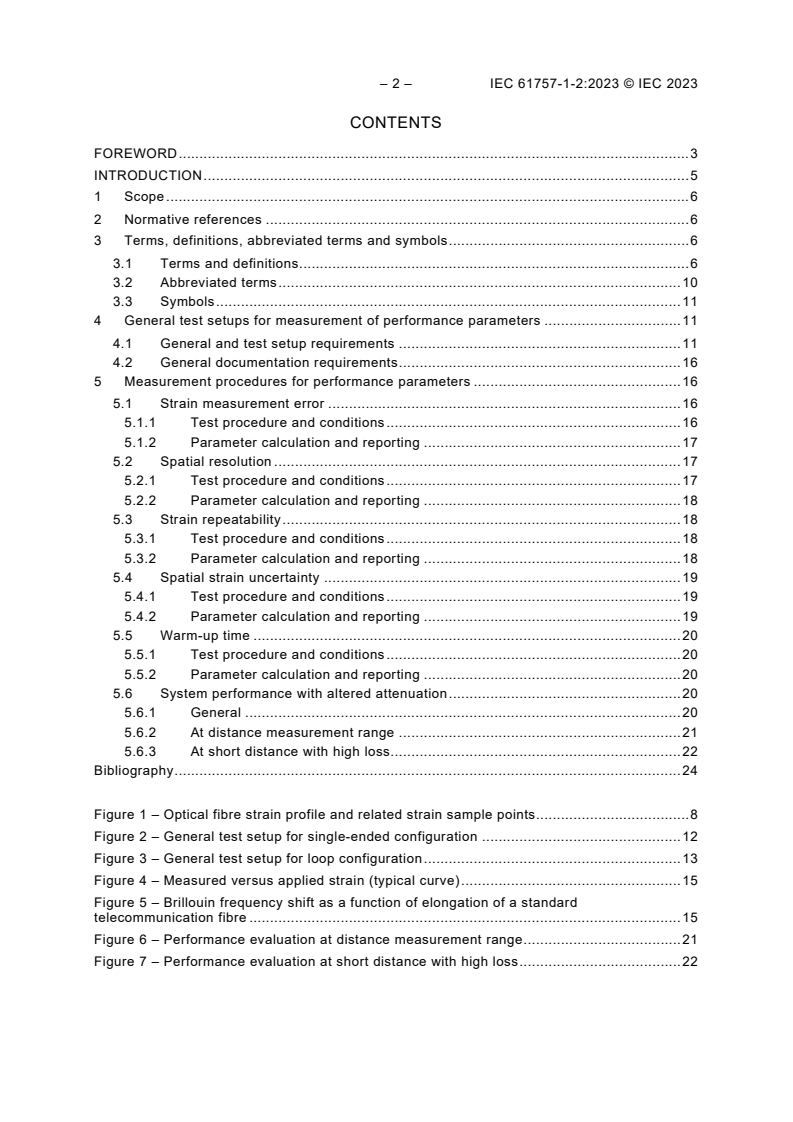
– 2 – IEC 61757-1-2:2023 © IEC 2023
CONTENTS
FOREWORD . 3
INTRODUCTION . 5
1 Scope . 6
2 Normative references . 6
3 Terms, definitions, abbreviated terms and symbols . 6
3.1 Terms and definitions . 6
3.2 Abbreviated terms . 10
3.3 Symbols . 11
4 General test setups for measurement of performance parameters . 11
4.1 General and test setup requirements . 11
4.2 General documentation requirements . 16
5 Measurement procedures for performance parameters . 16
5.1 Strain measurement error . 16
5.1.1 Test procedure and conditions . 16
5.1.2 Parameter calculation and reporting . 17
5.2 Spatial resolution . 17
5.2.1 Test procedure and conditions . 17
5.2.2 Parameter calculation and reporting . 18
5.3 Strain repeatability . 18
5.3.1 Test procedure and conditions . 18
5.3.2 Parameter calculation and reporting . 18
5.4 Spatial strain uncertainty . 19
5.4.1 Test procedure and conditions . 19
5.4.2 Parameter calculation and reporting . 19
5.5 Warm-up time . 20
5.5.1 Test procedure and conditions . 20
5.5.2 Parameter calculation and reporting . 20
5.6 System performance with altered attenuation . 20
5.6.1 General . 20
5.6.2 At distance measurement range . 21
5.6.3 At short distance with high loss. 22
Bibliography . 24
Figure 1 – Optical fibre strain profile and related strain sample points. 8
Figure 2 – General test setup for single-ended configuration . 12
Figure 3 – General test setup for loop configuration . 13
Figure 4 – Measured versus applied strain (typical curve) . 15
Figure 5 – Brillouin frequency shift as a function of elongation of a standard
telecommunication fibre . 15
Figure 6 – Performance evaluation at distance measurement range . 21
Figure 7 – Performance evaluation at short distance with high loss . 22
INTERNATIONAL ELECTROTECHNICAL COMMISSION
____________
FIBRE OPTIC SENSORS –
Part 1-2: Strain measurement –
Distributed sensing based on Brillouin scattering
FOREWORD
1) The International Electrotechnical Commission (IEC) is a worldwide organization for standardization comprising
all national electrotechnical committees (IEC National Committees). The object of IEC is to promote international
co-operation on all questions concerning standardization in the electrical and electronic fields. To this end and
in addition to other activities, IEC publishes International Standards, Technical Specifications, Technical Reports,
Publicly Available Specifications (PAS) and Guides (hereafter referred to as “IEC Publication(s)”). Their
preparation is entrusted to technical committees; any IEC National Committee interested in the subject dealt with
may participate in this preparatory work. International, governmental and non-governmental organizations liaising
with the IEC also participate in this preparation. IEC collaborates closely with the International Organization for
Standardization (ISO) in accordance with conditions determined by agreement between the two organizations.
2) The formal decisions or agreements of IEC on technical matters express, as nearly as possible, an international
consensus of opinion on the relevant subjects since each technical committee has representation from all
interested IEC National Committees.
3) IEC Publications have the form of recommendations for international use and are accepted by IEC National
Committees in that sense. While all reasonable efforts are made to ensure that the technical content of IEC
Publications is accurate, IEC cannot be held responsible for the way in which they are used or for any
misinterpretation by any end user.
4) In order to promote international uniformity, IEC National Committees undertake to apply IEC Publications
transparently to the maximum extent possible in their national and regional publications. Any divergence between
any IEC Publication and the corresponding national or regional publication shall be clearly indicated in the latter.
5) IEC itself does not provide any attestation of conformity. Independent certification bodies provide conformity
assessment services and, in some areas, access to IEC marks of conformity. IEC is not responsible for any
services carried out by independent certification bodies.
6) All users should ensure that they have the latest edition of this publication.
7) No liability shall attach to IEC or its directors, employees, servants or agents including individual experts and
members of its technical committees and IEC National Committees for any personal injury, property damage or
other damage of any nature whatsoever, whether direct or indirect, or for costs (including legal fees) and
expenses arising out of the publication, use of, or reliance upon, this IEC Publication or any other IEC
Publications.
8) Attention is drawn to the Normative references cited in this publication. Use of the referenced publications is
indispensable for the correct application of this publication.
9) IEC draws attention to the possibility that the implementation of this document may involve the use of (a)
patent(s). IEC takes no position concerning the evidence, validity or applicability of any claimed patent rights in
respect thereof. As of the date of publication of this document, IEC had not received notice of (a) patent(s), which
may be required to implement this document. However, implementers are cautioned that this may not represent
the latest information, which may be obtained from the patent database available at https://patents.iec.ch. IEC
shall not be held responsible for identifying any or all such patent rights.
IEC 61757-1-2 has been prepared by subcommittee 86C: Fibre optic systems and active
devices, of IEC technical committee 86: Fibre optics. It is an International Standard.
The text of this International Standard is based on the following documents:
Draft Report on voting
86C/1857/CDV 86C/1872/RVC
Full information on the voting for its approval can be found in the report on voting indicated in
the above table.
The language used for the development of this International Standard is English.
– 4 – IEC 61757-1-2:2023 © IEC 2023
This document was drafted in accordance with ISO/IEC Directives, Part 2, and developed in
accordance with ISO/IEC Directives, Part 1 and ISO/IEC Directives, IEC Supplement, available
at www.iec.ch/members_experts/refdocs. The main document types developed by IEC are
described in greater detail at www.iec.ch/publications.
A list of all parts in the IEC 61757 series, published under the general title Fibre optic sensors,
can be found on the IEC website.
The committee has decided that the contents of this document will remain unchanged until the
stability date indicated on the IEC website under webstore.iec.ch in the data related to the
specific document. At this date, the document will be
• reconfirmed,
• withdrawn, or
• revised.
IMPORTANT – The "colour inside" logo on the cover page of this document indicates
that it contains colours which are considered to be useful for the correct understanding
of its contents. Users should therefore print this document using a colour printer.
INTRODUCTION
This document is part of the IEC 61757 series, which is dedicated to fibre optic sensors. Generic
specifications for fibre optic sensors are defined in IEC 61757.
The individual parts of the IEC 61757 series are numbered as IEC 61757-M-T, where M denotes
the measure and T the technology of the fibre optic sensor. The IEC 61757-1-T series is
concerned with strain measurements.
– 6 – IEC 61757-1-2:2023 © IEC 2023
FIBRE OPTIC SENSORS –
Part 1-2: Strain measurement –
Distributed sensing based on Brillouin scattering
1 Scope
This part of IEC 61757 defines detailed specifications for distributed strain measurements with
a fibre optic sensor, also known as "fibre optic distributed strain sensing". It is applicable to
distributed strain sensing systems (DSS) based on spontaneous or stimulated Brillouin
scattering in the optical fibre sensor (strain sensitive element), that is, to sensors capable of
measuring absolute strain.
This document specifies the most important DSS performance parameters and defines the
procedures for their determination.
2 Normative references
The following documents are referred to in the text in such a way that some or all of their content
constitutes requirements of this document. For dated references, only the edition cited applies.
For undated references, the latest edition of the referenced document (including any
amendments) applies.
IEC 61757:2018, Fibre optic sensors – Generic specification
IEC 61757-2-2:2016, Fibre optic sensors – Part 2-2: Temperature measurement – Distributed
sensing
IEC 61757-3-2:2022, Fibre optic sensors – Part 3-2: Acoustic sensing and vibration
measurement – Distributed sensing
ISO/IEC Guide 98-3, Uncertainty of measurement – Part 3: Guide to the expression of
uncertainty in measurement (GUM:1995)
3 Terms, definitions, abbreviated terms and symbols
3.1 Terms and definitions
For the purposes of this document, the terms and definitions given in IEC 61757,
IEC 61757‑2‑2, IEC 61757-3-2, and the following apply.
ISO and IEC maintain terminology databases for use in standardization at the following
addresses:
• IEC Electropedia: available at https://www.electropedia.org/
• ISO Online browsing platform: available at https://www.iso.org/obp
NOTE For the following definitions, the relevant test procedures and parameters are defined in Clause 4.
3.1.1
distributed fibre optic strain sensing system
DSS
measurement set-up consisting of a distributed fibre optic sensor connected to an interrogation
unit, including processor, data archive, and user interface, which provides a spatially resolved
strain measurement
[SOURCE: IEC 61757-3-2:2022, 3.1.2, modified − adapted to distributed strain measurement]
3.1.2
distance measurement range
maximum distance from the DSS interrogation unit output connector along the fibre optic sensor
within which the DSS measures strain with specified measurement performance under defined
conditions
Note 1 to entry: Defined conditions are spatial resolution (3.1.8), spatial strain uncertainty (3.1.9) and measurement
time (3.1.5).
Note 2 to entry: This supporting parameter is closely related to the total accumulated optical loss (one way)
tolerated by the interrogation unit without affecting specified measurement performance. In test cases used to prove
or verify the reported specifications, the total fibre length shall be equal to or greater than the specified distance
measurement range, for the tolerated total accumulated optical loss.
Note 3 to entry: The distance measurement range is usually expressed in km.
Note 4 to entry: For fibre loop configurations, the distance measurement range is given by half the fibre length
between the output and input connector of the interrogation unit.
[SOURCE: IEC 61757-2-2:2016, 3.2, and ISO/IEC Guide 99:2007, 4.7, modified − adapted to
distributed strain measurement]
3.1.3
strained spot
ΔL
length of fibre optic sensor that experiences a small elongation (δL), which causes strain that
is significantly bigger than the strain repeatability of the interrogation unit and which is
confirmed by a reference strain measurement
Note 1 to entry: The applied strain ε is equal to (δL/ΔL).
Note 2 to entry: It is useful to define strain in με, where 1 με corresponds to a δL of 1 μm over a ΔL of 1 m.
[SOURCE: IEC 61757-2-2:2016, 3.6, modified − adapted to distributed strain measurement]
3.1.4
location
L
optical distance from the DSS interrogation unit output connector to a desired strain sample
point along the fibre optic sensor
Note 1 to entry: The farthest location from the DSS interrogation unit output connector for the particular test is
quantified as L km and is often chosen to be the same as the distance measurement range for purposes of
F,long
comparing the measurement results with quoted specifications.
Note 2 to entry: The location is usually expressed in km.
[SOURCE: IEC 61757-2-2:2016, 3.7, modified − adapted to distributed strain measurement]
– 8 – IEC 61757-1-2:2023 © IEC 2023
3.1.5
measurement time
time between independent strain measurements when making successive measurements on a
single fibre optic sensor
Note 1 to entry: Equivalently, it is the time interval between successive strain trace timestamps under these
conditions.
Note 2 to entry: This parameter includes acquisition time and processing time for the measured data. This
parameter is typically selectable by the user in some limited fashion. Multiple independent strain measurements may
be averaged together to provide an overall measurement time.
[SOURCE: IEC 61757-2-2:2016, 3.8, modified − adapted to distributed strain measurement]
3.1.6
point defect
local deviation of a fibre optic sensor from its nominal optical and mechanical properties
occurring at a single location, or over a length substantially less than the DSS spatial resolution
Note 1 to entry: The definition of a point defect encompasses a wide range of situations, which can produce similar
effects on the strain trace. Examples include
– a point loss, like a bad fibre splice,
– a back reflection (or return loss), as can be introduced by a fibre connector,
– a localized region of high loss, such as a bend or kink in the fibre, and
– a physical discontinuity in the fibre, like a splice between two fibres of different core diameters.
[SOURCE: IEC 61757-2-2:2016, 3.9, modified − adapted to distributed strain measurement]
3.1.7
sample spacing
distance between two consecutive strain sample points in a single strain trace
Note 1 to entry: Sample spacing can be a user-selectable parameter in the interrogation unit.
Note 2 to entry: The sample spacing is usually expressed in m.
Note 3 to entry: See Figure 1.
Figure 1 – Optical fibre strain profile and related strain sample points
[SOURCE: IEC 61757-2-2:2016, 3.11, modified − adapted to distributed strain measurement]
3.1.8
spatial resolution
smallest length of strain-affected fibre optic sensor for which a DSS can measure and confirm
the reference strain of a defined strained spot within the specified strain measurement error of
the DSS
Note 1 to entry: The spatial resolution is usually expressed in m.
[SOURCE: IEC 61757-2-2:2016, 3.12, modified − adapted to distributed strain measurement]
3.1.9
spatial strain uncertainty
uncertainty of the location of strain data in a single strain trace, expressed by twice the standard
deviation of a specified number of adjacent strain sample points, with the fibre optic sensor held
at constant strain and temperature
Note 1 to entry: Due to a potential cross-sensitivity of DSS to temperature, it can be necessary to stabilize the
temperature of the fibre optic sensor.
Note 2 to entry: The spatial strain uncertainty is usually expressed in units of με and noted as a tolerance
(e.g. ±xx με), where 1 με corresponds to a δL of 1 μm over a ΔL of 1 m.
[SOURCE: IEC 61757-2-2:2016, 3.13, modified − adapted to distributed strain measurement]
3.1.10
strain dead zone
limited zone of a strain trace, where the strain sample points deviate from the undisturbed parts
of the trace by a specified limit due to a point defect
Note 1 to entry: The strain dead zone is usually expressed in m.
[SOURCE: IEC 61757-2-2:2016, 3.14, modified − adapted to distributed strain measurement]
3.1.11
strain measurement error
maximum difference between a centred and uniformly weighted moving average of the
measured strain and a reference strain for all data points of the fibre optic sensor over the full
operating temperature range and all acquisition times
Note 1 to entry: Single value (worst case) is expressed like a tolerance in units of με (e.g. ±xx με).
Note 2 to entry: The number of elements used for the moving average is defined later in the document. In practical
applications, other methods of smoothing might be applicable.
[SOURCE: IEC 61757-2-2:2016, 3.15, modified − adapted to distributed strain measurement]
3.1.12
strain repeatability
precision of strain data based on repeated strain traces at a given location expressed by twice
the standard deviation of corresponding strain sample points in each strain trace, with the fibre
optic sensor held at constant strain and temperature
Note 1 to entry: The strain repeatability is expressed like a tolerance in units of με (e.g. ±xx με).
[SOURCE: IEC 61757-2-2:2016, 3.16, modified − adapted to distributed strain measurement]
– 10 – IEC 61757-1-2:2023 © IEC 2023
3.1.13
strain sample point
measured strain value associated with a single point at a known location along a fibre optic
sensor
Note 1 to entry: Due to signal averaging effects, the measured value represents the strain along a very small section
of the fibre optic sensor that includes the strain sample point.
Note 2 to entry: See Figure 1.
[SOURCE: IEC 61757-2-2:2016, 3.17, modified − adapted to distributed strain measurement]
3.1.14
strain trace
set of strain sample points distributed along a fibre optic sensor and spaced by the sample
spacing
Note 1 to entry: All sample points are associated with a common time of measurement, often called "trace
timestamp". The measured values represent the strain during a time period that includes the timestamp.
Note 2 to entry: All sample points in a strain trace are measured values produced by the DSS, and not interpolated
or smoothed values produced by subsequent processing outside the interrogation unit.
[SOURCE: IEC 61757-2-2:2016, 3.18, modified − adapted to distributed strain measurement]
3.1.15
total fibre length
L
F,tot
distance from the DSS interrogation unit output connector to the final end of the fibre optic
sensor
Note 1 to entry: The final end of the fibre optic sensor can be either a purposely cut or terminated end of the fibre,
physically located far from the interrogation unit (in a single-ended configuration), or the end of a loop consisting of
a connector that is connected to the same interrogation unit (in a loop configuration).
Note 2 to entry: This parameter is either equal to or greater than the distance measurement range and usually
expressed in km.
[SOURCE: IEC 61757-2-2:2016, 3.19, modified − adapted to distributed strain measurement]
3.1.16
warm-up time
duration between the instant after which the power supply of the DSS interrogation unit is
energized and the instant when the interrogation unit may be used as specified by the
manufacturer
Note 1 to entry: Warm-up time is usually expressed in seconds or minutes.
Note 2 to entry: The warm-up time helps to upload software and to stabilize operating temperatures of optical and
electronic components.
[SOURCE: IEC 60050-311:2001, 311-03-18, modified − adapted to distributed strain
measurement]
3.2 Abbreviated terms
DSS distributed fibre optic strain sensing system
FAT factory acceptance test
LVDT linear variable differential transformer
VOA variable optical attenuator
3.3 Symbols
A cross-sectional area
E Young’s modulus
F force
L optical distance from the output connector to a desired strain sample point
L , L fibre lengths
F,opt F,short
L , L fibre lengths
F,loop F,long
L total fibre length
F,tot
ΔL length of fibre optic sensor to be strained (strained spot)
δL small change in length of ΔL
N, n number of traces, number of data points
S standard deviation
T temperature
T , T , T minimum, typical, and maximum DSS operating temperature
low op high
T ambient operating temperature of the strain test section
STC
ε strain
ε strain repeatability
rep
ε spatial strain uncertainty
unc
σ stress
4 General test setups for measurement of performance parameters
4.1 General and test setup requirements
General test setups for single-ended and loop configurations are schematically shown in
Figure 2 and Figure 3, respectively. The aim of these setups is to provide a common base for
determining the measurement specifications while at the same time minimizing complexity, cost,
reconfiguration requirements, and test execution time. Temperature stabilisation is used to
avoid crosstalk from temperature.
– 12 – IEC 61757-1-2:2023 © IEC 2023
Key
1 temperature-controlled encasement (e.g. temperature chamber)
2 DSS interrogation unit
3 DSS interrogation unit output connector
4 fibre fusion splice
5 optional variable optical attenuator
6 optional long fibre length L (normal spool)
F,opt
7 temperature-controlled environment for stable ambient conditions
8 long fibre length L (loose and strain free wound)
F,long
9 strain test section with temperature-controlled environment for stable ambient conditions
10 fixed fibre clamping unit
11 movable fibre clamping unit
12 short fibre length L (loose wound), longer than 5 times the spatial resolution
F,short
13 fibre termination
Figure 2 – General test setup for single-ended configuration
Key
1 temperature-controlled encasement (e.g. temperature chamber)
2 DSS interrogation unit
3 DSS interrogation unit output connector
4 fibre fusion splice
5 optional variable optical attenuator
(normal spool)
6 optional long fibre length L
F,opt
7 temperature-controlled environment for stable ambient conditions
(loose and strain free wound)
8 long fibre length L
F,long
9 strain test section with temperature-controlled environment for stable ambient conditions
10 fixed fibre clamping unit
11 movable fibre clamping unit
12 long fibre length L (loose wound), longer than 5 times the spatial resolution
F,short
13 long fibre length L (normal spool), with L > (L + L + ΔL + L )
F,loop F,loop F,opt F,long F,short
14 DSS interrogation unit input connector
Figure 3 – General test setup for loop configuration
The temperature-controlled encasement containing the DSS interrogation unit shall provide a
steady temperature, for an extended period of time, within the temperature operating range
(T ≤ T ≤ T ) of the device under test. It is recommended to use commercial off-the-shelf
low op high
temperature chambers for determining the performance parameters. Minimum requirements for
such a device are:
– minimum and maximum temperature shall exceed the minimal and maximal operating
temperature of the interrogation unit under test;
– temperature variation in time (steady state): less than (±0,5 °C);
– temperature homogeneity in volume: less than (±1,5 °C).
For the optical power adjustment, a calibrated optical attenuator or an optical attenuator that
can be self-calibrated shall be used. Recommendations for a variable optical attenuator are:
– calibrated for the wavelength of operation (or self-calibrated with a power meter);
– variable attenuation range from 2 dB to 6 dB;
– resolution of attenuation setting as needed, assumed to be accurate within 0,1 dB.
– 14 – IEC 61757-1-2:2023 © IEC 2023
It is also acceptable to use calibrated fixed attenuators. More information on fibre optic passive
power control devices can be found in IEC 60869-1.
The strain test section shall reproducibly provide different levels of constant strain of the optical
sensor fibre length ΔL. A commercially available single-mode fibre shall be used as the optical
sensor fibre. The fibre strain shall be monitored and measured with suitable measuring
instruments. Suitable measuring instruments are, for example, a laser interferometric length
measuring system or a linear variable differential transformer (LVDT) to determine the fibre
elongation. If Young’s modulus of the fibre is known, a force transducer may be used to measure
the pulling force, from which the strain can be calculated using Formula (1). No interfering
influences (for example, due to high compressive load or slipping) on the strain measurement
shall be caused by fibre clamping. Minimum requirements for the strain test section are:
– minimum length of fibre optic sensor ΔL to be strained: ΔL > (3 × spatial resolution);
– fibre strain to be obtained: 0,3 % ≤ ε ≤ 1 %.
NOTE When determining the performance of the DSS interrogation unit with a dedicated sensor cable, one can first
determine the DSS performance with a regular single-mode fibre and then repeat the measurement with the sensor
cable instead of the regular single-mode fibre.
For strain measurements at relatively long distances L (e.g. 50 km), the spatial resolution
F,tot
can be in the order of several meters (e.g. 2 m to 3 m), so that the strain test section would
have to be fairly long (e.g. 6 m to 9 m). In such cases, strain and repeatability measurements
may be performed at different fibre lengths L , where the strain measurement is performed
F,long
with a short fibre of less than 5 km length, and the repeatability is measured without externally
applied strain at the original length L .
F,long
The strain test section and the entire fibre length of the sensor shall be operated at stable
= (23 ± 0,5) °C and (55 ± 10) % RH).
ambient conditions (recommended T
STC
The sensing fibre of length L or fibre sections of sufficient length shall be installed and
F,long
operated without any permanent strain applied.
In a horizontal setup of the strain test section, the fibre weight can cause some sagging, which
should be negligible (mainly less than the resolution of the interrogation unit). When strain is
applied to the sagging fibre by increasing ΔL, the fibre first becomes straight with increasing
displacement δL before the measured strain increases linearly with applied strain. Zero strain
shall be defined by the intersection of a linear fit of the measured versus applied strain curve
with the X-axis, as shown in Figure 4. The corresponding length ΔL shall be used as a
reference for strain calculation.
Figure 4 shows a typical curve of measured strain versus applied strain resulting from a
combination of displacement and strain. When the measured strain is expressed in the physical
quantity measured by the interrogation unit (for instance, the frequency shift in a Brillouin based
system), the slope of the linear fit corresponds to the calibration coefficient of the interrogation
unit, as shown in the example of Figure 5.
Figure 4 – Measured versus applied strain (typical curve)
Figure 5 – Brillouin frequency shift as a function of elongation
of a standard telecommunication fibre
As an alternative to the horizontal setup of the strain test section, a vertical setup with several
different weights can be used as the loading mechanism.
The fibre strain ε can be calculated from Formula (1).
F
σ E ε (1)
A
where
σ is the stress;
ε is the fibre strain;
E is Young’s modulus of the fibre;
F is the force applied to the fibre by the weight (or the pulling force);
A is the cross-sectional area of the fibre.
==
– 16 – IEC 61757-1-2:2023 © IEC 2023
The measurement uncertainty shall be estimated according to ISO/IEC Guide 98-3.
The DSS interrogator and any additional measuring equipment used (for example, temperature
sensors, high resolution reference length measuring system, or VOA) shall be calibrated prior
to testing in accordance with the manufacturer's recommendations, if they have no valid
calibration.
4.2 General documentation requirements
The general required information to be documented is as follows:
– completion date of all testing;
– name of the organization executing the testing;
– names of the persons carrying out the tests;
– test setup configuration;
– strain test section configuration;
– operating mode of the DSS interrogation unit (single-ended or loop configuration as shown
in Figure 2 and Figure 3, or channel(s) tested in case of a multi-channel system using the
same hardware);
– wavelength(s) of the launched signals [operating wavelength(s)];
– manufacturer, model, and serial number of the DSS interrogation unit;
– manufacturer, model, and serial number of the VOA;
– manufacturer, model, and serial number of the high-resolution reference length measuring
system (if applicable);
– manufacturer of the optical fibre and specified characteristics of the optical fibre;
;
– optical loss (one-way) of the optical setup to the end of L
F,short
– wavelength used to measure the loss to the end of the sensor;
– distance measurement range of the DSS interrogation unit;
– sample spacing used for all measurements;
– spatial resolution setting used for all measurements;
– number of measurements and measurement time used during DSS calibration;
– lengths of fibres L , L , L , and L (if applicable);
F,short F,long F,opt F,loop
– length of strain test section ΔL;
– strain level applied to sensor;
– maximum (T ) and minimum (T ) operating temperature limits of the DSS interrogation
high low
unit.
The required information for the tested DSS and the associated test setup shall be recorded
along with the calculated measurement specifications.
5 Measurement procedures for performance parameters
5.1 Strain measurement error
5.1.1 Test procedure and conditions
The following steps shall be performed.
a) Use a general test setup as described in 4.1 for the specific DSS interrogation unit
configuration under test.
b) Adjust the fibre length L , the length of strain test section ΔL, and the fibre length L
F,long F,opt
as specified in 4.1 and quoted for the specific DSS to be tested.
c) Place the DSS interrogation unit in a temperature chamber and stabilize the temperature at
the designated operating temperature T ± 0,5 °C. The designated operating temperature
op
shall be agreed upon by the manufacturer and the customer. Allow the unit sufficient time
to warm up before performing the following steps, so as to reach thermal equilibrium with
the environment in accordance with the manufacturer's recommendations (e.g. warm-up
time).
d) For a complete DSS interrogation unit type test or qualification, the use of a temperature
chamber and measurements at different temperatures are mandatory. For a factory
acceptance test (FAT) of a regularly manufactured DSS interrogation unit, it is possible to
perform the test at a single temperature, possibly without the use of a temperature chamber.
e) By means of the strain test section, apply 5 different strain levels, of which 4 strain levels
shall be in the linear regime of the measured curve (see Figure 4 and Figure 5 for typical
curves). Collect 10 strain traces for each measurement time (shortest, recommended, and
longest) for each strain level.
5.1.2 Parameter calculation and reporting
The following steps shall be performed.
a) Compute the average strain value over one spatial resolution around the centre of the
strained section for all traces.
b) Compute the absolute difference between the measured and applied strain.
c) Report the maximum value of step b) as the strain measurement error. Estimation of
measurement uncertainty shall be carried out according to ISO/IEC Guide 98-3.
5.2 Spatial resolution
5.2.1 Test procedure and conditions
The following steps shall be performed.
a) Use a general test setup as described in 4.1 for the specific DSS interrogation unit
configuration under test.
b) Adjust fibre length L and fibre length L as specified in 4.1 and quoted for the
F,long F,opt
specific DSS to be tested. Replace the strain test section of length ΔL with a sequence of
optical fibres of different length and Brillouin frequency, so as to simulate different lengths
of a strained fibre. The following fibre lengths are recommended with a length tolerance of
±10 mm: smallest spatial resolution specified by the manufacturer, 0,5 m, 1 m, 2 m, 3 m,
and 5 m. A Brillouin frequency difference of at least 30 MHz is recommended for the
individual fibre sections.
c) Place the DSS interrogation unit in a temperature chamber and stabilize the temperature at
the designated operating temperature T ± 0,5 °C. The designated operating temperature
op
shall be agreed upon by the manufacturer and the customer. Allow the unit sufficient time
to warm up before performing the following steps, so as to reach thermal equilibrium with
the environment in accordance with the manufacturer's recommendations (e.g. warm-up
time).
d) For a complete DSS interrogation unit type test or qualification, the use of a temperature
chamber and measurements at different temperatures are mandatory. For a factory
acceptance test (FAT) of a regularly manufactured DSS interrogation unit, it is possible to
perform the test at a single temperature, possibly without the use of a temperature chamber.
e) The spatial resolution shall be evaluated by measuring the strain of the simulated different
strained fibre sections. Spatial resolution is reached when the measured strain over at least
one sample point is above 90 % of the measured strain of a much longer fibre length with
the same Brillouin frequency. It is assumed that the sample spacing is not larger than half
of the spatial resolution.
– 18 – IEC 61757-1-2:2023 © IEC 2023
5.2.2 Parameter calculation and reporting
Report as spatial resolution the length of fibre for which the measured strain over at least one
sample point is above 90 % of the measured strain of a much longer fibre length with the same
Brillouin frequency.
5.3 Strain repeatability
5.3.1 Test procedure and conditions
The following steps shall be performed.
a) Use a general test setup as described in 4.1 for the specific DSS interrogation unit
configuration under test.
b) Adjust the fibre length L , the length of strain test section ΔL, and the fibre length L
F,long F,opt
as specified in 4.1 and quoted for the specific DSS to be tested.
c) Place the DSS interrogation unit in a temperature chamber and stabilize the temperature
within ±0,5 °C at representative temperatures (T , T , T ). The representative temperatures
1 2 3
shall be agreed upon by the manufacturer and the customer. Allow the unit sufficient time
to warm up before performing the following steps, so as to reach thermal equilibrium with
the environment in accordance with the manufacturer's recommendations.
d) For a complete DSS interrogation unit type test/qualification, the use of a temperature
chamber and measurements at different temperatures are mandatory. For a factory
acceptance test (FAT) of a regularly manufactured DSS interrogation unit, it is possible to
perform the test at a single temperature, possibly without the use of a temperature chamber.
e) Collect 10 consecutive strain traces with a quoted spat
...