


IEC TS 60479-2:2017
(Main)Effects of current on human beings and livestock - Part 2: Special aspects
General Information
- Abstract
IEC TS 60479-2:2017 describes the effects on the human body when a sinusoidal alternating current in the frequency range above 100 Hz passes through it. This document describes the effects of current passing through the human body in the form of single and multiple successive unidirectional rectangular impulses, sinusoidal impulses and impulses resulting from capacitor discharges. This basic safety publication is primarily intended for use by technical committees in the preparation of standards in accordance with the principles laid down in IEC Guide 104 and ISO/IEC Guide 51.
- Status
- Replaced
- Publication Date
- 19-Oct-2017
- Technical Committee
- TC 64 - Electrical installations and protection against electric shock
- Drafting Committee
- MT 4 - TC 64/MT 4
- Current Stage
- DELPUB - Deleted Publication
- Start Date
- 29-May-2019
- Completion Date
- 30-Aug-2018
Buy Documents
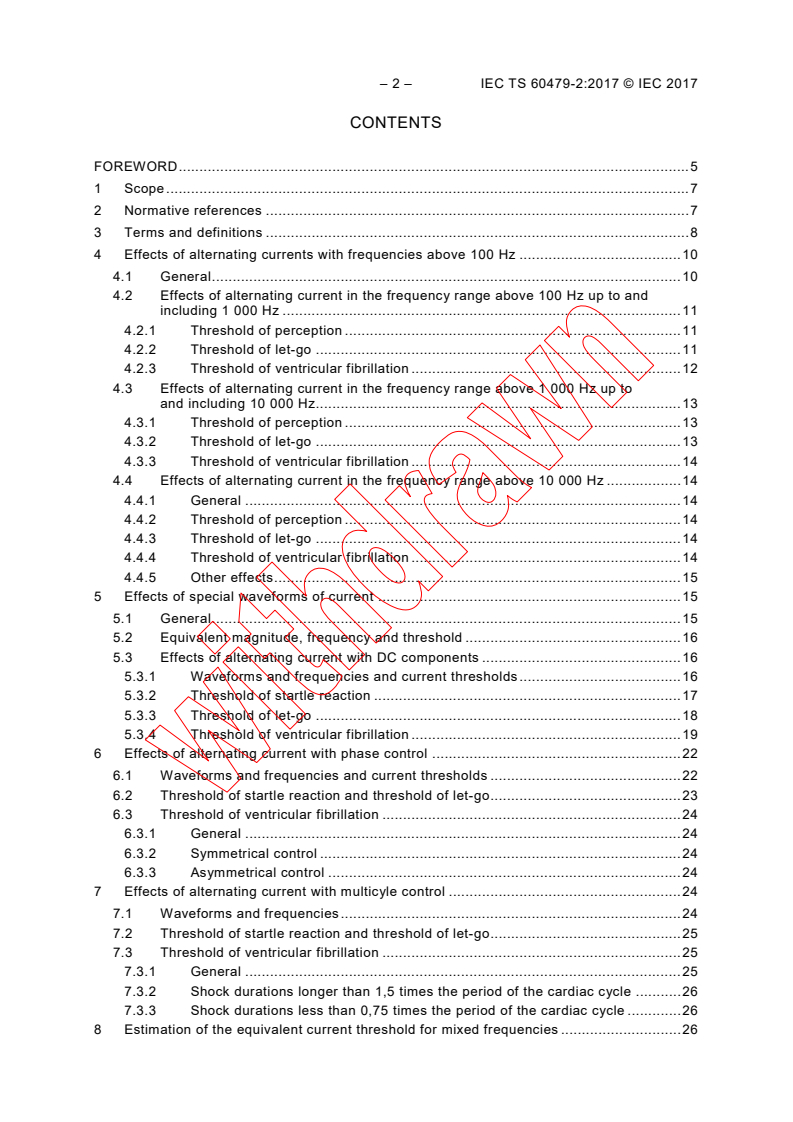
IEC TS 60479-2:2017 - Effects of current on human beings and livestock - Part 2: Special aspects Released:10/20/2017
IEC TS 60479-2:2017 RLV - Effects of current on human beings and livestock - Part 2: Special aspects Released:10/20/2017
Relations
- Replaced By
IEC 60479-2:2019 - Effects of current on human beings and livestock - Part 2: Special aspects - Effective Date
- 05-Sep-2023
- Revises
IEC TS 60479-2:2007 - Effects of current on human beings and livestock - Part 2: Special aspects - Effective Date
- 05-Sep-2023
Buy Documents
IEC TS 60479-2:2017 - Effects of current on human beings and livestock - Part 2: Special aspects Released:10/20/2017
IEC TS 60479-2:2017 RLV - Effects of current on human beings and livestock - Part 2: Special aspects Released:10/20/2017
Get Certified
Connect with accredited certification bodies for this standard

IMQ S.p.A. (Certification)
Italian electrical product certification.

SLG Prüf- und Zertifizierungs GmbH
German testing and certification body.

UL Solutions
Global safety science company with testing, inspection and certification.
Sponsored listings
Frequently Asked Questions
IEC TS 60479-2:2017 is a technical specification published by the International Electrotechnical Commission (IEC). Its full title is "Effects of current on human beings and livestock - Part 2: Special aspects". This standard covers: IEC TS 60479-2:2017 describes the effects on the human body when a sinusoidal alternating current in the frequency range above 100 Hz passes through it. This document describes the effects of current passing through the human body in the form of single and multiple successive unidirectional rectangular impulses, sinusoidal impulses and impulses resulting from capacitor discharges. This basic safety publication is primarily intended for use by technical committees in the preparation of standards in accordance with the principles laid down in IEC Guide 104 and ISO/IEC Guide 51.
IEC TS 60479-2:2017 describes the effects on the human body when a sinusoidal alternating current in the frequency range above 100 Hz passes through it. This document describes the effects of current passing through the human body in the form of single and multiple successive unidirectional rectangular impulses, sinusoidal impulses and impulses resulting from capacitor discharges. This basic safety publication is primarily intended for use by technical committees in the preparation of standards in accordance with the principles laid down in IEC Guide 104 and ISO/IEC Guide 51.
IEC TS 60479-2:2017 is classified under the following ICS (International Classification for Standards) categories: 13.200 - Accident and disaster control; 29.020 - Electrical engineering in general. The ICS classification helps identify the subject area and facilitates finding related standards.
IEC TS 60479-2:2017 has the following relationships with other standards: It is inter standard links to IEC 60479-2:2019, IEC TS 60479-2:2007. Understanding these relationships helps ensure you are using the most current and applicable version of the standard.
IEC TS 60479-2:2017 is available in PDF format for immediate download after purchase. The document can be added to your cart and obtained through the secure checkout process. Digital delivery ensures instant access to the complete standard document.
Standards Content (Sample)
IEC TS 60479-2 ®
Edition 4.0 2017-10
TECHNICAL
SPECIFICATION
colour
inside
BASIC SAFETY PUBLICATION
Effects of current on human beings and livestock –
Part 2: Special aspects
All rights reserved. Unless otherwise specified, no part of this publication may be reproduced or utilized in any form
or by any means, electronic or mechanical, including photocopying and microfilm, without permission in writing from
either IEC or IEC's member National Committee in the country of the requester. If you have any questions about IEC
copyright or have an enquiry about obtaining additional rights to this publication, please contact the address below or
your local IEC member National Committee for further information.
IEC Central Office Tel.: +41 22 919 02 11
3, rue de Varembé Fax: +41 22 919 03 00
CH-1211 Geneva 20 info@iec.ch
Switzerland www.iec.ch
About the IEC
The International Electrotechnical Commission (IEC) is the leading global organization that prepares and publishes
International Standards for all electrical, electronic and related technologies.
About IEC publications
The technical content of IEC publications is kept under constant review by the IEC. Please make sure that you have the
latest edition, a corrigenda or an amendment might have been published.
IEC Catalogue - webstore.iec.ch/catalogue Electropedia - www.electropedia.org
The stand-alone application for consulting the entire The world's leading online dictionary of electronic and
bibliographical information on IEC International Standards, electrical terms containing 20 000 terms and definitions in
Technical Specifications, Technical Reports and other English and French, with equivalent terms in 16 additional
documents. Available for PC, Mac OS, Android Tablets and languages. Also known as the International Electrotechnical
iPad. Vocabulary (IEV) online.
IEC publications search - www.iec.ch/searchpub IEC Glossary - std.iec.ch/glossary
The advanced search enables to find IEC publications by a 65 000 electrotechnical terminology entries in English and
variety of criteria (reference number, text, technical French extracted from the Terms and Definitions clause of
committee,…). It also gives information on projects, replaced IEC publications issued since 2002. Some entries have been
and withdrawn publications. collected from earlier publications of IEC TC 37, 77, 86 and
CISPR.
IEC Just Published - webstore.iec.ch/justpublished
Stay up to date on all new IEC publications. Just Published IEC Customer Service Centre - webstore.iec.ch/csc
details all new publications released. Available online and If you wish to give us your feedback on this publication or
also once a month by email. need further assistance, please contact the Customer Service
Centre: csc@iec.ch.
IEC TS 60479-2 ®
Edition 4.0 2017-10
TECHNICAL
SPECIFICATION
colour
inside
BASIC SAFETY PUBLICATION
Effects of current on human beings and livestock –
Part 2: Special aspects
INTERNATIONAL
ELECTROTECHNICAL
COMMISSION
ICS 13.200; 29.020 ISBN 978-2-8322-4845-4
– 2 – IEC TS 60479-2:2017 © IEC 2017
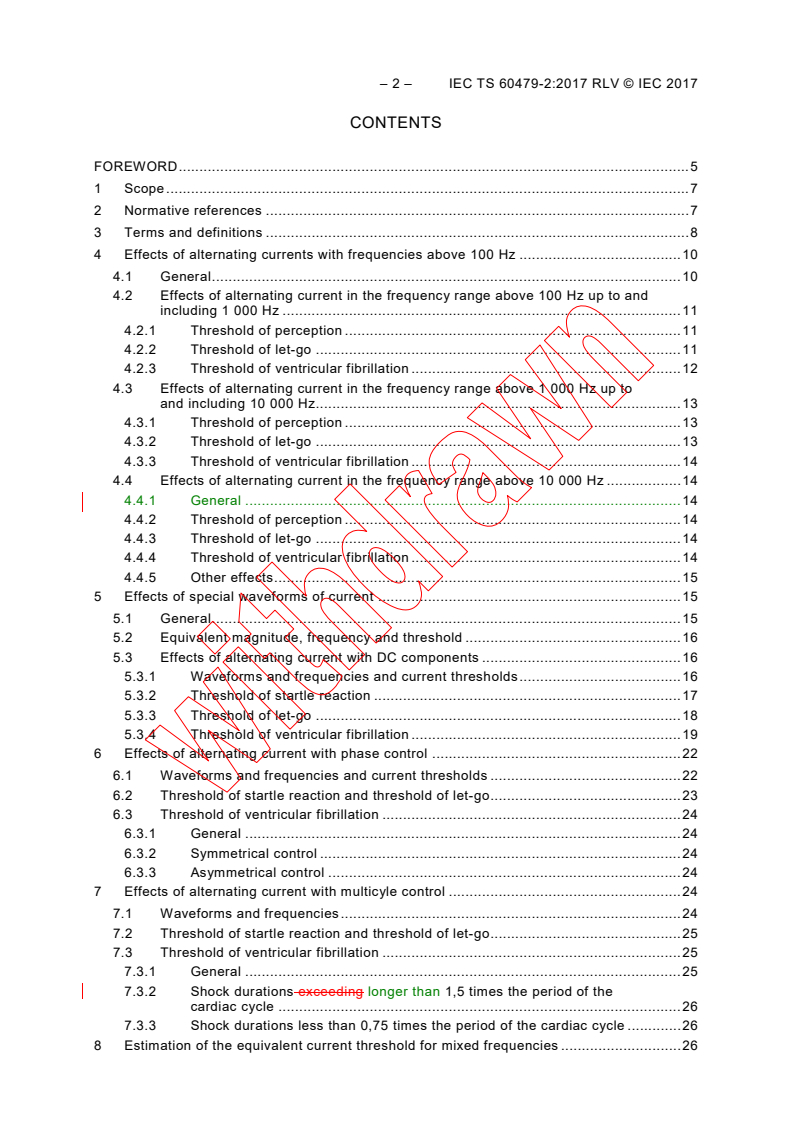
CONTENTS
FOREWORD . 5
1 Scope . 7
2 Normative references . 7
3 Terms and definitions . 8
4 Effects of alternating currents with frequencies above 100 Hz . 10
4.1 General . 10
4.2 Effects of alternating current in the frequency range above 100 Hz up to and
including 1 000 Hz . 11
4.2.1 Threshold of perception . 11
4.2.2 Threshold of let-go . 11
4.2.3 Threshold of ventricular fibrillation . 12
4.3 Effects of alternating current in the frequency range above 1 000 Hz up to
and including 10 000 Hz . 13
4.3.1 Threshold of perception . 13
4.3.2 Threshold of let-go . 13
4.3.3 Threshold of ventricular fibrillation . 14
4.4 Effects of alternating current in the frequency range above 10 000 Hz . 14
4.4.1 General . 14
4.4.2 Threshold of perception . 14
4.4.3 Threshold of let-go . 14
4.4.4 Threshold of ventricular fibrillation . 14
4.4.5 Other effects . 15
5 Effects of special waveforms of current . 15
5.1 General . 15
5.2 Equivalent magnitude, frequency and threshold . 16
5.3 Effects of alternating current with DC components . 16
5.3.1 Waveforms and frequencies and current thresholds . 16
5.3.2 Threshold of startle reaction . 17
5.3.3 Threshold of let-go . 18
5.3.4 Threshold of ventricular fibrillation . 19
6 Effects of alternating current with phase control . 22
6.1 Waveforms and frequencies and current thresholds . 22
6.2 Threshold of startle reaction and threshold of let-go . 23
6.3 Threshold of ventricular fibrillation . 24
6.3.1 General . 24
6.3.2 Symmetrical control . 24
6.3.3 Asymmetrical control . 24
7 Effects of alternating current with multicyle control . 24
7.1 Waveforms and frequencies . 24
7.2 Threshold of startle reaction and threshold of let-go . 25
7.3 Threshold of ventricular fibrillation . 25
7.3.1 General . 25
7.3.2 Shock durations longer than 1,5 times the period of the cardiac cycle . 26
7.3.3 Shock durations less than 0,75 times the period of the cardiac cycle . 26
8 Estimation of the equivalent current threshold for mixed frequencies . 26
8.1 Threshold of perception and let-go . 26
8.2 Threshold of ventricular fibrillation . 26
9 Effects of current pulse bursts and random complex irregular waveforms . 27
9.1 Ventricular fibrillation threshold of multiple pulses of current separated by
300 ms or more . 27
9.2 Ventricular fibrillation threshold of multiple pulses of current separated by
less than 300 ms . 27
9.2.1 General . 27
9.2.2 Examples. 28
9.2.3 Random complex irregular waveforms . 30
10 Effects of electric current through the immersed human body . 32
10.1 General . 32
10.2 Resistivity of water solutions and of the human body . 32
10.3 Conducted current through immersed body . 33
10.4 Physiological effects of current through the immersed body . 34
10.5 Threshold values of current . 35
10.6 Intrinsically “safe” voltage values . 35
11 Effects of unidirectional single impulse currents of short duration . 35
11.1 General . 35
11.2 Effects of unidirectional impulse currents of short duration . 36
11.2.1 Waveforms . 36
11.2.2 Determination of specific fibrillating energy F . 37
e
11.3 Threshold of perception and threshold of pain for capacitor discharge . 38
11.4 Threshold of ventricular fibrillation . 39
11.4.1 General . 39
11.4.2 Examples. 40
Annex A (informative) Random complex irregular waveform analysis . 43
A.1 General . 43
A.2 Formal theoretical statement of the method . 43
A.3 Demonstration of the calculation . 44
A.3.1 General . 44
A.3.2 Choice of justified current . 46
A.3.3 Choice of sampling step size . 46
A.4 Examples 1 and 2 . 47
Bibliography . 50
Figure 1 – Variation of the threshold of perception within the frequency range
50/60 Hz to 1 000 Hz . 11
Figure 2 – Variation of the threshold of let-go within the frequency range 50/60 Hz to
1 000 Hz . 12
Figure 3 – Variation of the threshold of ventricular fibrillation within the frequency
range 50/60 Hz to 1 000 Hz, shock durations longer than one heart period and
longitudinal current paths through the trunk of the body . 12
Figure 4 – Variation of the threshold of perception within the frequency range
1 000 Hz to 10 000 Hz . 13
Figure 5 – Variation of the threshold of let-go within the frequency range 1 000 Hz to
10 000 Hz . 13
Figure 6 – Variation of the threshold of ventricular fibrillation for continuous sinusoidal
current for use from 1 000 Hz to a maximum of 150 kHz . 15
Figure 7 – Waveforms of currents . 17
– 4 – IEC TS 60479-2:2017 © IEC 2017
Figure 8 – Let-go thresholds for men, women and children . 18
Figure 9 – 99,5 percentile let-go threshold for combinations of 50/60 Hz sinusoidal
alternating current and direct current . 19
Figure 10 – Composite alternating and direct current with equivalent likelihood of
ventricular fibrillation. 20
Figure 11 – Waveforms of rectified alternating currents . 21
Figure 12 – Waveforms of alternating currents with phase control . 23
Figure 13 – Waveforms of alternating currents with multicycle control . 25
Figure 14 – Threshold of ventricular fibrillation (average value) for alternating current
with multicycle control for various degrees of controls (results of experiments with
young pigs) . 26
Figure 15 – Series of four rectangular pulses of unidirectional current . 28
Figure 16 – Series of four rectangular pulses of unidirectional current . 29
Figure 17 – Series of four rectangular pulses of unidirectional current . 29
Figure 18 – Example of current versus elapsed time over a contaminated insulator . 30
Figure 19 – PC plotted on the AC time current curves (Figure 20 of IEC TS 60479-
1:2005) . 31
Figure 20 – Forms of current for rectangular impulses, sinusoidal impulses and for
capacitor discharges . 37
Figure 21 – Rectangular impulse, sinusoidal impulse and capacitor discharge having
the same specific fibrillating energy and the same shock-duration . 38
Figure 22 – Threshold of perception and threshold of pain for the current resulting
from the discharge of a capacitor (dry hands, large contact area) . 39
Figure 23 – Probability of fibrillation risks for current flowing in the path left hand to feet . 40
Figure A.1 – Definition of a segment of a random complex waveform . 43
Figure A.2 – Definition of a duration within a sample . 43
Figure A.3 – PC for demonstration example of the random complex waveform method
plotted against time-current curves for RMS AC . 46
Figure A.4 – Random complex waveform typical of those used in Example 1 . 47
Figure A.5 – Random complex waveform typical of those used in Example 2 . 48
Figure A.6 – PC for Examples 1 and 2 of the random complex waveform method
plotted against time-current curves for RMS AC . 49
Table 1 – Example of estimate for ventricular fibrillation threshold after each burst of
current in a series of pulses each of which excited the heart tissue . 28
Table 2 – Resistivity of water solutions [24], [25] . 32
Table 3 – Resistivity of human body tissues . 33
Table 4 – Relative interaction between the resistivity of water solution and the
impedance characteristic of the electrical source . 34
Table 5 – Effects of shocks . 41
Table 6 – Effects of shocks . 42
INTERNATIONAL ELECTROTECHNICAL COMMISSION
____________
EFFECTS OF CURRENT ON HUMAN BEINGS AND LIVESTOCK –
Part 2: Special aspects
FOREWORD
1) The International Electrotechnical Commission (IEC) is a worldwide organization for standardization comprising
all national electrotechnical committees (IEC National Committees). The object of IEC is to promote
international co-operation on all questions concerning standardization in the electrical and electronic fields. To
this end and in addition to other activities, IEC publishes International Standards, Technical Specifications,
Technical Reports, Publicly Available Specifications (PAS) and Guides (hereafter referred to as “IEC
Publication(s)”). Their preparation is entrusted to technical committees; any IEC National Committee interested
in the subject dealt with may participate in this preparatory work. International, governmental and non-
governmental organizations liaising with the IEC also participate in this preparation. IEC collaborates closely
with the International Organization for Standardization (ISO) in accordance with conditions determined by
agreement between the two organizations.
2) The formal decisions or agreements of IEC on technical matters express, as nearly as possible, an international
consensus of opinion on the relevant subjects since each technical committee has representation from all
interested IEC National Committees.
3) IEC Publications have the form of recommendations for international use and are accepted by IEC National
Committees in that sense. While all reasonable efforts are made to ensure that the technical content of IEC
Publications is accurate, IEC cannot be held responsible for the way in which they are used or for any
misinterpretation by any end user.
4) In order to promote international uniformity, IEC National Committees undertake to apply IEC Publications
transparently to the maximum extent possible in their national and regional publications. Any divergence
between any IEC Publication and the corresponding national or regional publication shall be clearly indicated in
the latter.
5) IEC itself does not provide any attestation of conformity. Independent certification bodies provide conformity
assessment services and, in some areas, access to IEC marks of conformity. IEC is not responsible for any
services carried out by independent certification bodies.
6) All users should ensure that they have the latest edition of this publication.
7) No liability shall attach to IEC or its directors, employees, servants or agents including individual experts and
members of its technical committees and IEC National Committees for any personal injury, property damage or
other damage of any nature whatsoever, whether direct or indirect, or for costs (including legal fees) and
expenses arising out of the publication, use of, or reliance upon, this IEC Publication or any other IEC
Publications.
8) Attention is drawn to the Normative references cited in this publication. Use of the referenced publications is
indispensable for the correct application of this publication.
9) Attention is drawn to the possibility that some of the elements of this IEC Publication may be the subject of
patent rights. IEC shall not be held responsible for identifying any or all such patent rights.
The main task of IEC technical committees is to prepare International Standards. In
exceptional circumstances, a technical committee may propose the publication of a Technical
Specification when
• the required support cannot be obtained for the publication of an International Standard,
despite repeated efforts, or
• the subject is still under technical development or where, for any other reason, there is the
future but no immediate possibility of an agreement on an International Standard.
Technical Specifications are subject to review within three years of publication to decide
whether they can be transformed into International Standards.
IEC TS 60479-2, which is a Technical Specification, has been prepared by IEC technical
committee 64: Electrical installations and protection against electric shock.
This fourth edition cancels and replaces the third edition, published in 2007. This edition
constitutes a technical revision.
– 6 – IEC TS 60479-2:2017 © IEC 2017
This edition includes the following significant technical changes with respect to the previous
edition:
• Changes reflecting the change in applicability of frequency from 1 kHz to 150 kHz have
been added.
• The examination of random complex irregular waveforms has been added.
• The handling of successive DC pulses has been clarified.
The text of this Technical Specification is based on the following documents:
Draft TS Report on voting
64/2143/DTS 64/2166/RVDTS
Full information on the voting for the approval of this Technical Specification can be found in
the report on voting indicated in the above table.
This Technical Specification has the status of a basic safety publication in accordance with
IEC Guide 104.
This document has been drafted in accordance with the ISO/IEC Directives, Part 2.
A list of all parts in the IEC 60479 series, published under the general title Effects of current
on human beings and livestock, can be found on the IEC website.
The committee has decided that the contents of this publication will remain unchanged until
the stability date indicated on the IEC website under "http://webstore.iec.ch" in the data
related to the specific publication. At this date, the publication will be
• transformed into an International standard,
• reconfirmed,
• withdrawn,
• replaced by a revised edition, or
• amended.
A bilingual version of this publication may be issued at a later date.
IMPORTANT – The 'colour inside' logo on the cover page of this publication indicates
that it contains colours which are considered to be useful for the correct
understanding of its contents. Users should therefore print this document using a
colour printer.
EFFECTS OF CURRENT ON HUMAN BEINGS AND LIVESTOCK –
Part 2: Special aspects
1 Scope
This part of IEC 60479 describes the effects on the human body when a sinusoidal
alternating current in the frequency range above 100 Hz passes through it.
The effects of current passing through the human body for:
– alternating sinusoidal current with DC components;
– alternating sinusoidal current with phase control;
– alternating sinusoidal current with multicycle control
are given but are only deemed applicable for alternating current frequencies from
15 Hz up to 100 Hz.
Means of extending the frequency of applicability of pure sinusoids to a frequency of 150 kHz
are given, supplementing the data in IEC TS 60479-1.
Means of examining random complex irregular waveforms are given.
This document describes the effects of current passing through the human body in the form of
single and multiple successive unidirectional rectangular impulses, sinusoidal impulses and
impulses resulting from capacitor discharges.
The values specified are deemed to be applicable for impulse durations from 0,1 ms up to and
including 10 ms.
This document only considers conducted current resulting from the direct application of a
source of current to the body, as does IEC TS 60479-1 and IEC TS 60479-3. It does not
consider current induced within the body caused by its exposure to an external
electromagnetic field.
This basic safety publication is primarily intended for use by technical committees in the
preparation of standards in accordance with the principles laid down in IEC Guide 104 and
ISO/IEC Guide 51. It is not intended for use by manufacturers or certification bodies.
One of the responsibilities of a technical committee is, wherever applicable, to make use of
basic safety publications in the preparation of its publications. The requirements, test
methods or test conditions of this basic safety publication will not apply unless specifically
referred to or included in the relevant publications.
2 Normative references
The following documents are referred to in the text in such a way that some or all of their
content constitutes requirements of this document. For dated references, only the edition
cited applies. For undated references, the latest edition of the referenced document (including
any amendments) applies.
– 8 – IEC TS 60479-2:2017 © IEC 2017
IEC TS 60479-1:2005, Effects of current on human beings and livestock – Part 1: General
aspects
IEC TS 60479-1:2005/AMD1:2016
IEC 60990, Methods of measurement of touch-current and protective conductor current
ISO/IEC Guide 51, Safety aspects – Guidelines for their inclusion in standards
IEC Guide 104, The preparation of safety publications and the use of basic safety publications
and group safety publications
3 Terms and definitions
For the purposes of this document, the terms and definitions given in IEC TS 60479-1 and the
following apply.
ISO and IEC maintain terminological databases for use in standardization at the following
addresses:
• IEC Electropedia: available at http://www.electropedia.org/
• ISO Online browsing platform: available at http://www.iso.org/obp
3.1
frequency factor
F
f
ratio of the threshold current for the relevant physiological effects at the frequency f to the
threshold current at 50/60 Hz.
Note 1 to entry The frequency factor differs for perception, let-go and ventricular fibrillation.
3.2
phase control
process of varying the instant within the cycle at which current conduction in an electronic
valve device or a valve arm begins
[SOURCE: IEC 60050-551:1998, 551-16-23]
3.3
phase control angle
current delay angle
time expressed in angular measure by which the starting instant of current conduction is
delayed by phase control
[SOURCE: IEC 60050-551:1998, 551-16-32, modified — the term "phase control angle" has
been added.]
3.4
multicycle control
process of varying the ratio of the number of cycles which include current conduction to the
number of cycles in which no current conduction occurs
[SOURCE: IEC 60050-551:1998, 551-16-31]
3.5
multicycle control factor
p
ratio between the number of conducting cycles and the sum of conducting and non-conducting
cycles in the case of multicycle control
SEE Figure 13.
[SOURCE: IEC 60050-551:1998, 551-16-37, modified — the symbol and reference to
Figure 13 have been added.]
3.6
specific fibrillating energy
F
e
minimum I ·t value of a unidirectional impulse of short duration which under given conditions
(current-path, heart-phase) causes ventricular fibrillation with a certain probability
Note 1 to entry: F is determined by the form of the impulse as the integral
e
t
i
i²dt
∫
where t is defined in Figure 20 and Figure 21. F multiplied by the body resistance gives the energy dissipated in
i e
the human body during the impulse.
Note 2 to entry: F is expressed in Ws/Ω or A s.
e
3.7
specific fibrillating charge
F
q
minimum I·t value of unidirectional impulse of short duration which under given conditions
(current-path, heart-phase) causes ventricular fibrillation with a certain probability
Note 1 to entry: F is determined by the form of the impulse as the integral
q
t
i
idt
∫
where t is defined in Figure 20 and Figure 21.
i
Note 2 to entry: F is expressed in C or As.
q
3.8
time constant
time required for the amplitude of an exponentially decaying quantity to decrease to
= 0,3679
e
times an initial amplitude
[SOURCE: IEC 60050-801:1994, 801-21-45, modified — the definition has been revised.]
3.9
shock-duration of a capacitor discharge
t
i
time interval from the beginning of the discharge to the time when the discharge current has
fallen to 5 % of its peak value
Note 1 to entry: When the time constant of the capacitor discharge is given by T the shock-duration of the
capacitor discharge is equal to 3T. During the shock-duration of the capacitor discharge practically all the energy of
the impulse is dissipated.
Note 2 to entry: See Figure 20 and Figure 21.
– 10 – IEC TS 60479-2:2017 © IEC 2017
3.10
shock-duration for complex asymptotic waveform
t
i
shortest duration of that part of the impulse that contains 95 % of the energy over the total
impulse
3.11
threshold of perception
minimum value for the charge of electricity which under given conditions causes any
sensation to the person through whom it is flowing
3.12
threshold of pain
2⋅
minimum value for the charge (I∙t) or specific energy (I t) that can be applied as an impulse
to a person holding a large electrode in the hand without causing pain
3.13
pain
unpleasant experience such that it is not readily accepted a second time by the subject
submitted to it
EXAMPLE: Electric shock above the threshold of pain described in 11.3, the sting of a bee or burn of a cigarette.
4 Effects of alternating currents with frequencies above 100 Hz
NOTE Values for 50/60 Hz are given in IEC TS 60479-1. For frequencies up to 100 Hz the provisions of
IEC TS 60479-1 are used.
4.1 General
Electric energy in the form of alternating current at frequencies higher than 50/60 Hz is
increasingly used in modern electrical equipment, for example aircraft (400 Hz), power tools
and electric welding (mostly up to 450 Hz), electrotherapy (using mostly 4 000 Hz to
5 000 Hz) and switching mode power supplies (20 kHz to 1 MHz).
Little experimental data is available for Clause 4, therefore the information given herein
should be considered as provisional only but may be used for the evaluation of risks in the
frequency ranges concerned (see Bibliography).
Recent experiments in governmental funded projects are ongoing to exploit and investigate
the effects of higher frequencies using the latest technologies and methods to justify existing
extrapolation of the frequency factor for ventricular fibrillation (VF) threshold.
Attention is also drawn to the fact that the impedance of human skin decreases
approximately inversely proportional to the frequency for touch voltages in the order of
some tens of volts, so that the skin impedance at 500 Hz is only about one-tenth of the skin
impedance at 50 Hz and may be neglected in many cases. This impedance of the human
body at such frequencies is therefore reduced to its internal impedance Z (see
i
IEC TS 60479-1).
NOTE Use of peak measurements: at current levels that produce physiological responses of perception,
startle reaction and inability of let-go, the physiological response from non sinusoidal and mixed frequency
periodic current is best indicated by the peak value of an output signal from measuring circuits containing a
frequency-weighting network such as those described in IEC 60990.
These frequency weighting networks attenuate the signal according to the frequency factors given in
IEC TS 60479-1:2005 and IEC TS 60479-1:2005/AMD1:2016, Clause 4 so that the output signal corresponds to a
constant level of physiological response. Attenuation is provided for narrow impulses of current that would
produce less physiological response because of the short duration of their peak value. The network output allows
a fixed value to be read independent of waveshape or mix of frequencies to be provided for ease of determination
of the leakage current and evaluation of the level of hazard present.
Comparable physiological effects are produced by non sinusoidal and sinusoidal current producing the same
peak value by this measurement method.
Representative network can be found in IEC 60990 and in bibliographic reference [16] .
4.2 Effects of alternating current in the frequency range above 100 Hz up to and
including 1 000 Hz
4.2.1 Threshold of perception
For the threshold of perception the frequency factor is given in Figure 1.
1,8
1,6
1,4
1,2
50/60 100 200 300 500 1 000
Frequency f (Hz)
IEC
Figure 1 – Variation of the threshold of perception
within the frequency range 50/60 Hz to 1 000 Hz
4.2.2 Threshold of let-go
For the threshold of let-go the frequency factor is given in Figure 2.
___________
Numbers in square brackets refer to the Bibliography.
Frequency factor F
f
– 12 – IEC TS 60479-2:2017 © IEC 2017
1,8
1,6
1,4
1,2
50/60 100 200 300 500 1 000
Frequency f (Hz)
IEC
Figure 2 – Variation of the threshold of let-go
within the frequency range 50/60 Hz to 1 000 Hz
4.2.3 Threshold of ventricular fibrillation
For shock durations longer than the cardiac cycle, the frequency factor for the threshold of
fibrillation for longitudinal current paths through the trunk of the body is given in Figure 3.
For shock durations shorter than the cardiac cycle no experimental data is available on the
effects of frequency.
50/60 100 300 1 000
Frequency f (Hz)
IEC
Figure 3 – Variation of the threshold of ventricular fibrillation within the frequency
range 50/60 Hz to 1 000 Hz, shock durations longer than one heart period and
longitudinal current paths through the trunk of the body
Frequency factor F
f
Frequency factor F
f
4.3 Effects of alternating current in the frequency range above 1 000 Hz up to and
including 10 000 Hz
4.3.1 Threshold of perception
For the threshold of perception the frequency factor is given in Figure 4.
1 2 3 5 10
Frequency f (kHz)
IEC
Figure 4 – Variation of the threshold of perception
within the frequency range 1 000 Hz to 10 000 Hz
4.3.2 Threshold of let-go
For the threshold of let-go the frequency factor is given in Figure 5.
1 2 3 5 10
Frequency f (kHz)
IEC
Figure 5 – Variation of the threshold of let-go
within the frequency range 1 000 Hz to 10 000 Hz
Frequency factor F
Frequency factor F f
f
– 14 – IEC TS 60479-2:2017 © IEC 2017
4.3.3 Threshold of ventricular fibrillation
For frequencies between 1 000 Hz and 10 000 Hz the provisions of 4.4.4 are used.
4.4 Effects of alternating current in the frequency range above 10 000 Hz
4.4.1 General
In 4.4, changes have not been made to the threshold of perception, or the threshold of let-go
for higher frequencies. While these are important thresholds, the most dangerous is that of
ventricular fibrillation. The fibrillation threshold is therefore given up to 150 kHz. The
remaining thresholds may be considered as in the paragraphs below up to the frequency
limits shown.
4.4.2 Threshold of perception
For frequencies between 10 kHz and 100 kHz the threshold rises approximately from 10 mA
to 100 mA (RMS values).
For frequencies above 100 kHz the tingling sensation characteristic for the perception at
lower frequencies changes into a sensation of warmth for current intensities in the order of
some hundred milliamperes.
4.4.3 Threshold of let-go
For frequencies above 100 kHz there is neither experimental data nor reported incidents
concerning the threshold of let-go.
4.4.4 Threshold of ventricular fibrillation
For shock durations longer than the cardiac cycle, the frequency factor for the threshold of
fibrillation for longitudinal current paths through the trunk of the body for the frequency range
above 1000 Hz up to and including 150 kHz is given in Figure 6.
For frequencies above 1 kHz, thermal effects are more likely to become dominant.
For shock durations shorter than the cardiac cycle, no experimental data is available.
150 kHz
1 000 3 000 10 000 30 000 100 000
Frequency f (Hz)
IEC
Figure 6 – Variation of the threshold of ventricular fibrillation for
continuous sinusoidal current for use from 1 000 Hz
to a maximum of 150 kHz
4.4.5 Other effects
Burns may occur at frequencies above 100 kHz and current magnitudes in the order of
amperes depending on the duration of the current flow.
5 Effects of special waveforms of current
5.1 General
As is to be expected, the effects of such currents on the human body are between those
caused by direct and by alternating current; therefore equivalent current magnitudes with
regard to ventricular fibrillation can be established.
Clause 5 describes the effects of current passing through the human body for:
– alternating sinusoidal current with DC components,
– alternating sinusoidal current with phase control,
– alternating sinusoidal current with multicycle control.
NOTE Other waveforms are under consideration.
The information given is deemed applicable for alternating current frequencies from 15 Hz up
to 100 Hz.
Frequency factor F
f
– 16 – IEC TS 60479-2:2017 © IEC 2017
5.2 Equivalent magnitude, frequency and threshold
In 5.2 the hazard may be taken as being approximately the same effect as with an equivalent
pure alternating sinusoidal current I having the following characteristics:
ev
– Magnitude equivalence:
The following current magnitudes have to be distinguished:
I = RMS value of the current of the proposed waveform,
RMS
I = peak value of the current of the proposed waveform,
p
I = peak-to-peak value of the current of the proposed waveform,
pp
I = RMS value of a sinusoidal current presenting the same effect as
ev
the waveform concerned.
NOTE The current I is used instead of the current I in Figures 20 and 22 of IEC TS 60479-1:2005 to
ev B
estimate the risk of ventricular fibrillation.
Most physiological effects are related to the filtered peak current (in magnitude and in
duration) with the natural body filter defined by the frequency factor F. The peak value of
the current should be used in all cases except where there is a known relationship
between the RMS value and the peak value, i.e. pure sinusoidal current.
– Frequency equivalence
The waveform under study has a time period equal to the period of the equivalent
sinusoidal waveform.
– Threshold equivalence
The different current thresholds (perception, inability of let-go and ventricular fibrillation)
for waveforms consisting of specific ratio of alternating to direct current is equivalent as
for a pure sinusoidal alternating current with a current having the characteristic equal to
I .
ev
This I value is different for each of these thresholds.
ev
5.3 Effects of alternating current with DC components
5.3.1 Waveforms and frequencies and current thresholds
Figure 7 shows typical waveforms which are dealt with in 5.3.1. Pure DC and pure AC are
represented as well as combined waveforms of various ratios AC to DC.
I = I /2√2*
ev pp
T
T
* for shock duration >1,5 cardiac cycle
** for shock duration <0,75 cardiac cycle
IEC
a) Combined waveforms of various ratios AC to DC together with rectangle pulse
for shock duration >1,5 and <0,75 of the cardiac cycle
I = I /2√2*
ev pp
I = I /√2**
ev p
I = I /√2**
I = I /√2**
ev p
ev p
T T T
* for shock duration >1,5 cardiac cycle
** for shock duration <0,75 cardiac cycle
IEC
b) Combined waveforms of various ratios AC to DC of mixed frequencies
for shock duration >1,5 and <0,75 of the cardiac cycle
Figure 7 – Waveforms of currents
5.3.2 Threshold of startle reaction
The threshold of startle reaction depends on several parameters such as the area of the body
in contact with an electrode (contact area), the conditions of contact (dry, wet, pressure,
temperature) and also on the physiological characteristics of the individual.
These effects are related to the peak value of the current [13] and the currents have to be
combined frequency by frequency to estimate the total effect. A measurement circuit is
described in IEC 60990.
I = I
p pp I = I
p pp
I = I /√2**
ev p
I /2 I = I /2√2*
p ev pp
I /2 I = I /2√2*
p ev pp I /2
p
I = I /√2
ev p
I = I
p pp
I
I
p
p
I
p
I
pp
I
pp
– 18 – IEC TS 60479-2:2017 © IEC 2017
5.3.3 Threshold of let-go
The threshold of let-go depends on several parameters, such as the contact area, the shape
and the size of the electrodes and also on the physiological characteristics of the individual.
From the standpoint of let-go (hand contacts with energized circuitry that can last a few
seconds), this document uses Figure 5 in the referenced Dalziel paper [17] to determine the
let-go current threshold for combinations of alternating current and direct current. The
frequency of the alternating current in this case was 60 Hz. 7,07 mA peak AC (5 mA RMS for
a sinusoidal c
...
IEC TS 60479-2 ®
Edition 4.0 2017-10
REDLINE VERSION
TECHNICAL
SPECIFICATION
colour
inside
BASIC SAFETY PUBLICATION
Effects of current on human beings and livestock –
Part 2: Special aspects
All rights reserved. Unless otherwise specified, no part of this publication may be reproduced or utilized in any form
or by any means, electronic or mechanical, including photocopying and microfilm, without permission in writing from
either IEC or IEC's member National Committee in the country of the requester. If you have any questions about IEC
copyright or have an enquiry about obtaining additional rights to this publication, please contact the address below or
your local IEC member National Committee for further information.
IEC Central Office Tel.: +41 22 919 02 11
3, rue de Varembé Fax: +41 22 919 03 00
CH-1211 Geneva 20 info@iec.ch
Switzerland www.iec.ch
About the IEC
The International Electrotechnical Commission (IEC) is the leading global organization that prepares and publishes
International Standards for all electrical, electronic and related technologies.
About IEC publications
The technical content of IEC publications is kept under constant review by the IEC. Please make sure that you have the
latest edition, a corrigenda or an amendment might have been published.
IEC Catalogue - webstore.iec.ch/catalogue Electropedia - www.electropedia.org
The stand-alone application for consulting the entire The world's leading online dictionary of electronic and
bibliographical information on IEC International Standards, electrical terms containing 20 000 terms and definitions in
Technical Specifications, Technical Reports and other English and French, with equivalent terms in 16 additional
documents. Available for PC, Mac OS, Android Tablets and languages. Also known as the International Electrotechnical
iPad. Vocabulary (IEV) online.
IEC publications search - www.iec.ch/searchpub IEC Glossary - std.iec.ch/glossary
The advanced search enables to find IEC publications by a 65 000 electrotechnical terminology entries in English and
variety of criteria (reference number, text, technical French extracted from the Terms and Definitions clause of
committee,…). It also gives information on projects, replaced IEC publications issued since 2002. Some entries have been
and withdrawn publications. collected from earlier publications of IEC TC 37, 77, 86 and
CISPR.
IEC Just Published - webstore.iec.ch/justpublished
Stay up to date on all new IEC publications. Just Published IEC Customer Service Centre - webstore.iec.ch/csc
details all new publications released. Available online and If you wish to give us your feedback on this publication or
also once a month by email. need further assistance, please contact the Customer Service
Centre: csc@iec.ch.
IEC TS 60479-2 ®
Edition 4.0 2017-10
REDLINE VERSION
TECHNICAL
SPECIFICATION
colour
inside
BASIC SAFETY PUBLICATION
Effects of current on human beings and livestock –
Part 2: Special aspects
INTERNATIONAL
ELECTROTECHNICAL
COMMISSION
ICS 13.200; 29.020 ISBN 978-2-8322-4243-8
– 2 – IEC TS 60479-2:2017 RLV © IEC 2017
CONTENTS
FOREWORD . 5
1 Scope . 7
2 Normative references . 7
3 Terms and definitions . 8
4 Effects of alternating currents with frequencies above 100 Hz . 10
4.1 General . 10
4.2 Effects of alternating current in the frequency range above 100 Hz up to and
including 1 000 Hz . 11
4.2.1 Threshold of perception . 11
4.2.2 Threshold of let-go . 11
4.2.3 Threshold of ventricular fibrillation . 12
4.3 Effects of alternating current in the frequency range above 1 000 Hz up to
and including 10 000 Hz . 13
4.3.1 Threshold of perception . 13
4.3.2 Threshold of let-go . 13
4.3.3 Threshold of ventricular fibrillation . 14
4.4 Effects of alternating current in the frequency range above 10 000 Hz . 14
4.4.1 General . 14
4.4.2 Threshold of perception . 14
4.4.3 Threshold of let-go . 14
4.4.4 Threshold of ventricular fibrillation . 14
4.4.5 Other effects . 15
5 Effects of special waveforms of current . 15
5.1 General . 15
5.2 Equivalent magnitude, frequency and threshold . 16
5.3 Effects of alternating current with DC components . 16
5.3.1 Waveforms and frequencies and current thresholds . 16
5.3.2 Threshold of startle reaction . 17
5.3.3 Threshold of let-go . 18
5.3.4 Threshold of ventricular fibrillation . 19
6 Effects of alternating current with phase control . 22
6.1 Waveforms and frequencies and current thresholds . 22
6.2 Threshold of startle reaction and threshold of let-go . 23
6.3 Threshold of ventricular fibrillation . 24
6.3.1 General . 24
6.3.2 Symmetrical control . 24
6.3.3 Asymmetrical control . 24
7 Effects of alternating current with multicyle control . 24
7.1 Waveforms and frequencies . 24
7.2 Threshold of startle reaction and threshold of let-go . 25
7.3 Threshold of ventricular fibrillation . 25
7.3.1 General . 25
7.3.2 Shock durations exceeding longer than 1,5 times the period of the
cardiac cycle . 26
7.3.3 Shock durations less than 0,75 times the period of the cardiac cycle . 26
8 Estimation of the equivalent current threshold for mixed frequencies . 26
8.1 Threshold of perception and let-go . 26
8.2 Threshold of ventricular fibrillation . 27
9 The effect of repeated pulses (bursts) of current on the threshold of ventricular
fibrillation Effects of current pulse bursts and random complex irregular
waveforms . 27
9.1 Ventricular fibrillation threshold of multiple bursts pulses of current
separated by 1 s 300 ms or more . 27
9.2 Ventricular fibrillation threshold of multiple bursts pulses of current
separated by less than 1 s 300 ms . 27
9.2.1 General . 27
9.2.2 Examples. 28
9.2.3 Random complex irregular waveforms . 31
10 Effects of electric current through the immersed human body . 33
10.1 General . 33
10.2 Resistivity of water solutions and of the human body . 33
10.3 Conducted current through immersed body . 35
10.4 Physiological effects of current through the immersed body . 36
10.5 Threshold values of current . 37
10.6 Intrinsically “safe” voltage values . 37
11 Effects of unidirectional single impulse currents of short duration . 37
11.1 General . 37
11.2 Effects of unidirectional impulse currents of short duration . 38
11.2.1 Waveforms . 38
11.2.2 Determination of specific fibrillating energy F . 39
e
11.3 Threshold of perception and threshold of pain for capacitor discharge . 40
11.4 Threshold of ventricular fibrillation . 41
11.4.1 General . 41
11.4.2 Examples. 43
Annex A (informative) Random complex irregular waveform analysis . 45
A.1 General . 45
A.2 Formal theoretical statement of the method . 45
A.3 Demonstration of the calculation . 46
A.3.1 General . 46
A.3.2 Choice of justified current . 48
A.3.3 Choice of sampling step size . 48
A.4 Examples 1 and 2 . 49
Bibliography . 52
Figure 1 – Variation of the threshold of perception within the frequency range
50/60 Hz to 1 000 Hz . 11
Figure 2 – Variation of the threshold of let-go within the frequency range 50/60 Hz to
1 000 Hz . 12
Figure 3 – Variation of the threshold of ventricular fibrillation within the frequency
range 50/60 Hz to 1 000 Hz, shock durations longer than one heart period and
longitudinal current paths through the trunk of the body . 12
Figure 4 – Variation of the threshold of perception within the frequency range
1 000 Hz to 10 000 Hz . 13
Figure 5 – Variation of the threshold of let-go within the frequency range 1 000 Hz to
10 000 Hz . 13
– 4 – IEC TS 60479-2:2017 RLV © IEC 2017
Figure 6 – Variation of the threshold of ventricular fibrillation for continuous sinusoidal
current for use from 1 000 Hz to a maximum of 150 kHz . 15
Figure 7 – Waveforms of currents . 17
Figure 8 – Let-go thresholds for men, women and children . 18
Figure 9 – 99,5 percentile let-go threshold for combinations of 50/60 Hz sinusoidal
alternating current and direct current . 19
Figure 10 – Composite alternating and direct current with equivalent likelihood of
ventricular fibrillation. 20
Figure 11 – Waveforms of rectified alternating currents . 21
Figure 12 – Waveforms of alternating currents with phase control . 23
Figure 13 – Waveforms of alternating currents with multicycle control . 25
Figure 14 – Threshold of ventricular fibrillation (average value) for alternating current
with multicycle control for various degrees of controls (results of experiments with
young pigs) . 26
Figure 15 – Series of four rectangular pulses of unidirectional current . 29
Figure 16 – Series of four rectangular pulses of unidirectional current . 29
Figure 17 – Series of four rectangular pulses of unidirectional current . 30
Figure 18 – Example of current versus elapsed time over a contaminated insulator . 32
Figure 19 – PC plotted on the AC time current curves
(Figure 20 of IEC TS 60479-1:2005) . 33
Figure 20 – Forms of current for rectangular impulses, sinusoidal impulses and for
capacitor discharges . 39
Figure 21 – Rectangular impulse, sinusoidal impulse and capacitor discharge having
the same specific fibrillating energy and the same shock-duration . 40
Figure 22 – Threshold of perception and threshold of pain for the current resulting
from the discharge of a capacitor (dry hands, large contact area) . 41
Figure 23 – Threshold of ventricular fibrillation Probability of fibrillation risks for
current flowing in the path left hand to feet . 42
Figure A.1 – Definition of a segment of a random complex waveform . 45
Figure A.2 – Definition of a duration within a sample . 45
Figure A.3 – PC for demonstration example of the random complex waveform method
plotted against time-current curves for RMS AC . 48
Figure A.4 – Random complex waveform typical of those used in Example 1 . 49
Figure A.5 – Random complex waveform typical of those used in Example 2 . 50
Figure A.6 – PC for Examples 1 and 2 of the random complex waveform method
plotted against time-current curves for RMS AC . 51
Table 1 – Example of estimate for ventricular fibrillation threshold after each burst of
current in a series of pulses each of which excited the heart tissue . 28
Table 2 – Resistivity of water solutions [24], [25] . 34
Table 3 – Resistivity of human body tissues . 35
Table 4 – Relative interaction between the resistivity of water solution and the
impedance characteristic of the electrical source . 36
Table 5 – Effects of shocks . 43
Table 6 – Effects of shocks . 44
INTERNATIONAL ELECTROTECHNICAL COMMISSION
____________
EFFECTS OF CURRENT ON HUMAN BEINGS AND LIVESTOCK –
Part 2: Special aspects
FOREWORD
1) The International Electrotechnical Commission (IEC) is a worldwide organization for standardization comprising
all national electrotechnical committees (IEC National Committees). The object of IEC is to promote
international co-operation on all questions concerning standardization in the electrical and electronic fields. To
this end and in addition to other activities, IEC publishes International Standards, Technical Specifications,
Technical Reports, Publicly Available Specifications (PAS) and Guides (hereafter referred to as “IEC
Publication(s)”). Their preparation is entrusted to technical committees; any IEC National Committee interested
in the subject dealt with may participate in this preparatory work. International, governmental and non-
governmental organizations liaising with the IEC also participate in this preparation. IEC collaborates closely
with the International Organization for Standardization (ISO) in accordance with conditions determined by
agreement between the two organizations.
2) The formal decisions or agreements of IEC on technical matters express, as nearly as possible, an international
consensus of opinion on the relevant subjects since each technical committee has representation from all
interested IEC National Committees.
3) IEC Publications have the form of recommendations for international use and are accepted by IEC National
Committees in that sense. While all reasonable efforts are made to ensure that the technical content of IEC
Publications is accurate, IEC cannot be held responsible for the way in which they are used or for any
misinterpretation by any end user.
4) In order to promote international uniformity, IEC National Committees undertake to apply IEC Publications
transparently to the maximum extent possible in their national and regional publications. Any divergence
between any IEC Publication and the corresponding national or regional publication shall be clearly indicated in
the latter.
5) IEC itself does not provide any attestation of conformity. Independent certification bodies provide conformity
assessment services and, in some areas, access to IEC marks of conformity. IEC is not responsible for any
services carried out by independent certification bodies.
6) All users should ensure that they have the latest edition of this publication.
7) No liability shall attach to IEC or its directors, employees, servants or agents including individual experts and
members of its technical committees and IEC National Committees for any personal injury, property damage or
other damage of any nature whatsoever, whether direct or indirect, or for costs (including legal fees) and
expenses arising out of the publication, use of, or reliance upon, this IEC Publication or any other IEC
Publications.
8) Attention is drawn to the Normative references cited in this publication. Use of the referenced publications is
indispensable for the correct application of this publication.
9) Attention is drawn to the possibility that some of the elements of this IEC Publication may be the subject of
patent rights. IEC shall not be held responsible for identifying any or all such patent rights.
This redline version of the official IEC Standard allows the user to identify the changes
made to the previous edition. A vertical bar appears in the margin wherever a change
has been made. Additions are in green text, deletions are in strikethrough red text.
– 6 – IEC TS 60479-2:2017 RLV © IEC 2017
The main task of IEC technical committees is to prepare International Standards. In
exceptional circumstances, a technical committee may propose the publication of a Technical
Specification when
• the required support cannot be obtained for the publication of an International Standard,
despite repeated efforts, or
• the subject is still under technical development or where, for any other reason, there is the
future but no immediate possibility of an agreement on an International Standard.
Technical Specifications are subject to review within three years of publication to decide
whether they can be transformed into International Standards.
IEC TS 60479-2, which is a Technical Specification, has been prepared by IEC technical
committee 64: Electrical installations and protection against electric shock.
This fourth edition cancels and replaces the third edition, published in 2007. This edition
constitutes a technical revision.
This edition includes the following significant technical changes with respect to the previous
edition:
• Changes reflecting the change in applicability of frequency from 1 kHz to 150 kHz have
been added.
• The examination of random complex irregular waveforms has been added.
• The handling of successive DC pulses has been clarified.
The text of this Technical Specification is based on the following documents:
Draft TS Report on voting
64/2143/DTS 64/2166/RVDTS
Full information on the voting for the approval of this Technical Specification can be found in
the report on voting indicated in the above table.
This Technical Specification has the status of a basic safety publication in accordance with
IEC Guide 104.
This document has been drafted in accordance with the ISO/IEC Directives, Part 2.
A list of all parts in the IEC 60479 series, published under the general title Effects of current
on human beings and livestock, can be found on the IEC website.
The committee has decided that the contents of this publication will remain unchanged until
the stability date indicated on the IEC website under "http://webstore.iec.ch" in the data
related to the specific publication. At this date, the publication will be
• transformed into an International standard,
• reconfirmed,
• withdrawn,
• replaced by a revised edition, or
• amended.
IMPORTANT – The 'colour inside' logo on the cover page of this publication indicates
that it contains colours which are considered to be useful for the correct
understanding of its contents. Users should therefore print this document using a
colour printer.
EFFECTS OF CURRENT ON HUMAN BEINGS AND LIVESTOCK –
Part 2: Special aspects
1 Scope
This part of IEC 60479 describes the effects on the human body when a sinusoidal
alternating current in the frequency range above 100 Hz passes through it.
The effects of current passing through the human body for:
– alternating sinusoidal current with DC components;
– alternating sinusoidal current with phase control;
– alternating sinusoidal current with multicycle control
are given but are only deemed applicable for alternating current frequencies from
15 Hz up to 100 Hz.
NOTE 1 Other waveforms are under consideration.
Means of extending the frequency of applicability of pure sinusoids to a frequency of 150 kHz
are given, supplementing the data in IEC TS 60479-1.
Means of examining random complex irregular waveforms are given.
This document describes the effects of current passing through the human body in the form of
single and multiple successive unidirectional rectangular impulses, sinusoidal impulses and
impulses resulting from capacitor discharges.
NOTE 2 The effects of sequences of impulses are under consideration.
The values specified are deemed to be applicable for impulse durations from 0,1 ms up to and
including 10 ms. For impulse durations greater than 10 ms, the values given in Figure 20 of
IEC 60479-1 apply.
This document only considers conducted current resulting from the direct application of a
source of current to the body, as does IEC TS 60479-1 and IEC TS 60479-3. It does not
consider current induced within the body caused by its exposure to an external
electromagnetic field.
This basic safety publication is primarily intended for use by technical committees in the
preparation of standards in accordance with the principles laid down in IEC Guide 104 and
ISO/IEC Guide 51. It is not intended for use by manufacturers or certification bodies.
One of the responsibilities of a technical committee is, wherever applicable, to make use of
basic safety publications in the preparation of its publications. The requirements, test
methods or test conditions of this basic safety publication will not apply unless specifically
referred to or included in the relevant publications.
2 Normative references
The following documents are referred to in the text in such a way that some or all of their
content constitutes requirements of this document. For dated references, only the edition
– 8 – IEC TS 60479-2:2017 RLV © IEC 2017
cited applies. For undated references, the latest edition of the referenced document (including
any amendments) applies.
IEC TS 60479-1:2005, Effects of current on human beings and livestock – Part 1: General
aspects
IEC TS 60479-1:2005/AMD1:2016
IEC 60479-3, Effects of current on human beings and livestock – Part 3: Effects of currents
passing through the body of livestock
IEC 60990, Methods of measurement of touch-current and protective conductor current
ISO/IEC Guide 51, Safety aspects – Guidelines for their inclusion in standards
IEC Guide 104, The preparation of safety publications and the use of basic safety publications
and group safety publications
3 Terms and definitions
For the purposes of this document, the terms and definitions given in IEC TS 60479-1 and the
following apply.
NOTE Certain definitions are taken from the IEV. Such references are listed in the bibliography [27], [28].
ISO and IEC maintain terminological databases for use in standardization at the following
addresses:
• IEC Electropedia: available at http://www.electropedia.org/
• ISO Online browsing platform: available at http://www.iso.org/obp
3.1
frequency factor
F
f
ratio of the threshold current for the relevant physiological effects at the frequency f to the
threshold current at 50/60 Hz.
Note 1 to entry The frequency factor differs for perception, let-go and ventricular fibrillation.
3.2
phase control
process of varying the instant within the cycle at which current conduction in an electronic
valve device or a valve arm begins
[SOURCE: IEC 60050-551:1998, 551-16-23]
3.3
phase control angle
current delay angle
time expressed in angular measure by which the starting instant of current conduction is
delayed by phase control
[SOURCE: IEC 60050-551:1998, 551-16-32, modified — the term "phase control angle" has
been added.]
3.4
multicycle control
process of varying the ratio of the number of cycles which include current conduction to the
number of cycles in which no current conduction occurs
[SOURCE: IEC 60050-551:1998, 551-16-31]
3.5
multicycle control factor
p
ratio between the number of conducting cycles and the sum of conducting and non-conducting
cycles in the case of multicycle control
SEE Figure 13.
[SOURCE: IEC 60050-551:1998, 551-16-37, modified — the symbol and reference to
Figure 13 have been added.]
3.6
specific fibrillating energy
F
e
minimum I ·t value of a unidirectional impulse of short duration which under given conditions
(current-path, heart-phase) causes ventricular fibrillation with a certain probability
Note 1 to entry: F is determined by the form of the impulse as the integral
e
t
i
i²dt
∫
where t is defined in Figure 20 and Figure 21. F multiplied by the body resistance gives the energy dissipated in
i e
the human body during the impulse.
Note 2 to entry: F is expressed in Ws/Ω or A s.
e
3.7
specific fibrillating charge
F
q
minimum I·t value of unidirectional impulse of short duration which under given conditions
(current-path, heart-phase) causes ventricular fibrillation with a certain probability
Note 1 to entry: F is determined by the form of the impulse as the integral
q
t
i
idt
∫
where t is defined in Figure 20 and Figure 21.
i
Note 2 to entry: F is expressed in C or As.
q
3.8
time constant
time required for the amplitude of an exponentially decaying quantity to decrease to
= 0,3679
e
times an initial amplitude
[SOURCE: IEC 60050-801:1994, 801-21-45, modified — the definition has been revised.]
– 10 – IEC TS 60479-2:2017 RLV © IEC 2017
3.9
shock-duration of a capacitor discharge
t
i
time interval from the beginning of the discharge to the time when the discharge current has
fallen to 5 % of its peak value
Note 1 to entry: When the time constant of the capacitor discharge is given by T the shock-duration of the
capacitor discharge is equal to 3T. During the shock-duration of the capacitor discharge practically all the energy of
the impulse is dissipated.
Note 2 to entry: See Figure 20 and Figure 21.
3.10
shock-duration for complex asymptotic waveform
t
i
shortest duration of that part of the impulse that contains 95 % of the energy over the total
impulse
3.11
threshold of perception
minimum value for the charge of electricity which under given conditions causes any
sensation to the person through whom it is flowing
3.12
threshold of pain
2⋅
minimum value for the charge (I∙t) or specific energy (I t) that can be applied as an impulse
to a person holding a large electrode in the hand without causing pain
3.13
pain
unpleasant experience such that it is not readily accepted a second time by the subject
submitted to it
NOTE EXAMPLE: Electric shock above the threshold of pain described in 11.3, the sting of a bee or burn of a
cigarette.
4 Effects of alternating currents with frequencies above 100 Hz
NOTE Values for 50/60 Hz are given in IEC TS 60479-1. For frequencies up to 100 Hz the provisions of
IEC TS 60479-1 are used.
4.1 General
Electric energy in the form of alternating current at frequencies higher than 50/60 Hz is
increasingly used in modern electrical equipment, for example aircraft (400 Hz), power tools
and electric welding (mostly up to 450 Hz), electrotherapy (using mostly 4 000 Hz to
5 000 Hz) and switching mode power supplies (20 kHz to 1 MHz).
Little experimental data is available for Clause 4, therefore the information given herein
should be considered as provisional only but may be used for the evaluation of risks in the
frequency ranges concerned (see Bibliography).
Recent experiments in governmental funded projects are ongoing to exploit and investigate
the effects of higher frequencies using the latest technologies and methods to justify existing
extrapolation of the frequency factor for ventricular fibrillation (VF) threshold.
Attention is also drawn to the fact that the impedance of human skin decreases
approximately inversely proportional to the frequency for touch voltages in the order of
some tens of volts, so that the skin impedance at 500 Hz is only about one-tenth of the skin
impedance at 50 Hz and may be neglected in many cases. This impedance of the human
body at such frequencies is therefore reduced to its internal impedance Z (see
i
IEC TS 60479-1).
NOTE Use of peak measurements: at current levels that produce physiological responses of perception,
startle reaction and inability of let-go, the physiological response from non sinusoidal and mixed frequency
periodic current is best indicated by the peak value of an output signal from measuring circuits containing a
frequency-weighting network such as those described in IEC 60990.
These frequency weighting networks attenuate the signal according to the frequency factors given in
IEC TS 60479-1:2005 and IEC TS 60479-1:2005/AMD1:2016, Clause 4 so that the output signal corresponds to a
constant level of physiological response. Attenuation is provided for narrow impulses of current that would produce
less physiological response because of the short duration of their peak value. The network output allows a fixed
value to be read independent of waveshape or mix of frequencies to be provided for ease of determination of the
leakage current and evaluation of the level of hazard present.
Comparable physiological effects are produced by non sinusoidal and sinusoidal current producing the same
peak value by this measurement method.
Representative network can be found in IEC 60990 and in bibliographic reference [16] .
4.2 Effects of alternating current in the frequency range above 100 Hz up to and
including 1 000 Hz
4.2.1 Threshold of perception
For the threshold of perception the frequency factor is given in Figure 1.
1,8
1,6
1,4
1,2
50/60 100 200 300 500 1 000
Frequency f (Hz)
IEC
Figure 1 – Variation of the threshold of perception
within the frequency range 50/60 Hz to 1 000 Hz
4.2.2 Threshold of let-go
For the threshold of let-go the frequency factor is given in Figure 2.
___________
Numbers in square brackets refer to the Bibliography.
Frequency factor F
f
– 12 – IEC TS 60479-2:2017 RLV © IEC 2017
1,8
1,6
1,4
1,2
50/60 100 200 300 500 1 000
Frequency f (Hz)
IEC
Figure 2 – Variation of the threshold of let-go
within the frequency range 50/60 Hz to 1 000 Hz
4.2.3 Threshold of ventricular fibrillation
For shock durations longer than the cardiac cycle, the frequency factor for the threshold of
fibrillation for longitudinal current paths through the trunk of the body is given in Figure 3.
For shock durations shorter than the cardiac cycle no experimental data is available on the
effects of frequency.
50/60 100 300 1 000
Frequency f (Hz)
IEC
Figure 3 – Variation of the threshold of ventricular fibrillation within the frequency
range 50/60 Hz to 1 000 Hz, shock durations longer than one heart period and
longitudinal current paths through the trunk of the body
Frequency factor F
f
Frequency factor F
f
4.3 Effects of alternating current in the frequency range above 1 000 Hz up to and
including 10 000 Hz
4.3.1 Threshold of perception
For the threshold of perception the frequency factor is given in Figure 4.
1 2 3 5 10
Frequency f (kHz)
IEC
Figure 4 – Variation of the threshold of perception
within the frequency range 1 000 Hz to 10 000 Hz
4.3.2 Threshold of let-go
For the threshold of let-go the frequency factor is given in Figure 5.
1 2 3 5 10
Frequency f (kHz)
IEC
Figure 5 – Variation of the threshold of let-go
within the frequency range 1 000 Hz to 10 000 Hz
Frequency factor F
Frequency factor F f
f
– 14 – IEC TS 60479-2:2017 RLV © IEC 2017
4.3.3 Threshold of ventricular fibrillation
Under consideration.
For frequencies between 1 000 Hz and 10 000 Hz the provisions of 4.4.4 are used.
4.4 Effects of alternating current in the frequency range above 10 000 Hz
4.4.1 General
In 4.4, changes have not been made to the threshold of perception, or the threshold of let-go
for higher frequencies. While these are important thresholds, the most dangerous is that of
ventricular fibrillation. The fibrillation threshold is therefore given up to 150 kHz. The
remaining thresholds may be considered as in the paragraphs below up to the frequency
limits shown.
4.4.2 Threshold of perception
For frequencies between 10 kHz and 100 kHz the threshold rises approximately from 10 mA
to 100 mA (RMS values).
For frequencies above 100 kHz the tingling sensation characteristic for the perception at
lower frequencies changes into a sensation of warmth for current intensities in the order of
some hundred milliamperes.
4.4.3 Threshold of let-go
For frequencies above 100 kHz there is neither experimental data nor reported incidents
concerning the threshold of let-go.
4.4.4 Threshold of ventricular fibrillation
For frequencies above 100 kHz, there is neither experimental data nor reported incidents
concerning the threshold of ventricular fibrillation.
For shock durations longer than the cardiac cycle, the frequency factor for the threshold of
fibrillation for longitudinal current paths through the trunk of the body for the frequency range
above 1000 Hz up to and including 150 kHz is given in Figure 6.
For frequencies above 1 kHz, thermal effects are more likely to become dominant.
For shock durations shorter than the cardiac cycle, no experimental data is available.
150 kHz
1 000 3 000 10 000 30 000 100 000
Frequency f (Hz)
IEC
Figure 6 – Variation of the threshold of ventricular fibrillation for
continuous sinusoidal current for use from 1 000 Hz
to a maximum of 150 kHz
4.4.5 Other effects
Burns may occur at frequencies above 100 kHz and current magnitudes in the order of
amperes depending on the duration of the current flow.
5 Effects of special waveforms of current
5.1 General
As is to be expected, the effects of such currents on the human body are between those
caused by direct and by alternating current; therefore equivalent current magnitudes with
regard to ventricular fibrillation can be established.
Clause 5 describes the effects of current passing through the human body for:
– alternating sinusoidal current with DC components,
– alternating sinusoidal current with phase control,
– alternating sinusoidal current with multicycle control.
NOTE Other waveforms are under consideration.
The information given is deemed applicable for alternating current frequencies from 15 Hz up
to 100 Hz.
Frequency factor F
f
– 16 – IEC TS 60479-2:2017 RLV © IEC 2017
5.2 Equivalent magnitude, frequency and threshold
In 5.2 the hazard may be taken as being approximately the same effect as with an equivalent
pure alternating sinusoidal current I having the following characteristics:
ev
– Magnitude equivalence:
The following current magnitudes have to be distinguished:
I = RMS value of the current of the proposed waveform,
RMS
I = peak value of the current of the proposed waveform,
p
I = peak-to-peak value of the current of the proposed waveform,
pp
I = RMS value of a sinusoidal current presenting the same effect as
ev
the waveform concerned.
NOTE The current I is used instead of the current I in Figures 20 and 22 of IEC TS 60479-1:2005 to
ev B
estimate the risk of ventricular fibrillation.
Most physiological effects are related to the filtered peak current (in magnitude and in
duration) with the natural body filter defined by the frequency factor F. The peak value of
the current should be used in all cases except where there is a known relationship
between the RMS value and the peak value, i.e. pure sinusoidal current.
– Frequency equivalence
The waveform under study has a time period equal to the period of the equivalent
sinusoidal waveform.
– Threshold equivalence
The different current thresholds (perception, inability of let-go and ventricular fibrillation)
for waveforms consisting of specific ratio of alternating to direct current is equivalent as
for a pure sinusoidal alternating current with a current having the characteristic equal to
I .
ev
This I value is different for each of these thresholds.
ev
5.3 Effects of alternating current with DC components
5.3.1 Waveforms and frequencies and current thresholds
Figure 7 shows typical waveforms which are dealt with in 5.3.1. Pure DC and pure AC are
represented as well as combined waveforms of various ratios AC to DC.
I = I /2√2*
ev pp
T
T
* for shock duration >1,5 cardiac cycle
** for shock duration <0,75 cardiac cycle
IEC
a) Combined waveforms of various ratios AC to DC together with rectangle pulse
for shock duration >1,5 and <0,75 of the cardiac cycle
I = I /2√2*
ev pp
I = I /√2**
ev p
I = I /√2**
I = I /√2**
ev p
ev p
T T T
* for shock duration >1,5 cardiac cycle
** for shock duration <0,75 cardiac cycle
IEC
b) Combined waveforms of various ratios AC to DC of mixed frequencies
for shock duration >1,5 and <0,75 of the cardiac cycle
Figure 7 – Waveforms of currents
5.3.2 Threshold of startle reaction
The threshold of startle reaction depends on several parameters such as the area of the body
in contact with an electrode (contact area), the conditions of contact (dry, wet, pressure,
temperature) and also on the physiological characteristics of the individual.
These effects are related to the peak value
...