


IEC 61800-4:2002
(Main)Adjustable speed electrical power drive systems - Part 4: General requirements - Rating specifications for a.c. power drive systems above 1 000 V a.c. and not exceeding 35 kV
General Information
- Abstract
Applies to adjustable speed a.c. drive systems that include power conversion, control equipment and a motor. Excluded are traction for railway applications and electrical vehicle drives. Applies to power drive systems with converter voltages (line-to-line voltage), between 1 kV a.c. and 35 kV a.c., input side 50 Hz or 60 Hz, and load side frequencies up to 600 Hz. Requirements for voltages above 15 kV are not included and are defined by agreement between the manufacturer and the system supplier. For power drive systems, with voltages above 1 kV, using a step-down input transformer and/or a step-up output transformer in connection with a low voltage converter (below 1 000 V), IEC 61800-2 applies. Gives the characteristics of the converters, their topologies and their relationship with the complete a.c. drive system. It also states their performance requirements with respect to ratings, normal operating conditions, overload conditions, surge withstand capabilities, stability, protection, a.c. line earthing, topologies and testing. Furthermore, it deals with application guidelines, such as control strategies, torsion analysis, recommendations for earthing and drive system component integration.
- Status
- Replaced
- Publication Date
- 11-Sep-2002
- Technical Committee
- SC 22G - Adjustable speed electric power drive systems (PDS)
- Drafting Committee
- MT 12 - TC 22/SC 22G/MT 12
- Current Stage
- DELPUB - Deleted Publication
- Start Date
- 09-Apr-2021
- Completion Date
- 28-Aug-2026
Buy Documents
IEC 61800-4:2002 - Adjustable speed electrical power drive systems - Part 4: General requirements - Rating specifications for a.c. power drive systems above 1 000 V a.c. and not exceeding 35 kV Released:9/12/2002
Relations
- Effective Date
- 05-Sep-2023
Buy Documents
IEC 61800-4:2002 - Adjustable speed electrical power drive systems - Part 4: General requirements - Rating specifications for a.c. power drive systems above 1 000 V a.c. and not exceeding 35 kV Released:9/12/2002
Get Certified
Connect with accredited certification bodies for this standard

IMQ S.p.A. (Certification)
Italian electrical product certification.

SLG Prüf- und Zertifizierungs GmbH
German testing and certification body.

UL Solutions
Global safety science company with testing, inspection and certification.
Sponsored listings
Frequently Asked Questions
IEC 61800-4:2002 is a standard published by the International Electrotechnical Commission (IEC). Its full title is "Adjustable speed electrical power drive systems - Part 4: General requirements - Rating specifications for a.c. power drive systems above 1 000 V a.c. and not exceeding 35 kV". This standard covers: Applies to adjustable speed a.c. drive systems that include power conversion, control equipment and a motor. Excluded are traction for railway applications and electrical vehicle drives. Applies to power drive systems with converter voltages (line-to-line voltage), between 1 kV a.c. and 35 kV a.c., input side 50 Hz or 60 Hz, and load side frequencies up to 600 Hz. Requirements for voltages above 15 kV are not included and are defined by agreement between the manufacturer and the system supplier. For power drive systems, with voltages above 1 kV, using a step-down input transformer and/or a step-up output transformer in connection with a low voltage converter (below 1 000 V), IEC 61800-2 applies. Gives the characteristics of the converters, their topologies and their relationship with the complete a.c. drive system. It also states their performance requirements with respect to ratings, normal operating conditions, overload conditions, surge withstand capabilities, stability, protection, a.c. line earthing, topologies and testing. Furthermore, it deals with application guidelines, such as control strategies, torsion analysis, recommendations for earthing and drive system component integration.
Applies to adjustable speed a.c. drive systems that include power conversion, control equipment and a motor. Excluded are traction for railway applications and electrical vehicle drives. Applies to power drive systems with converter voltages (line-to-line voltage), between 1 kV a.c. and 35 kV a.c., input side 50 Hz or 60 Hz, and load side frequencies up to 600 Hz. Requirements for voltages above 15 kV are not included and are defined by agreement between the manufacturer and the system supplier. For power drive systems, with voltages above 1 kV, using a step-down input transformer and/or a step-up output transformer in connection with a low voltage converter (below 1 000 V), IEC 61800-2 applies. Gives the characteristics of the converters, their topologies and their relationship with the complete a.c. drive system. It also states their performance requirements with respect to ratings, normal operating conditions, overload conditions, surge withstand capabilities, stability, protection, a.c. line earthing, topologies and testing. Furthermore, it deals with application guidelines, such as control strategies, torsion analysis, recommendations for earthing and drive system component integration.
IEC 61800-4:2002 is classified under the following ICS (International Classification for Standards) categories: 29.160.30 - Motors; 29.200 - Rectifiers. Convertors. Stabilized power supply. The ICS classification helps identify the subject area and facilitates finding related standards.
IEC 61800-4:2002 has the following relationships with other standards: It is inter standard links to IEC 61800-2:2021. Understanding these relationships helps ensure you are using the most current and applicable version of the standard.
IEC 61800-4:2002 is available in PDF format for immediate download after purchase. The document can be added to your cart and obtained through the secure checkout process. Digital delivery ensures instant access to the complete standard document.
Standards Content (Sample)
NORME CEI
INTERNATIONALE IEC
61800-4
INTERNATIONAL
Première édition
STANDARD
First edition
2002-09
Entraînements électriques de puissance
à vitesse variable –
Partie 4:
Exigences générales – Spécifications de
dimensionnement pour systèmes d'entraînements
de puissance en courant alternatif de tension
supérieure à 1 000 V alternatif et ne dépassant
pas 35 kV
Adjustable speed electrical power drive systems –
Part 4:
General requirements – Rating specifications
for a.c. power drive systems above 1 000 V a.c.
and not exceeding 35 kV
Numéro de référence
Reference number
CEI/IEC 61800-4:2002
Numérotation des publications Publication numbering
Depuis le 1er janvier 1997, les publications de la CEI As from 1 January 1997 all IEC publications are
sont numérotées à partir de 60000. Ainsi, la CEI 34-1 issued with a designation in the 60000 series. For
devient la CEI 60034-1. example, IEC 34-1 is now referred to as IEC 60034-1.
Editions consolidées Consolidated editions
Les versions consolidées de certaines publications de la The IEC is now publishing consolidated versions of its
CEI incorporant les amendements sont disponibles. Par publications. For example, edition numbers 1.0, 1.1
exemple, les numéros d’édition 1.0, 1.1 et 1.2 indiquent and 1.2 refer, respectively, to the base publication,
respectivement la publication de base, la publication de the base publication incorporating amendment 1 and
base incorporant l’amendement 1, et la publication de the base publication incorporating amendments 1
base incorporant les amendements 1 et 2. and 2.
Informations supplémentaires Further information on IEC publications
sur les publications de la CEI
Le contenu technique des publications de la CEI est The technical content of IEC publications is kept
constamment revu par la CEI afin qu'il reflète l'état under constant review by the IEC, thus ensuring that
actuel de la technique. Des renseignements relatifs à the content reflects current technology. Information
cette publication, y compris sa validité, sont dispo- relating to this publication, including its validity, is
nibles dans le Catalogue des publications de la CEI available in the IEC Catalogue of publications
(voir ci-dessous) en plus des nouvelles éditions, (see below) in addition to new editions, amendments
amendements et corrigenda. Des informations sur les and corrigenda. Information on the subjects under
sujets à l’étude et l’avancement des travaux entrepris consideration and work in progress undertaken by the
par le comité d’études qui a élaboré cette publication, technical committee which has prepared this
ainsi que la liste des publications parues, sont publication, as well as the list of publications issued,
également disponibles par l’intermédiaire de: is also available from the following:
• Site web de la CEI (www.iec.ch) • IEC Web Site (www.iec.ch)
• Catalogue des publications de la CEI • Catalogue of IEC publications
Le catalogue en ligne sur le site web de la CEI The on-line catalogue on the IEC web site
(http://www.iec.ch/searchpub/cur_fut.htm) vous permet (http://www.iec.ch/searchpub/cur_fut.htm) enables
de faire des recherches en utilisant de nombreux you to search by a variety of criteria including text
critères, comprenant des recherches textuelles, par searches, technical committees and date of
comité d’études ou date de publication. Des publication. On-line information is also available
informations en ligne sont également disponibles sur on recently issued publications, withdrawn and
les nouvelles publications, les publications rempla- replaced publications, as well as corrigenda.
cées ou retirées, ainsi que sur les corrigenda.
• IEC Just Published • IEC Just Published
Ce résumé des dernières publications parues This summary of recently issued publications
(http://www.iec.ch/online_news/justpub/jp_entry.htm) (http://www.iec.ch/online_news/justpub/jp_entry.htm)
est aussi disponible par courrier électronique. is also available by email. Please contact the
Veuillez prendre contact avec le Service client Customer Service Centre (see below) for further
(voir ci-dessous) pour plus d’informations. information.
• Service clients • Customer Service Centre
Si vous avez des questions au sujet de cette If you have any questions regarding this
publication ou avez besoin de renseignements publication or need further assistance, please
supplémentaires, prenez contact avec le Service contact the Customer Service Centre:
clients:
Email: custserv@iec.ch Email: custserv@iec.ch
Tél: +41 22 919 02 11 Tel: +41 22 919 02 11
Fax: +41 22 919 03 00 Fax: +41 22 919 03 00
.
NORME CEI
INTERNATIONALE IEC
61800-4
INTERNATIONAL
Première édition
STANDARD
First edition
2002-09
Entraînements électriques de puissance
à vitesse variable –
Partie 4:
Exigences générales – Spécifications de
dimensionnement pour systèmes d'entraînements
de puissance en courant alternatif de tension
supérieure à 1 000 V alternatif et ne dépassant
pas 35 kV
Adjustable speed electrical power drive systems –
Part 4:
General requirements – Rating specifications
for a.c. power drive systems above 1 000 V a.c.
and not exceeding 35 kV
IEC 2002 Droits de reproduction réservés Copyright - all rights reserved
Aucune partie de cette publication ne peut être reproduite ni No part of this publication may be reproduced or utilized in any
utilisée sous quelque forme que ce soit et par aucun procédé, form or by any means, electronic or mechanical, including
électronique ou mécanique, y compris la photocopie et les photocopying and microfilm, without permission in writing from
microfilms, sans l'accord écrit de l'éditeur. the publisher.
International Electrotechnical Commission, 3, rue de Varembé, PO Box 131, CH-1211 Geneva 20, Switzerland
Telephone: +41 22 919 02 11 Telefax: +41 22 919 03 00 E-mail: inmail@iec.ch Web: www.iec.ch
CODE PRIX
XE
Commission Electrotechnique Internationale PRICE CODE
International Electrotechnical Commission
Международная Электротехническая Комиссия
Pour prix, voir catalogue en vigueur
For price, see current catalogue
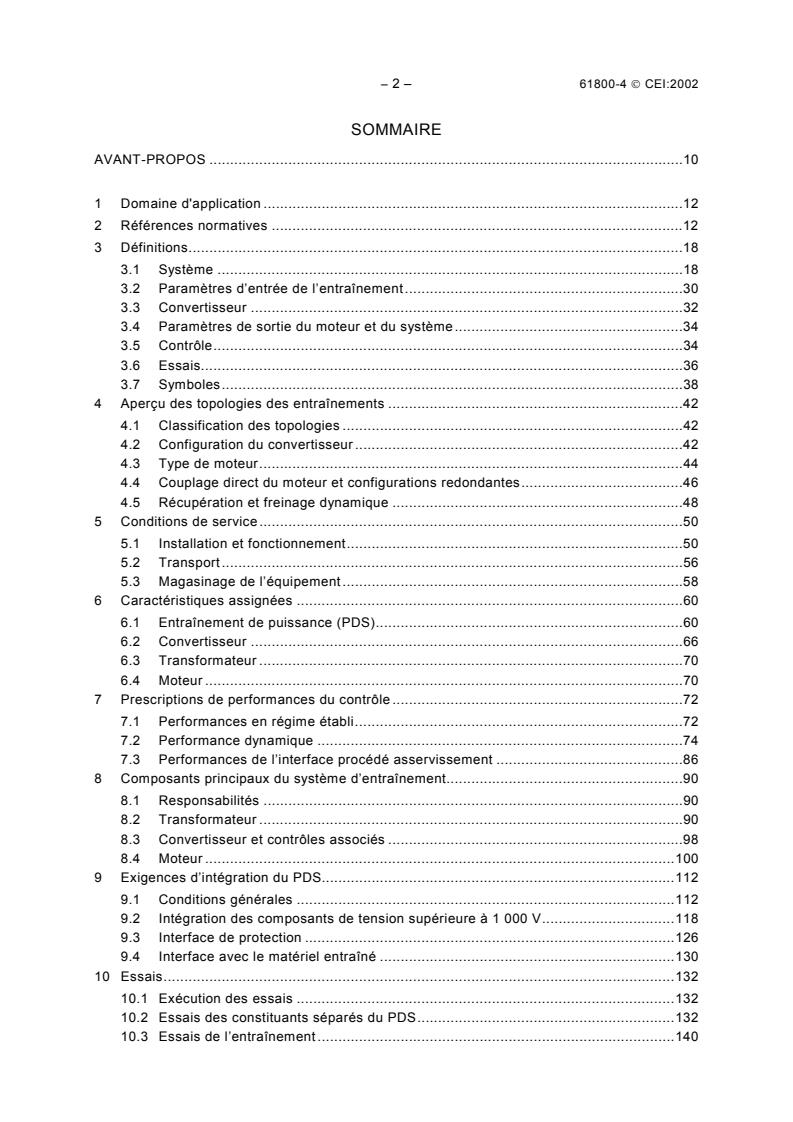
– 2 – 61800-4 CEI:2002
SOMMAIRE
AVANT-PROPOS .10
1 Domaine d'application .12
2 Références normatives .12
3 Définitions.18
3.1 Système .18
3.2 Paramètres d’entrée de l’entraînement.30
3.3 Convertisseur .32
3.4 Paramètres de sortie du moteur et du système.34
3.5 Contrôle.34
3.6 Essais.36
3.7 Symboles.38
4 Aperçu des topologies des entraînements .42
4.1 Classification des topologies .42
4.2 Configuration du convertisseur .42
4.3 Type de moteur.44
4.4 Couplage direct du moteur et configurations redondantes.46
4.5 Récupération et freinage dynamique .48
5 Conditions de service.50
5.1 Installation et fonctionnement.50
5.2 Transport.56
5.3 Magasinage de l’équipement.58
6 Caractéristiques assignées .60
6.1 Entraînement de puissance (PDS).60
6.2 Convertisseur .66
6.3 Transformateur .70
6.4 Moteur .70
7 Prescriptions de performances du contrôle .72
7.1 Performances en régime établi.72
7.2 Performance dynamique .74
7.3 Performances de l’interface procédé asservissement .86
8 Composants principaux du système d’entraînement.90
8.1 Responsabilités .90
8.2 Transformateur .90
8.3 Convertisseur et contrôles associés .98
8.4 Moteur .100
9 Exigences d’intégration du PDS.112
9.1 Conditions générales .112
9.2 Intégration des composants de tension supérieure à 1 000 V.118
9.3 Interface de protection .126
9.4 Interface avec le matériel entraîné .130
10 Essais.132
10.1 Exécution des essais .132
10.2 Essais des constituants séparés du PDS.132
10.3 Essais de l’entraînement.140
61800-4 IEC:2002 – 3 –
CONTENTS
FOREWORD .11
1 Scope .13
2 Normative references.13
3 Definitions.19
3.1 System .19
3.2 PDS input parameters .31
3.3 Converter.33
3.4 PDS output parameters.35
3.5 Control.35
3.6 Tests .37
3.7 Symbols.39
4 Overview of drive system topologies.43
4.1 Topologies classification .43
4.2 Converter configuration.43
4.3 Motor type.45
4.4 By-pass and redundant configurations.47
4.5 Regenerative and dynamic braking.49
5 Service conditions.51
5.1 Installation and operation .51
5.2 Transportation .57
5.3 Storage of equipment.59
6 Ratings .61
6.1 Power drive system (PDS).61
6.2 Converter.67
6.3 Transformer.71
6.4 Motor .71
7 Control performance requirements .73
7.1 Steady state performance .73
7.2 Dynamic performance .75
7.3 Process control interface performance .87
8 PDS main components.91
8.1 Responsibilities.91
8.2 Transformer.91
8.3 Converter and associated controls .99
8.4 Motor .101
9 PDS integration requirements.113
9.1 General conditions .113
9.2 Integration of components with voltages above 1 000 V .119
9.3 Protection interface.127
9.4 Driven equipment interface .131
10 Tests .133
10.1 Performance of tests.133
10.2 Items of individual PDS component tests.133
10.3 Drive system tests .141
– 4 – 61800-4 CEI:2002
11 Détermination du rendement .152
11.1 Généralités .152
11.2 Méthode des pertes séparées .156
11.3 Essai du système à pleine charge .164
Annexe A (informative) Topologies les plus utilisées pour les entraînements.170
A.1 Objet.170
A.2 Topologies d’entraînements avec convertisseurs indirects .170
A.3 Topologies d’entraînement à convertisseurs directs .186
Annexe B (informative) Performance du contrôle de vitesse et système mécanique.192
B.1 Généralités .192
B.2 Types de contrôle de vitesse fondamentaux.192
B.3 Effet de l’élasticité de torsion sur la performance de contrôle de vitesse .194
B.4 Effets des jeux mécaniques.198
B.5 Choix des critères du système de contrôle de vitesse .200
B.6 Spécification des performances du contrôle de vitesse .202
Annexe C (informative) Pertes des semi-conducteurs .204
C.1 Thyristor.204
C.2 GTO/GCT (thyristor commandé à l’extinction/thyristor à commande d’extinction
intégrée) .206
C.3 IGBT .210
C.4 Pertes des circuits d’aide à la commutation (CALC) .214
Figure 1 – Schéma fonctionnel d’un entraînement à vitesse variable à courant alternatif
(PDS) – Tension supérieure à 1 kV.20
Figure 2 – Exemple d'enveloppe de charge.34
Figure 3 – Structure générale d’un entraînement avec convertisseur indirect.42
Figure 4 – Structure générale d’un entraînement avec convertisseur direct .44
Figure 5 – Exemple de convertisseur à modules multiples et d’enroulements stator
séparés .46
Figure 6 – Configuration générique de couplage direct du moteur pour un système à
convertisseur indirect .46
Figure 7 – Onduleur à commutation assistée par la charge (LCI) pour moteur
synchrone en configuration partiellement redondante.48
Figure 8 – Exemple de freinage dynamique.48
Figure 9 – Caractéristiques typiques du rendement et des pertes d’un entraînement en
fonctionnement à flux constant .64
Figure 10 – Exemple de cycle de surcharge.66
Figure 11 – Bande de précision .74
Figure 12 – Réponse temporelle suivant une variation de référence d'entrée en échelon
– Variable opérationnelle constante .80
Figure 13 – Réponse temporelle suivant une variation de la variable opérationnelle –
Référence constante .82
Figure 14 – Réponse temporelle suivant une variation de la référence à un taux spécifié.82
61800-4 IEC:2002 – 5 –
11 Efficiency determination .153
11.1 General .153
11.2 Segregated loss method .157
11.3 Full load system test .165
Annex A (informative) Most commonly used drive system topologies.171
A.1 Object .171
A.2 Drive system topologies with indirect converters .171
A.3 Drive system topologies with direct converters .187
Annex B (informative) Speed control performance and the mechanical system .193
B.1 General.193
B.2 Basic speed control types.193
B.3 Effect of torsion elasticity on speed control performance.195
B.4 Effects of backlash.199
B.5 Selection criteria for the speed control system .201
B.6 Specification of the speed control performance.203
Annex C (informative) Power semiconductor losses .205
C.1 Thyristor.205
C.2 GTO/GCT thyristor (gate turn-off, gate commutated turn-off) .207
C.3 IGBT .211
C.4 Snubber losses .215
Figure 1 – Functional diagram of an a.c. adjustable speed power drive system (PDS) –
Voltage above 1 kV .21
Figure 2 – Example of load envelope .35
Figure 3 – General structure of a drive system with an indirect converter .43
Figure 4 – General structure of a drive system with direct converter .45
Figure 5 – Example of multiple converter modules and separate stator winding systems
motor .47
Figure 6 – Bypass configuration for system with indirect converter .47
Figure 7 – LCI-synchronous motor in a partly redundant configuration.49
Figure 8 – Example of dynamic braking .49
Figure 9 – Typical curves for efficiency and losses of a PDS at constant flux operation .65
Figure 10 – Overload cycle example .67
Figure 11 – Deviation band.75
Figure 12 – Time response following a step change of reference input – no change in
operating variables .81
Figure 13 – Time response following a change in an operating variable – no reference
change .83
Figure 14 – Time response following a reference change at specified rate .83
– 6 – 61800-4 CEI:2002
Figure 15 – Réponse fréquentielle de l’asservissement – Excitation en référence.84
Figure 16 – Responsabilités du fournisseur du système .90
Figure 17 – Types de contraintes d’isolement .106
Figure 18 – Définition de la tension transitoire aux bornes du moteur .108
Figure 19 – Caractéristiques limites admissibles d’une impulsion de tension (y compris
l’effet de réflexion et l’amortissement) aux bornes du moteur en fonction du temps de
montée t .108
a
Figure 20 – Entraînement de puissance (PDS) de tension supérieure à 1 000 V .114
Figure 21 – Intégration du PDS.118
Figure 22 – Exemple de mise à la terre de protection et d’interconnexion des
composants principaux .122
Figure 23 – Points de mesures recommandés sur un entraînement.142
Figure 24 – Schéma de l’essai en opposition .150
Figure 25 – Configuration matérielle du PDS et rendement individuel de chaque
composant .154
Figure A.1 – Structure de base d’un entraînement à moteur synchrone et onduleur de
type LCI .170
Figure A.2 – Structure de base d’un entraînement avec moteur à induction et onduleur LCI .172
Figure A.3 – Structure de base d’un entraînement avec moteur à induction et onduleur
auto-commuté en source de courant et à MLI .172
Figure A.4 – Topologie d’un entraînement avec moteur à induction et double onduleur
CSI-MLI.174
Figure A.5 – Entraînement triphasé avec onduleur en source de tension (VSI) .176
Figure A.6 – Entraînement à onduleur en source de tension NPC.176
Figure A.7 – Structure NPC .178
Figure A.8 – Entraînement à onduleur multiniveaux en source de tension.178
Figure A.9 – Structure de l’onduleur multiniveaux.180
Figure A.10 – Onduleur triphasé en source de tension avec convertisseur bidirectionnel
côté réseau .182
Figure A.11 – Entraînement à double onduleur en source de tension (VSI).182
Figure A.12 – Entraînement à onduleur multiniveaux en source de tension.184
Figure A.13 – Module de puissance (PM) pour onduleur multiniveaux en source de tension.186
Figure A.14 – Cycloconvertisseur triphasé d’indice de pulsation 6 avec transformateur à
3 secondaires.188
Figure A.15 – Cycloconvertisseur à circulation de courant.188
Figure B.1 – Schéma bloc d’un système de contrôle en boucle fermée avec les
éléments fondamentaux .192
Figure B.2 – Schéma mécanique d’un système à deux inerties.194
Figure C.1 – Forme d’onde de commutation des GTO/GCT.208
Figure C.2 – Forme d’onde de commutation d’un IGBT .212
Figure C.3 – Pont à thyristor triphasé.216
Figure C.4 – Ecrêteur commun de type RCD.216
61800-4 IEC:2002 – 7 –
Figure 15 – Frequency response of the control – reference value as stimulus.85
Figure 16 – Responsibilities of the system supplier .91
Figure 17 – Insulation stressing types .107
Figure 18 – Definition of the transient voltage at the terminals of the motor .109
Figure 19 – Admissible pulse voltage (including voltage reflection and damping) at the
motor terminals as a function of the peak rise time t .109
a
Figure 20 – Power drive system (PDS) – voltage above 1 000 V.115
Figure 21 – PDS integration.119
Figure 22 – Example of protective earthing and interconnection of main components .123
Figure 23 – Reference measuring points for drive system tests .143
Figure 24 – Back-to-back test .151
Figure 25 – PDS hardware configuration and individual component efficiency.155
Figure A.1 – Basic structure of an LCI synchronous motor drive system .171
Figure A.2 – Basic structure of an LCI induction motor drive system.173
Figure A.3 – Basic structure of a self-commutated PWM-CSI inverter for an induction
motor drive system .173
Figure A.4 – Dual CSI-PWM converter topology for induction motor drive system .175
Figure A.5 – Three-phase VSI drive systems .177
Figure A.6 – Voltage source NPC inverter drive system.177
Figure A.7 – NPC structure.179
Figure A.8 – Voltage source multi-level inverter drive system .179
Figure A.9 – Multi-level inverter structure.181
Figure A.10 – Three-phase VSI inverter with a bi-directional line-side converter .183
Figure A.11 – Dual voltage source inverter (VSI) drive system .183
Figure A.12 – Voltage source multilevel inverter drive system .185
Figure A.13 – Power module (PM) for each level.187
Figure A.14 – Three-phase six-pulse connection cycloconverter
with a four-winding transformer.189
Figure A.15 – Circulating current cycloconverter .189
Figure B.1 – Block diagram of the feedback control system
containing all the basic elements .193
Figure B.2 – Mechanical diagram of a two moment inertia system .195
Figure C.1 – GTO/GCT switching waveform.209
Figure C.2 – IGBT switching waveform .213
Figure C.3 – Three-phase thyristor bridge circuit.217
Figure C.4 – Common RCD clamp .217
– 8 – 61800-4 CEI:2002
Tableau 1 – Symboles .40
Tableau 2 – Conditions de service pour l’alimentation aux bornes de l’entraînement
(principales et auxiliaires) .50
Tableau 3 – Limites de vibration de l’installation .54
Tableau 4 – Limites de vibration au cours du transport (voir classe 2M1 de la
CEI 60721-3-2).58
Tableau 5 – Exemple de réduction de la charge maximale permanente en fonction de la
surcharge.66
Tableau 6 – Bandes de précision – Erreurs maximales (%) .74
Tableau 7 – Limites et types de contraintes .110
Tableau 8 – Fonctions de protection de l’entraînement.128
Tableau 9 – Essais normalisés des constituants des entraînements.132
Tableau 10 – Essais normalisés du convertisseur en tant que constituant .136
Tableau 11 – Essais d’un entraînement .140
61800-4 IEC:2002 – 9 –
Table 1 – Symbols.41
Table 2 – Service conditions for the voltage supply at the PDS terminals (main and
auxiliary) .51
Table 3 – Installation vibration limits .55
Table 4 – Transportation vibration limits (see class 2M1 IEC 60721-3-2) .59
Table 5 – Example of reduced maximum continuous load as a function of an overload.67
Table 6 – Maximum deviation bands (percent) .75
Table 7 – Limiting parts and typical voltage stress capability of the motor insulation system .111
Table 8 – PDS protection functions.129
Table 9 – Standard tests for PDS components .133
Table 10 – Standard tests of the converter as component .137
Table 11 – Drive system tests.141
– 10 – 61800-4 CEI:2002
COMMISSION ÉLECTROTECHNIQUE INTERNATIONALE
____________
ENTRAÎNEMENTS ÉLECTRIQUES DE PUISSANCE À VITESSE VARIABLE–
Partie 4: Exigences générales – Spécifications de dimensionnement
pour systèmes d'entraînements de puissance en courant alternatif
de tension supérieure à 1 000 V alternatif et ne dépassant pas 35 kV
AVANT-PROPOS
1) La CEI (Commission Électrotechnique Internationale) est une organisation mondiale de normalisation composée
de l'ensemble des comités électrotechniques nationaux (Comités nationaux de la CEI). La CEI a pour objet de
favoriser la coopération internationale pour toutes les questions de normalisation dans les domaines de
l'électricité et de l'électronique. A cet effet, la CEI, entre autres activités, publie des Normes internationales.
Leur élaboration est confiée à des comités d'études, aux travaux desquels tout Comité national intéressé par le
sujet traité peut participer. Les organisations internationales, gouvernementales et non gouvernementales, en
liaison avec la CEI, participent également aux travaux. La CEI collabore étroitement avec l'Organisation
Internationale de Normalisation (ISO), selon des conditions fixées par accord entre les deux organisations.
2) Les décisions ou accords officiels de la CEI concernant les questions techniques représentent, dans la mesure
du possible, un accord international sur les sujets étudiés, étant donné que les Comités nationaux intéressés
sont représentés dans chaque comité d’études.
3) Les documents produits se présentent sous la forme de recommandations internationales. Ils sont publiés
comme normes, spécifications techniques, rapports techniques ou guides et agréés comme tels par les Comités
nationaux.
4) Dans le but d'encourager l'unification internationale, les Comités nationaux de la CEI s'engagent à appliquer de
façon transparente, dans toute la mesure possible, les Normes internationales de la CEI dans leurs normes
nationales et régionales. Toute divergence entre la norme de la CEI et la norme nationale ou régionale
correspondante doit être indiquée en termes clairs dans cette dernière.
5) La CEI n’a fixé aucune procédure concernant le marquage comme indication d’approbation et sa responsabilité
n’est pas engagée quand un matériel est déclaré conforme à l’une de ses normes.
6) L’attention est attirée sur le fait que certains des éléments de la présente Norme internationale peuvent faire
l’objet de droits de propriété intellectuelle ou de droits analogues. La CEI ne saurait être tenue pour
responsable de ne pas avoir identifié de tels droits de propriété et de ne pas avoir signalé leur existence.
La Norme internationale CEI 61800-4 a été établie par le sous-comité 22G: Convertisseurs à
semiconducteurs pour les systèmes d’entraînement électriques à vitesse variable, du comité
d'études 22 de la CEI: Systèmes et équipements électroniques de puissance.
Le texte de cette norme est issu des documents suivants:
FDIS Rapport de vote
22G/99/FDIS 22G/107/RVD
Le rapport de vote indiqué dans le tableau ci-dessus donne toute information sur le vote ayant
abouti à l'approbation de cette norme.
Les annexes A, B et C sont données uniquement à titre d'information.
Cette publication a été rédigée selon les Directives ISO/CEI, Partie 3.
Le comité a décidé que le contenu de cette publication ne sera pas modifié avant 2008. A cette
date, la publication sera
• reconduite;
• supprimée;
• remplacée par une édition révisée, ou
• amendée.
61800-4 IEC:2002 – 11 –
INTERNATIONAL ELECTROTECHNICAL COMMISSION
____________
ADJUSTABLE SPEED ELECTRICAL POWER DRIVE SYSTEMS –
Part 4: General requirements – Rating specifications for a.c. power drive
systems above 1 000 V a.c and not exceeding 35 kV
FOREWORD
1) The IEC (International Electrotechnical Commission) is a worldwide organization for standardization comprising
all national electrotechnical committees (IEC National Committees). The object of the IEC is to promote
international co-operation on all questions concerning standardization in the electrical and electronic fields. To
this end and in addition to other activities, the IEC publishes International Standards. Their preparation is
entrusted to technical committees; any IEC National Committee interested in the subject dealt with may
participate in this preparatory work. International, governmental and non-governmental organizations liaising
with the IEC also participate in this preparation. The IEC collaborates closely with the International Organization
for Standardization (ISO) in accordance with conditions determined by agreement between the two
organizations.
2) The formal decisions or agreements of the IEC on technical matters express, as nearly as possible, an
international consensus of opinion on the relevant subjects since each technical committee has representation
from all interested National Committees.
3) The documents produced have the form of recommendations for international use and are published in the form
of standards, technical specifications, technical reports or guides and they are accepted by the National
Committees in that sense.
4) In order to promote international unification, IEC National Committees undertake to apply IEC International
Standards transparently to the maximum extent possible in their national and regional standards. Any
divergence between the IEC Standard and the corresponding national or regional standard shall be clearly
indicated in the latter.
5) The IEC provides no marking procedure to indicate its approval and cannot be rendered responsible for any
equipment declared to be in conformity with one of its standards.
6) Attention is drawn to the possibility that some of the elements of this International Standard may be the subject
of patent rights. The IEC shall not be held responsible for identifying any or all such patent rights.
International Standard IEC 61800-4 has been prepared by sub-committee 22G: Semiconductor
power converters for adjustable speed electric drive systems, of IEC technical committee 22:
Power electronic systems and equipment.
The text of this standard is based on the following documents:
FDIS Report on voting
22G/99/FDIS 22G/107/RVD
Full information on the voting for the approval of this standard can be found in the report on
voting indicated in the above table.
This publication has been drafted in accordance with the ISO/IEC Directives, Part 3.
Annexes A, B and C are for information only.
The committee has decided that the contents of this publication will remain unchanged until
2008. At this date, the publication will be
• reconfirmed;
• withdrawn;
• replaced by a revised edition, or
• amended.
...