


IEC 61577-6:2026
(Main)Radiation protection instrumentation - Radon and radon decay product measuring instruments - Part 6: Passive integrating radon measurement system using solid-state nuclear track detectors
Radiation protection instrumentation - Radon and radon decay product measuring instruments - Part 6: Passive integrating radon measurement system using solid-state nuclear track detectors
IEC 61577-6:2026 describes the specific requirements for instruments measuring the exposure to airborne radon (222Rn) outdoors and indoors. The exposure is the time-integrated radon activity concentration in air accumulated over the exposure period.
This document applies to radon integration measurement systems equipped with solid-state nuclear track detectors (SSNTD) installed in an enclosed volume. The air containing 222Rn enters the volume by diffusionIEC 61577 describes the specific requirements for instruments measuring the exposure to airborne radon (222Rn) outdoors and indoors. The exposure is the time-integrated radon activity concentration in air accumulated over the exposure period.
This document applies to radon integration measurement systems equipped with solid-state nuclear track detectors (SSNTD) installed in an enclosed volume. The air containing 222Rn enters the volume by diffusion
Instrumentation pour la radioprotection - Instruments de mesure du radon et des descendants du radon - Partie 6: Systèmes de mesure du radon à intégration passive utilisant des détecteurs solides de traces nucléaires
General Information
- Status
- Published
- Publication Date
- 11-Mar-2026
- Technical Committee
- SC 45B - Radiation protection instrumentation
- Drafting Committee
- WG 10 - TC 45/SC 45B/WG 10
- Current Stage
- PPUB - Publication issued
- Start Date
- 12-Mar-2026
- Completion Date
- 03-Apr-2026
Overview
IEC 61577-6:2026 is an international standard published by the IEC for radiation protection instrumentation, specifically focusing on radon and radon decay product measuring instruments. This part of the IEC 61577 series details the requirements for passive integrating radon measurement systems using solid-state nuclear track detectors (SSNTD). The document outlines how these instruments should measure airborne radon exposure (principally Radon-222) both indoors and outdoors by tracking the time-integrated concentration of radon in the air.
Passive radon detection systems addressed by IEC 61577-6 make use of diffusion chambers outfitted with SSNTDs, which require no external power during the monitoring period and register alpha particles emitted by radon decay. This standard ensures consistent performance and quality in the measurement of radon exposure, enhancing confidence in the resulting data and supporting regulatory compliance and radiation safety initiatives.
Key Topics
- Radon Exposure Measurement: Describes methodologies to determine time-integrated radon activity concentration, giving a cumulative measure of radon exposure over a specified period.
- Diffusion Chamber Design: Specifies requirements for the enclosed volumes allowing radon, but not its progeny or external contaminants, to enter by diffusion.
- Solid-State Nuclear Track Detectors (SSNTD): Details the use of specialized plastics sensitive to alpha particles, such as CR-39, LR115, and MAKROFOL, which form latent tracks from radon decay that are later made visible through etching.
- Quality Assurance and Control: Covers protocols for background measurement, calibration factors, environmental control, and the handling and storage of detectors to minimize measurement uncertainty and ensure data reliability.
- Testing Procedures: Provides methods for evaluating the accuracy, stability, and linearity of measurement systems under various environmental conditions, including temperature and humidity.
Applications
The practical applications of IEC 61577-6:2026 include:
- Indoor and Outdoor Environmental Monitoring: Essential for public health agencies, environmental consultancies, and building managers assessing radon levels in homes, public buildings, workplaces, and outdoors.
- Occupational Exposure Assessment: Used in workplaces with increased radon exposure risk (such as underground mines, waterworks, and spas), supporting worker safety programs and compliance with occupational health regulations.
- Long-Term Radon Surveys: Supports national and regional radon mapping campaigns by providing reliable and standardized passive measurement approaches.
- Personal Dosimetry: Can be implemented for individual exposure monitoring, with portable or wearable measurement devices enabled by passive SSNTDs.
By following IEC 61577-6, organizations can provide trustworthy radon measurement results, underpinning efforts in radiation protection, regulatory reporting, risk communication, and mitigation planning.
Related Standards
For comprehensive radon measurement and radiation protection, the following standards in the IEC 61577 series and related areas should be considered:
- IEC 61577-1: Terminology and units for radon and decay product measurements.
- IEC 61577-2: Requirements and tests for radon measuring instruments.
- IEC 61577-3: Requirements and tests for radon decay product (RnDP) measuring instruments.
- IEC 61577-4: Construction and use of test atmospheres for calibration and testing of radon measurement devices.
- IEC TR 61577-5: Technical information supporting the design and application of radon and radon decay product measuring systems.
- IEC 61140: Protection against electric shock – relevant for instrumentation safety.
- ISO/IEC Guide 98-3: Guidance on expressing and calculating measurement uncertainty.
These documents, together with IEC 61577-6:2026, establish a complete framework for the reliable measurement and management of radon exposure, advancing radiation protection practices globally.
Buy Documents
IEC 61577-6:2026 - Radiation protection instrumentation - Radon and radon decay product measuring instruments - Part 6: Passive integrating radon measurement system using solid-state nuclear track detectors
Get Certified
Connect with accredited certification bodies for this standard

NSF International
Global independent organization facilitating standards development and certification.

CIS Institut d.o.o.
Personal Protective Equipment (PPE) certification body. Notified Body NB-2890 for EU Regulation 2016/425 PPE.

Kiwa BDA Testing
Building and construction product certification.
Sponsored listings
Frequently Asked Questions
IEC 61577-6:2026 is a standard published by the International Electrotechnical Commission (IEC). Its full title is "Radiation protection instrumentation - Radon and radon decay product measuring instruments - Part 6: Passive integrating radon measurement system using solid-state nuclear track detectors". This standard covers: IEC 61577-6:2026 describes the specific requirements for instruments measuring the exposure to airborne radon (222Rn) outdoors and indoors. The exposure is the time-integrated radon activity concentration in air accumulated over the exposure period. This document applies to radon integration measurement systems equipped with solid-state nuclear track detectors (SSNTD) installed in an enclosed volume. The air containing 222Rn enters the volume by diffusionIEC 61577 describes the specific requirements for instruments measuring the exposure to airborne radon (222Rn) outdoors and indoors. The exposure is the time-integrated radon activity concentration in air accumulated over the exposure period. This document applies to radon integration measurement systems equipped with solid-state nuclear track detectors (SSNTD) installed in an enclosed volume. The air containing 222Rn enters the volume by diffusion
IEC 61577-6:2026 describes the specific requirements for instruments measuring the exposure to airborne radon (222Rn) outdoors and indoors. The exposure is the time-integrated radon activity concentration in air accumulated over the exposure period. This document applies to radon integration measurement systems equipped with solid-state nuclear track detectors (SSNTD) installed in an enclosed volume. The air containing 222Rn enters the volume by diffusionIEC 61577 describes the specific requirements for instruments measuring the exposure to airborne radon (222Rn) outdoors and indoors. The exposure is the time-integrated radon activity concentration in air accumulated over the exposure period. This document applies to radon integration measurement systems equipped with solid-state nuclear track detectors (SSNTD) installed in an enclosed volume. The air containing 222Rn enters the volume by diffusion
IEC 61577-6:2026 is classified under the following ICS (International Classification for Standards) categories: 13.280 - Radiation protection. The ICS classification helps identify the subject area and facilitates finding related standards.
IEC 61577-6:2026 is available in PDF format for immediate download after purchase. The document can be added to your cart and obtained through the secure checkout process. Digital delivery ensures instant access to the complete standard document.
Standards Content (Sample)
IEC 61577-6 ®
Edition 1.0 2026-03
INTERNATIONAL
STANDARD
Radiation protection instrumentation - Radon and radon decay product
measuring instruments -
Part 6: Passive integrating radon measurement system using solid-state
nuclear track detectors
ICS 13.280 ISBN 978-2-8327-1109-5
All rights reserved. Unless otherwise specified, no part of this publication may be reproduced or utilized in any form or
by any means, electronic or mechanical, including photocopying and microfilm, without permission in writing from either
IEC or IEC's member National Committee in the country of the requester. If you have any questions about IEC copyright
or have an enquiry about obtaining additional rights to this publication, please contact the address below or your local
IEC member National Committee for further information.
IEC Secretariat Tel.: +41 22 919 02 11
3, rue de Varembé info@iec.ch
CH-1211 Geneva 20 www.iec.ch
Switzerland
About the IEC
The International Electrotechnical Commission (IEC) is the leading global organization that prepares and publishes
International Standards for all electrical, electronic and related technologies.
About IEC publications
The technical content of IEC publications is kept under constant review by the IEC. Please make sure that you have the
latest edition, a corrigendum or an amendment might have been published.
IEC publications search - IEC Products & Services Portal - products.iec.ch
webstore.iec.ch/advsearchform Discover our powerful search engine and read freely all the
The advanced search enables to find IEC publications by a publications previews, graphical symbols and the glossary.
variety of criteria (reference number, text, technical With a subscription you will always have access to up to date
committee, …). It also gives information on projects, content tailored to your needs.
replaced and withdrawn publications.
Electropedia - www.electropedia.org
The world's leading online dictionary on electrotechnology,
IEC Just Published - webstore.iec.ch/justpublished
Stay up to date on all new IEC publications. Just Published containing more than 22 500 terminological entries in English
details all new publications released. Available online and and French, with equivalent terms in 25 additional languages.
once a month by email. Also known as the International Electrotechnical Vocabulary
(IEV) online.
IEC Customer Service Centre - webstore.iec.ch/csc
If you wish to give us your feedback on this publication or
need further assistance, please contact the Customer
Service Centre: sales@iec.ch.
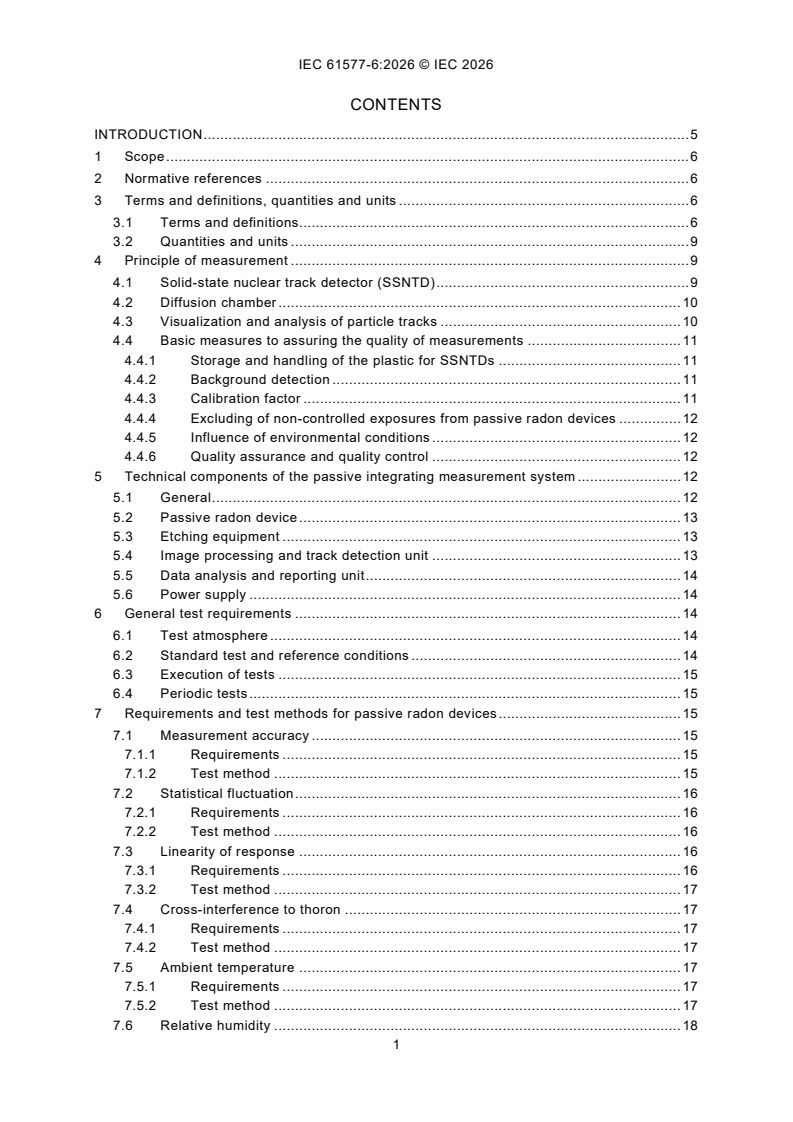
CONTENTS
INTRODUCTION . 5
1 Scope . 6
2 Normative references . 6
3 Terms and definitions, quantities and units . 6
3.1 Terms and definitions. 6
3.2 Quantities and units . 9
4 Principle of measurement . 9
4.1 Solid-state nuclear track detector (SSNTD) . 9
4.2 Diffusion chamber . 10
4.3 Visualization and analysis of particle tracks . 10
4.4 Basic measures to assuring the quality of measurements . 11
4.4.1 Storage and handling of the plastic for SSNTDs . 11
4.4.2 Background detection . 11
4.4.3 Calibration factor . 11
4.4.4 Excluding of non-controlled exposures from passive radon devices . 12
4.4.5 Influence of environmental conditions . 12
4.4.6 Quality assurance and quality control . 12
5 Technical components of the passive integrating measurement system . 12
5.1 General . 12
5.2 Passive radon device . 13
5.3 Etching equipment . 13
5.4 Image processing and track detection unit . 13
5.5 Data analysis and reporting unit . 14
5.6 Power supply . 14
6 General test requirements . 14
6.1 Test atmosphere . 14
6.2 Standard test and reference conditions . 14
6.3 Execution of tests . 15
6.4 Periodic tests . 15
7 Requirements and test methods for passive radon devices . 15
7.1 Measurement accuracy . 15
7.1.1 Requirements . 15
7.1.2 Test method . 15
7.2 Statistical fluctuation . 16
7.2.1 Requirements . 16
7.2.2 Test method . 16
7.3 Linearity of response . 16
7.3.1 Requirements . 16
7.3.2 Test method . 17
7.4 Cross-interference to thoron . 17
7.4.1 Requirements . 17
7.4.2 Test method . 17
7.5 Ambient temperature . 17
7.5.1 Requirements . 17
7.5.2 Test method . 17
7.6 Relative humidity . 18
7.6.1 Requirements . 18
7.6.2 Test method . 18
8 Quality control requirements for SSNTD processing . 19
8.1 General . 19
8.2 Exposure of SSNTDs for quality control . 19
8.3 Stability of etching temperature . 20
8.3.1 Chemical etching . 20
8.3.2 Electrochemical etching . 20
8.4 Stability of image processing and track detection . 20
9 Documentation . 20
9.1 Operation and maintenance instructions . 20
9.2 Technical records and test report . 20
Bibliography . 22
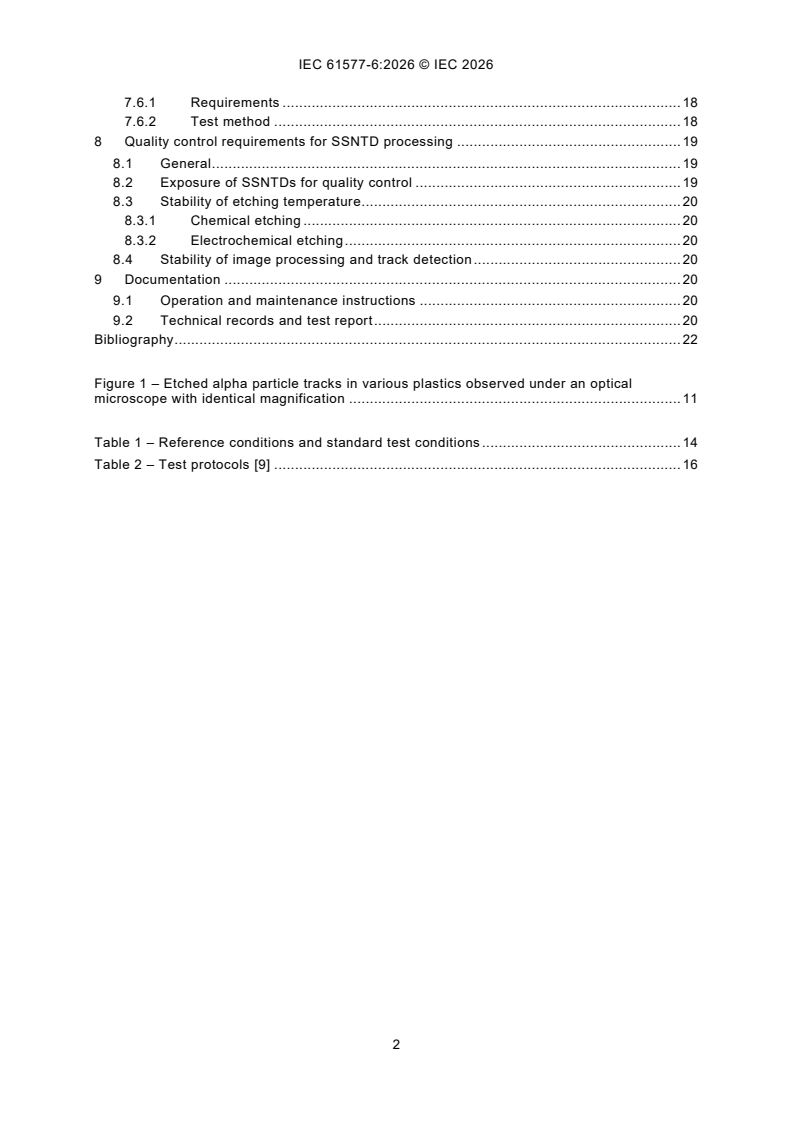
Figure 1 – Etched alpha particle tracks in various plastics observed under an optical
microscope with identical magnification . 11
Table 1 – Reference conditions and standard test conditions . 14
Table 2 – Test protocols [9] . 16
INTERNATIONAL ELECTROTECHNICAL COMMISSION
____________
Radiation protection instrumentation -
Radon and radon decay product measuring instruments -
Part 6: Passive integrating radon measurement system
using solid-state nuclear track detectors
FOREWORD
1) The International Electrotechnical Commission (IEC) is a worldwide organization for standardization comprising
all national electrotechnical committees (IEC National Committees). The object of IEC is to promote international
co-operation on all questions concerning standardization in the electrical and electronic fields. To this end and
in addition to other activities, IEC publishes International Standards, Technical Specifications, Technical Reports,
Publicly Available Specifications (PAS) and Guides (hereafter referred to as "IEC Publication(s)"). Their
preparation is entrusted to technical committees; any IEC National Committee interested in the subject dealt with
may participate in this preparatory work. International, governmental and non-governmental organizations liaising
with the IEC also participate in this preparation. IEC collaborates closely with the International Organization for
Standardization (ISO) in accordance with conditions determined by agreement between the two organizations.
2) The formal decisions or agreements of IEC on technical matters express, as nearly as possible, an international
consensus of opinion on the relevant subjects since each technical committee has representation from all
interested IEC National Committees.
3) IEC Publications have the form of recommendations for international use and are accepted by IEC National
Committees in that sense. While all reasonable efforts are made to ensure that the technical content of IEC
Publications is accurate, IEC cannot be held responsible for the way in which they are used or for any
misinterpretation by any end user.
4) In order to promote international uniformity, IEC National Committees undertake to apply IEC Publications
transparently to the maximum extent possible in their national and regional publications. Any divergence between
any IEC Publication and the corresponding national or regional publication shall be clearly indicated in the latter.
5) IEC itself does not provide any attestation of conformity. Independent certification bodies provide conformity
assessment services and, in some areas, access to IEC marks of conformity. IEC is not responsible for any
services carried out by independent certification bodies.
6) All users should ensure that they have the latest edition of this publication.
7) No liability shall attach to IEC or its directors, employees, servants or agents including individual experts and
members of its technical committees and IEC National Committees for any personal injury, property damage or
other damage of any nature whatsoever, whether direct or indirect, or for costs (including legal fees) and
expenses arising out of the publication, use of, or reliance upon, this IEC Publication or any other IEC
Publications.
8) Attention is drawn to the Normative references cited in this publication. Use of the referenced publications is
indispensable for the correct application of this publication.
9) IEC draws attention to the possibility that the implementation of this document may involve the use of (a)
patent(s). IEC takes no position concerning the evidence, validity or applicability of any claimed patent rights in
respect thereof. As of the date of publication of this document, IEC had not received notice of (a) patent(s), which
may be required to implement this document. However, implementers are cautioned that this may not represent
the latest information, which may be obtained from the patent database available at https://patents.iec.ch. IEC
shall not be held responsible for identifying any or all such patent rights.
IEC 61577-6 has been prepared by subcommittee 45B: Radiation protection instrumentation, of
IEC technical committee 45: Nuclear instrumentation. It is an International Standard.
The text of this International Standard is based on the following documents:
Draft Report on voting
45B/1100/FDIS 45B/1111/RVD
Full information on the voting for its approval can be found in the report on voting indicated in
the above table.
The language used for the development of this International Standard is English.
This document was drafted in accordance with ISO/IEC Directives, Part 2, and developed in
accordance with ISO/IEC Directives, Part 1 and ISO/IEC Directives, IEC Supplement, available
at www.iec.ch/members_experts/refdocs. The main document types developed by IEC are
described in greater detail at www.iec.ch/publications.
A list of all parts in the IEC 61577 series, published under the general title Radiation protection
instrumentation - Radon and radon decay product measuring instruments, can be found on the
IEC website.
The committee has decided that the contents of this document will remain unchanged until the
stability date indicated on the IEC website under webstore.iec.ch in the data related to the
specific document. At this date, the document will be
– reconfirmed,
– withdrawn, or
– revised.
INTRODUCTION
226 223 224
Radon is a radioactive gas produced by the decay of Ra, Ra and Ra, respectively
238 235 232
decay products of U, U and Th, which are present in the earth's crust. By decay, radon
222 219 220
isotopes (i.e. Rn, Rn, Rn) produce three decay chains ending in a stable lead isotope.
In normal conditions, due to the very short half-life of Rn, its activity and the activity of its
Radon Decay Products (RnDP) are considered negligible compared to the activity of the two
other series. Its health effects are therefore not important. Thus, in this document Rn and its
decay products are not considered.
218 214 214 214
Radon isotopes and their corresponding short-lived RnDP (i.e. Po, Pb, Bi, Po for
222 216 212 212 212 208 220
Rn, and Po, Pb, Bi, Po, Tl for Rn) are of considerable importance, as they
constitute the major part of the radiological exposure to natural radioactivity for the general
public and workers. In some workplaces, for instance in underground mines, spas and
waterworks, the workers can be exposed to very significant levels of RnDP. The conformity of
the technical characteristics of radon measuring devices with specific requirements contributes
to a harmonized quality level of the measurements and thus supports the confidence in the
measurement results and the acceptance of the decisions made.
Remark:
In order to facilitate its use, the IEC 61577 series is divided into the following different parts:
IEC 61577-1: This emphasizes the terminology and units of the specific field of radon and radon
decay products (RnDP) measurement techniques and presents briefly the concept of System
for Test Atmospheres with Radon (STAR) used for test and calibration of radon and RnDP
measuring devices.
2 222 220
IEC 61577-2 [1] : This part is dedicated to the tests of Rn and Rn measuring instruments.
IEC 61577-3 [2]: This part is dedicated to the tests of RnDP and RnDP measuring
222 220
instruments.
IEC 61577-4 [3]: This part details how a STAR is constructed and how it can be used for testing.
IEC TR 61577-5 [4]: This part provides basic data and technical information to support the
222 220
design of measuring instruments for Rn, Rn and their decay products and practical
application of the instruments for the measurement.
IEC 61577-6: This part is dedicated to the tests of passive integrating Rn measurement
systems.
___________
RnDP is the acronym of Radon Decay Products and it is equivalent to Radon Progeny.
Numbers in square brackets refer to the Bibliography.
1 Scope
This part of IEC 61577 describes the specific requirements for instruments measuring the
exposure to airborne radon ( Rn) outdoors and indoors. The exposure is the time-integrated
radon activity concentration in air accumulated over the exposure period.
This document applies to radon integration measurement systems equipped with solid-state
nuclear track detectors (SSNTD) installed in an enclosed volume. The air containing Rn
enters the volume by diffusion.
2 Normative references
The following documents are referred to in the text in such a way that some or all of their content
constitutes requirements of this document. For dated references, only the edition cited applies.
For undated references, the latest edition of the referenced document (including any
amendments) applies.
IEC 61140, Protection against electric shock - Common aspects for installation and equipment
ISO/IEC Guide 98-3, Uncertainty of measurement - Part 3: Guide to the expression of
uncertainty in measurement (GUM:1995)
3 Terms and definitions, quantities and units
3.1 Terms and definitions
For the purposes of this document, the following terms and definitions apply.
ISO and IEC maintain terminology databases for use in standardization at the following
addresses:
– IEC Electropedia: available at https://www.electropedia.org/
– ISO Online browsing platform: available at https://www.iso.org/obp
3.1.1
activity
number dN of spontaneous nuclear transitions or nuclear disintegrations for a radionuclide of
amount N produced during a short time interval dt, divided by this time interval
[SOURCE: IEC 60050-395:2014 [5], 395-01-05, modified – The formula and the notes to entry
have been omitted.]
3.1.2
activity concentration
activity per unit volume of the sample
[SOURCE: IEC 60050-395:2014, 395-01-09, modified – The notes to entry have been omitted.]
3.1.3
characteristic diffusion time
time required for radon to enter a diffusion chamber and reach at least 90 % of its external
concentration within the chamber
3.1.4
client
person or organization deploying passive radon devices for measurements and using the
resources of a radon service for this purpose
3.1.5
coefficient of variation
V
ratio of the standard deviation s to the arithmetic mean x of a set of n measurements x given
i
by the following formula:
x−x
( )
s 1
∑ i
V
xx n−1
m
Note 1 to entry: The coefficient of variation can be expressed in percent (%) of the arithmetic mean.
[SOURCE: IEC 61577-2:2014, 3.9]
3.1.6
conventional quantity value
υ
c
quantity value attributed by agreement to a quantity for a given purpose
Note 1 to entry: The term "conventional true quantity value" is sometimes used for this concept, but its use is
discouraged.
Note 2 to entry: Sometimes a conventional quantity value is an estimate of a true quantity value.
Note 3 to entry: A conventional quantity value is generally accepted as being associated with a suitably small
measurement uncertainty, which might be zero.
[SOURCE: ISO/IEC GUIDE 99:2007 [6], 2.12, modified – Examples have been omitted.]
3.1.7
cross-interference
ratio of the response of the instrument to the radiation from interfering radionuclide to the
response of the radiation from the radionuclide of interest
[SOURCE: IEC 61577-2:2014, 3.8]
3.1.8
diffusion chamber
enclosed volume into which radon enters by passive diffusion
3.1.9
absolute error
algebraic difference between the indicated value and a comparison value
Note 1 to entry: The comparison value should be a conventional quantity value.
[SOURCE: IEC 60050-311:2001 [7], 311-01-05, modified – The notes to entry have been
replaced by a new Note 1 to entry.]
3.1.10
relative error
ratio of the absolute error to a comparison value
Note 1 to entry: The comparison value should be a conventional quantity value.
Note 2 to entry: The conventional quantity value in this document is associated with the comparison value
established in the radon reference atmosphere.
[SOURCE: IEC 60050-311:2001, 311-01-17, modified – The notes to entry have been replaced
by a new Note 1 to entry and Note 2 to entry.]
3.1.11
etching
chemical or electrochemical process for treating SSNTD to make latent tracks optically visible
Note 1 to entry: In the chemical etching process, a chemical solvent is used as an etchant.
Note 2 to entry: In the electrochemical etching process, a sinusoidal electrical voltage is applied in addition to the
chemical etching in order to intensify the effect of the etching.
==
3.1.12
time-integrated radon activity concentration
time integral over the activity concentration of radon for a defined period of time
-3
Note 1 to entry: The unit is Bq⋅h⋅m .
Note 2 to entry: The term "exposure to radon" can also be used for the same meaning of "time-integrated radon
activity concentration" in this document.
3.1.13
exposure period
period for which someone/something is subject to ionizing radiation
Note 1 to entry: In the context of this document, period for which someone/something is exposed to radon.
3.1.14
radon
Rn
radon isotope with mass number 222
3.1.15
radon reference atmosphere
volume of air containing radon to realize the measurand of radon activity concentration
Note 1 to entry: A radon reference atmosphere is provided by a System for Test Atmospheres with Radon (STAR
facility). The components and operation of a STAR are described in IEC 61577-4.
Note 2 to entry: A radon reference atmosphere represents a secondary standard for the radon activity concentration
that combines the primary quantities of radon activity and volume.
3.1.16
radon service
entity operating a passive integrating radon measurement system
Note 1 to entry: A radon service carries out all activities required to evaluate exposed measuring devices and
determine radon exposure. It works in accordance with defined procedures and quality assurance requirements. The
radon service communicates the measurement result to the client.
3.1.17
passive sampling
sampling which involves only natural diffusion
3.1.18
passive radon device
diffusion chamber with a detector suitable for registering the radiation from Rn and its
progeny
Note 1 to entry: The passive radon devices covered by this document use solid-state nuclear track detectors. This
allows the devices to be operated for autonomous long-term measurements without additional electronic support.
Note 2 to entry: The passive radon device can be designed for on-site measurements indoors and outdoors or for
wearing on a person's body.
3.1.19
solid-state nuclear track detector
SSNTD
solid material in which penetrating nuclear particles change chemical bonds and thus create
latent tracks that can be made visible by subsequent chemical processing
Note 1 to entry: The latent tracks are formed along the entry path of the nuclear particle.
Note 2 to entry: For the measurement of radon and progeny, the solid material shall be sensitive to alpha particles.
3.1.20
test atmosphere
volume of air containing radon that is established for testing radon measuring instruments
Note 1 to entry: The radon activity concentration of a test atmosphere is traced back to a radon reference
atmosphere.
Note 2 to entry: A test atmosphere is provided by a System for Test Atmospheres with Radon (STAR facility). The
components and operation of a STAR are described in IEC 61577-4.
3.1.21
thoron
radon isotope with mass number 220
3.1.22
track density
number of tracks registered per unit area of a solid-state nuclear track detector
3.2 Quantities and units
In the present document, units of the International System (SI) are used . The definitions of
radiation quantities are given in IEC 60050-395.
Nevertheless, the following units may also be used:
–19
– for energy: electron-volt (symbol: eV), 1 eV = 1,602 × 10 J;
– for time: years (symbol: y), days (symbol: d), hours (symbol: h), minutes (symbol: min);
222 -3
– for exposure due to Rn: becquerel-hour per unit air volume (symbol: Bq·h·m );
222 -3
– for activity concentration of Rn: becquerel per unit air volume (Bq·m ).
Multiples and submultiples of SI units will be used, when practicable, according to the SI
system.
4 Principle of measurement
4.1 Solid-state nuclear track detector (SSNTD)
Ionizing charged particles passing through insulating matter leave narrow trails of damage. In
plastics, the radiation damage produces broken molecular chains, free radicals, etc. which
results in the formation of latent tracks. Chemical reagents (etchant) dissolve or degrade these
damaged regions at a much higher rate than the undamaged material [8], thus making latent
tracks visible.
The determination of exposure to airborne radon ( Rn) is based on the detection of alpha
particles, which are released by the decay of radon and its decay products. Alpha particles,
being helium nuclei, have a higher mass than protons, but a lower mass and charge than other
atomic ions. Since the efficiency of latent track formation in matter increases with the increasing
charge number and mass of the penetrating charged particle, alpha particles form latent tracks
that can be made visible only in certain plastics. Such plastics are suitable for SSNTD to detect
radon and its decay products.
EXAMPLE 1 Poly-allyl-diglycol-carbonate (PADC): A PADC frequently used for the registration of alpha particles
® ®
is CR-39 . CR-39 is a trademark of PPG INDUSTRIES OHIO, INC. The material is transparent in the visible
-3 4
spectrum and has a density of 1,3 g cm . It is mainly used in the manufacture of eyeglass lenses.
EXAMPLE 2 Cellulose nitrate film (CN film): A CN film specially developed for the registration of charged particles
® ®
and fission fragments is known under the trademark LR115 . Today, LR115 films are supplied by ALGADE SAS, ®
France. LR115 type 2 is often used for the registration of alpha particles. The film consists of a deep red, alpha-
sensitive CN layer with a thickness of 12 µm, which is applied to a 100 μm thick polyester base. The density of the
-3 4
sensitive layer is 1,67 g cm .
EXAMPLE 3 Extrusion film based on polycarbonate: A polycarbonate film with proven suitability for the registration
® ®
of alpha particles is MAKROFOL . MAKROFOL is a trademark of Covestro Deutschland AG. The material is used
as a film for graphic registration and is available in various standard thicknesses from 125 μm to 750 μm with a
-3 4
density of 1,2 g cm .
___________
3 th
International Bureau of Weights and Measures: The International System of Units, 8 edition, 2006.
This information is given for the convenience of users of this document and does not constitute an endorsement
by IEC of these products.
4.2 Diffusion chamber
A diffusion chamber is an enclosed volume into which airborne Rn can enter by passive
sampling. This method of sampling is also known as passive radon sampling. Radon decay
products, which always exist in the surrounding air, remain outside. Inside the volume, radon
atoms decay along the decay chain.
Various diffusion chambers are available, which differ in shape and material. Clusters of
electrical charges on the inner surfaces of the chamber lead to static electricity, which can
affect the measurements. To avoid static electricity, the chamber shall be made of conductive
plastic. This can be achieved by adding carbon, which gives the plastic a black colour. Some
chambers allow control of registration of radon through a locking mechanism. Diffusion
chambers shall be portable to allow on-site measurements. The chambers can also be worn by
individuals on their upper body to measure individual exposure. For this purpose, they shall be
lightweight but robust against external mechanical shocks.
Radon enters the diffusion chamber through a diffusion barrier, which can be air gaps or filters.
Moisture-repellent filters are preferred. The type of diffusion barrier affects the characteristic
diffusion time in which radon penetrates the volume. It is usually in the range of several minutes.
The diffusion barrier thus determines the time response of the measuring device, which is
relevant for measurements in fluctuating radon atmospheres.
222 220
In general, no distinction is made between Rn and Rn during sampling and measurement.
In cases where both occur together, it can be important to distinguish between them. This is
done by taking advantage of the very different half-lives of the two radionuclides. A well-
designed diffusion barrier or air gap extends the diffusion time into the sensitive volume of the
instrument. Because of its relatively short half-life of less than 1 min, most of Rn decays
before it can contribute to the measurement effect. A dual chamber system with and without an
extended diffusion barrier is proposed to allow measurement of both radon nuclides [9] [10].
4.3 Visualization and analysis of particle tracks
The latent particle tracks formed in an SSNTD become visible through chemical etching and
can then be counted with an optical microscope.
Etching is carried out by placing the plastics in temperature-controlled alkaline solutions for
several hours (chemical etching). The narrow damage track created by the alpha particle
penetrating the plastic is hollowed out by the etchant. This forms a high-contrast, cone-shaped
pit that finally becomes visible under the optical microscope. Having reached the boundaries of
the damage trail, the etchant continues to enlarge the pit in all directions at the lower, bulking-
etching, rate. Further radial enlargement of the etched pit reduces its contrast, making the etch
pit will be invisible for processing.
Chemical etching can be supported by an additional electromagnetic field with high voltage and
frequency. This method is described as electrochemical etching. The effect is based on the
strong alternating electric fields generated near the sharp, newly developed etching tip, which
emit micro-shocks into the surrounding material. This causes additional material damage
around the etching tip, thereby enlarging the visible alpha particle tracks. ®
NOTE Certain plastics, such as MAKROFOL , require increased energy transfer in order to damage the material to
such an extent that it can be attacked by the etchant. The minimum energy transfer required for track formation in
MAKROFOL® is only achieved shortly before the end of the alpha track, making the length of the latent track too
short to be enlarged and made visible by a conventional chemical etching process. The use of the electrochemical
etching process is necessary in this case in order to create optically visible particle tracks.
Depending on the plastic, etching process, and etching parameters used, etched alpha particle
tracks have diameters ranging from approximately 10 µm to 100 µm see (Figure 1). ®
EXAMPLE 1 Depending on the chemical etching process, etched alpha particle tracks in CR-39 have diameters
ranging from approximately 10 µm to 20 µm. ®
EXAMPLE 2 The etched alpha tracks in LR115 type 2 can be observed under an optical microscope as small
bright dots with diameters of less than 10 µm against a red or dark background.
EXAMPLE 3 The largest visible alpha tracks are formed by electrochemical etching. Depending on the etching ®
parameters used (etching time, voltage, frequency), the etched alpha tracks in MAKROFOL have diameters of
100 µm and above.
® ® ®
a) CR-39 b) LR115 type 2 c) MAKROFOL
Figure 1 – Etched alpha particle tracks in various plastics observed under an optical
microscope with identical magnification
4.4 Basic measures to assuring the quality of measurements
4.4.1 Storage and handling of the plastic for SSNTDs
The plastic for SSNTDs and bare SSNTDs which are already cut out of the plastic shall be
handled carefully to avoid scratches on the surface or dust deposits. The radon service shall
follow the manufacturer's recommendations for handling and storage.
The plastic has a minimum duration of serviceability over which the specified material properties
for the detection of nuclear particles are maintained. The duration of serviceability also depends
on compliance with the prescribed storage conditions. After the serviceability period has
expired, it is assumed that the detection performance of the plastic is impaired by detector age
and track fading. The manufacturer of the plastic shall specify the minimum duration of
serviceability of the plastic material and the condition of storage. If the manufacturer does not
provide the required information, the radon service shall undertake appropriate investigations
to gather the necessary data.
Solid-state nuclear track detectors shall be kept during their storage in such ways to avoid
unexpected additional radon exposures and mitigate changes in detection efficiency of the
detector by aging and fading effects [11].
4.4.2 Background detection
SSNTDs have an inherent background that shall be measured and subtracted from the response
of the detectors used in the field. The background of the detectors can also increase due to
effects during their storage prior to use. The fluctuation of the background determines the
detection limit of the measurement. Evaluation of the background of nuclear track detectors is
therefore essential and is usually performed as part of the quality assurance process.
The radon service shall specify the frequency of background measurements and the minimum
number of detectors from each production batch, which shall be tested.
The radon service shall maintain resources and take provisions to keep the background of the
detectors as low as possible.
4.4.3 Calibration factor
The calibration factor of passive radon devices with solid-state nuclear track detectors is
determined from the passive radon devices that have previously been exposed to a reference
atmosphere with known radon activity concentration for a certain period of time. It is the
relationship between the time-integrated radon activity concentration provided by a
measurement standard and the corresponding mean measurement value of a batch of passive
radon devices of the same type under identical processing conditions.
The SSNTDs taken from the devices shall be processed and analysed in accordance with the
established protocol of the radon service. Calibration should be performed for each production
batch of detectors to exclude influences from the production process and to validate the
measurement chain. Uncertainties regarding the calibration factor shall be specified in the data
analysis.
4.4.4 Excluding of non-controlled exposures from passive radon devices
Passive radon devices shall not be exposed to radon at times and places that are not the subject
of the measurement. Such non-controlled exposures can occur during transportation, storage
or when preparing the passive radon device for measurement. Non-controlled exposures can
contribute to the incorrect measurement result.
If non-controlled exposure cannot be eliminated, appropriate measures shall be taken to
minimize the effects. For this purpose, transit radon devices should be added to measure the
exposure to Rn and other radioactive sources during the transportation.
Passive radon devices can be designed to have a function to switch on and off. They shall be
switched off to avoid exposure to Rn during the transportation or at other times outside the
specified exposure period.
4.4.5 Influence of environmental conditions
The performance of a passive radon device depends on the environmental conditions in which
it is deployed. Harsh environmental conditions such as intense sunlight, water spray, ice
formation, and dust suspension can occur outdoors or at workplaces. The environmental
conditions can influence all components of the passive radon device, the diffusion chamber and
the SSNTD inside. Exposure to gamma and neutron radiation can additionally compromise the
detection efficiency of the SSNTD.
The manufacturer of the plastic from which SSNTDs are made shall specify the
optimum/measurable ranges of environmental conditions within which satisfactory operation of
the SSNTDs is ensured. The manufacturer shall state influences or conditions that significantly
reduce the measurement capability of the SSNTDs. If the manufacturer does not provide the
required information, the radon service shall undertake appropriate investigations to gather the
necessary data.
4.4.6 Quality assurance and quality control
Quality assurance and quality control programs shall be implemented to monitor the
performance of the passive integrating radon measurement system. These programs include
internal blind test, external proficiency tests, and interlaboratory comparisons [12].
Additional quality assurance and quality control tests should be performed by the radon service
to monitor the quality of the plastic. This includes monitoring background variations between
different plastic batches, monitoring the plastic for ageing effects and controlling surface
removal by etching. The assembled passive radon devices should be regularly calibrated in
reference atmospheres that are traceable to recognized primary standards.
5 Technical components of the passive integrating measurement system
5.1 General
The passive integrating radon measurement system consists of following elements:
a) a series of passive radon devices,
b) etching equipment,
c) track detection and image processing unit,
d) data analysis and reporting unit.
Equipment and accessories for etching, track detection, image processing and data analysis
are part of the radon service's stationary laboratory equipment.
5.2 Passive radon device
A passive radon device consists of a diffusion chamber that encloses an SSNTD. It can also be
considered as a passive sampling device for autonomous measurement. The SSNTD registers
the alpha particles emitted by Rn and its progeny and accumulates the measurement effect
over the exposure period.
The passive radon device is issued to the client by the radon service. In general, the client is
responsible for setting up and securing the radon device during exposure. He determines the
exposure period by specifying the times of start and end of exposure. At the end of the
exposure, the client returns the device together with the exposure data to the radon service,
where the SSNTD is removed and analysed.
5.3 Etching equipment
The etching equipment consists of a temperature-controlled bath (equipped with mixing device,
if required) filled with an etchant, temperature sensor and timer. The etchant used depends on
the type of the plastic of SSNTD. It usually consists of NaOH or KOH solution, which is
supplemented with alcohol if necessary. The radon service shall develop appropriate etching
solutions and methods to produce visible tracks that are optimized in size and number for
reliable microscopic evaluation.
To ensure quality, each etching process should be monitored with suitable control detectors.
Since the size of the alpha particle tracks depends on the temperature of the etching solution
and the etching time, these parameters shall be monitored. The average size of the visible
tracks should be determined after each etching process in order to verify the consistency of the
etchings.
In electrochemical etching which is applied to specific type of SSNTD, additional
electromagnetic field with high voltage and frequency is loaded during the etching. For this
purpose, electrochemical etching requires a generator that provides a high AC voltage. The
voltage can be in the range of up to 2 000 V with a frequency of up to 1 000 Hz. Each SSNTD
is placed separately in a special holder so that it forms the dielectric between the outer
electrodes. A space is created on each side of the detector, which is sealed off from the outside
by the electrode. The spaces are filled with the etchant. The etchant thus comes into direct
contact with the surface of the detector without causing an electrical short circuit.
Since electrochemical etching equipment shall ensure the protection of workers from electric
shock, the manufacturer shall demonstrate that the equipment meets the safety requirements
for high-voltage equipment. The management of the radon service shall have appropriate
means and measures in place to ensure compliance with occupational health and safety
regulations.
5.4 Image processing and track detection unit
The unit enables scanning of the detector and examination of visible structures on its surface.
In general, a computer-assisted optical scanner is required, consisting of a scanning table and
a microscope with a digital image sensor for optical magnification.
The optical scanner moves a specific area of the SSNTD under the microscope to capture an
image. The image processing system can classify the identified objects in order to distinguish
alpha particle tracks from other structures and correct overlapping tracks. Identified alpha
particle tracks are registered and counted. Other track parameters can also be determined for
quality assurance purposes.
Optical magnification shall be matched with the imaging processing system used to allow both
identification of individual alpha particle tracks and observation of a sufficiently large area of
the SSNTD. The use of a motorized scanning stage enables automatic movement of the SSNTD
...
Questions, Comments and Discussion
Ask us and Technical Secretary will try to provide an answer. You can facilitate discussion about the standard in here.
Loading comments...