


IEC 60794-2-10:2011
(Main)Optical fibre cables - Part 2-10: Indoor optical fibre cables - Family specification for simplex and duplex cables
Optical fibre cables - Part 2-10: Indoor optical fibre cables - Family specification for simplex and duplex cables
IEC 60794-2-10:2011 covers simplex and duplex optical fibre cables for indoor use except for cables used in terminated assemblies specified by IEC 60794-2-50. The requirements of the Sectional specification IEC 60794-2 are applicable to cables covered by this standard. The main changes with respect to the previous edition are as follows:
- A new clause has been introduced: Clause 4 - Dimensions;
- Test conditions and requirements have been made more accurate;
- The new Subclause 5.5 has been added to give useful figures.
This publication is to be read in conjunction with IEC 60794-1-1:2001, IEC 60794-1-2:2003 and IEC 60794-2:2002.
Câbles à fibres optiques - Partie 2-10: Câbles intérieurs à fibres optiques - Spécification de famille pour les câbles simplex et duplex
La CEI 60794-2-10:2011 couvre les câbles à fibres optiques simplex et duplex pour usage intérieur à l'exception des câbles utilisés dans les cordons spécifiés par la CEI 60794-2-50. Les exigences de la spécification intermédiaire CEI 60794-2 sont applicables aux câbles couverts par la présente norme. Les principales modifications par rapport à l'édition antérieure sont indiquées ci-dessous:
- Un nouvel article a été intégré: Article 4 - Dimensions;
- Les conditions et exigences d'essai ont été modifiées pour gagner en précision;
- Le nouveau Paragraphe 5.5 a été ajouté pour donner des chiffres utiles.
Cette publication doit être lue conjointement avec la CEI 60794-1-1:2001, la CEI 60794-1-2:2003 et la CEI 60794-2:2002.
General Information
- Status
- Published
- Publication Date
- 09-Aug-2011
- Technical Committee
- SC 86A - Fibres and cables
- Current Stage
- DELPUB - Deleted Publication
- Start Date
- 10-Mar-2023
- Completion Date
- 17-Dec-2021
Relations
- Effective Date
- 05-Sep-2023
- Effective Date
- 05-Sep-2023
Overview
IEC 60794-2-10:2011 is an international standard published by the International Electrotechnical Commission (IEC) that specifies the family requirements for simplex and duplex indoor optical fibre cables. This standard applies to optical fibre cables intended for indoor use, excluding those used in terminated assemblies as defined by IEC 60794-2-50. It serves as a detailed guideline for manufacturers, designers, and users to ensure consistency, quality, and performance of indoor optical fibre cabling solutions.
This edition, published in 2011, introduces significant updates including a dedicated clause on dimensions, refined test conditions and requirements, and added useful figures to enhance clarity. It should be used alongside related standards IEC 60794-1-1, IEC 60794-1-2, and IEC 60794-2 to fully address construction, testing, and performance benchmarks.
Key Topics
Cable Construction
- Simplex and Duplex Cables: The standard covers both single-fibre (simplex) and dual-fibre (duplex) cable configurations optimized for indoor environments.
- Core Elements: It details the components such as optical fibres and primary coatings, buffers, slotted cores, tubes, stranded loose tubes, ribbon structures, strength and anti-buckling members, ripcords, and sheathing.
- Sheath Marking and Identification: Standardized identification methods are specified to facilitate cable management and maintenance.
- Dimensional Specifications: Clause 4 introduces clear dimensional tolerances for optical fibres and primary coatings to support installation and interoperability.
Testing and Performance
- Mechanical Tests: Includes tensile performance, crush, impact, bending (including repeated bending and bending under tension), flexing, torsion, and kink tests to validate cable durability.
- Environmental Tests: Temperature cycling and related environmental conditions assure cable reliability in typical indoor settings.
- Transmission Requirements: Defines attenuation and other optical transmission performance criteria for different fibre types including single-mode and multimode fibres.
- Fire Performance: Specifies fire resistance test requirements important for safety in indoor deployments.
Updates and Improvements
- More accurate and comprehensive test conditions ensure improved assessment of cable robustness.
- Addition of Subclause 5.5 provides practical figures supporting evaluation and acceptance criteria.
- Introduction of detailed dimensional data aids in design consistency and compatibility across manufacturers.
Applications
IEC 60794-2-10 is critical in industries and infrastructures where indoor optical fibre communication is essential, including:
- Telecommunications Networks: Supports internal backbone and distribution cabling within commercial buildings and data centers.
- Enterprise Networks: Ensures reliable indoor fibre connectivity for offices, campuses, and industrial facilities.
- Broadcast and Audio Visual Systems: Provides standards for fibre cables used indoors in professional AV setups.
- Security and Surveillance Systems: Indoor fibre installations for secure, high-speed data transmission in monitored environments.
- Smart Building Infrastructure: Enables high-performance fibre cabling solutions integral to IoT and automation within modern buildings.
Implementing this standard enhances network integrity, simplifies maintenance, ensures compatibility among cables and connectors, and promotes safety compliance.
Related Standards
To fully comply with international norms and enhance system integration, IEC 60794-2-10 should be used in conjunction with:
- IEC 60794-1-1:2008 – Generic specification, general requirements and reference test procedures for optical fibre cables.
- IEC 60794-1-2:2007 – Part 1-2: Basic optical cable test procedures.
- IEC 60794-2:2002 – Sectional specification for optical fibre cables.
- IEC 60794-2-50 – Specification for terminated assemblies, which covers cables used in pre-terminated applications.
Additional related documents include fire safety standards and optical fibre performance standards that support indoor cabling safety and efficiency.
By ensuring adherence to IEC 60794-2-10:2011, stakeholders can deliver high-quality simplex and duplex indoor optical fibre cables that meet rigorous international standards for performance, safety, and reliability, thereby future-proofing indoor communication infrastructures.
Get Certified
Connect with accredited certification bodies for this standard

TL 9000 QuEST Forum
Telecommunications quality management system.

ANCE
Mexican certification and testing association.

Intertek Slovenia
Intertek testing, inspection, and certification services in Slovenia.
Sponsored listings
Frequently Asked Questions
IEC 60794-2-10:2011 is a standard published by the International Electrotechnical Commission (IEC). Its full title is "Optical fibre cables - Part 2-10: Indoor optical fibre cables - Family specification for simplex and duplex cables". This standard covers: IEC 60794-2-10:2011 covers simplex and duplex optical fibre cables for indoor use except for cables used in terminated assemblies specified by IEC 60794-2-50. The requirements of the Sectional specification IEC 60794-2 are applicable to cables covered by this standard. The main changes with respect to the previous edition are as follows: - A new clause has been introduced: Clause 4 - Dimensions; - Test conditions and requirements have been made more accurate; - The new Subclause 5.5 has been added to give useful figures. This publication is to be read in conjunction with IEC 60794-1-1:2001, IEC 60794-1-2:2003 and IEC 60794-2:2002.
IEC 60794-2-10:2011 covers simplex and duplex optical fibre cables for indoor use except for cables used in terminated assemblies specified by IEC 60794-2-50. The requirements of the Sectional specification IEC 60794-2 are applicable to cables covered by this standard. The main changes with respect to the previous edition are as follows: - A new clause has been introduced: Clause 4 - Dimensions; - Test conditions and requirements have been made more accurate; - The new Subclause 5.5 has been added to give useful figures. This publication is to be read in conjunction with IEC 60794-1-1:2001, IEC 60794-1-2:2003 and IEC 60794-2:2002.
IEC 60794-2-10:2011 is classified under the following ICS (International Classification for Standards) categories: 33.180.10 - Fibres and cables. The ICS classification helps identify the subject area and facilitates finding related standards.
IEC 60794-2-10:2011 has the following relationships with other standards: It is inter standard links to IEC 60794-2-10:2003, IEC 60794-2-10:2023. Understanding these relationships helps ensure you are using the most current and applicable version of the standard.
IEC 60794-2-10:2011 is available in PDF format for immediate download after purchase. The document can be added to your cart and obtained through the secure checkout process. Digital delivery ensures instant access to the complete standard document.
Standards Content (Sample)
IEC 60794-2-10 ®
Edition 2.0 2011-08
INTERNATIONAL
STANDARD
NORME
INTERNATIONALE
colour
inside
Optical fibre cables –
Part 2-10: Indoor optical fibre cables – Family specification for simplex and
duplex cables
Câbles à fibres optiques –
Partie 2-10: Câbles intérieurs à fibres optiques – Spécification de famille pour
les câbles simplex et duplex
All rights reserved. Unless otherwise specified, no part of this publication may be reproduced or utilized in any form or by
any means, electronic or mechanical, including photocopying and microfilm, without permission in writing from either IEC or
IEC's member National Committee in the country of the requester.
If you have any questions about IEC copyright or have an enquiry about obtaining additional rights to this publication,
please contact the address below or your local IEC member National Committee for further information.
Droits de reproduction réservés. Sauf indication contraire, aucune partie de cette publication ne peut être reproduite
ni utilisée sous quelque forme que ce soit et par aucun procédé, électronique ou mécanique, y compris la photocopie
et les microfilms, sans l'accord écrit de la CEI ou du Comité national de la CEI du pays du demandeur.
Si vous avez des questions sur le copyright de la CEI ou si vous désirez obtenir des droits supplémentaires sur cette
publication, utilisez les coordonnées ci-après ou contactez le Comité national de la CEI de votre pays de résidence.
IEC Central Office
3, rue de Varembé
CH-1211 Geneva 20
Switzerland
Email: inmail@iec.ch
Web: www.iec.ch
About the IEC
The International Electrotechnical Commission (IEC) is the leading global organization that prepares and publishes
International Standards for all electrical, electronic and related technologies.
About IEC publications
The technical content of IEC publications is kept under constant review by the IEC. Please make sure that you have the
latest edition, a corrigenda or an amendment might have been published.
Catalogue of IEC publications: www.iec.ch/searchpub
The IEC on-line Catalogue enables you to search by a variety of criteria (reference number, text, technical committee,…).
It also gives information on projects, withdrawn and replaced publications.
IEC Just Published: www.iec.ch/online_news/justpub
Stay up to date on all new IEC publications. Just Published details twice a month all new publications released. Available
on-line and also by email.
Electropedia: www.electropedia.org
The world's leading online dictionary of electronic and electrical terms containing more than 20 000 terms and definitions
in English and French, with equivalent terms in additional languages. Also known as the International Electrotechnical
Vocabulary online.
Customer Service Centre: www.iec.ch/webstore/custserv
If you wish to give us your feedback on this publication or need further assistance, please visit the Customer Service
Centre FAQ or contact us:
Email: csc@iec.ch
Tel.: +41 22 919 02 11
Fax: +41 22 919 03 00
A propos de la CEI
La Commission Electrotechnique Internationale (CEI) est la première organisation mondiale qui élabore et publie des
normes internationales pour tout ce qui a trait à l'électricité, à l'électronique et aux technologies apparentées.
A propos des publications CEI
Le contenu technique des publications de la CEI est constamment revu. Veuillez vous assurer que vous possédez
l’édition la plus récente, un corrigendum ou amendement peut avoir été publié.
Catalogue des publications de la CEI: www.iec.ch/searchpub/cur_fut-f.htm
Le Catalogue en-ligne de la CEI vous permet d’effectuer des recherches en utilisant différents critères (numéro de référence,
texte, comité d’études,…). Il donne aussi des informations sur les projets et les publications retirées ou remplacées.
Just Published CEI: www.iec.ch/online_news/justpub
Restez informé sur les nouvelles publications de la CEI. Just Published détaille deux fois par mois les nouvelles
publications parues. Disponible en-ligne et aussi par email.
Electropedia: www.electropedia.org
Le premier dictionnaire en ligne au monde de termes électroniques et électriques. Il contient plus de 20 000 termes et
définitions en anglais et en français, ainsi que les termes équivalents dans les langues additionnelles. Egalement appelé
Vocabulaire Electrotechnique International en ligne.
Service Clients: www.iec.ch/webstore/custserv/custserv_entry-f.htm
Si vous désirez nous donner des commentaires sur cette publication ou si vous avez des questions, visitez le FAQ du
Service clients ou contactez-nous:
Email: csc@iec.ch
Tél.: +41 22 919 02 11
Fax: +41 22 919 03 00
IEC 60794-2-10 ®
Edition 2.0 2011-08
INTERNATIONAL
STANDARD
NORME
INTERNATIONALE
colour
inside
Optical fibre cables –
Part 2-10: Indoor optical fibre cables – Family specification for simplex and
duplex cables
Câbles à fibres optiques –
Partie 2-10: Câbles intérieurs à fibres optiques – Spécification de famille pour
les câbles simplex et duplex
INTERNATIONAL
ELECTROTECHNICAL
COMMISSION
COMMISSION
ELECTROTECHNIQUE
PRICE CODE
INTERNATIONALE
CODE PRIX S
ICS 33.180.10 ISBN 978-2-88912-613-2
– 2 – 60794-2-10 IEC:2011
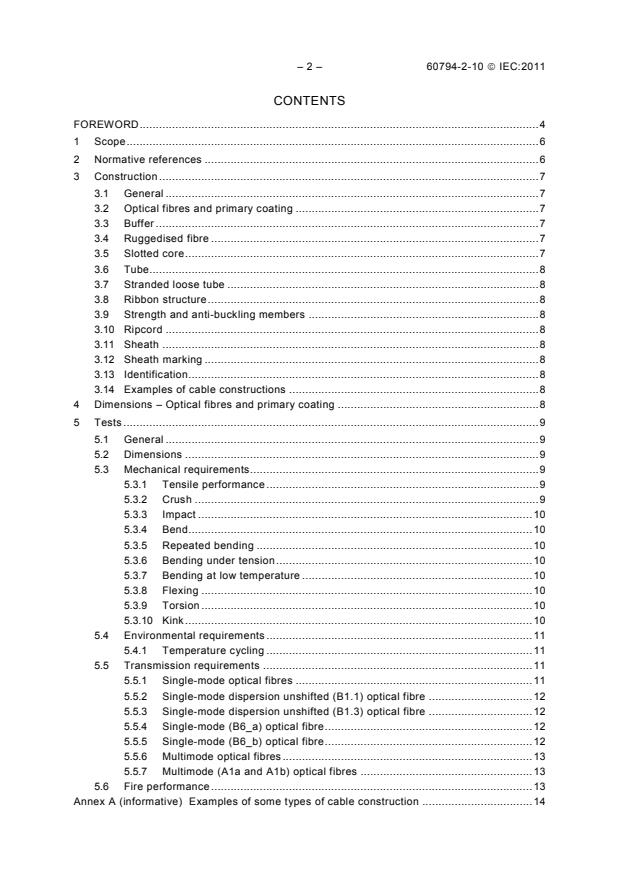
CONTENTS
FOREWORD . 4
1 Scope . 6
2 Normative references . 6
3 Construction . 7
3.1 General . 7
3.2 Optical fibres and primary coating . 7
3.3 Buffer . 7
3.4 Ruggedised fibre . 7
3.5 Slotted core . 7
3.6 Tube. 8
3.7 Stranded loose tube . 8
3.8 Ribbon structure . 8
3.9 Strength and anti-buckling members . 8
3.10 Ripcord . 8
3.11 Sheath . 8
3.12 Sheath marking . 8
3.13 Identification. 8
3.14 Examples of cable constructions . 8
4 Dimensions – Optical fibres and primary coating . 8
5 Tests . 9
5.1 General . 9
5.2 Dimensions . 9
5.3 Mechanical requirements . 9
5.3.1 Tensile performance . 9
5.3.2 Crush . 9
5.3.3 Impact . 10
5.3.4 Bend. 10
5.3.5 Repeated bending . 10
5.3.6 Bending under tension . 10
5.3.7 Bending at low temperature . 10
5.3.8 Flexing . 10
5.3.9 Torsion . 10
5.3.10 Kink . 10
5.4 Environmental requirements . 11
5.4.1 Temperature cycling . 11
5.5 Transmission requirements . 11
5.5.1 Single-mode optical fibres . 11
5.5.2 Single-mode dispersion unshifted (B1.1) optical fibre . 12
5.5.3 Single-mode dispersion unshifted (B1.3) optical fibre . 12
5.5.4 Single-mode (B6_a) optical fibre . 12
5.5.5 Single-mode (B6_b) optical fibre . 12
5.5.6 Multimode optical fibres . 13
5.5.7 Multimode (A1a and A1b) optical fibres . 13
5.6 Fire performance . 13
Annex A (informative) Examples of some types of cable construction . 14
60794-2-10 IEC:2011 – 3 –
Annex B (informative) Family specification of indoor cables – simplex and duplex
cables . 17
Bibliography . 20
Figure A.1 – Simplex loose non-buffered fibre cable . 14
Figure A.2 – Simplex ruggedised fibre cable . 14
Figure A.3 – Duplex loose non-buffered fibre cable . 14
Figure A.4 – Duplex ruggedised fibre cable . 15
Figure A.5 – Duplex ruggedised fibre zip cord . 15
Figure A.6 – Duplex flat cable . 15
Figure A.7 – Duplex round cable . 16
Figure A.8 – Simplex and duplex rectangular cables . 16
Table 1 – Dimensions of buffered fibres . 7
Table 2 – Temperature cycling conditions . 11
Table 3 – Common single-mode optical fibre requirements . 11
Table 4 – Cabled fibre attenuation requirements for B1.1 optical fibre . 12
Table 5 – Cabled fibre attenuation requirements for B1.3 optical fibre . 12
Table 6 – Cabled fibre attenuation requirements for B6_a optical fibre . 12
Table 7 – Cabled fibre attenuation requirements for B6_b optical fibre . 12
Table 8 – Common multimode optical fibre requirements . 13
Table 9 – Cabled fibre attenuation requirements for A1a and A1b optical fibres . 13
Table B.1 – Cable description . 17
Table B.2 – Cable element . 18
Table B.3 – Cable construction . 18
Table B.4 – Installation and operating conditions . 19
Table B.5 – Tests applicable . 19
– 4 – 60794-2-10 IEC:2011
INTERNATIONAL ELECTROTECHNICAL COMMISSION
___________
OPTICAL FIBRE CABLES –
Part 2-10: Indoor optical fibre cables –
Family specification for simplex and duplex cables
FOREWORD
1) The International Electrotechnical Commission (IEC) is a worldwide organization for standardization comprising
all national electrotechnical committees (IEC National Committees). The object of IEC is to promote
international co-operation on all questions concerning standardization in the electrical and electronic fields. To
this end and in addition to other activities, IEC publishes International Standards, Technical Specifications,
Technical Reports, Publicly Available Specifications (PAS) and Guides (hereafter referred to as “IEC
Publication(s)”). Their preparation is entrusted to technical committees; any IEC National Committee interested
in the subject dealt with may participate in this preparatory work. International, governmental and non-
governmental organizations liaising with the IEC also participate in this preparation. IEC collaborates closely
with the International Organization for Standardization (ISO) in accordance with conditions determined by
agreement between the two organizations.
2) The formal decisions or agreements of IEC on technical matters express, as nearly as possible, an international
consensus of opinion on the relevant subjects since each technical committee has representation from all
interested IEC National Committees.
3) IEC Publications have the form of recommendations for international use and are accepted by IEC National
Committees in that sense. While all reasonable efforts are made to ensure that the technical content of IEC
Publications is accurate, IEC cannot be held responsible for the way in which they are used or for any
misinterpretation by any end user.
4) In order to promote international uniformity, IEC National Committees undertake to apply IEC Publications
transparently to the maximum extent possible in their national and regional publications. Any divergence
between any IEC Publication and the corresponding national or regional publication shall be clearly indicated in
the latter.
5) IEC itself does not provide any attestation of conformity. Independent certification bodies provide conformity
assessment services and, in some areas, access to IEC marks of conformity. IEC is not responsible for any
services carried out by independent certification bodies.
6) All users should ensure that they have the latest edition of this publication.
7) No liability shall attach to IEC or its directors, employees, servants or agents including individual experts and
members of its technical committees and IEC National Committees for any personal injury, property damage or
other damage of any nature whatsoever, whether direct or indirect, or for costs (including legal fees) and
expenses arising out of the publication, use of, or reliance upon, this IEC Publication or any other IEC
Publications.
8) Attention is drawn to the Normative references cited in this publication. Use of the referenced publications is
indispensable for the correct application of this publication.
9) Attention is drawn to the possibility that some of the elements of this IEC Publication may be the subject of
patent rights. IEC shall not be held responsible for identifying any or all such patent rights.
International Standard IEC 60794-2-10 has been prepared by sub-committee 86A: Fibres and
cables, of IEC technical committee 86: Fibre optics.
This second edition cancels and replaces the first edition published in 2003. It constitutes a
technical revision.
The main changes with respect to the previous edition are as follows:
– A new clause has been introduced: Clause 4 – Dimensions.
– Test conditions and requirements have been made more accurate.
– The new Subclause 5.5 has been added to give useful figures.
This standard is to be used in conjunction with IEC 60794-1-1:2008, IEC 60794-1-2:2007 and
IEC 60794-2.
60794-2-10 IEC:2011 – 5 –
The text of this standard is based on the following documents:
FDIS Report on voting
86A/1396/FDIS 86A/1412/RVD
Full information on the voting for the approval of this standard can be found in the report on
voting indicated in the above table.
This publication has been drafted in accordance with the ISO/IEC Directives, Part 2.
A list of all parts of IEC 60794 series, published under the general title Optical fibre cables,
can be found on the IEC website.
The committee has decided that the contents of this publication will remain unchanged until
the stability date indicated on the IEC web site under "http://webstore.iec.ch" in the data
related to the specific publication. At this date, the publication will be
• reconfirmed,
• withdrawn,
• replaced by a revised edition, or
• amended.
IMPORTANT – The 'colour inside' logo on the cover page of this publication indicates that it
contains colours which are considered to be useful for the correct understanding of its
contents. Users should therefore print this document using a colour printer.
– 6 – 60794-2-10 IEC:2011
OPTICAL FIBRE CABLES –
Part 2-10: Indoor optical fibre cables –
Family specification for simplex and duplex cables
1 Scope
This part of IEC 60794 is a family specification that covers simplex and duplex optical fibre
cables for indoor use except for cables used in terminated assemblies specified by
IEC 60794-2-50. The requirements of the Sectional specification IEC 60794-2 are applicable
to cables covered by this standard.
For the cables intended for installation in industrial applications specified in ISO/IEC 24702,
MICE specifications may be additionally required (see Annex B.2).
2 Normative references
The following referenced documents are indispensable for the application of this document.
For dated references, only the edition cited applies. For undated references, the latest edition
of the referenced document (including any amendments) applies.
NOTE 1 They complete the normative references already listed in the generic specification (IEC 60794-1-1,
Clause 2, and IEC 60794-1-2, Clause 2).
IEC 60304, Standard colours for insulation for low-frequency cables and wires
IEC 60793-1-20, Optical fibres – Part 1-20: Measurement methods and test procedures –
Fibre geometry
IEC 60793-1-21, Optical fibres – Part 1-21: Measurement methods and test procedures –
Coating geometry
IEC 60793-1-40, Optical fibres – Part 1-40: Measurement methods and test procedures –
Attenuation
IEC 60793-1-44, Optical fibres – Part 1-44: Measurement methods and test procedures – Cut-
off wavelength
IEC 60793-2, Optical fibres – Part 2: Product specifications – General
IEC 60793-2-10, Optical fibres – Part 2-10: Product specifications – Sectional specification for
category A1 multimode fibres
IEC 60793-2-50, Optical fibres – Part 2-50: Product specifications – Sectional specification for
class B single-mode fibres
IEC 60794-1-1:2008, Optical fibre cables – Part 1-1: Generic specification – General
IEC 60794-1-2:2007, Optical fibre cables – Part 1-2: Generic specification – Basic optical
cable test procedures
IEC 60794-2, Optical fibre cables – Part 2: Indoor cables – Sectional specification
60794-2-10 IEC:2011 – 7 –
IEC 60811-1-1, Common test methods for insulating and sheathing materials of electric
cables – Part 1-1: Methods for general application – Measurement of thickness and overall
dimensions – Tests for determining the mechanical properties
NOTE 2 IEC 60811-1-1 is under revision to be replaced by IEC 60811-201, IEC 60811-202 and IEC 60811-203.
3 Construction
3.1 General
In addition to the constructional requirements in IEC 60794-2, the following apply to simplex
and duplex indoor cables.
The cable shall be designed and manufactured for an expected operating lifetime of at least
15 years. In this context, the attenuation of the installed cable at the operational
wavelength(s) shall not exceed values agreed between the customer and the supplier. The
materials in the cable shall not present a health hazard within its intended use.
There shall be no fibre splice in a delivery length unless otherwise agreed by the customer
and the supplier.
It shall be possible to identify each individual fibre throughout the length of the cable.
3.2 Optical fibres and primary coating
Multimode or single-mode optical fibres shall be used which meet the requirements of
IEC 60793-2.
3.3 Buffer
If a buffer is required, it shall consist of one or more layers of inert material. The buffer shall
be easily removable. For tight buffers, the buffer and fibre primary coating shall be removable
in one operation over a length of 10 mm to 25 mm, depending on customer requirements. For
semi-tight buffers, the buffer shall be easily removable over a length of 0,3 m to 0,5 m. For
loose buffers, the buffer shall be easily removable over a length of not less than 1,0 m.
Buffer dimensions are shown in Table 1.
Table 1 – Dimensions of buffered fibres
Buffer type Nominal diameter Tolerances
mm mm
Semi-tight buffer 0,3 to 1,3
± 0,05
Tight buffer 0,3 to 1,0
± 0,05
3.4 Ruggedised fibre
Further protection can be provided to buffered fibres by surrounding one or two of the fibres
with non-metallic strength members within a sheath of suitable material.
3.5 Slotted core
Cables of this construction are not commonly used.
– 8 – 60794-2-10 IEC:2011
3.6 Tube
One or two primary coated or buffered fibres are packaged (loosely or not) in a tube
construction which may be filled. The tube may be reinforced with a composite wall.
If required the suitability of the tube shall be determined by an evaluation of its kink
resistance in accordance with IEC 60794-1-2, Method G7.
3.7 Stranded loose tube
Cables of this construction are not commonly used.
3.8 Ribbon structure
Cables of this construction are not commonly used.
3.9 Strength and anti-buckling members
The cable shall be designed with sufficient strength members to meet installation and service
conditions so that the fibres are not subjected to strain in excess of limits agreed between the
customer and the supplier.
The strength and/or anti-buckling member may be either metallic or non-metallic and may be
located in the cable core and/or under the sheath and/or in the sheath.
3.10 Ripcord
Ripcords are not commonly used.
3.11 Sheath
The cable shall have an overall protective sheath. The cable diameter shall be specified in the
relevant detail specification (or product specification).
3.12 Sheath marking
If required, the cable shall be marked according to the local regulations or the agreement
between the customer and the supplier.
3.13 Identification
In case of duplex cables, the cable design should enable clear polarity identification for each
individual fibre. When fibre colouring is used for identification, standard colours shall be used
as closely as possible (reasonable match) to IEC 60304.
3.14 Examples of cable constructions
Examples of some main types of cable construction are shown in Annex A. Other
configurations are not excluded if they meet the mechanical, environmental and transmission
requirements given in this specification.
4 Dimensions – Optical fibres and primary coating
The dimensions of the individual primary coated fibres in the finished product shall be in
accordance with one of the sectional specifications defined in IEC 60793-2. The fibre
dimensions (e.g. cladding diameter or outer diameter including colouring) shall be verified in
accordance with IEC 60793-1-20 or IEC 60793-1-21.
60794-2-10 IEC:2011 – 9 –
5 Tests
5.1 General
Compliance with specification requirements shall be verified by carrying out tests selected
from the following subclauses. It is not intended that all tests shall be carried out; the
frequency of testing shall be agreed between customer and supplier.
Unless otherwise specified, all tests shall be carried out at ambient temperature.
5.2 Dimensions
The fibre dimensions and tolerances shall be checked in accordance with test method
IEC 60793-1-20 or IEC 60793-1-21. The diameter of the buffer and of the cable, as well as
the thickness of the sheath, shall be measured in accordance with the methods of
IEC 60811-1-1.
5.3 Mechanical requirements
Some of the following tests can be performed on a short sample length of cable which is still
an integral part of a longer length. Thus it becomes possible to detect permanent changes in
attenuation. The maximum value of this attenuation change shall be agreed between
customer and supplier.
5.3.1 Tensile performance
Method: IEC 60794-1-2, E1
Diameter of chuck drums and
transfer devices: not less than 250 mm
Rate of transfer device: either 100 mm/min or 100 N/min
Load: 75 N applied for 10 min for simplex cables and normal
duplex cables
150 N applied for 10 min for duplex cables which consist
of independent simplex cables (NOTE 1)
NOTE 1 In case of duplex cables including two simplex cables and bearing the applied tensile force by the
strength members of each simplex cable, e.g. Figures A.5, A.6 (without optional strength member) and A.7, the
tensile requirement for the duplex cable shall be double that for the simplex cable. The rationale is that those
simplex cables may be taken out from the duplex cable and will be independently used.
NOTE 2 Requirements of tensile load depends on construction of cables. Lower values may be adopted for some
types of cables e.g. small factor simplex cables.
Length of sample: sufficient to achieve the desired accuracy of measure-
ment of attenuation change and shall be agreed between
customer and supplier
Requirements: no change in attenuation after the test and there shall be
no damage to the cable elements
Fibre strain shall not exceed a value agreed upon
between customer and supplier
5.3.2 Crush
Method: IEC 60794-1-2, E3
Force: 500 N
Duration: 1 min
Length between test locations: 500 mm
– 10 – 60794-2-10 IEC:2011
Requirements: no change in attenuation after the test and there shall be
no damage to the cable elements
NOTE In the case of flat cables the force is applied on the flat sides of the cable.
5.3.3 Impact
Method: IEC 60794-1-2, E4
Radius of striking surface: 12,5 mm
Impact energy: 1,0 J
Number of impacts: at least 3, each separated at least 500 mm
Requirements: no fibre breakage
NOTE In the case of flat cables the force is applied on the flat sides of the cable.
5.3.4 Bend
Method: IEC 60794-1-2, E11A
Mandrel diameter: 60 mm
Number of turns: 6
Number of cycles: 10
Requirements: no fibre breakage
NOTE In the case of flat cables the force is applied on the flat sides of the cable.
5.3.5 Repeated bending
None.
5.3.6 Bending under tension
None.
5.3.7 Bending at low temperature
None.
5.3.8 Flexing
None.
5.3.9 Torsion
Method: IEC 60794-1-2, E7
Number of cycles: 3
Distance between
fixed and rotating clamp: 125 x cable diameter but not more than 1 m
Tension load: 20 N
Requirements: no fibre breakage
5.3.10 Kink
Method: IEC 60794-1-2, E10
Minimum loop diameter: 20 times cable diameter
Requirement: no kink shall occur
60794-2-10 IEC:2011 – 11 –
5.4 Environmental requirements
5.4.1 Temperature cycling
See Table 2.
Method: IEC 60794-1-2, F1
Table 2 – Temperature cycling conditions
Low temperature High temperature
T T
A B
a) 0 °C +50 °C
b) –5 °C +50 °C
c) –20 °C +60 °C
d) –45 °C +60 °C
NOTE Condition a), b), c) or d) will be selected depending on
application and customer requirements, for example condition
c) is appropriate for applications to ISO/IEC 11801.
Period t : sufficient that the cable has reached, and stabilised to,
the specified temperature
Number of cycles: 2
Length of sample: sufficient to achieve the desired accuracy of
measurement of attenuation
Requirement: maximum increase in attenuation to be agreed between
customer and supplier
5.5 Transmission requirements
The transmission requirements shall be in accordance with one of the sectional specifications
defined in IEC 60793-2 and shall be agreed between customer and supplier. Maximum cabled
fibre attenuation shall comply with this specification.
NOTE 1 625 nm performance is optional depending on agreement between customer and supplier.
5.5.1 Single-mode optical fibres
See Table 3.
Table 3 – Common single-mode optical fibre requirements
Characteristics IEC 60794-2 Requirements Test Methods Remarks
Clause no.
Uncabled optical fibre 3.2 IEC 60793-2-50
Cabled fibre cut-off
4.4 λ < λ operational IEC 60793-1-44
cc
wavelength
Attenuation Discontinuities
4.4 ≤ 0,10 dB IEC 60793-1-40
at 1 550 nm
– 12 – 60794-2-10 IEC:2011
5.5.2 Single-mode dispersion unshifted (B1.1) optical fibre
See Table 4.
Table 4 – Cabled fibre attenuation requirements for B1.1 optical fibre
Characteristics IEC 60794-2 Requirements Test Methods Remarks
Clause
Attenuation coefficient
4.4 Acc. DS IEC 60793-1-40
(cabled fibres)
≤ 1,0 dB/km
at 1 310 nm
at 1 550 nm ≤ 1,0 dB/km
at 1 625 nm
≤ 1,0 dB/km
5.5.3 Single-mode dispersion unshifted (B1.3) optical fibre
See Table 5.
Table 5 – Cabled fibre attenuation requirements for B1.3 optical fibre
Characteristics IEC 60794-2 Requirements Test Methods Remarks
Clause
Attenuation coefficient
4.4 Acc. DS IEC 60793-1-40
(cabled fibres)
≤ 1,0 dB/km
at 1 310 to 1 625 nm
at 1 383 nm ≤ 1,0 dB/km
at 1 550 nm
≤ 1,0 dB/km
5.5.4 Single-mode (B6_a) optical fibre
See Table 6.
Table 6 – Cabled fibre attenuation requirements for B6_a optical fibre
Characteristics IEC 60794-2 Requirements Test Methods Remarks
Clause
Attenuation coefficient
4.4 Acc. DS IEC 60793-1-40
(cabled fibres)
at 1 310 to 1 625 nm ≤ 1,0 dB/km
at 1 383 nm ≤ 1,0 dB/km
at 1 550 nm
≤ 1,0 dB/km
5.5.5 Single-mode (B6_b) optical fibre
See Table 7.
Table 7 – Cabled fibre attenuation requirements for B6_b optical fibre
Characteristics IEC 60794-2 Requirements Test Methods Remarks
Clause
Attenuation coefficient
4.4 Acc. DS IEC 60793-1-40
(cabled fibres)
at 1 310 nm < 1,0 dB/km
at 1 550 nm < 1,0 dB/km
at 1 625 nm < 1,0 dB/km
60794-2-10 IEC:2011 – 13 –
5.5.6 Multimode optical fibres
See Table 8.
Table 8 – Common multimode optical fibre requirements
Characteristics IEC 60794-2 Requirements Test Methods Remarks
Clause
Uncabled optical fibre 3.2 IEC 60793-2-10
Attenuation discontinuities
4.4 ≤ 0,10 dB IEC 60793-1-40
at 850 nm and 1 300 nm
5.5.7 Multimode (A1a and A1b) optical fibres
See Table 9.
Table 9 – Cabled fibre attenuation requirements for A1a and A1b optical fibres
Characteristics IEC 60794-2 Requirements Test Methods Remarks
Clause
Attenuation coefficient
4.4 Acc. DS IEC 60793-1-40
(cabled fibres)
at 850 nm 3,5 dB/km
at 1 300 nm 1,5 dB/km
5.6 Fire performance
IEC/TR 62222 provides guidance and recommendations for the requirements and test
methods for the fire performance of communication cables when installed in buildings. The
recommendations relate to typical applications and installation practices, and an assessment
of the fire hazards presented. Account is also taken of applicable legislation and regulation.
IEC/TR 62222 references several IEC fire performance test methods and also other test
methods that may be required by local or National legislation and regulation. The tests to be
applied, and the requirements, shall be agreed between the customer and supplier taking into
account the fire hazard presented by the end use application in which the cable is intended to
be used.
– 14 – 60794-2-10 IEC:2011
Annex A
(informative)
Examples of some types of cable construction
See Figures A.1 to A.8 for examples of types of cable construction.
The main dimensions shall be agreed between customer and supplier.
Sheath
Strength member embedded
in the sheath
Primary-coated optical fibre
IEC 445/08
Figure A.1 – Simplex loose non-buffered fibre cable
Sheath
Strength member
Buffer
Primary coating
Fibre
IEC 446/08
Figure A.2 – Simplex ruggedised fibre cable
Sheath
Strength member embedded
in the sheath
Primary-coated optical fibre
IEC 447/08
Figure A.3 – Duplex loose non-buffered fibre cable
60794-2-10 IEC:2011 – 15 –
Sheath
Strength member
Buffer
Primary coating
Fibre
IEC 448/08
Figure A.4 – Duplex ruggedised fibre cable
Sheath
Strength member
Buffer
Primary coating
Fibre
IEC 449/08
Figure A.5 – Duplex ruggedised fibre zip cord
Strength member
Optional strength member
Primary coated
optical fibre
Buffer
Sheath
Common sheath
IEC 450/08
Figure A.6 – Duplex flat cable
– 16 – 60794-2-10 IEC:2011
Primary coated
optical fibre
Buffer
Strength member
Sheath
Common sheath
Filler (optional)
IEC 451/08
Figure A.7 – Duplex round cable
Strength member
Primary coated optical fibre
Sheath
IEC 1760/11
Figure A.8 – Simplex and duplex rectangular cables
60794-2-10 IEC:2011 – 17 –
Annex B
(informative)
Family specification of indoor cables –
simplex and duplex cables
B.1 Blank detail specification
B.1.1 Cable description
See Table B.1 for cable description.
Table B.1 – Cable description
(1) Prepared by
(2) Document No :
Issue :
Date :
(3) Available from : (4) Generic Specification : IEC 60794-1-1
Sectional Specification : IEC 60794-2
(5) Additional references : ISO/IEC 24702 if required
(6) Cable description :
(7) Cable construction :
Optical fibres
Range of fibre count
Modularity
Construction
Additional remarks
– Optical fibres and primary coating
– Strength and anti-buckling members
Outer sheath
– Material
– Min. wall thickness
Sheath marking
– Customer requirement
– Identification of manufacturer
Fibre identification
– Customer requirement
(8) Application information :
Application (Indoor)
Maximum outer diameter (d) or width and height mm
Rated maximum tensile load N
Minimum bending radius for operation mm or nxd
Temperature range :
– Transport and storage °C
– Installation
°C
– Operation
°C
Manufacturing cable length
– Typical m
– Nominal/tolerances : -0 +1%
– 18 – 60794-2-10 IEC:2011
B.1.2 Cable element
See Table B.2 for cable elements.
Table B.2 – Cable element
Characteristics (9) IEC 60794-2 Family Test Methods Remarks (13)
Clause (10) Requirements (12)
(11)
Optical fibres and primary 3.2 Acc. DS
coating
Buffer 3.3 Acc. DS Visual inspection
Strength and anti-buckling 3.9 Acc. DS Visual inspection
member
B.1.3 Cable construction
See Table B.3 for cable construction.
Table B.3 – Cable construction
Characteristics (9) IEC 60794-2 Family Test Methods (12) Remarks (13)
Clause (10) Requirements (11)
Cable core Acc. DS visual inspection
Strength member 3.9 Acc. DS visual inspection
– Longitudinal
– Helical
– Embedded in the
sheath
Sheath 3.11
– Material Acc. DS
– Minimum sheath Acc. DS IEC 60811-1-1
thickness
– Width and height Acc. DS IEC 60811-1-1
– Optional protection Acc. DS
– Abrasion resistance Acc. DS IEC 60794-1-2
Method E2A
Sheath marking 3.12
– Configuration, Acc. DS visual inspection
dimensions
– Abrasion resistance Acc. DS IEC 60794-1-2 Steel needle diameter d
Method E2B = 1,0 mm
load : 4 N
Cable length
60794-2-10 IEC:2011 – 19 –
B.1.4 Installation and operating conditions
See Table B.4 for installation and operating conditions.
Table B.4 – Installation and operating conditions
Characteristics (9) IEC 60794-2 Family Test Methods (12) Remarks (13)
Clause (10) Requirements (11)
General requirements
Bend of cable element Acc. DS IEC 60794-1-2
Method G1
B.1.5 Mechanical, environmental and fire performance tests
See Table B.5 for mechanical, environmental and fire performance tests.
Table B.5 – Tests applicable
Characteristics (9) IEC 60794-2 Family Test Methods (12) Remarks (13)
Clause (10) Requirements (11)
Tensile performance 4.2.1 See 5.2.1 IEC 60794-1-2
Method E1A
Crush 4.2.2 See 5.2.2 IEC 60794-1-2
Method E3
Impact 4.2.3 See 5.2.3 IEC 60794-1-2
Method E4
Bending 4.2.4 See 5.2.4 IEC 60794-1-2
Method E11A
Repeated bending 4.2.5 See 5.2.5 IEC 60794-1-2
Method E6
Bending at low 4.2.7 See 5.2.7 IEC 60794-1-2
temperature Method E11A
Flexing 4.2.8 See 5.2.8 IEC 60794-1-2
Method E8
Torsion 4.2.9 See 5.2.9 IEC 60794-1-2
Method E7
Kink 4.2.10 See 5.2.10 IEC 60794-1-2
Method E10
Temperature cycling 4.3.1 See 5.3.1 IEC 60794-1-2
Method F1
Fire performance 4.5 See 5.5 IEC TR 62222
B.2 Additional requirements for cables subject to the MICE environmental
classification (ISO/IEC 24702 and related standards)
Cables intended for installation in conformity with ISO/IEC 24702 and related standards may
require the specification of additional tests to ensure their suitability in the applicable
environments defined by the Mechanical, Ingress, Climatic and Chemical, and
Electromechanical (MICE) classification. Such tests are outside of the scope of IEC 60794
cable specifications, and MICE criteria are not part of the requirements for 60794
specifications. The MICE tests may be the same as, similar to, or substantially different from,
the tests required by IEC 60794 specifications. Cables manufactured per IEC 60794
specifications may or may not meet the MICE criteria. For supplemental discussion see
TR62362.
– 20 – 60794-2-10 IEC:2011
Bibliography
IEC 60654-4: Operating conditions for industrial-process measurement and control equipment
– Part 4: Corrosive and erosive influences
IEC 60721-1: Classification of environmental conditions – Part 1: Environmental parameters
and their severities
IEC 60721-3-3: Classification of environmental conditions – Part 3: Classification of groups of
environmental parameters and their severities – Section 3: Stationary use at
weatherprotected locations
IEC 61000-2-5: Electromagnetic compatibility (EMC) – Part 2-5: Environment – Section 5:
Classification of electromagnetic environments. Basic EMC publication
IEC 61000-6-2: Electromagnetic compatibility (EMC) – Part 6-2: Generic standards –
Immunity for industrial environments
IEC 61918: Industrial communication networks – Installation of communication networks in
industrial premises
IEC/TR 62222: Fire performance of communication cables installed in buildings
IEC/TR 62362: Selection of optical fibre cable specifications relative to mechanical, ingress,
climatic or electromagnetic characteristics – Guidance
ISO/IEC 24702: Information technology – Generic cabling – Industrial premises
ISO/IEC 11801, Information technology – Generic cabling for customer premises
_____________
– 22 – 60794-2-10 CEI:2011
SOMMAIRE
AVANT-PROPOS . 24
1 Domaine d’application . 26
2 Références normatives . 26
3 Construction . 27
3.1 Généralités. 27
3.2 Fibres optiques et revêtement primaire . 27
3.3 Revêtement protecteur . 27
3.4 Fibre renforcée . 28
3.5 Jonc rainuré . 28
3.6 Tube. 28
3.7 Tube assemblé à structure lâche . 28
3.8 Structure en ruban . 28
3.9 Renforts de traction et anti-déformation . 28
3.10 Filin de déchirement . 28
3.11 Gaine . 28
3.12 Marquage de la gaine . 28
3.13 Identification. 28
3.14 Exemples de constructions de câbles . 29
4 Dimensions − Fibres optiques et revêtement primaire . 29
5 Essais . 29
5.1 Généralités. 29
5.2 Dimensions .
...
Questions, Comments and Discussion
Ask us and Technical Secretary will try to provide an answer. You can facilitate discussion about the standard in here.
Loading comments...