


IEC 60531:1999
(Main)Household electric thermal storage room heaters - Methods for measuring performance
General Information
- Abstract
Applies to electric storage heaters intended to heat the room in which they are located. It defines the main performance characteristics and describes methods for measuring these characteristics. It does not apply to heating appliances incorporated in the building structure, to central heating systems or to floor heating appliances.
- Status
- Published
- Publication Date
- 06-Jan-1999
- Technical Committee
- SC 59C - Electrical heating appliances for household and similar purposes
- Current Stage
- PPUB - Publication issued
- Start Date
- 07-Jan-1999
- Completion Date
- 31-Jan-1999


Overview
IEC 60531:1999 is the International Electrotechnical Commission (IEC) standard specifying methods for measuring the performance of household electric thermal storage room heaters. These electric storage heaters are designed to heat the room in which they are installed, operating on a daily cycle. The standard defines core performance characteristics and prescribes uniform testing methods to ensure comparability and transparency of product information for users and manufacturers. IEC 60531:1999 does not cover heaters incorporated into building structures, central heating systems, or floor heating appliances.
Key Topics
Scope and Purpose:
- Applies to standalone electric thermal storage room heaters used in residential settings.
- Excludes systems integrated into buildings or large-scale heating systems.
- Focuses on performance measurement, not safety or noise regulations.
Performance Characteristics Measured:
- Dimensions and mass
- Charge acceptance (how much energy the heater can store)
- Room heating capability (effectiveness at heating its intended space)
- Heat retention (the ability to hold and release stored heat over time)
- Temperature rises of surfaces and surrounding areas
- Stability of room temperature
- Function and performance under both storage and direct-acting heating modes
Testing Environment and Methods:
- Prescribes controlled conditions for installation, operation, and environmental temperature.
- Measurements are conducted in various controlled environments such as calorimeters and climatic test rooms.
- Specifies detailed requirements for test procedures, initial conditions, and reporting formats.
Classification of Storage Heaters:
- By type: without direct-acting function, with manual or automatic direct-acting functions
- By control type: with or without heat output control, via flaps, fans, or no control
- By heat retention capacity: categorized according to the percentage of heat retained over a given time
Applications
This standard is essential for:
- Manufacturers: Provides a uniform method for evaluating and reporting the performance of electric storage room heaters, enabling product development and comparison.
- Testing Laboratories and Certification Bodies: Supplies standardized testing protocols, ensuring measurement consistency and supporting quality marks and certifications globally.
- Purchasers and Regulators: Enables informed decision-making based on reliable, comparable performance data, benefiting residential and light commercial applications.
- Retailers and Consumers: Annex D outlines the information to be provided at the point of sale, supporting product transparency for end users.
Key practical benefits of adopting IEC 60531 include:
- Reliable, uniform product data: Enhances trust in product claims and enables side-by-side comparisons.
- Improved product design: Clear measurement criteria help drive innovation and optimization of heater efficiency and effectiveness.
- Global market access: Appliances tested to the IEC 60531 standard are more easily accepted in multiple countries, supporting international trade.
Related Standards
To fully address appliance performance, safety, and user information, consider these related IEC standards:
- IEC 60675: Methods for measuring the performance of direct-acting room heaters
- IEC 60584-1: Thermocouples - Reference tables, relevant for temperature measurement in heater testing
- IEC 60050: International Electrotechnical Vocabulary (terms and definitions)
- IEC 60417 / IEC 60617: Graphical symbols for use on equipment and diagrams
Adhering to IEC 60531:1999 enhances the credibility and international acceptance of household electric thermal storage room heaters through standardized performance measurement and reporting. This supports manufacturers, testers, and consumers with transparent, reliable information across global markets.
Frequently Asked Questions
IEC 60531:1999 is a standard published by the International Electrotechnical Commission (IEC). Its full title is "Household electric thermal storage room heaters - Methods for measuring performance". This standard covers: Applies to electric storage heaters intended to heat the room in which they are located. It defines the main performance characteristics and describes methods for measuring these characteristics. It does not apply to heating appliances incorporated in the building structure, to central heating systems or to floor heating appliances.
Applies to electric storage heaters intended to heat the room in which they are located. It defines the main performance characteristics and describes methods for measuring these characteristics. It does not apply to heating appliances incorporated in the building structure, to central heating systems or to floor heating appliances.
IEC 60531:1999 is classified under the following ICS (International Classification for Standards) categories: 97.100.10 - Electric heaters. The ICS classification helps identify the subject area and facilitates finding related standards.
IEC 60531:1999 is available in PDF format for immediate download after purchase. The document can be added to your cart and obtained through the secure checkout process. Digital delivery ensures instant access to the complete standard document.
Standards Content (Sample)
NORME
CEI
INTERNATIONALE
IEC
INTERNATIONAL
Deuxième édition
STANDARD
Second edition
1999-01
Appareils électrodomestiques de chauffage
à accumulation des locaux–
Méthodes de mesure de l'aptitude
à la fonction
Household electric thermal storage room heaters –
Methods for measuring performance
Numéro de référence
Reference number
CEI/IEC 60531:1999
Numéros des publications Numbering
Depuis le 1er janvier 1997, les publications de la CEI As from 1 January 1997 all IEC publications are
sont numérotées à partir de 60000. issued with a designation in the 60000 series.
Publications consolidées Consolidated publications
Les versions consolidées de certaines publications de Consolidated versions of some IEC publications
la CEI incorporant les amendements sont disponibles. including amendments are available. For example,
Par exemple, les numéros d’édition 1.0, 1.1 et 1.2 edition numbers 1.0, 1.1 and 1.2 refer, respectively, to
indiquent respectivement la publication de base, la the base publication, the base publication
publication de base incorporant l’amendement 1, et la incorporating amendment 1 and the base publication
publication de base incorporant les amendements 1 incorporating amendments 1 and 2.
et 2.
Validité de la présente publication Validity of this publication
Le contenu technique des publications de la CEI est The technical content of IEC publications is kept under
constamment revu par la CEI afin qu'il reflète l'état constant review by the IEC, thus ensuring that the
actuel de la technique. content reflects current technology.
Des renseignements relatifs à la date de Information relating to the date of the reconfirmation of
reconfirmation de la publication sont disponibles dans the publication is available in the IEC catalogue.
le Catalogue de la CEI.
Les renseignements relatifs à des questions à l’étude et Information on the subjects under consideration and
des travaux en cours entrepris par le comité technique work in progress undertaken by the technical
qui a établi cette publication, ainsi que la liste des committee which has prepared this publication, as well
publications établies, se trouvent dans les documents ci- as the list of publications issued, is to be found at the
dessous: following IEC sources:
• «Site web» de la CEI* • IEC web site*
• Catalogue des publications de la CEI • Catalogue of IEC publications
Publié annuellement et mis à jour régulièrement Published yearly with regular updates
(Catalogue en ligne)* (On-line catalogue)*
• Bulletin de la CEI • IEC Bulletin
Disponible à la fois au «site web» de la CEI* et Available both at the IEC web site* and as a
comme périodique imprimé printed periodical
Terminologie, symboles graphiques Terminology, graphical and letter
et littéraux symbols
En ce qui concerne la terminologie générale, le lecteur For general terminology, readers are referred to
se reportera à la CEI 60050: Vocabulaire Electro- IEC 60050: International Electrotechnical Vocabulary
technique International (VEI). (IEV).
Pour les symboles graphiques, les symboles littéraux For graphical symbols, and letter symbols and signs
et les signes d'usage général approuvés par la CEI, le approved by the IEC for general use, readers are
lecteur consultera la CEI 60027: Symboles littéraux à referred to publications IEC 60027: Letter symbols to
utiliser en électrotechnique, la CEI 60417: Symboles be used in electrical technology, IEC 60417: Graphical
graphiques utilisables sur le matériel. Index, relevé et symbols for use on equipment. Index, survey and
compilation des feuilles individuelles, et la CEI 60617: compilation of the single sheets and IEC 60617:
Symboles graphiques pour schémas. Graphical symbols for diagrams.
* Voir adresse «site web» sur la page de titre. * See web site address on title page.
NORME
CEI
INTERNATIONALE
IEC
INTERNATIONAL
Deuxième édition
STANDARD
Second edition
1999-01
Appareils électrodomestiques de chauffage
à accumulation des locaux–
Méthodes de mesure de l'aptitude
à la fonction
Household electric thermal storage room heaters –
Methods for measuring performance
IEC 1999 Droits de reproduction réservés Copyright - all rights reserved
Aucune partie de cette publication ne peut être reproduite ni No part of this publication may be reproduced or utilized in
utilisée sous quelque forme que ce soit et par aucun any form or by any means, electronic or mechanical,
procédé, électronique ou mécanique, y compris la photo- including photocopying and microfilm, without permission in
copie et les microfilms, sans l'accord écrit de l'éditeur. writing from the publisher.
International Electrotechnical Commission 3, rue de Varembé Geneva, Switzerland
Telefax: +41 22 919 0300 e-mail: inmail@iec.ch IEC web site http: //www.iec.ch
CODE PRIX
Commission Electrotechnique Internationale
PRICE CODE V
International Electrotechnical Commission
Pour prix, voir catalogue en vigueur
For price, see current catalogue
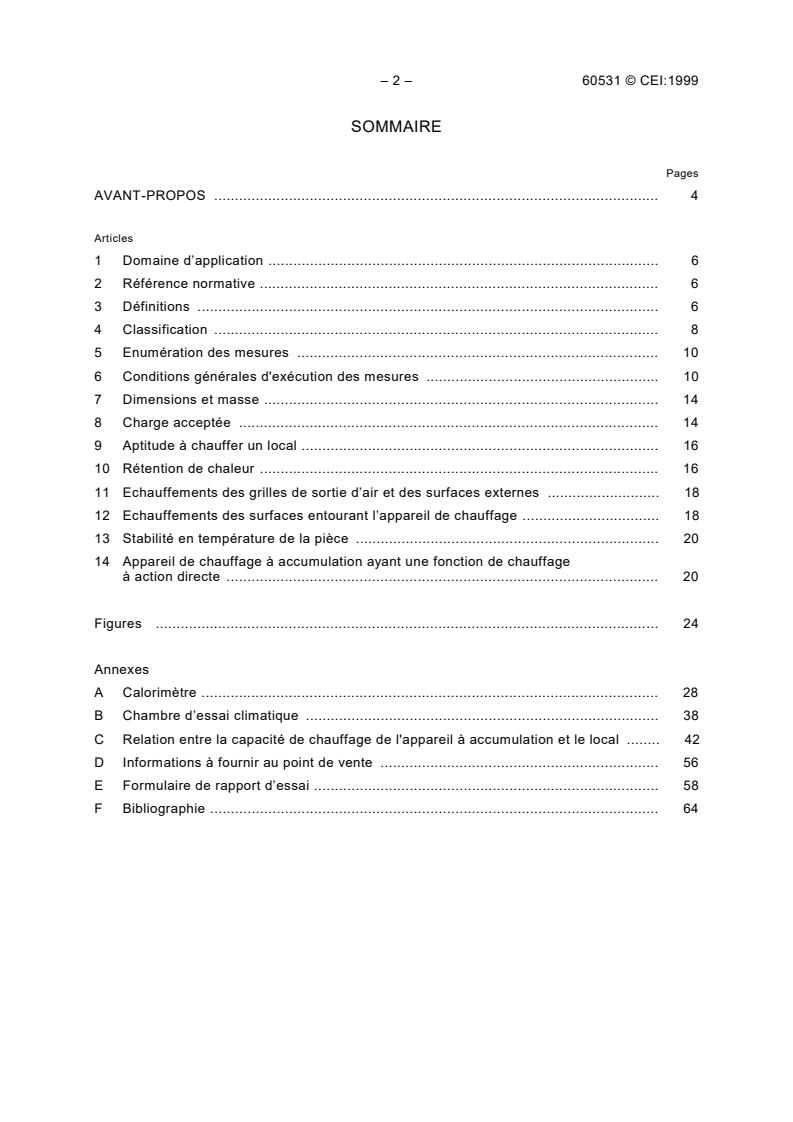
– 2 – 60531 © CEI:1999
SOMMAIRE
Pages
AVANT-PROPOS . 4
Articles
1 Domaine d’application . 6
2 Référence normative . 6
3 Définitions . 6
4 Classification . 8
5 Enumération des mesures . 10
6 Conditions générales d'exécution des mesures . 10
7 Dimensions et masse . 14
8 Charge acceptée . 14
9 Aptitude à chauffer un local . 16
10 Rétention de chaleur . 16
11 Echauffements des grilles de sortie d’air et des surfaces externes . 18
12 Echauffements des surfaces entourant l’appareil de chauffage . 18
13 Stabilité en température de la pièce . 20
14 Appareil de chauffage à accumulation ayant une fonction de chauffage
à action directe . 20
Figures . 24
Annexes
A Calorimètre . 28
B Chambre d’essai climatique . 38
C Relation entre la capacité de chauffage de l'appareil à accumulation et le local . 42
D Informations à fournir au point de vente . 56
E Formulaire de rapport d’essai . 58
F Bibliographie . 64
60531 © IEC:1999 – 3 –
CONTENTS
Page
FOREWORD . 5
Clause
1 Scope . 7
2 Normative reference . 7
3 Definitions . 7
4 Classification . 9
5 List of measurements . 11
6 General conditions for measurements . 11
7 Dimensions and mass . 15
8 Charge acceptance . 15
9 Room heating capability . 17
10 Heat retention . 17
11 Temperature rises of air-outlet grilles and external surfaces . 19
12 Temperature rises of surfaces surrounding the heater . 19
13 Stability of room temperature . 21
14 Storage heater having a direct-acting heating function . 21
Figures . 25
Annexes
A Calorimeter . 29
B Climatic test room . 39
C Relationship between the heating capability of the storage heater and the room . 43
D Information provided at point of sale . 57
E Test report form . 59
F Bibliography . 65
– 4 – 60531 © CEI:1999
COMMISSION ÉLECTROTECHNIQUE INTERNATIONALE
___________
APPAREILS ÉLECTRODOMESTIQUES DE CHAUFFAGE
À ACCUMULATION DES LOCAUX –
MÉTHODES DE MESURE DE L'APTITUDE À LA FONCTION
AVANT-PROPOS
1) La CEI (Commission Electrotechnique Internationale) est une organisation mondiale de normalisation composée
de l'ensemble des comités électrotechniques nationaux (Comités nationaux de la CEI). La CEI a pour objet de
favoriser la coopération internationale pour toutes les questions de normalisation dans les domaines de
l'électricité et de l'électronique. A cet effet, la CEI, entre autres activités, publie des Normes internationales.
Leur élaboration est confiée à des comités d'études, aux travaux desquels tout Comité national intéressé par le
sujet traité peut participer. Les organisations internationales, gouvernementales et non gouvernementales, en
liaison avec la CEI, participent également aux travaux. La CEI collabore étroitement avec l'Organisation
Internationale de Normalisation (ISO), selon des conditions fixées par accord entre les deux organisations.
2) Les décisions ou accords officiels de la CEI concernant les questions techniques représentent, dans la mesure
du possible un accord international sur les sujets étudiés, étant donné que les Comités nationaux intéressés
sont représentés dans chaque comité d’études.
3) Les documents produits se présentent sous la forme de recommandations internationales. Ils sont publiés
comme normes, rapports techniques ou guides et agréés comme tels par les Comités nationaux.
4) Dans le but d'encourager l'unification internationale, les Comités nationaux de la CEI s'engagent à appliquer de
façon transparente, dans toute la mesure possible, les Normes internationales de la CEI dans leurs normes
nationales et régionales. Toute divergence entre la norme de la CEI et la norme nationale ou régionale
correspondante doit être indiquée en termes clairs dans cette dernière.
5) La CEI n’a fixé aucune procédure concernant le marquage comme indication d’approbation et sa responsabilité
n’est pas engagée quand un matériel est déclaré conforme à l’une de ses normes.
6) L’attention est attirée sur le fait que certains des éléments de la présente Norme internationale peuvent faire
l’objet de droits de propriété intellectuelle ou de droits analogues. La CEI ne saurait être tenue pour
responsable de ne pas avoir identifié de tels droits de propriété et de ne pas avoir signalé leur existence.
La Norme internationale CEI 60531 a été établie par le sous-comité 59C: Appareils de
chauffage, du comité d'études 59 de la CEI: Aptitude à la fonction des appareils
électrodomestiques.
Cette deuxième édition annule et remplace la première édition parue en 1976 dont elle
constitue une révision technique.
Le texte de cette norme est issu des documents suivants:
FDIS Rapport de vote
59C/85/FDIS 59C/86/RVD
Le rapport de vote indiqué dans le tableau ci-dessus donne toute information sur le vote ayant
abouti à l'approbation de cette norme.
Les annexes A et B font partie intégrante de cette norme.
Les annexes C, D, E et F sont données uniquement à titre d'information.
60531 © IEC:1999 – 5 –
INTERNATIONAL ELECTROTECHNICAL COMMISSION
___________
HOUSEHOLD ELECTRIC THERMAL
STORAGE ROOM HEATERS –
METHODS FOR MEASURING PERFORMANCE
FOREWORD
1) The IEC (International Electrotechnical Commission) is a worldwide organization for standardization comprising
all national electrotechnical committees (IEC National Committees). The object of the IEC is to promote
international co-operation on all questions concerning standardization in the electrical and electronic fields. To
this end and in addition to other activities, the IEC publishes International Standards. Their preparation is
entrusted to technical committees; any IEC National Committee interested in the subject dealt with may
participate in this preparatory work. International, governmental and non-governmental organizations liaising
with the IEC also participate in this preparation. The IEC collaborates closely with the International Organization
for Standardization (ISO) in accordance with conditions determined by agreement between the two
organizations.
2) The formal decisions or agreements of the IEC on technical matters express, as nearly as possible, an
international consensus of opinion on the relevant subjects since each technical committee has representation
from all interested National Committees.
3) The documents produced have the form of recommendations for international use and are published in the form
of standards, technical reports or guides and they are accepted by the National Committees in that sense.
4) In order to promote international unification, IEC National Committees undertake to apply IEC International
Standards transparently to the maximum extent possible in their national and regional standards. Any
divergence between the IEC Standard and the corresponding national or regional standard shall be clearly
indicated in the latter.
5) The IEC provides no marking procedure to indicate its approval and cannot be rendered responsible for any
equipment declared to be in conformity with one of its standards.
6) Attention is drawn to the possibility that some of the elements of this International Standard may be the subject
of patent rights. The IEC shall not be held responsible for identifying any or all such patent rights.
International Standard IEC 60531 has been prepared by subcommittee 59C: Heating
appliances, of IEC technical committee 59: Performance of household electrical appliances.
This second edition cancels and replaces the first edition published in 1976 and constitutes a
technical revision.
The text of this standard is based on the following documents:
FDIS Report on voting
59C/85/FDIS 59C/86/RVD
Full information on the voting for the approval of this standard can be found in the report on
voting indicated in the above table.
Annexes A and B form an integral part of this standard.
Annexes C, D, E and F are for information only.
– 6 – 60531 © CEI:1999
APPAREILS ÉLECTRODOMESTIQUES DE CHAUFFAGE
À ACCUMULATION DES LOCAUX –
MÉTHODES DE MESURE DE L'APTITUDE À LA FONCTION
1 Domaine d’application
La présente Norme internationale traite des appareils de chauffage électriques à accumulation
ayant un cycle de 24 h et destinés à chauffer la pièce dans laquelle ils sont placés.
NOTE 1 – La présente norme ne traite ni des appareils de chauffage incorporés dans la structure des bâtiments, ni
des équipements de chauffage central ou des installations de chauffage par le sol.
NOTE 2 – Si un appareil est prévu pour fonctionner comme un appareil de chauffage à accumulation ou comme un
*
appareil de chauffage à action directe, il est également essayé selon la CEI 60675 [1] .
La présente norme définit les principales caractéristiques nécessaires pour déterminer
l’aptitude à la fonction des appareils de chauffage à accumulation et spécifie des méthodes
pour mesurer ces caractéristiques, en vue d’informer les utilisateurs.
NOTE 3 – Les informations qui peuvent intéresser les utilisateurs sont énumérées à l'annexe D.
La présente norme ne spécifie pas des valeurs pour les caractéristiques d’aptitude à la
fonction.
NOTE 4 – La présente norme ne traite pas:
– des règles de sécurité [2];
– du bruit aérien [3].
2 Référence normative
Le document normatif suivant contient des dispositions qui, par suite de la référence qui y est
faite, constituent des dispositions valables pour la présente Norme internationale. Au moment
de la publication, l’édition indiquée était en vigueur. Tout document normatif est sujet à révision
et les parties prenantes aux accords fondés sur la présente Norme internationale sont invités à
rechercher la possibilité d’appliquer l’édition la plus récente du document normatif indiqué ci-
après. Les membres de la CEI et de l’ISO possèdent le registre des Normes internationales en
vigueur.
CEI 60584-1:1995, Couples thermoélectriques – Partie 1: Tables de référence
3 Définitions
Pour les besoins de la présente Norme internationale, les définitions suivantes s’appliquent.
3.1
appareil de chauffage à accumulation
appareils de chauffage dont la chaleur emmagasinée est obtenue à partir de l’énergie
électrique en chargeant un noyau accumulateur avant la demande de chaleur d’une pièce, la
chaleur pouvant être déchargée à tout moment
___________
*
Les chiffres entre crochets renvoient à la bibliographie de l'annexe F.
60531 © IEC:1999 – 7 –
HOUSEHOLD ELECTRIC THERMAL
STORAGE ROOM HEATERS –
METHODS FOR MEASURING PERFORMANCE
1 Scope
This International Standard applies to electric storage heaters having a daily operating cycle
and intended to heat the room in which they are located.
NOTE 1 – This standard does not apply to heating appliances incorporated in the building structure, to central
heating systems or to floor heating installations.
NOTE 2 – If an appliance is intended to be operated as a storage heater or as a direct-acting room heater, it is also
*
tested in accordance with IEC 60675 [1] .
This standard defines the main performance characteristics of storage heaters and specifies
methods for measuring these characteristics, for the information of users.
NOTE 3 – Information which may be of interest to the consumer is listed in annex D.
This standard does not specify values for performance characteristics.
NOTE 4 – This standard does not deal with:
– safety requirements [2];
– acoustical noise [3].
2 Normative reference
The following normative document contains provisions which, through reference in this text,
constitute provisions of this standard. At the time of publication, the edition indicated was valid.
All normative documents are subject to revision, and parties to agreements based on this
standard are encouraged to investigate the possibility of applying the most recent edition of the
normative document indicated below. Members of IEC and ISO maintain registers of currently
valid International Standards.
IEC 60584-1:1995, Thermocouples – Part 1: Reference tables
3 Definitions
For the purposes of this International Standard the following definitions apply.
3.1
storage heater
heater which stores heat obtained from electric energy by charging an accumulating core
before a heat demand in a room occurs, the heat being discharged at any time
___________
*
Figures in square brackets refer to the bibliography in annex F.
– 8 – 60531 © CEI:1999
3.2
condition d’émission minimale
condition dans laquelle l’appareil est en fonctionnement, les organes contrôlant le flux
thermique, tels que les volets et les ventilateurs, étant réglés sur la position minimale
3.3
condition d’émission maximale
condition dans laquelle l’appareil est en fonctionnement, les organes contrôlant le flux
thermique, tels que les volets et les ventilateurs, étant réglés sur la position maximale, toute
position de relance étant ignorée
NOTE – Une position «relance» correspond au positionnement d’une commande pour une utilisation occasionnelle
qui accélère de façon temporaire la vitesse du ventilateur.
3.4
température moyenne de la pièce
moyenne arithmétique des températures maximales et minimales de la pièce pour un réglage
du thermostat de température ambiante
3.5
thermostat de température ambiante
thermostat sensible à la température de la pièce, et réglable par l’utilisateur, dont la sonde est
au moins incorporée à l’appareil de chauffage
3.6
amplitude
différence entre la température maximale et la température minimale de la pièce pour un
réglage donné du thermostat de température ambiante
3.7
dérive
différence entre les températures moyennes de la pièce obtenues à différents niveaux de
charge pour un réglage du thermostat de température ambiante
4 Classification
4.1 Selon le type
a) appareil de chauffage à accumulation sans élément chauffant direct;
b) appareil de chauffage à accumulation avec élément chauffant à action directe contrôlé
manuellement;
c) appareil de chauffage à accumulation avec élément chauffant direct contrôlé automatique-
ment.
4.2 Selon le contrôle du flux thermique
a) appareil de chauffage à accumulation sans contrôle du flux thermique;
b) appareil de chauffage à accumulation avec un flux thermique contrôlé par des volets ou
équivalents;
c) appareil de chauffage à accumulation avec un flux thermique contrôlé par un ventilateur.
60531 © IEC:1999 – 9 –
3.2
minimum discharge condition
condition under which the appliance is operated, the means for controlling the heat output,
such as flaps and fans, being set at the lowest position
3.3
maximum discharge condition
condition under which the appliance is operated, the means for controlling the heat output,
such as flaps and fans, being set at the highest position, any boost position being ignored
NOTE – A boost position is a setting of a control for occasional use which results in a higher temporary fan speed.
3.4
average room temperature
arithmetic average of the maximum and minimum room temperatures for a setting of the
ambient temperature thermostat
3.5
ambient temperature thermostat
thermostat, sensitive to the room temperature and adjustable by the user, with at least the
sensing part incorporated in the heater
3.6
amplitude
difference between the maximum and the minimum room temperatures for a setting of the
ambient temperature thermostat
3.7
drift
difference between the average room temperatures obtained at different charge levels for a
setting of the ambient temperature thermostat
4 Classification
4.1 According to type
a) storage heater without a direct-acting heating function;
b) storage heater with a direct-acting function manually controlled;
c) storage heater with a direct-acting function automatically controlled.
4.2 According to the control of heat output
a) storage heater without heat output control;
b) storage heater with the heat output controlled by flaps or similar means;
c) storage heater with the heat output controlled by a fan.
– 10 – 60531 © CEI:1999
4.3 Selon la rétention de chaleur
Rétention de chaleur Catégorie
en pourcentage
≥ 10 et < 30
≥ 30 et < 50
≥ 50 3
NOTE – Si la rétention de chaleur est inférieure à 10 %, on ne considère pas l’appareil comme un appareil de
chauffage à accumulation.
5 Enumération des mesures
a) dimensions et masse (article 7);
b) charge acceptée (article 8);
c) aptitude à chauffer un local (article 9);
d) rétention de chaleur (article 10);
e) échauffements des grilles de sortie d’air et des surfaces externes (article 11);
f) échauffements des surfaces entourant l’appareil de chauffage (article 12);
g) stabilité en température de la pièce (article 13);
h) fonction de chauffage à action directe (article 14).
Les résultats de ces mesures peuvent être consignés dans un rapport d’essai.
NOTE – Un exemple de formulaire de rapport d’essai est présenté à l'annexe E.
6 Conditions générales d’exécution des mesures
Avant d’effectuer les essais, l’appareil de chauffage à accumulation est assemblé et installé
conformément aux instructions.
NOTE – A l’exception des essais de l’article 14, les éléments supplémentaires qui permettent la fonction de
chauffage à action directe sont rendus inopérants.
Sauf spécifications contraires, les mesures sont réalisées dans les conditions indiquées ci-
dessous:
6.1 Tension d’alimentation
L’appareil de chauffage à accumulation est alimenté à une tension permettant d’obtenir la
puissance assignée en état de régime. Les ventilateurs sont cependant alimentés à la tension
assignée.
NOTE – Les états de régime ne peuvent pas être établis avant la fin de la période de charge.
Les tensions sont maintenues à la valeur assignée ±1 %.
6.2 Locaux d’essai
Tous les essais à l’exception de ceux des articles 9 et 10 sont effectués dans un local exempt
de courants d'air dans lequel la température ambiante est maintenue à 20 °C ± 1 °C, mesurée
à une distance d’environ 2 m du dispositif et à 1,5 m au-dessus du sol.
NOTE – Il convient de prendre des précautions de façon à s’assurer que le point de mesure n’est pas directement
influencé par le flux thermique.
60531 © IEC:1999 – 11 –
4.3 According to heat retention
Heat retention Category
in %
≥ 10 and < 30
≥ 30 and < 50
≥ 50 3
NOTE – If the heat retention is less than 10 %, the appliance is not considered to be a storage heater.
5 List of measurements
a) dimensions and mass (clause 7);
b) charge acceptance (clause 8);
c) room heating capability (clause 9);
d) heat retention (clause 10);
e) temperature rises of air-outlet grilles and external surfaces (clause 11);
f) temperature rises of surfaces surrounding the heater (clause 12);
g) stability of room temperature (clause 13);
h) direct-acting heating function (clause 14).
The results of these measurements may be given in a test report.
NOTE – An example of a test report form is shown in annex E.
6 General conditions for measurements
Before carrying out the tests, the storage heater is assembled and installed in accordance with
the instructions.
NOTE – Except for tests of clause 14, supplementary elements which provide direct heating are rendered
inoperative.
Unless otherwise specified, measurements are made under the following conditions.
6.1 Supply voltage
The storage heater is supplied at a voltage which gives rated power input under steady
conditions. However, fans are supplied at rated voltage.
NOTE – Steady conditions may not be established until the end of the charging period.
Supply voltages are kept within ±1 %.
6.2 Test rooms
All tests except those of clauses 9 and 10 are carried out in a draught-free room in which the
ambient temperature is maintained at 20 °C ± 1 °C, measured at a distance of approximately
2 m from the appliance and 1,5 m above the floor.
NOTE – Care has to be taken to ensure that the measurement point is not directly influenced by the heat output.
– 12 – 60531 © CEI:1999
Les essais des articles 9 et 10 sont effectués dans un calorimètre comme cela est spécifié à
l'annexe A. La température de l’air entrant dans le calorimètre est maintenue à 20 °C ± 1 °C.
Les essais de l’article 13 sont effectués dans une enceinte climatique comme cela est spécifié
à l'annexe B.
6.3 Disposition de l’appareil de chauffage à accumulation
Pour les essais des articles 8, 11 et 12, les appareils encastrables sont installés conformément
aux instructions du fabricant, les autres appareils sont placés dans un coin d’essai.
Un contreplaqué peint en noir mat d’environ 20 mm d’épaisseur est utilisé pour le coin d’essai
et pour la mise en place des appareils encastrables.
Le coin d’essai s’étend de 300 mm au moins au-delà de l’appareil. Une planche de bois d’une
hauteur de 120 mm et d’épaisseur 15 mm, est fixée sur toute la longueur des parois du coin
d’essai en contact avec le plancher.
Les appareils sont placés sur le coin d’essai comme suit:
– les appareils normalement utilisés sur le sol sont placés sur le plancher aussi près que
possible des parois sauf indications contraires dans les instructions d’installation;
– les appareils qui sont normalement fixés à un mur sont installés sur l’une des parois aussi
près de l’autre paroi et du plancher qu’ils peuvent l’être en usage normal, sauf indications
contraires dans les instructions d’installation.
Pour les essais des articles 9, 10, 13 et 14, l’appareil est placé sur un chariot, comme cela est
indiqué à la figure A.1.
Les appareils prévus pour être fixés à un mur sont fixés à une planche sur le chariot. Les
dimensions de la planche sont approximativement égales à la longueur et la hauteur de
l’appareil mais incluent la hauteur d’installation de l’appareil au-dessus du sol.
6.4 Conditions initiales
Au début de chaque essai, l’appareil de chauffage à accumulation est à la température du
local.
6.5 Dispositif de commande de charge
Les dispositifs de commande de charge sont réglés sur leur position maximale.
Si un signal extérieur est nécessaire pour faire fonctionner l’appareil, celui-ci est fourni
conformément aux instructions.
6.6 Préconditionnement
Si les instructions d’installation indiquent qu’un préconditionnement est nécessaire, ce dernier
est effectué avant l’essai.
6.7 Thermostat de température ambiante
A l’exception des essais de l’article 13, tous les thermostats de température ambiante sont
rendus inopérants.
60531 © IEC:1999 – 13 –
The tests of clauses 9 and 10 are carried out in a calorimeter as specified in annex A. The
temperature of the air entering the calorimeter is maintained at 20 °C ± 1 °C.
The tests of clause 13 are carried out in a climatic test room as specified in annex B.
6.3 Position of the storage heater
For the tests of clauses 8, 11 and 12, built-in appliances are installed in accordance with the
manufacturer’s instructions, other appliances being placed in a test corner.
Dull black painted plywood approximately 20 mm thick is used for the test corner and for the
installation of built-in appliances.
The test corner extends at least 300 mm beyond the appliance. A wooden board having a
height of 120 mm and a thickness of 15 mm, is fixed along the full length of the walls of the test
corner and in contact with the floor.
Appliances are positioned in the test corner as follows:
- appliances normally used on a floor are placed on the floor as near to the walls as possible
unless otherwise stated in the installation instructions;
- appliances normally fixed to a wall are mounted on one of the walls and as near to the other
wall and to the floor as is likely to occur in normal use, unless otherwise stated in the
installation instructions.
For the tests of clauses 9, 10, 13 and 14, the appliance is placed on a trolley as shown in
figure A.1.
Appliances intended to be fixed to a wall are fixed to a board on the trolley. The dimensions of
the board are approximately equal to the length and height of the appliance but include the
mounting height of the appliance above the floor.
6.4 Initial conditions
At the beginning of each test, the storage heater is at room temperature.
6.5 Charging control
Charging controls are set to the maximum position.
If an external signal is required in order to operate the appliance, this is provided in accordance
with the instructions.
6.6 Preconditioning
If the installation instructions state that preconditioning is necessary, this preconditioning is
carried out before testing.
6.7 Ambient temperature thermostat
Any ambient temperature thermostat is rendered inoperative except for the tests of clause 13.
– 14 – 60531 © CEI:1999
7 Dimensions et masse
Les longueur, hauteur et profondeur hors tout de l’appareil de chauffage à accumulation, y
compris boutons, poignées et pattes de fixation sont déterminés.
Les dimensions sont données en millimètres, arrondies aux 5 mm les plus proches.
La masse est donnée en kilogrammes, arrondie au 0,1 kg le plus proche.
8 Charge acceptée
8.1 Charge acceptée continue
La charge acceptée continue, la période de charge continue et le temps de déclenchement du
dispositif de contrôle de charge sont déterminés.
L’appareil de chauffage à accumulation est chargé en condition d’émission minimale jusqu’à ce
que le dispositif de commande de charge déconnecte les éléments chauffants pour la première
fois.
La consommation d’énergie et le temps de charge sont mesurés.
La consommation d’énergie est donnée comme étant la charge nominale continue en
kilowattheures arrondis au 0,1 kWh le plus proche.
Le temps de charge est donné comme étant la période de charge continue en heures et en
minutes, arrondies aux 5 min les plus proches.
L’alimentation est coupée et l’appareil est mis en fonctionnement en condition d’émission
maximale jusqu’à ce qu’une période totale de 24 h soit écoulée. Le temps mis par le dispositif
de contrôle de charge pour se déclencher est mesuré.
Le temps entre l’ouverture et la fermeture du dispositif de contrôle de charge est donné comme
étant le temps de déclenchement du dispositif de contrôle de charge en heures et en minutes,
arrondies aux 5 min les plus proches.
NOTE – La charge acceptée donnée par le fabricant peut être différente de la charge acceptée continue si
l’appareil a été conçu pour différentes périodes d’alimentation.
8.2 Charge acceptée utile maximale
La charge acceptée utile maximale est déterminée.
Immédiatement après l’essai de 8.1, l’appareil est chargé de nouveau en condition d’émission
minimale jusqu’à ce que le dispositif de contrôle de charge déconnecte les éléments chauffants
pour la première fois. La consommation d’énergie est mesurée.
La consommation d’énergie est donnée comme étant la charge utile acceptée maximale en
kilowattheures, arrondis au 0,1 kWh le plus proche.
60531 © IEC:1999 – 15 –
7 Dimensions and mass
The overall length, height and depth of the storage heater, including any knobs, handles and
fixing brackets, are determined.
The dimensions are stated in millimetres, rounded up to the nearest 5 mm.
The mass is stated in kilograms, rounded up to the nearest 0,1 kg.
8 Charge acceptance
8.1 Continuous charge acceptance
The continuous charge acceptance, the continuous charging period and the charging control
reset time are determined.
The storage heater is charged in the minimum discharge condition until the charging control
switches off for the first time.
The energy consumption and the charging time are measured.
The energy consumption is stated as the continuous nominal charge in kilowatt-hours, rounded
to the nearest 0,1 kWh.
The charging time is stated as the continuous charging period in hours and minutes, rounded
to the nearest 5 min.
The charging supply is switched off and the appliance is operated in the maximum discharge
condition until a total period of 24 h has elapsed. The time taken when the charging control
switches to the on-position is measured.
The period between the charging control switching off and switching on is stated as the
charging control reset time in hours and minutes, rounded to the nearest 5 min.
NOTE – The rated charge stated by the manufacturer may be different from the continuous charge acceptance if
the appliance is designed for a variety of supply periods.
8.2 Maximum usable nominal charge
The maximum usable nominal charge is determined.
Immediately after the test of 8.1, the appliance is charged again in the minimum discharge
condition until the charge control switches off for the first time. The energy consumption is
measured.
The energy consumption is stated as the maximum usable charge acceptance in kilowatt-
hours, rounded to the nearest 0,1 kWh.
– 16 – 60531 © CEI:1999
8.3 Charge acceptée minimale
La charge acceptée minimale est déterminée.
L’essai de 8.1 est répété exception faite que le dispositif de contrôle de la charge est réglé sur
la plus basse position permettant à l’appareil de chauffage à accumulation d’accepter une
charge.
La consommation d’énergie est mesurée.
La charge acceptée minimale est donnée en pourcentage de la charge continue acceptée.
9 Aptitude à chauffer un local
L'aptitude de l’appareil de chauffage à accumulation à chauffer un local est déterminée.
NOTE 1 – L'aptitude à chauffer un local d’un appareil de chauffage à accumulation dépend de l’énergie pouvant
être déchargée pour un niveau de décharge donné.
NOTE 2 – Une méthode de détermination du dimensionnement de l’appareil de chauffage à accumulation est
indiquée à l'annexe C.
L’appareil de chauffage à accumulation est placé dans le calorimètre décrit à l'annexe A, sa
face avant orientée vers la sortie d’air, puis il est mis en fonctionnement pendant 24 h. Le
dispositif de commande de charge est court-circuité et l’appareil est chargé en condition
d’émission minimale jusqu’à ce que l’énergie consommée soit égale à la charge continue
acceptée mesurée en 8.1.
L’alimentation de la charge est coupée et l’appareil est mis en fonctionnement en condition
d’émission maximale jusqu’à ce qu’un temps de 24 h se soit écoulé.
L’émission calorifique en kilowatts est mesurée pendant le cycle de fonctionnement et les
résultats sont exprimés comme cela est indiqué à la figure 1. L’énergie déchargée par
l’appareil de chauffage à accumulation pendant n’importe quelle période est calculée en
intégrant l’émission calorifique sur cette période.
La chaleur contenue η dans l’appareil de chauffage à accumulation à la fin de la période de
max
charge est calculée par la différence entre la charge continue acceptée et l’énergie déchargée
pendant cette période.
La chaleur contenue à n’importe quel instant de la période de fonctionnement en condition
d’émission maximale est calculée par la différence entre η et l’énergie déchargée pendant
max
cette période. La chaleur contenue est exprimée en fonction du temps comme cela est indiqué
à la figure 2.
L’aptitude à chauffer un local à n’importe quel instant dépend de l’énergie déchargée pendant
la période de fonctionnement en condition d’émission maximale et est exprimée en fonction de
l’émission calorifique comme cela est indiqué à la figure 3.
10 Rétention de chaleur
La capacité à la rétention de chaleur de l’appareil de chauffage à accumulation est déterminée.
L’essai de l’article 9 est répété à l’exception du fait que l’appareil de chauffage à accumulation
est laissé en condition d’émission minimale durant l’essai.
60531 © IEC:1999 – 17 –
8.3 Minimum charge acceptance
The minimum charge acceptance is determined.
The test of 8.1 is repeated except that the charging control is set to the lowest position which
allows the storage heater to accept a charge.
The energy consumption is measured.
The minimum charge acceptance is stated as a percentage of the continuous charge
acceptance.
9 Room heating capability
The capability of the storage heater to heat the room is determined.
NOTE 1 – The room heating capability of a storage heater is dependent on the energy which can be discharged at
a particular level of heat output.
NOTE 2 – A method of determining the size of a storage heater suitable for a particular room is given in annex C.
The storage heater is placed in the calorimeter described in annex A with its front facing the air
outlet and is operated for 24 h. The charging control is short-circuited and the appliance is
charged in the minimum discharge condition until the energy consumed equals the continuous
charge acceptance measured in 8.1.
The charging supply is switched off and the appliance is operated in the maximum discharge
condition until a total period of 24 h has elapsed.
The heat output in kilowatts is measured throughout the cycle of operation and the results
expressed as shown in figure 1. The energy discharged by the storage heater during any
period is calculated by integrating the heat output with this period.
The heat content η of the storage heater at the end of the charging period is calculated as
max
the difference between the continuous charge acceptance and the energy discharged during
this period.
The heat content at any point in time during the period of operation in the maximum discharge
condition is calculated as the difference between η and the energy discharged during this
max
period. The heat content is expressed as a function of time as shown in figure 2.
The room heating capability at any point in time is dependent on the energy discharged during
the period of operation in the maximum discharge condition and is expressed as a function of
the heat output as shown in figure 3.
10 Heat retention
The ability of the storage heater to retain heat is determined.
The test of clause 9 is repeated except that the storage heater is kept in the minimum
discharge condition throughout the test.
– 18 – 60531 © CEI:1999
L’émission calorifique est mesurée pendant un cycle de fonctionnement. L’énergie totale
déchargée par l’appareil de chauffage à accumulation est calculée en intégrant la restitution
calorifique sur la période de 24 h.
La chaleur contenue dans l’appareil de chauffage à accumulation à la fin de cette période est
déterminée et exprimée comme étant la différence entre la charge continue acceptée et
l’énergie déchargée.
La chaleur contenue après 24 h, exprimée comme un pourcentage de la charge continue
acceptée est donnée comme la capacité de rétention de chaleur.
La plus grande valeur d’émission calorifique mesurée pendant l’essai est notée en kilowatts.
11 Echauffements des grilles de sortie d’air et des surfaces extérieures
Les échauffements des grilles de sortie d’air des appareils de chauffage à accumulation sont
déterminés, ainsi que l’échauffement des surfaces externes telles que la face avant, les
panneaux de dessus et des côtés et la face arrière des appareils utilisés normalement sur le
sol.
Les échauffements sont mesurés au moyen de la sonde présentée à la figure 4. La sonde est
appliquée sur la surface avec une force de 4 N ± 1 N de façon à ce que le meilleur contact
possible soit assuré.
Les grilles de sortie d’air et l’entourage immédiat jusqu’à une distance de 25 mm du bord de la
sortie sont divisés en un nombre minimal de rectangles égaux ayant des côtés n’excédant pas
50 mm de haut et 300 mm de longueur. La sonde est appliquée à la grille aussi près du centre
du rectangle que possible.
Les autres surfaces sont divisées en un nombre minimal de rectangles égaux ayant des côtés
n’excédant pas 300 mm. La sonde est appliquée au centre des rectangles.
Les mesures sont effectuées pendant l’essai de 8.1, en démarrant une demi-heure après la fin
de la période de charge.
La distribution de l’échauffement, les échauffements les plus importants et les échauffements
moyens des différentes parties sont donnés arrondis au 1 K le plus proche.
NOTE –
...