

IEC 62302:2007
(Main)Radiation protection instrumentation - Equipment for sampling and monitoring radioactive noble gases
General Information
- Abstract
Is applicable to equipment used for sampling and continuous measurement of radioactive noble gases in the workplace, in gaseous effluents discharged into the environment as well as in the environment itself. Monitoring by definition is the process of continuous and real-time measurement. The processes of sampling or taking samples for retrospective laboratory analysis are covered as well.
- Status
- Published
- Publication Date
- 18-Sep-2007
- Technical Committee
- SC 45B - Radiation protection instrumentation
- Drafting Committee
- WG 13 - TC 45/SC 45B/WG 13
- Current Stage
- PPUB - Publication issued
- Start Date
- 19-Sep-2007
- Completion Date
- 15-Oct-2007
Overview
IEC 62302:2007 is an International Standard developed by the International Electrotechnical Commission (IEC) that specifies requirements for radiation protection instrumentation, particularly equipment for sampling and monitoring radioactive noble gases. This standard applies to devices used in workplaces, during the measurement of gaseous effluents, and for environmental monitoring. The scope of IEC 62302 includes both continuous, real-time monitoring and the sampling of gases for retrospective laboratory analysis.
The standard is integral for ensuring radiological safety wherever radioactive noble gases may pose a hazard, including nuclear facilities, laboratories, industrial sites, and the environment. It sets out mandatory general requirements, testing procedures, and guidance for the design, operation, and certification of noble gas monitoring equipment.
Key Topics
- General Requirements: Covers mechanical, electrical, electronic, radiological, safety, and environmental characteristics of equipment designed for sampling and monitoring radioactive noble gases.
- Types of Equipment: Includes guidelines for fixed, portable, and transportable samplers and monitors with functions such as real-time measurement, retrospective analysis, and alarm actuation.
- Monitoring and Sampling: Defines continuous monitoring for workplace and environmental applications, as well as guidelines for collecting samples for laboratory analysis.
- Performance Criteria: Specifies test conditions for operation under normal and emergency situations, covering measurement accuracy, response time, stability, reliability, and environmental tolerance.
- Alarm and Indication Systems: Requirements for alarms when concentration thresholds are exceeded and features such as visual and audible alarm output, test facilities, and fault detection.
- Testing and Certification: Outlines procedures for type testing, performance validation, and the provision of operation and maintenance manuals.
Applications
The IEC 62302:2007 standard is widely used in:
- Nuclear Power Plants: For the continuous monitoring of radioactive noble gases in workplaces, effluents, and the facility's environment to maintain regulatory compliance and ensure worker safety.
- Industrial and Research Laboratories: Where radioactive noble gases may be used, sampled, or monitored as part of routine operations or emergency response.
- Environmental Protection: To monitor gaseous emissions from any source potentially releasing radioactive noble gases, helping to assess and minimize environmental impact.
- Emergency Preparedness: Provides guidance for equipment performance during accidental releases, supporting rapid detection, warning, and response to radiological incidents.
- Retrospective Analysis: Ensures traceable sampling for subsequent laboratory analysis, crucial for investigations and regulatory reporting.
Implementing equipment in alignment with IEC 62302 supports compliance with safety regulations, enhances radiological hazard management, and improves the reliability of noble gas detection and measurement.
Related Standards
To ensure comprehensive radiation monitoring, IEC 62302:2007 should be applied alongside other relevant standards, including:
- IEC 60761-1:2002 - General requirements for continuous monitoring of radioactivity in gaseous effluents.
- IEC 60761-3:2002 - Specific requirements for noble gas monitors in gaseous effluents.
- IEC 60050-393 - International Electrotechnical Vocabulary for nuclear instrumentation.
- IEC 60068 - Environmental testing for determining equipment resilience.
- IEC 61000 - Standards on electromagnetic compatibility (EMC).
- IEC 61187 - Documentation for electrical and electronic measuring equipment.
- ISO Guide 98 - Guide to the expression of uncertainty in measurement.
Organizations and facilities using radioactive noble gas sampling and monitoring equipment are encouraged to ensure compliance with these related standards for robust radiation protection and environmental safety programs.
Get Certified
Connect with accredited certification bodies for this standard

CIS Institut d.o.o.
Personal Protective Equipment (PPE) certification body. Notified Body NB-2890 for EU Regulation 2016/425 PPE.

Kiwa BDA Testing
Building and construction product certification.
Kmetijski inštitut Slovenije
Agricultural Institute of Slovenia. Soil testing, plant health, agricultural product analysis.
Sponsored listings
Frequently Asked Questions
IEC 62302:2007 is a standard published by the International Electrotechnical Commission (IEC). Its full title is "Radiation protection instrumentation - Equipment for sampling and monitoring radioactive noble gases". This standard covers: Is applicable to equipment used for sampling and continuous measurement of radioactive noble gases in the workplace, in gaseous effluents discharged into the environment as well as in the environment itself. Monitoring by definition is the process of continuous and real-time measurement. The processes of sampling or taking samples for retrospective laboratory analysis are covered as well.
Is applicable to equipment used for sampling and continuous measurement of radioactive noble gases in the workplace, in gaseous effluents discharged into the environment as well as in the environment itself. Monitoring by definition is the process of continuous and real-time measurement. The processes of sampling or taking samples for retrospective laboratory analysis are covered as well.
IEC 62302:2007 is classified under the following ICS (International Classification for Standards) categories: 13.280 - Radiation protection. The ICS classification helps identify the subject area and facilitates finding related standards.
IEC 62302:2007 is available in PDF format for immediate download after purchase. The document can be added to your cart and obtained through the secure checkout process. Digital delivery ensures instant access to the complete standard document.
Standards Content (Sample)
IEC 62302
Edition 1.0 2007-09
INTERNATIONAL
STANDARD
NORME
INTERNATIONALE
Radiation protection instrumentation – Equipment for sampling and monitoring
radioactive noble gases
Instrumentation pour la radioprotection – Matériel pour le prélèvement et la
surveillance des gaz rares radioactifs
All rights reserved. Unless otherwise specified, no part of this publication may be reproduced or utilized in any form or by
any means, electronic or mechanical, including photocopying and microfilm, without permission in writing from either IEC or
IEC's member National Committee in the country of the requester.
If you have any questions about IEC copyright or have an enquiry about obtaining additional rights to this publication,
please contact the address below or your local IEC member National Committee for further information.
Droits de reproduction réservés. Sauf indication contraire, aucune partie de cette publication ne peut être reproduite
ni utilisée sous quelque forme que ce soit et par aucun procédé, électronique ou mécanique, y compris la photocopie
et les microfilms, sans l'accord écrit de la CEI ou du Comité national de la CEI du pays du demandeur.
Si vous avez des questions sur le copyright de la CEI ou si vous désirez obtenir des droits supplémentaires sur cette
publication, utilisez les coordonnées ci-après ou contactez le Comité national de la CEI de votre pays de résidence.
IEC Central Office
3, rue de Varembé
CH-1211 Geneva 20
Switzerland
Email: inmail@iec.ch
Web: www.iec.ch
About the IEC
The International Electrotechnical Commission (IEC) is the leading global organization that prepares and publishes
International Standards for all electrical, electronic and related technologies.
About IEC publications
The technical content of IEC publications is kept under constant review by the IEC. Please make sure that you have the
latest edition, a corrigenda or an amendment might have been published.
ƒ Catalogue of IEC publications: www.iec.ch/searchpub
The IEC on-line Catalogue enables you to search by a variety of criteria (reference number, text, technical committee,…).
It also gives information on projects, withdrawn and replaced publications.
ƒ IEC Just Published: www.iec.ch/online_news/justpub
Stay up to date on all new IEC publications. Just Published details twice a month all new publications released. Available
on-line and also by email.
ƒ Electropedia: www.electropedia.org
The world's leading online dictionary of electronic and electrical terms containing more than 20 000 terms and definitions
in English and French, with equivalent terms in additional languages. Also known as the International Electrotechnical
Vocabulary online.
ƒ Customer Service Centre: www.iec.ch/webstore/custserv
If you wish to give us your feedback on this publication or need further assistance, please visit the Customer Service
Centre FAQ or contact us:
Email: csc@iec.ch
Tel.: +41 22 919 02 11
Fax: +41 22 919 03 00
A propos de la CEI
La Commission Electrotechnique Internationale (CEI) est la première organisation mondiale qui élabore et publie des
normes internationales pour tout ce qui a trait à l'électricité, à l'électronique et aux technologies apparentées.
A propos des publications CEI
Le contenu technique des publications de la CEI est constamment revu. Veuillez vous assurer que vous possédez
l’édition la plus récente, un corrigendum ou amendement peut avoir été publié.
ƒ Catalogue des publications de la CEI: www.iec.ch/searchpub/cur_fut-f.htm
Le Catalogue en-ligne de la CEI vous permet d’effectuer des recherches en utilisant différents critères (numéro de référence,
texte, comité d’études,…). Il donne aussi des informations sur les projets et les publications retirées ou remplacées.
ƒ Just Published CEI: www.iec.ch/online_news/justpub
Restez informé sur les nouvelles publications de la CEI. Just Published détaille deux fois par mois les nouvelles
publications parues. Disponible en-ligne et aussi par email.
ƒ Electropedia: www.electropedia.org
Le premier dictionnaire en ligne au monde de termes électroniques et électriques. Il contient plus de 20 000 termes et
définitions en anglais et en français, ainsi que les termes équivalents dans les langues additionnelles. Egalement appelé
Vocabulaire Electrotechnique International en ligne.
ƒ Service Clients: www.iec.ch/webstore/custserv/custserv_entry-f.htm
Si vous désirez nous donner des commentaires sur cette publication ou si vous avez des questions, visitez le FAQ du
Service clients ou contactez-nous:
Email: csc@iec.ch
Tél.: +41 22 919 02 11
Fax: +41 22 919 03 00
IEC 62302
Edition 1.0 2007-09
INTERNATIONAL
STANDARD
NORME
INTERNATIONALE
Radiation protection instrumentation – Equipment for sampling and monitoring
radioactive noble gases
Instrumentation pour la radioprotection – Matériel pour le prélèvement et la
surveillance des gaz rares radioactifs
INTERNATIONAL
ELECTROTECHNICAL
COMMISSION
COMMISSION
ELECTROTECHNIQUE
PRICE CODE
INTERNATIONALE
X
CODE PRIX
ICS 13.280 ISBN 2-8318-9315-1
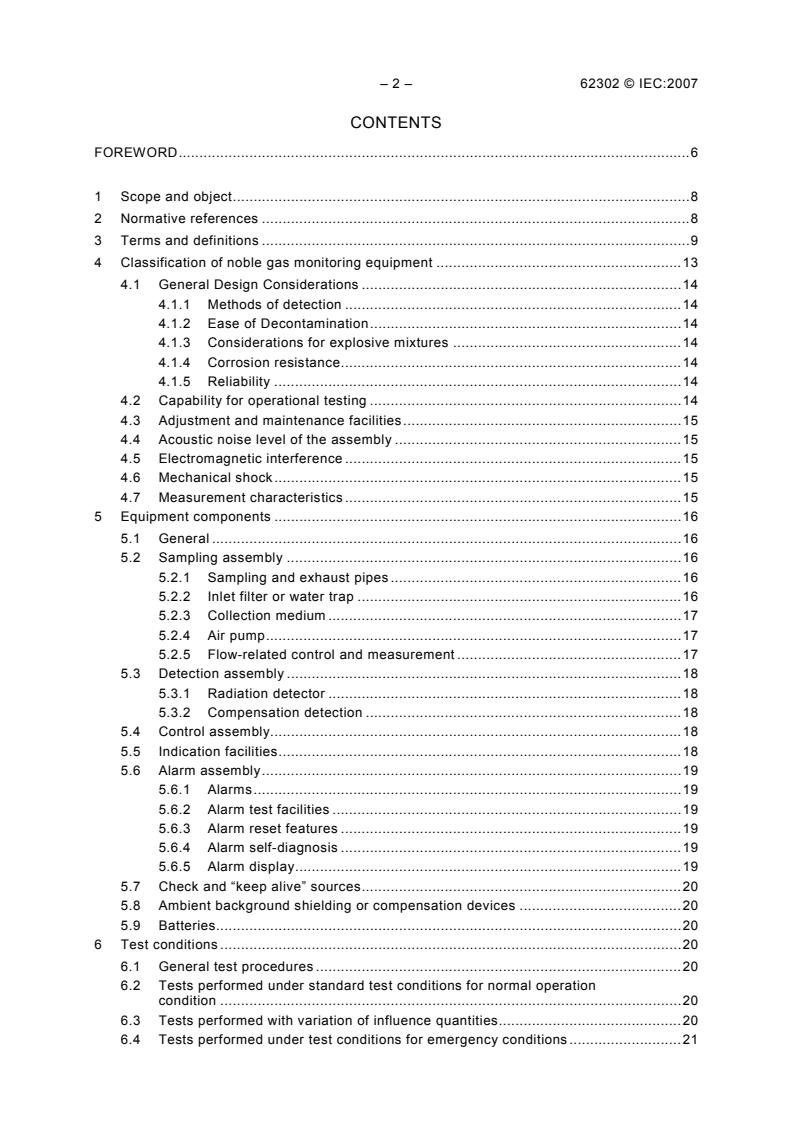
– 2 – 62302 © IEC:2007
CONTENTS
FOREWORD.6
1 Scope and object.8
2 Normative references .8
3 Terms and definitions .9
4 Classification of noble gas monitoring equipment .13
4.1 General Design Considerations .14
4.1.1 Methods of detection .14
4.1.2 Ease of Decontamination.14
4.1.3 Considerations for explosive mixtures .14
4.1.4 Corrosion resistance.14
4.1.5 Reliability .14
4.2 Capability for operational testing .14
4.3 Adjustment and maintenance facilities.15
4.4 Acoustic noise level of the assembly .15
4.5 Electromagnetic interference .15
4.6 Mechanical shock.15
4.7 Measurement characteristics .15
5 Equipment components .16
5.1 General .16
5.2 Sampling assembly .16
5.2.1 Sampling and exhaust pipes .16
5.2.2 Inlet filter or water trap .16
5.2.3 Collection medium .17
5.2.4 Air pump.17
5.2.5 Flow-related control and measurement .17
5.3 Detection assembly .18
5.3.1 Radiation detector .18
5.3.2 Compensation detection .18
5.4 Control assembly.18
5.5 Indication facilities.18
5.6 Alarm assembly.19
5.6.1 Alarms.19
5.6.2 Alarm test facilities .19
5.6.3 Alarm reset features .19
5.6.4 Alarm self-diagnosis .19
5.6.5 Alarm display.19
5.7 Check and “keep alive” sources.20
5.8 Ambient background shielding or compensation devices .20
5.9 Batteries.20
6 Test conditions .20
6.1 General test procedures .20
6.2 Tests performed under standard test conditions for normal operation
condition .20
6.3 Tests performed with variation of influence quantities.20
6.4 Tests performed under test conditions for emergency conditions .21
62302 © IEC:2007 – 3 –
6.5 Types of sources.21
6.5.1 Reference source .21
6.5.2 Solid sources.21
6.6 Metrological confirmation system during tests .21
6.6.1 Uncertainty of measurement .21
6.6.2 Statistical fluctuations.22
7 Radiation detection performance tests.22
7.1 Reference response .22
7.1.1 Requirements .22
7.1.2 Test to be carried out .22
7.1.3 Test method with gaseous sources.22
7.1.4 Relative response with solid sources .22
7.1.5 Test with an electronic signal generator.22
7.2 Linearity .23
7.2.1 Test source .23
7.2.2 Requirements .23
7.2.3 Test method .23
7.3 Response to radioactive gases other than radioactive noble gases .23
7.3.1 Requirements .23
7.3.2 Test method .23
7.4 Response time .23
7.4.1 Requirements .23
7.4.2 Test method .23
7.5 Response to ambient gamma radiation.24
7.5.1 General .24
7.5.2 Requirements .24
7.5.3 Test method .24
7.6 Response to neutron radiation.25
7.6.1 Response to neutron radiation.25
7.7 Overload test.25
7.7.1 Requirements .25
7.7.2 Test method .25
7.8 Statistical fluctuations .25
7.8.1 Requirements .25
7.8.2 Test method .25
7.9 Zero stability .26
7.9.1 Stability of zero indication with time.26
7.9.2 Stability of zero indication with variation of temperature .26
7.10 Reproducibility of the response .27
7.10.1 Requirements .27
7.10.2 Test method .27
8 Electrical, electronic and mechanical tests .27
8.1 Alarm trip range .27
8.1.1 Requirement.27
8.1.2 Test method .27
8.2 Alarm trip stability .28
8.2.1 Requirements .28
8.2.2 Test method .28
8.3 Equipment fault alarm system.28
– 4 – 62302 © IEC:2007
8.3.1 Loss of detector signal .28
8.3.2 Failure of the electronic system .28
8.3.3 Loss of the sampling circuit .29
8.4 Warm-up time – Detection and measurement assembly.29
8.4.1 Requirements .29
8.4.2 Test method .29
8.5 Power supply variations.29
8.5.1 Requirements .29
8.5.2 Test method .29
8.6 Battery test.30
8.6.1 General .30
8.6.2 Requirements .30
8.7 Power supply transient effects.30
8.7.1 Requirements .30
8.7.2 Test method .31
9 Air circuit performances test .31
9.1 General .31
9.2 Susceptibility to gaseous retention .31
9.2.1 Requirements .31
9.2.2 Test method .31
9.3 Accuracy of the volume and flow rate measurement .32
9.3.1 Requirement.32
9.3.2 Test method .32
9.4 Flow-rate stability .32
9.4.1 Requirements .32
9.4.2 Test method .32
9.5 Effect of filter pressure drop .32
9.5.1 Requirements .32
9.5.2 Test method .33
9.6 Effect of power supply voltage on the flow rate.33
9.6.1 Requirement for mains supplied equipment .33
9.6.2 Test method .33
9.7 Effect of power supply frequency on flow rate.33
9.7.1 Requirement for mains supplied equipment .33
9.7.2 Test method .33
10 Environmental performance tests .34
10.1 Ambient temperature .34
10.1.1 General .34
10.1.2 Requirements .34
10.1.3 Test method .34
10.2 Temperature shock for portable and transportable assemblies .34
10.2.1 General .34
10.2.2 Requirement.34
10.2.3 Test method .34
10.3 Relative humidity.35
10.3.1 General .35
10.3.2 Requirement.35
10.3.3 Test method .35
10.4 Atmospheric pressure.35
62302 © IEC:2007 – 5 –
10.4.1 General .35
10.4.2 Ambient Atmosphere .35
10.4.3 Atmosphere inside the detector system .35
10.5 Sealing.36
10.6 Mechanical shocks .36
10.6.1 Requirements .36
10.6.2 Test methods.36
10.7 External electromagnetic immunity and electrostatic discharge .36
10.7.1 Requirements .36
10.7.2 Test method .36
10.8 Electromagnetic emission.36
10.8.1 Requirements .36
10.8.2 Test method .37
11 Type test report and Certificate .37
12 Operation and maintenance manual .37
Annex A (informative) Preparation of radioactive gas reference sources .42
Figure A.1 – Calibration loop .43
Table 1 – Reference conditions and standard test conditions for normal operation
conditions .38
Table 2 – Tests performed under standard test conditions for normal operation
conditions .39
Table 3 – Tests performed with variation of influence quantities for normal operational
conditions .40
Table 4 – Tests of the air circuit.41
– 6 – 62302 © IEC:2007
INTERNATIONAL ELECTROTECHNICAL COMMISSION
____________
RADIATION PROTECTION INSTRUMENTATION –
EQUIPMENT FOR SAMPLING AND MONITORING
RADIOACTIVE NOBLE GASES
FOREWORD
1) The International Electrotechnical Commission (IEC) is a worldwide organization for standardization comprising
all national electrotechnical committees (IEC National Committees). The object of IEC is to promote
international co-operation on all questions concerning standardization in the electrical and electronic fields. To
this end and in addition to other activities, IEC publishes International Standards, Technical Specifications,
Technical Reports, Publicly Available Specifications (PAS) and Guides (hereafter referred to as “IEC
Publication(s)”). Their preparation is entrusted to technical committees; any IEC National Committee interested
in the subject dealt with may participate in this preparatory work. International, governmental and non-
governmental organizations liaising with the IEC also participate in this preparation. IEC collaborates closely
with the International Organization for Standardization (ISO) in accordance with conditions determined by
agreement between the two organizations.
2) The formal decisions or agreements of IEC on technical matters express, as nearly as possible, an international
consensus of opinion on the relevant subjects since each technical committee has representation from all
interested IEC National Committees.
3) IEC Publications have the form of recommendations for international use and are accepted by IEC National
Committees in that sense. While all reasonable efforts are made to ensure that the technical content of IEC
Publications is accurate, IEC cannot be held responsible for the way in which they are used or for any
misinterpretation by any end user.
4) In order to promote international uniformity, IEC National Committees undertake to apply IEC Publications
transparently to the maximum extent possible in their national and regional publications. Any divergence
between any IEC Publication and the corresponding national or regional publication shall be clearly indicated in
the latter.
5) IEC provides no marking procedure to indicate its approval and cannot be rendered responsible for any
equipment declared to be in conformity with an IEC Publication.
6) All users should ensure that they have the latest edition of this publication.
7) No liability shall attach to IEC or its directors, employees, servants or agents including individual experts and
members of its technical committees and IEC National Committees for any personal injury, property damage or
other damage of any nature whatsoever, whether direct or indirect, or for costs (including legal fees) and
expenses arising out of the publication, use of, or reliance upon, this IEC Publication or any other IEC
Publications.
8) Attention is drawn to the Normative references cited in this publication. Use of the referenced publications is
indispensable for the correct application of this publication.
9) Attention is drawn to the possibility that some of the elements of this IEC Publication may be the subject of
patent rights. IEC shall not be held responsible for identifying any or all such patent rights.
International Standard IEC 62302 has been prepared by subcommittee 45B: Radiation
protection instrumentation, of IEC technical committee 45: Nuclear instrumentation.
This standard directly complements IEC 60761-1 (2002) and IEC 60761-3 (2002).
The text of this standard is based on the following documents:
FDIS Report on voting
45B/550/FDIS 45B/556/RVD
Full information on the voting for the approval of this standard can be found in the report on
voting indicated in the above table.
This publication has been drafted in accordance with the ISO/IEC Directives, Part 2.
62302 © IEC:2007 – 7 –
The committee has decided that the contents of this publication will remain unchanged until
the maintenance result date indicated on the IEC web site under "http://webstore.iec.ch" in
the data related to the specific publication. At this date, the publication will be
• reconfirmed,
• withdrawn,
• replaced by a revised edition, or
• amended.
– 8 – 62302 © IEC:2007
RADIATION PROTECTION INSTRUMENTATION –
EQUIPMENT FOR SAMPLING AND MONITORING
RADIOACTIVE NOBLE GASES
1 Scope and object
This International Standard is applicable to equipment used for sampling and continuous
measurement of radioactive noble gases in the workplace, in gaseous effluents discharged
into the environment as well as in the environment itself. Monitoring by definition is the
process of continuous and real-time measurement. The processes of sampling or taking
samples for retrospective laboratory analysis are included in this standard.
The object of this standard is to establish mandatory general requirements and to present
examples of acceptable methods and equipment for sampling and monitoring radioactive
noble gases. Current standard IEC 60761-3 which is complemented by this standard, is
applicable to installing portable and transportable equipment for sampling and monitoring
radioactive noble gases, ONLY IN GASEOUS EFFLUENTS, while this standard expands
coverage to include monitoring all possible locations where radioactive noble gases could
present a radiological hazard. The equipment is designed to be operational during normal
operation conditions as well as under emergency conditions, both during and following an
accident. Depending on the nature of the emergency conditions it may be necessary to install
specially designed equipment for normal operational conditions and other equipment for
emergency conditions.
This standard is applicable to radioactive noble gas samplers and monitors intended to
provide the following functions:
– The measurement of the volumetric activity of radioactive noble gases and their variation
with time in the workplace, in gaseous effluents at the discharge point and in the
environment.
– The measurements performed during normal operational conditions as well as under
emergency conditions during and after an accidental release.
– The actuation of an alarm when a predetermined volumetric activity, or concentration, or a
predetermined total of released radioactivity is exceeded.
– The determination of the total gaseous activity discharged over a given time and/or to
provide information on the composition of a mixture of different gases released.
– The sampling and retrospective analysis of air or gas containing noble gas.
219 220 222
Radon, with isotopes Rn, Rn, and Rn, is a naturally occurring radioactive noble gas
whose measurements are NOT considered in this standard. The presence of radon and its
progeny may significantly interfere with the proper measurement of the noble gases of
concern in this standard.
This standard specifies the general characteristics, general testing procedures, mechanical,
electrical and electronic, radiological, safety and environmental characteristics, and the
proper identification and certification of the equipment. If this equipment is part of a
centralized system for continuous radiation monitoring in a nuclear facility, there may be
additional requirements from other standards related to those systems.
2 Normative references
The following referenced documents are indispensable for the application of this document.
For dated references, only the edition cited applies. For undated references, the latest edition
of the referenced document (including any amendments) applies.
62302 © IEC:2007 – 9 –
IEC 60050-393:2003, International Electrotechnical Vocabulary (IEV) – Chapter 393: Nuclear
instrumentation – Physical phenomena and basic concepts
IEC 60068 (all parts), Environmental testing
IEC 60761-1:2002, Equipment for continuous monitoring of radioactivity in gaseous effluents
– Part 1: General requirements
IEC 60761-3:2002, Equipment for continuously monitoring radioactivity in gaseous effluents –
Part 3: Specific requirements for radioactive noble gas monitors
IEC 61000 (all parts): Electromagnetic compatibility (EMC)
IEC 61187:1993, Electrical and electronic measuring equipment – Documentation
ISO Guide 98:1995, Guide to the expression of uncertainty in measurement (GUM)
3 Terms and definitions
For the purposes of this document, the following terms and definitions apply.
3.1
acceptance test
contractual test to prove to the customer that the system meets certain conditions of its
specification
3.2
accident conditions
conditions deviating from normal operations, more severe than anticipated operational
occurrences, including design basis accidents and severe accidents
3.3
alarm assembly
assembly or a combination of assemblies whose output provides audible or visual alarm in the
event that an alarm threshold has been exceeded or a malfunction has been detected
3.4
anticipated operation occurrence
operational process deviating from normal operation which is expected to occur at least once
during the operational lifetime of a nuclear power plant but which, in view of appropriate
design provisions, does not cause any significant damage to items important to safety or lead
to accident conditions
3.5
coefficient of variation
the ratio V of the standard deviation s to the arithmetic mean x of a set of n measurements x
i
given by the following formula:
n
s 11
V== xx−
()
∑ i
xx n − 1
i=1
3.6
collection efficiency
where applicable, the collection efficiency of a monitor is defined as the ratio of the total
activity available for measurement on or in the collection medium to the total activity in the air
at the inlet of the collection medium
– 10 – 62302 © IEC:2007
3.7
control assembly
assembly used to process the output of the detection assembly and to provide data indication
and electrical power for the entire system
3.8
conventionally true activity
the best estimate of the activity of a radioactive source
NOTE Conventional activities, in general, are regarded as sufficiently close to the true values for the difference to
be insignificant for the given purpose. For example, a value and its uncertainty determined from a primary or a
secondary standard, or by a reference instrument which has been calibrated against a primary or secondary
standard, may be taken as the conventionally true value.
3.9
coverage factor
numerical factor (k) used as a multiplier of the combined standard uncertainty in order to
obtain an expanded uncertainty (ISO GUM: 1995)
3.10
decision quantity
random variable used to determine whether a physical effect to be measured is present or not
3.11
decision threshold
fixed value of the radioactivity that allows a decision to be made for each measurement with a
given probability of error as to whether the registered measurement includes a contribution
from the physical effect
NOTE The statistical test shall be designed such that the probability of wrongly rejecting the hypothesis is equal
to a designation α. For this standard error of the first type, α is equal to 5 %.
3.12
design basis accident
accident conditions for which a nuclear power plant is designed according to established
design criteria, and for which the damage of the fuel and the release of radioactive material
are kept within authorized limits
3.13
detection limit
minimum value of the measurement quantifying a physical effect that can be detected with a
given probability of error by the measuring method.
NOTE The detection limit is the smallest true value of the measured value that is associated with the statistical
test and hypotheses (Cf. decision quantity) by the following characteristics: if in reality the true value is equal to or
exceeds the detection limit, the probability of wrongly not rejecting the hypothesis (error of the second kind) shall
be at most equal to a given value β. For this standard ß equals 5 %.
3.14
dynamic range
ratio of the signal from the maximum measurable indication to the signal from the minimum
detectable value of that quantity
3.15
effective range of measurement
range of values of the radioactive quantity to be measured over which the performance of
equipment or an assembly meets the requirements of its specifications
62302 © IEC:2007 – 11 –
3.16
error of indication
difference between the indicated value ʋ of an activity and the conventionally true value ʋ of
c
that activity at the point of measurement
Δν = ν − ν
c
where:
ν is the value of the activity indicated by the equipment or assembly under test;
ν is the conventionally true value of the activity.
c
3.17
installed equipment
equipment designed to be in place for many years. IEC 60050-393 specifies the “installed life”
of such equipment as less than 40 years
3.18
maintenance test
test carried out periodically on a device or equipment to ascertain and, if necessary, make
certain adjustments to ensure that its performance remains within specified limits
3.19
manufacturer and purchaser
the term "manufacturer" includes the designer and the seller of the equipment;
the term "purchaser" includes the user of the equipment.
3.20
measurement assembly
this assembly includes functional units designed to measure quantities related to ionizing
radiation (activity, volumetric activity, etc.)
3.21
measurement uncertainty
parameter associated with the result of a measurement that characterizes the dispersion of
the values that could reasonably be attributed to the measurement. Any result of
measurement shall be given with the associated uncertainty calculated following method
recommended in the ISO GUM: 1995
3.22
monitor air circuit efficiency
the air circuit efficiency of the monitor describes the losses of activity on the walls of the
monitor between the air circuit inlet and the collection medium. It is defined as the ratio of the
total activity available for the monitor to sample to the total activity in the air supplied at the
inlet of the monitor.
3.23
monitor sampling efficiency
monitor sampling efficiency is defined as the ratio of the volumetric activity as available for
measurement on or in the collection medium, to the volumetric activity in the air supplied to
the inlet of the monitor. It is the product of the collection efficiency times the air circuit
efficiency of the monitor.
– 12 – 62302 © IEC:2007
3.24
noble gas
41 85 133 135
the radioactive noble gases of concern in this standard include Ar, Kr, Xe and Xe in
the workplace, in gaseous effluents and in the environment itself. The isotopes of Radon are
NOT included.
3.25
normal operation conditions
operation within specified limits and conditions
3.26
portable equipment
equipment designed to be easily carried by one person to a location where a measurement is
required or desired
3.27
radiation detection assembly
assembly or combination of assemblies capable of providing radiation measurements
3.28
reference response
the reference response R is the ratio under standard test conditions, between the response
ref
indication of the monitor and the unit reference activity (Table 1). This response is expressed
by the relation:
ν
R =
ref
ν
c
where:
ν is the value of the activity measured by the equipment or assembly under test;
ν is the conventionally true value of the activity.
c
3.29
relative intrinsic error
relative error of indication (e) of a piece of equipment or an assembly with respect to a
i
quantity when subjected to a specified reference quantity under specified reference conditions
expressed as:
ν − ν
c
e = .
i
ν
c
3.30
response time
time required after a step variation in the measured quantity for the output signal variation to
reach a given percentage for the first time, usually 90 %, of its final value
NOTE In this standard, 90 % is used.
3.31
retention capacity
the maximum quantity of a defined substance that can be retained at equilibrium in the
medium considered
62302 © IEC:2007 – 13 –
3.32
routine test
a test to which each individual device is subjected during or after manufacture to ascertain
whether it complies with certain criteria
3.33
sampling assembly
a set of connected devices used to collect a representative gas or air sample
3.34
severe accident
accident conditions more severe than a design basis accident involving significant core
degradation
3.35
surface emission rate of a solid source
number of particles of a given type above a given energy that are emerging from the front
face of a source per unit time
NOTE This normally applies to alpha and beta emitting sources and not to photon sources, characterized by
activity (refer to 7.2.1).
3.36
transportable equipment
equipment designed to be in place for a limited time and capable of being transported to other
locations for measurements
3.37
type test
a test of one or more devices made to a certain design to show that the design meets certain
specifications
3.38
sensitivity
ratio of the variation of the observed variable to the corresponding variation of the measured
quantity, for a given value of the measured quantity
3.39
volumetric activity
radioactivity per unit volume of measured air or gas
4 Classification of noble gas monitoring equipment
There are a number of designs for noble gas monitors available with some monitors of special
design to meet the specific needs of the user. This standard classifies noble gas monitors
based on the following radiological requirements:
– Gamma detection (best applied to monitoring for Ar)
– Beta detection
– Combination beta/gamma detection
– Radionuclide-specific (again applied to monitoring for Ar)
• Measurement range
– Low range monitors include those monitors that have range (R) 0 < R < 10 MBq/m .
– High range monitors have a range X < R < Y where “X” and “Y” are, respectively, the
minimum and the maximum responses of the monitor as stated by the manufacturer.
• Working condition
– 14 – 62302 © IEC:2007
– Normal operation conditions
– Emergency conditions
• System interface
– Local readout and alarm only.
• Type of installation and/or power source
– Installed or transportable noble gas monitors operate mainly using line power and may
also have battery backup. Installed monitors typically have outputs that interface the
monitor with a centralized radiation monitoring system.
– Portable monitors primarily use batteries and are typically carried from location to location
for use. They may also use line power through an internal or external converter and can
also be interfaced with a centralized system.
4.1 General design considerations
4.1.1 Methods of detection
This standard does NOT specify what type or types of radiation detectors may be used to
accomplish the performance required. The entire range of radiation detectors, including
ionization chambers, proportional counters, GM detectors, solid-state detectors, inorganic and
organic scintillators, and combinations of these, can and are used to measure noble gases.
4.1.2 Ease of decontamination
Surfaces that are designed to come in contact with radioactivity, such as the sampling and
detection assemblies, shall be designed and constructed such that the accumulation of
contamination is minimized and shall be designed to facilita
...