

IEC TS 60034-32:2016
(Main)Rotating electrical machines - Part 32: Measurement of stator end-winding vibration at form-wound windings
General Information
- Abstract
IEC TS 60034-32:2016(E) is intended to provide consistent guidelines for measuring and reporting end-winding vibration behaviour during operation and at standstill. It
- defines terms for measuring, analysis and evaluation of stator end-winding vibration and related structural dynamics;
- gives guidelines for measuring dynamic / structural characteristics offline and stator end-winding vibrations online;
- describes instrumentation and installation practices for end-winding vibration measurement equipment;
- establishes general principles for documentation of test results;
- describes the theoretical background of stator end-winding vibrations. This part of IEC 60034 is applicable to three-phase synchronous generators and three-phase synchronous direct online (DOL) motors.
- Status
- Published
- Publication Date
- 14-Dec-2016
- Technical Committee
- TC 2 - Rotating machinery
- Drafting Committee
- WG 32 - TC 2/WG 32
- Current Stage
- PPUB - Publication issued
- Start Date
- 15-Dec-2016
- Completion Date
- 28-Feb-2017
Overview
IEC TS 60034-32:2016 - Rotating electrical machines - Part 32 - provides standardized guidance for the measurement and reporting of stator end-winding vibration in machines with form‑wound windings. The technical specification addresses both measurements offline (standstill) and online (during operation), defines terms and evaluation criteria, describes instrumentation and installation practices, and establishes principles for documenting test results. It is applicable to three‑phase synchronous generators and three‑phase synchronous direct‑online (DOL) motors.
Key Topics
- Terminology and definitions for vibration measurement, analysis and structural dynamics to ensure consistent reporting.
- Standstill structural dynamics methods such as experimental modal analysis and driving‑point analysis to identify natural frequencies and mode shapes.
- Online vibration measurement: guidance on locating sensors, retrieving dynamic characteristics, and identifying operational deflection shapes (ODS).
- Instrumentation and installation practices: recommended vibration transducers, electro‑optical converters (for fiber‑optic systems), penetrations for hydrogen‑cooled machines, and data‑acquisition considerations.
- Measurement procedures and evaluation: procedures for acquiring frequency response functions (FRFs), coherence checks, and interpreting mode identification results.
- Documentation and test reporting: required elements of reports to support repeatability and trend analysis.
- Repeated measurements and monitoring: strategies to detect structural changes over time and ensure comparability of reference measurements.
- Theoretical background: causes and effects of stator end‑winding vibration, excitation mechanisms and influence of operational parameters.
Applications
- Acceptance testing and commissioning of large generators and synchronous motors.
- Design verification and prototype testing for OEMs to validate end‑winding dynamic behaviour.
- Condition monitoring and predictive maintenance programs to detect increases in vibration and structural changes.
- Root‑cause analysis after vibration‑related failures or insulation damage.
- Field testing where hydrogen‑cooled machines require special penetrations and fiber‑optic sensing.
Who Should Use This Standard
- Generator and motor designers (OEMs)
- Test and commissioning engineers
- Vibration analysts and condition‑monitoring teams
- Power utilities and industrial plant maintenance groups
- Independent test laboratories and certification bodies
Related Standards
- Other parts of the IEC 60034 series covering rotating electrical machines (refer to the IEC catalogue for related parts and normative references).
Keywords: IEC TS 60034-32:2016, stator end-winding vibration, form-wound windings, measurement, modal analysis, operational deflection shape, vibration sensors, data acquisition, synchronous generators, synchronous DOL motors.
Get Certified
Connect with accredited certification bodies for this standard

IMQ S.p.A. (Certification)
Italian electrical product certification.

SLG Prüf- und Zertifizierungs GmbH
German testing and certification body.

UL Solutions
Global safety science company with testing, inspection and certification.
Sponsored listings
Frequently Asked Questions
IEC TS 60034-32:2016 is a technical specification published by the International Electrotechnical Commission (IEC). Its full title is "Rotating electrical machines - Part 32: Measurement of stator end-winding vibration at form-wound windings". This standard covers: IEC TS 60034-32:2016(E) is intended to provide consistent guidelines for measuring and reporting end-winding vibration behaviour during operation and at standstill. It - defines terms for measuring, analysis and evaluation of stator end-winding vibration and related structural dynamics; - gives guidelines for measuring dynamic / structural characteristics offline and stator end-winding vibrations online; - describes instrumentation and installation practices for end-winding vibration measurement equipment; - establishes general principles for documentation of test results; - describes the theoretical background of stator end-winding vibrations. This part of IEC 60034 is applicable to three-phase synchronous generators and three-phase synchronous direct online (DOL) motors.
IEC TS 60034-32:2016(E) is intended to provide consistent guidelines for measuring and reporting end-winding vibration behaviour during operation and at standstill. It - defines terms for measuring, analysis and evaluation of stator end-winding vibration and related structural dynamics; - gives guidelines for measuring dynamic / structural characteristics offline and stator end-winding vibrations online; - describes instrumentation and installation practices for end-winding vibration measurement equipment; - establishes general principles for documentation of test results; - describes the theoretical background of stator end-winding vibrations. This part of IEC 60034 is applicable to three-phase synchronous generators and three-phase synchronous direct online (DOL) motors.
IEC TS 60034-32:2016 is classified under the following ICS (International Classification for Standards) categories: 29.160.01 - Rotating machinery in general. The ICS classification helps identify the subject area and facilitates finding related standards.
IEC TS 60034-32:2016 is available in PDF format for immediate download after purchase. The document can be added to your cart and obtained through the secure checkout process. Digital delivery ensures instant access to the complete standard document.
Standards Content (Sample)
IEC TS 60034-32 ®
Edition 1.0 2016-12
TECHNICAL
SPECIFICATION
colour
inside
Rotating electrical machines –
Part 32: Measurement of stator end-winding vibration at form-wound windings
All rights reserved. Unless otherwise specified, no part of this publication may be reproduced or utilized in any form
or by any means, electronic or mechanical, including photocopying and microfilm, without permission in writing from
either IEC or IEC's member National Committee in the country of the requester. If you have any questions about IEC
copyright or have an enquiry about obtaining additional rights to this publication, please contact the address below or
your local IEC member National Committee for further information.
IEC Central Office Tel.: +41 22 919 02 11
3, rue de Varembé Fax: +41 22 919 03 00
CH-1211 Geneva 20 info@iec.ch
Switzerland www.iec.ch
About the IEC
The International Electrotechnical Commission (IEC) is the leading global organization that prepares and publishes
International Standards for all electrical, electronic and related technologies.
About IEC publications
The technical content of IEC publications is kept under constant review by the IEC. Please make sure that you have the
latest edition, a corrigenda or an amendment might have been published.
IEC Catalogue - webstore.iec.ch/catalogue Electropedia - www.electropedia.org
The stand-alone application for consulting the entire The world's leading online dictionary of electronic and
bibliographical information on IEC International Standards, electrical terms containing 20 000 terms and definitions in
Technical Specifications, Technical Reports and other English and French, with equivalent terms in 15 additional
documents. Available for PC, Mac OS, Android Tablets and languages. Also known as the International Electrotechnical
iPad. Vocabulary (IEV) online.
IEC publications search - www.iec.ch/searchpub IEC Glossary - std.iec.ch/glossary
The advanced search enables to find IEC publications by a 65 000 electrotechnical terminology entries in English and
variety of criteria (reference number, text, technical French extracted from the Terms and Definitions clause of
committee,…). It also gives information on projects, replaced IEC publications issued since 2002. Some entries have been
and withdrawn publications. collected from earlier publications of IEC TC 37, 77, 86 and
CISPR.
IEC Just Published - webstore.iec.ch/justpublished
Stay up to date on all new IEC publications. Just Published IEC Customer Service Centre - webstore.iec.ch/csc
details all new publications released. Available online and If you wish to give us your feedback on this publication or
also once a month by email. need further assistance, please contact the Customer Service
Centre: csc@iec.ch.
IEC TS 60034-32 ®
Edition 1.0 2016-12
TECHNICAL
SPECIFICATION
colour
inside
Rotating electrical machines –
Part 32: Measurement of stator end-winding vibration at form-wound windings
INTERNATIONAL
ELECTROTECHNICAL
COMMISSION
ICS 29.160.01 ISBN 978-2-8322-3714-4
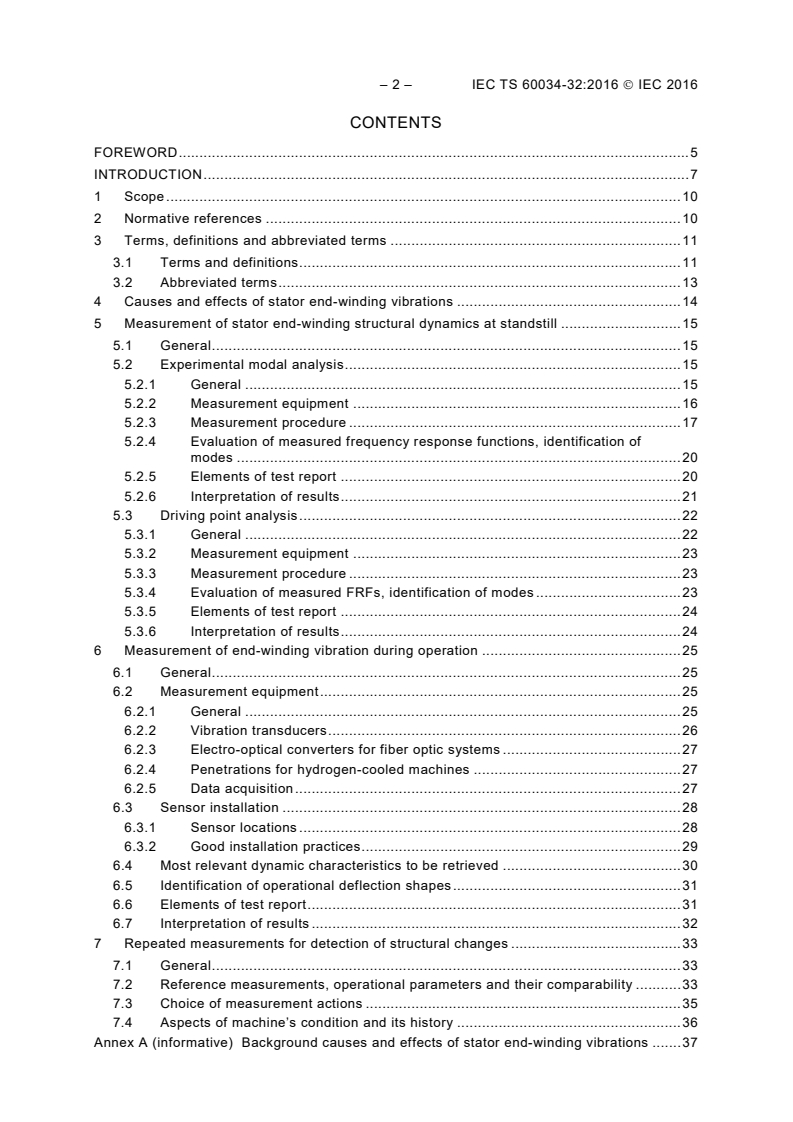
– 2 – IEC TS 60034-32:2016 IEC 2016
CONTENTS
FOREWORD . 5
INTRODUCTION . 7
1 Scope . 10
2 Normative references . 10
3 Terms, definitions and abbreviated terms . 11
3.1 Terms and definitions . 11
3.2 Abbreviated terms . 13
4 Causes and effects of stator end-winding vibrations . 14
5 Measurement of stator end-winding structural dynamics at standstill . 15
5.1 General . 15
5.2 Experimental modal analysis . 15
5.2.1 General . 15
5.2.2 Measurement equipment . 16
5.2.3 Measurement procedure . 17
5.2.4 Evaluation of measured frequency response functions, identification of
modes . 20
5.2.5 Elements of test report . 20
5.2.6 Interpretation of results . 21
5.3 Driving point analysis . 22
5.3.1 General . 22
5.3.2 Measurement equipment . 23
5.3.3 Measurement procedure . 23
5.3.4 Evaluation of measured FRFs, identification of modes . 23
5.3.5 Elements of test report . 24
5.3.6 Interpretation of results . 24
6 Measurement of end-winding vibration during operation . 25
6.1 General . 25
6.2 Measurement equipment . 25
6.2.1 General . 25
6.2.2 Vibration transducers . 26
6.2.3 Electro-optical converters for fiber optic systems . 27
6.2.4 Penetrations for hydrogen-cooled machines . 27
6.2.5 Data acquisition . 27
6.3 Sensor installation . 28
6.3.1 Sensor locations . 28
6.3.2 Good installation practices . 29
6.4 Most relevant dynamic characteristics to be retrieved . 30
6.5 Identification of operational deflection shapes . 31
6.6 Elements of test report . 31
6.7 Interpretation of results . 32
7 Repeated measurements for detection of structural changes . 33
7.1 General . 33
7.2 Reference measurements, operational parameters and their comparability . 33
7.3 Choice of measurement actions . 35
7.4 Aspects of machine’s condition and its history . 36
Annex A (informative) Background causes and effects of stator end-winding vibrations . 37
A.1 Stator end-winding dynamics . 37
A.1.1 Vibration modes and operating deflection shape . 37
A.1.2 Excitation of stator end-winding vibrations . 38
A.1.3 Relevant vibration characteristics of stator end-windings . 38
A.1.4 Influence of operational parameter . 41
A.2 Increased stator end-winding vibrations . 41
A.2.1 General aspects of increased vibration . 41
A.2.2 Increase of stator end-winding vibrations levels over time and potential
remedial actions . 42
A.2.3 Transient conditions as cause for structural changes . 43
A.2.4 Special aspects of main insulation . 44
A.3 Operational deflection shape of global stator end-winding vibrations . 44
A.3.1 General . 44
A.3.2 Force distributions relevant for global vibrational behaviour . 44
A.3.3 Idealized global vibration behaviour while in operation . 45
A.3.4 General vibration behaviour of stator end-windings . 47
A.3.5 Positioning of sensors for the measurement of global vibration level . 49
A.4 Operational deflection shape of local stator end-winding vibrations . 51
Annex B (informative) Data visualization . 52
B.1 General . 52
B.2 Standstill measurements . 53
B.3 Measurements during operation . 56
Bibliography . 62
Figure 1 – Stator end-winding of a turbogenerator (left) and a large motor (right) at
connection end with parallel rings . 7
Figure 2 – Example for an end-winding structure of an indirect cooled machine . 8
Figure 3 – Measurement structure with point numbering and indication of excitation . 19
Figure 4 – Simplified cause effect chain of stator end-winding vibration and influencing
operational parameters . 35
Figure A.1 – Illustration of global vibration modes . 40
Figure A.2 – Example of rotational force distribution for p = 1 . 45
Figure A.3 – Example of rotating operational vibration deflection wave for p = 1 . 46
Figure A.4 – Illustration of two vibration modes with different orientation in space
(example for p = 1) . 47
Figure A.5 – on-rotational operational vibration deflection wave (example for p = 1) . 48
Figure A.6 – Amplitude and phase distribution for a general case. . 49
Figure A.7 – Sensors for the measurement of global vibration level centred in the
winding zones . 50
Figure A.8 – Measurement of global vibration level with 6 equidistantly distributed
sensors in the centre of winding zones . 50
Figure A.9 – Example – Sensor positions for the measurement of local vibration level
of the winding connection relative to global vibration level . 51
Figure B.1 – Measurement structure with point numbering and indication of excitation . 52
Figure B.2 – Example for linearity test − Force signal and variance of related FRFs . 53
Figure B.3 – Example for reciprocity test – FRFs in comparison . 53
Figure B.4 – Example – Two overlay-plots of the same transfer functions but different
dimensions . 54
– 4 – IEC TS 60034-32:2016 IEC 2016
Figure B.5 – Shapes of the 4, 6 and 8-node modes with natural frequencies,
measurement in one plane . 55
Figure B.6 – Mode shape of a typical 4-node mode with different viewing directions
(stator end-winding and outer support ring) . 55
Figure B.7 – Example – Amplitude and phase of dynamic compliance and coherence . 56
Figure B.8 – 2-pole, 60 Hz generator – Trend in displacement over time for 10 stator
end-winding accelerometers, as well as one accelerometer mounted on the stator core . 56
Figure B.9 – 2-pole, 60 Hz generator – End-winding vibration, winding temperature
trends over time, constant stator current . 57
Figure B.10 – 2-pole, 60 Hz generator – End-winding vibration, stator current trends
over time, constant winding temperature . 57
Figure B.11 – 2-pole, 60 Hz generator – Example of variation in vibration levels at
comparable operating conditions. 58
Figure B.12 – 2-pole, 60 Hz generator – Raw vibration signal, acceleration waveform . 59
Figure B.13 – 2-pole, 60 Hz generator – FFT and double integrated vibration signal,
displacement spectrum . 59
Figure B.14 – 2-pole, 60 Hz generator – Displacement spectrum . 60
Figure B.15 – 2-pole, 60 Hz generator – Velocity spectrum . 60
Figure B.16 – 2-pole, 60 Hz generator – Acceleration spectrum . 61
Table 1 – Node number of highest mode shape in relevant frequency range and
minimum number of measurement locations . 20
Table 2 – Possible measurement actions to gain insight into various aspects of the
cause-effect chain. . 36
INTERNATIONAL ELECTROTECHNICAL COMMISSION
____________
ROTATING ELECTRICAL MACHINES –
Part 32: Measurement of stator end-winding vibration
at form-wound windings
FOREWORD
1) The International Electrotechnical Commission (IEC) is a worldwide organization for standardization comprising
all national electrotechnical committees (IEC National Committees). The object of IEC is to promote
international co-operation on all questions concerning standardization in the electrical and electronic fields. To
this end and in addition to other activities, IEC publishes International Standards, Technical Specifications,
Technical Reports, Publicly Available Specifications (PAS) and Guides (hereafter referred to as “IEC
Publication(s)”). Their preparation is entrusted to technical committees; any IEC National Committee interested
in the subject dealt with may participate in this preparatory work. International, governmental and non-
governmental organizations liaising with the IEC also participate in this preparation. IEC collaborates closely
with the International Organization for Standardization (ISO) in accordance with conditions determined by
agreement between the two organizations.
2) The formal decisions or agreements of IEC on technical matters express, as nearly as possible, an international
consensus of opinion on the relevant subjects since each technical committee has representation from all
interested IEC National Committees.
3) IEC Publications have the form of recommendations for international use and are accepted by IEC National
Committees in that sense. While all reasonable efforts are made to ensure that the technical content of IEC
Publications is accurate, IEC cannot be held responsible for the way in which they are used or for any
misinterpretation by any end user.
4) In order to promote international uniformity, IEC National Committees undertake to apply IEC Publications
transparently to the maximum extent possible in their national and regional publications. Any divergence
between any IEC Publication and the corresponding national or regional publication shall be clearly indicated in
the latter.
5) IEC itself does not provide any attestation of conformity. Independent certification bodies provide conformity
assessment services and, in some areas, access to IEC marks of conformity. IEC is not responsible for any
services carried out by independent certification bodies.
6) All users should ensure that they have the latest edition of this publication.
7) No liability shall attach to IEC or its directors, employees, servants or agents including individual experts and
members of its technical committees and IEC National Committees for any personal injury, property damage or
other damage of any nature whatsoever, whether direct or indirect, or for costs (including legal fees) and
expenses arising out of the publication, use of, or reliance upon, this IEC Publication or any other IEC
Publications.
8) Attention is drawn to the Normative references cited in this publication. Use of the referenced publications is
indispensable for the correct application of this publication.
9) Attention is drawn to the possibility that some of the elements of this IEC Publication may be the subject of
patent rights. IEC shall not be held responsible for identifying any or all such patent rights.
The main task of IEC technical committees is to prepare International Standards. In
exceptional circumstances, a technical committee may propose the publication of a Technical
Specification when
• the required support cannot be obtained for the publication of an International Standard,
despite repeated efforts, or
• the subject is still under technical development or where, for any other reason, there is the
future but no immediate possibility of an agreement on an International Standard.
Technical Specifications are subject to review within three years of publication to decide
whether they can be transformed into International Standards.
IEC TS 60034-32, which is a Technical Specification, has been prepared by IEC technical
committee 2: Rotating machinery.
– 6 – IEC TS 60034-32:2016 IEC 2016
The text of this Technical Specification is based on the following documents:
Enquiry draft Report on voting
2/1810/DTS 2/1849/RVC
Full information on the voting for the approval of this Technical Specification can be found in
the report on voting indicated in the above table.
This publication has been drafted in accordance with the ISO/IEC Directives, Part 2.
NOTE A table of cross-references of all IEC TC 2 publications can be found on the IEC TC 2 dashboard on the
IEC website.
The committee has decided that the contents of this publication will remain unchanged until
the stability date indicated on the IEC website under "http://webstore.iec.ch" in the data
related to the specific publication. At this date, the publication will be
• transformed into an International standard,
• reconfirmed,
• withdrawn,
• replaced by a revised edition, or
• amended.
A bilingual version of this publication may be issued at a later date.
IMPORTANT – The 'colour inside' logo on the cover page of this publication indicates
that it contains colours which are considered to be useful for the correct
understanding of its contents. Users should therefore print this document using a
colour printer.
INTRODUCTION
Large alternating current (AC) machines are equipped with multiphase stator windings. The
information in this document is based on a dual-layer design. Such windings are connected to
a multiphase voltage system (multiphase current system), which establishes a rotating
magnetic field in the air gap between the rotor surface and stator bore. The voltage and
current can vary during operation in order to adapt to varying mechanical load. Electrical
machines are normally designed for motor or generator operating mode. The majority of AC
machines are equipped with symmetrical three-phase windings, consisting of three,
electrically isolated, spatially distributed winding parts that are intended for common
operation.
Large AC rotating electrical machines are typically equipped with form-wound windings
consisting of form wound coils (as defined in IEC 60034-15:2009, 2.3), single winding coils
(single winding bars) which are given their shape before being assembled into the machine.
The winding overhang, or end-winding, is the portion of the stator winding that extends
beyond the end of the magnetic core and is, in most cases, formed as a circular cone, see
some examples in Figure 1 below.
IEC
NOTE Individual coil end marked with black line.
Figure 1 – Stator end-winding of a turbogenerator (left)
and a large motor (right) at connection end with parallel rings
– 8 – IEC TS 60034-32:2016 IEC 2016
The majority of large AC machines with form-wound stator windings are equipped with a
stator end-winding support structure. Among other functions it is expected to withstand the
high electromagnetic force loading when the machine is exposed to an electrical fault in the
electrical supply system. This includes a fault in the supply lines of an electrical grid or in an
electronic supply device. In many cases the stator end-winding support structure is not only
designed to increase the structural strength, but also provide appropriate structural stiffness
and inertia to systematically influence structural dynamics and thus the vibration level during
operation.
IEC
Figure 2 – Example for an end-winding structure of an indirect cooled machine
Typical support elements are plates and rings, which support the end-winding cone as a
whole. Moreover, the distance between coils (or bars) of the end-winding are defined by
spacing elements and their positions are fixed by fastening components. The typical materials
used for support elements, spacers and fasteners are composites containing glass fibre
materials as well as resin impregnated felts, cords and bandings (see Figure 2). Also, high
electrical fields surrounding metal parts could produce electrical discharges compromising
long term electrical strength.
Until now there existed no general Technical Specification to get reliable and comparable
results for the identification of natural frequencies during stand-still and for vibration
behaviour of stator end-windings during operation.
The experimental modal analysis of stator end-windings is a well-established tool which has
also been used for the verification of natural frequencies and mode shapes of large electrical
machines worldwide. The goal is to avoid operation of the machine with increased end-
winding vibration levels under the influence of natural frequencies. Measurement of transfer
functions and identification of structural dynamic properties (e.g. natural frequencies, mode
shapes and other modal parameters) with an impact test is a common testing procedure. It is
applied to new machines by the manufacturer and also used as a maintenance tool by the
user or contractor during a major overhaul of large rotating machines.
Operational measurement of vibrational behaviour of stator end-windings can be performed by
the installation of special vibration transducers at selected end-winding locations for periodic
measurements or permanent on-line monitoring.
Although measurements of natural frequencies and vibration levels of stator end-windings are
well established techniques, the interpretation of results is still a matter of further
improvement and development. Therefore this first edition is a Technical Specification and not
an International Standard.
– 10 – IEC TS 60034-32:2016 IEC 2016
ROTATING ELECTRICAL MACHINES –
Part 32: Measurement of stator end-winding vibration
at form-wound windings
1 Scope
This part of IEC 60034 is intended to provide consistent guidelines for measuring and
reporting end-winding vibration behaviour during operation and at standstill. It
– defines terms for measuring, analysis and evaluation of stator end-winding vibration and
related structural dynamics,
– gives guidelines for measuring dynamic / structural characteristics offline and stator end-
winding vibrations online,
– describes instrumentation and installation practices for end-winding vibration
measurement equipment,
– establishes general principles for documentation of test results,
– describes the theoretical background of stator end-winding vibrations.
This part of IEC 60034 is applicable to:
– three-phase synchronous generators, having rated outputs of 150 MVA and above driven
by steam turbines or combustion turbines;
– three-phase synchronous direct online (DOL) motors, having rated output of 30 MW and
above.
This document is limited to the description of measurement procedures for 2-pole and 4-pole
machines. For smaller ratings of machines than defined in this document, agreement can be
made between the vendor and the purchaser for the selection of measurements in this
document to be applied.
2 Normative references
The following documents are referred to in the text in such a way that some or all of their
content constitutes requirements of this document. For dated references, only the edition
cited applies. For undated references, the latest edition of the referenced document (including
any amendments) applies.
IEC 60034-1, Rotating electrical machines – Part 1: Rating and performance
IEC 60034-15, Rotating electrical machines – Part 15: Impulse voltage withstand levels of
form-wound stator coils for rotating a.c. machines
IEC 60079 (all parts), Explosive atmospheres
ISO 7626-5:1994, Vibration and shock – Experimental determination of mechanical mobility –
Part 5: Measurements using impact excitation with an exciter which is not attached to the
structure
ISO 18431-1, Mechanical vibration and shock – Signal processing – Part 1: General
introduction
ISO 18431-2, Mechanical vibration and shock – Signal processing – Part 2: Time domain
windows for Fourier Transform analysis
3 Terms, definitions and abbreviated terms
3.1 Terms and definitions
For the purposes of this document, the following terms and definitions apply.
ISO and IEC maintain terminological databases for use in standardization at the following
addresses:
• IEC Electropedia: available at http://www.electropedia.org/
• ISO Online browsing platform: available at http://www.iso.org/obp
3.1.1
turbine driven generator
three-phase synchronous generator with cylindrical rotor with 2 or 4 poles driven by a steam
turbine or combustion turbine
Note 1 to entry: In this document, the term turbogenerator will be used.
3.1.2
partial discharge
electrical discharge that only partially bridges the insulation between conductors
Note 1 to entry: A transient gaseous ionization occurs in an insulation system when the electric stress exceeds a
critical value, and this ionization produces partial discharges.
Note 2 to entry: See IEC TS 60034-27.
3.1.3
stator end-winding
portion of the stator winding that extends beyond the end of the core and is formed as a
circular cone
3.1.4
stator end-winding support structure
components like rings, plates, spacers and fasteners as well as components for tightening,
blocking and roving which are supporting and fixing the stator end-winding
3.1.5
stator end-winding structure
assembly of both the stator end-winding and the stator end-winding support structure
3.1.6
stator bar
single electrical slot conductor as part of the stator winding
3.1.7
parallel rings
electrical components connecting the stator winding to the main leads
Note 1 to entry: Parallel rings are also called connection rings, phase rings or circuits rings.
3.1.8
displacement amplitude
amplitude of displacement vector
Note 1 to entry: See ISO 2041.
– 12 – IEC TS 60034-32:2016 IEC 2016
3.1.9
phase angle
angle of a complex response which characterizes a shift in time at a given frequency
Note 1 to entry: See ISO 2041.
3.1.10
measurement position
measurement location and direction
3.1.11
1x-vibration
vibration with rotational frequency
3.1.12
2x-vibration
vibration with twice rotational frequency
3.1.13
1f-vibration
vibration with once line frequency
3.1.14
2f-vibration
vibration with twice line frequency
3.1.15
mode shapes
shapes of a natural mode of vibration of a mechanical system, usually normalized to a
specified deflection magnitude
Note 1 to entry: See ISO 2041.
3.1.16
local modes
vibration involving part of a stator end-winding structure with typically small spatial expansion
relative to the circumference of the stator end-winding
3.1.17
global modes
vibration involving a large part of the stator end-winding structure, i.e. the winding bars
outside the stator core and the support components
Note 1 to entry: See 8.1.3.
3.1.18
4-node mode
global vibration mode, which exhibits 4 nodes over the circumference of the stator end
winding
Note 1 to entry: See 8.1.3.
3.1.19
8-node mode
global vibration mode, which exhibits 8 nodes over the circumference of the stator end
winding
Note 1 to entry: See 8.1.3.
3.1.20
modal force
generalized force which is equal to the dot (scalar) product of the mode shape and the
physical force vector (that is, the projection of the force distribution on the mode shape)
Note 1 to entry: Individual modes are excited by the modal force.
3.1.21
impact test
test to obtain the vibration response characteristics of a structure with a calibrated impact
force
3.1.22
modal test
test to obtain modal parameters of a structure, including natural frequencies, mode shapes,
modal damping
3.1.23
transient load condition
operational parameter outside of steady state operation regime
3.1.24
single bar end connection
electrical connection between bars in a stator
3.1.25
coherence
degree of linear relationship between the response and the force for each sampled frequency
Note 1 to entry: The value of the coherence function is always between 1 and 0.
3.1.26
operating deflection shape
ODS
vibration pattern of measured points on a structure under given operating conditions
3.2 Abbreviated terms
Abbreviated term Definition
ADC analog digital converter
DOL direct on line
DPA driving point analysis
DP-FRF driving point frequency response function
EMA experimental modal analysis
FFT Fast-Fourier transformation
FRF frequency response function (see ISO 7626-1 and ISO 2041)
IEPE internal electronic piezoelectric
– 14 – IEC TS 60034-32:2016 IEC 2016
Abbreviated term Definition
MDOF multi-degree of freedom (see ISO 2041)
MIMO multi input multi output analysis
OEM original equipment manufacturer
PD partial discharge
SDOF single degree of freedom (see ISO 2041)
4 Causes and effects of stator end-winding vibrations
The physical background of stator end-winding vibration is described in Annex A.
The predominant cause for stator end-winding vibration is the force-distribution due to the
electromagnetic field in the active part and the machine’s end-winding region. These forces
depend on operational parameters (active power, reactive power) and are generally
unavoidable. They are dominated by twice the fundamental frequency of phase currents, i.e.
100 Hz if operating at 50 Hz grid and 120 Hz if operating at 60 Hz grid.
Global and local aspects of stator end-winding vibrations are generally distinguished: a global
vibration involves a large part of stator end-winding structure, i.e. the winding bars outside the
stator core and the support components. Local vibration involves only a part of the stator end-
winding structure with typically small spatial extension relative to the circumference of the
stator end-winding. Local vibration modes can always be excited during operation. On the
other hand, global vibration modes are not always excited, even if their natural frequency
matches the frequency of electromagnetic force-excitation. A global vibration mode can
generally lead to significant operational vibration levels, if the mode-shape of a 2-pole
machine exhibits 4 nodes or if the mode-shape of a 4-pole machine exhibits 8 nodes. In some
cases, even for 4 poles, the 4-node mode can induce a significant operational vibration level
(e.g. in case of fractional slot winding). Another force that may lead to end-winding vibration is
due to rotor vibration at one times the rotational speed (1x). The rotor vibration through the
bearings may couple to the stator frame and core, and then to the end-winding.
Although the vibration excitation is due to a rotating electromagnetic field inside the machine,
the vibration amplitude is generally not constant along the circumference of the stator end-
winding. A sufficient number of equidistantly distributed sensors is required to estimate the
maximum of global vibration.
Stator end-winding vibration levels may change over time due to operational parameter
changes, such as active power, reactive power, voltage, operational temperature. Operation
parameters of the electric machine should be recorded in parallel with vibration data and be
available for analysis. Apart from this, long-term changes of the stator end-winding vibration
level at comparable operational parameters could indicate a change in structural dynamics,
which typically results in gradually decreasing natural frequencies of the relevant vibration
modes. The detection of such long-term changes is the main purpose of the vibration
trending. Sudden changes of the monitored vibration amplitudes after electrical faults could
also be an indicator for a changed stator end-winding structure and can be irreversible.
Specific frequency or vibration limits are not part of this document. It should be pointed out
that changes in the monitored vibration are likely to be of greater significance than the actual
magnitude of such values (for more detailed information, see 7.2). For the time being, if
acceptance or operational monitoring vibration criteria are required they should be based on
experience with a particular class and type of machine − if such experience exists − and
agreed on a case by case basis between the customer and manufacturer.
NOTE This is because the vibration is very much dependent on the specific design features of a particular
electrical machine, for example stator end-winding designs differ a lot between air cooled, hydrogen cooled and
water cooled generators and between different manufacturers. For HV motors the variation of the end winding
design depends on the specific application. Therefore it is not possible to apply a universal set of limits which can
be applied to even nominally similar types of machines from different manufacturers. Furthermore, currently there
is only a small amount of data available and this is insufficient to define internationally accepted vibration criteria
for acceptance or operational monitoring.
5 Measurement of stator end-winding structural dynamics at standstill
5.1 General
Clause 5 defines the conditions and procedures to measure frequency response function
(FRF) and to derive the natural frequencies, mode shapes and modal damping ratios of stator
end-windings.
The common excitation method for stator end-windings is by impacting with a hand held
impact hammer. Excitation with a shaker (e.g. electro-dynamic) allows applying other
excitation signals, like harmonic, swept sine or the use of broadband signals. The advantages
of using an impact hammer are the ease of setup, portability and cost. The advantages of
using a shaker are repeatability, wider frequency range and speed of data acquisition for
many locations as well as the possibility to use it for multi input multi output analysis (MIMO)
and a controlled application of excitation force-levels.
Impact hammer excitation is primarily used for end-winding structure modal analysis.
Therefore the following sub chapters refer only to this excitation method.
There are two purposes of impact testing:
– Determination of global modes to assess whether a specific mode may be excitable during
operation (experimental modal analysis, EMA).
– Determination of local dynamic flexibility (driving point analysis, DPA).
5.2 Experimental modal analysis
5.2.1 General
The experimental modal analysis (EMA) is a well-established method to identify natural
frequencies, mode shapes and modal damping ratios of any structure.
For stator end-windings, EMA is used to identify the natural frequencies and mode shapes of
those modes which are excitable during operation of the electrical machines.
These identified modes are referred to as the so-called global mode shapes, describing the
ring-like behaviour of the stator end-winding.
The most relevant mode shapes are the 4-node modes for 2-pole machines and the 8-node
modes for 4-pole machines. However there are also other mode shapes that may be excitable
as well, but they would not contribute as much to the vibration level compared to the above
mentioned modes which are contributing most to the vibration response.
EMA consists of 2 steps:
a) measurement of a set of frequency response functions (FRF), which requires
measurement of the excitation force and responses due to this excitation force;
b) identification of natural frequencies, mode shapes and modal damping ratios from the
measured FRFs.
NOTE ISO 7626 (all parts) describe good practices for the measurement of FRFs. ISO 7626-5 relates to
measurements using impact excitation with an exciter which is not attached to the structure. It specifies procedures
for measuring frequency-response functions of structures excited by means of a translational impulsive force. The
signal analysis methods covered are all based on the discrete Fourier transform.
– 16 – IEC TS 60034-32:2016 IEC 2016
The end-winding is excited with a calibrated excitation device at one point in the radial
direction. The response is measured at the point of excitation and at other response points in
three directions. To limit the number of measurement channels the accelerometer can be
moved to the other points (roving accelerometer method). Each response location should be
measured with a minimum of three force excitations. The average of these values represents
the measurement of a column in the FRF matrix. In general, this procedure should be
repeated for a minimum of two different circumferential excitation points.
To allow for identification of mode shapes, it is recommended to locate the impact points and
the measurements in accordance with 5.2.3.4 and Table 1.
The following subclauses describe in detail the various aspects to identify the natural
frequencies and mode shapes of those modes which are excitable during operation of the
electrical machine.
5.2.2 Measurement equipment
5.2.2.1 General
ISO 7626-1 defines basic terms and specifies calibration tests, environmental tests, and
physical measurements to determine the suitability of motion transducers and load cells
necessary for the measurement of the frequency response functions.
5.2.2.2 Vibration transducers
The sensors used are typically piezoelectric accelerometers.
Both basic types, charge mode accelerometers as well as internally amplified accelerometers
or IEPE (internal electronic piezoelectric) can be used.
The sensors shall provide an adequate output signal to provide good coherence of the
measurements. Sensor response shall be high enough to not create digitizing errors at the
lowest signal levels. Single-axis or tri-axial acceleration pickups with sensitivity between 1 V/g
2 2
(or in V/(m/s ) ) and 100 mV/g (or in V/(m/s ) ) are generally used. The response shall also
not be beyond the linear range of the vibration transducer. This range is affected by the
mounting method.
Vibration transducer fixation is typically done using wax or putty. An adhesive non-conductive
wax or putty that will conform to the end-winding surface and hold the vibration transducers in
place is an excellent material. The putty should be easily removed with little residue left on
the stator end-winding.
5.2.2.3 Impact hammer
The measurement of frequency response functions with hammer impact is described in
ISO 7626-5. For the calibration of the hammer, see ISO 7626-5:1994, 7.2.
The hammer mass and tip is chosen such that the frequency range of interest in the force
spectrum does not decay by more than 10 dB to 20 dB and above that frequency range
excessive energy is not applied. The frequency range of interest is typically from 10 Hz
to 200 Hz but may also go up to 500 Hz. In general a soft tip is useable for a frequency range
up to 200 Hz, a medium tip up to 500 Hz and a hard tip for a range above 500 Hz. When using
an impact hammer for excitation, a weight of 500 g to 2 kg is recommended. An appropriate
tip is recommended so that the coherence is better than 0,80 in the vicinity of natural
frequencies within the frequency range of interest.
If it is chosen to impact the stator core, lower levels of coherence may
...