


IEC TR 62271-303:2008
(Main)High-voltage switchgear and controlgear - Part 303: Use and handling of sulphur hexafluoride (SF6)
General Information
- Abstract
IEC/TR 62271-303:2008 addresses the procedures for safe and environmental compatible handling of SF6 during installation, commissioning, normal and abnormal operations, disposal at the end of life of high voltage switchgear and controlgear. Storage and transportation of SF6 are also covered. These procedures should be regarded as minimum requirements to ensure the safety of personnel working with SF6 and to minimize the SF6 emission to the environment. This first edition of IEC/TR 62271-303 cancels and replaces the first edition of IEC 61634 published in 1995. This edition constitutes a technical revision. This edition includes the following significant technical changes with respect to the previous edition: IEC/TR 62271-303 is a major revision of the old IEC 61634. The former sections of IEC 61634 are removed and replaced by the chapters of the CIGRE brochure n. 276. IEC 61634 was issued in 1995 when the focus was on safety. In 2008, safety is a very well known and established concept and the focus is nowadays on the environmental compatibility. SF6 must be kept in a closed cycle and any intentional release must be forbidden. The implementation of the SF6 reuse concept suggested in the CIGRE brochure was updated with the most recent information. Today SF6 can be recovered and reclaimed for either being reused on-site or given back to the gas supplier and reused as raw material for the production of "technical grade SF6". Detailed procedures for appropriate SF6 handling are given together with the description of the state-of-the-art equipments and measuring devices.
- Status
- Replaced
- Publication Date
- 22-Jul-2008
- Technical Committee
- SC 17A - Switching devices
- Current Stage
- DELPUB - Deleted Publication
- Start Date
- 26-Aug-2013
- Completion Date
- 28-Aug-2026
Relations
- Effective Date
- 05-Sep-2023
Get Certified
Connect with accredited certification bodies for this standard

IMQ S.p.A. (Certification)
Italian electrical product certification.

SLG Prüf- und Zertifizierungs GmbH
German testing and certification body.

UL Solutions
Global safety science company with testing, inspection and certification.
Sponsored listings
Frequently Asked Questions
IEC TR 62271-303:2008 is a technical report published by the International Electrotechnical Commission (IEC). Its full title is "High-voltage switchgear and controlgear - Part 303: Use and handling of sulphur hexafluoride (SF<sub>6</sub>)". This standard covers: IEC/TR 62271-303:2008 addresses the procedures for safe and environmental compatible handling of SF6 during installation, commissioning, normal and abnormal operations, disposal at the end of life of high voltage switchgear and controlgear. Storage and transportation of SF6 are also covered. These procedures should be regarded as minimum requirements to ensure the safety of personnel working with SF6 and to minimize the SF6 emission to the environment. This first edition of IEC/TR 62271-303 cancels and replaces the first edition of IEC 61634 published in 1995. This edition constitutes a technical revision. This edition includes the following significant technical changes with respect to the previous edition: IEC/TR 62271-303 is a major revision of the old IEC 61634. The former sections of IEC 61634 are removed and replaced by the chapters of the CIGRE brochure n. 276. IEC 61634 was issued in 1995 when the focus was on safety. In 2008, safety is a very well known and established concept and the focus is nowadays on the environmental compatibility. SF6 must be kept in a closed cycle and any intentional release must be forbidden. The implementation of the SF6 reuse concept suggested in the CIGRE brochure was updated with the most recent information. Today SF6 can be recovered and reclaimed for either being reused on-site or given back to the gas supplier and reused as raw material for the production of "technical grade SF6". Detailed procedures for appropriate SF6 handling are given together with the description of the state-of-the-art equipments and measuring devices.
IEC/TR 62271-303:2008 addresses the procedures for safe and environmental compatible handling of SF6 during installation, commissioning, normal and abnormal operations, disposal at the end of life of high voltage switchgear and controlgear. Storage and transportation of SF6 are also covered. These procedures should be regarded as minimum requirements to ensure the safety of personnel working with SF6 and to minimize the SF6 emission to the environment. This first edition of IEC/TR 62271-303 cancels and replaces the first edition of IEC 61634 published in 1995. This edition constitutes a technical revision. This edition includes the following significant technical changes with respect to the previous edition: IEC/TR 62271-303 is a major revision of the old IEC 61634. The former sections of IEC 61634 are removed and replaced by the chapters of the CIGRE brochure n. 276. IEC 61634 was issued in 1995 when the focus was on safety. In 2008, safety is a very well known and established concept and the focus is nowadays on the environmental compatibility. SF6 must be kept in a closed cycle and any intentional release must be forbidden. The implementation of the SF6 reuse concept suggested in the CIGRE brochure was updated with the most recent information. Today SF6 can be recovered and reclaimed for either being reused on-site or given back to the gas supplier and reused as raw material for the production of "technical grade SF6". Detailed procedures for appropriate SF6 handling are given together with the description of the state-of-the-art equipments and measuring devices.
IEC TR 62271-303:2008 is classified under the following ICS (International Classification for Standards) categories: 29.130.10 - High voltage switchgear and controlgear. The ICS classification helps identify the subject area and facilitates finding related standards.
IEC TR 62271-303:2008 has the following relationships with other standards: It is inter standard links to IEC 62271-4:2013. Understanding these relationships helps ensure you are using the most current and applicable version of the standard.
IEC TR 62271-303:2008 is available in PDF format for immediate download after purchase. The document can be added to your cart and obtained through the secure checkout process. Digital delivery ensures instant access to the complete standard document.
Standards Content (Sample)
IEC/TR 62271-303
Edition 1.0 2008-07
TECHNICAL
REPORT
RAPPORT
TECHNIQUE
High-voltage switchgear and controlgear –
Part 303: Use and handling of sulphur hexafluoride (SF )
Appareillage à haute tension –
Partie 303: Utilisation et manipulation de l’hexafluorure de soufre (SF )
IEC/TR 62271-303:2008
All rights reserved. Unless otherwise specified, no part of this publication may be reproduced or utilized in any form or by
any means, electronic or mechanical, including photocopying and microfilm, without permission in writing from either IEC or
IEC's member National Committee in the country of the requester.
If you have any questions about IEC copyright or have an enquiry about obtaining additional rights to this publication,
please contact the address below or your local IEC member National Committee for further information.
Droits de reproduction réservés. Sauf indication contraire, aucune partie de cette publication ne peut être reproduite
ni utilisée sous quelque forme que ce soit et par aucun procédé, électronique ou mécanique, y compris la photocopie
et les microfilms, sans l'accord écrit de la CEI ou du Comité national de la CEI du pays du demandeur.
Si vous avez des questions sur le copyright de la CEI ou si vous désirez obtenir des droits supplémentaires sur cette
publication, utilisez les coordonnées ci-après ou contactez le Comité national de la CEI de votre pays de résidence.
IEC Central Office
3, rue de Varembé
CH-1211 Geneva 20
Switzerland
Email: inmail@iec.ch
Web: www.iec.ch
About the IEC
The International Electrotechnical Commission (IEC) is the leading global organization that prepares and publishes
International Standards for all electrical, electronic and related technologies.
About IEC publications
The technical content of IEC publications is kept under constant review by the IEC. Please make sure that you have the
latest edition, a corrigenda or an amendment might have been published.
ƒ Catalogue of IEC publications: www.iec.ch/searchpub
The IEC on-line Catalogue enables you to search by a variety of criteria (reference number, text, technical committee,…).
It also gives information on projects, withdrawn and replaced publications.
ƒ IEC Just Published: www.iec.ch/online_news/justpub
Stay up to date on all new IEC publications. Just Published details twice a month all new publications released. Available
on-line and also by email.
ƒ Electropedia: www.electropedia.org
The world's leading online dictionary of electronic and electrical terms containing more than 20 000 terms and definitions
in English and French, with equivalent terms in additional languages. Also known as the International Electrotechnical
Vocabulary online.
ƒ Customer Service Centre: www.iec.ch/webstore/custserv
If you wish to give us your feedback on this publication or need further assistance, please visit the Customer Service
Centre FAQ or contact us:
Email: csc@iec.ch
Tel.: +41 22 919 02 11
Fax: +41 22 919 03 00
A propos de la CEI
La Commission Electrotechnique Internationale (CEI) est la première organisation mondiale qui élabore et publie des
normes internationales pour tout ce qui a trait à l'électricité, à l'électronique et aux technologies apparentées.
A propos des publications CEI
Le contenu technique des publications de la CEI est constamment revu. Veuillez vous assurer que vous possédez
l’édition la plus récente, un corrigendum ou amendement peut avoir été publié.
ƒ Catalogue des publications de la CEI: www.iec.ch/searchpub/cur_fut-f.htm
Le Catalogue en-ligne de la CEI vous permet d’effectuer des recherches en utilisant différents critères (numéro de référence,
texte, comité d’études,…). Il donne aussi des informations sur les projets et les publications retirées ou remplacées.
ƒ Just Published CEI: www.iec.ch/online_news/justpub
Restez informé sur les nouvelles publications de la CEI. Just Published détaille deux fois par mois les nouvelles
publications parues. Disponible en-ligne et aussi par email.
ƒ Electropedia: www.electropedia.org
Le premier dictionnaire en ligne au monde de termes électroniques et électriques. Il contient plus de 20 000 termes et
définitions en anglais et en français, ainsi que les termes équivalents dans les langues additionnelles. Egalement appelé
Vocabulaire Electrotechnique International en ligne.
ƒ Service Clients: www.iec.ch/webstore/custserv/custserv_entry-f.htm
Si vous désirez nous donner des commentaires sur cette publication ou si vous avez des questions, visitez le FAQ du
Service clients ou contactez-nous:
Email: csc@iec.ch
Tél.: +41 22 919 02 11
Fax: +41 22 919 03 00
IEC/TR 62271-303
Edition 1.0 2008-07
TECHNICAL
REPORT
RAPPORT
TECHNIQUE
High-voltage switchgear and controlgear –
Part 303: Use and handling of sulphur hexafluoride (SF )
Appareillage à haute tension –
Partie 303: Utilisation et manipulation de l’hexafluorure de soufre (SF )
INTERNATIONAL
ELECTROTECHNICAL
COMMISSION
COMMISSION
ELECTROTECHNIQUE
PRICE CODE
INTERNATIONALE
XC
CODE PRIX
ICS 29.130.10 ISBN 2-8318-9915-X
– 2 – TR 62271-303 © IEC:2008
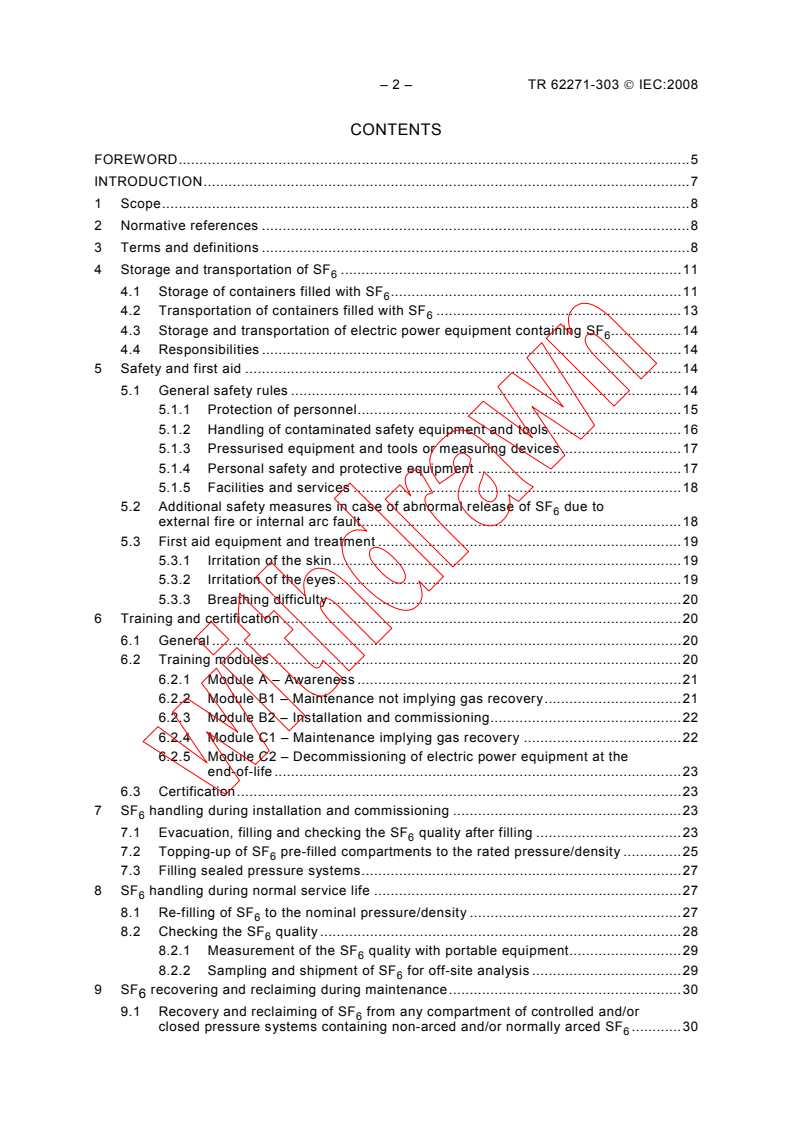
CONTENTS
FOREWORD.5
INTRODUCTION.7
1 Scope.8
2 Normative references .8
3 Terms and definitions .8
4 Storage and transportation of SF .11
4.1 Storage of containers filled with SF .11
4.2 Transportation of containers filled with SF .13
4.3 Storage and transportation of electric power equipment containing SF .14
4.4 Responsibilities .14
5 Safety and first aid .14
5.1 General safety rules .14
5.1.1 Protection of personnel.15
5.1.2 Handling of contaminated safety equipment and tools .16
5.1.3 Pressurised equipment and tools or measuring devices.17
5.1.4 Personal safety and protective equipment .17
5.1.5 Facilities and services .18
5.2 Additional safety measures in case of abnormal release of SF due to
external fire or internal arc fault.18
5.3 First aid equipment and treatment .19
5.3.1 Irritation of the skin.19
5.3.2 Irritation of the eyes.19
5.3.3 Breathing difficulty.20
6 Training and certification .20
6.1 General .20
6.2 Training modules.20
6.2.1 Module A – Awareness .21
6.2.2 Module B1 – Maintenance not implying gas recovery.21
6.2.3 Module B2 – Installation and commissioning.22
6.2.4 Module C1 – Maintenance implying gas recovery .22
6.2.5 Module C2 – Decommissioning of electric power equipment at the
end-of-life.23
6.3 Certification.23
7 SF handling during installation and commissioning .23
7.1 Evacuation, filling and checking the SF quality after filling .23
7.2 Topping-up of SF pre-filled compartments to the rated pressure/density .25
7.3 Filling sealed pressure systems.27
8 SF handling during normal service life .27
8.1 Re-filling of SF to the nominal pressure/density .27
8.2 Checking the SF quality .28
8.2.1 Measurement of the SF quality with portable equipment.29
8.2.2 Sampling and shipment of SF for off-site analysis .29
9 SF recovering and reclaiming during maintenance.30
9.1 Recovery and reclaiming of SF from any compartment of controlled and/or
............30
closed pressure systems containing non-arced and/or normally arced SF
TR 62271-303 © IEC:2008 – 3 –
9.2 Recovery and reclaiming from any compartment of controlled and/or closed
pressure systems containing heavily arced SF .32
10 Dismantling of SF electric power equipment at the end-of-life .34
10.1 End-of-life of controlled and/or closed pressure systems .35
10.2 End-of-life of sealed pressure systems .35
10.3 Recovery and reclaiming of SF at the end-of-life of sealed pressure systems .36
10.4 Dismantling of electric power equipment at the end-of-life .38
10.5 By-products at the end-of-life .39
11 Description of SF handling equipment.40
11.1 Reclaimer.40
11.1.1 External and internal pre-filters.41
11.1.2 Filters .41
11.1.3 Vacuum pump .42
11.1.4 Main and auxiliary compressors.43
11.1.5 External and internal gas storage containers .43
11.1.6 Evaporator and gas storage container heater .43
11.1.7 Gas piping and pipe junctions.43
11.1.8 Control instruments .43
11.1.9 Safety valves.44
11.2 Flexible hose connections .44
11.3 Portable devices for gas measurement.44
11.3.1 Dew point meter .44
11.3.2 SF percentage measuring device.45
11.3.3 Reaction tubes sensitive to SO .45
11.3.4 Portable SF detectors .45
11.3.5 Alarm system SF detectors .46
11.4 Cylinder for gas samples .46
Annex A (informative) Sulphur hexafluoride .47
Annex B (informative) Environmental effects of SF .51
Annex C (informative) SF by-products .54
Annex D (informative) Potential effects on health of SF by-products.57
Bibliography.76
Figure 1 – Commissioning or re-commissioning of SF compartments .24
Figure 2 – Topping-up of SF pre-filled compartments to the rated pressure/density.26
Figure 3 – SF re-filling to the nominal pressure/density .28
Figure 4 – Checking the SF quality on-site .29
Figure 5 – SF sampling and shipment .30
Figure 6 – Recovering and reclaiming from any compartment of controlled and/or
closed pressure systems containing non-arced and/or normally arced SF .31
Figure 7 – Recovering and reclaiming from any compartment of controlled and/or
closed pressure systems containing heavily arced SF .33
Figure 8 – End-of-life of controlled and/or closed pressure systems.35
Figure 9 – End-of-life of sealed pressure systems.36
Figure 10 – SF recovery and reclaiming at the end-of-life of sealed pressure systems .37
Figure 11 – Dismantling of electric power equipment .39
Figure 12 – General purpose reclaimer .41
– 4 – TR 62271-303 © IEC:2008
Figure A.1 – Pressure/temperature/density characteristics for SF [9].48
Table 1 – Methods for storage of SF .12
Table 2 – Container types and labelling required for storage and transportation of SF .13
Table 3 – International regulations for shipment of SF .14
Table 4 – Measures when working with SF electric power equipment .15
Table 5 – Safety measures when opening and/or accessing gas compartments .16
Table 6 – Neutralising solutions .17
Table 7 – Additional safety measures .19
Table 8 – Commissioning or re-commissioning of SF compartments.25
Table 9 – Topping-up of SF pre-filled compartments to the rated pressure/density .27
Table 10 – SF re-filling to the nominal pressure/density .28
Table 11 – Checking the SF quality on-site .29
Table 12 – SF sampling and shipment.30
Table 13 – Recovering and reclaiming from any compartment of controlled and/or
closed pressure systems containing non-arced and/or normally arced SF .32
Table 14 – Recovering and reclaiming from any compartment of controlled and/or
closed pressure systems containing heavily arced SF .34
Table 15 – SF recovery at the end-of-life of sealed pressure systems .38
Table 16 – Expected SF characteristics and quantity of by-products .40
Table 17 – Typical filter types used during SF reclaiming .42
Table 18 – Gas measuring devices .44
Table A.1 – Main chemical characteristics of SF [9].47
Table A.2 – Main physical characteristics of SF [9].49
Table A.3 – Main electrical characteristics of SF [9] .49
Table D.1 – TLVs for SOF , SO , HF, and S F .60
2 2 2 10
Table D.2 – Results of example calculations for leakage situations.63
Table D.3 – Results for leakage situations taking account of SOF hydrolysis .64
Table D.4 – Sample calculation of S F concentration for partial discharges .65
2 10
Table D.5 – Sample calculation of S F concentration for corona discharges .66
2 10
Table D.6 – Sample calculation of S F concentration for disconnector sparking.67
2 10
Table D.7 – Sample calculation of SOF concentrations for internal fault situations .68
Table D.8 – Switchgear volume and filling pressure .71
Table D.9 – Arc energies for interruptions.72
Table D.10 – Arc energies for internal faults .72
Table D.11 – SOF production rates .73
Table D.12 – Quantities of SOF formed .73
Table D.13 – SF leakage rates .73
Table D.14 – SOF leakage rates .74
TR 62271-303 © IEC:2008 – 5 –
INTERNATIONAL ELECTROTECHNICAL COMMISSION
____________
HIGH-VOLTAGE SWITCHGEAR AND CONTROLGEAR –
Part 303: Use and handling of sulphur hexafluoride (SF )
FOREWORD
1) The International Electrotechnical Commission (IEC) is a worldwide organization for standardization comprising
all national electrotechnical committees (IEC National Committees). The object of IEC is to promote
international co-operation on all questions concerning standardization in the electrical and electronic fields. To
this end and in addition to other activities, IEC publishes International Standards, Technical Specifications,
Technical Reports, Publicly Available Specifications (PAS) and Guides (hereafter referred to as “IEC
Publication(s)”). Their preparation is entrusted to technical committees; any IEC National Committee interested
in the subject dealt with may participate in this preparatory work. International, governmental and
non-governmental organizations liaising with the IEC also participate in this preparation. IEC collaborates
closely with the International Organization for Standardization (ISO) in accordance with conditions determined
by agreement between the two organizations.
2) The formal decisions or agreements of IEC on technical matters express, as nearly as possible, an international
consensus of opinion on the relevant subjects since each technical committee has representation from all
interested IEC National Committees.
3) IEC Publications have the form of recommendations for international use and are accepted by IEC National
Committees in that sense. While all reasonable efforts are made to ensure that the technical content of IEC
Publications is accurate, IEC cannot be held responsible for the way in which they are used or for any
misinterpretation by any end user.
4) In order to promote international uniformity, IEC National Committees undertake to apply IEC Publications
transparently to the maximum extent possible in their national and regional publications. Any divergence
between any IEC Publication and the corresponding national or regional publication should be clearly indicated
in the latter.
5) IEC provides no marking procedure to indicate its approval and cannot be rendered responsible for any
equipment declared to be in conformity with an IEC Publication.
6) All users should ensure that they have the latest edition of this publication.
7) No liability should attach to IEC or its directors, employees, servants or agents including individual experts and
members of its technical committees and IEC National Committees for any personal injury, property damage or
other damage of any nature whatsoever, whether direct or indirect, or for costs (including legal fees) and
expenses arising out of the publication, use of, or reliance upon, this IEC Publication or any other IEC
Publications.
8) Attention is drawn to the Normative references cited in this publication. Use of the referenced publications is
indispensable for the correct application of this publication.
9) Attention is drawn to the possibility that some of the elements of this IEC Publication may be the subject of
patent rights. IEC should not be held responsible for identifying any or all such patent rights.
The main task of IEC technical committees is to prepare International Standards. However, a
technical committee may propose the publication of a technical report when it has collected
data of a different kind from that which is normally published as an International Standard, for
example "state of the art".
IEC 62271-303, which is a technical report, has been prepared by subcommittee 17A:
High-voltage switchgear and controlgear, of IEC technical committee 17: Switchgear and
controlgear.
This first edition of IEC/TR 62271-303 cancels and replaces the first edition of IEC 61634
published in1995. This edition constitutes a technical revision.
This edition includes the following significant technical changes with respect to the previous
edition.
IEC 62271-303 is a major revision of the old IEC 61634. The former sections of IEC 61634
are removed and replaced by the chapters of the CIGRE brochure n. 276.
– 6 – TR 62271-303 © IEC:2008
IEC 61634 was issued in 1995 when the focus was on safety. In 2008, safety is a very well
known and established concept and the focus is nowadays on the environmental compatibility.
SF must be kept in a closed cycle and any intentional release must be forbidden. The
implementation of the SF reuse concept suggested in the CIGRE brochure was updated with
the most recent information. Today SF can be recovered and reclaimed for either being
reused on-site or given back to the gas supplier and reused as raw material for the production
of "technical grade SF ". Detailed procedures for appropriate SF handling are given together
6 6
with the description of the state-of-the-art equipments and measuring devices.
More in detail, clause by clause:
– The former Section 1 was removed and replaced with Clause 1 "Scope", Clause 2
"Normative references" and Clause 3 “ Terms and Definitions”.
– Clause 4 "Storage and transportation of SF ", Clause 5 "Safety and first aid", Clause 6
"Training and certification", and Clause 11 "Description of SF handling equipment" were
taken from the CIGRE brochure and their content was revised.
– Clause 7 " SF handling during installation and commissioning", Clause 8 " SF handling
6 6
during normal service life", Clause 9 " SF recovery and reclaiming during maintenance",
and Clause 10 "Dismantling of SF electric power equipment at the end-of-life" were taken
from the CIGRE brochure, their content was revised and replaces the former sections 2, 3,
4, 5, and 6.
– The former Annexes A, B, C, and D were revised while the Annexes E and F were
dropped. The Bibliography replaces the former Annex G.
The text of this technical report is based on the following documents:
Enquiry draft Report on voting
17A/813/DTR 17A/817/RVC
Full information on the voting for the approval of this technical report can be found in the
report on voting indicated in the above table.
This publication has been drafted in accordance with the ISO/IEC Directives, Part 2.
A list of all parts of IEC 62271 series, under the general title High-voltage switchgear and
controlgear can be found on the IEC website.
The committee has decided that the contents of this publication will remain unchanged until
the maintenance result date indicated on the IEC web site under "http://webstore.iec.ch" in
the data related to the specific publication. At this date, the publication will be
• reconfirmed,
• withdrawn,
• replaced by a revised edition, or
• amended.
TR 62271-303 © IEC:2008 – 7 –
INTRODUCTION
SF technology is used in switchgear and controlgear, for more than 30 years. Its application
is mainly in electric power equipment for rated voltages exceeding 1 kV up to the highest
rated voltages for which switchgear and controlgear are manufactured. It is estimated that
several millions of the different types of SF -filled units are currently in service.
Three methods for gas containment are technically available, according to IEC 62271-1:
• controlled pressure system;
NOTE 1 Controlled pressure systems are no longer used for new equipment, because of the unacceptable
leakage rate (see IEC 62271-203).
• closed pressure system: modern high-voltage electric power equipments. The
standardized values for leakage rates are 0,5 % and 1 % per year and per gas-filled
compartment;
• sealed pressure system: modern medium-voltage electric power equipments (commercially
designated as “sealed for life products” or “hermetically sealed systems”). The tightness of
sealed pressure systems is specified by their expected operating life. The expected operating
life with regard to leakage performance is specified by the manufacturer. Preferred values
are 20, 30 and 40 years.
NOTE 2 To fulfil the expected operating life requirement the leakage rate of the SF sealed pressure systems is
considered to be less than 0,1 % per year.
The long experience with the use of SF in switchgear and controlgear evidences that a
certain number of elementary precautions and procedures should be adopted in order to
achieve operational, safety at work and environmental benefits such as:
• safe operation of the equipment;
• optimisation of resources and tools required;
• minimisation of out-of-service time for equipment;
• standard training of personnel handling SF ;
• reduction of the amount of gas released during handling operations down to the functional
physical limit;
• avoidance of any deliberate release, for example flushing to the atmosphere;
• reduction of SF losses and emissions during commissioning, service, operation and
end-of-life treatment to a minimum.
Recently, the latest practical recommendations on the use of SF technology applied to
switchgear and controlgear have been published by WG B3.02 of CIGRE Study Committee B3
[1] . This information is used to revise IEC 61634 into the present technical report.
—————————
Figures in square brackets refer to the Bibliography.
– 8 – TR 62271-303 © IEC:2008
HIGH-VOLTAGE SWITCHGEAR AND CONTROLGEAR –
Part 303: Use and handling of sulphur hexafluoride (SF )
1 Scope
The scope of this technical report is to address the procedures for safe and environmental
compatible handling of SF during installation, commissioning, normal and abnormal
operations, disposal at the end-of-life of high-voltage switchgear and controlgear. Storage and
transportation of SF are also covered.
These procedures should be regarded as minimum requirements to ensure the safety of
personnel working with SF and to minimize the SF emission to the environment.
6 6
This technical report generally applies also to gas mixtures containing SF .
NOTE 1 For the use of this technical report, the term “ high voltage” (reference IEV 601-01-27) is the rated
voltage above 1 000 V. However, the term “ medium voltage” (reference IEV 601-01-28) is commonly used for
distribution systems with voltages above 1 kV and generally applied up to and including 52 kV.
NOTE 2 Throughout this technical report, the term “electric power equipment” stands for “high-voltage and
medium voltage switchgear and/or controlgear”.
2 Normative references
The following referenced documents are indispensable for the application of this technical
report. For dated references, only the edition cited applies. For undated references, the latest
edition of the referenced document (including any amendments) applies.
IEC 60050-441, International Electrotechnical Vocabulary (IEV) – Part 441: Switchgear,
controlgear and fuses
IEC 60376, Specification of technical grade sulphur hexafluoride (SF ) for use in electrical
equipment
IEC 60480, Guidelines for the checking and treatment of sulphur hexafluoride (SF ) taken
from electrical equipment and specifications for its reuse
IEC 62271-1, High-voltage switchgear and controlgear – Part 1: Common specifications
IEC 62271-100, High-voltage switchgear and controlgear – Part 100: Alternating-current
circuit-breakers
3 Terms and definitions
For the purposes of this document, the following terms and definitions apply.
NOTE There are many different types of electric power equipment which use SF as a dielectric and/or
arc-quenching medium.
3.1
abnormal release of sulphur hexafluoride (SF )
release from equipment in service due to a failure in the pressure system
TR 62271-303 © IEC:2008 – 9 –
NOTE An abnormal SF release is usually an un-wanted and continuous emission of gas. As soon as an
abnormal SF leakage is detected, appropriate measures to locate and eliminate the leak should be immediately
arranged.
3.2
handling of sulphur hexafluoride (SF )
any process which might involve transfer of SF
3.3
evacuation
transfer of a gas different from SF (for example air or N ) from the gas compartment to the
6 2
atmosphere. The operation is performed utilising a vacuum pump
3.4
recovery of sulphur hexafluoride (SF )
transfer of SF from the gas compartment into a reclaimer or storage container. The operation
is normally performed utilising a recovery compressor
3.5
topping-up with sulphur hexafluoride (SF )
filling with SF a pre-filled compartment to the SF rated filling pressure
6 6
NOTE Pre-filled compartments are closed pressure systems filled in the factory prior to shipment. They contain
SF at a typical pressure between 0,12 MPa to 0,15 MPa allowing for a faster and easier commissioning on-site.
3.6
reclaim of sulphur hexafluoride (SF )
a series of SF handling including recovery and minimum SF refining process such as
6 6
filtering dust, by-products, moisture, oil, etc.
NOTE 1 A standard reclaimer is described in 11.1.
NOTE 2 Sometimes the words “reclaiming” or “reclamation” may be used with the same meaning as “reclaim”.
3.7
metal-enclosed switchgear and controlgear
switchgear and controlgear assemblies with an external metal enclosure intended to be
earthed, and complete except for external connections
[IEV 441-12-04]
3.8
insulation-enclosed switchgear and controlgear
switchgear and controlgear assemblies with an external insulation enclosure and completely
assembled, except for external connections
NOTE The external insulation may be supplied with a (semi-) conducting layer.
[IEV 441-12-06, modified]
3.9
gas-insulated metal-enclosed switchgear
metal-enclosed switchgear in which the insulation is obtained, at least partly, by an insulating
gas other than air at atmospheric pressure
NOTE This term generally applies to high-voltage switchgear and controlgear.
[IEV 441-12-05]
– 10 – TR 62271-303 © IEC:2008
3.10
gas-filled compartment
compartment of switchgear and controlgear in which the gas pressure is maintained by one of
the following systems:
• controlled pressure system;
• closed pressure system;
• sealed pressure system.
NOTE 1 Several gas-filled compartments may be permanently interconnected to form a common gas-system
(gas-tight assembly).
NOTE 2 This definition reproduces 3.6.6.1 of IEC 62271-1.
3.11
controlled pressure system for gas
volume which is automatically replenished from an external compressed gas supply or internal
gas source
NOTE 1 Examples of controlled pressure systems are air-blast circuit-breakers or pneumatic operating
mechanisms.
NOTE 2 A volume may consist of several permanently connected gas-filled compartments.
NOTE 3 This definition reproduces 3.6.6.2 of IEC 62271-1.
3.12
closed pressure system for gas
volume which is replenished only periodically by manual connection to an external gas source
NOTE 1 Example of closed pressure systems are SF single pressure circuit-breakers.
NOTE 2 This definition reproduces 3.6.6.3 of IEC 62271-1.
3.13
sealed pressure system
volume for which no further gas or vacuum processing is required during its expected
operating life
NOTE 1 Examples of sealed pressure systems are tubes of vacuum circuit-breakers or some SF
circuit-breakers.
NOTE 2 Sealed pressure systems are completely assembled and tested in the factory.
NOTE 3 This definition reproduces 3.6.6.4 of IEC 62271-1.
3.14
technical grade sulphur hexafluoride (SF )
SF gas having a very low level of impurities in accordance with IEC 60376
3.15
used sulphur hexafluoride (SF )
gas removed from an electrical equipment, initially filled with SF according to IEC 60376 or
IEC 60480. If after filling, the gas is removed for any purpose during the life of the equipment,
for example repair, service, maintenance, the gas will be transferred and is considered as
used gas
NOTE Annex C provides information regarding the by-products of used SF , which occur as gaseous and solid.
3.16
used sulphur hexafluoride (SF ) suitable for reuse on site
used SF complying with the maximum acceptable impurity level in IEC 60480
TR 62271-303 © IEC:2008 – 11 –
NOTE If necessary, service units with appropriate filters and adsorber materials should be used.
3.17
used sulphur hexafluoride (SF ) suitable for reuse at the gas manufacturer
used SF exceeding the maximum acceptable impurity level in IEC 60480, but complying with
the specification for gas reuse given by the gas manufacturer
NOTE If necessary to meet the specification, service units with appropriate filters and adsorber materials should
be used.
3.18
used sulphur hexafluoride (SF ) not suitable for reuse
gas complying with 3.15 but not complying with 3.16, and/or 3.17.
NOTE Used sulphur hexafluoride not suitable for reuse is disposed according to local or international regulations
on waste management.
3.19
non-arced sulphur hexafluoride (SF )
used sulphur hexafluoride (SF ) having less than approx. 0,1 % by volume of gaseous
by-products
NOTE Non-arced sulphur hexafluoride is typically expected to be in any compartment after filling and prior to
energising and/or after insulation testing and/or in insulation compartments which never experienced arcing.
3.20
normally arced sulphur hexafluoride (SF )
used sulphur hexafluoride (SF ) having between approx. 0,1 % by volume and approx. 5 % by
vol. of gaseous by-products
NOTE 1 Normally arced sulphur hexafluoride is typically expected to be in circuit breakers/load break switches
after normal (load or fault) operations.
NOTE 2 A small amount of solid by-products, mainly metal fluorides and tungsten oxifluorides, may be present as
well.
3.21
heavily arced sulphur hexafluoride (SF )
used sulphur hexafluoride (SF ) having more than approx. 5 % by vol. of gaseous by-products
NOTE 1 Heavily arced sulphur hexafluoride is typically expected to be in any gas compartments after internal arc
fault and/or circuit breakers/load break switches after interruption failure and/or circuit breakers after successful
interruptions of several short circuits at high amplitude in relation with its ratings.
NOTE 2 A large amount of solid by-products, mainly metal fluorides and tungsten oxifluorides, is expected as
well.
4 Storage and transportation of SF
Storage and transportation of SF , either in containers or in electric power equipment is
always carried out in accordance with local and international regulations.
NOTE An empty SF container may still contain a residual amount of SF . It should be stored and transported in
6 6
the same way as for a filled container.
4.1 Storage of containers filled with SF
In general, SF can be stored in two ways either as a gas at less than 2 MPa or as a liquid up
to 5 MPa. Gaseous storage has the advantage of reducing the recovery and filling times but
requires large storage volumes and is therefore generally restricted to small volume
equipment or used in fixed location gas handling facilities. Liquid storage gives the ability to
reduce storage volumes and economically transport large quantities of SF .
– 12 – TR 62271-303 © IEC:2008
Containers are handled carefully and stored in a cool, dry, well ventilated area away from
flammable or explosive material. They should be protected from direct sunlight, mounted clear
of wet ground and secured to prevent falling over. Special valve protections should be
adopted to avoid any potential damage on the valve itself.
Containers are refillable (non refillable containers are banned) and clearly labelled to identify
their contents; containers containing technical grade SF and used SF suitable for reuse on
6 6
site should be physically separated from those containing used SF suitable for reuse at the
gas manufacturer or used SF not suitable for reuse.
Table 1 gives an overview of all possible storage methods on which a storage container may
be based.
Table 1 – Methods for storage of SF
Method Requirements Features
Requires relatively small recovery pressure differential
(typically 100:1) but needs larger storage volumes. Gas
Typical pressure lower than 2 MPa.
Gaseous cannot be liquefied in containers for transportation.
SF remains in the gaseous state
Therefore it is limited to small quantities (typically 200 kg)
and stationary use
Typical pressure equal to 3 MPa. Requires relatively small recovery pressure differential
Liquid- Employs additional cooling system to (typically 700:1) but needs cooling aggregate. Performance
cooling cool SF after compression, which of cooling aggregate can influence processing speed.
assisted allows SF to be stored in liquid Additional maintenance requirements. Limited storage
form volume required and generally not suitable for transportation
Liquid- Typical pressure equal to 5 MPa. Requires recovery differential of typically 1000:1 but
pressure SF compressed to 5 MPa liquefies eliminates the need of additional aggregates. Can be used
only by pressure only with any storage vessel rated 5 MPa or higher
When used SF is stored on-site, the storage containers comply with local and international
regulations on pressurised vessels. Container labelling should be done according to local and
international regulations, as well.
NOTE International regulations are published and periodically revised by the Committee of Experts on the
Transport of Dangerous Goods (TDG) and on the Globally Harmonized System of Classification and Labelling
(GHS) of the Economic Commission for Europe of the United Nations
Table 2 gives an overview of container types and required labelling. For practical reasons it is
recommended to preferentially use transportable storage containers, wherever possible.
TR 62271-303 © IEC:2008 – 13 –
Table 2 – Container types and labelling required for storage and transportation of SF
Gas Characteristic Container type Container labelling
Suitable for liquefied gas up to a
pressure of 7 MPa.
Stencilled on
NOTE The filling factor for technical
container: UN 1080,
grade SF is up to 1,04 kg/l.
Technical grade SF Liquefied inert gas
sulphur hexafluoride
Recommendation: Containers should
be marked with a green label or the
Danger label 2.2
container should be painted green
according to EN 1089-3
Suitable for liquefied gas up to a
pressure of 7 MPa.
NOTE Due to the inert gas content
Stencilled on
(for example N , O ), the filling factor
container: UN 3163,
2 2
is smaller than 0,8 kg/litre (see
sulphur hexafluoride,
Used SF suitable for NOTE 1).
carbon tetrafluoride or
Liquefied inert gas
reuse on site Recommendation: Containers should
air or nitrogen (see
be specially coloured to avoid
NOTE 2)
confusion between used and technical
Danger label 2.2
grade SF (an orange band on the
upper third of the container is
suggested)
Container type and labelling are the same as for used SF
Liquefied inert gas
suitable for reuse on-site
Stencilled on
container: UN 3162,
Liquefied gas
sulphur hexafluoride,
containing toxic Same as for used SF suitable for
hydrogen fluoride,
Used SF suitable for
gaseous by-products reuse on site
6 thionyl fluoride (see
reuse at gas
(see NOTE 3)
NOTE 2)
manufacturer and/or
used SF not
Danger label 2.3
suitable for reuse
Stencilled on
Liquefied gas Special containers approved for
container: UN 3308,
containing both toxic storing and transportation of
sulphur hexafluoride,
and corrosive gaseous corrosive gases (such as
hydrogen fluoride,
by-products (see hydrofluoric acid HF) with a
thionyl fluoride
NOTE 4) corrosion-proof valve and adapter
Danger labels 2.3 + 8
NOTE 1 The filling factor is the weight of SF contained in the container divided by the container volume and is
usually specified in kg/litre.
NOTE 2 Only the two most abundant contaminants have to be specified.
NOTE 3 Any used SF containing toxic gaseous by-products can be reclaimed on site to remove the toxic
gaseous by-products and allowing an easier transportation.
NOTE 4 Any used SF containing both toxic and corrosive gaseous by-products can be reclaimed on site to
remove the toxic and corrosive gaseous by-products and allowing an easier transportation.
4.2 Transportation of containers filled with SF
International regulatio
...